2 Kings 4:7

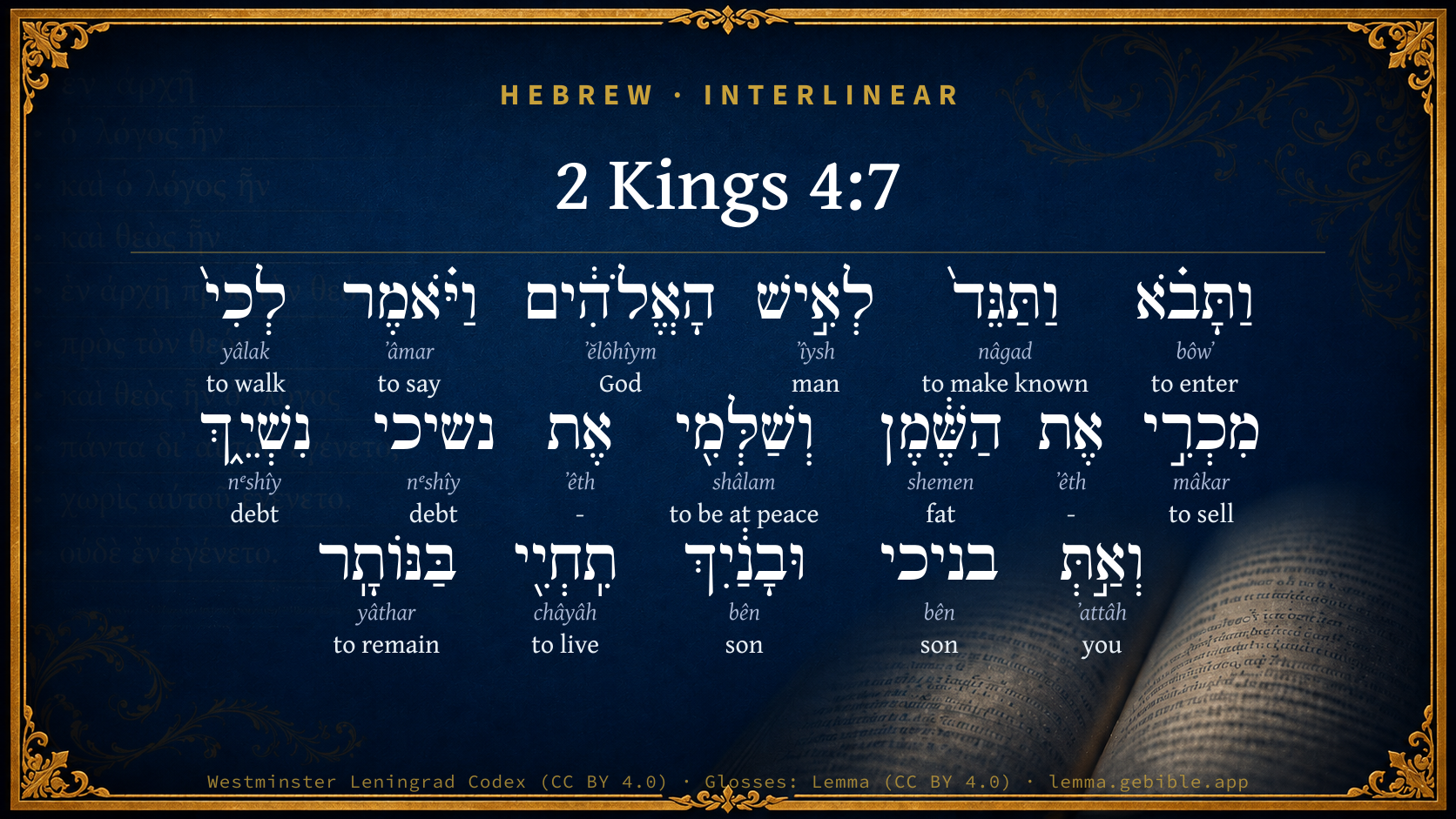
Hebrew (Westminster Leningrad Codex) 2 Kings 4:7 appears in the Hebrew Old Testament. The text above is from the Westminster Leningrad Codex. Each word links to its Strong’s number, a concise gloss, and parsing drawn from the Open Scriptures Hebrew Bible morphology. Click any word for its full Brown-Driver-Briggs (BDB) entry.
Download image
Cite this verse

2 Kings 4:7 (World English Bible). Public Domain. Lemma interlinear Bible study tool, https://lemma.gebible.app/v/2-kings/4/7.

Show BibTeX & RIS
BibTeX
RIS
English Translation
Then she came and told the man of God. He said, Go, sell the oil, and pay your debt, and live you and your sons of the rest.
World English Bible · Public Domain
Highlights
  • 1 first appearance in the Hebrew Bible
Full analysis ↓
Download a study sheet

One document with this verse’s original text, its word-by-word gloss line, the meaning frame, cross-references with their text, attributed commentary, and full source and license credits — printable, and it pastes into notes with its structure intact.

This verse Autodidact and up

Study sheet (.html) Plain text (.txt)

A passage Seminary Student

Up to 50 verses in one chapter. A passage sheet keeps up to 6 commentary sources and 12 cross-references per verse, in the order this page ranks them, and says so on the sheet whenever that leaves anything out. Ask for a single verse and you get the Autodidact verse sheet above.

Everything on this page stays free to read, with no account — the sheet is a download of what is already on screen, not access to it.

Want to remove ads? Support Godless Engineer
Compare translations 3

The same verse in 3 English versions, stacked beneath the original-language interlinear above. Click any original word for its lexicon entry.

Each is an independent rendering of the whole verse — the interlinear is not word-aligned to these translations.

Highlighted words mark where these versions differ — a whole-verse word diff, not a word-by-word alignment.

  • World English Bible Public Domain
    Then she came and told the man of God. He said, Go, sell the oil, and pay your debt, and live you and your sons of the rest.
  • King James Version Public Domain
    Then she came and told the man of God. And he said, Go, sell the oil, and pay thy debt, and live thou and thy children of the rest.
  • unfoldingWord Literal Text CC BY-SA 4.0
    And she came and declared to the man of God, and he said, “Go, sell the oil and repay your debt. And you may live on the rest, you and your sons.”

unfoldingWord Literal Text — © unfoldingWord, licensed CC BY-SA 4.0. Word-aligned USFM3 via Door43 (git.door43.org/unfoldingWord/en_ult).

Versions to compare (up to 4)

3 of 4 selected

Show all 18 translations

Every available English version of this verse, each an independent rendering of the whole verse.

  • World English Bible Public Domain
    Then she came and told the man of God. He said, Go, sell the oil, and pay your debt, and live you and your sons of the rest.
  • Berean Standard Bible Public Domain
    She went and told the man of God, and he said, “Go, sell the oil, and pay your debt. Then you and your sons can live on the remainder.”
  • Majority Standard Bible Public Domain
    She went and told the man of God, and he said, “Go, sell the oil, and pay your debt. Then you and your sons can live on the remainder.”
  • King James Version Public Domain
    Then she came and told the man of God. And he said, Go, sell the oil, and pay thy debt, and live thou and thy children of the rest.
  • American Standard Version (1901) Public Domain
    Then she came and told the man of God. And he said, Go, sell the oil, and pay thy debt, and live thou and thy sons of the rest.
  • Revised Version (1885) Public Domain
    Then she came and told the man of God. And he said, Go, sell the oil, and pay thy debt, and live thou and thy sons of the rest.
  • Geneva Bible (1599) Public Domain
    Then shee came and tolde the man of God. And he saide, Goe, and sell the oyle, and pay them that thou art in debt vnto, and liue thou and thy children of the rest.
  • Douay-Rheims (1899) Public Domain
    And she came, and told the man of God. And he said: Go, sell the oil, and pay thy creditor: and thou and thy sons live of the rest.
  • Young's Literal Translation Public Domain
    And she cometh and declareth to the man of God, and he saith, `Go, sell the oil, and repay thy loan; and thou `and' thy sons do live of the rest.'
  • Literal Standard Version CC BY-SA 4.0
    And she comes and declares [it] to the man of God, and he says, “Go, sell the oil, and repay your loan; and you [and] your sons live off the rest.”
  • Unlocked Literal Bible CC BY-SA 4.0
    Then she came and told the man of God. He said, “Go, sell the oil; pay your debt, and live with your sons on the rest.”
  • unfoldingWord Literal Text CC BY-SA 4.0
    And she came and declared to the man of God, and he said, “Go, sell the oil and repay your debt. And you may live on the rest, you and your sons.”
  • Darby Bible Public Domain
    And she came and told the man of God; and he said, Go, sell the oil, and pay thy debt, and live thou [and] thy sons on the rest.
  • World Messianic Bible Public Domain
    Then she came and told the man of God. He said, “Go, sell the oil, and pay your debt; and you and your sons live on the rest.”
  • Webster's Bible Public Domain
    Then she came and told the man of God. And he said, Go, sell the oil, and pay thy debt, and live thou and thy children on the remainder.
  • Free Bible Version CC BY-SA 4.0
    She went and told the man of God what had happened, and he said, “Go and sell the olive oil and pay your debts, and you and your sons can live on what's left.”
  • Bible in Basic English Public Domain
    So she came to the man of God and gave him word of what she had done. And he said, Go and get money for the oil and make payment of your debt, and let the rest be for the needs of yourself and your sons.
  • JPS Tanakh (1917) Public Domain
    Then she came and told the man of God. And he said: 'Go, sell the oil, and pay thy debt, and live thou and thy sons of the rest.'

Literal Standard Version (2020), Covenant Press — licensed CC BY-SA 4.0. Text via the HelloAO Bible API (eBible.org). Unlocked Literal Bible (unfoldingWord) — licensed CC BY-SA 4.0. Text via the HelloAO Bible API (eBible.org). unfoldingWord Literal Text — © unfoldingWord, licensed CC BY-SA 4.0. Word-aligned USFM3 via Door43 (git.door43.org/unfoldingWord/en_ult). Free Bible Version, Dr. Jonathan Gallagher — licensed CC BY-SA 4.0. Text via the HelloAO Bible API (eBible.org).

Word by word

More ways to search: Search by grammar → Find every occurrence → Compare this word →

Practice this passage: Drill this verse → Learn its vocabulary →

נשיכי
nᵉshîy
H5386
“debt · your”
Noun, Common, Masculine, Singular, Construct + Suffix, Personal, 2nd Person, Feminine, Singular
Part of Speech
Noun
Type
Common
Gender
Masculine
Number
Singular
State
Construct
Full BDB Definition

Origin: from H5383

TWOT: 1427a

debt
  1. וַתָּבֹ֗א bôwʼ H935 “and · to enter” Conjunction + Verb, Qal, Sequential Imperfect, 3rd Person, Feminine, Singular
  2. וַתַּגֵּד֙ nâgad H5046 “and · to make known” Conjunction + Verb, Hiphil, Sequential Imperfect, 3rd Person, Feminine, Singular
  3. לְאִ֣ישׁ ʼîysh H376 “to/for · man of” Preposition + Noun, Common, Masculine, Singular, Construct
  4. הָאֱלֹהִ֔ים ʼĕlôhîym H430 “the · God(s)” Particle, Definite Article + Noun, Common, Masculine, Plural, Absolute
  5. וַיֹּ֗אמֶר ʼâmar H559 “and · to say” Conjunction + Verb, Qal, Sequential Imperfect, 3rd Person, Masculine, Singular
  6. לְכִי֙ yâlak H3212 “walk” Verb, Qal, Imperative, 2nd Person, Feminine, Singular
  7. מִכְרִ֣י mâkar H4376 “sell” Verb, Qal, Imperative, 2nd Person, Feminine, Singular
  8. אֶת ʼêth H853 “-” Particle, Direct Object
  9. הַשֶּׁ֔מֶן shemen H8081 “the · fat” Particle, Definite Article + Noun, Common, Masculine, Singular, Absolute
  10. וְשַׁלְּמִ֖י shâlam H7999 “and · be at peace” Conjunction + Verb, Piel, Imperative, 2nd Person, Feminine, Singular
  11. אֶת ʼêth H853 “-” Particle, Direct Object
  12. נִשְׁיֵ֑ךְ nᵉshîy H5386 “debt · your” Noun, Common, Masculine, Singular, Construct + Suffix, Personal, 2nd Person, Feminine, Singular
  13. וְאַ֣תְּ ʼattâh H859 “and · you” Conjunction + Pronoun, Personal, 2nd Person, Feminine, Singular
  14. בניכי bên H1121 “sons · your” Noun, Common, Masculine, Plural, Construct + Suffix, Personal, 2nd Person, Feminine, Singular
  15. וּבָנַ֔יִךְ bên H1121 “and · sons · your” Conjunction + Noun, Common, Masculine, Plural, Construct + Suffix, Personal, 2nd Person, Feminine, Singular
  16. תִֽחְיִ֖י châyâh H2421 “to live” Verb, Qal, Imperfect, 2nd Person, Feminine, Singular
  17. בַּנּוֹתָֽר yâthar H3498 “in/at the · remaining” Preposition, Determined + Verb, Niphal, Participle Active, Masculine, Singular, Absolute

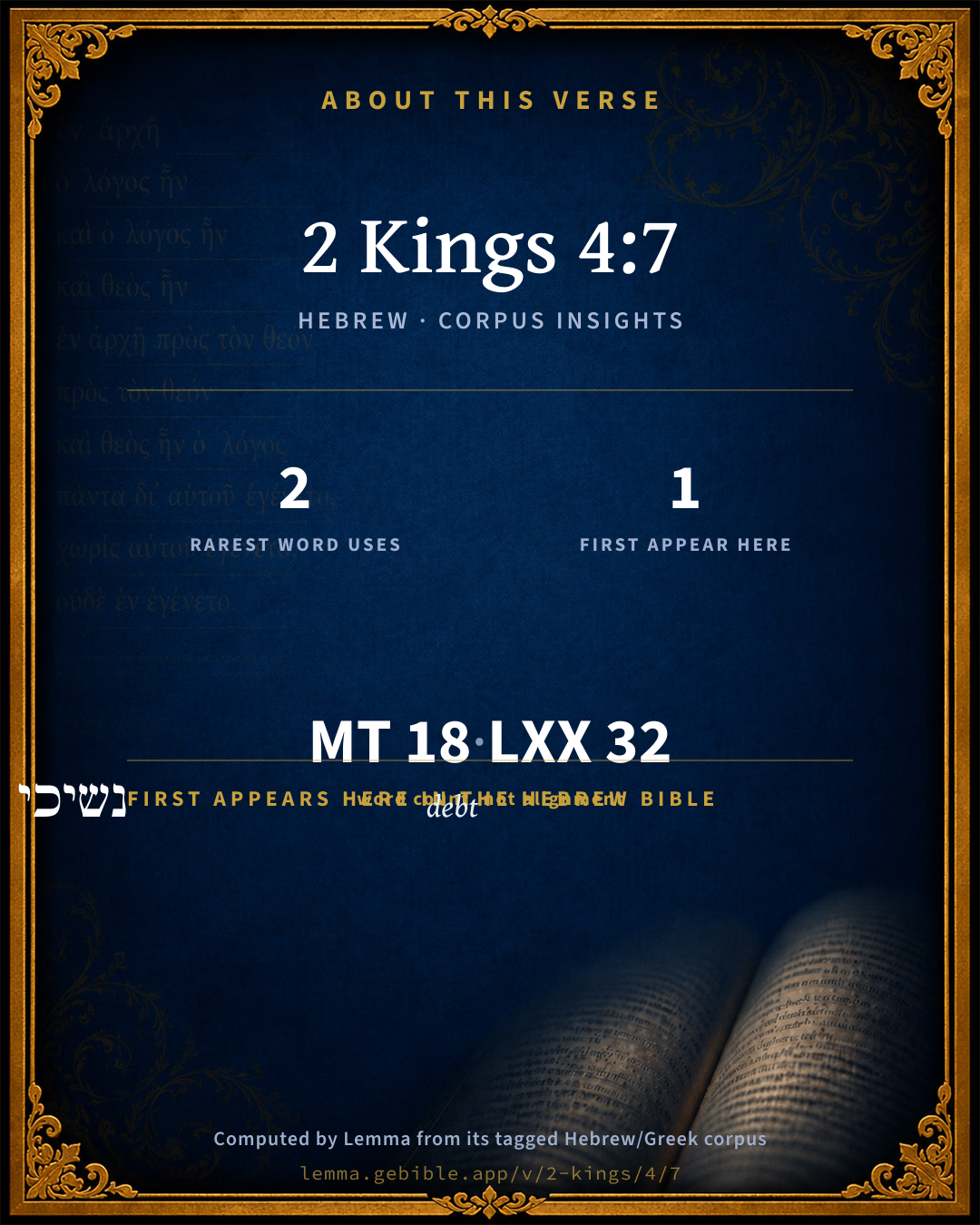
About this verse

These counts appear in no published source. They are computed here, from the morphology-tagged text and Lemma’s own curated glosses. What Lemma adds →

18
words
15
distinct lemmas
Historical
section

Notable vocabulary

The rarest word here is נשיכי debt H5386 — appearing just 2 times in the whole Hebrew Bible.

First appearance in Scripture

This word makes its first canonical appearance in the Hebrew Bible here:

Grammatical profile

  • 8 verbs
  • 7 nouns
  • 1 pronoun
  • 2 particles

Verb forms

  • וַתָּבֹ֗א Qal · Sequential Imperfect
  • וַתַּגֵּד֙ Hiphil · Sequential Imperfect
  • וַיֹּ֗אמֶר Qal · Sequential Imperfect
  • לְכִי֙ Qal · Imperative
  • מִכְרִ֣י Qal · Imperative
  • וְשַׁלְּמִ֖י Piel · Imperative
  • תִֽחְיִ֖י Qal · Imperfect
  • בַּנּוֹתָֽר Niphal · Participle Active

Repetition

Words recur within this verse — often emphatic in Hebrew:

  • נשיכי debt H5386 ×2
  • בניכי son H1121 ×2

Hebrew & Septuagint length

In English translation the verse runs 28 words from the Hebrew and 34 from the Septuagint (LXX English) — closely comparable.

A rough comparison of the two English renderings, which tokenize alike — not a word-level alignment.

Word counts can differ between the Hebrew and the Greek without any difference in meaning — e.g. the Hebrew direct-object marker אֵת has no separate Greek word, and Greek often adds the article ὁ.

In the original languages it is 18 Hebrew tokens and 32 Greek tokens — but the two are counted differently (Hebrew bundles its prefixes and suffixes into one token; the Greek is in lemma form), so that isn’t a like-for-like length.

Cross-references

5

Topical passages linked to 2 Kings 4:7 in the Treasury of Scripture Knowledge — connected by theme and wording, ordered by reader-vote popularity; previews shown in the World English Bible.

  • 2 Thessalonians 3:7–12 For you know how you ought to imitate us. For we didn't behave ourselves rebelliously among you,
  • 1 Kings 12:22 But the word of God came to Shemaiah the man of God, saying,
  • Psalms 37:21 The wicked borrow, and don't pay back, But the righteous give generously.
  • Romans 12:17 Repay no one evil for evil. Respect what is honorable in the sight of all men.
  • Philippians 4:8 Finally, brothers, whatever things are true, whatever things are honorable, whatever things are just, whatever things are pure, whatever things are lovely, whatever things are of good report; if there is any virtue, and if there is any praise, think about these things.

Cross-references courtesy of OpenBible.info (CC BY 4.0).

Hebrew and Greek witnesses Masoretic Hebrew ↔ Greek Septuagint

The same verse in the two great witnesses to the Old Testament, shown verse-for-verse.

These are two independent witnesses, not word-aligned to each other, and the Septuagint is shown in lemma (dictionary) form.

Hebrew 2 Kings 4:7 Masoretic · Westminster Leningrad Codex

וַתָּבֹ֗א וַתַּגֵּד֙ לְאִ֣ישׁ הָאֱלֹהִ֔ים וַיֹּ֗אמֶר לְכִי֙ מִכְרִ֣י אֶת הַשֶּׁ֔מֶן וְשַׁלְּמִ֖י אֶת נשיכי נִשְׁיֵ֑ךְ וְאַ֣תְּ בניכי וּבָנַ֔יִךְ תִֽחְיִ֖י בַּנּוֹתָֽר

Then she came and told the man of God. He said, Go, sell the oil, and pay your debt, and live you and your sons of the rest.

World English Bible · Public Domain

Greek LXX 2 Kings 4:7 Septuagint · lemma form

καί ἔρχομαι καί ἀποἀγγέλλω ὁ ἄνθρωπος ὁ θεός καί εἶπον ελισαιε δεῦρο καί ἀποδίδωμι ὁ ἔλαιον καί ἀποτίνω ὁ τόκος σύ καί σύ καί ὁ υἱός σύ ζάω ἐν ὁ ἐπίλοιπος ἔλαιον

And she came and told the man of God: and Elisaie said, Go, and sell the oil, and you shall pay your debts, and you and your sons shall live of the remaining oil.

LXX2012 (modern English Septuagint) · Public Domain

On this verse, Ellicott's Commentary for English Readers discusses the Septuagint’s reading. Read the note in Commentary ↓

Hebrew: Westminster Leningrad Codex (CC BY 4.0). Greek: Septuagint (public domain); English from LXX2012 (modern English Septuagint) (Public Domain). How the Septuagint differs from the Hebrew →

Targum (Aramaic paraphrase)

1

The Targum is the ancient Jewish Aramaic paraphrase of the Hebrew Scriptures — an interpretive translation, not the Hebrew text itself. Onkelos (literal) and Pseudo-Jonathan (expansive) render the Torah, and Jonathan the Prophets. Coverage is partial: where no permissively-licensed English translation exists for a verse, only the Aramaic is shown. This is verse-level text, not a word-by-word alignment to the Hebrew.

  1. Targum Jonathan Prophets (Joshua–Malachi)
    וַאֲתַת וְחַוִיאַת לִנְבִיָא דַייָ וַאֲמַר אֱזִילִי זַבִּינִי יַת מִשְׁחָא וְשַׁלְמִי לְמָרֵי חוֹבְתִיךְ וְאַתְּ וּבְנַיִיךְ תִּתְפַּרְנְסִין מִדְיִשְׁתָּאר:

    (no public-domain English translation for this verse)

    Targum Jonathan — Aramaic: “Mikraot Gedolot” (public domain). English: “Sefaria Community Translation” (CC0 1.0 (public-domain dedication)); “London "Chaldee Paraphrase," 1871” (public domain). Text via Sefaria.

Commentary

Notes on 2 Kings 4:7 from classic Christian and Jewish commentators (each source and its license shown beneath its notes). The classic Christian expositions comment on the surrounding passage and are grouped to its opening verse, so a note may address several verses; the Jewish commentaries on the Tanakh (Rashi and others) are per-verse, so they appear only where the commentator wrote on this verse.

Lemma curates 59 commentaries, every one of them public domain or Creative Commons licensed, each selected and text-cleaned for this edition rather than reprinted as found. About our sources →

Trapp's Complete Commentary

John Trapp

2Ki 4:7 Then she came and told the man of God. And he said, Go, sell the oil, and pay thy debt, and live thou and thy children of the rest.

Ver. 7. And live thou and thy children of the rest.] This was more than she desired of the prophet. God is oft better to his people than their prayers, than their hopes. Men must likewise see to it, that their ministers’ widows and children have a comfortable subsistence.

John Trapp, A Commentary or Exposition upon All the Books of the Old and New Testament (1647–1656) — public domain. Text from a community e-Sword module.

Joseph Benson's Commentary

2Ki 4:7. He said, Go, sell the oil — She must not keep it for her own use. Those whom Providence has made poor, must be content with poor accommodations for themselves: they must know how to want, and must not think, when they get a little of that which is better than ordinary, to feed their own luxury therewith. And pay thy debt — Though her creditors were too rigorous with her, yet they must not therefore be deprived of what was due to them: her first care, now she has wherewithal to do it, must be to discharge that, even before she makes any provision for her children. We must first do justice, and then expect God’s blessing upon our endeavours to provide for ourselves and families.

Joseph Benson's Commentary on the Old and New Testaments (1811–1818) — public domain. Text from a community e-Sword module.

Geneva Bible (1599)

Geneva Bible translators

God here did not only provide for his servant, that his debts should be paid and so kept his doctrine and profession without slander, but also for his wife and children.

Geneva Bible (1599) marginal notes — public domain. Text via Bolls.life.

Adam Clarke's Commentary

Verse 7. Go, sell the oil, and pay thy debt] He does not inveigh against the cruelty of this creditor, because the law and custom of the country gave him the authority on which he acted; and rather than permit a poor honest widow to have her children sold, or that even a Philistine should suffer loss who had given credit to a genuine Israelite, he would work a miracle to pay a debt which, in the course of providence, it was out of her power to discharge.

Adam Clarke's Commentary on the Bible (1810–1826) — public domain. Text from a community e-Sword/MySword module.

Ellicott's Commentary for English Readers

(7) Then she came.—And she went in.

He said.—LXX., “Elisha said.”

Thy debt.—Right. Margin incorrect.

And live thou and thy children.—Heb., and thou—thy sons—thou mayest live. Clearly “and” has fallen out before the second word. Many MSS. and all the versions have it.

Thou.—’Attî, an archaism, perhaps retained in the dialect of northern Israel (1Ki_14:2).

Of the rest.—On what is left over—i.e., of the price of the oil.

(8–37) The Shunammitess and her son.

A Bible Commentary for English Readers, edited by Charles John Ellicott (1878–1897) — public domain. Text from a community e-Sword module.

The Cambridge Bible for Schools and Colleges

gen. ed. J. J. S. Perowne

7. she came and told the man of God] Feeling that the disposal of the oil should be made according to the direction of him who had told her what to do. It would seem to her that the unexpected supply could not be regarded as her own property.

pay thy debt] Like several of Elisha’s miracles, e.g. the curing the noxious water at Jericho (2Ki_2:19-22), this multiplying of the widow’s oil was wrought for the help of those connected with the colleges of prophets. And as we read the frequent mention of these bodies, in the histories both of Elijah and Elisha, we cannot but wonder at the righteous zeal which shewed itself in this way in the northern kingdom. Most of the places we read of as seats of prophetic schools were in the ten tribes, and nearly all the work of the two great leaders was done among the northern people. It would seem therefore that in spite of the prevalence of the calf-worship there must have been a special manifestation of true religious feeling, just at the worst time of Israel’s history.

live thou and thy children [R.V. sons] of the rest] Not, that is, on the remaining oil, though the LXX. gives ἐν τῷ ἐπιλοίπῳ ἐλαίῳ. The oil was all to be sold, and the money that was over, when the debt was paid, would be a means of support till the sons, now no longer forced to labour as slaves, might find a way to earn a living.

The Cambridge Bible for Schools and Colleges (gen. ed. J. J. S. Perowne; Cambridge University Press, 1878–1918) — public domain. Text from a community e-Sword module.

John Gill's Exposition

Then she came and told the man of God,.... Elisha the prophet, what had been done, what a quantity of oil she had, and advised with him what was to be done with it:

and he said, go, sell thy oil, and pay thy debt; what was thus miraculously produced was no doubt very good and excellent, and would fetch a good price; and she is therefore bid to turn it into money, and pay her debts with it; she was not to keep it all for her own use, and indulge to luxury with it, but first pay her just debt, as everyone ought to do that is able:

and live thou and thy children of the rest; so that it seems there was enough to pay her debt with it, rid her of her troubles, and somewhat remaining for the support of herself and children.

John Gill's Exposition of the Whole Bible (1746–1763) — public domain (CC PDM 1.0). Text via the HelloAO Bible API.

Matthew Poole's English Annotations

First do justice to others, and then take care of thyself and children.

Matthew Poole's English Annotations on the Holy Bible (1683–1685) — public domain. Text from a community e-Sword/MySword module.

Whedon's Commentary on the Bible

Daniel D. Whedon

7. Go, sell the oil, and pay thy debt — There is a resemblance between this miracle and that of our Lord when he sent Peter to catch a fish in whose mouth he should find money to pay the tribute. Mat_17:27. In each case the miracle was to pay a debt, and was wrought, not publicly, but comparatively in secret.

Some of the ancient interpreters find in this widow an image of the Gentile Church. The husband being dead, signifies that she was no longer joined to her ancient idolatries. Her coming to Elijah and obeying his word is explained as a type of the eagerness with which the Gentiles sought salvation at the hands of Christ and his apostles; and the abundant supply of oil represents the bountiful provisions of the Gospel to deliver all nations from the bondage of sin.

Daniel D. Whedon (gen. ed.), Commentary on the Old and New Testaments (1874–1909) — public domain. Text from a community e-Sword module.

The Pulpit Commentary

Then she came and told the man of God; i.e. Elisha (comp. vers. 9, 16, 21, 22, etc.). She did not feel entitled to make use of the oil which she had got by his instrumentality without first telling him and receiving his directions respecting it. The prophet gave them with all plainness and brevity. And he said, Go, sell the oil, and pay thy debt, and live thou and thy children of the rest. The oil in the vessels was more than sufficient for the discharge of the debt. The prophet directs the woman to sell the whole, and, after satisfying the claim of her creditor with part of the money, to support herself and her children on the remainder.

The Pulpit Commentary (1880–1919), ed. H.D.M. Spence-Jones & Joseph S. Exell — public domain. Text from a community e-Sword module.

John Wesley's Explanatory Notes

Unto her son - To one of them: for she had two, ver. 1. The oil stayed - To teach us, that we should not waste any of his good creatures; and that God would not work miracles unnecessarily. We are never straiten'd in God, and in his power and bounty, and the riches of his grace. All our straitness is in ourselves. It is our faith that fails, not his promise. Were there more vessels, there is enough in God to fill them, enough for all, enough for each.

John Wesley, Explanatory Notes Upon the Whole Bible (1754–1765) — public domain. Text via the GEBible commentary corpus.

unfoldingWord translationNotes

Door43 World Missions Community

the man of God

This refers to Elisha. AT: "Elisha, the man of God" (See: Assumed Knowledge and Implicit Information)

live with your sons on the rest

This is an idiom. It means to use the money to buy the things that they need, such as food and clothing. AT: "use the rest of the money for you and your sons for what you need to live" (See: Idiom)

translationWords

God

life

unfoldingWord translationNotes — © Distant Shores Media and the Door43 World Missions Community, licensed CC BY-SA 4.0. Source: git.door43.org/Door43/en_tn.

Rashi

Rabbi Shlomo Yitzchaki (Rashi)

She came and told, etc. She came for advice, whether to sell [the oil] or to wait until it would become even more expensive. He said to her, “Go sell, for there is enough [to pay] all your debt, and for you and your sons to live with the remainder, until the dead are resurrected.”

Rashi on the Tanakh — English translations: “The Judaica Press complete Tanach with Rashi, translated by A. J. Rosenberg” (CC BY 4.0); “Pentateuch with Rashi's commentary by M. Rosenbaum and A.M. Silbermann, 1929-1934” (public domain); “The Metsudah Tanach series, Lakewood, N.J” (CC BY 4.0); and “The Book of Joshua, Metsudah Publications, 1997” (CC BY 4.0). Text via Sefaria.

Lesson kit

Teaching starters — assembled from the data on this page, not authored interpretation. Every prompt links to the verse data it draws on. Edit before teaching.

2 Kings, in the Historical, opens this verse with 18 words (15 distinct Hebrew lemmas). Its most distinctive word is nᵉshîy (“debt”). A historical commentator’s framing appears above. Read the whole chapter for the surrounding context.

Discussion questions

  1. What does “debt” (nᵉshîy) contribute to the verse as a whole?
  2. This is the first place “debt” appears in Scripture (first appears here). What does its debut here establish?
  3. How does 2 Thessalonians 3:7–12, which shares this passage’s theme, read alongside this verse?
  4. What does the repetition of “debt” (2× in this one verse) do in this verse?
  5. These translations render this verse differently; the difference is in the English rendering, not the original. What questions does that raise?
  6. «וַתָּבֹ֗א» is a Qal Sequential Imperfect verb. How does that grammatical form shape the action described?
  7. Compare how Trapp's Complete Commentary and Joseph Benson's Commentary read this verse. Where do they agree or differ?

Things to notice

Reading settings

Reading text

Shown beneath each verse's original-language words.

Old Testament
Old Testament edition

Read the OT as the Masoretic Hebrew (MT) or the Greek Septuagint (LXX).

English shown for the Greek Septuagint (in the Hebrew ↔ Greek comparison).

Comparing translations? Open the Compare panel on any verse page to stack up to four side by side.