Ezekiel 18:22

Hebrew (Westminster Leningrad Codex) Ezekiel 18:22 appears in the Hebrew Old Testament. The text above is from the Westminster Leningrad Codex. Each word links to its Strong’s number, a concise gloss, and parsing drawn from the Open Scriptures Hebrew Bible morphology. Click any word for its full Brown-Driver-Briggs (BDB) entry.
Download image
Cite this verse

Ezekiel 18:22 (World English Bible). Public Domain. Lemma interlinear Bible study tool, https://lemma.gebible.app/v/ezekiel/18/22.

Show BibTeX & RIS
BibTeX
RIS
English Translation
None of his transgressions that he has committed shall be remembered against him: in his righteousness that he has done he shall live.
World English Bible · Public Domain
Download a study sheet

One document with this verse’s original text, its word-by-word gloss line, the meaning frame, cross-references with their text, attributed commentary, and full source and license credits — printable, and it pastes into notes with its structure intact.

This verse Autodidact and up

Study sheet (.html) Plain text (.txt)

A passage Seminary Student

Up to 50 verses in one chapter. A passage sheet keeps up to 6 commentary sources and 12 cross-references per verse, in the order this page ranks them, and says so on the sheet whenever that leaves anything out. Ask for a single verse and you get the Autodidact verse sheet above.

Everything on this page stays free to read, with no account — the sheet is a download of what is already on screen, not access to it.

Want to remove ads? Support Godless Engineer
Compare translations 3

The same verse in 3 English versions, stacked beneath the original-language interlinear above. Click any original word for its lexicon entry.

Each is an independent rendering of the whole verse — the interlinear is not word-aligned to these translations.

Highlighted words mark where these versions differ — a whole-verse word diff, not a word-by-word alignment.

  • World English Bible Public Domain
    None of his transgressions that he has committed shall be remembered against him: in his righteousness that he has done he shall live.
  • King James Version Public Domain
    All his transgressions that he hath committed, they shall not be mentioned unto him: in his righteousness that he hath done he shall live.
  • unfoldingWord Literal Text CC BY-SA 4.0
    All the transgressions that he has committed will not be called to mind against him. He will live by the righteousness that he practices.

unfoldingWord Literal Text — © unfoldingWord, licensed CC BY-SA 4.0. Word-aligned USFM3 via Door43 (git.door43.org/unfoldingWord/en_ult).

Versions to compare (up to 4)

3 of 4 selected

Show all 18 translations

Every available English version of this verse, each an independent rendering of the whole verse.

  • World English Bible Public Domain
    None of his transgressions that he has committed shall be remembered against him: in his righteousness that he has done he shall live.
  • Berean Standard Bible Public Domain
    None of the transgressions he has committed will be held against him. Because of the righteousness he has practiced, he will live.
  • Majority Standard Bible Public Domain
    None of the transgressions he has committed will be held against him. Because of the righteousness he has practiced, he will live.
  • King James Version Public Domain
    All his transgressions that he hath committed, they shall not be mentioned unto him: in his righteousness that he hath done he shall live.
  • American Standard Version (1901) Public Domain
    None of his transgressions that he hath committed shall be remembered against him: in his righteousness that he hath done he shall live.
  • Revised Version (1885) Public Domain
    None of his transgressions that he hath committed shall be remembered against him: in his righteousness that he hath done he shall live.
  • Geneva Bible (1599) Public Domain
    All his transgressions that he hath committed, they shall not be mentioned vnto him, but in his righteousnes that he hath done, he shall liue.
  • Douay-Rheims (1899) Public Domain
    I will not remember all his iniquities that he hath done: in his justice which he hath wrought, he shall live.
  • Young's Literal Translation Public Domain
    All his transgressions that he hath done Are not remembered to him, In his righteousness that he hath done he liveth.
  • Literal Standard Version CC BY-SA 4.0
    All his transgressions that he has done || Are not remembered to him, || In his righteousness that he has done he lives.
  • Unlocked Literal Bible CC BY-SA 4.0
    All the transgressions that he has committed will not be called to mind against him. He will live by the righteousness that he practices.
  • unfoldingWord Literal Text CC BY-SA 4.0
    All the transgressions that he has committed will not be called to mind against him. He will live by the righteousness that he practices.
  • Darby Bible Public Domain
    None of his transgressions which he hath committed shall be remembered against him; in his righteousness which he hath done shall he live.
  • World Messianic Bible Public Domain
    None of his transgressions that he has committed will be remembered against him. In his righteousness that he has done, he shall live.
  • Webster's Bible Public Domain
    All his transgressions that he hath committed, they shall not be mentioned to him: in his righteousness that he hath done he shall live.
  • Free Bible Version CC BY-SA 4.0
    None of their sins will be held against them. Because they are now doing what's right, they will live.
  • Bible in Basic English Public Domain
    Not one of the sins which he has done will be kept in memory against him: in the righteousness which he has done he will have life.
  • JPS Tanakh (1917) Public Domain
    None of his transgressions that he hath committed shall be remembered against him; for his righteousness that he hath done he shall live.

Literal Standard Version (2020), Covenant Press — licensed CC BY-SA 4.0. Text via the HelloAO Bible API (eBible.org). Unlocked Literal Bible (unfoldingWord) — licensed CC BY-SA 4.0. Text via the HelloAO Bible API (eBible.org). unfoldingWord Literal Text — © unfoldingWord, licensed CC BY-SA 4.0. Word-aligned USFM3 via Door43 (git.door43.org/unfoldingWord/en_ult). Free Bible Version, Dr. Jonathan Gallagher — licensed CC BY-SA 4.0. Text via the HelloAO Bible API (eBible.org).

Word by word

More ways to search: Search by grammar → Find every occurrence → Compare this word →

Practice this passage: Drill this verse → Learn its vocabulary →

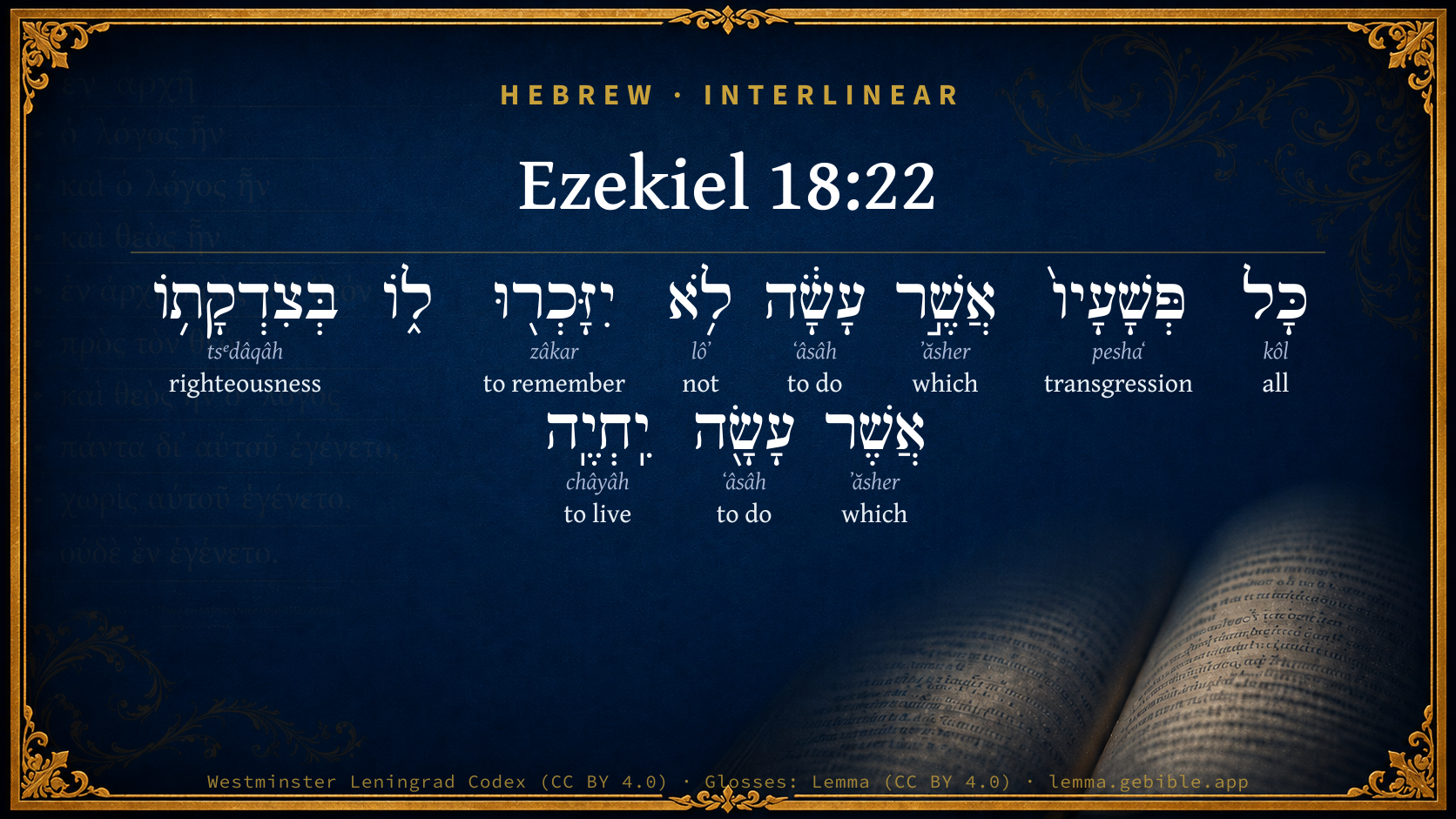
פְּשָׁעָיו֙
peshaʻ
H6588
“transgressions · his”
Noun, Common, Masculine, Plural, Construct + Suffix, Personal, 3rd Person, Masculine, Singular
Part of Speech
Noun
Type
Common
Gender
Masculine
Number
Plural
State
Construct
Full BDB Definition

Origin: from H6586

TWOT: 1846a

transgression, rebellion - transgression (against individuals) - transgression (nation against nation) - transgression (against God) - in general - as recognised by sinner - as God deals with it - as God forgives - guilt of transgression - punishment for transgression - offering for transgression
  1. כָּל kôl H3605 “all of” Noun, Common, Masculine, Singular, Construct
  2. אֲשֶׁ֣ר ʼăsher H834 “which” Particle, Relative
  3. עָשָׂ֔ה ʻâsâh H6213 “to do” Verb, Qal, Perfect, 3rd Person, Masculine, Singular
  4. לֹ֥א lôʼ H3808 “not” Particle, Negative
  5. יִזָּכְר֖וּ zâkar H2142 “to remember” Verb, Niphal, Imperfect, 3rd Person, Masculine, Plural
  6. בְּצִדְקָת֥וֹ tsᵉdâqâh H6666 “in/at · righteousness · his” Preposition + Noun, Common, Feminine, Singular, Construct + Suffix, Personal, 3rd Person, Masculine, Singular
  7. אֲשֶׁר ʼăsher H834 “which” Particle, Relative
  8. עָשָׂ֖ה ʻâsâh H6213 “to do” Verb, Qal, Perfect, 3rd Person, Masculine, Singular
  9. יִֽחְיֶֽה châyâh H2421 “to live” Verb, Qal, Imperfect, 3rd Person, Masculine, Singular

About this verse

These counts appear in no published source. They are computed here, from the morphology-tagged text and Lemma’s own curated glosses. What Lemma adds →

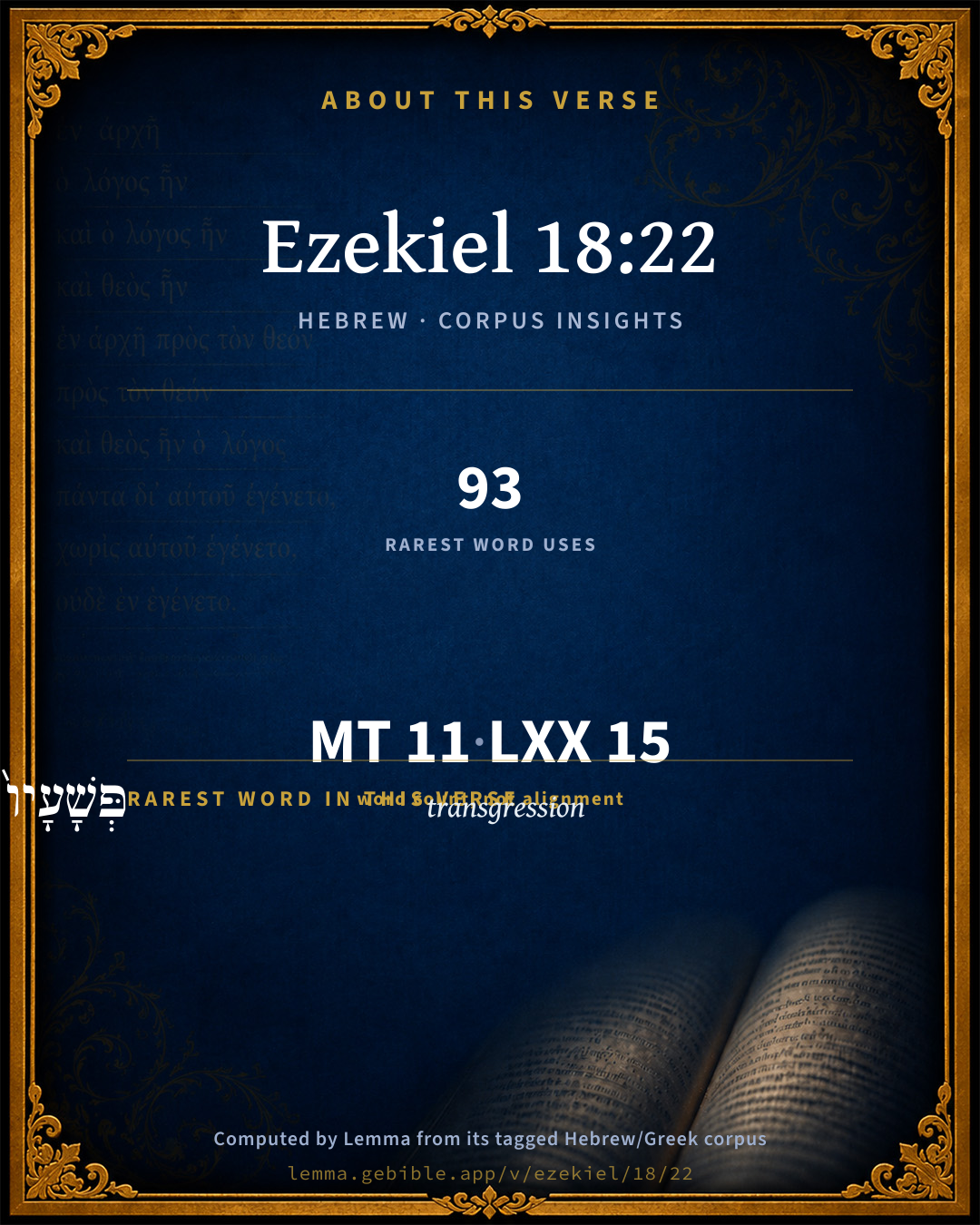
11
words
8
distinct lemmas
Prophets
section

Grammatical profile

  • 4 verbs
  • 3 nouns
  • 1 preposition
  • 3 particles

Verb forms

  • עָשָׂ֔ה Qal · Perfect
  • יִזָּכְר֖וּ Niphal · Imperfect
  • עָשָׂ֖ה Qal · Perfect
  • יִֽחְיֶֽה Qal · Imperfect

Repetition

Words recur within this verse — often emphatic in Hebrew:

  • עָשָׂ֔ה to do H6213 ×2
  • אֲשֶׁ֣ר which H834 ×2

Hebrew & Septuagint length

In English translation the verse runs 23 words from the Hebrew and 21 from the Septuagint (LXX English) — closely comparable.

A rough comparison of the two English renderings, which tokenize alike — not a word-level alignment.

Word counts can differ between the Hebrew and the Greek without any difference in meaning — e.g. the Hebrew direct-object marker אֵת has no separate Greek word, and Greek often adds the article ὁ.

In the original languages it is 11 Hebrew tokens and 15 Greek tokens — but the two are counted differently (Hebrew bundles its prefixes and suffixes into one token; the Greek is in lemma form), so that isn’t a like-for-like length.

Cross-references

22

Topical passages linked to Ezekiel 18:22 in the Treasury of Scripture Knowledge — connected by theme and wording, ordered by reader-vote popularity; previews shown in the World English Bible.

  • Micah 7:19 He will again have compassion on us. He will tread our iniquities under foot; And you will cast all their sins into the depths of the sea.
  • Isaiah 43:25 I, even I, am he who blots out your transgressions for my own sake; and I will not remember your sins.
  • Ezekiel 33:16 None of his sins that he has committed shall be remembered against him: he has done that which is lawful and right; he shall surely live.
  • Psalms 18:20–24 Yahweh has rewarded me according to my righteousness. According to the cleanness of my hands has he recompensed me.
  • Ezekiel 18:24 But when the righteous turns away from his righteousness, and commits iniquity, and does according to all the abominations that the wicked man does, shall he live? None of his righteous deeds that he has done shall be remembered: in his trespass that he has trespassed, and in his sin that he has sinned, in them shall he die.
  • Psalms 103:12 As far as the east is from the west, So far has he removed our transgressions from us.
  • Jeremiah 50:20 In those days, and in that time, says Yahweh, the iniquity of Israel shall be sought for, and there shall be none; and the sins of Judah, and they shall not be found: for I will pardon them whom I leave as a remnant.
  • Romans 8:1 There is therefore now no condemnation to those who are in Christ Jesus, who don't walk according to the flesh, but according to the Spirit.
  • Hebrews 8:12 For I will be merciful to their unrighteousness. I will remember their sins and lawless deeds no more."
  • 1 Kings 17:18 She said to Elijah, What have I to do with you, you man of God? You have come to me to bring my sin to memory, and to kill my son!
  • 2 Chronicles 6:23 then hear from heaven, and do, and judge your servants, requiting the wicked, to bring his way on his own head; and justifying the righteous, to give him according to his righteousness.
  • Psalms 19:11 Moreover by them is your servant warned. In keeping them there is great reward.
  • Psalms 25:7 Don't remember the sins of my youth, nor my transgressions. Remember me according to your loving kindness, For your goodness' sake, Yahweh.
  • Psalms 32:1–2 Blessed is he whose disobedience is forgiven, Whose sin is covered.
  • Psalms 51:1 Have mercy on me, God, according to your loving kindness. According to the multitude of your tender mercies, blot out my transgressions.
  • Jeremiah 31:34 and they shall teach no more every man his neighbor, and every man his brother, saying, Know Yahweh; for they shall all know me, from the least of them to the greatest of them, says Yahweh: for I will forgive their iniquity, and their sin will I remember no more.
  • Romans 2:6–7 who "will pay back to everyone according to their works:"
  • Galatians 6:7–8 Don't be deceived. God is not mocked, for whatever a man sows, that will he also reap.
  • Hebrews 10:3–4 But in those sacrifices there is yearly reminder of sins.
  • James 2:21–26 Wasn't Abraham our father justified by works, in that he offered up Isaac his son on the altar?
  • 1 John 3:7 Little children, let no one lead you astray. He who does righteousness is righteous, even as he is righteous.
  • 2 Peter 1:5–11 Yes, and for this very cause adding on your part all diligence, in your faith supply moral excellence; and in moral excellence, knowledge;

Cross-references courtesy of OpenBible.info (CC BY 4.0).

Hebrew and Greek witnesses Masoretic Hebrew ↔ Greek Septuagint

The same verse in the two great witnesses to the Old Testament, shown verse-for-verse.

These are two independent witnesses, not word-aligned to each other, and the Septuagint is shown in lemma (dictionary) form.

Hebrew Ezekiel 18:22 Masoretic · Westminster Leningrad Codex

כָּל פְּשָׁעָיו֙ אֲשֶׁ֣ר עָשָׂ֔ה לֹ֥א יִזָּכְר֖וּ ל֑וֹ בְּצִדְקָת֥וֹ אֲשֶׁר עָשָׂ֖ה יִֽחְיֶֽה

None of his transgressions that he has committed shall be remembered against him: in his righteousness that he has done he shall live.

World English Bible · Public Domain

Greek LXX Ezekiel 18:22 Septuagint · lemma form

πᾶς ὁ παράπτωμα αὐτός ὅσος ποιέω οὐ μιμνήσκω ἐν ὁ δικαιοσύνη αὐτός ὅς ποιέω ζάω

None of his trespasses which he has committed shall be remembers: in his righteousness which he has done he shall live.

LXX2012 (modern English Septuagint) · Public Domain

Hebrew: Westminster Leningrad Codex (CC BY 4.0). Greek: Septuagint (public domain); English from LXX2012 (modern English Septuagint) (Public Domain). How the Septuagint differs from the Hebrew →

Targum (Aramaic paraphrase)

1

The Targum is the ancient Jewish Aramaic paraphrase of the Hebrew Scriptures — an interpretive translation, not the Hebrew text itself. Onkelos (literal) and Pseudo-Jonathan (expansive) render the Torah, and Jonathan the Prophets. Coverage is partial: where no permissively-licensed English translation exists for a verse, only the Aramaic is shown. This is verse-level text, not a word-by-word alignment to the Hebrew.

  1. Targum Jonathan Prophets (Joshua–Malachi)
    כָּל חוֹבוֹהִי דַעֲבַד לָא יִדְכְּרוּן לֵיהּ בִּזְכוּתֵהּ דַעֲבַד יִתְקַיֵם:

    (no public-domain English translation for this verse)

    Targum Jonathan — Aramaic: “Mikraot Gedolot” (public domain). English: “Sefaria Community Translation” (CC0 1.0 (public-domain dedication)); “London "Chaldee Paraphrase," 1871” (public domain). Text via Sefaria.

Commentary

Notes on Ezekiel 18:22 from classic Christian and Jewish commentators (each source and its license shown beneath its notes). The classic Christian expositions comment on the surrounding passage and are grouped to its opening verse, so a note may address several verses; the Jewish commentaries on the Tanakh (Rashi and others) are per-verse, so they appear only where the commentator wrote on this verse.

Lemma curates 59 commentaries, every one of them public domain or Creative Commons licensed, each selected and text-cleaned for this edition rather than reprinted as found. About our sources →

Trapp's Complete Commentary

John Trapp

Eze 18:22 All his transgressions that he hath committed, they shall not be mentioned unto him: in his righteousness that he hath done he shall live.

Ver. 22. All his transgressions.] So true is that of an ancient, Quem poenitet peccasse, poene est innocens - Penitence is nearly as good as innocence.

In his righteousness.] Or, For his righteousness, tanquam ob causum sine qua non, et ob promissionem Dei, {a} not of merit, but mercy and free grace.

{a} Piscator.

John Trapp, A Commentary or Exposition upon All the Books of the Old and New Testament (1647–1656) — public domain. Text from a community e-Sword module.

Geneva Bible (1599)

Geneva Bible translators

Or, not laid to his charge.

That is, in the fruits of his faith which declare that God doth accept him.

Geneva Bible (1599) marginal notes — public domain. Text via Bolls.life.

Jamieson, Fausset & Brown

Robert Jamieson, A. R. Fausset & David Brown

in his righteousness . . . he shah live--in it, not for it, as if that atoned for his former sins; but "in his righteousness" he shall live, as the evidence of his being already in favor with God through the merit of Messiah, who was to come. The Gospel clears up for us many such passages (Pe1 1:12), which were dimly understood at the time, while men, however, had light enough for salvation.

Jamieson, Fausset & Brown — Commentary Critical and Explanatory on the Whole Bible (1871) — public domain (CC PDM 1.0). Text via the HelloAO Bible API.

Adam Clarke's Commentary

Verse 22. All his transgressions] Shall be so completely forgiven by God's mercy, that they shall not be even mentioned to him; and if he live and die in this recovered state, he shall live with God to all eternity. And why? Hear the reason:-

Adam Clarke's Commentary on the Bible (1810–1826) — public domain. Text from a community e-Sword/MySword module.

Ellicott's Commentary for English Readers

(22) Shall not be mentioned unto him.—A strong way of expressing the completeness of the Divine forgiveness. Here, again, at first sight, there seems to be an inconsistency between the Divine promise and the actual facts of the world. The penitent and forgiven sinner is continually seen to suffer through life from the consequences of his sin, as David’s whole reign was overclouded with trouble and sorrow after his great sin in the matter of Bathsheba and Uriah. But here also it is the natural law continuing to work in subservience to a higher moral law. The natural consequences of any acts are not changed, or are only partially modified, by the subsequent moral state of him who has done them; but that moral state determines whether those consequences, however painful they may be in themselves, shall or shall not be really for his own highest gain. The absoluteness of the Divine forgiveness is seen by us, under the Christian dispensation, to be a necessary result of the ground on which it rests—the atonement of Christ. If the believer is truly united to Him by faith, he is a new creature (2Co_5:17), and is looked upon no longer as a sinful son of Adam, but, as he is in reality, a member of the beloved and only-begotten Son of God. Hence his forgiveness must be complete, for his sins are atoned for, covered up, hidden from God’s sight.

A Bible Commentary for English Readers, edited by Charles John Ellicott (1878–1897) — public domain. Text from a community e-Sword module.

The Cambridge Bible for Schools and Colleges

gen. ed. J. J. S. Perowne

22. mentioned unto him] Or, remembered in regard to him.

The Cambridge Bible for Schools and Colleges (gen. ed. J. J. S. Perowne; Cambridge University Press, 1878–1918) — public domain. Text from a community e-Sword module.

John Gill's Exposition

Have I any pleasure at all that the wicked should die? saith the Lord God,.... Perish by sword, famine, or pestilence, or go into captivity; this, though the Lord's will and work, yet is his strange work; mercy is his delight. This is to be understood not absolutely; for the Lord does take pleasure in these things, as they fulfil his word, secure the honour of his truth and holiness, and glorify his justice, and especially when they are the means of reclaiming men from the evil of their ways; but comparatively, as follows:

and not that he should return from his ways, and live? that is, it is more pleasing to God that a man should repent of his sins, and forsake his vicious course of life, and enjoy good things, than to go on in his sins, and bring ruin on himself, here and hereafter.

John Gill's Exposition of the Whole Bible (1746–1763) — public domain (CC PDM 1.0). Text via the HelloAO Bible API.

Matthew Poole's English Annotations

All; not one of all, so the Hebraism is; every one shall be forgiven.

His transgressions; personal, actual sins, in which he was not accessary, but principal; though great sins.

That he hath committed; formerly did commit, but now repenteth for.

They shall not be mentioned unto him; not remembered, i.e. imputed to or punished on him. They shall be as forgotten. So when God promiseth to pardon, he promiseth that he will not remember our sins.

In his righteousness that he hath done he shall live; this penitent, whose last works are righteousness, proper fruits of repentance, shall live, be rewarded and blessed for his righteousness, yet without merit: life should be the fruit of his repentance and righteousness.

Matthew Poole's English Annotations on the Holy Bible (1683–1685) — public domain. Text from a community e-Sword/MySword module.

Whedon's Commentary on the Bible

Daniel D. Whedon

22. Shall not be mentioned unto him — Rather, remembered of him.

Daniel D. Whedon (gen. ed.), Commentary on the Old and New Testaments (1874–1909) — public domain. Text from a community e-Sword module.

John Wesley's Explanatory Notes

Not mentioned - Not to him.

John Wesley, Explanatory Notes Upon the Whole Bible (1754–1765) — public domain. Text via the GEBible commentary corpus.

Lesson kit

Teaching starters — assembled from the data on this page, not authored interpretation. Every prompt links to the verse data it draws on. Edit before teaching.

Ezekiel, in the Prophets, opens this verse with 11 words (8 distinct Hebrew lemmas). Its most distinctive word is peshaʻ (“transgression”). A historical commentator’s framing appears above. Read the whole chapter for the surrounding context.

Discussion questions

  1. How does “transgression” (peshaʻ) shape what this verse is saying?
  2. Micah 7:19 shares this passage’s theme. How do the two illuminate each other?
  3. “to do” occurs 2× in this one verse. What is the effect of the repetition?
  4. These translations render this verse differently. What is at stake in choosing one wording over another?
  5. The verb «עָשָׂ֔ה» is Qal Perfect. How does its form color the action?
  6. Reading how Trapp's Complete Commentary and Geneva Bible (1599) read this verse, where do the two commentators agree and where do they part?

Things to notice

Reading settings

Reading text

Shown beneath each verse's original-language words.

Old Testament
Old Testament edition

Read the OT as the Masoretic Hebrew (MT) or the Greek Septuagint (LXX).

English shown for the Greek Septuagint (in the Hebrew ↔ Greek comparison).

Comparing translations? Open the Compare panel on any verse page to stack up to four side by side.