
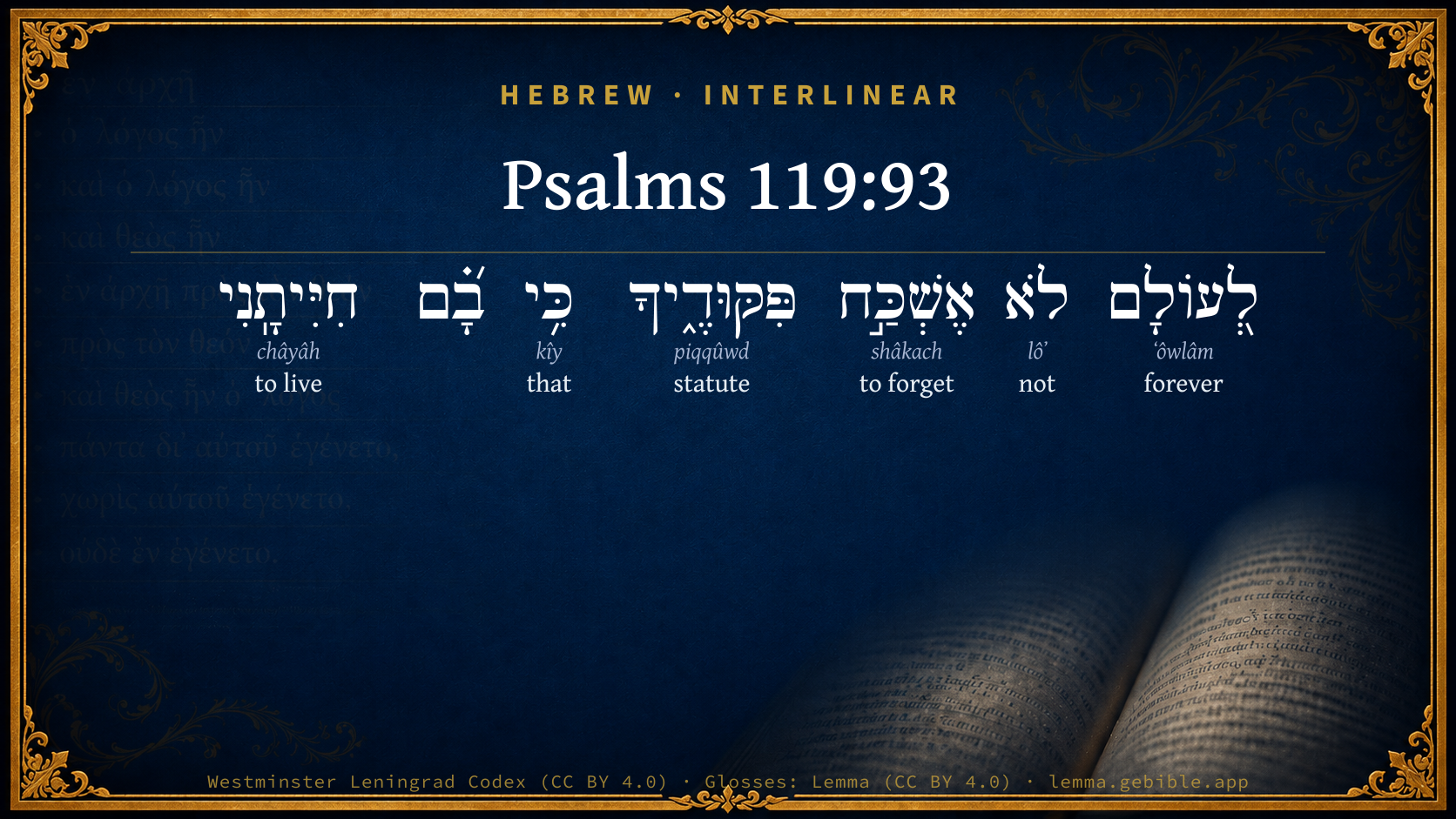
Psalms 119:93

Hebrew (Westminster Leningrad Codex) Psalms 119:93 appears in the Hebrew Old Testament. The text above is from the Westminster Leningrad Codex. Each word links to its Strong’s number, a concise gloss, and parsing drawn from the Open Scriptures Hebrew Bible morphology. Click any word for its full Brown-Driver-Briggs (BDB) entry.
Download image
Cite this verse

Psalms 119:93 (World English Bible). Public Domain. Lemma interlinear Bible study tool, https://lemma.gebible.app/v/psalms/119/93.

Show BibTeX & RIS
BibTeX
RIS
English Translation
I will never forget your precepts, For with them, you have revived me.
World English Bible · Public Domain
Download a study sheet

One document with this verse’s original text, its word-by-word gloss line, the meaning frame, cross-references with their text, attributed commentary, and full source and license credits — printable, and it pastes into notes with its structure intact.

This verse Autodidact and up

Study sheet (.html) Plain text (.txt)

A passage Seminary Student

Up to 50 verses in one chapter. A passage sheet keeps up to 6 commentary sources and 12 cross-references per verse, in the order this page ranks them, and says so on the sheet whenever that leaves anything out. Ask for a single verse and you get the Autodidact verse sheet above.

Everything on this page stays free to read, with no account — the sheet is a download of what is already on screen, not access to it.

Want to remove ads? Support Godless Engineer
Compare translations 3

The same verse in 3 English versions, stacked beneath the original-language interlinear above. Click any original word for its lexicon entry.

Each is an independent rendering of the whole verse — the interlinear is not word-aligned to these translations.

Highlighted words mark where these versions differ — a whole-verse word diff, not a word-by-word alignment.

  • World English Bible Public Domain
    I will never forget your precepts, For with them, you have revived me.
  • King James Version Public Domain
    I will never forget thy precepts: for with them thou hast quickened me.
  • unfoldingWord Literal Text CC BY-SA 4.0
    I will not forget your precepts forever, for through them you have preserved me alive.

unfoldingWord Literal Text — © unfoldingWord, licensed CC BY-SA 4.0. Word-aligned USFM3 via Door43 (git.door43.org/unfoldingWord/en_ult).

Versions to compare (up to 4)

3 of 4 selected

Show all 17 translations

Every available English version of this verse, each an independent rendering of the whole verse.

  • World English Bible Public Domain
    I will never forget your precepts, For with them, you have revived me.
  • Berean Standard Bible Public Domain
    I will never forget Your precepts, for by them You have revived me.
  • Majority Standard Bible Public Domain
    I will never forget Your precepts, for by them You have revived me.
  • King James Version Public Domain
    I will never forget thy precepts: for with them thou hast quickened me.
  • American Standard Version (1901) Public Domain
    I will never forget thy precepts; For with them thou hast quickened me.
  • Revised Version (1885) Public Domain
    I will never forget thy precepts; for with them thou hast quickened me.
  • Geneva Bible (1599) Public Domain
    I wil neuer forget thy precepts: for by them thou hast quickened me.
  • Young's Literal Translation Public Domain
    To the age I forget not Thy precepts, For by them Thou hast quickened me.
  • Literal Standard Version CC BY-SA 4.0
    I do not forget Your precepts for all time, || For You have quickened me by them.
  • Unlocked Literal Bible CC BY-SA 4.0
    I will never forget your instructions, for through them you have kept me alive.
  • unfoldingWord Literal Text CC BY-SA 4.0
    I will not forget your precepts forever, for through them you have preserved me alive.
  • Darby Bible Public Domain
    I will never forget thy precepts; for by them thou hast quickened me.
  • World Messianic Bible Public Domain
    I will never forget your precepts, for with them, you have revived me.
  • Webster's Bible Public Domain
    I will never forget thy precepts: for with them thou hast revived me.
  • Free Bible Version CC BY-SA 4.0
    I will never forget your instructions, for through them you give me life.
  • Bible in Basic English Public Domain
    I will ever keep your orders in mind; for in them I have life.
  • JPS Tanakh (1917) Public Domain
    I will never forget Thy precepts; for with them Thou hast quickened me.

Literal Standard Version (2020), Covenant Press — licensed CC BY-SA 4.0. Text via the HelloAO Bible API (eBible.org). Unlocked Literal Bible (unfoldingWord) — licensed CC BY-SA 4.0. Text via the HelloAO Bible API (eBible.org). unfoldingWord Literal Text — © unfoldingWord, licensed CC BY-SA 4.0. Word-aligned USFM3 via Door43 (git.door43.org/unfoldingWord/en_ult). Free Bible Version, Dr. Jonathan Gallagher — licensed CC BY-SA 4.0. Text via the HelloAO Bible API (eBible.org).

Word by word

More ways to search: Search by grammar → Find every occurrence → Compare this word →

Practice this passage: Drill this verse → Learn its vocabulary →

About this verse

These counts appear in no published source. They are computed here, from the morphology-tagged text and Lemma’s own curated glosses. What Lemma adds →

7
words
6
distinct lemmas
Wisdom
section

Notable vocabulary

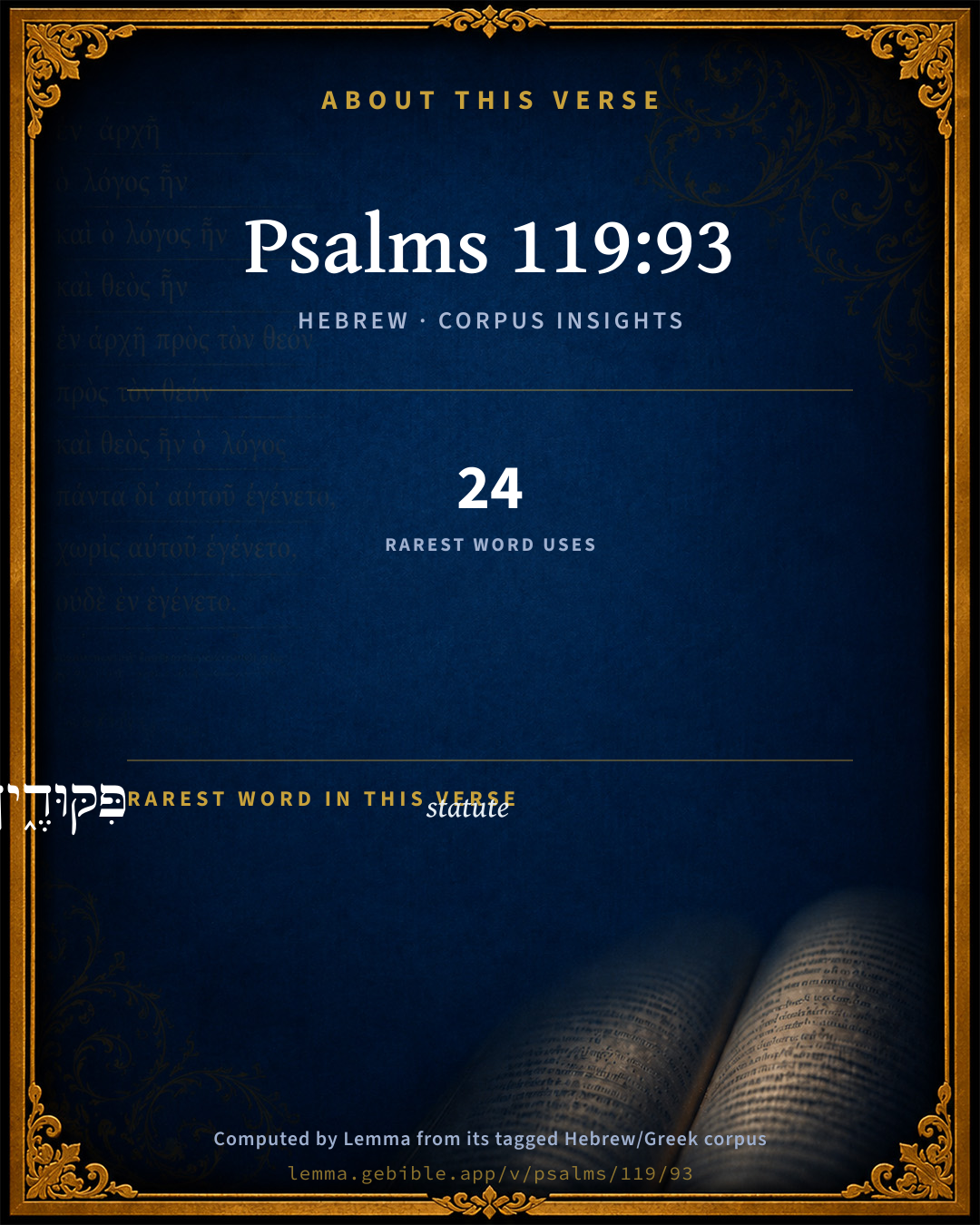
The rarest word here is פִּקּוּדֶ֑יךָ statute H6490 — appearing just 24 times in the whole Hebrew Bible.

Shared distinctive vocabulary

פִּקּוּדֶ֑יךָ statute H6490 occurs in 24 verses of the Hebrew Bible. Also found in:

Grammatical profile

  • 2 verbs
  • 2 nouns
  • 1 preposition
  • 1 conjunction
  • 1 particle

Verb forms

  • אֶשְׁכַּ֣ח Qal · Imperfect
  • חִיִּיתָֽנִי Piel · Perfect

Hebrew & Septuagint length

In English translation the verse runs 13 words from the Hebrew and 13 from the Septuagint (LXX English) — the same length.

A rough comparison of the two English renderings, which tokenize alike — not a word-level alignment.

Word counts can differ between the Hebrew and the Greek without any difference in meaning — e.g. the Hebrew direct-object marker אֵת has no separate Greek word, and Greek often adds the article ὁ.

Cross-references

4

Topical passages linked to Psalms 119:93 in the Treasury of Scripture Knowledge — connected by theme and wording, ordered by reader-vote popularity; previews shown in the World English Bible.

  • Psalms 119:50 This is my comfort in my affliction, For your word has revived me.
  • Psalms 119:16 I will delight myself in your statutes. I will not forget your word.
  • John 6:63 It is the spirit who gives life. The flesh profits nothing. The words that I speak to you are spirit, and are life.
  • 1 Peter 1:23 having been born again, not of corruptible seed, but of incorruptible, through the word of God, which lives and remains forever.

Cross-references courtesy of OpenBible.info (CC BY 4.0).

Hebrew and Greek witnesses Masoretic Hebrew ↔ Greek Septuagint

The same verse in the two great witnesses to the Old Testament, shown verse-for-verse.

You’re reading Greek Psalm 118 (Hebrew Psalm 119). The Septuagint counts the superscription, so verse numbers can differ from the Hebrew — chapter-level alignment, not verse-by-verse. Numbering follows Rahlfs.

These are two independent witnesses, not word-aligned to each other, and the Septuagint is shown in lemma (dictionary) form.

Hebrew Psalms 119:93 Masoretic · Westminster Leningrad Codex

לְ֭עוֹלָם לֹא אֶשְׁכַּ֣ח פִּקּוּדֶ֑יךָ כִּ֥י בָ֝֗ם חִיִּיתָֽנִי

I will never forget your precepts, For with them, you have revived me.

World English Bible · Public Domain

Greek LXX Greek Psalm 118:93 Septuagint · lemma form

εἰς ὁ αἰών οὐ μή ἐπιλανθάνω ὁ δικαίωμα σύ ὅτι ἐν αὐτός ζάω ἐγώ κύριος

I will never forget your ordinances; for with them you have quickened me.

LXX2012 (modern English Septuagint) · Public Domain

Hebrew: Westminster Leningrad Codex (CC BY 4.0). Greek: Septuagint (public domain); English from LXX2012 (modern English Septuagint) (Public Domain). How the Septuagint differs from the Hebrew →

Commentary

Notes on Psalms 119:93 from classic Christian and Jewish commentators (each source and its license shown beneath its notes). The classic Christian expositions comment on the surrounding passage and are grouped to its opening verse, so a note may address several verses; the Jewish commentaries on the Tanakh (Rashi and others) are per-verse, so they appear only where the commentator wrote on this verse.

Lemma curates 59 commentaries, every one of them public domain or Creative Commons licensed, each selected and text-cleaned for this edition rather than reprinted as found. About our sources →

Trapp's Complete Commentary

John Trapp

Psa 119:93 I will never forget thy precepts: for with them thou hast quickened me.

Ver. 93. I will never forget thy precepts] That is, thy promises, which are as sure and firm as the commands of the most absolute monarch upon earth. And here the prophet proposeth his own example for a pattern to others; for, as Pacatus writeth in his panegyric to Theodosius the emperor, blandissime iubetur exemplo examples are sweet precepts.

For with them thou hast quickened me] Thou hast fetched me again, when ready to faint, as Psa 119:92.

John Trapp, A Commentary or Exposition upon All the Books of the Old and New Testament (1647–1656) — public domain. Text from a community e-Sword module.

J. A. Alexander on Psalms

Joseph Addison Alexander

93. (Psa 119:93) To eternity I will not forget thy precepts, for in them hast thou quickened me. In them, or by them, which is really included in the other, meaning in the practice of them and by means of them. Quickened, as in Psa 119:17; Psa 119:25; Psa 119:37; Psa 119:40; Psa 119:50.

Joseph Addison Alexander, The Psalms Translated and Explained (1850) — public domain. Text from a community e-Sword module.

Matthew Henry's Commentary

Here is, 1. A very good resolution: "I will never forget thy precepts, but will always retain a remembrance of and regard to thy word as my rule." It is a resolution for perpetuity, never to be altered. Note, The best evidence of our love to the word of God is never to forget it. We must resolve that we will never, at any time, cast off our religion, and never, upon any occasion, lay aside our religion, but that we will be constant to it and persevere in it. 2. A very good reason for it: "For by them thou hast quickened me; not only they are quickening, but," (1.) "They have been so to me; I have found them so." Those speak best of the things of God who speak by experience, who can say that by the word the spiritual life has been begun in them, maintained and strengthened in them, excited and comforted in them. (2.) "Thou hast made them so;" the word of itself, without the grace of God, would not quicken us. Ministers can but prophesy upon the dry bones, they cannot put life into them; but, ordinarily, the grace of God works by the word and makes use of it as a means of quickening, and this is a good reason why we should never forget it, but should highly value what God has put such honour upon, and dearly love what we have found and hope still to find such benefit by. See here what is the best help for bad memories, namely, good affections. If we are quickened by the word, we shall never forget it; nay, that word that does really quicken us to and in our duty is not forgotten; though the expressions be lost, if the impressions remain, it is well.

Matthew Henry's Commentary on the Whole Bible (1708–1710) — public domain (CC PDM 1.0). Text via the HelloAO Bible API.

Adam Clarke's Commentary

Verse 93. I will never forget thy precepts] How can I? It is by them I live.

Adam Clarke's Commentary on the Bible (1810–1826) — public domain. Text from a community e-Sword/MySword module.

John Calvin's Commentaries

93. I will never forget thy statutes. This verse contains a thanksgiving. As the law of the Lord had preserved him, he engages that he will never forget it. Yet he, at the same time, admonishes himself and others how necessary it is to cherish in the heart the remembrance of the Divine Law; for though we have found from experience its life-giving power, yet we easily allow it to pass from our memories, and on this account God afterwards justly punishes us, by leaving us for a long time to languish in our sadness.

John Calvin's Commentaries (1540-1563) — public domain. Text from the Calvin Translation Society English edition (1840s-50s) via the Christian Classics Ethereal Library (ccel.org). Calvin's coverage is partial (roughly two-thirds of the Bible); uncommented books and verses are honest gaps, never fabricated. The 19th-century editor's footnotes and remarks are omitted so the notes are faithfully Calvin's own voice.

John Gill's Exposition

MEM.--The Thirteenth Part.

MEM. O how love I thy law!.... The whole word of God, the preceptive part of it; the commands of the moral law, which are holy, just, and good, and to be loved: but they are not loved by carnal men, whose minds are enmity to them, and therefore are not and cannot be subject to them, but despise and reject them; but to a good man, on whose heart they are written, they are delightful, and loved to admiration: though this is wholly owing to the grace of God; and marvellous it is that men so sadly depraved by sin should love the holy law of God; yet so it is, and David could appeal to God for the truth of it. So the ordinances of the Gospel, the commands of Jesus Christ, are not grievous to saints, but loved, valued, and esteemed by them; likewise the doctrinal part of the word, the truths of the Gospel, which may be more especially meant by the "thorah", or doctrine, here; which those who have had an experience of greatly love and justly value, because of the intrinsic worth of them, being comparable to gold, silver, and precious stones; and for the profit and benefit of them to their souls, they being wholesome words, soul nourishing doctrines, and so more to them than their necessary food; and for the pleasure they have in them, these being sweeter to them than the honey or honeycomb: particularly the exceeding great and precious promises of the word, which are more to be rejoiced at than a great spoil; and even the whole Gospel part of the word, that containing the doctrines of peace, pardon, righteousness, salvation, and eternal life through Christ; yea, the whole Scripture, which is both profitable and pleasant to read in, and hear explained;

it is my meditation all the day; not only in the night, when at leisure, and free from the incumbrance of business; but in the day, and while engaged in the affairs of life, yea, all the day long; see Psa 1:2. Or, "it is my discourse" (c); what he talked of, as well as what he thought on. Good men cannot forbear speaking of this or the other passage of Scripture, which has been of use unto them: and this is a proof of affection for the word; for what men love, persons or things, they often think of, and frequently talk of; see Deu 6:6.

(c) "de qua meus sermo est", Tigurine version, Vatablus, Piscator; "vel colloquium meum", Cocceius; so Michaelis.

John Gill's Exposition of the Whole Bible (1746–1763) — public domain (CC PDM 1.0). Text via the HelloAO Bible API.

Albert Barnes' Notes on the Bible

I will never forget thy precepts - Thy laws; thy truth. I will bear them in mind forever. To all eternity they shall be the object of my meditation.

For with them thou hast quickened me - By them thou hast given me life, spiritual life. Compare the notes at Jam 1:18. This is stated as a reason why he would never suffer the truth of God to pass out of his mind. By that truth he had been made really to live. He had been brought from spiritual death to spiritual life. He saw before him now, as the result of that, an endless career of blessedness. How could he ever forget what had worked such a change in his character and condition; which had inspired such hopes; which had opened before him such an immortal career of glory!

Albert Barnes' Notes on the Bible (1834–1885) — public domain. Text from a community e-Sword/MySword module.

Matthew Poole's English Annotations

Revived and cheered me, when my heart was ready to sink and die within me.

Matthew Poole's English Annotations on the Holy Bible (1683–1685) — public domain. Text from a community e-Sword/MySword module.

The Treasury of David

Charles H. Spurgeon

Ver. 93. I will never forget thy precepts: for with them thou hast quickened me. When we have felt the quickening power of a precept we never can forget it. We may read it, learn it, repeat it, and think we have it, and yet it may slip out of our minds; but if it has once given us life or renewed that life, there is no fear of its falling from our recollection. Experience teaches, and teaches effectually. How blessed a thing it is to have the precepts written on the heart with the golden pea of experience, and graven on the memory with the divine stylus of grace. Forgetfulness is a great evil in holy things; we see here the man of God fighting against it, and feeling sure of victory because he knew the life giving energy of the word in his own soul. That which quickens the heart is sure to quicken the memory.

It seems singular that he should ascribe quickening to the precepts, and yet it lies in them and in all the words of the Lord alike. It is to be noted that when the Lord raised the dead he addressed to them the word of command. He said, "Lazarus, come forth, " or "Maid, arise." We need not fear to address gospel precepts to dead sinners, since by them the Spirit gives them life. Remark that the Psalmist does not say that the precepts quickened him, but that the Lord quickened him by their means: thus he traces the life from tile channel to the source, and places the glory where it is due. Yet at the same time he prized the instruments of the blessing, and resolved never to forget them. He had already remembered them when he likened himself to a bottle in the smoke, and now he feels that whether in the smoke or in the fire the memory of the Lord's precepts shall never depart from him.

Ver. 93. I will never forget thy precepts, etc. Forgetfulness must be striven against in every possible way, lest it should gradually creep in, through ingratitude, old age, weakness of mind, or other overwhelming cares. See Ps 119:16, 61, 83. Martin Geier.

Ver. 93. I will never forget thy precepts, etc. This afflicted good man is now comforted; his comfort came from his delight in God's law; he thinks of it, he feels the force of it, and therefore to the end that he might ever receive the like comforts, he will bind himself by a promise to the Lord that he will never forget his precepts; adding a reason, namely, that they were to him spirit and life.

With them hast thou quickened me. Quickened he was, as he saith, by God, but yet also by the word, soundly preached, savingly understood, and particularly applied to the conscience. Thus then doth the power of Christ's death make us to walk on in newness of life. No aqua vitae, or celestis like unto this, by which we have inward peace of conscience, and an outward obedience to God's commandments. David rejoiced in this blessing, , so ought we: we desire to be ever quick, and cheerful to all good duties; it is only God, by his Spirit, in the word, that can give it. Richard Greenham.

Ver. 93. With them thou hast quickened me. The quickening Spirit delights to work by means of the word; but though the word be the means, yet the benefit comes from God: "For with them thou hast quickened me." Life comes, from the fountain of life. The gospel is a sovereign plaster; but it is God's hand that must apply it, and make it stick; make it to be peace, comfort, and quickening to our souls. There is a double quickening, when, from dead, we are made living; or when, from cold, and sad, and heavy, we are made lively...and so not only have life, but enjoy it more abundantly, according to Christ's gracious promise (Joh 10:10); that they may be living, lively, kept still in rigour. Now, this second quickening may be taken, either more largely, for the vitality of grace; or, strictly, for actual comfort Largely taken; so God quickens by increasing the life of: grace; either internally, by promising the life of grace; or morally and externally, by promising the life of glory. More strictly, his quickening may be taken for comfort and support in his affliction; so it is likely to be taken here: he had said immediately before, "Unless thy law had been my delights, I should then have perished in my affliction"; and now, "I will never forget thy precepts, for with them thou hast quickened me." It was great comfort and support to him; and therefore he should prize the word as long as he lived. Thomas Manton.

Ver. 93. Thou hast quickened me. Leave not off reading the Bible till you find your hearts warmed. Read the word, not only as a history, but labour to be affected with it. Let it not only inform you, but inflame you. "Is not my word like a fire? saith the Lord": Jer 23:29. Go not from the word till you can say as those disciples, "Did not our hearts burn within us?" Lu 24:32. Thomas Watson.

Ver. 93. Experience fixes the word upon the memory.

Ver. 93.

1. A good resolve: "I will never forget thy precepts."

(a) The precepts are worth remembering.

(b) Safety lies in remembering them.

(c) Fidelity to God cannot be without remembering them.

(d) Not to remember them is shameful ingratitude.

2. An excellent reason for making it: "For with them thou hast quickened me."

(a) A reason founded upon personal experience: "me."

(b) A reason appreciative of the benefit received:

"quickened."

(c) A reason indicative of gratitude to God: "thou." J.F.

Ver. 93. Never forget; an often uttered phrase. Here golden.

1. Something that could not be forgotten: life and pardon received. How could it?

2. Something that should not be forgotten: the precious instrumentality. W.B.H.

Ver. 93.

1. The instrumental power of truth.

(a) Used by God in our regeneration:

Jas 1:18 Ps 19:7.

(b) Used in our liberation: Joh 8:32.

(c) Used in our sanctification: Joh 17:7.

2. Our consequent affection for it. We cannot forget.

(a) Our past obligations to it.

(b) Our present dependence upon it.

(c) Our future needs of it. W.W.

Psalms 119:94*

Charles H. Spurgeon's The Treasury of David (1869–1885) — public domain. Psalms only. Text from a community e-Sword/MySword module.

The Pulpit Commentary

I will never forget thy precepts (comp. vers. 16, 61, 83). For with them thou hast quickened me (comp. ver. 50, "Thy Word hath quickened me").

The Pulpit Commentary (1880–1919), ed. H.D.M. Spence-Jones & Joseph S. Exell — public domain. Text from a community e-Sword module.

unfoldingWord translationNotes

Door43 World Missions Community

I will never forget

This can be stated in positive form. AT: "I will always remember" (See: Litotes)

for through them you have kept me alive

It is implied that the writer obeys God's instructions. The full meaning of this statement can be made explicit. AT: "for you have kept me alive because I obey them" (See: Assumed Knowledge and Implicit Information)

for I seek your instructions

Trying hard to obey God's instructions is spoken of as if instructions were an object for which a person must search. (See: Metaphor)

translationWords

instruct

life

save

seek

unfoldingWord translationNotes — © Distant Shores Media and the Door43 World Missions Community, licensed CC BY-SA 4.0. Source: git.door43.org/Door43/en_tn.

Lesson kit

Teaching starters — assembled from the data on this page, not authored interpretation. Every prompt links to the verse data it draws on. Edit before teaching.

Psalms, in the Wisdom, opens this verse with 7 words (6 distinct Hebrew lemmas). Its most distinctive word is piqqûwd (“statute”). A historical commentator’s framing appears above. Read the whole chapter for the surrounding context.

Discussion questions

  1. The word piqqûwd carries the sense “statute.” How does it shape the verse?
  2. How does Psalms 19:8, which shares the word «statute», read alongside this verse?
  3. These translations render this verse differently. What is at stake in choosing one wording over another?
  4. «אֶשְׁכַּ֣ח» is a Qal Imperfect verb. How does that grammatical form shape the action described?
  5. Compare how Trapp's Complete Commentary and J. A. Alexander on Psalms read this verse. Where do they agree or differ?

Things to notice

Reading settings

Reading text

Shown beneath each verse's original-language words.

Old Testament
Old Testament edition

Read the OT as the Masoretic Hebrew (MT) or the Greek Septuagint (LXX).

English shown for the Greek Septuagint (in the Hebrew ↔ Greek comparison).

Comparing translations? Open the Compare panel on any verse page to stack up to four side by side.