
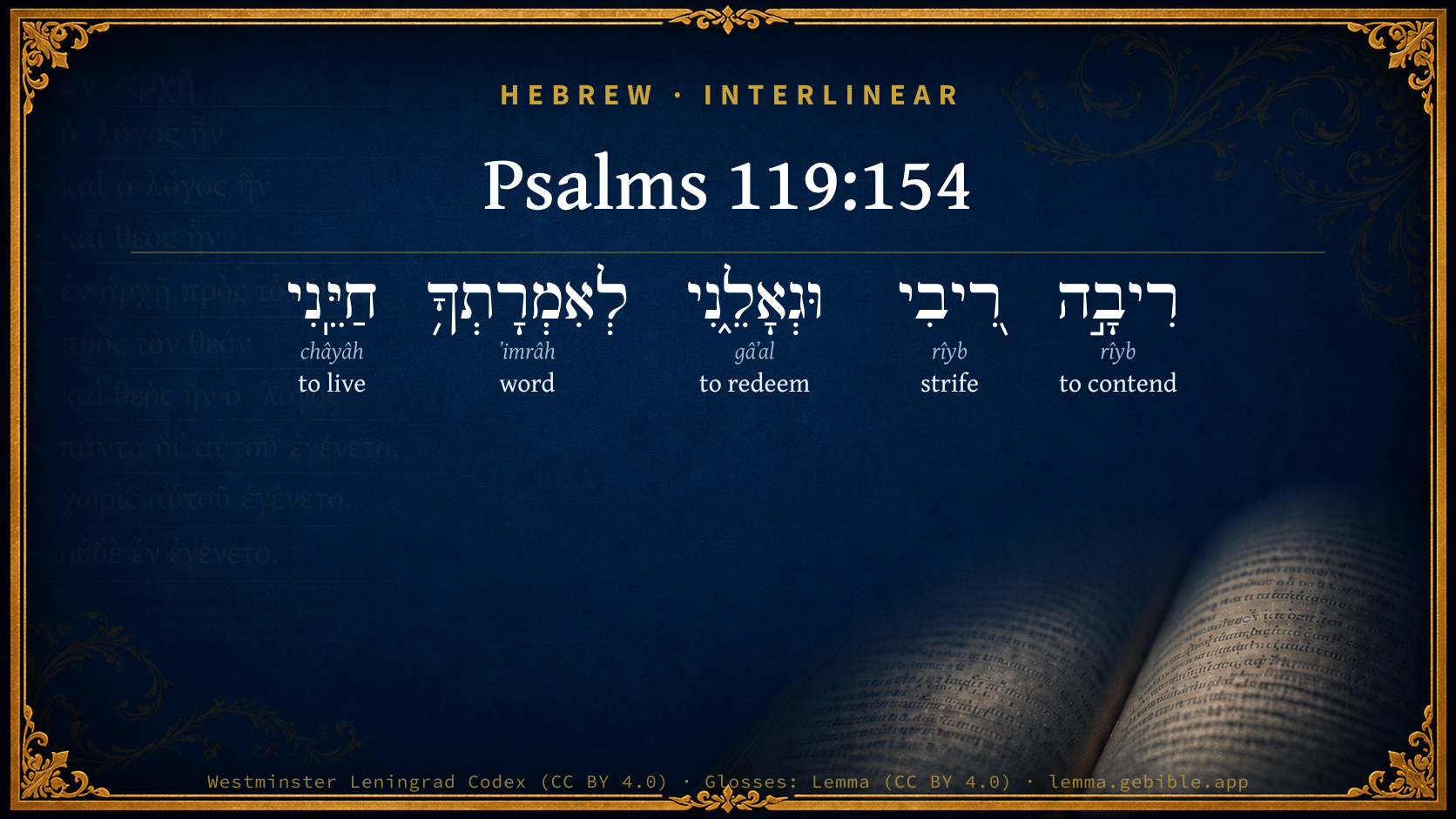
Psalms 119:154

Hebrew (Westminster Leningrad Codex) Psalms 119:154 appears in the Hebrew Old Testament. The text above is from the Westminster Leningrad Codex. Each word links to its Strong’s number, a concise gloss, and parsing drawn from the Open Scriptures Hebrew Bible morphology. Click any word for its full Brown-Driver-Briggs (BDB) entry.
Download image
Cite this verse

Psalms 119:154 (World English Bible). Public Domain. Lemma interlinear Bible study tool, https://lemma.gebible.app/v/psalms/119/154.

Show BibTeX & RIS
BibTeX
RIS
English Translation
Plead my cause, and redeem me! Revive me according to your promise.
World English Bible · Public Domain
Download a study sheet

One document with this verse’s original text, its word-by-word gloss line, the meaning frame, cross-references with their text, attributed commentary, and full source and license credits — printable, and it pastes into notes with its structure intact.

This verse Autodidact and up

Study sheet (.html) Plain text (.txt)

A passage Seminary Student

Up to 50 verses in one chapter. A passage sheet keeps up to 6 commentary sources and 12 cross-references per verse, in the order this page ranks them, and says so on the sheet whenever that leaves anything out. Ask for a single verse and you get the Autodidact verse sheet above.

Everything on this page stays free to read, with no account — the sheet is a download of what is already on screen, not access to it.

Want to remove ads? Support Godless Engineer
Compare translations 3

The same verse in 3 English versions, stacked beneath the original-language interlinear above. Click any original word for its lexicon entry.

Each is an independent rendering of the whole verse — the interlinear is not word-aligned to these translations.

Highlighted words mark where these versions differ — a whole-verse word diff, not a word-by-word alignment.

  • World English Bible Public Domain
    Plead my cause, and redeem me! Revive me according to your promise.
  • King James Version Public Domain
    Plead my cause, and deliver me: quicken me according to thy word.
  • unfoldingWord Literal Text CC BY-SA 4.0
    Plead my plea and redeem me; for your word, revive me.

unfoldingWord Literal Text — © unfoldingWord, licensed CC BY-SA 4.0. Word-aligned USFM3 via Door43 (git.door43.org/unfoldingWord/en_ult).

Versions to compare (up to 4)

3 of 4 selected

Show all 17 translations

Every available English version of this verse, each an independent rendering of the whole verse.

  • World English Bible Public Domain
    Plead my cause, and redeem me! Revive me according to your promise.
  • Berean Standard Bible Public Domain
    Defend my cause and redeem me; revive me according to Your word.
  • Majority Standard Bible Public Domain
    Defend my cause and redeem me; revive me according to Your word.
  • King James Version Public Domain
    Plead my cause, and deliver me: quicken me according to thy word.
  • American Standard Version (1901) Public Domain
    Plead thou my cause, and redeem me: Quicken me according to thy word.
  • Revised Version (1885) Public Domain
    Plead thou my cause, and redeem me: quicken me according to thy word.
  • Geneva Bible (1599) Public Domain
    Pleade my cause, and deliuer me: quicken me according vnto thy word.
  • Young's Literal Translation Public Domain
    Plead my plea, and redeem me, According to Thy saying quicken me.
  • Literal Standard Version CC BY-SA 4.0
    Plead my plea, and redeem me, || Quicken me according to Your saying.
  • Unlocked Literal Bible CC BY-SA 4.0
    Plead my cause and redeem me; keep me, as you have promised in your word.
  • unfoldingWord Literal Text CC BY-SA 4.0
    Plead my plea and redeem me; for your word, revive me.
  • Darby Bible Public Domain
    Plead my cause, and redeem me: quicken me according to thy ùword.
  • World Messianic Bible Public Domain
    Plead my cause, and redeem me! Revive me according to your promise.
  • Webster's Bible Public Domain
    Plead my cause, and deliver me: revive me according to thy word.
  • Free Bible Version CC BY-SA 4.0
    Plead my case, and save me as you promised! Let me live!
  • Bible in Basic English Public Domain
    Undertake my cause, and come to my help, give me life, as you have said.
  • JPS Tanakh (1917) Public Domain
    Plead Thou my cause, and redeem me; quicken me according to Thy word.

Literal Standard Version (2020), Covenant Press — licensed CC BY-SA 4.0. Text via the HelloAO Bible API (eBible.org). Unlocked Literal Bible (unfoldingWord) — licensed CC BY-SA 4.0. Text via the HelloAO Bible API (eBible.org). unfoldingWord Literal Text — © unfoldingWord, licensed CC BY-SA 4.0. Word-aligned USFM3 via Door43 (git.door43.org/unfoldingWord/en_ult). Free Bible Version, Dr. Jonathan Gallagher — licensed CC BY-SA 4.0. Text via the HelloAO Bible API (eBible.org).

Word by word

More ways to search: Search by grammar → Find every occurrence → Compare this word →

Practice this passage: Drill this verse → Learn its vocabulary →

About this verse

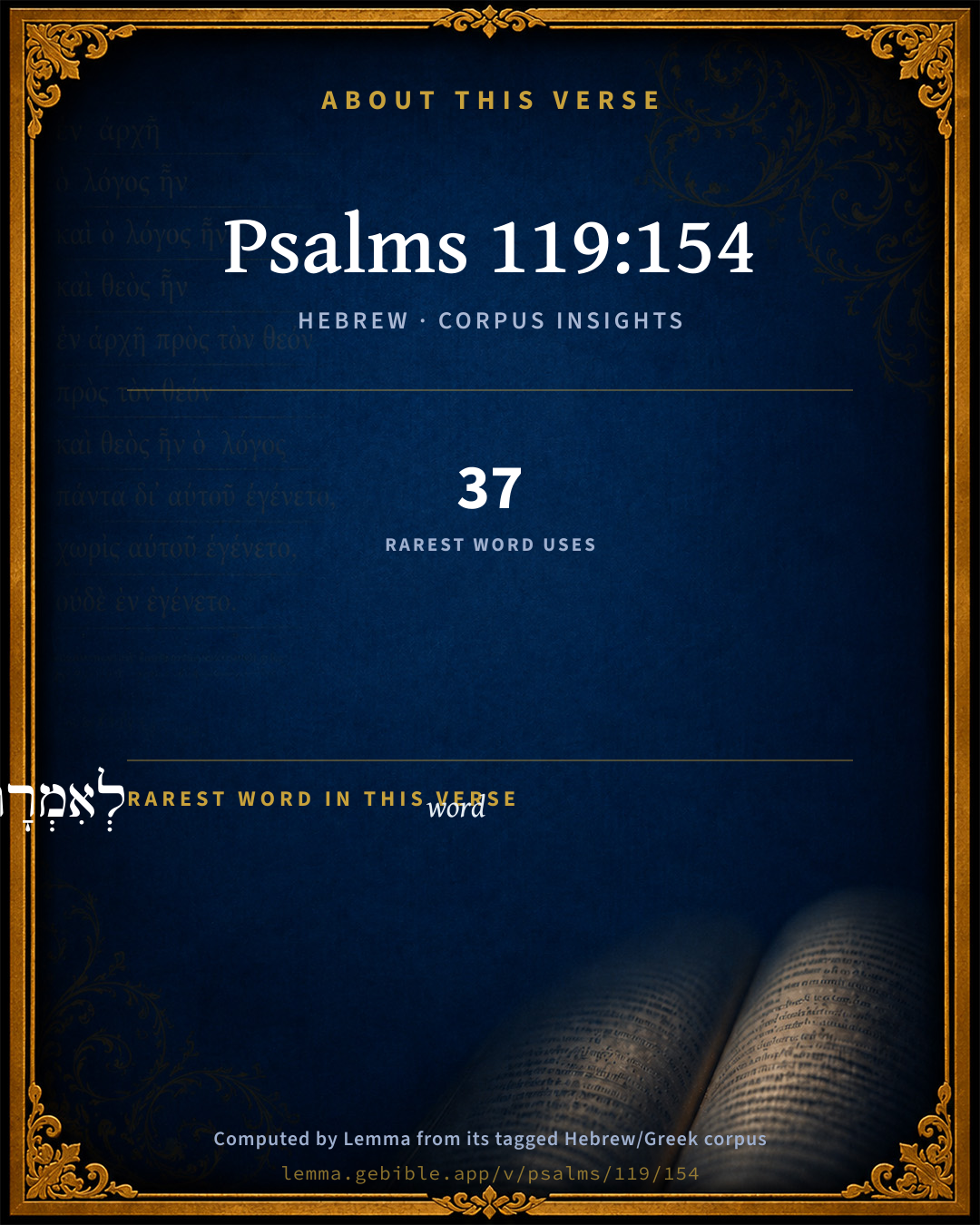
These counts appear in no published source. They are computed here, from the morphology-tagged text and Lemma’s own curated glosses. What Lemma adds →

5
words
5
distinct lemmas
Wisdom
section

Shared distinctive vocabulary

לְאִמְרָתְךָ֥ word H565 occurs in 35 verses of the Hebrew Bible. Also found in:

Grammatical profile

  • 3 verbs
  • 2 nouns

Verb forms

  • רִיבָ֣ה Qal · Imperative
  • וּגְאָלֵ֑נִי Qal · Imperative
  • חַיֵּֽנִי Piel · Imperative

Hebrew & Septuagint length

In English translation the verse runs 12 words from the Hebrew and 12 from the Septuagint (LXX English) — the same length.

A rough comparison of the two English renderings, which tokenize alike — not a word-level alignment.

Word counts can differ between the Hebrew and the Greek without any difference in meaning — e.g. the Hebrew direct-object marker אֵת has no separate Greek word, and Greek often adds the article ὁ.

Cross-references

12

Topical passages linked to Psalms 119:154 in the Treasury of Scripture Knowledge — connected by theme and wording, ordered by reader-vote popularity; previews shown in the World English Bible.

  • Psalms 35:1 Contend, Yahweh, with those who contend with me. Fight against those who fight against me.
  • 1 Samuel 24:15 Yahweh therefore be judge, and give sentence between me and you, and see, and plead my cause, and deliver me out of your hand.
  • Jeremiah 50:34 Their Redeemer is strong; Yahweh of Hosts is his name: he will thoroughly plead their cause, that he may give rest to the earth, and disquiet the inhabitants of Babylon.
  • Micah 7:9 I will bear the indignation of Yahweh, Because I have sinned against him, Until he pleads my case, and executes judgment for me. He will bring me forth to the light. I will see his righteousness.
  • Psalms 119:25 My soul is laid low in the dust. Revive me according to your word!
  • Psalms 119:40 Behold, I long for your precepts! Revive me in your righteousness.
  • Jeremiah 11:20 But, Yahweh of Hosts, who judge righteously, who try the heart and the mind, I shall see your vengeance on them; for to you have I revealed my cause.
  • Job 5:8 "But as for me, I would seek God, To God would I commit my cause;
  • Psalms 43:1 Vindicate me, God, and plead my cause against an ungodly nation. Oh, deliver me from deceitful and wicked men.
  • Proverbs 22:23 For Yahweh will plead their case, And plunder the life of those who plunder them.
  • Jeremiah 51:36 Therefore thus says Yahweh: Behold, I will plead your cause, and take vengeance for you; and I will dry up her sea, and make her fountain dry.
  • 1 John 2:1 My little children, I write these things to you so that you may not sin. If anyone sins, we have a Counselor with the Father, Jesus Christ, the righteous.

Cross-references courtesy of OpenBible.info (CC BY 4.0).

Hebrew and Greek witnesses Masoretic Hebrew ↔ Greek Septuagint

The same verse in the two great witnesses to the Old Testament, shown verse-for-verse.

You’re reading Greek Psalm 118 (Hebrew Psalm 119). The Septuagint counts the superscription, so verse numbers can differ from the Hebrew — chapter-level alignment, not verse-by-verse. Numbering follows Rahlfs.

These are two independent witnesses, not word-aligned to each other, and the Septuagint is shown in lemma (dictionary) form.

Hebrew Psalms 119:154 Masoretic · Westminster Leningrad Codex

רִיבָ֣ה רִ֭יבִי וּגְאָלֵ֑נִי לְאִמְרָתְךָ֥ חַיֵּֽנִי

Plead my cause, and redeem me! Revive me according to your promise.

World English Bible · Public Domain

Greek LXX Greek Psalm 118:154 Septuagint · lemma form

κρίνω ὁ κρίσις ἐγώ καί λυτρόω ἐγώ διά ὁ λόγος σύ ζάω ἐγώ

Plead my cause, and ransom me: quicken me because of your word.

LXX2012 (modern English Septuagint) · Public Domain

Hebrew: Westminster Leningrad Codex (CC BY 4.0). Greek: Septuagint (public domain); English from LXX2012 (modern English Septuagint) (Public Domain). How the Septuagint differs from the Hebrew →

Commentary

Notes on Psalms 119:154 from classic Christian and Jewish commentators (each source and its license shown beneath its notes). The classic Christian expositions comment on the surrounding passage and are grouped to its opening verse, so a note may address several verses; the Jewish commentaries on the Tanakh (Rashi and others) are per-verse, so they appear only where the commentator wrote on this verse.

Lemma curates 59 commentaries, every one of them public domain or Creative Commons licensed, each selected and text-cleaned for this edition rather than reprinted as found. About our sources →

Trapp's Complete Commentary

John Trapp

Psa 119:154 Plead my cause, and deliver me: quicken me according to thy word.

Ver. 154. Plead my cause, and deliver me] Litiga litigium meum. Be both mine advocate and my redeemer.

John Trapp, A Commentary or Exposition upon All the Books of the Old and New Testament (1647–1656) — public domain. Text from a community e-Sword module.

J. A. Alexander on Psalms

Joseph Addison Alexander

154. (Psa 119:154) Strive my strife and redeem me; as to thy word, quicken me. With the first clause compare Psa 43:1; Psa 69:18. As to, according to, in fulfilment of, thy saying, that which thou hast said, thy promise. Seeabove, Psa 119:41.

Joseph Addison Alexander, The Psalms Translated and Explained (1850) — public domain. Text from a community e-Sword module.

Geneva Bible (1599)

Geneva Bible translators

For without God’s promise there is no hope of deliverance.

Geneva Bible (1599) marginal notes — public domain. Text via Bolls.life.

Adam Clarke's Commentary

Verse 154. Plead my cause] ריבה ריבי ribah ribi. "Be my Advocate in my suit." Contend for us against the Babylonians, and bring us out of our bondage.

According to thy word.] Spoken by thy prophets for our comfort and encouragement.

Adam Clarke's Commentary on the Bible (1810–1826) — public domain. Text from a community e-Sword/MySword module.

John Calvin's Commentaries

154. Debate thy cause, and redeem me. In this verse David specifics the kind of his affliction, which was the wrongful and harassing treatment which he met with at the hands of evil and unprincipled men. The reading literally is, Plead my cause, which is the same thing as to undertake a cause, or to take the charge of defending one in judgment, or to maintain the right of the oppressed. In the first place the Prophet in invoking God to defend his cause, shows that he is wrongfully oppressed, either by violence, calumnies, or crafty policies; and in seeking to be redeemed, he intimates that he was unable to make any resistance, or that he was so entangled in their snares, as to have no remaining hope except in the deliverance of God. In the second clause the letter ל, lamed, seems to be taken for the letter כ, caph, the mark of similitude, “La letre כ, qui signifie Sclon.” — Fr. “The letter כ, which signifies ‘According to.’”

John Calvin's Commentaries (1540-1563) — public domain. Text from the Calvin Translation Society English edition (1840s-50s) via the Christian Classics Ethereal Library (ccel.org). Calvin's coverage is partial (roughly two-thirds of the Bible); uncommented books and verses are honest gaps, never fabricated. The 19th-century editor's footnotes and remarks are omitted so the notes are faithfully Calvin's own voice.

The Cambridge Bible for Schools and Colleges

gen. ed. J. J. S. Perowne

154. Plead my cause] The dispute between him and his persecutors is represented as a lawsuit: will not Jehovah be his advocate? Cp. Psa_35:1; Psa_43:1; Isa_51:22.

deliver me] Redeem me, as from bondage. Cp. Exo_6:6; Exo_15:13; Psa_19:14, and the frequent description of Jehovah as Israel’s Redeemer from exile in Isaiah 40-66.

The Cambridge Bible for Schools and Colleges (gen. ed. J. J. S. Perowne; Cambridge University Press, 1878–1918) — public domain. Text from a community e-Sword module.

John Gill's Exposition

I beheld the transgressors, and was grieved,.... Transgressors of the law of God, profane sinners; such as among whom he dwelt in Mesech and Kedar; it grieved him when he beheld their wicked life and conversation; as Lot in Sodom; and Isaiah and Jeremiah, among persons of unclean lips, and an assembly of treacherous men: and the word here used signifies "treacherous" (g) persons; and may design not the profane only, but professors also; that dealt treacherously with God and men, made a profession of religion, but walked not agreeably to it, which is matter of grief to good men; see Phi 3:18; as well as the conduct of abandoned sinners; with whom the psalmist was grieved, not so much on his own account, being hated and persecuted by them, as on their account, because of the ruin they brought upon themselves; but chiefly because of the dishonour of God, and their disregard to his righteous law. Joseph Kimchi paraphrases it,

"I saw them prosper, and was weary of my life;''

and refers for the sense of the word to Job 10:1; as does also Aben Ezra; but David Kimchi and the Targum interpret it "I strove", or "contended" with them; that is, with the transgressors;

because they kept not thy word: did not regard the doctrines, nor observe the precepts of it; but despised, rejected, and cast them away from them.

(g) "perfidos", Vatablus, Cocceius, Michaelis; "perfide agentes", Junius & Tremellius, Piscator.

John Gill's Exposition of the Whole Bible (1746–1763) — public domain (CC PDM 1.0). Text via the HelloAO Bible API.

Albert Barnes' Notes on the Bible

Plead my cause ... - Undertake my cause, as an advocate does. See the notes at Psa 35:1.

Quicken me ... - Give me life. See the notes at Psa 119:25.

Albert Barnes' Notes on the Bible (1834–1885) — public domain. Text from a community e-Sword/MySword module.

The Treasury of David

Charles H. Spurgeon

Ver. 154. Plead my cause, and deliver me. In the last verse he had prayed, "Deliver me, "and here he specifies one method in which that deliverance might be vouchsafed, namely, by the advocacy of his cause. In providence the Lord has many ways of clearing the slandered of the accusations brought against them. He can make it manifest to all that they have been belied, and in this way he can practically plead their cause. He can, moreover, raise up friends for the godly who will leave no stone unturned till their characters are cleared; or he can smite their enemies with such fearfulness of heart that they will be forced to confess their falsehood, and thus the righteous will be delivered without tile striking of a blow. Alexander reads it, "Strive my strife, and redeem me" that is, stand in my stead, bear my burden, fight my fight, pay my price, and bring me out to liberty. When we feel ourselves dumb before the foe, here is a prayer made to our hand. What a comfort that if we sin we have an advocate, and if we do not sin the same pleader is engaged on our side.

Quicken me. We had this prayer in the last section, and we shall have it again and again in this. It is a desire which cannot be too often felt and expressed. As the soul is the centre of everything, so to be quickened is the central blessing. It means more love, more grace, more faith more courage, more strength, and if we get these we can hold up our heads before our adversaries. God alone can give this quickening; but to the Lord and giver of life the work is easy enough, and he delights to perform it.

According to thy word. David had found such a blessing among the promised things, or at least he perceived that it was according to the general tenor of God's word that tried believers should be quickened and brought up again from the dust of the earth; therefore he pleads the word, and desires the Lord to act to him according to the usual run of that word. What a mighty plea is this "according to thy word." No gun in all our arsenals can match it.

Ver. 154. Plead my cause, and deliver me, etc. Albeit the godly under persecution have a good cause, yet they cannot plead it except God the Redeemer show himself as Advocate for them; therefore prayeth the Psalmist, "Plead my cause."

When God the Redeemer pleadeth a man's cause, he doth it to purpose and effectually: "Plead my cause, and deliver me."

Except the Lord's clients shall find new influence from God from time to time in their troubles, they are but as dead men in their exercise; for, "Quicken me" imports this.

Till we find lively encouragement given to us in trouble we must adhere to the word of promise: "Quicken me according to thy word."

What the believer hath need of, that God hath not only a will to supply, but also an office to attend it, and power to effectuate it, as here he hath the office of an Advocate and of a powerful Redeemer also, wherein the believer may confidently give him daily employment, as he needeth: "Plead my cause, and deliver me: quicken me according to thy word." David Dickson.

Ver. 154. Plead my cause, and deliver me, etc. He now supposes himself to be arraigned before the tribunal of men, as he certainly was in their general charges against him; arraigned, too, in his helplessness, without a name, without state; in such way as one disowned would be arraigned. He prays the Lord to come in and plead his cause; so should he be redeemed; for this is the import of the original. As it were, he regards himself as one sold to corrupt judges, or at all events, as one that has lost his standing in society in the estimation of men. But if the Lord will come, and maintain the cause of his servant, his servant shall be redeemed indeed. There is good confidence in this prayer; the man of God is acquainted with the way of the Lord, and he makes his believing application. O how much do we need to know the Lord's righteous character in our seasons of great distress! Now the Lord pleads the cause of his own by the power of the truth; he pleads it also in his providences of divers kinds; he acts upon the hearts, and the hopes, and the fears of men; and in many wondrous ways he pleads his people's cause. He redeems his saints from all evil; and if not together from all evil in this world, certainly from all evil as concerns the world to come. John Stephen.

Ver. 154. Plead my cause, and deliver me, etc. In this verse are three requests, and all backed with one and the same argument. In the first, he intimates the right of his and that he was unjustly vexed by wicked cause, men; therefore, as burdened with their calumnies, he desireth God to undertake his defence: "Plead my cause." In the second, he represents the misery and helplessness of his condition; therefore, as oppressed by violence, he saith, "Deliver me; "or, as the words will bear, "Redeem me". In the third, his own weakness, and readiness to faint under this burden; therefore he saith, "Quicken me."

Or, in short, with respect to the injustice of his adversaries, "Plead my cause; "with respect to the misery of his own condition, "Deliver me; "with respect to the weakness and imbecility of his own heart, "Quicken me."

The reason and ground of asking, "According to thy word." This last clause must be applied to all the branches of the prayer: "Plead my cause, ""according to thy word; ""deliver me, ""according to thy word; ""quicken me, ""according to thy word:" for God in his word engages for all: to be advocate, Redeemer, and fountain of life. The word that David buildeth upon was found either in the general promises made to them that kept the law, or in some particular promise made to himself by the prophets of that time. Thomas Manton.

Ver. 154. Plead my cause, and deliver me. A wicked woman once brought against Dr. Payson an accusation, under circumstances which seemed to render it impossible that he should escape. She was in the same packet, in which, many months before, he had gone to Boston. For a time, it seemed almost certain that his character would be ruined. He was cut off from all resource except the throne of grace. He felt that his only hope was in God; and to him he addressed his fervent prayer. He was heard by the Defender of the innocent. A "compunctious visiting" induced the wretched woman to confess that the whole was a malicious slander. From Asa Cummings' Memoir of Edward Payson.

Ver. 154. Plead my cause. I do not know that David meant, by calling upon God to plead his cause, anything more than that he should vindicate his innocence, and make it manifest to all, by delivering him out of the hand of all his enemies; but whether he had an ulterior reference or no, the word powerfully and sweetly recalls to every Christian heart him who was indeed to be the Advocate for poor sinners, even Jesus Christ the righteous, who is the propitiation for our sins. Barton Bouchier.

Ver. 154. Plead my cause. The children of this world are wiser in their generation than the children of God. Which made David here pray to God that he would plead his cause, and be his Advocate against all their lies. He trusted not to the equity of his own cause, but to the Lord. From whence we gather, that the cause why our oppressors prevail oft against us is, because we trust too much in our own wits, and lean too much upon our own inventions; opposing subtilty to subtilty, one evil device to another, matching and maintaining policy by policy, and not committing our cause to God. Abraham Wright.

Ver. 154. Deliver. Not as in Ps 119:153, but a word meaning to redeem, or to save by avenging. The corresponding participle is rendered redeemer, avenger, revenger, kinsman, near kinsman, next kinsman. William S. Plumer.

Ver. 154. Quicken me. Here, again, we are called to consider the bearing of the pious mind. Ever and anon, the great desire of the man of God is to advance in the divine life. He makes spiritual gain of everything. He seeks his goodly pearls out of strange conditions; the reason is, his heart is in these things. Deliverance from temporal evil, deliverance from spiritual evil, both were sought; but along with these, ever does the man of God take up the prayer to be quickened. Certainly we may understand him as seeking life. Such is the import of the phraseology; but in a man like David, the life he seeks must be the highest. He desires spiritual life above all things; he wants to get more into a blessed assimilation to God, that so he may enjoy the highest good. So pants the heaven born soul...Give the believer this, and this will set him above all the ills of life. And this and all good had been promised in the word. So he prays, "Quicken me according to the word." He goes upon the word for everything; he cannot be self deceived there. Judge of yourselves, my brethren, by your spiritual aspirations. Nothing less will prove you to be of the Lord's redeemed. John Stephen.

Ver. 154, 156, 159. Quicken me. Pray to be quickened, as the Psalmist often does, and look unto Jesus, who is a quickening spirit: 1Co 15:45. "The first man Adam was made a living soul; the last Adam was made a quickening spirit." As he has given you life, so he is ready to give it more and more abundantly; this will make you to live to him, and to be unweariedly active for him. Nathanael Vincent, in "A Present for such as have been Sick and

Recovered, "1693.

Outlines Upon Keywords of the Psalm, By Pastor C. A. Davis.

Ver. 154,156,159. The threefold quickening. A capital subject, if the contexts are carefully considered.

Ver. 154. Intercession, deliverance, quickening, and all in faithfulness to the word.

Ver. 154. A prayer.

1. For promised defence.

2. For promised deliverance.

3. For promised revival

G.R.

Ver. 154. The Advocate.

1. The soul hard pressed by the accuser in the conscience (1Jo 3:20); before the world; at the throne of grace (Zec 3:1-10); at the bar of judgment.

2. The accused soul committing its case to the Advocate: 1Jo 2:2; 2Ti 1:12.

3. How the case will go. He never lost one yet.

C.A.D.

Psalms 119:155*

Charles H. Spurgeon's The Treasury of David (1869–1885) — public domain. Psalms only. Text from a community e-Sword/MySword module.

The Pulpit Commentary

Plead my cause. (comp. Psa_35:1 Psa_43:1 Mic_7:9) God "pleads the cause" of his servants when he takes up their quarrel, and avenges them upon their enemies. And deliver me; or, "rescue me" (Cheyne). Quicken me according to thy Word (comp. ver. 25).

The Pulpit Commentary (1880–1919), ed. H.D.M. Spence-Jones & Joseph S. Exell — public domain. Text from a community e-Sword module.

Scofield Reference Notes

C. I. Scofield

deliver

Heb. "goel," Redemp. (Kinsman type). (See Scofield "Isa 59:20").

The Scofield Reference Bible (1917 edition), notes by C. I. Scofield — public domain. Text from a community e-Sword module.

Lesson kit

Teaching starters — assembled from the data on this page, not authored interpretation. Every prompt links to the verse data it draws on. Edit before teaching.

Psalms, in the Wisdom, opens this verse with 5 words (5 distinct Hebrew lemmas). Its most distinctive word is ʼimrâh (“word”). A historical commentator’s framing appears above. Read the whole chapter for the surrounding context.

Discussion questions

  1. What does “word” (ʼimrâh) contribute to the verse as a whole?
  2. How does Genesis 4:23, which shares the word «word», read alongside this verse?
  3. These translations render this verse differently; the difference is in the English rendering, not the original. What questions does that raise?
  4. «רִיבָ֣ה» is a Qal Imperative verb. How does that grammatical form shape the action described?
  5. Compare how Trapp's Complete Commentary and J. A. Alexander on Psalms read this verse. Where do they agree or differ?

Things to notice

Reading settings

Reading text

Shown beneath each verse's original-language words.

Old Testament
Old Testament edition

Read the OT as the Masoretic Hebrew (MT) or the Greek Septuagint (LXX).

English shown for the Greek Septuagint (in the Hebrew ↔ Greek comparison).

Comparing translations? Open the Compare panel on any verse page to stack up to four side by side.