
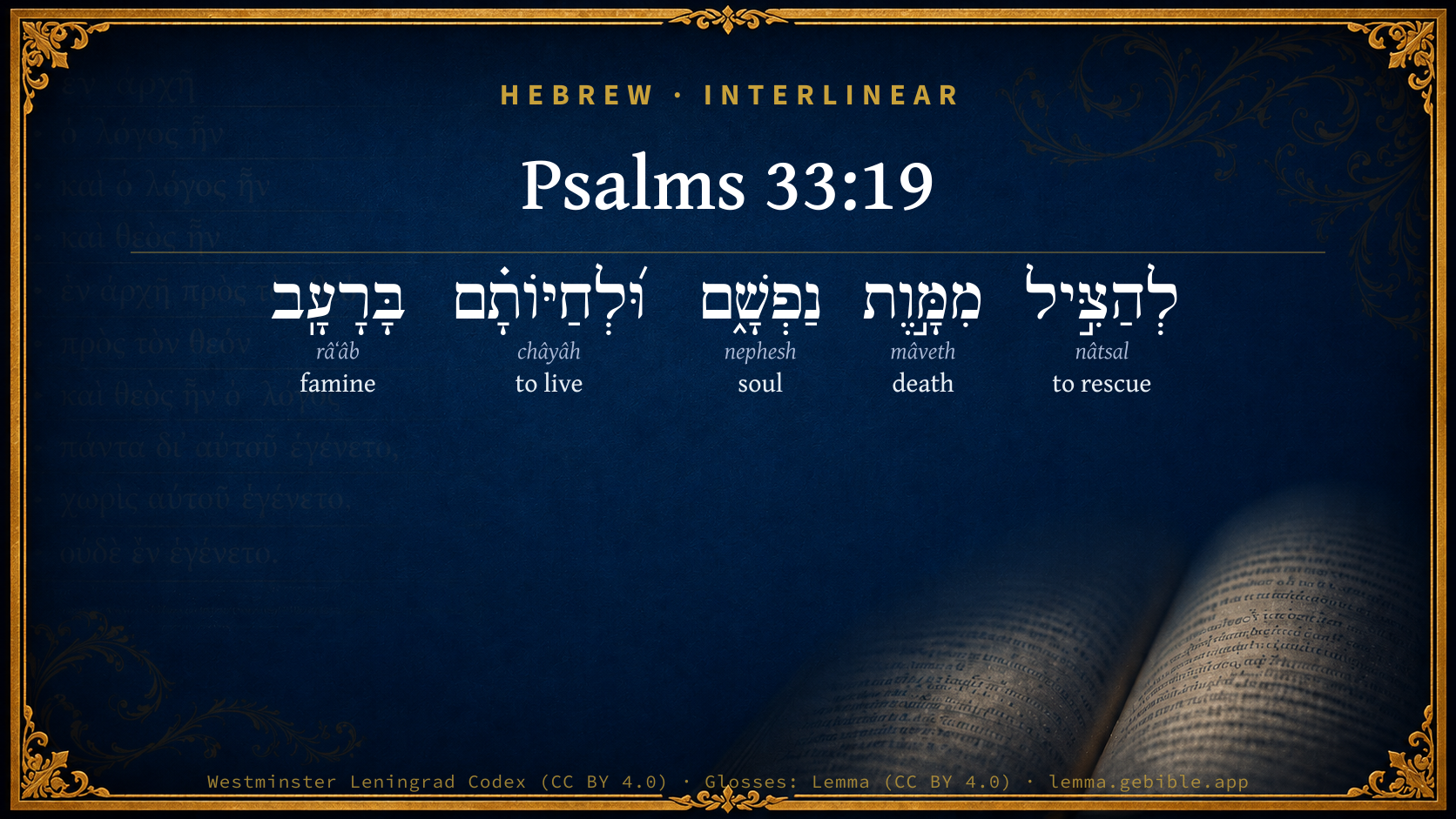
Psalms 33:19

Hebrew (Westminster Leningrad Codex) Psalms 33:19 appears in the Hebrew Old Testament. The text above is from the Westminster Leningrad Codex. Each word links to its Strong’s number, a concise gloss, and parsing drawn from the Open Scriptures Hebrew Bible morphology. Click any word for its full Brown-Driver-Briggs (BDB) entry.
Download image
Cite this verse

Psalms 33:19 (World English Bible). Public Domain. Lemma interlinear Bible study tool, https://lemma.gebible.app/v/psalms/33/19.

Show BibTeX & RIS
BibTeX
RIS
English Translation
To deliver their soul from death, To keep them alive in famine.
World English Bible · Public Domain
Download a study sheet

One document with this verse’s original text, its word-by-word gloss line, the meaning frame, cross-references with their text, attributed commentary, and full source and license credits — printable, and it pastes into notes with its structure intact.

This verse Autodidact and up

Study sheet (.html) Plain text (.txt)

A passage Seminary Student

Up to 50 verses in one chapter. A passage sheet keeps up to 6 commentary sources and 12 cross-references per verse, in the order this page ranks them, and says so on the sheet whenever that leaves anything out. Ask for a single verse and you get the Autodidact verse sheet above.

Everything on this page stays free to read, with no account — the sheet is a download of what is already on screen, not access to it.

Want to remove ads? Support Godless Engineer
Compare translations 3

The same verse in 3 English versions, stacked beneath the original-language interlinear above. Click any original word for its lexicon entry.

Each is an independent rendering of the whole verse — the interlinear is not word-aligned to these translations.

Highlighted words mark where these versions differ — a whole-verse word diff, not a word-by-word alignment.

  • World English Bible Public Domain
    To deliver their soul from death, To keep them alive in famine.
  • King James Version Public Domain
    To deliver their soul from death, and to keep them alive in famine.
  • unfoldingWord Literal Text CC BY-SA 4.0
    to deliver their soul from death and to keep them alive in the famine.

unfoldingWord Literal Text — © unfoldingWord, licensed CC BY-SA 4.0. Word-aligned USFM3 via Door43 (git.door43.org/unfoldingWord/en_ult).

Versions to compare (up to 4)

3 of 4 selected

Show all 18 translations

Every available English version of this verse, each an independent rendering of the whole verse.

  • World English Bible Public Domain
    To deliver their soul from death, To keep them alive in famine.
  • Berean Standard Bible Public Domain
    to deliver them from death and keep them alive in famine.
  • Majority Standard Bible Public Domain
    to deliver them from death and keep them alive in famine.
  • King James Version Public Domain
    To deliver their soul from death, and to keep them alive in famine.
  • American Standard Version (1901) Public Domain
    To deliver their soul from death, And to keep them alive in famine.
  • Revised Version (1885) Public Domain
    To deliver their soul from death, and to keep them alive in famine.
  • Geneva Bible (1599) Public Domain
    To deliuer their soules from death, and to preserue them in famine.
  • Douay-Rheims (1899) Public Domain
    To deliver their souls from death; and feed them in famine.
  • Young's Literal Translation Public Domain
    To deliver from death their soul, And to keep them alive in famine.
  • Literal Standard Version CC BY-SA 4.0
    To deliver their soul from death, || And to keep them alive in famine.
  • Unlocked Literal Bible CC BY-SA 4.0
    to deliver their lives from death and to keep them alive in times of famine.
  • unfoldingWord Literal Text CC BY-SA 4.0
    to deliver their soul from death and to keep them alive in the famine.
  • Darby Bible Public Domain
    To deliver their soul from death, and to keep them alive in famine.
  • World Messianic Bible Public Domain
    to deliver their soul from death, to keep them alive in famine.
  • Webster's Bible Public Domain
    To deliver their soul from death, and to keep them alive in famine.
  • Free Bible Version CC BY-SA 4.0
    to save them from death and to keep them alive when famine strikes.
  • Bible in Basic English Public Domain
    To keep their souls from death; and to keep them living in time of need.
  • JPS Tanakh (1917) Public Domain
    To deliver their soul from death, and to keep them alive in famine.

Literal Standard Version (2020), Covenant Press — licensed CC BY-SA 4.0. Text via the HelloAO Bible API (eBible.org). Unlocked Literal Bible (unfoldingWord) — licensed CC BY-SA 4.0. Text via the HelloAO Bible API (eBible.org). unfoldingWord Literal Text — © unfoldingWord, licensed CC BY-SA 4.0. Word-aligned USFM3 via Door43 (git.door43.org/unfoldingWord/en_ult). Free Bible Version, Dr. Jonathan Gallagher — licensed CC BY-SA 4.0. Text via the HelloAO Bible API (eBible.org).

Word by word

More ways to search: Search by grammar → Find every occurrence → Compare this word →

Practice this passage: Drill this verse → Learn its vocabulary →

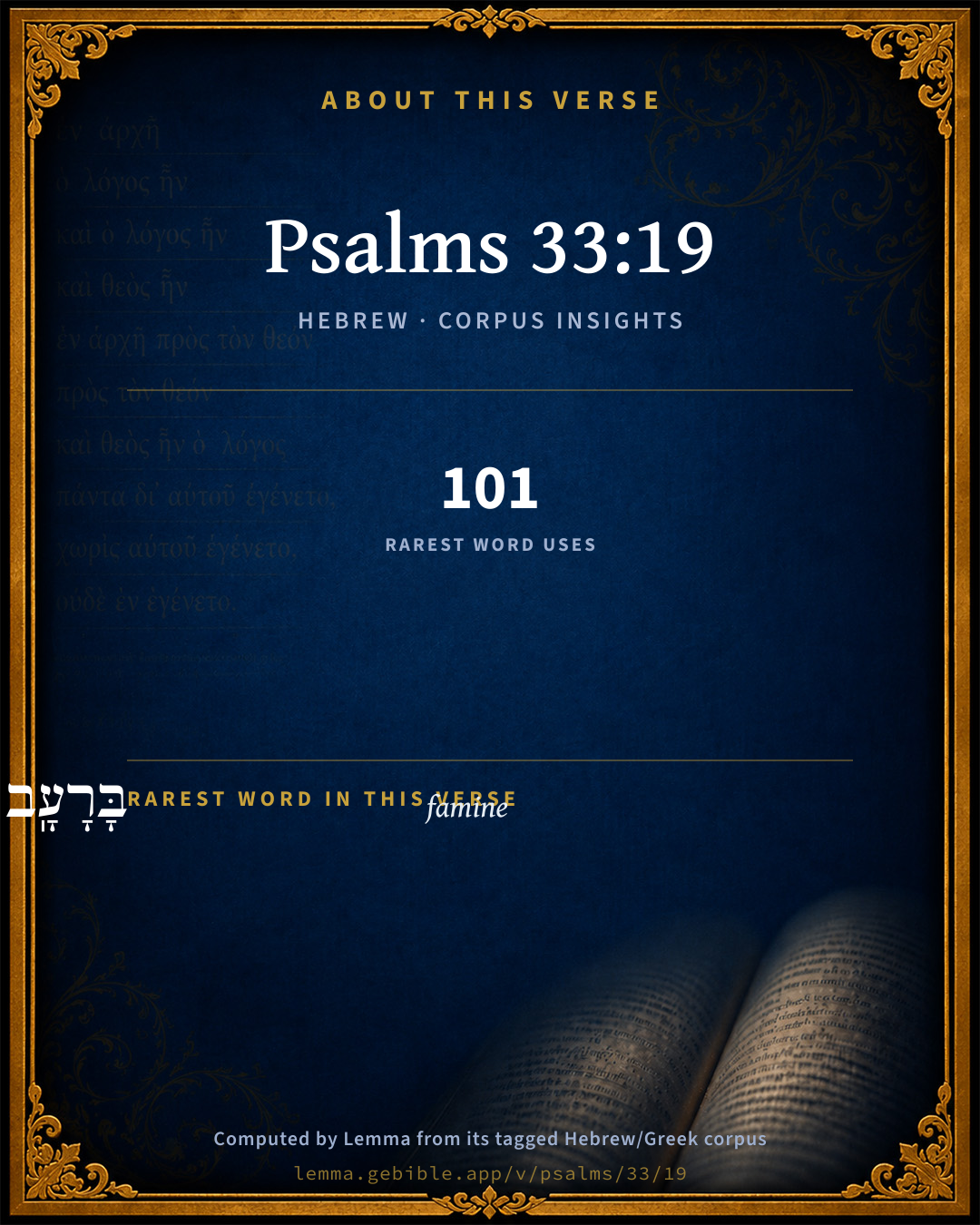
About this verse

These counts appear in no published source. They are computed here, from the morphology-tagged text and Lemma’s own curated glosses. What Lemma adds →

5
words
5
distinct lemmas
Wisdom
section

Grammatical profile

  • 2 verbs
  • 3 nouns

Verb forms

  • לְהַצִּ֣יל Hiphil · Infinitive Construct
  • וּ֝לְחַיּוֹתָ֗ם Piel · Infinitive Construct

Hebrew & Septuagint length

In English translation the verse runs 12 words from the Hebrew and 13 from the Septuagint (LXX English) — closely comparable.

A rough comparison of the two English renderings, which tokenize alike — not a word-level alignment.

Word counts can differ between the Hebrew and the Greek without any difference in meaning — e.g. the Hebrew direct-object marker אֵת has no separate Greek word, and Greek often adds the article ὁ.

Cross-references

11

Topical passages linked to Psalms 33:19 in the Treasury of Scripture Knowledge — connected by theme and wording, ordered by reader-vote popularity; previews shown in the World English Bible.

  • Psalms 37:19 They shall not be disappointed in the time of evil. In the days of famine they shall be satisfied.
  • Proverbs 10:3 Yahweh will not allow the soul of the righteous to go hungry, But he thrusts away the desire of the wicked.
  • Job 5:19–22 He will deliver you in six troubles; Yes, in seven there shall no evil touch you.
  • Isaiah 33:16 He shall dwell on high; his place of defense shall be the munitions of rocks; his bread shall be given [him]; his waters shall be sure.
  • Matthew 6:31–33 "Therefore don't be anxious, saying, 'What will we eat?', 'What will we drink?' or, 'With what will we be clothed?'
  • John 10:28 I give eternal life to them. They will never perish, and no one will snatch them out of my hand.
  • Psalms 37:3 Trust in Yahweh, and do good. Dwell in the land, and enjoy safe pasture.
  • Psalms 91:3–7 For he will deliver you from the snare of the fowler, And from the deadly pestilence.
  • Psalms 91:10 No evil shall happen to you, Neither shall any plague come near your dwelling.
  • John 10:30 I and the Father are one."
  • Acts 12:11 When Peter had come to himself, he said, "Now I truly know that the Lord has sent out his angel and delivered me out of the hand of Herod, and from everything the Jewish people were expecting."

Cross-references courtesy of OpenBible.info (CC BY 4.0).

Hebrew and Greek witnesses Masoretic Hebrew ↔ Greek Septuagint

The same verse in the two great witnesses to the Old Testament, shown verse-for-verse.

You’re reading Greek Psalm 32 (Hebrew Psalm 33). The Septuagint counts the superscription, so verse numbers can differ from the Hebrew — chapter-level alignment, not verse-by-verse. Numbering follows Rahlfs.

These are two independent witnesses, not word-aligned to each other, and the Septuagint is shown in lemma (dictionary) form.

Hebrew Psalms 33:19 Masoretic · Westminster Leningrad Codex

לְהַצִּ֣יל מִמָּ֣וֶת נַפְשָׁ֑ם וּ֝לְחַיּוֹתָ֗ם בָּרָעָֽב

To deliver their soul from death, To keep them alive in famine.

World English Bible · Public Domain

Greek LXX Greek Psalm 32:19 Septuagint · lemma form

ῥύομαι ἐκ θάνατος ὁ ψυχή αὐτός καί διατρέφω αὐτός ἐν λιμός

to deliver their souls from death, and to keep them alive in famine.

LXX2012 (modern English Septuagint) · Public Domain

Hebrew: Westminster Leningrad Codex (CC BY 4.0). Greek: Septuagint (public domain); English from LXX2012 (modern English Septuagint) (Public Domain). How the Septuagint differs from the Hebrew →

Commentary

Notes on Psalms 33:19 from classic Christian and Jewish commentators (each source and its license shown beneath its notes). The classic Christian expositions comment on the surrounding passage and are grouped to its opening verse, so a note may address several verses; the Jewish commentaries on the Tanakh (Rashi and others) are per-verse, so they appear only where the commentator wrote on this verse.

Lemma curates 59 commentaries, every one of them public domain or Creative Commons licensed, each selected and text-cleaned for this edition rather than reprinted as found. About our sources →

Trapp's Complete Commentary

John Trapp

Psa 33:19 To deliver their soul from death, and to keep them alive in famine.

Ver. 19. To deliver their soul] Freedom from troubles he promiseth not; but deliverance in due time he assureth them; and support in the mean while, to keep them alive in famine.

John Trapp, A Commentary or Exposition upon All the Books of the Old and New Testament (1647–1656) — public domain. Text from a community e-Sword module.

J. A. Alexander on Psalms

Joseph Addison Alexander

19. (Psa 33:19) To deliver from death their soul, and to keep them alive in the famine. The sentence is continued from the foregoing verse. His eye is towards them for the very purpose of interposing when he sees it to be necessary, for the rescue of their soul, their life, from death in general, to which is added one specific form of danger well known to the ancient Hebrews. The famine is a similar expression to the king in Psa 33:16, and to our common phrase the pestilence, when used in a generic sense, and not in reference to any particular disease or visitation.

Joseph Addison Alexander, The Psalms Translated and Explained (1850) — public domain. Text from a community e-Sword module.

Adam Clarke's Commentary

Verse 19. To deliver their soul frown death] To watch over and protect them in all sudden dangers and emergencies, so that they shall not lose their LIVES by any accident.

And to keep them alive in famine.] Not only prevent sudden death by an instantaneous interposition of my power, but keep them from a lingering death, by extraordinary supplies granted them in an extraordinary manner; because I am all in all, and all everywhere.

Adam Clarke's Commentary on the Bible (1810–1826) — public domain. Text from a community e-Sword/MySword module.

John Calvin's Commentaries

Again, when it is affirmed, that God, in times of famine and dearth, has remedies in readiness to preserve the lives of the godly, we are taught that the faithful only pay due honor to his providence when they allow not their hearts to despond in the extremest indigence; but, on the contrary, raise their hopes even from the grave. God often suffers his servants to be hungry for a time that he may afterwards satiate them, and he overspreads them with the darkness of death that he may afterwards restore them to the light of life. Yea, we only begin to place our trust firmly in him when death comes to present itself before our eyes; for, until we have known by experience the vanity of the aids of the world, our affections continue entangled in them, and wedded to them. The Psalmist characterises believers by two marks, which comprehend the whole perfection of our life. The first is, that we reverently serve the Lord; and the second, that we depend upon his grace. Hypocrites may loudly boast of their faith, but they have never tasted even a little of the divine goodness, so as to be induced to look to him for what they need. On the contrary, when the faithful give themselves with their whole heart to the service and fear of God, this affection springs from faith; or rather the principal part of right worship, which the faithful render to God, consists in this, that they depend upon his mercy.

John Calvin's Commentaries (1540-1563) — public domain. Text from the Calvin Translation Society English edition (1840s-50s) via the Christian Classics Ethereal Library (ccel.org). Calvin's coverage is partial (roughly two-thirds of the Bible); uncommented books and verses are honest gaps, never fabricated. The 19th-century editor's footnotes and remarks are omitted so the notes are faithfully Calvin's own voice.

The Cambridge Bible for Schools and Colleges

gen. ed. J. J. S. Perowne

19. death] Violent death by war or pestilence is meant, as the parallel line shews. Famine was a common scourge in Palestine (Psa_37:19).

The Cambridge Bible for Schools and Colleges (gen. ed. J. J. S. Perowne; Cambridge University Press, 1878–1918) — public domain. Text from a community e-Sword module.

John Gill's Exposition

To deliver their soul from death,.... Not a corporeal death, for the soul dies not, and is never in any danger of death; and should life, or the whole man, be intended here, yet those that fear the Lord, and hope in his mercy, are not exempted and secured from a corporeal death, but die as other men; though sometimes indeed they are remarkably preserved from death, and even in a time of general calamity; but a spiritual death is meant, which, while in a state of nature, they are under; but, being quickened at conversion, they live spiritually, and are preserved from dying any more in this sense; and also from an eternal death, which shall never harm them, nor have any power over them;

and to keep them alive in famine; not corporeal, though the Lord does give meat to them that fear him, and sometimes in a miraculous way provides for them; as by sending ravens to feed them, and by increasing the cruse of oil; see Isa 41:17; but spiritual, a famine of hearing the word of the Lord; the Lord prepares a place for his church and people in the wilderness, where they are privately nourished with the word and ordinances, and their souls kept alive, Rev 12:6.

John Gill's Exposition of the Whole Bible (1746–1763) — public domain (CC PDM 1.0). Text via the HelloAO Bible API.

Albert Barnes' Notes on the Bible

To deliver their soul from death - To preserve their “lives,” - for so the word “soul” is to be understood here. The meaning is, to keep them alive. That is, God is their Protector; He guards and defends them when in danger.

And to keep them alive in famine - In times of want. Compare Job 5:20. He can provide for them when the harvests fail. Famine was one of the evils to which the inhabitants of Palestine, and of Oriental countries generally, were particularly exposed, and it is often referred to in the Scriptures.

Albert Barnes' Notes on the Bible (1834–1885) — public domain. Text from a community e-Sword/MySword module.

Matthew Poole's English Annotations

Their soul, i.e. their life, when he sees it to be expedient for them: sometimes it is better for them to die than to live, as both good and bad men have declared; and when it is so, it is known to God, but not to us. And therefore the constant accomplishment of this and the like promises in a literal sense is not to be expected, nor simply desired, but with submission to God’s wise and gracious will.

Matthew Poole's English Annotations on the Holy Bible (1683–1685) — public domain. Text from a community e-Sword/MySword module.

The Treasury of David

Charles H. Spurgeon

Ver. 19. To deliver their soul from death. The Lord's hand goes with his eye; he sovereignly preserves those whom he graciously observes. Rescues and restorations hedge about the lives of the saints; death cannot touch them till the King signs his warrant and gives him leave, and even then his touch is not so much mortal as immortal; he doth not so much kill us as kill our mortality. And to keep them alive in famine. Gaunt famine knows its master. God has meal and oil for his Elijahs somewhere. "Verily thou shalt be fed" is a divine provision for the man of faith. The Preserver of men will not suffer the soul of the righteous to famish. Power in human hands is outmatched by famine, but God is good at a pinch, and proves his bounty under the most straitened circumstances. Believer, wait upon thy God in temporals. His eye is upon thee, and his hand will not long delay.

Ver. 19. Life in famine, natural and spiritual, especially a famine of inward hope and legal satisfaction.

Psalms 33:20*

Charles H. Spurgeon's The Treasury of David (1869–1885) — public domain. Psalms only. Text from a community e-Sword/MySword module.

The Pulpit Commentary

To deliver their soul from death. The protection and deliverance, which a man"s own strength cannot give, which no host, however numerous, can afford (ver. 16), which are not to be obtained from the largest chariot or cavalry force (ver. 17), can he and will be furnished freely by God, who alone keeps souls from death, and "delivers" those who are in peril. And to keep them alive in famine. Famine was a calamity from which Palestine often suffered. (see Gen_12:10 Gen_26:1 Gen_42:5 Rth_1:1 2Sa_21:1 1Ki_18:5 2Ki_8:1, etc.) The righteous were sometimes "kept alive" through a time of famine by miraculous means. (1Ki_17:6, 1Ki_17:16)

The Pulpit Commentary (1880–1919), ed. H.D.M. Spence-Jones & Joseph S. Exell — public domain. Text from a community e-Sword module.

Lesson kit

Teaching starters — assembled from the data on this page, not authored interpretation. Every prompt links to the verse data it draws on. Edit before teaching.

Psalms, in the Wisdom, opens this verse with 5 words (5 distinct Hebrew lemmas). Its most distinctive word is râʻâb (“famine”). A historical commentator’s framing appears above. Read the whole chapter for the surrounding context.

Discussion questions

  1. What does “famine” (râʻâb) contribute to the verse as a whole?
  2. Psalms 37:19 shares this passage’s theme. How do the two illuminate each other?
  3. The verb «לְהַצִּ֣יל» is Hiphil Infinitive Construct. How does its form color the action?
  4. Reading how Trapp's Complete Commentary and J. A. Alexander on Psalms read this verse, where do the two commentators agree and where do they part?

Reading settings

Reading text

Shown beneath each verse's original-language words.

Old Testament
Old Testament edition

Read the OT as the Masoretic Hebrew (MT) or the Greek Septuagint (LXX).

English shown for the Greek Septuagint (in the Hebrew ↔ Greek comparison).

Comparing translations? Open the Compare panel on any verse page to stack up to four side by side.