
Ezekiel 37:3

Hebrew (Westminster Leningrad Codex) Ezekiel 37:3 appears in the Hebrew Old Testament. The text above is from the Westminster Leningrad Codex. Each word links to its Strong’s number, a concise gloss, and parsing drawn from the Open Scriptures Hebrew Bible morphology. Click any word for its full Brown-Driver-Briggs (BDB) entry.
Download image
Cite this verse

Ezekiel 37:3 (World English Bible). Public Domain. Lemma interlinear Bible study tool, https://lemma.gebible.app/v/ezekiel/37/3.

Show BibTeX & RIS
BibTeX
RIS
English Translation
He said to me, Son of man, can these bones live? I answered, Lord Yahweh, you know.
World English Bible · Public Domain
Download a study sheet

One document with this verse’s original text, its word-by-word gloss line, the meaning frame, cross-references with their text, attributed commentary, and full source and license credits — printable, and it pastes into notes with its structure intact.

This verse Autodidact and up

Study sheet (.html) Plain text (.txt)

A passage Seminary Student

Up to 50 verses in one chapter. A passage sheet keeps up to 6 commentary sources and 12 cross-references per verse, in the order this page ranks them, and says so on the sheet whenever that leaves anything out. Ask for a single verse and you get the Autodidact verse sheet above.

Everything on this page stays free to read, with no account — the sheet is a download of what is already on screen, not access to it.

Want to remove ads? Support Godless Engineer
Compare translations 3

The same verse in 3 English versions, stacked beneath the original-language interlinear above. Click any original word for its lexicon entry.

Each is an independent rendering of the whole verse — the interlinear is not word-aligned to these translations.

Highlighted words mark where these versions differ — a whole-verse word diff, not a word-by-word alignment.

  • World English Bible Public Domain
    He said to me, Son of man, can these bones live? I answered, Lord Yahweh, you know.
  • King James Version Public Domain
    And he said unto me, Son of man, can these bones live? And I answered, O Lord GOD, thou knowest.
  • unfoldingWord Literal Text CC BY-SA 4.0
    He said to me, “Son of man, can these bones live again?” So I said, “Lord Yahweh, you alone know.”

unfoldingWord Literal Text — © unfoldingWord, licensed CC BY-SA 4.0. Word-aligned USFM3 via Door43 (git.door43.org/unfoldingWord/en_ult).

Versions to compare (up to 4)

3 of 4 selected

Show all 18 translations

Every available English version of this verse, each an independent rendering of the whole verse.

  • World English Bible Public Domain
    He said to me, Son of man, can these bones live? I answered, Lord Yahweh, you know.
  • Berean Standard Bible Public Domain
    Then He asked me, “Son of man, can these bones come to life?” “O Lord GOD,” I replied, “only You know.”
  • Majority Standard Bible Public Domain
    Then He asked me, “Son of man, can these bones come to life?” “O Lord GOD,” I replied, “only You know.”
  • King James Version Public Domain
    And he said unto me, Son of man, can these bones live? And I answered, O Lord GOD, thou knowest.
  • American Standard Version (1901) Public Domain
    And he said unto me, Son of man, can these bones live? And I answered, O Lord Jehovah, thou knowest.
  • Revised Version (1885) Public Domain
    And he said unto me, Son of man, can these bones live? And I answered, O Lord GOD, thou knowest.
  • Geneva Bible (1599) Public Domain
    And he sayde vnto me, Sonne of man, can these bones liue? And I answered, O Lord God, thou knowest.
  • Douay-Rheims (1899) Public Domain
    And he said to me: Son of man, dost thou think these bones shall live? And I answered: O Lord God, thou knowest.
  • Young's Literal Translation Public Domain
    And He saith unto me, `Son of man, do these bones live?' And I say, `O Lord Jehovah, Thou -- Thou hast known.'
  • Literal Standard Version CC BY-SA 4.0
    And He says to me, “Son of man, do these bones live?” And I say, “O Lord YHWH, You have known.”
  • Unlocked Literal Bible CC BY-SA 4.0
    He said to me, “Son of man, can these bones live again?” So I said, “Lord Yahweh, you alone know.”
  • unfoldingWord Literal Text CC BY-SA 4.0
    He said to me, “Son of man, can these bones live again?” So I said, “Lord Yahweh, you alone know.”
  • Darby Bible Public Domain
    And he said unto me, Son of man, Shall these bones live? And I said, Lord Jehovah, thou knowest.
  • World Messianic Bible Public Domain
    He said to me, “Son of man, can these bones live?” I answered, “Lord GOD, you know.”
  • Webster's Bible Public Domain
    And he said to me, Son of man, can these bones live? and I answered, O Lord GOD, thou knowest.
  • Free Bible Version CC BY-SA 4.0
    Then he asked me, “Son of man, can these bones come back to life?” “Lord God, only you know the answer,” I replied.
  • Bible in Basic English Public Domain
    And he said to me, Son of man, is it possible for these bones to come to life? And I made answer, and said, It is for you to say, O Lord.
  • JPS Tanakh (1917) Public Domain
    And He said unto me: 'Son of man, can these bones live?' And I answered: 'O Lord GOD, Thou knowest.'

Literal Standard Version (2020), Covenant Press — licensed CC BY-SA 4.0. Text via the HelloAO Bible API (eBible.org). Unlocked Literal Bible (unfoldingWord) — licensed CC BY-SA 4.0. Text via the HelloAO Bible API (eBible.org). unfoldingWord Literal Text — © unfoldingWord, licensed CC BY-SA 4.0. Word-aligned USFM3 via Door43 (git.door43.org/unfoldingWord/en_ult). Free Bible Version, Dr. Jonathan Gallagher — licensed CC BY-SA 4.0. Text via the HelloAO Bible API (eBible.org).

Word by word

More ways to search: Search by grammar → Find every occurrence → Compare this word →

Practice this passage: Drill this verse → Learn its vocabulary →

הָעֲצָמ֣וֹת
ʻetsem
H6106
“the · bones”
Particle, Definite Article + Noun, Common, Feminine, Plural, Absolute
Part of Speech
Particle + Noun
Type
Common
Gender
Feminine
Number
Plural
State
Absolute
Full BDB Definition

Origin: from H6105

TWOT: 1673c

bone, essence, substance - bone - body, limbs, members, external body - bone (of animal) - substance, self
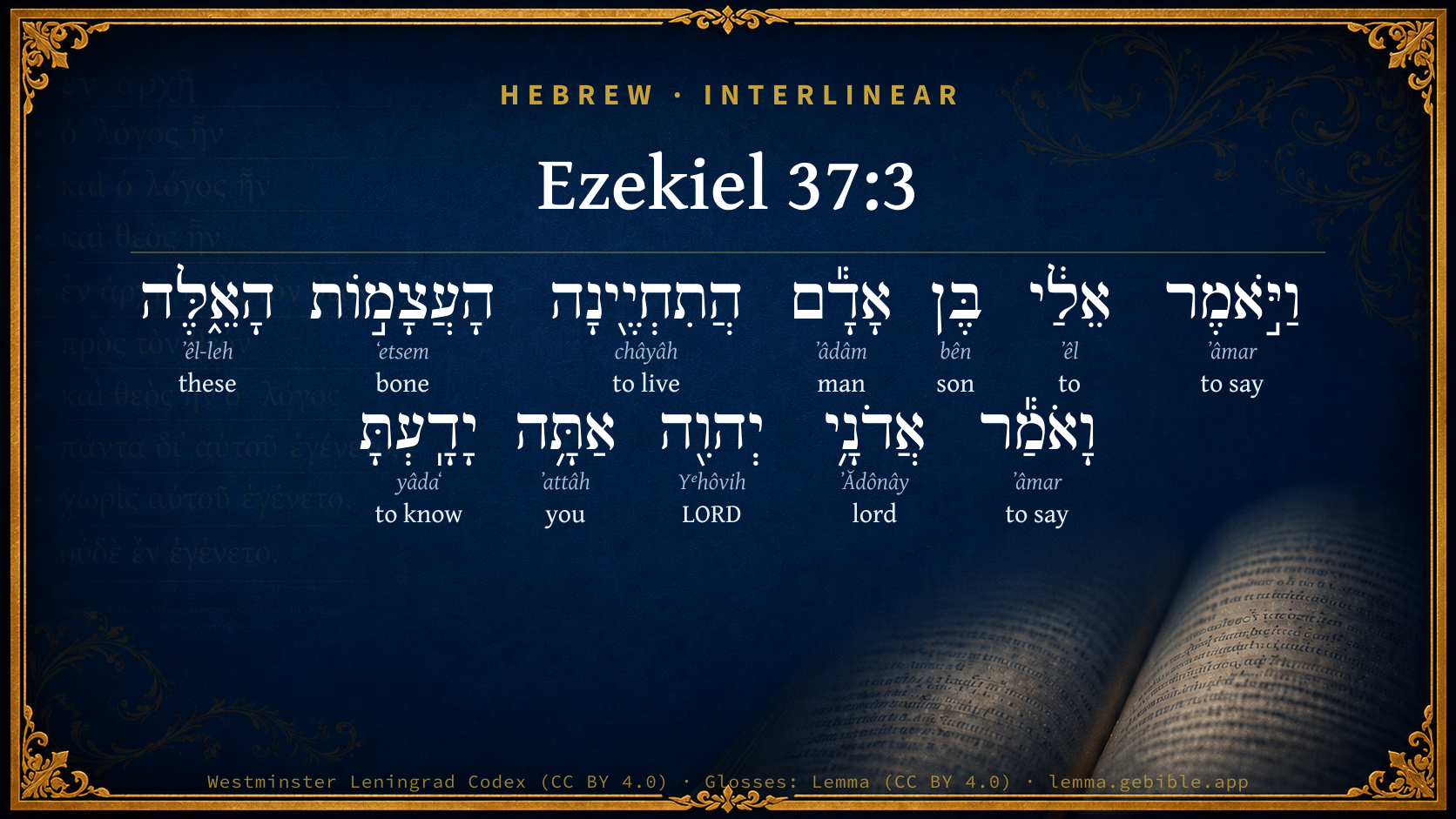
  1. וַיֹּ֣אמֶר ʼâmar H559 “and · to say” Conjunction + Verb, Qal, Sequential Imperfect, 3rd Person, Masculine, Singular
  2. אֵלַ֔י ʼêl H413 “to · me” Preposition + Suffix, Personal, 1st Person, Common, Singular
  3. בֶּן bên H1121 “son of” Noun, Common, Masculine, Singular, Construct
  4. אָדָ֕ם ʼâdâm H120 “man” Noun, Common, Masculine, Singular, Absolute
  5. הֲתִחְיֶ֖ינָה châyâh H2421 “to live” Particle, Interrogative + Verb, Qal, Imperfect, 3rd Person, Feminine, Plural
  6. הָאֵ֑לֶּה ʼêl-leh H428 “the · these” Particle, Definite Article + Pronoun, Demonstrative, Common, Plural
  7. וָאֹמַ֕ר ʼâmar H559 “and · to say” Conjunction + Verb, Qal, Sequential Imperfect, 1st Person, Common, Singular
  8. אֲדֹנָ֥י ʼĂdônây H136 “Lord · my” Noun, Common, Masculine, Plural, Construct + Suffix, Personal, 1st Person, Common, Singular
  9. יְהוִ֖ה Yᵉhôvih H3069 “LORD” Noun, Proper
  10. אַתָּ֥ה ʼattâh H859 “you” Pronoun, Personal, 2nd Person, Masculine, Singular
  11. יָדָֽעְתָּ yâdaʻ H3045 “to know” Verb, Qal, Perfect, 2nd Person, Masculine, Singular

About this verse

These counts appear in no published source. They are computed here, from the morphology-tagged text and Lemma’s own curated glosses. What Lemma adds →

12
words
11
distinct lemmas
Prophets
section

Grammatical profile

  • 4 verbs
  • 5 nouns
  • 2 pronouns
  • 1 preposition

Verb forms

  • וַיֹּ֣אמֶר Qal · Sequential Imperfect
  • הֲתִחְיֶ֖ינָה Qal · Imperfect
  • וָאֹמַ֕ר Qal · Sequential Imperfect
  • יָדָֽעְתָּ Qal · Perfect

Repetition

A word recurs within this verse — often emphatic in Hebrew:

  • וַיֹּ֣אמֶר to say H559 ×2

Hebrew & Septuagint length

In English translation the verse runs 17 words from the Hebrew and 21 from the Septuagint (LXX English) — closely comparable.

A rough comparison of the two English renderings, which tokenize alike — not a word-level alignment.

Word counts can differ between the Hebrew and the Greek without any difference in meaning — e.g. the Hebrew direct-object marker אֵת has no separate Greek word, and Greek often adds the article ὁ.

In the original languages it is 12 Hebrew tokens and 17 Greek tokens — but the two are counted differently (Hebrew bundles its prefixes and suffixes into one token; the Greek is in lemma form), so that isn’t a like-for-like length.

Cross-references

10

Topical passages linked to Ezekiel 37:3 in the Treasury of Scripture Knowledge — connected by theme and wording, ordered by reader-vote popularity; previews shown in the World English Bible.

  • John 11:25–26 Jesus said to her, "I am the resurrection and the life. He who believes in me, though he die, yet will he live.
  • John 5:21 For as the Father raises the dead and gives them life, even so the Son also gives life to whom he desires.
  • Deuteronomy 32:39 See now that I, even I, am he, There is no god with me: I kill, and I make alive; I wound, and I heal; There is none who can deliver out of my hand.
  • Romans 4:17 As it is written, "I have made you a father of many nations." This is in the presence of him whom he believed: God, who gives life to the dead, and calls the things that are not, as though they were.
  • 2 Corinthians 1:9–10 Yes, we ourselves have had the sentence of death within ourselves, that we should not trust in ourselves, but in God who raises the dead,
  • Hebrews 11:19 accounting that God is able to raise up even from the dead. Figuratively speaking, he also did receive him back from the dead.
  • 1 Samuel 2:6 Yahweh kills, and makes alive: He brings down to Sheol, and brings up.
  • Acts 26:8 Why is it judged incredible with you, if God does raise the dead?
  • John 6:5–6 Jesus therefore lifting up his eyes, and seeing that a great multitude was coming to him, said to Philip, "Where are we to buy bread, that these may eat?"
  • Deuteronomy 32:29 Oh that they were wise, that they understood this, That they would consider their latter end!

Cross-references courtesy of OpenBible.info (CC BY 4.0).

Hebrew and Greek witnesses Masoretic Hebrew ↔ Greek Septuagint

The same verse in the two great witnesses to the Old Testament, shown verse-for-verse.

These are two independent witnesses, not word-aligned to each other, and the Septuagint is shown in lemma (dictionary) form.

Hebrew Ezekiel 37:3 Masoretic · Westminster Leningrad Codex

וַיֹּ֣אמֶר אֵלַ֔י בֶּן אָדָ֕ם הֲתִחְיֶ֖ינָה הָעֲצָמ֣וֹת הָאֵ֑לֶּה וָאֹמַ֕ר אֲדֹנָ֥י יְהוִ֖ה אַתָּ֥ה יָדָֽעְתָּ

He said to me, Son of man, can these bones live? I answered, Lord Yahweh, you know.

World English Bible · Public Domain

Greek LXX Ezekiel 37:3 Septuagint · lemma form

καί εἶπον πρός ἐγώ υἱός ἄνθρωπος εἰ ζάω ὁ ὀστέον οὗτος καί εἶπον κύριος σύ ἐπίσταμαι οὗτος

And he said to me, Son of man, will these bones live? and I said, O Lord God, you know this.

LXX2012 (modern English Septuagint) · Public Domain

Hebrew: Westminster Leningrad Codex (CC BY 4.0). Greek: Septuagint (public domain); English from LXX2012 (modern English Septuagint) (Public Domain). How the Septuagint differs from the Hebrew →

Targum (Aramaic paraphrase)

1

The Targum is the ancient Jewish Aramaic paraphrase of the Hebrew Scriptures — an interpretive translation, not the Hebrew text itself. Onkelos (literal) and Pseudo-Jonathan (expansive) render the Torah, and Jonathan the Prophets. Coverage is partial: where no permissively-licensed English translation exists for a verse, only the Aramaic is shown. This is verse-level text, not a word-by-word alignment to the Hebrew.

  1. Targum Jonathan Prophets (Joshua–Malachi)
    וַאֲמַר לִי בַּר אָדָם הֲיֵחוּן גַרְמַיָא הָאִלֵין וַאֲמָרֵית יְיָ אֱלֹהִים אַתְּ גְלֵי קֳדָמָךְ:

    (no public-domain English translation for this verse)

    Targum Jonathan — Aramaic: “Mikraot Gedolot” (public domain). English: “Sefaria Community Translation” (CC0 1.0 (public-domain dedication)); “London "Chaldee Paraphrase," 1871” (public domain). Text via Sefaria.

Commentary

Notes on Ezekiel 37:3 from classic Christian and Jewish commentators (each source and its license shown beneath its notes). The classic Christian expositions comment on the surrounding passage and are grouped to its opening verse, so a note may address several verses; the Jewish commentaries on the Tanakh (Rashi and others) are per-verse, so they appear only where the commentator wrote on this verse.

Lemma curates 59 commentaries, every one of them public domain or Creative Commons licensed, each selected and text-cleaned for this edition rather than reprinted as found. About our sources →

Trapp's Complete Commentary

John Trapp

Eze 37:3 And he said unto me, Son of man, can these bones live? And I answered, O Lord GOD, thou knowest.

Ver. 3. Can these bones live?] In the resurrection at the last day he knew they should, for among the Jews that was generally believed; {Joh 11:24} but whether in this world, and at this time, that was the question. The Jewish doctors boldly, but groundlessly, answer that these dead bones and bodies did then revive, and that many of them did return into the land of Israel, and married wives and begat children. But this is as true as that other dotage of theirs, that the dead bodies of Jews, in what country soever buried, do by certain underground passages travel into Judea, and there rest until the general resurrection.

O Lord God, thou knowest.] And he to whom thou art pleased to reveal it. Eπεχω. The Russians in a difficult question use to answer, God and our great duke know all this.

John Trapp, A Commentary or Exposition upon All the Books of the Old and New Testament (1647–1656) — public domain. Text from a community e-Sword module.

Tyndale Open Study Notes

Tyndale Open Resources

37:3 Son of man, can these bones become living people again? The expected answer was no, but Ezekiel knew that God’s power is unlimited, so he turned the question back to God. The real issue was not whether the Lord was able to make these bones live, but whether it was his will to do so.

Tyndale Open Study Notes — © Tyndale Open Resources, licensed CC BY-SA 4.0. Text via the HelloAO Bible API.

Jamieson, Fausset & Brown

Robert Jamieson, A. R. Fausset & David Brown

can these bones live? . . . thou knowest--implying that, humanly speaking, they could not; but faith leaves the question of possibility to rest with God, with whom nothing is impossible (Deu 32:39). An image of Christian faith which believes in the coming general resurrection of the dead, in spite of all appearances against it, because God has said it (Joh 5:21; Rom 4:17; Co2 1:9).

Jamieson, Fausset & Brown — Commentary Critical and Explanatory on the Whole Bible (1871) — public domain (CC PDM 1.0). Text via the HelloAO Bible API.

Adam Clarke's Commentary

Verse 3. Can these bones live?] Is it possible that the persons whose bones these are can return to life?

Adam Clarke's Commentary on the Bible (1810–1826) — public domain. Text from a community e-Sword/MySword module.

Ellicott's Commentary for English Readers

(3) Can these bones live?—The question is put to the prophet in order to emphasise the human impossibility of that which is immediately brought about by the Divine omnipotence. (Comp. Mat_9:5-6.) It was precisely this teaching which the people needed. As they had formerly refused to believe his announcements of impending judgment, so now that this had come, they were utterly incredulous in regard to his declarations of future blessing. It seemed to them impossible, and what they needed to be taught was that “what is impossible with man is possible with God.”

Thou knowest.—The prophet sees the natural impossibility, yet perceives that there must be some deeper reason for the question, and therefore replies in these words. It may be, too, that the question thus asked, before its object is suggested, connected itself in his mind with the thought of the literal resurrection of the dead and the difficulties it suggests.

A Bible Commentary for English Readers, edited by Charles John Ellicott (1878–1897) — public domain. Text from a community e-Sword module.

The Cambridge Bible for Schools and Colleges

gen. ed. J. J. S. Perowne

3. To the question, Can these bones live? the prophet, looking at them, could not answer Yea (even to the Apostle attainment unto the resurrection of the dead was something ineffably lofty, Php_3:11), and yet in the presence of him who put the question he could not answer No (Rom_4:17-21; Heb_11:19). With reverence he answers, Thou knowest (Rev_7:14).

Eze_37:4-6. The prophet is bidden prophesy to the bones and promise them life from Jehovah.

The Cambridge Bible for Schools and Colleges (gen. ed. J. J. S. Perowne; Cambridge University Press, 1878–1918) — public domain. Text from a community e-Sword module.

John Gill's Exposition

And he said unto me, son of man, can these bones live?.... Is there any probability of it? is there any reason to believe they shall live? can any ways and means be devised, or any methods taken, to cause them to live?

and I answered, O Lord God, thou knowest; the prophet does not pronounce at once that it was improbable and impossible; he knew indeed it was not probable, or possible, that these bones should revive of themselves; and he knew that neither he nor any creature could quicken them; but he wisely refers it to an omniscient and omnipotent God, who knew what he could and what he would do: the conversion of sinners is not of themselves, nor of ministers, but of God; it is wholly owing to his will and power, Joh 1:13 nothing else can make it probable, or possible.

John Gill's Exposition of the Whole Bible (1746–1763) — public domain (CC PDM 1.0). Text via the HelloAO Bible API.

Matthew Poole's English Annotations

He said; the Lord, who brought Ezekiel hither, asks him what he thought.

Can these bones live? either, is it likely they should? or, is it a future thing that shall be, or possible, that they may live?

Thou knowest: the prophet’s answer refers all to God, to whom all things are possible which argue power in doing, and who knows all he will do in time to come. The prophet’s answer seems to own the possibility, and refers the futurity to the will of God.

Matthew Poole's English Annotations on the Holy Bible (1683–1685) — public domain. Text from a community e-Sword/MySword module.

The Pulpit Commentary

Son of man, can these bones live? Whether or not this question was directed, as Plumptre surmises, to meet despairing thoughts which had arisen in the prophet"s own mind, it seems reasonable to hold, with Havernick, that the question was addressed to him as representing "ever against God the people, and certainly as to this point the natural and purely human consciousness of the same," to which Israel"s restoration appeared as unlikely an occurrence as the reanimation of the withered bones that lay around. The extreme improbability, if not absolute impossibility, of the occurrence, at least to human reason and power, is perhaps pointed at in the designation "Son of man" here given to the prophet. The prophet"s answer, O Lord God, thou knowest, is not to be interpreted as proving that to the prophet hitherto the thought of a resurrection had been unfamiliar, if not completely absent, or as giving a direct reply either affirmative or negative to the question proposed to him, but merely as expressing the prophet"s sense of the greatness of the wonder suggested to his mind, with perhaps a latent acknowledgment that God alone had the power by which such a wonder could, and therefore alone also the knowledge whether it would, be accomplished. (comp. Rev_7:14)

The Pulpit Commentary (1880–1919), ed. H.D.M. Spence-Jones & Joseph S. Exell — public domain. Text from a community e-Sword module.

John Wesley's Explanatory Notes

And he - The Lord.

John Wesley, Explanatory Notes Upon the Whole Bible (1754–1765) — public domain. Text via the GEBible commentary corpus.

Rashi

Rabbi Shlomo Yitzchaki (Rashi)

can...become alive Do you think that they can come to life?

Rashi on the Tanakh — English translations: “The Judaica Press complete Tanach with Rashi, translated by A. J. Rosenberg” (CC BY 4.0); “Pentateuch with Rashi's commentary by M. Rosenbaum and A.M. Silbermann, 1929-1934” (public domain); “The Metsudah Tanach series, Lakewood, N.J” (CC BY 4.0); and “The Book of Joshua, Metsudah Publications, 1997” (CC BY 4.0). Text via Sefaria.

Lesson kit

Teaching starters — assembled from the data on this page, not authored interpretation. Every prompt links to the verse data it draws on. Edit before teaching.

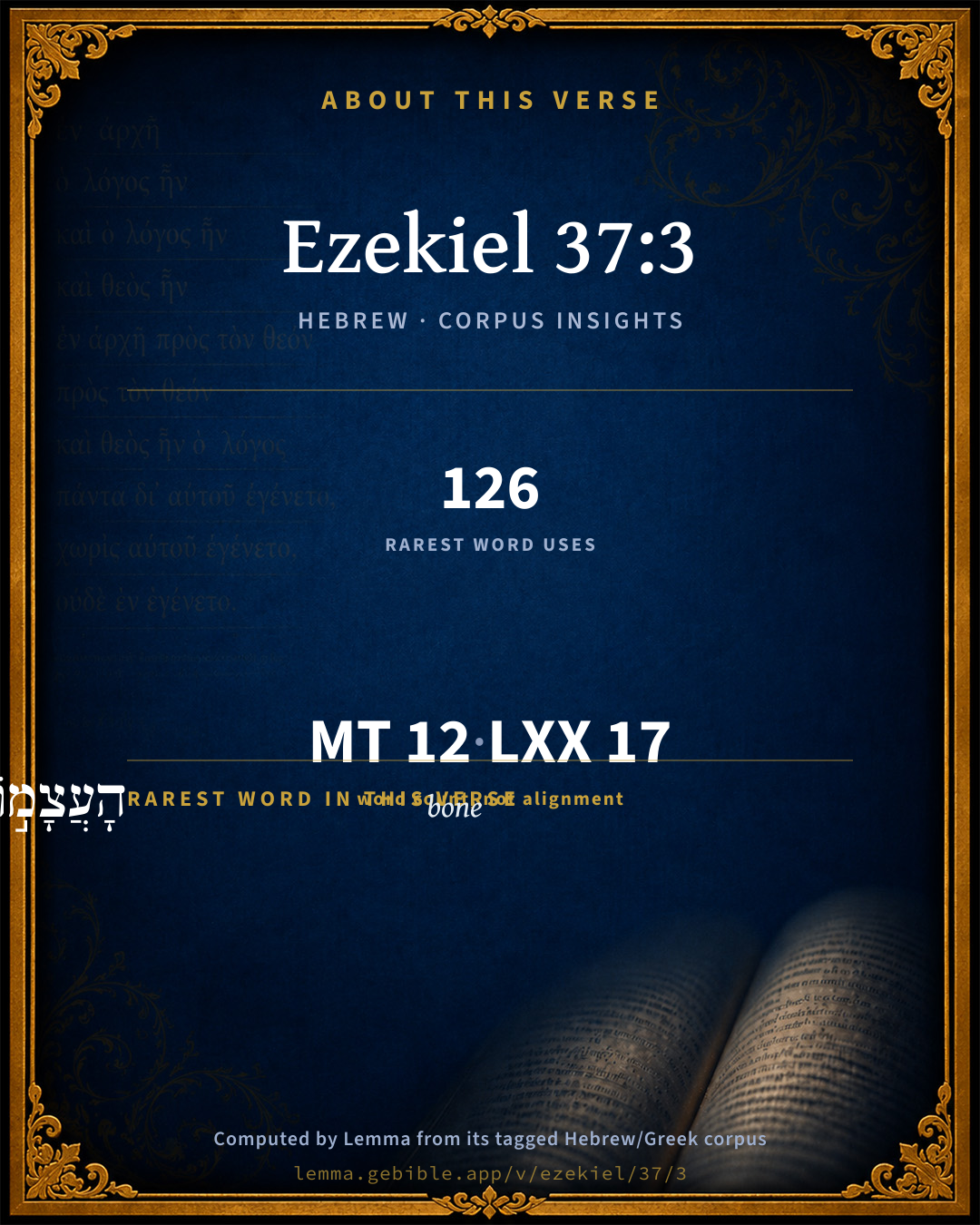
Ezekiel, in the Prophets, opens this verse with 12 words (11 distinct Hebrew lemmas). Its most distinctive word is ʻetsem (“bone”). A historical commentator’s framing appears above. Read the whole chapter for the surrounding context.

Discussion questions

  1. How does “bone” (ʻetsem) shape what this verse is saying?
  2. John 11:25–26 shares this passage’s theme. How do the two illuminate each other?
  3. “to say” occurs 2× in this one verse. What is the effect of the repetition?
  4. These translations render this verse differently. What is at stake in choosing one wording over another?
  5. The verb «וַיֹּ֣אמֶר» is Qal Sequential Imperfect. How does its form color the action?
  6. Reading how Trapp's Complete Commentary and Tyndale Open Study Notes read this verse, where do the two commentators agree and where do they part?

Things to notice

Reading settings

Reading text

Shown beneath each verse's original-language words.

Old Testament
Old Testament edition

Read the OT as the Masoretic Hebrew (MT) or the Greek Septuagint (LXX).

English shown for the Greek Septuagint (in the Hebrew ↔ Greek comparison).

Comparing translations? Open the Compare panel on any verse page to stack up to four side by side.