
Psalms 69:32

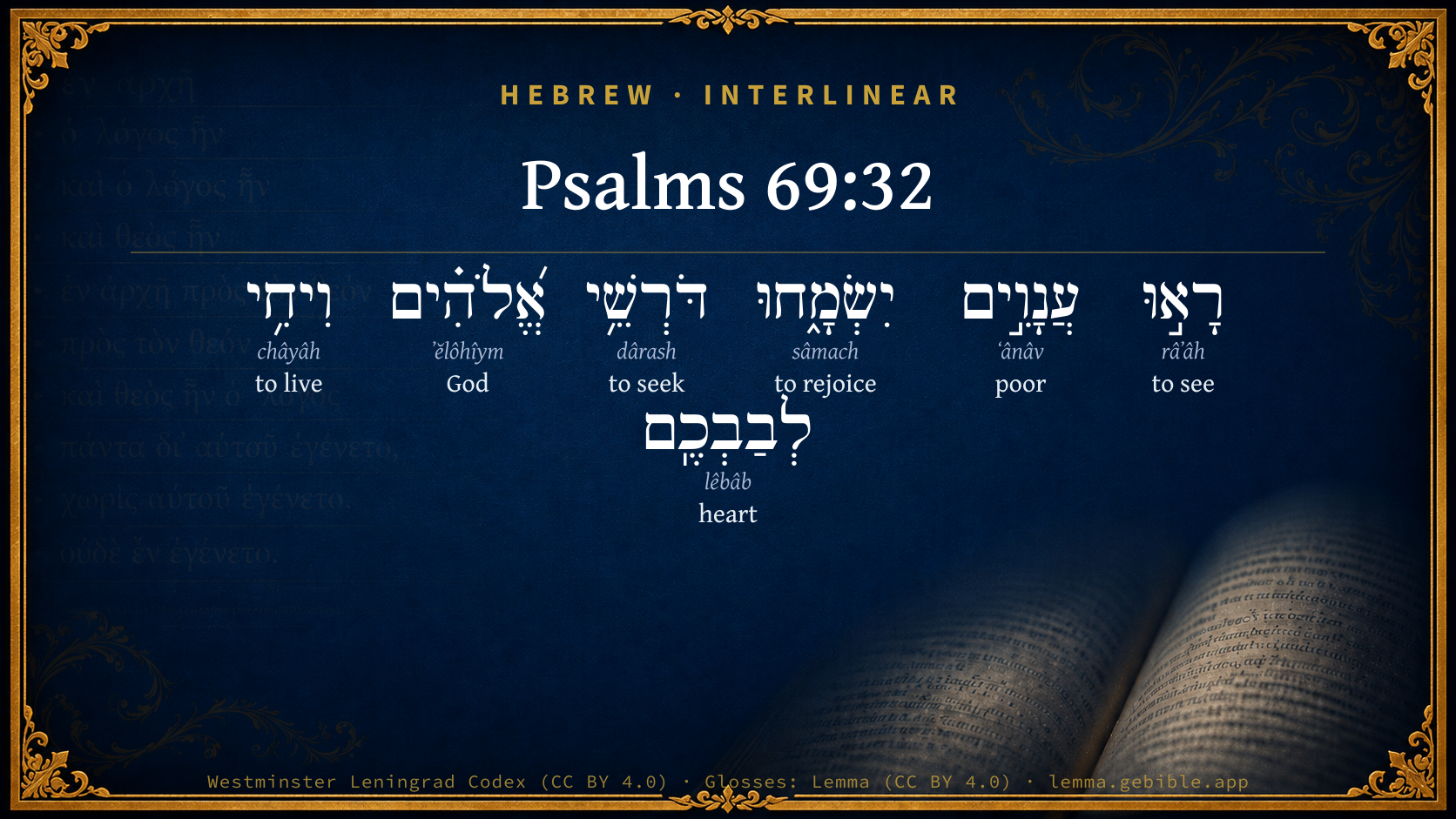
Hebrew (Westminster Leningrad Codex) Psalms 69:32 appears in the Hebrew Old Testament. The text above is from the Westminster Leningrad Codex. Each word links to its Strong’s number, a concise gloss, and parsing drawn from the Open Scriptures Hebrew Bible morphology. Click any word for its full Brown-Driver-Briggs (BDB) entry.
Download image
Cite this verse

Psalms 69:32 (World English Bible). Public Domain. Lemma interlinear Bible study tool, https://lemma.gebible.app/v/psalms/69/32.

Show BibTeX & RIS
BibTeX
RIS
English Translation
The humble have seen it, and are glad. You who seek after God, let your heart live.
World English Bible · Public Domain
Download a study sheet

One document with this verse’s original text, its word-by-word gloss line, the meaning frame, cross-references with their text, attributed commentary, and full source and license credits — printable, and it pastes into notes with its structure intact.

This verse Autodidact and up

Study sheet (.html) Plain text (.txt)

A passage Seminary Student

Up to 50 verses in one chapter. A passage sheet keeps up to 6 commentary sources and 12 cross-references per verse, in the order this page ranks them, and says so on the sheet whenever that leaves anything out. Ask for a single verse and you get the Autodidact verse sheet above.

Everything on this page stays free to read, with no account — the sheet is a download of what is already on screen, not access to it.

Want to remove ads? Support Godless Engineer
Compare translations 3

The same verse in 3 English versions, stacked beneath the original-language interlinear above. Click any original word for its lexicon entry.

Each is an independent rendering of the whole verse — the interlinear is not word-aligned to these translations.

Highlighted words mark where these versions differ — a whole-verse word diff, not a word-by-word alignment.

  • World English Bible Public Domain
    The humble have seen it, and are glad. You who seek after God, let your heart live.
  • King James Version Public Domain
    The humble shall see this, and be glad: and your heart shall live that seek God.
  • unfoldingWord Literal Text CC BY-SA 4.0
    The poor will see, they will rejoice; seekers of God, let your heart live.

unfoldingWord Literal Text — © unfoldingWord, licensed CC BY-SA 4.0. Word-aligned USFM3 via Door43 (git.door43.org/unfoldingWord/en_ult).

Versions to compare (up to 4)

3 of 4 selected

Show all 18 translations

Every available English version of this verse, each an independent rendering of the whole verse.

  • World English Bible Public Domain
    The humble have seen it, and are glad. You who seek after God, let your heart live.
  • Berean Standard Bible Public Domain
    The humble will see and rejoice. You who seek God, let your hearts be revived!
  • Majority Standard Bible Public Domain
    The humble will see and rejoice. You who seek God, let your hearts be revived!
  • King James Version Public Domain
    The humble shall see this, and be glad: and your heart shall live that seek God.
  • American Standard Version (1901) Public Domain
    The meek have seen it, and are glad: Ye that seek after God, let your heart live.
  • Revised Version (1885) Public Domain
    The meek have seen it, and are glad: ye that seek after God, let your heart live.
  • Geneva Bible (1599) Public Domain
    The humble shall see this, and they that seeke God, shalbe glad, and your heart shall liue.
  • Douay-Rheims (1899) Public Domain
    And it shall please God better than a young calf, that bringeth forth horns and hoofs.
  • Young's Literal Translation Public Domain
    The humble have seen -- they rejoice, Ye who seek God -- and your heart liveth.
  • Literal Standard Version CC BY-SA 4.0
    The humble have seen—they rejoice, || You who seek God—and your heart lives.
  • Unlocked Literal Bible CC BY-SA 4.0
    The meek have seen it and are glad; you who seek after God, let your hearts live.
  • unfoldingWord Literal Text CC BY-SA 4.0
    The poor will see, they will rejoice; seekers of God, let your heart live.
  • Darby Bible Public Domain
    The meek shall see it, they shall be glad; ye that seek God, your heart shall live.
  • World Messianic Bible Public Domain
    The humble have seen it, and are glad. You who seek after God, let your heart live.
  • Webster's Bible Public Domain
    \\69:31\\This also shall please the LORD better than an ox or bullock that hath horns and hoofs.
  • Free Bible Version CC BY-SA 4.0
    The humble will see this and be happy. May God encourage everyone who comes to him.
  • Bible in Basic English Public Domain
    The poor will see it and be glad: you who are lovers of God, let your hearts have life.
  • JPS Tanakh (1917) Public Domain
    (69-33) The humble shall see it, and be glad; ye that seek after God, let your heart revive.

Literal Standard Version (2020), Covenant Press — licensed CC BY-SA 4.0. Text via the HelloAO Bible API (eBible.org). Unlocked Literal Bible (unfoldingWord) — licensed CC BY-SA 4.0. Text via the HelloAO Bible API (eBible.org). unfoldingWord Literal Text — © unfoldingWord, licensed CC BY-SA 4.0. Word-aligned USFM3 via Door43 (git.door43.org/unfoldingWord/en_ult). Free Bible Version, Dr. Jonathan Gallagher — licensed CC BY-SA 4.0. Text via the HelloAO Bible API (eBible.org).

Word by word

More ways to search: Search by grammar → Find every occurrence → Compare this word →

Practice this passage: Drill this verse → Learn its vocabulary →

About this verse

These counts appear in no published source. They are computed here, from the morphology-tagged text and Lemma’s own curated glosses. What Lemma adds →

7
words
7
distinct lemmas
Wisdom
section

Shared distinctive vocabulary

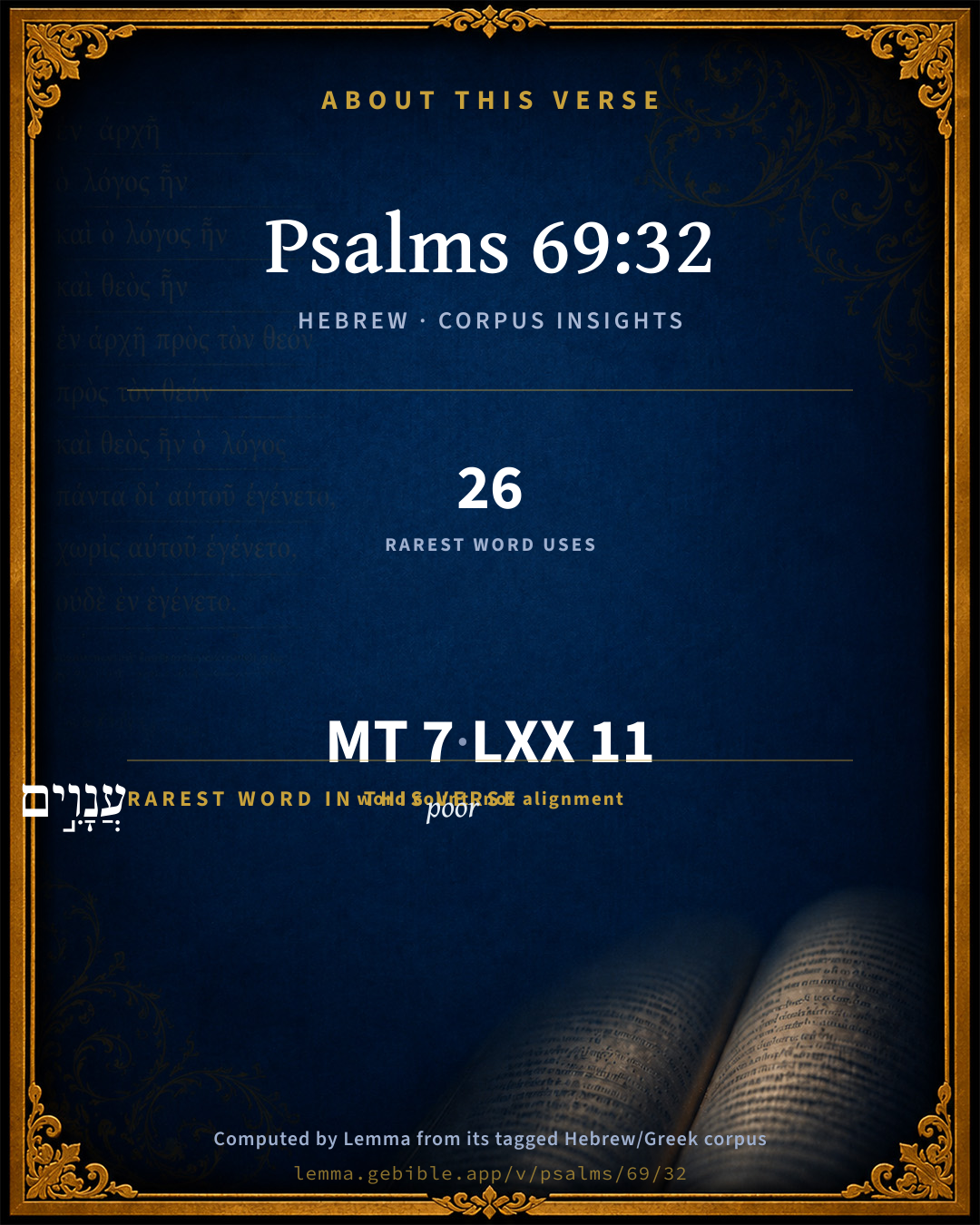
עֲנָוִ֣ים poor H6035 occurs in 24 verses of the Hebrew Bible. Also found in:

Grammatical profile

  • 4 verbs
  • 2 nouns
  • 1 adjective

Verb forms

  • רָא֣וּ Qal · Perfect
  • יִשְׂמָ֑חוּ Qal · Imperfect
  • דֹּרְשֵׁ֥י Qal · Participle Active
  • וִיחִ֥י Qal · Imperfect

Hebrew & Septuagint length

In English translation the verse runs 17 words from the Hebrew and 14 from the Septuagint (LXX English) — closely comparable.

A rough comparison of the two English renderings, which tokenize alike — not a word-level alignment.

Word counts can differ between the Hebrew and the Greek without any difference in meaning — e.g. the Hebrew direct-object marker אֵת has no separate Greek word, and Greek often adds the article ὁ.

In the original languages it is 7 Hebrew tokens and 11 Greek tokens — but the two are counted differently (Hebrew bundles its prefixes and suffixes into one token; the Greek is in lemma form), so that isn’t a like-for-like length.

Cross-references

8

Topical passages linked to Psalms 69:32 in the Treasury of Scripture Knowledge — connected by theme and wording, ordered by reader-vote popularity; previews shown in the World English Bible.

  • Psalms 22:26 The humble shall eat and be satisfied. They shall praise Yahweh who seek after him. Let your hearts live forever.
  • John 16:22 Therefore you now have sorrow, but I will see you again, and your heart will rejoice, and no one will take your joy away from you.
  • Isaiah 55:6–7 Seek you Yahweh while he may be found; call you on him while he is near:
  • Psalms 34:2 My soul shall boast in Yahweh. The humble shall hear of it, and be glad.
  • Isaiah 61:1–3 The Spirit of the Lord Yahweh is on me; because Yahweh has anointed me to preach good news to the humble; he has sent me to bind up the broken-hearted, to proclaim liberty to the captives, and the opening [of the prison] to those who are bound;
  • Psalms 25:9 He will guide the humble in justice. He will teach the humble his way.
  • Psalms 22:29 All the rich ones of the earth shall eat and worship. All those who go down to the dust shall bow before him, Even he who can't keep his soul alive.
  • John 20:20 When he had said this, he showed them his hands and his side. The disciples therefore were glad when they saw the Lord.

Cross-references courtesy of OpenBible.info (CC BY 4.0).

Hebrew and Greek witnesses Masoretic Hebrew ↔ Greek Septuagint

The same verse in the two great witnesses to the Old Testament, shown verse-for-verse.

You’re reading Greek Psalm 68 (Hebrew Psalm 69). The Septuagint counts the superscription, so verse numbers can differ from the Hebrew — chapter-level alignment, not verse-by-verse. Numbering follows Rahlfs.

These are two independent witnesses, not word-aligned to each other, and the Septuagint is shown in lemma (dictionary) form.

Hebrew Psalms 69:32 Masoretic · Westminster Leningrad Codex

רָא֣וּ עֲנָוִ֣ים יִשְׂמָ֑חוּ דֹּרְשֵׁ֥י אֱ֝לֹהִ֗ים וִיחִ֥י לְבַבְכֶֽם

The humble have seen it, and are glad. You who seek after God, let your heart live.

World English Bible · Public Domain

Greek LXX Greek Psalm 68:32 Septuagint · lemma form

καί ἀρέσκω ὁ θεός ὑπέρ μόσχος νέος κέρας ἐκφέρω καί ὁπλή

Let the poor see and rejoice; seek the Lord diligently, and you⌃ shall live.

LXX2012 (modern English Septuagint) · Public Domain

Hebrew: Westminster Leningrad Codex (CC BY 4.0). Greek: Septuagint (public domain); English from LXX2012 (modern English Septuagint) (Public Domain). How the Septuagint differs from the Hebrew →

Commentary

Notes on Psalms 69:32 from classic Christian and Jewish commentators (each source and its license shown beneath its notes). The classic Christian expositions comment on the surrounding passage and are grouped to its opening verse, so a note may address several verses; the Jewish commentaries on the Tanakh (Rashi and others) are per-verse, so they appear only where the commentator wrote on this verse.

Lemma curates 59 commentaries, every one of them public domain or Creative Commons licensed, each selected and text-cleaned for this edition rather than reprinted as found. About our sources →

Trapp's Complete Commentary

John Trapp

Psa 69:32 The humble shall see [this, and] be glad: and your heart shall live that seek God.

Ver. 32. The humble shall see this and be glad] David’s great care was for others’ confirmation and comfort; much more Christ’s, witness that holy prayer of his, Joh 17:9

Your heart shall live] Which before was all lifeless. Pray that ye may joy. David did so often, Psa 6:1-10, &c.

John Trapp, A Commentary or Exposition upon All the Books of the Old and New Testament (1647–1656) — public domain. Text from a community e-Sword module.

Joseph Benson's Commentary

Psa 69:32-33. The humble shall see this — Shall see, in my case, how ready God is to hear the poor and distressed when they cry to him, and to grant their petitions, and how far he is from despising his prisoners, namely, those who are in prison or affliction for his sake, though men despise them; and be glad — Not only because, when one member is honoured, all the members rejoice with it, but because it would be an encouragement to them in their straits and difficulties to trust in God. It will revive the hearts of those who seek God to see more seals to this truth, that God never said to any of the seed of Jacob, Seek ye me in vain.

Joseph Benson's Commentary on the Old and New Testaments (1811–1818) — public domain. Text from a community e-Sword module.

J. A. Alexander on Psalms

Joseph Addison Alexander

33. (Psa 69:32). The humble see and rejoice, literally have seen and will rejoice, in my deliverance (even ye) that seek God, seekers of God, and may your heart live! May you be revived and cheered by witnessing this exhibition of God's power and goodness! The wish that it may be so includes a promise that it shall be, as in Psa 22:26, where the form of expression is the same.

Joseph Addison Alexander, The Psalms Translated and Explained (1850) — public domain. Text from a community e-Sword module.

Tyndale Open Study Notes

Tyndale Open Resources

69:32-33 despise: See 22:24; cp. Matt 25:36; Heb 13:3.

Tyndale Open Study Notes — © Tyndale Open Resources, licensed CC BY-SA 4.0. Text via the HelloAO Bible API.

Jamieson, Fausset & Brown

Robert Jamieson, A. R. Fausset & David Brown

Others shall rejoice. "Humble" and poor, as in Psa 69:29.

your heart, &c.--address to such (compare Psa 22:26).

Jamieson, Fausset & Brown — Commentary Critical and Explanatory on the Whole Bible (1871) — public domain (CC PDM 1.0). Text via the HelloAO Bible API.

Adam Clarke's Commentary

Verse 32. The humble shall see this, and be glad] Those who are low, pressed down by misfortune or cruelty, shall see this and take courage; expecting that thou wilt lift them up also; and thus the heart of those who seek the Lord shall be revived.

Adam Clarke's Commentary on the Bible (1810–1826) — public domain. Text from a community e-Sword/MySword module.

John Calvin's Commentaries

32. The afflicted have seen it. He here shows that the blessed effects of his deliverance will extend to others as well as to himself, a point which he frequently insists on in the Psalms, as we have seen in Psalm 22:23, 26, and in many other places. And his object in doing this is, partly to commend the goodness and grace of God to true believers, and partly that by this as an argument he may prevail with God to succor him. Besides, he does not mean that God’s people would rejoice at this spectacle merely on the ground of brotherly friendship, but because, in the deliverance of one man, a pledge would be given to others, affording them also assurance of salvation. For this very reason he terms them the afflicted. Whoever seek God, (says he,) although they may be subjected to afflictions, will nevertheless take courage from my example. The first and the second clauses of the verse must be read together; for a connected sense would not be preserved were we not to understand the meaning to be this, That the example of David would afford a ground of rejoicing to all the faithful servants of God when they should seek a remedy for their afflictions. He very properly conjoins the desire of seeking God with affliction; for all men do not so profit under the chastening hand of God as to seek salvation from him in the exercise of a sincere and ardent faith. In the concluding part of this verse there is a change of person: And your heart shall live. But this apostrophe is so far from rendering the sense obscure, that, on the contrary, it expresses it the more forcibly, as if a thing present were described. In addressing those who were so much under the pressure of affliction as to be laid prostrate like dead men, he exhibits to their view a kind of image of the resurrection; as if he had said, O ye who are dead! unto you new vigor shall be restored. It is not meant that faith perishes in the children of God, and remains entirely dead until it is quickened into life again by the example of the deliverance of others; but that the light which was quenched is rekindled, and thus, so to speak, recovers life anew. The Psalmist immediately after (verse 33) describes the means by which this will be brought about in the children of God, which is, that believing the deliverance of David to be a common token or pledge of the grace of God presented before them, they will confidently come to the conclusion, that God regards the needy, and does not despise the prisoners. We thus see that he considers what was done to one man, as a clear indication on the part of God that he will be ready to succor all who are in adversity.

John Calvin's Commentaries (1540-1563) — public domain. Text from the Calvin Translation Society English edition (1840s-50s) via the Christian Classics Ethereal Library (ccel.org). Calvin's coverage is partial (roughly two-thirds of the Bible); uncommented books and verses are honest gaps, never fabricated. The 19th-century editor's footnotes and remarks are omitted so the notes are faithfully Calvin's own voice.

Ellicott's Commentary for English Readers

(32) Humble.—Rather, afflicted.

And your heart . . .—Better, may your heart live. (See Psa_22:5.)

A Bible Commentary for English Readers, edited by Charles John Ellicott (1878–1897) — public domain. Text from a community e-Sword module.

The Cambridge Bible for Schools and Colleges

gen. ed. J. J. S. Perowne

32. When the meek see it, they shall be glad:

Ye that seek after God, let your heart revive.

Cp. Psa_22:16, and with Psa_69:33 cp. Psa_22:24.

The Cambridge Bible for Schools and Colleges (gen. ed. J. J. S. Perowne; Cambridge University Press, 1878–1918) — public domain. Text from a community e-Sword module.

John Gill's Exposition

The humble shall see this, and be glad,.... The resurrection and exaltation of Christ, Psa 69:29; the meek and humble followers of Christ, as his disciples were, saw him risen from the dead, saw him alive, to whom he showed himself forty days after his resurrection; they saw his hands, and feet, and side, and the prints of the nails and spear in them; they saw him go up to heaven, to be set on high at the right hand of God; and humble believers now see him by faith, crowned with glory and honour; and as the disciples were glad, and rejoiced when they saw him again, and when he was parted from them, and went up to heaven, Joh 20:20; so true believers in Christ, who have a spiritual sight of a risen, ascended, and exalted Saviour, are glad, and rejoice in him with joy unspeakable, and full of glory, Pe1 1:8; they rejoice in the righteousness he has brought in, in the atonement that he has made, and in the salvation he has wrought out, which is so suitable for them; and because they do or will share in all the blessings of his resurrection, ascension, and exaltation; such as regeneration, justification, every supply of grace, and perseverance in it, the resurrection of their bodies, and eternal glorification: and "humble" ones are such as are humbled under a sense of sin, and the exceeding sinfulness of it, in a view of their own righteousness, and its insufficiency to justify them before God: they ascribe all they have and are to the free grace of God; and all boasting is excluded from them, save in Christ; they are such that learn of him, who is meek and lowly; and behave humbly before men, esteem others better than themselves; and are in their own account the chief of sinners, and the least of saints: and as they are, for the most part, "afflicted", and so some render the word (p) here; they are humble under the mighty hand of God, and patiently bear it;

and your heart shall live that seek God; that seek his face and favour, his gracious presence, and communion with him; that seek, by prayer and supplications, blessings from him; that seek him in Christ, where he is to be found; that seek Christ, and righteousness and salvation by him, and that early, earnestly, and diligently; that seek the things of Christ, the honour of his name, and the good of his interest; and who, in a word, are the true and spiritual worshippers of God; these seek him, and he seeks them. The Targum is,

"that seek doctrine from before God;''

and the hearts of those revived, who were as dead men before, as were the two disciples travelling to Emmaus, when they found that Christ was risen, Luk 24:17; just as the spirit of old Jacob revived, when he understood that his son Joseph was alive, Gen 45:27; see Psa 22:26.

(p) "afflicti", Vatablus, Musculus; "miseri", Gejerus; "mansueti ac miseri", Michaelis.

John Gill's Exposition of the Whole Bible (1746–1763) — public domain (CC PDM 1.0). Text via the HelloAO Bible API.

Albert Barnes' Notes on the Bible

The humble shall see this, and be glad - Margin, “The meek.” That is, Others who are thus afflicted - the poor, the needy, the oppressed, the sad - shall be made acquainted with what has been done in my behalf, and shall take courage, or be strengthened. They will learn to trust that God will also interpose in “their” troubles, and bring them out of “their” distresses.

And your heart shall live that seek God - Shall be revived; shall be encouraged, strengthened, animated.

Albert Barnes' Notes on the Bible (1834–1885) — public domain. Text from a community e-Sword/MySword module.

Matthew Poole's English Annotations

Be glad; those pious persons who are grieved for my calamities shall have occasion to rejoice, and they will heartily rejoice in my deliverance and exaltation.

Shall live, or be revived, to wit, with joy, which were dejected, and in a manner dead with sorrow. Compare Gen 45:27; Psa 22:26; 109:21.

Matthew Poole's English Annotations on the Holy Bible (1683–1685) — public domain. Text from a community e-Sword/MySword module.

The Treasury of David

Charles H. Spurgeon

Ver. 32. The humble shall see this and be glad. Grateful hearts are ever on the look out for recruits, and the rejoicing psalmist discerns with joy the fact, that other oppressed and lowly men observing the Lord's dealings with his servants are encouraged to look for a like issue to their own tribulations. The standing consolation of the godly is the experience of their Lord, for as he is so are we also in this world; yea, moreover, his triumph has secured ours, and therefore, we may on the most solid grounds rejoice in him. This gave our great leader satisfaction as he foresaw the comforts which would flow to us from his conflict and conquest.

And your heart shall live that seek God. A similar assurance is given in Psalm 22, which is near akin to this. It would have been useless to seek if Jesus' victories had not cleared the way, and opened a door of hope; but, since the Breaker has gone up before us, and the King at the head of us, our hope is a living one, our faith is living, our love is living, and our renewed nature is full of a vitality which challenges the cold hand of death to damp it.

Ver. 32. Your heart shall live that seek God. As such who are poor in spirit, and truly humbled, do live upon God's alms, and are daily at his doors for relief of their necessities, and for communion with his gracious goodness; so shall they thrive well in this trade. David Dickson.

Ver. 32. Your heart shall live. The heart, or the soul, is said to live, to be converted, or to return, when it is refreshed and cured of its pains and griefs. In this way it could be said of Jacob, when the good tidings were brought, that his spirit revived... On the contrary, when Nabal heard the bad news, it is recorded that his heart died within him, and he became as a stone. Lorinus.

Ver. 32.

I. The joy of a good man's heart is in the experience of

others.

II. The life of his heart is in God.

Psalms 69:33*

Charles H. Spurgeon's The Treasury of David (1869–1885) — public domain. Psalms only. Text from a community e-Sword/MySword module.

The Pulpit Commentary

The humble shall see this, and be glad. The meek God"s people see David"s deliverance, and are glad rejoice in their heart, and unite with him in thanksgiving. And your heart shall live that seek God. (comp. Psa_22:26)

Here are three greatest things.

I THE GREATEST THING IN MAN. The "heart." It is the heart that marks character; (Pro_23:7) that settles worth; (1Sa_16:7) that determines destiny . (Rom_10:9, 10 Pro_4:23) Even among men, the man who has "no heart," whatever else he may have, is despised; whereas he who has a kind heart, though he may have many failings, is beloved (cf. Nabal and David).

II THE GREATEST WORK FOR MAN. "Seek God." This implies that, though man is separated from God through sin, there is a possibility of return. God has drawn near to us, and we may draw near to God. Christ is the true Mercy seat. In him God and man meet and are reconciled. The chief object of life is to seek God. (Psa_27:8 Isa_55:6) In his works and in his Word, in the Person of his Son and in doing his will by the Spirit, he is evermore to be found of those who truly seek him. (Isa_45:19 Amo_5:8)

III THE GREATEST BLESSEDNESS FOR MAN. "Live." Life is the greatest boon but only when it is the life of the heart. "We live by admiration, faith, and hope, And ever as these are well and wisely fixed, In dignity of being we ascend. (Wordsworth)

It is in Christ that we find our true life and our highest blessedness (cf. Demas and Paul, 2Ti_4:10 2Co_6:11 1Jn_3:1) W.F.

The Pulpit Commentary (1880–1919), ed. H.D.M. Spence-Jones & Joseph S. Exell — public domain. Text from a community e-Sword module.

John Wesley's Explanatory Notes

The humble - Those pious persons who are grieved for their calamities, will heartily rejoice in my deliverance. Live - Or, be revived, which were dejected, and in a manner dead with sorrow.

John Wesley, Explanatory Notes Upon the Whole Bible (1754–1765) — public domain. Text via the GEBible commentary corpus.

unfoldingWord translationNotes

Door43 World Missions Community

The meek

This refers to meek people in general. AT: "Meek people" (See: Nominal Adjectives)

you who seek after God

Seeking God represents either 1) asking God for help or 2) thinking about God and obeying him. AT: "you who ask God for help" or "you who think about God" (See: Metaphor)

let your hearts live

Here "hearts" refer to the people. Here "live" is an idiom that means to be encouraged. AT: "may you be encouraged" (See: Synecdoche and Hypothetical Situations)

Yahweh hears

Here "hears" means to respond. AT: "Yahweh answers" (See: Metonymy)

the needy

This refers to needy people in general. AT: "needy people" (See: Nominal Adjectives)

his prisoners

"those who have suffered for him"

translationWords

meek

heart

life

prison

unfoldingWord translationNotes — © Distant Shores Media and the Door43 World Missions Community, licensed CC BY-SA 4.0. Source: git.door43.org/Door43/en_tn.

Rashi

Rabbi Shlomo Yitzchaki (Rashi)

And it will appeal to the Lord My praise to the Lord.

more than a young bull that is mature That is the bull sacrificed by Adam, which was created at its height. On the day it was called שּׁוֹר, on that very day, he brought it, for a bull on day of its birth is called שּׁוֹר, as it is said (Lev. 22:27): “A bull (שור), a lamb, or a goat, that is born.” On that very day, it resembled a פַּר, which is a three-year old.

with horns and hooves Its horns preceded its hooves, because it was created at its height with its horns, and its head emerged from the ground first; the earth thrust them forth in the manner in which all creatures are born, so that its horns preceded its feet.

Rashi on the Tanakh — English translations: “The Judaica Press complete Tanach with Rashi, translated by A. J. Rosenberg” (CC BY 4.0); “Pentateuch with Rashi's commentary by M. Rosenbaum and A.M. Silbermann, 1929-1934” (public domain); “The Metsudah Tanach series, Lakewood, N.J” (CC BY 4.0); and “The Book of Joshua, Metsudah Publications, 1997” (CC BY 4.0). Text via Sefaria.

Lesson kit

Teaching starters — assembled from the data on this page, not authored interpretation. Every prompt links to the verse data it draws on. Edit before teaching.

Psalms, in the Wisdom, opens this verse with 7 words (7 distinct Hebrew lemmas). Its most distinctive word is ʻânâv (“poor”). A historical commentator’s framing appears above. Read the whole chapter for the surrounding context.

Discussion questions

  1. How does “poor” (ʻânâv) shape what this verse is saying?
  2. Numbers 12:3 shares the word «poor» with this verse. How do the two illuminate each other?
  3. These translations render this verse differently; the difference is in the English rendering, not the original. What questions does that raise?
  4. The verb «רָא֣וּ» is Qal Perfect. How does its form color the action?
  5. Reading how Trapp's Complete Commentary and Joseph Benson's Commentary read this verse, where do the two commentators agree and where do they part?

Things to notice

Reading settings

Reading text

Shown beneath each verse's original-language words.

Old Testament
Old Testament edition

Read the OT as the Masoretic Hebrew (MT) or the Greek Septuagint (LXX).

English shown for the Greek Septuagint (in the Hebrew ↔ Greek comparison).

Comparing translations? Open the Compare panel on any verse page to stack up to four side by side.