
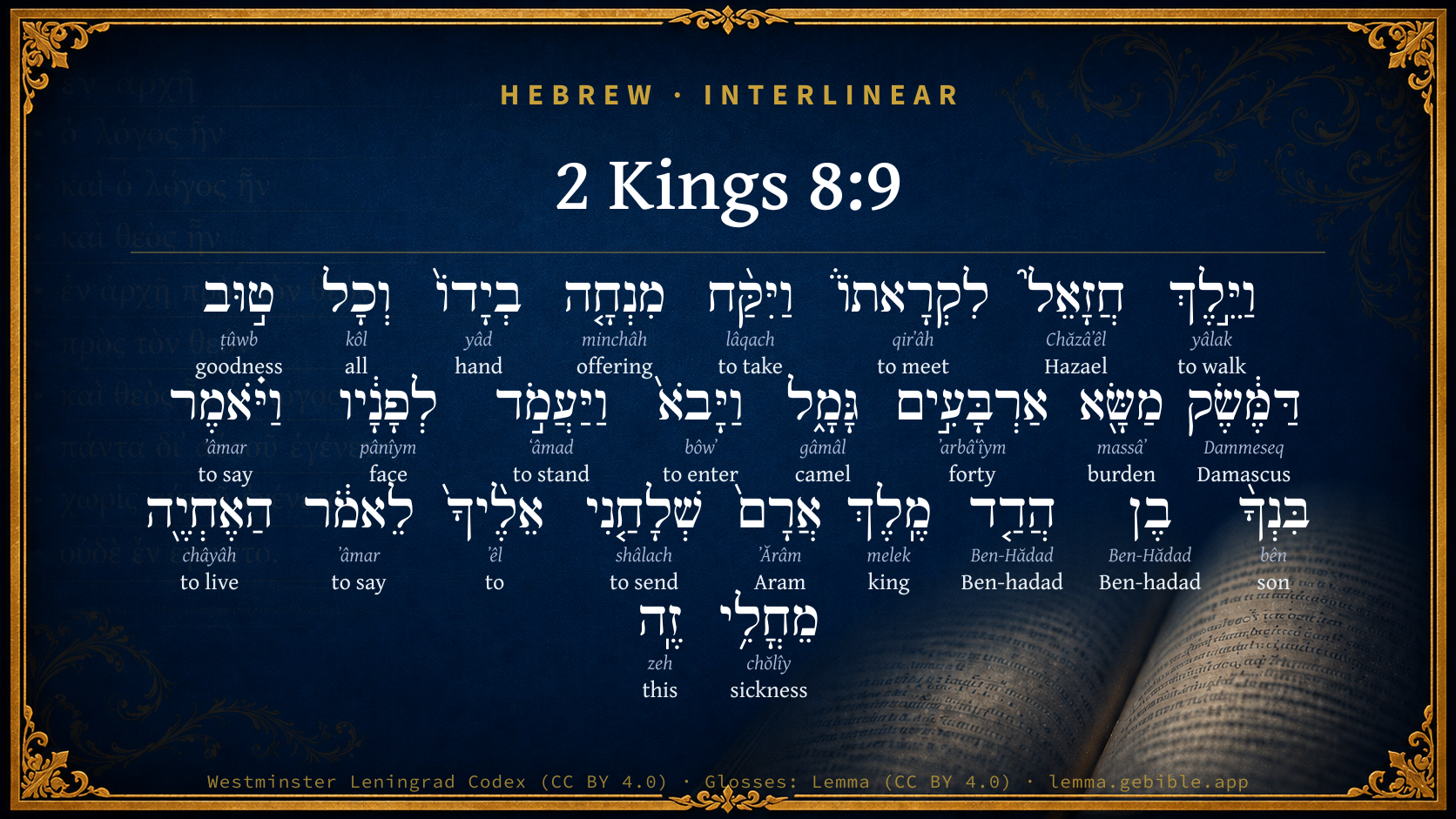
2 Kings 8:9

Hebrew (Westminster Leningrad Codex) 2 Kings 8:9 appears in the Hebrew Old Testament. The text above is from the Westminster Leningrad Codex. Each word links to its Strong’s number, a concise gloss, and parsing drawn from the Open Scriptures Hebrew Bible morphology. Click any word for its full Brown-Driver-Briggs (BDB) entry.
Download image
Cite this verse

2 Kings 8:9 (World English Bible). Public Domain. Lemma interlinear Bible study tool, https://lemma.gebible.app/v/2-kings/8/9.

Show BibTeX & RIS
BibTeX
RIS
English Translation
So Hazael went to meet him, and took a present with him, even of every good thing of Damascus, forty camels' burden, and came and stood before him, and said, Your son Benhadad king of Syria has sent me to you, saying, Shall I recover of this sickness?
World English Bible · Public Domain
Download a study sheet

One document with this verse’s original text, its word-by-word gloss line, the meaning frame, cross-references with their text, attributed commentary, and full source and license credits — printable, and it pastes into notes with its structure intact.

This verse Autodidact and up

Study sheet (.html) Plain text (.txt)

A passage Seminary Student

Up to 50 verses in one chapter. A passage sheet keeps up to 6 commentary sources and 12 cross-references per verse, in the order this page ranks them, and says so on the sheet whenever that leaves anything out. Ask for a single verse and you get the Autodidact verse sheet above.

Everything on this page stays free to read, with no account — the sheet is a download of what is already on screen, not access to it.

Want to remove ads? Support Godless Engineer
Compare translations 3

The same verse in 3 English versions, stacked beneath the original-language interlinear above. Click any original word for its lexicon entry.

Each is an independent rendering of the whole verse — the interlinear is not word-aligned to these translations.

Highlighted words mark where these versions differ — a whole-verse word diff, not a word-by-word alignment.

  • World English Bible Public Domain
    So Hazael went to meet him, and took a present with him, even of every good thing of Damascus, forty camels' burden, and came and stood before him, and said, Your son Benhadad king of Syria has sent me to you, saying, Shall I recover of this sickness?
  • King James Version Public Domain
    So Hazael went to meet him, and took a present with him, even of every good thing of Damascus, forty camels' burden, and came and stood before him, and said, Thy son Benhadad king of Syria hath sent me to thee, saying, Shall I recover of this disease?
  • unfoldingWord Literal Text CC BY-SA 4.0
    And Hazael went to meet him, and in his hand he took a gift and every good of Damascus, a burden of 40 camels. And he came and stood to his face, and he said, “Your son Ben Hadad, the king of Aram, has sent me to you, saying, ‘Will I revive from this sickness?’”

unfoldingWord Literal Text — © unfoldingWord, licensed CC BY-SA 4.0. Word-aligned USFM3 via Door43 (git.door43.org/unfoldingWord/en_ult).

Versions to compare (up to 4)

3 of 4 selected

Show all 18 translations

Every available English version of this verse, each an independent rendering of the whole verse.

  • World English Bible Public Domain
    So Hazael went to meet him, and took a present with him, even of every good thing of Damascus, forty camels' burden, and came and stood before him, and said, Your son Benhadad king of Syria has sent me to you, saying, Shall I recover of this sickness?
  • Berean Standard Bible Public Domain
    So Hazael went to meet Elisha, taking with him a gift of forty camel loads of every good thing from Damascus. And he went in and stood before him and said, “Your son Ben-hadad king of Aram has sent me to ask, ‘Will I recover from this illness?’”
  • Majority Standard Bible Public Domain
    So Hazael went to meet Elisha, taking with him a gift of forty camel loads of every good thing from Damascus. And he went in and stood before him and said, “Your son Ben-hadad king of Aram has sent me to ask, ‘Will I recover from this illness?’”
  • King James Version Public Domain
    So Hazael went to meet him, and took a present with him, even of every good thing of Damascus, forty camels' burden, and came and stood before him, and said, Thy son Benhadad king of Syria hath sent me to thee, saying, Shall I recover of this disease?
  • American Standard Version (1901) Public Domain
    So Hazael went to meet him, and took a present with him, even of every good thing of Damascus, forty camels' burden, and came and stood before him, and said, Thy son Benhadad king of Syria hath sent me to thee, saying, Shall I recover of this sickness?
  • Revised Version (1885) Public Domain
    So Hazael went to meet him, and took a present with him, even of every good thing of Damascus, forty camels’ burden, and came and stood before him, and said, Thy son Ben-hadad king of Syria hath sent me to thee, saying, Shall I recover of this sickness.
  • Geneva Bible (1599) Public Domain
    So Hazael went to meete him, and tooke the present in his hand, and of euery good thing of Damascus, euen the burden of fourtie camels, and came and stood before him, and sayde, Thy sonne Ben-hadad King of Aram hath sent me to thee, saying, Shall I recouer of this disease?
  • Douay-Rheims (1899) Public Domain
    And Hazael went to meet him, taking with him presents, and all the good things of Damascus, the burdens of forty camels. And when he stood before him, he said: Thy son Benadad the king of Syria hath sent me to thee, saying: Can I recover of this my illness?
  • Young's Literal Translation Public Domain
    And Hazael goeth to meet him, and taketh a present in his hand, even of every good thing of Damascus, a burden of forty camels, and he cometh in and standeth before him, and saith, `Thy son Ben-Hadad, king of Aram, hath sent me unto thee, saying, Do I revive from this sickness?'
  • Literal Standard Version CC BY-SA 4.0
    And Hazael goes to meet him, and takes a present in his hand, even of every good thing of Damascus, a burden of forty camels, and he comes in and stands before him, and says, “Your son Ben-Hadad, king of Aram, has sent me to you, saying, Do I revive from this sickness?”
  • Unlocked Literal Bible CC BY-SA 4.0
    So Hazael went to meet him and took a gift with him of every kind of good thing of Damascus, carried by forty camels. So Hazael came and stood before Elisha and said, “Your son Ben Hadad king of Aram has sent me to you, saying, 'Will I recover from this sickness?'”
  • unfoldingWord Literal Text CC BY-SA 4.0
    And Hazael went to meet him, and in his hand he took a gift and every good of Damascus, a burden of 40 camels. And he came and stood to his face, and he said, “Your son Ben Hadad, the king of Aram, has sent me to you, saying, ‘Will I revive from this sickness?’”
  • Darby Bible Public Domain
    And Hazael went to meet him, and took with him a present, even of every good thing of Damascus, forty camels' burden; and he came and stood before him, and said, Thy son Ben-Hadad king of Syria has sent me to thee, saying, Shall I recover from this disease?
  • World Messianic Bible Public Domain
    So Hazael went to meet him and took a present with him, even of every good thing of Damascus, forty camels’ burden, and came and stood before him and said, “Your son Benhadad king of Syria has sent me to you, saying, ‘Will I recover from this sickness?’”
  • Webster's Bible Public Domain
    So Hazael went to meet him, and took a present with him, even of every good thing of Damascus, forty camels burden, and came and stood before him, and said, Thy son Ben-hadad king of Syria hath sent me to thee, saying, Shall I recover of this disease?
  • Free Bible Version CC BY-SA 4.0
    So Hazael went to meet Elisha. He took with him a gift of all the best things from Damascus—forty camel loads of goods. He came in and stood before him and said, “Your son Ben-hadad, king of Aram, has sent me to you to ask, ‘Will I recover from this illness?’”
  • Bible in Basic English Public Domain
    So Hazael went to see him, taking with him forty camels with offerings on their backs of every sort of good thing from Damascus; and when he came before him, he said, Your son Ben-hadad, king of Aram, has sent me to you, saying, Will I get better from this disease?
  • JPS Tanakh (1917) Public Domain
    So Hazael went to meet him, and took a present with him, even of every good thing of Damascus, forty camels' burden, and came and stood before him, and said: 'Thy son Ben-hadad king of Aram hath sent me to thee, saying: Shall I recover of this sickness?'

Literal Standard Version (2020), Covenant Press — licensed CC BY-SA 4.0. Text via the HelloAO Bible API (eBible.org). Unlocked Literal Bible (unfoldingWord) — licensed CC BY-SA 4.0. Text via the HelloAO Bible API (eBible.org). unfoldingWord Literal Text — © unfoldingWord, licensed CC BY-SA 4.0. Word-aligned USFM3 via Door43 (git.door43.org/unfoldingWord/en_ult). Free Bible Version, Dr. Jonathan Gallagher — licensed CC BY-SA 4.0. Text via the HelloAO Bible API (eBible.org).

Word by word

More ways to search: Search by grammar → Find every occurrence → Compare this word →

Practice this passage: Drill this verse → Learn its vocabulary →

חֲזָאֵל֮
Chăzâʼêl
H2371
“Hazael”
Noun, Proper
Part of Speech
Noun
Type
Proper
Full BDB Definition

Origin: from H2372 and H410

TWOT: None

Hazael = "one who sees God" - a king of Syria; sent by his master, Ben-hadad, to the prophet Elisha, to seek a remedy for Ben-hadad's leprosy; apparently later killed Ben-hadad, assumed the throne, and soon became engaged in a war with the kings of Judah and Israel for the possession of the city of Ramoth-gilead
  1. וַיֵּ֣לֶךְ yâlak H3212 “and · to walk” Conjunction + Verb, Qal, Sequential Imperfect, 3rd Person, Masculine, Singular
  2. לִקְרָאתוֹ֒ qirʼâh H7125 “to meet · him” Preposition + Verb, Qal, Infinitive Construct + Suffix, Personal, 3rd Person, Masculine, Singular
  3. וַיִּקַּ֨ח lâqach H3947 “and · to take” Conjunction + Verb, Qal, Sequential Imperfect, 3rd Person, Masculine, Singular
  4. מִנְחָ֤ה minchâh H4503 “offering” Noun, Common, Feminine, Singular, Absolute
  5. בְיָדוֹ֙ yâd H3027 “in/at · hand · his” Preposition + Noun, Common, Both, Singular, Construct + Suffix, Personal, 3rd Person, Masculine, Singular
  6. וְכָל kôl H3605 “and · all of” Conjunction + Noun, Common, Masculine, Singular, Construct
  7. ט֣וּב ṭûwb H2898 “goodness of” Noun, Common, Masculine, Singular, Construct
  8. דַּמֶּ֔שֶׂק Dammeseq H1834 “Damascus” Noun, Proper
  9. מַשָּׂ֖א massâʼ H4853 “burden of” Noun, Common, Masculine, Singular, Construct
  10. אַרְבָּעִ֣ים ʼarbâʻîym H705 “forty” Adjective, Cardinal number, Both, Plural, Absolute
  11. גָּמָ֑ל gâmâl H1581 “camel” Noun, Common, Masculine, Singular, Absolute
  12. וַיָּבֹא֙ bôwʼ H935 “and · to enter” Conjunction + Verb, Qal, Sequential Imperfect, 3rd Person, Masculine, Singular
  13. וַיַּעֲמֹ֣ד ʻâmad H5975 “and · to stand” Conjunction + Verb, Qal, Sequential Imperfect, 3rd Person, Masculine, Singular
  14. לְפָנָ֔יו pânîym H6440 “to/for · face(s) · his” Preposition + Noun, Common, Both, Plural, Construct + Suffix, Personal, 3rd Person, Masculine, Singular
  15. וַיֹּ֗אמֶר ʼâmar H559 “and · to say” Conjunction + Verb, Qal, Sequential Imperfect, 3rd Person, Masculine, Singular
  16. בִּנְךָ֨ bên H1121 “son · your” Noun, Common, Masculine, Singular, Construct + Suffix, Personal, 2nd Person, Masculine, Singular
  17. בֶן Ben-Hădad H1130 “Ben-hadad” Noun, Proper
  18. הֲדַ֤ד Ben-Hădad H1130 “Ben-hadad” Noun, Proper
  19. מֶֽלֶךְ melek H4428 “king of” Noun, Common, Masculine, Singular, Construct
  20. אֲרָם֙ ʼĂrâm H758 “Aram” Noun, Proper
  21. שְׁלָחַ֤נִי shâlach H7971 “to send · me” Verb, Qal, Perfect, 3rd Person, Masculine, Singular + Suffix, Personal, 1st Person, Common, Singular
  22. אֵלֶ֨יךָ֙ ʼêl H413 “to · you” Preposition + Suffix, Personal, 2nd Person, Masculine, Singular
  23. לֵאמֹ֔ר ʼâmar H559 “to say” Preposition + Verb, Qal, Infinitive Construct
  24. הַאֶחְיֶ֖ה châyâh H2421 “to live” Particle, Interrogative + Verb, Qal, Imperfect, 1st Person, Common, Singular
  25. מֵחֳלִ֥י chŏlîy H2483 “from · sickness” Preposition + Noun, Common, Masculine, Singular, Absolute
  26. זֶֽה zeh H2088 “this” Pronoun, Demonstrative, Masculine, Singular

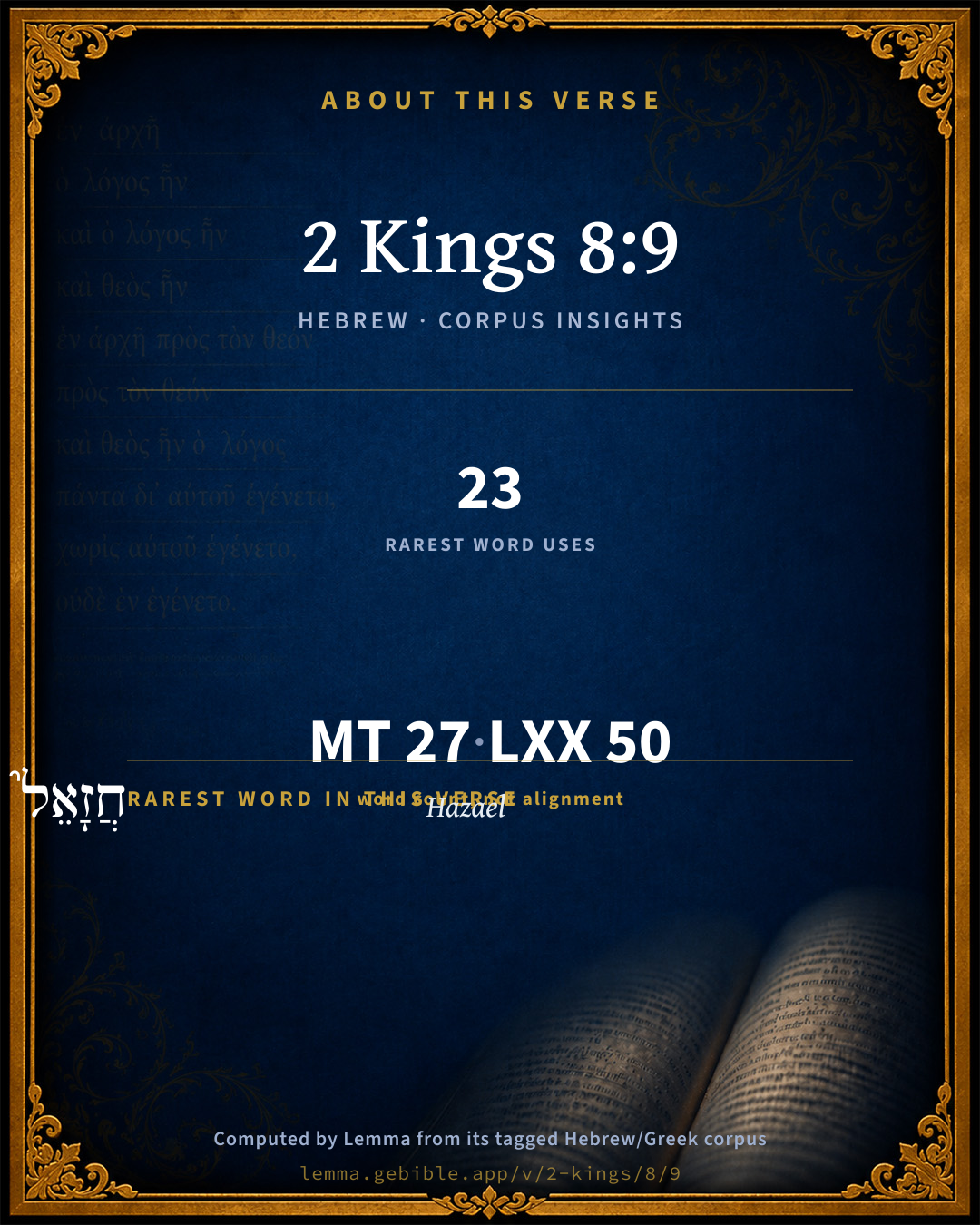
About this verse

These counts appear in no published source. They are computed here, from the morphology-tagged text and Lemma’s own curated glosses. What Lemma adds →

27
words
25
distinct lemmas
Historical
section

Notable vocabulary

The rarest word here is חֲזָאֵל֮ Hazael H2371 — appearing just 23 times in the whole Hebrew Bible.

Shared distinctive vocabulary

חֲזָאֵל֮ Hazael H2371 occurs in 21 verses of the Hebrew Bible. Also found in:

Grammatical profile

  • 9 verbs
  • 15 nouns
  • 1 adjective
  • 1 pronoun
  • 1 preposition

Verb forms

  • וַיֵּ֣לֶךְ Qal · Sequential Imperfect
  • לִקְרָאתוֹ֒ Qal · Infinitive Construct
  • וַיִּקַּ֨ח Qal · Sequential Imperfect
  • וַיָּבֹא֙ Qal · Sequential Imperfect
  • וַיַּעֲמֹ֣ד Qal · Sequential Imperfect
  • וַיֹּ֗אמֶר Qal · Sequential Imperfect
  • שְׁלָחַ֤נִי Qal · Perfect
  • לֵאמֹ֔ר Qal · Infinitive Construct
  • הַאֶחְיֶ֖ה Qal · Imperfect

Repetition

Words recur within this verse — often emphatic in Hebrew:

  • וַיֹּ֗אמֶר to say H559 ×2
  • בֶן Ben-hadad H1130 ×2

Hebrew & Septuagint length

In English translation the verse runs 48 words from the Hebrew and 59 from the Septuagint (LXX English) — closely comparable.

A rough comparison of the two English renderings, which tokenize alike — not a word-level alignment.

Word counts can differ between the Hebrew and the Greek without any difference in meaning — e.g. the Hebrew direct-object marker אֵת has no separate Greek word, and Greek often adds the article ὁ.

In the original languages it is 27 Hebrew tokens and 50 Greek tokens — but the two are counted differently (Hebrew bundles its prefixes and suffixes into one token; the Greek is in lemma form), so that isn’t a like-for-like length.

Cross-references

8

Topical passages linked to 2 Kings 8:9 in the Treasury of Scripture Knowledge — connected by theme and wording, ordered by reader-vote popularity; previews shown in the World English Bible.

  • 1 Samuel 25:8 Ask your young men, and they will tell you: therefore let the young men find favor in your eyes; for we come in a good day. Please give whatever comes to your hand, to your servants, and to your son David.
  • 1 Kings 19:15 Yahweh said to him, Go, return on your way to the wilderness of Damascus: and when you come, you shall anoint Hazael to be king over Syria;
  • 2 Kings 5:5 The king of Syria said, Go now, and I will send a letter to the king of Israel. He departed, and took with him ten talents of silver, and six thousand [pieces] of gold, and ten changes of clothing.
  • 2 Kings 5:13 His servants came near, and spoke to him, and said, My father, if the prophet had bid you do some great thing, wouldn't you have done it? how much rather then, when he says to you, Wash, and be clean?
  • 2 Kings 6:21 The king of Israel said to Elisha, when he saw them, My father, shall I strike them? shall I strike them?
  • 2 Kings 13:14 Now Elisha was fallen sick of his sickness of which he died: and Joash the king of Israel came down to him, and wept over him, and said, My father, my father, the chariots of Israel and the horsemen of it!
  • 2 Kings 16:7 So Ahaz sent messengers to Tiglath Pileser king of Assyria, saying, I am your servant and your son: come up, and save me out of the hand of the king of Syria, and out of the hand of the king of Israel, who rise up against me.
  • Philemon 1:14 But I was willing to do nothing without your consent, that your goodness would not be as of necessity, but of free will.

Cross-references courtesy of OpenBible.info (CC BY 4.0).

Hebrew and Greek witnesses Masoretic Hebrew ↔ Greek Septuagint

The same verse in the two great witnesses to the Old Testament, shown verse-for-verse.

These are two independent witnesses, not word-aligned to each other, and the Septuagint is shown in lemma (dictionary) form.

Hebrew 2 Kings 8:9 Masoretic · Westminster Leningrad Codex

וַיֵּ֣לֶךְ חֲזָאֵל֮ לִקְרָאתוֹ֒ וַיִּקַּ֨ח מִנְחָ֤ה בְיָדוֹ֙ וְכָל ט֣וּב דַּמֶּ֔שֶׂק מַשָּׂ֖א אַרְבָּעִ֣ים גָּמָ֑ל וַיָּבֹא֙ וַיַּעֲמֹ֣ד לְפָנָ֔יו וַיֹּ֗אמֶר בִּנְךָ֨ בֶן הֲדַ֤ד מֶֽלֶךְ אֲרָם֙ שְׁלָחַ֤נִי אֵלֶ֨יךָ֙ לֵאמֹ֔ר הַאֶחְיֶ֖ה מֵחֳלִ֥י זֶֽה

So Hazael went to meet him, and took a present with him, even of every good thing of Damascus, forty camels' burden, and came and stood before him, and said, Your son Benhadad king of Syria has sent me to you, saying, Shall I recover of this sickness?

World English Bible · Public Domain

Greek LXX 2 Kings 8:9 Septuagint · lemma form

καί πορεύομαι αζαηλ εἰς ἀπαντή αὐτός καί λαμβάνω μαναα ἐν ὁ χείρ αὐτός καί πᾶς ὁ ἀγαθός δαμασκός ἄρσις τεσσαράκοντα κάμηλος καί ἔρχομαι καί ἵστημι ἐνώπιον αὐτός καί εἶπον πρός ελισαιε ὁ υἱός σύ υἱός αδερ βασιλεύς συρία ἀποστέλλω ἐγώ πρός σύ λέγω εἰ ζάω ἐκ ὁ ἀρρωστία ἐγώ οὗτος

And Azael went to meet him, and he took a present in his hand, and all the good things of Damascus, forty camels' load, and came and stood before him, and said to Elisaie, Your son the son of Ader, the king of Syria, has sent me to you to enquire, saying, Shall I recover of this my disease?

LXX2012 (modern English Septuagint) · Public Domain

Hebrew: Westminster Leningrad Codex (CC BY 4.0). Greek: Septuagint (public domain); English from LXX2012 (modern English Septuagint) (Public Domain). How the Septuagint differs from the Hebrew →

Targum (Aramaic paraphrase)

1

The Targum is the ancient Jewish Aramaic paraphrase of the Hebrew Scriptures — an interpretive translation, not the Hebrew text itself. Onkelos (literal) and Pseudo-Jonathan (expansive) render the Torah, and Jonathan the Prophets. Coverage is partial: where no permissively-licensed English translation exists for a verse, only the Aramaic is shown. This is verse-level text, not a word-by-word alignment to the Hebrew.

  1. Targum Jonathan Prophets (Joshua–Malachi)
    וַאֲזַל חֲזָאֵל לָקֳדָמוּתֵיהּ וּנְסֵיב תִּקְרוּבְתָּא בִּידֵיהּ וְכָל טוּב דַמֶשֶׂק טָעוּן אַרְבְּעִין גַמְלִין וַאֲתָא וְקָם קֳדָמוֹהִי וַאֲמַר בְּרָךְ בַּר הֲדַד מַלְכָּא דַאֲרַם שַׁלְחַנִי לְוָתָךְ לְמֵימַר הַאֵיחֵי מִמַרְעֵי דֵין:

    (no public-domain English translation for this verse)

    Targum Jonathan — Aramaic: “Mikraot Gedolot” (public domain). English: “Sefaria Community Translation” (CC0 1.0 (public-domain dedication)); “London "Chaldee Paraphrase," 1871” (public domain). Text via Sefaria.

Commentary

Notes on 2 Kings 8:9 from classic Christian and Jewish commentators (each source and its license shown beneath its notes). The classic Christian expositions comment on the surrounding passage and are grouped to its opening verse, so a note may address several verses; the Jewish commentaries on the Tanakh (Rashi and others) are per-verse, so they appear only where the commentator wrote on this verse.

Lemma curates 59 commentaries, every one of them public domain or Creative Commons licensed, each selected and text-cleaned for this edition rather than reprinted as found. About our sources →

Trapp's Complete Commentary

John Trapp

2Ki 8:9 So Hazael went to meet him, and took a present with him, even of every good thing of Damascus, forty camels’ burden, and came and stood before him, and said, Thy son Benhadad king of Syria hath sent me to thee, saying, Shall I recover of this disease?

Ver. 9. Forty camels’ burden] A very great present, and far beyond that of Naaman. {2Ki 5:5} What will not princes part with for their life and health? Why should I die, being so rich? said Cardinal Beauford, Chancellor of England, in the reign of Henry VI; if the whole realm would save my life, I am able either by policy to get it, or by riches to buy it. Fie! quoth he, will not death be hired? will money do nothing? {a}

{a} Fox, Martyr., 925.

John Trapp, A Commentary or Exposition upon All the Books of the Old and New Testament (1647–1656) — public domain. Text from a community e-Sword module.

Joseph Benson's Commentary

2Ki 8:9. And took a present with him, forty camels’ burden — By this noble present, consisting of every good thing of Damascus, the king testified his affection to the prophet, bid him welcome to Damascus, and provided for his sustenance while he was there, and the sustenance of those that were with him: for some have inferred, from the king’s sending him so very large a quantity of provisions, beyond measure too much for a single person, that Elisha, besides his servant, had several of the sons of the prophets with him. It is probable he accepted this present; for if he had refused it, it is likely his refusal would have been noticed.

Joseph Benson's Commentary on the Old and New Testaments (1811–1818) — public domain. Text from a community e-Sword module.

MacLaren's Expositions of Holy Scripture

Alexander MacLaren

2 Kings

THE STORY OF HAZAEL

2Ki 8:9 - 2Ki 8:15.

This is a strange, wild story. That Damascene monarchy burst into sudden power, warlike and commercial-for the two things went together in those days. As is usually the case, Hazael the successful soldier becomes ambitious. His sword seems to be the real sceptre, and he will have the dominion. Many years before this Elijah had anointed him to be king over Syria. That had wrought upon him and stirred ambition in him. Elijah’s other appointments, coeval with his own, had already taken effect, Jehu was king of Israel, Elisha was prophet, and he only had not attained the dignity to which he had been designated.

He comes now with his message from the king of Damascus to Elisha. No doubt he had been often contrasting his own vigour with the decrepit, nominal king, and many a time had thought of the anointing, and had nursed ambitious hopes, which gradually turned to dark resolves.

He hoped, no doubt, that Ben-hadad was mortally sick, and it must have been a cruel, crushing disappointment when he heard that there was nothing deadly in the illness. Another hope was gone from him. The throne seemed further off than ever. I suppose that, at that instant, there sprang in his heart the resolve that he would kill Ben-hadad. The recoil of disappointment spurred Hazael to the resolution which he then and there took. It had been gathering form, no doubt, through some years, but now it became definite and settled. While his face glowed with the new determination, and his lips clenched themselves in the firmness of his purpose, the even voice of the prophet went on, ‘howbeit he shall certainly die,’ and the eye of the man of God searched him till he turned away ashamed because aware that his inmost heart was read.

Then there followed the prophet’s weeping, and the solemn announcement of what Hazael would do when he had climbed to the throne. He shrank in real horror from the thought of such enormity of sin. ‘Is thy servant a dog that he should do such a thing?’ Elisha sternly answers: ‘The Lord hath shewed me that thou shalt be king over Syria.’ The certainty is that in his character occasion will develop evil. The certainty is that a course begun by such crime will be of a piece, and consistent with itself.

This conversation with Elisha seems to have accelerated Hazael’s purpose, as if the prediction were to his mind a justification of his means of fulfilling it.

How like Macbeth he is!-the successful soldier, stirred by supernatural monitions of a greatness which he should achieve, and at last a murderer.

This narrative opens to us some of the solemn, dark places of human life, of men’s hearts, of God’s ways. Let us look at some of the lessons which lie here.

I. Man’s responsibility for the sin which God foresees.

It seems as if the prophet’s words had much to do in exciting the ambitious desires which led to the crime. Hazael’s purpose of executing the deed is clearly known to the prophet. His ascending the throne is part of the divine purpose. He could find excuses for his guilt, and fling the responsibility for firing his ambition on the divine messenger. It may be asked-What sort of God is this who works on the mind of a man by exciting promises, and having done so, and having it fixed in His purposes that the man is to do the crime, yet treats it when done as guilt?

But now, whatever you may say, or whatever excuses Hazael might have found for himself, here is just in its most naked form that which is true about all sin. God foresees it all. God puts men into circumstances where they will fall, God presents to them things which they will make temptations. God takes the consequences of their wrongdoing and works them into His great scheme. That is undeniable on one side, and on the other it is as undeniable that God’s foreseeing leaves men free. God’s putting men into circumstances where they fall is not His tempting them. God’s non-prevention of sin is not permission to sin. God’s overruling the consequences of sin is not His condoning of sin as part of the scheme of His providence.

Man is free. Man is responsible. God hates sin. God foresees and permits sin.

It is all a terrible mystery, but the facts are as undeniable as the mystery of their co-existence is inscrutable.

II. The slumbering possibilities of sin.

Hazael indignantly protests against the thought that he should do such a thing. There is conscience left in him yet. His example suggests how little any of us know what it is in us to be or to do. We are all of us a mystery to ourselves. Slumbering powers lie in us. We are like quiescent volcanoes.

So much in us lies dormant, needing occasion for its development, like seeds that may sleep for centuries. That is true in regard to both the good and the bad in us. Life reveals us to ourselves. We learn to know ourselves by our actions, better than by mental self-inspection.

All sin is one in essence, and may pass into diverse forms according to circumstances. Of course characters differ, but the root of sin is in us all. We are largely good because not tempted, as a house may well stand firm when there are no floods. By the nature of the case, thorough self-knowledge is impossible.

Sin has the power of blinding us to its presence. It comes in a cloud as the old gods were fabled to do. The lungs get accustomed to a vitiated atmosphere, and scarcely are conscious of oppression till they cease to play.

All this should teach us-

Lessons of wary walking and humility. We are good because we have not been tried.

Lessons of charity and brotherly kindness. Every thief in the hulks, every prostitute on the streets, is our brother and sister, and they prove their fraternity by their sin. ‘Whatever man has done man may do.’ ‘Nihil humanum alienum a me puto.’ ‘Let him that is without sin cast the first stone.’

III. The fatal necessity by which sin repeats itself in aggravated forms.

See how Hazael is drifted into his worst crimes. His first one leads on by fell necessity to others. A man who has done no sin is conceivable, but a man who has done only one is impossible. Did you ever see a dam bursting or breaking down? Through a little crack comes one drop: will it stop there-the gap or the trickle? No! The drop has widened the crack, it has softened the earth around, it has cleared away some impediments. So another and another follow ever more rapidly, until the water pours out in a flood and the retaining embankment is swept away.

No sin ‘is dead, being alone.’ The demon brings seven other devils worse than himself. The reason for that aggravation is plain.

There is, first, habit.

There is, second, growing inclination.

There is, third, weakened restraint.

There is, fourth, a craving for excitement to still conscience.

There is, fifth, the necessity of the man’s position.

There is, sixth, the strange love of consistency which tones all life down or up to one tint, as near as may be. There comes at last despair.

But not merely does every sin tend to repeat itself and to draw others after it. It tends to repeat itself in aggravated forms. There is growth, the law of increase as well as of perpetuity. The seed produces ‘some sixty and some an hundredfold.’

And so the slaughtered soldiers and desolated homesteads of Israel were the sequel of the cloth on Ben-hadad’s face. The secret of much enormous crime is the kind of relief from conscience which is found in committing a yet greater sin. The Furies drive with whips of scorpions, and the poor wretch goes plunging and kicking deeper and deeper in the mire, further and farther from the path. So you can never say: ‘I will only do this one wrong thing.’

We see here how powerless against sin are all restraints. The prophecy did not prevent Hazael from his sins. The clear sense that they were sins did not prevent him. The horror-struck shudder of conscience did not prevent him. It was soon gagged.

Hear, then, the conclusion of the whole matter. Christ reveals us to ourselves. Christ breaks the chain of sin, makes a new beginning, cuts off the entail, reverses the irreversible, erases the indelible, cancels the irrevocable, forgives all the faultful past, and by the power of His love in the soul, works a mightier miracle than changing the Ethiopian’s skin; teaches them that are accustomed to evil to do well, and though sins be as scarlet, makes them white as snow. He gives us a cleansed past and a bright future, and out of all our sins and wasted years makes pardoned sinners and glorified, perfected saints.

Alexander MacLaren, Expositions of Holy Scripture (1904–1910) — public domain. Text from a community e-Sword module.

Tyndale Open Study Notes

Tyndale Open Resources

8:9 forty camels with the finest products: Although gifts were not unusual when inquiring of a prophet (see 1 Sam 9:6-8), Ben-hadad’s gifts were lavish, testifying both to his wealth and to the esteem he had for Elisha.

Tyndale Open Study Notes — © Tyndale Open Resources, licensed CC BY-SA 4.0. Text via the HelloAO Bible API.

Geneva Bible (1599)

Geneva Bible translators

Of all the chiefest and precious things of the country.

Geneva Bible (1599) marginal notes — public domain. Text via Bolls.life.

Jamieson, Fausset & Brown

Robert Jamieson, A. R. Fausset & David Brown

forty camels' burden--The present, consisting of the rarest and most valuable produce of the land, would be liberal and magnificent. But it must not be supposed it was actually so large as to require forty camels to carry it. The Orientals are fond of display, and would, ostentatiously, lay upon forty beasts what might very easily have been borne by four.

Thy son Ben-hadad--so called from the established usage of designating the prophet "father." This was the same Syrian monarch who had formerly persecuted him (see Kg2 6:13-14).

Jamieson, Fausset & Brown — Commentary Critical and Explanatory on the Whole Bible (1871) — public domain (CC PDM 1.0). Text via the HelloAO Bible API.

Ellicott's Commentary for English Readers

(9) A present with him—i.e., in money. (Comp. 2Ki_5:5, and see the margin here.)

Even of every good thing.—Rather, and every kind of good thing; in addition to the present of money. Damascus was a great centre of traffic between Eastern and Western Asia. (Comp. Eze_27:18; Amo_3:12.) Damask silk was originally imported from Damascus, and the Damascene sword-blades were famous in mediæval Europe.

Forty camels’ burden.—To be understood of an actual train of forty camels, carrying the presents of Ben-hadad. The Orientals are fond of making the most of a gift in this way. Chardin remarks, that “fifty persons often carry what a single one could very well carry” (Voyage, 3:21).

Came.—Or, went in, i.e., into the house where Elisha was.

Thy son Ben-hadad.—Comp. 2Ki_13:14; 2Ki_5:13; 2Ki_4:12; 2Ki_6:21. “Father” was a respectful mode of addressing the prophet.

A Bible Commentary for English Readers, edited by Charles John Ellicott (1878–1897) — public domain. Text from a community e-Sword module.

The Cambridge Bible for Schools and Colleges

gen. ed. J. J. S. Perowne

9. even of every good thing of Damascus] Cf. the present which Jacob sent by his sons when they were going down into Egypt to buy food (Gen_43:11), ‘Take of the best fruits in the land in your vessels, and carry down the man a present &c.’

forty camels’ burden] The number of camels was for display. We are not to suppose that each was fully laden. Nor need we think that Elisha who had refused Naaman’s present would be more ready to accept Benhadad’s.

stood before him] It must have been well known where Elisha was to be found. There was no concealment in his visit. An array of forty camels would only be brought to a definite spot.

Thy son Ben-hadad] The term indicates the humility of the petitioner. So Ahaz (2Ki_16:7) when he sent for help to Tiglath-pileser, said ‘I am thy servant and thy son’. In like manner Jehoram called Elisha ‘my father’, above in 2Ki_6:21.

The Cambridge Bible for Schools and Colleges (gen. ed. J. J. S. Perowne; Cambridge University Press, 1878–1918) — public domain. Text from a community e-Sword module.

John Gill's Exposition

So Hazael went to meet him, and took a present with him,.... As was usual when a prophet or seer was consulted, see Sa1 9:7.

even of every good thing of Damascus; which was a very fruitful place, and had abundance of gardens and orchards in it, which yielded excellent fruit, and of such it is probable the present consisted, and which was large:

even forty camels' burden: which, as they are strong creatures, will bear a great deal. Abarbinel thinks, bread, flesh, and wine, and fowls, were in the present, but not gold, silver, and raiment, which the prophet had refused to take of Naaman; the Jews have a fable, that there was a precious stone in it, worth all the good things of Damascus:

and came and stood before him, and said, thy son Benhadad, king of Syria, hath sent me to thee, saying, shall I recover of this disease? he calls him his son, in veneration of the prophet as a father, as such men were called.

John Gill's Exposition of the Whole Bible (1746–1763) — public domain (CC PDM 1.0). Text via the HelloAO Bible API.

Albert Barnes' Notes on the Bible

Every good thing of Damascus - Probably, besides rich robes and precious metals, the luscious wine of Helbon, which was the drink of the Persian kings, the soft white wool of the anti-Libanus Eze 27:18, damask coverings of couches Amo 3:12, and numerous manufactured articles of luxury, which the Syrian capital imported from Tyre, Egypt, Nineveh, and Babylon. Forty camels were laden with it, and this goodly caravan paraded the streets of the town, conveying to the prophet the splendid gift designed for him. Eastern ostentation induces donors to make the greatest possible show of their gifts, and each camel would probably bear only one or two articles.

Thy son Ben-hadad - A phrase indicative of the greatest respect, no doubt used at the command of Benhadad in order to dispose the prophet favorably toward him. Compare 2Ki 6:21.

Albert Barnes' Notes on the Bible (1834–1885) — public domain. Text from a community e-Sword/MySword module.

Haydock's Catholic Bible Commentary

Camels. It does not appear that Eliseus rejected these presents. (Menochius) --- Thy son. The kings of Israel and Juda styled the prophet father, and this title was given by Christians of antiquity to bishops and priests.

George Leo Haydock (1774–1849), Haydock's Catholic Family Bible and Commentary, 1859 edition — public domain. Excludes Psalms (Douay-Rheims chapter numbering differs from Protestant) and Deuterocanonical books (Catholic canon only).

Matthew Poole's English Annotations

Forty camels’ burden. Hazael carried the more noble present, hoping, as his master did, to get some interest in the prophet and advantage to himself by it. Whether the prophet received it or not, is not here mentioned; but it is most probable he did not, from his former practice, 2Ki 5 and because the reasons which then swayed him were still of the same force.

Son Ben-hadad: he who before persecuted him as an enemy, 2Ki 6:13,14, now in his extremity honours him like a father.

Matthew Poole's English Annotations on the Holy Bible (1683–1685) — public domain. Text from a community e-Sword/MySword module.

Whedon's Commentary on the Bible

Daniel D. Whedon

9. Forty camels’ burden — “There is often in these countries,” observes Harmer, “a great deal of pomp and parade in presenting gifts, and that not only when they are presented to princes, or governors of provinces, but where they are of a more private nature. ‘Through ostentation,’ says one writer, ‘they never fail to load upon four or five horses what might easily be carried by one.’ In like manner as to jewels, trinkets, and other things of value, they place in fifteen dishes what a single plate would very well hold.” Accordingly, we must not understand that this present for Elisha, though doubtless very large and valuable, and worthy of the king, was so great that it required forty camels to carry it, but must understand it in the light of this Oriental custom of making on such occasions as great a display as possible.

Shall I recover — Literally, Shall I live?

Daniel D. Whedon (gen. ed.), Commentary on the Old and New Testaments (1874–1909) — public domain. Text from a community e-Sword module.

The Pulpit Commentary

So Hazael went to meet himi.e. Elishaand took a present with him; literally, in his hand; but we must not pros this expression "In his hand" means "under his control." The present was far too large to be carried by an individual. It consisted even of every good thing of Damascus; i.e. of gold and silver and costly raiment, of the luscious wine of Helbon, which was the drink of the Persian kings (Strab., 15:3. of the soft white wool of the Antilibanus, (Eze_27:18) of damask coverings of couches, (Amo_3:12) perhaps of Damascus blades, and of various manufactured articles, the products of Tyro, Egypt, Nineveh, and Babylon, which her extensive land trade was always bringing to the Syrian capital. Forty camels" burden. Not as much as forty camels could carry, but a gift of such a size that it was actually placed on the backs of forty camels, which paraded the town, and conveyed in a long procession to the prophet"s house the king"s magnificent offering. Orientals are guilty of extreme ostentation with respect to the presents that they make. As Chardin says, "Fifty persons often carry what a single one could have very well borne" ("Voyage en Perse," vol. 3. p. 217). The practice is illustrated by the bas-reliefs of Nineveh and Persepolis, which furnish proofs of its antiquity. One present-bearer carries a few pomegranates; another, a bunch of grapes; a third, a string of locusts; a fourth, two small ointment-pots; a fifth, a branch of an olive tree, and the like (Layard, "Monuments of Nineveh," second series, pls. 8, 9, etc.). It is not unlikely that a single camel could have carried the whole. And earns and stood before him, and said, Thy son Benhadad King of Syria hath sent me to thee, saying Benhadad seeks to propitiate Elisha by calling himself his son, thus indicating the respect he feels for him. (comp. 2Ki_6:21 2Ki_13:14) Shall I recover of this disease? Nothing was more common in the ancient world than the consultation of an oracle or a prophet in cases of disease or other bodily affliction. Two questions were commonly asked, "Shall I recover?" and "How may I recover?" So Pheron of Egypt is said to have consulted an oracle with respect to his blindness (Herod., 2:111), and Battus of Cyrene to have done the same with respect to his stammering (ibid., 4:155). It was seldom that a clear and direct answer was given.

The Pulpit Commentary (1880–1919), ed. H.D.M. Spence-Jones & Joseph S. Exell — public domain. Text from a community e-Sword module.

John Wesley's Explanatory Notes

Thy son - He who before persecuted him as an enemy, now in his extremity honours him like a father.

John Wesley, Explanatory Notes Upon the Whole Bible (1754–1765) — public domain. Text via the GEBible commentary corpus.

Lesson kit

Teaching starters — assembled from the data on this page, not authored interpretation. Every prompt links to the verse data it draws on. Edit before teaching.

2 Kings, in the Historical, opens this verse with 27 words (25 distinct Hebrew lemmas). Its most distinctive word is Chăzâʼêl (“Hazael”). A historical commentator’s framing appears above. Read the whole chapter for the surrounding context.

Discussion questions

  1. How does “Hazael” (Chăzâʼêl) shape what this verse is saying?
  2. How does 1 Kings 19:15, which shares the word «Hazael», read alongside this verse?
  3. What does the repetition of “to say” (2× in this one verse) do in this verse?
  4. These translations render this verse differently. What is at stake in choosing one wording over another?
  5. «וַיֵּ֣לֶךְ» is a Qal Sequential Imperfect verb. How does that grammatical form shape the action described?
  6. Compare how Trapp's Complete Commentary and Joseph Benson's Commentary read this verse. Where do they agree or differ?

Things to notice

Reading settings

Reading text

Shown beneath each verse's original-language words.

Old Testament
Old Testament edition

Read the OT as the Masoretic Hebrew (MT) or the Greek Septuagint (LXX).

English shown for the Greek Septuagint (in the Hebrew ↔ Greek comparison).

Comparing translations? Open the Compare panel on any verse page to stack up to four side by side.