
1 Kings 1:34

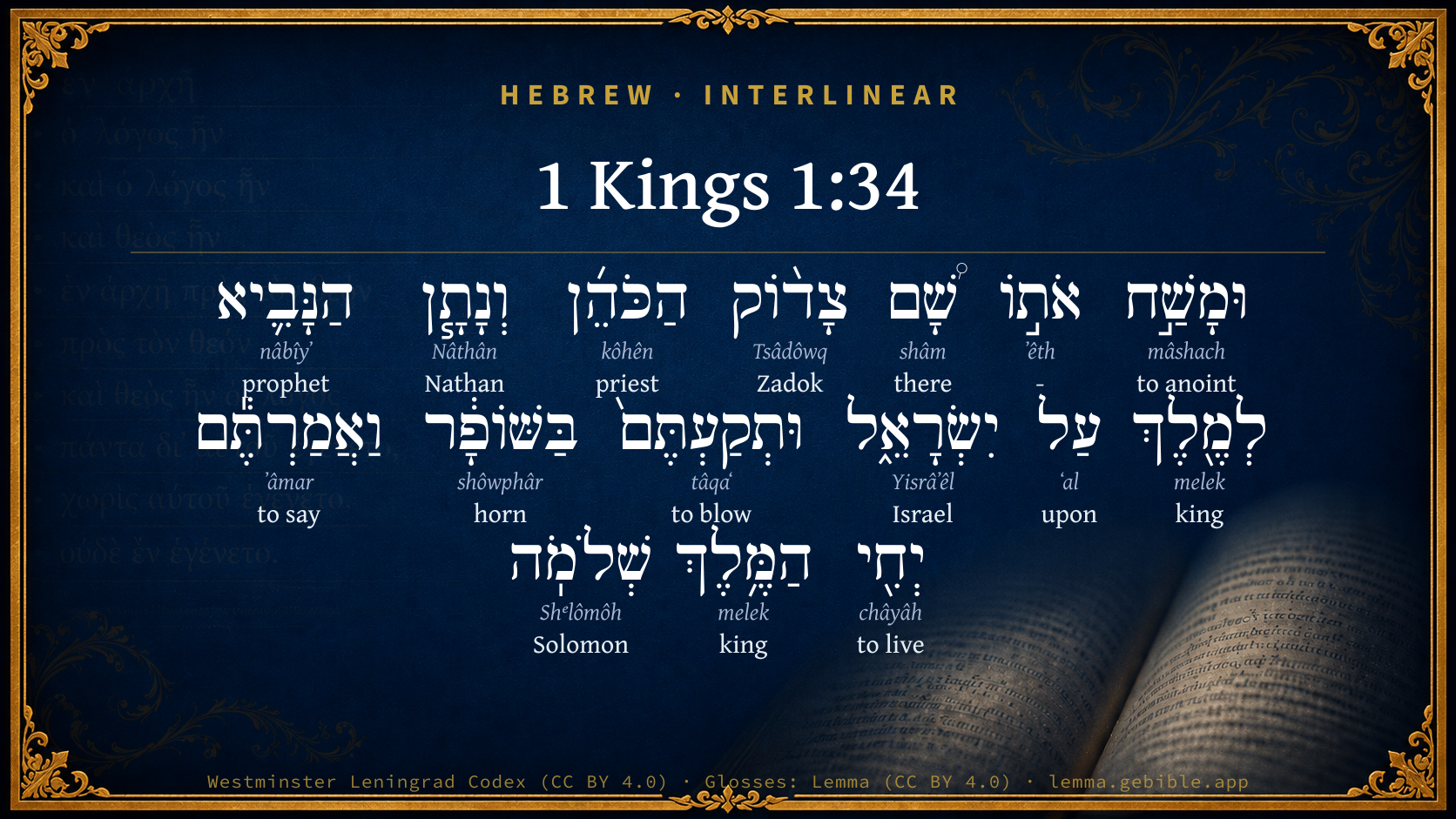
Hebrew (Westminster Leningrad Codex) 1 Kings 1:34 appears in the Hebrew Old Testament. The text above is from the Westminster Leningrad Codex. Each word links to its Strong’s number, a concise gloss, and parsing drawn from the Open Scriptures Hebrew Bible morphology. Click any word for its full Brown-Driver-Briggs (BDB) entry.
Download image
Cite this verse

1 Kings 1:34 (World English Bible). Public Domain. Lemma interlinear Bible study tool, https://lemma.gebible.app/v/1-kings/1/34.

Show BibTeX & RIS
BibTeX
RIS
English Translation
and let Zadok the priest and Nathan the prophet anoint him there king over Israel; and blow you the trumpet, and say, [Long] live king Solomon.
World English Bible · Public Domain
Download a study sheet

One document with this verse’s original text, its word-by-word gloss line, the meaning frame, cross-references with their text, attributed commentary, and full source and license credits — printable, and it pastes into notes with its structure intact.

This verse Autodidact and up

Study sheet (.html) Plain text (.txt)

A passage Seminary Student

Up to 50 verses in one chapter. A passage sheet keeps up to 6 commentary sources and 12 cross-references per verse, in the order this page ranks them, and says so on the sheet whenever that leaves anything out. Ask for a single verse and you get the Autodidact verse sheet above.

Everything on this page stays free to read, with no account — the sheet is a download of what is already on screen, not access to it.

Want to remove ads? Support Godless Engineer
Compare translations 3

The same verse in 3 English versions, stacked beneath the original-language interlinear above. Click any original word for its lexicon entry.

Each is an independent rendering of the whole verse — the interlinear is not word-aligned to these translations.

Highlighted words mark where these versions differ — a whole-verse word diff, not a word-by-word alignment.

  • World English Bible Public Domain
    and let Zadok the priest and Nathan the prophet anoint him there king over Israel; and blow you the trumpet, and say, [Long] live king Solomon.
  • King James Version Public Domain
    And let Zadok the priest and Nathan the prophet anoint him there king over Israel: and blow ye with the trumpet, and say, God save king Solomon.
  • unfoldingWord Literal Text CC BY-SA 4.0
    And Zadok the priest and Nathan the prophet shall anoint him there as king over Israel. And you shall blow on a shofar, and you shall say, ‘May King Solomon live!’

unfoldingWord Literal Text — © unfoldingWord, licensed CC BY-SA 4.0. Word-aligned USFM3 via Door43 (git.door43.org/unfoldingWord/en_ult).

Versions to compare (up to 4)

3 of 4 selected

Show all 18 translations

Every available English version of this verse, each an independent rendering of the whole verse.

  • World English Bible Public Domain
    and let Zadok the priest and Nathan the prophet anoint him there king over Israel; and blow you the trumpet, and say, [Long] live king Solomon.
  • Berean Standard Bible Public Domain
    There Zadok the priest and Nathan the prophet are to anoint him king over Israel. You are to blow the ram’s horn and declare, ‘Long live King Solomon!’
  • Majority Standard Bible Public Domain
    There Zadok the priest and Nathan the prophet are to anoint him king over Israel. You are to blow the ram’s horn and declare, ‘Long live King Solomon!’
  • King James Version Public Domain
    And let Zadok the priest and Nathan the prophet anoint him there king over Israel: and blow ye with the trumpet, and say, God save king Solomon.
  • American Standard Version (1901) Public Domain
    and let Zadok the priest and Nathan the prophet anoint him there king over Israel; and blow ye the trumpet, and say, `Long' live king Solomon.
  • Revised Version (1885) Public Domain
    and let Zadok the priest and Nathan the prophet anoint him there king over Israel: and blow ye with the trumpet, and say, God save king Solomon.
  • Geneva Bible (1599) Public Domain
    And let Zadok the Priest and Nathan the Prophet anoint him there King ouer Israel, and blowe ye the trumpet, and say, God saue king Salomon.
  • Douay-Rheims (1899) Public Domain
    And let Sadoc the priest, and Nathan the prophet anoint him there king over Israel: and you shall sound the trumpet, and shall say: God save king Solomon.
  • Young's Literal Translation Public Domain
    and anointed him there hath Zadok the priest -- and Nathan the prophet -- for king over Israel, and ye have blown with a trumpet, and said, Let king Solomon live;
  • Literal Standard Version CC BY-SA 4.0
    and Zadok the priest has anointed him there—and Nathan the prophet—for king over Israel, and you have blown with a horn and said, Let King Solomon live;
  • Unlocked Literal Bible CC BY-SA 4.0
    Let Zadok the priest and Nathan the prophet anoint him king over Israel and blow the trumpet and say, 'Long live King Solomon!'
  • unfoldingWord Literal Text CC BY-SA 4.0
    And Zadok the priest and Nathan the prophet shall anoint him there as king over Israel. And you shall blow on a shofar, and you shall say, ‘May King Solomon live!’
  • Darby Bible Public Domain
    and let Zadok the priest and Nathan the prophet anoint him there king over Israel; and blow ye with the trumpet, and say, Long live king Solomon!
  • World Messianic Bible Public Domain
    Let Zadok the priest and Nathan the prophet anoint him there king over Israel. Blow the shofar, and say, ‘Long live King Solomon!’
  • Webster's Bible Public Domain
    And let Zadok the priest and Nathan the prophet anoint him there king over Israel: and blow ye with the trumpet, and say, God save king Solomon.
  • Free Bible Version CC BY-SA 4.0
    There have Zadok the priest and Nathan the prophet anoint him king of Israel. Blow the trumpet and shout out, ‘Long live King Solomon!’
  • Bible in Basic English Public Domain
    And there let Zadok the priest and Nathan the prophet put the holy oil on him to make him king over Israel; and sounding the horn say, Long life to King Solomon!
  • JPS Tanakh (1917) Public Domain
    And let Zadok the priest and Nathan the prophet anoint him there king over Israel; and blow ye with the horn, and say: Long live king Solomon.

Literal Standard Version (2020), Covenant Press — licensed CC BY-SA 4.0. Text via the HelloAO Bible API (eBible.org). Unlocked Literal Bible (unfoldingWord) — licensed CC BY-SA 4.0. Text via the HelloAO Bible API (eBible.org). unfoldingWord Literal Text — © unfoldingWord, licensed CC BY-SA 4.0. Word-aligned USFM3 via Door43 (git.door43.org/unfoldingWord/en_ult). Free Bible Version, Dr. Jonathan Gallagher — licensed CC BY-SA 4.0. Text via the HelloAO Bible API (eBible.org).

Word by word

More ways to search: Search by grammar → Find every occurrence → Compare this word →

Practice this passage: Drill this verse → Learn its vocabulary →

וְנָתָ֧ן
Nâthân
H5416
“and · Nathan”
Conjunction + Noun, Proper
Part of Speech
Conjunction + Noun
Type
Proper
Full BDB Definition

Origin: from H5414

TWOT: None

Nathan = "giver" - a son of David by Bathsheba - the eminent prophet in the time of David and Solomon - a man of Zobah, father of one of David's mighty warriors - father of Azariah who was over the officers of Solomon - son of Attai and father of Zabad of the tribe of Judah - brother of Joel of the tribe of Judah - one of the head men who returned from Babylon with Ezra - a man with a foreign wife in the time of Ezra - head of a family of Israel who shall mourn when they look on Him whom they pierced
  1. וּמָשַׁ֣ח mâshach H4886 “and · to anoint” Conjunction + Verb, Qal, Sequential Perfect, 3rd Person, Masculine, Singular
  2. אֹת֣וֹ ʼêth H853 “- · him” Particle, Direct Object + Suffix, Personal, 3rd Person, Masculine, Singular
  3. שָׁ֠ם shâm H8033 “there” Adverb
  4. צָד֨וֹק Tsâdôwq H6659 “Zadok” Noun, Proper
  5. הַכֹּהֵ֜ן kôhên H3548 “the · priest” Particle, Definite Article + Noun, Common, Masculine, Singular, Absolute
  6. הַנָּבִ֛יא nâbîyʼ H5030 “the · prophet” Particle, Definite Article + Noun, Common, Masculine, Singular, Absolute
  7. לְמֶ֖לֶךְ melek H4428 “to/for · king” Preposition + Noun, Common, Masculine, Singular, Absolute
  8. עַל ʻal H5921 “upon” Preposition
  9. יִשְׂרָאֵ֑ל Yisrâʼêl H3478 “Israel” Noun, Proper
  10. וּתְקַעְתֶּם֙ tâqaʻ H8628 “and · to blow” Conjunction + Verb, Qal, Sequential Perfect, 2nd Person, Masculine, Plural
  11. בַּשּׁוֹפָ֔ר shôwphâr H7782 “in/at the · horn” Preposition, Determined + Noun, Common, Masculine, Singular, Absolute
  12. וַאֲמַרְתֶּ֕ם ʼâmar H559 “and · to say” Conjunction + Verb, Qal, Sequential Perfect, 2nd Person, Masculine, Plural
  13. יְחִ֖י châyâh H2421 “to live” Verb, Qal, Jussive, 3rd Person, Masculine, Singular
  14. הַמֶּ֥לֶךְ melek H4428 “the · king” Particle, Definite Article + Noun, Common, Masculine, Singular, Absolute
  15. שְׁלֹמֹֽה Shᵉlômôh H8010 “Solomon” Noun, Proper

About this verse

These counts appear in no published source. They are computed here, from the morphology-tagged text and Lemma’s own curated glosses. What Lemma adds →

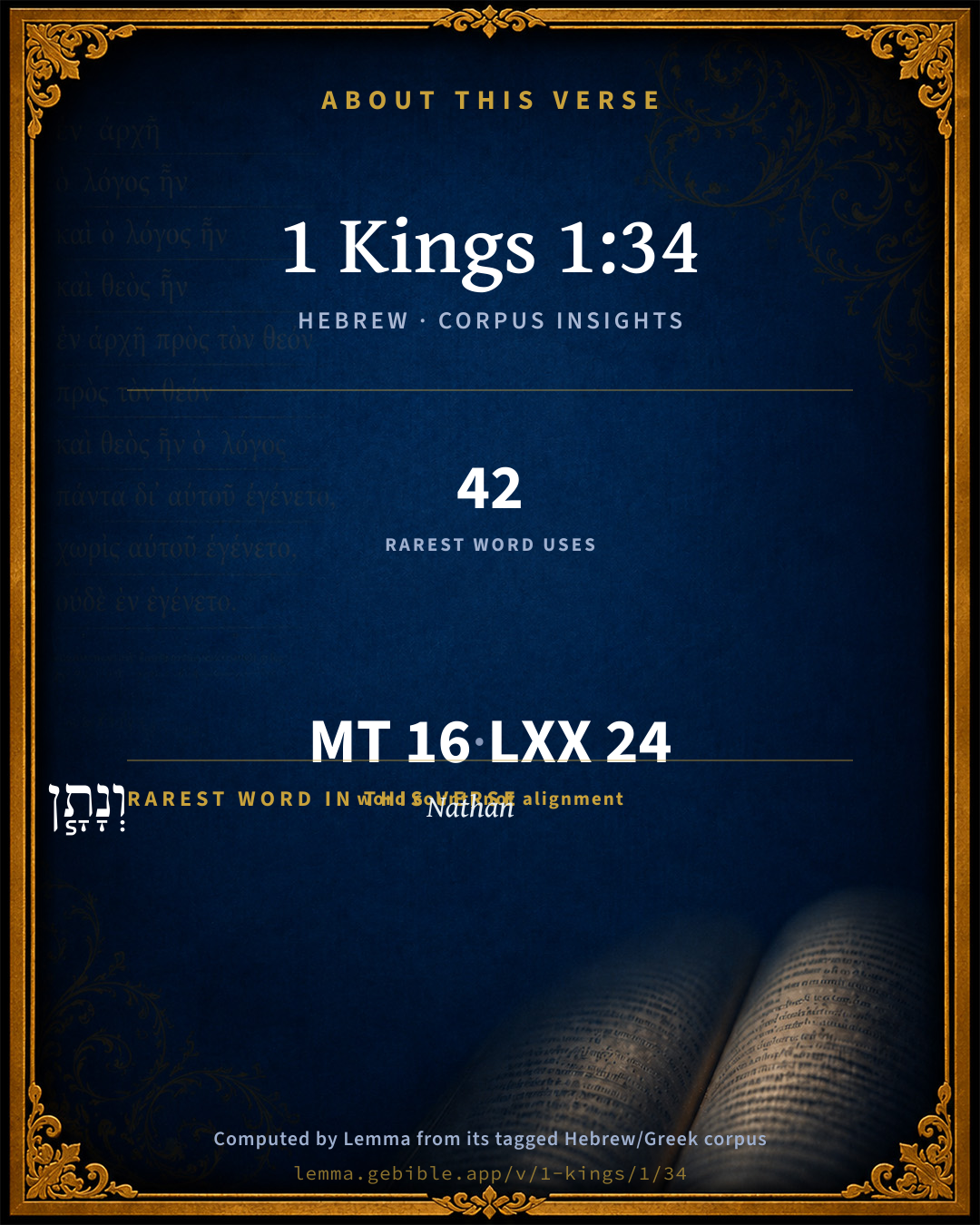
16
words
15
distinct lemmas
Historical
section

Shared distinctive vocabulary

וְנָתָ֧ן Nathan H5416 occurs in 39 verses of the Hebrew Bible. Also found in:

Grammatical profile

  • 4 verbs
  • 9 nouns
  • 1 preposition
  • 1 adverb
  • 1 particle

Verb forms

  • וּמָשַׁ֣ח Qal · Sequential Perfect
  • וּתְקַעְתֶּם֙ Qal · Sequential Perfect
  • וַאֲמַרְתֶּ֕ם Qal · Sequential Perfect
  • יְחִ֖י Qal · Jussive

Repetition

A word recurs within this verse — often emphatic in Hebrew:

  • לְמֶ֖לֶךְ king H4428 ×2

Hebrew & Septuagint length

In English translation the verse runs 26 words from the Hebrew and 31 from the Septuagint (LXX English) — closely comparable.

A rough comparison of the two English renderings, which tokenize alike — not a word-level alignment.

Word counts can differ between the Hebrew and the Greek without any difference in meaning — e.g. the Hebrew direct-object marker אֵת has no separate Greek word, and Greek often adds the article ὁ.

In the original languages it is 16 Hebrew tokens and 24 Greek tokens — but the two are counted differently (Hebrew bundles its prefixes and suffixes into one token; the Greek is in lemma form), so that isn’t a like-for-like length.

Cross-references

21

Topical passages linked to 1 Kings 1:34 in the Treasury of Scripture Knowledge — connected by theme and wording, ordered by reader-vote popularity; previews shown in the World English Bible.

  • 1 Samuel 10:1 Then Samuel took the vial of oil, and poured it on his head, and kissed him, and said, Isn't it that Yahweh has anointed you to be prince over his inheritance?
  • 2 Samuel 15:10 But Absalom sent spies throughout all the tribes of Israel, saying, As soon as you hear the sound of the trumpet, then you shall say, Absalom is king in Hebron.
  • 1 Kings 1:25 For he is gone down this day, and has slain oxen and fatlings and sheep in abundance, and has called all the king's sons, and the captains of the host, and Abiathar the priest; and, behold, they are eating and drinking before him, and say, [Long] live king Adonijah.
  • 1 Samuel 16:3 Call Jesse to the sacrifice, and I will show you what you shall do: and you shall anoint to me him whom I name to you.
  • 2 Samuel 5:3 So all the elders of Israel came to the king to Hebron; and king David made a covenant with them in Hebron before Yahweh: and they anointed David king over Israel.
  • 1 Kings 19:16 and Jehu the son of Nimshi shall you anoint to be king over Israel; and Elisha the son of Shaphat of Abel Meholah shall you anoint to be prophet in your room.
  • 2 Kings 9:3 Then take the vial of oil, and pour it on his head, and say, Thus says Yahweh, I have anointed you king over Israel. Then open the door, and flee, and don't wait.
  • 2 Kings 9:13 Then they hurried, and took every man his garment, and put it under him on the top of the stairs, and blew the trumpet, saying, Jehu is king.
  • 2 Kings 11:12 Then he brought out the king's son, and put the crown on him, and [gave him] the testimony; and they made him king, and anointed him; and they clapped their hands, and said, [Long] live the king.
  • 2 Kings 11:14 and she looked, and, behold, the king stood by the pillar, as the manner was, and the captains and the trumpets by the king; and all the people of the land rejoiced, and blew trumpets. Then Athaliah tore her clothes, and cried, Treason! treason!
  • Acts 10:38 even Jesus of Nazareth, how God anointed him with the Holy Spirit and with power, who went about doing good and healing all who were oppressed by the devil, for God was with him.
  • 1 Samuel 16:12–13 He sent, and brought him in. Now he was ruddy, and withal of a beautiful face, and goodly to look on. Yahweh said, Arise, anoint him; for this is he.
  • 2 Samuel 2:4 The men of Judah came, and there they anointed David king over the house of Judah. They told David, saying, The men of Jabesh Gilead were those who buried Saul.
  • 2 Kings 9:6 He arose, and went into the house; and he poured the oil on his head, and said to him, Thus says Yahweh, the God of Israel, I have anointed you king over the people of Yahweh, even over Israel.
  • 2 Chronicles 23:11 Then they brought out the king's son, and put the crown on him, and [gave him] the testimony, and made him king: and Jehoiada and his sons anointed him; and they said, [Long] live the king.
  • Psalms 45:7 You have loved righteousness, and hated wickedness. Therefore God, your God, has anointed you with the oil of gladness above your fellows.
  • Psalms 89:20 I have found David, my servant. I have anointed him with my holy oil,
  • Psalms 89:36 His seed will endure forever, His throne like the sun before me.
  • Psalms 98:5–7 Sing praises to Yahweh with the harp, With the harp and the voice of melody.
  • Isaiah 45:1 Thus says Yahweh to his anointed, to Cyrus, whose right hand I have held, to subdue nations before him, and I will loose the loins of kings; to open the doors before him, and the gates shall not be shut:
  • 2 Corinthians 1:21–22 Now he who establishes us with you in Christ, and anointed us, is God;

Cross-references courtesy of OpenBible.info (CC BY 4.0).

Hebrew and Greek witnesses Masoretic Hebrew ↔ Greek Septuagint

The same verse in the two great witnesses to the Old Testament, shown verse-for-verse.

These are two independent witnesses, not word-aligned to each other, and the Septuagint is shown in lemma (dictionary) form.

Hebrew 1 Kings 1:34 Masoretic · Westminster Leningrad Codex

וּמָשַׁ֣ח אֹת֣וֹ שָׁ֠ם צָד֨וֹק הַכֹּהֵ֜ן וְנָתָ֧ן הַנָּבִ֛יא לְמֶ֖לֶךְ עַל יִשְׂרָאֵ֑ל וּתְקַעְתֶּם֙ בַּשּׁוֹפָ֔ר וַאֲמַרְתֶּ֕ם יְחִ֖י הַמֶּ֥לֶךְ שְׁלֹמֹֽה

and let Zadok the priest and Nathan the prophet anoint him there king over Israel; and blow you the trumpet, and say, [Long] live king Solomon.

World English Bible · Public Domain

Greek LXX 1 Kings 1:34 Septuagint · lemma form

καί χρίω αὐτός ἐκεῖ σαδωκ ὁ ἱερεύς καί ναθαν ὁ προφήτης εἰς βασιλεύς ἐπί ἰσραήλ καί σαλπίζω κερατίνη καί εἶπον ζάω ὁ βασιλεύς σαλωμών

And there let Sadoc the priest and Nathan the prophet anoint him to be king over Israel, and do you⌃ sound the trumpet, and you⌃ shall say, Let king Solomon live.

LXX2012 (modern English Septuagint) · Public Domain

Hebrew: Westminster Leningrad Codex (CC BY 4.0). Greek: Septuagint (public domain); English from LXX2012 (modern English Septuagint) (Public Domain). How the Septuagint differs from the Hebrew →

Targum (Aramaic paraphrase)

1

The Targum is the ancient Jewish Aramaic paraphrase of the Hebrew Scriptures — an interpretive translation, not the Hebrew text itself. Onkelos (literal) and Pseudo-Jonathan (expansive) render the Torah, and Jonathan the Prophets. Coverage is partial: where no permissively-licensed English translation exists for a verse, only the Aramaic is shown. This is verse-level text, not a word-by-word alignment to the Hebrew.

  1. Targum Jonathan Prophets (Joshua–Malachi)
    וְיִמְשַׁח יָתֵיהּ תַּמָן צָדוֹק כַּהֲנָא וְנָתָן נְבִיָא לְמֶהֱוֵי מַלְכָּא עַל יִשְׂרָאֵל וְתִתְקְעוּן בְּשׁוֹפָרָא וְתֵימְרוּן יַצְלַח מַלְכָּא שְׁלֹמֹה:

    (no public-domain English translation for this verse)

    Targum Jonathan — Aramaic: “Mikraot Gedolot” (public domain). English: “Sefaria Community Translation” (CC0 1.0 (public-domain dedication)); “London "Chaldee Paraphrase," 1871” (public domain). Text via Sefaria.

Commentary

Notes on 1 Kings 1:34 from classic Christian and Jewish commentators (each source and its license shown beneath its notes). The classic Christian expositions comment on the surrounding passage and are grouped to its opening verse, so a note may address several verses; the Jewish commentaries on the Tanakh (Rashi and others) are per-verse, so they appear only where the commentator wrote on this verse.

Lemma curates 59 commentaries, every one of them public domain or Creative Commons licensed, each selected and text-cleaned for this edition rather than reprinted as found. About our sources →

Trapp's Complete Commentary

John Trapp

1Ki 1:34 And let Zadok the priest and Nathan the prophet anoint him there king over Israel: and blow ye with the trumpet, and say, God save king Solomon.

Ver. 34. And let Zadok the priest and Nathan the prophet.] That the young king might learn betime to hearken to such, and to give them all due respect.

John Trapp, A Commentary or Exposition upon All the Books of the Old and New Testament (1647–1656) — public domain. Text from a community e-Sword module.

Joseph Benson's Commentary

1Ki 1:34. Let Zadok the priest and Nathan the prophet anoint him — That is, say the Jews, one of them poured out the oil, and the other anointed his head, drawing a circle round about it with oil, according to their maxim that their kings were anointed in the form of a crown, to denote their delegation to the royal dignity. It is of more importance to observe, that this unction signified not only the designation of the person anointed to his office, but the gifts and graces which were necessary to qualify him for it, and which, seeking them sincerely of God, he might expect to receive. “We do not find,” says Henry, “that Abiathar pretended to anoint Adonijah: he was made king by a feast, not by unction. Whom God calls, he will qualify, which was signified by the anointing: usurpers had it not. Christ signifies anointed, and he is the king whom God hath set upon his holy hill of Zion, according to the decree, Psa 2:6-7. Christians, also, are made to our God, and by him, kings, and they have an unction from the Holy One, 1Jn 2:20.”

Joseph Benson's Commentary on the Old and New Testaments (1811–1818) — public domain. Text from a community e-Sword module.

Tyndale Open Study Notes

Tyndale Open Resources

1:34 Solomon’s anointing followed established protocol in being administered by a prophet (see 1 Sam 16:1-13). • Priests also played significant roles in royal matters, and the populace would welcome Zadok’s blessing. David later confirmed Solomon’s kingship in a public ceremony (1 Chr 29:22).

Tyndale Open Study Notes — © Tyndale Open Resources, licensed CC BY-SA 4.0. Text via the HelloAO Bible API.

Jamieson, Fausset & Brown

Robert Jamieson, A. R. Fausset & David Brown

anoint him--done only in the case of a new dynasty or disputed succession (see on Sa1 16:13; Sa2 2:1).

Jamieson, Fausset & Brown — Commentary Critical and Explanatory on the Whole Bible (1871) — public domain (CC PDM 1.0). Text via the HelloAO Bible API.

Adam Clarke's Commentary

Verse 34. Blow ye with the trumpet] After he has been anointed, make proclamation that he is king.

Adam Clarke's Commentary on the Bible (1810–1826) — public domain. Text from a community e-Sword/MySword module.

Ellicott's Commentary for English Readers

(34) Anoint him . . . king.—It is notable that of this solemn inauguration of royalty, marked emphatically as a religious consecration by the common phrase “the Lord’s anointed”—then especially in use (1Sa_16:6; 1Sa_24:6; 1Sa_26:9; 2Sa_1:14; 2Sa_19:21), though found also occasionally in the later books (Lam_4:20)—there is no mention of the tumultuous usurpation of Adonijah. Probably, as in the appointment of Saul and David himself, the right to anoint was recognised as belonging to the prophetic order (see 1Ki_19:16), inasmuch as it signified the outpouring of the Holy Spirit of the Lord. (Comp. Act_10:38.) Hence, in the absence of Nathan, it could not be attempted. In the case of David, such anointing had marked (1Sa_16:13) his first private designation for the kingdom by Samuel, and his public accession to royalty, first over Judah (2Sa_2:4), then over all Israel (2Sa_5:3).

The completeness of the old King’s provision is especially to be noticed. The “riding on the King’s mule,” attended by the body-guard, marked the royal sanction; the anointing, the sanction of priest and prophet; and the acclamation the adhesion of the people. Then are to follow the enthronement and homage.

A Bible Commentary for English Readers, edited by Charles John Ellicott (1878–1897) — public domain. Text from a community e-Sword module.

The Cambridge Bible for Schools and Colleges

gen. ed. J. J. S. Perowne

34. anoint him there] The anointing was the most solemn portion of the ceremonies connected with the installation of a new king. We only read of its being done on some very marked occasions. Thus Saul, the first king, was anointed (1Sa_10:1), and David, the king of God’s own choice (1Sa_16:13); also when God orders the prophet Elijah to make provision for a new succession in Israel, Jehu is to be anointed (1Ki_19:16), which was done when the proper time came (2Ki_9:3; 2Ki_9:6); so Joash after his preservation was anointed by Jehoiada (2Ch_23:11). But though unmentioned it may have been performed in other cases. For ‘anointing’ is mentioned even in Jotham’s parable (Jdg_9:8), where the trees will choose them a king. The ceremony is intended to symbolize the outpouring of gifts from above upon the new monarch.

blow ye with the trumpet] Thus did Jehu’s companions after his anointing (2Ki_9:13); neither anointing nor the blowing of the trumpets has been mentioned in connexion with Adonijah’s faction. No doubt they wished to gain strength before making such a public display of what they were doing.

The Cambridge Bible for Schools and Colleges (gen. ed. J. J. S. Perowne; Cambridge University Press, 1878–1918) — public domain. Text from a community e-Sword module.

John Gill's Exposition

And let Zadok the priest, and Nathan the prophet, anoint him there king over Israel,.... For it might be done by either of them, as the unctions of Saul and David show:

and blow ye the trumpet, and say, God save King Solomon; the blowing of the trumpet was to make it public; the proclamation of him as king was to be made by the sound of it, and the acclamation of the people was to express their concurrence with it, their loyal affection to the new king, and their hearty wishes for his health, prosperity, and long life.

John Gill's Exposition of the Whole Bible (1746–1763) — public domain (CC PDM 1.0). Text via the HelloAO Bible API.

Albert Barnes' Notes on the Bible

Anoint him - Inauguration into each of the three offices (those of prophet, priest, and king) typical of the Messiah or Anointed One, was by anointing with oil. Divine appointment had already instituted the rite in connection with the kingly office 2Sa 2:4; but after Solomon we have no express mention of the anointing of kings, except in the three cases of Jehu, Joash, and Jehoahaz 2Ki 9:6; 2Ki 11:12; 2Ki 23:30, who were all appointed irregularly. At the time of the captivity, kings, whose anointing has not been related in the historical books, still bear the title of “the anointed of the Lord.” Lam 4:20; Psa 89:38, Psa 89:51.

Albert Barnes' Notes on the Bible (1834–1885) — public domain. Text from a community e-Sword/MySword module.

Haydock's Catholic Bible Commentary

Save, (Vavat.) "Live." May Solomon reign for many years. (Haydock)

George Leo Haydock (1774–1849), Haydock's Catholic Family Bible and Commentary, 1859 edition — public domain. Excludes Psalms (Douay-Rheims chapter numbering differs from Protestant) and Deuterocanonical books (Catholic canon only).

Matthew Poole's English Annotations

Anoint him there king; as they used to do where there was any thing new, or doubtful, or extraordinary in the succession, as 1Sa 10:1; 16:12,13; 1Ki 19:15,16; 2Ki 9:3. And this unction signified both the designation of the persons to the office, and the gifts and graces which were necessary for their office, and which they, seeking them sincerely from God, might expect to receive.

Blow ye with the trumpet; to make the action more solemn, and glorious, and public.

Matthew Poole's English Annotations on the Holy Bible (1683–1685) — public domain. Text from a community e-Sword/MySword module.

The Pulpit Commentary

And let Zadok the priest and Nathan the prophet Bahr sees in the fact that Nathan was associated with Zadok in the anointing, "the high significance David attributed to the prophetic office in Israel" But the prophets constantly performed this ceremony. Samuel anointed both Saul and David; Elisha anointed Jehu, (2Ki_9:1) and was commissioned to anoint Hazael (1Ki_19:15, 1Ki_19:16) anoint him the king, being a sacred personage, was set apart to the office, like the priest and prophet, by anointing. Saul was probably anointed twice. (1Sa_10:1 1Sa_11:15. Cf. 12:3) David was anointed thrice (1Sa_16:13; 2Sa_2:4 2Sa_5:3. Solomon was anointed twice. (ver. 39; 1Ch_29:22) The Rabbins have always held that subsequent kings were not anointed, where the succession was regular. But this opinion must be taken quantum valet. It is true that we only read of the anointing of Jehu, (2Ki_9:6) Joash (ibid. 1Ki_11:12) and Jehoahaz, (ibid. 1Ki 23:30) and that in these three cases the accession was irregular. But it is obvious that other kings may have been anointed as well, though the fact is not recorded. There would be no reason for recording it in ordinary cases It seems hardly likely, too, that any king would readily dispense with an ordinance which would so much strengthen his title there king over Israel: and blow ye with the trumpet the sound of the trumpet would almost seem to have been a necessary accompaniment of coronations, or the proclamation of a new king. (See 2Sa_15:10; 2Ki_9:13 2Ki_11:14) and say, God cave king Solomon. See on ver. 25.

The Pulpit Commentary (1880–1919), ed. H.D.M. Spence-Jones & Joseph S. Exell — public domain. Text from a community e-Sword module.

John Wesley's Explanatory Notes

Anoint - As they used to do where there was any thing new or extraordinary in the succession. And this unction signified both the designation of the persons to the office, and the gifts and graces which were necessary for their office, and which, they, seeking them sincerely from God, might expect to receive.

John Wesley, Explanatory Notes Upon the Whole Bible (1754–1765) — public domain. Text via the GEBible commentary corpus.

Keil & Delitzsch

C. F. Keil & F. Delitzsch

The blowing of the trumpet and the cry "Long live the king" (cf. Sa1 10:24) were to serve as a solemn proclamation after the anointing had taken place.

Keil & Delitzsch — Biblical Commentary on the Old Testament (1861–1891) — public domain (CC PDM 1.0). Text via the HelloAO Bible API. (Old Testament only.)

Rashi

Rabbi Shlomo Yitzchaki (Rashi)

And he shall be anointed. He places the oil between his eyelids in the form of a crown.

Rashi on the Tanakh — English translations: “The Judaica Press complete Tanach with Rashi, translated by A. J. Rosenberg” (CC BY 4.0); “Pentateuch with Rashi's commentary by M. Rosenbaum and A.M. Silbermann, 1929-1934” (public domain); “The Metsudah Tanach series, Lakewood, N.J” (CC BY 4.0); and “The Book of Joshua, Metsudah Publications, 1997” (CC BY 4.0). Text via Sefaria.

Lesson kit

Teaching starters — assembled from the data on this page, not authored interpretation. Every prompt links to the verse data it draws on. Edit before teaching.

1 Kings, in the Historical, opens this verse with 16 words (15 distinct Hebrew lemmas). Its most distinctive word is Nâthân (“Nathan”). A historical commentator’s framing appears above. Read the whole chapter for the surrounding context.

Discussion questions

  1. What does “Nathan” (Nâthân) contribute to the verse as a whole?
  2. How does 2 Samuel 5:14, which shares the word «Nathan», read alongside this verse?
  3. What does the repetition of “king” (2× in this one verse) do in this verse?
  4. The translations on this page render this verse differently — a whole-verse word diff, not a word-by-word alignment. What might account for the different wordings?
  5. «וּמָשַׁ֣ח» is a Qal Sequential Perfect verb. How does that grammatical form shape the action described?
  6. Compare how Trapp's Complete Commentary and Joseph Benson's Commentary read this verse. Where do they agree or differ?

Things to notice

Reading settings

Reading text

Shown beneath each verse's original-language words.

Old Testament
Old Testament edition

Read the OT as the Masoretic Hebrew (MT) or the Greek Septuagint (LXX).

English shown for the Greek Septuagint (in the Hebrew ↔ Greek comparison).

Comparing translations? Open the Compare panel on any verse page to stack up to four side by side.