
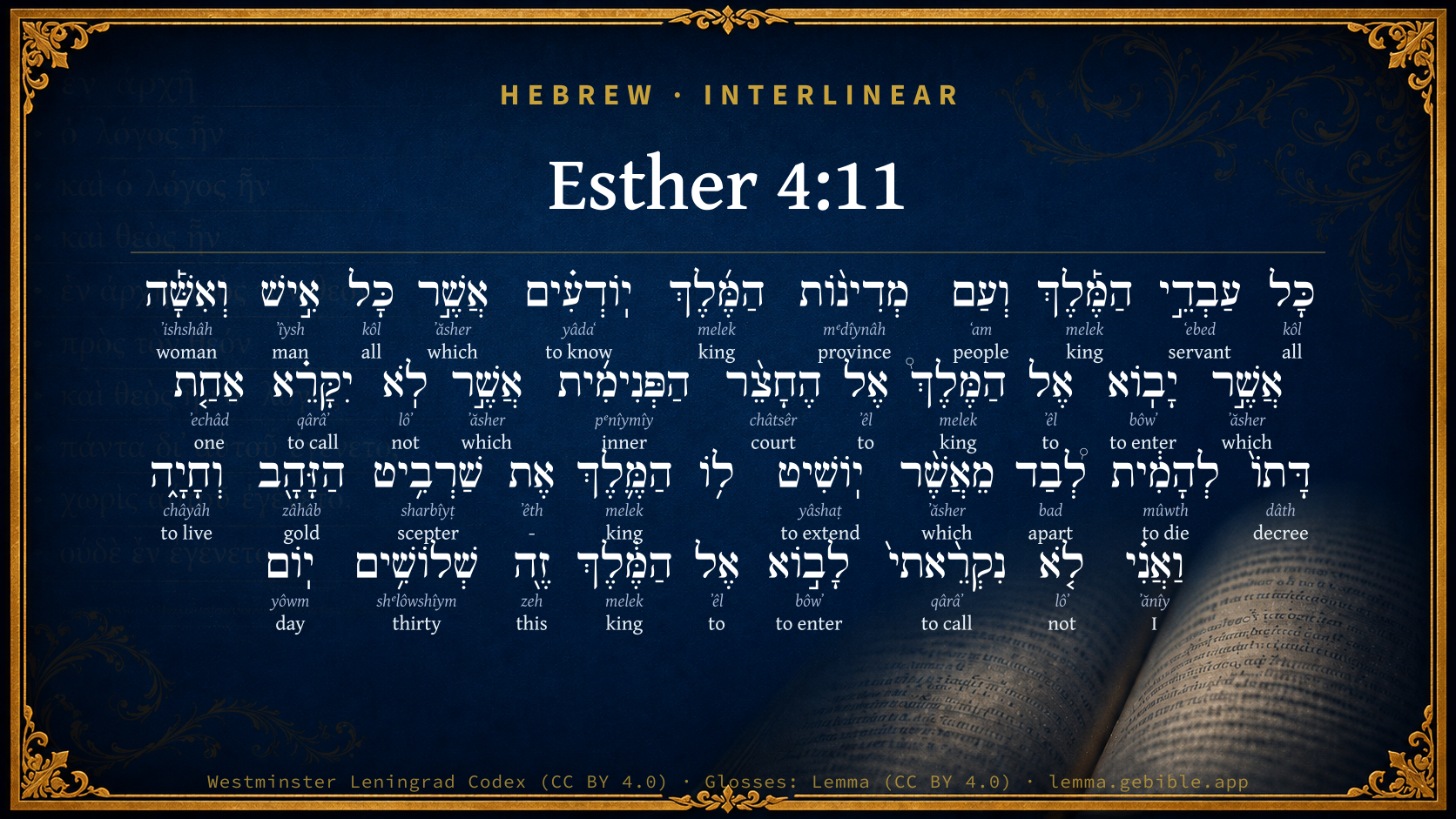
Esther 4:11

Hebrew (Westminster Leningrad Codex) Esther 4:11 appears in the Hebrew Old Testament. The text above is from the Westminster Leningrad Codex. Each word links to its Strong’s number, a concise gloss, and parsing drawn from the Open Scriptures Hebrew Bible morphology. Click any word for its full Brown-Driver-Briggs (BDB) entry.
Download image
Cite this verse

Esther 4:11 (World English Bible). Public Domain. Lemma interlinear Bible study tool, https://lemma.gebible.app/v/esther/4/11.

Show BibTeX & RIS
BibTeX
RIS
English Translation
All the king's servants, and the people of the king's provinces, do know, that whoever, whether man or woman, shall come to the king into the inner court, who is not called, there is one law for him, that he be put to death, except those to whom the king shall hold out the golden scepter, that he may live: but I have not been called to come in to the king these thirty days.
World English Bible · Public Domain
Highlights
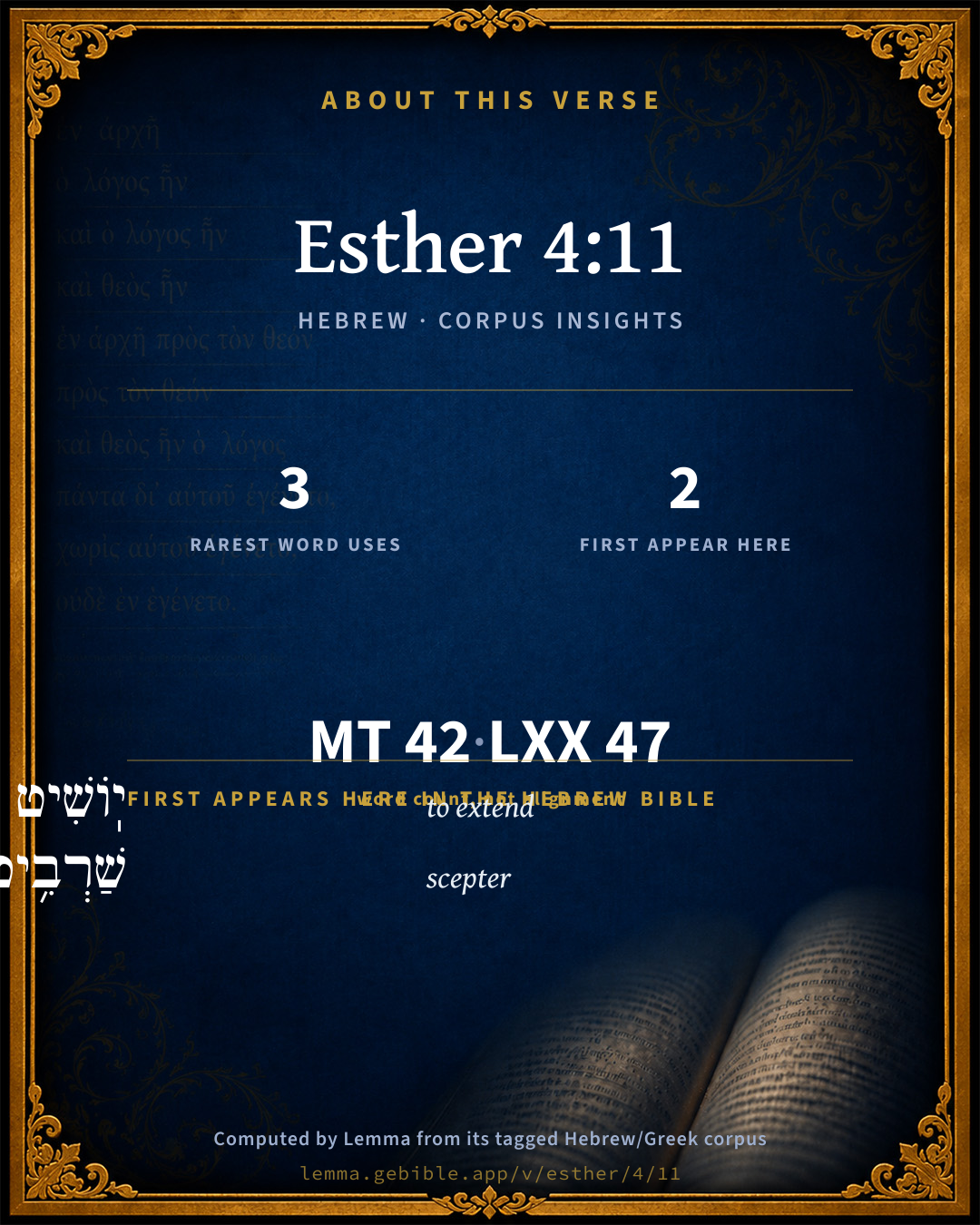
  • 2 first appearances in the Hebrew Bible
Full analysis ↓
Download a study sheet

One document with this verse’s original text, its word-by-word gloss line, the meaning frame, cross-references with their text, attributed commentary, and full source and license credits — printable, and it pastes into notes with its structure intact.

This verse Autodidact and up

Study sheet (.html) Plain text (.txt)

A passage Seminary Student

Up to 50 verses in one chapter. A passage sheet keeps up to 6 commentary sources and 12 cross-references per verse, in the order this page ranks them, and says so on the sheet whenever that leaves anything out. Ask for a single verse and you get the Autodidact verse sheet above.

Everything on this page stays free to read, with no account — the sheet is a download of what is already on screen, not access to it.

Want to remove ads? Support Godless Engineer
Compare translations 3

The same verse in 3 English versions, stacked beneath the original-language interlinear above. Click any original word for its lexicon entry.

Each is an independent rendering of the whole verse — the interlinear is not word-aligned to these translations.

Highlighted words mark where these versions differ — a whole-verse word diff, not a word-by-word alignment.

  • World English Bible Public Domain
    All the king's servants, and the people of the king's provinces, do know, that whoever, whether man or woman, shall come to the king into the inner court, who is not called, there is one law for him, that he be put to death, except those to whom the king shall hold out the golden scepter, that he may live: but I have not been called to come in to the king these thirty days.
  • King James Version Public Domain
    All the king's servants, and the people of the king's provinces, do know, that whosoever, whether man or women, shall come unto the king into the inner court, who is not called, there is one law of his to put him to death, except such to whom the king shall hold out the golden sceptre, that he may live: but I have not been called to come in unto the king these thirty days.
  • unfoldingWord Literal Text CC BY-SA 4.0
    “All the servants of the king and the people of the provinces of the king are knowing that for any man or woman who goes to the king, to the inner court, who has not been called, his law is one: to cause to die, apart from when the king holds out to him the scepter of gold; then he will live. But as for me, I have not been called to come to the king these 30 days.”

unfoldingWord Literal Text — © unfoldingWord, licensed CC BY-SA 4.0. Word-aligned USFM3 via Door43 (git.door43.org/unfoldingWord/en_ult).

Versions to compare (up to 4)

3 of 4 selected

Show all 18 translations

Every available English version of this verse, each an independent rendering of the whole verse.

  • World English Bible Public Domain
    All the king's servants, and the people of the king's provinces, do know, that whoever, whether man or woman, shall come to the king into the inner court, who is not called, there is one law for him, that he be put to death, except those to whom the king shall hold out the golden scepter, that he may live: but I have not been called to come in to the king these thirty days.
  • Berean Standard Bible Public Domain
    “All the royal officials and the people of the king’s provinces know that one law applies to every man or woman who approaches the king in the inner court without being summoned—that he be put to death. Only if the king extends the gold scepter may that person live. But I have not been summoned to appear before the king for the past thirty days.”
  • Majority Standard Bible Public Domain
    “All the royal officials and the people of the king’s provinces know that one law applies to every man or woman who approaches the king in the inner court without being summoned—that he be put to death. Only if the king extends the gold scepter may that person live. But I have not been summoned to appear before the king for the past thirty days.”
  • King James Version Public Domain
    All the king's servants, and the people of the king's provinces, do know, that whosoever, whether man or women, shall come unto the king into the inner court, who is not called, there is one law of his to put him to death, except such to whom the king shall hold out the golden sceptre, that he may live: but I have not been called to come in unto the king these thirty days.
  • American Standard Version (1901) Public Domain
    All the king's servants, and the people of the king's provinces, do know, that whosoever, whether man or woman, shall come unto the king into the inner court, who is not called, there is one law for him, that he be put to death, except those to whom the king shall hold out the golden sceptre, that he may live: but I have not been called to come in unto the king these thirty days.
  • Revised Version (1885) Public Domain
    All the king’s servants, and the people of the king’s provinces, do know, that whosoever, whether man or woman, shall come unto the king into the inner court, who is not called, there is one law for him, that he be put to death, except such to whom the king shall hold out the golden sceptre, that he may live: but I have not been called to come in unto the king these thirty days.
  • Geneva Bible (1599) Public Domain
    All the Kings seruants and the people of the Kings prouinces doe knowe, that whosoeuer, man or woman, that commeth to the King into the inner court, which is not called, there is a law of his, that he shall dye, except him to whom the King holdeth out the golden rodde, that he may liue. Now I haue not bene called to come vnto the King these thirtie dayes.
  • Douay-Rheims (1899) Public Domain
    ,11All the king's servants, and all the provinces that are under his dominion, know, that whosoever, whether man or woman, cometh into the king's inner court, who is not called for, is immediately to be put to death without any delay: except the king shall hold out the golden sceptre to him, in token of clemency, that so he may live. How then can I go in to the king, who for these thirty days now have not been called unto him?
  • Young's Literal Translation Public Domain
    `All servants of the king, and people of the provinces of the king, do know that any man and woman, who cometh in unto the king, unto the inner court, who is not called -- one law `of' his `is' to put `them' to death, apart from him to whom the king holdeth out the golden sceptre, then he hath lived; and I -- I have not been called to come in unto the king these thirty days.'
  • Literal Standard Version CC BY-SA 4.0
    “All servants of the king, and people of the provinces of the king, know that any man and woman who comes to the king, into the inner court, who is not called—one law of his [is] to put [them] to death, apart from him to whom the king holds out the golden scepter, then he has lived; and I have not been called to come in to the king these thirty days.”
  • Unlocked Literal Bible CC BY-SA 4.0
    She said, “All the king's servants and the people of the king's provinces know that if any man or woman goes to the king inside the inner courtyard without being summoned, there is only one law: That he must be put to death—except for anyone to whom the king holds out the golden scepter so that he may live. I have not been called to come to the king these thirty days.”
  • unfoldingWord Literal Text CC BY-SA 4.0
    “All the servants of the king and the people of the provinces of the king are knowing that for any man or woman who goes to the king, to the inner court, who has not been called, his law is one: to cause to die, apart from when the king holds out to him the scepter of gold; then he will live. But as for me, I have not been called to come to the king these 30 days.”
  • Darby Bible Public Domain
    All the king's servants and the people of the king's provinces do know that whoever, whether man or woman, shall come to the king into the inner court, who is not called, there is *one* law, to put [him] to death, except [such] to whom the king shall hold out the golden sceptre, that he may live; and I have not been called to come in unto the king these thirty days.
  • World Messianic Bible Public Domain
    “All the king’s servants and the people of the king’s provinces know that whoever, whether man or woman, comes to the king into the inner court without being called, there is one law for him, that he be put to death, except those to whom the king might hold out the golden scepter, that he may live. I have not been called to come in to the king these thirty days.”
  • Webster's Bible Public Domain
    All the king's servants, and the people of the king's provinces, do know, that whoever, whether man or woman, shall come to the king into the inner court, who is not called, there is one law of his to put him to death, except him to whom the king shall hold out the golden scepter, that he may live: but I have not been called to come in to the king these thirty days.
  • Free Bible Version CC BY-SA 4.0
    “All the king's officials, and even the people in the provinces of the king's empire, know that any man or any woman who goes to the king, entering his inner court without being summoned, is sentenced to death—that is the king's one law—unless the king holds out his golden scepter to them so they can live. In my case, I have not been called to go to the king for thirty days.”
  • Bible in Basic English Public Domain
    It is common knowledge among all the king's servants and the people of every part of the kingdom, that if anyone, man or woman, comes to the king in his inner room without being sent for, there is only one law for him, that he is to be put to death; only those to whom the king's rod of gold is stretched out may keep their lives: but I have not been sent for to come before the king these thirty days.
  • JPS Tanakh (1917) Public Domain
    'All the king's servants, and the people of the king's provinces, do know, that whosoever, whether man or woman, shall come unto the king into the inner court, who is not called, there is one law for him, that he be put to death, except such to whom the king shall hold out the golden sceptre, that he may live; but I have not been called to come in unto the king these thirty days.'

Literal Standard Version (2020), Covenant Press — licensed CC BY-SA 4.0. Text via the HelloAO Bible API (eBible.org). Unlocked Literal Bible (unfoldingWord) — licensed CC BY-SA 4.0. Text via the HelloAO Bible API (eBible.org). unfoldingWord Literal Text — © unfoldingWord, licensed CC BY-SA 4.0. Word-aligned USFM3 via Door43 (git.door43.org/unfoldingWord/en_ult). Free Bible Version, Dr. Jonathan Gallagher — licensed CC BY-SA 4.0. Text via the HelloAO Bible API (eBible.org).

Word by word

More ways to search: Search by grammar → Find every occurrence → Compare this word →

Practice this passage: Drill this verse → Learn its vocabulary →

יֽוֹשִׁיט
yâshaṭ
H3447
“to extend”
Verb, Hiphil, Imperfect, 3rd Person, Masculine, Singular
Part of Speech
Verb
Stem
Hiphil
Form
Imperfect
Person
3rd Person
Gender
Masculine
Number
Singular
Full BDB Definition

Origin: a primitive root

TWOT: 925

(Hiphil) to hold out, extend
  1. כָּל kôl H3605 “all of” Noun, Common, Masculine, Singular, Construct
  2. עַבְדֵ֣י ʻebed H5650 “servants of” Noun, Common, Masculine, Plural, Construct
  3. הַמֶּ֡לֶךְ melek H4428 “the · king” Particle, Definite Article + Noun, Common, Masculine, Singular, Absolute
  4. וְעַם ʻam H5971 “and · people of” Conjunction + Noun, Common, Masculine, Singular, Construct
  5. מְדִינ֨וֹת mᵉdîynâh H4082 “provinces of” Noun, Common, Feminine, Plural, Construct
  6. הַמֶּ֜לֶךְ melek H4428 “the · king” Particle, Definite Article + Noun, Common, Masculine, Singular, Absolute
  7. יֽוֹדְעִ֗ים yâdaʻ H3045 “knowing” Verb, Qal, Participle Active, Masculine, Plural, Absolute
  8. אֲשֶׁ֣ר ʼăsher H834 “which” Particle, Relative
  9. כָּל kôl H3605 “all of” Noun, Common, Masculine, Singular, Construct
  10. אִ֣ישׁ ʼîysh H376 “man” Noun, Common, Masculine, Singular, Absolute
  11. וְאִשָּׁ֡ה ʼishshâh H802 “and · woman” Conjunction + Noun, Common, Feminine, Singular, Absolute
  12. אֲשֶׁ֣ר ʼăsher H834 “which” Particle, Relative
  13. יָבֽוֹא bôwʼ H935 “to enter” Verb, Qal, Imperfect, 3rd Person, Masculine, Singular
  14. אֶל ʼêl H413 “to” Preposition
  15. הַמֶּלֶךְ֩ melek H4428 “the · king” Particle, Definite Article + Noun, Common, Masculine, Singular, Absolute
  16. אֶל ʼêl H413 “to” Preposition
  17. הֶחָצֵ֨ר châtsêr H2691 “the · court” Particle, Definite Article + Noun, Common, Both, Singular, Absolute
  18. הַפְּנִימִ֜ית pᵉnîymîy H6442 “the · inner” Particle, Definite Article + Adjective, Adjective, Feminine, Singular, Absolute
  19. אֲשֶׁ֣ר ʼăsher H834 “which” Particle, Relative
  20. לֹֽא lôʼ H3808 “not” Particle, Negative
  21. יִקָּרֵ֗א qârâʼ H7121 “to call” Verb, Niphal, Imperfect, 3rd Person, Masculine, Singular
  22. אַחַ֤ת ʼechâd H259 “one” Adjective, Cardinal number, Feminine, Singular, Absolute
  23. דָּתוֹ֙ dâth H1881 “decree · his” Noun, Common, Feminine, Singular, Construct + Suffix, Personal, 3rd Person, Masculine, Singular
  24. לְהָמִ֔ית mûwth H4191 “to die” Preposition + Verb, Hiphil, Infinitive Construct
  25. לְ֠בַד bad H905 “to/for · apart” Preposition + Noun, Common, Masculine, Singular, Absolute
  26. מֵאֲשֶׁ֨ר ʼăsher H834 “from · which” Preposition + Particle, Relative
  27. הַמֶּ֛לֶךְ melek H4428 “the · king” Particle, Definite Article + Noun, Common, Masculine, Singular, Absolute
  28. אֶת ʼêth H853 “-” Particle, Direct Object
  29. שַׁרְבִ֥יט sharbîyṭ H8275 “scepter of” Noun, Common, Masculine, Singular, Construct
  30. הַזָּהָ֖ב zâhâb H2091 “the · gold” Particle, Definite Article + Noun, Common, Masculine, Singular, Absolute
  31. וְחָיָ֑ה châyâh H2421 “and · to live” Conjunction + Verb, Qal, Sequential Perfect, 3rd Person, Masculine, Singular
  32. וַאֲנִ֗י ʼănîy H589 “and · I” Conjunction + Pronoun, Personal, 1st Person, Common, Singular
  33. לֹ֤א lôʼ H3808 “not” Particle, Negative
  34. נִקְרֵ֨אתי֙ qârâʼ H7121 “to call” Verb, Niphal, Perfect, 1st Person, Common, Singular
  35. לָב֣וֹא bôwʼ H935 “to enter” Preposition + Verb, Qal, Infinitive Construct
  36. אֶל ʼêl H413 “to” Preposition
  37. הַמֶּ֔לֶךְ melek H4428 “the · king” Particle, Definite Article + Noun, Common, Masculine, Singular, Absolute
  38. זֶ֖ה zeh H2088 “this” Pronoun, Demonstrative, Masculine, Singular
  39. שְׁלוֹשִׁ֥ים shᵉlôwshîym H7970 “thirty” Adjective, Cardinal number, Both, Plural, Absolute
  40. יֽוֹם yôwm H3117 “day” Noun, Common, Masculine, Singular, Absolute

About this verse

These counts appear in no published source. They are computed here, from the morphology-tagged text and Lemma’s own curated glosses. What Lemma adds →

42
words
28
distinct lemmas
Historical
section

Notable vocabulary

The rarest word here is יֽוֹשִׁיט to extend H3447 — appearing just 3 times in the whole Hebrew Bible.

First appearance in Scripture

These words make their first canonical appearance in the Hebrew Bible here:

  • יֽוֹשִׁיט to extend H3447
  • שַׁרְבִ֥יט scepter H8275

Shared distinctive vocabulary

יֽוֹשִׁיט to extend H3447 occurs in 3 verses of the Hebrew Bible. Also found in:

Grammatical profile

  • 8 verbs
  • 18 nouns
  • 3 adjectives
  • 2 pronouns
  • 4 prepositions
  • 7 particles

Verb forms

  • יֽוֹדְעִ֗ים Qal · Participle Active
  • יָבֽוֹא Qal · Imperfect
  • יִקָּרֵ֗א Niphal · Imperfect
  • לְהָמִ֔ית Hiphil · Infinitive Construct
  • יֽוֹשִׁיט Hiphil · Imperfect
  • וְחָיָ֑ה Qal · Sequential Perfect
  • נִקְרֵ֨אתי֙ Niphal · Perfect
  • לָב֣וֹא Qal · Infinitive Construct

Repetition

Words recur within this verse — often emphatic in Hebrew:

  • הַמֶּ֡לֶךְ king H4428 ×5
  • כָּל all H3605 ×2
  • יָבֽוֹא to enter H935 ×2
  • יִקָּרֵ֗א to call H7121 ×2
  • אֲשֶׁ֣ר which H834 ×4
  • אֶל to H413 ×3
  • לֹֽא not H3808 ×2

Hebrew & Septuagint length

In English translation the verse runs 75 words from the Hebrew and 56 from the Septuagint (LXX English) — closely comparable.

A rough comparison of the two English renderings, which tokenize alike — not a word-level alignment.

Word counts can differ between the Hebrew and the Greek without any difference in meaning — e.g. the Hebrew direct-object marker אֵת has no separate Greek word, and Greek often adds the article ὁ.

In the original languages it is 42 Hebrew tokens and 47 Greek tokens — but the two are counted differently (Hebrew bundles its prefixes and suffixes into one token; the Greek is in lemma form), so that isn’t a like-for-like length.

Cross-references

7

Topical passages linked to Esther 4:11 in the Treasury of Scripture Knowledge — connected by theme and wording, ordered by reader-vote popularity; previews shown in the World English Bible.

  • Esther 5:1–2 Now it happened on the third day, that Esther put on her royal clothing, and stood in the inner court of the king's house, over against the king's house: and the king sat on his royal throne in the royal house, over against the entrance of the house.
  • Esther 8:4 Then the king held out to Esther the golden scepter. So Esther arose, and stood before the king.
  • Daniel 2:9 But if you don't make known to me the dream, there is but one law for you; for you have prepared lying and corrupt words to speak before me, until the time be changed: therefore tell me the dream, and I shall know that you can show me the interpretation of it.
  • Esther 2:14 In the evening she went, and on the next day she returned into the second house of the women, to the custody of Shaashgaz, the king's chamberlain, who kept the concubines: she came in to the king no more, except the king delighted in her, and she were called by name.
  • Esther 1:19 If it please the king, let there go forth a royal commandment from him, and let it be written among the laws of the Persians and the Medes, that it not be altered, that Vashti come no more before king Ahasuerus; and let the king give her royal estate to another who is better than she.
  • Esther 6:4 The king said, "Who is in the court?" Now Haman was come into the outward court of the king's house, to speak to the king to hang Mordecai on the gallows that he had prepared for him.
  • 1 Peter 3:7 You husbands, in like manner, live with your wives according to knowledge, giving honor to the woman, as to the weaker vessel, as being also joint heirs of the grace of life; that your prayers may not be hindered.

Cross-references courtesy of OpenBible.info (CC BY 4.0).

Hebrew and Greek witnesses Masoretic Hebrew ↔ Greek Septuagint

The same verse in the two great witnesses to the Old Testament, shown verse-for-verse.

These are two independent witnesses, not word-aligned to each other, and the Septuagint is shown in lemma (dictionary) form.

Hebrew Esther 4:11 Masoretic · Westminster Leningrad Codex

כָּל עַבְדֵ֣י הַמֶּ֡לֶךְ וְעַם מְדִינ֨וֹת הַמֶּ֜לֶךְ יֽוֹדְעִ֗ים אֲשֶׁ֣ר כָּל אִ֣ישׁ וְאִשָּׁ֡ה אֲשֶׁ֣ר יָבֽוֹא אֶל הַמֶּלֶךְ֩ אֶל הֶחָצֵ֨ר הַפְּנִימִ֜ית אֲשֶׁ֣ר לֹֽא יִקָּרֵ֗א אַחַ֤ת דָּתוֹ֙ לְהָמִ֔ית לְ֠בַד מֵאֲשֶׁ֨ר יֽוֹשִׁיט ל֥וֹ הַמֶּ֛לֶךְ אֶת שַׁרְבִ֥יט הַזָּהָ֖ב וְחָיָ֑ה וַאֲנִ֗י לֹ֤א נִקְרֵ֨אתי֙ לָב֣וֹא אֶל הַמֶּ֔לֶךְ זֶ֖ה שְׁלוֹשִׁ֥ים יֽוֹם

All the king's servants, and the people of the king's provinces, do know, that whoever, whether man or woman, shall come to the king into the inner court, who is not called, there is one law for him, that he be put to death, except those to whom the king shall hold out the golden scepter, that he may live: but I have not been called to come in to the king these thirty days.

World English Bible · Public Domain

Greek LXX Esther 4:11 Septuagint · lemma form

ὁ ἔθνος πᾶς ὁ βασιλεία γιγνώσκω ὅτι πᾶς ἄνθρωπος ἤ γυνή ὅς εἰςἔρχομαι πρός ὁ βασιλεύς εἰς ὁ αὐλή ὁ ἐσώτερος ἄκλητος οὐ εἰμί αὐτός σωτηρία πλήν ὅς ἐκτείνω ὁ βασιλεύς ὁ χρυσοῦς ῥάβδος οὗτος σώζω καΐἐγώ οὐ καλέω εἰςἔρχομαι πρός ὁ βασιλεύς εἰμί ἑαυτοῦ ἡμέρα τριάκοντα

All the nations of the empire know, that whoever, man or woman, shall go in to the king into the inner court uncalled, that person can’t live: only to whoever the king shall stretch out his golden sceptre, he shall live: and I have not been called to go into the king, for these thirty days.

LXX2012 (modern English Septuagint) · Public Domain

Hebrew: Westminster Leningrad Codex (CC BY 4.0). Greek: Septuagint (public domain); English from LXX2012 (modern English Septuagint) (Public Domain). How the Septuagint differs from the Hebrew →

Commentary

Notes on Esther 4:11 from classic Christian and Jewish commentators (each source and its license shown beneath its notes). The classic Christian expositions comment on the surrounding passage and are grouped to its opening verse, so a note may address several verses; the Jewish commentaries on the Tanakh (Rashi and others) are per-verse, so they appear only where the commentator wrote on this verse.

Lemma curates 59 commentaries, every one of them public domain or Creative Commons licensed, each selected and text-cleaned for this edition rather than reprinted as found. About our sources →

Trapp's Complete Commentary

John Trapp

Est 4:11 All the king’s servants, and the people of the king’s provinces, do know, that whosoever, whether man or woman, shall come unto the king into the inner court, who is not called, [there is] one law of his to put [him] to death, except such to whom the king shall hold out the golden sceptre, that he may live: but I have not been called to come in unto the king these thirty days.

Ver. 11. All the king’s servants] His courtiers and counsellors, who haply were as very slaves to him, as now the greatest lords of the court are to the Great Turk; no man having any power over himself, much less is be master of the house wherein he dwelleth, or of the land which he tilleth, but is in danger of being whipped upon the least displeasure of the tyrant, especially if he be not a natural Turk born.

And the people of the king’s provinces, do know] i.e. All, both far and near: this shows that the law here mentioned was no new law procured by Haman, to prevent Jewish suppliants, as Lyra would have it, but long since made, and known to all the king’s subjects.

That whosoever, whether man or woman] Yea, though she be his dearest consort, who should cohabit with him, and not be sundered for a season but by consent, 1Co 7:5.

Shall come unto the king] The Persians usually hid their king, tanquam aliquod sacrum mysterium, as some precious business, and that for two reasons. First, for state and authority, lest familiarity with their subjects should breed contempt, and make them too cheap. Philip II, King of Spain, was of the same mind and practice. For, after that he had gotten into his hands the kingdom of Portugal, and therewith the wealth of the Indies, inclusit se in Curiali, he shut up and immured himself in his court, and was seldom seen of any, though never so great a man, but upon long suit, and as a singular favour. This made him to be adored as a demi-god. Secondly, for security and safety, lest, if all should be suffered to come that would, the king should be assassinated and made away, as Eglon was by Ehud; Ishbosheth, by Baanah and Rechab; Gedaliah, by Ishmael; and many kings of Israel and emperors of Rome were by their own servants. The Turks at this day allow no stranger to come into the presence of their emperor, but first they search him that he have no weapon; and so, clasping him by the arms, under colour of doing him honour, dissemblingly they bereave him of the use of his hands, lest he should offer him any violence; yet hath he alway, as he sitteth in his throne, lying at hand ready by him, a target, a scimitar, an iron mace, with bow and arrows.

- Sors ista tyrannis

Muniti ut gladiis vivant, cinctique venenis.

How much better Agesilaus, king of Spartans, who walked daily among his subjects, doing justice, and is, therefore, by Xenophon worthily preferred before this stately king of Persia! How much better Queen Elizabeth, who often showed herself to her people, and cheerfully received bouquets, flowers, rosemary, from lowly persons. She got the heart of her subjects (which Philip of Spain, her stately contemporary, never could do), by coupling mildness with majesty, and stooping, yet in a stately manner, to those of low condition. So reserved she was, that all about her stood in a reverent awe of her very presence and aspect, but much more of her least frown or check; wherewith some of them, who thought they might presume of her favour, have been so suddenly daunted and planet-stricken, {to strike as a malignant influence, to blast} that they could not lay down the grief thereof but in their graves (Speed, 1235).

There is one law of his] A wretched law it was, written not with black, but with blood, and condemned by very heathens for barbarous and pernicious to the public. For if the king may not be come at, but upon pain of death, what shall become of the poor oppressed? and how shall he ever hear of the rapines and other miscarriages of his favourites and junior officers, by whom he shall be even bought and sold, and himself never the wiser, as Aurelian, the emperor, complained. Orpheus, that oldest of poets, feigneth, that Litae (or petitions) are Jove’s daughters, and ever conversant about his throne. David heard the woman of Tekoa; Solomon the two harlots; and King Joram the affamished woman that called to him for justice with, Help, O king; Philip, of Macedon, righted the old wife that checked him for his neglect of her; and Trajan, the widow that would not be put off till another time (Plutarch). This was king-like; his office is to judge the people with righteousness, and the poor with judgment. He shall judge the poor of the people … and break in pieces the oppressor, Psa 72:2; Psa 72:4.

To put him to death] Yανατος η ζημια (Athenaeus). No such danger in approaching God’s presence: he soliciteth suitors, and seeketh such as may come before him, Joh 4:23. This was anciently figured by the door of the tabernacle, not made of any hard or debarring matter, but of a veil easily penetrable; which also now is rent, to show our easy access to him, who heareth prayers, and willeth that all flesh come unto him, lifting up in all places pure hands, without wrath, and without doubting, Psa 65:2 1Ti 2:8.

Except such to whom the king shall hold out the golden sceptre] In token that he called for them. Thus whom he would he slew, and whom he would he kept alive, as Dan 5:19. But Esther should (as afterwards she did) have trusted God with her life; and with a Roman resolution have said, Necesse est ut eam, non ut vivam: It is necessary that I venture, not that I live. That she was fearful when her life lay upon it, we may impute to the weakness of her sex, or rather of her faith; against which sense fights sore when it is upon its own dunghill; I mean, in a sensible danger. Nature’s retraction of itself, from a visible fear, may cause the pulse of a Christian, that beats truly and strongly in the main point (the state of the soul), to intermit and falter at such a time. Abraham showed some trepidation, and Peter much more.

But I have not been called to come in to the king these thirty days] There was hot love the while; his concubines, perhaps, had engrossed him. Doves are said to draw the chariot of Venus; and those neither change their mates nor forsake their company. Haman was all the doer now about the king, as our King Richard II’s favourites, knights of Venus rather than Bellona, saith the chronicler, conversing with the king, not without suspicion of foul familiarity, as Walsingham writeth. Sodomitica labe infecti fere omnes, saith another (Speed. 746).

John Trapp, A Commentary or Exposition upon All the Books of the Old and New Testament (1647–1656) — public domain. Text from a community e-Sword module.

The Biblical Illustrator

Joseph S. Exell

Est_4:11

But I have not been called to come in unto the king these thirty days.

Providence tries faith

Thus it is that Providence sometimes frowns on the cause of His Church and people, by not only exposing them to imminent danger, but by shutting up all the ordinary avenues of escape, so that there appears no evasion for them. This proves a severe trial to their faith, but affords an opportunity for displaying His own wisdom and mercy in their ultimate deliverance. (T. McCrie.)

The darker aspect, of providence

We have here an illustration of what is not unfrequently observable in the arrangements of the Divine providence--that the affairs of Gods people assume a darker and darker aspect, just before a favourable interposition comes--in order, no doubt, to make the truth more palpable, that it is by His hand that their deliverance, is wrought out, and that therefore they should never distrust Him, nor think that He has forgotten to be gracious. (A. B. Davidson, D. D.)

Access to God without fear

It is indeed with the Great King you have to deal, and life and death are at His disposal; but you may go to Him without fear, if you go with a true heart. There was all the formality of priestly services under the law, between the worshippers and Jehovah, to make them feel that they could not come nigh personally; just as there were functionaries to prevent Esther from coming into the presence of the king, when she merely felt the wish to do so. Now, however, God invites us to come to Him at all times, and what prevents us from having full communion with Him is not our personal unworthiness, but our unbelief. (A. B. Davidson, D. D.)

The Biblical Illustrator, edited by Joseph S. Exell (c. 1880s–1900s) — public domain. Text from a community e-Sword module.

Joseph Benson's Commentary

Est 4:11. Whosoever shall come into the inner court — Within which the king’s residence and throne were; who is not called — This was decreed to maintain both the majesty and the safety of the king’s person; and by the contrivance of the greater officers of state, that few or none might have access to the king but themselves and their friends. I have not been called, &c. — Which gives me just cause to fear that the king’s affections are alienated from me, and that neither my person nor petition will be acceptable to him.

Joseph Benson's Commentary on the Old and New Testaments (1811–1818) — public domain. Text from a community e-Sword module.

Tyndale Open Study Notes

Tyndale Open Resources

4:11 anyone who appears . . . without being invited is doomed to die: Access to the king was strictly controlled by his guards to prevent unwanted guests from wasting the king’s time with petty requests. Since these were the official rules of the court, the danger to Esther’s life was enormous. Apparently she ruled out requesting an audience with the king through a messenger, possibly because she would have to tell the messenger why she wanted to talk to the king. • has not called for me to come to him for thirty days: Esther had no guarantee of the king’s favorable response.

Tyndale Open Study Notes — © Tyndale Open Resources, licensed CC BY-SA 4.0. Text via the HelloAO Bible API.

Jamieson, Fausset & Brown

Robert Jamieson, A. R. Fausset & David Brown

whosoever, whether man or woman, shall come unto the king into the inner court, who is not called--The Persian kings surrounded themselves with an almost impassable circle of forms. The law alluded to was first enacted by Deioces, king of Media, and afterwards, when the empires were united, adopted by the Persians, that all business should be transacted and petitions transmitted to the king through his ministers. Although the restriction was not intended, of course, to apply to the queen, yet from the strict and inflexible character of the Persian laws and the extreme desire to exalt the majesty of the sovereign, even his favorite wife had not the privilege of entree, except by special favor and indulgence. Esther was suffering from the severity of this law; and as, from not being admitted for a whole month to the king's presence, she had reason to fear that the royal affections had become alienated from her, she had little hope of serving her country's cause in this awful emergency.

Jamieson, Fausset & Brown — Commentary Critical and Explanatory on the Whole Bible (1871) — public domain (CC PDM 1.0). Text via the HelloAO Bible API.

Adam Clarke's Commentary

Verse 11. Into the inner court] We have already seen that the Persian sovereigns affected the highest degree of majesty, even to the assuming of Divine honours. No man nor woman dared to appear unveiled before them, without hazarding their lives; into the inner chamber of the harem no person ever entered but the king, and the woman he had chosen to call thither. None even of his courtiers or ministers dared to appear there; nor the most beloved of his concubines, except led thither by himself, or ordered to come to him. Here was Esther's difficulty; and that difficulty was now increased by the circumstance of her not having been sent for to the king's bed for thirty days. In the last verse of the preceding chapter we find that the king and Haman sat down to drink. It is very likely that this wicked man had endeavoured to draw the king's attention from the queen, that his affection might be lessened, as he must have known something of the relationship between her and Mordecai; and consequently viewed her as a person who, in all probability, might stand much in the way of the accomplishment of his designs. I cannot but think that he had been the cause why Esther had not seen the king for thirty days.

Adam Clarke's Commentary on the Bible (1810–1826) — public domain. Text from a community e-Sword/MySword module.

Ellicott's Commentary for English Readers

(11) There is one law of his . . .—Literally, one is his law, that is, there is one unvarying rule for such. No one who had not been summoned might enter the king’s presence under pain of death.

The golden sceptre—We are told that in the representations of Persian kings at Persepolis, in every case the monarch holds a long staff or sceptre in his right hand. How forcibly, after reading this verse, the contrast strikes us between the self-styled king of kings, to enter into whose presence even as a suppliant for help and protection was to risk death, and the King of Kings, who has Himself instructed man to say, “Let us go into His tabernacle and fall low on our knees before His footstool.”

A Bible Commentary for English Readers, edited by Charles John Ellicott (1878–1897) — public domain. Text from a community e-Sword module.

The Cambridge Bible for Schools and Colleges

gen. ed. J. J. S. Perowne

11. Esther points out that it is a matter of common notoriety, not only among the courtiers but throughout the Empire, that death would be the penalty for entering the king’s presence unsummoned, unless he should hold out the golden sceptre. Herodotus puts the rule in a modified form, saying that those who sought the interview had to be announced (Herod. iii. 118, and cp. 140). But Esther might very well have hesitated to make application in this way, from the likelihood to her mind that she was no longer in favour with the king, and that therefore a request for an audience would certainly prove futile, whereas in the method which she actually adopted there was at least a chance of success. Josephus makes the law to have been that none of the king’s own people (that is, members of the royal family) should approach him unsummoned, when he sat on his throne (Ant. xi. 6. 3).

there is one law for him] i.e. the law is without exception, the pronoun referring to the law-breaker. The A.V. (‘there is one law of his’) wrongly makes it refer to the king.

The Cambridge Bible for Schools and Colleges (gen. ed. J. J. S. Perowne; Cambridge University Press, 1878–1918) — public domain. Text from a community e-Sword module.

John Gill's Exposition

And they told to Mordecai Esther's, words. The messengers she sent to him.

And they told to Mordecai Esther's, words. The messengers she sent to him.

Esther 4:13

est 4:13

est 4:13

est 4:13Then Mordecai commanded to answer Esther,.... Gave in charge to the messengers what they should say to Esther from him, by way of reply:

think not with thyself that thou shall escape in the king's house, more than all the Jews; signifying that her being queen, and in the king's palace, would be no protection to her; and she would be no safer there than the Jews elsewhere, since they had no greater enemies any where than in the king's court; and it was or would be known of what nation she was, and therefore must not expect to escape the fury of the enemy.

John Gill's Exposition of the Whole Bible (1746–1763) — public domain (CC PDM 1.0). Text via the HelloAO Bible API.

Albert Barnes' Notes on the Bible

The golden scepter - In all the numerous representations of Persian kings at Persepolis the monarch holds a long tapering staff (probably the scepter of Esther) in his right hand. It was death to intrude on the privacy of the Persian king uninvited.

Albert Barnes' Notes on the Bible (1834–1885) — public domain. Text from a community e-Sword/MySword module.

Haydock's Catholic Bible Commentary

Inner court, with regard to many others around, though there was one still more retired, (Tirinus) where the king alone could enter. This admitted the light only by the door, before which hung a curtain, so that the king could see (Calmet) who came into the hall of audience, (Haydock) without being seen. None durst come even to this antichamber, without being called. It was also death to appear with their hands out of their sleeves, (Cyrop. ii.) or to sit down, (Diod. xvii.) or look at any of the king’s wives in the face, &c. (Plut. Artax.) --- This gloomy retirement was intended to keep up the idea of his majesty being something more than man. (Haydock) --- Apud Persas persona regis, sub specie majestatis, occulitur. (Justin. i.) --- The king’s secret cabinet (Calmet) resembled, in magnificence (chap. xv. 9.) the description which Ovid has given us of the palace of the sun. (Tirinus) --- It was covered with gold and precious stones. Here he continued, almost inaccessible, and business was despatched slowly. (Calmet) --- Agesilaus, king of Sparta, shewed how ridiculous these customs were, by acting quite the reverse, appearing frequently among his subjects, and granting their just requests without delay. (Xenophon) --- Thirty. She might apprehend that the king’s affection was beginning to cool. God was pleased thus to try her the more. (Haydock)

George Leo Haydock (1774–1849), Haydock's Catholic Family Bible and Commentary, 1859 edition — public domain. Excludes Psalms (Douay-Rheims chapter numbering differs from Protestant) and Deuterocanonical books (Catholic canon only).

Matthew Poole's English Annotations

The king’s servants and the people do know, by common fame, of this received custom and law.

Into the inner court, within which the king’s residence and throne was.

There is one law of his to put him to death: this was decreed, partly to maintain both the majesty and the safety of the king’s person; and partly by the contrivance of the greater officers of state, that few or none might have access to the king but themselves and their friends. And many such severe laws there were in the Persian court, which profane historians relate, as that if any person looked upon one of the king’s concubines, or wore any of his own clothes, or drink of that water which he had appropriated to himself; and other such-like things, he was punished with death.

I have not been called to come in unto the king these thirty days; which gives me just cause to suspect and fear that the king’s affections are alienated from me, and therefore that neither my person nor petition will be acceptable to him.

Matthew Poole's English Annotations on the Holy Bible (1683–1685) — public domain. Text from a community e-Sword/MySword module.

Whedon's Commentary on the Bible

Daniel D. Whedon

11. The inner court — The court that faced the principal audience hall — the throne chamber — where alone it would be practicable for Esther to see the king on such a business. See on Est_5:1.

There is one law of his to put him to death — Literally, one is his law to put to death; that is, the king’s law or custom is one and unchangeable — to put such intruders to death. This law receives confirmation from Herodotus, 3:84, 118.

Hold out the golden sceptre — “In all the numerous representations of Persian kings at Persepolis, there is not one in which the monarch does not hold a long, tapering staff in his right hand.” — Rawlinson. This was one of the emblems of royalty which he seems ever to have had about his person.

But I have not been called… these thirty days — This was Esther’s greatest difficulty. At other times, when her intercourse with the king was frequent, she might have ventured, with little or no fear, unbidden into his presence. But not having been invited to go in to the king for a month, she had reason to fear that he did not wish to see her, and it would be specially perilous to approach him publicly in the great throne chamber.

We have here a glimpse of female life in the harem of a Persian king. Days and months might elapse, and a wife not see her lord. How could it well be otherwise, where wives and concubines were numbered by hundreds? Herodotus says (iii, 79) that the Persian wives visited their husbands by turns, but this rule was probably not regularly followed.

Daniel D. Whedon (gen. ed.), Commentary on the Old and New Testaments (1874–1909) — public domain. Text from a community e-Sword module.

The Pulpit Commentary

All the king"s servants seems to mean here "all the court," "all those in the immediate service of the king." The inner court. The palace had, as it would seem, only two courts, the "outward court" of Est_6:4, and the "inner court" of the present passage. There is one law of his to put him to death. Rather, "there is one law for him. "Whoever he be, there is one and the same law regarding him he must suffer death. Herodotus excepts six persons from the operation of this law (3:84, 118), but in making the exception shows the general rule to have been such as here represented. Except such to whom the king shall hold out the golden sceptre. No other writer tells us of this custom, but it is in perfect harmony with Oriental habits and modes of thought. Some have objected that the king would not always have a golden sceptre by him; but the Persepolitan sculptures uniformly represent him with a long tapering staff in his hand, which is probably the "sceptre" (sharbith) of Esther. I have not been called to come in unto the king these thirty days. The king s passion had cooled, and Esther now, like his other wives, waited her occasional summons to his presence. She had not been called for a whole month, and did not know when a summons might come. It would not do to trust to so mere a chance; and therefore, if she was to interpose on behalf of her nation, she must intrude on the king uninvited, and risk being put to death.

The golden sceptre.

The superstitious reverence which surrounded the throne of Ahasuerus is manifest from the whole tenor of this narrative. Capricious and absolute, his frown was feared as the most awful of earthly ills; and his smile was sought, with abject slavishness and adulation, as the herald of honour, riches, end power. Even his wife could not approach unbidden into the presence of the "great king," save at the peril of her life. When he was pleased to stretch forth the golden sceptre of clemency and mercy, all was well. The golden sceptre, which encouraged the timid, assured the suppliant of a gracious reception, and was the earnest of royal favours and blessings, may be taken as an emblem of the merciful regard and purposes of the King of kings. In the gospel of his Son our heavenly Ruler and Lord extends to us the golden sceptre of his grace.

I It is a sceptre OF ROYAL POWER. Originally the sceptre was the rod of the chief with which he smote the cowardly and the recreant, and thus it became the emblem of kingly rule. All God"s acts are acts of a just authority, enforced by an irresistible power. Whilst his sway extends over his whole creation, as a moral sway it is exercised upon righteous principles over his moral and accountable subjects.

II It is a sceptre OF ROYAL FAVOUR. It is evident from the narrative that Esther had no hope except from the clemency of the king. Her position as queen did not even give her the right to approach the throne unbidden. When Ahasuerus stretched forth the golden sceptre she knew that she was regarded with favour. Our heavenly King extends to us the favour of his royal nature. His word, his gospel, is the expression of his regard for men. His anger is turned away, and he comforts us.

III It is a sceptre OF ROYAL MERCY. Esther"s approach was a presumption, an offence. But the symbolical act we are considering assured her that her offence was overlooked, and she herself accepted. In the gospel God appears not only as kind, but as merciful. He addresses the sinful suppliant, and says, Fear not! I am the Lord that hath mercy on thee! Thou shalt not perish, but shalt have pardon and life eternal.

IV It is a sceptre OF ROYAL BOUNTY. The act of Ahasuerus was the earnest of further kindness. "What is thy petition, and what is thy request?" She had, in response, only to ask, and to have. God has given us his Son, and the gospel, which tells us of this gift, tells us that all provision is made for us. This is the language of our royal Father: "All that I have is thine!"

The Pulpit Commentary (1880–1919), ed. H.D.M. Spence-Jones & Joseph S. Exell — public domain. Text from a community e-Sword module.

John Wesley's Explanatory Notes

Inner court - Within which, the king's residence and throne was. Not called - This was decreed, to maintain both the majesty, and the safety of the king's person; and by the contrivance of the greater officers of state, that few or none might have access to the king but themselves and their friends. I have not been called, &c. - Which gives me just cause to fear that the king's affections are alienated from me, and that neither my person nor petition will be acceptable to him.

John Wesley, Explanatory Notes Upon the Whole Bible (1754–1765) — public domain. Text via the GEBible commentary corpus.

Lesson kit

Teaching starters — assembled from the data on this page, not authored interpretation. Every prompt links to the verse data it draws on. Edit before teaching.

Esther, in the Historical, opens this verse with 42 words (28 distinct Hebrew lemmas). Its most distinctive word is yâshaṭ (“to extend”). A historical commentator’s framing appears above. Read the whole chapter for the surrounding context.

Discussion questions

  1. How does “to extend” (yâshaṭ) shape what this verse is saying?
  2. 2 words make their first appearance in Scripture here. What does this debut establish?
  3. How does Esther 5:2, which shares the word «to extend», read alongside this verse?
  4. What does the repetition of “king” (5× in this one verse) do in this verse?
  5. These translations render this verse differently; the difference is in the English rendering, not the original. What questions does that raise?
  6. «יֽוֹדְעִ֗ים» is a Qal Participle Active verb. How does that grammatical form shape the action described?
  7. Compare how Trapp's Complete Commentary and The Biblical Illustrator read this verse. Where do they agree or differ?

Things to notice

Reading settings

Reading text

Shown beneath each verse's original-language words.

Old Testament
Old Testament edition

Read the OT as the Masoretic Hebrew (MT) or the Greek Septuagint (LXX).

English shown for the Greek Septuagint (in the Hebrew ↔ Greek comparison).

Comparing translations? Open the Compare panel on any verse page to stack up to four side by side.