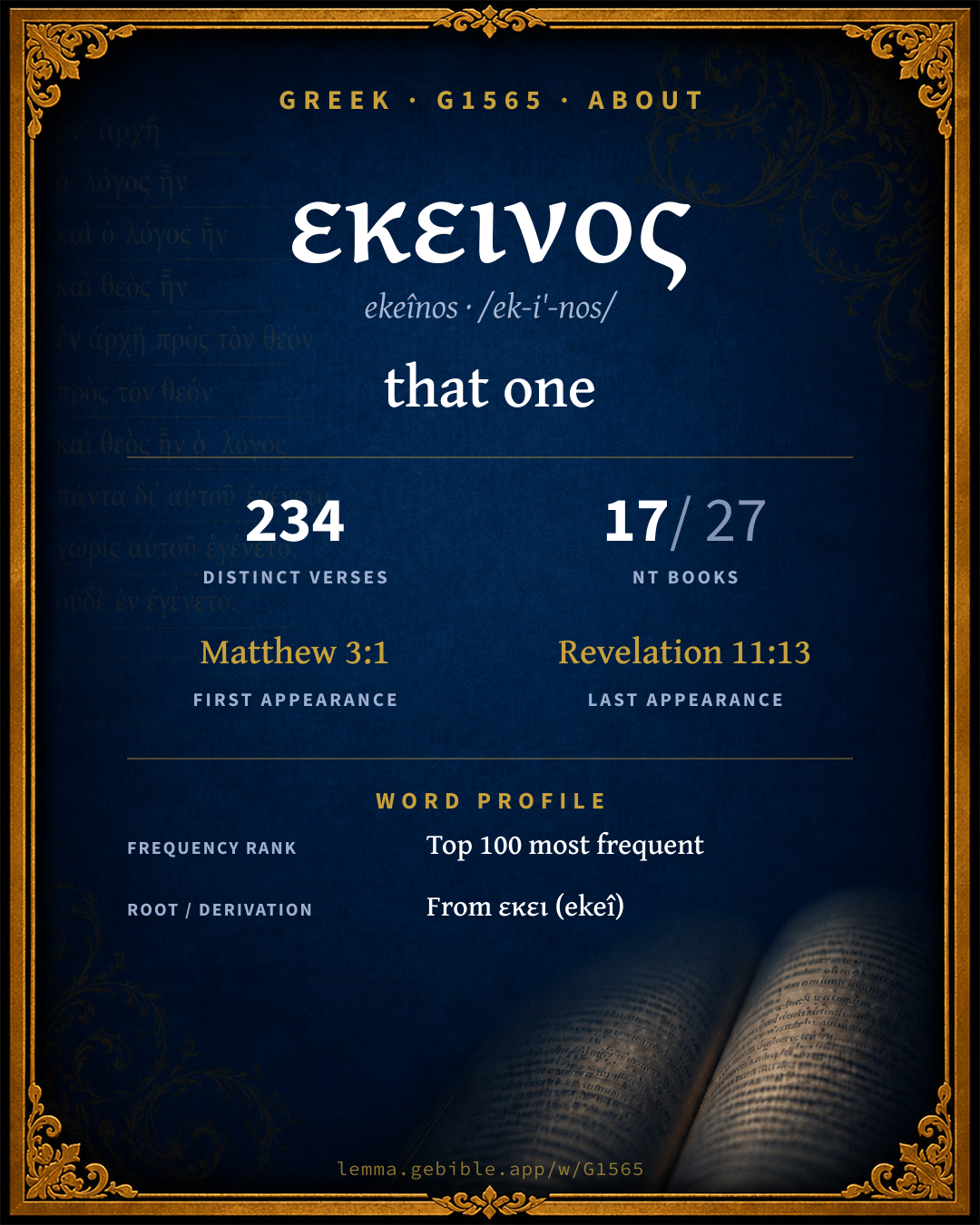
ἐκεῖνος
that one
Full lexicon entry — Thayer's Greek Lexicon
From Thayer's Greek Lexicon
Where this word appears
See every Nominative-case word in the Greek New Testament →
Grammar key — what these labels mean
Part of speech
- Demonstrative pronoun
- Points something out (“this,” “that”).
Case
- Nominative
- The case of the subject (and the predicate nominative).
- Dative
- The case of the indirect object, means, or location — “to / for / with / in.”
- Genitive
- The case of source, possession, or “of” — answers “whose / from what.”
- Accusative
- The case of the direct object and of extent.
Gender
- Masculine
- Grammatically masculine.
- Feminine
- Grammatically feminine.
- Neuter
- Grammatically neuter.
Number
- Singular
- One.
- Plural
- More than one.
Grammatical forms 21 distinct
- Demonstrative pronoun, Nominative, Singular, Masculine 58 times (24%)
- Demonstrative pronoun, Dative, Singular, Feminine 38 times (16%)
- Demonstrative pronoun, Genitive, Singular, Masculine 20 times (8%)
- Demonstrative pronoun, Genitive, Singular, Feminine 19 times (8%)
- Demonstrative pronoun, Nominative, Plural, Masculine 16 times (7%)
- Demonstrative pronoun, Dative, Plural, Feminine 15 times (6%)
- Demonstrative pronoun, Accusative, Singular, Masculine 11 times (5%)
- Demonstrative pronoun, Accusative, Singular, Feminine 10 times (4%)
+13 more forms (53 occurrences)
Parsed forms decoded from the imported morphology (Robinson–Tischendorf, public domain), counted across 240 parsed occurrences — not distinct verses.
Page 1 of 2 — showing verses 1–200 of 234 distinct verses where G1565 appears, across 17 books. Click any verse to open its interlinear word-by-word view. Verse text shown in the World English Bible for context — . Each verse’s Greek form is shown with its reference; the English is not keyword-highlighted, since the data carries no word-level English alignment. Use “Compare translations” on any verse to read it across multiple English versions. This concordance covers the Greek New Testament; Septuagint (Greek Old Testament) occurrences of this word are not indexed here.
Matthew 50 verses
- Matthew 3:1 ἐκείναις dem.pron dat pl fem In those days, John the Baptizer came, preaching in the wilderness of Judea, saying,
- Matthew 7:22 ἐκείνῃ dem.pron dat sg fem Many will tell me in that day, 'Lord, Lord, didn't we prophesy in your name, in your name cast out demons, and in your name do many mighty works?'
- Matthew 7:25 ἐκείνῃ dem.pron dat sg fem The rain came down, the floods came, and the winds blew, and beat on that house; and it didn't fall, for it was founded on the rock.
- Matthew 7:27 ἐκείνῃ dem.pron dat sg fem The rain came down, the floods came, and the winds blew, and beat on that house; and it fell--and great was its fall."
- Matthew 8:13 ἐκείνῃ dem.pron dat sg fem Jesus said to the centurion, "Go your way. Let it be done for you as you have believed." His servant was healed in that hour.
- Matthew 8:28 ἐκείνης dem.pron gen sg fem When he came to the other side, into the country of the Gergesenes, two people possessed by demons met him there, coming out of the tombs, exceedingly fierce, so that nobody could pass by that way.
- Matthew 9:22 ἐκείνης dem.pron gen sg fem But Jesus, turning around and seeing her, said, "Daughter, cheer up! Your faith has made you well." And the woman was made well from that hour.
- Matthew 9:26 ἐκείνην dem.pron acc sg fem The report of this went out into all that land.
- Matthew 9:31 ἐκείνῃ dem.pron dat sg fem But they went out and spread abroad his fame in all that land.
- Matthew 10:14 ἐκείνης dem.pron gen sg fem Whoever doesn't receive you, nor hear your words, as you go out of that house or that city, shake off the dust from your feet.
- Matthew 10:15 ἐκείνῃ dem.pron dat sg fem Most assuredly I tell you, it will be more tolerable for the land of Sodom and Gomorrah in the day of judgment than for that city.
- Matthew 10:19 ἐκείνῃ dem.pron dat sg fem But when they deliver you up, don't be anxious how or what you will say, for it will be given you in that hour what you will say.
- Matthew 11:25 ἐκείνῳ dem.pron dat sg masc At that time, Jesus answered, "I thank you, Father, Lord of heaven and earth, that you hid these things from the wise and understanding, and revealed them to infants.
- Matthew 12:1 ἐκείνῳ dem.pron dat sg masc At that time, Jesus went on the Sabbath day through the grain fields. His disciples were hungry and began to pluck heads of grain and to eat.
- Matthew 12:45 ἐκείνου dem.pron gen sg masc Then he goes, and takes with himself seven other spirits more evil than he is, and they enter in and dwell there. The last state of that man becomes worse than the first. Even so will it be also to this evil generation."
- Matthew 13:1 ἐκείνῃ dem.pron dat sg fem On that day Jesus went out of the house, and sat by the seaside.
- Matthew 13:11 ἐκείνοις dem.pron dat pl masc He answered them, "To you it is given to know the mysteries of the Kingdom of Heaven, but it is not given to them.
- Matthew 13:44 ἐκεῖνον dem.pron acc sg masc "Again, the Kingdom of Heaven is like a treasure hidden in the field, which a man found, and hid. In his joy, he goes and sells all that he has, and buys that field.
- Matthew 14:1 ἐκείνῳ dem.pron dat sg masc At that time, Herod the tetrarch heard the report concerning Jesus,
- Matthew 14:35 ἐκείνου ἐκείνην dem.pron gen sg masc dem.pron acc sg fem When the men of that place recognized him, they sent into all that surrounding region, and brought to him all who were sick,
- Matthew 15:22 ἐκείνων dem.pron gen pl neut Behold, a Canaanite woman came out from those borders, and cried, saying, "Have mercy on me, Lord, you son of David! My daughter is severely demonized!"
- Matthew 15:28 ἐκείνης dem.pron gen sg fem Then Jesus answered her, "Woman, great is your faith! Be it done to you even as you desire." And her daughter was healed from that hour.
- Matthew 17:18 ἐκείνης dem.pron gen sg fem Jesus rebuked him, the demon went out of him, and the boy was cured from that hour.
- Matthew 17:27 ἐκεῖνον dem.pron acc sg masc But, lest we cause them to stumble, go to the sea, and cast a hook, and take up the first fish that comes up. When you have opened its mouth, you will find a stater coin. Take that, and give it to them for me and you."
- Matthew 18:1 ἐκείνῃ dem.pron dat sg fem In that hour the disciples came to Jesus, saying, "Who then is greatest in the Kingdom of Heaven?"
- Matthew 18:26 ἐκεῖνος dem.pron nom sg masc The servant therefore fell down and kneeled before him, saying, 'Lord, have patience with me, and I will repay you all!'
- Matthew 18:27 ἐκείνου dem.pron gen sg masc The lord of that servant, being moved with compassion, released him, and forgave him the debt.
- Matthew 18:28 ἐκεῖνος dem.pron nom sg masc "But that servant went out, and found one of his fellow servants, who owed him one hundred denarii, and he grabbed him, and took him by the throat, saying, 'Pay me what you owe!'
- Matthew 18:32 ἐκείνην dem.pron acc sg fem Then his lord called him in, and said to him, 'You wicked servant! I forgave you all that debt, because you begged me.
- Matthew 20:4 ἐκείνοις dem.pron dat pl masc To them he said, 'You also go into the vineyard, and whatever is right I will give you.' So they went their way.
- Matthew 21:40 ἐκείνοις dem.pron dat pl masc When therefore the lord of the vineyard comes, what will he do to those farmers?"
- Matthew 22:7 ἐκείνους dem.pron acc pl masc When the king heard that, he was angry, and he sent his armies, destroyed those murderers, and burned their city.
- Matthew 22:10 ἐκεῖνοι dem.pron nom pl masc Those servants went out into the highways, and gathered together as many as they found, both bad and good. The wedding was filled with guests.
- Matthew 22:23 ἐκείνῃ dem.pron dat sg fem On that day Sadducees (those who say that there is no resurrection) came to him. They asked him,
- Matthew 22:46 ἐκείνης dem.pron gen sg fem No one was able to answer him a word, neither dared any man from that day forth ask him any more questions.
- Matthew 24:19 ἐκείναις dem.pron dat pl fem But woe to those who are with child and to nursing mothers in those days!
- Matthew 24:22 ἐκεῖναι ἐκεῖναι dem.pron nom pl fem dem.pron nom pl fem Unless those days had been shortened, no flesh would have been saved. But for the sake of the chosen ones, those days will be shortened.
- Matthew 24:29 ἐκείνων dem.pron gen pl fem But immediately after the oppression of those days, the sun will be darkened, the moon will not give its light, the stars will fall from the sky, and the powers of the heavens will be shaken;
- Matthew 24:36 ἐκείνης dem.pron gen sg fem But no one knows of that day and hour, not even the angels of heaven, but my Father only.
- Matthew 24:43 Ἐκεῖνο dem.pron acc sg neut But know this, that if the master of the house had known in what watch of the night the thief was coming, he would have watched, and would not have allowed his house to be broken into.
- Matthew 24:46 ἐκεῖνος dem.pron nom sg masc Blessed is that servant whom his lord finds doing so when he comes.
- Matthew 24:50 ἐκείνου dem.pron gen sg masc the lord of that servant will come in a day when he doesn't expect it, and in an hour when he doesn't know it,
- Matthew 25:7 ἐκεῖναι dem.pron nom pl fem Then all those virgins arose, and trimmed their lamps.
- Matthew 25:19 ἐκείνων dem.pron gen pl masc "Now after a long time the lord of those servants came, and reconciled accounts with them.
- Matthew 26:24 ἐκείνῳ ἐκεῖνος dem.pron dat sg masc dem.pron nom sg masc The Son of Man goes, even as it is written of him, but woe to that man through whom the Son of Man is betrayed! It would be better for that man if he had not been born."
- Matthew 26:29 ἐκείνης dem.pron gen sg fem But I tell you that I will not drink of this fruit of the vine from now on, until that day when I drink it anew with you in my Father's Kingdom."
- Matthew 26:55 ἐκείνῃ dem.pron dat sg fem In that hour Jesus said to the multitudes, "Have you come out as against a robber with swords and clubs to seize me? I sat daily in the temple teaching, and you didn't arrest me.
- Matthew 27:8 ἐκεῖνος dem.pron nom sg masc Therefore that field was called "The Field of Blood" to this day.
- Matthew 27:19 ἐκείνῳ dem.pron dat sg masc While he was sitting on the judgment seat, his wife sent to him, saying, "Have nothing to do with that righteous man, for I have suffered many things this day in a dream because of him."
- Matthew 27:63 ἐκεῖνος dem.pron nom sg masc saying, "Sir, we remember what that deceiver said while he was still alive: 'After three days I will rise again.'
Mark 21 verses
- Mark 1:9 ἐκείναις dem.pron dat pl fem It happened in those days, that Jesus came from Nazareth of Galilee, and was baptized by John in the Jordan.
- Mark 2:20 ἐκείνῃ dem.pron dat sg fem But the days will come when the bridegroom will be taken away from them, and then will they fast in that day.
- Mark 3:24 ἐκείνη dem.pron nom sg fem If a kingdom is divided against itself, that kingdom cannot stand.
- Mark 3:25 ἐκείνη dem.pron nom sg fem If a house is divided against itself, that house cannot stand.
- Mark 4:11 ἐκείνοις dem.pron dat pl masc He said to them, "To you is given the mystery of the Kingdom of God, but to those who are outside, all things are done in parables,
- Mark 4:20 ἐκεῖνοί dem.pron nom pl masc These are those which were sown on the good ground: such as hear the word, and accept it, and bear fruit, some thirty times, some sixty times, and some one hundred times."
- Mark 4:35 ἐκείνῃ dem.pron dat sg fem On that day, when evening had come, he said to them, "Let's go over to the other side."
- Mark 6:55 ἐκείνην dem.pron acc sg fem and ran around that whole region, and began to bring those who were sick, on their mats, to where they heard he was.
- Mark 7:20 ἐκεῖνο dem.pron nom sg neut He said, "That which proceeds out of the man, that defiles the man.
- Mark 8:1 ἐκείναις dem.pron dat pl fem In those days, when there was a very great multitude, and they had nothing to eat, Jesus called his disciples to himself, and said to them,
- Mark 12:7 ἐκεῖνοι dem.pron nom pl masc But those farmers said among themselves, 'This is the heir. Come, let's kill him, and the inheritance will be ours.'
- Mark 13:11 ἐκείνῃ dem.pron dat sg fem When they lead you away and deliver you up, don't be anxious beforehand, or premeditate what you will say, but say whatever will be given you in that hour. For it is not you who speak, but the Holy Spirit.
- Mark 13:17 ἐκείναις dem.pron dat pl fem But woe to those who are with child and to those who nurse babies in those days!
- Mark 13:19 ἐκεῖναι dem.pron nom pl fem For in those days there will be oppression, such as there has not been the like from the beginning of the creation which God created until now, and never will be.
- Mark 13:24 ἐκείναις ἐκείνην dem.pron dat pl fem dem.pron acc sg fem But in those days, after that oppression, the sun will be darkened, the moon will not give its light,
- Mark 13:32 ἐκείνης dem.pron gen sg fem But of that day or that hour no one knows, not even the angels in heaven, nor the Son, but only the Father.
- Mark 14:21 ἐκείνῳ ἐκεῖνος dem.pron dat sg masc dem.pron nom sg masc For the Son of Man goes, even as it is written about him, but woe to that man by whom the Son of Man is betrayed! It would be better for that man if he had not been born."
- Mark 14:25 ἐκείνης dem.pron gen sg fem Most assuredly I tell you, I will no more drink of the fruit of the vine, until that day when I drink it anew in the Kingdom of God."
- Mark 16:10 ἐκείνη dem.pron nom sg fem She went and told those who had been with him, as they mourned and wept.
- Mark 16:13 ἐκείνοις dem.pron dat pl masc They went away and told it to the rest. They didn't believe them, either.
- Mark 16:20 ἐκεῖνοι dem.pron nom pl masc They went out, and preached everywhere, the Lord working with them, and confirming the word by the signs that followed. Amen.
Luke 31 verses
- Luke 2:1 ἐκείναις dem.pron dat pl fem Now it happened in those days, that a decree went out from Caesar Augustus that all the world should be enrolled.
- Luke 4:2 ἐκείναις dem.pron dat pl fem for forty days, being tempted by the devil. He ate nothing in those days. Afterward, when they were completed, he was hungry.
- Luke 5:35 ἐκείναις dem.pron dat pl fem But the days will come when the bridegroom will be taken away from them. Then they will fast in those days."
- Luke 6:23 ἐκείνῃ dem.pron dat sg fem Rejoice in that day, and leap for joy, for behold, your reward is great in heaven, for their fathers did the same thing to the prophets.
- Luke 6:48 ἐκείνῃ dem.pron dat sg fem He is like a man building a house, who dug and went deep, and laid a foundation on the rock. When a flood arose, the stream broke against that house, and could not shake it, because it was founded on the rock.
- Luke 6:49 ἐκείνης dem.pron gen sg fem But he who hears, and doesn't do, is like a man who built a house on the earth without a foundation, against which the stream broke, and immediately it fell, and the ruin of that house was great."
- Luke 7:21 ἐκείνῃ dem.pron dat sg fem In that hour he cured many of diseases and plagues and evil spirits; and to many who were blind he gave sight.
- Luke 8:32 ἐκείνους dem.pron acc pl masc Now there was there a herd of many pigs feeding on the mountain, and they begged him that he would allow them to enter into those. He allowed them.
- Luke 9:5 ἐκείνης dem.pron gen sg fem As many as don't receive you, when you depart from that city, shake off even the dust from your feet for a testimony against them."
- Luke 9:36 ἐκείναις dem.pron dat pl fem When the voice came, Jesus was found alone. They were silent, and told no one in those days any of the things which they had seen.
- Luke 10:12 ἐκείνῃ ἐκείνῃ dem.pron dat sg fem dem.pron dat sg fem I tell you, it will be more tolerable in that day for Sodom than for that city.
- Luke 10:31 ἐκείνῃ dem.pron dat sg fem By chance a certain priest was going down that way. When he saw him, he passed by on the other side.
- Luke 11:26 ἐκείνου dem.pron gen sg masc Then he goes, and takes seven other spirits more evil than himself, and they enter in and dwell there. The last state of that man becomes worse than the first."
- Luke 12:37 ἐκεῖνοι dem.pron nom pl masc Blessed are those servants, whom the lord will find watching when he comes. Most assuredly I tell you, that he will dress himself, and make them recline, and will come and serve them.
- Luke 12:43 ἐκεῖνος dem.pron nom sg masc Blessed is that servant whom his lord will find doing so when he comes.
- Luke 12:45 ἐκεῖνος dem.pron nom sg masc But if that servant says in his heart, 'My lord delays his coming,' and begins to beat the menservants and the maidservants, and to eat and drink, and to be drunken,
- Luke 12:46 ἐκείνου dem.pron gen sg masc then the lord of that servant will come in a day when he isn't expecting him, and in an hour that he doesn't know, and will cut him in two, and place his portion with the unfaithful.
- Luke 12:47 ἐκεῖνος dem.pron nom sg masc That servant, who knew his lord's will, and didn't prepare, nor do what he wanted, will be beaten with many stripes,
- Luke 13:4 ἐκεῖνοι dem.pron nom pl masc Or those eighteen, on whom the tower in Siloam fell, and killed them; do you think that they were worse offenders than all the men who dwell in Jerusalem?
- Luke 14:24 ἐκείνων dem.pron gen pl masc For I tell you that none of those men who were invited will taste of my supper.'"
- Luke 15:14 ἐκείνην dem.pron acc sg fem When he had spent all of it, there arose a severe famine in that country, and he began to be in need.
- Luke 15:15 ἐκείνης dem.pron gen sg fem He went and joined himself to one of the citizens of that country, and he sent him into his fields to feed pigs.
- Luke 17:31 ἐκείνῃ dem.pron dat sg fem In that day, he who will be on the housetop, and his goods in the house, let him not go down to take them away. Let him who is in the field likewise not turn back.
- Luke 18:3 ἐκείνῃ dem.pron dat sg fem A widow was in that city, and she often came to him, saying, 'Defend me from my adversary!'
- Luke 18:14 ἐκεῖνος dem.pron nom sg masc I tell you, this man went down to his house justified rather than the other; for everyone who exalts himself will be humbled, but he who humbles himself will be exalted."
- Luke 19:4 ἐκείνης dem.pron gen sg fem He ran on ahead, and climbed up into a sycamore tree to see him, for he was to pass that way.
- Luke 20:18 ἐκεῖνον dem.pron acc sg masc "Everyone who falls on that stone will be broken to pieces, But it will crush whomever it falls on to dust."
- Luke 20:35 ἐκείνου dem.pron gen sg masc But those who are considered worthy to attain to that age and the resurrection from the dead, neither marry, nor are given in marriage.
- Luke 21:23 ἐκείναις dem.pron dat pl fem Woe to those who are pregnant and to those who nurse infants in those days! For there will be great distress in the land, and wrath to this people.
- Luke 21:34 ἐκείνη dem.pron nom sg fem "So be careful, or your hearts will be loaded down with carousing, drunkenness, and cares of this life, and that day will come on you suddenly.
- Luke 22:22 ἐκείνῳ dem.pron dat sg masc The Son of Man indeed goes, as it has been determined, but woe to that man through whom he is betrayed!"
John 70 verses
- John 1:8 ἐκεῖνος dem.pron nom sg masc He was not the light, but was sent that he might testify about the light.
- John 1:18 ἐκεῖνος dem.pron nom sg masc No one has seen God at any time. The one and only Son, who is in the bosom of the Father, he has declared him.
- John 1:33 ἐκεῖνός dem.pron nom sg masc I didn't recognize him, but he who sent me to baptize in water, he said to me, 'On whomever you will see the Spirit descending, and remaining on him, the same is he who baptizes in the Holy Spirit.'
- John 1:40 ἐκείνην dem.pron acc sg fem One of the two who heard John, and followed him, was Andrew, Simon Peter's brother.
- John 2:21 ἐκεῖνος dem.pron nom sg masc But he spoke of the temple of his body.
- John 3:28 ἐκείνου dem.pron gen sg masc You yourselves testify that I said, 'I am not the Christ,' but, 'I have been sent before him.'
- John 3:30 ἐκεῖνον dem.pron acc sg masc He must increase, but I must decrease.
- John 4:25 ἐκεῖνος dem.pron nom sg masc The woman said to him, "I know that Messiah comes," (he who is called Christ). "When he has come, he will declare to us all things."
- John 4:39 ἐκείνης dem.pron gen sg fem From that city many of the Samaritans believed in him because of the word of the woman, who testified, "He told me everything that I did."
- John 4:53 ἐκείνῃ dem.pron dat sg fem So the father knew that it was at that hour in which Jesus said to him, "Your son lives." He believed, as did his whole house.
- John 5:9 ἐκείνῃ dem.pron dat sg fem Immediately, the man was made well, and took up his mat and walked. Now it was the Sabbath on that day.
- John 5:11 ἐκεῖνός dem.pron nom sg masc He answered them, "He who made me well, the same said to me, 'Take up your mat, and walk.'"
- John 5:19 ἐκεῖνος dem.pron nom sg masc Jesus therefore answered them, "Most assuredly, I tell you, the Son can do nothing of himself, but what he sees the Father doing. For whatever things he does, these the Son also does likewise.
- John 5:35 ἐκεῖνος dem.pron nom sg masc He was the burning and shining lamp, and you were willing to rejoice for a while in his light.
- John 5:37 ἐκεῖνος dem.pron nom sg masc The Father himself, who sent me, has testified about me. You have neither heard his voice at any time, nor seen his form.
- John 5:38 ἐκεῖνος dem.pron nom sg masc You don't have his word living in you; because you don't believe him whom he sent.
- John 5:39 ἐκεῖναί dem.pron nom pl fem "You search the Scriptures, because you think that in them you have eternal life; and these are they which testify about me.
- John 5:43 ἐκεῖνον dem.pron acc sg masc I have come in my Father's name, and you don't receive me. If another comes in his own name, you will receive him.
- John 5:46 ἐκεῖνος dem.pron nom sg masc For if you believed Moses, you would believe me; for he wrote about me.
- John 5:47 ἐκείνου dem.pron gen sg masc But if you don't believe his writings, how will you believe my words?"
- John 6:29 ἐκεῖνος dem.pron nom sg masc Jesus answered them, "This is the work of God, that you believe in him whom he has sent."
- John 7:11 ἐκεῖνος dem.pron nom sg masc The Jews therefore sought him at the feast, and said, "Where is he?"
- John 7:45 ἐκεῖνοι dem.pron nom pl masc The officers therefore came to the chief priests and Pharisees, and they said to them, "Why didn't you bring him?"
- John 8:10 ἐκεῖνοι dem.pron nom pl masc Jesus, standing up, saw her and said, "Woman, where are your accusers? Did no one condemn you?"
- John 8:42 ἐκεῖνός dem.pron nom sg masc Therefore Jesus said to them, "If God were your Father, you would love me, for I came out and have come from God. For I haven't come of myself, but he sent me.
- John 8:44 ἐκεῖνος dem.pron nom sg masc You are of your Father, the devil, and you want to do the desires of your father. He was a murderer from the beginning, and doesn't stand in the truth, because there is no truth in him. When he speaks a lie, he speaks on his own; for he is a liar, and the father of it.
- John 9:9 ἐκεῖνος dem.pron nom sg masc Others were saying, "It is he." Still others were saying, "He looks like him." He said, "I am he."
- John 9:11 ἐκεῖνος dem.pron nom sg masc He answered, "A man called Jesus made mud, anointed my eyes, and said to me, 'Go to the pool of Siloam, and wash.' So I went away and washed, and I received sight."
- John 9:12 ἐκεῖνος dem.pron nom sg masc Then they asked him, "Where is he?" He said, "I don't know."
- John 9:25 ἐκεῖνος dem.pron nom sg masc He therefore answered, "I don't know if he is a sinner. One thing I do know: that though I was blind, now I see."
- John 9:28 ἐκείνου dem.pron gen sg masc They insulted him and said, "You are his disciple, but we are disciples of Moses.
- John 9:36 ἐκεῖνος dem.pron nom sg masc He answered, "Who is he, Lord, that I may believe in him?"
- John 9:37 ἐκεῖνός dem.pron nom sg masc Jesus said to him, "You have both seen him, and it is he who speaks with you."
- John 10:1 ἐκεῖνος dem.pron nom sg masc "Most assuredly, I tell you, one who doesn't enter by the door into the sheep fold, but climbs up some other way, the same is a thief and a robber.
- John 10:6 ἐκεῖνοι dem.pron nom pl masc Jesus spoke this parable to them, but they didn't understand what he was telling them.
- John 10:35 ἐκείνους dem.pron acc pl masc If he called them gods, to whom the word of God came (and the Scripture can't be broken),
- John 11:13 ἐκεῖνοι dem.pron nom pl masc Now Jesus had spoken of his death, but they thought that he spoke of taking rest in sleep.
- John 11:29 ἐκείνη dem.pron nom sg fem When she heard this, she arose quickly, and went to him.
- John 11:49 ἐκείνου dem.pron gen sg masc But a certain one of them, Caiaphas, being high priest that year, said to them, "You know nothing at all,
- John 11:51 ἐκείνου dem.pron gen sg masc Now he didn't say this of himself, but being high priest that year, he prophesied that Jesus would die for the nation,
- John 11:53 ἐκείνης dem.pron gen sg fem So from that day forward they took counsel that they might put him to death.
- John 12:48 ἐκεῖνος dem.pron nom sg masc He who rejects me, and doesn't receive my sayings, has one who judges him. The word that I spoke, the same will judge him in the last day.
- John 13:25 ἐκεῖνος dem.pron nom sg masc He, leaning back, as he was, on Jesus' breast, asked him, "Lord, who is it?"
- John 13:26 ἐκεῖνός dem.pron nom sg masc Jesus therefore answered, "It is he to whom I will give this piece of bread when I have dipped it." So when he had dipped the piece of bread, he gave it to Judas, the son of Simon Iscariot.
- John 13:27 ἐκεῖνον dem.pron acc sg masc After the piece of bread, then Satan entered into him. Then Jesus said to him, "What you do, do quickly."
- John 13:30 ἐκεῖνος dem.pron nom sg masc Therefore, having received that morsel, he went out immediately. It was night.
- John 14:20 ἐκείνῃ dem.pron dat sg fem In that day you will know that I am in my Father, and you in me, and I in you.
- John 14:21 ἐκεῖνός dem.pron nom sg masc One who has my commandments, and keeps them, that person is one who loves me. One who loves me will be loved by my Father, and I will love him, and will reveal myself to him."
- John 14:26 ἐκεῖνος dem.pron nom sg masc But the Counselor, the Holy Spirit, whom the Father will send in my name, he will teach you all things, and will remind you of all that I said to you.
- John 15:26 ἐκεῖνος dem.pron nom sg masc "When the Counselor has come, whom I will send to you from the Father, the Spirit of truth, who proceeds from the Father, he will testify about me.
- John 16:8 ἐκεῖνος dem.pron nom sg masc When he has come, he will convict the world about sin, about righteousness, and about judgment;
- John 16:13 ἐκεῖνος dem.pron nom sg masc However when he, the Spirit of truth, has come, he will guide you into all truth, for he will not speak from himself; but whatever he hears, he will speak. He will declare to you things that are coming.
- John 16:14 ἐκεῖνος dem.pron nom sg masc He will glorify me, for he will take from what is mine, and will declare it to you.
- John 16:23 ἐκείνῃ dem.pron dat sg fem "In that day you will ask me no questions. Most assuredly I tell you, whatever you may ask of the Father in my name, he will give it to you.
- John 16:26 ἐκείνῃ dem.pron dat sg fem In that day you will ask in my name; and I don't say to you, that I will pray to the Father for you,
- John 18:13 ἐκείνου dem.pron gen sg masc and led him to Annas first, for he was father-in-law to Caiaphas, who was high priest that year.
- John 18:15 ἐκεῖνος dem.pron nom sg masc Simon Peter followed Jesus, as did another disciple. Now that disciple was known to the high priest, and entered in with Jesus into the court of the high priest;
- John 18:17 ἐκεῖνος dem.pron nom sg masc Then the maid who kept the door said to Peter, "Are you also one of this man's disciples?" He said, "I am not."
- John 18:25 ἐκεῖνος dem.pron nom sg masc Now Simon Peter was standing and warming himself. They said therefore to him, "You aren't also one of his disciples, are you?" He denied it, and said, "I am not."
- John 19:15 ἐκεῖνοι dem.pron nom pl masc They cried out, "Away with him! Away with him! Crucify him!" Pilate said to them, "Shall I crucify your King?" The chief priests answered, "We have no king but Caesar!"
- John 19:21 ἐκεῖνος dem.pron nom sg masc The chief priests of the Jews therefore said to Pilate, "Don't write, 'The King of the Jews,' but, 'he said, I am King of the Jews.'"
- John 19:27 ἐκείνης dem.pron gen sg fem Then he said to the disciple, "Behold, your mother!" From that hour, the disciple took her to his own home.
- John 19:31 ἐκείνου dem.pron gen sg neut Therefore the Jews, because it was the Preparation Day, so that the bodies wouldn't remain on the cross on the Sabbath (for that Sabbath was a special one), asked of Pilate that their legs might be broken, and that they might be taken away.
- John 20:13 ἐκεῖνοι dem.pron nom pl masc They told her, "Woman, why are you weeping?" She said to them, "Because they have taken away my Lord, and I don't know where they have laid him."
- John 20:15 ἐκείνη dem.pron nom sg fem Jesus said to her, "Woman, why are you weeping? Who are you looking for?" She, supposing him to be the gardener, said to him, "Sir, if you have carried him away, tell me where you have laid him, and I will take him away."
- John 20:16 ἐκείνη dem.pron nom sg fem Jesus said to her, "Mary." She turned and said to him, "Rhabbouni!" which is to say, "Teacher!"
- John 20:19 ἐκείνῃ dem.pron dat sg fem When therefore it was evening, on that day, the first day of the week, and when the doors were locked where the disciples were assembled, for fear of the Jews, Jesus came and stood in the midst, and said to them, "Peace be to you."
- John 21:3 ἐκείνῃ dem.pron dat sg fem Simon Peter said to them, "I'm going fishing." They told him, "We are also coming with you." They immediately went out, and entered into the boat. That night, they caught nothing.
- John 21:7 ἐκεῖνος dem.pron nom sg masc That disciple therefore whom Jesus loved said to Peter, "It's the Lord!" So when Simon Peter heard that it was the Lord, he wrapped his coat around him (for he was naked), and threw himself into the sea.
- John 21:23 ἐκεῖνος dem.pron nom sg masc This saying therefore went out among the brothers, that this disciple wouldn't die. Yet Jesus didn't say to him that he wouldn't die, but, "If I desire that he stay until I come, what is that to you?"
Acts 21 verses
- Acts 1:19 ἐκεῖνο dem.pron acc sg neut It became known to everyone who lived in Jerusalem that in their language that field was called 'Akeldama,' that is, 'The field of blood.'
- Acts 2:18 ἐκείναις dem.pron dat pl fem Yes, and on my servants and on my handmaidens in those days, I will pour out my Spirit, and they will prophesy.
- Acts 2:41 ἐκείνῃ dem.pron dat sg fem Then those who gladly received his word were baptized. There were added that day about three thousand souls.
- Acts 3:13 ἐκείνου dem.pron gen sg masc The God of Abraham, Isaac, and Jacob, the God of our fathers, has glorified his Servant Jesus, whom you delivered up, and denied in the presence of Pilate, when he had determined to release him.
- Acts 3:23 ἐκείνου dem.pron gen sg masc It will be, that every soul that will not listen to that prophet will be utterly destroyed from among the people.'
- Acts 7:41 ἐκείναις dem.pron dat pl fem They made a calf in those days, and brought a sacrifice to the idol, and rejoiced in the works of their hands.
- Acts 8:1 ἐκείνῃ dem.pron dat sg fem Saul was consenting to his death. A great persecution arose against the assembly which was in Jerusalem in that day. They were all scattered abroad throughout the regions of Judea and Samaria, except for the apostles.
- Acts 8:8 ἐκείνῃ dem.pron dat sg fem There was great joy in that city.
- Acts 9:37 ἐκείναις dem.pron dat pl fem It happened in those days that she fell sick, and died. When they had washed her, they laid her in an upper chamber.
- Acts 12:1 ἐκεῖνον dem.pron acc sg masc Now about that time, Herod the king stretched out his hands to oppress some of the assembly.
- Acts 12:6 ἐκείνῃ dem.pron dat sg fem The same night when Herod was about to bring him out, Peter was sleeping between two soldiers, bound with two chains. Guards in front of the door kept the prison.
- Acts 14:21 ἐκείνην dem.pron acc sg fem When they had preached the Gospel to that city, and had made many disciples, they returned to Lystra, Iconium, and Antioch,
- Acts 16:3 ἐκείνοις dem.pron dat pl masc Paul wanted to have him go out with him, and he took and circumcised him because of the Jews who were in those parts; for they all knew that his father was a Greek.
- Acts 16:33 ἐκείνῃ dem.pron dat sg fem He took them the same hour of the night, and washed their stripes, and was immediately baptized, he and all his household.
- Acts 16:35 ἐκείνους dem.pron acc pl masc But when it was day, the magistrates sent the sergeants, saying, "Let those men go."
- Acts 19:16 ἐκείνου dem.pron gen sg masc The man in whom the evil spirit was leaped on them, and overpowered them, and prevailed against them, so that they fled out of that house naked and wounded.
- Acts 19:23 ἐκεῖνον dem.pron acc sg masc About that time there arose no small stir concerning the Way.
- Acts 20:2 ἐκεῖνα dem.pron acc pl neut When he had gone through those parts, and had encouraged them with many words, he came into Greece.
- Acts 21:6 ἐκεῖνοι dem.pron nom pl masc After saying goodbye to each other, we went on board the ship, and they returned home again.
- Acts 22:11 ἐκείνου dem.pron gen sg neut When I couldn't see for the glory of that light, being led by the hand of those who were with me, I came into Damascus.
- Acts 28:7 ἐκεῖνον dem.pron acc sg masc Now in the neighborhood of that place were lands belonging to the chief man of the island, named Publius, who received us, and courteously entertained us for three days.
Romans 3 verses
- Romans 6:21 ἐκείνων dem.pron gen pl masc What fruit then did you have at that time in the things of which you are now ashamed? For the end of those things is death.
- Romans 14:14 ἐκείνῳ dem.pron dat sg masc I know, and am persuaded in the Lord Jesus, that nothing is unclean of itself; except that to him who considers anything to be unclean, to him it is unclean.
- Romans 14:15 ἐκεῖνον dem.pron acc sg masc Yet if because of food your brother is grieved, you walk no longer in love. Don't destroy with your food him for whom Christ died.
1 Corinthians 4 verses
- 1 Corinthians 9:25 ἐκεῖνοι dem.pron nom pl masc Every man who strives in the games exercises self-control in all things. Now they do it to receive a corruptible crown, but we an incorruptible.
- 1 Corinthians 10:11 ἐκείνοις dem.pron dat pl masc Now all these things happened to them by way of example, and they were written for our admonition, on whom the ends of the ages have come.
- 1 Corinthians 10:28 ἐκεῖνον dem.pron acc sg masc But if anyone says to you, "This was offered to idols," don't eat it for the sake of the one who told you, and for the sake of conscience. For "the earth is the Lord's, and all its fullness."
- 1 Corinthians 15:11 ἐκεῖνοι dem.pron nom pl masc Whether then it is I or they, so we preach, and so you believed.
About this entry
At a glance — auto-summarized from this page’s data, not written by a person. Every figure links to its source below. This summary describes the numbers; it doesn’t interpret them.
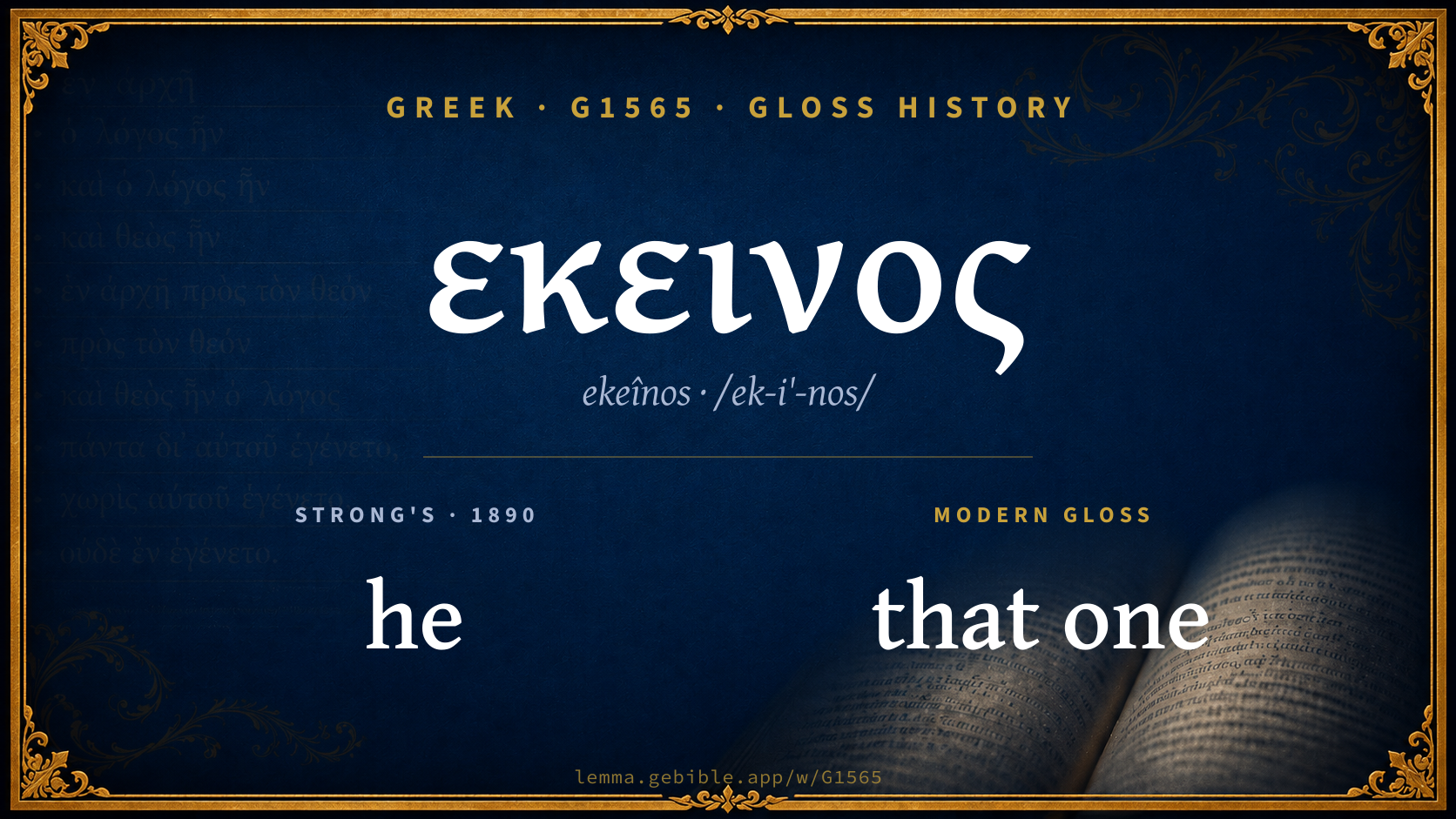
At its core, εκεινος (ekeînos) means “that one.” The King James Version’s older “same” has given way to “that” in modern versions, as the renderings breakdown shows. Spanning 234 verses in 17 books, it ranks among the common words of the Greek New Testament. Its uses concentrate in John (30% of all occurrences). It first appears in Matthew 3:1. Each statement above links to its evidence; the full detail follows below.
Gloss history
Strong's 1890 vs modern scholarship
About this word
Strong's G1565 catalogs a Greek word from the Greek New Testament.
These counts are not copied from any lexicon or concordance. They are computed here, from the morphology-tagged Greek New Testament. What Lemma adds →
- 234
- distinct verses
- The word appears in 234 distinct verses.
- 17 / 27
- NT books
- The word appears in 17 of 27 New Testament books.
- #67
- by frequency
- Top 100 most frequent Greek words (rank 67 of 5,347 Greek words by occurrence).
View all 234 occurrences in the concordance →
By section of the New Testament
By traditional corpus
Conventional, traditional groupings — biblical authorship is debated, so this is a traditional corpus grouping, not an authorship claim. Some books belong to more than one corpus (Luke is in both the Gospels and the Lukan corpus, and so on), so these shares overlap and need not total 100%. Each figure is a share of the word’s 234 distinct verses.
- Gospels 172 verses · 74%
- Johannine 79 verses · 34%
- Lukan (Luke–Acts) 52 verses · 22%
- Pauline corpus 21 verses · 9%
- General (Catholic) Epistles 10 verses · 4%
- Hebrews 8 verses · 3%
- Revelation 2 verses · 1%
How translations render this word
Counts come from each version’s own published word-to-Strong’s tagging or interlinear alignment — an approximate guide to how each version renders this word, not a word-level alignment the data otherwise carries. Because each total is that version’s own tagged count, the per-version totals vary from one another and need not match the appearance or distinct-verse counts above. These counts may also differ from a printed concordance because Lemma counts each distinctly tagged rendering and does not collapse phrase taggings into a single head-word total. This is a fixed set of word-tagged versions (KJV, ASV, BSB, ULT) and does not change with the reading translation you choose elsewhere. Each version’s license is shown beside its name below (and on Sources).
- King James Version: That 92×, Those 38×, He 36×
- American Standard Version: That 109×, He 36×, Those 33×
- Berean Standard Bible: That 87×, Those 28×, He 23×
- unfoldingWord Literal Text: That 117×, One 48×, Those 46×
King James Version Public Domain
Renders G1565 across 245 tagged occurrences — most commonly:
Plus other, less common renderings. Plus 13 renderings that appear only once — usually multi-word phrases or single function words the recovered tagging swept in, not distinct renderings. Not rendered by a distinct English word in 6 further occurrences.
American Standard Version Public Domain
Renders G1565 across 245 tagged occurrences — most commonly:
Plus other, less common renderings. Plus 14 renderings that appear only once — usually multi-word phrases or single function words the recovered tagging swept in, not distinct renderings.
Berean Standard Bible Public Domain
Renders G1565 across 185 tagged occurrences — most commonly:
Plus 10 renderings that appear only once — usually multi-word phrases or single function words the recovered tagging swept in, not distinct renderings. Not rendered by a distinct English word in 54 further occurrences.
unfoldingWord Literal Text CC BY-SA 4.0
Renders G1565 across 246 tagged occurrences — most commonly:
Plus 7 renderings that appear only once — usually multi-word phrases or single function words the recovered tagging swept in, not distinct renderings.
Senses in Thayer's
The 1 sense Thayer's distinguishes for this word, in lexicon order (not ranked by frequency or importance). The full entry — with sub-senses — is in the Lexicon Entry tab.
- he, she it, etc.
Word origin
Derived from εκει (ekeî) (G1563) — there.
Forms in the corpus
The 21 distinct written forms G1565 takes in the Greek New Testament, most frequent first — each parse links to that case’s occurrences in the concordance.
Same root — word family
Other Thayer's entries built from the same root as G1565, grouped by Strong’s listed origin. These share a root / origin per the lexicon — not necessarily a shared meaning. Each links to that word’s own entry.
Derives from
Shares the same root
Compare all same-root words → They share a root, not necessarily a meaning.
Septuagint usage
The same Greek word εκεινος appears 576 times in the Greek Old Testament (Septuagint), across 546 verses in 31 books.
- 576
- LXX occurrences
- Tagged occurrences of this Greek word in the Septuagint.
- 546
- verses
- Distinct Septuagint verses containing this word.
- 31 / 39
- OT books
- The word appears in 31 of the 39 Old Testament books.
Sample Septuagint occurrences
- Genesis 2:12 ἐκεῖνος
- Exodus 1:6 ἐκεῖνος
- Leviticus 7:20 ἐκεῖνος
- Numbers 5:6 ἐκεῖνος
- Deuteronomy 1:9 ἐκεῖνος
- Joshua 2:24 ἐκεῖνος
- Judges 2:5 ἐκεῖνος
- 1 Samuel 3:1 ἐκεῖνος
- 2 Samuel 2:16 ἐκεῖνος
- 1 Kings 2:25 ἐκεῖνος
- 2 Kings 3:6 ἐκεῖνος
- 1 Chronicles 7:24 ἐκεῖνος
Septuagint occurrences (same lexeme)
Every verse where the same Strong’s number (G1565) appears in the Greek Septuagint — showing the first 50 of 546. Verse text shown in the World English Bible for context; the Greek form is the matched word — the English is not keyword-highlighted.
- Genesis 2:12 ἐκεῖνος and the gold of that land is good. There is aromatic resin and the onyx stone.
- Genesis 6:4 ἐκεῖνος The Nephilim were in the earth in those days, and also after that, when God's sons came to men's daughters. They bore children to them: the same were the mighty men who were of old, men of renown.
- Genesis 6:21 ἐκεῖνος Take with you of all food that is eaten, and gather it to you; and it will be for food for you, and for them."
- Genesis 10:11 ἐκεῖνος Out of that land he went forth into Assyria, and built Nineveh, Rehoboth Ir, Calah,
- Genesis 15:18 ἐκεῖνος In that day Yahweh made a covenant with Abram, saying, "To your seed have I given this land, from the river of Egypt to the great river, the river Euphrates:
- Genesis 17:14 ἐκεῖνος The uncircumcised male who is not circumcised in the flesh of his foreskin, that soul shall be cut off from his people. He has broken my covenant."
- Genesis 17:23 ἐκεῖνος Abraham took Ishmael his son, all who were born in his house, and all who were bought with his money; every male among the men of Abraham's house, and circumcised the flesh of their foreskin in the same day, as God had said to him.
- Genesis 17:26 ἐκεῖνος In the same day both Abraham and Ishmael, his son, were circumcised.
- Genesis 19:9 ἐκεῖνος They said, "Stand back!" They said, "This one fellow came in to live as a foreigner, and he appoints himself a judge. Now will we deal worse with you, than with them!" They pressed hard on the man, even Lot, and drew near to break the door.
- Genesis 19:22 ἐκεῖνος Hurry, escape there, for I can't do anything until you get there." Therefore the name of the city was called Zoar.
- Genesis 19:33 ἐκεῖνος They made their father drink wine that night: and the firstborn went in, and lay with her father. He didn't know when she lay down, nor when she arose.
- Genesis 19:35 ἐκεῖνος They made their father drink wine that night also. The younger arose, and lay with him. He didn't know when she lay down, nor when she arose.
- Genesis 21:22 ἐκεῖνος It happened at that time, that Abimelech and Phicol the captain of his host spoke to Abraham, saying, "God is with you in all that you do.
- Genesis 21:31 ἐκεῖνος Therefore he called that place Beersheba, because they both swore there.
- Genesis 22:14 ἐκεῖνος Abraham called the name of that place Yahweh-Jireh. As it is said to this day, "In Yahweh's mountain it will be provided.
- Genesis 24:65 ἐκεῖνος She said to the servant, "Who is the man who is walking in the field to meet us?" The servant said, "It is my master." She took her veil, and covered herself.
- Genesis 26:12 ἐκεῖνος Isaac sowed in that land, and reaped in the same year one hundred times what he planted. Yahweh blessed him.
- Genesis 26:21 ἐκεῖνος They dug another well, and they argued over that, also. He called the name of it Sitnah.
- Genesis 26:24 ἐκεῖνος Yahweh appeared to him the same night, and said, "I am the God of Abraham your father. Don't be afraid, for I am with you, and will bless you, and multiply your seed for my servant Abraham's sake."
- Genesis 26:32 ἐκεῖνος It happened the same day, that Isaac's servants came, and told him concerning the well which they had dug, and said to him, "We have found water."
- Genesis 28:11 ἐκεῖνος He came to a certain place, and stayed there all night, because the sun had set. He took one of the stones of the place, and put it under his head, and lay down in that place to sleep.
- Genesis 28:19 ἐκεῖνος He called the name of that place Bethel, but the name of the city was Luz at the first.
- Genesis 29:2 ἐκεῖνος He looked, and behold, a well in the field, and, behold, three flocks of sheep lying there by it. For out of that well they watered the flocks. The stone on the well's mouth was great.
- Genesis 30:16 ἐκεῖνος Jacob came from the field in the evening, and Leah went out to meet him, and said, "You must come in to me; for I have surely hired you with my son's mandrakes." He lay with her that night.
- Genesis 30:35 ἐκεῖνος That day, he removed the male goats that were streaked and spotted, and all the female goats that were speckled and spotted, every one that had white in it, and all the black ones among the sheep, and gave them into the hand of his sons.
- Genesis 32:3 ἐκεῖνος Jacob sent messengers in front of him to Esau, his brother, to the land of Seir, the field of Edom.
- Genesis 32:14 ἐκεῖνος two hundred female goats and twenty male goats, two hundred ewes and twenty rams,
- Genesis 32:22 ἐκεῖνος He rose up that night, and took his two wives, and his two handmaids, and his eleven sons, and passed over the ford of the Jabbok.
- Genesis 32:23 ἐκεῖνος He took them, and sent them over the stream, and sent over that which he had.
- Genesis 32:31 ἐκεῖνος The sun rose on him as he passed over Peniel, and he limped because of his thigh.
- Genesis 33:16 ἐκεῖνος So Esau returned that day on his way to Seir.
- Genesis 33:17 ἐκεῖνος Jacob traveled to Succoth, built himself a house, and made shelters for his cattle. Therefore the name of the place is called Succoth.
- Genesis 35:22 ἐκεῖνος It happened, while Israel lived in that land, that Reuben went and lay with Bilhah, his father's concubine, and Israel heard of it. Now the sons of Jacob were twelve.
- Genesis 37:19 ἐκεῖνος They said one to another, "Behold, this dreamer comes.
- Genesis 38:1 ἐκεῖνος It happened at that time, that Judah went down from his brothers, and visited a certain Adullamite, whose name was Hirah.
- Genesis 41:13 ἐκεῖνος It happened, as he interpreted to us, so it was: he restored me to my office, and he hanged him."
- Genesis 43:28 ἐκεῖνος They said, "Your servant, our father, is well. He is still alive." They bowed the head, and did homage.
- Genesis 43:34 ἐκεῖνος He sent portions to them from before him, but Benjamin's portion was five times as much as any of theirs. They drank, and were merry with him.
- Genesis 47:17 ἐκεῖνος They brought their cattle to Joseph, and Joseph gave them bread in exchange for the horses, and for the flocks, and for the herds, and for the donkeys: and he fed them with bread in exchange for all their cattle for that year.
- Genesis 47:18 ἐκεῖνος When that year was ended, they came to him the second year, and said to him, "We will not hide from my lord how our money is all spent, and the herds of cattle are my lord's. There is nothing left in the sight of my lord, but our bodies, and our lands.
- Genesis 48:6 ἐκεῖνος Your issue, who you become the father of after them, will be yours. They will be called after the name of their brothers in their inheritance.
- Genesis 48:20 ἐκεῖνος He blessed them that day, saying, "In you will Israel bless, saying, 'God make you as Ephraim and as Manasseh'" He set Ephraim before Manasseh.
- Exodus 1:6 ἐκεῖνος Joseph died, as did all his brothers, and all that generation.
- Exodus 2:11 ἐκεῖνος It happened in those days, when Moses had grown up, that he went out to his brothers, and looked at their burdens. He saw an Egyptian striking a Hebrew, one of his brothers.
- Exodus 2:23 ἐκεῖνος It happened in the course of those many days, that the king of Egypt died, and the children of Israel sighed because of the bondage, and they cried, and their cry came up to God because of the bondage.
- Exodus 3:8 ἐκεῖνος I have come down to deliver them out of the hand of the Egyptians, and to bring them up out of that land to a good and large land, to a land flowing with milk and honey; to the place of the Canaanite, the Hittite, the Amorite, the Perizzite, the Hivite, and the Jebusite.
- Exodus 4:19 ἐκεῖνος Yahweh said to Moses in Midian, "Go, return into Egypt; for all the men who sought your life are dead."
- Exodus 7:12 ἐκεῖνος For they cast down every man his rod, and they became serpents: but Aaron's rod swallowed up their rods.
- Exodus 8:18 ἐκεῖνος The magicians tried with their enchantments to bring forth lice, but they couldn't. There were lice on man, and on animal.
- Exodus 9:4 ἐκεῖνος Yahweh will make a distinction between the cattle of Israel and the cattle of Egypt; and there shall nothing die of all that belongs to the children of Israel."'"
These are occurrences of the same Greek lexeme (G1565) in the Septuagint — not a translation of any one Hebrew word. The store carries no word-level Hebrew↔Greek alignment, so no Hebrew original is asserted here. Counts come from the recovered LXX Strong's tagging — high-frequency vocabulary is well covered, while rare or late forms may be untagged — so they reflect tagged occurrences and may slightly undercount.