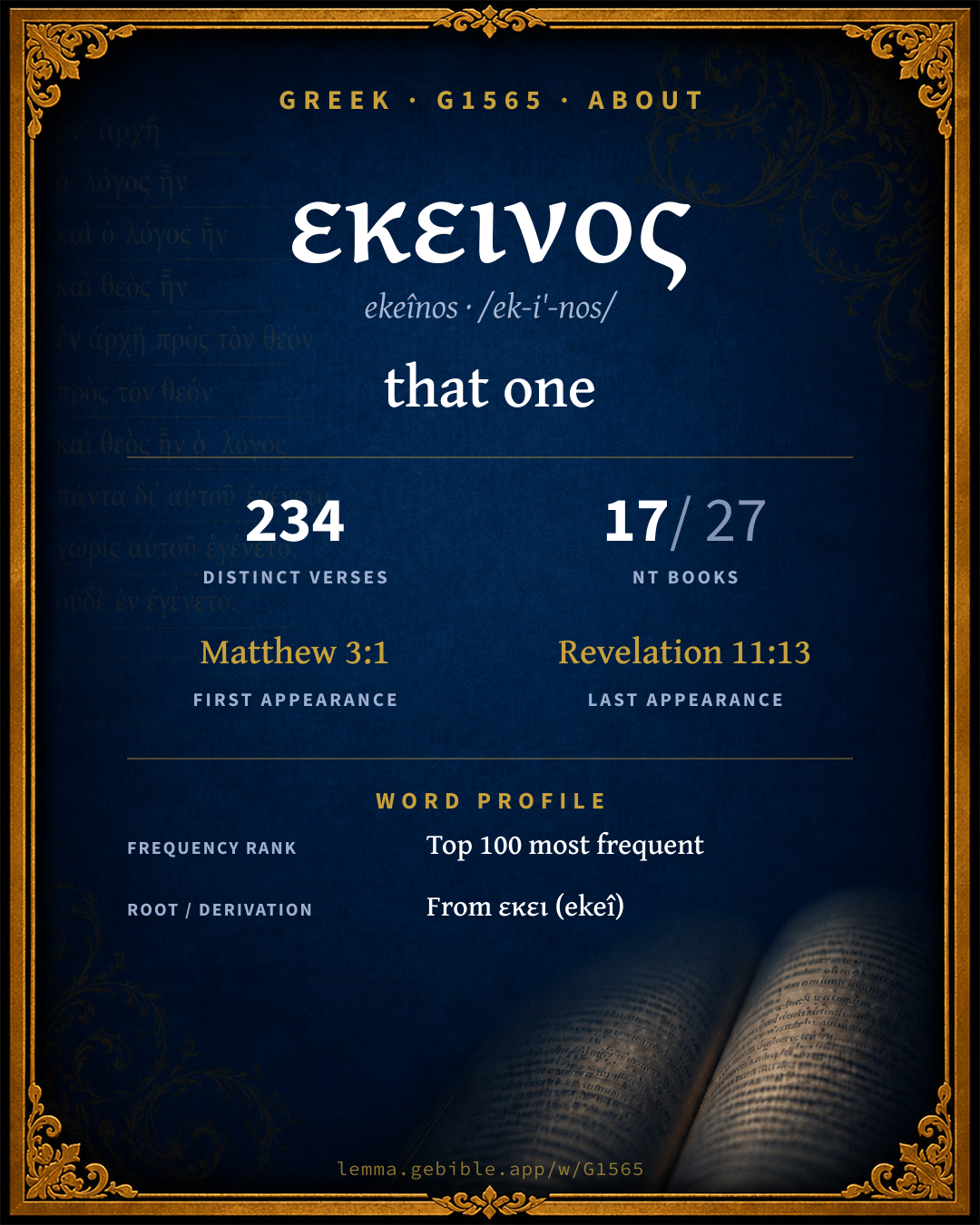
ἐκεῖνος
that one
Full lexicon entry — Thayer's Greek Lexicon
From Thayer's Greek Lexicon
Where this word appears
See every Genitive-case word in the Greek New Testament →
Grammar key — what these labels mean
Part of speech
- Demonstrative pronoun
- Points something out (“this,” “that”).
Case
- Nominative
- The case of the subject (and the predicate nominative).
- Dative
- The case of the indirect object, means, or location — “to / for / with / in.”
- Genitive
- The case of source, possession, or “of” — answers “whose / from what.”
- Accusative
- The case of the direct object and of extent.
Gender
- Masculine
- Grammatically masculine.
- Feminine
- Grammatically feminine.
- Neuter
- Grammatically neuter.
Number
- Singular
- One.
- Plural
- More than one.
Every verse where G1565 appears in the Book of 2 Corinthians — 5 distinct verses. Click any verse to open its interlinear word-by-word view. Verse text shown in the World English Bible for context — . Each verse’s Greek form is shown with its reference; the English is not keyword-highlighted, since the data carries no word-level English alignment. Use “Compare translations” on any verse to read it across multiple English versions. This concordance covers the Greek New Testament; Septuagint (Greek Old Testament) occurrences of this word are not indexed here.
2 Corinthians
- 2 Corinthians 7:8 ἐκείνη dem.pron nom sg fem For though I made you sorry with my letter, I do not regret it, though I did regret it. For I see that my letter made you sorry, though just for a while.
- 2 Corinthians 8:9 ἐκείνου dem.pron gen sg masc For you know the grace of our Lord Jesus Christ, that, though he was rich, yet for your sakes he became poor, that you through his poverty might become rich.
- 2 Corinthians 8:13 ἐκείνων dem.pron gen pl masc For this is not that others may be eased and you distressed,
- 2 Corinthians 8:14 ἐκείνων dem.pron gen pl masc but for equality. Your abundance at this present time supplies their lack, that their abundance also may become a supply for your lack; that there may be equality.
- 2 Corinthians 10:18 ἐκεῖνός dem.pron nom sg masc For it isn't he who commends himself who is approved, but whom the Lord commends.
About this entry
At a glance — auto-summarized from this page’s data, not written by a person. Every figure links to its source below. This summary describes the numbers; it doesn’t interpret them.
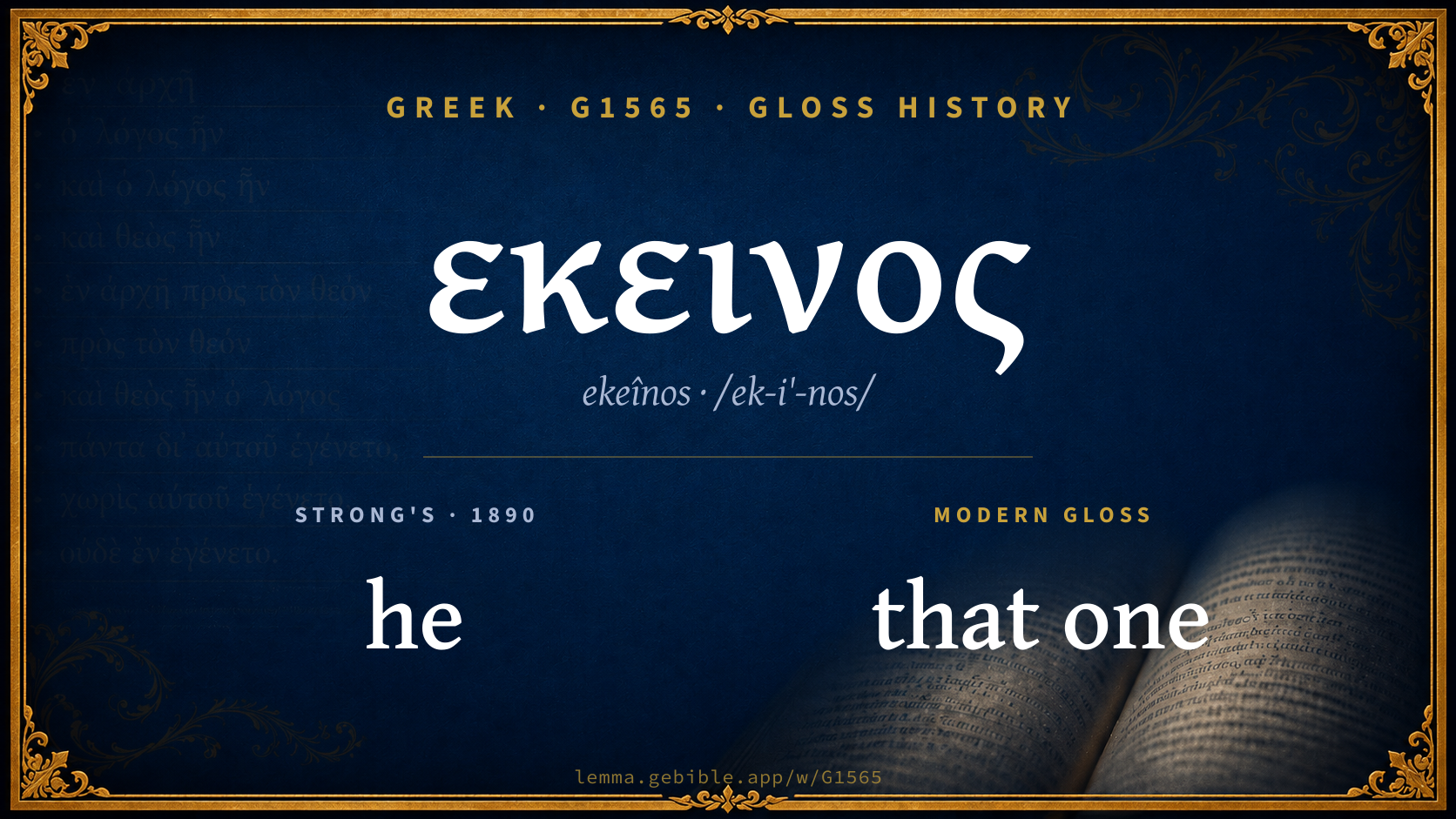
At its core, εκεινος (ekeînos) means “that one.” The King James Version’s older “same” has given way to “that” in modern versions, as the renderings breakdown shows. Spanning 234 verses in 17 books, it ranks among the common words of the Greek New Testament. Its uses concentrate in John (30% of all occurrences). It first appears in Matthew 3:1. Each statement above links to its evidence; the full detail follows below.
Gloss history
Strong's 1890 vs modern scholarship
About this word
Strong's G1565 catalogs a Greek word from the Greek New Testament.
These counts are not copied from any lexicon or concordance. They are computed here, from the morphology-tagged Greek New Testament. What Lemma adds →
- 234
- distinct verses
- The word appears in 234 distinct verses.
- 17 / 27
- NT books
- The word appears in 17 of 27 New Testament books.
- #67
- by frequency
- Top 100 most frequent Greek words (rank 67 of 5,347 Greek words by occurrence).
View all 234 occurrences in the concordance →
By section of the New Testament
By traditional corpus
Conventional, traditional groupings — biblical authorship is debated, so this is a traditional corpus grouping, not an authorship claim. Some books belong to more than one corpus (Luke is in both the Gospels and the Lukan corpus, and so on), so these shares overlap and need not total 100%. Each figure is a share of the word’s 234 distinct verses.
- Gospels 172 verses · 74%
- Johannine 79 verses · 34%
- Lukan (Luke–Acts) 52 verses · 22%
- Pauline corpus 21 verses · 9%
- General (Catholic) Epistles 10 verses · 4%
- Hebrews 8 verses · 3%
- Revelation 2 verses · 1%
How translations render this word
Counts come from each version’s own published word-to-Strong’s tagging or interlinear alignment — an approximate guide to how each version renders this word, not a word-level alignment the data otherwise carries. Because each total is that version’s own tagged count, the per-version totals vary from one another and need not match the appearance or distinct-verse counts above. These counts may also differ from a printed concordance because Lemma counts each distinctly tagged rendering and does not collapse phrase taggings into a single head-word total. This is a fixed set of word-tagged versions (KJV, ASV, BSB, ULT) and does not change with the reading translation you choose elsewhere. Each version’s license is shown beside its name below (and on Sources).
- King James Version: That 92×, Those 38×, He 36×
- American Standard Version: That 109×, He 36×, Those 33×
- Berean Standard Bible: That 87×, Those 28×, He 23×
- unfoldingWord Literal Text: That 117×, One 48×, Those 46×
King James Version Public Domain
Renders G1565 across 245 tagged occurrences — most commonly:
Plus other, less common renderings. Plus 13 renderings that appear only once — usually multi-word phrases or single function words the recovered tagging swept in, not distinct renderings. Not rendered by a distinct English word in 6 further occurrences.
American Standard Version Public Domain
Renders G1565 across 245 tagged occurrences — most commonly:
Plus other, less common renderings. Plus 14 renderings that appear only once — usually multi-word phrases or single function words the recovered tagging swept in, not distinct renderings.
Berean Standard Bible Public Domain
Renders G1565 across 185 tagged occurrences — most commonly:
Plus 10 renderings that appear only once — usually multi-word phrases or single function words the recovered tagging swept in, not distinct renderings. Not rendered by a distinct English word in 54 further occurrences.
unfoldingWord Literal Text CC BY-SA 4.0
Renders G1565 across 246 tagged occurrences — most commonly:
Plus 7 renderings that appear only once — usually multi-word phrases or single function words the recovered tagging swept in, not distinct renderings.
Senses in Thayer's
The 1 sense Thayer's distinguishes for this word, in lexicon order (not ranked by frequency or importance). The full entry — with sub-senses — is in the Lexicon Entry tab.
- he, she it, etc.
Word origin
Derived from εκει (ekeî) (G1563) — there.
Forms in the corpus
The 21 distinct written forms G1565 takes in the Greek New Testament, most frequent first — each parse links to that case’s occurrences in the concordance.
Same root — word family
Other Thayer's entries built from the same root as G1565, grouped by Strong’s listed origin. These share a root / origin per the lexicon — not necessarily a shared meaning. Each links to that word’s own entry.
Derives from
Shares the same root
Compare all same-root words → They share a root, not necessarily a meaning.
Septuagint usage
The same Greek word εκεινος appears 576 times in the Greek Old Testament (Septuagint), across 546 verses in 31 books.
- 576
- LXX occurrences
- Tagged occurrences of this Greek word in the Septuagint.
- 546
- verses
- Distinct Septuagint verses containing this word.
- 31 / 39
- OT books
- The word appears in 31 of the 39 Old Testament books.
Sample Septuagint occurrences
- Genesis 2:12 ἐκεῖνος
- Exodus 1:6 ἐκεῖνος
- Leviticus 7:20 ἐκεῖνος
- Numbers 5:6 ἐκεῖνος
- Deuteronomy 1:9 ἐκεῖνος
- Joshua 2:24 ἐκεῖνος
- Judges 2:5 ἐκεῖνος
- 1 Samuel 3:1 ἐκεῖνος
- 2 Samuel 2:16 ἐκεῖνος
- 1 Kings 2:25 ἐκεῖνος
- 2 Kings 3:6 ἐκεῖνος
- 1 Chronicles 7:24 ἐκεῖνος
Septuagint occurrences (same lexeme)
Every verse where the same Strong’s number (G1565) appears in the Greek Septuagint — showing the first 50 of 546. Verse text shown in the World English Bible for context; the Greek form is the matched word — the English is not keyword-highlighted.
- Genesis 2:12 ἐκεῖνος and the gold of that land is good. There is aromatic resin and the onyx stone.
- Genesis 6:4 ἐκεῖνος The Nephilim were in the earth in those days, and also after that, when God's sons came to men's daughters. They bore children to them: the same were the mighty men who were of old, men of renown.
- Genesis 6:21 ἐκεῖνος Take with you of all food that is eaten, and gather it to you; and it will be for food for you, and for them."
- Genesis 10:11 ἐκεῖνος Out of that land he went forth into Assyria, and built Nineveh, Rehoboth Ir, Calah,
- Genesis 15:18 ἐκεῖνος In that day Yahweh made a covenant with Abram, saying, "To your seed have I given this land, from the river of Egypt to the great river, the river Euphrates:
- Genesis 17:14 ἐκεῖνος The uncircumcised male who is not circumcised in the flesh of his foreskin, that soul shall be cut off from his people. He has broken my covenant."
- Genesis 17:23 ἐκεῖνος Abraham took Ishmael his son, all who were born in his house, and all who were bought with his money; every male among the men of Abraham's house, and circumcised the flesh of their foreskin in the same day, as God had said to him.
- Genesis 17:26 ἐκεῖνος In the same day both Abraham and Ishmael, his son, were circumcised.
- Genesis 19:9 ἐκεῖνος They said, "Stand back!" They said, "This one fellow came in to live as a foreigner, and he appoints himself a judge. Now will we deal worse with you, than with them!" They pressed hard on the man, even Lot, and drew near to break the door.
- Genesis 19:22 ἐκεῖνος Hurry, escape there, for I can't do anything until you get there." Therefore the name of the city was called Zoar.
- Genesis 19:33 ἐκεῖνος They made their father drink wine that night: and the firstborn went in, and lay with her father. He didn't know when she lay down, nor when she arose.
- Genesis 19:35 ἐκεῖνος They made their father drink wine that night also. The younger arose, and lay with him. He didn't know when she lay down, nor when she arose.
- Genesis 21:22 ἐκεῖνος It happened at that time, that Abimelech and Phicol the captain of his host spoke to Abraham, saying, "God is with you in all that you do.
- Genesis 21:31 ἐκεῖνος Therefore he called that place Beersheba, because they both swore there.
- Genesis 22:14 ἐκεῖνος Abraham called the name of that place Yahweh-Jireh. As it is said to this day, "In Yahweh's mountain it will be provided.
- Genesis 24:65 ἐκεῖνος She said to the servant, "Who is the man who is walking in the field to meet us?" The servant said, "It is my master." She took her veil, and covered herself.
- Genesis 26:12 ἐκεῖνος Isaac sowed in that land, and reaped in the same year one hundred times what he planted. Yahweh blessed him.
- Genesis 26:21 ἐκεῖνος They dug another well, and they argued over that, also. He called the name of it Sitnah.
- Genesis 26:24 ἐκεῖνος Yahweh appeared to him the same night, and said, "I am the God of Abraham your father. Don't be afraid, for I am with you, and will bless you, and multiply your seed for my servant Abraham's sake."
- Genesis 26:32 ἐκεῖνος It happened the same day, that Isaac's servants came, and told him concerning the well which they had dug, and said to him, "We have found water."
- Genesis 28:11 ἐκεῖνος He came to a certain place, and stayed there all night, because the sun had set. He took one of the stones of the place, and put it under his head, and lay down in that place to sleep.
- Genesis 28:19 ἐκεῖνος He called the name of that place Bethel, but the name of the city was Luz at the first.
- Genesis 29:2 ἐκεῖνος He looked, and behold, a well in the field, and, behold, three flocks of sheep lying there by it. For out of that well they watered the flocks. The stone on the well's mouth was great.
- Genesis 30:16 ἐκεῖνος Jacob came from the field in the evening, and Leah went out to meet him, and said, "You must come in to me; for I have surely hired you with my son's mandrakes." He lay with her that night.
- Genesis 30:35 ἐκεῖνος That day, he removed the male goats that were streaked and spotted, and all the female goats that were speckled and spotted, every one that had white in it, and all the black ones among the sheep, and gave them into the hand of his sons.
- Genesis 32:3 ἐκεῖνος Jacob sent messengers in front of him to Esau, his brother, to the land of Seir, the field of Edom.
- Genesis 32:14 ἐκεῖνος two hundred female goats and twenty male goats, two hundred ewes and twenty rams,
- Genesis 32:22 ἐκεῖνος He rose up that night, and took his two wives, and his two handmaids, and his eleven sons, and passed over the ford of the Jabbok.
- Genesis 32:23 ἐκεῖνος He took them, and sent them over the stream, and sent over that which he had.
- Genesis 32:31 ἐκεῖνος The sun rose on him as he passed over Peniel, and he limped because of his thigh.
- Genesis 33:16 ἐκεῖνος So Esau returned that day on his way to Seir.
- Genesis 33:17 ἐκεῖνος Jacob traveled to Succoth, built himself a house, and made shelters for his cattle. Therefore the name of the place is called Succoth.
- Genesis 35:22 ἐκεῖνος It happened, while Israel lived in that land, that Reuben went and lay with Bilhah, his father's concubine, and Israel heard of it. Now the sons of Jacob were twelve.
- Genesis 37:19 ἐκεῖνος They said one to another, "Behold, this dreamer comes.
- Genesis 38:1 ἐκεῖνος It happened at that time, that Judah went down from his brothers, and visited a certain Adullamite, whose name was Hirah.
- Genesis 41:13 ἐκεῖνος It happened, as he interpreted to us, so it was: he restored me to my office, and he hanged him."
- Genesis 43:28 ἐκεῖνος They said, "Your servant, our father, is well. He is still alive." They bowed the head, and did homage.
- Genesis 43:34 ἐκεῖνος He sent portions to them from before him, but Benjamin's portion was five times as much as any of theirs. They drank, and were merry with him.
- Genesis 47:17 ἐκεῖνος They brought their cattle to Joseph, and Joseph gave them bread in exchange for the horses, and for the flocks, and for the herds, and for the donkeys: and he fed them with bread in exchange for all their cattle for that year.
- Genesis 47:18 ἐκεῖνος When that year was ended, they came to him the second year, and said to him, "We will not hide from my lord how our money is all spent, and the herds of cattle are my lord's. There is nothing left in the sight of my lord, but our bodies, and our lands.
- Genesis 48:6 ἐκεῖνος Your issue, who you become the father of after them, will be yours. They will be called after the name of their brothers in their inheritance.
- Genesis 48:20 ἐκεῖνος He blessed them that day, saying, "In you will Israel bless, saying, 'God make you as Ephraim and as Manasseh'" He set Ephraim before Manasseh.
- Exodus 1:6 ἐκεῖνος Joseph died, as did all his brothers, and all that generation.
- Exodus 2:11 ἐκεῖνος It happened in those days, when Moses had grown up, that he went out to his brothers, and looked at their burdens. He saw an Egyptian striking a Hebrew, one of his brothers.
- Exodus 2:23 ἐκεῖνος It happened in the course of those many days, that the king of Egypt died, and the children of Israel sighed because of the bondage, and they cried, and their cry came up to God because of the bondage.
- Exodus 3:8 ἐκεῖνος I have come down to deliver them out of the hand of the Egyptians, and to bring them up out of that land to a good and large land, to a land flowing with milk and honey; to the place of the Canaanite, the Hittite, the Amorite, the Perizzite, the Hivite, and the Jebusite.
- Exodus 4:19 ἐκεῖνος Yahweh said to Moses in Midian, "Go, return into Egypt; for all the men who sought your life are dead."
- Exodus 7:12 ἐκεῖνος For they cast down every man his rod, and they became serpents: but Aaron's rod swallowed up their rods.
- Exodus 8:18 ἐκεῖνος The magicians tried with their enchantments to bring forth lice, but they couldn't. There were lice on man, and on animal.
- Exodus 9:4 ἐκεῖνος Yahweh will make a distinction between the cattle of Israel and the cattle of Egypt; and there shall nothing die of all that belongs to the children of Israel."'"
These are occurrences of the same Greek lexeme (G1565) in the Septuagint — not a translation of any one Hebrew word. The store carries no word-level Hebrew↔Greek alignment, so no Hebrew original is asserted here. Counts come from the recovered LXX Strong's tagging — high-frequency vocabulary is well covered, while rare or late forms may be untagged — so they reflect tagged occurrences and may slightly undercount.