
Luke 10:31

Greek (Tischendorf 8th ed.) Luke 10:31 appears in the Greek New Testament. The text above is from the Tischendorf 8th edition. Each word links to its Strong’s number and a concise gloss. Click any word for its full Thayer’s Greek Lexicon entry.

Download image
Cite this verse

Luke 10:31 (World English Bible). Public Domain. Lemma interlinear Bible study tool, https://lemma.gebible.app/v/luke/10/31.

Show BibTeX & RIS
BibTeX
RIS
English Translation
By chance a certain priest was going down that way. When he saw him, he passed by on the other side.
World English Bible · Public Domain
Highlights
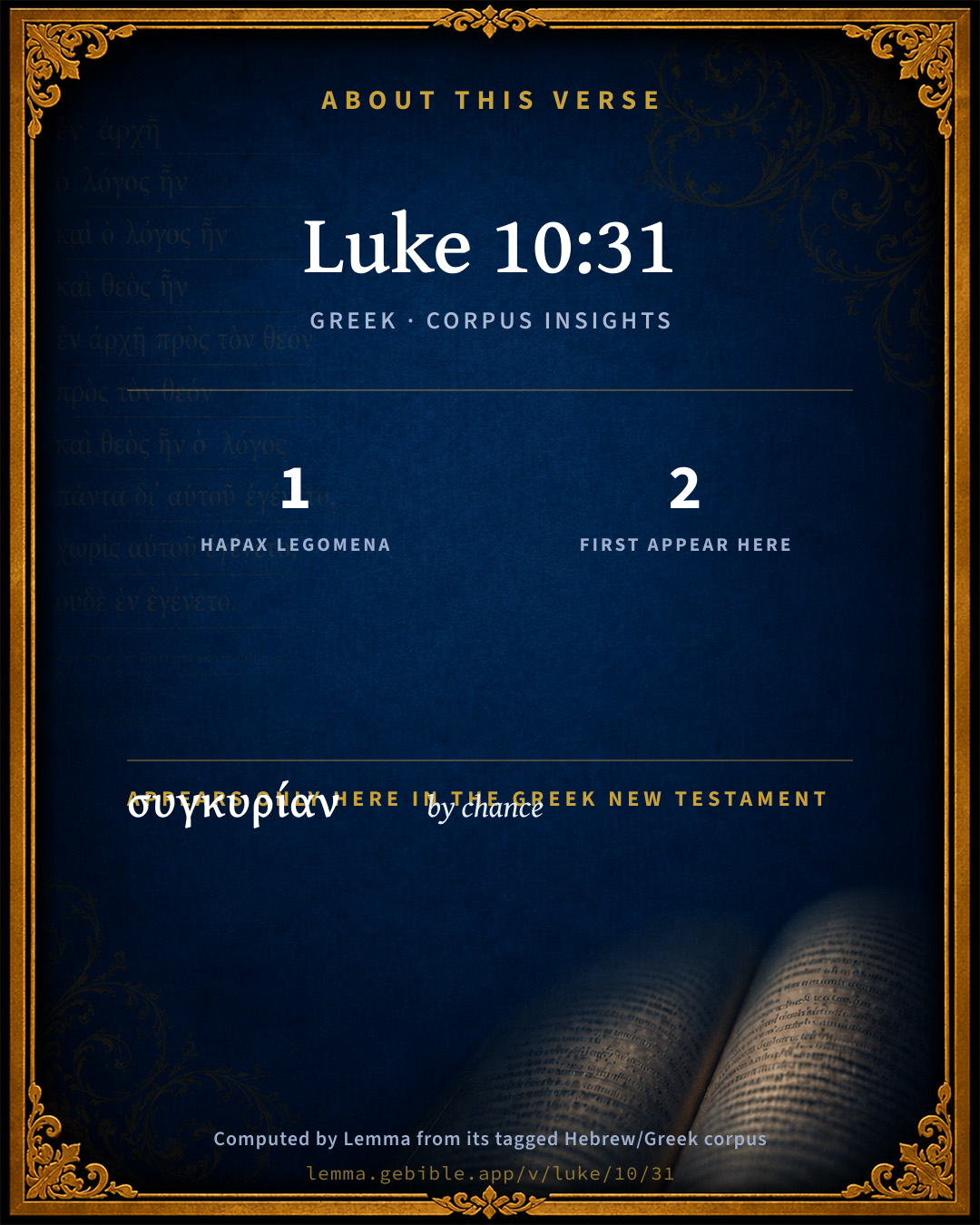
  • 1 hapax legomenon — only here in the Greek New Testament
  • 2 first appearances in the Greek New Testament
Full analysis ↓
Download a study sheet

One document with this verse’s original text, its word-by-word gloss line, the meaning frame, cross-references with their text, attributed commentary, and full source and license credits — printable, and it pastes into notes with its structure intact.

This verse Autodidact and up

Study sheet (.html) Plain text (.txt)

A passage Seminary Student

Up to 50 verses in one chapter. A passage sheet keeps up to 6 commentary sources and 12 cross-references per verse, in the order this page ranks them, and says so on the sheet whenever that leaves anything out. Ask for a single verse and you get the Autodidact verse sheet above.

Everything on this page stays free to read, with no account — the sheet is a download of what is already on screen, not access to it.

Want to remove ads? Support Godless Engineer
Compare translations 3

The same verse in 3 English versions, stacked beneath the original-language interlinear above. Click any original word for its lexicon entry.

Each is an independent rendering of the whole verse — the interlinear is not word-aligned to these translations.

Highlighted words mark where these versions differ — a whole-verse word diff, not a word-by-word alignment.

  • World English Bible Public Domain
    By chance a certain priest was going down that way. When he saw him, he passed by on the other side.
  • King James Version Public Domain
    And by chance there came down a certain priest that way: and when he saw him, he passed by on the other side.
  • unfoldingWord Literal Text CC BY-SA 4.0
    Then by coincidence a certain priest was going down on that road, and having seen him, he passed by on the other side.

unfoldingWord Literal Text — © unfoldingWord, licensed CC BY-SA 4.0. Word-aligned USFM3 via Door43 (git.door43.org/unfoldingWord/en_ult).

Versions to compare (up to 4)

3 of 4 selected

Show all 19 translations

Every available English version of this verse, each an independent rendering of the whole verse.

  • World English Bible Public Domain
    By chance a certain priest was going down that way. When he saw him, he passed by on the other side.
  • Berean Standard Bible Public Domain
    Now by chance a priest was going down the same road, but when he saw him, he passed by on the other side.
  • Majority Standard Bible Public Domain
    Now by chance a priest was going down the same road, but when he saw him, he passed by on the other side.
  • King James Version Public Domain
    And by chance there came down a certain priest that way: and when he saw him, he passed by on the other side.
  • American Standard Version (1901) Public Domain
    And by chance a certain priest was going down that way: and when he saw him, he passed by on the other side.
  • Revised Version (1885) Public Domain
    And by chance a certain priest was going down that way: and when he saw him, he passed by on the other side.
  • Geneva Bible (1599) Public Domain
    Nowe so it fell out, that there came downe a certaine Priest that same way, and when he sawe him, he passed by on the other side.
  • Douay-Rheims (1899) Public Domain
    And it chanced, that a certain priest went down the same way: and seeing him, passed by.
  • Young's Literal Translation Public Domain
    `And by a coincidence a certain priest was going down in that way, and having seen him, he passed over on the opposite side;
  • Literal Standard Version CC BY-SA 4.0
    And by a coincidence a certain priest was going down in that way, and having seen him, he passed over on the opposite side;
  • Unlocked Literal Bible CC BY-SA 4.0
    By chance a certain priest was going down that way, and when he saw him, he passed by on the other side.
  • unfoldingWord Literal Text CC BY-SA 4.0
    Then by coincidence a certain priest was going down on that road, and having seen him, he passed by on the other side.
  • Darby Bible Public Domain
    And a certain priest happened to go down that way, and seeing him, passed on on the opposite side;
  • World Messianic Bible Public Domain
    By chance a certain priest was going down that way. When he saw him, he passed by on the other side.
  • Webster's Bible Public Domain
    And by chance there came down a certain priest that way; and when he saw him, he passed by on the other side.
  • Free Bible Version CC BY-SA 4.0
    It so happened that a priest was going the same way. He saw the man, but he passed by on the other side of the road.
  • Bible in Basic English Public Domain
    And by chance a certain priest was going down that way: and when he saw him, he went by on the other side.
  • Text-Critical English NT CC BY 4.0
    Now a priest happened to be going down that road, but when he saw the man, he passed by on the other side.
  • Tyndale New Testament (1534) Public Domain
    And by chaunce ther came a certayne preste that same waye and when he sawe him he passed by.

Literal Standard Version (2020), Covenant Press — licensed CC BY-SA 4.0. Text via the HelloAO Bible API (eBible.org). Unlocked Literal Bible (unfoldingWord) — licensed CC BY-SA 4.0. Text via the HelloAO Bible API (eBible.org). unfoldingWord Literal Text — © unfoldingWord, licensed CC BY-SA 4.0. Word-aligned USFM3 via Door43 (git.door43.org/unfoldingWord/en_ult). Free Bible Version, Dr. Jonathan Gallagher — licensed CC BY-SA 4.0. Text via the HelloAO Bible API (eBible.org).

Word by word

More ways to search: Search by grammar → Find every occurrence → Compare this word →

Practice this passage: Drill this verse → Learn its vocabulary →

συγκυρίαν
synkyría
G4795
“by chance”
Noun, Accusative, Singular, Feminine
Part of Speech
Noun
Case
Accusative
Number
Singular
Gender
Feminine
Full Thayer's Definition

Origin: from a comparative of G4862 and kureo (to light or happen

TDNT: from the base of 2962)

1. accident, by chance
  1. κατὰ katá G2596 “down” Preposition
  2. δὲ dé G1161 “but” Conjunction
  3. ἱερεύς hiereús G2409 “priest” Noun, Nominative, Singular, Masculine
  4. τις tìs G5100 “a certain” Indefinite pronoun, Nominative, Singular, Masculine
  5. κατέβαινεν katabaínō G2597 “to descend” Verb, Imperfect, Active, Indicative, 3rd person, Singular
  6. ἐν en G1722 “in” Preposition
  7. τῇ ho G3588 “the” Article, Dative, Singular, Feminine
  8. ὁδῷ hodós G3598 “way” Noun, Dative, Singular, Feminine
  9. ἐκείνῃ ekeînos G1565 “that one” Demonstrative pronoun, Dative, Singular, Feminine
  10. καὶ kaí G2532 “and” Conjunction
  11. ἰδὼν horáō G3708 “to see” Verb, Aorist, Active, Participle, Nominative, Singular, Masculine
  12. αὐτὸν autós G846 “he” Personal pronoun, Accusative, Singular, Masculine
  13. ἀντιπαρῆλθεν antiparérchomai G492 “to pass by” Verb, Aorist, Active, Indicative, 3rd person, Singular

About this verse

These counts appear in no published source. They are computed here, from the morphology-tagged text and Lemma’s own curated glosses. What Lemma adds →

14
words
14
distinct lemmas
Gospels
section

Notable vocabulary

1 hapax legomenon — a word that appears only here in the entire Greek New Testament:

  • συγκυρίαν by chance G4795

First appearance in Scripture

These words make their first canonical appearance in the Greek New Testament here:

  • συγκυρίαν by chance G4795
  • ἀντιπαρῆλθεν to pass by G492

Shared distinctive vocabulary

ἀντιπαρῆλθεν to pass by G492 occurs in 2 verses of the Greek New Testament. Also found in:
Cross-references

15

Topical passages linked to Luke 10:31 in the Treasury of Scripture Knowledge — connected by theme and wording, ordered by reader-vote popularity; previews shown in the World English Bible.

  • Psalms 69:20 Reproach has broken my heart, and I am full of heaviness. I looked for some to take pity, but there was none; For comforters, but I found none.
  • 1 John 3:16–18 By this we know love, because he laid down his life for us. And we ought to lay down our lives for the brothers.
  • Proverbs 21:13 Whoever stops his ears at the cry of the poor, He will also cry out, but shall not be heard.
  • Jeremiah 5:31 the prophets prophesy falsely, and the priests bear rule by their means; and my people love to have it so: and what will you do in the end of it?
  • Hosea 6:9 As gangs of robbers wait to ambush a man, So the company of priests murder in the way toward Shechem, Committing shameful crimes.
  • Ruth 2:3 She went, and came and gleaned in the field after the reapers: and she happened to come to the portion of the field belonging to Boaz, who was of the family of Elimelech.
  • Psalms 142:4 Look on my right, and see; For there is no one who is concerned for me. Refuge has fled from me. No one cares for my soul.
  • Ecclesiastes 9:11 I returned, and saw under the sun, that the race is not to the swift, nor the battle to the strong, neither yet bread to the wise, nor yet riches to men of understanding, nor yet favor to men of skill; but time and chance happen to them all.
  • Hosea 5:1 "Listen to this, you priests! Listen, house of Israel, And give ear, house of the king! For the judgment is against you; For you have been a snare at Mizpah, And a net spread on Tabor.
  • Malachi 1:10 "Oh that there were one among you who would shut the doors, that you might not kindle fire on my altar in vain! I have no pleasure in you," says Yahweh of hosts, "neither will I accept an offering at your hand.
  • 2 Samuel 1:6 The young man who told him said, As I happened by chance on Mount Gilboa, behold, Saul was leaning on his spear; and, behold, the chariots and the horsemen followed hard after him.
  • Job 6:14–21 "To him who is ready to faint, kindness should be shown from his friend; Even to him who forsakes the fear of the Almighty.
  • Psalms 38:10–11 My heart throbs. My strength fails me. As for the light of my eyes, it has also left me.
  • Proverbs 24:11–12 Rescue those who are being led away to death! Indeed, hold back those who are staggering to the slaughter!
  • James 2:13–16 For judgment is without mercy to him who has shown no mercy. Mercy triumphs over judgment.

Cross-references courtesy of OpenBible.info (CC BY 4.0).

Commentary

Notes on Luke 10:31 from classic Christian and Jewish commentators (each source and its license shown beneath its notes). The classic Christian expositions comment on the surrounding passage and are grouped to its opening verse, so a note may address several verses; the Jewish commentaries on the Tanakh (Rashi and others) are per-verse, so they appear only where the commentator wrote on this verse.

Lemma curates 59 commentaries, every one of them public domain or Creative Commons licensed, each selected and text-cleaned for this edition rather than reprinted as found. About our sources →

Tyndale Open Study Notes

Tyndale Open Resources

10:31 a priest: Priests were descendants of Aaron from the tribe of Levi (Exod 28:1-3). They served in the Temple and offered sacrifices to God. • passed him by: A priest or a Levite became unclean and unable to serve in the Temple if he touched a dead body. This priest was unwilling to risk ritual impurity by helping a person in desperate trouble.

Tyndale Open Study Notes — © Tyndale Open Resources, licensed CC BY-SA 4.0. Text via the HelloAO Bible API.

Bengel's Gnomon

Johann Albrecht Bengel

Luk 10:31. Κατὰ συγκυρίαν, by a contingency [chance]) Many good opportunities lie hid under those things which may seem to be matters of chance. Scripture describes nothing at random, as if a matter of chance: in this passage it is a suitable Syncategorema [accessory proposition added to the principal one] in relation to the parable; and it is opposed to that which is inevitable.—ἱερεὺς, a priest) There was many a journey of Priests and Levites wont to be taken on that road to the city and the temple.—ὁδῷ, way) Even on the way-side, in inns, Luk 10:34, in the middle of the intercourse of social life, piety and mutual love can be exercised or omitted: Exo 23:4-5.—ἀντιπαρῆλθεν, he passed by on the other side) without showing any compassion, being in haste to go to Jerusalem.

Bengel's Gnomon of the New Testament — English translation (T&T Clark, Edinburgh, 1860) — public domain. Text from a community e-Sword module.

Expositor's Greek Testament

ed. W. Robertson Nicoll

Luk 10:31 . κατὰ συγκυρίαν ( συγκυρία , from συνκυρέω ), rare, late Greek = κατὰ συντυχίαν (Hesychius, συγκυρία , συντυχία ), by chance; the probabilities against succour being at hand just when sorely wanted; still more improbable that three possibilities of succour should meet just there and then. But the supposition, duly apologised for, is allowable, as the story must go on. ἱερεύς : Schanz infers from κατὰ συγ . that Jericho was not a sacerdotal city, as, since Lightfoot, has been usually taken for granted. But the phrase has its full meaning independently of this inference, vide above. ἀντιπαρῆλθεν , variously rendered either = passed by simply, or = passed the opposite way (going up), Grotius; or passed with the wounded man in full view, staring him in the face, a sight fit to awaken compassion in any one (Hahn); or passed by on the other side of the road.

The Expositor's Greek Testament, edited by W. Robertson Nicoll (1897–1910) — public domain. Text from a community e-Sword module.

Jamieson, Fausset & Brown

Robert Jamieson, A. R. Fausset & David Brown

came down a . . . priest . . . and a Levite--Jericho, the second city of Judea, was a city of the priests and Levites, and thousands of them lived there. The two here mentioned are supposed, apparently, to be returning from temple duties, but they had not learnt what that meaneth, 'I will have mercy and not sacrifice' [TRENCH].

saw him--It was not inadvertently that he acted.

came and looked--a further aggravation.

passed by--although the law expressly required the opposite treatment even of the beast not only of their brethren, but of their enemy (Deu 22:4; Exo 23:4-5; compare Isa 58:7).

Jamieson, Fausset & Brown — Commentary Critical and Explanatory on the Whole Bible (1871) — public domain (CC PDM 1.0). Text via the HelloAO Bible API.

Adam Clarke's Commentary

Verse 31. And by chance] κατα συγκυριαν properly means the coincidence of time and circumstance. At the time in which the poor Jew was half dead, through the wounds which he had received, a priest came where he was. So the priest's coming while the man was in that state is the coincidence marked out by the original words.

Verses 31. - 32. Priest and Levite are mentioned here, partly because they were the most frequent travellers on this road, and partly to show that these were the persons who, from the nature of their office, were most obliged to perform works of mercy; and from whom a person in distress had a right to expect immediate succour and comfort; and their inhuman conduct here was a flat breach of the law, De 22:1-4.

Adam Clarke's Commentary on the Bible (1810–1826) — public domain. Text from a community e-Sword/MySword module.

Ellicott's Commentary for English Readers

(31) By chance. . . .—The passage is the only one in the New Testament in which the phrase occurs. Our Lord seems to use it as with a touch of what we have elsewhere termed irony. It seemed so casual, as such opportunities always do to men who neglect them, and yet it was, in the purpose of God, the test-moment of each man’s character and life.

There came down.—Better, as before, there was going down.

A certain priest.—Jericho was at this time a priestly city, and so the journey of the priest from Jerusalem, as if returning from his week of sacerdotal offices there, has a touch of vivid naturalness. He, too, like the questioner, had been doing his duty to God, according to his measure of that duty.

Passed by on the other side.—The priest shrank, it might be, (1) from the trouble and peril of meddling with a man whom robbers had just attacked, and (2) from the fear of incurring a ceremonial defilement by coming into contact with what might possibly be a corpse before he reached it. He accordingly “passed by on the other side,” not of the road only, but of the ravine through which the road passed.

A Bible Commentary for English Readers, edited by Charles John Ellicott (1878–1897) — public domain. Text from a community e-Sword module.

The Cambridge Bible for Schools and Colleges

gen. ed. J. J. S. Perowne

31. by chance] Rather, by coincidence, i.e. at the same time. The word ‘chance’ (τύχη) does not occur in Scripture. The nearest approach to it is the participle τυχὸν in 1Co_15:37 (if τυγχάνοντα be omitted in Luk_10:30). Chance, to the sacred writers, as to the most thoughtful of the Greeks, is ‘the daughter of Forethought;’ is “God’s unseen Providence, by men nicknamed Chance” (Fuller). “Many good opportunities work under things which seem fortuitous.” Bengel.

a certain priest] His official duties at Jerusalem were over, and he was on his way back to his home in the priestly city of Jericho. Perhaps the uselessness of his external service is implied. In superstitious attention to the letter, he was wholly blind to the spirit, Deu_22:1-4. See 1Jn_3:17. He was selfishly afraid of risk, trouble, and ceremonial defilement, and, since no one was there to know of his conduct, he was thus led to neglect the traditional kindness of Jews towards their own countrymen (Tac. Hist. v. 5, Juv. xiv. 103, 104), as well as the positive rules of the Law (Deu_22:4) and the Prophets (Isa_58:7).

that way] Rather, on that road. It is emphatically mentioned, because there was another road to Jericho which was safe and therefore more frequently used.

The Cambridge Bible for Schools and Colleges (gen. ed. J. J. S. Perowne; Cambridge University Press, 1878–1918) — public domain. Text from a community e-Sword module.

John Gill's Exposition

And likewise a Levite, when he was at the place,.... Where the poor man lay in this deplorable condition:

came and looked on him; and that was all; but neither spoke a comfortable word, nor administered any relief to him, or in the least assisted him:

and passed by on the other side; as the priest had done before him: by the "priest" may be meant, the moral law, and by the Levite the ceremonial law; and so by both, the whole law of Moses; and intimates, that no mercy is to be expected from thence: the law makes no abatement in its demands, nor any allowance for the fall and weakness of man: nor is it become milder under the Gospel dispensation; nor will it accept of an imperfect, though sincere obedience, in the room of a perfect one; and is deaf to all repentings, cries, and tears: no relief is to be had from thence, for a naked, wounded, and dead man; no robe of righteousness to cover a naked soul; for by the law is the knowledge of sin, but not a justifying righteousness by the deeds of it: for the deeds of the law, performed by sinful men, are impure and imperfect; and were they pure and perfect, they would be unprofitable, and could not justify in the sight of God from former sins; for could they, they would establish boasting, and disannul the death of Christ, and frustrate the grace of God; and therefore righteousness cannot be by the law, that leaves a man as naked as it finds him: nor is there any healing by it to a wounded conscience; there is no pity from it, no justification by it, no pardon through it, no expiation or atonement of sin, by obedience to it; no word of comfort is spoken by it; so far from it, that when it comes with power, it opens the wounds of sin, fills the conscience with wrath and terror, destroys all the man's former hopes of happiness, and leaves him where it found him; without healing him itself, or pointing out a physician to him: much less can it give life to a dead sinner: spiritual life is not communicated by it, nor can eternal life, or any true hope of it, be attained through it; it is so far from it, that it is the killing letter, and the ministration of condemnation and death.

John Gill's Exposition of the Whole Bible (1746–1763) — public domain (CC PDM 1.0). Text via the HelloAO Bible API.

Trapp's Complete Commentary

John Trapp

31 And by chance there came down a certain priest that way: and when he saw him, he passed by on the other side.

Ver. 31. And by chance] Indeed by the providence of God overruling the matter, as it doth in things that to us are merely casual and contingent.

John Trapp, A Commentary or Exposition upon All the Books of the Old and New Testament (1647–1656) — public domain. Text from a community e-Sword module.

Albert Barnes' Notes on the Bible

By chance - Accidentally, or as it happened. It means that he did not do it with a “design” to aid the man that was wounded.

A certain priest - It is said that not less than 12,000 priests and Levites dwelt at Jericho; and as their business was at Jerusalem, of course there would be many of them constantly traveling on that road.

When he saw him - He saw him lie, but came not near him.

Passed by on the other side - On the farther side of the way. Did not turn out of his course even to come and see him.

Albert Barnes' Notes on the Bible (1834–1885) — public domain. Text from a community e-Sword/MySword module.

Haydock's Catholic Bible Commentary

Our Saviour here shews the Jewish priests how preposterous was their behaviour, who, though scrupulously exact in performing all external acts of religion, entirely neglected piety, mercy, and other more essential duties. The Jews despised the Samaritans as wicked and irreligious men; but our Saviour here tells them that they were less exact in works of charity towards their neighbours than the very Samaritans. (Tirinus)

George Leo Haydock (1774–1849), Haydock's Catholic Family Bible and Commentary, 1859 edition — public domain. Excludes Psalms (Douay-Rheims chapter numbering differs from Protestant) and Deuterocanonical books (Catholic canon only).

Whedon's Commentary on the Bible

Daniel D. Whedon

31. By chance—By a concurrence or coincidence of the two things.

A certain priest—Very naturally; for Jericho was by law a sacerdotal city; that is, a city for the residence of the priests who, in their turn, went up to Jerusalem to perform their office at the Temple. No less than twelve thousand priests here lived, one or more of whom were daily seen walking this route.

On the other side—He availed himself of the broad road to sheer away from the victim.

Daniel D. Whedon (gen. ed.), Commentary on the Old and New Testaments (1874–1909) — public domain. Text from a community e-Sword module.

The Pulpit Commentary

There came down a certain priest that way: and when he saw him, he passed by on the other side. Both the priest and Levite were frequent travellers along this road between the capital and Jericho. Jericho was especially a city of priests, and when the allotted service or residence time at the temple was over, these would return naturally to their own homes. It has been remarked that the grave censure which this story levels at the everyday want of charity on the part of priests and Levites, fills up what would otherwise have been a blank in the Master"s many-sided teaching. Nowhere else in the gospel narrative do we find our Lord taking up the attitude of censor of the priestly and Levitical orders. We have little difficulty in discovering reasons for this apparently strange reticence. They were still the official guardians and ministers of his Father"s house. In his public teaching, as a rule, he would refrain from touching these or their hollow, pretentious lives. Once, and once only, in this one parable did he dwell but even here with no severe denunciations, as in the case of scribes and Pharisees on the shortcomings of the priestly caste. The bitter woe was fast coming on these degenerate children of Aaron. In less than half a century, that house, the glory and the joy of Israel, would be utterly destroyed, net to be raised again. No woe that the Christ could pronounce could be as crushing in its pitiless condemnation. The very reason for the existence of priest and Levite as priest and Levite would exist no longer. The selfish life of the doomed order, in which holiness seemed effectually to have been divorced from charity, is portrayed in the lifelike picture of the parable of the good Samaritan.

The Pulpit Commentary (1880–1919), ed. H.D.M. Spence-Jones & Joseph S. Exell — public domain. Text from a community e-Sword module.

John Wesley's Explanatory Notes

The common translation is, by chance - Which is full of gross improprieties. For if we speak strictly, there is no such thing in the universe as either chance or fortune. A certain priest came down that way, and passed by on the other side - And both he and the Levite no doubt could find an excuse for passing over on the other side, and might perhaps gravely thank God for their own deliverance, while they left their brother bleeding to death. Is it not an emblem of many living characters, perhaps of some who bear the sacred office? O house of Levi and of Aaron, is not the day coming, when the virtues of heathens and Samaritans will rise up in judgment against you?

John Wesley, Explanatory Notes Upon the Whole Bible (1754–1765) — public domain. Text via the GEBible commentary corpus.

unfoldingWord translationNotes

Door43 World Missions Community

By chance

This was not something that any person had planned.

a certain priest

This expression introduces a new person in the story, but does not identify him by name. (See: Introduction of New and Old Participants)

when he saw him

"when the priest saw the injured man." A priest is a very religious person, so the audience would assume that he would help the injured man. Since he did not, this phrase could be stated as "but when he saw him" to call attention to this unexpected result. (See: Assumed Knowledge and Implicit Information)

he passed by on the other side

It is implied that he did not help the man. AT: "he did not help the injured man but instead walked past him on the other side of the road" (See: Assumed Knowledge and Implicit Information)

a Levite ... the other side

The Levite served in the temple. He would be expected to help his fellow Jewish man. Since he did not, it may are helpful to state that. AT: "a Levite ... the other side and did not help him" (See: Assumed Knowledge and Implicit Information)

translationWords

priest

Levi

unfoldingWord translationNotes — © Distant Shores Media and the Door43 World Missions Community, licensed CC BY-SA 4.0. Source: git.door43.org/Door43/en_tn.

Cambridge Greek Testament for Schools and Colleges

31. κατὰ συγκυρίαν. ‘By coincidence.’ i.e. at the same time. The word ‘chance’ (τύχη) does not occur in Scripture. The nearest approach to it is the participle τυχὸν in 1Co 15:37 (if τυγχάνοντα be omitted in Luk 10:30). ‘Chance,’ to the sacred writers, as to the most thoughtful of the Greeks, is ‘the daughter of Forethought:’ it is “God’s unseen Providence, by men nicknamed Chance” (Fuller). “Many good opportunities work under things which seem fortuitous.” Bengel. The rare word συγκυρία is, like others used by St Luke, found chiefly in the writings of Hippocrates.

ἱερεύς τις. His official duties at Jerusalem were over, and he was on his way back to his home in the priestly city of Jericho. Perhaps the uselessness of his external service is implied. In superstitious attention to the letter, he was wholly blind to the spirit, Deu 22:1-4. See 1Jn 3:17. He was selfishly afraid of risk, trouble, and ceremonial defilement, and, since no one was there to know of his conduct, he was thus led to neglect the traditional kindness of Jews towards their own countrymen (Tac. Hist. Luk 10:5; Juv. XIV. 103, 104), as well as the positive rules of the Law (Deu 22:4) and the Prophets (Isa 58:7).

ἐν τῇ ὁδῷ ἐκείνῃ. ‘On that road.’ It is emphatically mentioned, because there was another road to Jericho which was safer, and therefore more frequently used.

Cambridge Greek Testament for Schools and Colleges (Cambridge University Press, 1896; 21 vols, various authors incl. Carr, Maclear, Plummer, Farrar, Lumby, Moule, M. R. James, Simcox) — public domain. Text from a community e-Sword module.

Alford’s Greek Testament

Henry Alford

31.] Many priests journeyed this way, for Jericho was a priestly city; this man is perhaps represented as having been up to Jerusalem in the order of his course, and returning (κατέβαινεν).

The Law and Prophets enjoined the act of mercy which this priest refused (see Exo 23:4, Exo 23:5: Deu 22:1-4: Isa 58:7); not, it is true, literally,—and therefore he neglected it.

“The form συγκυρία is uncommon: Polybius has συγκύρημα and -ρησις.” Bleek.

ἀντιπαρῆλθεν, he did not even go up to him to examine him, but passed by on the opposite side of the road.

Henry Alford, The Greek Testament (1849–1861) — public domain. Text from a community e-Sword module.

International Critical Commentary

31. κατὰ συγκυρίαν . Not exactly “by chance,” but “by way of coincidence, by concurrence.” Vulg. has accidit ut; Lat. Vet. fortuito (a ff2 q r), forte (d), derepente (e), while several omit (b c i 1). The word occurs here only in N.T. and is rare elsewhere. In Hippocrates we have διʼ ἄλλην τινα συγκυρίαν and τὰ ἀπὸ συγκυρίας Neither συντυχία nor τύχη occurs in N.T.; and τύχη only once or twice, συντυχία hot once, in LXX. Multæ bone occasiones latent sub his quæ fortuita videantur. Scriptura nil describit temere ut fortuitum (Beng.).

ἱερεύς τις κατέβαινεν . This implies that he also was on his way from Jerusalem. That he was going home after discharging his turn of service, and that Jericho was a priestly city, like Hebron, is conjecture.

ἀντιπαρῆλθεν. “Went by opposite to him.” A rare word; here only in N.T. In Wisd. 16:10 it has the contrary meaning, “came by opposite to them” to help them; τὸ ἔλεος γάρ σου ἀντιπαρῆλθεν καὶ ἰάσατο αὐτούς. Comp. Mal 2:7-9.

International Critical Commentary — older volumes (1896–1929), various authors — public domain. Text from a community e-Sword module.

Vincent's Word Studies in the New Testament

Marvin R. Vincent

By chance [κατα συγκυριαν] . Only here in New Testament. The word means, literally, a coincidence. By coincidence of circumstances. There came down. Imperfect, was going down, as Rev.

Priest. The Talmudists said that there were almost as many priests at Jericho as at Jerusalem.

Passed by on the other side [αντιπαρηλθεν] . The verb occurs only here and ver. 32.

Marvin R. Vincent, Word Studies in the New Testament (1887–1900) — public domain. Text from a community e-Sword/MySword module.

Lesson kit

Teaching starters — assembled from the data on this page, not authored interpretation. Every prompt links to the verse data it draws on. Edit before teaching.

Luke, in the Gospels, opens this verse with 14 words (14 distinct Greek lemmas). Its most distinctive word is synkyría (“by chance”). A historical commentator’s framing appears above. Read the whole chapter for the surrounding context.

Discussion questions

  1. The word synkyría carries the sense “by chance.” How does it shape the verse?
  2. This verse holds 1 word here found nowhere else in the Greek New Testament. What might the rare word draw attention to?
  3. 2 words here appear for the first time in Scripture. What is being introduced at this debut?
  4. Luke 10:32 shares the word «to pass by» with this verse. How do the two illuminate each other?
  5. The translations on this page render this verse differently — a whole-verse word diff, not a word-by-word alignment. What might account for the different wordings?
  6. Reading how Tyndale Open Study Notes and Bengel's Gnomon read this verse, where do the two commentators agree and where do they part?

Things to notice

  • 1 word in this verse appears nowhere else in the Greek New Testament.
  • 2 words make their first canonical appearance in Scripture here.
  • These translations choose different wording for 11 words in this verse.
  • 14 distinct Greek lemmas span 14 words in this verse.

Reading settings

Reading text

Shown beneath each verse's original-language words.

Old Testament
Old Testament edition

Read the OT as the Masoretic Hebrew (MT) or the Greek Septuagint (LXX).

English shown for the Greek Septuagint (in the Hebrew ↔ Greek comparison).

Comparing translations? Open the Compare panel on any verse page to stack up to four side by side.