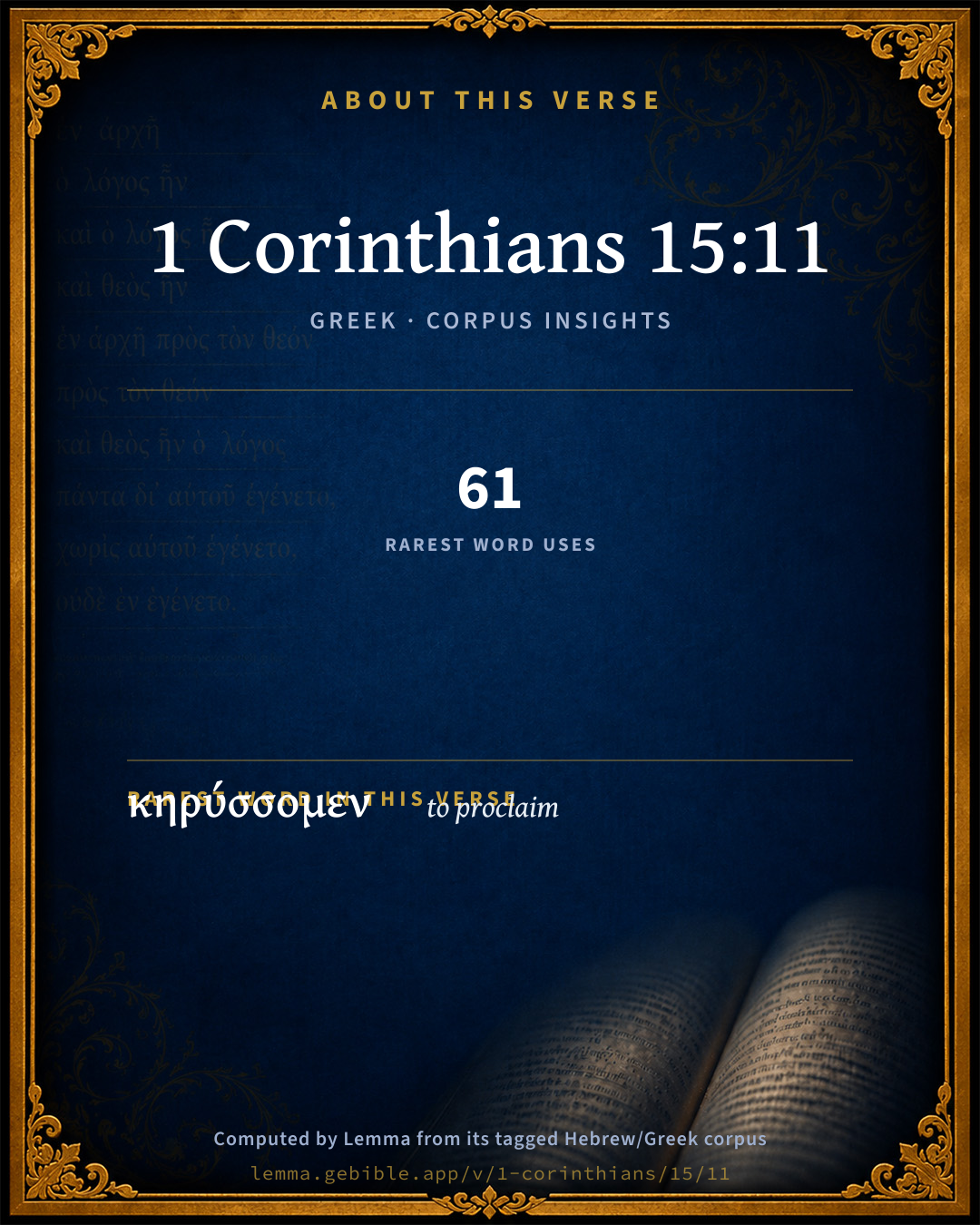
1 Corinthians 15:11

Greek (Tischendorf 8th ed.) 1 Corinthians 15:11 appears in the Greek New Testament. The text above is from the Tischendorf 8th edition. Each word links to its Strong’s number and a concise gloss. Click any word for its full Thayer’s Greek Lexicon entry.
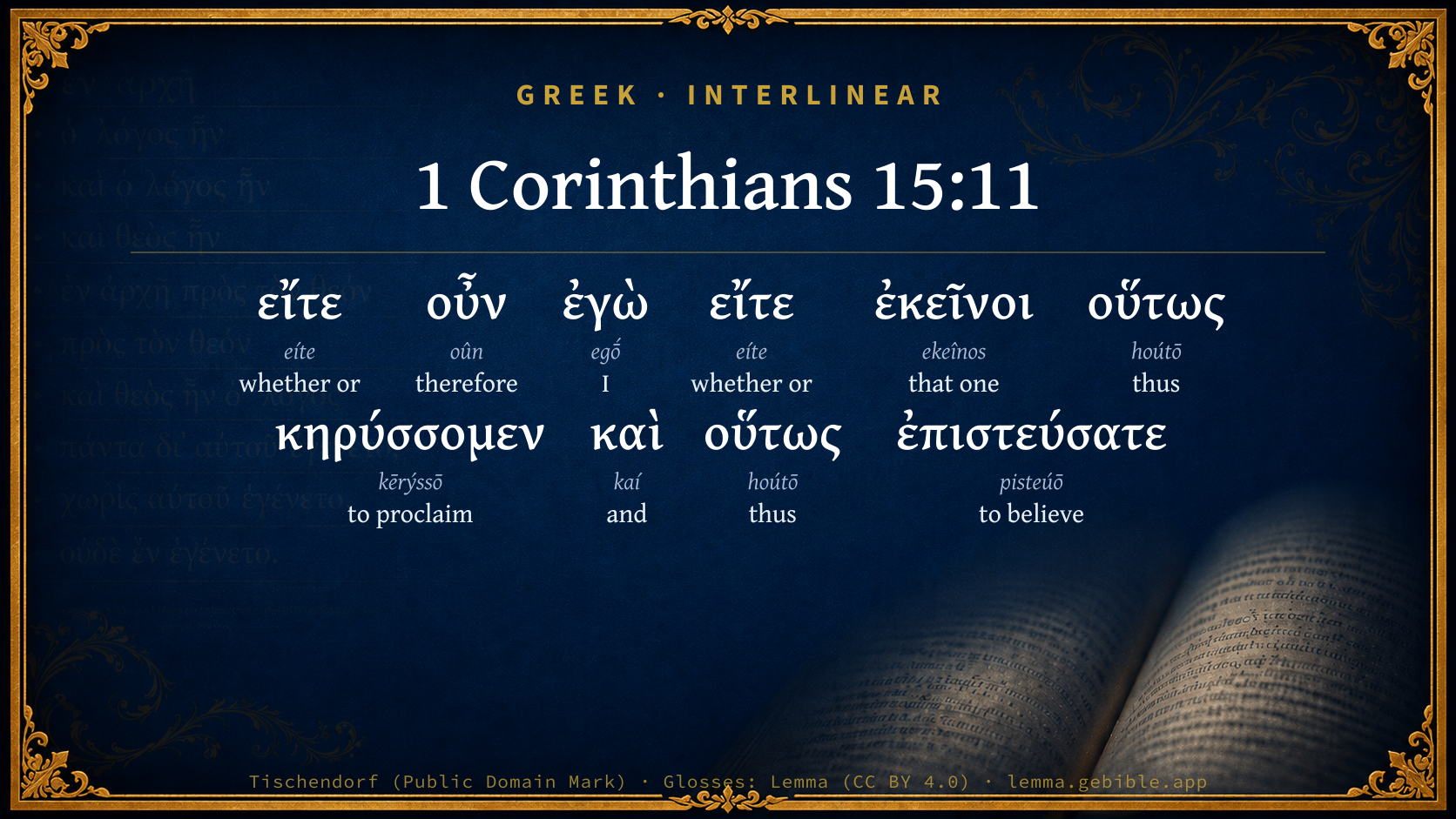
Download image
Cite this verse

1 Corinthians 15:11 (World English Bible). Public Domain. Lemma interlinear Bible study tool, https://lemma.gebible.app/v/1-corinthians/15/11.

Show BibTeX & RIS
BibTeX
RIS
English Translation
Whether then it is I or they, so we preach, and so you believed.
World English Bible · Public Domain
Download a study sheet

One document with this verse’s original text, its word-by-word gloss line, the meaning frame, cross-references with their text, attributed commentary, and full source and license credits — printable, and it pastes into notes with its structure intact.

This verse Autodidact and up

Study sheet (.html) Plain text (.txt)

A passage Seminary Student

Up to 50 verses in one chapter. A passage sheet keeps up to 6 commentary sources and 12 cross-references per verse, in the order this page ranks them, and says so on the sheet whenever that leaves anything out. Ask for a single verse and you get the Autodidact verse sheet above.

Everything on this page stays free to read, with no account — the sheet is a download of what is already on screen, not access to it.

Want to remove ads? Support Godless Engineer
Compare translations 3

The same verse in 3 English versions, stacked beneath the original-language interlinear above. Click any original word for its lexicon entry.

Each is an independent rendering of the whole verse — the interlinear is not word-aligned to these translations.

Highlighted words mark where these versions differ — a whole-verse word diff, not a word-by-word alignment.

  • World English Bible Public Domain
    Whether then it is I or they, so we preach, and so you believed.
  • King James Version Public Domain
    Therefore whether it were I or they, so we preach, and so ye believed.
  • unfoldingWord Literal Text CC BY-SA 4.0
    Therefore, whether I or they, in this way we preach, and in this way you believed.

unfoldingWord Literal Text — © unfoldingWord, licensed CC BY-SA 4.0. Word-aligned USFM3 via Door43 (git.door43.org/unfoldingWord/en_ult).

Versions to compare (up to 4)

3 of 4 selected

Show all 19 translations

Every available English version of this verse, each an independent rendering of the whole verse.

  • World English Bible Public Domain
    Whether then it is I or they, so we preach, and so you believed.
  • Berean Standard Bible Public Domain
    Whether, then, it was I or they, this is what we preach, and this is what you believed.
  • Majority Standard Bible Public Domain
    Whether, then, it was I or they, this is what we preach, and this is what you believed.
  • King James Version Public Domain
    Therefore whether it were I or they, so we preach, and so ye believed.
  • American Standard Version (1901) Public Domain
    Whether then `it be' I or they, so we preach, and so ye believed.
  • Revised Version (1885) Public Domain
    Whether then it be I or they, so we preach, and so ye believed.
  • Geneva Bible (1599) Public Domain
    Wherefore, whether it were I, or they, so we preach, and so haue ye beleeued.
  • Douay-Rheims (1899) Public Domain
    For whether I, or they, so we preach, and so you have believed.
  • Young's Literal Translation Public Domain
    whether, then, I or they, so we preach, and so ye did believe.
  • Literal Standard Version CC BY-SA 4.0
    whether, then, I or they, so we preach, and so you believed.
  • Unlocked Literal Bible CC BY-SA 4.0
    Therefore whether it is I or they, so we preach and so you believed.
  • unfoldingWord Literal Text CC BY-SA 4.0
    Therefore, whether I or they, in this way we preach, and in this way you believed.
  • Darby Bible Public Domain
    Whether, therefore, I or they, thus we preach, and thus ye have believed.
  • World Messianic Bible Public Domain
    Whether then it is I or they, so we proclaim, and so you believed.
  • Webster's Bible Public Domain
    Therefore whether it was I or they, so we preach, and so ye believed.
  • Free Bible Version CC BY-SA 4.0
    So whether it's I or they, this is the message we shared with you that brought you to trust in God.
  • Bible in Basic English Public Domain
    If then it is I who am the preacher, or they, this is our word, and to this you have given your faith.
  • Text-Critical English NT CC BY 4.0
    Whether then it was I or they, this is what we preach, and this is what you have come to believe.
  • Tyndale New Testament (1534) Public Domain
    Whether it were I or they so we preache and so have ye beleved.

Literal Standard Version (2020), Covenant Press — licensed CC BY-SA 4.0. Text via the HelloAO Bible API (eBible.org). Unlocked Literal Bible (unfoldingWord) — licensed CC BY-SA 4.0. Text via the HelloAO Bible API (eBible.org). unfoldingWord Literal Text — © unfoldingWord, licensed CC BY-SA 4.0. Word-aligned USFM3 via Door43 (git.door43.org/unfoldingWord/en_ult). Free Bible Version, Dr. Jonathan Gallagher — licensed CC BY-SA 4.0. Text via the HelloAO Bible API (eBible.org).

Word by word

More ways to search: Search by grammar → Find every occurrence → Compare this word →

Practice this passage: Drill this verse → Learn its vocabulary →

κηρύσσομεν
kērýssō
G2784
“to proclaim”
Verb, Present, Active, Indicative, 1st person, Plural
Part of Speech
Verb
Tense
Present
Voice
Active
Mood
Indicative
Person
1st person
Number
Plural
Full Thayer's Definition

Origin: of uncertain affinity

TDNT: 14:37,4

1. to be a herald, to officiate as a herald a. to proclaim after the manner of a herald b. always with the suggestion of formality, gravity and an authority which must be listened to and obeyed 2. to publish, proclaim openly: something which has been done 3. used of the public proclamation of the gospel and matters pertaining to it, made by John the Baptist, by Jesus, by the apostles and other Christian teachers
  1. εἴτε eíte G1535 “whether or” Conjunction
  2. οὖν oûn G3767 “therefore” Conjunction
  3. ἐγὼ egṓ G1473 “I” Personal pronoun, 1st person, Nominative, Singular
  4. εἴτε eíte G1535 “whether or” Conjunction
  5. ἐκεῖνοι ekeînos G1565 “that one” Demonstrative pronoun, Nominative, Plural, Masculine
  6. οὕτως hoútō G3779 “thus” Adverb
  7. καὶ kaí G2532 “and” Conjunction
  8. οὕτως hoútō G3779 “thus” Adverb
  9. ἐπιστεύσατε pisteúō G4100 “to believe” Verb, Aorist, Active, Indicative, 2nd person, Plural

About this verse

These counts appear in no published source. They are computed here, from the morphology-tagged text and Lemma’s own curated glosses. What Lemma adds →

10
words
8
distinct lemmas
Pauline Epistles
section

Repetition

Words recur within this verse:

  • εἴτε whether or G1535 ×2
  • οὕτως thus G3779 ×2

Cross-references

2

Topical passages linked to 1 Corinthians 15:11 in the Treasury of Scripture Knowledge — connected by theme and wording, ordered by reader-vote popularity; previews shown in the World English Bible.

  • 1 Corinthians 2:2 For I determined not to know anything among you, except Jesus Christ, and him crucified.
  • 1 Corinthians 15:3–4 For I delivered to you first of all that which I also received: that Christ died for our sins according to the Scriptures,

Cross-references courtesy of OpenBible.info (CC BY 4.0).

Commentary

Notes on 1 Corinthians 15:11 from classic Christian and Jewish commentators (each source and its license shown beneath its notes). The classic Christian expositions comment on the surrounding passage and are grouped to its opening verse, so a note may address several verses; the Jewish commentaries on the Tanakh (Rashi and others) are per-verse, so they appear only where the commentator wrote on this verse.

Lemma curates 59 commentaries, every one of them public domain or Creative Commons licensed, each selected and text-cleaned for this edition rather than reprinted as found. About our sources →

The Biblical Illustrator

Joseph S. Exell

1Co_15:11

Therefore whether it were I or they, so we preach, and so ye believed.

The truly important in preaching.

1. Not the preacher, but the truth preached.

2. Not the hearing, but the belief of the truth. (J. Lyth, D.D.)

An example of a faithful ministry and the conduct of a faithful people

I. A faithful ministry.

1. The gospel preached. Not scientific or philosophical discussions occupied St. Pauls ministry or that of his fellow apostles, but he proclaimed--

(1) Christs atoning death.

(2) Christs certified resurrection. These must be ever the themes of a true minister.

2. The character possessed.

(1) Humility breathes through the words, I am not worthy to be called an apostle. What true minister of God feels his worthiness to handle those sacred truths?

(2) Dependence on Divine grace. By the grace of God I am what I am, etc.

3. The work accomplished. I laboured more abundantly than they all. Follow the zealous work of St. Paul from Damascus to Rome. Labour for God must be earnest and abundant.

II. A faithful people. So ye believed. The death and resurrection of Christ preached in the spirit of humility, and the co-operation of the grace of God, the grace of God with me, should ever produce this result--faith. (Clerical World.)

The Biblical Illustrator, edited by Joseph S. Exell (c. 1880s–1900s) — public domain. Text from a community e-Sword module.

MacLaren's Expositions of Holy Scripture

Alexander MacLaren

1 Corinthians

THE UNITY OF APOSTOLIC TEACHING

1Co 15:11.

Party spirit and faction were the curses of Greek civic life, and they had crept into at least one of the Greek churches-that in the luxurious and powerful city of Corinth. We know that there was a very considerable body of antagonists to Paul, who ranked themselves under the banner of Apollos or of Cephas i.e. Peter. Therefore, Paul, keenly conscious that he was speaking to some unfriendly critics, hastens in the context to remove the possible objection which might be made, that the Gospel which he preached was peculiar to himself, and proceeds to assert that the whole substance of what he had to say to men, was held with unbroken unanimity by the other apostles. ‘They’ means all of them; and ‘so’ means the summary of the Gospel teaching in the preceding verses.

Now, Paul would not have ventured to make that assertion, in the face of men whom he knew to be eager to pick holes in anything that he said, unless he had been perfectly sure of his ground. There were broad differences between him and the others. But their partisans might squabble, as is often the case, and the men, whose partisans they were, be unanimous. There were differences of individual character, of temper, and of views about certain points of Christian truth. But there was an unbroken front of unanimity in regard to all that lies within the compass of that little word which covers so much ground-’So we preach.’

Now, I wish to turn to that outstanding fact-which does not always attract the attention which it deserves-of the absolute identity of the message which all the apostles and primitive teachers delivered, and to seek to enforce some of the considerations and lessons which seem to me naturally to flow from it.

I. First, then, I ask you to think of the fact itself-the unbroken unanimity of the whole body of Apostolic teachers.

As I have said, there were wide differences of characteristics between them, but there was a broad tract of teaching wherein they all agreed. Let me briefly gather up the points of unanimity, the contents of the one Gospel, which every man of them felt was his message to the world. I may take it all from the two clauses in the preceding context, ‘how that Christ died for our sins according to the Scriptures, and that He was buried, and that He rose again the third day according to the Scriptures.’ These are the things about which, as Paul declares, there was not the whisper of a dissentient voice. There is the vital centre which he declares every Christian teacher grasped as being the essential of his message, and in various tones and manners, but in substantial identity of content, declared to the world.

Now, what lies in it? The Person spoken of-the Christ, and all that that word involves of reference to the ancient and incomplete Revelation in the past, its shadows and types, its prophecies and ceremonies, its priesthood and its sacrifices; with all that it involves of reference to the ancient hopes on which a thousand generations had lived, and which either are baseless delusions, or are realised in Jesus-the Person whom all the Apostles proclaimed was One anointed from God as Prophet, Priest, and King; who had come into the world to fulfil all that the ancient system had shadowed by sacrifice, temple, and priest, and was the Monarch of Israel and of the world.

And not only were they absolutely unanimous in regard to the Person, but they were unbrokenly consentient in regard to the facts of His life, His death, and His Resurrection. But the proclamation of the external fact is no gospel. You must add the clause ‘for our sins,’ and then the record, which is a mere piece of history, with no more good news in it than the record of the death of any other martyr, hero, or saint, starts into being truly the good news for the world. The least part of a historical fact is the fact; the greatest part of it is the explanation of the fact, and the setting it in its place in regard to other facts, the exhibition of the principles which it expresses, and of the conclusions to which it leads. So the bare historical declaration of a death and a resurrection is transmuted into a gospel, by that which is the most important part of the Gospel, the explanation of the meaning of the fact-’He died for our sins.’

If redemption from sin through the death of a Person is the fundamental conception of the Gospel for the world, then it is clear that, for such a purpose, a divine nature in the Person is wanted. Your notion of what Christ came to do will determine your notion of who He is. If you only recognise that His work is to teach, or to show in exercise a fair human character, then you may rest content with the lower notion of His nature which sees in Him but the foremost of the sons of men. But if we grasp ‘died for our sins,’ then for such a task the incarnation of the Eternal Son of God is the absolute pre-requisite.

Still further, our text brings out the contents of this gospel as being the declaration of the Resurrection. On that I need not here and now dwell at any length. But these are the points, the Person, the two facts, death and resurrection, and the great meaning of the death-viz. the expiation for the world’s sins: these are the things on which the whole of the primitive teachers of the Apostolic Church had one voice and one message.

Now, I do not suppose that I need spend any time in showing to you how the extant records bear out, absolutely, this contention of the Apostle’s. I need only remind you how the opposition that was waged against him-and it was a very vigorous and a very bitter opposition-from a section of the Church, had no bearing at all upon the question of what he taught, but only upon the question of to whom it was to be taught. The only objection that the so-called Judaising party in the early Church had against Paul and his preaching, was not the Gospel that he declared, but his assertion that the Gentile nations might enter into the Church through faith in Jesus Christ, without passing through the gate of circumcision. Depend upon it, if there had been any, even the most microscopic, divergence on his part from the general, broad stream of Christian teaching, the sleepless, keen-eyed, unscrupulous enemies that dogged him all his days would have pounced upon it eagerly, and would never have ceased talking about it. But not one of them ever said a word of the sort, but allowed his teaching to pass, because it was the teaching of every one of the apostles.

If I had time, or if it were necessary, it would be easy to point you to the records that we have left of the Apostolic teaching, in order to confirm this unbroken unanimity. I do not need to spend time on that. Proof-texts are not worth so much as the fact that these doctrines are interwoven into the whole structure of the New Testament as a whole-just as they are into Paul’s letters. But I may gather one or two sayings, in which the substance of each writer’s teaching has been concentrated by himself. For instance, Peter speaks about being ‘redeemed by the precious blood of Christ as of a Lamb without blemish and without spot,’ and declares that ‘He Himself bare our sins in His own body on the tree.’ John comes in with his doxology: ‘Unto Him that loved us, and loosed us from our sins in His own blood’; and it is his pen that records how in the heavens there echoed ‘glory and honour and thanks and blessing, for ever and ever, to the Lamb that was slain, and has redeemed us unto God by His blood.’ The writer of the Epistle to the Hebrews, steeped as he is in ceremonial and sacrificial ideas, and having for his one purpose to work out the thought that Jesus Christ is all that the ancient ritual, sacerdotal and sacrificial system shadows and foretells, sums up his teaching in the statement that Christ having come, a high priest of good things to come, ‘through His own blood, entered in, once for all, into the holy place, having obtained eternal redemption for us.’

There were limits to the unanimity, as I have already said. Paul and Peter had a great quarrel about circumcision and related subjects. The Apostolic writings are wondrously diverse from one another. Peter is far less constructive and profound than Paul. Paul and Peter are both untouched with the mystic wisdom of the Apostle John. But, in regard to the facts that I have signalised, the divinity, the person of Jesus Christ, His death and Resurrection, and the significance to be attached to that death, they are absolutely one. The instruments in the orchestra are various, the tender flute, the ringing trumpet, and many another, but the note they strike is the same. ‘Whether it were I or they, so we preach.’

II. Now, let me ask you to consider the only explanation of this unanimity.

Time was when the people, who did not believe in Christ’s divinity and sacrificial death, tortured themselves to try and make out meanings for these epistles, which should not include the obnoxious doctrines. That is nearly antiquated. I suppose that there is nobody now, or next to nobody, who does not admit that, right or wrong, Paul, Peter, John-all of them-teach these two things, that Christ is the Eternal Son of the Father, and that His death is the Sacrifice for the world’s sin. But they say that that is not the primitive, simple teaching of the Man of Nazareth; and that the unanimity is a unanimity of misapprehension of, and addition to, His words and to the drift of His teaching.

Now, just think what a huge-I was going to say-inconceivability that supposition is. For there is no point, say from the time at which the Apostle who wrote the words of my text, which was somewhere about the year 56 or 57 A.D.,-there is no point between that period, working backwards through the history of the Church to the Crucifixion, where you can insert such a tremendous revolution of teaching as this. There is no trace of such a change. Peter’s earliest speeches, as recorded in Acts, are in some important respects less developed doctrinally than are the epistles, but Christ’s Messiahship, death, and Resurrection, with which is connected the remission of sins, are as clearly and emphatically proclaimed as at any later time. So these points of the Apostolic testimony were preached from the first, and, if in preaching them, the witnesses perverted the simple teaching of the Carpenter of Nazareth, and ascribed to Him a character which He had not claimed, and to His death a power of which He had not dreamed, they did so at the very time when the impressions of His personality and teaching were most recent and strong. It seems to me, apart altogether from other considerations, that such a right-about-face movement on the part of the early teachers of Christianity, is an absolute impossibility, regard being had to the facts of the case, even if you make much allowance for possible errors in the record.

But I would make another remark. If misapprehension came in, if these men, in their unanimous declaration of Christ’s death as the Sacrifice for sin, were not fairly representing the conclusions inevitable from the facts of Christ’s life and death, and from His own words, is it not an odd thing that the same misapprehension affected them all? When people misconceive a teacher’s doctrine, they generally differ in the nature of their misconceptions, and split into sections and parties. But here you have to account for the fact that every man of them, with all their diversity of idiosyncrasy and character, tumbled into the same pit of error, and that there was not one of them left sane enough to protest. Does that seem to be a likely thing?

And what about the worth of the teacher’s teaching, that did not guard its receivers from such absolute misapprehension as that? If the whole Church unanimously mistook everything that Jesus Christ had said to them, and unwarrantably made out of Him what they did, on this hypothesis, I do not think that there is much left to honour or admire in a teacher, whose teaching was so ambiguous, as that it led all that received it into such an error as that into which, by the supposition, they fell.

No, brethren; they were one, because their Gospel was the only possible statement of the principles that underlay, and the conclusions that flowed from, the plain facts of the life and the teaching of Jesus Christ. I am not going to spend time in quoting His own words. I can only refer to one or two of them very succinctly. ‘Destroy this Temple, and in three days I will raise it up.’ ‘As Moses lifted up the serpent in the wilderness, even so must the Son of Man be lifted up.’ ‘My flesh is the bread which I will give for the life of the world.’ ‘The Son of Man came not to be ministered unto, but to minister, and to give His life a ransom for many.’ ‘This is My body broken for you; take, eat, in remembrance of Me.’ ‘This is My blood, shed for many for the remission of sins; this do ye, as often as ye drink it, in remembrance of Me.’ What possible explanation, doing justice to these words, is there, except ‘Jesus Christ died for our sins according to the Scriptures’ ? And how could men who had heard them with their own ears, and with their own eyes had seen Him risen from the dead and ascending into heaven, do otherwise than eagerly, enthusiastically, at the cost of all, and with unhesitating voice of unbroken unanimity, ‘so preach’ ?

I quite admit that in Christ’s teaching in the gospels you will not find the articulate drawing out into doctrinal statement of the principles that underlay, and the conclusions that flow from, the historical fact of Christ’s propitiatory death. I do not wonder at that, nor do I admit that it is any argument against the truth of the divine revelation which is made in these doctrinal statements, to allege that we find nothing corresponding to them in Jesus Christ’s own words. The silence is not as absolute as is alleged, as the quotations which I have made, and which might have been multiplied, do distinctly enough show. Even if it were more absolute than it is, the silence is by no means unintelligible. Christ had to offer the Sacrifice before the Sacrifice could be preached. He Himself warned His disciples against accepting His own words prior to the Cross, as the conclusive and ultimate revelation. ‘I have many things to say unto you, but you cannot carry them now.’ There was need that the Cross should be a fact before it was evolved into a doctrine. And so I venture to say that the unanimity of the preaching is only explicable on the ground of that preaching in both its parts-its assertion of Jesus’ Messiahship and of His propitiatory death-being the repetition on the housetop of the lessons which they had heard in the ear from Him.

III. Note, briefly, the lesson from this unanimity.

Let us distinctly apprehend where is the living heart of the Gospel-that it is the message of redemption by the incarnation and sacrifice of the Son of God. There follows from that incarnation and sacrifice all the great teaching about the work of the Divine Spirit in men, dwelling in them for evermore. But the beginning of all is, ‘Christ died for our sins according to the Scriptures.’ And, brethren, that message meets, as nothing else meets, the deepest needs of every human soul. It is able, as nothing else is able, to open out into a whole encyclopædia and universe of wisdom and truth and power. If we strike it out of our conception of Christianity, or if we obscure it as being the very palpitating centre of the whole, then feebleness will creep over the Christianity that is minus a Cross, or does not see in it the Sacrifice for the world’s sin. You may cast overboard the sails to lighten the ship. If you do, she lies a log on the waters. And if, for the sake of meeting new phases of thought, Christian churches tamper with this central truth, they have flung away their means of progress and of power.

Let me say again, and in a word only, that the considerations that I have been trying to submit to you in this sermon, show us the limits within which the modern cry of ‘Back to the Christ of the Gospels,’ is right, and where it may be wrong. I believe that in former days, and to some extent in the present day, we evangelical teachers have too much sometimes talked rather about the doctrines than about the Person who is the doctrines. And if the cry of ‘Back to the Christ’ means, ‘Do not talk so much about the Atonement and Propitiation; talk about the Christ who atones,’ then, with all my heart, I say, ‘Amen!’ But put the Person in the foreground, the living-loving, the dying-loving, the risen-loving Christ, put Him in the foreground. But if it is implied, as I am afraid it is often implied, that the Christ of the Gospels is one and the Christ of the epistles is another, and that to go back to the Christ of the gospels means to drop ‘died for our sins according to the Scriptures,’ and to retain only the non-miraculous, moral and religious teachings that are recorded in the three first gospels, then I say that it is fatal for the Church, and it is false to the facts, for the Christ of the epistles is the Christ of the gospels: the difference only being that in the one you have the facts, and in the other you have their meaning and their power.

So, lastly, let this text teach us what we ourselves have to do with this unanimous testimony. ‘So we preach, and so ye believed.’ Brother! Do you believe so? That is to say, is your conception of the Gospel the mighty redemptive agency which is wrought by the Incarnate Son of God, who was crucified for our offences, and rose that we might live, and is glorified that we, too, may share His glory? Is that your Gospel? But do not be content with an intellectual grasp of the thing. ‘So ye believed’ means a great deal more than ‘I believe that Christ died for our sins.’ It means ‘I believe in the Christ who did die for my sins.’ You must cast yourself as a sinful man on Him; and, so casting, you will find that it is no vain story which is commended to us by all these august voices from the past, but you will have in your own experience the verification of the fact that He died for our sins, in your own consciousness of sins forgiven, and new love bestowed; and so may turn round to Paul, the leader of the chorus, and to all the apostolic band, and say to them, ‘Now I believe, not because of thy saying, but because I have seen Him, and myself heard Him.’

Alexander MacLaren, Expositions of Holy Scripture (1904–1910) — public domain. Text from a community e-Sword module.

Tyndale Open Study Notes

Tyndale Open Resources

15:11 The important thing is the message, not the messengers (cp. 1:10-12).

Tyndale Open Study Notes — © Tyndale Open Resources, licensed CC BY-SA 4.0. Text via the HelloAO Bible API.

Bengel's Gnomon

Johann Albrecht Bengel

1Co 15:11. Κηρύσσομεν, we preach) all the apostles with one mouth.—ἐπιστεύσατε, ye believed) Faith once received lays the foundation for subsequent faith: and its first firmness not only obliges [binds] those wavering, but also often retains them.

Bengel's Gnomon of the New Testament — English translation (T&T Clark, Edinburgh, 1860) — public domain. Text from a community e-Sword module.

Meyer's Critical & Exegetical Commentary

Heinrich August Wilhelm Meyer

1Co_15:11. Οὖν] takes up again the thread of the discourse which had been interrupted by 1Co_15:9-10, as in 1Co_8:4, but yet with reference to 1Co_15:9 f.

ἐκεῖνοι] i.e. the rest of the apostles, 1Co_15:7-9 f.

οὕτω] so as was stated above, namely, that Christ is risen, 1Co_15:4 ff., and see 1Co_15:12.

καὶ οὕτως] and in this way, in consequence, namely, of this, that the resurrection of Jesus was proclaimed to you, ye have become believers (ἐπιστ. as in 1Co_15:2).

Observe, further, in εἴτε οὖν ἐγὼ, εἴτε ἐκεῖνοι, the apologetic glance of apostolic self-assertion, which he turns upon those who questioned his rank as an apostle.

Meyer — Critical and Exegetical Commentary on the New Testament — English translation by Peter Christie, edited by Frederick Crombie (T&T Clark, 1880) — public domain. Text from a community e-Sword module.

Expositor's Greek Testament

ed. W. Robertson Nicoll

1Co 15:11 breaks off the comparison between himself and the other App., into which Paul was being drawn, to sum up the statement of fact and evidence concerning Christ’s resurrection: “Whether then it were I (1Co 15:8 f.) or they (Kephas, the Twelve, the first disciples, James 5 ff.), so we proclaim (1Co 15:3 f.), and so you believed (1Co 15:2 )”. For εἴτε , εἴτε , giving alternatives indifferent from the point of view assumed, cf. 1Co 3:22 , 1Co 10:31 , etc. οὕτως is emphatic: in the essential matters of 1Co 15:1-4 and the crucial point of the resurrection of Jesus, there is not the least variation in the authoritative testimony; Peter, James, Paul Jerusalem, Antioch, Corinth are in perfect accord, preaching, believing, with one mind and one mouth, that the crucified Jesus rose from the dead. On κηρύσσω , see note to 1Co 1:23 . This closes the case on the ground of testimony.

The Expositor's Greek Testament, edited by W. Robertson Nicoll (1897–1910) — public domain. Text from a community e-Sword module.

Hodge's Commentary on Romans, Ephesians & First Corinthians

Charles Hodge

1Co_15:11

Therefore whether (it were) I or they, so we preach, and so ye believed.

This verse resumes the subject from which 1Co_15:9, 1Co_15:10 are a digression. Christ appeared to the apostles and to me; whether therefore I or they preached, we all proclaimed that fact, and ye all believed it. The resurrection of Christ was included in the preaching of all ministers, and in the faith of all Christians.

Charles Hodge — Commentary on Romans (1835), First Corinthians (1857), and Ephesians (1856) — public domain. Text from a community e-Sword module.

Jamieson, Fausset & Brown

Robert Jamieson, A. R. Fausset & David Brown

whether it were I or they--(the apostles) who "labored more abundantly" (Co1 15:10) in preaching, such was the substance of our preaching, namely, the truths stated in Co1 15:3-4.

Jamieson, Fausset & Brown — Commentary Critical and Explanatory on the Whole Bible (1871) — public domain (CC PDM 1.0). Text via the HelloAO Bible API.

Adam Clarke's Commentary

Verse 11. Whether it were I or they] All the apostles of Christ agree in the same doctrines; we all preach one and the same thing; and, as we preached, so ye believed; having received from us the true apostolical faith, that Jesus died for our sins, and rose again for our justification; and that his resurrection is the pledge and proof of ours. Whoever teaches contrary to this does not preach the true apostolic doctrine.

Paul was the last of the primitive apostles. The primitive apostles were those who had seen Christ, and got their call to the apostolate immediately from himself. There were many apostles after this time, but they were all secondary; they had a Divine call, but it was internal, and never accompanied by any vision or external demonstration of that Christ who had been manifested in the flesh.

Adam Clarke's Commentary on the Bible (1810–1826) — public domain. Text from a community e-Sword/MySword module.

Ellicott's Commentary for English Readers

(11) Therefore whether . . .—Better, Whether, therefore, it were I or they. Such (see 1Co_15:3-4) was and is our teaching, such was your belief. It matters not from whom it came, whether from the greatest or least of the Apostles, the gospel was preached, and was accepted by you. These words thus recall the reader from the strong personal feeling shown in the preceding verse to the main argument.

A Bible Commentary for English Readers, edited by Charles John Ellicott (1878–1897) — public domain. Text from a community e-Sword module.

The Cambridge Bible for Schools and Colleges

gen. ed. J. J. S. Perowne

11. Therefore whether it were I or they, so we preach, and so ye believed] The word preach (derived from the Latin praedicare, to proclaim) has now acquired the conventional sense of discoursing publicly about religion. The word used by St Paul refers to the work of a herald, the formal proclamation of matters of importance by one who was commissioned to make it. The substantial identity of the message, by whomsoever it was at first delivered, is a matter of fact, as the writings of the Apostles and Evangelists plainly shew. “By his earnestness in saying this, the Apostle testifies to the immense value and importance of historical Christianity.” Robertson.

The Cambridge Bible for Schools and Colleges (gen. ed. J. J. S. Perowne; Cambridge University Press, 1878–1918) — public domain. Text from a community e-Sword module.

John Gill's Exposition

Therefore whether it were I or they,.... By whom Christ was seen first or last, we were all eyewitnesses of him; or whether I am the least, and others the chief of the apostles; or whether I have laboured more abundantly than they all, this matters not:

so we preach; we agree in our ministry to preach Christ, and him only, and with one heart and mouth assert, that he died, was buried, and rose again the third day:

and so ye believed; these several truths relating to the death, burial, and resurrection of Christ. Thus the apostle, after he had made a digression upon his own character, as one of the witnesses of Christ's resurrection, returns to the subject he set out upon in the beginning of the chapter, in order to lead on to the doctrine of the resurrection of the dead, which he proves by the resurrection of Christ, in the following verses. One of Stephen's copies read, "so we believed"; and so the Ethiopic version seems to have read; see Co2 4:13.

John Gill's Exposition of the Whole Bible (1746–1763) — public domain (CC PDM 1.0). Text via the HelloAO Bible API.

Trapp's Complete Commentary

John Trapp

11 Therefore whether it were I or they, so we preach, and so ye believed.

Ver. 11. So we preach, and so ye believed] A happy compliance, when the hearers’ affections and endeavours do answer the affections and endeavours of the preacher, as here, and at Ephesus, Act 20:31-37; when people deliver themselves up to the form of doctrine, and are cast into the mould of the word, Rom 6:17.

John Trapp, A Commentary or Exposition upon All the Books of the Old and New Testament (1647–1656) — public domain. Text from a community e-Sword module.

Albert Barnes' Notes on the Bible

Therefore, whether it were I or they - I or the other apostles. It is comparatively immaterial by whom it was done. The establishment of the truth is the great matter; and the question by whom it is done is one of secondary importance.

So we preach - So we all preach. We all defend the same great doctrines; we all insist on the fact that the Lord Jesus died and rose; and this doctrine you all have believed. This doctrine is confirmed by all who preach; and this enters into the faith of all who believe. The design of Paul is to affirm that the doctrines which he here refers to were great, undeniable, and fundamental doctrines of Christianity; that they were proclaimed by “all” the ministers of the gospel, and believed by all Christians. They were, therefore, immensely important to all; and they must enter essentially into the hopes of all.

Albert Barnes' Notes on the Bible (1834–1885) — public domain. Text from a community e-Sword/MySword module.

Matthew Poole's English Annotations

Whether it were I or they; whether I or any other of the apostles preached amongst you.

So we preach, and so ye believed: this was one great point that we preached amongst you, that Christ was risen again from the dead. This we held forth to you as the object of your faith, this you received and closed with as the object of your faith; we did not only preach to you, that Christ died for our sins, but that he rose again for our justification. Neither was your faith objected only in Christ as one that was crucified and had died, but as one that was risen from the dead. Thus Peter preached, Act 2:31; 3:15; 4:10; 5:30; and Stephen, Act 7:56; and Peter, Act 10:40; and Paul, Act 13:37; 17:3,31; and so all the apostles.

Matthew Poole's English Annotations on the Holy Bible (1683–1685) — public domain. Text from a community e-Sword/MySword module.

Whedon's Commentary on the Bible

Daniel D. Whedon

11. Therefore—In view of this profession of faith.

Or they—The other apostles.

So we preach—Ours is a common and unanimous apostolic doctrine; including the resurrection of the dead. This is a very positive declaration of Paul that he and the other apostles preached one faith and dogma.

So ye believed—As I have preached, so have ye believed, the one common catholic apostolic faith. The concealed object of this covered approach is revealed in the next paragraph.

Daniel D. Whedon (gen. ed.), Commentary on the Old and New Testaments (1874–1909) — public domain. Text from a community e-Sword module.

The Pulpit Commentary

Whether it were I or they; namely, who preached this gospel to you. It is not his immediate object to maintain his independent apostolic claims, but only to appeal to the fact of the Resurrection which was preached by all the apostles alike. So. In accordance with the testimony just given (vers. 4-8). We preach. There are in the New Testament two words for "preaching." One is often rendered "prophesy," and refers to spiritual instruction and exhortation. The other, which is used here, is "we proclaim," or "herald" (kerusso), and refers to the statement of the facts of the gospel Christ crucified and risen (see the same argument. Rom_8:11) That there is no resurrection of the dead. These deniers of the resurrection are usually called "the Corinthian Sadducees." After the state of social and moral laxity of which we have been reading, we can scarcely be surprised at the existence of any disorder or anomaly in the Church of Corinth. Yet it comes with something of a shock on our paralyzed sense of astonishment to read that some of these Christians actually denied a resurrection! The fact at once proves two remarkable truths, namely,

(1) that the early Christian Church had none of the ideal purity of doctrine which is sometimes ecclesiastically attributed to it; and

(2) that there was in the bosom of that Church a wide and most forbearing tolerance. We have no data to enable us to determine what were the influences which led to the denial of the resurrection.

1. They can hardly have been Jewish. The mass of Jews at this time shared the views of the Pharisees, who strongly maintained the resurrection. (Act_23:6) If they were Jews at all, they could only have been Sadducees or Essenes. But

(1) the Sadducees were a small, wealthy, and mainly political sect, who had no religious influence, and can certainly have had no representatives at Corinth; and

(2) the Essenes, though they had considerable influence in Asia, do not seem to have established themselves in Greece, nor are we aware that they were hostile to the doctrine of the resurrection.

2. Probably, then, they were Gentiles. If so, they may have been

(1) either Epicureans, who disbelieved in a future life altogether; or

(2) Stoics, who held that the future life was only an impersonal absorption into the Divine. Both these schools of philosophers "jeered" at the very notion of a bodily resurrection. (Act_17:32) In 2Ti_2:18 we read of some, like Hymenaeus and Philetus, who erred, saying "that the resurrection was past already." These teachers were incipient Gnostics, who spiritualized the resurrection, or rather said that the term was only applicable to the rising from the death of sin to the life of righteousness. The Corinthian doubters seem from the arguments which St. Paul addresses to them, to have been rather troubled with material doubts which they may have inherited from their Gentile training.

The Pulpit Commentary (1880–1919), ed. H.D.M. Spence-Jones & Joseph S. Exell — public domain. Text from a community e-Sword module.

John Wesley's Explanatory Notes

Whether I or they, so we preach - All of us speak the same thing.

John Wesley, Explanatory Notes Upon the Whole Bible (1754–1765) — public domain. Text via the GEBible commentary corpus.

McGarvey & Pendleton's Commentaries

J. W. McGarvey

Whether then it be I or they, so we preach, and so ye believed . [Paul recognizes the tardiness of his belief on the Lord and the lateness of his vision of him as an evidence of his unworthiness. Though this personal allusion appears on its face to be a digression from his argument, it really lends great force to it. There could be no higher honor known to men than to be chosen as a witness of the resurrection of Christ. For this reason it might be thought that Paul was zealous in establishing the truth of the resurrection because of the honors which he enjoyed as a witness to that truth. But he reminds them that the circumstances under which he saw the Lord so emphasized his own unworthiness (he being then on his way to persecute the Christians at Damascus) that the memory of the event wakened in him a sense of humiliation rather than exaltation. In fact, he would be exalted rather than dishonored by their unbelief, for he could claim no reverence as a witness when his testimony necessarily involved a confession of his crimes. But having confessed his crime and consequent inferiority, and knowing that this admission would be most strictly construed by those who disparaged him and contended that he was not an apostle, he rehabilitates himself by showing that his own littleness had been made big by the abounding grace of God, so that he had labored more abundantly than any of the apostles. Moreover, those to whom Peter or Apollos were more acceptable, would gain nothing by their partiality and discrimination in respect to this matter, for all who had preached Christ to them had been a unit in proclaiming the resurrection. Christ had never been preached otherwise than as a risen one. Again, this preaching had resulted in their believing, which was the point he did not wish them to lose sight of. Having committed themselves to belief, they did wrong in thus becoming champions of unbelief; i. e., unbelief in the resurrection. It should be observed that in proving the resurrection Paul cites witnesses (1) who were living; (2) who were many of them commonly known by name; (3) who were too familiar with the form, face, voice, manner, life, etc., of Jesus to be deceived by a pretender, if any could have found motive for practicing such a deception. Having shown their folly in abandoning without evidence that which they had believed on competent testimony, the apostle turns to show the consequences of their act.]

J. W. McGarvey (with Philip Y. Pendleton), Commentaries on the New Testament (The Fourfold Gospel, 1914; Acts; and the epistles) — public domain. Text from a community e-Sword/MySword module.

The People's New Testament

B. W. Johnson

11. Whether it be I, or they. I and all the apostles preach the same gospel of a risen Lord and this you accepted when you believed. Their faith was built on the resurrection.

B. W. Johnson's The People's New Testament with Notes (1889–1891) — public domain. Electronic text from the Christian Classics Ethereal Library (CCEL) ThML edition.

Cambridge Greek Testament for Schools and Colleges

11. κηρύσσομεν. This word, which originally meant to proclaim publicly, as a herald, came to mean the delivery of any public discourse. Cf. κηρύσσειν ἐν ἐκκλησίαις καὶ ῥήτορας ἐκδιδάσκειν Lucian Deor. Dial. 24. See 1Co 9:27, note. The present denotes the fact that St Paul is still proclaiming this message. ‘By his earnestness in saving this, the Apostle testifies to the immense value and importance of historic Christianity.’ Robertson.

Cambridge Greek Testament for Schools and Colleges (Cambridge University Press, 1896; 21 vols, various authors incl. Carr, Maclear, Plummer, Farrar, Lumby, Moule, M. R. James, Simcox) — public domain. Text from a community e-Sword module.

Alford’s Greek Testament

Henry Alford

11.] He resumes the subject after the digression respecting himself:—it matters not whether it were I or they (the other Apostles)—such is the purport of our preaching—such was your belief:—οὕτως, after this manner, viz. that Christ died, was buried, and rose again, as vv. 3, 4.

Henry Alford, The Greek Testament (1849–1861) — public domain. Text from a community e-Sword module.

International Critical Commentary

11. εἴτε οὖν ἐγὼ εἴτε ἐκεῖνοι, οὕτως κ.τ.λ. ‘Whether then it were I or they (who laboured most abundantly after seeing the Risen Christ), so we continually preach (1:23), and so ye once for all believed,’ when ye accepted the preaching. He does not mean that they had ceased to believe, but that there was a definite time when they accepted this belief as the result of Apostolic preaching. The οὖν resumes the main argument (vv. 3-8) after the digression (vv. 9, 10), and οὕτως looks back to τίνι λόγῳ. Evans, somewhat hesitatingly, questions this, and prefers to render οὖν ‘however.’

Harnack points out that “legends concerning the appearances of the Risen Christ and the Ascension are difficult to explain, on the assumption that they arose before the destruction of Jerusalem” (The Acts of the Apostles, p. 291). It is quite clear from these verses that appearances of the Risen Christ were firmly believed in long before a.d. 70. Harnack himself places 1 Corinthians in a.d. 52 or 53. The inference is that the reports about the appearances were not “legends.”

There is nothing to show that St Paul meant this list of the appearances to be exhaustive, and that he mentions no others because he knew of no others. He omits five of the appearances which are mentioned in the Gospels: to the women, to Mary Magdalen, to the two on the way to Emmaus, to Thomas with the other Apostles on the second Lord’s Day, and to certain disciples at the Sea of Tiberias. He probably knew of some of these, if not of all. His reason for confining himself to those which he mentions can be easily conjectured. The witnesses whom he cites were persons well known to the Corinthians as leaders of the Church; Kephas, the Apostolic body, James, and himself; to which he adds a large company, some of whom could be easily found and questioned. The evidence would not have been strengthened by mentioning appearances to persons of whom the Corinthians had never heard. See F. H. Chase and A. J. Mason in Cambridge Theological Essays, pp. 396-401, 424-429; also J. O. F. Murray, pp. 329-332.

“It is curious that, in Paul’s time, it was the principle of the resurrection which was denied by the Corinthians to whom he is writing, while the actual fact of the resurrection of Jesus was admitted. Now, it is the principle which is admitted, while the actual resurrection of Jesus is denied.” But the life and teaching of St Paul, and the evolution and continued existence of the Christian Church cannot be explained, if the belief in the resurrection of Jesus Christ was based on hallucination. Can any Christian believe that Christianity is built upon this fundamental error?

“The reality of the resurrection is maintained, so long as the cause of the appearances of Jesus is attributed to Jesus, and not to the imaginations of the disciples. To the twentieth-century mind a spiritual manifestation seems open to less objection than the reanimation of the physical body which had been laid in the grave. We do not know, however, sufficient either of matter or spirit to justify any dogmatism either in the one direction or the other. The narratives will support either theory. The story of the empty tomb, however, certainly implies that the physical body of Jesus disappeared, though what finally became of it is not expressly explained. It must be admitted that the reanimation of the physical body of Jesus presents difficulties to the modern mind in the way of its final disposal which cannot lightly be ignored. The old conception of its literal ascension into heaven is in these days inconceivable. Our ignorance on this matter, however, ought not to invalidate the knowledge we undoubtedly possess of the empty tomb, nor ought we to allow the difficulty of accounting for the final disposal of the body to lead us to reject the plain story of its disappearance. Certainly, on the hypothesis of pure hallucinations, the speedy cessation of the appearances is a difficulty more easily ignored than explained” (The Fifth Gospel, pp. 169, 191-194).

15:12-34. If Christ is Risen, the Dead in Christ Will Rise

Here again we have three subdivisions: (a) The Consequences of denying the Doctrine of the Resurrection, 12-19; (b) The Consequences of accepting the Resurrection of Christ 20-28; (c) Arguments from Experience, 29-34.

How is it that, in the face of this Apostolic proclamation, some people go about and declare that a resurrection of dead people is impossible; thus making Apostolic preaching to be a lie, and your faith to be a delusion, and the condition of dead Christians to be quite hopeless, and the condition of living Christians to be pitiable in the extreme?

But they are quite wrong; for Christ has risen, and therefore resurrection is for us certain. For in this matter Christ is the first sheaf of a vast harvest; and when He has conquered all that opposes Him, including death itself, then, as the Son of God, He will yield up everything to His Father, and God will be supreme.

Baptism for the sake of the dead would lose all its meaning, and Christian self-sacrifice would lose most of its inspiration and comfort, if there were no resurrection and no future life.

12 Now, if Apostles are continually proclaiming Christ as having been raised from the dead, how is it that some are declaring among you that there is no such thing as a resurrection of dead people? 13 If there is no such thing, then Christ Himself cannot have been raised. 14 And if Christ has not been raised, then our proclamation of the Gospel is empty verbiage, and your faith in it is empty credulity. 15 And, what is more, we are found guilty of misrepresenting God, because we have represented Him as having raised the Christ, whereas He did nothing of the kind, if as a matter of fact dead people are never raised. 16 For it is quite clear that, if dead people are never raised, Christ Himself has not been raised. 17 And in that case your faith is futile; you are still living in your sins. 18 Yes, and it follows that all those who went to their rest trusting in Christ, forthwith perished utterly and are now lost to Christ! 19 If our case is no better than this, that just in the present life we have had hope in Christ, there are no human beings more truly to be pitied than we are.

20 But this dismal doctrine is not true. Christ has been raised from the dead; and He is no solitary exception, but the first and foremost example of many that are to be awakened. 21 For since it is through a man that we have death, it is through a Man also that we have resurrection from the dead. 22 For as in virtue of our union with Adam we all die, so also in virtue of our union with Christ we shall all be made alive. 23 But each in his proper order; Christ the first sheaf; afterwards Christ’s own harvest in the Day of His Coming. 24 After that will come the End, when He is to give up His Kingship into the hands of His God and Father; and that will be when He has brought to nought all other rule and all other authority and power. 25 For He must retain His Kingship until God has put all His enemies under His feet. 26 The last foe to be brought to nought is death. 27 For God has put all things, death included, in subjection under Christ’s feet. (Now, when it is said that all things have been put in subjection to Christ, it is obvious that God, who put them thus in subjection, is not included.) 28 But when every power has been made subject to the Son, then, but not till then, even the Son Himself will become subject to the Father who put all things under Him, in order that God may be everything in every creature, and the Divine immanence be perfect and complete.

29 Otherwise, what will be the position of those who from time to time are being baptized out of consideration for the dead? If dead men never rise at all, why in the world are people baptized out of consideration for them? 30 And why do so many of us stand in peril every hour? 31 I protest to you, my Brothers, as surely as I glory over you—and you know that I do that in Christ Jesus our Lord, there is not a day that I do not stand face to face with death. 32 If, looking at it from a purely human point of view, I was near being torn in pieces at Ephesus, what did I gain by it? If dead men do not rise, the human point of view gives as a practical inference, ‘Let us eat and drink, for to-morrow we die.’ 33 Do not make the serious mistake of supposing that there is no risk in being friendly to these views and to those who advocate them. ‘Fair characters are marred by foul companionships.’ 34 You must rouse yourselves from this paralysing delusion in a right spirit, and cease to persist in culpable error. You pride yourselves upon your religious enlightenment: crass ignorance as to the very meaning of God is what some of you have. It is to make you ashamed of yourselves that I speak like this.

International Critical Commentary — older volumes (1896–1929), various authors — public domain. Text from a community e-Sword module.

Vincent's Word Studies in the New Testament

Marvin R. Vincent

Ye believed [επιστευσατε] . When the Gospel was first preached : with a suggestion of a subsequent wavering from the faith.

Marvin R. Vincent, Word Studies in the New Testament (1887–1900) — public domain. Text from a community e-Sword/MySword module.

Godet's Commentaries

Frédéric Louis Godet

Vv. 11. “Therefore whether I, or they, so we preach, and so ye believed.”

The οὕτω, so, expressly goes back on the τίνι λόγῳ, in what sense, of 1Co 15:2. The present κηρύσσομεν, we preach, denotes a constant fact; the aorist ἐπιστεύσατε, ye believed, a past fact done once for all, but without the idea of a spiritual decline, which Chrysostom found in this past. This declaration proves that it was matter of notoriety in the Church that the gospel of Peter and of the Twelve rested on the same foundation as that of Paul, on the facts of Christ’s death and resurrection regarded as having effected the salvation of the sinful world (for our sins, 1Co 15:3; and that according to the Scriptures, 1Co 15:3-4). The historical conception of primitive Christianity presented by Baur is incompatible with the fact attested by Paul.

This verse, while summing up the foregoing passage, forms the transition to the following section.

Frédéric Louis Godet — Commentaries on Luke, John, Romans, and 1 Corinthians — English translation (T&T Clark, Edinburgh, 1870s–1890s) — public domain. Text from a community e-Sword module.

Lesson kit

Teaching starters — assembled from the data on this page, not authored interpretation. Every prompt links to the verse data it draws on. Edit before teaching.

1 Corinthians, in the Pauline Epistles, opens this verse with 10 words (8 distinct Greek lemmas). Its most distinctive word is kērýssō (“to proclaim”). A historical commentator’s framing appears above. Read the whole chapter for the surrounding context.

Discussion questions

  1. The word kērýssō carries the sense “to proclaim.” How does it shape the verse?
  2. How does 1 Corinthians 2:2, which shares this passage’s theme, read alongside this verse?
  3. What does the repetition of “whether or” (2× in this one verse) do in this verse?
  4. These translations render this verse differently; the difference is in the English rendering, not the original. What questions does that raise?
  5. Compare how The Biblical Illustrator and MacLaren's Expositions of Holy Scripture read this verse. Where do they agree or differ?

Things to notice

  • These translations choose different wording for 3 words in this verse.
  • “whether or” occurs 2× in this single verse.
  • 8 distinct Greek lemmas span 10 words in this verse.

Reading settings

Reading text

Shown beneath each verse's original-language words.

Old Testament
Old Testament edition

Read the OT as the Masoretic Hebrew (MT) or the Greek Septuagint (LXX).

English shown for the Greek Septuagint (in the Hebrew ↔ Greek comparison).

Comparing translations? Open the Compare panel on any verse page to stack up to four side by side.