
Genesis 21:31

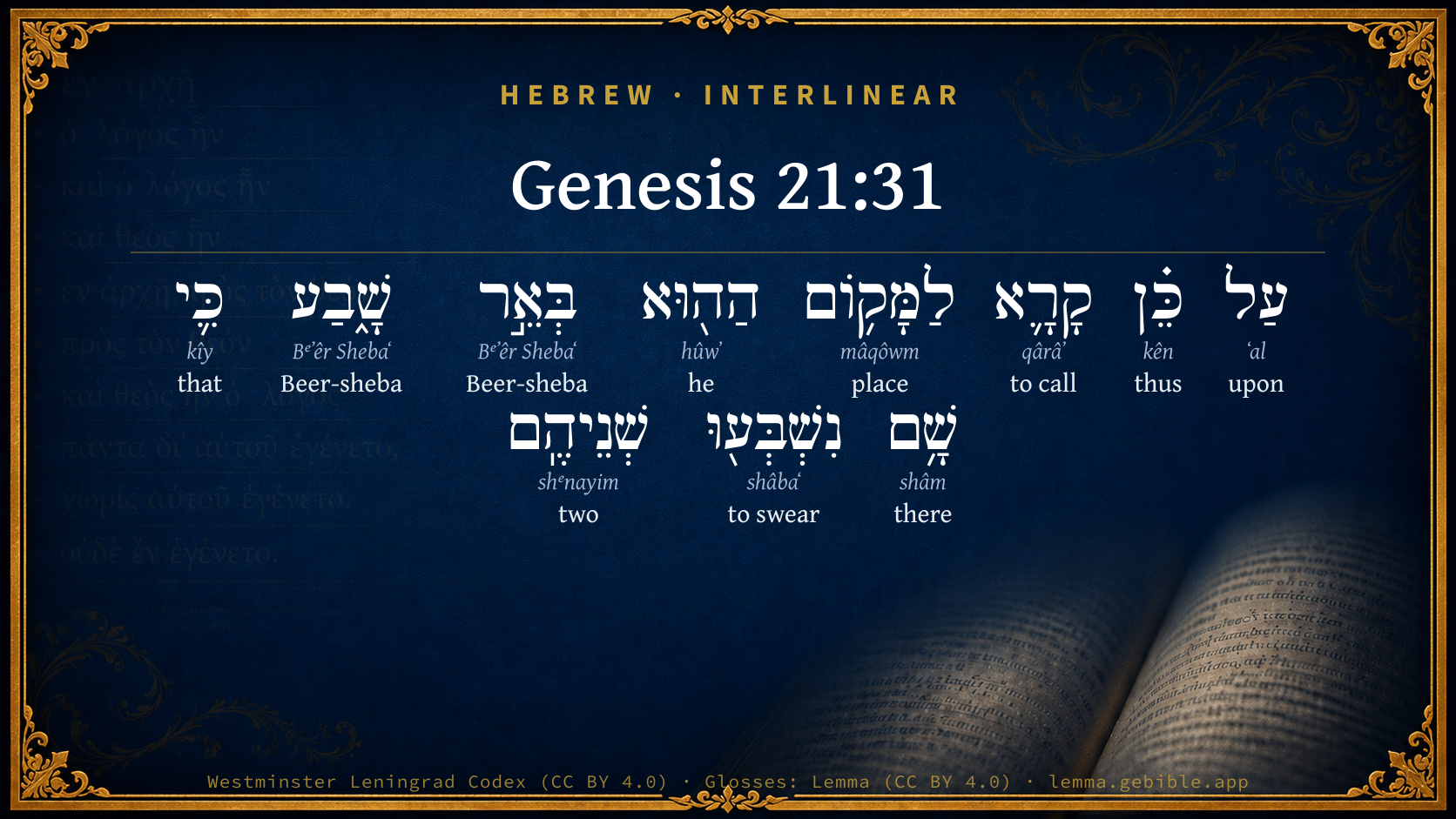
Hebrew (Westminster Leningrad Codex) Genesis 21:31 appears in the Hebrew Old Testament. The text above is from the Westminster Leningrad Codex. Each word links to its Strong’s number, a concise gloss, and parsing drawn from the Open Scriptures Hebrew Bible morphology. Click any word for its full Brown-Driver-Briggs (BDB) entry.
Download image
Cite this verse

Genesis 21:31 (World English Bible). Public Domain. Lemma interlinear Bible study tool, https://lemma.gebible.app/v/genesis/21/31.

Show BibTeX & RIS
BibTeX
RIS
English Translation
Therefore he called that place Beersheba, because they both swore there.
World English Bible · Public Domain
Download a study sheet

One document with this verse’s original text, its word-by-word gloss line, the meaning frame, cross-references with their text, attributed commentary, and full source and license credits — printable, and it pastes into notes with its structure intact.

This verse Autodidact and up

Study sheet (.html) Plain text (.txt)

A passage Seminary Student

Up to 50 verses in one chapter. A passage sheet keeps up to 6 commentary sources and 12 cross-references per verse, in the order this page ranks them, and says so on the sheet whenever that leaves anything out. Ask for a single verse and you get the Autodidact verse sheet above.

Everything on this page stays free to read, with no account — the sheet is a download of what is already on screen, not access to it.

Want to remove ads? Support Godless Engineer
Compare translations 3

The same verse in 3 English versions, stacked beneath the original-language interlinear above. Click any original word for its lexicon entry.

Each is an independent rendering of the whole verse — the interlinear is not word-aligned to these translations.

Highlighted words mark where these versions differ — a whole-verse word diff, not a word-by-word alignment.

  • World English Bible Public Domain
    Therefore he called that place Beersheba, because they both swore there.
  • King James Version Public Domain
    Wherefore he called that place Beersheba; because there they sware both of them.
  • unfoldingWord Literal Text CC BY-SA 4.0
    For that he called that place Beersheba, because there the two of them swore an oath.

unfoldingWord Literal Text — © unfoldingWord, licensed CC BY-SA 4.0. Word-aligned USFM3 via Door43 (git.door43.org/unfoldingWord/en_ult).

Versions to compare (up to 4)

3 of 4 selected

Show all 18 translations

Every available English version of this verse, each an independent rendering of the whole verse.

  • World English Bible Public Domain
    Therefore he called that place Beersheba, because they both swore there.
  • Berean Standard Bible Public Domain
    So that place was called Beersheba, because it was there that the two of them swore an oath.
  • Majority Standard Bible Public Domain
    So that place was called Beersheba, because it was there that the two of them swore an oath.
  • King James Version Public Domain
    Wherefore he called that place Beersheba; because there they sware both of them.
  • American Standard Version (1901) Public Domain
    Wherefore he called that place Beer-sheba. Because there they sware both of them.
  • Revised Version (1885) Public Domain
    Wherefore he called that place Beer-sheba; because there they sware both of them.
  • Geneva Bible (1599) Public Domain
    Wherefore the place is called Beer-sheba, because there they both sware.
  • Douay-Rheims (1899) Public Domain
    Therefore that place was called Bersabee: because both of them did swear.
  • Young's Literal Translation Public Domain
    therefore hath he called that place `Beer-Sheba,' for there have both of them sworn.
  • Literal Standard Version CC BY-SA 4.0
    therefore he has called that place “Beer-Sheba,” for both of them have sworn there.
  • Unlocked Literal Bible CC BY-SA 4.0
    So he called that place Beersheba, because there they both swore an oath.
  • unfoldingWord Literal Text CC BY-SA 4.0
    For that he called that place Beersheba, because there the two of them swore an oath.
  • Darby Bible Public Domain
    Therefore he called that place Beer-sheba, because there they had sworn, both of them.
  • World Messianic Bible Public Domain
    Therefore he called that place Beersheba, because they both swore an oath there.
  • Webster's Bible Public Domain
    Wherefore he called that place Beer-sheba: because there they swore both of them.
  • Free Bible Version CC BY-SA 4.0
    That's why he called the place Beersheba, because the two of them swore an oath to each other.
  • Bible in Basic English Public Domain
    So he gave that place the name Beer-sheba, because there the two of them had given their oaths.
  • JPS Tanakh (1917) Public Domain
    Wherefore that place was called Beer-sheba; because there they swore both of them.

Literal Standard Version (2020), Covenant Press — licensed CC BY-SA 4.0. Text via the HelloAO Bible API (eBible.org). Unlocked Literal Bible (unfoldingWord) — licensed CC BY-SA 4.0. Text via the HelloAO Bible API (eBible.org). unfoldingWord Literal Text — © unfoldingWord, licensed CC BY-SA 4.0. Word-aligned USFM3 via Door43 (git.door43.org/unfoldingWord/en_ult). Free Bible Version, Dr. Jonathan Gallagher — licensed CC BY-SA 4.0. Text via the HelloAO Bible API (eBible.org).

Word by word

More ways to search: Search by grammar → Find every occurrence → Compare this word →

Practice this passage: Drill this verse → Learn its vocabulary →

About this verse

These counts appear in no published source. They are computed here, from the morphology-tagged text and Lemma’s own curated glosses. What Lemma adds →

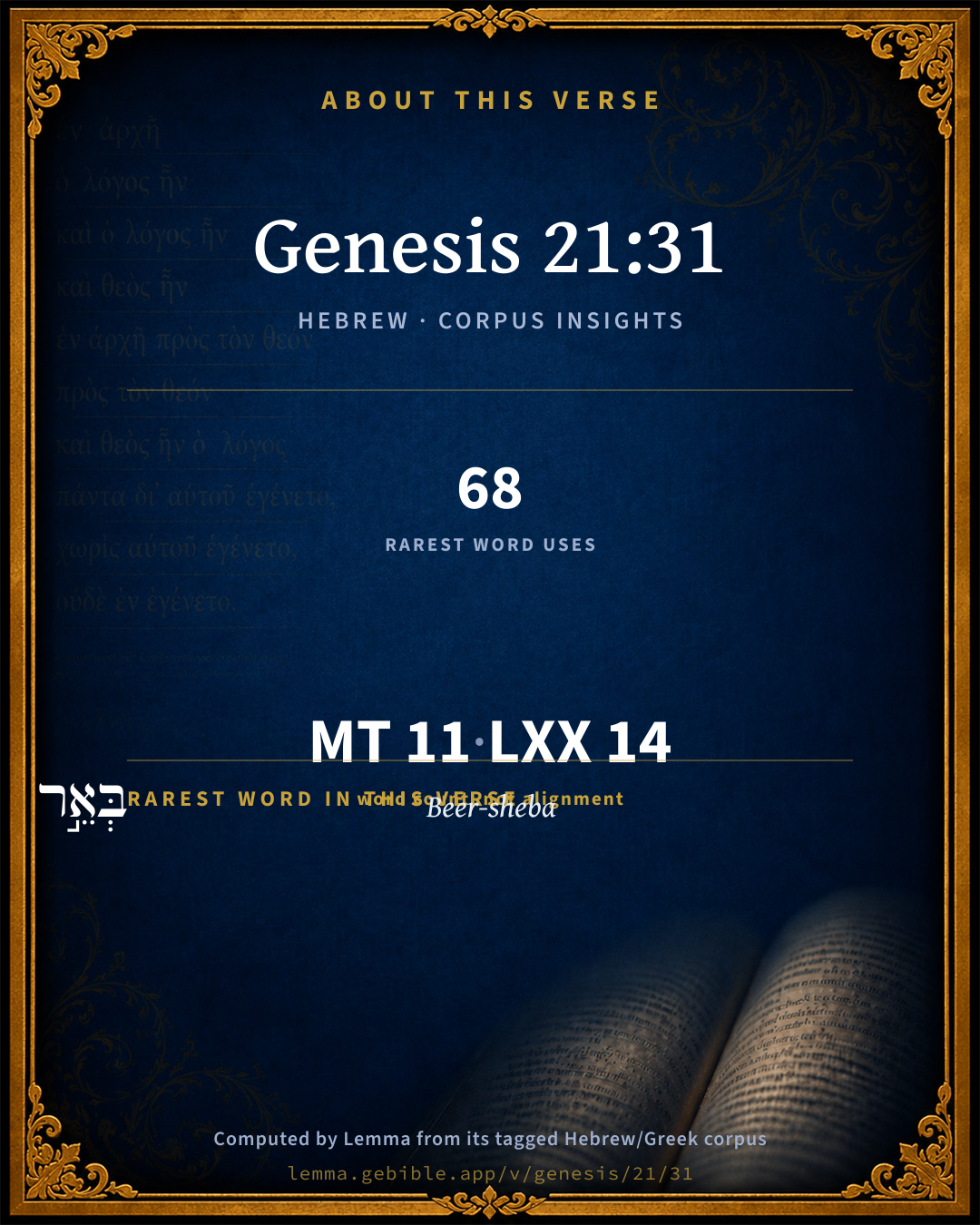
11
words
10
distinct lemmas
Pentateuch
section

Grammatical profile

  • 2 verbs
  • 3 nouns
  • 1 adjective
  • 1 pronoun
  • 1 preposition
  • 1 conjunction
  • 1 adverb
  • 1 particle

Verb forms

  • קָרָ֛א Qal · Perfect
  • נִשְׁבְּע֖וּ Niphal · Perfect

Repetition

A word recurs within this verse — often emphatic in Hebrew:

  • בְּאֵ֣ר Beer-sheba H884 ×2

Hebrew & Septuagint length

In English translation the verse runs 11 words from the Hebrew and 18 from the Septuagint (LXX English) — the Septuagint runs noticeably longer here. See the side-by-side →

A rough comparison of the two English renderings, which tokenize alike — not a word-level alignment.

Word counts can differ between the Hebrew and the Greek without any difference in meaning — e.g. the Hebrew direct-object marker אֵת has no separate Greek word, and Greek often adds the article ὁ.

In the original languages it is 11 Hebrew tokens and 14 Greek tokens — but the two are counted differently (Hebrew bundles its prefixes and suffixes into one token; the Greek is in lemma form), so that isn’t a like-for-like length.

Cross-references

7

Topical passages linked to Genesis 21:31 in the Treasury of Scripture Knowledge — connected by theme and wording, ordered by reader-vote popularity; previews shown in the World English Bible.

  • Genesis 26:33 He called it Shibah. Therefore the name of the city is Beersheba to this day.
  • Genesis 21:14 Abraham rose up early in the morning, and took bread and a bottle of water, and gave it to Hagar, putting it on her shoulder, and gave her the child, and sent her away. She departed, and wandered in the wilderness of Beersheba.
  • Genesis 26:23 He went up from there to Beersheba.
  • Joshua 15:28 and Hazar Shual, and Beersheba, and Biziothiah,
  • Judges 20:1 Then all the children of Israel went out, and the congregation was assembled as one man, from Dan even to Beersheba, with the land of Gilead, to Yahweh at Mizpah.
  • 2 Samuel 17:11 But I counsel that all Israel be gathered together to you, from Dan even to Beersheba, as the sand that is by the sea for multitude; and that you go to battle in your own person.
  • 1 Kings 4:25 Judah and Israel lived safely, every man under his vine and under his fig tree, from Dan even to Beersheba, all the days of Solomon.

Cross-references courtesy of OpenBible.info (CC BY 4.0).

Hebrew and Greek witnesses Masoretic Hebrew ↔ Greek Septuagint

The same verse in the two great witnesses to the Old Testament, shown verse-for-verse.

Here the Septuagint runs noticeably longer than the Hebrew — LXX2012 (modern English Septuagint) 18 words vs World English Bible 11. A rough length comparison of the two English translations, not a word-level alignment — read both below.

These are two independent witnesses, not word-aligned to each other, and the Septuagint is shown in lemma (dictionary) form.

Hebrew Genesis 21:31 Masoretic · Westminster Leningrad Codex

עַל כֵּ֗ן קָרָ֛א לַמָּק֥וֹם הַה֖וּא בְּאֵ֣ר שָׁ֑בַע כִּ֛י שָׁ֥ם נִשְׁבְּע֖וּ שְׁנֵיהֶֽם

Therefore he called that place Beersheba, because they both swore there.

World English Bible · Public Domain

Greek LXX Genesis 21:31 Septuagint · lemma form

διά οὗτος ἐπιὀνομάζω ὁ ὄνομα ὁ τόπος ἐκεῖνος φρέαρ ὁρκισμός ὅτι ἐκεῖ ὄμνυμι ἀμφότεροι

Therefore he named the name of that place, The Well of the Oath, for there they both swore.

LXX2012 (modern English Septuagint) · Public Domain

On this verse, The Cambridge Bible for Schools and Colleges discusses the Septuagint’s reading. Read the note in Commentary ↓

Hebrew: Westminster Leningrad Codex (CC BY 4.0). Greek: Septuagint (public domain); English from LXX2012 (modern English Septuagint) (Public Domain). How the Septuagint differs from the Hebrew →

Targum (Aramaic paraphrase)

2

The Targum is the ancient Jewish Aramaic paraphrase of the Hebrew Scriptures — an interpretive translation, not the Hebrew text itself. Onkelos (literal) and Pseudo-Jonathan (expansive) render the Torah, and Jonathan the Prophets. Coverage is partial: where no permissively-licensed English translation exists for a verse, only the Aramaic is shown. This is verse-level text, not a word-by-word alignment to the Hebrew.

  1. Targum Onkelos Torah (Genesis–Deuteronomy)
    עַל כֵּן קְרָא לְאַתְרָא הַהוּא בְּאֵר שָׁבַע אֲרֵי תַמָּן קַיָּמוּ תַּרְוֵיהוֹן

    (no public-domain English translation for this verse)

    Targum Onkelos — Aramaic: “Onkelos Genesis” (public domain); “Onkelos Exodus” (public domain); “Onkelos Leviticus” (public domain); “Onkelos Numbers” (public domain); “Onkelos Deuteronomy” (public domain). English: “Sefaria Community Translation” (CC0 1.0 (public-domain dedication)); “J.W. Etheridge. The Targums of Onkelos and Jonathan Ben Uzziel on the Pentateuch. London: Longmans, Green, 1862” (public domain). Text via Sefaria.

  2. Targum Pseudo-Jonathan Torah (Genesis–Deuteronomy)
    בְּגִין כֵּן קָרָא לְבֵירָא הַהוּא בֵּירָא דְשֶׁבַע חוּרְפַן אֲרוּם תַּמָן קִיְימוּ תַּרְוֵיהוֹן

    Therefore he called that well the Well of the Seven Lambs; because there they two did swear.

    Targum Pseudo-Jonathan — Aramaic: “Targum Jonathan on Genesis” (public domain); “Targum Jonathan on Exodus” (public domain); “Targum Jonathan on Leviticus” (public domain); “Targum Jonathan on Numbers” (public domain); “Targum Jonathan on Deuteronomy” (public domain). English: “The Targum of Jonathan ben Uzziel, trans. J. W. Etheridge, London, 1862” (public domain). Text via Sefaria.

Commentary

Notes on Genesis 21:31 from classic Christian and Jewish commentators (each source and its license shown beneath its notes). The classic Christian expositions comment on the surrounding passage and are grouped to its opening verse, so a note may address several verses; the Jewish commentaries on the Tanakh (Rashi and others) are per-verse, so they appear only where the commentator wrote on this verse.

Lemma curates 59 commentaries, every one of them public domain or Creative Commons licensed, each selected and text-cleaned for this edition rather than reprinted as found. About our sources →

Trapp's Complete Commentary

John Trapp

Gen 21:31 Wherefore he called that place Beersheba; because there they sware both of them.

Ver. 31. They sware both of them.] Or, they were sworn. The Hebrew is passive ( נשׁבע). To show that an oath is not rashly to he undertaken, but by a kind of necessity imposed. It comes of a root that signifies to satisfy; because he, to whom we swear, must therewith be contented. An oath is an end of strife, saith the apostle. {Heb 6:16} The Greeks call it ορχος ψυασι ερχος, a hedge, which a man may not break.

John Trapp, A Commentary or Exposition upon All the Books of the Old and New Testament (1647–1656) — public domain. Text from a community e-Sword module.

Joseph Benson's Commentary

Gen 21:31. Beer-sheba — That is, the well of the oath, or the well of the seven, (for the word equally signifies either,) alluding to the seven ewe- lambs which Abraham set by themselves and gave to Abimelech. Probably when a covenant was solemnly made and confirmed by an oath, seven lambs or sheep were wont to be offered.

Joseph Benson's Commentary on the Old and New Testaments (1811–1818) — public domain. Text from a community e-Sword module.

Geneva Bible (1599)

Geneva Bible translators

Or, well of the oath, or of seven, meaning lambs.

Geneva Bible (1599) marginal notes — public domain. Text via Bolls.life.

Adam Clarke's Commentary

Verse 31. He called that place Beer-sheba] באר שבע Beer-shaba, literally, the well of swearing or of the oath, because they both sware there-mutually confirmed the covenant.

Adam Clarke's Commentary on the Bible (1810–1826) — public domain. Text from a community e-Sword/MySword module.

John Calvin's Commentaries

31. Wherefore he called that place Beer-sheba. Moses has once already called the place by this name, but proleptically. Now, however, he declares when, and for what reason, the name was given; namely, because there both he and Abimelech had sworn; therefore I translate the term ‘the well of swearing.’ Others translate it ‘the well of seven.’ But Moses plainly derives the word from swearing; nor is it of any consequence that the pronunciation slightly varies from grammatical correctness, which in proper names is not very nicely observed. In fact, Moses does not restrict the etymology to the well, but comprises the whole covenant. I do not, however, deny that Moses might allude to the number seven

John Calvin's Commentaries (1540-1563) — public domain. Text from the Calvin Translation Society English edition (1840s-50s) via the Christian Classics Ethereal Library (ccel.org). Calvin's coverage is partial (roughly two-thirds of the Bible); uncommented books and verses are honest gaps, never fabricated. The 19th-century editor's footnotes and remarks are omitted so the notes are faithfully Calvin's own voice.

Ellicott's Commentary for English Readers

(31) Beer-sheba.—That is, the well of seven, but with a covert allusion to the seven lambs having been used for the ratification of an oath. Robinson found the exact site in the Wady-es-Seba, with its name still preserved as Bir-es-Seba. There are there two wells of solid construction, the first twelve and a half feet in diameter; the other, situated about 200 yards to the south, much smaller, being only five feet in diameter. Both are lined with solid masonry, and reach down to never-failing springs in the rock. Around are stone troughs for watering the cattle, and the parapet of the larger well is worn into deep indentations, by the ropes used in drawing the water (Finn, Bye-ways in Palestine, p. 190).

A Bible Commentary for English Readers, edited by Charles John Ellicott (1878–1897) — public domain. Text from a community e-Sword module.

The Cambridge Bible for Schools and Colleges

gen. ed. J. J. S. Perowne

31. Beer-sheba] LXX φρέαρ ὁρκισμοῦ: the derivation here given is “because there they sware both of them.” The word in Heb. “they sware” (nishb‘u) is the reflexive form of the verb shaba‘. This derivation of Beer-sheba, as “the well of swearing,” is clearly not a complete explanation of the word. The correct derivation—“the well of seven”—is probably hinted at in Abraham’s pledge of the seven lambs. At Beer sheba, there were also “seven” wells, which can even now be identified. But there is a close connexion between the Heb. word “seven,” and the Heb. word “to swear”; and if, as seems probable, the Heb. nishba‘ “to swear” meant originally “to bind oneself by staking, or pledging, seven things,” we can see that the well of “seven” and the well of “swearing” were practically identical in significance.

Beer-sheba stood on the southernmost boundary of Palestine, at the edge of the desert, about 50 miles S.W. of Jerusalem. In later days it was famous as a sacred place of pilgrimage, Amo_5:5; Amo_8:14.

The Cambridge Bible for Schools and Colleges (gen. ed. J. J. S. Perowne; Cambridge University Press, 1878–1918) — public domain. Text from a community e-Sword module.

John Gill's Exposition

And Abraham sojourned in the Philistines' land many days. Even many years, days being sometimes put for years; having entered into covenant with Abimelech, the king of the country, and settled a good correspondence with him, and having his friendship and good will, which commanded respect from his subjects, Abraham sojourned very quietly and comfortably for many years, chiefly at Beersheba; the Jewish writers say (a) he sojourned here twenty six years.

(a) Jarchi & Bereshit Rabba, sect. 54. fol. 48. 4.

Next: Genesis Chapter 22

John Gill's Exposition of the Whole Bible (1746–1763) — public domain (CC PDM 1.0). Text via the HelloAO Bible API.

Haydock's Catholic Bible Commentary

Bersabee. That is, the well of oath; (Challoner) or "the well of the seven;" meaning the seven ewe-lambs set apart. (Menochius) --- This precaution of Abraham, in giving seven lambs as a testimony that the well was dug by him, was not without reason. See chap. xxvi. 15. (Calmet)

George Leo Haydock (1774–1849), Haydock's Catholic Family Bible and Commentary, 1859 edition — public domain. Excludes Psalms (Douay-Rheims chapter numbering differs from Protestant) and Deuterocanonical books (Catholic canon only).

Matthew Poole's English Annotations

Which name was communicated unto a city adjoining: of which see Gen 26:23; Jos 15:28; 2Sa 17:11; 24:2.

Matthew Poole's English Annotations on the Holy Bible (1683–1685) — public domain. Text from a community e-Sword/MySword module.

Whedon's Commentary on the Bible

Daniel D. Whedon

31. Beer-sheba — Which means well of the oath, or, well of the seven, in allusion to the seven lambs by which Abraham here confirmed his covenant with Abimelech. In a broad valley, some twelve hours’ travel south of Hebron, Dr. Robinson discovered two deep wells, still called Bir es-Seba, probably the very same as those dug by the servants of Abraham and Isaac. Compare Gen_26:32. “These wells are some distance apart; they are circular, and stoned up with solid masonry. The larger one is twelve and a half feet in diameter and forty-four and a half feet deep to the surface of the water, sixteen feet of which, at the bottom, is excavated in the solid rock. The other well lies fifty-five rods W.S.W., and is five feet in diameter and forty-two feet deep. The water in both is pure and sweet, and in great abundance; the finest, indeed, we had found since leaving Sinai.” — ROBINSON, Biblical Researches, vol. i, p. 204. Such wells would be of the first importance to a great shepherd chief.

Daniel D. Whedon (gen. ed.), Commentary on the Old and New Testaments (1874–1909) — public domain. Text from a community e-Sword module.

The Pulpit Commentary

Wherefore he called that place Beersheba. Ie. "the well of the oath," frear oJrkismou (LXX, Gesenius, Furst, Rosenm or the well of the seven (Keil), rather than the seven wells (Lange); discovered by Robinson in Bir-es-seba, in the Wady-es-seba, twelve miles to the south of Hebron, with two deep wells of excellent water. "The great well has an internal diameter at the mouth of twelve feet six inches, or a circumference of nearly forty feet. The shaft is formed of excellent masonry to a great depth until it reaches the rock, and at this juncture a spring trickles perpetually. Around the mouth of the well is a circular course of masonry, topped by a circular parapet of about a foot high; and at a distance of ten or twelve feet are stone troughs placed in a concentric circle with the well, the sides of which have deep indentions made by the wear of ropes on the upper edges The second well, about 200 yards farther south, is not more than five feet in diameter, but is formed of equally good masonry, and furnishes equally good water" (vide "Byeways in Palestine," by James Finn, M.R.A.S., p. 190). Because there they aware both of them.

The Pulpit Commentary (1880–1919), ed. H.D.M. Spence-Jones & Joseph S. Exell — public domain. Text from a community e-Sword module.

John Wesley's Explanatory Notes

Beer-sheba - That is, the well of the oath, in remembrance of the covenant that they swear to, that they might be ever mindful of it.

John Wesley, Explanatory Notes Upon the Whole Bible (1754–1765) — public domain. Text via the GEBible commentary corpus.

Keil & Delitzsch

C. F. Keil & F. Delitzsch

From this circumstance, the place where it occurred received the name שׁבע בּאר, i.e., seven-well, "because there they sware both of them." It does not follow from this note, that the writer interpreted the name "oath-well," and took שׁבע in the sense of שׁבעה. The idea is rather the following: the place received its name from the seven lambs, by which Abraham secured to himself possession of the well, because the treaty was sworn to on the basis of the agreement confirmed by the seven lambs. There is no mention of sacrifice, however, in connection with the treaty (see Gen 26:33). נשׁבּע to swear, lit., to seven one's self, not because in the oath the divine number 3 is combined with the world-number 4, but because, from the sacredness of the number 7, the real origin and ground of which are to be sought in the number 7 of the work of creation, seven things were generally chosen to give validity to an oath, as was the case, according to Herodotus (3, 8), with the Arabians among others. Beersheba was in the Wady es-Seba, the broad channel of a winter-torrent, 12 hours' journey to the south of Hebron on the road to Egypt and the Dead Sea, where there are still stones to be found, the relics of an ancient town, and two deep wells with excellent water, called Bir es Seba, i.e., seven-well (not lion-well, as the Bedouins erroneously interpret it): cf. Robinson's Pal. i. pp. 300ff.

Keil & Delitzsch — Biblical Commentary on the Old Testament (1861–1891) — public domain (CC PDM 1.0). Text via the HelloAO Bible API. (Old Testament only.)

unfoldingWord translationNotes

Door43 World Missions Community

he called that place

"Abraham called that place"

Beersheba

Translators may add a footnote saying "Beersheba can mean either "well of the oath" or "well of seven."

they both

"Abraham and Abimelech"

Phicol

This is the name of a man. See how you translated this name in Genesis 21:22.

translationWords

Beersheba

oath

covenant

Abimelech

Philistines

unfoldingWord translationNotes — © Distant Shores Media and the Door43 World Missions Community, licensed CC BY-SA 4.0. Source: git.door43.org/Door43/en_tn.

Radak

Rabbi David Kimhi (Radak)

על כן...כי שם נשבעו, the word כי lacks the conjunctive letter ו in front. We find similar constructions with the missing conjunctive letter ו in Chabakuk 2,11 שמש ירח, instead of שמש וירח. Another such example is found in Exodus 1,2 ראובן שמעון instead of ראובן ושמעון. Had the letter ו not been missing, we would have clearly understood at first glance that both the oath and the seven sheep are referred to as a “package deal.” Naming a location was a very important step in laying claim to a region as one’s inalienable property.

Radak on the Tanakh — English translations: “Sefaria Community Translation” (CC0 1.0 (public-domain dedication)); “Eliyahu Munk, HaChut Hameshulash” (CC BY 4.0); “Rabbi Mike Feuer, Jerusalem Anthology” (CC BY 4.0); and “R. David Kimhi on the first book of Psalms, Translated by R.G. Finch, London, 1919” (public domain). Text via Sefaria.

Lesson kit

Teaching starters — assembled from the data on this page, not authored interpretation. Every prompt links to the verse data it draws on. Edit before teaching.

Genesis, in the Pentateuch, opens this verse with 11 words (10 distinct Hebrew lemmas). Its most distinctive word is Bᵉʼêr Shebaʻ (“Beer-sheba”). The Greek Septuagint runs longer here. A historical commentator’s framing appears above. Read the whole chapter for the surrounding context.

Discussion questions

  1. The word Bᵉʼêr Shebaʻ carries the sense “Beer-sheba.” How does it shape the verse?
  2. How does Genesis 26:33, which shares this passage’s theme, read alongside this verse?
  3. What does the repetition of “Beer-sheba” (2× in this one verse) do in this verse?
  4. The Septuagint runs longer here than the Hebrew. What might account for the difference?
  5. The translations on this page render this verse differently — a whole-verse word diff, not a word-by-word alignment. What might account for the different wordings?
  6. «קָרָ֛א» is a Qal Perfect verb. How does that grammatical form shape the action described?
  7. Compare how Trapp's Complete Commentary and Joseph Benson's Commentary read this verse. Where do they agree or differ?

Things to notice

Reading settings

Reading text

Shown beneath each verse's original-language words.

Old Testament
Old Testament edition

Read the OT as the Masoretic Hebrew (MT) or the Greek Septuagint (LXX).

English shown for the Greek Septuagint (in the Hebrew ↔ Greek comparison).

Comparing translations? Open the Compare panel on any verse page to stack up to four side by side.