
Acts 7:41

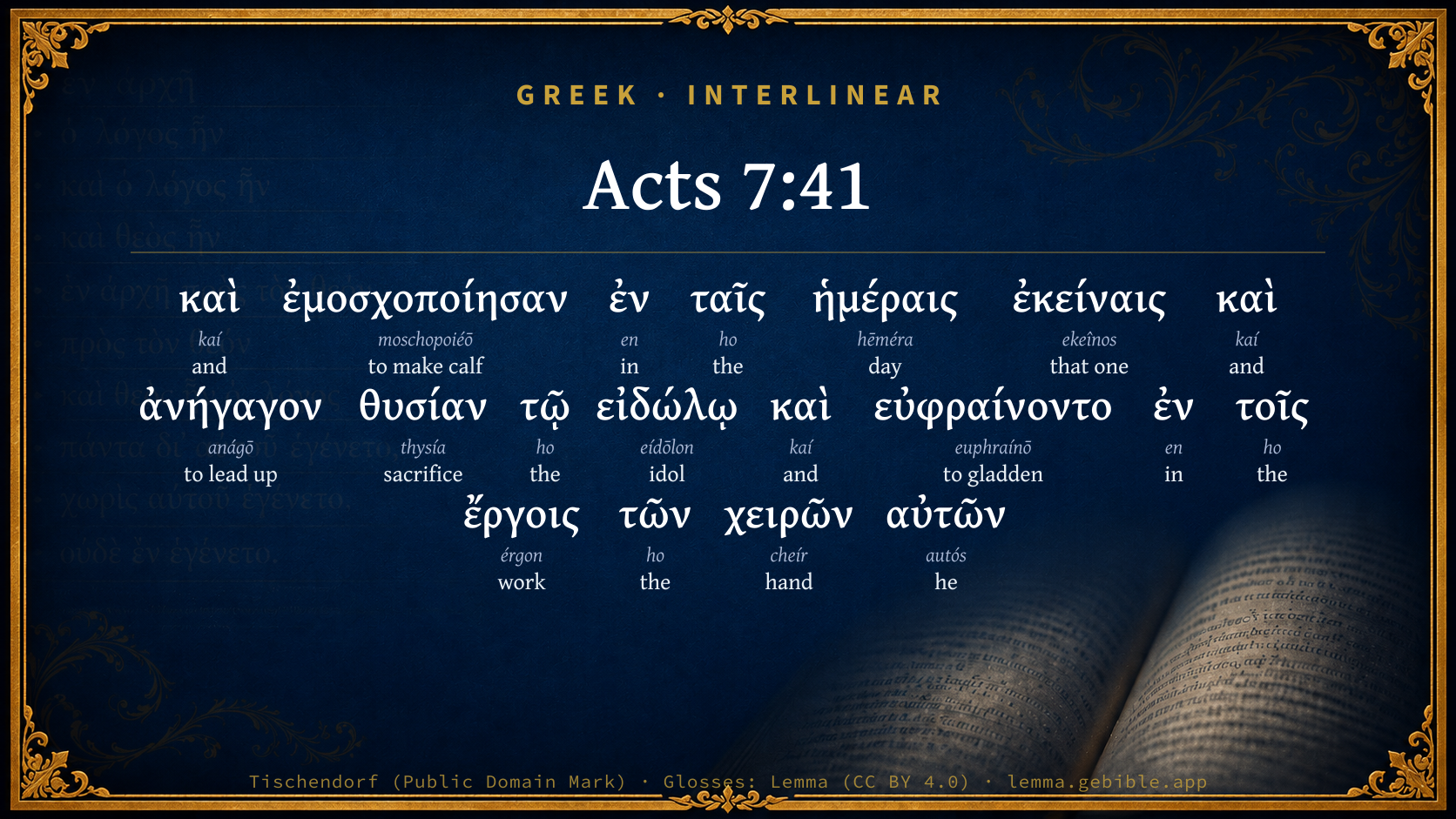
Greek (Tischendorf 8th ed.) Acts 7:41 appears in the Greek New Testament. The text above is from the Tischendorf 8th edition. Each word links to its Strong’s number and a concise gloss. Click any word for its full Thayer’s Greek Lexicon entry.
Download image
Cite this verse

Acts 7:41 (World English Bible). Public Domain. Lemma interlinear Bible study tool, https://lemma.gebible.app/v/acts/7/41.

Show BibTeX & RIS
BibTeX
RIS
English Translation
They made a calf in those days, and brought a sacrifice to the idol, and rejoiced in the works of their hands.
World English Bible · Public Domain
Highlights
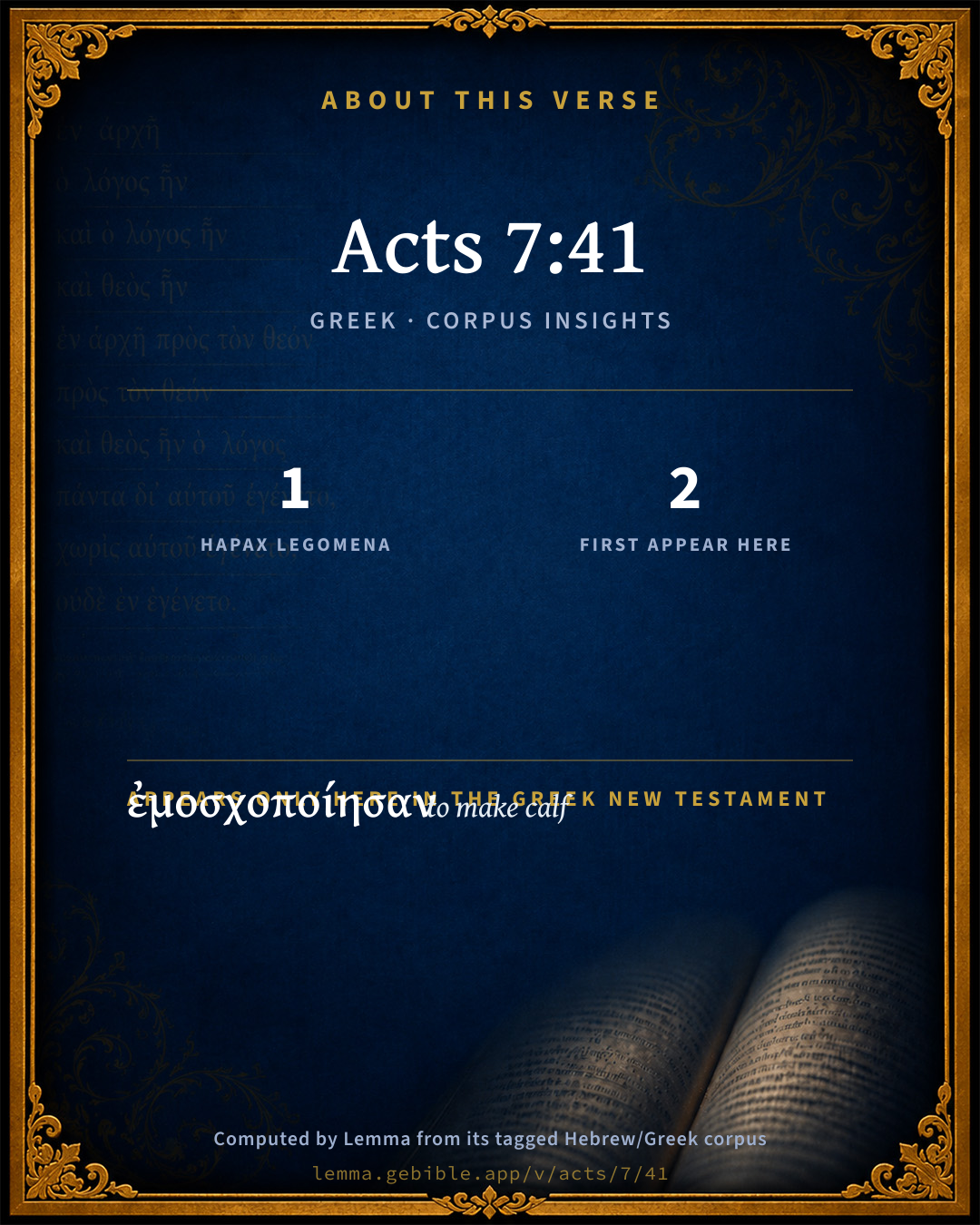
  • 1 hapax legomenon — only here in the Greek New Testament
  • 2 first appearances in the Greek New Testament
Full analysis ↓
Download a study sheet

One document with this verse’s original text, its word-by-word gloss line, the meaning frame, cross-references with their text, attributed commentary, and full source and license credits — printable, and it pastes into notes with its structure intact.

This verse Autodidact and up

Study sheet (.html) Plain text (.txt)

A passage Seminary Student

Up to 50 verses in one chapter. A passage sheet keeps up to 6 commentary sources and 12 cross-references per verse, in the order this page ranks them, and says so on the sheet whenever that leaves anything out. Ask for a single verse and you get the Autodidact verse sheet above.

Everything on this page stays free to read, with no account — the sheet is a download of what is already on screen, not access to it.

Want to remove ads? Support Godless Engineer
Compare translations 3

The same verse in 3 English versions, stacked beneath the original-language interlinear above. Click any original word for its lexicon entry.

Each is an independent rendering of the whole verse — the interlinear is not word-aligned to these translations.

Highlighted words mark where these versions differ — a whole-verse word diff, not a word-by-word alignment.

  • World English Bible Public Domain
    They made a calf in those days, and brought a sacrifice to the idol, and rejoiced in the works of their hands.
  • King James Version Public Domain
    And they made a calf in those days, and offered sacrifice unto the idol, and rejoiced in the works of their own hands.
  • unfoldingWord Literal Text CC BY-SA 4.0
    So they made an image of a calf in those days and brought a sacrifice to the idol and rejoiced in the works of their hands.

unfoldingWord Literal Text — © unfoldingWord, licensed CC BY-SA 4.0. Word-aligned USFM3 via Door43 (git.door43.org/unfoldingWord/en_ult).

Versions to compare (up to 4)

3 of 4 selected

Show all 19 translations

Every available English version of this verse, each an independent rendering of the whole verse.

  • World English Bible Public Domain
    They made a calf in those days, and brought a sacrifice to the idol, and rejoiced in the works of their hands.
  • Berean Standard Bible Public Domain
    At that time they made a calf and offered a sacrifice to the idol, rejoicing in the works of their hands.
  • Majority Standard Bible Public Domain
    At that time they made a calf and offered a sacrifice to the idol, rejoicing in the works of their hands.
  • King James Version Public Domain
    And they made a calf in those days, and offered sacrifice unto the idol, and rejoiced in the works of their own hands.
  • American Standard Version (1901) Public Domain
    And they made a calf in those days, and brought a sacrifice unto the idol, and rejoiced in the works of their hands.
  • Revised Version (1885) Public Domain
    And they made a calf in those days, and brought a sacrifice unto the idol, and rejoiced in the works of their hands.
  • Geneva Bible (1599) Public Domain
    And they made a calfe in those dayes, and offered sacrifice vnto the idole, and reioyced in the workes of their owne handes.
  • Douay-Rheims (1899) Public Domain
    And they made a calf in those days, and offered sacrifices to the idol, and rejoiced in the works of their own hands.
  • Young's Literal Translation Public Domain
    `And they made a calf in those days, and brought a sacrifice to the idol, and were rejoicing in the works of their hands,
  • Literal Standard Version CC BY-SA 4.0
    And they made a calf in those days, and brought a sacrifice to the idol, and were rejoicing in the works of their hands,
  • Unlocked Literal Bible CC BY-SA 4.0
    So they made a calf in those days and brought a sacrifice to the idol, and rejoiced because of the work of their hands.
  • unfoldingWord Literal Text CC BY-SA 4.0
    So they made an image of a calf in those days and brought a sacrifice to the idol and rejoiced in the works of their hands.
  • Darby Bible Public Domain
    And they made a calf in those days, and offered sacrifice to the idol, and rejoiced in the works of their own hands.
  • World Messianic Bible Public Domain
    They made a calf in those days, and brought a sacrifice to the idol, and rejoiced in the works of their hands.
  • Webster's Bible Public Domain
    And they made a calf in those days, and offered sacrifice to the idol, and rejoiced in the works of their own hands.
  • Free Bible Version CC BY-SA 4.0
    Then they made an idol in the shape of a calf, sacrificed to it, and celebrated what they themselves had made!
  • Bible in Basic English Public Domain
    And they made the image of a young ox in those days, and made an offering to it, and had joy in the work of their hands.
  • Text-Critical English NT CC BY 4.0
    In those days they made an idol in the form of a calf, brought a sacrifice to the idol, and rejoiced at the works of their hands.
  • Tyndale New Testament (1534) Public Domain
    And they made a calfe in those dayes and offered sacrifice vnto the ymage and reioysed in the workes of their awne hondes.

Literal Standard Version (2020), Covenant Press — licensed CC BY-SA 4.0. Text via the HelloAO Bible API (eBible.org). Unlocked Literal Bible (unfoldingWord) — licensed CC BY-SA 4.0. Text via the HelloAO Bible API (eBible.org). unfoldingWord Literal Text — © unfoldingWord, licensed CC BY-SA 4.0. Word-aligned USFM3 via Door43 (git.door43.org/unfoldingWord/en_ult). Free Bible Version, Dr. Jonathan Gallagher — licensed CC BY-SA 4.0. Text via the HelloAO Bible API (eBible.org).

Word by word

More ways to search: Search by grammar → Find every occurrence → Compare this word →

Practice this passage: Drill this verse → Learn its vocabulary →

ἐμοσχοποίησαν
moschopoiéō
G3447
“to make calf”
Verb, Aorist, Active, Indicative, 3rd person, Plural
Part of Speech
Verb
Tense
Aorist
Voice
Active
Mood
Indicative
Person
3rd person
Number
Plural
Full Thayer's Definition

Origin: from G3448 and G4160

TDNT: None

1. to make (an image of) a calf
  1. καὶ kaí G2532 “and” Conjunction
  2. ἐν en G1722 “in” Preposition
  3. ταῖς ho G3588 “the” Article, Dative, Plural, Feminine
  4. ἡμέραις hēméra G2250 “day” Noun, Dative, Plural, Feminine
  5. ἐκείναις ekeînos G1565 “that one” Demonstrative pronoun, Dative, Plural, Feminine
  6. καὶ kaí G2532 “and” Conjunction
  7. ἀνήγαγον anágō G321 “to lead up” Verb, Aorist, Active, Indicative, 3rd person, Plural, Attic form
  8. θυσίαν thysía G2378 “sacrifice” Noun, Accusative, Singular, Feminine
  9. τῷ ho G3588 “the” Article, Dative, Singular, Neuter
  10. εἰδώλῳ eídōlon G1497 “idol” Noun, Dative, Singular, Neuter
  11. καὶ kaí G2532 “and” Conjunction
  12. εὐφραίνοντο euphraínō G2165 “to gladden” Verb, Imperfect, Passive, Indicative, 3rd person, Plural
  13. ἐν en G1722 “in” Preposition
  14. τοῖς ho G3588 “the” Article, Dative, Plural, Neuter
  15. ἔργοις érgon G2041 “work” Noun, Dative, Plural, Neuter
  16. τῶν ho G3588 “the” Article, Genitive, Plural, Feminine
  17. χειρῶν cheír G5495 “hand” Noun, Genitive, Plural, Feminine
  18. αὐτῶν autós G846 “he” Personal pronoun, Genitive, Plural, Masculine

About this verse

These counts appear in no published source. They are computed here, from the morphology-tagged text and Lemma’s own curated glosses. What Lemma adds →

19
words
13
distinct lemmas
Acts
section

Notable vocabulary

1 hapax legomenon — a word that appears only here in the entire Greek New Testament:

  • ἐμοσχοποίησαν to make calf G3447

First appearance in Scripture

These words make their first canonical appearance in the Greek New Testament here:

  • ἐμοσχοποίησαν to make calf G3447
  • εἰδώλῳ idol G1497

Shared distinctive vocabulary

εἰδώλῳ idol G1497 occurs in 11 verses of the Greek New Testament. Also found in:
Repetition

Words recur within this verse:

Cross-references

11

Topical passages linked to Acts 7:41 in the Treasury of Scripture Knowledge — connected by theme and wording, ordered by reader-vote popularity; previews shown in the World English Bible.

  • Psalms 106:19–21 They made a calf in Horeb, And worshiped a molten image.
  • Nehemiah 9:18 Yes, when they had made them a molten calf, and said, This is your God who brought you up out of Egypt, and had committed awful blasphemies;
  • Hosea 9:1 Don't rejoice, Israel, to jubilation like the nations; For you were unfaithful to your God. You love the wages of a prostitute at every grain threshing floor.
  • Hosea 9:10 I found Israel like grapes in the wilderness. I saw your fathers as the first ripe in the fig tree at its first season; But they came to Baal Peor, and consecrated themselves to the shameful thing, And became abominable like that which they loved.
  • Habakkuk 2:18–20 "What value does the engraved image have, that its maker has engraved it; the molten image, even the teacher of lies, that he who fashions its form trusts in it, to make mute idols?
  • Revelation 9:20 The rest of mankind, who were not killed with these plagues, didn't repent of the works of their hands, that they wouldn't worship demons, and the idols of gold, and of silver, and of brass, and of stone, and of wood; which can neither see, nor hear, nor walk.
  • Exodus 32:2–8 Aaron said to them, "Take off the golden rings, which are in the ears of your wives, of your sons, and of your daughters, and bring them to me."
  • Exodus 32:17–20 When Joshua heard the noise of the people as they shouted, he said to Moses, "There is the noise of war in the camp."
  • Deuteronomy 9:12–18 Yahweh said to me, Arise, get you down quickly from hence; for your people whom you have brought forth out of Egypt have corrupted themselves; they have quickly turned aside out of the way which I commanded them; they have made them a molten image.
  • Isaiah 2:8–9 Their land also is full of idols. They worship the work of their own hands, That which their own fingers have made.
  • Isaiah 44:9–20 Those who fashion an engraved image are all of them vanity; and the things that they delight in shall not profit; and their own witnesses don't see, nor know: that they may be disappointed.

Cross-references courtesy of OpenBible.info (CC BY 4.0).

Commentary

Notes on Acts 7:41 from classic Christian and Jewish commentators (each source and its license shown beneath its notes). The classic Christian expositions comment on the surrounding passage and are grouped to its opening verse, so a note may address several verses; the Jewish commentaries on the Tanakh (Rashi and others) are per-verse, so they appear only where the commentator wrote on this verse.

Lemma curates 59 commentaries, every one of them public domain or Creative Commons licensed, each selected and text-cleaned for this edition rather than reprinted as found. About our sources →

Bengel's Gnomon

Johann Albrecht Bengel

Act 7:41. Ἐμοσχοποίησαν, they made a calf) A very notorious act of wickedness is signified by an extraordinary and newly-coined word. They imitated the Egyptians, whose God Apis was an OX.—ἀνήγαγον θυσίαν) A rare phrase. But so also in 1Ki 3:15, ἀνήγαγεν ὁλοκαυτώσεις.—τῷ εἰδώλῳ, unto the idol) They were idolaters, although they made the name of God their pretext.[48]—εὐφραίνοντο, they rejoiced) with great pageant.—ἐν τοῖς ἔργοις τῶν χειρῶν αὐτῶν, in the works of their own hands) It becomes GOD to rejoice in the works of His own hands: and it becomes us to rejoice in the works of His hands. Men are idolaters who rejoice in the works of their own hands.

[48] The calves were probably an imitation of the Cherubim, a recognised symbol of the true God. Hence Aaron says, “These be thy Gods, O Israel, which brought thee up out of the land of Egypt,” Exo 32:4. The plural form, Gods, refers to the plural form of the name of God, Elohim.—E. and T.

Bengel's Gnomon of the New Testament — English translation (T&T Clark, Edinburgh, 1860) — public domain. Text from a community e-Sword module.

Meyer's Critical & Exegetical Commentary

Heinrich August Wilhelm Meyer

Act_7:41. Ἐμοσχοποίησαν] they made a bull, Exo_32:4 : ἐποίησεν αὐτὰ μόσχον χώνευτον. The word does not elsewhere occur, except in the Fathers, and may have belonged to the colloquial language. The idol itself was an imitation of the very ancient and widely-spread bull-worship in Egypt, which had impressed itself in different forms, e.g. in the worship of Apis at Memphis, and of Mnevis at Heliopolis. Hence μόσχος is not a calf, but (comp. Heb_9:12-13; Heb_9:19; Herod. iii. 28) equivalent to ταῦρος, a young bull already full-grown, but not yet put into the yoke.

Examples of ἀνάγειν (namely, to the altar, 1Ki_3:15) θυσίαν may be seen in Elsner, p. 393, and from Philo in Loesner, p. 189.

εὐφραίνοντο] they rejoiced in the works of their hands. By the interpretation: they held sacrificial feasts (Kuinoel), the well-known history (Exo_32:6), to which the meaning of the words points, is confounded with that meaning itself.

ἔργοις] plural of the category, which presented itself in the golden calf. On εὐφραίν. ἐν (Sir_14:5; Sir_39:31; Sir_51:29; Xen. Hier. i. 16), to denote that on which the joy is causally based, compare χαίρειν ἐν, Luk_10:20; see on Php_1:18.

Meyer — Critical and Exegetical Commentary on the New Testament — English translation by Peter Christie, edited by Frederick Crombie (T&T Clark, 1880) — public domain. Text from a community e-Sword module.

Expositor's Greek Testament

ed. W. Robertson Nicoll

Act 7:41 . ἐμοσχοποίησαν : not in LXX or in classical Greek; in Exo 32:2 , ἐποίησαν μόσχον . ἀνήγαγον θυσίαν , cf. 1Ki 3:15 (and 2Sa 6:17 , A.), for similar use of the word, “quia victima in aram tollitur,” Grimm. εὐφραίνοντο , cf. Exo 32:6 ; Exo 32:18 ; the word is very frequent in LXX, and several times with ἐν , cf., e.g. , 2Ch 6:41 , Sir 14:5 , Mal 3:7Mal 3:7 ; χαίρειν ἐν , Luk 10:20 ; used only by St. Luke amongst the Evangelists, six times in his Gospel, twice in Acts (but Act 2:26 is a quotation). Bengel points out that God rejoices in the works of His own hands, and men in the work of God’s hands, but not as here half irony in the words.

The Expositor's Greek Testament, edited by W. Robertson Nicoll (1897–1910) — public domain. Text from a community e-Sword module.

Geneva Bible (1599)

Geneva Bible translators

This was the superstition of the Egyptians’ idolatry: for they worshipped Apis a strange and marvelous calf, and made goodly images of Kine, Herodias, lib. 2.

Geneva Bible (1599) marginal notes — public domain. Text via Bolls.life.

John Calvin's Commentaries

41. And they made a calf. We may easily gather by that which goeth before, why they were more delighted in that figure than in any other. For although Egypt did swarm with innumerable idols, yet it is well known that they made the greatest account of an ox. And whence is it that they are so desirous to have an idol, save only because they were turned back into Egypt, as Stephen hath already said? We must note the speech when he saith that they offered sacrifice to the idol. Aaron commandeth the people to assemble themselves together to worship God; they come all together. Therefore they testify that they mean nothing less [any thing rather] than to defraud God of his worship, howsoever they translate the same unto the calf; yea, rather, they are determined to worship God in the image of the calf. But because they forsook the true God, by making an idol, whatsoever followeth afterward it is judged to be given to the idol, because God refuseth all wicked worshipping. For it is not meet to account that as bestowed upon him which he hath not commanded; and because he forbids them expressly to erect any visible image unto him, that is mere sacrilege whatsoever is done afterward in honor thereof.

They rejoiced over the works. This speech is taken out of Isaiah, yet, out of the prophets, who, in like sort, upbraid unto the Jews that they were delighted in their own inventions. And surely it is wonderful madness, when men arrogate unto themselves anything in God’s matters. I take this rejoicing to be that solemn dancing whereof Moses speaketh, in the thirty-second chapter of Exodus. Yet Stephen toucheth a common vice, wherewith idolaters are infected. For although it be altogether unlawful for men to attempt anything in religion which God hath not appointed, yet do they invent everything unadvisedly, and setting light by the Word of God, they make choice of the works of their own hands; but Stephen showeth that while they take such pleasure in this liberty, they displease God so much the more. But if we will have God to allow our worship, we must abstain from the works of our hands, that is, from our own inventions; for all that which men invent of themselves is nothing else but sacrilegious profanation. The idol is properly so called reproachfully, as it were a thing nothing worth, because no reason doth suffer man to make God.

John Calvin's Commentaries (1540-1563) — public domain. Text from the Calvin Translation Society English edition (1840s-50s) via the Christian Classics Ethereal Library (ccel.org). Calvin's coverage is partial (roughly two-thirds of the Bible); uncommented books and verses are honest gaps, never fabricated. The 19th-century editor's footnotes and remarks are omitted so the notes are faithfully Calvin's own voice.

Ellicott's Commentary for English Readers

(41) They made a calf.—The fact is stated in a compound word which is not found in the LXX. version, and which St. Stephen apparently coined for the purpose.

Rejoiced in the works of their own hands.—The verb expresses specially the joy of a feast, as in Luk_15:23-24; Luk_15:29; Luk_16:19; and is therefore specially appropriate for what is related in Exo_32:5-6. The tense “were rejoicing” expresses the frequency or continuance of the sin.

A Bible Commentary for English Readers, edited by Charles John Ellicott (1878–1897) — public domain. Text from a community e-Sword module.

The Cambridge Bible for Schools and Colleges

gen. ed. J. J. S. Perowne

41. and rejoiced] It was not the voice of them that shout for the mastery, nor of them that cry for being overcome, but the noise of them that sing which Moses (Exo_32:18) heard when he came down from the mount.

The Cambridge Bible for Schools and Colleges (gen. ed. J. J. S. Perowne; Cambridge University Press, 1878–1918) — public domain. Text from a community e-Sword module.

John Gill's Exposition

And they made a calf in those days,.... Whilst Moses was in the mount; this was done in imitation of the Egyptian idol Apis or Serapis, which was an ox or a bullock; and it was made of the golden earnings of the people, which were melted down, and cast into the form of a calf, and graved by Aaron with a graving tool, Exo 32:2 And so the Syriac version here reads in the singular number, "and he made them a calf"; this was a most shameful and scandalous piece of idolatry. The Jews themselves are so sensible of the horribleness of it, and of the guilt of it, and of the reproach that lies on them for it, that it is common for them to say (c),

"there is not a generation, or an age, in which there is not an ounce of the sin of the calf.''

Or, as elsewhere (d) expressed,

"no punishment befalls thee, O Israel, in "which there is not an ounce of the sin of the calf".''

And offered sacrifice unto the idol; an altar was built, and proclamation made, that the next day would be the feast of the Lord; and accordingly early in the morning the people rose, and offered both burnt offerings and peace offerings, Exo 32:5 and rejoiceth in the works of their own hands; for so the calf was; and which rejoicing they showed by eating, and drinking, and singing, and dancing.

(c) T. Hieros. Taaniot, fol. 68. 3. (d) Vid. Bab. Sanhedrin, fol. 102. 1.

John Gill's Exposition of the Whole Bible (1746–1763) — public domain (CC PDM 1.0). Text via the HelloAO Bible API.

Trapp's Complete Commentary

John Trapp

41 And they made a calf in those days, and offered sacrifice unto the idol, and rejoiced in the works of their own hands.

Ver. 41. And offered sacrifice to the idol] That is, to the devil, Psa 106:37, who is ειδωλοχαρης, as Synesius calls him. Howbeit the idolaters pretended herein to worship Jehovah, Exo 32:4-5. Their idol, if it would not make a god, would make an excellent devil; as the mayor of Doncaster told the wise men of Cockram concerning their ill-shaped crucifix.

John Trapp, A Commentary or Exposition upon All the Books of the Old and New Testament (1647–1656) — public domain. Text from a community e-Sword module.

Albert Barnes' Notes on the Bible

And they made a calf - This was made of the ear-rings and ornaments which they had brought from Egypt, Exo 32:2-4. Stephen introduces this to remind them how prone the nation had been to reject God, and to walk in the ways of sin.

Albert Barnes' Notes on the Bible (1834–1885) — public domain. Text from a community e-Sword/MySword module.

Matthew Poole's English Annotations

They made a calf; in imitation of the Egyptians, who worshipped their god Apis in that, or the like form of an ox.

The idol; the calf which they had made, which they could not be so sottish as to terminate their worship in, knowing that they themselves had made it, and it had not made them; yet they are for this charged to have committed idolatry, 1Co 10:6,7.

Rejoiced; which joy they express by feasting, singing, and dancing, Exo 32:6.

The works of their own hands; so this idol, and idols generally, are called, Psa 115:4; 135:15 which is enough to speak their emptiness and vanity; vain man can make but vain gods.

Matthew Poole's English Annotations on the Holy Bible (1683–1685) — public domain. Text from a community e-Sword/MySword module.

Whedon's Commentary on the Bible

Daniel D. Whedon

41-43. Stephen describes the complication of idolatries which the Israelites practised in rebellion against Moses and against God. They adopted the bullock-worship used by their old task-masters the Egyptians, who worshipped the bull Apis at Memphis, Upper Egypt, and the bull Muevis at Heliopolis in Lower Egypt. They adopted from the Phenicians or old Canaanites the star-worship of Moloch and of Remphan, the Egyptian name for Saturn. It was for these abominations that they suffered captivity in Babylon.

41. Made a calf—Stephen here, in order doubtless to express contempt for the base idolatry, probably coined a word found nowhere else in the Greek language, which may be literally rendered, they bullock-made.

Rejoiced in—Revelled in. Alluding to the licentious rites of heathen worship.

Daniel D. Whedon (gen. ed.), Commentary on the Old and New Testaments (1874–1909) — public domain. Text from a community e-Sword module.

The Pulpit Commentary

Brought a sacrifice for offered sacrifice, A.V.; (see Exo_32:6, with which the A.V. agrees best) hands for own hands, A.V.

The Pulpit Commentary (1880–1919), ed. H.D.M. Spence-Jones & Joseph S. Exell — public domain. Text from a community e-Sword module.

John Wesley's Explanatory Notes

And they made a calf - In imitation of Apis, the Egyptian god: and rejoiced in the works of their hands - In the God they had made.

John Wesley, Explanatory Notes Upon the Whole Bible (1754–1765) — public domain. Text via the GEBible commentary corpus.

McGarvey & Pendleton's Commentaries

J. W. McGarvey

41-43. Stephen next shows that the same people who so often rejected the servants of God, likewise rejected God himself. (41) " They made a calf in those days, and brought sacrifice to the idol, and rejoiced in the works of their own hands. (42) And God turned, and gave them up to serve the host of heaven, even as it is written in the book of the prophets, O house of Israel, have you offered to me slain beasts and sacrifices during forty years in the wilderness? (43) You have even taken up the tabernacle of Moloch, and the star of your god Remphan, figures which you made, to worship them; and I will carry you away beyond Babylon. " With this brief glance at the subsequent fate of the people who had so often rejected their deliverers, covering a period of many centuries, and terminating with their captivity in Babylon, Stephen concludes his summary of facts; but, previous to the final application, which he saw would raise a storm in the Assembly, he has a few words in reference to the temple.

J. W. McGarvey (with Philip Y. Pendleton), Commentaries on the New Testament (The Fourfold Gospel, 1914; Acts; and the epistles) — public domain. Text from a community e-Sword/MySword module.

unfoldingWord translationNotes

Door43 World Missions Community

General Information:

Stephen's quotation here is from the prophet Amos.

they made a calf

Stephen's audience knew the calf they made was a statue. AT: "they made a statue that looked like a calf" (See: Assumed Knowledge and Implicit Information)

a calf ... the idol ... the work of their hands

These phrases all refer to the same statue of the calf.

God turned

"God turned away." This action expresses that God was not pleased with the people and no longer helped them. AT: "God stopped correcting them" (See: Symbolic Action)

gave them up

"abandoned them"

the stars in the sky

Possible meanings for the original phrase are 1) the stars only or 2) the sun, moon, and stars.

the book of the prophets

This was apparently a collection of the writings of several of the Old Testament prophets into one scroll. It would also have included the writings of Amo.

Did you offer to me slain beasts and sacrifices ... Israel?

God asked this question to show Israel they did not worship Him with their sacrifices. AT: "You did not honor me when you offered slain beasts and sacrifices ... Israel" (See: Rhetorical Question)

house of Israel

This refers to the whole nation of Israel. AT: "all you Israelites" (See: Metonymy)

translationWords

sacrifice

false god

joy

works

turn

heaven

prophet

desert

house

Israel

unfoldingWord translationNotes — © Distant Shores Media and the Door43 World Missions Community, licensed CC BY-SA 4.0. Source: git.door43.org/Door43/en_tn.

Cambridge Greek Testament for Schools and Colleges

41. καὶ εὐφραίνοντο, and they rejoiced. It was not the voice of them that shout for the mastery, nor of them that cry for being overcome, but the noise of them that sing which Moses (Exo 32:18) heard when he came down from the mount.

Cambridge Greek Testament for Schools and Colleges (Cambridge University Press, 1896; 21 vols, various authors incl. Carr, Maclear, Plummer, Farrar, Lumby, Moule, M. R. James, Simcox) — public domain. Text from a community e-Sword module.

Alford’s Greek Testament

Henry Alford

41. ἐμοσχοποίησαν] apparently in imitation of Apis, a bull worshipped at Memphis as the living symbol of Osiris. Herod. iii. 28. Diod. Sic. i. 21. Strabo, xvii. 805 (Winer, Realw. ‘Kalb’). The ox was a common symbolic form of idols in the East; it was one of the cherubic forms, Eze 1:10; and the most recent discoveries at Nineveh have brought to light colossal bulls. Sir Gardiner Wilkinson (second series, ii. 97, Winer) thinks the golden calves of Israel to have been imitations of Mnevis, a bull kept at Heliopolis (Diod. Sic. i. 21. Strabo, xvii. 803) as a living symbol of the sun. Jeroboam afterwards set up golden calves at Bethel and Dan, and with the same proclamation: see 1Ki 12:28.

Henry Alford, The Greek Testament (1849–1861) — public domain. Text from a community e-Sword module.

Vincent's Word Studies in the New Testament

Marvin R. Vincent

They made a calf [εμοσχοποιησαν] . Only here in New Testament, and not in Septuagint. Bengel says, "A very notorious crime is denoted by an extraordinary and newly - coined word." This was in imitation of the Egyptian bull - worship. Several of these animals were worshipped at different places in Egypt. Apis was worshipped at Memphis. Herodotus says : "Now this Apis, or Epaphus, is the calf of a cow which is never afterward able to bear young. The Egyptians say that fire comes down from heaven upon the cow, which thereupon conceives Apis. The calf which is so called has the following marks : He is black, with a square spot of white upon his forehead, and on his back the figure of an eagle. The hairs in his tail are double, and there is a beetle upon his tongue" (3, 28). He was regarded by the Egyptians, not merely as an emblem, but as a God. He was lodged in a magnificent court, ornamented with figures twelve cubits high, which he never quitted except on fixed days, when he was led in procession through the streets. His festival lasted seven days, and all came forward from their houses to welcome him as he passed. He was not allowed to reach the natural term of his life. If a natural death did not remove him earlier, he was drowned when he reached the age of twenty - five, and was then embalmed and entombed in one of the sepulchral chambers of the Serapeum, a temple devoted expressly to the burial of these animals.

Another sacred bull was maintained at Heliopolis, in the great Temple of the Sun, under the name of Mnevis, and was honored with a reverence next to Apis. Wilkinson thinks that it was from this, and not from Apis, that the Israelites borrowed their notions of the golden calf. "The offerings, dancing, and rejoicings practiced on the occasion, were doubtless in imitation of a ceremony they had witnessed in honor of Mnevis during their sojourn in Egypt" (" Ancient Egyptians, " 2 ser., vol 2 p. 197). A third sacred bull, called Bacis, was maintained at Hermonthis, near Thebes. It was a huge, black animal, and its hairs were said to grow the wrong way. Other bulls and cows did not hold the rank of gods, but were only sacred. Offered [αγνηγαγον] . Lit., led up. See on Jas 2:21.

Marvin R. Vincent, Word Studies in the New Testament (1887–1900) — public domain. Text from a community e-Sword/MySword module.

Lesson kit

Teaching starters — assembled from the data on this page, not authored interpretation. Every prompt links to the verse data it draws on. Edit before teaching.

Acts, in the Acts, opens this verse with 19 words (13 distinct Greek lemmas). Its most distinctive word is moschopoiéō (“to make calf”). A historical commentator’s framing appears above. Read the whole chapter for the surrounding context.

Discussion questions

  1. How does “to make calf” (moschopoiéō) shape what this verse is saying?
  2. 1 word here appears nowhere else in the Greek New Testament. Why might the author reach for such rare wording?
  3. 2 words make their first appearance in Scripture here. What does this debut establish?
  4. How does Acts 15:20, which shares the word «idol», read alongside this verse?
  5. What does the repetition of “the” (4× in this one verse) do in this verse?
  6. The translations on this page render this verse differently — a whole-verse word diff, not a word-by-word alignment. What might account for the different wordings?
  7. Compare how Bengel's Gnomon and Meyer's Critical & Exegetical Commentary read this verse. Where do they agree or differ?

Things to notice

  • 1 word in this verse appears nowhere else in the Greek New Testament.
  • 2 words make their first canonical appearance in Scripture here.
  • These translations choose different wording for 4 words in this verse.
  • “the” occurs 4× in this single verse.
  • 13 distinct Greek lemmas span 19 words in this verse.

Reading settings

Reading text

Shown beneath each verse's original-language words.

Old Testament
Old Testament edition

Read the OT as the Masoretic Hebrew (MT) or the Greek Septuagint (LXX).

English shown for the Greek Septuagint (in the Hebrew ↔ Greek comparison).

Comparing translations? Open the Compare panel on any verse page to stack up to four side by side.