John 19:15

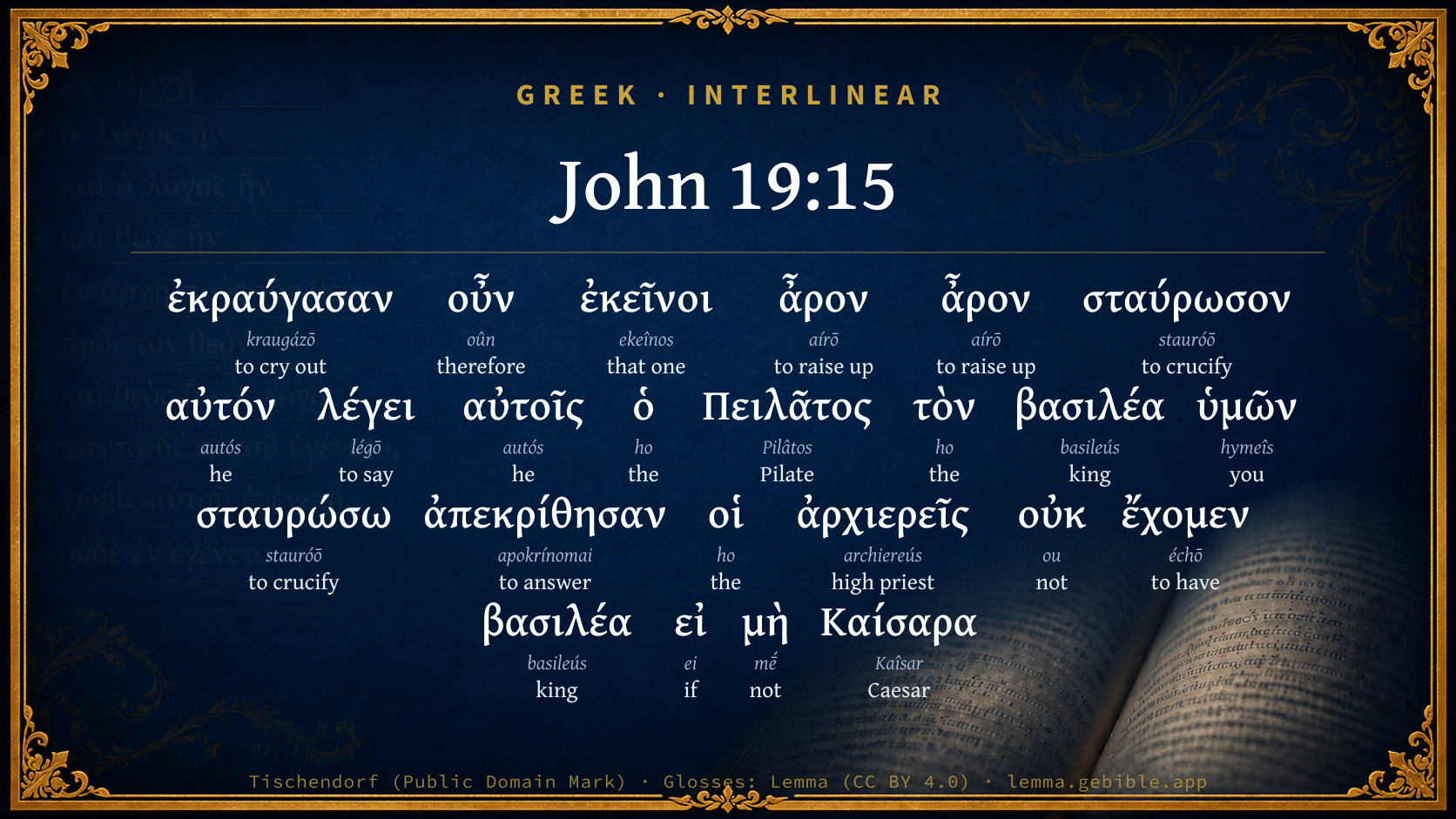
Greek (Tischendorf 8th ed.) John 19:15 appears in the Greek New Testament. The text above is from the Tischendorf 8th edition. Each word links to its Strong’s number and a concise gloss. Click any word for its full Thayer’s Greek Lexicon entry.
Download image
Cite this verse

John 19:15 (World English Bible). Public Domain. Lemma interlinear Bible study tool, https://lemma.gebible.app/v/john/19/15.

Show BibTeX & RIS
BibTeX
RIS
English Translation
They cried out, "Away with him! Away with him! Crucify him!" Pilate said to them, "Shall I crucify your King?" The chief priests answered, "We have no king but Caesar!"
World English Bible · Public Domain
Download a study sheet

One document with this verse’s original text, its word-by-word gloss line, the meaning frame, cross-references with their text, attributed commentary, and full source and license credits — printable, and it pastes into notes with its structure intact.

This verse Autodidact and up

Study sheet (.html) Plain text (.txt)

A passage Seminary Student

Up to 50 verses in one chapter. A passage sheet keeps up to 6 commentary sources and 12 cross-references per verse, in the order this page ranks them, and says so on the sheet whenever that leaves anything out. Ask for a single verse and you get the Autodidact verse sheet above.

Everything on this page stays free to read, with no account — the sheet is a download of what is already on screen, not access to it.

Want to remove ads? Support Godless Engineer
Compare translations 3

The same verse in 3 English versions, stacked beneath the original-language interlinear above. Click any original word for its lexicon entry.

Each is an independent rendering of the whole verse — the interlinear is not word-aligned to these translations.

Highlighted words mark where these versions differ — a whole-verse word diff, not a word-by-word alignment.

  • World English Bible Public Domain
    They cried out, "Away with him! Away with him! Crucify him!" Pilate said to them, "Shall I crucify your King?" The chief priests answered, "We have no king but Caesar!"
  • King James Version Public Domain
    But they cried out, Away with him, away with him, crucify him. Pilate saith unto them, Shall I crucify your King? The chief priests answered, We have no king but Caesar.
  • unfoldingWord Literal Text CC BY-SA 4.0
    But they cried out, “Take away! Take away! Crucify him!” Pilate says to them, “Should I crucify your king?” The chief priests answered, “We have no king except Caesar.”

unfoldingWord Literal Text — © unfoldingWord, licensed CC BY-SA 4.0. Word-aligned USFM3 via Door43 (git.door43.org/unfoldingWord/en_ult).

Versions to compare (up to 4)

3 of 4 selected

Show all 19 translations

Every available English version of this verse, each an independent rendering of the whole verse.

  • World English Bible Public Domain
    They cried out, "Away with him! Away with him! Crucify him!" Pilate said to them, "Shall I crucify your King?" The chief priests answered, "We have no king but Caesar!"
  • Berean Standard Bible Public Domain
    At this, they shouted, “Away with Him! Away with Him! Crucify Him!” “Shall I crucify your King?” Pilate asked. “We have no king but Caesar,” replied the chief priests.
  • Majority Standard Bible Public Domain
    At this, they shouted, “Away with Him! Away with Him! Crucify Him!” “Shall I crucify your King?” Pilate asked. “We have no king but Caesar,” replied the chief priests.
  • King James Version Public Domain
    But they cried out, Away with him, away with him, crucify him. Pilate saith unto them, Shall I crucify your King? The chief priests answered, We have no king but Caesar.
  • American Standard Version (1901) Public Domain
    They therefore cried out, Away with `him', away with `him', crucify him! Pilate saith unto them, Shall I crucify your King? The chief priests answered, We have no king but Caesar.
  • Revised Version (1885) Public Domain
    They therefore cried out, Away with him, away with him, crucify him. Pilate saith unto them, Shall I crucify your King? The chief priests answered, We have no king but Caesar.
  • Geneva Bible (1599) Public Domain
    But they cried, Away with him, away with him, crucifie him. Pilate sayde vnto them, Shall I crucifie your King? The high Priestes answered, We haue no King but Cesar.
  • Douay-Rheims (1899) Public Domain
    But they cried out: Away with him; away with him; crucify him. Pilate saith to them: Shall I crucify your king? The chief priests answered: We have no king but Caesar.
  • Young's Literal Translation Public Domain
    and they cried out, `Take away, take away, crucify him;' Pilate saith to them, `Your king shall I crucify?' the chief priests answered, `We have no king except Caesar.'
  • Literal Standard Version CC BY-SA 4.0
    And they cried out, “Take away! Take away! Crucify Him!” Pilate says to them, “Will I crucify your King?” The chief priests answered, “We have no king except Caesar.”
  • Unlocked Literal Bible CC BY-SA 4.0
    They cried out, “Away with him, away with him; crucify him!” Pilate said to them, “Should I crucify your King?” The chief priests answered, “We have no king but Caesar.”
  • unfoldingWord Literal Text CC BY-SA 4.0
    But they cried out, “Take away! Take away! Crucify him!” Pilate says to them, “Should I crucify your king?” The chief priests answered, “We have no king except Caesar.”
  • Darby Bible Public Domain
    But they cried out, Take [him] away, take [him] away, crucify him. Pilate says to them, Shall I crucify your king? The chief priests answered, We have no king but Caesar.
  • World Messianic Bible Public Domain
    They cried out, “Away with him! Away with him! Crucify him!” Pilate said to them, “Shall I crucify your King?” The chief priests answered, “We have no king but Caesar!”
  • Webster's Bible Public Domain
    But they cried out, Away with him, away with him, crucify him. Pilate saith to them, Shall I crucify your King? The chief priests answered, We have no king but Cesar.
  • Free Bible Version CC BY-SA 4.0
    “Kill him! Kill him! Crucify him!” they screamed out. “Do you want me to crucify your king?” Pilate asked. “The only king we have is Caesar,” the chief priests replied.
  • Bible in Basic English Public Domain
    Then they gave a loud cry, Away with him! away with him! to the cross! Pilate said to them, Am I to put your King to death on the cross? The chief priests said in answer, We have no king but Caesar.
  • Text-Critical English NT CC BY 4.0
    But they cried out, “Away with him, away with him, crucify him!” Pilate said to them, “Shall I crucify your king?” The chief priests answered, “We have no king but Caesar.”
  • Tyndale New Testament (1534) Public Domain
    They cryed awaye with him awaye with him crucify him. Pylate sayde vnto them. Shall I crucify youre kynge? The hye Prestes answered: we have no kynge but Cesar.

Literal Standard Version (2020), Covenant Press — licensed CC BY-SA 4.0. Text via the HelloAO Bible API (eBible.org). Unlocked Literal Bible (unfoldingWord) — licensed CC BY-SA 4.0. Text via the HelloAO Bible API (eBible.org). unfoldingWord Literal Text — © unfoldingWord, licensed CC BY-SA 4.0. Word-aligned USFM3 via Door43 (git.door43.org/unfoldingWord/en_ult). Free Bible Version, Dr. Jonathan Gallagher — licensed CC BY-SA 4.0. Text via the HelloAO Bible API (eBible.org).

Word by word

More ways to search: Search by grammar → Find every occurrence → Compare this word →

Practice this passage: Drill this verse → Learn its vocabulary →

ἐκραύγασαν
kraugázō
G2905
“to cry out”
Verb, Aorist, Active, Indicative, 3rd person, Plural
Part of Speech
Verb
Tense
Aorist
Voice
Active
Mood
Indicative
Person
3rd person
Number
Plural
Full Thayer's Definition

Origin: from G2906

TDNT: 17:58,5

1. to cry out, cry aloud, to shout, to cry out to one
  1. οὖν oûn G3767 “therefore” Conjunction
  2. ἐκεῖνοι ekeînos G1565 “that one” Demonstrative pronoun, Nominative, Plural, Masculine
  3. ἆρον aírō G142 “to raise up” Verb, Aorist, Active, Imperative, 2nd person, Singular
  4. ἆρον aírō G142 “to raise up” Verb, Aorist, Active, Imperative, 2nd person, Singular
  5. σταύρωσον stauróō G4717 “to crucify” Verb, Aorist, Active, Imperative, 2nd person, Singular
  6. αὐτόν autós G846 “he” Personal pronoun, Accusative, Singular, Masculine
  7. λέγει légō G3004 “to say” Verb, Present, Active, Indicative, 3rd person, Singular
  8. αὐτοῖς autós G846 “he” Personal pronoun, Dative, Plural, Masculine
  9. ὁ ho G3588 “the” Article, Nominative, Singular, Masculine
  10. Πειλᾶτος Pilâtos G4091 “Pilate” Noun, Nominative, Singular, Masculine
  11. τὸν ho G3588 “the” Article, Accusative, Singular, Masculine
  12. βασιλέα basileús G935 “king” Noun, Accusative, Singular, Masculine
  13. ὑμῶν hymeîs G5210 “you” Personal pronoun, 2nd person, Genitive, Plural
  14. σταυρώσω stauróō G4717 “to crucify” Verb, Future, Active, Indicative, 1st person, Singular
  15. ἀπεκρίθησαν apokrínomai G611 “to answer” Verb, Aorist, Middle deponent, Indicative, 3rd person, Plural
  16. οἱ ho G3588 “the” Article, Nominative, Plural, Masculine
  17. ἀρχιερεῖς archiereús G749 “high priest” Noun, Nominative, Plural, Masculine
  18. οὐκ ou G3756 “not” Particle, Negative
  19. ἔχομεν échō G2192 “to have” Verb, Present, Active, Indicative, 1st person, Plural
  20. βασιλέα basileús G935 “king” Noun, Accusative, Singular, Masculine
  21. εἰ ei G1487 “if” Conditional
  22. μὴ mḗ G3361 “not” Particle, Negative
  23. Καίσαρα Kaîsar G2541 “Caesar” Noun, Accusative, Singular, Masculine

About this verse

These counts appear in no published source. They are computed here, from the morphology-tagged text and Lemma’s own curated glosses. What Lemma adds →

24
words
18
distinct lemmas
Gospels
section

Notable vocabulary

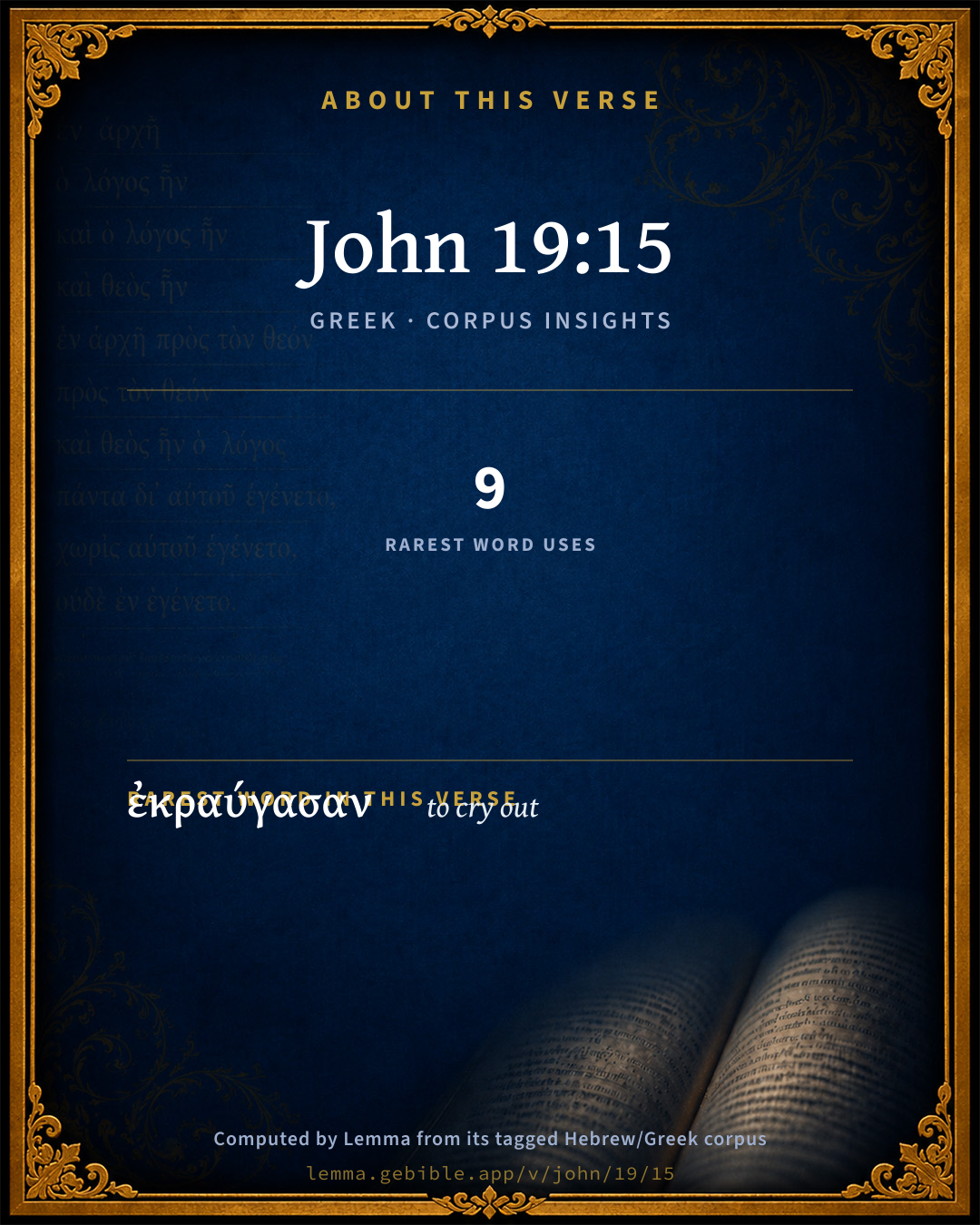
The rarest word here is ἐκραύγασαν to cry out G2905 — appearing just 9 times in the whole Greek New Testament.

Shared distinctive vocabulary

ἐκραύγασαν to cry out G2905 occurs in 9 verses of the Greek New Testament. Also found in:

Repetition

Words recur within this verse:

  • ἆρον to raise up G142 ×2
  • σταύρωσον to crucify G4717 ×2
  • βασιλέα king G935 ×2
  • ὁ the G3588 ×3
  • αὐτόν he G846 ×2

Cross-references

7

Topical passages linked to John 19:15 in the Treasury of Scripture Knowledge — connected by theme and wording, ordered by reader-vote popularity; previews shown in the World English Bible.

  • Luke 23:18 But they all cried out together, saying, "Away with this man! Release to us Barabbas!" --
  • Acts 21:36 for the multitude of the people followed after, crying out, "Away with him!"
  • Genesis 49:10 The scepter will not depart from Judah, Nor the ruler's staff from between his feet, Until he comes to whom it belongs. To him will the obedience of the peoples be.
  • John 19:6 When therefore the chief priests and the officers saw him, they shouted, saying, "Crucify! Crucify!" Pilate said to them, "Take him yourselves, and crucify him, for I find no basis for a charge against him."
  • Acts 22:22 They listened to him until he said that; then they lifted up their voice, and said, "Rid the earth of this fellow, for he isn't fit to live!"
  • Ezekiel 21:26–27 thus says the Lord Yahweh: Remove the turban, and take off the crown; this [shall be] no more the same; exalt that which is low, and abase that which is high.
  • John 18:31 Pilate therefore said to them, "Take him yourselves, and judge him according to your law." Therefore the Jews said to him, "It is not lawful for us to put anyone to death,"

Cross-references courtesy of OpenBible.info (CC BY 4.0).

Where the printed editions differ

1 variant

Places in this verse where the major printed Greek editions disagree on the wording in a way that affects the translation — a comparison of editions, not a manuscript-by-manuscript collation. The editions are the modern critical texts (Nestlé-Aland 28/27, SBL, Westcott-Hort, Tregelles, Tyndale House) and the traditional texts behind the KJV (the Textus Receptus and the Byzantine/Majority text). It is not a claim about which reading is original.

  1. Extra text
    οὖν

    “therefore”

    In NA28NA27TynSBLWHTreg Not in TRByz

    οὖν (oun) 'therefore' is only in older manuscripts (NA28+NA27+Tyn+SBL+WH+Treg)

Textual data: Translators Amalgamated Greek New Testament (STEPBible TAGNT) · CC BY 4.0.

Commentary

Notes on John 19:15 from classic Christian and Jewish commentators (each source and its license shown beneath its notes). The classic Christian expositions comment on the surrounding passage and are grouped to its opening verse, so a note may address several verses; the Jewish commentaries on the Tanakh (Rashi and others) are per-verse, so they appear only where the commentator wrote on this verse.

Lemma curates 59 commentaries, every one of them public domain or Creative Commons licensed, each selected and text-cleaned for this edition rather than reprinted as found. About our sources →

The Biblical Illustrator

Joseph S. Exell

Joh_19:15

But they cried out … Crucify Him.

--As the Crucify Him! falls upon our ears, it is simply the cry of an excited mob, instigated by the chief priests and elders. It falls painfully upon our Christian, and even upon our civilized, ears. We do not like to see human nature wrought up to such a pitch of frenzy. And if He whose cruel execution is thus demanded is the Lamb of God that taketh away the sin of the world, then this cry pierces our very souls. But let us, while we gather around the cross, close our outward ear and hear with the ear of faith. Then other voices will reach us, and, though they utter the very same sentence, it will sound very differently and produce a far different impression. We hear a voice

I. FROM THE DIVINE SIDE.

1. From the throne of God. Let Him be crucified is the decree of the Almighty, the determinate counsel and foreknowledge of God. This shedding of the precious blood of Christ, as of a lamb without blemish and without spot, was fore-ordained before the foundation of the world. We cannot discern the point at which Gods sovereignty and mans free agency meet: we know that they were without excuse who nailed the Redeemer to the tree; but underlying all, overruling all, accomplishing all, is the Divine purpose. Through that guilty act of man there was wrought a mysterious bat most real purpose of Divine love. God so loved the world, &c. We shall never know at what a cost nor understand the terrible strain upon the heart of the infinite Father. But though there entered into His ear that deepest wail of sorrow, My God, My God, why hast Thou forsaken Me? He only answered by His silence--Let Him be crucified. It was a terrible price to pay, but only thus can sin be taken away and man be saved from everlasting death.

2. From the cross itself. Christ had prayed a little before that if it were possible for human salvation to be secured in any other way He might be spared. But not otherwise. It was for this purpose He had taken human nature upon Him. Lo, I come, &c. And now, He asks not for deliverance; nay, though He is able to come down from the cross, yet will He not do it. Let Me be crucified is the utterance of the willing sufferer. I have power to lay down My life, and I will lay it down for My sheep. For the joy that is set before Me I will endure the Cross and despise the shame. Father, forgive them, &c.

3. The Holy Spirit joins His voice. In all that He had caused to be written He had foreshadowed the death of the Son of God. The sacrifice in Eden; the sacrifice of Abel; the paschal lamb and the scapegoat; the sacrifices offered every day upon the Jewish altar; all pointed to this Lamb of God now laid upon the altar of the cross. How then, saith the Spirit, shall all be fulfilled unless He be crucified?

II. FROM THE HUMAN SIDE. Is there no petition for this atoning death from the lips of the sinners themselves whom God has so loved? I will suppose that we are gathered about the cross of Christ, and that the consciousness of our sin and misery has dawned upon our minds and is burdening our souls. Shall we enter our protest? Shall we say, Let Him not be crucified. Oh, then, if He should heed our cry, what would become of us? We cannot by any means save ourselves. The soul that sinneth, it shall die; and we cannot make ourselves alive. We are sold unto Satan; we are powerless to deliver ourselves; only One can do that, and He in one way only, viz., by being crucified. If He dies the death, at that instant the doors of our prison-house will fly open and Satan will be powerless to hold us. But not otherwise. And so we cry, O Son of God, die for us. Are we selfish? Would we have Him perish that we may live? Ah, if the condition of our salvation were His everlasting destruction, God forbid that we should demand the awful sacrifice! For what would heaven be with such a memory as that? But when we know that, having died for our sins, He will rise again for our justification; that He would far rather die for us thus than to have us lost; and that our salvation will be a source of joy to Him for ever, we can say, while we mourn that our sins have pierced Him and made it necessary for Him to die, Let Him be crucified. Conclusion:

1. Let nothing draw you who are Christians away from Christ crucified even for one careless moment.

2. What shall be said to those who seem so indifferent about this great event? Shall heaven and hell be moved by this scene, and any of us men, for whose salvation it occurred, pass by it? (G. D. Baker, D. D.)

The chief priests answered, We have no king but Caesar

No king but Caesar

1. There is nothing which shows more completely what sin is, than the scenes which centre about the death of our Lord. We see wicked men now, but they act generally under restraint; but here sin seemed to be without restraint; and it carried the Jews on to a wickedness unparalleled in history. For Christ did nothing in the whole course of His life to anger men. What aroused evil passions was simply the righteousness that was in Him. Therefore, if we desire to understand what sin itself is, we must look at it in those wicked men, who would have nothing but the blood of the sinless Saviour.

2. In the text we see the degradation of sin. These Jews renounced every thing of national honour and greatness, every hope concerning the Messiah; every principle of patriotism; and they confessed themselves the abject slaves of their Roman conquerors. Heretofore, their highest glory was that God was their King; and in the strength of this position they had endured, with a certain air of grandeur, their oppression. But the language, We have no king but Caesar, was a complete abandonment of all their claims. What was it all for? Simply that hatred might satiate itself in the blood of One who had conferred upon them the highest benefits. It was sin in the heart, acting without restraint, showing its true self. In order to carry out purposes of wrong, it is not unusual to find men falsifying their whole past record, and placing an indelible stain upon their characters. See what avariciousness and covetousness will make a man stoop to, the many mean, tricky, and dishonest actions. See what ambition will bring men to. See how the inordinate appetite for strong drink will bring men from respectability to the gutter. See how impurity, unchastity, and all the vices of fleshly sensuality, destroy manhood. He abandons every thing, to serve the Caesar of his own sinful lusts and passions.

3. In the end these Jews got more than they wanted from Caesar. When they were made to feel the iron heel of the despot in the destruction of their city, how their minds must have reverted to the day when they cried out to Pilate, We have no king but Caesar! So is it with sin when it has finished its work. Its imperious will must be submitted to. When at last the man has reached that awful end in eternity, when there is no thought, desire, affection, will, but to do iniquity; when he is entirely under the control of sin, and is enduring the suffering consequent upon sin--then will be realized the bitter degradation and curse to which sin legitimately tends. (C. S. Abbott.)

Christ, a great King

Latimer, while preaching one day before Henry VIII., stood up in the pulpit, and seeing the king, addressed himself in a kind of soliloquy, thus: Latimer, Latimer, Latimer, take care of what you say, for the great King Henry VIII. is here. Then he paused, and proceeded: Latimer, Latimer, Latimer, take care what you say, for the great King of kings is here. (W. Baxendale.)

The universal sovereignty of Christ

When Alexander the Great set forward upon his great exploits before leaving Macedonia, he divided amongst his captains and nobles all his property. On being rebuked by a friend for having, as he thought, acted so foolishly in parting with all his possessions, reserving nothing for himself, Alexander replied, I have reserved for myself much more than I have given away: I have reserved for myself the hope of universal monarchy; and when, by the valour and help of these my captains and nobles, I shall be monarch of the world, the gifts I have parted with will come back to me with an increase of a thousandfold. (W. Baxendale.)

The Biblical Illustrator, edited by Joseph S. Exell (c. 1880s–1900s) — public domain. Text from a community e-Sword module.

Tyndale Open Study Notes

Tyndale Open Resources

19:15 The final words of the priests, “We have no king but Caesar,” stood in direct contradiction to the Old Testament understanding that God was Israel’s king (cp. Judg 8:23; 1 Sam 8:7; 10:19). Jerusalem and its leaders were in the process of killing their true king (John 18:37) while paying homage to Caesar, the pagan king of Rome.

Tyndale Open Study Notes — © Tyndale Open Resources, licensed CC BY-SA 4.0. Text via the HelloAO Bible API.

Bengel's Gnomon

Johann Albrecht Bengel

Joh 19:15. Ἀπεκρίθησαν, answered) And yet they would have gladly set aside Cæsar, if they could. They deny Jesus to such a degree as to deny the Christ altogether: Act 17:7, The Jews in Thessalonica say against Jason, etc., “These all do contrary to the decrees of Cæsar, saying that there is another king, one Jesus.”

Bengel's Gnomon of the New Testament — English translation (T&T Clark, Edinburgh, 1860) — public domain. Text from a community e-Sword module.

Meyer's Critical & Exegetical Commentary

Heinrich August Wilhelm Meyer

Joh_19:15-16. The bitterness is still further embittered. To the impetuous clamour which demands crucifixion, the question of Pilate: your king shall I crucify? is only the feeble echo of ἴδε ὁ βασ. ὑμ., whereupon, with the decisive οὐκ ἔχομεν βασιλέα, κ.τ.λ., although it perfidiously denied the sense of the hierarchy, the again awakened fear of the emperor at last completely disarms the procurator, so that now then (τότε οὖν) the tragic and ignominious final result of his judicial action comes out: Χριστὸν ἑκὼν ἀέκων ἀδίκῳ παρέδωκεν ὀλέθρῳ, Nonnus.

αὐτοῖς] to the chief priests, Joh_19:15. To these Jesus was given over, and that, as a matter of fact, not merely by the sentence of itself (Hengstenberg), that He might be crucified under their direction by Roman soldiers (Joh_19:23, comp. Mat_27:26-27). Comp. Joh_8:28; Act_2:23; Act_3:15. παρέδ. does not signify to yield to their desire (Grotius, B. Crusius, Baeumlein).

On crucifixion in general, see on Mat_27:35.

Meyer — Critical and Exegetical Commentary on the New Testament — English translation by Peter Christie, edited by Frederick Crombie (T&T Clark, 1880) — public domain. Text from a community e-Sword module.

Expositor's Greek Testament

ed. W. Robertson Nicoll

Joh 19:15 . They at once shouted, Ἆρον , ἆρον , σταύρωσον αὐτόν . To this Pilate could offer only the feeble opposition of more sarcasm, Τὸν βασιλέα ὑμῶν σταυρώσω ; where, of course, the emphasis is on the first words, John with his artistic perception exhibits their final rejection of Christ in the form in which it appeared as a reckless renunciation of all their national liberties and hopes: Οὐκ ἔχομεν βασιλέα εἰ μὴ Καίσαρα . Even yet Pilate will take no active part, but hands Jesus over to the Sanhedrists with the requisite authorisation; παρέδωκεν , used in a semi-technical sense, cf. Plut., Dem. , xiv. 4, and the passages cited in Holden’s note.

The Expositor's Greek Testament, edited by W. Robertson Nicoll (1897–1910) — public domain. Text from a community e-Sword module.

Jamieson, Fausset & Brown

Robert Jamieson, A. R. Fausset & David Brown

crucify your King? . . . We have no king but Cæsar--"Some of those who thus cried died miserably in rebellion against Cæsar forty years afterwards. But it suited their present purpose" [ALFORD].

Jamieson, Fausset & Brown — Commentary Critical and Explanatory on the Whole Bible (1871) — public domain (CC PDM 1.0). Text via the HelloAO Bible API.

Adam Clarke's Commentary

Verse 15. Away with him] αρον: probably this means, kill him. In Isa 57:1, it is said, και ανδρες, δικαιοι αιρονται, and just men are taken away; that is, according to some, by a violent death.

Adam Clarke's Commentary on the Bible (1810–1826) — public domain. Text from a community e-Sword/MySword module.

John Calvin's Commentaries

15. We have no king but Caesar. This is a display of shocking madness, that the priests, who ought to have been well acquainted with the Law, reject Christ, in whom the salvation of the people was wholly contained, on whom all the promises depended, and on whom the whole of their religion was founded; and, indeed, by rejecting Christ, they deprive themselves of the grace of God and of every blessing. We see, then, what insanity had seized them. Let us suppose that Jesus Christ was not the Christ; still they have no excuse for acknowledging no other king but Caesar. For, first, they revolt from the spiritual kingdom of God; and, secondly, they prefer the tyranny of the Roman Empire, which they greatly abhorred, to a just government, such as God had promised to them. Thus wicked men, in order to fly from Christ, not only deprive themselves of eternal life, but draw down on their heads every kind of miseries. On the other hand, the sole happiness of the godly is, to be subject to the royal authority of Christ, whether, according to the flesh, they are placed under a just and lawful government, under the oppression of tyrants.

John Calvin's Commentaries (1540-1563) — public domain. Text from the Calvin Translation Society English edition (1840s-50s) via the Christian Classics Ethereal Library (ccel.org). Calvin's coverage is partial (roughly two-thirds of the Bible); uncommented books and verses are honest gaps, never fabricated. The 19th-century editor's footnotes and remarks are omitted so the notes are faithfully Calvin's own voice.

Ellicott's Commentary for English Readers

(15) But they cried out . . .—Better, they cried out therefore . . . They feel the sting of Pilate’s irony, therefore cry the more passionately, “Away with Him, away with Him, crucify Him.”

Shall I crucify your King?—In the order of the Greek words “your King” comes emphatically first, “Your King—shall I crucify Him?” The taunt is uttered in its bitterest form.

We have no king but Cæsar.—They are driven by Pilate’s taunt, and by their hatred of Jesus, to a denial of their own highest hopes. They who gloried in the Theocracy, and hoped for a temporal Messianic reign, which should free them from Roman bondage; they who boasted that they “were never in bondage to any man” (Joh_8:33); they who were “chief priests” of the Jews, confess that Cæsar is their only king. The words were doubtless meant, as those in Joh_19:12, to drive Pilate to comply with their wishes, under the dread of an accusation at Rome. They had this effect.

A Bible Commentary for English Readers, edited by Charles John Ellicott (1878–1897) — public domain. Text from a community e-Sword module.

The Cambridge Bible for Schools and Colleges

gen. ed. J. J. S. Perowne

15. But they] The true text gives. They therefore, with the pronoun of opposition (ekeinoi) in harmony with their cry. They will have nothing to do with such a king.

Shall I] Or, must I. There is a strong emphasis on ‘King,’ which stands first in the original. Pilate begins (Joh_18:33) and ends with the same idea, the one dangerous item in the indictment, the claim of Jesus to be King of the Jews.

The chief priests] This depth of degradation was reserved for them. “The official organs of the theocracy themselves proclaim that they have abandoned the faith by which the nation had lived.” Sooner than acknowledge that Jesus is the Messiah they proclaim that a heathen Emperor is their King. And their baseness is at once followed by Pilate’s: sooner than meet a dangerous charge he condemns the innocent to death.

The Cambridge Bible for Schools and Colleges (gen. ed. J. J. S. Perowne; Cambridge University Press, 1878–1918) — public domain. Text from a community e-Sword module.

John Gill's Exposition

But they cried out, Away with him,.... As a person hateful and loathsome to them, the sight of whom they could not bear; and this they said with great indignation and wrath, and with great vehemency, earnestness and importunacy, in a very clamorous way; repeating the words

away with him: they were impatient until he was ordered away for execution; and nothing would satisfy them but the crucifixion of him; and therefore they say,

crucify him; which is also repeated in the Syriac version; for this was what they thirsted after, and were so intent upon; this cry was made by the chief priests:

Pilate saith unto them, shall I crucify your King? This he said either seriously or jeeringly, and it may be with a view to draw out of them their sentiments concerning Caesar, as well as him; however it had this effect;

the chief priests answered, we have no king but Caesar; whereby they denied God to be their king, though they used to say, and still say in their prayers; "we have no king but God" (g): they rejected the government of the King Messiah, and tacitly confessed that the sceptre was departed from Judah; and what they now said, came quickly upon them, and still continues; for according to prophecy, Hos 3:4 they have been many days and years "without a king": and this they said in spite to Jesus, and not in respect to Caesar, whose government they would have been glad to have had an opportunity to shake off. They could name no one as king but Jesus, or Caesar; the former they rejected, and were obliged to own the latter: it is a poor observation of the Jew (h) upon this passage, that it

"shows that before the crucifixion of Jesus, the Roman Caesars ruled over Israel; and that this Caesar was Tiberius, who had set Pilate over Jerusalem, as is clear from Luk 3:1. Wherefore here is an answer to the objection of the Nazarenes, who say that the Jews, for the sin of crucifying Jesus, lost their kingdom.''

To which may be replied, that this is not said by any of the writers of the New Testament, that the kingdom of the Jews was taken away from them for their sin of crucifying Jesus; and therefore this is no contradiction to anything said by them; this is only the assertion of some private persons, upon whom it lies to defend themselves; and what is asserted, is defensible, nor do the words of the text militate against it: for though before the crucifixion of Christ the Jews were tributary to the Roman Caesars, and Roman governors were sent to preside among them; yet the government was not utterly taken from them, or their kingdom lost; they indeed feared this would be the case, should Jesus succeed and prosper, as he did, saying, "the Romans shall come and take away both our place and nation", Joh 11:48, which shows, that as yet this was not done; though for their disbelief and rejection of the Messiah, their destruction was hastening on apace; and after the crucifixion of him, all power was taken from them; the government was seized upon by the Romans entirely, and at last utterly destroyed; besides, the Jews did not own Caesar to be their king, though they said this now to serve a turn; and after this they had kings of the race of Herod over them, though placed there by the Roman emperor or senate.

(g) T. Bab. Taanith, fol. 25. 2. Seder Tephillot, fol. 46. 2. Ed. Basil. fol. 71. 2. Ed. Amsterd. (h) R. Isaac Chizzuk Emuna, par. 2. c. 57. p. 446.

John Gill's Exposition of the Whole Bible (1746–1763) — public domain (CC PDM 1.0). Text via the HelloAO Bible API.

Trapp's Complete Commentary

John Trapp

15 But they cried out, Away with him, away with him, crucify him. Pilate saith unto them, Shall I crucify your King? The chief priests answered, We have no king but Caesar.

Ver. 15. We have no king but Caesar] Why but, Is there no king in Sion? is her counsellor perished? saith the prophet, Mic 4:9. Did not these men look for a Messiah? Or if not, will they reject the Lord from being their King? Oh, how blind is malice, how desperately set upon its ends and enterprises! But in Christ’s kingdom this is wonderful, saith Zanchius, that this King willeth and causeth that the kingdoms of the world be subject to his kingdom; and again he willeth and causeth that his kingdom be also subject to the kingdoms of the world. In regno Christi hoc mirabile est, quod iste rex vult et efficit. (Zanch. Miscel.)

John Trapp, A Commentary or Exposition upon All the Books of the Old and New Testament (1647–1656) — public domain. Text from a community e-Sword module.

Matthew Poole's English Annotations

The more Pilate sought to quiet them, the more they rage, contrary to all dictates of reason; when God hath determined a thing, all things shall concur to bring it about. Pilate mocks them when he saith,

Shall I crucify your King? Yet so fierce was their malice against Christ, that to compel the governor to condemn him, (though there were not a people under heaven more zealous for their liberties, nor more impatient of a foreign yoke), they cry out,

We have no king but Caesar; that is, the Roman emperor, who had conquered them.

Matthew Poole's English Annotations on the Holy Bible (1683–1685) — public domain. Text from a community e-Sword/MySword module.

Whedon's Commentary on the Bible

Daniel D. Whedon

15. We have no king but Cesar—Thus, to repudiate the Messiahship of Jesus, they not only lay firm claim to the domination of the Romans, but reject Jehovah himself as the king of Israel.

Daniel D. Whedon (gen. ed.), Commentary on the Old and New Testaments (1874–1909) — public domain. Text from a community e-Sword module.

The Pulpit Commentary

Vers. 15, 16. They on the other hand therefore yelledout, Away with him! away with (him)! Crucify him! The aorists, aron staurwson , imply the haste and impatience which they manifest to have done with the conflict; and Pilate, eager to thrust another envenomed dagger into the heart of their pride, and knowing that to call this Man whom he had made vile in their eyes their "KING," and to crucify One to whom such a title could be given would be gall and wormwood to them, cried, with flashing anger, Shall I crucify your King? This wrung forth from them a cry which expressed the uttermost and basest abandonment of all their proud boasts, a heartless and fateful acknowledgment of their servility and dependence. The chief priests answered, We have no king but Caesar! Our Messianic hope is dead, our national independence is at an end, our witness as a people to truth, our listening to the voice which would have gathered us together, are over. As before they had shouted, "Not this Man, but Barabbas!" so now, "Not the Lord of glory, but the damon lord of Rome; not this King of kings, but Tiberius Augustus et Dominus sacratissimus noster." In renouncing Christ by the lips of their chief priests, they put themselves under the power of the prince of this world, and terribly they answered for their crime. "They elected Caesar to be their king; by Caesar they were destroyed" (Lampe). Their theocracy fell by their mad rage against the perfect embodiment of the highest righteousness and purest love. "The kingdom of God, by the confession of its rulers, has become the kingdom of this world." How terribly symptomatic of the perpetual resistance of his claims by all those who deliberately reject his authority! "We have no king but fashion! .... We have no king but mammon!" "We have no king but the leader of our clique!" "We have no king but pleasure!" "We have no king but our royal selves! are voices not infrequently heard even now. This cry was too much for Pilate; he wavered, paltered with justice, vented his insolence and pride, knew better and did the thing which he felt to be base. "He who had often prostituted justice was now utterly unable to achieve the one act of justice which he desired. He who had so often murdered pity was now forbidden to taste the sweetness of a pity for which he longed" (Farrar). Then therefore he delivered him to them, in order that he might be crucified. "IBIS AD CRUCEM. I MILES EXPEDI CRUCEM," were the awful words in which he would deliver his judgment and secure an everlasting execration. He delivered up Jesus unto them; for they, though not the positive hands by which the foul deed was done, were the sole inciting causes of the act. Luke, as well as John, involves this idea, and (Act_2:23) says, "Ye slew him, crucifying him by the hands of lawless men," and (Act_3:15) "Ye killed the Prince of Life." Yet they were profoundly anxious for his death by Roman crucifixion, not only because thus they were impelled to fulfill the great prophecy and confirm the words of the blessed Lord himself, but because they wished to stamp out in disgrace and shame all his claims; because they wished that the supreme court, the heathen and corrupting power, should dash down to earth and defile this idol of some of the people and even some of their own number; because they wished to deliver themselves from the responsibility of the act, and to avoid being called to give an account to Rome of their judicial murder; and in the act itself they wished to have a Roman guard to prevent an escape and quell an emeute. The school of T endeavor to invalidate the Johannine portraiture of Pilate, and to ascribe its fictitious creation in the second century to a desire then rampant, to charge upon the Jews all the blame of the act, and to exhibit Pilate as a symbol of the sympathy which the Gentile world was extending to Christianity and the Church. The persecutions which prevailed from the days of Nero, Domitian, and Trajan, to those of the Antonines, rebuke such a supposition. Moreover, the synoptic narrative is equally explicit with St. John in setting forth the sympathy of Pilate, or rather his desire to release. (Mat_27:14 and 18, 17-23, 24 Mar_15:8-10 Luk_23:13-22) Luke tells us that Peter charges the guilt of the Crucifixion upon the Jews. (Act_2:23 Act_3:15; cf. Jam_5:6 Rev_11:8) The explanation of Pilate"s conduct and of his final despicable act is given only in John"s Gospel; and even Reuss admits that we have in John "the true key of the problem" (see Coder, in loc., vol. 3. pp. 260-263).

The king acknowledged by the high priests.

I THE STOOPING OF MEN WHEN THEY HAVE AN END TO GAIN. "We have no king but Caesar." Assuredly the high priests would never have said anything like this except in the way they actually said it. They had no love to Rome and Rome"s ruler, and Pilate knew it, and must have despised them as they professed to be influenced by loyalty to Caesar in all their enmity to Jesus. They were ready to say anything and do anything, however inconsistent, however mendacious, if only it helped them to their end. Thus we have clear evidence from their own conduct of what bad men they were. We cannot give them the credit of being mistaken patriots. Real lovers of their country, however exasperated, however driven into a corner, would never have made a lying confession of allegiance to the hated foreigner.

II EVEN IF THE STATEMENT HAD BEEN TRUE, THE ACTION BELIED THE WORD. Suppose there had been a real fidelity to Caesar, rejection of Jesus was the very way to injure Caesar"s government. The more subjects of Jesus there are in any kingdom, the better for that kingdom. Christians can struggle bravely against all that is tyrannous and overbearing without forgetting that human authority of some sort is an ordinance of Heaven, and must be maintained and honored. All opposition to Christianity tends toward anarchy, and none the less so because the tendency may be denied. Y.

The Pulpit Commentary (1880–1919), ed. H.D.M. Spence-Jones & Joseph S. Exell — public domain. Text from a community e-Sword module.

Cambridge Greek Testament for Schools and Colleges

15. ἐκεῖνοι. The pronoun indicates their opposition. The four aorists are all appropriate: ἐκραύγασαν, they shouted out once for all; while the three aorists imperative shew their impatience to have their will. Σταυρώσω is either Shall I or Must I. Note the emphatic position of τ. βασ. ὑμῶν: ‘Must I crucify your King?’ Pilate begins (Joh 18:33) and ends with the same idea, the one dangerous item in the indictment, the claim of Jesus to be King of the Jews. This explains the length at which S. John describes the scenes with Pilate: see introductory note on Joh 18:12-27.

οἱ ἀρχιερεῖς. This depth of degradation is reserved for them. “The official organs of the theocracy themselves proclaim that they have abandoned the faith by which the nation had lived.” Sooner than acknowledge that Jesus is the Messiah they proclaim that a heathen Emperor is their King. And their baseness is at once followed by Pilate’s: sooner than meet a dangerous charge he condemns the Innocent to death. To rid themselves of Jesus they commit political suicide; to free himself from danger he commits a judicial murder.

Cambridge Greek Testament for Schools and Colleges (Cambridge University Press, 1896; 21 vols, various authors incl. Carr, Maclear, Plummer, Farrar, Lumby, Moule, M. R. James, Simcox) — public domain. Text from a community e-Sword module.

Alford’s Greek Testament

Henry Alford

15.] οὐκ ἔχ. βασ. εἰ μὴ Κ.,—a degrading confession from the chief priests of that people of whom it was said, “The Lord your God is your King.” 1Sa 12:12. “Jesum negant usque eo, ut omnino Christum negent,” Bengel. However, it furthered the present purpose, and to this all was sacrificed, including truth itself; for the confession was not only degrading, but false in their mouths. Some of those who now cried this, died miserably in rebellion against Cæsar forty years afterwards.

Henry Alford, The Greek Testament (1849–1861) — public domain. Text from a community e-Sword module.

International Critical Commentary

15. ἐκραύγασαν οὖν ἐκεῖνοι. So אcBL, ἐκεῖνοι being emphatic: the rec. text has οἱ δὲ ἐκραύγασαν. W has ἔλεγον. For κραυγάζειν, see on 11:43 (cf. v. 6).

Ἆρον ἆρον. Cf. Luk 23:18 αἶρε τούτον, and Act 21:36. Moulton-Milligan illustrate this usage of αἴρω from a second-century papyrus letter in which a mother says of her son: “He upsets me; away with him!” (ἄρρον αὐτόν).

Τὸν βασιλέα ὑμῶν σταυρώσω; Pilate’s ironical question is made specially incisive by the prominence in the sentence of τ. βασιλέα ὑμ.

οἱ ἀρχιερεῖς, who have been the prime movers throughout (cf. vv. 6, 21, and 12:10), in their eagerness to answer Pilate, not only deny that Jesus was their King, but repudiate the idea that they have any king but Cæsar, thus formally denying the first principle of the Jewish theocracy that “Yahweh was their King” (1Sa 12:12). Implicitly, they denied the ideal of the Messianic King, in order to conciliate a heathen power; and thus, by saying “We have no king but Cæsar,” they abandoned that which was most distinctive of the religion of Judaism. In words, they not only rejected Jesus; they repudiated the claims of the Christ, to whose Advent they professed to look forward. So, at least, the Johannine narrative implies.

To be sure, they did not mean as much as this; they were so anxious to gain their point that they did not measure their words. By the time the Fourth Gospel was written, the Jewish state had been overthrown by Titus; and some of those who avowed before Pilate their unreserved loyalty to Cæsar had doubtless fallen, fighting against Cæsar’s legions.

International Critical Commentary — older volumes (1896–1929), various authors — public domain. Text from a community e-Sword module.

Vincent's Word Studies in the New Testament

Marvin R. Vincent

They [οι] . The best texts read ejkeinoi, those (people). The pronoun of remote reference isolates and sharply distinguishes them from Jesus. See on 13 27.

Away with him [αρον] . Literally, take away.

We have no king but Caesar. These words, uttered by the chief priests, are very significant. These chief representatives of the theocratic government of Israel thus formally and expressly renounce it, and declare their allegiance to a temporal and pagan power. This utterance is "the formal abdication of the Messianic hope."

16 - 17. Compare Mt 27:31 - 34; Mr 14:20 - 23; Luk 23:26 - 33.

Marvin R. Vincent, Word Studies in the New Testament (1887–1900) — public domain. Text from a community e-Sword/MySword module.

Lesson kit

Teaching starters — assembled from the data on this page, not authored interpretation. Every prompt links to the verse data it draws on. Edit before teaching.

John, in the Gospels, opens this verse with 24 words (18 distinct Greek lemmas). Its most distinctive word is kraugázō (“to cry out”). A historical commentator’s framing appears above. Read the whole chapter for the surrounding context.

Discussion questions

  1. The word kraugázō carries the sense “to cry out.” How does it shape the verse?
  2. How does Matthew 12:19, which shares the word «to cry out», read alongside this verse?
  3. What does the repetition of “to raise up” (2× in this one verse) do in this verse?
  4. The translations on this page render this verse differently — a whole-verse word diff, not a word-by-word alignment. What might account for the different wordings?
  5. Compare how The Biblical Illustrator and Tyndale Open Study Notes read this verse. Where do they agree or differ?

Things to notice

  • These translations choose different wording for 6 words in this verse.
  • “to raise up” occurs 2× in this single verse.
  • 18 distinct Greek lemmas span 24 words in this verse.

Reading settings

Reading text

Shown beneath each verse's original-language words.

Old Testament
Old Testament edition

Read the OT as the Masoretic Hebrew (MT) or the Greek Septuagint (LXX).

English shown for the Greek Septuagint (in the Hebrew ↔ Greek comparison).

Comparing translations? Open the Compare panel on any verse page to stack up to four side by side.