Acts 9:37

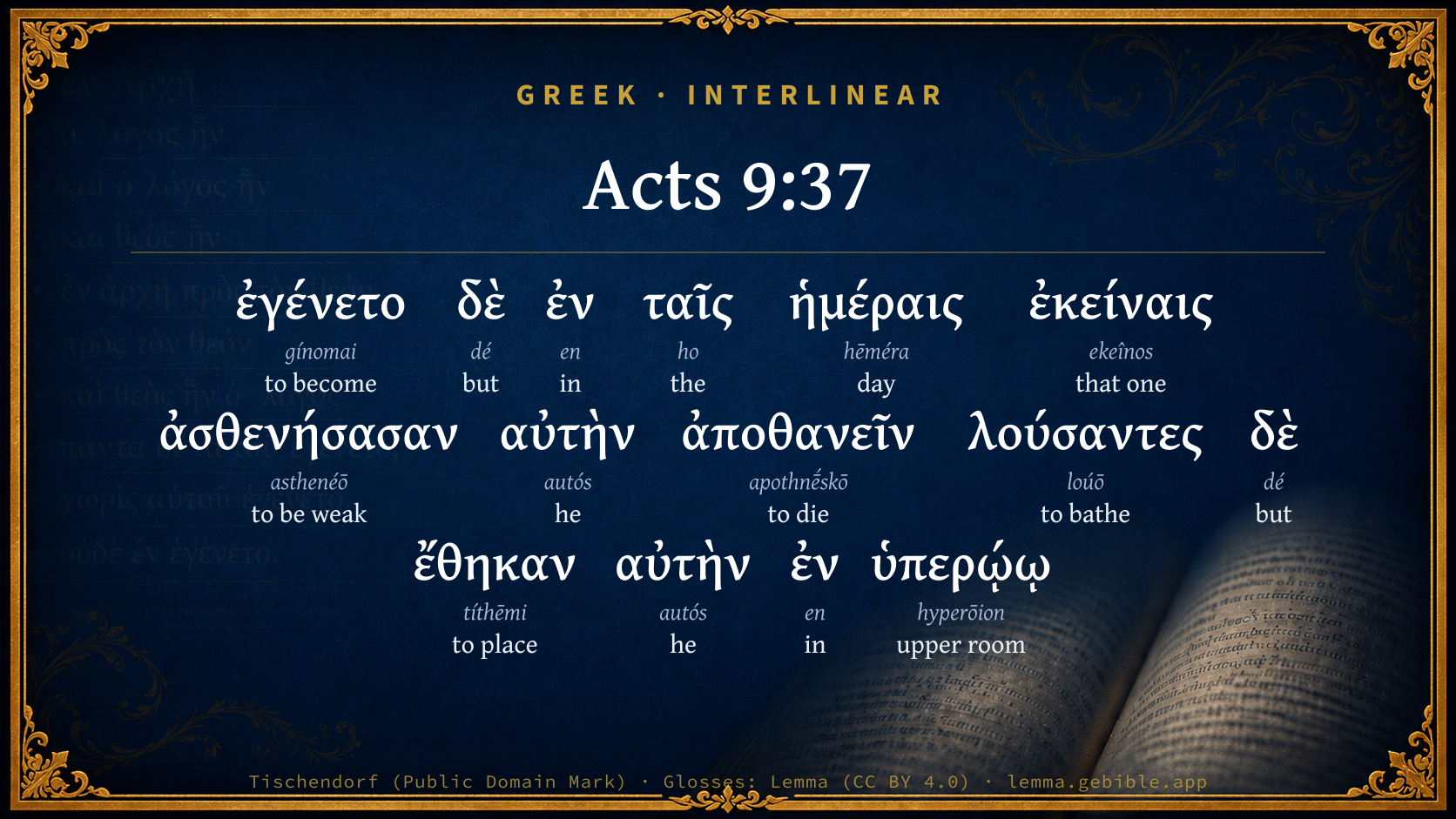
Greek (Tischendorf 8th ed.) Acts 9:37 appears in the Greek New Testament. The text above is from the Tischendorf 8th edition. Each word links to its Strong’s number and a concise gloss. Click any word for its full Thayer’s Greek Lexicon entry.
Download image
Cite this verse

Acts 9:37 (World English Bible). Public Domain. Lemma interlinear Bible study tool, https://lemma.gebible.app/v/acts/9/37.

Show BibTeX & RIS
BibTeX
RIS
English Translation
It happened in those days that she fell sick, and died. When they had washed her, they laid her in an upper chamber.
World English Bible · Public Domain
Download a study sheet

One document with this verse’s original text, its word-by-word gloss line, the meaning frame, cross-references with their text, attributed commentary, and full source and license credits — printable, and it pastes into notes with its structure intact.

This verse Autodidact and up

Study sheet (.html) Plain text (.txt)

A passage Seminary Student

Up to 50 verses in one chapter. A passage sheet keeps up to 6 commentary sources and 12 cross-references per verse, in the order this page ranks them, and says so on the sheet whenever that leaves anything out. Ask for a single verse and you get the Autodidact verse sheet above.

Everything on this page stays free to read, with no account — the sheet is a download of what is already on screen, not access to it.

Want to remove ads? Support Godless Engineer
Compare translations 3

The same verse in 3 English versions, stacked beneath the original-language interlinear above. Click any original word for its lexicon entry.

Each is an independent rendering of the whole verse — the interlinear is not word-aligned to these translations.

Highlighted words mark where these versions differ — a whole-verse word diff, not a word-by-word alignment.

  • World English Bible Public Domain
    It happened in those days that she fell sick, and died. When they had washed her, they laid her in an upper chamber.
  • King James Version Public Domain
    And it came to pass in those days, that she was sick, and died: whom when they had washed, they laid her in an upper chamber.
  • unfoldingWord Literal Text CC BY-SA 4.0
    And it happened in those days that, having been sick, she died. And having washed her, they laid her in an upper room.

unfoldingWord Literal Text — © unfoldingWord, licensed CC BY-SA 4.0. Word-aligned USFM3 via Door43 (git.door43.org/unfoldingWord/en_ult).

Versions to compare (up to 4)

3 of 4 selected

Show all 19 translations

Every available English version of this verse, each an independent rendering of the whole verse.

  • World English Bible Public Domain
    It happened in those days that she fell sick, and died. When they had washed her, they laid her in an upper chamber.
  • Berean Standard Bible Public Domain
    At that time, however, she became sick and died, and her body was washed and placed in an upper room.
  • Majority Standard Bible Public Domain
    At that time, however, she became sick and died, and her body was washed and placed in an upper room.
  • King James Version Public Domain
    And it came to pass in those days, that she was sick, and died: whom when they had washed, they laid her in an upper chamber.
  • American Standard Version (1901) Public Domain
    And it came to pass in those days, that she fell sick, and died: and when they had washed her, they laid her in an upper chamber.
  • Revised Version (1885) Public Domain
    And it came to pass in those days, that she fell sick, and died: and when they had washed her, they laid her in an upper chamber.
  • Geneva Bible (1599) Public Domain
    And it came to passe in those dayes, that she was sicke and dyed: and when they had washed her, they layd her in an vpper chamber.
  • Douay-Rheims (1899) Public Domain
    And it came to pass in those days that she was sick, and died. Whom when they had washed, they laid her in an upper chamber.
  • Young's Literal Translation Public Domain
    and it came to pass in those days she, having ailed, died, and having bathed her, they laid her in an upper chamber,
  • Literal Standard Version CC BY-SA 4.0
    and it came to pass in those days she, having ailed, died, and having bathed her, they laid her in an upper chamber,
  • Unlocked Literal Bible CC BY-SA 4.0
    It came about in those days that she fell sick and died; when they had washed her, they laid her in an upper room.
  • unfoldingWord Literal Text CC BY-SA 4.0
    And it happened in those days that, having been sick, she died. And having washed her, they laid her in an upper room.
  • Darby Bible Public Domain
    And it came to pass in those days that she grew sick and died; and, having washed her, they put her in [the] upper room.
  • World Messianic Bible Public Domain
    In those days, she became sick and died. When they had washed her, they laid her in an upper room.
  • Webster's Bible Public Domain
    And it came to pass in those days, that she was sick, and died: whom, when they had washed, they laid in an upper chamber.
  • Free Bible Version CC BY-SA 4.0
    However, about this time she became sick, and died. After washing her body, they laid her out in an upstairs room.
  • Bible in Basic English Public Domain
    And it came about, in those days, that she got ill and came to her death: and when she had been washed, they put her in a room which was high up.
  • Text-Critical English NT CC BY 4.0
    In those days she became sick and died, so they washed her body and laid it in an upper room.
  • Tyndale New Testament (1534) Public Domain
    And it chaunsed in those dayes that she was sicke and dyed. When they had wesshed her and layd her in a chamber:

Literal Standard Version (2020), Covenant Press — licensed CC BY-SA 4.0. Text via the HelloAO Bible API (eBible.org). Unlocked Literal Bible (unfoldingWord) — licensed CC BY-SA 4.0. Text via the HelloAO Bible API (eBible.org). unfoldingWord Literal Text — © unfoldingWord, licensed CC BY-SA 4.0. Word-aligned USFM3 via Door43 (git.door43.org/unfoldingWord/en_ult). Free Bible Version, Dr. Jonathan Gallagher — licensed CC BY-SA 4.0. Text via the HelloAO Bible API (eBible.org).

Word by word

More ways to search: Search by grammar → Find every occurrence → Compare this word →

Practice this passage: Drill this verse → Learn its vocabulary →

ὑπερῴῳ
hyperōion
G5253
“upper room”
Noun, Dative, Singular, Neuter
Part of Speech
Noun
Case
Dative
Number
Singular
Gender
Neuter
Full Thayer's Definition

Origin: from a derivative of G5228

TDNT: None

1. the highest part of the house, the upper rooms or story where the women resided 2. a room in the upper part of a house, sometimes built upon the flat roof of the house, whither Orientals were wont to retire in order to sup, meditate, pray
  1. ἐγένετο gínomai G1096 “to become” Verb, Aorist, Middle deponent, Indicative, 3rd person, Singular
  2. δὲ dé G1161 “but” Conjunction
  3. ἐν en G1722 “in” Preposition
  4. ταῖς ho G3588 “the” Article, Dative, Plural, Feminine
  5. ἡμέραις hēméra G2250 “day” Noun, Dative, Plural, Feminine
  6. ἐκείναις ekeînos G1565 “that one” Demonstrative pronoun, Dative, Plural, Feminine
  7. ἀσθενήσασαν asthenéō G770 “to be weak” Verb, Aorist, Active, Participle, Accusative, Singular, Feminine
  8. αὐτὴν autós G846 “he” Personal pronoun, Accusative, Singular, Feminine
  9. ἀποθανεῖν apothnḗskō G599 “to die” Verb, Aorist, Active, Infinitive
  10. λούσαντες loúō G3068 “to bathe” Verb, Aorist, Active, Participle, Nominative, Plural, Masculine
  11. δὲ dé G1161 “but” Conjunction
  12. ἔθηκαν títhēmi G5087 “to place” Verb, Aorist, Active, Indicative, 3rd person, Plural
  13. αὐτὴν autós G846 “he” Personal pronoun, Accusative, Singular, Feminine
  14. ἐν en G1722 “in” Preposition

About this verse

These counts appear in no published source. They are computed here, from the morphology-tagged text and Lemma’s own curated glosses. What Lemma adds →

15
words
12
distinct lemmas
Acts
section

Notable vocabulary

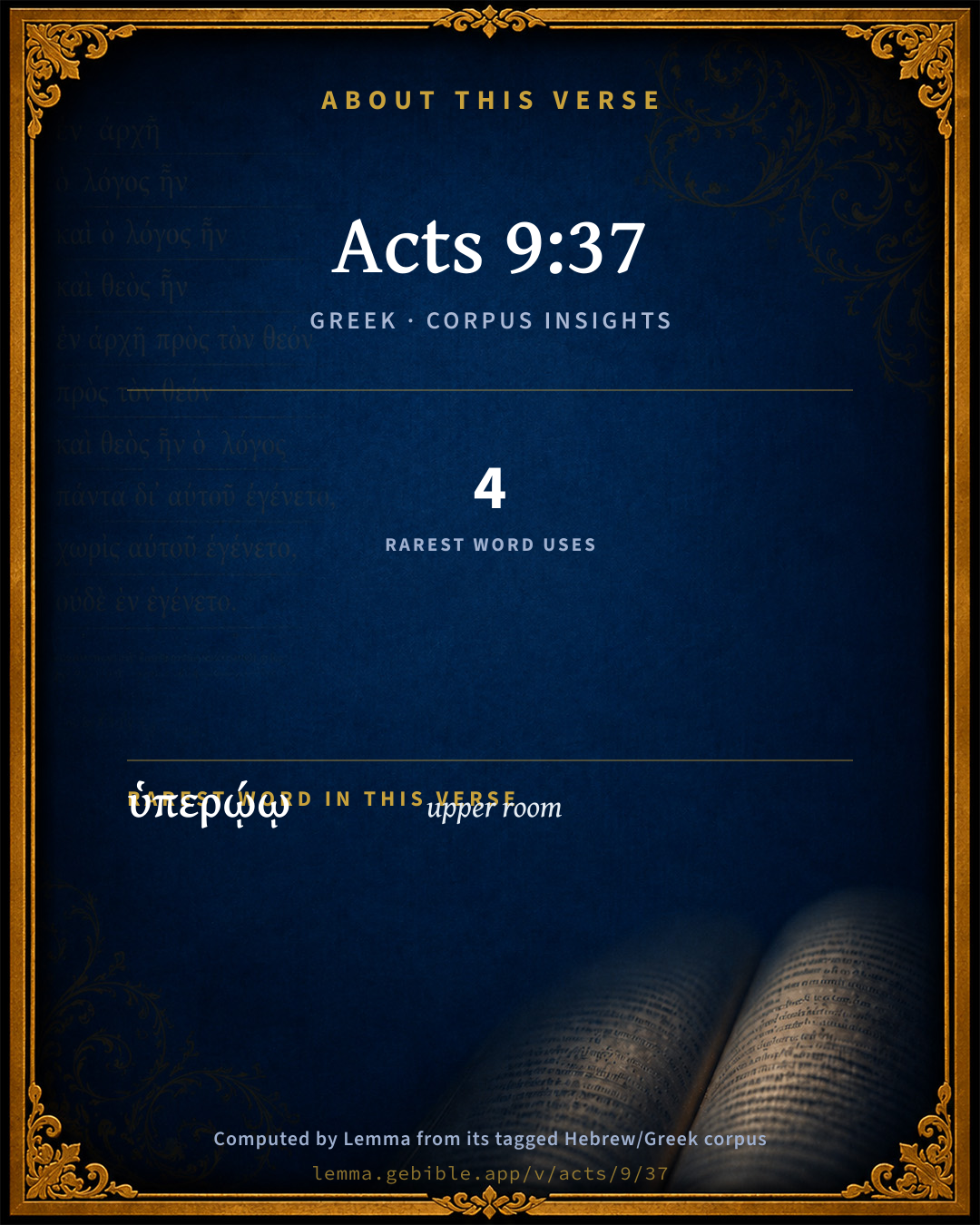
The rarest word here is ὑπερῴῳ upper room G5253 — appearing just 4 times in the whole Greek New Testament.

Shared distinctive vocabulary

ὑπερῴῳ upper room G5253 occurs in 4 verses of the Greek New Testament. Also found in:

Repetition

Words recur within this verse:

Cross-references

6

Topical passages linked to Acts 9:37 in the Treasury of Scripture Knowledge — connected by theme and wording, ordered by reader-vote popularity; previews shown in the World English Bible.

  • Acts 1:13 When they had come in, they went up into the upper room, where they were staying; that is Peter, John, James, Andrew, Philip, Thomas, Bartholomew, Matthew, James the son of Alphaeus, Simon the Zealot, and Judas the son of James.
  • Acts 20:8 There were many lights in the upper chamber where we were gathered together.
  • Mark 14:15 He will himself show you a large upper room furnished and ready. Make ready for us there."
  • John 11:3–4 The sisters therefore sent to him, saying, "Lord, behold, he for whom you have great affection is sick."
  • John 11:36–37 The Jews therefore said, "See how much affection he had for him!"
  • Acts 9:39 Peter got up and went with them. When he had come, they brought him into the upper chamber. All the widows stood by him weeping, and showing the coats and garments which Dorcas had made while she was with them.

Cross-references courtesy of OpenBible.info (CC BY 4.0).

Commentary

Notes on Acts 9:37 from classic Christian and Jewish commentators (each source and its license shown beneath its notes). The classic Christian expositions comment on the surrounding passage and are grouped to its opening verse, so a note may address several verses; the Jewish commentaries on the Tanakh (Rashi and others) are per-verse, so they appear only where the commentator wrote on this verse.

Lemma curates 59 commentaries, every one of them public domain or Creative Commons licensed, each selected and text-cleaned for this edition rather than reprinted as found. About our sources →

Meyer's Critical & Exegetical Commentary

Heinrich August Wilhelm Meyer

Act_9:37-38. Concerning the general ancient custom of washing the dead, see Dougtaei Anal. II. p. 77 ff., and Wetstein; also Hermann, Privatalterth. § 39. 5.

ἐν ὑπερῴῳ] The article (which Lachmann and Bornemann have, after A C E) was not necessary, as it was well known that there was only one upper room (Act_1:13) in the house, and thus no mistake could occur. Nor is anything known as to its having usually served as the chamber for the dead; perhaps the room for privacy and prayer was chosen in this particular instance, because they from the very first thought to obtain the presence and agency of Peter.

μὴ ὀκνήσῃς κ.τ.λ.] Comp. Num_22:16. Fides non tollit civilitatem verborum, Bengel. On the classical ὀκνεῖν (only here in the N. T.), see Ruhnk. ad Tim. p. 190; Jacobs, ad Anthol. III. p. 894. Thou mayest not hesitate to come to us. On διελθ., comp. Luk_2:15.

Meyer — Critical and Exegetical Commentary on the New Testament — English translation by Peter Christie, edited by Frederick Crombie (T&T Clark, 1880) — public domain. Text from a community e-Sword module.

Expositor's Greek Testament

ed. W. Robertson Nicoll

Act 9:37 . ἐγέν . δὲ : on the frequency of the formula in Luke see above p. 124, and Plummer, St. Luke , p. 45, on the use of ἐγένετο . ἀσθενήσασαν : aorist, marking the time when she fell sick (Weiss). λούσαντες : after the manner of the Jews as well as of the Greeks, cf. instances in Wetstein and Hamburger, Real-Encyclopädie des Judentums , i., 2, 162, “Beerdigung” Outside Jerusalem three days might elapse between the death and burial, but in Jerusalem no corpse lay over night, see Hamburger, u. s. , p. 161; in the case of Ananias and Sapphira we may note the accuracy of this distinction. ἔθηκαν : burial did not take place until the danger of an apparent death was considered past; in uncertain cases a delay as above might be allowed, or for other special reasons, and children were forbidden to hasten the burial of their parents, Hamburger, u. s. , p. 161; and further for burial and mourning customs, Edersheim, Jewish Social Life , p. 168, and History of the Jewish Nation , p. 311. ἐν ὑπερῴῳ : the body was usually laid in an upper chamber when burial was delayed; see Hackett’s note and also on Act 9:39 , and Alford on the article.

The Expositor's Greek Testament, edited by W. Robertson Nicoll (1897–1910) — public domain. Text from a community e-Sword module.

Jamieson, Fausset & Brown

Robert Jamieson, A. R. Fausset & David Brown

when they had washed--according to the custom of civilized nations towards the dead.

in an--rather, "the"

upper chamber--(compare Kg1 17:19).

Jamieson, Fausset & Brown — Commentary Critical and Explanatory on the Whole Bible (1871) — public domain (CC PDM 1.0). Text via the HelloAO Bible API.

Adam Clarke's Commentary

Verse 37. She was sick, and died] Even her holiness and usefulness could not prevent her from sickness and death. Dust thou art, and to dust thou shalt return, is a decree that must be fulfilled, even on the saints; for the body is dead, sentenced to death, because of sin, though the spirit be life because of righteousness.

Whom when they had washed] Having the fullest proof that she was dead, they prepared for her interment. In most nations of the world it was customary to wash their dead before they buried them, and before they laid them out to lie in state, as Homer tells us was the case with the body of Patroclus: -

Ὡς εἱπων, ἑταροισιν εκεκλετο διος Αχιλλευς,

Αμφι πυρι Ϛησαι τριποδα μεγαν, οφρα ταχιϚα

Πατροκλον λουσειαν -

Και τοτε δη λουσαν τε, και ηλειψαν λιπ' ελαιῳ __

Iliad xviii. 343.

"So saying, he bade his train surround with fire

A tripod huge, that they might quickly cleanse

Patroclus from all stains of clotted gore.

They on the blazing hearth a tripod placed,

Infused the water, thrust dry wood beneath,

And soon the flames, encompassing around

Its ample belly, warm'd the flood within.

Soon as the water in the singing brass

Simmer'd, they bathed him, and with limpid oil

Anointed.

They stretch'd him on his bed, then cover'd him

From head to feet with linen texture light,

And with a wide unsullied mantle last."

COWPER.

The waking or watching of the dead was also practised among the ancient Greeks, as we learn from a preceding paragraph, where Achilles, addressing his dead friend Patroclus, tells him:-

Τοφρα δε μοι παρα νηυσι κορωνισι κεισεαι αὑτως·

Αμφι δε σε Τρωαι και Δαρδανιδες βαθυκολποι

Κλαυσονται, νυκτας τε και ηματα δακρυχεουσαι

Il. xviii. 338.

"Mean time, among

My lofty galleys thou shalt lie, with tears

Mourn'd day and night, by Trojan captives fair

And Dardan, compassing thy bier around."

COWPER.

A similar description is given by Virgil of the funeral obsequies of Misenus, AEneid vi. ver. 212.

Nec minus interea Misenum in littore Teucri

Flebant, et cineri ingrato suprema ferebant.

* * * * * * *

Pars calidos latices et aena undantia flammis

Expediunt, corpusque lavant frigentis et ungunt

Fit gemitus: tum membra toro defleta reponunt,

Purpureasque super vestes, velamina nota,

Conjiciunt, c.

"Meanwhile, the Trojan troops, with weeping eyes,

To dead Misenus pay his obsequies.

First from the ground a lofty pile they rear

Of pitch-trees, oaks, and pines, and unctuous fir:

The fabric's front with cypress twigs they strew

And stick the sides with boughs of baleful yew;

The topmost part his glitt'ring arms adorn:

Warm waters then, in brazen cauldrons borne,

Are pour'd to wash his body, joint by joint;

And fragrant oils the stiffen'd limbs anoint.

With groans and cries Misenus they deplore.

Then on a bier with purple cover'd o'er

The breathless body, thus bewail'd, they lay."

DRYDEN.

These rites, in many respects, resemble those still used among the native Irish. See the account of the funeral ceremonies of the Egyptians, in the notes, See Clarke on Ge 50:2. The primitive Christians washed the bodies of their dead not only out of decency and affectionate respect to them, but as a token of their firm belief in the resurrection of the dead.

Adam Clarke's Commentary on the Bible (1810–1826) — public domain. Text from a community e-Sword/MySword module.

John Calvin's Commentaries

37. It happened that she was sick. He saith in plain words that she was sick, that he may the more plainly express her death which followed. To the same end he saith that the corpse was washed and laid in an upper chamber; therefore, these circumstances serve to make the miracle to be believed. Whereas they carry her not straightway to the grave, but lay her in the upper part of the house, that they may keep her there, we may thereby gather that they had some hope of recovering her life. It is likely that the rite of washing, whereof Luke maketh mention, was most ancient; and I do not doubt but that it came from the holy fathers by continual course of times, as if it had been delivered from hand to hand, that in death itself some visible and of the resurrection might comfort the minds of the godly, and lift them up unto some good hope; to wit, seeing the manifestation of eternal life was not so evident, yea, seeing that Christ, the pledge and substance of eternal life, was not as yet revealed, it was requisite that both the obscurity of doctrine, and also the absence of Christ, should be supplied by such helps. Therefore they washed the bodies of the dead, that they might once stand before the judgment-seat of God, being clean. Finally, there was the same reason for washing the dead which was for the living; the daily washing put them in mind of this, that no man can please God save he who should be purged from his filthiness. So, in the rite of burying, God would have some sign extant whereby men might be admonished that they went polluted out of this life by reason of that filthiness which they had gathered in the world. Washing did no more help those which were dead than burial, but it was used to teach the living; for because death hath some show of destruction, lest it should extinguish the faith of the resurrection, it was requisite that contrary shows should be set against it, that they might represent life in death. The Gentiles also took to themselves this ceremony, for which cause Ennius saith, A good woman did wash and anoint Tarquinius’s corpse. But (their) imitation was but apish in this thing, as in all other ceremonies. And Christians also have taken to themselves this example unadvisedly, as if the observation of a figure used under the law ought to continue always; for at the beginning of the gospel, although the necessity were abolished, yet the use was lawful, until such time as it might grow out of use in tract of time. But the monks do at this day no less imitate Judaism than did the Gentiles in times past, without choice and judgment, for they wash corpses, that they may bury Christ in shadows, which, being buried with him in his grave, ought never to have been used any more.

John Calvin's Commentaries (1540-1563) — public domain. Text from the Calvin Translation Society English edition (1840s-50s) via the Christian Classics Ethereal Library (ccel.org). Calvin's coverage is partial (roughly two-thirds of the Bible); uncommented books and verses are honest gaps, never fabricated. The 19th-century editor's footnotes and remarks are omitted so the notes are faithfully Calvin's own voice.

Ellicott's Commentary for English Readers

(37) They laid her in an upper chamber.—This implies some little delay in the usual rapidity of Eastern funerals. As Lydda was only nine miles from Joppa, the report of Æneas’s recovery might well have travelled from the one city to the other, and led to the hope that the power which St. Peter had thus put forth might extend even to the farther work of raising from the dead.

A Bible Commentary for English Readers, edited by Charles John Ellicott (1878–1897) — public domain. Text from a community e-Sword module.

The Cambridge Bible for Schools and Colleges

gen. ed. J. J. S. Perowne

37. that she was [fell] sick, and died] The proceedings which followed on her death are evidence of its reality. The probable reason for deferring the burial was the knowledge that Peter was close at hand, and the hope of the disciples that the power of Jesus might be exercised through him for the restoration to life of so eminent a disciple as Dorcas.

The Cambridge Bible for Schools and Colleges (gen. ed. J. J. S. Perowne; Cambridge University Press, 1878–1918) — public domain. Text from a community e-Sword module.

John Gill's Exposition

And forasmuch as Lydda was nigh to Joppa,.... Some say it was six miles distant, but it must be eight; since from Jerusalem to Joppa were forty miles, and from Jerusalem to Lydda thirty two, and therefore it must be eight miles from thence to Joppa:

and the disciples had heard that Peter was there; and also no doubt that he had healed Aeneas of his palsy, and which might induce them to do as follows:

they sent unto him two men; very likely of their own company or church; for it is certain here were disciples or believers in Christ, and very likely were formed into a church state; these seem to be converts under Philip's ministry, who when he went from Azotus, preached in all the cities, and so in Joppa, till he came to Caesarea, Act 8:40 though we read nothing in ecclesiastical history of this church at Joppa, until the fifth century, when it appears there was a church in that place (n); and in the same century we read of Fidus bishop of Joppa, that was present in the synod held at Ephesus, anno 431 and in the sixth century of Elias bishop of the same place, in the council at Jerusalem, anno 536 (o) and in the same century a bishop of the church here assisted in the synod of Rome and Constantinople (p).

desiring him, that he would not delay to come to them; they entreated he would not refuse to come, and think it too great a burden on him, or make any difficulty about it, or show any aversion to it; but that he would with all readiness and cheerfulness, and without delay immediately come unto them; for the case they wanted him for required speed and haste.

(n) Magdeburg. Hist. Eccles. cent. 5. c. 2. p. 2. (o) Reland. Palestina Illustrata, l. 3. p. 867. (p) Magdeburg. ib. cent. 6. c. 2. p. 3.

John Gill's Exposition of the Whole Bible (1746–1763) — public domain (CC PDM 1.0). Text via the HelloAO Bible API.

Trapp's Complete Commentary

John Trapp

37 And it came to pass in those days, that she was sick, and died: whom when they had washed, they laid her in an upper chamber.

Ver. 37. When they had washed] This they did to show their hope of a joyful resurrection. The heathens also, though their lives and hopes ended together, yet they washed their dead in an apish imitation of this Church custom. Faciunt et vespae faves; simlae imitantur homines.

John Trapp, A Commentary or Exposition upon All the Books of the Old and New Testament (1647–1656) — public domain. Text from a community e-Sword module.

Albert Barnes' Notes on the Bible

Whom, when they had washed - Among most people it has been customary to wash the body before it is buried or burned. They prepared her in the usual manner for interment.

In an upper chamber - See the notes on Act 1:13. There is no evidence that they expected that Peter would raise her up to life.

Albert Barnes' Notes on the Bible (1834–1885) — public domain. Text from a community e-Sword/MySword module.

Haydock's Catholic Bible Commentary

Washed. This custom of washing the dead was observed among the Greeks, Romans, Hebrews, and most other nations. It is still practised in monasteries, and formerly was observed with much ceremony. St. John Chrysostom observes, that our Saviour’s body was washed and embalmed. The same custom is mentioned in Homer and Virgil: Corpusque lavant frigentis, et ungunt. --- And again,

Date, vulnera lymphis abluam. --- Æneid. iv.

--- Tertullian, in his Apology, testifies, that the Christians performed that office to the dead. It was a proof of their respect for the image of God impressed upon his creature, and for the character of Christian, which these persons have borne during their lives. It was likewise a sign of the confidence they had in a future resurrection.

George Leo Haydock (1774–1849), Haydock's Catholic Family Bible and Commentary, 1859 edition — public domain. Excludes Psalms (Douay-Rheims chapter numbering differs from Protestant) and Deuterocanonical books (Catholic canon only).

Matthew Poole's English Annotations

They washed the dead, and anointed them, to fit them for their burying, and especially to show their hope of the resurrection; which some think St. Paul alludes unto, 1Co 15:29.

Matthew Poole's English Annotations on the Holy Bible (1683–1685) — public domain. Text from a community e-Sword/MySword module.

The Pulpit Commentary

Fell sick for was sick, A.V.; and when they had washed her for whom when they had washed, A.V. For the phrase in those days, comp. Act_6:1. The days here meant are those while Peter was in those parts.

An upper chamber (uJperwon), as in Act_1:13. The upper chamber was much more private and quiet than a room on the ground floor. (see 2Ki_4:10, 2Ki_4:11)

The Pulpit Commentary (1880–1919), ed. H.D.M. Spence-Jones & Joseph S. Exell — public domain. Text from a community e-Sword module.

Godbey's Commentary on the New Testament

William B. Godbey

37. . . .“and washing her they placed her in an upper chamber.” Pursuant to the beautiful symbolism of the Jewish dispensation, they invariably washed a corpse with great care before depositing it in the sepulcher, thus typifying the complete purification of the soul in order to its admission into paradise. On Peter’s arrival the saints and widows gather around him, showing him “the shirts and cloaks, such as Dorcas was accustomed to make while with them.” Oriental costume at the present day is very simple with the common people, consisting of only two garments, i. e., the interior, which is constantly worn, and the exterior, frequently carried on the arm, to be worn when needed and used as a bed for lodging. These were the garments in whose manufacture Dorcas excelled. While the common people in the Old World dress in a cheap and simple style, such as we seldom see in this country, the nobility and royalists go to excess in quantity and quality far beyond anything observable among Occidentals.

William B. Godbey, Commentary on the New Testament (1896–1900) — public domain. Text from a community e-Sword module.

McGarvey & Pendleton's Commentaries

J. W. McGarvey

See notes on verse 36

J. W. McGarvey (with Philip Y. Pendleton), Commentaries on the New Testament (The Fourfold Gospel, 1914; Acts; and the epistles) — public domain. Text from a community e-Sword/MySword module.

The People's New Testament

B. W. Johnson

37. Washed, … laid her in an upper chamber. Prepared for burial. The place was the large upper room on the upper floor of Eastern houses, usually used as a guest chamber.

B. W. Johnson's The People's New Testament with Notes (1889–1891) — public domain. Electronic text from the Christian Classics Ethereal Library (CCEL) ThML edition.

Cambridge Greek Testament for Schools and Colleges

37. ἀσθενήσασαν αὐτὴν ἀποθανεῖν, that she fell sick and died. The proceedings which followed on her death are evidence of its reality. The probable reason for deferring the burial was the knowledge that Peter was close at hand, and the hope of the disciples that the power of Jesus might be exercised through him for the restoration to life of so eminent a disciple as Dorcas.

λούσαντες δέ, and when they had washed her. No doubt it was the women who prepared the body for burial, but the historian, speaking generally, writes not λούσασαι but the masculine.

Cambridge Greek Testament for Schools and Colleges (Cambridge University Press, 1896; 21 vols, various authors incl. Carr, Maclear, Plummer, Farrar, Lumby, Moule, M. R. James, Simcox) — public domain. Text from a community e-Sword module.

Alford’s Greek Testament

Henry Alford

37. ἐν ὑπερῴῳ] No art., as in the expressions εἰς οἶκον, ‘on deck,’ &c., which usually occur after prepositions, cf. Middl. ch. vi. § 1.

See 1Ki 17:19.

Henry Alford, The Greek Testament (1849–1861) — public domain. Text from a community e-Sword module.

Vincent's Word Studies in the New Testament

Marvin R. Vincent

Upper chamber. See on ch. Act 1:13.

Marvin R. Vincent, Word Studies in the New Testament (1887–1900) — public domain. Text from a community e-Sword/MySword module.

Lesson kit

Teaching starters — assembled from the data on this page, not authored interpretation. Every prompt links to the verse data it draws on. Edit before teaching.

Acts, in the Acts, opens this verse with 15 words (12 distinct Greek lemmas). Its most distinctive word is hyperōion (“upper room”). A historical commentator’s framing appears above. Read the whole chapter for the surrounding context.

Discussion questions

  1. How does “upper room” (hyperōion) shape what this verse is saying?
  2. Acts 1:13 shares the word «upper room» with this verse. How do the two illuminate each other?
  3. “but” occurs 2× in this one verse. What is the effect of the repetition?
  4. These translations render this verse differently; the difference is in the English rendering, not the original. What questions does that raise?
  5. Reading how Meyer's Critical & Exegetical Commentary and Expositor's Greek Testament read this verse, where do the two commentators agree and where do they part?

Things to notice

Reading settings

Reading text

Shown beneath each verse's original-language words.

Old Testament
Old Testament edition

Read the OT as the Masoretic Hebrew (MT) or the Greek Septuagint (LXX).

English shown for the Greek Septuagint (in the Hebrew ↔ Greek comparison).

Comparing translations? Open the Compare panel on any verse page to stack up to four side by side.