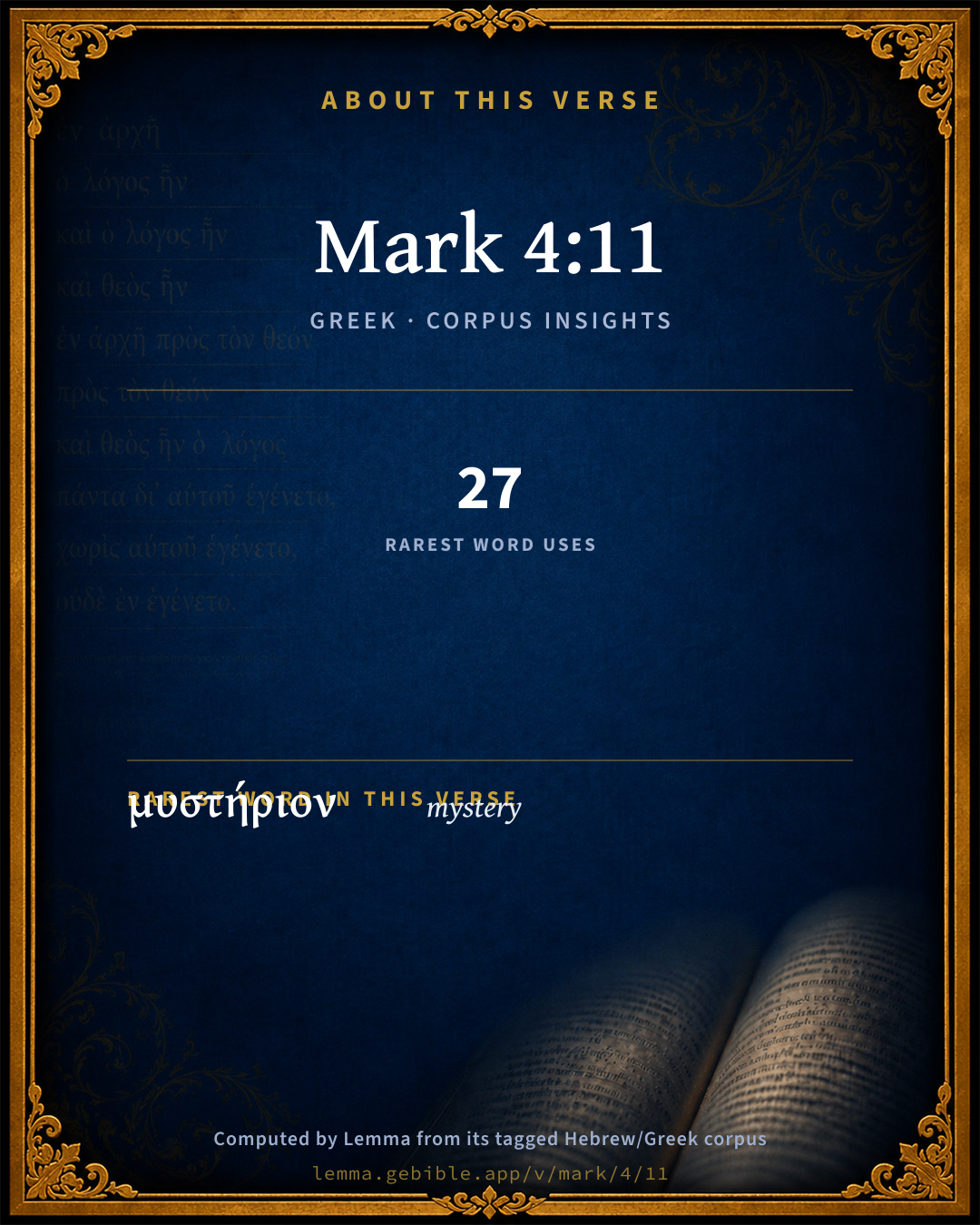
Mark 4:11

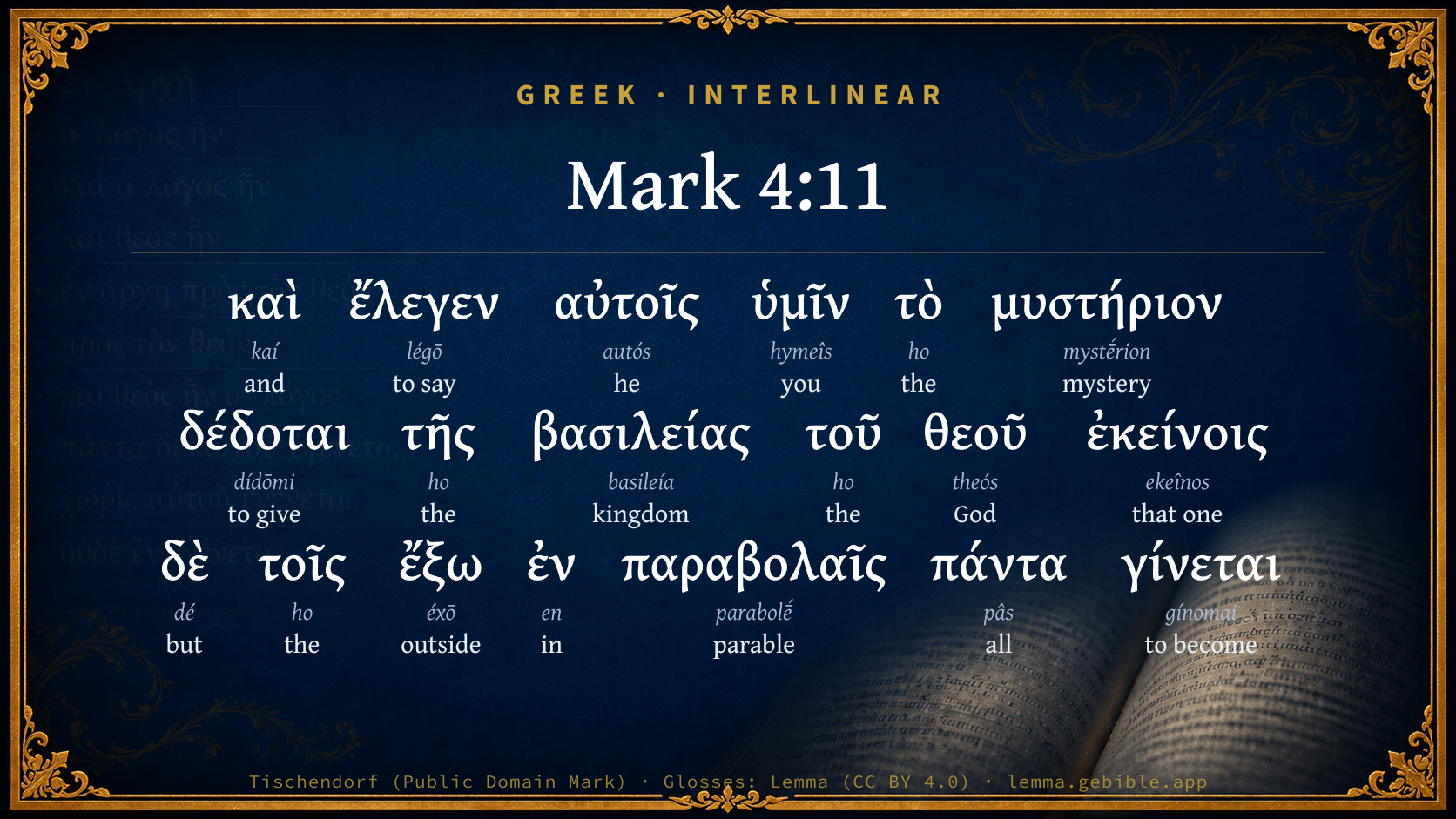
Greek (Tischendorf 8th ed.) Mark 4:11 appears in the Greek New Testament. The text above is from the Tischendorf 8th edition. Each word links to its Strong’s number and a concise gloss. Click any word for its full Thayer’s Greek Lexicon entry.
Download image
Cite this verse

Mark 4:11 (World English Bible). Public Domain. Lemma interlinear Bible study tool, https://lemma.gebible.app/v/mark/4/11.

Show BibTeX & RIS
BibTeX
RIS
English Translation
He said to them, "To you is given the mystery of the Kingdom of God, but to those who are outside, all things are done in parables,
World English Bible · Public Domain
Download a study sheet

One document with this verse’s original text, its word-by-word gloss line, the meaning frame, cross-references with their text, attributed commentary, and full source and license credits — printable, and it pastes into notes with its structure intact.

This verse Autodidact and up

Study sheet (.html) Plain text (.txt)

A passage Seminary Student

Up to 50 verses in one chapter. A passage sheet keeps up to 6 commentary sources and 12 cross-references per verse, in the order this page ranks them, and says so on the sheet whenever that leaves anything out. Ask for a single verse and you get the Autodidact verse sheet above.

Everything on this page stays free to read, with no account — the sheet is a download of what is already on screen, not access to it.

Want to remove ads? Support Godless Engineer
Compare translations 3

The same verse in 3 English versions, stacked beneath the original-language interlinear above. Click any original word for its lexicon entry.

Each is an independent rendering of the whole verse — the interlinear is not word-aligned to these translations.

Highlighted words mark where these versions differ — a whole-verse word diff, not a word-by-word alignment.

  • World English Bible Public Domain
    He said to them, "To you is given the mystery of the Kingdom of God, but to those who are outside, all things are done in parables,
  • King James Version Public Domain
    And he said unto them, Unto you it is given to know the mystery of the kingdom of God: but unto them that are without, all these things are done in parables:
  • unfoldingWord Literal Text CC BY-SA 4.0
    And he was saying to them, “To you has been given the mystery of the kingdom of God, but to those, the ones outside, everything is in parables,

unfoldingWord Literal Text — © unfoldingWord, licensed CC BY-SA 4.0. Word-aligned USFM3 via Door43 (git.door43.org/unfoldingWord/en_ult).

Versions to compare (up to 4)

3 of 4 selected

Show all 19 translations

Every available English version of this verse, each an independent rendering of the whole verse.

  • World English Bible Public Domain
    He said to them, "To you is given the mystery of the Kingdom of God, but to those who are outside, all things are done in parables,
  • Berean Standard Bible Public Domain
    He replied, “The mystery of the kingdom of God has been given to you, but to those on the outside everything is expressed in parables,
  • Majority Standard Bible Public Domain
    He replied, “To know the mystery of the kingdom of God has been given to you, but to those on the outside everything is expressed in parables,
  • King James Version Public Domain
    And he said unto them, Unto you it is given to know the mystery of the kingdom of God: but unto them that are without, all these things are done in parables:
  • American Standard Version (1901) Public Domain
    And he said unto them, Unto you is given the mystery of the kingdom of God: but unto them that are without, all things are done in parables:
  • Revised Version (1885) Public Domain
    And he said unto them, Unto you is given the mystery of the kingdom of God: but unto them that are without, all things are done in parables:
  • Geneva Bible (1599) Public Domain
    And he saide vnto them, To you it is giuen to knowe the mysterie of the kingdome of God: but vnto them that are without, all thinges bee done in parables,
  • Douay-Rheims (1899) Public Domain
    And he said to them: To you it is given to know the mystery of the kingdom of God: but to them that are without, all things are done in parables:
  • Young's Literal Translation Public Domain
    and he said to them, `To you it hath been given to know the secret of the reign of God, but to those who are without, in similes are all the things done;
  • Literal Standard Version CC BY-SA 4.0
    and He said to them, “To you it has been given to know the secret of the Kingdom of God, but to those who are outside, in allegories are all the things done,
  • Unlocked Literal Bible CC BY-SA 4.0
    He said to them, “To you is given the mystery of the kingdom of God. But to those outside everything is in parables,
  • unfoldingWord Literal Text CC BY-SA 4.0
    And he was saying to them, “To you has been given the mystery of the kingdom of God, but to those, the ones outside, everything is in parables,
  • Darby Bible Public Domain
    And he said to them, To you is given [to know] the mystery of the kingdom of God; but to them who are without, all things are done in parables,
  • World Messianic Bible Public Domain
    He said to them, “To you is given the mystery of God’s Kingdom, but to those who are outside, all things are done in parables,
  • Webster's Bible Public Domain
    And he said to them, To you it is given to know the mystery of the kingdom of God: but to them that are without, all these things are done in parables:
  • Free Bible Version CC BY-SA 4.0
    He told them, “The mystery of God's kingdom has been given to you to understand. But outsiders only have the stories,
  • Bible in Basic English Public Domain
    And he said to them, To you is given the secret of the kingdom of God, but to those who are outside, all things are given in the form of stories;
  • Text-Critical English NT CC BY 4.0
    So he said to them, “To you it has been given to know the mystery of the kingdom of God, but to those who are outside everything is spoken in parables,
  • Tyndale New Testament (1534) Public Domain
    And he sayde vnto them. To you it is geve to knowe the mistery of the kyngdome of God. But vnto them that are with out shall all thinges be done in similitudes:

Literal Standard Version (2020), Covenant Press — licensed CC BY-SA 4.0. Text via the HelloAO Bible API (eBible.org). Unlocked Literal Bible (unfoldingWord) — licensed CC BY-SA 4.0. Text via the HelloAO Bible API (eBible.org). unfoldingWord Literal Text — © unfoldingWord, licensed CC BY-SA 4.0. Word-aligned USFM3 via Door43 (git.door43.org/unfoldingWord/en_ult). Free Bible Version, Dr. Jonathan Gallagher — licensed CC BY-SA 4.0. Text via the HelloAO Bible API (eBible.org).

Word by word

More ways to search: Search by grammar → Find every occurrence → Compare this word →

Practice this passage: Drill this verse → Learn its vocabulary →

μυστήριον
mystḗrion
G3466
“mystery”
Noun, Nominative, Singular, Neuter
Part of Speech
Noun
Case
Nominative
Number
Singular
Gender
Neuter
Full Thayer's Definition

Origin: from a derivative of muo (to shut the mouth)

TDNT: 17:22,6

1. hidden thing, secret, mystery a. generally mysteries, religious secrets, confided only to the initiated and not to ordinary mortals b. a hidden or secret thing, not obvious to the understanding c. a hidden purpose or counsel 1. secret will 1c d. of men 1c e. of God: the secret counsels which govern God in dealing with the righteous, which are hidden from ungodly and wicked men but plain to the godly 2. in rabbinic writings, it denotes the mystic or hidden sense a. of an OT saying b. of an image or form seen in a vision c. of a dream
  1. καὶ kaí G2532 “and” Conjunction
  2. ἔλεγεν légō G3004 “to say” Verb, Imperfect, Active, Indicative, 3rd person, Singular
  3. αὐτοῖς autós G846 “he” Personal pronoun, Dative, Plural, Masculine
  4. ὑμῖν hymeîs G5210 “you” Personal pronoun, 2nd person, Dative, Plural
  5. τὸ ho G3588 “the” Article, Nominative, Singular, Neuter
  6. δέδοται dídōmi G1325 “to give” Verb, Perfect, Passive, Indicative, 3rd person, Singular
  7. τῆς ho G3588 “the” Article, Genitive, Singular, Feminine
  8. βασιλείας basileía G932 “kingdom” Noun, Genitive, Singular, Feminine
  9. τοῦ ho G3588 “the” Article, Genitive, Singular, Masculine
  10. θεοῦ theós G2316 “God” Noun, Genitive, Singular, Masculine
  11. ἐκείνοις ekeînos G1565 “that one” Demonstrative pronoun, Dative, Plural, Masculine
  12. δὲ dé G1161 “but” Conjunction
  13. τοῖς ho G3588 “the” Article, Dative, Plural, Masculine
  14. ἔξω éxō G1854 “outside” Adverb
  15. ἐν en G1722 “in” Preposition
  16. παραβολαῖς parabolḗ G3850 “parable” Noun, Dative, Plural, Feminine
  17. πάντα pâs G3956 “all” Adjective, Nominative, Plural, Neuter
  18. γίνεται gínomai G1096 “to become” Verb, Present, Middle or Passive deponent, Indicative, 3rd person, Singular

About this verse

These counts appear in no published source. They are computed here, from the morphology-tagged text and Lemma’s own curated glosses. What Lemma adds →

19
words
16
distinct lemmas
Gospels
section

Shared distinctive vocabulary

μυστήριον mystery G3466 occurs in 27 verses of the Greek New Testament. Also found in:

Repetition

A word recurs within this verse:

Cross-references

17

Topical passages linked to Mark 4:11 in the Treasury of Scripture Knowledge — connected by theme and wording, ordered by reader-vote popularity; previews shown in the World English Bible.

  • Matthew 11:25 At that time, Jesus answered, "I thank you, Father, Lord of heaven and earth, that you hid these things from the wise and understanding, and revealed them to infants.
  • Luke 8:10 He said, "To you it is given to know the mysteries of the Kingdom of God, but to the rest in parables; that 'seeing they may not see, and hearing they may not understand.'
  • 1 Corinthians 5:12–13 For what have I to do with also judging those who are outside? Don't you judge those who are within?
  • Colossians 4:5 Walk in wisdom toward those who are outside, redeeming the time.
  • 1 Thessalonians 4:12 that you may walk properly toward those who are outside, and may have need of nothing.
  • James 1:16–18 Don't be deceived, my beloved brothers.
  • 1 John 5:20 We know that the Son of God has come, and has given us an understanding, that we know him who is true, and we are in him who is true, in his Son Jesus Christ. This is the true God, and eternal life.
  • Ephesians 1:9 making known to us the mystery of his will, according to his good pleasure which he purposed in him
  • Ephesians 2:4–10 But God, being rich in mercy, for his great love with which he loved us,
  • 1 Timothy 3:7 Moreover he must have good testimony from those who are outside, to avoid falling into reproach and the snare of the devil.
  • Titus 3:3–7 For we were also once foolish, disobedient, deceived, serving various lusts and pleasures, living in malice and envy, hateful, and hating one another.
  • Matthew 13:16 "But blessed are your eyes, for they see; and your ears, for they hear.
  • Matthew 16:17 Jesus answered him, "Blessed are you, Simon Bar Jonah, for flesh and blood has not revealed this to you, but my Father who is in heaven.
  • Luke 10:21–24 In that same hour Jesus rejoiced in the Holy Spirit, and said, "I thank you, O Father, Lord of heaven and earth, that you have hidden these things from the wise and understanding, and revealed them to little children. Yes, Father, for so it was well-pleasing in your sight."
  • 2 Corinthians 4:6 seeing it is God who said, "Light will shine out of darkness," who has shone in our hearts, to give the light of the knowledge of the glory of God in the face of Jesus Christ.
  • Matthew 13:11–13 He answered them, "To you it is given to know the mysteries of the Kingdom of Heaven, but it is not given to them.
  • 1 Corinthians 4:7 For who makes you different? And what do you have that you didn't receive? But if you did receive it, why do you boast as if you had not received it?

Cross-references courtesy of OpenBible.info (CC BY 4.0).

Commentary

Notes on Mark 4:11 from classic Christian and Jewish commentators (each source and its license shown beneath its notes). The classic Christian expositions comment on the surrounding passage and are grouped to its opening verse, so a note may address several verses; the Jewish commentaries on the Tanakh (Rashi and others) are per-verse, so they appear only where the commentator wrote on this verse.

Lemma curates 59 commentaries, every one of them public domain or Creative Commons licensed, each selected and text-cleaned for this edition rather than reprinted as found. About our sources →

The Biblical Illustrator

Joseph S. Exell

Mar_4:11

Unto you it is given to know the mystery of the Kingdom of God.

Parables for two multitudes

As for the multitude, if you strain Christs language respecting them, you might say they were punished for their blindness by His making dark to them things which He made clear to others. This has been said. You have heard of judicial blindness-blindness, that is to say, inflicted by God as the punishment of unbelief or other sin. But if this was the case, why did He speak to them at all? Did He wish only a dozen men, or a few dozens, to understand what He said? If then it was not to hide His meaning from the multitude that Christ taught them in parables, how do you account for His choosing to teach them in that way? To answer this question we have to consider for a moment-

I. What a parable is. Now there is one thing certain as to these stories, that whatever might be His intention in using them, they do clear up things wonderfully. It would have taken a long discourse on true piety to show the distinction between it and false piety, which is shown in the Publican and the Pharisee; and what long discourse would have shown it so well? Remember this also, in regard to parables like Christs-they keep close to reality, they reproduce nature and life. Now if we take all this into consideration as to the nature of parables, it is possible, I think, to account for Christs speaking to the multitude in parables, and parables alone. In the first place, possibly there were what we may call considerations of prudence and policy in favour of this way of teaching. Look at the whole set of parables in this chapter; they all relate to the kingdom of God; and one thing they all more or less distinctly intimate, and it is that the establishment of that kingdom must be a work of time. It is like a sower who goes forth to sow; it is like the tares and the wheat which must grow up together until the harvest. As all these parables here suggest to us, time was needed for truth to prevail against error. Direct attack upon it was useless. Christ had tried that and found it unprofitable. And here the parables came in to serve the purpose. They did not assail error or assert truth controversially. Everyone could take from them and make of them what he pleased. But there was one thing certain with regard to them, and it was that they were certain to be remembered. They were sure to pass from mouth to mouth, and travel where doctrine however clear, or precept however just, would not reach. The meaning in them now open to the few would remain, and by and by might be perceived by the many. Time would ripen them for the purpose of instructing the multitude as well as the disciples. And this was their special virtue, that while they were thus fitted to preserve truth from being forgotten, they were above all fitted to preserve truth from being corrupted. Those whose minds were filled with the Pharisees ideas of religion could hardly help misunderstanding and misrepresenting the doctrinal sayings of Jesus. But it is impossible to corrupt, or sophisticate, or distort the story of the Prodigal Son or the Good Samaritan. A parable cannot be qualified like a saying or a body of doctrine. It is a bit of fact, and cannot be qualified by words. It keeps its meaning pure in spite of every effort to corrupt it. It is of kin with nature, which, whatever you may say of it or of any part of it, remains nature still, and is the truth. And thus it was for one thing Christ spoke to the multitude in parables. His purpose was to teach them truth, but their minds being filled with error, they had to unlearn that first. He spoke in parables, knowing that parables would last, and that while they lasted and were working their work, they would not, because they could not, be corrupted. But the great thing was that which distinguishes parables from other figures of speech-that they keep close to reality, to nature, and to life. It was the special vice of the religion of the multitude in Christs day, that it was wholly artificial, all sacrifice and no mercy. Their teachers taught them for doctrine the commandments of men, the thousand and one arbitrary rules about eating and drinking, about fasts and feasts, about offerings, about days, about intercourse with Gentiles, and touching the dead. The scope of Christs teaching was exactly the opposite of this. He was for mercy, and not sacrifice; for righteousness, and not mint and anise and cumin. It suited His doctrine, therefore, to be taught in parables. The world itself, if your doctrine is mercy, is one great parable ready for your use. Reality of any kind is truth, and all truth, from the lowest to the highest, is one; so that there are books in the running brooks, sermons in stones, and good in everything. The truth of things, begin with it where you will, if you follow it out will lead you up to God. You can make birds and beasts, and virtues and vices talk what you please; but you cannot, if you go to nature and human life find a parable to fit a lie. Christ chose that form of teaching which brought men face to face with nature and human life, because the men He had to teach, in the matter of their religion had departed as far as was possible from the truth of things, and had lost themselves in sayings and commandments and traditions, questions and strifes of words. He put truth into a form in which it could not perish or be corrupted; He turned his hearers minds in the direction in which they could soonest unlearn their errors and be prepared to receive His truth.

II. Now, consider the different effect of his parables upon the multitude and the disciples. As for the multitude, they had first to begin and unlearn everything they believed, before they could perceive the truth which His parables contained. Before anything in this particular set of parables here as to the kingdom of God could reach their minds, they had to unlearn all that they had learned from their teachers as to the kingdom of God being a Jewish commonwealth. The sower going forth to sow, the tares and the wheat growing up together until the harvest, the grain of mustard seed, the leaven hid in meal, the net dropped into the sea-what had these to tell them of their ideal Jewish commonwealth? They would find no meaning in these, as far as that kingdom of heaven was concerned. This, to be sure, was not to be the final effect of Christs parables, even upon the multitude. From being brought into this school of nature and life some of them at least would begin to feel its influence in turning them away from strifes of words about rites and ceremonies. Contact with reality could scarcely fail in many cases to engender suspicion, and then distrust, of all that was fictitious; and so in the decline of error truth would have its day. But, while, in course of time this might be the effect of the parables upon the multitude, the immediate effect, no doubt, was to confuse and darken their minds. Turn, on the ether hand, to the disciples. They had, at least in part, unlearned the false. They had begun to appreciate the true. To the minds of the disciples, alive already to the value of righteousness and the worthlessness of ceremonial sanctity, how rich in instruction and in comfort the story of the Prodigal Son!-how true and how glorious its representation of the great Father as one who is never so happy as when He has to welcome back to the home of eternal goodness and eternal blessedness the erring and miserable of His children! To their minds again how full of meaning and of comfort, the parable of the Lost Sheep!-the suggestion of the Eternal Righteousness engrossed, to the neglect of suns and solar systems, in the recovery of one soul which has strayed into the damnation of evil. Think that these disciples, like the multitude, were Jews, and held, till Christ began to teach, the religious notions of the multitude. Then consider all the certainty and breadth and fulness which these parables of their Master could not but give to their new faith,-faith in God as good, in goodness as mans true life, in the ultimate triumph of good over evil. Consider under what a different aspect the world now presented itself to their minds. He said to His disciples in reference to these parables, Blessed are your eyes, for they see, and your ears, for they hear; and also when he added, For verily I say unto you, that many prophets and righteous men have desired to see those things which ye see, and have not seen them, and to hear those things which ye hear, and have not heard them. I conclude with two remarks, the first of which is, that not one religion, but every religion, that of Christ included is apt, in the common mind, to degenerate into ceremonialism and strifes of words. And, in that case, what professes to be light becomes the grossest of darkness. It was not for an age, therefore, but for all time, that Christ spoke in parables to the multitude. These parables of His, bringing us into contact with nature and human life, furnish us with a resource of inestimable value against the prevalence of irreligion, error, infidelity, not only in the world, but in the church. Thus the parables are the salt of Christianity to preserve it from corruption and extinction; they recall us from all this barren or disgraceful war of words to the sterling virtue of the Good Samaritan, and the substantial goodness of the Prodigals Father. Again, I remark, the blessedness of Christian belief is that it is a vision of the universe as undivided. What did the disciples, who were blessed in their seeing, see? When it was given to them, as it was not given to the multitude, to understand these parables, what did they hear and comprehend? It was not that their own souls were to be saved; it was not that the Jews were to be converted, or the Gentiles to be visited by Christian missionaries. It was, that the kingdom of God, the Father and Saviour of all men, is eternal; that evil here and every where is temporary, and good alone is forever and ever. (J. Service, D. D.)

The Biblical Illustrator, edited by Joseph S. Exell (c. 1880s–1900s) — public domain. Text from a community e-Sword module.

Tyndale Open Study Notes

Tyndale Open Resources

4:11-12 Jesus’ real followers were permitted to understand the secret of the Kingdom of God—namely, that the Kingdom of God had come (1:14-15) and that Christ, the Son of God, was in their midst (1:1). For outsiders, it all seemed like riddles. • Jesus’ reply to the disciples’ question suggests that the parables were intended to prevent outsiders from understanding them, so that they would be unable to repent and be forgiven. The quotation from Isa 6:9-10 (Greek version) suggests that it was an intentional judgment on the hearers. Jesus’ teaching in parables, and the resultant unbelief of outsiders, fulfilled what the Scriptures had predicted. The sensitive nature of Jesus’ teaching about the Kingdom of God (a theme that would have made Roman authorities very uneasy) made teaching in parables useful in defusing this issue.

Tyndale Open Study Notes — © Tyndale Open Resources, licensed CC BY-SA 4.0. Text via the HelloAO Bible API.

Bengel's Gnomon

Johann Albrecht Bengel

Mar 4:11. Ἔλεγεν, He said) With hearty good-will [with real pleasure].—ἔξω, without) outside of the circle of genuine discipleship. [In antithesis to Mar 4:10 (They that were about Him with the twelve).—V. g.]—γίνεται) Fall to [are done as concerns] them as parables.

Bengel's Gnomon of the New Testament — English translation (T&T Clark, Edinburgh, 1860) — public domain. Text from a community e-Sword module.

Expositor's Greek Testament

ed. W. Robertson Nicoll

Mar 4:11 . ὑμῖν , to you has been given, so as to be a permanent possession, the mystery of the Kingdom of God. They have been initiated into the secret, so that for them it is a secret no longer, not by explanation of the parable (Weiss), but independently. This true of them so far as disciples; discipleship means initiation into the mystery. In reality, it was only partially, and by comparison with the people, true of the disciples. γνῶναι in T. R. is superfluous. τοῖς ἔξω refers to the common crowd. ἐν παραβολαῖς : all things take place as set forth in parables. This implies that the use of parables had been a standing feature of Christ’s popular kerygma , in synagogue and street.

The Expositor's Greek Testament, edited by W. Robertson Nicoll (1897–1910) — public domain. Text from a community e-Sword module.

Geneva Bible (1599)

Geneva Bible translators

That is to say, to strangers, and such as are none of ours.

Geneva Bible (1599) marginal notes — public domain. Text via Bolls.life.

Adam Clarke's Commentary

Verse 11. Unto you it is given to know] γνωναι, to know, is omitted by ABKL, ten others, the Coptic, and one of the Itala. The omission of this word makes a material alteration in the sense; for without it the passage may be read thus: - To you the mystery of the kingdom of God is given; but all these things are transacted in parables to those without. Griesbach leaves it doubtful. And Professor White says, probabiliter delendum. I should be inclined to omit it, were it not found in the parallel passages in Matthew and Luke, in neither of whom it is omitted by any MS. or version. See the dissertation on parabolical writing at the end of Mt 13:58.

Adam Clarke's Commentary on the Bible (1810–1826) — public domain. Text from a community e-Sword/MySword module.

Ellicott's Commentary for English Readers

(11) Unto them that are without.—The form of the phrase is peculiar to St. Mark; St. Matthew giving, “to them,” and St. Luke, “to the rest.”

A Bible Commentary for English Readers, edited by Charles John Ellicott (1878–1897) — public domain. Text from a community e-Sword module.

The Cambridge Bible for Schools and Colleges

gen. ed. J. J. S. Perowne

11. the mystery] The word Mystery denotes (1) a religious mystery like those of Eleusis, into which men were initiated; (2) a secret (as in 1Co_15:51); and is applied (α) to the Gospel itself (as here and in 1Co_2:7; Rom_16:25; Eph_1:9); (β) to the various parts and truths of the Gospel (Mat_13:11; Luk_8:10; 1Co_4:1); (3) to a symbolic representation or emblem (Rev_17:5; Rev_17:7).

them that are without] Comp. 1Co_5:12-13; Col_4:5; 1Th_4:12.

The Cambridge Bible for Schools and Colleges (gen. ed. J. J. S. Perowne; Cambridge University Press, 1878–1918) — public domain. Text from a community e-Sword module.

John Gill's Exposition

That seeing they may see,.... Which the end and reason of his speaking to them in parables. The passage referred to is in Isa 6:9. See Gill on Mat 13:14. See Gill on Mat 13:15.

.

Mark 4:13

mar 4:13

mar 4:13

mar 4:13And he saith unto them, know ye not this parable?.... So easy to be understood, taken from things common, and which fall under every one's observation:

and how then will you know all parables? if not this single one, and which is so plain, how will ye be able to understand the numerous parables hereafter to be related, and which will be much more difficult?

John Gill's Exposition of the Whole Bible (1746–1763) — public domain (CC PDM 1.0). Text via the HelloAO Bible API.

Trapp's Complete Commentary

John Trapp

11 And he said unto them, Unto you it is given to know the mystery of the kingdom of God: but unto them that are without, all these things are done in parables:

Ver. 11. Unto them that are without] That are those who are in the Church, but not of the Church. She hath her hangers on, that are as wens or botches to the body.

John Trapp, A Commentary or Exposition upon All the Books of the Old and New Testament (1647–1656) — public domain. Text from a community e-Sword module.

Haydock's Catholic Bible Commentary

Such as are out of the Church, though they both hear and read, they cannot understand. (Ven. Bede, in Chap. iv, Mark.)

George Leo Haydock (1774–1849), Haydock's Catholic Family Bible and Commentary, 1859 edition — public domain. Excludes Psalms (Douay-Rheims chapter numbering differs from Protestant) and Deuterocanonical books (Catholic canon only).

Whedon's Commentary on the Bible

Daniel D. Whedon

11. Them that are without — The division between the within and the without was a very customary one with ancient philosophers. Those within were the people who listened and received their philosophy and became learned; those without were the common mass of men, who remained in unphilosophical ignorance. From the Greek words which designate this difference were derived the English words exoteric and esoteric. The exoteric, or those without, in Christianity, are not those who are incapable of learning — for the Gospel is not, like a philosophy, abstruse and difficult — but they are those who refuse to be wise when the Gospel, simple enough for a child, proposes to make them wiser than philosophy can make them.

Daniel D. Whedon (gen. ed.), Commentary on the Old and New Testaments (1874–1909) — public domain. Text from a community e-Sword module.

The Pulpit Commentary

Vers. 11, 12. To know the mystery. The Greek verb gnwnai , to know, is not found in the best manuscripts, in which the words are (umin to musthdotai), unto you is given the mystery of the kingdom of God. Our Lord here explains why he spake to the mixed multitude in parables; namely, because most of them were as yet incapable of receiving the gospel: some would not believe it, others reviled it. Therefore our Lord here encourages his own disciples to search out his words spoken in parables, and humbly to inquire into their full meaning, that so they might become able ministers and efficient preachers of the gospel. Moreover, by this he shows that this efficiency cannot be obtained by our own strength, but must be humbly sought for from God. For it is his own gift which he bestows on the disciples of Christ, and denies to others, whom he leaves to the blindness of their own hearts. It is as though he said, "To you, my disciples, my apostles, it is given, since you believe in me as the Messiah, to have continually more clear revelations from me of the mysteries of God and of heaven, by which you shall day by day increase in the knowledge and love of him. But from the scribes and others, because they will not believe in me as their own Messiah, God will take away even that small knowledge which they have of him and of his kingdom. Yea, he will deprive them of all the special privileges which they have hitherto possessed." But the words are not limited in their application to those who were living on the earth when Christ sojourned here. He says to all in every age who come within the reach of his gospel, "Those who come to me with a sincere heart and a simple desire to know the truth, as you, my apostles, are doing, to them I will reveal the mysteries of my kingdom, and I will help them onwards in the path of holiness, by which they may at length attain to the heavenly kingdom. But they who have not this pure desire of truth, but indulge their own lusts and errors, from them that little knowledge of God and of Divine things will by degrees be taken away, and they will become altogether blind." Observe the expression ( ekeinoiv de toiv exw), but unto them that are without. There were then, just as there are now, those who were outside the realm of spiritual things; not caring for, not understanding, not desirous of spiritual truth. Lest at any time they should be converted (mhpote epistreqwsi) lest haply they should turn again (the verb is active) and their sins should be forgiven them. According to the best reading, ta amarthmata is omitted; so it runs, and it should be forgiven them. The use of the active verb brings out the sinner"s responsibility with respect to his own conversion.

The reward of discipleship.

The sense of the word "mystery." Eleusinian and other heathen mysteries. Something previously hidden, but revealed in the gospel; or rather, something hidden from certain conditions of the moral nature of man, but revealed to other conditions.

I IT AGREES WITH THE MANIFEST END OF DISCIPLESHIP. The learner seeks for knowledge. The disciple of any master desires to receive his special doctrine or discovery. It is the highest, the esoteric, teaching that is here promised. There are to be no secrets or reserves between the Master and his disciples. Revelation not the mere anticipation of experience, but its determining influence and its consummation.

II IT IS BEYOND THE COMPASS OF UNAIDED HUMAN FACULTY. Christ said," To you it is given. " They were not to discover it of themselves.

1. The noblest saints who had preceded them were not able to understand. (1Pe_1:10-12)

2. The wisdom of man could not discover them. Eye hath not seen," etc.. (1Co_2:8-10; cf. Eph_1:15-23 Col_1:9, seq. )

III IT IS A DIVINE GRACE FOR MORAL PURPOSES. This appears from the negatives of Ver. 12. To produce:

1. Repentance and faith.

2. Sympathy with Christ in his aims, works, and sufferings.

3. Triumphant superiority to the evil circumstance of the world. M.

The Pulpit Commentary (1880–1919), ed. H.D.M. Spence-Jones & Joseph S. Exell — public domain. Text from a community e-Sword module.

John Wesley's Explanatory Notes

To them that are without - So the Jews termed the heathens: so our Lord terms all obstinate unbelievers: for they shall not enter into his kingdom: they shall abide in outer darkness.

John Wesley, Explanatory Notes Upon the Whole Bible (1754–1765) — public domain. Text via the GEBible commentary corpus.

Scofield Reference Notes

C. I. Scofield

mystery

(See Scofield "Mat 13:11")

The Scofield Reference Bible (1917 edition), notes by C. I. Scofield — public domain. Text from a community e-Sword module.

Cambridge Greek Testament for Schools and Colleges

11. [716][717][718][719][720][721][722] omit γνῶναι (from Mt. and Lk.).

[716] Codex Sinaiticus. 4th cent. Discovered by Tischendorf in 1859 at the Monastery of St Katharine on Mount Sinai. Now at St Petersburg. The whole Gospel, ending at Mar 16:8. Photographic facsimile, 1911.

[717] Codex Alexandrinus. 5th cent. Brought by Cyril Lucar, Patriarch of Constantinople, from Alexandria, and afterwards presented by him to King Charles I. in 1628. In the British Museum. The whole Gospel. Photographic facsimile, 1879.

[718] Codex Vaticanus. 4th cent., but perhaps a little later than א. In the Vatican Library almost since its foundation by Pope Nicolas V., and one of its greatest treasures. The whole Gospel, ending at Mar 16:8. Photographic facsimile, 1889.

[719] Codex Ephraemi. 5th cent. A palimpsest: the original writing has been partially rubbed out, and the works of Ephraem the Syrian have been written over it; but a great deal of the original writing has been recovered; of Mark we have Mar 1:17 to Mar 6:31, Mar 8:5 to Mar 12:29, Mar 13:19 to Mar 16:20. In the National Library at Paris.

[720] An asterisk denotes that the word is not found elsewhere in N.T., and such words are included in the index, even if there is no note on them in the commentary.

[721] Codex Cyprius. 9th cent. One of the seven uncials which have the Gospels complete, the others being אBMSUΩ. At Paris.

[722] Codex Regius. 8th cent. An important witness. At Paris. Contains Mar 1:1 to Mar 10:15; Mar 10:30 to Mar 15:1; Mar 15:20 to Mar 16:20, but the shorter ending is inserted between Mar 16:8 and Mar 16:9, showing that the scribe preferred it to the longer one.

11. ἔλεγεν. Conversational imperf.; or possibly it introduces His customary explanation of the use of parables. Christ’s reply, as often, goes deeper than the question put to Him. They want explanations of the parables just spoken; He explains the purpose of parabolic teaching.

τὸ μυστήριον δέδοται. Emphasis on τὸ μυσ. Mt. and Lk. have δέδοται γνῶναι τὰ μυστήρια, which is not the same thing. Some texts here have γνῶναι, and some have τά μυστήρια. Christ Himself, the revelation of the Father, had been given to the disciples. He, as the embodiment of the Gospel, was τὸ μυστήριον, of the import of which they as yet knew very little. He was the embodiment of the Good Tidings that the Kingdom of Heaven had been sown here and would produce a glorious harvest hereafter. Nowhere else in the Gospels does μυστήριον occur, but it is very freq. in Paul. Dalman, Words, p. 283.

τοῖς ἔξω. “The multitude of followers who were outside the circle of disciples.” The meaning of such an expression, like our “outsiders,” must depend on the context. To Jews it means non-Jews; to Christians, non-Christians; to the initiated, the uninitiated. It is not found elsewhere in the Gospels; cf. 1Co 5:12-13; Col 4:5; 1Th 4:12; 1Ti 3:7.

τὰ πάντα γίνεται. In Mk only. Not “all these things” (A.V.), nor “all things” (R.V.), but the whole, the whole contents of the mystery of the Gospel. Not “are done” (A.V., R.V.), but proves to be to them, because of the πώρωσις of their hearts. It was given as illumination and instruction, but in their case it becomes a riddle; cf. Luk 10:36; Luk 11:26.

Cambridge Greek Testament for Schools and Colleges (Cambridge University Press, 1896; 21 vols, various authors incl. Carr, Maclear, Plummer, Farrar, Lumby, Moule, M. R. James, Simcox) — public domain. Text from a community e-Sword module.

Alford’s Greek Testament

Henry Alford

11.] τὸ μυστήριον = τὰ μυστήρια Matt. and Luke.

τοῖς ἔξω added here (= τοῖς λοιποῖς, Luke) means the multitudes—those out of the circle of his followers. In the Epistles, all who are not Christians,—the corresponding meaning for those days,—are designated by it.

τὰ πάντα γίνεται] the whole matter is transacted. Herod. ix. 46, ἡμῖν οἱ λόγοι γεγόνασι.

Henry Alford, The Greek Testament (1849–1861) — public domain. Text from a community e-Sword module.

International Critical Commentary

11. Ὑμῖν δέδοται τὸ μυστήριον—To you has been given the mystery. The mystery has been put into your hands.

Omit γνῶναι, to know, after δέδοται, Tisch. Treg. WH. RV. א ABCKL one ms. of Lat. Vet. Vulg. Memph. some edd. etc.

A mystery in the N.T. is not something hard to understand, but something hidden, revealed only to the initiated, like the Greek mysteries. The secret of the Kingdom of God set forth in these parables is the fact of its only partial success in this early stage. This fact seemed to those outside, not possessed of the secret of the kingdom, to be inconsistent with its nature as a heavenly kingdom. They thought, when God really set out to establish his Kingdom, its success would be speedy and sure. Supernatural powers would supersede natural processes, and everything would yield to them. The mystery, the hidden thing, set forth by Jesus, in this group of parables, is that the kingdom belongs to living, growing things, and is subject thus to the same laws as grain, leaven, mustard seed, and the like. Gradualness therefore belongs to its nature.

ἐκείνοις δὲ τοῖς ἔξω—to those outsiders. The EV. translates τοῖς ἔξω by them who are without. And we need to add something to this to indicate the presence of the demonstrative. This can be done by emphasizing the word them (those), or by translating τοῖς ἔξω outsiders. Jesus has in mind probably the multitude just gone from them, whom he points out in ἐκείνοις, and describes by τοῖς ἔξω; cf. Mat 13:11, where ἐκείνοις alone is used. The connection with τ. βασιλείας τ. Θεοῦ in the preceding clause indicates that it is the kingdom of God outside of which he places them. Those inside the kingdom know its secrets, those outside do not know them. τὰ πάντα—all things. It is defined by the context as all things pertaining to the mystery of the kingdom.

ἐν παραβολαῖς—in parables. Instead of being stated in terms belonging to itself, the mystery of the kingdom is so stated in terms belonging to another realm, as to veil it. The parable, i.e. by itself, without its key. If the truth is stated first abstractly, and then in terms of the analogy, the two help to the understanding of each other by showing that the phenomenon is not special, but common, a general fact belonging to the related realms of matter and spirit. But without this key, the parable remains a riddle, which is one of its meanings.

International Critical Commentary — older volumes (1896–1929), various authors — public domain. Text from a community e-Sword module.

Vincent's Word Studies in the New Testament

Marvin R. Vincent

Unto them that are without [εκεινοις τοις εξω] . The two latter words are peculiar to Mark. The phrase means those outside of our circle. Its sense is always determined by the contrast to it. Thus, 1Co 5:12, 13, it is non - Christians in contrast with me. Col 4:5, Christians, contrasted with people of the world. Compare 1Th 4:12; 1Ti 3:7. Matthew (xiii. 11), with less precision, uses simply ejkeinoiv (to them), the pronoun of remote reference. Luk 8:10, toiv loipoiv (to the rest).

Marvin R. Vincent, Word Studies in the New Testament (1887–1900) — public domain. Text from a community e-Sword/MySword module.

Lesson kit

Teaching starters — assembled from the data on this page, not authored interpretation. Every prompt links to the verse data it draws on. Edit before teaching.

Mark, in the Gospels, opens this verse with 19 words (16 distinct Greek lemmas). Its most distinctive word is mystḗrion (“mystery”). A historical commentator’s framing appears above. Read the whole chapter for the surrounding context.

Discussion questions

  1. How does “mystery” (mystḗrion) shape what this verse is saying?
  2. How does Matthew 13:11, which shares the word «mystery», read alongside this verse?
  3. What does the repetition of “the” (4× in this one verse) do in this verse?
  4. The translations on this page render this verse differently — a whole-verse word diff, not a word-by-word alignment. What might account for the different wordings?
  5. Compare how The Biblical Illustrator and Tyndale Open Study Notes read this verse. Where do they agree or differ?

Things to notice

Reading settings

Reading text

Shown beneath each verse's original-language words.

Old Testament
Old Testament edition

Read the OT as the Masoretic Hebrew (MT) or the Greek Septuagint (LXX).

English shown for the Greek Septuagint (in the Hebrew ↔ Greek comparison).

Comparing translations? Open the Compare panel on any verse page to stack up to four side by side.