
Matthew 8:13

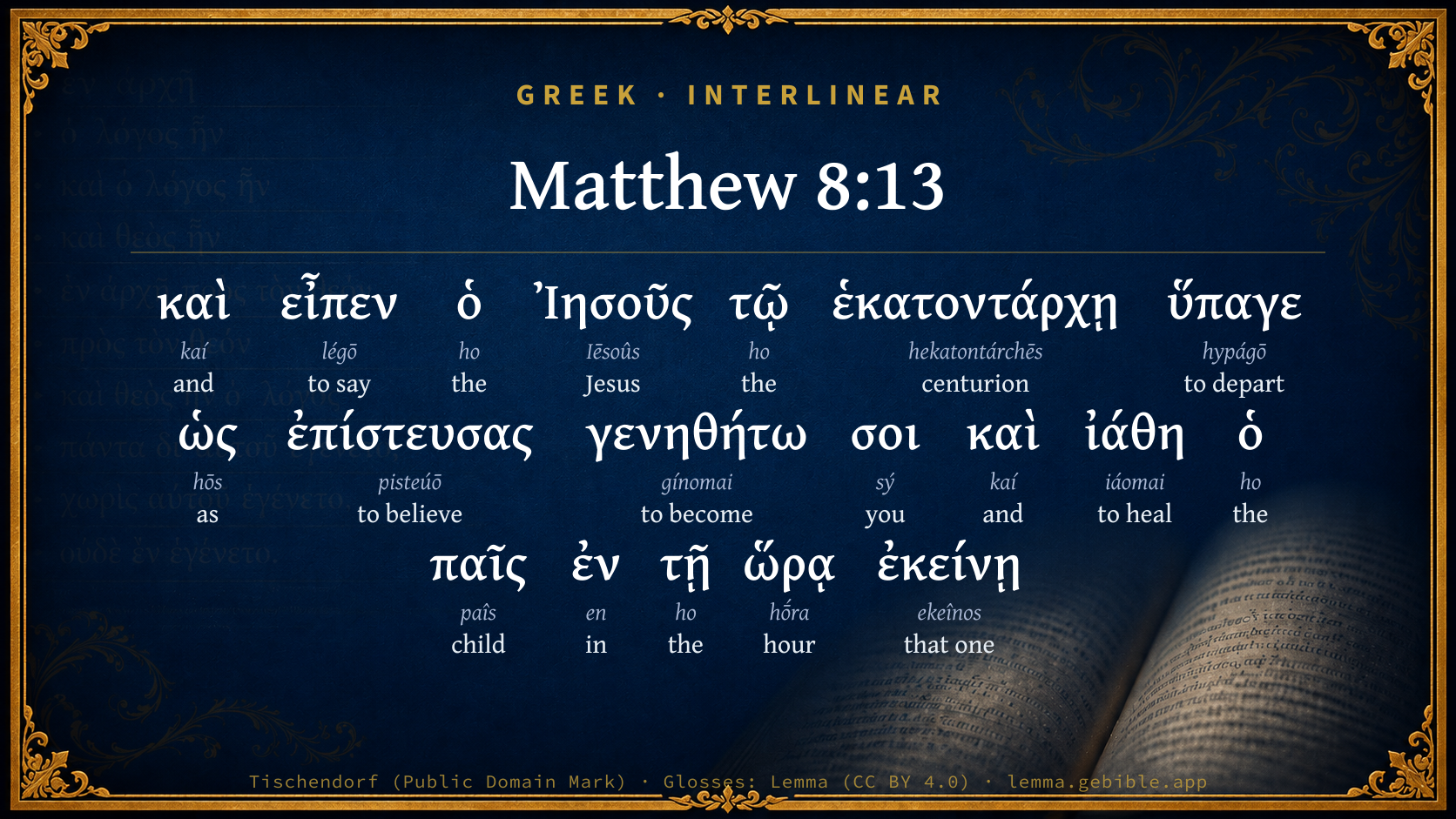
Greek (Tischendorf 8th ed.) Matthew 8:13 appears in the Greek New Testament. The text above is from the Tischendorf 8th edition. Each word links to its Strong’s number and a concise gloss. Click any word for its full Thayer’s Greek Lexicon entry.
Download image
Cite this verse

Matthew 8:13 (World English Bible). Public Domain. Lemma interlinear Bible study tool, https://lemma.gebible.app/v/matthew/8/13.

Show BibTeX & RIS
BibTeX
RIS
English Translation
Jesus said to the centurion, "Go your way. Let it be done for you as you have believed." His servant was healed in that hour.
World English Bible · Public Domain
Highlights
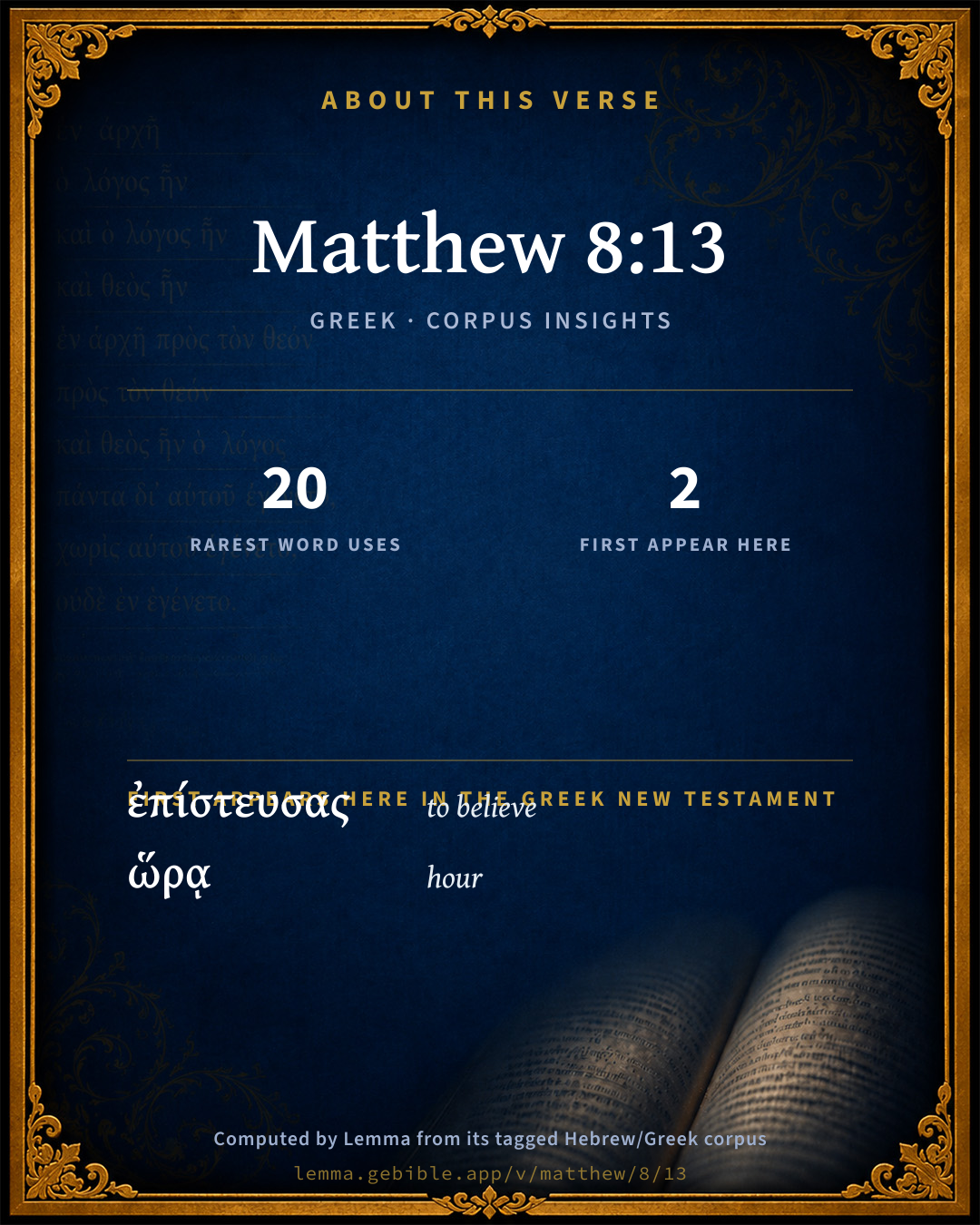
  • 2 first appearances in the Greek New Testament
Full analysis ↓
Download a study sheet

One document with this verse’s original text, its word-by-word gloss line, the meaning frame, cross-references with their text, attributed commentary, and full source and license credits — printable, and it pastes into notes with its structure intact.

This verse Autodidact and up

Study sheet (.html) Plain text (.txt)

A passage Seminary Student

Up to 50 verses in one chapter. A passage sheet keeps up to 6 commentary sources and 12 cross-references per verse, in the order this page ranks them, and says so on the sheet whenever that leaves anything out. Ask for a single verse and you get the Autodidact verse sheet above.

Everything on this page stays free to read, with no account — the sheet is a download of what is already on screen, not access to it.

Want to remove ads? Support Godless Engineer
Compare translations 3

The same verse in 3 English versions, stacked beneath the original-language interlinear above. Click any original word for its lexicon entry.

Each is an independent rendering of the whole verse — the interlinear is not word-aligned to these translations.

Highlighted words mark where these versions differ — a whole-verse word diff, not a word-by-word alignment.

  • World English Bible Public Domain
    Jesus said to the centurion, "Go your way. Let it be done for you as you have believed." His servant was healed in that hour.
  • King James Version Public Domain
    And Jesus said unto the centurion, Go thy way; and as thou hast believed, so be it done unto thee. And his servant was healed in the selfsame hour.
  • unfoldingWord Literal Text CC BY-SA 4.0
    And Jesus said to the centurion, “Go! As you believed, let it be done for you.” And the servant was healed at that hour.

unfoldingWord Literal Text — © unfoldingWord, licensed CC BY-SA 4.0. Word-aligned USFM3 via Door43 (git.door43.org/unfoldingWord/en_ult).

Versions to compare (up to 4)

3 of 4 selected

Show all 19 translations

Every available English version of this verse, each an independent rendering of the whole verse.

  • World English Bible Public Domain
    Jesus said to the centurion, "Go your way. Let it be done for you as you have believed." His servant was healed in that hour.
  • Berean Standard Bible Public Domain
    Then Jesus said to the centurion, “Go! As you have believed, so will it be done for you.” And his servant was healed at that very hour.
  • Majority Standard Bible Public Domain
    Then Jesus said to the centurion, “Go! As you have believed, so will it be done for you.” And his servant was healed at that very hour.
  • King James Version Public Domain
    And Jesus said unto the centurion, Go thy way; and as thou hast believed, so be it done unto thee. And his servant was healed in the selfsame hour.
  • American Standard Version (1901) Public Domain
    And Jesus said unto the centurion, Go thy way; as thou hast believed, `so' be it done unto thee. And the servant was healed in that hour.
  • Revised Version (1885) Public Domain
    And Jesus said unto the centurion, Go thy way; as thou hast believed, so be it done unto thee. And the servant was healed in that hour.
  • Geneva Bible (1599) Public Domain
    Then Iesus saide vnto the Centurion, Goe thy way, and as thou hast beleeued, so be it vnto thee, And his seruant was healed the same houre.
  • Douay-Rheims (1899) Public Domain
    And Jesus said to the centurion: Go, and as thou hast believed, so be it done to thee. And the servant was healed at the same hour.
  • Young's Literal Translation Public Domain
    And Jesus said to the centurion, `Go, and as thou didst believe let it be to thee;' and his young man was healed in that hour.
  • Literal Standard Version CC BY-SA 4.0
    And Jesus said to the centurion, “Go, and as you believed let it be to you”; and his young man was healed in that hour.
  • Unlocked Literal Bible CC BY-SA 4.0
    Jesus said to the centurion, “Go! As you have believed, so may it be done for you.” And the servant was healed at that very hour.
  • unfoldingWord Literal Text CC BY-SA 4.0
    And Jesus said to the centurion, “Go! As you believed, let it be done for you.” And the servant was healed at that hour.
  • Darby Bible Public Domain
    And Jesus said to the centurion, Go, and as thou hast believed, be it to thee. And his servant was healed in that hour.
  • World Messianic Bible Public Domain
    Yeshua said to the centurion, “Go your way. Let it be done for you as you have believed.” His servant was healed in that hour.
  • Webster's Bible Public Domain
    And Jesus said to the centurion, Depart; and as thou hast believed, so be it done to thee. And his servant was healed in the same hour.
  • Free Bible Version CC BY-SA 4.0
    Then Jesus told the centurion, “Go home. Because you trusted that it would happen, what you asked for has been done.” The servant was healed right away.
  • Bible in Basic English Public Domain
    And Jesus said to the captain, Go in peace; as your faith is, so let it be done to you. And the servant was made well in that hour.
  • Text-Critical English NT CC BY 4.0
    Then Jesus said to the centurion, “Go; it will be done for you just as yoʋ have believed.” And his servant was healed in that hour.
  • Tyndale New Testament (1534) Public Domain
    The Iesus sayd vnto the Centurion go thy waye and as thou belevest so be it vnto the. And his servaunt was healed the selfe houre.

Literal Standard Version (2020), Covenant Press — licensed CC BY-SA 4.0. Text via the HelloAO Bible API (eBible.org). Unlocked Literal Bible (unfoldingWord) — licensed CC BY-SA 4.0. Text via the HelloAO Bible API (eBible.org). unfoldingWord Literal Text — © unfoldingWord, licensed CC BY-SA 4.0. Word-aligned USFM3 via Door43 (git.door43.org/unfoldingWord/en_ult). Free Bible Version, Dr. Jonathan Gallagher — licensed CC BY-SA 4.0. Text via the HelloAO Bible API (eBible.org).

Word by word

More ways to search: Search by grammar → Find every occurrence → Compare this word →

Practice this passage: Drill this verse → Learn its vocabulary →

ἑκατοντάρχῃ
hekatontárchēs
G1543
“centurion”
Noun, Dative, Singular, Masculine
Part of Speech
Noun
Case
Dative
Number
Singular
Gender
Masculine
Full Thayer's Definition

Origin: from G1540 and G757

TDNT: None

1. an officer in the Roman army
  1. καὶ kaí G2532 “and” Conjunction
  2. εἶπεν légō G3004 “to say” Verb, Aorist, Active, Indicative, 3rd person, Singular
  3. ὁ ho G3588 “the” Article, Nominative, Singular, Masculine
  4. Ἰησοῦς Iēsoûs G2424 “Jesus” Noun, Nominative, Singular, Masculine
  5. τῷ ho G3588 “the” Article, Dative, Singular, Masculine
  6. ὕπαγε hypágō G5217 “to depart” Verb, Present, Active, Imperative, 2nd person, Singular
  7. ὡς hōs G5613 “as” Adverb
  8. ἐπίστευσας pisteúō G4100 “to believe” Verb, Aorist, Active, Indicative, 2nd person, Singular
  9. γενηθήτω gínomai G1096 “to become” Verb, Aorist, Passive deponent, Imperative, 3rd person, Singular
  10. σοι sý G4771 “you” Personal pronoun, 2nd person, Dative, Singular
  11. καὶ kaí G2532 “and” Conjunction
  12. ἰάθη iáomai G2390 “to heal” Verb, Aorist, Passive, Indicative, 3rd person, Singular
  13. ὁ ho G3588 “the” Article, Nominative, Singular, Masculine
  14. παῖς paîs G3816 “child” Noun, Nominative, Singular, Masculine
  15. ἐν en G1722 “in” Preposition
  16. τῇ ho G3588 “the” Article, Dative, Singular, Feminine
  17. ὥρᾳ hṓra G5610 “hour” Noun, Dative, Singular, Feminine
  18. ἐκείνῃ ekeînos G1565 “that one” Demonstrative pronoun, Dative, Singular, Feminine

About this verse

These counts appear in no published source. They are computed here, from the morphology-tagged text and Lemma’s own curated glosses. What Lemma adds →

19
words
15
distinct lemmas
Gospels
section

Notable vocabulary

The rarest word here is ἑκατοντάρχῃ centurion G1543 — appearing just 20 times in the whole Greek New Testament.

First appearance in Scripture

These words make their first canonical appearance in the Greek New Testament here:

  • ἐπίστευσας to believe G4100
  • ὥρᾳ hour G5610

Shared distinctive vocabulary

ἑκατοντάρχῃ centurion G1543 occurs in 20 verses of the Greek New Testament. Also found in:
Repetition

Words recur within this verse:

Cross-references

10

Topical passages linked to Matthew 8:13 in the Treasury of Scripture Knowledge — connected by theme and wording, ordered by reader-vote popularity; previews shown in the World English Bible.

  • Matthew 9:29–30 Then he touched their eyes, saying, "According to your faith be it done to you."
  • Mark 9:23 Jesus said to him, "If you can believe, all things are possible to him who believes."
  • John 4:50 Jesus said to him, "Go your way. Your son lives." The man believed the word that Jesus spoke to him, and he went his way.
  • Matthew 9:22 But Jesus, turning around and seeing her, said, "Daughter, cheer up! Your faith has made you well." And the woman was made well from that hour.
  • Matthew 15:28 Then Jesus answered her, "Woman, great is your faith! Be it done to you even as you desire." And her daughter was healed from that hour.
  • Matthew 17:20 He said to them, "Because of your unbelief. For most assuredly I tell you, if you have faith as a grain of mustard seed, you will tell this mountain, 'Move from here to there,' and it will move; and nothing will be impossible for you.
  • John 4:52–53 So he inquired of them the hour when he began to get better. They said therefore to him, "Yesterday at the seventh hour, the fever left him."
  • Ecclesiastes 9:7 Go your way--eat your bread with joy, and drink your wine with a merry heart; for God has already accepted your works.
  • Matthew 8:4 Jesus said to him, "See that you tell nobody, but go, show yourself to the priest, and offer the gift that Moses commanded, as a testimony to them."
  • Mark 7:29 He said to her, "For this saying, go your way. The demon has gone out of your daughter."

Cross-references courtesy of OpenBible.info (CC BY 4.0).

Commentary

Notes on Matthew 8:13 from classic Christian and Jewish commentators (each source and its license shown beneath its notes). The classic Christian expositions comment on the surrounding passage and are grouped to its opening verse, so a note may address several verses; the Jewish commentaries on the Tanakh (Rashi and others) are per-verse, so they appear only where the commentator wrote on this verse.

Lemma curates 59 commentaries, every one of them public domain or Creative Commons licensed, each selected and text-cleaned for this edition rather than reprinted as found. About our sources →

Bengel's Gnomon

Johann Albrecht Bengel

Mat 8:13. Ὡς ἐπίστευσας, as thou hast believed) A bountiful concession.

Bengel's Gnomon of the New Testament — English translation (T&T Clark, Edinburgh, 1860) — public domain. Text from a community e-Sword module.

Meyer's Critical & Exegetical Commentary

Heinrich August Wilhelm Meyer

Mat_8:13. Ἐν τῇ ὥρᾳ ἐκ.] ὥρᾳ is emphatic. In the very hour in which Jesus was uttering these words, the slave became whole, and that through the divine power of Jesus operating upon him from a distance, as in Joh_4:46 ff. The narrative is to be explained neither by a desire to present an enlarging view of the miraculous power of Jesus (Strauss), nor as a parable (Weisse), nor as a historical picture of the way in which Gods word acts at a distance upon the Gentiles (Volkmar), nor as being the story of the woman of Canaan metamorphosed (Bruno Bauer); nor are we to construe the proceeding as the providential fulfilment of a general but sure promise given by Jesus (Ammon), or, in that case, to have recourse to the supposition that the healing was effected through sending an intermediate agent (Paulus). But if, as is alleged, Jesus in His reply only used an affirmation which was halfway between a benediction depending on God and the faith of the house, and a positive act (Keim), it is impossible to reconcile with such vagueness of meaning the simple imperative and the no less impartial statement of the result. Moreover, there exists as little a psychical contact between the sick man and Jesus, as at the healing of the daughter of the woman of Canaan, Mat_15:22, but the slave was cured in consideration of the centurions faith.

Meyer — Critical and Exegetical Commentary on the New Testament — English translation by Peter Christie, edited by Frederick Crombie (T&T Clark, 1880) — public domain. Text from a community e-Sword module.

Expositor's Greek Testament

ed. W. Robertson Nicoll

Mat 8:13 . ὕπαγε , etc.: compressed impassioned utterance, spoken under emotion = Go, as thou hast believed be it to thee; cure as thorough as thy faith. The καὶ before ὡς in T. R. is the addition of prosaic scribes. Men speaking under emotion discard expletives.

Weizsäcker ( Untersuchungen über die Evang. Gesch. , p. 50) remarks on the felicitous juxtaposition of these two narratives relatively to one another and to the Sermon on Mount. “In the first Jesus has to do with a Jew, and demands of him observance of the law. In this respect the second serves as a companion piece, the subject of healing being a heathen, giving occasion for a word as to the position of heathens. The two combined are happily appended to a discourse in which Jesus states His attitude to the law, forming as complements of each other a commentary on the statement.”

The Expositor's Greek Testament, edited by W. Robertson Nicoll (1897–1910) — public domain. Text from a community e-Sword module.

Adam Clarke's Commentary

Verse 13. As thou hast believed; so be it done] Let the mercy thou requestest be equal to the faith thou hast brought to receive it by. ACCORDING to thy faith be it done unto thee, is a general measure of God's dealings with mankind. To get an increase of faith is to get an increase of every grace which constitutes the mind that was in Jesus, and prepares fully for the enjoyment of the kingdom of God. God is the same in the present time which he was in ancient days; and miracles of healing may be wrought on our own bodies and souls, and on those of others, by the instrumentality of our faith. But, alas! where is faith to be found!

And his servant was healed in the selfsame hour.] εν τη ωρα εκεινη, in that very hour. Faith is never exercised in the power and goodness of God till it is needed; and, when it is exercised, God works the miracle of healing. Christ never says, Believe now for a salvation which thou now needest, and I will give it to thee in some future time. That salvation which is expected through works or sufferings must of necessity be future, as there must be time to work or suffer in; but the salvation which is by faith must be for the present moment, for this simple reason, IT IS BY FAITH, that God may be manifested and honoured; and not by works or by sufferings, lest any man should boast. To say that, though it is of faith, yet it may; and, must in many cases, be delayed, (though the person is coming in the most genuine humility, deepest contrition, and with the liveliest faith in the blood of the Lamb,) is to say that there is still something necessary to be done, either on the part of the person, or on the part of God, in order to procure it; neither of which positions has any truth in it.

Adam Clarke's Commentary on the Bible (1810–1826) — public domain. Text from a community e-Sword/MySword module.

Ellicott's Commentary for English Readers

(13) As thou hast believed.—The words were, of course, sent as a message. Better, As thou didst believe—referring to his one great act of faith.

A Bible Commentary for English Readers, edited by Charles John Ellicott (1878–1897) — public domain. Text from a community e-Sword module.

John Gill's Exposition

And when Jesus was come into Peter's house,.... And which was also Andrew's, Mar 1:29 for these two brothers lived together, and this was in Capernaum, as appears from the context. Though Andrew and Peter were originally of Bethsaida, a place not far from this, but had removed hither since their call by Christ, this being his city; though probably this house was Peter's wife's mother's, and only called their's, because they lodged there, whilst in this city: into this house Christ entered, with James and John, and others; when

he saw his (Peter's) wife's mother, laid, or "cast" on a bed, See Gill on Mat 8:6.

and sick of a fever: Luke says, Luk 4:38 that she "was taken", or rather held, or "detained with a great fever"; the distemper was very raging and furious, it had got to a very great height. The other evangelists say, that the persons in the house told him of her, and besought him for her, that he would heal her, having a very great affection for her, and desire of her life, which seemed to be in great danger. Hence it may be observed against the Papists, that ministers of the Gospel may lawfully marry; Peter, an apostle, and from whom they pretend to derive their succession of bishops, was a married man, had a wife, and that after he was called to be an apostle. His wife's mother is expressly mentioned, being the person labouring under a violent fever, and whom Christ cured in the following manner.

John Gill's Exposition of the Whole Bible (1746–1763) — public domain (CC PDM 1.0). Text via the HelloAO Bible API.

Trapp's Complete Commentary

John Trapp

13 And Jesus said unto the centurion, Go thy way; and as thou hast believed, so be it done unto thee. And his servant was healed in the selfsame hour.

Ver. 13. And as thou hast believed, &c.] Faith hath a happy hand; and never but speeds in one kind or other. It hath what it would, either in money or money’s worth. Apollonius, saith Sozomen, never asked anything of God in all his life, that he obtained not. This man, saith one concerning Luther, could have from God whatsoever he wished.

John Trapp, A Commentary or Exposition upon All the Books of the Old and New Testament (1647–1656) — public domain. Text from a community e-Sword module.

Albert Barnes' Notes on the Bible

He was healed in that self-same hour - This showed decisively the goodness and power of Jesus. No miracle could be more complete. There could be no imposition or deception.

This account, or one similar to this, is found in Luk 7:1-10. There has been a difference of opinion whether the account in Luke refers to the same case as that recorded in Matthew, or whether a second centurion, encouraged by the success of the first, applied to our Saviour in a similar case and manner, and obtained the same success. In support of the supposition that they are different narratives, it is said that they disagree so far that it is impossible to reconcile them, and that it is not improbable that a similar occurrence might take place, and be attended with similar results.

To a plain reader, however, the narratives appear to be the same. They agree in the character of the person, the place, and apparently the time; in the same substantial structure of the account; in the expression of similar feelings, the same answers, and the same result. It is very difficult to believe that all these circumstances would coincide in two different stories.

They differ, however. Matthew says that the centurion “came himself.” Luke says that he at first sent elders of the Jews, and then his particular friends. He also adds that he was friendly to the Jews, and had built them a synagogue. An infidel will ask whether there is not here a palpable contradiction. In explanation of this, let it be remarked:

1. That the fact that the centurion came himself, supposing that to have been the fact, is no evidence that others did not come also. It was “in” the city. The centurion was a great favorite, and had conferred on the Jews many favors, and they would be anxious that the favor which he desired of Jesus should be granted. At his suggestion, or of their own accord, his Jewish friends might apply to Jesus, and press the subject upon him, and be anxious to represent the case as favorably as possible. All this was probably done, as it would be in any other city, in considerable haste and apparent confusion; and one observer might fix his attention strongly on one circumstance, and another on another. It is not at all improbable that the same representation and request might have been made both by the centurion and his friends. Matthew might have fixed his eye very strongly on the fact that the centurion came himself, and been particularly struck with his deportment; and Luke on the remarkable zeal shown by the friends of a pagan, the interest they took in his welfare, and the circumstance that he had done much for them. Full of these interesting circumstances, he might comparatively have overlooked the centurion himself. But,

2. It was a maxim among the Jews, as it is now in law, “that what a man does by another, he does himself.” So, in Mar 10:35, James and John are represented as coming to the Saviour with a request: in Mat 20:20, it appears that they presented their request through their mother. In Joh 4:1, Jesus is said to baptize, when, in fact, he did not do it himself, but by his disciples. In Joh 19:1, Pilate is said to have scourged Jesus; but he certainly did not do it with his own hands. In the case of the centurion, Matthew narrates what occurred very briefly; Luke goes more into detail, and states more of the circumstances. Matthew was intent on the great leading facts of the cure. He was studious of brevity. He did not choose to explain the particular circumstances. He says that the centurion “made the application” and received the answer. He does not say whether by himself or by “an agent.” Luke explains particularly “how” it was done. There is no more contradiction, therefore, than there would be if it should be said of a man in a court of law that he came and made application for a new trial, when the application was really made by his lawyer. Two men, narrating the fact, might exhibit the same variety that Matthew and Luke have done, and both be true. It should never be forgotten that “the sacred narrative of an event is what it is stated to be by all the sacred writers; as the testimony in a court in which a case is decided is what is stated by all the credible witnesses, though one may have stated one circumstance and another another.”

One thing is most clearly shown by this narrative: that this account was not invented by the evangelists for the sake of imposition. If it had been, they would have “agreed in all the circumstances.”

Albert Barnes' Notes on the Bible (1834–1885) — public domain. Text from a community e-Sword/MySword module.

Matthew Poole's English Annotations

Luke saith, And they that were sent, returning to the

house, found the servant whole that had been sick, Luk 7:10; so as it seemeth that what Christ said unto the centurion, must be interpreted, to those whom the centurion sent in his name. Go your way, your business is done, the centurion’s faith hath obtained, it shall be done to him as he hath believed; where believing must signify, a certain persuasion of the power of Christ, with a relying on this mercy and goodness. The proximate object of faith is some word of God. How far this centurion was acquainted with the oracles of the Old Testament (though he lived amongst the Jews, and, as appears by his building a synagogue for them, Luk 7:5, had a kindness for their religion) I cannot tell. It is most probable that he had some immediate revelation of God concerning Christ, which he is here said to have believed, and to have had a full persuasion of and trusted in. All revelations of God are the object of faith, though the Scriptures, being now written, are to us that have them the tests and touchstones to try such impressions by.

As thou believest, not because thou believest. Our faith is not meritorious of the least mercies, built is an exercise of grace which gives glory to God, and receiveth the reward not of debt but of grace. The miracle appeared in that the disease was of an incurable nature, and the cure was wrought without application of means, and in such a moment of time as means, though used, could not have wrought it.

Matthew Poole's English Annotations on the Holy Bible (1683–1685) — public domain. Text from a community e-Sword/MySword module.

The Pulpit Commentary

Matthew only. The parallel passage, Luk_7:10, gives the result found by the messengers on their return. And Jesus said unto the centurion, Go thy way; and (omitted by the Revised Version) as thou hast believed, so be it done unto thee. As. Not strictly proportionate, but in the same way as (Mat_6:12 Mat_18:33) thou hast now believed, be it done unto thee. And his servant was healed in the selfsame (Revised Version, in that) hour.

The grounds and rewards of faith.

Christ"s miracles were not so much convictions for the unbelieving as confirmations for the believing. If we believe in Christ on other grounds, then his miracles will serve to establish and to instruct our faith. It is not the merely wonderful features of them; it is the moral and spiritual truth they exhibit and illustrate which really blesses men. And so we find that they are always called "signs" or "mighty works.

I THE GROUNDS OF FAITH. Faith is exceedingly difficult to explain and define. Partly because it has both an intellectual and a moral side. It is, in a sense, the mental grasp of a proposition; and it is heart-acceptance of a relation. It is belief and it is trust. , Commonly received definitions do but give features or aspects of it. Essentially it is the act and expression of soul-dependence. Faith is not difficult to recognize in particular instances; as when the little child leaps into the dark cellar on her father"s assurance. Faith is not difficult to recognize as the motive power in our common, everyday relations. We know well how our daily life is built upon mutual trust. And yet the faith that bears relation to our eternal salvation must have a ground or reason. It may rest on

(1) a statement; or on

(2) a person; or on

(3) a doctrine; or on

(4) a character.

The highest ground is trust in a person. The most effective influences on our lives are our trusts in persons. Sometimes through the doctrine faith comes to reliance on the person. Sometimes through the person it comes to the acceptance of the doctrine. Both apply to Christ; in one way or the other, saving faith is reliance on the living, redeeming, sanctifying Person the Lord Jesus Christ. Our proper ground of faith is Jesus himself.

II THE REWARDS OF FAITH. These may be either:

1. Gaining the thing desired. Responding to the prayer of faith, Christ may be graciously pleased to say, "Be it unto thee even as thou wilt." Let it be the burden of sin, he may say, "Thy sins are forgiven thee.

2. Increase of faith. More than once a little and weak faith came to Christ, and in his presence grew stronger; it won a blessing, and in the joy of the blessing it sprang up into fuller power. Wait for the right faith, and you may wait in vain. Use well the little faith you have, and in the use you shall find the faith increase.

3. Kindling faith in others. We seldom recognize as we should what a power there is in faith to quicken faith in others. The confident, hopeful man cheers all about him. The world is being saved, not by its men of science, but by its men of faith. R.T.

The Pulpit Commentary (1880–1919), ed. H.D.M. Spence-Jones & Joseph S. Exell — public domain. Text from a community e-Sword module.

Kretzmann's Popular Commentary

Paul E. Kretzmann

The reward of faith:

v. 13. And Jesus said unto the centurion, Go thy way, and as thou hast believed, so be it done unto thee. And his servant was healed in the selfsame hour.

As was the faith, so was the cure. The trust in the power of the word brought the word with power to heal. Christ speaks under great emotion, granting the boon to which the captain’s belief clung, bidding his messengers and himself go to witness the fulfillment of his prayer. In the self-same hour, at the identical time, the miracle was performed. Thus faith receives from Christ, to whom it clings, help, comfort, mercy, and every good thing.

Paul E. Kretzmann, Popular Commentary of the Bible (1921–1924) — public domain. Text from a community e-Sword module.

The People's New Testament

B. W. Johnson

13. As thou hast believed. The centurion believed that Jesus could heal his servant by speaking the word. In that hour. At the moment these words were spoken the servant was well.

B. W. Johnson's The People's New Testament with Notes (1889–1891) — public domain. Electronic text from the Christian Classics Ethereal Library (CCEL) ThML edition.

Cambridge Greek Testament for Schools and Colleges

13. ὕπαγε, ‘go,’ the ordinary modern word in this sense, and so used colloquially before it was established in literary language. Cp. Aristoph. Ranœ, 174, ὑπάγεθʼ ὑμεῖς τῆς ὁδοῦ. See note ch. Mat 4:10. ὑπάγειν is especially frequent in St John’s gospel.

Cambridge Greek Testament for Schools and Colleges (Cambridge University Press, 1896; 21 vols, various authors incl. Carr, Maclear, Plummer, Farrar, Lumby, Moule, M. R. James, Simcox) — public domain. Text from a community e-Sword module.

Alford’s Greek Testament

Henry Alford

13. ἰάθη] Of what precise disease does not appear. In Luke ἤμελλεν τελευτᾷν—here he is παραλυτικός, δεινῶς βασανιζόμενος. But though these descriptions do not agree with the character of palsy among us, we read of a similar case in 1 Macc. 9:55, 56: ἐν τῷ καιρῷ ἐκείνῳ ἐπλήγη Ἄλκιμος καὶ ἐνεποδίσθη τὰ ἔργα αὐτοῦ, καὶ ἀπεφράγη τὸ στόμα αὐτοῦ, καὶ παρελύθη, καὶ οὐκ ἐδύνατο ἔτι λαλῆσαι λόγον καὶ ἐντείλασθαι περὶ τοῦ οἴκου αὐτοῦ. καὶ ἀπέθανεν Ἄλκιμος ἐν τῷ καιρῷ ἐκείνῳ μετὰ βασάνου μεγάλης. The disease in the text may have been an attack of tetanus, which the ancient physicians included under paralysis, and which is more common in hot countries than with us. It could hardly have been apoplexy, which usually bereaves of sensation.

Henry Alford, The Greek Testament (1849–1861) — public domain. Text from a community e-Sword module.

International Critical Commentary

13. And Jesus said to the centurion, Go; as thou hast believed, be it to thee. And the boy was healed at that hour.] For the healing at the moment of Christ’s utterance, cf. 9:22, 15:28, 17:18.—ἐν ἐκείνῃ τῇ ὤρᾳ] is a formula of frequent occurrence in Rabbinical literature; cf. Schlatter, Die Sprache und Heimat des vierten Evangelisten, p. 64.—ὡς ἐπίστευσας] see on v. 10.

International Critical Commentary — older volumes (1896–1929), various authors — public domain. Text from a community e-Sword module.

Vincent's Word Studies in the New Testament

Marvin R. Vincent

Was healed [ιαθη] . Note that the stronger word of the centurion (ver. 8) is used here. Where Christ tends, he heals.

Marvin R. Vincent, Word Studies in the New Testament (1887–1900) — public domain. Text from a community e-Sword/MySword module.

Lesson kit

Teaching starters — assembled from the data on this page, not authored interpretation. Every prompt links to the verse data it draws on. Edit before teaching.

Matthew, in the Gospels, opens this verse with 19 words (15 distinct Greek lemmas). Its most distinctive word is hekatontárchēs (“centurion”). A historical commentator’s framing appears above. Read the whole chapter for the surrounding context.

Discussion questions

  1. How does “centurion” (hekatontárchēs) shape what this verse is saying?
  2. 2 words here appear for the first time in Scripture. What is being introduced at this debut?
  3. Matthew 8:5 shares the word «centurion» with this verse. How do the two illuminate each other?
  4. “the” occurs 4× in this one verse. What is the effect of the repetition?
  5. These translations render this verse differently. What is at stake in choosing one wording over another?
  6. Reading how Bengel's Gnomon and Meyer's Critical & Exegetical Commentary read this verse, where do the two commentators agree and where do they part?

Things to notice

  • 2 words make their first canonical appearance in Scripture here.
  • These translations choose different wording for 5 words in this verse.
  • “the” occurs 4× in this single verse.
  • 15 distinct Greek lemmas span 19 words in this verse.

Reading settings

Reading text

Shown beneath each verse's original-language words.

Old Testament
Old Testament edition

Read the OT as the Masoretic Hebrew (MT) or the Greek Septuagint (LXX).

English shown for the Greek Septuagint (in the Hebrew ↔ Greek comparison).

Comparing translations? Open the Compare panel on any verse page to stack up to four side by side.