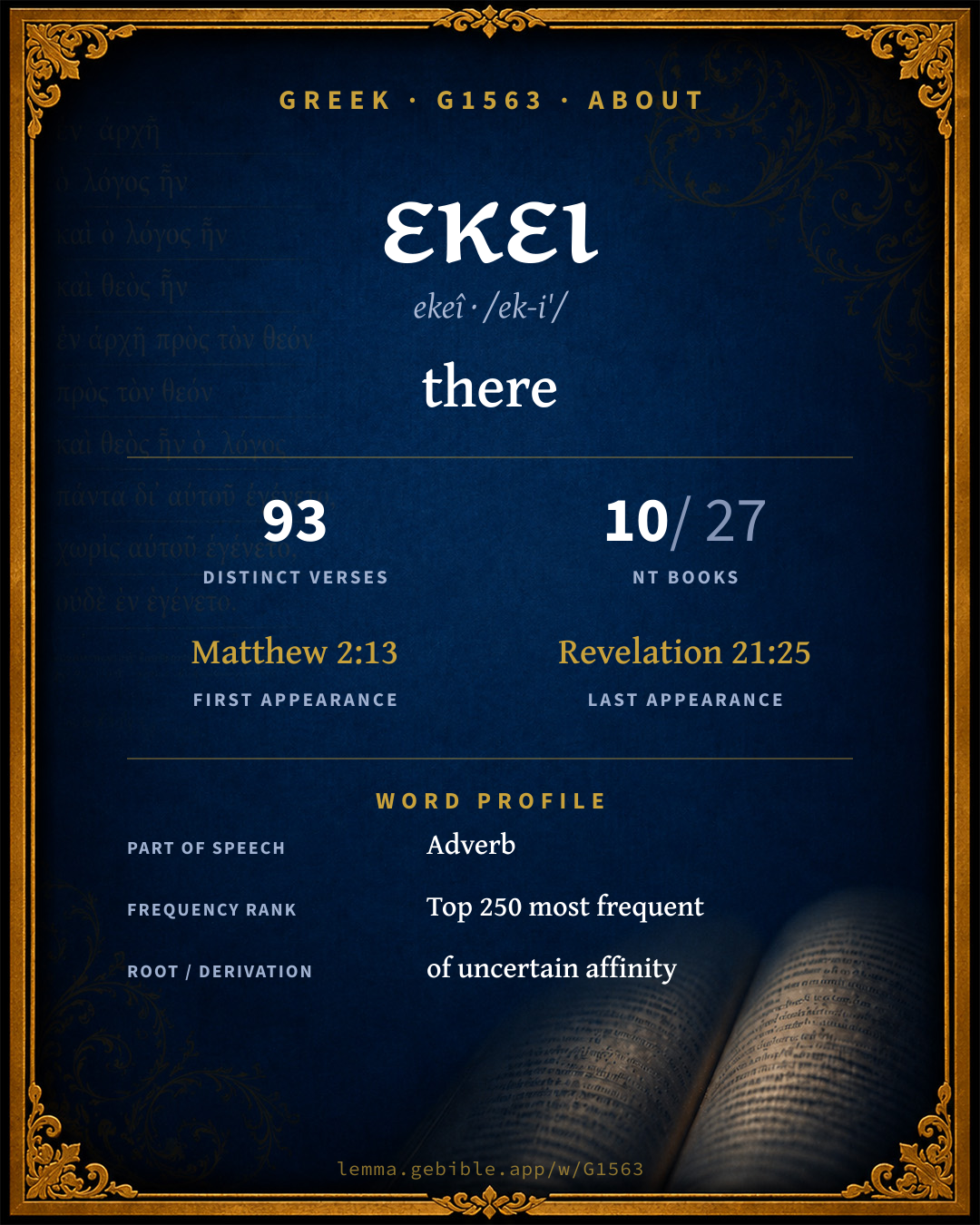
ἐκεῖ
there
Full lexicon entry — Thayer's Greek Lexicon
From Thayer's Greek Lexicon
Where this word appears
Grammar key — what these labels mean
Part of speech
- Adverb
- A word that modifies a verb, adjective, or other adverb.
Every verse where G1563 appears — 93 distinct verses across 10 books. Click any verse to open its interlinear word-by-word view. Verse text shown in the World English Bible for context — . Each verse’s Greek form is shown with its reference; the English is not keyword-highlighted, since the data carries no word-level English alignment. Use “Compare translations” on any verse to read it across multiple English versions. This concordance covers the Greek New Testament; Septuagint (Greek Old Testament) occurrences of this word are not indexed here.
Matthew 29 verses
- Matthew 2:13 ἐκεῖ adv Now when they had departed, behold, an angel of the Lord appeared to Joseph in a dream, saying, "Arise and take the young child and his mother, and flee into Egypt, and stay there until I tell you, for Herod will seek the young child to destroy him."
- Matthew 2:15 ἐκεῖ adv and was there until the death of Herod; that it might be fulfilled which was spoken by the Lord through the prophet, saying, "Out of Egypt I called my son."
- Matthew 2:22 ἐκεῖ adv But when he heard that Archelaus was reigning over Judea in the place of his father, Herod, he was afraid to go there. Being warned in a dream, he withdrew into the region of Galilee,
- Matthew 5:24 ἐκεῖ adv leave your gift there before the altar, and go your way. First be reconciled to your brother, and then come and offer your gift.
- Matthew 6:21 ἐκεῖ adv for where your treasure is, there your heart will be also.
- Matthew 8:12 ἐκεῖ adv but the children of the Kingdom will be thrown out into the outer darkness. There will be weeping and the gnashing of teeth."
- Matthew 12:45 ἐκεῖ adv Then he goes, and takes with himself seven other spirits more evil than he is, and they enter in and dwell there. The last state of that man becomes worse than the first. Even so will it be also to this evil generation."
- Matthew 13:42 ἐκεῖ adv and will cast them into the furnace of fire. There will be weeping and the gnashing of teeth.
- Matthew 13:50 ἐκεῖ adv and will cast them into the furnace of fire. There will be the weeping and the gnashing of teeth."
- Matthew 13:58 ἐκεῖ adv He didn't do many mighty works there because of their unbelief.
- Matthew 14:23 ἐκεῖ adv After he had sent the multitudes away, he went up into the mountain by himself to pray. When evening had come, he was there alone.
- Matthew 15:29 ἐκεῖ adv Jesus departed there, and came near to the sea of Galilee; and he went up into the mountain, and sat there.
- Matthew 17:20 ἐκεῖ adv He said to them, "Because of your unbelief. For most assuredly I tell you, if you have faith as a grain of mustard seed, you will tell this mountain, 'Move from here to there,' and it will move; and nothing will be impossible for you.
- Matthew 18:20 ἐκεῖ adv For where two or three are gathered together in my name, there I am in the midst of them."
- Matthew 19:2 ἐκεῖ adv Great multitudes followed him, and he healed them there.
- Matthew 21:17 ἐκεῖ adv He left them, and went out of the city to Bethany, and lodged there.
- Matthew 22:11 ἐκεῖ adv But when the king came in to see the guests, he saw there a man who didn't have on wedding clothing,
- Matthew 22:13 ἐκεῖ adv Then the king said to the servants, 'Bind him hand and foot, take him away, and throw him into the outer darkness; there is where the weeping and grinding of teeth will be.'
- Matthew 24:28 ἐκεῖ adv For wherever the carcass is, there will the vultures be gathered together.
- Matthew 24:51 ἐκεῖ adv and will cut him in pieces, and appoint his portion with the hypocrites; there is where the weeping and grinding of teeth will be.
- Matthew 25:30 ἐκεῖ adv Throw out the unprofitable servant into the outer darkness, where there will be weeping and gnashing of teeth.'
- Matthew 26:36 ἐκεῖ adv Then Jesus came with them to a place called Gethsemane, and said to his disciples, "Sit here, while I go there and pray."
- Matthew 26:71 ἐκεῖ adv When he had gone out onto the porch, someone else saw him, and said to those who were there, "This man also was with Jesus of Nazareth."
- Matthew 27:36 ἐκεῖ adv and they sat and watched him there.
- Matthew 27:47 ἐκεῖ adv Some of them who stood there, when they heard it, said, "This man is calling Elijah."
- Matthew 27:55 ἐκεῖ adv Many women were there watching from afar, who had followed Jesus from Galilee, serving him.
- Matthew 27:61 ἐκεῖ adv Mary Magdalene was there, and the other Mary, sitting opposite the tomb.
- Matthew 28:7 ἐκεῖ adv Go quickly and tell his disciples, 'He has risen from the dead, and behold, he goes before you into Galilee; there you will see him.' Behold, I have told you."
- Matthew 28:10 ἐκεῖ adv Then Jesus said to them, "Don't be afraid. Go tell my brothers that they should go into Galilee, and there they will see me."
Mark 9 verses
- Mark 2:6 ἐκεῖ adv But there were some of the scribes sitting there, and reasoning in their hearts,
- Mark 3:1 ἐκεῖ adv He entered again into the synagogue, and there was a man there who had his hand withered.
- Mark 5:11 ἐκεῖ adv Now there was on the mountainside a great herd of pigs feeding.
- Mark 6:5 ἐκεῖ adv He could do no mighty work there, except that he laid his hands on a few sick people, and healed them.
- Mark 6:10 ἐκεῖ adv He said to them, "Wherever you enter into a house, stay there until you depart from there.
- Mark 6:33 ἐκεῖ adv They saw them going, and many recognized him and ran there on foot from all the cities. They arrived before them and came together to him.
- Mark 11:5 ἐκεῖ adv Some of those who stood there asked them, "What are you doing, untying the young donkey?"
- Mark 13:21 ἐκεῖ adv Then if anyone tells you, 'Look, here is the Christ!' or, 'Look, there!' don't believe it.
- Mark 16:7 ἐκεῖ adv But go, tell his disciples and Peter, 'He goes before you into Galilee. There you will see him, as he said to you.'"
Luke 16 verses
- Luke 2:6 ἐκεῖ adv It happened, while they were there, that the day had come that she should give birth.
- Luke 6:6 ἐκεῖ adv It also happened on another Sabbath that he entered into the synagogue and taught. There was a man there, and his right hand was withered.
- Luke 8:32 ἐκεῖ adv Now there was there a herd of many pigs feeding on the mountain, and they begged him that he would allow them to enter into those. He allowed them.
- Luke 9:4 ἐκεῖ adv Into whatever house you enter, stay there, and depart from there.
- Luke 10:6 ἐκεῖ adv If a son of peace is there, your peace will rest on him; but if not, it will return to you.
- Luke 11:26 ἐκεῖ adv Then he goes, and takes seven other spirits more evil than himself, and they enter in and dwell there. The last state of that man becomes worse than the first."
- Luke 12:18 ἐκεῖ adv He said, 'This is what I will do. I will pull down my barns, and build bigger ones, and there I will store all my grain and my goods.
- Luke 12:34 ἐκεῖ adv For where your treasure is, there will your heart be also.
- Luke 13:28 ἐκεῖ adv There will be weeping and gnashing of teeth, when you see Abraham, Isaac, Jacob, and all the prophets, in the Kingdom of God, and yourselves being thrown outside.
- Luke 15:13 ἐκεῖ adv Not many days after, the younger son gathered all of this together and traveled into a far country. There he wasted his property with riotous living.
- Luke 17:21 ἐκεῖ adv neither will they say, 'Look, here!' or, 'Look, there!' for behold, the Kingdom of God is within you."
- Luke 17:23 ἐκεῖ adv They will tell you, 'Look, here!' or 'Look, there!' Don't go away, nor follow after them,
- Luke 17:37 ἐκεῖ adv They answering, asked him, "Where, Lord?" He said to them, "Where the body is, there will the vultures also be gathered together."
- Luke 21:2 ἐκεῖ adv He saw a certain poor widow casting in two small brass coins.
- Luke 22:12 ἐκεῖ adv He will show you a large, furnished upper room. Make preparations there."
- Luke 23:33 ἐκεῖ adv When they came to the place that is called The Skull, they crucified him there with the criminals, one on the right and the other on the left.
John 22 verses
- John 2:1 ἐκεῖ adv The third day, there was a marriage in Cana of Galilee. Jesus' mother was there.
- John 2:6 ἐκεῖ adv Now there were six water pots of stone set there after the Jews' manner of purifying, containing two or three metretes apiece.
- John 2:12 ἐκεῖ adv After this, he went down to Capernaum, he, and his mother, his brothers, and his disciples; and they stayed there a few days.
- John 3:22 ἐκεῖ adv After these things, Jesus came with his disciples into the land of Judea. He stayed there with them, and baptized.
- John 3:23 ἐκεῖ adv John also was baptizing in Enon near Salim, because there was much water there. They came, and were baptized.
- John 4:6 ἐκεῖ adv Jacob's well was there. Jesus therefore, being tired from his journey, sat down by the well. It was about the sixth hour.
- John 4:40 ἐκεῖ adv So when the Samaritans came to him, they begged him to stay with them. He stayed there two days.
- John 5:5 ἐκεῖ adv A certain man was there, who had been sick for thirty-eight years.
- John 6:3 ἐκεῖ adv Jesus went up into the mountain, and he sat there with his disciples.
- John 6:22 ἐκεῖ adv On the next day, the multitude that stood on the other side of the sea saw that there was no other boat there, except the one in which his disciples had embarked, and that Jesus hadn't entered with his disciples into the boat, but his disciples had gone away alone.
- John 6:24 ἐκεῖ adv When the multitude therefore saw that Jesus wasn't there, nor his disciples, they themselves got into the boats, and came to Capernaum, seeking Jesus.
- John 10:40 ἐκεῖ adv He went away again beyond the Jordan into the place where John was baptizing at first, and there he stayed.
- John 10:42 ἐκεῖ adv Many believed in him there.
- John 11:8 ἐκεῖ adv The disciples told him, "Rabbi, the Jews were just trying to stone you, and are you going there again?"
- John 11:15 ἐκεῖ adv I am glad for your sakes that I was not there, so that you may believe. Nevertheless, let's go to him."
- John 11:31 ἐκεῖ adv Then the Jews who were with her in the house, and were consoling her, when they saw Mary, that she rose up quickly and went out, followed her, saying, "She is going to the tomb to weep there."
- John 12:2 ἐκεῖ adv So they made him a supper there. Martha served, but Lazarus was one of those who sat at the table with him.
- John 12:9 ἐκεῖ adv A large crowd therefore of the Jews learned that he was there, and they came, not for Jesus' sake only, but that they might see Lazarus also, whom he had raised from the dead.
- John 12:26 ἐκεῖ adv If anyone serves me, let him follow me. Where I am, there will my servant also be. If anyone serves me, the Father will honor him.
- John 18:2 ἐκεῖ adv Now Judas, who betrayed him, also knew the place, for Jesus often resorted there with his disciples.
- John 18:3 ἐκεῖ adv Judas then, having taken a detachment of soldiers and officers from the chief priests and the Pharisees, came there with lanterns, torches, and weapons.
- John 19:42 ἐκεῖ adv Then because of the Jews' Preparation Day (for the tomb was near at hand) they laid Jesus there.
Acts 6 verses
- Acts 9:33 ἐκεῖ adv There he found a certain man named Aeneas, who had been bedridden for eight years, because he was paralyzed.
- Acts 16:1 ἐκεῖ adv He came to Derbe and Lystra: and behold, a certain disciple was there, named Timothy, the son of a Jewess who believed; but his father was a Greek.
- Acts 17:14 ἐκεῖ adv Then the brothers immediately sent out Paul to go as far as to the sea, and Silas and Timothy still stayed there.
- Acts 19:21 ἐκεῖ adv Now after these things had ended, Paul determined in the spirit, when he had passed through Macedonia and Achaia, to go to Jerusalem, saying, "After I have been there, I must also see Rome."
- Acts 25:9 ἐκεῖ adv But Festus, desiring to gain favor with the Jews, answered Paul and said, "Are you willing to go up to Jerusalem, and be judged by me there concerning these things?"
- Acts 25:14 ἐκεῖ adv As he stayed there many days, Festus laid Paul's case before the king, saying, "There is a certain man left a prisoner by Felix;
Romans 2 verses
- Romans 9:26 ἐκεῖ adv "It will be that in the place where it was said to them, 'You are not my people,' There they will be called 'children of the living God.'"
- Romans 15:24 ἐκεῖ adv whenever I journey to Spain, I will come to you. For I hope to see you on my journey, and to be helped on my way there by you, if first I may enjoy your company for a while.
Titus 1 verse
Hebrews 1 verse
James 3 verses
- James 2:3 ἐκεῖ adv and you pay special attention to him who wears the fine clothing, and say, "Sit here in a good place;" and you tell the poor man, "Stand there," or "Sit by my footstool;"
- James 3:16 ἐκεῖ adv For where jealousy and selfish ambition are, there is confusion and every evil deed.
- James 4:13 ἐκεῖ adv Come now, you who say, "Today or tomorrow let's go into this city, and spend a year there, trade, and make a profit."
Revelation 4 verses
- Revelation 2:14 ἐκεῖ adv But I have a few things against you, because you have there some who hold the teaching of Balaam, who taught Balak to throw a stumbling block before the children of Israel, to eat things sacrificed to idols, and to commit sexual immorality.
- Revelation 12:6 ἐκεῖ ἐκεῖ adv adv The woman fled into the wilderness, where she has a place prepared by God, that there they may nourish her one thousand two hundred sixty days.
- Revelation 12:14 ἐκεῖ adv Two wings of the great eagle were given to the woman, that she might fly into the wilderness to her place, so that she might be nourished for a time, and times, and half a time, from the face of the serpent.
- Revelation 21:25 ἐκεῖ adv Its gates will in no way be shut by day (for there will be no night there),
About this entry
At a glance — auto-summarized from this page’s data, not written by a person. Every figure links to its source below. This summary describes the numbers; it doesn’t interpret them.
The Greek verb εκει centers on the idea of “there.” Its earliest occurrence is Matthew 2:13. The Greek New Testament uses it across 93 verses — moderately common. Matthew dominates its distribution — 29 of 93 verses. Sharing its root, it stands alongside εκειθεν, εκεινος and εκεισε. Dig into 93-verse concordance and the renderings breakdown below.
Gloss history
Strong's 1890 vs modern scholarship
About this word
Strong's G1563 catalogs a Greek word from the Greek New Testament.
These counts are not copied from any lexicon or concordance. They are computed here, from the morphology-tagged Greek New Testament. What Lemma adds →
- 93
- distinct verses
- The word appears in 93 distinct verses.
- 10 / 27
- NT books
- The word appears in 10 of 27 New Testament books.
- #181
- by frequency
- Top 250 most frequent Greek words (rank 181 of 5,347 Greek words by occurrence).
View all 93 occurrences in the concordance →
By section of the New Testament
By traditional corpus
Conventional, traditional groupings — biblical authorship is debated, so this is a traditional corpus grouping, not an authorship claim. Some books belong to more than one corpus (Luke is in both the Gospels and the Lukan corpus, and so on), so these shares overlap and need not total 100%. Each figure is a share of the word’s 93 distinct verses.
- Gospels 76 verses · 82%
- Johannine 26 verses · 28%
- Lukan (Luke–Acts) 22 verses · 24%
- Revelation 4 verses · 4%
- Pauline corpus 3 verses · 3%
- General (Catholic) Epistles 3 verses · 3%
- Hebrews 1 verse · 1%
How translations render this word
Counts come from each version’s own published word-to-Strong’s tagging or interlinear alignment — an approximate guide to how each version renders this word, not a word-level alignment the data otherwise carries. Because each total is that version’s own tagged count, the per-version totals vary from one another and need not match the appearance or distinct-verse counts above. These counts may also differ from a printed concordance because Lemma counts each distinctly tagged rendering and does not collapse phrase taggings into a single head-word total. This is a fixed set of word-tagged versions (KJV, ASV, BSB, ULT) and does not change with the reading translation you choose elsewhere. Each version’s license is shown beside its name below (and on Sources).
- King James Version: There 82×, Thither 6×, Is there 2×
- American Standard Version: There 79×, Thither 5×, Is 2×
- Berean Standard Bible: There 69×
- unfoldingWord Literal Text: There 89×, Where 6×
King James Version Public Domain
Renders G1563 across 97 tagged occurrences — most commonly:
Plus 7 renderings that appear only once — usually multi-word phrases or single function words the recovered tagging swept in, not distinct renderings. Not rendered by a distinct English word in 1 further occurrence.
American Standard Version Public Domain
Renders G1563 across 96 tagged occurrences — most commonly:
Plus 10 renderings that appear only once — usually multi-word phrases or single function words the recovered tagging swept in, not distinct renderings.
Berean Standard Bible Public Domain
Renders G1563 across 75 tagged occurrences — most commonly:
Plus 6 renderings that appear only once — usually multi-word phrases or single function words the recovered tagging swept in, not distinct renderings. Not rendered by a distinct English word in 19 further occurrences.
unfoldingWord Literal Text CC BY-SA 4.0
Renders G1563 across 96 tagged occurrences — most commonly:
Plus 1 rendering that appears only once — usually multi-word phrases or single function words the recovered tagging swept in, not distinct renderings.
Senses in Thayer's
The 1 sense Thayer's distinguishes for this word, in lexicon order (not ranked by frequency or importance). The full entry — with sub-senses — is in the Lexicon Entry tab.
- there, in or to that place
Word origin
Origin: of uncertain affinity
Of uncertain affinity; there ; by extension thither : - there thither (-ward) (to) yonder (place).
— Strong’s Exhaustive Concordance (1890), public domain.
Same root — word family
Other Thayer's entries built from the same root as G1563, grouped by Strong’s listed origin. These share a root / origin per the lexicon — not necessarily a shared meaning. Each links to that word’s own entry.
Derived from this word
Compare all same-root words → They share a root, not necessarily a meaning.
Septuagint usage
The same Greek word εκει appears 682 times in the Greek Old Testament (Septuagint), across 603 verses in 31 books.
- 682
- LXX occurrences
- Tagged occurrences of this Greek word in the Septuagint.
- 603
- verses
- Distinct Septuagint verses containing this word.
- 31 / 39
- OT books
- The word appears in 31 of the 39 Old Testament books.
Sample Septuagint occurrences
- Genesis 2:8 ἐκεῖ
- Exodus 8:18 ἐκεῖ
- Leviticus 8:31 ἐκεῖ
- Numbers 9:17 ἐκεῖ
- Deuteronomy 1:28 ἐκεῖ
- Joshua 2:1 ἐκεῖ
- Judges 1:7 ἐκεῖ
- Ruth 1:2 ἐκεῖ
- 1 Samuel 1:3 ἐκεῖ
- 2 Samuel 1:21 ἐκεῖ
- 1 Kings 1:14 ἐκεῖ
- 2 Kings 1:4 ἐκεῖ
Septuagint occurrences (same lexeme)
Every verse where the same Strong’s number (G1563) appears in the Greek Septuagint — showing the first 50 of 603. Verse text shown in the World English Bible for context; the Greek form is the matched word — the English is not keyword-highlighted.
- Genesis 2:8 ἐκεῖ Yahweh God planted a garden eastward, in Eden, and there he put the man whom he had formed.
- Genesis 2:11 ἐκεῖ The name of the first is Pishon: this is the one which flows through the whole land of Havilah, where there is gold;
- Genesis 2:12 ἐκεῖ and the gold of that land is good. There is aromatic resin and the onyx stone.
- Genesis 11:2 ἐκεῖ It happened, as they traveled east, that they found a plain in the land of Shinar; and they lived there.
- Genesis 11:7 ἐκεῖ Come, let's go down, and there confuse their language, that they may not understand one another's speech."
- Genesis 11:9 ἐκεῖ Therefore the name of it was called Babel, because Yahweh confused the language of all the earth, there. From there, Yahweh scattered them abroad on the surface of all the earth.
- Genesis 11:31 ἐκεῖ Terah took Abram his son, Lot the son of Haran, his son's son, and Sarai his daughter-in-law, his son Abram's wife. They went forth from Ur of the Chaldees, to go into the land of Canaan. They came to Haran, and lived there.
- Genesis 12:7 ἐκεῖ Yahweh appeared to Abram, and said, "I will give this land to your seed." He built an altar there to Yahweh, who appeared to him.
- Genesis 12:8 ἐκεῖ He left from there to the mountain on the east of Bethel, and pitched his tent, having Bethel on the west, and Ai on the east. There he built an altar to Yahweh, and called on the name of Yahweh.
- Genesis 12:10 ἐκεῖ There was a famine in the land. Abram went down into Egypt to live as a foreigner there, for the famine was sore in the land.
- Genesis 13:4 ἐκεῖ to the place of the altar, which he had made there at the first. There Abram called on the name of Yahweh.
- Genesis 13:18 ἐκεῖ Abram moved his tent, and came and lived by the oaks of Mamre, which are in Hebron, and built an altar there to Yahweh.
- Genesis 14:10 ἐκεῖ Now the valley of Siddim was full of tar pits; and the kings of Sodom and Gomorrah fled, and they fell there, and those who remained fled to the mountain.
- Genesis 18:28 ἐκεῖ What if there will lack five of the fifty righteous? Will you destroy all the city for lack of five?" He said, "I will not destroy it, if I find forty-five there."
- Genesis 18:29 ἐκεῖ He spoke to him yet again, and said, "What if there are forty found there?" He said, "I will not do it for the forty's sake."
- Genesis 18:30 ἐκεῖ He said, "Oh don't let the Lord be angry, and I will speak. What if there are thirty found there?" He said, "I will not do it, if I find thirty there."
- Genesis 18:31 ἐκεῖ He said, "See now, I have taken it on myself to speak to the Lord. What if there are twenty found there?" He said, "I will not destroy it for the twenty's sake."
- Genesis 18:32 ἐκεῖ He said, "Oh don't let the Lord be angry, and I will speak yet but this once. What if ten are found there?" He said, "I will not destroy it for the ten's sake."
- Genesis 19:9 ἐκεῖ They said, "Stand back!" They said, "This one fellow came in to live as a foreigner, and he appoints himself a judge. Now will we deal worse with you, than with them!" They pressed hard on the man, even Lot, and drew near to break the door.
- Genesis 19:20 ἐκεῖ See now, this city is near to flee to, and it is a little one. Oh let me escape there (isn't it a little one?), and my soul will live."
- Genesis 19:22 ἐκεῖ Hurry, escape there, for I can't do anything until you get there." Therefore the name of the city was called Zoar.
- Genesis 20:13 ἐκεῖ It happened, when God caused me to wander from my father's house, that I said to her, 'This is your kindness which you shall show to me. Everywhere that we go, say of me, "He is my brother."'"
- Genesis 21:31 ἐκεῖ Therefore he called that place Beersheba, because they both swore there.
- Genesis 21:33 ἐκεῖ Abraham planted a tamarisk tree in Beersheba, and called there on the name of Yahweh, the Everlasting God.
- Genesis 22:2 ἐκεῖ He said, "Now take your son, your only son, whom you love, even Isaac, and go into the land of Moriah. Offer him there for a burnt offering on one of the mountains which I will tell you of."
- Genesis 22:9 ἐκεῖ They came to the place which God had told him of. Abraham built the altar there, and laid the wood in order, bound Isaac his son, and laid him on the altar, on the wood.
- Genesis 23:6 ἐκεῖ "Hear us, my lord. You are a prince of God among us. In the choice of our tombs bury your dead. None of us will withhold from you his tomb, but that you may bury your dead."
- Genesis 23:13 ἐκεῖ He spoke to Ephron in the audience of the people of the land, saying, "But if you will, please hear me. I will give the price of the field. Take it from me, and I will bury my dead there."
- Genesis 24:6 ἐκεῖ Abraham said to him, "Beware that you don't bring my son there again.
- Genesis 24:8 ἐκεῖ If the woman isn't willing to follow you, then you shall be clear from this my oath. Only you shall not bring my son there again."
- Genesis 25:10 ἐκεῖ the field which Abraham purchased of the children of Heth. There was Abraham buried, with Sarah his wife.
- Genesis 26:8 ἐκεῖ It happened, when he had been there a long time, that Abimelech king of the Philistines looked out at a window, and saw, and, behold, Isaac was caressing Rebekah, his wife.
- Genesis 26:17 ἐκεῖ Isaac departed from there, encamped in the valley of Gerar, and lived there.
- Genesis 26:19 ἐκεῖ Isaac's servants dug in the valley, and found there a well of springing water.
- Genesis 26:25 ἐκεῖ He built an altar there, and called on the name of Yahweh, and pitched his tent there. There Isaac's servants dug a well.
- Genesis 28:11 ἐκεῖ He came to a certain place, and stayed there all night, because the sun had set. He took one of the stones of the place, and put it under his head, and lay down in that place to sleep.
- Genesis 28:18 ἐκεῖ Jacob rose up early in the morning, and took the stone that he had put under his head, and set it up for a pillar, and poured oil on the top of it.
- Genesis 29:2 ἐκεῖ He looked, and behold, a well in the field, and, behold, three flocks of sheep lying there by it. For out of that well they watered the flocks. The stone on the well's mouth was great.
- Genesis 29:3 ἐκεῖ There all the flocks were gathered. They rolled the stone from the well's mouth, and watered the sheep, and put the stone again on the well's mouth in its place.
- Genesis 31:13 ἐκεῖ I am the God of Bethel, where you anointed a pillar, where you vowed a vow to me. Now arise, get out from this land, and return to the land of your birth."
- Genesis 31:46 ἐκεῖ Jacob said to his relatives, "Gather stones." They took stones, and made a heap. They ate there by the heap.
- Genesis 32:14 ἐκεῖ two hundred female goats and twenty male goats, two hundred ewes and twenty rams,
- Genesis 32:30 ἐκεῖ Jacob called the name of the place Peniel: for, he said, "I have seen God face to face, and my life is preserved."
- Genesis 33:17 ἐκεῖ Jacob traveled to Succoth, built himself a house, and made shelters for his cattle. Therefore the name of the place is called Succoth.
- Genesis 33:19 ἐκεῖ He bought the parcel of ground, where he had spread his tent, at the hand of the children of Hamor, Shechem's father, for one hundred pieces of money.
- Genesis 33:20 ἐκεῖ He erected an altar there, and called it El Elohe Israel.
- Genesis 35:1 ἐκεῖ God said to Jacob, "Arise, go up to Bethel, and live there. Make there an altar to God, who appeared to you when you fled from the face of Esau your brother."
- Genesis 35:3 ἐκεῖ Let us arise, and go up to Bethel. I will make there an altar to God, who answered me in the day of my distress, and was with me in the way which I went."
- Genesis 35:7 ἐκεῖ He built an altar there, and called the place El Beth El; because there God was revealed to him, when he fled from the face of his brother.
- Genesis 35:15 ἐκεῖ Jacob called the name of the place where God spoke with him "Bethel."
These are occurrences of the same Greek lexeme (G1563) in the Septuagint — not a translation of any one Hebrew word. The store carries no word-level Hebrew↔Greek alignment, so no Hebrew original is asserted here. Counts come from the recovered LXX Strong's tagging — high-frequency vocabulary is well covered, while rare or late forms may be untagged — so they reflect tagged occurrences and may slightly undercount.