
Genesis 32:14

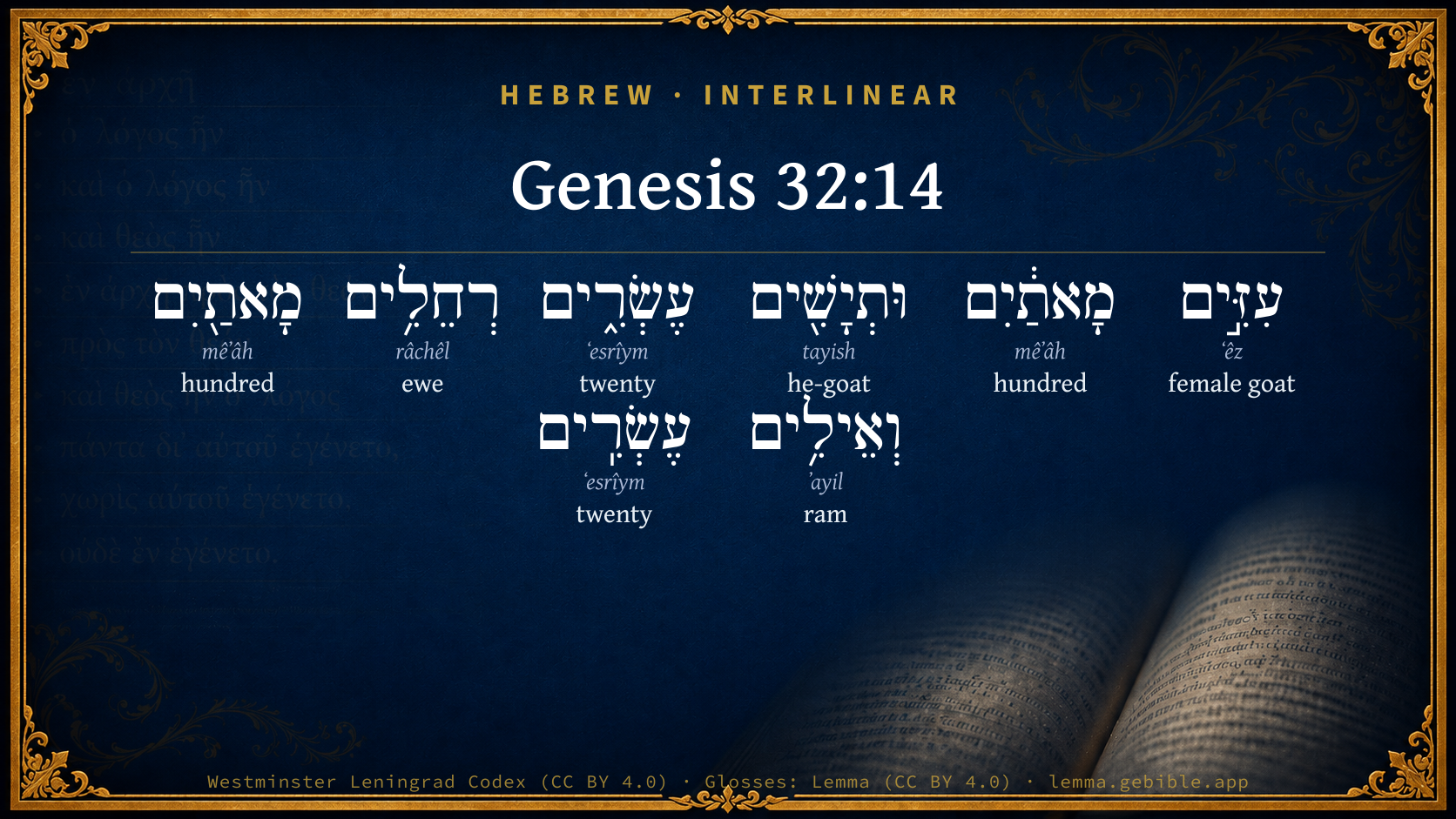
Hebrew (Westminster Leningrad Codex) Genesis 32:14 appears in the Hebrew Old Testament. The text above is from the Westminster Leningrad Codex. Each word links to its Strong’s number, a concise gloss, and parsing drawn from the Open Scriptures Hebrew Bible morphology. Click any word for its full Brown-Driver-Briggs (BDB) entry.
Download image
Cite this verse

Genesis 32:14 (World English Bible). Public Domain. Lemma interlinear Bible study tool, https://lemma.gebible.app/v/genesis/32/14.

Show BibTeX & RIS
BibTeX
RIS
English Translation
two hundred female goats and twenty male goats, two hundred ewes and twenty rams,
World English Bible · Public Domain
Download a study sheet

One document with this verse’s original text, its word-by-word gloss line, the meaning frame, cross-references with their text, attributed commentary, and full source and license credits — printable, and it pastes into notes with its structure intact.

This verse Autodidact and up

Study sheet (.html) Plain text (.txt)

A passage Seminary Student

Up to 50 verses in one chapter. A passage sheet keeps up to 6 commentary sources and 12 cross-references per verse, in the order this page ranks them, and says so on the sheet whenever that leaves anything out. Ask for a single verse and you get the Autodidact verse sheet above.

Everything on this page stays free to read, with no account — the sheet is a download of what is already on screen, not access to it.

Want to remove ads? Support Godless Engineer
Compare translations 3

The same verse in 3 English versions, stacked beneath the original-language interlinear above. Click any original word for its lexicon entry.

Each is an independent rendering of the whole verse — the interlinear is not word-aligned to these translations.

Highlighted words mark where these versions differ — a whole-verse word diff, not a word-by-word alignment.

  • World English Bible Public Domain
    two hundred female goats and twenty male goats, two hundred ewes and twenty rams,
  • King James Version Public Domain
    Two hundred she goats, and twenty he goats, two hundred ewes, and twenty rams,
  • unfoldingWord Literal Text CC BY-SA 4.0
    two hundred she-goats and twenty he-goats, two hundred ewes and twenty rams,

unfoldingWord Literal Text — © unfoldingWord, licensed CC BY-SA 4.0. Word-aligned USFM3 via Door43 (git.door43.org/unfoldingWord/en_ult).

Versions to compare (up to 4)

3 of 4 selected

Show all 18 translations

Every available English version of this verse, each an independent rendering of the whole verse.

  • World English Bible Public Domain
    two hundred female goats and twenty male goats, two hundred ewes and twenty rams,
  • Berean Standard Bible Public Domain
    200 female goats, 20 male goats, 200 ewes, 20 rams,
  • Majority Standard Bible Public Domain
    200 female goats, 20 male goats, 200 ewes, 20 rams,
  • King James Version Public Domain
    Two hundred she goats, and twenty he goats, two hundred ewes, and twenty rams,
  • American Standard Version (1901) Public Domain
    two hundred she-goats and twenty he-goats, two hundred ewes and twenty rams,
  • Revised Version (1885) Public Domain
    two hundred she-goats and twenty he-goats, two hundred ewes and twenty rams,
  • Geneva Bible (1599) Public Domain
    Two hundreth shee goates and twenty hee goates, two hundreth ewes and twentie rammes:
  • Douay-Rheims (1899) Public Domain
    Two hundred she goats, twenty he goats, two hundred ewes, and twenty rams,
  • Young's Literal Translation Public Domain
    she-goats two hundred, and he-goats twenty, ewes two hundred, and rams twenty,
  • Literal Standard Version CC BY-SA 4.0
    female goats two hundred, and male goats twenty, ewes two hundred, and rams twenty,
  • Unlocked Literal Bible CC BY-SA 4.0
    two hundred female goats and twenty male goats, two hundred ewes and twenty rams,
  • unfoldingWord Literal Text CC BY-SA 4.0
    two hundred she-goats and twenty he-goats, two hundred ewes and twenty rams,
  • Darby Bible Public Domain
    two hundred she-goats, and twenty he-goats; two hundred ewes, and twenty rams;
  • World Messianic Bible Public Domain
    two hundred female goats and twenty male goats, two hundred ewes and twenty rams,
  • Webster's Bible Public Domain
    Two hundred she-goats, and twenty he-goats, two hundred ewes and twenty rams,
  • Free Bible Version CC BY-SA 4.0
    200 female goats, 20 male goats; 200 ewes, 20 rams;
  • Bible in Basic English Public Domain
    Two hundred she-goats and twenty he-goats, two hundred females and twenty males from the sheep,
  • JPS Tanakh (1917) Public Domain
    (32-15) two hundred she-goats and twenty he-goats, two hundred ewes and twenty rams,

Literal Standard Version (2020), Covenant Press — licensed CC BY-SA 4.0. Text via the HelloAO Bible API (eBible.org). Unlocked Literal Bible (unfoldingWord) — licensed CC BY-SA 4.0. Text via the HelloAO Bible API (eBible.org). unfoldingWord Literal Text — © unfoldingWord, licensed CC BY-SA 4.0. Word-aligned USFM3 via Door43 (git.door43.org/unfoldingWord/en_ult). Free Bible Version, Dr. Jonathan Gallagher — licensed CC BY-SA 4.0. Text via the HelloAO Bible API (eBible.org).

Word by word

More ways to search: Search by grammar → Find every occurrence → Compare this word →

Practice this passage: Drill this verse → Learn its vocabulary →

About this verse

These counts appear in no published source. They are computed here, from the morphology-tagged text and Lemma’s own curated glosses. What Lemma adds →

8
words
6
distinct lemmas
Pentateuch
section

Notable vocabulary

The rarest word here is וּתְיָשִׁ֖ים he-goat H8495 — appearing just 4 times in the whole Hebrew Bible.

Shared distinctive vocabulary

וּתְיָשִׁ֖ים he-goat H8495 occurs in 4 verses of the Hebrew Bible. Also found in:

Grammatical profile

  • 4 nouns
  • 4 adjectives

Repetition

Words recur within this verse — often emphatic in Hebrew:

  • מָאתַ֔יִם hundred H3967 ×2
  • עֶשְׂרִ֑ים twenty H6242 ×2

Hebrew & Septuagint length

In English translation the verse runs 14 words from the Hebrew and 10 from the Septuagint (LXX English) — the Septuagint runs noticeably shorter here. See the side-by-side →

A rough comparison of the two English renderings, which tokenize alike — not a word-level alignment.

Word counts can differ between the Hebrew and the Greek without any difference in meaning — e.g. the Hebrew direct-object marker אֵת has no separate Greek word, and Greek often adds the article ὁ.

Cross-references

7

Topical passages linked to Genesis 32:14 in the Treasury of Scripture Knowledge — connected by theme and wording, ordered by reader-vote popularity; previews shown in the World English Bible.

  • Deuteronomy 8:18 But you shall remember Yahweh your God, for it is he who gives you power to get wealth; that he may establish his covenant which he swore to your fathers, as at this day.
  • Job 1:3 His possessions also were seven thousand sheep, three thousand camels, five hundred yoke of oxen, five hundred she-donkeys, and a very great household; so that this man was the greatest of all the children of the east.
  • Job 42:12 So Yahweh blessed the latter end of Job more than his beginning. He had fourteen thousand sheep, six thousand camels, one thousand yoke of oxen, and a thousand female donkeys.
  • Genesis 30:43 The man increased exceedingly, and had large flocks, maid-servants and men-servants, and camels and donkeys.
  • Genesis 31:9 Thus God has taken away the cattle of your father, and given them to me.
  • Genesis 31:16 For all the riches which God has taken away from our father, that is ours and our children's. Now then, whatever God has said to you, do."
  • 1 Samuel 25:2 There was a man in Maon, whose possessions were in Carmel; and the man was very great, and he had three thousand sheep, and a thousand goats: and he was shearing his sheep in Carmel.

Cross-references courtesy of OpenBible.info (CC BY 4.0).

Hebrew and Greek witnesses Masoretic Hebrew ↔ Greek Septuagint

The same verse in the two great witnesses to the Old Testament, shown verse-for-verse.

Here the Septuagint runs noticeably shorter than the Hebrew — LXX2012 (modern English Septuagint) 10 words vs World English Bible 14. A rough length comparison of the two English translations, not a word-level alignment — read both below.

These are two independent witnesses, not word-aligned to each other, and the Septuagint is shown in lemma (dictionary) form.

Hebrew Genesis 32:14 Masoretic · Westminster Leningrad Codex

עִזִּ֣ים מָאתַ֔יִם וּתְיָשִׁ֖ים עֶשְׂרִ֑ים רְחֵלִ֥ים מָאתַ֖יִם וְאֵילִ֥ים עֶשְׂרִֽים

two hundred female goats and twenty male goats, two hundred ewes and twenty rams,

World English Bible · Public Domain

Greek LXX Genesis 32:14 Septuagint · lemma form

καί κοιμάω ἐκεῖ ὁ νύξ ἐκεῖνος καί λαμβάνω ὅς φέρω δῶρον καί ἐκ ἀποστέλλω ησαυ ὁ ἀδελφός αὐτός

two hundred she-goats, twenty he-goats, two hundred sheep, twenty rams,

LXX2012 (modern English Septuagint) · Public Domain

Hebrew: Westminster Leningrad Codex (CC BY 4.0). Greek: Septuagint (public domain); English from LXX2012 (modern English Septuagint) (Public Domain). How the Septuagint differs from the Hebrew →

Targum (Aramaic paraphrase)

2

The Targum is the ancient Jewish Aramaic paraphrase of the Hebrew Scriptures — an interpretive translation, not the Hebrew text itself. Onkelos (literal) and Pseudo-Jonathan (expansive) render the Torah, and Jonathan the Prophets. Coverage is partial: where no permissively-licensed English translation exists for a verse, only the Aramaic is shown. This is verse-level text, not a word-by-word alignment to the Hebrew.

  1. Targum Onkelos Torah (Genesis–Deuteronomy)
    וּבָת תַּמָּן בְּלֵילְיָא הַהוּא וּנְסִיב מִן דְּאַיְתִי בִּידֵהּ תִּקְרֻבְתָּא לְעֵשָׂו אֲחוּהִי

    (no public-domain English translation for this verse)

    Targum Onkelos — Aramaic: “Onkelos Genesis” (public domain); “Onkelos Exodus” (public domain); “Onkelos Leviticus” (public domain); “Onkelos Numbers” (public domain); “Onkelos Deuteronomy” (public domain). English: “Sefaria Community Translation” (CC0 1.0 (public-domain dedication)); “J.W. Etheridge. The Targums of Onkelos and Jonathan Ben Uzziel on the Pentateuch. London: Longmans, Green, 1862” (public domain). Text via Sefaria.

  2. Targum Pseudo-Jonathan Torah (Genesis–Deuteronomy)
    וּבַת תַּמָן בְּלֵילְיָא הַהוּא וּנְסֵיב מִן דְאִזְדַמָן בִּידֵיהּ דוֹרוֹן לְעֵשָו אָחוֹי

    And he abode there that night; and he took what was ready at his hand a present for Esau his brother:

    Targum Pseudo-Jonathan — Aramaic: “Targum Jonathan on Genesis” (public domain); “Targum Jonathan on Exodus” (public domain); “Targum Jonathan on Leviticus” (public domain); “Targum Jonathan on Numbers” (public domain); “Targum Jonathan on Deuteronomy” (public domain). English: “The Targum of Jonathan ben Uzziel, trans. J. W. Etheridge, London, 1862” (public domain). Text via Sefaria.

Commentary

Notes on Genesis 32:14 from classic Christian and Jewish commentators (each source and its license shown beneath its notes). The classic Christian expositions comment on the surrounding passage and are grouped to its opening verse, so a note may address several verses; the Jewish commentaries on the Tanakh (Rashi and others) are per-verse, so they appear only where the commentator wrote on this verse.

Lemma curates 59 commentaries, every one of them public domain or Creative Commons licensed, each selected and text-cleaned for this edition rather than reprinted as found. About our sources →

Trapp's Complete Commentary

John Trapp

Gen 32:14 Two hundred she goats, and twenty he goats, two hundred ewes, and twenty rams,

Ver. 14. Two hundred she-goats, &c.] A very great present for a private person to send. Five hundred and fifty beasts, of sundry sorts, for store. He spares no cost, that he may buy his peace, and enjoy his birthright. Heaven, he knew (whereof Canaan was a type and pledge), would pay for all. Get but a patriarch’s eye to see heaven afar off, and we shall be soon ready to buy it at any rate. The pearl of price cannot be a dear bargain, though we part with all to purchase it. Moses was forty years old, and therefore no baby, when "he preferred the reproach of Christ," the worst thing about him, "before the treasures of Egypt". {Heb 11:26} Egypt was a country rich, fruitful, and learned. Thence Solomon had his chief horses; {2Ch 9:28} thence the harlot had her fine linens. {Pro 7:16} Moses might, in likelihood, have been king of Egypt, yea, and of Ethiopia too, as some think: but he had a better prize in his hand, and therefore slights all the world’s flitting and flattering felicities. When Basil was tempted with money and preferment, he answered, pecuniam da quae permaneat, ac continuo daret, gloriam quae semper floreat. This the world cannot do; nay, it cannot keep off diseases, death, &c. Non domus et fundus, &c. When Michael Paleologus, Emperor of Constantinople, sent to Nugas the Scythian prince, for a present, certain royal robes and rich ornaments, he set light by them, asking, Whether they could drive away calamities, sickness, death? {a} No, no: this, nothing can do, but the favour of God and interest in Christ. Wherefore should I die, being so rich? was the foolish question of that rich and wretched cardinal, Henry Beaufort, bishop of Winchester, and Chancellor of England, in the reign of Henry VI. Fie, quoth he, will not death be hired? will money do nothing? {b} No, saith Solomon: "Treasures of wickedness profit nothing; but righteousness delivereth from death". {Pro 10:2} Many are loath to die, because they have treasures in the world; as those ten men had in the field. {Jer 41:8} The Irish ask, - What! such men mean to die? But such men must die; nor can their riches reprieve them. Oh! happy is he that, with Jacob, lays hold on the heavenly inheritance, though with the loss of earthly possessions; that cares not to part with his cattle, so he may have his crown; with his swine, so he may have his Saviour. {Mat 8:34} This is the wise merchant, this is the true tradesman, that traffics for heaven; looking upon the world as a great dunghill, with Paul, σκυβαλα, dog’s dung. {Php 3:8}

{a} Numquid calamitates, morbos, aut mortem depellere possent? - Pachymer. Hist., lib. v.

{b} Act, and Mon., fol. 925.

John Trapp, A Commentary or Exposition upon All the Books of the Old and New Testament (1647–1656) — public domain. Text from a community e-Sword module.

Keil & Delitzsch

C. F. Keil & F. Delitzsch

Although hoping for aid and safety from the Lord alone, Jacob neglected no means of doing what might help to appease his brother. Having taken up his quarters for the night in the place where he received the tidings of Esau's approach, he selected from his flocks ("of that which came to his hand," i.e., which he had acquired) a very respectable present of 550 head of cattle, and sent them in different detachments to meet Esau, "as a present from his servant Jacob," who was coming behind. The selection was in harmony with the general possessions of nomads (cf. Job 1:3; Job 42:12), and the proportion of male to female animals was arranged according to the agricultural rule of Varro (de re rustica 2, 3). The division of the present, "drove and drove separately," i.e., into several separate droves which followed one another at certain intervals, was to serve the purpose of gradually mitigating the wrath of Esau. פּנים כּפּר, Gen 32:21, to appease the countenance; פּנים נשׁא to raise any one's countenance, i.e., to receive him in a friendly manner. This present he sent forward; and he himself remained the same night (mentioned in Gen 32:14) in the camp.

Keil & Delitzsch — Biblical Commentary on the Old Testament (1861–1891) — public domain (CC PDM 1.0). Text via the HelloAO Bible API. (Old Testament only.)

Adam Clarke's Commentary

Verse 14. Two hundred she-goats, c.] This was a princely present, and such as was sufficient to have compensated Esau for any kind of temporal loss he might have sustained in being deprived of his birthright and blessing. The thirty milch camels were particularly valuable, for milch camels among the Arabs constitute a principal part of their riches, the creature being every way so serviceable that the providence of God appears peculiarly kind and wise in providing such a beast for those countries where no other animal could be of equal service. "The she-camel gives milk continually, not ceasing till great with young the milk of which," as Pliny has remarked, "when mixed with three parts of water, affords the most pleasant and wholesome beverage." Cameli lac habent, donec iterum gravescant, suavissimumque hoc existimatur, ad unam mensuram tribus aquae additis.-Hist. Nat., lib. xi., chap. 41.

Adam Clarke's Commentary on the Bible (1810–1826) — public domain. Text from a community e-Sword/MySword module.

John Calvin's Commentaries

14. Two hundred she-goats. Hence we perceive the value which Jacob set upon the promise given to him, seeing he does not refuse to make so great a sacrifice of his property. We know that those things which are obtained with great toil and trouble are the more highly esteemed. So that generally they who are enriched by their own labor are proportionally sparing and tenacious. It was, however, no trivial diminution even of great wealth, to give forty cows, thirty camels with their young, twenty bulls, and as many asses with their foals, two hundred she-goats, and as many sheep, with twenty rams, and the same number of he-goats. But Jacob freely lays upon himself this tax, that he may obtains a safe return to his own country. Certainly it would not have been difficult to find some nook where he might live with his property entire: and an equally commodious habitations might have been found elsewhere. But, that he might not lose the benefit of the promise, he purchases, at so great a price, from his brother, a peaceable abode in the land of Canaan. Therefore should we be ashamed of our effeminacy and tardiness, who wickedly turn aside from the duty of our calling, as soon as any loss is to be sustained. With a clear and loud voice the Lord commands us to do what he pleases; but some, because they find it troublesome to take up their burdens, lie in idleness; pleasures also keep back some; riches or honors impede others; finally, few follow God, because scarcely one in a hundred will bear to be losers. In putting a space between the messengers, and in sending them at different times from each other, he does it to mitigate by degrees the ferocity of his brother: Whence we infer again, that he was not so seized with fear, as to be unable prudently to order his affairs.

John Calvin's Commentaries (1540-1563) — public domain. Text from the Calvin Translation Society English edition (1840s-50s) via the Christian Classics Ethereal Library (ccel.org). Calvin's coverage is partial (roughly two-thirds of the Bible); uncommented books and verses are honest gaps, never fabricated. The 19th-century editor's footnotes and remarks are omitted so the notes are faithfully Calvin's own voice.

Ellicott's Commentary for English Readers

(14, 15) Goats—ewes—camels—kine—asses.—As the kinds of cattle are arranged according to their value, it is remarkable that kine should be prized above camels; for the milk of cows was regarded as of little worth. This high estimation of them, therefore, must have arisen from an increased regard for agriculture, the ploughing being done in the East by oxen. Asses of course come last, as being the animal used by chieftains for riding, and therefore prized as matters of luxury. (See Gen_12:16; Jdg_5:10.) Jacob selected “milch camels” because their milk forms a valuable part of the daily food of the Arabs.

A Bible Commentary for English Readers, edited by Charles John Ellicott (1878–1897) — public domain. Text from a community e-Sword module.

The Cambridge Bible for Schools and Colleges

gen. ed. J. J. S. Perowne

14. two hundred, &c.] The numbers here given enable us to form some idea of the great size of Jacob’s caravan. The animals are apparently mentioned in the order of their value, beginning with the least valuable.

Jacob hopes by the arrival of a succession of gifts to break down Esau’s bitter grudge against him. For “a brother offended,” cf. Pro_18:19.

The Cambridge Bible for Schools and Colleges (gen. ed. J. J. S. Perowne; Cambridge University Press, 1878–1918) — public domain. Text from a community e-Sword module.

John Gill's Exposition

Two hundred she goats, and twenty he goats, two hundred ewes,

and twenty rams. And it seems this proportion of one he goat to ten she goats, and of one ram to ten ewes, is a proper one, and what has been so judged in other times and countries (x).

(x) Varro de rustica, l. 2. c. 3. apud Bochart. Hierozoic. par. 1. l. 2. c. 43. col. 439. &c. 53. col. 648.

John Gill's Exposition of the Whole Bible (1746–1763) — public domain (CC PDM 1.0). Text via the HelloAO Bible API.

The Pulpit Commentary

Vers. 14, 15Two hundred she goats, and twenty he goats, two hundred ewes, and twenty rams, thirty milch camels (specially valuable in the East on account of their milk, which was peculiarly sweet and wholesome) with their colts, forty kine, and ten hulls, twenty she asses, and ten foals. The selection was in harmony witch the general possessions of nomads, (cf. Job_1:3 Job_42:12) and the proportion of male to female animals was arranged according to what the experience of the best ancient authorities has shown to be necessary for the purposes of breeding (Rosenm Keil, Kalisch).

The Pulpit Commentary (1880–1919), ed. H.D.M. Spence-Jones & Joseph S. Exell — public domain. Text from a community e-Sword module.

Rashi

Rabbi Shlomo Yitzchaki (Rashi)

הבא בידו AND TOOK OF THAT WHICH CAME TO HIS HAND (literally, in his hand) — in his possession, similar to (Numbers 21:26) “and he had taken all his land out of his possession (מידו).” A Midrashic explanation is: מן הבא בידו — precious stones and jewels which a person ties up in a package and carries in his hand. Another explanation is: מן הבא בידו THAT WHICH A MAN MAY TAKE INTO HIS OWN POSSESSION — of that which no longer has a sacred character — for he had set aside the tithe, just as you read (28:22) “[And Jacob vowed] … I will surely give the tenth unto Thee”. Only afterwards did he take the present of what was left after the tithe had been set aside, and this was that which he might rightly take into his own possession.

Rashi on the Tanakh — English translations: “The Judaica Press complete Tanach with Rashi, translated by A. J. Rosenberg” (CC BY 4.0); “Pentateuch with Rashi's commentary by M. Rosenbaum and A.M. Silbermann, 1929-1934” (public domain); “The Metsudah Tanach series, Lakewood, N.J” (CC BY 4.0); and “The Book of Joshua, Metsudah Publications, 1997” (CC BY 4.0). Text via Sefaria.

Ramban (Nachmanides)

Rabbi Moshe ben Nachman (Ramban / Nachmanides)

OF THAT WHICH HE HAD WITH HIM A PRESENT. Scripture states that he composed a gift out of that which he had since his wealth consisted of flocks and herds, and it was from them that Jacob sent a gift, for he was en-route and he had no opportunity to send him vessels of silver, and vessels of gold… and precious things.

Ramban (Nachmanides) on the Tanakh — English translation: “Commentary on the Torah by Ramban (Nachmanides). Translated and annotated by Charles B. Chavel. New York, Shilo Pub. House, 1971-1976” (CC BY 4.0). Text via Sefaria.

Radak

Rabbi David Kimhi (Radak)

וילן, he remained standing all night waiting for a response to his prayer. While waiting he prepared the gift he was going to send to Esau in the morning. The Torah describes this gift in detail a little later on in its narrative, commencing with the words עזים מאתים.

בידו, which were his. The word occurs in this sense also in 39,4 where Potiphar transfers all his belongings to the care of Joseph. The angel with whom Yaakov wrestled, and who represented the answer to his prayer, did not arrive until after Yaakov had completed preparing his gift for Esau. The reason for this delay was in order to teach us that we must not entrust our affairs to the intervention of G’d on our behalf until after we have exhausted natural means of achieving our purpose (legally, of course). Even the greatest tzaddik must not entrust his needs to G’d while attending to matters such as Torah study, for instance, instead of his duties to insure his own and his family’s needs. These include prayer, appeasement of adversaries by gifts or lip-service, and in the final analysis physical resistance, war. In all one’s endeavours one must, of course, put one’s trust in G’d, hoping that He will approve of one’s efforts and grant one success.

Radak on the Tanakh — English translations: “Sefaria Community Translation” (CC0 1.0 (public-domain dedication)); “Eliyahu Munk, HaChut Hameshulash” (CC BY 4.0); “Rabbi Mike Feuer, Jerusalem Anthology” (CC BY 4.0); and “R. David Kimhi on the first book of Psalms, Translated by R.G. Finch, London, 1919” (public domain). Text via Sefaria.

Lesson kit

Teaching starters — assembled from the data on this page, not authored interpretation. Every prompt links to the verse data it draws on. Edit before teaching.

Genesis, in the Pentateuch, opens this verse with 8 words (6 distinct Hebrew lemmas). Its most distinctive word is tayish (“he-goat”). The Greek Septuagint runs shorter here. A historical commentator’s framing appears above. Read the whole chapter for the surrounding context.

Discussion questions

  1. How does “he-goat” (tayish) shape what this verse is saying?
  2. Genesis 30:35 shares the word «he-goat» with this verse. How do the two illuminate each other?
  3. “hundred” occurs 2× in this one verse. What is the effect of the repetition?
  4. Compared with the Hebrew, the Septuagint runs shorter here. What questions does that raise?
  5. These translations render this verse differently. What is at stake in choosing one wording over another?
  6. Reading how Trapp's Complete Commentary and Keil & Delitzsch read this verse, where do the two commentators agree and where do they part?

Things to notice

  • These translations choose different wording for 5 words in this verse.
  • “hundred” occurs 2× in this single verse.
  • 6 distinct Hebrew lemmas span 8 words in this verse.

Reading settings

Reading text

Shown beneath each verse's original-language words.

Old Testament
Old Testament edition

Read the OT as the Masoretic Hebrew (MT) or the Greek Septuagint (LXX).

English shown for the Greek Septuagint (in the Hebrew ↔ Greek comparison).

Comparing translations? Open the Compare panel on any verse page to stack up to four side by side.