
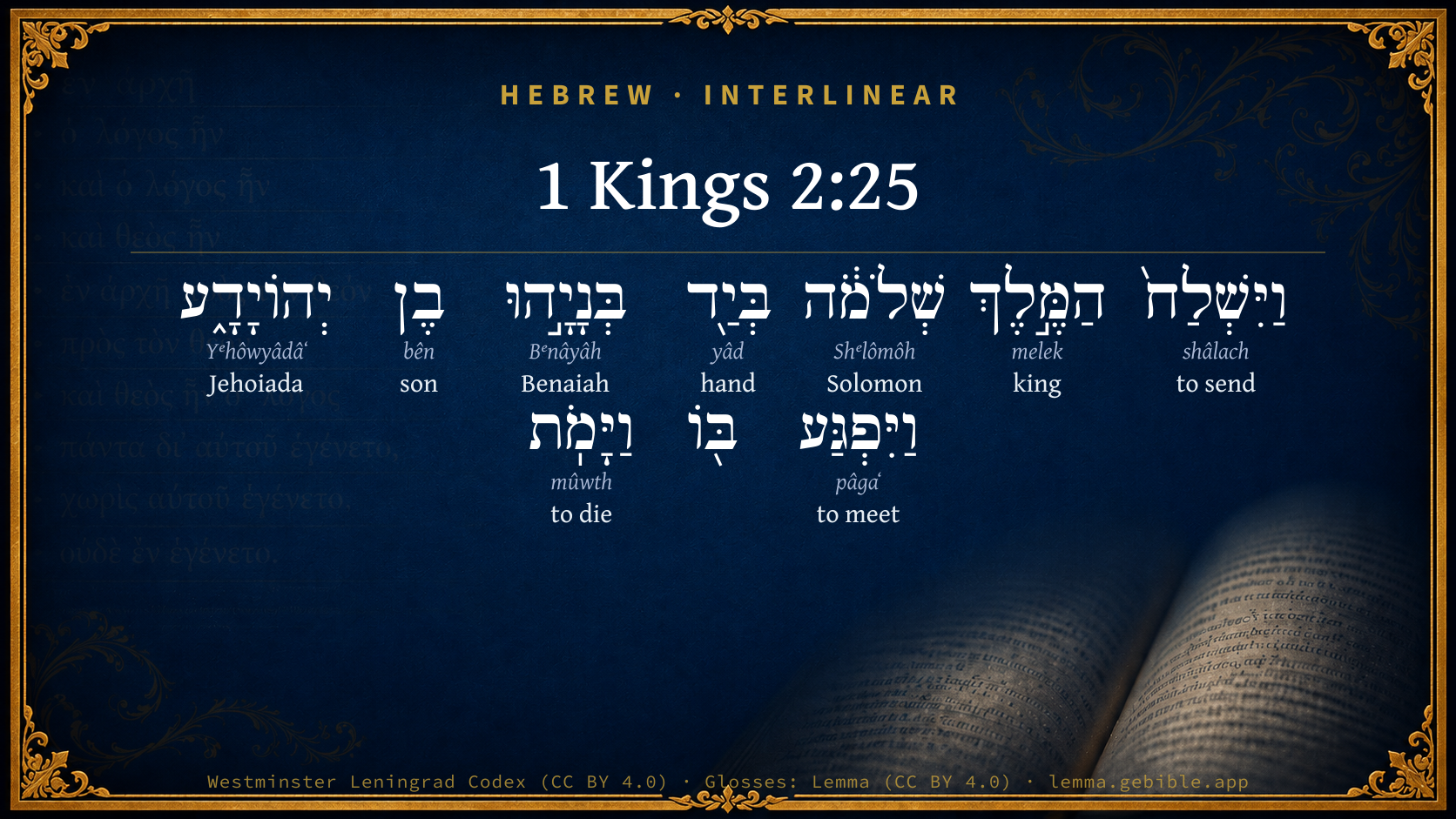
1 Kings 2:25

Hebrew (Westminster Leningrad Codex) 1 Kings 2:25 appears in the Hebrew Old Testament. The text above is from the Westminster Leningrad Codex. Each word links to its Strong’s number, a concise gloss, and parsing drawn from the Open Scriptures Hebrew Bible morphology. Click any word for its full Brown-Driver-Briggs (BDB) entry.
Download image
Cite this verse

1 Kings 2:25 (World English Bible). Public Domain. Lemma interlinear Bible study tool, https://lemma.gebible.app/v/1-kings/2/25.

Show BibTeX & RIS
BibTeX
RIS
English Translation
King Solomon sent by Benaiah the son of Jehoiada; and he fell on him, so that he died.
World English Bible · Public Domain
Download a study sheet

One document with this verse’s original text, its word-by-word gloss line, the meaning frame, cross-references with their text, attributed commentary, and full source and license credits — printable, and it pastes into notes with its structure intact.

This verse Autodidact and up

Study sheet (.html) Plain text (.txt)

A passage Seminary Student

Up to 50 verses in one chapter. A passage sheet keeps up to 6 commentary sources and 12 cross-references per verse, in the order this page ranks them, and says so on the sheet whenever that leaves anything out. Ask for a single verse and you get the Autodidact verse sheet above.

Everything on this page stays free to read, with no account — the sheet is a download of what is already on screen, not access to it.

Want to remove ads? Support Godless Engineer
Compare translations 3

The same verse in 3 English versions, stacked beneath the original-language interlinear above. Click any original word for its lexicon entry.

Each is an independent rendering of the whole verse — the interlinear is not word-aligned to these translations.

Highlighted words mark where these versions differ — a whole-verse word diff, not a word-by-word alignment.

  • World English Bible Public Domain
    King Solomon sent by Benaiah the son of Jehoiada; and he fell on him, so that he died.
  • King James Version Public Domain
    And king Solomon sent by the hand of Benaiah the son of Jehoiada; and he fell upon him that he died.
  • unfoldingWord Literal Text CC BY-SA 4.0
    And King Solomon sent by the hand of Benaiah, the son of Jehoiada, and he attacked him, and he died.

unfoldingWord Literal Text — © unfoldingWord, licensed CC BY-SA 4.0. Word-aligned USFM3 via Door43 (git.door43.org/unfoldingWord/en_ult).

Versions to compare (up to 4)

3 of 4 selected

Show all 18 translations

Every available English version of this verse, each an independent rendering of the whole verse.

  • World English Bible Public Domain
    King Solomon sent by Benaiah the son of Jehoiada; and he fell on him, so that he died.
  • Berean Standard Bible Public Domain
    So King Solomon sent the order to Benaiah son of Jehoiada, who struck down Adonijah, and he died.
  • Majority Standard Bible Public Domain
    So King Solomon gave orders to Benaiah son of Jehoiada, and he struck down Adonijah and he died.
  • King James Version Public Domain
    And king Solomon sent by the hand of Benaiah the son of Jehoiada; and he fell upon him that he died.
  • American Standard Version (1901) Public Domain
    And king Solomon sent by Benaiah the son of Jehoiada; and he fell upon him, so that he died.
  • Revised Version (1885) Public Domain
    And king Solomon sent by the hand of Benaiah the son of Jehoiada; and he fell upon him, that he died.
  • Geneva Bible (1599) Public Domain
    And King Salomon sent by the hand of Benaiah the sonne of Iehoiada, and hee smote him that he dyed.
  • Douay-Rheims (1899) Public Domain
    And king Solomon sent by the hand of Banaias the son of Joiada, who slew him, and he died.
  • Young's Literal Translation Public Domain
    And king Solomon sendeth by the hand of Benaiah son of Jehoiada, and he falleth upon him, and he dieth.
  • Literal Standard Version CC BY-SA 4.0
    And King Solomon sends by the hand of Benaiah son of Jehoiada, and he falls on him, and he dies.
  • Unlocked Literal Bible CC BY-SA 4.0
    So King Solomon sent Benaiah son of Jehoiada, and Benaiah found Adonijah and put him to death.
  • unfoldingWord Literal Text CC BY-SA 4.0
    And King Solomon sent by the hand of Benaiah, the son of Jehoiada, and he attacked him, and he died.
  • Darby Bible Public Domain
    And king Solomon sent by the hand of Benaiah the son of Jehoiada; who fell on him, that he died.
  • World Messianic Bible Public Domain
    King Solomon sent Benaiah the son of Jehoiada; and he fell on him, so that he died.
  • Webster's Bible Public Domain
    And king Solomon sent by the hand of Benaiah the son of Jehoiada; and he fell upon him that he died.
  • Free Bible Version CC BY-SA 4.0
    King Solomon sent Benaiah, son of Jehoiada, who carried out the king's orders and executed Adonijah.
  • Bible in Basic English Public Domain
    And King Solomon sent Benaiah, the son of Jehoiada, and he made an attack on him and put him to death.
  • JPS Tanakh (1917) Public Domain
    And king Solomon sent by the hand of Benaiah the son of Jehoiada; and he fell upon him, so that he died.

Literal Standard Version (2020), Covenant Press — licensed CC BY-SA 4.0. Text via the HelloAO Bible API (eBible.org). Unlocked Literal Bible (unfoldingWord) — licensed CC BY-SA 4.0. Text via the HelloAO Bible API (eBible.org). unfoldingWord Literal Text — © unfoldingWord, licensed CC BY-SA 4.0. Word-aligned USFM3 via Door43 (git.door43.org/unfoldingWord/en_ult). Free Bible Version, Dr. Jonathan Gallagher — licensed CC BY-SA 4.0. Text via the HelloAO Bible API (eBible.org).

Word by word

More ways to search: Search by grammar → Find every occurrence → Compare this word →

Practice this passage: Drill this verse → Learn its vocabulary →

בְּנָיָ֣הוּ
Bᵉnâyâh
H1141
“Benaiah”
Noun, Proper
Part of Speech
Noun
Type
Proper
Full BDB Definition

Origin: from H1129 and H3050

TWOT: None

Benaiah = "Jehovah has built" or " Yahweh has built up" - one of David's mighty warriors, son of Jehoiada the chief priest, a Levite, set by David over his bodyguard, later having remained faithful to Solomon during Adonijah's attempt on the crown, was raised into the place of Joab as commander-in-chief of the army - the Pirathonite, an Ephraimite, one of David's thirty mighty warriors, and the captain of the eleventh monthly course - a Simeonite, a prince of the families of Simeon - a Levite in the time of David who played with a psaltery on Alamoth - a priest in the time of David, appointed to blow the trumpet before the ark - a Levite of the sons of Asaph - a Levite in the time of Hezekiah - Four Israelites in the time of Ezra who had taken strange wives - the father of Pelatiah
  1. וַיִּשְׁלַח֙ shâlach H7971 “and · to send” Conjunction + Verb, Qal, Sequential Imperfect, 3rd Person, Masculine, Singular
  2. הַמֶּ֣לֶךְ melek H4428 “the · king” Particle, Definite Article + Noun, Common, Masculine, Singular, Absolute
  3. שְׁלֹמֹ֔ה Shᵉlômôh H8010 “Solomon” Noun, Proper
  4. בְּיַ֖ד yâd H3027 “in/at · hand of” Preposition + Noun, Common, Both, Singular, Construct
  5. בֶן bên H1121 “son of” Noun, Common, Masculine, Singular, Construct
  6. יְהוֹיָדָ֑ע Yᵉhôwyâdâʻ H3077 “Jehoiada” Noun, Proper
  7. וַיִּפְגַּע pâgaʻ H6293 “and · to meet” Conjunction + Verb, Qal, Sequential Imperfect, 3rd Person, Masculine, Singular
  8. וַיָּמֹֽת mûwth H4191 “and · to die” Conjunction + Verb, Qal, Sequential Imperfect, 3rd Person, Masculine, Singular

About this verse

These counts appear in no published source. They are computed here, from the morphology-tagged text and Lemma’s own curated glosses. What Lemma adds →

10
words
9
distinct lemmas
Historical
section

Shared distinctive vocabulary

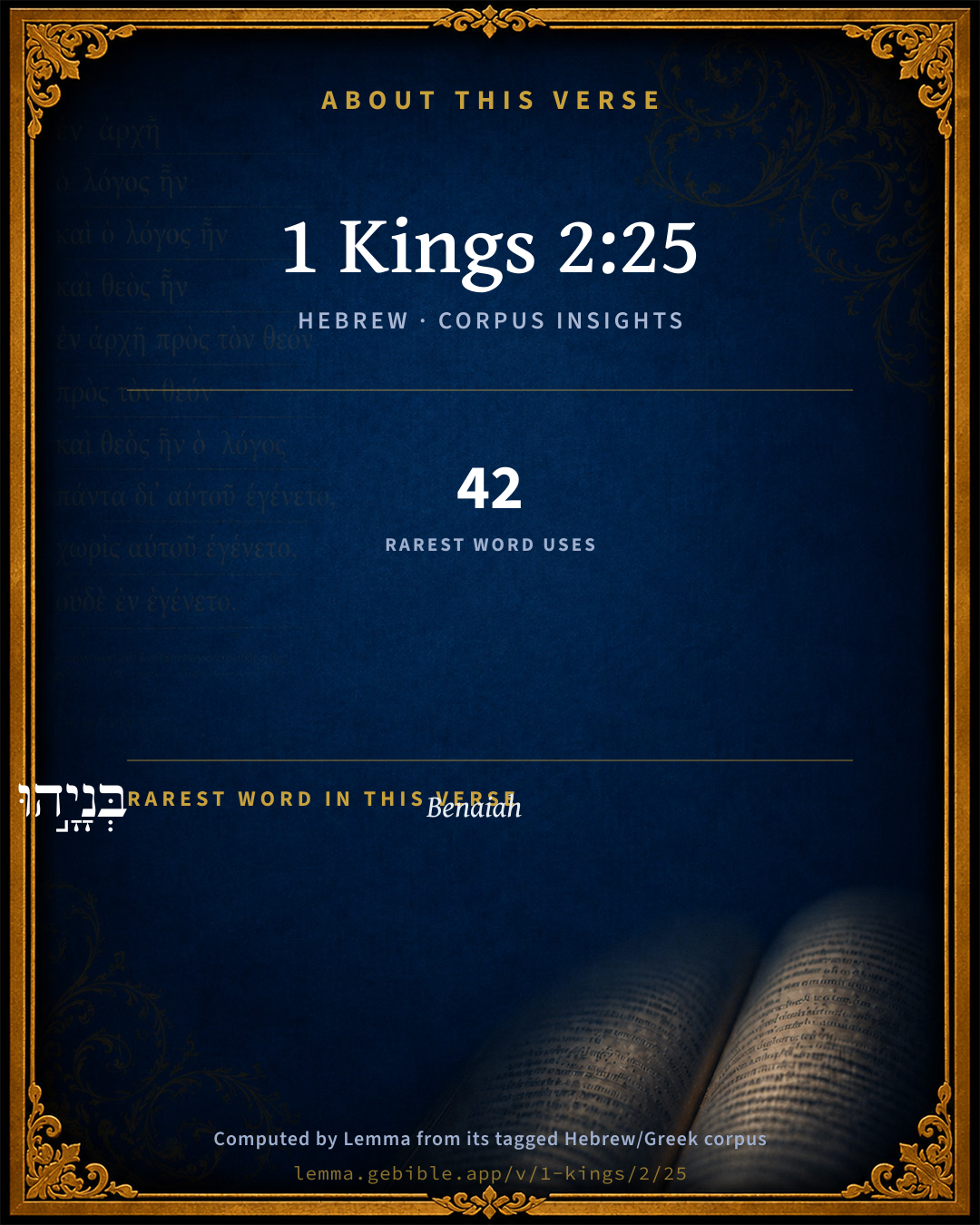
בְּנָיָ֣הוּ Benaiah H1141 occurs in 41 verses of the Hebrew Bible. Also found in:

Grammatical profile

  • 3 verbs
  • 6 nouns
  • 1 preposition

Verb forms

  • וַיִּשְׁלַח֙ Qal · Sequential Imperfect
  • וַיִּפְגַּע Qal · Sequential Imperfect
  • וַיָּמֹֽת Qal · Sequential Imperfect

Hebrew & Septuagint length

In English translation the verse runs 18 words from the Hebrew and 23 from the Septuagint (LXX English) — closely comparable.

A rough comparison of the two English renderings, which tokenize alike — not a word-level alignment.

Word counts can differ between the Hebrew and the Greek without any difference in meaning — e.g. the Hebrew direct-object marker אֵת has no separate Greek word, and Greek often adds the article ὁ.

Cross-references

8

Topical passages linked to 1 Kings 2:25 in the Treasury of Scripture Knowledge — connected by theme and wording, ordered by reader-vote popularity; previews shown in the World English Bible.

  • 2 Samuel 8:18 and Benaiah the son of Jehoiada [was over] the Cherethites and the Pelethites; and David's sons were chief ministers.
  • Judges 8:20–21 He said to Jether his firstborn, Up, and kill them. But the youth didn't draw his sword; for he feared, because he was yet a youth.
  • 1 Samuel 15:33 Samuel said, As your sword has made women childless, so shall your mother be childless among women. Samuel hewed Agag in pieces before Yahweh in Gilgal.
  • 2 Samuel 1:15 David called one of the young men, and said, Go near, and fall on him. He struck him, so that he died.
  • 2 Samuel 4:12 David commanded his young men, and they killed them, and cut off their hands and their feet, and hanged them up beside the pool in Hebron. But they took the head of Ish-bosheth, and buried it in the grave of Abner in Hebron.
  • 1 Kings 2:31 The king said to him, Do as he has said, and fall on him, and bury him; that you may take away the blood, which Joab shed without cause, from me and from my father's house.
  • 1 Kings 2:34 Then Benaiah the son of Jehoiada went up, and fell on him, and killed him; and he was buried in his own house in the wilderness.
  • 1 Kings 2:46 So the king commanded Benaiah the son of Jehoiada; and he went out, and fell on him, so that he died. The kingdom was established in the hand of Solomon.

Cross-references courtesy of OpenBible.info (CC BY 4.0).

Hebrew and Greek witnesses Masoretic Hebrew ↔ Greek Septuagint

The same verse in the two great witnesses to the Old Testament, shown verse-for-verse.

These are two independent witnesses, not word-aligned to each other, and the Septuagint is shown in lemma (dictionary) form.

Hebrew 1 Kings 2:25 Masoretic · Westminster Leningrad Codex

וַיִּשְׁלַח֙ הַמֶּ֣לֶךְ שְׁלֹמֹ֔ה בְּיַ֖ד בְּנָיָ֣הוּ בֶן יְהוֹיָדָ֑ע וַיִּפְגַּע בּ֖וֹ וַיָּמֹֽת

King Solomon sent by Benaiah the son of Jehoiada; and he fell on him, so that he died.

World English Bible · Public Domain

Greek LXX 1 Kings 2:25 Septuagint · lemma form

καί ἐκ ἀποστέλλω σαλωμών ὁ βασιλεύς ἐν χείρ βαναιας υἱός ιωδαε καί ἀνααἱρέω αὐτός καί ἀποθνήσκω αδωνίας ἐν ὁ ἡμέρα ἐκεῖνος

So king Solomon sent by the hand of Banaeas the son of Jodae, and he killed him, and Adonias died in that day.

LXX2012 (modern English Septuagint) · Public Domain

On this verse, The Cambridge Bible for Schools and Colleges discusses the Septuagint’s reading. Read the note in Commentary ↓

Hebrew: Westminster Leningrad Codex (CC BY 4.0). Greek: Septuagint (public domain); English from LXX2012 (modern English Septuagint) (Public Domain). How the Septuagint differs from the Hebrew →

Targum (Aramaic paraphrase)

1

The Targum is the ancient Jewish Aramaic paraphrase of the Hebrew Scriptures — an interpretive translation, not the Hebrew text itself. Onkelos (literal) and Pseudo-Jonathan (expansive) render the Torah, and Jonathan the Prophets. Coverage is partial: where no permissively-licensed English translation exists for a verse, only the Aramaic is shown. This is verse-level text, not a word-by-word alignment to the Hebrew.

  1. Targum Jonathan Prophets (Joshua–Malachi)
    וּשְׁלַח מַלְכָּא שְׁלֹמֹה בְּיַד בְּנָיָהוּ בַּר יְהוֹיָדָע וְשַׁלִיט בֵּיהּ וְקַטְלֵיהּ:

    (no public-domain English translation for this verse)

    Targum Jonathan — Aramaic: “Mikraot Gedolot” (public domain). English: “Sefaria Community Translation” (CC0 1.0 (public-domain dedication)); “London "Chaldee Paraphrase," 1871” (public domain). Text via Sefaria.

Commentary

Notes on 1 Kings 2:25 from classic Christian and Jewish commentators (each source and its license shown beneath its notes). The classic Christian expositions comment on the surrounding passage and are grouped to its opening verse, so a note may address several verses; the Jewish commentaries on the Tanakh (Rashi and others) are per-verse, so they appear only where the commentator wrote on this verse.

Lemma curates 59 commentaries, every one of them public domain or Creative Commons licensed, each selected and text-cleaned for this edition rather than reprinted as found. About our sources →

Trapp's Complete Commentary

John Trapp

1Ki 2:25 And king Solomon sent by the hand of Benaiah the son of Jehoiada; and he fell upon him that he died.

Ver. 25. And he fell upon him that he died.] This was another piece of the punishment of David’s two great sins: the small and short pleasure whereof, behold, what a train and tail of calamities it draweth after it!

John Trapp, A Commentary or Exposition upon All the Books of the Old and New Testament (1647–1656) — public domain. Text from a community e-Sword module.

Joseph Benson's Commentary

1Ki 2:25. Solomon sent by the hand of Benaiah, &c. — For the execution of justice was not then committed to obscure persons, as it is now, but to persons of great honour and authority. Notwithstanding what has been observed in the two or three preceding notes, probably the reader will be inclined to think, as certainly many are, that it is far from being clear Solomon acted right in putting Adonijah to death, or that the latter had any ill design in asking Abishag. And yet, what certainly is of great weight, we nowhere find Solomon censured in the Scriptures for this action.

Joseph Benson's Commentary on the Old and New Testaments (1811–1818) — public domain. Text from a community e-Sword module.

Geneva Bible (1599)

Geneva Bible translators

Or, fell upon him.

Geneva Bible (1599) marginal notes — public domain. Text via Bolls.life.

Adam Clarke's Commentary

Verse 25. Solomon sent - Benaiah - and he fell upon him that he died.] Benaiah seems to have been the public state executioner, and yet he was generalissimo of all the forces. See him employed in a similar work, 1Kg 2:34; 1Kg 2:46. I suppose him to have been such another general as Suwarrow, butcher-general of the Turks and Poles to the late Empress Catharine of Russia: like mistress, like man. But they have long since been called to an impartial tribunal.

That this was an act of cruelty towards Adonijah, needs no proof. He is suspected, condemned, and slain, without a hearing. Calmet vindicates all this by various assumptions, and lays down a doctrine that is calculated for the meridian of Fez or Morocco; hear him: Un prince, dans ses jugemens, ne peut pas toujours suivre les regles de la plus parfaite morale; la politique, et le bien de l'etat, obligent souvent a des choses opposees aux conseils de l'evangile; "A prince in his judgments cannot always follow the rules of the most perfect morality; policy and the good of the state often require things to be done which are contrary to the counsels of the Gospel." What a diabolic maxim is this! And is this indeed the way that French kings ruled and ministers decreed judgment? Then we need not wonder at a revolution in that state, nor of the scourge that desolated the land. O England! magnify God for your constitution, your constitutional king, and the laws according to which he reigns.

Adam Clarke's Commentary on the Bible (1810–1826) — public domain. Text from a community e-Sword/MySword module.

Ellicott's Commentary for English Readers

(25) Sent by the hand of Benaiah.—The chief of the body-guard is the chief of “the executioners” (see 1Ki_1:38), apparently, in the case of great criminals, carrying out the sentence of condemnation with his own hand. (Comp. Jdg_8:20-21.)

A Bible Commentary for English Readers, edited by Charles John Ellicott (1878–1897) — public domain. Text from a community e-Sword module.

The Cambridge Bible for Schools and Colleges

gen. ed. J. J. S. Perowne

25. by the hand of Benaiah] To Benaiah was committed not the oversight, but the execution of the sentence. In like manner he puts to death Joab (1Ki_2:34) and Shimei (1Ki_2:46). Solomon was absolute as a monarch, and the command was executed as promptly as it was given. The LXX fills out the sentence thus, καὶ ἀπέθανεν Ἀδωνίας ἐν τῇ ἡμέρᾳ ἐκείνῃ.

The Cambridge Bible for Schools and Colleges (gen. ed. J. J. S. Perowne; Cambridge University Press, 1878–1918) — public domain. Text from a community e-Sword module.

John Gill's Exposition

And unto Abiathar the priest said the king,.... Who was either at court, or he sent for him, and thus addressed him:

get thee to Anathoth; a city of the tribe of Benjamin, given to the priests, Jos 21:18; of which place Abiathar might be originally, and whither he is bid to return:

unto thine own fields; which belonged to him there, either by inheritance or purchase; and these he was to mind, and not perform the functions of his office, however as high priest, and at Jerusalem, and the tabernacle there, and still less appear at court, or meddle with state affairs, only to attend to his private domestic concerns:

for thou art worthy of death; in joining with Adonijah in the lifetime of David, and setting him up as a king without his knowledge, and in opposition to Solomon, contrary to the will of God, and promise of David, of which he, being high priest, cannot be thought to be ignorant, and for his late confederacy with Adonijah, of which Solomon had knowledge:

but I will not at this time put thee to death; he does not give him a full pardon, only a respite; suggesting, that should he be guilty of any overt act, he would be put to death another time, though not now:

because thou barest the ark of the Lord God before David my father; when he fled from Absalom, Sa2 15:24;

and because thou hast been afflicted in all wherein my father was afflicted; shared with him in all his afflictions under the persecutions of Saul, from the time he slew the priests at Nob, and at the rebellion of Absalom; in each of which he accompanied him, and suffered and sympathized with him.

John Gill's Exposition of the Whole Bible (1746–1763) — public domain (CC PDM 1.0). Text via the HelloAO Bible API.

Haydock's Catholic Bible Commentary

Banaias. The chief officers became executioners, on such occasions, Daniel ii. 24. The Romans employed soldiers; which makes Tertullian (Coron. xi.) dissuade Christians from entering the service.

George Leo Haydock (1774–1849), Haydock's Catholic Family Bible and Commentary, 1859 edition — public domain. Excludes Psalms (Douay-Rheims chapter numbering differs from Protestant) and Deuterocanonical books (Catholic canon only).

Matthew Poole's English Annotations

For the execution of justice was not then committed to obscure persons, as now it is; but to persons of great honour and authority. See Jdg 8:21; 1Sa 22:18; 2Sa 1:15; 4:12. He fell upon him with a sword, or other instrument of death; as below, 1Ki 2:32,34,46.

Matthew Poole's English Annotations on the Holy Bible (1683–1685) — public domain. Text from a community e-Sword/MySword module.

The Pulpit Commentary

And King Solomon sent by the hand i.e. , the instrumentality; not necessarily eigenhandig, as Thenius. Cf. Exodus 1Sa_16:20, Hebrews; 1Ki_12:15 1Ki_14:18; Jer_37:2, ("which he spake by the hand of Jeremiah etc. The same expression is found in ver. 46 of this chapter of Benaiah in the East the captain of the king"s bodyguard has always been the "chief of the executioners," the title given to Potiphar, Gen_37:36, Hebrews; in 2Ki_25:8 to Nebuzar-Adan; and in Dan_2:14 to Arioch "the captain of the king"s guard, which was gone forth to slay the wise men, etc. and he fell upon him so that he died. Solomon has been accused of "a coldblooded vengeance" and of "that jealous cruelty so common in Oriental despots," in ordering the execution of his brother. But unjustly. It is to be remembered that on the occasion of Adonijah"s first rebellion the young monarch had displayed the greatest magnanimity towards him. He might then have justly decreed against him the death which no doubt the conspirators had designed against him (1Ki_1:12) Adonijah, by fleeing to the altar, showed that he had good grounds for fearing the avenging sword. He was clearly conscious that he had merited the death of the traitor. But Solomon spared him, during good behaviour. He warned him that "if wickedness were found in him" he should die (1Ki_1:52) His first treason, consequently, was not to be lost sight of, in case he were guilty of a fresh offence. And now that he is found conspiring again; now that he abuses the royal clemency, and seeks by chicanery and intrigue to snatch his brother"s crown, the sentence of death takes effect. This renewed attempt, after failure and forgiveness, must have convinced the king that Adonijah"s pretensions would be a standing menace to the peace and prosperity of his empire, and therefore he owed it to himself, to his subjects, and above all to God, who had entrusted him with the crown, to put this restless and dangerous plotter out of the way. To pass over a second offence would be a virtual encouragement of sedition, for it would show that the king was weak and might be trifled with. Adonijah therefore must die, not only in expiation of his treason, but as an example to the subjects of Solomon, that the disaffected, including all Adonijah"s partizans, might be awed into obedience.

Vers. 22-25. The Brothers.

It may be instructive if, after the manner of ancient writers, we draw out a comparison between the two brothers whose history is recorded in part in this section, and who here appear as rivals. Their careers were very different. The one reigned with almost unparalleled magnificence for forty years; the other fell in the very May-morn of his life by the sword of the executioner. What were the causes which produced such different results? Let us consider some few of them.

I ADONIJAH WAS ENDUED WITH BEAUTY, SOLOMON WITH WISDOM. The first had goodliness; the second goodness. Men admired Adonijah; the Lord loved Solomon. (2Sa_12:24) To the elder brother the Allwise Providence allotted the gifts of face and form exterior advantages to the latter He gave "wisdom and understanding exceeding much, and largeness of heart the quiet, unobtrusive adornment of the spirit. Wisdom is better than rubies; yes, and better than beauties.

II ADONIJAH WAS AMBITIOUS; SOLOMON WAS PIOUS. The first loved self, and sought his own advancement. The second "loved the". (1Ki_3:3) The first, by his own showing, resisted and defied the will of Heaven; (1Ki_2:15) the latter "walked in the statutes of David his father." Adonijah desired riches, honours, the life of his enemies; Solomon asked for none of these things, but for an understanding heart. (1Ki_3:9, 1Ki_3:11) Their lives consequently were regulated on totally different principles. The first acted as if he were master; (1Ki_1:5) the second remembered he was but a servant (ver. 9). And Adonijah lost everything, even his life, while Solomon gained everything the wisdom for which he asked; the "richest honour" for which he did not ask. Verily "godliness is profitable unto all things. (1Ti_4:8)

III ADONIJAH SOUGHT TO FORCE EVENTS; SOLOMON WAITED PATIENTLY FOR THE LORD. Adonijah would not wait till his father was dead; he would snatch the sceptre from the old man"s feeble grasp; he would be king at any cost, and at once. It is worth noticing that Solomon on the other hand took no part in the measures which placed him on the throne. "He that believeth shall not make haste." The one sought to frustrate the designs of Providence, the other "committed himself to him that judgeth righteously." And he was crowned and Adonijah was executed.

IV ADONIJAH REBELLED AGAINST HIS FATHER; SOLOMON REVERENCED HIS MOTHER. Treatment of parents is a test of character. To honour father and mother is "the first commandment with promise." Adonijah repaid his father"s indulgence with treason against his throne; Solomon, when seated on his throne, had a throne set for his mother. If he were king, his mother should be queen. He received her with the profoundest respect, though she was his subject; for he "counted her uncrowned womanhood to be the royal thing." The fortunes of these two brothers were not more diverse than their characters, as revealed by their treatment of their eiders. And their histories accorded with their principles; their lives and deaths illustrated the commandment.

V GOD CHOSE SOLOMON AND REFUSED ADONIJAH. As in the case of Esau and Jacob, as in the case of Manasseh and Ephraim, the younger is preferred to the elder. And yet the elder was apparently the popular favourite. "Man looketh on the outward appearance, but the Load looketh on the heart." It is the case of David and his brethren over again.

In all these cases "the Lord hath set apart him that"s godly for himself." The meek, pacific Solomon, the rejected of Joab and Abiathar, is the accepted of Jehovah. And the brilliant and beautiful Adonijah, his advantages, his influence, his efforts, all these avail him nothing, for "the proud and we may add, the selfish, the disobedient LORD knoweth afar off", (Psa_138:6) while "the wicked and him that loveth violence his soul hateth". (Psa_11:5)

The Pulpit Commentary (1880–1919), ed. H.D.M. Spence-Jones & Joseph S. Exell — public domain. Text from a community e-Sword module.

John Wesley's Explanatory Notes

Benaiah - For the execution of justice was not then committed to obscure persons, as now it is; but to persons of great honour and authority. It is far from clear, that Solomon did right herein, or that Adonijah had any ill design in asking Abishag.

John Wesley, Explanatory Notes Upon the Whole Bible (1754–1765) — public domain. Text via the GEBible commentary corpus.

Lesson kit

Teaching starters — assembled from the data on this page, not authored interpretation. Every prompt links to the verse data it draws on. Edit before teaching.

1 Kings, in the Historical, opens this verse with 10 words (9 distinct Hebrew lemmas). Its most distinctive word is Bᵉnâyâh (“Benaiah”). A historical commentator’s framing appears above. Read the whole chapter for the surrounding context.

Discussion questions

  1. The word Bᵉnâyâh carries the sense “Benaiah.” How does it shape the verse?
  2. 2 Samuel 8:18 shares the word «Benaiah» with this verse. How do the two illuminate each other?
  3. These translations render this verse differently; the difference is in the English rendering, not the original. What questions does that raise?
  4. The verb «וַיִּשְׁלַח֙» is Qal Sequential Imperfect. How does its form color the action?
  5. Reading how Trapp's Complete Commentary and Joseph Benson's Commentary read this verse, where do the two commentators agree and where do they part?

Things to notice

Reading settings

Reading text

Shown beneath each verse's original-language words.

Old Testament
Old Testament edition

Read the OT as the Masoretic Hebrew (MT) or the Greek Septuagint (LXX).

English shown for the Greek Septuagint (in the Hebrew ↔ Greek comparison).

Comparing translations? Open the Compare panel on any verse page to stack up to four side by side.