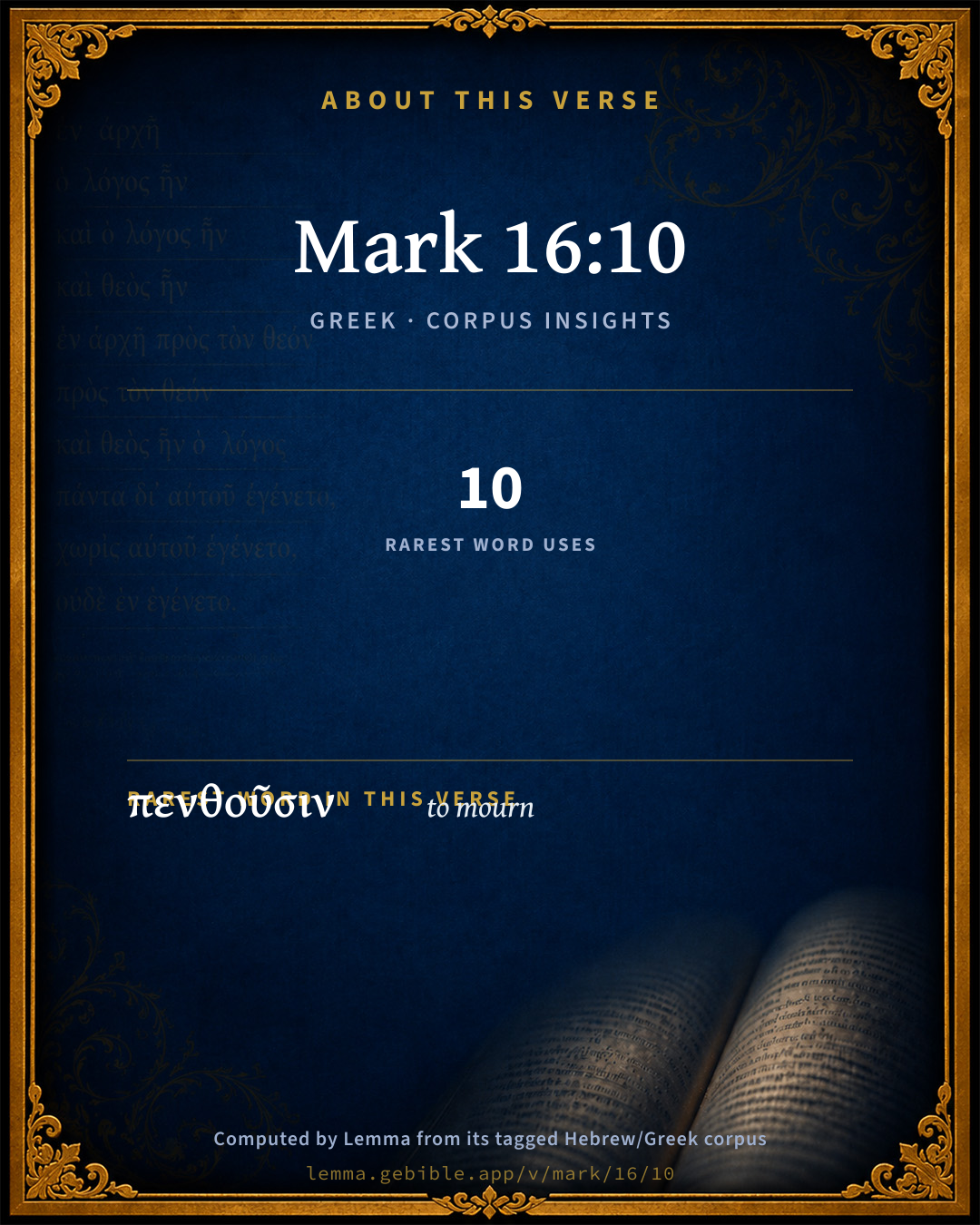
Mark 16:10

Greek (Tischendorf 8th ed.) Mark 16:10 appears in the Greek New Testament. The text above is from the Tischendorf 8th edition. Each word links to its Strong’s number and a concise gloss. Click any word for its full Thayer’s Greek Lexicon entry.
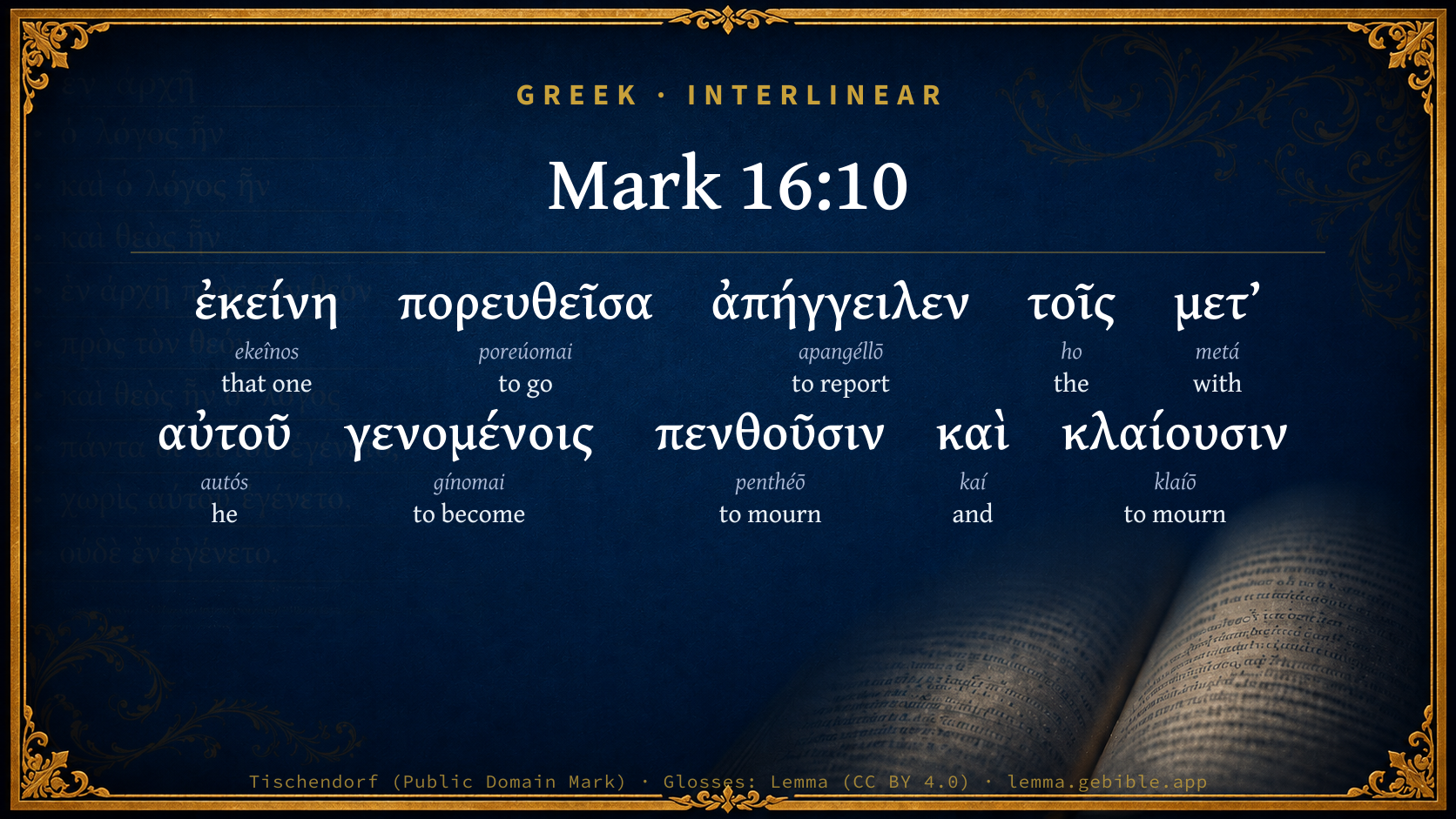
Download image
Cite this verse

Mark 16:10 (World English Bible). Public Domain. Lemma interlinear Bible study tool, https://lemma.gebible.app/v/mark/16/10.

Show BibTeX & RIS
BibTeX
RIS
English Translation
She went and told those who had been with him, as they mourned and wept.
World English Bible · Public Domain
Download a study sheet

One document with this verse’s original text, its word-by-word gloss line, the meaning frame, cross-references with their text, attributed commentary, and full source and license credits — printable, and it pastes into notes with its structure intact.

This verse Autodidact and up

Study sheet (.html) Plain text (.txt)

A passage Seminary Student

Up to 50 verses in one chapter. A passage sheet keeps up to 6 commentary sources and 12 cross-references per verse, in the order this page ranks them, and says so on the sheet whenever that leaves anything out. Ask for a single verse and you get the Autodidact verse sheet above.

Everything on this page stays free to read, with no account — the sheet is a download of what is already on screen, not access to it.

Want to remove ads? Support Godless Engineer
Compare translations 3

The same verse in 3 English versions, stacked beneath the original-language interlinear above. Click any original word for its lexicon entry.

Each is an independent rendering of the whole verse — the interlinear is not word-aligned to these translations.

Highlighted words mark where these versions differ — a whole-verse word diff, not a word-by-word alignment.

  • World English Bible Public Domain
    She went and told those who had been with him, as they mourned and wept.
  • King James Version Public Domain
    And she went and told them that had been with him, as they mourned and wept.
  • unfoldingWord Literal Text CC BY-SA 4.0
    That, going, reported to the ones having been with him, mourning and weeping.

unfoldingWord Literal Text — © unfoldingWord, licensed CC BY-SA 4.0. Word-aligned USFM3 via Door43 (git.door43.org/unfoldingWord/en_ult).

Versions to compare (up to 4)

3 of 4 selected

Show all 19 translations

Every available English version of this verse, each an independent rendering of the whole verse.

  • World English Bible Public Domain
    She went and told those who had been with him, as they mourned and wept.
  • Berean Standard Bible Public Domain
    She went and told those who had been with Him, who were mourning and weeping.
  • Majority Standard Bible Public Domain
    She went and told those who had been with Him, who were mourning and weeping.
  • King James Version Public Domain
    And she went and told them that had been with him, as they mourned and wept.
  • American Standard Version (1901) Public Domain
    She went and told them that had been with him, as they mourned and wept.
  • Revised Version (1885) Public Domain
    She went and told them that had been with him, as they mourned and wept.
  • Geneva Bible (1599) Public Domain
    And shee went and tolde them that had bene with him, which mourned and wept.
  • Douay-Rheims (1899) Public Domain
    She went and told them that had been with him, who were mourning and weeping.
  • Young's Literal Translation Public Domain
    she having gone, told those who had been with him, mourning and weeping;
  • Literal Standard Version CC BY-SA 4.0
    she having gone, told those who had been with Him, mourning and weeping;
  • Unlocked Literal Bible CC BY-SA 4.0
    She went and told those who were with him, while they were mourning and weeping.
  • unfoldingWord Literal Text CC BY-SA 4.0
    That, going, reported to the ones having been with him, mourning and weeping.
  • Darby Bible Public Domain
    *She* went and brought word to those that had been with him, [who were] grieving and weeping.
  • World Messianic Bible Public Domain
    She went and told those who had been with him, as they mourned and wept.
  • Webster's Bible Public Domain
    And she went and told them that had been with him, as they mourned and wept.
  • Free Bible Version CC BY-SA 4.0
    She went and told those who had been with him as they mourned and cried.
  • Bible in Basic English Public Domain
    She went and gave news of it to those who had been with him, while they were sorrowing and weeping.
  • Text-Critical English NT CC BY 4.0
    She then went and told those who had been with him, while they were mourning and weeping.
  • Tyndale New Testament (1534) Public Domain
    And she went and toolde them that were with him as they morned and weapte.

Literal Standard Version (2020), Covenant Press — licensed CC BY-SA 4.0. Text via the HelloAO Bible API (eBible.org). Unlocked Literal Bible (unfoldingWord) — licensed CC BY-SA 4.0. Text via the HelloAO Bible API (eBible.org). unfoldingWord Literal Text — © unfoldingWord, licensed CC BY-SA 4.0. Word-aligned USFM3 via Door43 (git.door43.org/unfoldingWord/en_ult). Free Bible Version, Dr. Jonathan Gallagher — licensed CC BY-SA 4.0. Text via the HelloAO Bible API (eBible.org).

Word by word

More ways to search: Search by grammar → Find every occurrence → Compare this word →

Practice this passage: Drill this verse → Learn its vocabulary →

About this verse

These counts appear in no published source. They are computed here, from the morphology-tagged text and Lemma’s own curated glosses. What Lemma adds →

10
words
10
distinct lemmas
Gospels
section

Notable vocabulary

The rarest word here is πενθοῦσιν to mourn G3996 — appearing just 10 times in the whole Greek New Testament.

Shared distinctive vocabulary

πενθοῦσιν to mourn G3996 occurs in 10 verses of the Greek New Testament. Also found in:

Cross-references

7

Topical passages linked to Mark 16:10 in the Treasury of Scripture Knowledge — connected by theme and wording, ordered by reader-vote popularity; previews shown in the World English Bible.

  • John 20:18 Mary Magdalene came and told the disciples that she had seen the Lord, and that he had said these things to her.
  • Matthew 9:15 Jesus said to them, "Can the friends of the bridegroom mourn, as long as the bridegroom is with them? But the days will come when the bridegroom will be taken away from them, and then they will fast.
  • Mark 14:72 The rooster crowed the second time. Peter remembered the word, how that Jesus said to him, "Before the rooster crows twice, you will deny me three times." When he thought about that, he wept.
  • Luke 24:17 He said to them, "What are you talking about as you walk, and are sad?"
  • John 16:6 But because I have told you these things, sorrow has filled your heart.
  • Matthew 24:30 and then the sign of the Son of Man will appear in the sky. Then all the tribes of the earth will mourn, and they will see the Son of Man coming on the clouds of the sky with power and great glory.
  • John 16:20–22 Most assuredly I tell you, that you will weep and lament, but the world will rejoice. You will be sorrowful, but your sorrow will be turned into joy.

Cross-references courtesy of OpenBible.info (CC BY 4.0).

Where the printed editions differ

1 variant

Places in this verse where the major printed Greek editions disagree on the wording in a way that affects the translation — a comparison of editions, not a manuscript-by-manuscript collation. The editions are the modern critical texts (Nestlé-Aland 28/27, SBL, Westcott-Hort, Tregelles, Tyndale House) and the traditional texts behind the KJV (the Textus Receptus and the Byzantine/Majority text). It is not a claim about which reading is original.

  1. Extra text
    ἐκείνη πορευθεῖσα ἀπήγγειλεν τοῖς μετ᾽ αὐτοῦ γενομένοις, πενθοῦσιν καὶ κλαίουσιν.

    “She having gone told [it] to those with Him having been mourning and weeping.”

    In NA28NA27TynWHTregTRByz Not in SBL

    ἐκείνη πορευθεῖσα ἀπήγγειλεν τοῖς μετ᾽ αὐτοῦ γενομένοις, πενθοῦσιν καὶ κλαίουσιν. (ekeinē poreutheisa apēngeilen tois met᾽ autou genomenois penthousin kai klaiousin) 'She having gone told [it] to those with Him having been mourning and weeping.' is only in traditional manuscripts

Textual data: Translators Amalgamated Greek New Testament (STEPBible TAGNT) · CC BY 4.0.

Commentary

Notes on Mark 16:10 from classic Christian and Jewish commentators (each source and its license shown beneath its notes). The classic Christian expositions comment on the surrounding passage and are grouped to its opening verse, so a note may address several verses; the Jewish commentaries on the Tanakh (Rashi and others) are per-verse, so they appear only where the commentator wrote on this verse.

Lemma curates 59 commentaries, every one of them public domain or Creative Commons licensed, each selected and text-cleaned for this edition rather than reprinted as found. About our sources →

The Biblical Illustrator

Joseph S. Exell

Mar_16:10-11

And she went and told them.

A sad interior and a cheery messenger

Mark is graphic: he paints an interior like a Dutch artist. We see a choice company-Them that had been with Him. We know many of the individuals, and are interested to note what they are doing, and how they bear their bereavement. We see-

I. A sorrowing assembly. As they mourned and wept. What a scene I We behold a common mourning, abundantly expressed by tears and lamentations. They mourned-

1. Because they had believed in Jesus, and loved Him; and therefore they were concerned at what had happened.

2. Because they felt their great loss in losing Him.

3. Because they had seen His sufferings and death.

4. Because they remembered their ill-conduct towards Him.

5. Because their hopes concerning Him were disappointed.

6. Because they were utterly bewildered as to what was now to be done, seeing their Leader was gone.

II. A consoling messenger.

1. Mary Magdalene was one of themselves.

2. She came with the best of news. The resurrection of Christ

(a) removes the cause of sorrow;

(b) assures of the help of a living Redeemer;

(c) secures personal resurrection (1Co_15:23);

(d) brings personal justification (Rom_4:25).

3. She was not believed.

(a) Unbelief is apt to become chronic: they had not believed the Lord when He foretold His own resurrection, and so they do not believe an eyewitness who reported it.

(b) Unbelief is cruelly unjust: they made Mary Magdalene a liar, and yet all of them esteemed her.

III. A reassuring reflection.

1. We are not the only persons who have mourned an absent Lord.

2. We are not the only messengers who have been rejected.

3. We are sure beyond all doubt of the resurrection of Christ.

(a) The evidence is more abundant than that which testifies to any other great historical event.

(b) The apostles so believed it as to die as witnesses of it.

(c) They were very slow to be convinced, and therefore that which forced them to believe should have the same effect on us.

4. Great reason, then, for us to rejoice. (C. H. Spurgeon.)

Unnecessary grief

A sorrow is none the less sharp because it is founded upon a mistake. Jacob mourned very bitterly for Joseph, though his darling was not torn in pieces, but on the way to be lord over all Egypt. Yet while there is of necessity so much well-founded sorrow in the world, it is a pity that one unnecessary pang should be endured, and endured by those who have the best possible grounds for joy. The case in the text before us is a typical one. Thousands are at this day mourning and weeping who ought to be rejoicing. Oh, the mass of needless grief! Unbelief works for the father of lies in this matter, and works misery out of falsehood among those who are not in truth children of sadness but heirs of light and joy. Rise, faith, and with thy light chase away this darkness! And if ever thou must have thy lamp trimmed by a humble Mary, do not despise her kindly aid.

Transient unbelief

Is it always foggy here? inquired a lady passenger of a Cunard steamers captain, when they were groping their way across the Banks of Newfoundland. How should I know? replied the captain, gruffly; I do not live here. But there are some of Christs professed followers who do manage to live in the chilling regions of spiritual fog for a great part of their unhappy lives. (Cuyler.)

The Biblical Illustrator, edited by Joseph S. Exell (c. 1880s–1900s) — public domain. Text from a community e-Sword module.

Expositor's Greek Testament

ed. W. Robertson Nicoll

Mar 16:10 . ἐκείνη , she, without emphasis, not elsewhere so used. πορευθεῖσα : the simple verb πορεύεσθαι , three times used in this section (Mar 16:12 ; Mar 16:15 ), does not occur anywhere else in this Gospel. τοῖς μετʼ αὐτοῦ γενομένοις : the reference is not to the disciples in the stricter sense who are called the Eleven (Mar 16:14 ), but to the friends of Jesus generally, an expression not elsewhere occurring in any of the Gospels.

The Expositor's Greek Testament, edited by W. Robertson Nicoll (1897–1910) — public domain. Text from a community e-Sword module.

Adam Clarke's Commentary

Verse 10. Them that had been with him] Not only the eleven disciples, but several others who had been the occasional companions of Christ and the apostles.

Mourned and wept.] Because they had lost their Lord and Master, and had basely abandoned him in his extremity.

Adam Clarke's Commentary on the Bible (1810–1826) — public domain. Text from a community e-Sword/MySword module.

The Cambridge Bible for Schools and Colleges

gen. ed. J. J. S. Perowne

10. she went and told] In the fulness of believing faith she hurried back to Jerusalem and recounted her tale of joy to the Eleven and the rest.

as they mourned and wept] Desolate at the loss of their beloved Master, and unable to realize the wonderful accounts of His resurrection. “Weylinge and wepynge” is Wyclifs rendering.

The Cambridge Bible for Schools and Colleges (gen. ed. J. J. S. Perowne; Cambridge University Press, 1878–1918) — public domain. Text from a community e-Sword module.

John Gill's Exposition

And they, when they had heard that he was alive,.... That is, the apostles, and those that were with them; when they heard the report of Mary Magdalene, that Christ was raised from the dead, and was certainly alive; or of all the women, for the Syriac version reads, "when they heard them saying that he was alive", not only Mary Magdalene, but Joanna, and Mary the mother of James, and other women; for these all related this to the apostles, and the rest; see Luk 24:9.

And had been seen of her; of Mary Magdalene, or "of them"; as the Syriac version reads, and as it is read in one of Beza's copies:

they believed not; the words of Mary, and the other women, for they seemed as idle tales to them, Luk 24:11, imagining they were deceived with the sight of a spectre, or apparition; and fearing the news were too good and great to be true; forgetting the words of their Lord, that he should rise again the third day, and which had been so often repeated to them; and all this through stupidity of mind, occasioned by the trouble and consternation they were in.

John Gill's Exposition of the Whole Bible (1746–1763) — public domain (CC PDM 1.0). Text via the HelloAO Bible API.

Trapp's Complete Commentary

John Trapp

10 And she went and told them that had been with him, as they mourned and wept.

Ver. 10. See Mat 28:8. {See Trapp on "Mat 28:8"}

John Trapp, A Commentary or Exposition upon All the Books of the Old and New Testament (1647–1656) — public domain. Text from a community e-Sword module.

Whedon's Commentary on the Bible

Daniel D. Whedon

10. Them that had been with him — Namely, his apostles whom he had chosen to be with him, who for near three years had been his constant followers. As they mourned and wept — As they were mourning and weeping the loss of their beloved Master, and the overthrow of their dearest prospects. In the catastrophe of the crucifixion, their courage and fortitude had been lost. Recollections they no doubt had of his predictions of his resurrection; but their minds are incapable now of rising to the high level of so stupendous a supernatural fact. This seems, indeed, strange. But the same thing is occurring every day to ourselves. We weep and mourn hardly the less for our friends just deceased, from the fact that they are still living in soul and will rise in body at the last day. Sense so overcomes faith that we are overwhelmed with sorrow for the sad lot of those whom we fully believe to have gone to a better world. See notes on Mar_9:10; Mar_9:32.

Daniel D. Whedon (gen. ed.), Commentary on the Old and New Testaments (1874–1909) — public domain. Text from a community e-Sword module.

The Pulpit Commentary

She went and told (ekeinh poreuyeisa aphggeile) them that had been with him, as they mourned and wept. The aorist here indicates immediate action. This word poreuesyai occurs again in vers. 12 and 15, but nowhere else in St. Mark"s Gospel It is to be noticed, however, that it occurs twice in the First Epistle of St. Peter, and once in his Second Epistle. This seems to connect St. Peter with the writer of these verses.

The Pulpit Commentary (1880–1919), ed. H.D.M. Spence-Jones & Joseph S. Exell — public domain. Text from a community e-Sword module.

John Wesley's Explanatory Notes

Luke xxiv, 9; John xx, 18.

John Wesley, Explanatory Notes Upon the Whole Bible (1754–1765) — public domain. Text via the GEBible commentary corpus.

MacLaren's Expositions of Holy Scripture

Alexander MacLaren

Mark

THE INCREDULOUS DISCIPLES

Mar 16:1 - Mar 16:13.

It is not my business here to discuss questions of harmonising or of criticism. I have only to deal with the narrative as it stands. Its peculiar character is very plain. The manner in which the first disciples learned the fact of the Resurrection, and the disbelief with which they received it, much rather than the Resurrection itself, come into view in this section. The disciples, and not the risen Lord, are shown us. There is nothing here of the earthquake, or of the descending angel, or of the terrified guard, or of our Lord’s appearance to the women. The two appearances to Mary Magdalene and to the travellers to Emmaus, which, in the hands of John and Luke, are so pathetic and rich, are here mentioned with the utmost brevity, for the sake chiefly of insisting on the disbelief of the disciples who heard of them. Mark’s theme is mainly what they thought of the testimony to the Resurrection.

I. He shows us, first, bewildered love and sorrow.

We leave the question whether this group of women is the same as that of which Luke records that Joanna was one, as well as the other puzzle as to harmonising the notes of time in the Evangelists. May not the difference between the time of starting and that of arrival solve some of the difficulty? When all the notes are more or less vague, and refer to the time of transition from dark to day, when every moment partakes of both and may be differently described as belonging to either, is precision to be expected? In the whirl of agitation of that morning, would any one be at leisure to take much note of the exact minute? Are not these ‘discrepancies’ much more valuable as confirmation of the story than precise accord would have been? It is better to try to understand the feelings of that little band than to carp at such trifles.

Sorrow wakes early, and love is impatient to bring its tribute. So we can see these three women, leaving their abode as soon as the doleful grey of morning permitted, stealing through the silent streets, and reaching the rock-cut tomb while the sun was rising over Olivet. Where were Salome’s ambitious hopes for her two sons now? Dead, and buried in the Master’s grave. The completeness of the women’s despair, as well as the faithfulness of their love, is witnessed by their purpose. They had come to anoint the body of Him to whom in life they had ministered. They had no thought of a resurrection, plainly as they had been told of it. The waves of sorrow had washed the remembrance of His assurances on that subject clean out of their minds. Truth that is only half understood, however plainly spoken, is always forgotten when the time to apply it comes. We are told that the disbelief of the disciples in the Resurrection, after Christ’s plain predictions of it, is ‘psychologically impossible.’ Such big words are imposing, but the objection is shallow. These disciples are not the only people who forgot in the hour of need the thing which it most concerned them to remember, and let the clouds of sorrow hide starry promises which would have turned mourning into dancing, and night into day. Christ’s sayings about His resurrection were not understood in their, as it appears to us, obvious meaning when spoken. No wonder, then, that they were not expected to be fulfilled in their obvious meaning when He was dead. We shall have a word to say presently about the value of the fact that there was no anticipation of resurrection on the part of the disciples. For the present it is enough to note how these three loving souls confess their hopelessness by their errand. Did they not know, too, that Joseph and Nicodemus had been beforehand with them in their labour of love? Apparently not. It might easily happen, in the confusion and dispersion, that no knowledge of this had reached them; or perhaps sorrow and agitation had driven it out of their memories; or perhaps they felt that, whether others had done the same before or no, they must do it too, not because the loved form needed it, but because their hearts needed to do it. It was the love which must serve, not calculation of necessity, which loaded their hands with costly spices. The living Christ was pleased with the ‘odour of a sweet smell,’ from the needless spices, meant to re-anoint the dead Christ, and accepted the purpose, though it came from ignorance and was never carried out, since its deepest root was love, genuine, though bewildered.

The same absence of ‘calm practical common sense’ is seen in the too late consideration, which never occurred to the three women till they were getting near the tomb, as to how to get into it. They do not seem to have heard of the guard; but they know that the stone is too heavy for them to move, and none of the men among the disciples had been taken into their confidence. ‘Why did they not think of that before? what a want of foresight!’ says the cool observer. ‘How beautifully true to nature!’ says a wiser judgment. To obey the impulse of love and sorrow without thinking, and then to be arrested on their road by a difficulty, which they might have thought of at first, but did not till they were close to it, is surely just what might have been expected of such mourners. Mark gives a graphic picture in that one word ‘looking up,’ and follows it with picturesque present tenses. They had been looking down or at each other in perplexity, when they lifted their eyes to the tomb, which was possibly on an eminence. What a flash of wonder would pass through their minds when they saw it open! What that might signify they would be eager to hurry to find out; but, at all events, their difficulty was at an end. When love to Christ is brought to a stand in its venturous enterprises by difficulties occurring for the first time to the mind, it is well to go close up to them; and it often happens that when we do, and look steadily at them, we see that they are rolled away, and the passage cleared which we feared was hopelessly barred.

II. The calm herald of the Resurrection and the amazed hearers.

Apparently Mary Magdalene had turned back as soon as she saw the opened tomb, and hurried to tell that the body had been carried off, as she supposed. The guard had also probably fled before this; and so the other two women enter the vestibule, and there find the angel. Sometimes one angel, sometimes two, sometimes none, were visible there. The variation in their numbers in the various narratives is not to be regarded as an instance of ‘discrepancy.’ Many angels hovered round the spot where the greatest wonder of the universe was to be seen, ‘eagerly desiring to look into’ that grave. The beholder’s eye may have determined their visibility. Their number may have fluctuated. Mark does not use the word ‘angel’ at all, but leaves us to infer what manner of being he was who first proclaimed the Resurrection.

He tells of his youth, his attitude, and his attire. The angelic life is vigorous, progressive, buoyant, and alien from decay. Immortal youth belongs to them who ‘excel in strength’ because they ‘do his commandments.’ That waiting minister shows us what the children of the Resurrection shall be, and so his presence as well as his speech expounds the blessed mystery of our life in the risen Lord. His serene attitude of sitting ‘on the right side’ is not only a vivid touch of description, but is significant of restfulness and fixed contemplation, as well as of the calmness of a higher life. That still watcher knows too much to be agitated; but the less he is moved, the more he adores. His quiet contrasts with and heightens the impression of the storm of conflicting feelings in the women’s tremulous natures. His garments symbolise purity and repose. How sharply the difference between heaven and earth is given in the last words of Mar 16:5! They were ‘amazed,’ swept out of themselves in an ecstasy of bewilderment in which hope had no place. Terror, surprise, curiosity, wonder, blank incapacity to know what all this meant, made chaos in them.

The angel’s words are a succession of short sentences, which have a certain dignity, and break up the astounding revelation he has to make into small pieces, which the women’s bewildered minds can grasp. He calms their tumult of spirit. He shows them that he knows their errand. He adoringly names his Lord and theirs by the names recalling His manhood, His lowly home, and His ignominious death. He lingers on the thought, to him covering so profound a mystery of divine love, that his Lord had been born, had lived in the obscure village, and died on the Cross. Then, in one word, he proclaims the stupendous fact of His resurrection as His own act-’He is risen.’ This crown of all miracles, which brings life and immortality to light, and changes the whole outlook of humanity, which changes the Cross into victory, and without which Christianity is a dream and a ruin, is announced in a single word-the mightiest ever spoken save by Christ’s own lips. It was fitting that angel lips should proclaim the Resurrection, as they did the Nativity, though in either ‘He taketh not hold of angels,’ and they had but a secondary share in the blessings. Yet that empty grave opened to ‘principalities and powers in heavenly places’ a new unfolding of the manifold wisdom and love of God.

The angel-a true evangelist-does not linger on the wondrous intimation, but points to the vacant place, which would have been so drear but for his previous words, and bids them approach to verify his assurance, and with reverent wonder to gaze on the hallowed and now happy spot. A moment is granted for feeling to overflow, and certainty to be attained, and then the women are sent on their errand. Even the joy of that gaze is not to be selfishly prolonged, while others are sitting in sorrow for want of what they know. That is the law for all the Christian life. First make sure work of one’s own possession of the truth, and then hasten to tell it to those who need it.

‘And Peter’-Mark alone gives us this. The other Evangelists might pass it by; but how could Peter ever forget the balm which that message of pardon and restoration brought to him, and how could Peter’s mouthpiece leave it out? Is there anything in the Gospels more beautiful, or fuller of long-suffering and thoughtful love, than that message from the risen Saviour to the denier? And how delicate the love which, by calling him Peter, not Simon, reinstates him in his official position by anticipation, even though in the subsequent full restoration scene by the lake he is thrice called Simon, before the complete effacement of the triple denial by the triple confession! Galilee is named as the rendezvous, and the word employed, ‘goeth before you,’ is appropriate to the Shepherd in front of His flock. They had been ‘scattered,’ but are to be drawn together again. He is to ‘precede’ them there, thus lightly indicating the new form of their relations to Him, marked during the forty days by a distance which prepared for his final withdrawal. Galilee was the home of most of them, and had been the field of His most continuous labours. There would be many disciples there, who would gather to see their risen Lord {‘five hundred at once’}; and there, rather than in Jerusalem which had slain Him, was it fitting that He should show Himself to His friends. The appearances in Jerusalem were all within a week {if we except the Ascension}, and the connection in which Mark introduces them {if Mar 16:14 be his} seems to treat them as forced on Christ by the disciples’ unbelief, rather than as His original intention. It looks as if He meant to show Himself in the city only to one or two, such as Mary, Peter, and some others, but to reserve His more public appearance for Galilee.

How did the women receive the message? Mark represents them as trembling in body and in an ecstasy in mind, and as hurrying away silent with terror. Matthew says that they were full of ‘fear and great joy,’ and went in haste to tell the disciples. In the whirl of feeling, there were opposites blended or succeeding one another; and the one Evangelist lays hold of one set, and the other of the other. It is as impossible to catalogue the swift emotions of such a moment as to separate and tabulate the hues of sunrise. The silence which Mark tells of can only refer to their demeanour as they ‘fled.’ His object is to bring out the very imperfect credence which, at the best, was given to the testimony that Christ was risen, and to paint the tumult of feeling in the breasts of its first recipients. His picture is taken from a different angle from Matthew’s; but Matthew’s contains the same elements, for he speaks of ‘fear,’ though he completes it by ‘joy.’

III. The incredulity of the disciples.

The two appearances to Mary Magdalene and the travellers to Emmaus are introduced mainly to record the unbelief of the disciples. A strange choice that was, of the woman who had been rescued from so low a debasement, to be first to see Him! But her former degradation was the measure of her love. Longing eyes, that have been washed clean by many a tear of penitent gratitude, are purged to see Jesus; and a yearning heart ever brings Him near. The unbelief of the story of the two from Emmaus seems to conflict with Luke’s account, which tells that they were met by the news of Christ’s appearance to Simon. But the two statements are not contradictory. If we remember the excitement and confusion of mind in which they were, we shall not wonder if belief and unbelief followed each other, like the flow and recoil of the waves. One moment they were on the crest of the billows, and saw land ahead; the next they were down in the trough, and saw only the melancholy surge. The very fact that Peter was believed, might make them disbelieve the travellers; for how could Jesus have been in Jerusalem and Emmaus at so nearly the same time? However the two narratives be reconciled, it remains obvious that the first disciples did not believe the first witnesses of the Resurrection, and that their unbelief is an important fact. It bears very distinctly on the worth of their subsequent conviction. It has special bearing on the most modern form of disbelief in the Resurrection, which accounts for the belief of the first disciples on the ground that they expected Christ to rise, and that they then persuaded themselves, in all good faith, that He had risen. That monstrous theory is vulnerable at all points, but one sufficient answer is-the disciples did not expect Christ to rise again, and were so far from it that they did not believe that He had risen when they were told it. Their original unbelief is a strong argument for the reliableness of their final faith. What raised them from the stupor of despair and incredulity? Only one answer is ‘psychologically’ reasonable: they at last believed because they saw. It is incredible that they were conscious deceivers; for such lives as they lived, and such a gospel as they preached, never came from liars. It is as incredible that they were unconsciously mistaken; for they were wholly unprepared for the Resurrection, and sturdily disbelieved all witnesses for it, till they saw with their own eyes, and had ‘many infallible proofs.’ Let us be thankful for their unbelief and its record, and let us seek to possess the blessing of those ‘that have not seen, and yet have believed!’

Alexander MacLaren, Expositions of Holy Scripture (1904–1910) — public domain. Text from a community e-Sword module.

The People's New Testament

B. W. Johnson

10. And she went. While she was going to tell the disciples, Jesus appeared to the other women, who had started before on the same errand (Matt. 28:9, 10).

B. W. Johnson's The People's New Testament with Notes (1889–1891) — public domain. Electronic text from the Christian Classics Ethereal Library (CCEL) ThML edition.

Cambridge Greek Testament for Schools and Colleges

10. ἐκείνη πορευθεῖσα. This use of ἐκεῖνος, merely to recall the main subject, is very freq. in Jn (Joh 1:8; Joh 1:18; Joh 1:33; Joh 5:11; Joh 5:37; Joh 5:39; Joh 5:43, etc.), but is not in Mk’s style; yet we have it three times in this appendix (10, 11, 20). And πορεύομαι, so very freq. in Mt., Lk., Jn, and Acts, occurs only once in Mk (Mar 9:30), and then with the definite meaning of travelling; yet we have it three times in six verses (10–15).

τοῖς μετʼ αὐτοῦ γενομένοις. This periphrasis for the disciples is found in no Gospel; it is as comprehensive as Lk.’s “to the Eleven and to all the rest.”

πενθοῦσιν καὶ κλαίονσιν. This was an early fulfilment of what had been foretold (Joh 16:20). The disciples were mourning and weeping while the world was rejoicing in keeping the Feast; but the sorrow was soon to be turned into joy. The two verbs are often combined (Luk 6:25; Jas 4:9; Rev 18:11; Rev 18:15; Rev 18:19). The Gospel of Peter has ἐκλαίομεν καὶ ἐλυπούμεθα, but there is reason for believing that the Mk known to that writer ended at Mar 16:8.

Cambridge Greek Testament for Schools and Colleges (Cambridge University Press, 1896; 21 vols, various authors incl. Carr, Maclear, Plummer, Farrar, Lumby, Moule, M. R. James, Simcox) — public domain. Text from a community e-Sword module.

Alford’s Greek Testament

Henry Alford

10.] ἐκεῖνος is no where found used absolutely by Mark,—but always emphatically (see ch. 4:11; 7:15, 20; 14:21); whereas here and ver. 11 it is absolutely used (not in vv. 13 b and 20, where it is emphatical).

πορευθ.] This word, never used by Mark, is three times contained in this passage (vv. 12, 15).

τοῖς μετʼ αὐτοῦ γεν., though found in the Acts (20:18), never occurs in the Gospels: nor does the word μαθηταί in this passage.

Henry Alford, The Greek Testament (1849–1861) — public domain. Text from a community e-Sword module.

International Critical Commentary

10. ἐκείνη—this unemphatic use of ἐκεῖνος reminds us of the fourth Gospel, but is foreign to Mk. And yet, in this paragraph, it is found in v. 10, 11, 20. The use in v. 13, while it is more or less emphatic, is foreign to Mk.’s style. πορευθεῖσα—Here is a more striking anomaly. For this word, though it occurs here three times, v. 10, 12, 15,—in fact, is the staple word for going,—is not found elsewhere in Mk., though it is so common a word, and the occasions for its use are so frequent. This makes the striking feature, that this common word is dropped from Mk.’s vocabulary, and suddenly appears here. The other evangelists use it constantly. τοῖς μετʼ αὐτοῦ γενομένοις—to those who had come to be (associated) with him. This paraphrase for his disciples is also unknown to Mk., and to the other evangelists. πενθοῦσι—weeping. This word πενθοῦσι is also a word occurring only here in this gospel, but that does not count, as it is about the rate of its use in the other books of the N.T.

International Critical Commentary — older volumes (1896–1929), various authors — public domain. Text from a community e-Sword module.

Vincent's Word Studies in the New Testament

Marvin R. Vincent

She [εκεινη] . An absolute use of the pronoun unexampled in Mark. See also verses 11, 13. It would imply an emphasis which is not intended. Compare Mr 4:11; Mr 12:4, 5, 7; Mr 14:21.

Went [πορευθεισα] . So in verses 12, 15. Went, go. This verb for to go occurs nowhere else in this Gospel except in compounds.

Them that had been with him [τοις μετ αυτου γενομενοις] . A circumlocution foreign to the Gospels.

Marvin R. Vincent, Word Studies in the New Testament (1887–1900) — public domain. Text from a community e-Sword/MySword module.

Lesson kit

Teaching starters — assembled from the data on this page, not authored interpretation. Every prompt links to the verse data it draws on. Edit before teaching.

Mark, in the Gospels, opens this verse with 10 words (10 distinct Greek lemmas). Its most distinctive word is penthéō (“to mourn”). A historical commentator’s framing appears above. Read the whole chapter for the surrounding context.

Discussion questions

  1. How does “to mourn” (penthéō) shape what this verse is saying?
  2. How does Matthew 5:5, which shares the word «to mourn», read alongside this verse?
  3. These translations render this verse differently. What is at stake in choosing one wording over another?
  4. Compare how The Biblical Illustrator and Expositor's Greek Testament read this verse. Where do they agree or differ?

Things to notice

Reading settings

Reading text

Shown beneath each verse's original-language words.

Old Testament
Old Testament edition

Read the OT as the Masoretic Hebrew (MT) or the Greek Septuagint (LXX).

English shown for the Greek Septuagint (in the Hebrew ↔ Greek comparison).

Comparing translations? Open the Compare panel on any verse page to stack up to four side by side.