Luke 5:35

Greek (Tischendorf 8th ed.) Luke 5:35 appears in the Greek New Testament. The text above is from the Tischendorf 8th edition. Each word links to its Strong’s number and a concise gloss. Click any word for its full Thayer’s Greek Lexicon entry.
Download image
Cite this verse

Luke 5:35 (World English Bible). Public Domain. Lemma interlinear Bible study tool, https://lemma.gebible.app/v/luke/5/35.

Show BibTeX & RIS
BibTeX
RIS
English Translation
But the days will come when the bridegroom will be taken away from them. Then they will fast in those days."
World English Bible · Public Domain
Download a study sheet

One document with this verse’s original text, its word-by-word gloss line, the meaning frame, cross-references with their text, attributed commentary, and full source and license credits — printable, and it pastes into notes with its structure intact.

This verse Autodidact and up

Study sheet (.html) Plain text (.txt)

A passage Seminary Student

Up to 50 verses in one chapter. A passage sheet keeps up to 6 commentary sources and 12 cross-references per verse, in the order this page ranks them, and says so on the sheet whenever that leaves anything out. Ask for a single verse and you get the Autodidact verse sheet above.

Everything on this page stays free to read, with no account — the sheet is a download of what is already on screen, not access to it.

Want to remove ads? Support Godless Engineer
Compare translations 3

The same verse in 3 English versions, stacked beneath the original-language interlinear above. Click any original word for its lexicon entry.

Each is an independent rendering of the whole verse — the interlinear is not word-aligned to these translations.

Highlighted words mark where these versions differ — a whole-verse word diff, not a word-by-word alignment.

  • World English Bible Public Domain
    But the days will come when the bridegroom will be taken away from them. Then they will fast in those days."
  • King James Version Public Domain
    But the days will come, when the bridegroom shall be taken away from them, and then shall they fast in those days.
  • unfoldingWord Literal Text CC BY-SA 4.0
    But days will indeed come when the bridegroom will be taken away from them. Then, in those days, they will fast.”

unfoldingWord Literal Text — © unfoldingWord, licensed CC BY-SA 4.0. Word-aligned USFM3 via Door43 (git.door43.org/unfoldingWord/en_ult).

Versions to compare (up to 4)

3 of 4 selected

Show all 19 translations

Every available English version of this verse, each an independent rendering of the whole verse.

  • World English Bible Public Domain
    But the days will come when the bridegroom will be taken away from them. Then they will fast in those days."
  • Berean Standard Bible Public Domain
    But the time will come when the bridegroom will be taken from them; then they will fast.”
  • Majority Standard Bible Public Domain
    But the time will come when the bridegroom will be taken from them; then they will fast.”
  • King James Version Public Domain
    But the days will come, when the bridegroom shall be taken away from them, and then shall they fast in those days.
  • American Standard Version (1901) Public Domain
    But the days will come; and when the bridegroom shall be taken away from them, then will they fast in those days.
  • Revised Version (1885) Public Domain
    But the days will come; and when the bridegroom shall be taken away from them, then will they fast in those days.
  • Geneva Bible (1599) Public Domain
    But the dayes will come, euen when the bridegrome shalbe taken away from them: then shall they fast in those dayes.
  • Douay-Rheims (1899) Public Domain
    But the days will come, when the bridegroom shall be taken away from them, then shall they fast in those days.
  • Young's Literal Translation Public Domain
    but days will come, and, when the bridegroom may be taken away from them, then they shall fast in those days.'
  • Literal Standard Version CC BY-SA 4.0
    But days will come, and when the Bridegroom may be taken away from them, then they will fast in those days.”
  • Unlocked Literal Bible CC BY-SA 4.0
    But the days will come when the bridegroom will be taken away from them, then in those days they will fast.”
  • unfoldingWord Literal Text CC BY-SA 4.0
    But days will indeed come when the bridegroom will be taken away from them. Then, in those days, they will fast.”
  • Darby Bible Public Domain
    But days will come when also the bridegroom will have been taken away from them; then shall they fast in those days.
  • World Messianic Bible Public Domain
    But the days will come when the bridegroom will be taken away from them. Then they will fast in those days.”
  • Webster's Bible Public Domain
    But the days will come, when the bridegroom shall be taken from them, and then they will fast in those days.
  • Free Bible Version CC BY-SA 4.0
    “No—but the time is coming when the bridegroom will be taken away from them. Then they can fast.”
  • Bible in Basic English Public Domain
    But the days will come when he will be taken away from them, and then they will go without food.
  • Text-Critical English NT CC BY 4.0
    But those days are coming, and when the bridegroom is taken away from them, they will fast in those days.”
  • Tyndale New Testament (1534) Public Domain
    The dayes will come when the brydgrome shalbe take awaye from them: then shall they fast in those dayes

Literal Standard Version (2020), Covenant Press — licensed CC BY-SA 4.0. Text via the HelloAO Bible API (eBible.org). Unlocked Literal Bible (unfoldingWord) — licensed CC BY-SA 4.0. Text via the HelloAO Bible API (eBible.org). unfoldingWord Literal Text — © unfoldingWord, licensed CC BY-SA 4.0. Word-aligned USFM3 via Door43 (git.door43.org/unfoldingWord/en_ult). Free Bible Version, Dr. Jonathan Gallagher — licensed CC BY-SA 4.0. Text via the HelloAO Bible API (eBible.org).

Word by word

More ways to search: Search by grammar → Find every occurrence → Compare this word →

Practice this passage: Drill this verse → Learn its vocabulary →

ἀπαρθῇ
apaírō
G522
“to take away”
Verb, Aorist, Passive, Subjunctive, 3rd person, Singular
Part of Speech
Verb
Tense
Aorist
Voice
Passive
Mood
Subjunctive
Person
3rd person
Number
Singular
Full Thayer's Definition

Origin: from G575 and G142

TDNT: None

1. to lift off, take or carry away 2. to be taken away from anyone
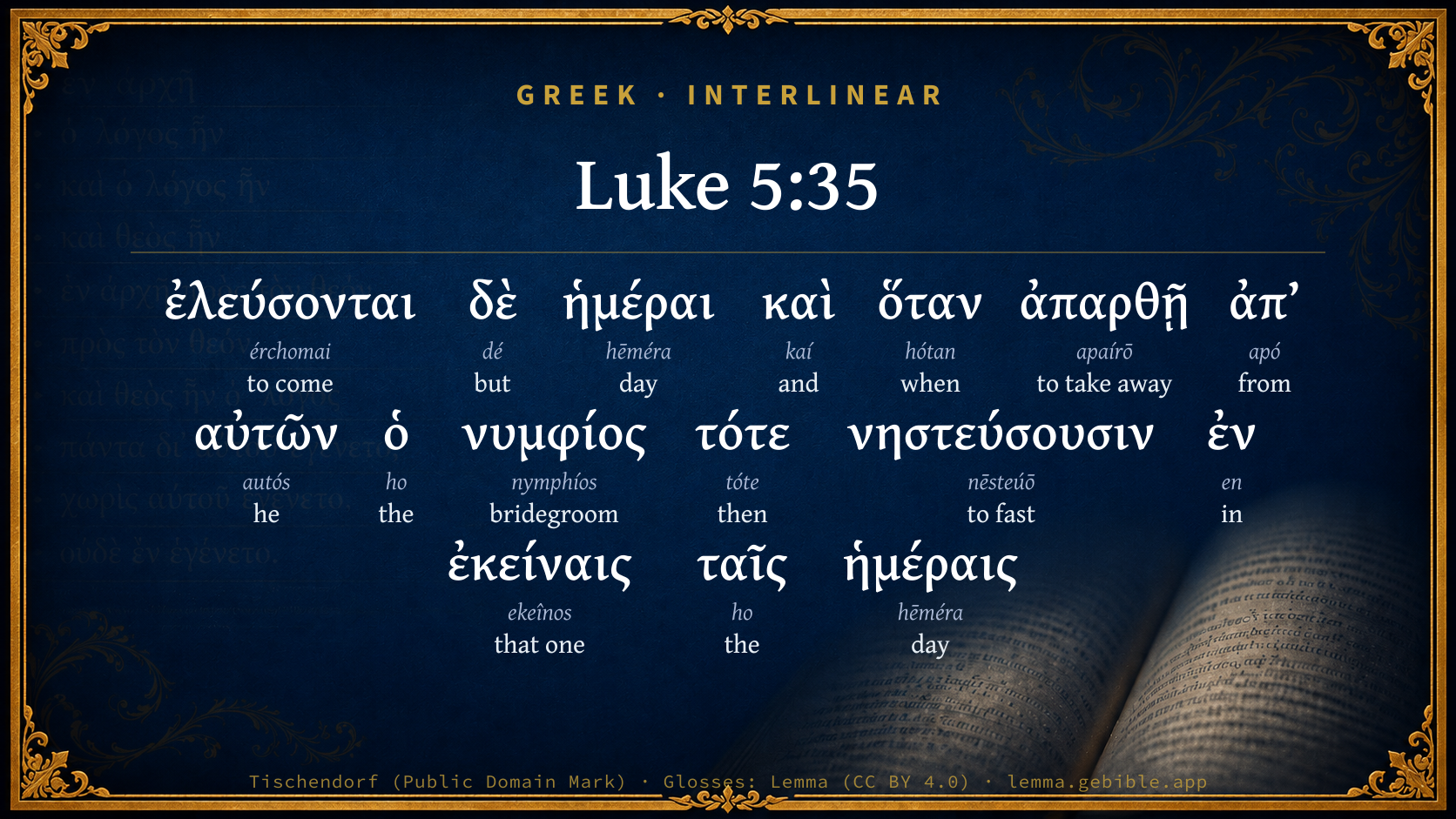
  1. ἐλεύσονται érchomai G2064 “to come” Verb, Future, Middle deponent, Indicative, 3rd person, Plural
  2. δὲ dé G1161 “but” Conjunction
  3. ἡμέραι hēméra G2250 “day” Noun, Nominative, Plural, Feminine
  4. καὶ kaí G2532 “and” Conjunction
  5. ὅταν hótan G3752 “when” Conjunction
  6. ἀπ’ apó G575 “from” Preposition
  7. αὐτῶν autós G846 “he” Personal pronoun, Genitive, Plural, Masculine
  8. ὁ ho G3588 “the” Article, Nominative, Singular, Masculine
  9. νυμφίος nymphíos G3566 “bridegroom” Noun, Nominative, Singular, Masculine
  10. τότε tóte G5119 “then” Adverb
  11. νηστεύσουσιν nēsteúō G3522 “to fast” Verb, Future, Active, Indicative, 3rd person, Plural
  12. ἐν en G1722 “in” Preposition
  13. ἐκείναις ekeînos G1565 “that one” Demonstrative pronoun, Dative, Plural, Feminine
  14. ταῖς ho G3588 “the” Article, Dative, Plural, Feminine
  15. ἡμέραις hēméra G2250 “day” Noun, Dative, Plural, Feminine

About this verse

These counts appear in no published source. They are computed here, from the morphology-tagged text and Lemma’s own curated glosses. What Lemma adds →

16
words
14
distinct lemmas
Gospels
section

Notable vocabulary

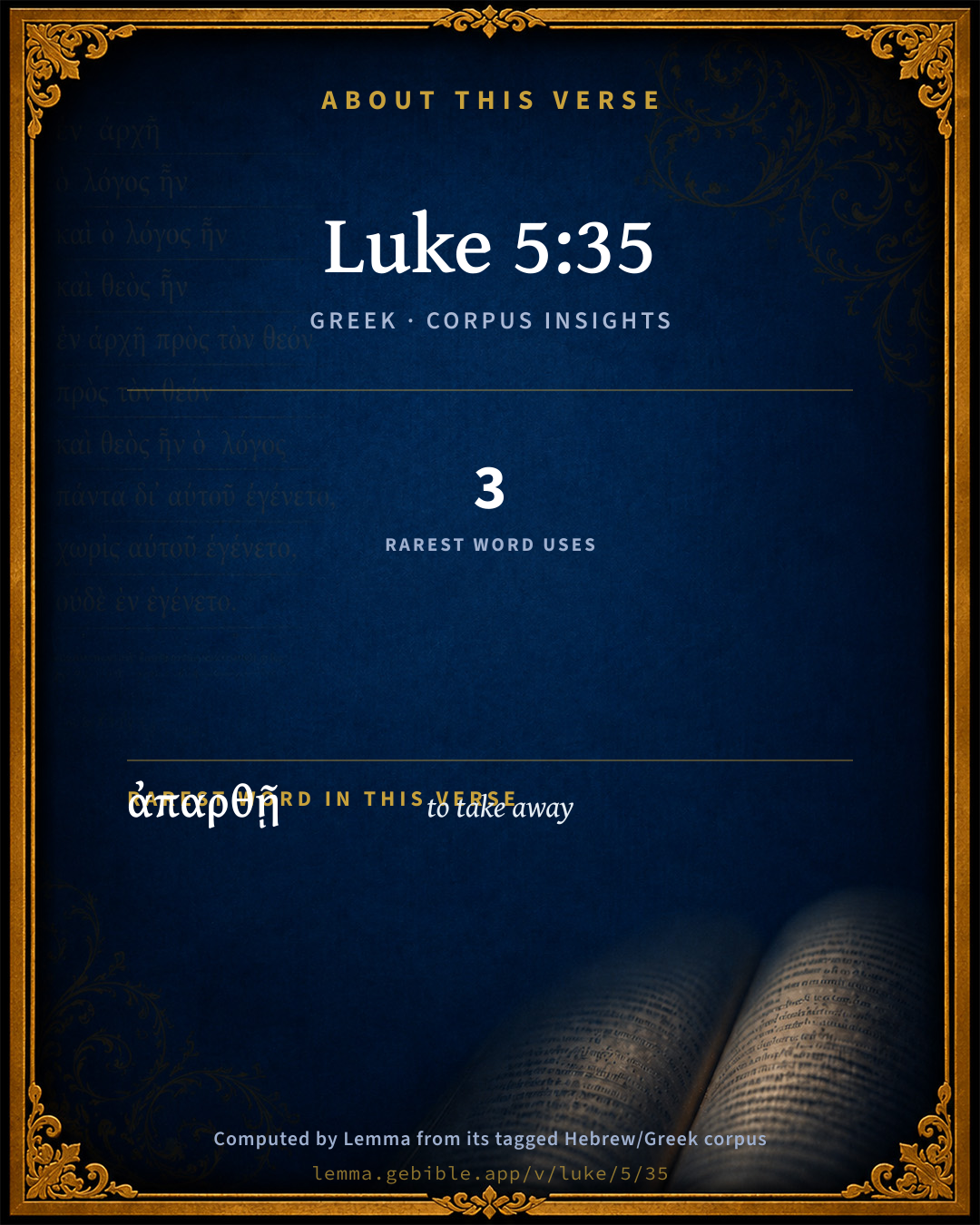
The rarest word here is ἀπαρθῇ to take away G522 — appearing just 3 times in the whole Greek New Testament.

Shared distinctive vocabulary

ἀπαρθῇ to take away G522 occurs in 3 verses of the Greek New Testament. Also found in:

Repetition

Words recur within this verse:

Cross-references

19

Topical passages linked to Luke 5:35 in the Treasury of Scripture Knowledge — connected by theme and wording, ordered by reader-vote popularity; previews shown in the World English Bible.

  • Luke 17:22 He said to the disciples, "The days will come, when you will desire to see one of the days of the Son of Man, and you will not see it.
  • John 16:4–7 But I have told you these things, so that when the time comes, you may remember that I told you about them. I didn't tell you these things from the beginning, because I was with you.
  • Acts 3:21 whom heaven must receive until the times of restoration of all things, which God spoke long ago by the mouth of his holy prophets.
  • Acts 14:23 When they had appointed elders for them in every assembly, and had prayed with fasting, they commended them to the Lord, on whom they had believed.
  • Isaiah 22:12 In that day did the Lord, Yahweh of Hosts, call to weeping, and to mourning, and to baldness, and to girding with sackcloth:
  • Daniel 9:26 After the sixty-two weeks the Anointed One shall be cut off, and shall have nothing: and the people of the prince who shall come shall destroy the city and the sanctuary; and the end of it shall be with a flood, and even to the end shall be war; desolations are determined.
  • Zechariah 13:7 "Awake, sword, against my shepherd, And against the man who is close to me," says Yahweh of Hosts. Strike the shepherd, and the sheep will be scattered; And I will turn my hand against the little ones.
  • Matthew 6:17–18 But you, when you fast, anoint your head, and wash your face;
  • Luke 24:17–21 He said to them, "What are you talking about as you walk, and are sad?"
  • John 12:8 For you always have the poor with you, but you don't always have me."
  • John 14:3–4 If I go and prepare a place for you, I will come again, and will receive you to myself; that where I am, you may be there also.
  • John 16:16–22 A little while, and you will not see me. Again a little while, and you will see me."
  • John 16:28 I came out from the Father, and have come into the world. Again, I leave the world, and go to the Father."
  • Acts 1:9 When he had said these things, as they were looking, he was taken up, and a cloud received him out of their sight.
  • Acts 13:2–3 As they served the Lord and fasted, the Holy Spirit said, "Separate Barnabas and Saul for me, for the work to which I have called them."
  • 1 Corinthians 7:5 Don't deprive one another, unless it is by consent for a season, that you may give yourselves to fasting and prayer, and may be together again, that Satan doesn't tempt you because of your lack of self-control.
  • 2 Corinthians 11:27 in labor and travail, in watchings often, in hunger and thirst, in fastings often, and in cold and nakedness.
  • John 13:33 Little children, I will be with you a little while longer. You will seek me, and as I said to the Jews, 'Where I am going, you can't come,' so now I tell you.
  • John 17:11–13 I am no more in the world, but these are in the world, and I am coming to you. Holy Father, keep them through your name which you have given me, that they may be one, even as we are.

Cross-references courtesy of OpenBible.info (CC BY 4.0).

Commentary

Notes on Luke 5:35 from classic Christian and Jewish commentators (each source and its license shown beneath its notes). The classic Christian expositions comment on the surrounding passage and are grouped to its opening verse, so a note may address several verses; the Jewish commentaries on the Tanakh (Rashi and others) are per-verse, so they appear only where the commentator wrote on this verse.

Lemma curates 59 commentaries, every one of them public domain or Creative Commons licensed, each selected and text-cleaned for this edition rather than reprinted as found. About our sources →

The Biblical Illustrator

Joseph S. Exell

Luk_5:35

But the days will come when the bridegroom shall be taken away from them

Duties are not to be pressed indiscriminately on all persons and at all times

Our Lord makes fasting a duty, but, nevertheless, He excuses the children of the bridechamber while the bridegroom was with them, and then gives, as one reason for excusing them, the inexpediency of prescribing austerities to those yet young in His religion: it would only be likely to alienate and disgust them, driving them back to what they had abandoned, and thus making the rent worse, even as would the new cloth fastened on the old.

Attend carefully to this. There is all the difference between keeping a duty entirely out of sight, and enjoining it only at a certain stage in Christian experience. Undoubtedly, as a Christian grows in grace he grows fitted for sacrifices, privations, and endurances, which would have quite overcome him if demanded at an earlier point of his career as a believer; and it is not so much Christian prudence as Christian truth to avoid requiring from the young convert what may justly be required from the practised disciple. If our duties grow, as they certainly do, with our Christian age, it is not merely inexpedient, it is actually erroneous, to ask a beginner to perform a task, or to bear a burden, for which he may not have strength till grown into a veteran. (H. Melvill, B. D.)

The Biblical Illustrator, edited by Joseph S. Exell (c. 1880s–1900s) — public domain. Text from a community e-Sword module.

Expositor's Greek Testament

ed. W. Robertson Nicoll

Luk 5:35 . καὶ ὅταν : Mt. and Mk. place the καὶ before τότε in the next clause. Lk.’s arrangement throws more emphasis on ἡμέραι : there will come days , and when, etc. The καὶ may be explicative (= et quidem , Bornemann), or it may introduce the apodosis. ὅταν ἀπαρθῇ , the subjunctive with ἂν in a relative clause referring to a probable future event.

The Expositor's Greek Testament, edited by W. Robertson Nicoll (1897–1910) — public domain. Text from a community e-Sword module.

The Cambridge Bible for Schools and Colleges

gen. ed. J. J. S. Perowne

35. the days will come] Rather, but there will come days.

when the bridegroom shall be taken away from them] Rather, and when (καὶ A, B, D). Comp. Joh_16:16, “A little while and ye shall not see me.” The verb used—aparthê—occurs nowhere else in the N. T., and clearly hints at a violent end. This is memorable as being the earliest recorded public intimation of His crucifixion, of which a dim hint (“even so shall the Son of man be lifted up”) had been given privately to Nicodemus (Joh_3:14).

then shall they fast] As we are told that they did, Act_13:2-3. Observe that is not said, ‘then shall ye be able to insist on their fasting.’ The Christian fasts would be voluntary, not compulsory; the result of a felt need, not the observance of a rigid command. Our Lord never entered fully into the subject of fasting, and it is clear that throughout the Bible it is never enjoined as a frequent duty, though it is sanctioned and encouraged as an occasional means of grace. In the Law only one day in the year—the Kippur, or Day of Atonement—was appointed as a fast (Lev_16:29; Num_29:7). After the exile four annual fasts had arisen, but the prophets do not enjoin them (Zec_7:1-12; Zec_8:19), nor did our Lord in any way approve (or apparently practise) the two weekly fasts of the Pharisees (Luk_18:12). Probably the reason why fasting has never been commanded as a universal and constant duty is that it acts very differently on different temperaments, and according to the testimony of some who have tried it most seriously, acts in some cases as a powerful stimulus to temptation. It is remarkable that the words “and fasting” are probably the interpolations of an ascetic bias in Mat_17:21; Mar_9:29; Act_10:30; 1Co_7:5, though fasting is implied in Mat_6:16. Fasting is not commanded and is not forbidden. The Christian is free (Rom_14:5), but must, while temperate in all things, do exactly that which he finds most conducive to his spiritual and moral welfare. For now the bridegroom is not taken from us but is with us (Mat_28:20; Heb_13:5-6; Joh_14:16; Joh_16:7).

The Cambridge Bible for Schools and Colleges (gen. ed. J. J. S. Perowne; Cambridge University Press, 1878–1918) — public domain. Text from a community e-Sword module.

John Gill's Exposition

And he spake also a parable unto them,.... The Scribes and Pharisees; illustrating what he had just now said:

no man putteth a piece of a new garment upon an old; by "a piece of a new garment" meaning the new and upstart notions and traditions of the elders, which were so in comparison of the law of Moses; and by the "old", the robe of their own righteousness, wrought out in obedience to the moral and ceremonial law: and Christ suggests, that to join these together, in order to patch up a garment of righteousness, to appear in before God, was equally as weak and ridiculous, as to put a piece of new and undressed cloth into a garment that was old, and wore threadbare.

If otherwise, then both the new, maketh the rent; that is, much worse than it was, as it is expressed both in Matthew and Mark; the old and new cloth being unsuitable, and not of equal strength to hold together: by this Christ intimates, that the Jews, by being directed to the observance of the traditions of the elders, were drawn off from a regard to the commandments of God; so that instead of having a better righteousness, they had one much the worse, a ragged, and a rent one.

And the piece that was taken out of the new, agreeth not with the old; and so the statutes of men, and the ordinances of God, or the traditions of the elders, and the commands of God, are no more like one another, than the piece of a new and an old garment, and as unlike is obedience to the one, and to the other;

See Gill on Mat 9:16. See Gill on Mat 9:17. See Gill on Mar 2:21.

See Gill on Mar 2:22 where this, and the following parable, are more largely explained.

John Gill's Exposition of the Whole Bible (1746–1763) — public domain (CC PDM 1.0). Text via the HelloAO Bible API.

Trapp's Complete Commentary

John Trapp

35 But the days will come, when the bridegroom shall be taken away from them, and then shall they fast in those days.

Ver. 35. And then shall they fast] This is fulfilled, saith Bellarmine, in our Lent fasts. But this was fulfilled, say we, when Christ was crucified, and the apostles mourned. Papists’ set fasts are mere mock fasts.

John Trapp, A Commentary or Exposition upon All the Books of the Old and New Testament (1647–1656) — public domain. Text from a community e-Sword module.

Cambridge Greek Testament for Schools and Colleges

35. ἐλεύσονται δὲ ἡμέραι. ‘But there will come days.’

καὶ ὅταν ἀπαρθῆ ἀπ’ αὐτῶν ὁ νυμφίος. ‘And when’ (καὶ ABD). Comp. Joh 16:16, “A little while and ye shall not see me.” The verb used—ἀπαρθῇ—occurs nowhere else in the N. T., though we have ἐξαρθῇ (1Co 5:2). It clearly points to a violent end. This is memorable as being the earliest recorded public intimation of His crucifixion, of which a dim hint (“even so shall the Son of man be lifted up”) had been given privately to Nicodemus (Joh 3:14).

τότε νηστεύσουσιν. As we are told that they did, Act 13:2-3. Observe that it is not said, ‘then shall ye be able to insist on their fasting.’ The Christian fasts would be voluntary, not compulsory; the result of a felt need, not the observance of a rigid command. Our Lord never entered fully into the subject of fasting, and it is clear that throughout the Bible it is never enjoined as a frequent duty, though it is sanctioned and encouraged as an occasional means of grace. In the Law only one day in the year—the Kippur, or Day of Atonement—was appointed as a fast (Lev 16:29; Num 29:7). After the exile four annual fasts had arisen, but the prophets do not enjoin them (Zec 7:1-12; Zec 8:19), nor did our Lord in any way approve (or apparently practise) the two weekly fasts of the Pharisees (Luk 18:12). Probably the reason why fasting has never been commanded as a universal and constant duty is that it produces very different effects on different temperaments, and according to the testimony of some who have tried it most seriously, acts in some cases as a powerful stimulus to temptation. It is remarkable that the words “and fasting” are probably the interpolations of an ascetic bias in Mat 17:21; Mar 9:29; Act 10:30; 1Co 7:5, though fasting is implied in Mat 6:16. Fasting is not commanded and is not forbidden. The Christian is free (Rom 14:5), but must, while temperate in all things, do exactly that which he finds most conducive to his spiritual and moral welfare. For now the bridegroom is not taken from us but is with us (Mat 28:20; Heb 13:5-6; Joh 14:16; Joh 16:7).

Cambridge Greek Testament for Schools and Colleges (Cambridge University Press, 1896; 21 vols, various authors incl. Carr, Maclear, Plummer, Farrar, Lumby, Moule, M. R. James, Simcox) — public domain. Text from a community e-Sword module.

Alford’s Greek Testament

Henry Alford

35. καὶ ὅταν …] yea, days when …: so τινας καὶ συχνούς, Plato, Gorg. 455 c: ὀλίγου τινὸς ἀξία καὶ οὐδενός, ib. Apol. 23 a: see Hartung, Partikellehre, i. p. 145 f.

Henry Alford, The Greek Testament (1849–1861) — public domain. Text from a community e-Sword module.

International Critical Commentary

35. ἐλεύσονται δὲ ἡμέραι. “But days will come,” i.e. days very different from the joyous days of the wedding. It is best to take this clause separately. After it there is an aposiopesis, which is mournfully impressive; and then the sentence begins again.

καὶ ὅταν ἀπαρθῆς ἀπʼ αὐτῶν ὁ νυμφίος. There is no καί in Mt. or Mk., and some texts omit it here, because of its apparent awkwardness. We may take the καί as beginning a fresh sentence, or as epexegetic of the preceding clause. “But days will come—and when the bridegroom shall be taken away,” etc. Or, “But days will come, yea, days when the bridegroom,” etc. The word ἀπαρθῆς is in all three, and nowhere else in N.T. It is common in class. Grk., esp. of the moving of fleets and armies.

τότε νηστεύσουσιν. “Then they will fast”—of their own accord. He does not say, “Then ye will be able to make them fast,” which would be the exact antithesis of what goes before; and the change is significant. Compulsion will be as superfluous then as it would be outrageous now: comp. 17:22. This is the first intimation of His death and departure, after which fasting will be appropriate and voluntary. Its value consists in its being spontaneously adopted, not forcibly imposed. This point is further developed in the short parables which follow. Note the characteristic ἐν ἐκείναις ταῖς ἡμέραις (not in Mat 9:15), and see on 9:36.

International Critical Commentary — older volumes (1896–1929), various authors — public domain. Text from a community e-Sword module.

Vincent's Word Studies in the New Testament

Marvin R. Vincent

But the days will come when, etc. [ελευσονται δε ημεραι και οταν] . The A. V. follows a reading which omits kai, and, which is inserted in all the best texts. The thought is broken off. "The days shall come - and when the bridegroom shall be taken away, then shall they fast." So Rev.

Marvin R. Vincent, Word Studies in the New Testament (1887–1900) — public domain. Text from a community e-Sword/MySword module.

Godet's Commentaries

Frédéric Louis Godet

Vers. 33-35. In Luke they are the same parties, particularly the scribes, who continue the conversation, and who allege, in favour of the regular practice of fasting, the example of the disciples of John and of the Pharisees. The scribes express themselves in this manner, because they themselves, as scribes, belong to no party whatever. In Matthew it is the disciples of John who appear all at once in the midst of this scene, and interrogate Jesus in their own name and in that of the Pharisees. In Mark it is the disciples of John and of the Pharisees united who put the question. This difference might easily find its way into the oral tradition, but it is inexplicable on any of the hypotheses which deduce the three texts from one and the same written source, or one of them from another.

Mark says literally: the disciples of John and the Pharisees were fasting; and we may understand that day. Devout persons in Israel fasted, in fact, twice a week (Luk 18:12), on Mondays and Fridays, the days on which it was said that Moses went up Sinai (see Meyer on Mat 6:16); this particular day may have been one or other of these two days. But we may also explain it: fasted habitually. They were fasting persons, addicted to religious observances in which fasting held an important place. It is not easy to decide between these two senses: with the first, there seems less reason for the question; with the second, it conveys a much more serious charge against Jesus, since it refers to His habitual conduct; comp. Luk 7:34, “Ye say, He is a glutton and a winebibber (an eater and a drinker).” The word διατί, omitted by the Alex., appears to have been taken from Matthew and Mark.

Whether the disciples of John were present or not, it is to their mode of religious reformation that our Lord’s answer more especially applies. As they do not appear to have cherished very kindly feelings towards Jesus (Joh 3:25-26), it is very possible that they were united on this occasion with His avowed adversaries (Matthew).

Jesus compares the days of His presence on the earth to a nuptial feast. The Old Testament had represented the Messianic coming of Jehovah by this figure. If John the Baptist had already uttered the words reported by John (Joh 3:29): “He that hath the bride is the bridegroom; but the friend of the bridegroom, which standeth and heareth him, rejoiceth greatly because of the bridegroom’s voice: this my joy therefore is fulfilled,”—what appropriateness there was in this figure by which He replied to his disciples! Perhaps the Pharisees authorized a departure from the rule respecting fasting during the nuptial weeks. In this case Jesus’ reply would become more striking still. Νυμφών signifies the nuptial chamber, and not the bridegroom (νυμφίος), as Martin, Ostervald, and Crampon translate. The true Greek term to indicate the nuptial friend would have been παρανύμφιος; John says: φίλος τοῦ νυμφίου. The expression of the Syn., son of the nuptial chamber, is a Hebraism (comp son of the kingdom, of wisdom, of perdition, etc.). The received reading, “Can you make the marriage friends fast?” (notwithstanding the joy with which their hearts are full), is preferable to that of the Sinait. and of the Graeco-Latin Codd., “Can they fast?” which is less forcible, and which is taken from Matthew and Mark. In the midst of this feast of publicans the heart of Jesus is overflowing with joy; it is one of the hours when His earthly life seems to His feeling like a marriage day. But suddenly His countenance becomes overcast; the shadow of a painful vision passes across His brow: The days will come...said He in a solemn tone. At the close of this nuptial week, the bridegroom Himself will be suddenly smitten and cut off; then will come the time of fasting for those who to-day are rejoicing; there will be no necessity to enjoin it. In this striking and poetic answer Jesus evidently announces His violent death. The passive aor. cannot, as Bleek admits, be explained otherwise. This verb and tense indicate a stroke of violence, by which the subject of the verb will be smitten (comp. 1Co 5:2). This saying is parallel to the words found in Joh 2:19, “Destroy this temple;” and Luk 3:14, “As Moses lifted up the serpent, so must the Son of man be lifted up.” The fasting which Jesus here opposes to the prescribed fasting practised in Israel is neither a state of purely inward grief, a moral fast, in moments of spiritual depression, nor, as Neander thought, the life of privation and sacrifice to which the apostles would inevitably be exposed after the departure of their Master; it is indeed, according to the context, fasting in the proper sense of the term. Fasting has always been practised in the Church at certain solemn seasons, but it is not a rite imposed on it from without, but the expression of a sentiment of real grief. It proceeds from the sorrow which the Church feels in the absence of its Head, and is designed to lend intensity to its prayers, and to ensure with greater certainty that assistance of Jesus which alone can supply the place of His visible presence (comp. Mar 9:29 (?); Act 13:2-3; Act 14:23).

This remarkable saying was preserved with literal exactness in the tradition; accordingly we find it in identical words in the three Syn. It proves, first, that from the earliest period of His ministry Jesus regarded Himself as the Messiah; next, that He identified His coming with that of Jehovah, the husband of Israel and of makind (Hos 2:19); lastly, that at that time He already foresaw and announced His violent death. It is an error, therefore, to oppose, on these three points, the fourth Gospel to the other three.

Frédéric Louis Godet — Commentaries on Luke, John, Romans, and 1 Corinthians — English translation (T&T Clark, Edinburgh, 1870s–1890s) — public domain. Text from a community e-Sword module.

Lesson kit

Teaching starters — assembled from the data on this page, not authored interpretation. Every prompt links to the verse data it draws on. Edit before teaching.

Luke, in the Gospels, opens this verse with 16 words (14 distinct Greek lemmas). Its most distinctive word is apaírō (“to take away”). A historical commentator’s framing appears above. Read the whole chapter for the surrounding context.

Discussion questions

  1. The word apaírō carries the sense “to take away.” How does it shape the verse?
  2. Matthew 9:15 shares the word «to take away» with this verse. How do the two illuminate each other?
  3. “day” occurs 2× in this one verse. What is the effect of the repetition?
  4. These translations render this verse differently; the difference is in the English rendering, not the original. What questions does that raise?
  5. Reading how The Biblical Illustrator and Expositor's Greek Testament read this verse, where do the two commentators agree and where do they part?

Things to notice

Reading settings

Reading text

Shown beneath each verse's original-language words.

Old Testament
Old Testament edition

Read the OT as the Masoretic Hebrew (MT) or the Greek Septuagint (LXX).

English shown for the Greek Septuagint (in the Hebrew ↔ Greek comparison).

Comparing translations? Open the Compare panel on any verse page to stack up to four side by side.