
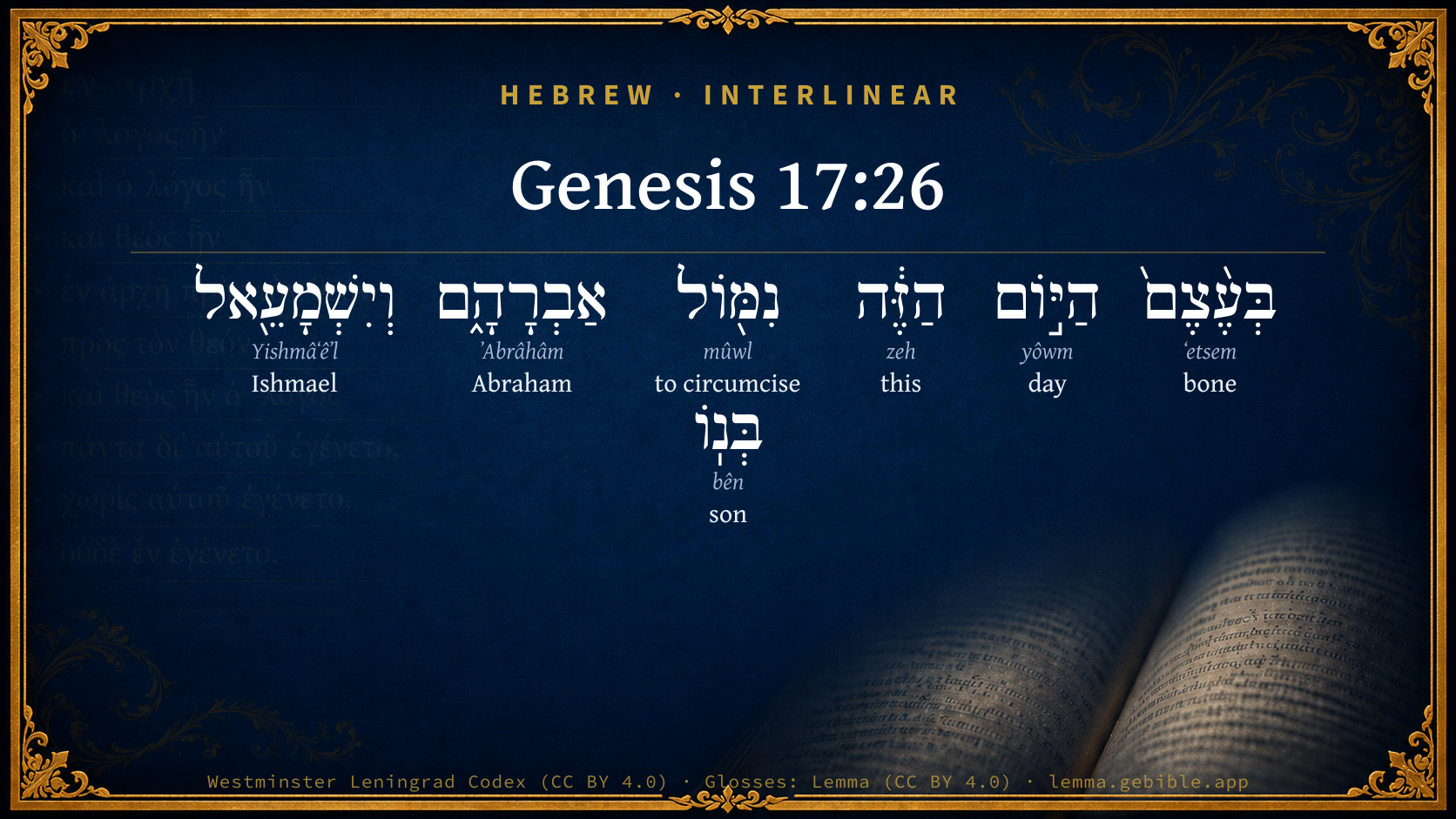
Genesis 17:26

Hebrew (Westminster Leningrad Codex) Genesis 17:26 appears in the Hebrew Old Testament. The text above is from the Westminster Leningrad Codex. Each word links to its Strong’s number, a concise gloss, and parsing drawn from the Open Scriptures Hebrew Bible morphology. Click any word for its full Brown-Driver-Briggs (BDB) entry.
Download image
Cite this verse

Genesis 17:26 (World English Bible). Public Domain. Lemma interlinear Bible study tool, https://lemma.gebible.app/v/genesis/17/26.

Show BibTeX & RIS
BibTeX
RIS
English Translation
In the same day both Abraham and Ishmael, his son, were circumcised.
World English Bible · Public Domain
Download a study sheet

One document with this verse’s original text, its word-by-word gloss line, the meaning frame, cross-references with their text, attributed commentary, and full source and license credits — printable, and it pastes into notes with its structure intact.

This verse Autodidact and up

Study sheet (.html) Plain text (.txt)

A passage Seminary Student

Up to 50 verses in one chapter. A passage sheet keeps up to 6 commentary sources and 12 cross-references per verse, in the order this page ranks them, and says so on the sheet whenever that leaves anything out. Ask for a single verse and you get the Autodidact verse sheet above.

Everything on this page stays free to read, with no account — the sheet is a download of what is already on screen, not access to it.

Want to remove ads? Support Godless Engineer
Compare translations 3

The same verse in 3 English versions, stacked beneath the original-language interlinear above. Click any original word for its lexicon entry.

Each is an independent rendering of the whole verse — the interlinear is not word-aligned to these translations.

Highlighted words mark where these versions differ — a whole-verse word diff, not a word-by-word alignment.

  • World English Bible Public Domain
    In the same day both Abraham and Ishmael, his son, were circumcised.
  • King James Version Public Domain
    In the selfsame day was Abraham circumcised, and Ishmael his son.
  • unfoldingWord Literal Text CC BY-SA 4.0
    On that very day Abraham was circumcised, and Ishmael his son.

unfoldingWord Literal Text — © unfoldingWord, licensed CC BY-SA 4.0. Word-aligned USFM3 via Door43 (git.door43.org/unfoldingWord/en_ult).

Versions to compare (up to 4)

3 of 4 selected

Show all 17 translations

Every available English version of this verse, each an independent rendering of the whole verse.

  • World English Bible Public Domain
    In the same day both Abraham and Ishmael, his son, were circumcised.
  • Berean Standard Bible Public Domain
    Abraham and his son Ishmael were circumcised on the same day.
  • Majority Standard Bible Public Domain
    Abraham and his son Ishmael were circumcised on the same day.
  • King James Version Public Domain
    In the selfsame day was Abraham circumcised, and Ishmael his son.
  • American Standard Version (1901) Public Domain
    In the selfsame day was Abraham circumcised, and Ishmael his son.
  • Revised Version (1885) Public Domain
    In the selfsame day was Abraham circumcised, and Ishmael his son.
  • Geneva Bible (1599) Public Domain
    The selfe same day was Abraham circumcised, and Ishmael his sonne:
  • Young's Literal Translation Public Domain
    in this self-same day hath Abraham been circumcised, and Ishmael his son;
  • Literal Standard Version CC BY-SA 4.0
    in this very same day Abraham has been circumcised, and his son Ishmael;
  • Unlocked Literal Bible CC BY-SA 4.0
    On the very same day Abraham and Ishmael his son were both circumcised.
  • unfoldingWord Literal Text CC BY-SA 4.0
    On that very day Abraham was circumcised, and Ishmael his son.
  • Darby Bible Public Domain
    In the selfsame day was Abraham circumcised, and Ishmael his son;
  • World Messianic Bible Public Domain
    In the same day both Abraham and Ishmael, his son, were circumcised.
  • Webster's Bible Public Domain
    In the same day was Abraham circumcised, and Ishmael his son.
  • Free Bible Version CC BY-SA 4.0
    Both Abraham and his son Ishmael were circumcised on the same day.
  • Bible in Basic English Public Domain
    Abraham and Ishmael, his son, underwent circumcision on that very day.
  • JPS Tanakh (1917) Public Domain
    In the selfsame day was Abraham circumcised, and Ishmael his son.

Literal Standard Version (2020), Covenant Press — licensed CC BY-SA 4.0. Text via the HelloAO Bible API (eBible.org). Unlocked Literal Bible (unfoldingWord) — licensed CC BY-SA 4.0. Text via the HelloAO Bible API (eBible.org). unfoldingWord Literal Text — © unfoldingWord, licensed CC BY-SA 4.0. Word-aligned USFM3 via Door43 (git.door43.org/unfoldingWord/en_ult). Free Bible Version, Dr. Jonathan Gallagher — licensed CC BY-SA 4.0. Text via the HelloAO Bible API (eBible.org).

Word by word

More ways to search: Search by grammar → Find every occurrence → Compare this word →

Practice this passage: Drill this verse → Learn its vocabulary →

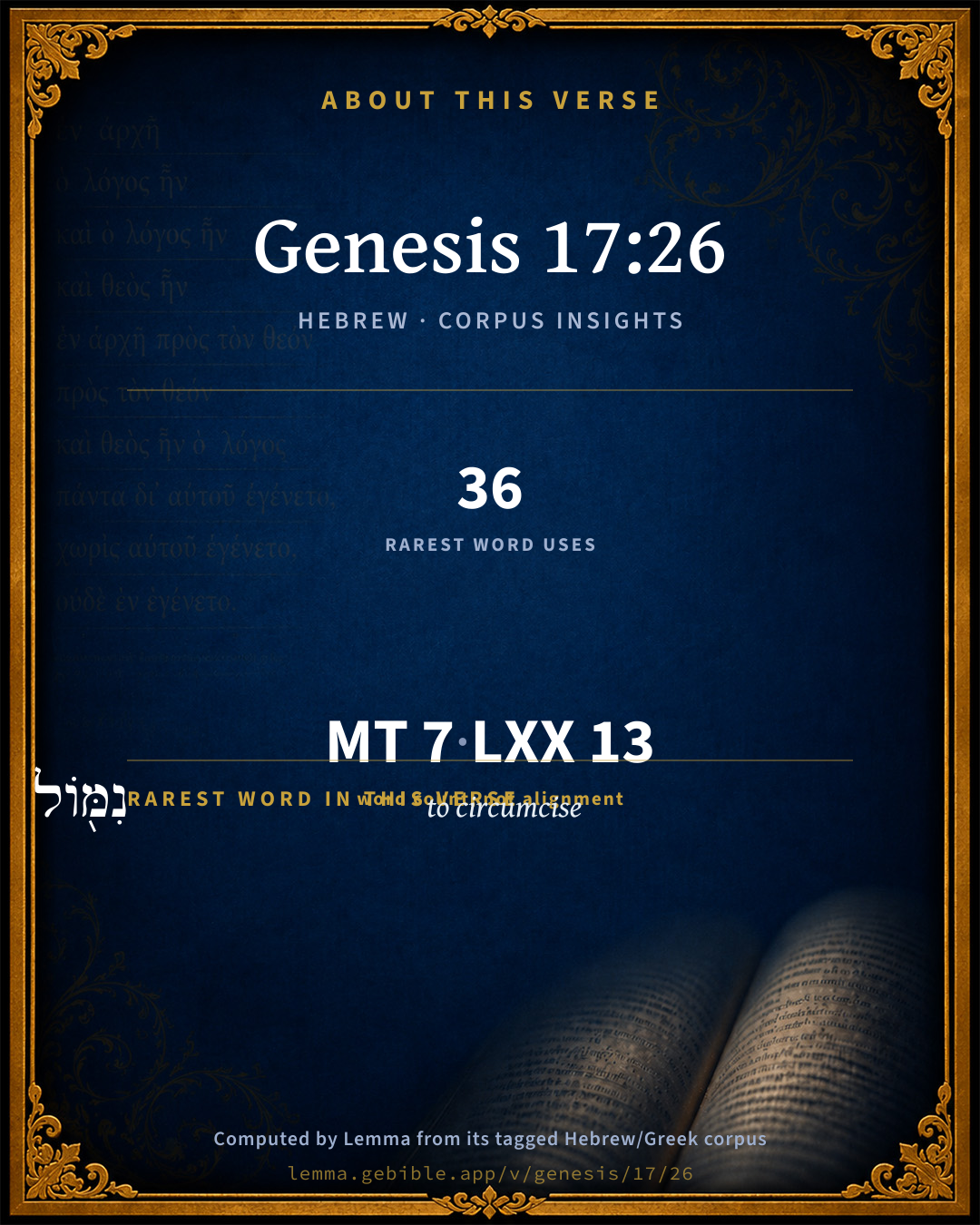
About this verse

These counts appear in no published source. They are computed here, from the morphology-tagged text and Lemma’s own curated glosses. What Lemma adds →

7
words
7
distinct lemmas
Pentateuch
section

Shared distinctive vocabulary

נִמּ֖וֹל to circumcise H4135 occurs in 32 verses of the Hebrew Bible. Also found in:

Grammatical profile

  • 1 verb
  • 5 nouns
  • 1 pronoun

Verb forms

  • נִמּ֖וֹל Niphal · Perfect

Hebrew & Septuagint length

In English translation the verse runs 12 words from the Hebrew and 14 from the Septuagint (LXX English) — closely comparable.

A rough comparison of the two English renderings, which tokenize alike — not a word-level alignment.

Word counts can differ between the Hebrew and the Greek without any difference in meaning — e.g. the Hebrew direct-object marker אֵת has no separate Greek word, and Greek often adds the article ὁ.

In the original languages it is 7 Hebrew tokens and 13 Greek tokens — but the two are counted differently (Hebrew bundles its prefixes and suffixes into one token; the Greek is in lemma form), so that isn’t a like-for-like length.

Cross-references

3

Topical passages linked to Genesis 17:26 in the Treasury of Scripture Knowledge — connected by theme and wording, ordered by reader-vote popularity; previews shown in the World English Bible.

  • Genesis 12:4 So Abram went, as Yahweh had spoken to him. Lot went with him. Abram was seventy-five years old when he departed out of Haran.
  • Genesis 22:3–4 Abraham rose early in the morning, and saddled his donkey, and took two of his young men with him, and Isaac his son. He split the wood for the burnt offering, and rose up, and went to the place of which God had told him.
  • Psalms 119:60 I will hurry, and not delay, To obey your commandments.

Cross-references courtesy of OpenBible.info (CC BY 4.0).

Hebrew and Greek witnesses Masoretic Hebrew ↔ Greek Septuagint

The same verse in the two great witnesses to the Old Testament, shown verse-for-verse.

These are two independent witnesses, not word-aligned to each other, and the Septuagint is shown in lemma (dictionary) form.

Hebrew Genesis 17:26 Masoretic · Westminster Leningrad Codex

בְּעֶ֨צֶם֙ הַיּ֣וֹם הַזֶּ֔ה נִמּ֖וֹל אַבְרָהָ֑ם וְיִשְׁמָעֵ֖אל בְּנֽוֹ

In the same day both Abraham and Ishmael, his son, were circumcised.

World English Bible · Public Domain

Greek LXX Genesis 17:26 Septuagint · lemma form

ἐν ὁ καιρός ὁ ἡμέρα ἐκεῖνος περιτέμνω αβρααμ καί ισμαηλ ὁ υἱός αὐτός

And at the period of that day, Abraam was circumcised, and Ismael his son,

LXX2012 (modern English Septuagint) · Public Domain

Hebrew: Westminster Leningrad Codex (CC BY 4.0). Greek: Septuagint (public domain); English from LXX2012 (modern English Septuagint) (Public Domain). How the Septuagint differs from the Hebrew →

Targum (Aramaic paraphrase)

2

The Targum is the ancient Jewish Aramaic paraphrase of the Hebrew Scriptures — an interpretive translation, not the Hebrew text itself. Onkelos (literal) and Pseudo-Jonathan (expansive) render the Torah, and Jonathan the Prophets. Coverage is partial: where no permissively-licensed English translation exists for a verse, only the Aramaic is shown. This is verse-level text, not a word-by-word alignment to the Hebrew.

  1. Targum Onkelos Torah (Genesis–Deuteronomy)
    בִּכְרַן יוֹמָא הָדֵין (גְּזַר) אִתְגְּזַר אַבְרָהָם וְיִשְׁמָעֵאל בְּרֵהּ

    (no public-domain English translation for this verse)

    Targum Onkelos — Aramaic: “Onkelos Genesis” (public domain); “Onkelos Exodus” (public domain); “Onkelos Leviticus” (public domain); “Onkelos Numbers” (public domain); “Onkelos Deuteronomy” (public domain). English: “Sefaria Community Translation” (CC0 1.0 (public-domain dedication)); “J.W. Etheridge. The Targums of Onkelos and Jonathan Ben Uzziel on the Pentateuch. London: Longmans, Green, 1862” (public domain). Text via Sefaria.

  2. Targum Pseudo-Jonathan Torah (Genesis–Deuteronomy)
    בִּכְרַן יוֹמָא הָדֵין בְּאַרְבְּעַת עֲשַר שְׁנִין גְזַר אַבְרָהָם וְיִשְׁמָעֵאל בְּרֵיהּ

    In the same day, in the fourteenth year, was Abraham circumcised, and Ishmael his son.

    Targum Pseudo-Jonathan — Aramaic: “Targum Jonathan on Genesis” (public domain); “Targum Jonathan on Exodus” (public domain); “Targum Jonathan on Leviticus” (public domain); “Targum Jonathan on Numbers” (public domain); “Targum Jonathan on Deuteronomy” (public domain). English: “The Targum of Jonathan ben Uzziel, trans. J. W. Etheridge, London, 1862” (public domain). Text via Sefaria.

Commentary

Notes on Genesis 17:26 from classic Christian and Jewish commentators (each source and its license shown beneath its notes). The classic Christian expositions comment on the surrounding passage and are grouped to its opening verse, so a note may address several verses; the Jewish commentaries on the Tanakh (Rashi and others) are per-verse, so they appear only where the commentator wrote on this verse.

Lemma curates 59 commentaries, every one of them public domain or Creative Commons licensed, each selected and text-cleaned for this edition rather than reprinted as found. About our sources →

Trapp's Complete Commentary

John Trapp

Gen 17:26 In the selfsame day was Abraham circumcised, and Ishmael his son.

Ver. 26. In the self-same day.] To show his prompt and present obedience, without shucking and hucking, without delays and consults.

John Trapp, A Commentary or Exposition upon All the Books of the Old and New Testament (1647–1656) — public domain. Text from a community e-Sword module.

Ellicott's Commentary for English Readers

(26) In the selfsame day.—Heb., In the bone of this day, and so in Gen_17:23 (see Gen_2:23). In the circumcising of the household together with Abraham and his son we see that no impassable interval separated the Hebrew slave from his master, but that he was to share all the national and religious privileges of the freeman.

A Bible Commentary for English Readers, edited by Charles John Ellicott (1878–1897) — public domain. Text from a community e-Sword module.

John Gill's Exposition

In the selfsame day was Abraham circumcised, and Ishmael his son. This is repeated, that it might be taken notice of that both were circumcised according to the command of God, and on the very day in which it was given. Jarchi observes, it was in the day, and not in the night; which shows, says he, he was not afraid of the Heathen, and of mockers; and that his enemies, and the men of that generation, might not say, if we had seen him, we would not have suffered him to be circumcised, and keep the commandment of God: and some of the Jewish writers (e) fable, that he was circumcised on the day afterwards appointed by Moses for the day of atonement, and that in the place where he was circumcised the altar was built; but all this is without any foundation. This affair was transacted, according to Bishop Usher (f), A. M. 2107, and before Christ 1897.

(e) Pirke Eliezer, ut supra. (c. 29.) (f) Annales Ver. Test. p. 8.

John Gill's Exposition of the Whole Bible (1746–1763) — public domain (CC PDM 1.0). Text via the HelloAO Bible API.

The Pulpit Commentary

Vers. 26, 27. In the self-same day was Abraham circumcised, and Ishmael his son. And all the men of his house, born in the house, and bought with money of the stranger, wore circumcised with him. The usual charges of needless repetition which are preferred against the closing verses of this chapter may be disposed of by observing that Ver. 23 intimates that the sacrament of circumcision was administered to the patriarch and his household on the very day that God had enjoined it, i.e. without delay; that Vers. 24, 25 declare the respective ages of Abraham and Ishmael when they received the Divinely-appointed rite; and that Vers. 26, 27 state the fact that the entire household of the patriarch was circumcised simultaneously with himself.

THE ORIGIN OF CIRCUMCISION. The determination of this question does not appear of paramount importance, yet the ascertained results may be briefly indicated.

(1) According to Herodotus (2. 104) circumcision was observed as a custom of primitive antiquity among the Colchiaus, Ethiopians, and Egyptians, by the last of whom it was communicated to the Syrians of Palestine and the Phoenicians. It is, however, uncertain Whether among the Egyptians the practice was universal, as Philo and Herodotus assert, or limited to the priesthood, as Origen believed; and equally doubtful whether the Egyptians themselves may not have adopted it from the Hebrews in the time of Joseph, instead of from the Ethiopians, as appears to be the judgment of Kalisch. Against the idea that circumcision was a national and universal observance among the Egyptians in the time of Abraham, it has been urged that the male servants of the patriarch, some of whom were Egyptians, (Gen_12:16) were not circumcised till Abraham was commanded to perform the rite; that Ishmael, the son of an Egyptian mother, remained uncircumcised till the same time; and that the daughter of Pharaoh recognized Moses as a Hebrew child, which, it is supposed, she could not have done had circumcision been generally practiced among her own people. On the other hand, it is contended that the absence of details as to how the rite should be performed seems to imply that already circumcision was familiar to Abraham; and by some modern Egyptologists it is asserted that an examination of ancient mummies and sculptures, in which circumcision is a distinctive mark between the Egyptians and their enemies, shows that the ceremony must have been in use not among the priests only, but throughout the nation generally so early as the time of the fourth dynasty, i.e. 2400 B.C., or considerably earlier than the time of Abraham. Still

(2) though it should be held as indubitably established that circumcision was a prevalent custom among the Egyptians in the time of Abraham, it would not follow that the Hebrews adopted it from them. On the contrary, the Biblical narrative expressly mentions that its observance by the patriarch and- his household was due to a Divine command, and was connected with a religious significance which was altogether foreign to the Egyptians and others by whom that rite was practiced. Among the reasons for its adoption by the heathen nations of antiquity have been assigned, among the Ethiopians, a prophylactic design to ward off certain painful, and often incurable, disorders; among the Egyptians, a regard to cleanliness; and perhaps among the priesthood of the latter country a semi religious idea (the deification of the generative powers) was associated with a practice which was commonly regarded as enhancing productivity; but the import of the ceremony as enjoined upon the father of the faithful was as widely as possible removed from every one of these ideas, being connected with spiritual conceptions of which the heathen world was entirely ignorant. That a heathen custom should have been adopted by Jehovah and elevated to the rank and connected with the spiritual significance of a religious sign will not occur as a difficulty to those who remember that the rainbow, a well-known natural phenomenon, was selected as the sign for Noah"s covenant, and that Christian baptism is a similar transformation of a previously existing ceremony by which Gentile proselytes were admitted to the Hebrew Church.

The Pulpit Commentary (1880–1919), ed. H.D.M. Spence-Jones & Joseph S. Exell — public domain. Text from a community e-Sword module.

Rashi

Rabbi Shlomo Yitzchaki (Rashi)

בעצם היום הזה ON THE SELFSAME DAY when Abraham completed his ninety-ninth year and Ishmael his thirteenth year נמול אברהם וישמעאל בנו WAS ABRAHAM CIRCUMCISED AND ISHMAEL HIS SON.

Rashi on the Tanakh — English translations: “The Judaica Press complete Tanach with Rashi, translated by A. J. Rosenberg” (CC BY 4.0); “Pentateuch with Rashi's commentary by M. Rosenbaum and A.M. Silbermann, 1929-1934” (public domain); “The Metsudah Tanach series, Lakewood, N.J” (CC BY 4.0); and “The Book of Joshua, Metsudah Publications, 1997” (CC BY 4.0). Text via Sefaria.

Ramban (Nachmanides)

Rabbi Moshe ben Nachman (Ramban / Nachmanides)

IN THE SELFSAME DAY WAS ABRAHAM CIRCUMCISED. Rashi wrote: “In the selfsame day when Abraham completed his ninety-ninth year and Ishmael his thirteenth, they were circumcised.”But what reason is there to mention this? Moreover, there is already general agreement with the words of Rabbi Eliezer, 27a. See also Seder Noach, Note 148, for fuller discussion of this point. who said that in the month of Tishri the world was created, and in Tishri the patriarchs were born, with the exception of Isaac who was born on Passover. Now Scripture says that the birth of Isaac will be at this time in the next year, and Rashi himself wrote further on in Seder Vayeira that the tidings were given on Passover. Consequently, Isaac was born on the next Passover! Instead, the expression, In the selfsame day, means that on the very day he was charged with this commandment, he and the men of his house — three hundred and eighteen — and all those purchased with his money were circumcised. Scripture thus tells of Abraham’s distinction with respect to the fear of G-d, as well as that of all the men of his house, i.e., that they were all zealous, fulfilling their religious duty as promptly as possible.Now the meaning of the phrase, was Abraham circumcised and Ishmael his son, is not that Abraham was circumcised first. Instead, it was Ishmael who was circumcised first, and then all the men of Abraham’s house, for it is so written: And Abraham took Ishmael his son, and all that were born in his house, and after that it says, And Abraham was ninety years and nine when he was circumcised. The reason for this was that Abraham was zealous concerning the commandment to circumcise them first, either doing it himself or perhaps inviting many circumcisers whom he supervised, and then he circumcised himself. Had he performed his circumcision first, he would have been sick or in danger on account of his advanced age, and he would then not have been in a position to concern himself with their circumcision.Vayeira

Ramban (Nachmanides) on the Tanakh — English translation: “Commentary on the Torah by Ramban (Nachmanides). Translated and annotated by Charles B. Chavel. New York, Shilo Pub. House, 1971-1976” (CC BY 4.0). Text via Sefaria.

Radak

Rabbi David Kimhi (Radak)

בעצם היום הזה; we (the Torah) have already stated that Avraham circumcised all the members of his household on the very day G'd issued the command to him (verse 23). The Torah had not mentioned that he also circumcised himself and his son on that day. This is why this is added here, to tell us that he brooked no delay in performing the commandment both on his son and on himself. The meaning of the word נימול is that he performed the operation on himself and did not delegate anyone to do it as his agent. The use of a passive mode to describe that someone did something himself is not unique. We find it also in Samuel II 20,10 וכן עמשא לא נשמר, "and so Amassa did not protect himself."

Radak on the Tanakh — English translations: “Sefaria Community Translation” (CC0 1.0 (public-domain dedication)); “Eliyahu Munk, HaChut Hameshulash” (CC BY 4.0); “Rabbi Mike Feuer, Jerusalem Anthology” (CC BY 4.0); and “R. David Kimhi on the first book of Psalms, Translated by R.G. Finch, London, 1919” (public domain). Text via Sefaria.

Lesson kit

Teaching starters — assembled from the data on this page, not authored interpretation. Every prompt links to the verse data it draws on. Edit before teaching.

Genesis, in the Pentateuch, opens this verse with 7 words (7 distinct Hebrew lemmas). Its most distinctive word is mûwl (“to circumcise”). A historical commentator’s framing appears above. Read the whole chapter for the surrounding context.

Discussion questions

  1. How does “to circumcise” (mûwl) shape what this verse is saying?
  2. Genesis 17:10 shares the word «to circumcise» with this verse. How do the two illuminate each other?
  3. These translations render this verse differently. What is at stake in choosing one wording over another?
  4. The verb «נִמּ֖וֹל» is Niphal Perfect. How does its form color the action?
  5. Reading how Trapp's Complete Commentary and Ellicott's Commentary for English Readers read this verse, where do the two commentators agree and where do they part?

Things to notice

Reading settings

Reading text

Shown beneath each verse's original-language words.

Old Testament
Old Testament edition

Read the OT as the Masoretic Hebrew (MT) or the Greek Septuagint (LXX).

English shown for the Greek Septuagint (in the Hebrew ↔ Greek comparison).

Comparing translations? Open the Compare panel on any verse page to stack up to four side by side.