John 5:47

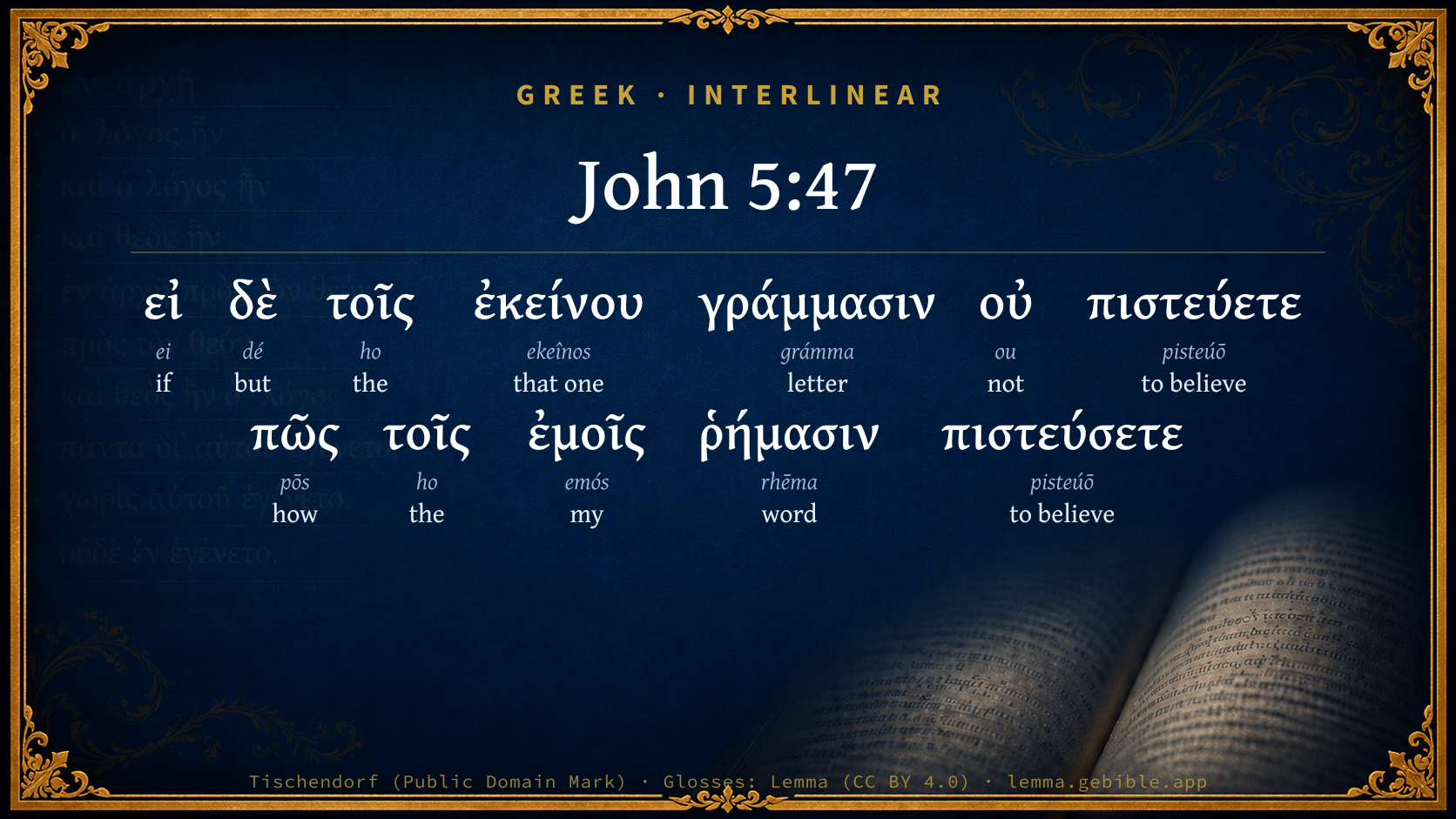
Greek (Tischendorf 8th ed.) John 5:47 appears in the Greek New Testament. The text above is from the Tischendorf 8th edition. Each word links to its Strong’s number and a concise gloss. Click any word for its full Thayer’s Greek Lexicon entry.
Download image
Cite this verse

John 5:47 (World English Bible). Public Domain. Lemma interlinear Bible study tool, https://lemma.gebible.app/v/john/5/47.

Show BibTeX & RIS
BibTeX
RIS
English Translation
But if you don't believe his writings, how will you believe my words?"
World English Bible · Public Domain
Download a study sheet

One document with this verse’s original text, its word-by-word gloss line, the meaning frame, cross-references with their text, attributed commentary, and full source and license credits — printable, and it pastes into notes with its structure intact.

This verse Autodidact and up

Study sheet (.html) Plain text (.txt)

A passage Seminary Student

Up to 50 verses in one chapter. A passage sheet keeps up to 6 commentary sources and 12 cross-references per verse, in the order this page ranks them, and says so on the sheet whenever that leaves anything out. Ask for a single verse and you get the Autodidact verse sheet above.

Everything on this page stays free to read, with no account — the sheet is a download of what is already on screen, not access to it.

Want to remove ads? Support Godless Engineer
Compare translations 3

The same verse in 3 English versions, stacked beneath the original-language interlinear above. Click any original word for its lexicon entry.

Each is an independent rendering of the whole verse — the interlinear is not word-aligned to these translations.

Highlighted words mark where these versions differ — a whole-verse word diff, not a word-by-word alignment.

  • World English Bible Public Domain
    But if you don't believe his writings, how will you believe my words?"
  • King James Version Public Domain
    But if ye believe not his writings, how shall ye believe my words?
  • unfoldingWord Literal Text CC BY-SA 4.0
    But if you do not believe the writings of that one, how will you believe my words?”

unfoldingWord Literal Text — © unfoldingWord, licensed CC BY-SA 4.0. Word-aligned USFM3 via Door43 (git.door43.org/unfoldingWord/en_ult).

Versions to compare (up to 4)

3 of 4 selected

Show all 19 translations

Every available English version of this verse, each an independent rendering of the whole verse.

  • World English Bible Public Domain
    But if you don't believe his writings, how will you believe my words?"
  • Berean Standard Bible Public Domain
    But since you do not believe what he wrote, how will you believe what I say?”
  • Majority Standard Bible Public Domain
    But since you do not believe what he wrote, how will you believe what I say?”
  • King James Version Public Domain
    But if ye believe not his writings, how shall ye believe my words?
  • American Standard Version (1901) Public Domain
    But if ye believe not his writings, how shall ye believe my words?
  • Revised Version (1885) Public Domain
    But if ye believe not his writings, how shall ye believe my words?
  • Geneva Bible (1599) Public Domain
    But if ye beleeue not his writings, how shall ye beleeue my wordes?
  • Douay-Rheims (1899) Public Domain
    But if you do not believe his writings, how will you believe my words?
  • Young's Literal Translation Public Domain
    but if his writings ye believe not, how shall ye believe my sayings?'
  • Literal Standard Version CC BY-SA 4.0
    but if you do not believe his writings, how will you believe My sayings?”
  • Unlocked Literal Bible CC BY-SA 4.0
    If you do not believe his writings, how are you going to believe my words?”
  • unfoldingWord Literal Text CC BY-SA 4.0
    But if you do not believe the writings of that one, how will you believe my words?”
  • Darby Bible Public Domain
    But if ye do not believe his writings, how shall ye believe my words?
  • World Messianic Bible Public Domain
    But if you don’t believe his writings, how will you believe my words?”
  • Webster's Bible Public Domain
    But if ye believe not his writings, how shall ye believe my words?
  • Free Bible Version CC BY-SA 4.0
    But since you don't trust what he said, why would you trust what I say?”
  • Bible in Basic English Public Domain
    If you have no belief in his writings, how will you have belief in my words?
  • Text-Critical English NT CC BY 4.0
    But if you do not believe his writings, how will you believe my words?”
  • Tyndale New Testament (1534) Public Domain
    But now ye beleve not his writinge: how shall ye beleve my wordes.

Literal Standard Version (2020), Covenant Press — licensed CC BY-SA 4.0. Text via the HelloAO Bible API (eBible.org). Unlocked Literal Bible (unfoldingWord) — licensed CC BY-SA 4.0. Text via the HelloAO Bible API (eBible.org). unfoldingWord Literal Text — © unfoldingWord, licensed CC BY-SA 4.0. Word-aligned USFM3 via Door43 (git.door43.org/unfoldingWord/en_ult). Free Bible Version, Dr. Jonathan Gallagher — licensed CC BY-SA 4.0. Text via the HelloAO Bible API (eBible.org).

Word by word

More ways to search: Search by grammar → Find every occurrence → Compare this word →

Practice this passage: Drill this verse → Learn its vocabulary →

About this verse

These counts appear in no published source. They are computed here, from the morphology-tagged text and Lemma’s own curated glosses. What Lemma adds →

12
words
10
distinct lemmas
Gospels
section

Notable vocabulary

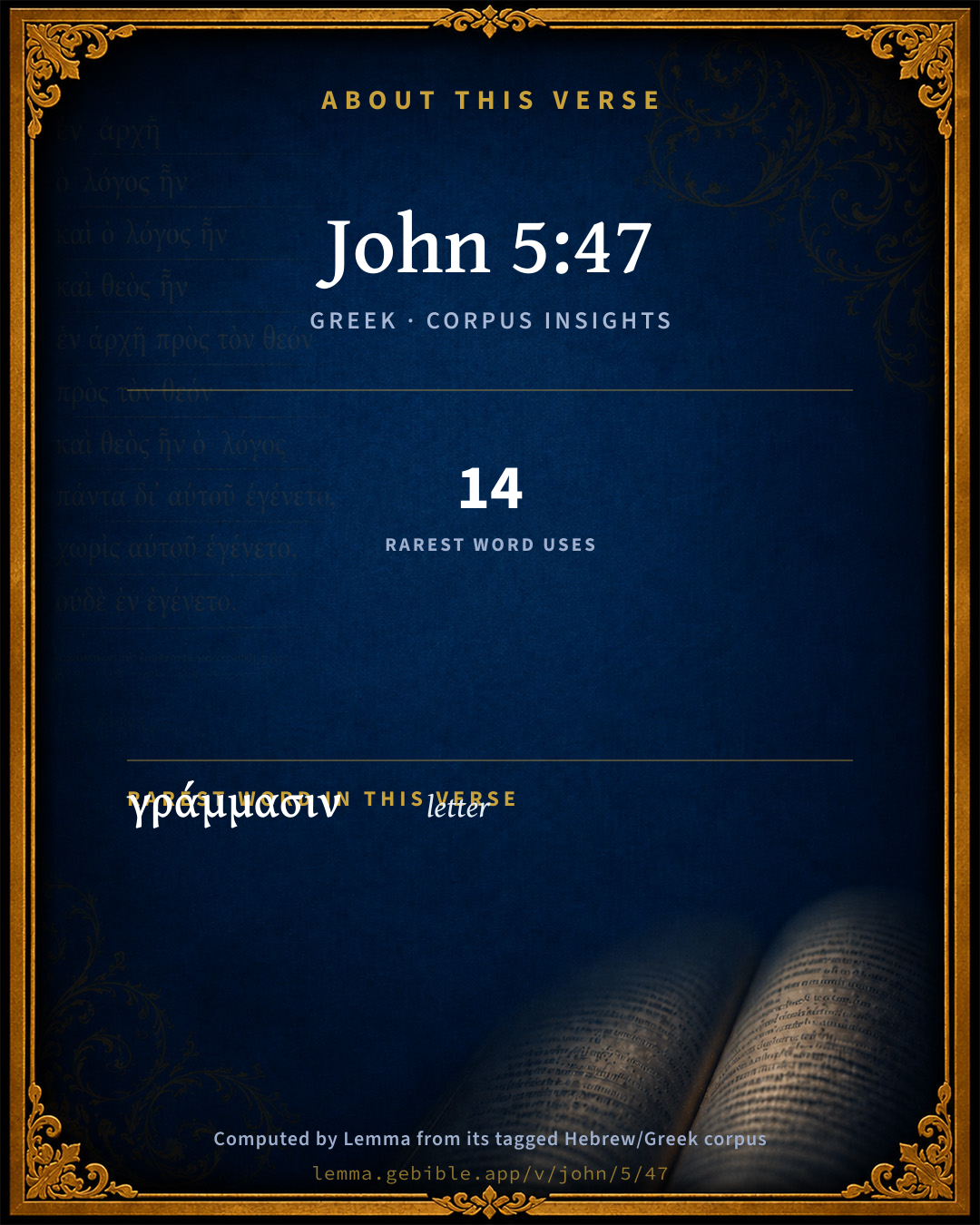
The rarest word here is γράμμασιν letter G1121 — appearing just 14 times in the whole Greek New Testament.

Shared distinctive vocabulary

γράμμασιν letter G1121 occurs in 13 verses of the Greek New Testament. Also found in:

Repetition

Words recur within this verse:

  • πιστεύετε to believe G4100 ×2
  • τοῖς the G3588 ×2

Cross-references

2

Topical passages linked to John 5:47 in the Treasury of Scripture Knowledge — connected by theme and wording, ordered by reader-vote popularity; previews shown in the World English Bible.

  • Luke 16:31 "He said to him, 'If they don't listen to Moses and the prophets, neither will they be persuaded if one rises from the dead.'"
  • Luke 16:29 "But Abraham said to him, 'They have Moses and the prophets. Let them listen to them.'

Cross-references courtesy of OpenBible.info (CC BY 4.0).

Commentary

Notes on John 5:47 from classic Christian and Jewish commentators (each source and its license shown beneath its notes). The classic Christian expositions comment on the surrounding passage and are grouped to its opening verse, so a note may address several verses; the Jewish commentaries on the Tanakh (Rashi and others) are per-verse, so they appear only where the commentator wrote on this verse.

Lemma curates 59 commentaries, every one of them public domain or Creative Commons licensed, each selected and text-cleaned for this edition rather than reprinted as found. About our sources →

Bengel's Gnomon

Johann Albrecht Bengel

Joh 5:47. Γράμμασιν, his letter [writings]) In antithesis to ῥήμασι, words. Often more readily is belief attached to a letter previously received, than to a discourse heard for the first time.—ἐμοῖς, My) speaking heavenly things, as compared with Moses.

Bengel's Gnomon of the New Testament — English translation (T&T Clark, Edinburgh, 1860) — public domain. Text from a community e-Sword module.

Expositor's Greek Testament

ed. W. Robertson Nicoll

Joh 5:47 . The converse is true, and true with an a fortiori conveyed by the contrast between γράμμασιν and ῥήμασι . If the writings you have had before you for your study all your life, and which you have heard read in the Synagogues Sabbath after Sabbath, have not produced faith in you, and enabled you to see God and appreciate His glory, how shall ye believe the once heard words of one whose coming was prepared for, and His identification made easy by all that Moses wrote?

The Expositor's Greek Testament, edited by W. Robertson Nicoll (1897–1910) — public domain. Text from a community e-Sword module.

Jamieson, Fausset & Brown

Robert Jamieson, A. R. Fausset & David Brown

If ye believe not--(See Luk 16:31).

his writings . . . my words--a remarkable contrast, not absolutely exalting Old Testament Scripture above His own words, but pointing to the office of those venerable documents to prepare Christ's way, to the necessity universally felt for documentary testimony in revealed religion, and perhaps (as STIER adds) to the relation which the comparative "letter" of the Old Testament holds to the more flowing "words" of "spirit and life" which characterize the New Testament.

Next: John Chapter 6

Jamieson, Fausset & Brown — Commentary Critical and Explanatory on the Whole Bible (1871) — public domain (CC PDM 1.0). Text via the HelloAO Bible API.

Adam Clarke's Commentary

Verse 47. But if ye believe not his writings, c.] If you lay them not to heart - if you draw not those conclusions from them which their very letter, as well as their spirit, authorizes you to draw, how shall ye believe my words, against which ye have taken up the most ungrounded prejudice? It is no wonder that we find the Jews still in the gall of bitterness, and bond of iniquity: as they believe not Moses and the prophets, in reference to the Messiah, it is no marvel that they reject Christ and the apostles. Till they see and acknowledge, from the law and the prophets, that Christ must have come, they will never believe the Gospel. St. Paul says, 2Co 3:15, that even until this day, when Moses (i.e. the law) is read, the VEIL is upon their hearts:- so that they see not to the end of that which is abolished: 2Co 3:13. Nor will this veil be taken away, till they turn from worldly gain and atheism (which appears to be their general system) to the Lord, 2Co 3:16 and then the light of the glory of God shall shine on them in the face (through the mediation and merits) of Jesus Christ.

It appears that this discourse of our Lord had effectually confounded these Jews, for they went away without replying-a manifest proof they had nothing to say.

1. IN all periods of their history, the Jews were both an incredulous and disobedient people: perhaps it was on this ground that God first chose them to be keepers of his testimonies; for had they not had the most incontrovertible proofs that God did speak, they would neither have credited nor preserved his oracles.

Their incredulity is, therefore, no mean proof of the Divine authority of the law and the prophets. The apostles, who were all Jews, partook deeply of the same spirit, as various places in the Gospel prove; and, had not they had the fullest evidence of the divinity of their Master, they would not have believed, much less have sealed the truth with their blood. Thus their incredulity is a strong proof of the authenticity of the Gospel.

2. When a man, through prejudice, bigotry, or malevolence, is determined to disbelieve, both evidence and demonstration are lost upon him: he is incapable of conviction, because he is determined not to yield. This was, this is, the case with the Jews - there are facts before their eyes sufficient to convince and confound them; but they have made a covenant with unbelief, and therefore they continue blind, ignorant, and wicked; obstinately closing their eyes against the light; and thus the wrath of God is coming upon them to the very uttermost. But shall not a rebellious and wicked Christian be judged worthy of more punishment? Certainly: for he professes to believe that truth which is able to make him wise unto salvation, by faith in Jesus Christ. Reader, it is an awful thing to trifle with the Gospel! - the God of it is pure, jealous, and holy. Come unto him and implore forgiveness of thy past sins, that thou mayest have eternal life.

Adam Clarke's Commentary on the Bible (1810–1826) — public domain. Text from a community e-Sword/MySword module.

John Calvin's Commentaries

47. But if you do not believe his writings. Christ appears here to claim less authority for himself than for Moses; and yet we know that heaven and earth have been shaken by the voice of the Gospel, (Hebrews 12:26.) But Christ accommodates his discourse to those to whom he speaks; for the authority of the Law was, beyond all controversy, held sacred among the Jews; and thus it was impossible that Christ should be inferior to Moses. To the same purpose is the contrast between writings and words; for he shows their unbelief to be more aggravated, because the truth of God, recorded in an authentic form, has no authority with them.

John Calvin's Commentaries (1540-1563) — public domain. Text from the Calvin Translation Society English edition (1840s-50s) via the Christian Classics Ethereal Library (ccel.org). Calvin's coverage is partial (roughly two-thirds of the Bible); uncommented books and verses are honest gaps, never fabricated. The 19th-century editor's footnotes and remarks are omitted so the notes are faithfully Calvin's own voice.

Ellicott's Commentary for English Readers

(47) The emphasis of the contrast here is not between “writings” and “words,” but between “his” and “My.” It is a repetition of the thought of the previous verse, with an advance in time. They had not believed Moses, and therefore had not believed Him. They do not believe, for they do not read the spiritual meaning of the writings of Moses even now. What ground of hope is left? His words, revealing the deeper truths of the kingdom of God, will fall upon their ears as so many unmeaning sounds. (Comp. Note on Joh_3:12.)

A Bible Commentary for English Readers, edited by Charles John Ellicott (1878–1897) — public domain. Text from a community e-Sword module.

The Cambridge Bible for Schools and Colleges

gen. ed. J. J. S. Perowne

47. if ye believe not] The emphatic words are ‘his’ and ‘My.’ Most readers erroneously emphasize ‘writings’ and ‘words.’ The comparison is between Moses and Christ. It was a simple matter of fact that Moses had written and Christ had not: the contrast between writings and words is no part of the argument. Comp. Luk_16:31; ‘If they hear not Moses and the prophets, neither will they be persuaded though one rose from the dead.’

my words] Or, My sayings. It is not the plural of ‘word’ (λόγος) in Joh_5:38, but another substantive (ῥήματα) used by S. John only in the plural. Comp. Joh_6:63; Joh_6:68, Joh_8:47, Joh_12:47, Joh_15:7; where the separate sayings are meant; whereas in Joh_6:60, Joh_8:43; Joh_8:51, Joh_12:48, Joh_15:3 it is rather the teaching as a whole that is meant.

The Cambridge Bible for Schools and Colleges (gen. ed. J. J. S. Perowne; Cambridge University Press, 1878–1918) — public domain. Text from a community e-Sword module.

Trapp's Complete Commentary

John Trapp

47 But if ye believe not his writings, how shall ye believe my words?

Ver. 47. But if ye believe not his writings] He that will not take God’s word in one place will take it in no place.

John Trapp, A Commentary or Exposition upon All the Books of the Old and New Testament (1647–1656) — public domain. Text from a community e-Sword module.

Albert Barnes' Notes on the Bible

If ye believe not his writings - If you do not credit what he has written which you profess to believe, it is not to be expected that you will believe my declarations. And from this we may learn:

That many men who profess to believe the Bible have really no regard for it when it crosses their own views and inclinations. It is our duty to study the Bible, that we may be established in the belief that Jesus is the Messiah. The prophecies of the Old Testament are conclusive proofs of the truth of the Christian religion. He that rejects one part of the Bible, will, for the same reason, reject all. The Saviour acknowledged the truth of the writings of Moses, built his religion upon them, appealed to them to prove that he was the Messiah, and commanded men to search them. We have the testimony of Jesus, therefore, that the Old Testament is a revelation from God. He that rejects his testimony on This subject must reject his authority altogether; and it is vain for any man to profess to believe in the New Testament, or in the Lord Jesus, without also acknowledging the authority of the Old Testament and of Moses.

We have in this chapter an instance of the profound and masterly manner in which Jesus could meet and silence his enemies. There is not anywhere a more conclusive argument, or a more triumphant meeting of the charges which they had brought against him. No one can read this without being struck with his profound wisdom; and it is scarcely possible to conceive that there could be a more distinct declaration and proof that he was equal with God.

Albert Barnes' Notes on the Bible (1834–1885) — public domain. Text from a community e-Sword/MySword module.

Matthew Poole's English Annotations

But if you believe not his writings, who so plainly wrote of me, and whose writings you own, and have so great a veneration for, how can I expect that you should believe the words of one whom you so vilify and condemn? For though my words be in themselves of greater authority, yet I have not so much credit with you as Moses had. But how doth our Saviour affirm, Joh 5:45, that they trusted in Moses, and deny here that they did believe him?

Answer. Some say, they believed with an implicit faith, presuming upon the merits of Abraham, Isaac, Jacob; but not with an explicit faith. Others say, they believed in the general, that whatsoever he wrote was true; but they did not believe them in the true sense of them. Tarnovius thinks, that they trusted in Moses, that they might be saved by their own works done in obedience to his law; but they did not believe him, because they rejected him of whom Moses wrote, and to whom the law of Moses was but a schoolmaster. They refused him who was the Head of the corner, Psa 118:22; Mat 21:42.

Matthew Poole's English Annotations on the Holy Bible (1683–1685) — public domain. Text from a community e-Sword/MySword module.

Whedon's Commentary on the Bible

Daniel D. Whedon

47. His writings… my words?—The same question Christ addresses to the rationalists of our age. Their unbelief is the result of a predisposition, and its consequence is a terrible accusation from the Moses they disbelieve in behalf of the Christ they reject. Their belief is grounded in the heart, and that heart is a wilful and guilty heart that refuses the means of its own regeneration.

Daniel D. Whedon (gen. ed.), Commentary on the Old and New Testaments (1874–1909) — public domain. Text from a community e-Sword module.

Cambridge Greek Testament for Schools and Colleges

47. ἐκείνου … ἐμοῖς. These are the emphatic words, not γράμμασιν and ῥήμασιν. The comparison is between Moses and Christ; the contrast between writings and words is no part of the argument. It was a mere matter of fact that Moses had written and Christ had not. Comp. ‘If they hear not Moses and the prophets, &c., (Luk 16:31). For εἰ οὐ see on Joh 10:37. On ῥήμασιν see on Joh 3:34.

We pass now from a crisis in the work at Jerusalem to a crisis in the work in Galilee, each typical of the section to which it belongs and exhibiting the development of national unbelief.

Cambridge Greek Testament for Schools and Colleges (Cambridge University Press, 1896; 21 vols, various authors incl. Carr, Maclear, Plummer, Farrar, Lumby, Moule, M. R. James, Simcox) — public domain. Text from a community e-Sword module.

Alford’s Greek Testament

Henry Alford

47.] γράμμασιν here does not, in the sense, = γραφαῖς: for ταῖς ἐκείνου γραφαῖς could not be used;—the γραφή being ἡ θεία γραφή, not (ἡ τοῦ) Μωυσέως γραφή,—but the γράμματα were those of Moses; the outward expression of the γραφή,—the letters, and words, as found on paper:—just as the ῥήματα in the other case are the outward expression of the λόγος. The meaning is: ‘men give greater weight to what is written and published, the letter of a book, than to mere word of mouth;—and ye in particular give greater honour to Moses, than to Me: if then ye believe not what he has written, which comes down to you hallowed by the reverence of ages,—how can you believe the words which are uttered by Me, to whom you are hostile?’ This however is not all:—Moses leads to Christ:—is one of the witnesses by which the Father hath testified of Him: ‘if then ye have rejected the means, how shall ye reach the end?’ ‘If your unbelief has stopped the path, how shall ye arrive at Him to whom it leads?’ Meyer is quite right in maintaining that the opposition does not lie between γράμμασιν and ῥήμασιν, but between ἐκείνου and τοῖς ἐμοῖς.

Those who can, should by all means consult Stier, whose exposition of the above important discourse is very elaborate and valuable:—Reden Jesu, vol. iv. pp. 170-233, 2nd edn.

Henry Alford, The Greek Testament (1849–1861) — public domain. Text from a community e-Sword module.

International Critical Commentary

47. εἰ δὲ τοῖς ἐκείνου γράμμασιν κτλ., “but if you do not believe his writings, how will you believe my words?” There is a double contrast, between ἐκείνου and ἐμοῖς, and between γοάμμασιν and ῥήμασιν. The argument, If you do not believe Moses, how will you believe Christ? would not have appealed to a Christian of any age; but it was addressed here to Jews, for whom the authority of Moses was the greatest they knew (cf. Luk 16:31), and in such a context was weighty. Here, again, it is plain that Jn. is reproducing with fidelity the kind of argument which Jesus used in Jewish controversy. Upon the contrast between γράμματα, “writings,” and ῥήματα, “sayings,” no special stress is laid, although these γράμματα were reckoned as ἱερὰ γράμματα (2Ti 3:15) and as entitled therefore to special reverence. If Jesus were no other than an ordinary Rabbi, it would be obvious that his authority as a teacher would be far inferior to that of the sacred writings, consecrated by a long tradition.

The ῥήματα of Jesus are mentioned again 6:63, 68, 8:20, 12:47, 48, 14:10, 15:7, 17:8 (see on 3:34 above).

The constr. εἰ … οὐ, as an undivided phrase, is noted by Abbott (Diat. 2256) as occurring again in Jn. only at 10:37.

1 For the position of c. 5 in the text, cf. Introd., pp. 17, 30.

2 Introd., p. 108.

3 Introd., p. 116.

4 See Introd., p. 103.

אԠSinaiticus (δ 2). Leningrad. iv.

C Ephræmi (δ 3). Paris. v. Palimpsest. Contains considerable fragments of Jn.

L Regius (ε 56). Paris. viii. Cc. 15:2-20 21:15-25 are missing.

D Bezæ (δ 5). Cambridge. v-vi. Græco-Latin. Cc. 18:14-20:13 are missing in the Greek text, and the gap has been filled by a ninth-century scribe (Dsupp).

A Alexandrinus (δ 4). British Museum. v. Cc. 6:50-8:52 are missing.

B Vaticanus (δ 1). Rome. Cent. iv.

N Purpureus Petropolitanus (ε 19). Dispersed through the libraries of Leningrad, Patmos, Rome, Vienna, and British Museum. vi. Some pages are missing. Edited by H. S. Cronin in Cambridge Texts and Studies (1899).

W Freer (ε 014). Washington. iv-vi. Discovered in Egypt in 1906. The Gospels are in the order Mt., Jn., Lk., Mk. Collation in The Washington MS. of the Four Gospels, by H. A. Sanders (1912).

Θ̠Koridethi (ε 050). Tiflis. vii-ix. Discovered at Koridethi, in Russian territory, and edited by Beermann & Gregory (Leipzig, 1913). The text is akin to that of fam. 13, fam. 1, and the cursives 28, 565, 700 See Lake and Blake in Harvard Theol. Review (July 1923) and Streeter, The Four Gospels. Cf. also J.T.S. Oct. 1915, April and July 1925.

Δ̠Sangallensis (ε 76). St. Gall. ix-x. Græco-Latin.

Γ̠(ε 70) Oxford and Leningrad. ix-x. Contains Son 1:1-13 8:3-15:24 19:6 to end.

1 Cf. Torrey, Harvard Theol. Review, Oct. 1923, p. 334, who presses the force of ἔστιν as representfng an Aramaic original, and holds that the Gospel must have been composed before Jerusalem had been destroyed.

1 See G. A. Smith, Jerusalem, ii. 566, and Lightfoot, Biblical Essays, p. 170; cf. also D.C.G., s.v. “Bethesda.”

1 Cf. Sanday, Sacred Sites of the Gospels, p. 55.

2 Introd., p. lxxxvii.

Diat. E. A. Abbott’s Diatessarica, including his Johannine Vocabulary and Johannine Grammar, Parts I.-X. (1900-1915).

1 Cambridge Biblical Essays (ed. H. B. Swete), p. 483.

1 Diat. 2537; see, for illustrations from the papyri, MoultonMilligan, s.v. ἀποκρίομαι.

1 Cf. Introd., p. cxxv.

2 Cf. also Clem. Alex. Strom. vi. 16, p. 813 P.

1 Origen, in Num. Hom. xxii. 4 (Lommatzsch, x. 282).

2 Horæ Semiticæ, No. v. p. 234 (ed. M. D. Gibson).

Moulton-Milligan Vocabulary of the Greek Testament, illustrated from the papyri, by J. H. Moulton and G.Milligan (1914-). This is being completed by Dr. Milligan; it is indispensable.

1 Cf. Burlutt, Gospel History and Transmission, p. 239.

2 See Abbott, Diat. 2516.

1 Cf. Abbott, Diat. 2066b.

1 Cf. Schürer, Jewish People in the Time of Christ, Eng. Tr., Div. ii. p. 85.

1 See Introd., p. clx.

1 This is the true construction, as supported by Syr. cur., the O.L., Origen, and Paul of Samosata; see on v. 28 for Chrysostom’s rendering.

2 See v. 22, and Introd., p. cxxvii.

1 Wendt (Gospel according to St. John, pp. 131 ff.) argues that vv. 28, 29, cannot belong to the original form of the discourse

1 Aboth x. 4, quoted by Westcott, in loc.

1 Grammar of N.T., p. 180.

1 Aboth, ii. 8, quoted by Schoettgen, 1. P. 356.

2 τί δοκεῖ ὐμῖν; (11:56) is a question, “What do you think ?”

3 Abbott points out that ἐραυνᾶτε or ἐξεραυνᾶτε does not occur elsewhere in the Greek Bible as an imperative, the aorist being generally used when there is a command; cf 7:52 (Diat. 2439i).

1 Cf. Kautzsch in D.B., extra p. 641.

2 E.B. 2551.

1 The Antichrist Legend, p. 133.

1 Abbott (Diat. 2442-2443, 2473) traces the Johannine perfect to Hebrew influence, and says that we should have expected the aor. or the pres. rather than the perf. at 5:45. But, on the contrary, the perf. is right here and the aor. would be wrong, as it is wrong in the LXX often. See also Field, in loc.

International Critical Commentary — older volumes (1896–1929), various authors — public domain. Text from a community e-Sword module.

Vincent's Word Studies in the New Testament

Marvin R. Vincent

Writings [γραμμασιν] . It is important to understand the precise sense of this word, because it goes to determine whether Jesus intended an antithesis between Moses ' writings and His own words, or simply between Moses [εκεινου] and Himself [εμοις] .

Gramma primarily means what is written. Hence it may describe either a single character or a document. From this general notion several forms develop themselves in the New Testament. The word occurs in its narrower sense of characters, at Luk 23:38; 2Co 3:7; Gal 6:11. In Act 28:21, it means official communications. Paul, with a single exception (2Co 3:7), uses it of the letter of scripture as contrasted with its spirit (Rom 2:27, 29; Rom 7:6; 2Co 3:6). In Luk 16:6, 7, it denotes a debtor 's bond (A. V., bill). In Joh 7:15, Act 26:24) it is used in the plural as a general term for scriptural and Rabbinical learning. Compare Sept., Isa 29:11, 12) where a learned man is described as ejpitamenov grammata, acquainted with letters. Once it is used collectively of the sacred writings - the scriptures (2Ti 3:15), though some give it a wider reference to Rabbinical exegesis, as well as to scripture itself. Among the Alexandrian Greeks the term is not confined to elementary instruction, but includes exposition, based, however, on critical study of the text. The tendency of such exegesis was often toward mystical and allegorical interpretation, degenerating into a petty ingenuity in fixing new and recondite meanings upon the old and familiar forms. This was illustrated by the Neo - Platonists' expositions of Homer, and by the Rabbinical exegesis. Men unacquainted with such studies, especially if they appeared as public teachers, would be regarded as ignorant by the Jews of the times of Christ and the Apostles. Hence the question respecting our Lord Himself : How knoweth this man letters (grammata Joh 7:15)? Also the comment upon Peter and John (Act 4:13) that they were unlearned [αγραμματοι] . Thus, too, those who discovered in the Old Testament scriptures references to Christ, would be stigmatized by Pagans, as following the ingenious and fanciful method of the Jewish interpreters, which they held in contempt. Some such feeling may have provoked the words of Festus to Paul : Much learning [πολλα γραμματα] doth make thee mad (Act 26:24). It is well known with what minute care the literal transcription of the sacred writings was guarded. The Scribes [γραμματεις] were charged with producing copies according to the letter [κατα το γραμμα] .

The one passage in second Timothy cannot be urged in favor of the general use of the term for the scriptures, especially since the best texts reject the article before iJera gramma, so that the meaning is apparently more general : "thou hast known sacred writings." The familiar formula for the scriptures was aiJ grafai aJgiai.. A single book of the collection of writings was known as biblion (Luk 4:17), or biblov (Luk 20:42); never grafh, which was the term for a particular passage. See on Mr 12:10. 27 It seems to me, therefore, that the antithesis between the writings of Moses, superstitiously reverenced in the letter, and minutely and critically searched and expounded by the Jews, and the living words (rJhmasin, see on Luk 1:37), is to be recognized. This, however, need not exclude the other antithesis between Moses and Jesus personally. ===Joh6

CHAPTER VI

1 - 14. Compare Mt 14:13 - 21; Mr 6:30 - 44; Luk 9:10 - 17.

Marvin R. Vincent, Word Studies in the New Testament (1887–1900) — public domain. Text from a community e-Sword/MySword module.

Godet's Commentaries

Frédéric Louis Godet

Ver. 47. On the other hand, unbelief towards Moses carries naturally in its train the rejection of Jesus. The essential antithesis is not that of the substantives, writings and words, but that of the pronouns, his and my. The former is only accidental; it arises only from the fact that the Jews knew Moses by his writings and Jesus by Hiswords. This charge of not believing Moses, addressed to people whom the alleged violation of one of the Mosaic commandments threw into a rage, recalls that other saying of Jesus, so sorrowful and so bitter (Mat 23:29-32): “Ye build the tombs of the prophets, and ye bear witness thus that ye are children of those who killed them.” The rejection of a sacred principle shelters itself sometimes under the appearances of the most particular regard and most ardent zeal for the principle itself. From this coincidence, there result, in the religious history of humanity, those tragic situations, among which the catastrophe of Israel here announced certainly holds the foremost place.

As regards the historical reality of this discourse, the following appear to us to be the results of the exegesis:

1. The fundamental thought is perfectly suited to the given situation. Accused of having done an anti-Sabbatical work, and even of ascribing to Himself equality with God, Jesus justifies Himself in a way at once the most lofty and the most humble, by averring, on the testimony of His consciousness, the absolute dependence of His work, relatively to that of the Father.

2. The three principal parts of the discourse are naturally linked together, as they start from the central idea which we have just indicated: 1. Jesus affirms the constant adapting of His activity to that of the Father, and declares that from this relation of dependence between Him and God will proceed yet far more considerable works. 2. He proves this internal relation, which it is impossible for men to test, by a double testimony of the Father: His miracles, a specimen of which is at this very moment before their eyes, and the Scriptures.

3. He closes by showing them, in their secret antipathy to the moral tendency of His work, the reason which prevents them from trusting the divine testimony, and by declaring to them their future condemnation in the name of that Moses whom they accuse Him of despising.

Instead of the abstruse metaphysics which has been charged upon the discourses in John, there remains for us only the simple expression of the filial consciousness of Jesus. This latter displays itself gradually in a series of views of imposing grandeur, and of an unique elevation. What renders this feature more striking, is thenaive and almost child-like simplicity of the figures employed to describe this communion of the Son with the Father. Such a relation must have been lived, in order to be expressed, and expressed in this way.

Strauss has acknowledged, up to a certain point, these results of exegesis. “There is not,” he says, “in the tenor of the rest of the discourse, anything which causes difficulty, anything which Jesus could not Himself have said, since the evangelist relates, in the best connection, things...which, according to the Synoptics also, Jesus ascribes to Himself.” The objections of Strauss bear only on the analogies of style between this discourse, that of John the Baptist (chap. 3), and certain passages of the first Epistle of St. John (Introd., pp. 106, 107). Strauss concludes by saying: “If, then, the form of this discourse should be ascribed to the evangelist, it might be that the substance of it belonged to Jesus.” We believe that we may conclude by saying: Jesus must have really spoken in this way. The principal theme bears the character of most perfect appropriateness. The secondary ideas are logically subordinated to this theme. No detail turns aside from the idea of the whole, or goes beyond it; finally, the application is of a thrilling solemnity, as it should be in such a situation, and closes by impressing on the whole discourse the seal of reality.

Renan considers that the author of this narrative must have derived the substance of his account from tradition, which is, he says, extremely weighty, because it proves that a part of the Christian community really attributed to Jesus miracles performed at Jerusalem. As to the discourse in particular, see his summary judgment respecting the discourses of the fourth Gospel (p. lxxviii.): “The theme cannot be without a certain degree of authenticity; but in the execution, the fancy of the artist gives itself full play. We feel the factitious action, the rhetoric, the studied diction.” But factitious action betrays itself by commonplaces without appropriateness; have we met with them? Rhetoric, by emphasis and inflation; have we found a redundant word, a word which does not express an original thought? Studied diction, by the ingenious antithesis or the striving after piquancy; has the discourse which we have just studied offered us anything like this? The substance and the force equally exclude the idea of an artificial work, of a composition in cold blood.

Finally, let us notice an assertion of Reville, trenchant and bold like those which so often come from the pen of this critic: “This book,” he says, in speaking of the fourth Gospel, “in which Judaism, the Jewish law, the Jewish temples, are things as foreign, as indifferent, as they could be to a Hellenistic Christian of the second century...” And one ventures to write words like these in the face of the last verses of this chapter, in which Jesus so identifies His teaching with that of Moses, that to believe the one is implicitly to believe the other, and to reject the second, is virtually to reject the first, because Jesus is in reality nothing but Moses completed. The agreement of the law and the Gospel does not appear more clearly from the Sermon on the Mount, than from the passage which we have just studied. But we know that the Sermon on the Mount is universally regarded as that which has most authenticity in the Synoptic tradition.

Frédéric Louis Godet — Commentaries on Luke, John, Romans, and 1 Corinthians — English translation (T&T Clark, Edinburgh, 1870s–1890s) — public domain. Text from a community e-Sword module.

Lesson kit

Teaching starters — assembled from the data on this page, not authored interpretation. Every prompt links to the verse data it draws on. Edit before teaching.

John, in the Gospels, opens this verse with 12 words (10 distinct Greek lemmas). Its most distinctive word is grámma (“letter”). A historical commentator’s framing appears above. Read the whole chapter for the surrounding context.

Discussion questions

  1. What does “letter” (grámma) contribute to the verse as a whole?
  2. How does Luke 16:6, which shares the word «letter», read alongside this verse?
  3. What does the repetition of “to believe” (2× in this one verse) do in this verse?
  4. The translations on this page render this verse differently — a whole-verse word diff, not a word-by-word alignment. What might account for the different wordings?
  5. Compare how Bengel's Gnomon and Expositor's Greek Testament read this verse. Where do they agree or differ?

Things to notice

  • These translations choose different wording for 6 words in this verse.
  • “to believe” occurs 2× in this single verse.
  • 10 distinct Greek lemmas span 12 words in this verse.

Reading settings

Reading text

Shown beneath each verse's original-language words.

Old Testament
Old Testament edition

Read the OT as the Masoretic Hebrew (MT) or the Greek Septuagint (LXX).

English shown for the Greek Septuagint (in the Hebrew ↔ Greek comparison).

Comparing translations? Open the Compare panel on any verse page to stack up to four side by side.