

Luke 12:45
Greek (Tischendorf 8th ed.) Luke 12:45 appears in the Greek New Testament. The text above is from the Tischendorf 8th edition. Each word links to its Strong’s number and a concise gloss. Click any word for its full Thayer’s Greek Lexicon entry.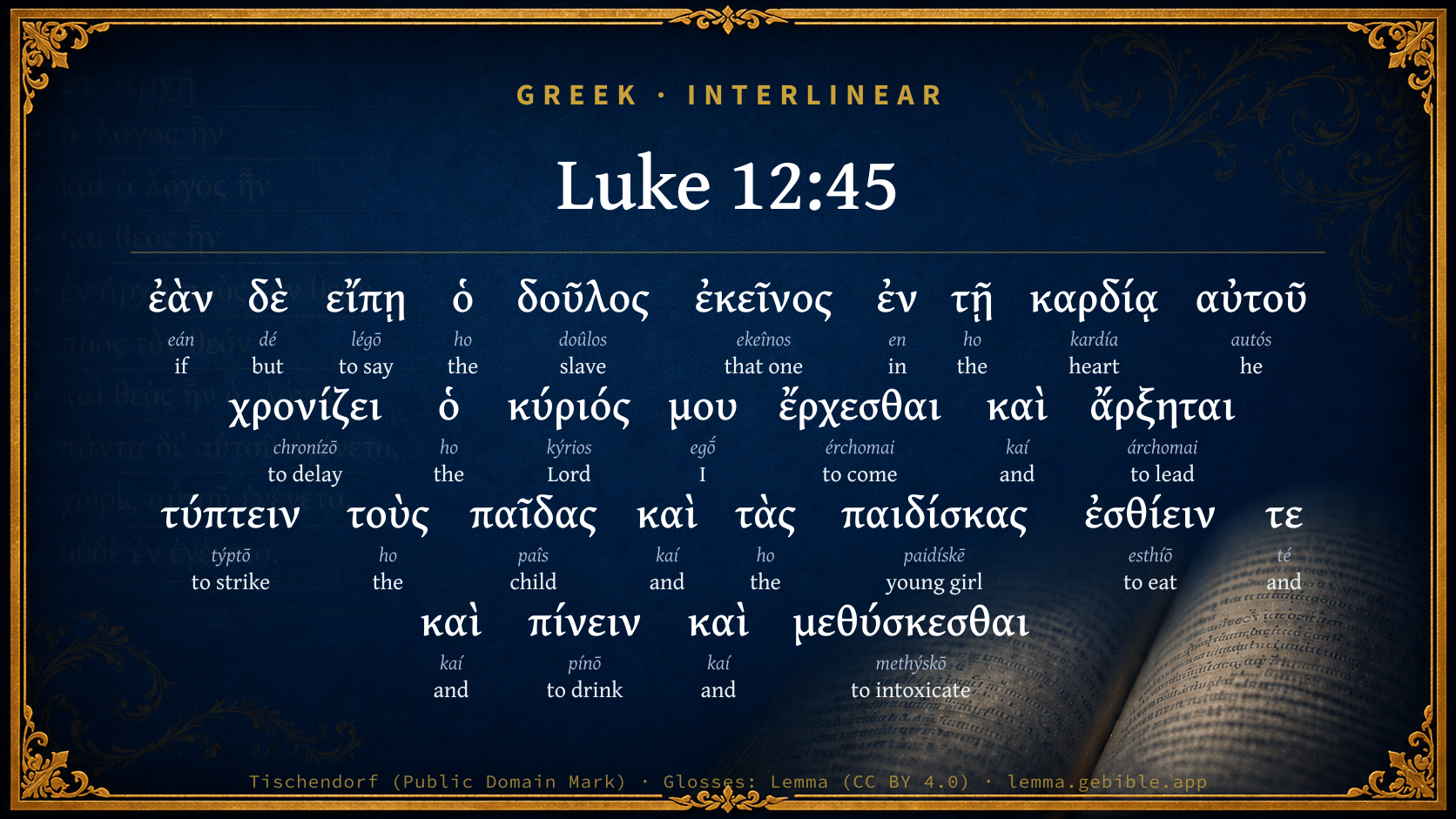
But if that servant says in his heart, 'My lord delays his coming,' and begins to beat the menservants and the maidservants, and to eat and drink, and to be drunken,
Download a study sheet
One document with this verse’s original text, its word-by-word gloss line, the meaning frame, cross-references with their text, attributed commentary, and full source and license credits — printable, and it pastes into notes with its structure intact.
This verse Autodidact and up
A passage Seminary Student
Up to 50 verses in one chapter. A passage sheet keeps up to 6 commentary sources and 12 cross-references per verse, in the order this page ranks them, and says so on the sheet whenever that leaves anything out. Ask for a single verse and you get the Autodidact verse sheet above.
Everything on this page stays free to read, with no account — the sheet is a download of what is already on screen, not access to it.
Compare translations 3
The same verse in 3 English versions, stacked beneath the original-language interlinear above. Click any original word for its lexicon entry.
Each is an independent rendering of the whole verse — the interlinear is not word-aligned to these translations.
Highlighted words mark where these versions differ — a whole-verse word diff, not a word-by-word alignment.
-
World English Bible Public Domain
But if that servant says in his heart, 'My lord delays his coming,' and begins to beat the menservants and the maidservants, and to eat and drink, and to be drunken,
-
King James Version Public Domain
But and if that servant say in his heart, My lord delayeth his coming; and shall begin to beat the menservants and maidens, and to eat and drink, and to be drunken;
-
unfoldingWord Literal Text CC BY-SA 4.0
But if that slave says in his heart, ‘My master delays to come,’ and he begins to beat the male servants and the female servants, and to eat and drink, and to become drunk,
unfoldingWord Literal Text — © unfoldingWord, licensed CC BY-SA 4.0. Word-aligned USFM3 via Door43 (git.door43.org/unfoldingWord/en_ult).
Show all 19 translations
Every available English version of this verse, each an independent rendering of the whole verse.
-
World English Bible Public Domain
But if that servant says in his heart, 'My lord delays his coming,' and begins to beat the menservants and the maidservants, and to eat and drink, and to be drunken,
-
Berean Standard Bible Public Domain
But suppose that servant says in his heart, ‘My master will be a long time in coming,’ and he begins to beat the menservants and maidservants, and to eat and drink and get drunk.
-
Majority Standard Bible Public Domain
But suppose that servant says in his heart, ‘My master will be a long time in coming,’ and he begins to beat the menservants and maidservants, and to eat and drink and get drunk.
-
King James Version Public Domain
But and if that servant say in his heart, My lord delayeth his coming; and shall begin to beat the menservants and maidens, and to eat and drink, and to be drunken;
-
American Standard Version (1901) Public Domain
But if that servant shall say in his heart, My lord delayeth his coming; and shall begin to beat the menservants and the maidservants, and to eat and drink, and to be drunken;
-
Revised Version (1885) Public Domain
But if that servant shall say in his heart, My lord delayeth his coming; and shall begin to beat the menservants and the maidservants, and to eat and drink, and to be drunken;
-
Geneva Bible (1599) Public Domain
But if that seruant say in his heart, My master doeth deferre his comming, and ginne to smite the seruants, and maydens, and to eate, and drinke, and to be drunken,
-
Douay-Rheims (1899) Public Domain
But if that servant shall say in his heart: My lord is long a coming; and shall begin to strike the menservants and maidservants, and to eat and to drink and be drunk:
-
Young's Literal Translation Public Domain
`And if that servant may say in his heart, My lord doth delay to come, and may begin to beat the men-servants and the maid-servants, to eat also, and to drink, and to be drunken;
-
Literal Standard Version CC BY-SA 4.0
And if that servant may say in his heart, My lord delays to come, and may begin to beat the menservants and the maidservants, to eat also, and to drink, and to be drunken,
-
Unlocked Literal Bible CC BY-SA 4.0
But if that servant says in his heart, 'My lord delays his return,' and begins to beat the male and female servants, and to eat and drink, and to become drunk,
-
unfoldingWord Literal Text CC BY-SA 4.0
But if that slave says in his heart, ‘My master delays to come,’ and he begins to beat the male servants and the female servants, and to eat and drink, and to become drunk,
-
Darby Bible Public Domain
But if that bondman should say in his heart, My lord delays to come, and begin to beat the menservants and the maidservants, and to eat and to drink and to be drunken,
-
World Messianic Bible Public Domain
But if that servant says in his heart, ‘My lord delays his coming,’ and begins to beat the menservants and the maidservants, and to eat and drink and to be drunken,
-
Webster's Bible Public Domain
But if that servant shall say in his heart, My lord delayeth his coming; and shall begin to beat the men-servants, and maidens, and to eat and drink, and to be drunken?
-
Free Bible Version CC BY-SA 4.0
But what if the servant were to say to himself, ‘My master is taking a long time in coming,’ and then starts beating the other servants, both men and women, feasting and getting drunk?
-
Bible in Basic English Public Domain
But if that servant says to himself, My lord is a long time coming; and goes about giving blows to the men-servants and the women-servants, feasting and taking overmuch wine;
-
Text-Critical English NT CC BY 4.0
But if that servant says in his heart, ‘My master is delayed in coming,’ and he begins to beat the male and female servants, and to eat and drink and get drunk,
-
Tyndale New Testament (1534) Public Domain
But and yf the evyll servaunt shall saye in his hert: My master wyll differre his cominge and shall beginne to smyte the servauntes and maydens and to eate and drinke and to be dronken:
Literal Standard Version (2020), Covenant Press — licensed CC BY-SA 4.0. Text via the HelloAO Bible API (eBible.org). Unlocked Literal Bible (unfoldingWord) — licensed CC BY-SA 4.0. Text via the HelloAO Bible API (eBible.org). unfoldingWord Literal Text — © unfoldingWord, licensed CC BY-SA 4.0. Word-aligned USFM3 via Door43 (git.door43.org/unfoldingWord/en_ult). Free Bible Version, Dr. Jonathan Gallagher — licensed CC BY-SA 4.0. Text via the HelloAO Bible API (eBible.org).
Word by word
More ways to search: Search by grammar → Find every occurrence → Compare this word →
Practice this passage: Drill this verse → Learn its vocabulary →
- Appears 4× in the Greek New Testament
- First appears here
- Part of Speech
- Verb
- Tense
- Present
- Voice
- Passive
- Mood
- Infinitive
Full Thayer's Definition
- ἐὰν eán G1437 “if” Conditional
- δὲ dé G1161 “but” Conjunction
- εἴπῃ légō G3004 “to say” Verb, Aorist, Active, Subjunctive, 3rd person, Singular
- ὁ ho G3588 “the” Article, Nominative, Singular, Masculine
- δοῦλος doûlos G1401 “slave” Noun, Nominative, Singular, Masculine
- ἐκεῖνος ekeînos G1565 “that one” Demonstrative pronoun, Nominative, Singular, Masculine
- ἐν en G1722 “in” Preposition
- τῇ ho G3588 “the” Article, Dative, Singular, Feminine
- καρδίᾳ kardía G2588 “heart” Noun, Dative, Singular, Feminine
- αὐτοῦ autós G846 “he” Personal pronoun, Genitive, Singular, Masculine
- χρονίζει chronízō G5549 “to delay” Verb, Present, Active, Indicative, 3rd person, Singular
- ὁ ho G3588 “the” Article, Nominative, Singular, Masculine
- κύριός kýrios G2962 “Lord” Noun, Nominative, Singular, Masculine
- μου egṓ G1473 “I” Personal pronoun, 1st person, Genitive, Singular
- ἔρχεσθαι érchomai G2064 “to come” Verb, Present, Middle or Passive deponent, Infinitive
- καὶ kaí G2532 “and” Conjunction
- ἄρξηται árchomai G756 “to lead” Verb, Aorist, Middle, Subjunctive, 3rd person, Singular
- τύπτειν týptō G5180 “to strike” Verb, Present, Active, Infinitive
- τοὺς ho G3588 “the” Article, Accusative, Plural, Masculine
- παῖδας paîs G3816 “child” Noun, Accusative, Plural, Masculine
- καὶ kaí G2532 “and” Conjunction
- τὰς ho G3588 “the” Article, Accusative, Plural, Feminine
- παιδίσκας paidískē G3814 “young girl” Noun, Accusative, Plural, Feminine
- ἐσθίειν esthíō G2068 “to eat” Verb, Present, Active, Infinitive
- τε té G5037 “and” Particle
- καὶ kaí G2532 “and” Conjunction
- πίνειν pínō G4095 “to drink” Verb, Present, Active, Infinitive
- καὶ kaí G2532 “and” Conjunction
- μεθύσκεσθαι methýskō G3182 “to intoxicate” Verb, Present, Passive, Infinitive
About this verse
These counts appear in no published source. They are computed here, from the morphology-tagged text and Lemma’s own curated glosses. What Lemma adds →
- 29
- words
- 22
- distinct lemmas
- Gospels
- section
Notable vocabulary
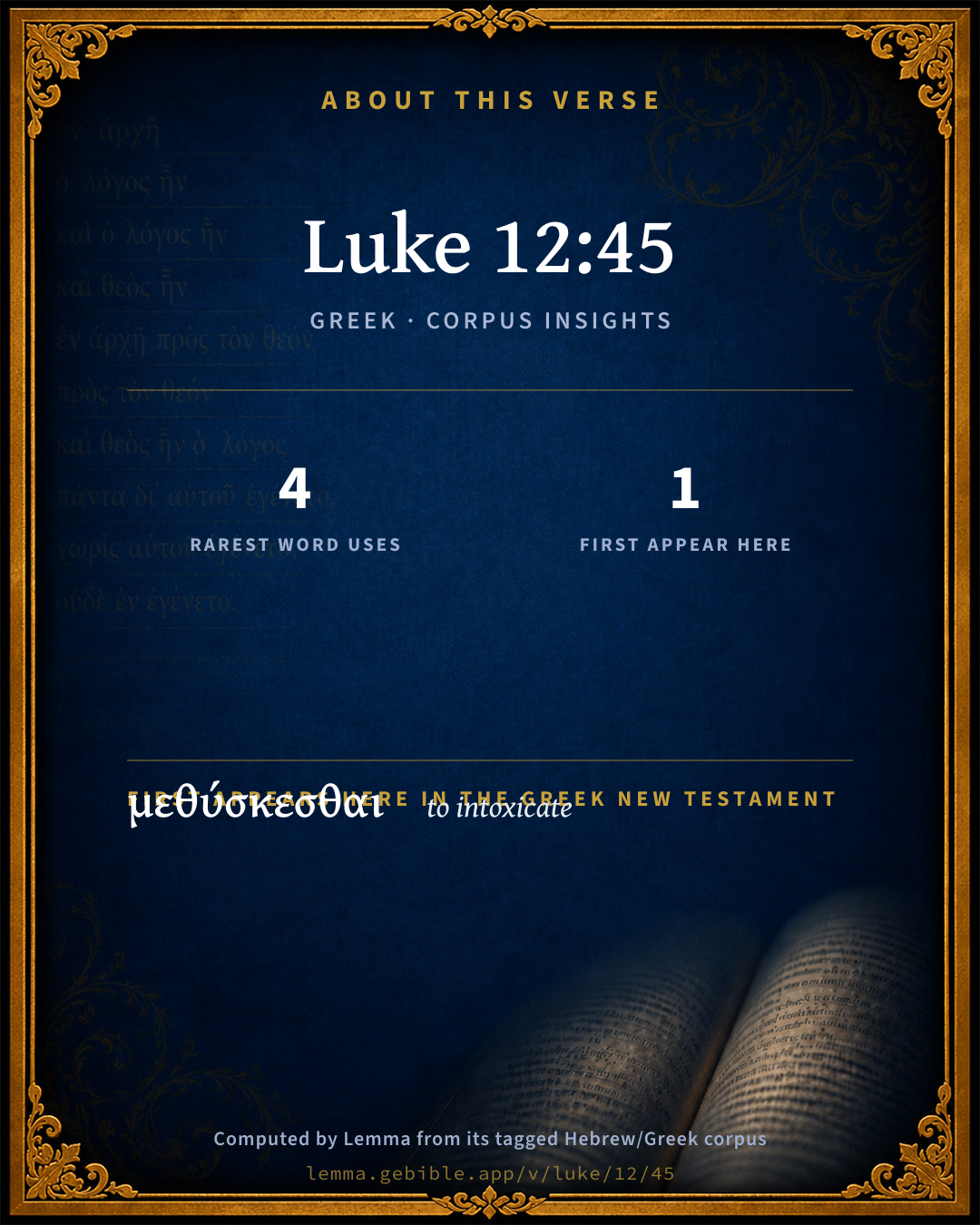
The rarest word here is μεθύσκεσθαι to intoxicate G3182 — appearing just 4 times in the whole Greek New Testament.
First appearance in Scripture
This word makes its first canonical appearance in the Greek New Testament here:
- μεθύσκεσθαι to intoxicate G3182
Shared distinctive vocabulary
μεθύσκεσθαι to intoxicate G3182 occurs in 4 verses of the Greek New Testament. Also found in:
Cross-references
24Topical passages linked to Luke 12:45 in the Treasury of Scripture Knowledge — connected by theme and wording, ordered by reader-vote popularity; previews shown in the World English Bible.
- Matthew 24:48–50 But if that evil servant should say in his heart, 'My lord is delaying his coming,'
- Jeremiah 20:2 Then Pashhur struck Jeremiah the prophet, and put him in the stocks that were in the upper gate of Benjamin, which was in the house of Yahweh.
- Ezekiel 34:8 As I live, says the Lord Yahweh, surely because my sheep became a prey, and my sheep became food to all the animals of the field, because there was no shepherd, neither did my shepherds search for my sheep, but the shepherds fed themselves, and didn't feed my sheep;
- Revelation 18:7–8 However much she glorified herself, and grew wanton, so much give her of torment and mourning. For she says in her heart, 'I sit a queen, and am no widow, and will in no way see mourning.'
- Isaiah 65:6 Behold, it is written before me: I will not keep silence, but will recompense, yes, I will recompense into their bosom,
- Ezekiel 12:22 Son of man, what is this proverb that you have in the land of Israel, saying, The days are prolonged, and every vision fails?
- Matthew 22:6 and the rest grabbed his servants, and treated them shamefully, and killed them.
- Romans 16:18 For those who are such don't serve our Lord, Jesus Christ, but their own belly; and by their smooth and flattering speech, they deceive the hearts of the innocent.
- 2 Corinthians 11:20 For you bear with a man, if he brings you into bondage, if he devours you, if he takes you captive, if he exalts himself, if he strikes you on the face.
- Philippians 3:18–19 For many walk, of whom I told you often, and now tell you even weeping, as the enemies of the cross of Christ,
- 1 Thessalonians 5:7 For those who sleep, sleep in the night, and those who are drunken are drunken in the night.
- 2 Peter 2:3–4 In covetousness they will exploit you with deceptive words: whose sentence now from of old doesn't linger, and their destruction will not slumber.
- 2 Peter 2:13 receiving the wages of unrighteousness; people who count it pleasure to revel in the day-time, spots and blemishes, reveling in their deceit while they feast with you;
- 2 Peter 2:19 promising them liberty, while they themselves are bondservants of corruption; for by whom a man is overcome, by the same is he also brought into bondage.
- 3 John 1:9–10 I wrote to the assembly, but Diotrephes, who loves to be first among them, doesn't accept what we say.
- Jude 1:12–13 These are hidden rocky reefs in your love feasts when they feast with you, shepherds who without fear feed themselves; clouds without water, carried along by winds; autumn leaves without fruit, twice dead, plucked up by the roots;
- Revelation 13:7–10 It was given to him to make war with the saints, and to overcome them. Authority over every tribe, people, language, and nation was given to him.
- Revelation 13:15–17 It was given to him to give breath to it, to the image of the beast, that the image of the beast should both speak, and cause as many as wouldn't worship the image of the beast to be killed.
- Revelation 16:6 For they poured out the blood of the saints and the prophets, and you have given them blood to drink. They deserve this."
- Revelation 18:24 In her was found the blood of prophets and of saints, and of all who have been slain on the earth."
- Isaiah 56:10–12 His watchmen are blind, they are all without knowledge; they are all mute dogs, they can't bark; dreaming, lying down, loving to slumber.
- Ezekiel 12:27–28 Son of man, behold, they of the house of Israel say, The vision that he sees is for many day to come, and he prophesies of times that are far off.
- Ezekiel 34:3–4 You eat the fat, and you clothe you with the wool, you kill the fatlings; but you don't feed the sheep.
- Revelation 17:5–6 And on her forehead a name was written, "MYSTERY, BABYLON THE GREAT, THE MOTHER OF THE PROSTITUTES AND OF THE ABOMINATIONS OF THE EARTH."
Cross-references courtesy of OpenBible.info (CC BY 4.0).
Lesson kit
Teaching starters — assembled from the data on this page, not authored interpretation. Every prompt links to the verse data it draws on. Edit before teaching.
Luke, in the Gospels, opens this verse with 29 words (22 distinct Greek lemmas). Its most distinctive word is methýskō (“to intoxicate”). A historical commentator’s framing appears above. Read the whole chapter for the surrounding context.
Discussion questions
- The word methýskō carries the sense “to intoxicate.” How does it shape the verse?
- This is the first place “to intoxicate” appears in Scripture (first appears here). What does its debut here establish?
- How does Ephesians 5:18, which shares the word «to intoxicate», read alongside this verse?
- What does the repetition of “the” (5× in this one verse) do in this verse?
- The translations on this page render this verse differently — a whole-verse word diff, not a word-by-word alignment. What might account for the different wordings?
- Compare how The Biblical Illustrator and Joseph Benson's Commentary read this verse. Where do they agree or differ?
Things to notice
- 1 word makes its first canonical appearance in Scripture here.
- These translations choose different wording for 22 words in this verse.
- “the” occurs 5× in this single verse.
- 22 distinct Greek lemmas span 29 words in this verse.
Commentary
Notes on Luke 12:45 from classic Christian and Jewish commentators (each source and its license shown beneath its notes). The classic Christian expositions comment on the surrounding passage and are grouped to its opening verse, so a note may address several verses; the Jewish commentaries on the Tanakh (Rashi and others) are per-verse, so they appear only where the commentator wrote on this verse.
Lemma curates 59 commentaries, every one of them public domain or Creative Commons licensed, each selected and text-cleaned for this edition rather than reprinted as found. About our sources →
The Biblical Illustrator
Joseph S. Exell
The Biblical Illustrator, edited by Joseph S. Exell (c. 1880s–1900s) — public domain. Text from a community e-Sword module.
Joseph Benson's Commentary
Joseph Benson's Commentary on the Old and New Testaments (1811–1818) — public domain. Text from a community e-Sword module.
Bengel's Gnomon
Johann Albrecht Bengel
Bengel's Gnomon of the New Testament — English translation (T&T Clark, Edinburgh, 1860) — public domain. Text from a community e-Sword module.
Meyer's Critical & Exegetical Commentary
Heinrich August Wilhelm Meyer
Meyer — Critical and Exegetical Commentary on the New Testament — English translation by Peter Christie, edited by Frederick Crombie (T&T Clark, 1880) — public domain. Text from a community e-Sword module.
Expositor's Greek Testament
ed. W. Robertson Nicoll
The Expositor's Greek Testament, edited by W. Robertson Nicoll (1897–1910) — public domain. Text from a community e-Sword module.
Jamieson, Fausset & Brown
Robert Jamieson, A. R. Fausset & David Brown
Jamieson, Fausset & Brown — Commentary Critical and Explanatory on the Whole Bible (1871) — public domain (CC PDM 1.0). Text via the HelloAO Bible API.
Adam Clarke's Commentary
Adam Clarke's Commentary on the Bible (1810–1826) — public domain. Text from a community e-Sword/MySword module.
Ellicott's Commentary for English Readers
A Bible Commentary for English Readers, edited by Charles John Ellicott (1878–1897) — public domain. Text from a community e-Sword module.
The Cambridge Bible for Schools and Colleges
gen. ed. J. J. S. Perowne
The Cambridge Bible for Schools and Colleges (gen. ed. J. J. S. Perowne; Cambridge University Press, 1878–1918) — public domain. Text from a community e-Sword module.
John Gill's Exposition
John Gill's Exposition of the Whole Bible (1746–1763) — public domain (CC PDM 1.0). Text via the HelloAO Bible API.
Trapp's Complete Commentary
John Trapp
John Trapp, A Commentary or Exposition upon All the Books of the Old and New Testament (1647–1656) — public domain. Text from a community e-Sword module.
Whedon's Commentary on the Bible
Daniel D. Whedon
Daniel D. Whedon (gen. ed.), Commentary on the Old and New Testaments (1874–1909) — public domain. Text from a community e-Sword module.
The Pulpit Commentary
The Pulpit Commentary (1880–1919), ed. H.D.M. Spence-Jones & Joseph S. Exell — public domain. Text from a community e-Sword module.
Burkitt's Expository Notes on the New Testament
William Burkitt
William Burkitt's Expository Notes on the New Testament (1700–1703) — public domain. Text from a community e-Sword module.
unfoldingWord translationNotes
Door43 World Missions Community
unfoldingWord translationNotes — © Distant Shores Media and the Door43 World Missions Community, licensed CC BY-SA 4.0. Source: git.door43.org/Door43/en_tn.
Cambridge Greek Testament for Schools and Colleges
Cambridge Greek Testament for Schools and Colleges (Cambridge University Press, 1896; 21 vols, various authors incl. Carr, Maclear, Plummer, Farrar, Lumby, Moule, M. R. James, Simcox) — public domain. Text from a community e-Sword module.
International Critical Commentary
International Critical Commentary — older volumes (1896–1929), various authors — public domain. Text from a community e-Sword module.
Vincent's Word Studies in the New Testament
Marvin R. Vincent
Marvin R. Vincent, Word Studies in the New Testament (1887–1900) — public domain. Text from a community e-Sword/MySword module.
Godet's Commentaries
Frédéric Louis Godet
Frédéric Louis Godet — Commentaries on Luke, John, Romans, and 1 Corinthians — English translation (T&T Clark, Edinburgh, 1870s–1890s) — public domain. Text from a community e-Sword module.