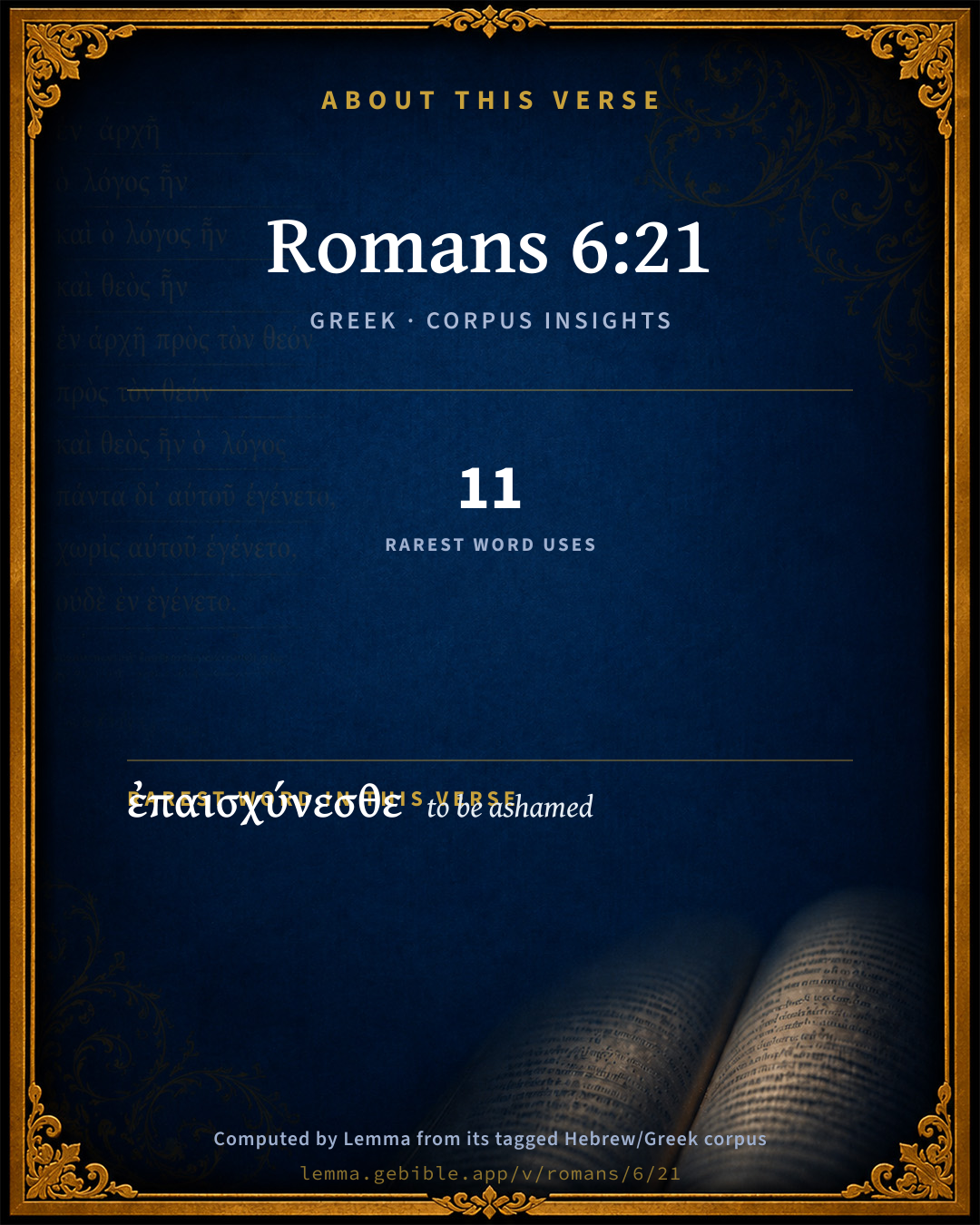
Romans 6:21

Greek (Tischendorf 8th ed.) Romans 6:21 appears in the Greek New Testament. The text above is from the Tischendorf 8th edition. Each word links to its Strong’s number and a concise gloss. Click any word for its full Thayer’s Greek Lexicon entry.
Download image
Cite this verse

Romans 6:21 (World English Bible). Public Domain. Lemma interlinear Bible study tool, https://lemma.gebible.app/v/romans/6/21.

Show BibTeX & RIS
BibTeX
RIS
English Translation
What fruit then did you have at that time in the things of which you are now ashamed? For the end of those things is death.
World English Bible · Public Domain
Download a study sheet

One document with this verse’s original text, its word-by-word gloss line, the meaning frame, cross-references with their text, attributed commentary, and full source and license credits — printable, and it pastes into notes with its structure intact.

This verse Autodidact and up

Study sheet (.html) Plain text (.txt)

A passage Seminary Student

Up to 50 verses in one chapter. A passage sheet keeps up to 6 commentary sources and 12 cross-references per verse, in the order this page ranks them, and says so on the sheet whenever that leaves anything out. Ask for a single verse and you get the Autodidact verse sheet above.

Everything on this page stays free to read, with no account — the sheet is a download of what is already on screen, not access to it.

Want to remove ads? Support Godless Engineer
Compare translations 3

The same verse in 3 English versions, stacked beneath the original-language interlinear above. Click any original word for its lexicon entry.

Each is an independent rendering of the whole verse — the interlinear is not word-aligned to these translations.

Highlighted words mark where these versions differ — a whole-verse word diff, not a word-by-word alignment.

  • World English Bible Public Domain
    What fruit then did you have at that time in the things of which you are now ashamed? For the end of those things is death.
  • King James Version Public Domain
    What fruit had ye then in those things whereof ye are now ashamed? for the end of those things is death.
  • unfoldingWord Literal Text CC BY-SA 4.0
    So what fruit were you then having because of which things you are now ashamed? For the outcome of those things death.

unfoldingWord Literal Text — © unfoldingWord, licensed CC BY-SA 4.0. Word-aligned USFM3 via Door43 (git.door43.org/unfoldingWord/en_ult).

Versions to compare (up to 4)

3 of 4 selected

Show all 19 translations

Every available English version of this verse, each an independent rendering of the whole verse.

  • World English Bible Public Domain
    What fruit then did you have at that time in the things of which you are now ashamed? For the end of those things is death.
  • Berean Standard Bible Public Domain
    What fruit did you reap at that time from the things of which you are now ashamed? The outcome of those things is death.
  • Majority Standard Bible Public Domain
    What fruit did you reap at that time from the things of which you are now ashamed? The outcome of those things is death.
  • King James Version Public Domain
    What fruit had ye then in those things whereof ye are now ashamed? for the end of those things is death.
  • American Standard Version (1901) Public Domain
    What fruit then had ye at that time in the things whereof ye are now ashamed? for the end of those things is death.
  • Revised Version (1885) Public Domain
    What fruit then had ye at that time in the things whereof ye are now ashamed? for the end of those things is death.
  • Geneva Bible (1599) Public Domain
    What fruit had ye then in those things, whereof ye are nowe ashamed? For the ende of those things is death.
  • Douay-Rheims (1899) Public Domain
    What fruit therefore had you then in those things, of which you are now ashamed? For the end of them is death.
  • Young's Literal Translation Public Domain
    what fruit, therefore, were ye having then, in the things of which ye are now ashamed? for the end of those `is' death.
  • Literal Standard Version CC BY-SA 4.0
    What fruit, therefore, were you having then, in the things of which you are now ashamed? For the end of those [is] death.
  • Unlocked Literal Bible CC BY-SA 4.0
    At that time, what fruit then did you have of the things of which you are now ashamed? For the outcome of those things is death.
  • unfoldingWord Literal Text CC BY-SA 4.0
    So what fruit were you then having because of which things you are now ashamed? For the outcome of those things death.
  • Darby Bible Public Domain
    What fruit therefore had ye *then* in the things of which ye are *now* ashamed? for the end of *them* [is] death.
  • World Messianic Bible Public Domain
    What fruit then did you have at that time in the things of which you are now ashamed? For the end of those things is death.
  • Webster's Bible Public Domain
    What fruit had ye then in those things of which ye are now ashamed? for the end of those things is death.
  • Free Bible Version CC BY-SA 4.0
    But what were the results back then? Aren't you ashamed of the things you did? Such things that lead to death!
  • Bible in Basic English Public Domain
    What fruit had you at that time in the things which are now a shame to you? for the end of such things is death.
  • Text-Critical English NT CC BY 4.0
    So what fruit did you have at that time from the things of which you are now ashamed? The end result of those things is death.
  • Tyndale New Testament (1534) Public Domain
    What frute had ye then in tho thinges wher of ye are now ashamed. For the ende of tho thynges is deeth.

Literal Standard Version (2020), Covenant Press — licensed CC BY-SA 4.0. Text via the HelloAO Bible API (eBible.org). Unlocked Literal Bible (unfoldingWord) — licensed CC BY-SA 4.0. Text via the HelloAO Bible API (eBible.org). unfoldingWord Literal Text — © unfoldingWord, licensed CC BY-SA 4.0. Word-aligned USFM3 via Door43 (git.door43.org/unfoldingWord/en_ult). Free Bible Version, Dr. Jonathan Gallagher — licensed CC BY-SA 4.0. Text via the HelloAO Bible API (eBible.org).

Word by word

More ways to search: Search by grammar → Find every occurrence → Compare this word →

Practice this passage: Drill this verse → Learn its vocabulary →

ἐπαισχύνεσθε
epaischýnomai
G1870
“to be ashamed”
Verb, Present, Middle or Passive deponent, Indicative, 2nd person, Plural
Part of Speech
Verb
Tense
Present
Voice
Middle or Passive deponent
Mood
Indicative
Person
2nd person
Number
Plural
Full Thayer's Definition

Origin: from G1909 and G153

TDNT: 1:189,*

1. to be ashamed
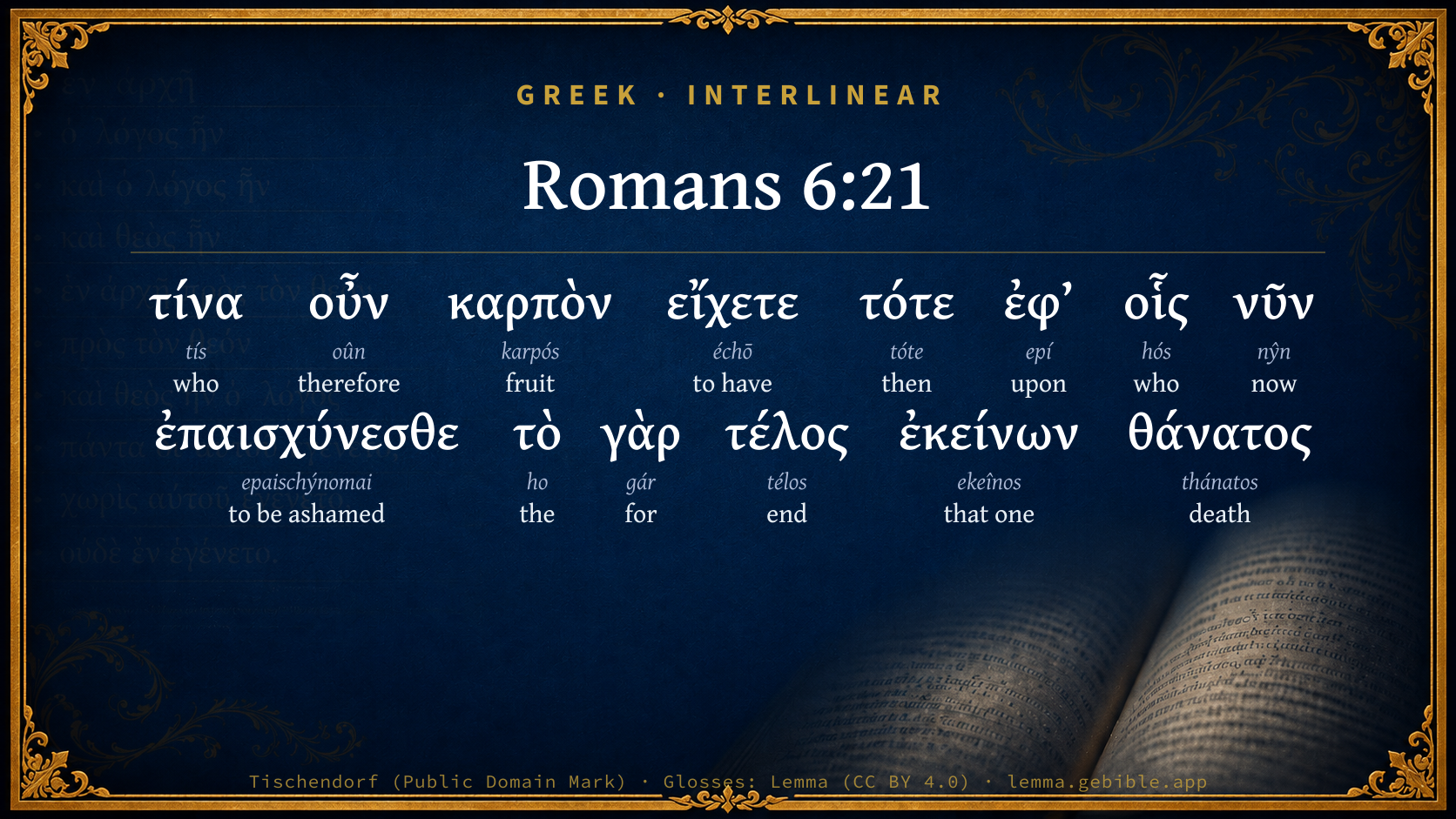
  1. τίνα tís G5101 “who” Interrogative pronoun, Accusative, Singular, Masculine
  2. οὖν oûn G3767 “therefore” Conjunction
  3. καρπὸν karpós G2590 “fruit” Noun, Accusative, Singular, Masculine
  4. εἴχετε échō G2192 “to have” Verb, Imperfect, Active, Indicative, 2nd person, Plural
  5. τότε tóte G5119 “then” Adverb
  6. ἐφ’ epí G1909 “upon” Preposition
  7. οἷς hós G3739 “who” Relative pronoun, Dative, Plural, Neuter
  8. νῦν nŷn G3568 “now” Adverb
  9. τὸ ho G3588 “the” Article, Nominative, Singular, Neuter
  10. γὰρ gár G1063 “for” Conjunction
  11. τέλος télos G5056 “end” Noun, Nominative, Singular, Neuter
  12. ἐκείνων ekeînos G1565 “that one” Demonstrative pronoun, Genitive, Plural, Masculine
  13. θάνατος thánatos G2288 “death” Noun, Nominative, Singular, Masculine

About this verse

These counts appear in no published source. They are computed here, from the morphology-tagged text and Lemma’s own curated glosses. What Lemma adds →

14
words
14
distinct lemmas
Pauline Epistles
section

Notable vocabulary

The rarest word here is ἐπαισχύνεσθε to be ashamed G1870 — appearing just 11 times in the whole Greek New Testament.

Shared distinctive vocabulary

ἐπαισχύνεσθε to be ashamed G1870 occurs in 9 verses of the Greek New Testament. Also found in:

Cross-references

42

Topical passages linked to Romans 6:21 in the Treasury of Scripture Knowledge — connected by theme and wording, ordered by reader-vote popularity; previews shown in the World English Bible.

  • Romans 1:32 who, knowing the ordinance of God, that those who practice such things are worthy of death, not only do the same, but also approve of those who practice them.
  • Romans 7:5 For when we were in the flesh, the sinful passions which were through the law, worked in our members to bring forth fruit to death.
  • Romans 6:23 For the wages of sin is death, but the free gift of God is eternal life in Christ Jesus our Lord.
  • Proverbs 14:12 There is a way which seems right to a man, But in the end it leads to death.
  • Galatians 6:7–8 Don't be deceived. God is not mocked, for whatever a man sows, that will he also reap.
  • Proverbs 16:25 There is a way which seems right to a man, But in the end it leads to death.
  • Jeremiah 8:12 Were they ashamed when they had committed abomination? nay, they were not at all ashamed, neither could they blush: therefore shall they fall among those who fall; in the time of their visitation they shall be cast down, says Yahweh.
  • Jeremiah 17:10 I, Yahweh, search the mind, I try the heart, even to give every man according to his ways, according to the fruit of his doings.
  • Daniel 12:2 Many of those who sleep in the dust of the earth shall awake, some to everlasting life, and some to shame and everlasting contempt.
  • Romans 8:6 For the mind of the flesh is death, but the mind of the Spirit is life and peace;
  • Romans 8:13 For if you live after the flesh, you must die; but if by the Spirit you put to death the deeds of the body, you will live.
  • Hebrews 6:8 but if it bears thorns and thistles, it is rejected and near being cursed, whose end is to be burned.
  • 1 John 2:28 Now, little children, remain in him, that when he appears, we may have boldness, and not be ashamed before him at his coming.
  • Deuteronomy 17:6 At the mouth of two witnesses, or three witnesses, shall he who is to die be put to death; at the mouth of one witness he shall not be put to death.
  • Deuteronomy 21:22 If a man have committed a sin worthy of death, and he be put to death, and you hang him on a tree;
  • 2 Samuel 12:5–7 David's anger was greatly kindled against the man, and he said to Nathan, "As Yahweh lives, the man who has done this is worthy to die!
  • 1 Kings 2:26 To Abiathar the priest said the king, Get you to Anathoth, to your own fields; for you are worthy of death: but I will not at this time put you to death, because you bear the ark of the Lord Yahweh before David my father, and because you were afflicted in all in which my father was afflicted.
  • Ezra 9:6 and I said, my God, I am ashamed and blush to lift up my face to you, my God; for our iniquities are increased over our head, and our guiltiness is grown up to the heavens.
  • Job 40:4 "Behold, I am of small account. What shall I answer you? I lay my hand on my mouth.
  • Job 42:6 Therefore I abhor myself, And repent in dust and ashes."
  • Psalms 73:17 Until I entered God's sanctuary, And considered their latter end.
  • Proverbs 1:31 Therefore they will eat of the fruit of their own way, And be filled with their own schemes.
  • Proverbs 5:10–13 Lest strangers feast on your wealth, And your labors enrich another man's house.
  • Proverbs 9:17–18 "Stolen water is sweet. Food eaten in secret is pleasant."
  • Isaiah 3:10 Tell the righteous "Good!" For they shall eat the fruit of their deeds.
  • Jeremiah 3:3 Therefore the showers have been withheld, and there has been no latter rain; yet you have a prostitute's forehead, you refused to be ashamed.
  • Jeremiah 12:13 They have sown wheat, and have reaped thorns; they have put themselves to pain, and profit nothing: and you shall be ashamed of your fruits, because of the fierce anger of Yahweh.
  • Jeremiah 31:19 Surely after that I was turned, I repented; and after that I was instructed, I struck on my thigh: I was ashamed, yes, even confounded, because I did bear the reproach of my youth.
  • Jeremiah 44:20–24 Then Jeremiah said to all the people, to the men, and to the women, even to all the people who had given him who answer, saying,
  • Ezekiel 16:61–63 Then shall you remember your ways, and be ashamed, when you shall receive your sisters, your elder [sisters] and your younger; and I will give them to you for daughters, but not by your covenant.
  • Ezekiel 36:31–32 Then shall you remember your evil ways, and your doings that were not good; and you shall loathe yourselves in your own sight for your iniquities and for your abominations.
  • Ezekiel 43:11 If they be ashamed of all that they have done, make known to them the form of the house, and the fashion of it, and the exits of it, and the entrances of it, and all the forms of it, and all the ordinances of it, and all the forms of it, and all the laws of it; and write it in their sight; that they may keep the whole form of it, and all the ordinances of it, and do them.
  • Daniel 9:7–8 Lord, righteousness belongs to you, but to us confusion of face, as at this day; to the men of Judah, and to the inhabitants of Jerusalem, and to all Israel, who are near, and who are far off, through all the countries where you have driven them, because of their trespass that they have trespassed against you.
  • Luke 15:17–21 But when he came to himself he said, 'How many hired servants of my father's have bread enough to spare, and I'm dying with hunger!
  • 2 Corinthians 7:11 For behold, this same thing, that you were made sorry in a godly way, what earnest care it worked in you. Yes, what defense, indignation, fear, longing, zeal, and vengeance! In everything you demonstrated yourselves to be pure in the matter.
  • Philippians 3:19 whose end is destruction, whose god is the belly, and whose glory is in their shame, who think about earthly things.
  • Hebrews 10:29 How much worse punishment, do you think, will he be judged worthy of, who has trodden under foot the Son of God, and has counted the blood of the covenant with which he was sanctified an unholy thing, and has insulted the Spirit of grace?
  • James 1:15 Then the lust, when it has conceived, bears sin; and the sin, when it is full grown, brings forth death.
  • James 5:20 let him know that he who turns a sinner from the error of his way will save a soul from death, and will cover a multitude of sins.
  • 1 Peter 4:17 For the time has come for judgment to begin at the house of God. If it begins first with us, what will happen to those who don't obey the Gospel of God?
  • Revelation 16:6 For they poured out the blood of the saints and the prophets, and you have given them blood to drink. They deserve this."
  • Revelation 20:14 Death and Hades were thrown into the lake of fire. This is the second death, the lake of fire.

Cross-references courtesy of OpenBible.info (CC BY 4.0).

Commentary

Notes on Romans 6:21 from classic Christian and Jewish commentators (each source and its license shown beneath its notes). The classic Christian expositions comment on the surrounding passage and are grouped to its opening verse, so a note may address several verses; the Jewish commentaries on the Tanakh (Rashi and others) are per-verse, so they appear only where the commentator wrote on this verse.

Lemma curates 59 commentaries, every one of them public domain or Creative Commons licensed, each selected and text-cleaned for this edition rather than reprinted as found. About our sources →

The Biblical Illustrator

Joseph S. Exell

Rom_6:21

What fruit had ye then in those things whereof ye are now ashamed?

The characters of sin

Sin is here arraigned in all the periods of time.

I. For the past as unfruitful. What fruit had ye? Sin ought to produce something: for it costs much. Now, for a man to labour and give up all the advantages of religion for nothing is hard indeed! And is not this the case? Read the history of wicked nations, families, individuals. Does the sinner ever gain what deserves the name of fruit? It promises much, but how does it perform? (Job_20:11-14). Sinful gratifications continue no longer than the actions themselves; for then, consequences begin to be thought of; reason ascends the throne, and scourges; conscience awakes, and condemns. Suppose the swearer was to tell us what he has gained by his oaths, the drunkard by his cups, the sensualist by his uncleanness, the prodigal by his extravagance, the proud, the envious, the malicious, by indulging their vile tempers; suppose the sinner was to balance his accounts at the end of a year, of a week, of a day--surely he must find that his gains do not counterbalance his loss, his pleasures do not make him amends for his pains even in the lowest degree.

II. For the present as disgraceful. Ye are now ashamed. And well ye may, for there is nothing so scandalous as sin. It is not a shame to be poor and distressed--but it is shameful to be a fool, a base coward, a traitor to the best of kings, and to be ungrateful to the kindest of friends.

1. There is a natural shame which arises from the commission of sin. This it was that made our first parents hide themselves, so closely did shame tread on the heels of guilt. This class of emotions may be in a great measure subdued by continuance in sin; for some glory in their shame. But this is not general (Job_24:15-17). Hence they not only elude observation--which they would not do if there was anything that tended to their praise, but frame excuses. But why deny or palliate? Why plead mistake, ignorance, surprise, infirmity unless disparaging to character? The sinner is ashamed even to meet himself, and finally abandons the moral world, and mingles only with those of his own quality; for here mutual wickedness creates mutual confidence, and keeps them from reproaching one another.

2. There is also a gracious shame which accompanies repentance unto life.

(1) This does not spring from a fear of discovery, but from a sense of the odiousness of sin. The real penitent is now ashamed of things which pass uncensured in the world, and which once produced no uneasiness in himself.

(2) This will be in proportion to our perception of the glory and goodness of God. The more we think of His patience while we are rebelling, of His mercy in pardoning us and adopting us into His family after all our provocations, the more shall we be affected with our vileness in offending Him.

3. There is also a penal shame. For God has so ordered things that if a man be not ashamed of his sins, he shall be put to shame by them.

(1) How often is the transgressor dishonoured in this world! See the miser. He is a proverb and a by-word. See the extortioner. How many curse his habitation! A wicked man is loathsome, and cometh to shame.

(2) But this will be more especially the ease hereafter. The wicked will rise to shame and everlasting contempt--ashamed in themselves; and contemned by each other, by saints, by angels, and by the Judge of all.

III. For the future as destructive. The end of these things is death.

1. The death of the body was the produce of sin.

2. There are many instances recorded of Gods inflicting death immediately upon sinners in a way of judgment.

3. Death sometimes attends sin as a natural consequence of vice. How frequently do persons, by anger, intemperance, and such like courses, hasten on dissolution, and become self-murderers! A physician of great repute has given it as his opinion that scarcely one in a thousand dies a natural death.

4. But what the apostle principally intends is the second death.

(1) It is a dreadful end. Nothing that we can here feel or fear deserves to be compared with it.

(2) It is a righteous end. Hence the wicked themselves will be speechless.

(3) It is a certain end. From what quarter can you derive a hope to escape? The power of God enables Him, His holiness excites Him, His truth binds Him to inflict this misery. Conclusion: Mark the difference between the service of sin and the service of God. It holds in all the articles we have reviewed. If sin be unfruitful, godliness is profitable unto all things. If sin is shameful, holiness is honourable and glorious. If sin ends in death, religion ends in everlasting life. (W. Jay.)

The Christians review

I. What fruit had you in the works of sin?

1. They are not innocent. If we permit the noblest object God ever built to take the place of God in our esteem, and every unregenerate man does, God must feel Himself robbed and insulted.

2. They are not rational.

(1) It surely is most reasonable that men put themselves under the guidance of their Maker, and obey Him in all things, and on Him place supremely their affections. But none of these is true of the ungodly.

(2) They consist in the gratification of their appetites and passions, not in those pursuits that elevate the mind and mend the heart.

3. They are not satisfying. That which is neither innocent nor rational, we should not expect would be satisfying; we should promptly declare it impossible. God has made the brute creation, but not man, to be satisfied with the gratifications of appetite. Of them God has not required a higher aim, nor even this; He requires nothing. Of man He requires that we give Him our hearts, and man He has made capable of a higher enjoyment through the medium of the moral affections than through the gratifications of appetite. And He requires us to be happy through this higher medium. He will not be satisfied that our noblest powers lie dormant; and while He is not so, neither shall we be.

4. They are not calculated to elevate, but to depress their nature. They take pleasure in objects beneath the dignity of their being. I remember the disgust it gave me when I read of one of the emperors of antiquity that most of his time was spent in catching flies. Though a mere child when I met with this historical fact, I involuntarily inquired, why his crown, and throne, and sceptre? A beggar boy might succeed as well as he in his sordid occupation. But why did he appear meanly occupied, but as I compared his employment with some nobler business that might have occupied him?

5. They are not abiding. What joy they have, and it is far beneath what they might have, is fleeting and transitory. Every object on which their joy depends is perishing--is a dying and a transitory object. They were not created to be the permanent food of an immortal mind. To expect permanent bliss, and base the hope of it on that which worms can devour, and thieves break through and steal, is to expect grapes of thorns and figs of thistles; is to sow to the wind and reap the whirlwind; is to pierce ourselves through with many sorrows.

6. They are dangerous, being guilty and forbidden. That a nature capable of loving his Maker should fix his supreme attachment elsewhere is offering God a perpetual insult, and exposing the offender to the indignation and wrath of the holy and jealous Jehovah. Having noticed how entirely without any fruit or enjoyment was the good man in his unconverted state in those things which he once tried to enjoy we shall--

II. View him under the operation of that shame and regret to which his past conduct has subjected him. He is brought to see that God is worthy of his whole heart, and that he has withheld it, and has worshipped and served the creature more than the Creator, who is over all, God blessed forever. He becomes conscious of a quarrel with his Maker, but for no reason that he dare now assign. Every attribute of His nature is glorious, and every act of His government holy, and just, and good. And still the sinner has placed the supreme love on some idol, and refused to love and worship his Maker and his Redeemer. Then shalt thou be ashamed, says the prophet in the name of the Lord, and never open thy mouth any more, because of thy shame, when I am pacified toward thee for all that thou hast done. And the Psalmist says, Thou makest me to bear the iniquities of my youth. His shame is greatly enhanced by the consideration that he must now be indebted, as he always has been, for all his benefits to one whom he has always expelled from his affections. He sees, too, that the ground of his preference for idols was a depraved heart, that would prefer anything to God would love a stock or a stone more than the infinitely adorable and kind Creator; and in the meantime would not be convinced that the course he took ruined him, that his misplaced affections polluted and belittled his mind, and that he was ensnared, and impoverished, and destroyed by the works of his own hands. Now it is that the man becomes filled with shame and confusion of face.

III. The end of these things would naturally have been, to the now regenerate man, and must be to all men who do not repent, death.

1. A course of sin leads to bad society. If men will be transgressors, they must of necessity associate with men of similar pursuit. Make the attempt to collect a company of sober, serious, thoughtful, ungodly men, and if you do not soon discover that no such society can be formed, then have we very much mistaken the true state of the world.

2. A course of sin absorbs precious time. Unregenerate men throw away very many years of their probation. All that time that the Christian must spend in his closet, in the study of the Bible, and in the duties of domestic worship, the ungodly have to spare. This shortens life, and begets the habit of not thinking--the habit of placing the mind in an attitude of listlessness and inattention, than which no habit can be more ruinous to one whose happiness in this life and in the life to come depends so much on prompt and vigorous action. If we are to reach heaven, and would be prepared for it, we must form soon the very opposite habit, and must learn to husband well every hour that lies between us and the grave.

3. A course of sin is death, as it leads to the adoption of bad sentiments, and engenders an erroneous creed. There is an whole system of infidelity taught and believed in the promiscuous associations of the ungodly. It may not be styled infidelity, and lectures may not be given in the formal didactic mode, but the result may be the same.

4. A course of sin benumbs the right affections. It tends to destroy filial confidence, and fraternal, and parental, and conjugal affection. Devotion to some idol easily becomes stronger than any of the natural relationships, and thus neutralises many a restraint, that the God of nature, as the infidel would name Jehovah, has imposed. But when we pass these and speak of the religious affections, it hardly need be said that all these are suppressed and quenched by a course of sin.

5. A course of sin ends in death as it nourishes the unhallowed passions. Men grow worse day by day while they remain in the gall of bitterness and under the bonds of iniquity. Their position is never stationary, but their course downward, downward, downward toward the blackness of darkness forever.

6. A course of sin tends to death as it offers constant provocation of the Spirit of God. On the operations of His Spirit we are dependent for life and salvation. There is no amount of means, or force of human eloquence, or impetus of natural resolution that can arrest the course of sin. Men will not try to stop themselves, nor allow themselves to be stayed in their course by any human power. Hence our only hope is that God will make them willing in the day of His power. But every act of sin is resistance made to the efforts of His mercy and the influence of His Spirit. (D. A. Clark.)

Apples of Sodom: or the fruits of sin

The son of Sirach prudently advised, Judge none blessed before his death; for a man shall be known in his children. This holds good concerning the family of sin: for it keeps a good house which is full of company and servants; it is served by the possessions of the world, courted by the unhappy, flattered by fools, and feasted all the way of its progress. But if we look to what are the children of this splendid family, and see what issue sin produces, it may help to untie the charm. Sin and concupiscence marry together and feast highly; but the children of their filthy union are ugly, foolish, and ill-matured--shame and death. These are the fruits of sin--apples of Sodom, fair on the outside, but within full of ashes and rottenness. And the tree with its fruits go together; if you will have the mother, you must take the daughters. In answer to the question of the text we are to consider--

I. What is the sum total of the pleasures of sin. Most of them will be found very punishments.

1. To pass over the miseries ensuing from envy, murder, and a whole catalogue of sins, every one of which is a disease, we may observe that nothing pretends to pleasure but the lusts of the flesh, ambition, and revenge. These alone cozen us with a fair outside; and yet on a survey of their fruits we shall see how miserably they deceive us.

2. For a man cannot take pleasure in the lusts of the flesh unless he be helped forward by inconsideration and folly. Grave and wise persons are extremely less affected by them than the hare-brained boy. It is a strange beauty that none but the blind or blear-eyed can see.

3. The pleasures of intemperance are nothing but the relics and images of pleasure, after nature has been feasted; for so long as she needs, and temperance waits, pleasure stands by: but as temperance begins to go away, having done the ministries of nature, every morsel and drop is less delicious and endurable, but as men force nature to stay longer than she would.

4. With these pretenders to pleasure there is so much trouble to bring them to act an enjoyment, that the appetite is above half tired before it comes. An ambitious man must be wonderfully patient; and no one buys death and damnation at so dear a rate as he who fights for it, enduring heat and cold and hunger; and who practises all the austerities of the hermit, with this difference that the one does it for heaven and the other for hell. And as for revenge, its pleasure is like that of eating chalk and coals, or like the feeding of a cancer or a wolf; the man is restless till it be done, and when it is everyone sees how infinitely removed he is from satisfaction.

5. These sins, when they are entertained with the greatest fondness from without, must have little pleasure, because there is a strong faction against them. Something within strives against the entertainment, and they sit uneasy on the spirit, when the man is vexed that they are not lawful. They are against a mans conscience, i.e., against his reason and his rest.

6. The pleasure in those few sins that pretend to it is a little limited nothing, confined to a single faculty, to one sense; and that which is the instrument of sense is its torment. By the faculty through which it tastes it is afflicted, for so long as it can taste it is tormented with desire, and when it can desire no longer it cannot feel pleasure.

7. Sin hath little or no pleasure in its enjoyment because its very manner of entry and production is by a curse and a contradiction. Men love sin because it is forbidden, some out of the spirit of disobedience, some by wildness, some because they are reproved, many by importunity; and sins grow up with spite, peevishness, and wrath.

8. The pleasures in the enjoyment of sin are trifling because so transient; if they be in themselves little this makes them still less; but if they were great this would change the delight into torment. Add to this that it so passes away that nothing pleasant remains behind: it is like the path of an arrow; no man can tell what is become of the pleasures of last nights sin.

9. Sin has in its best advantages but a trifling pleasure, because not only God, reason, conscience, honour, interest, and laws sour it, but the devil himself makes it troublesome; so that one sin contradicts another and vexes the man with a variety of evils. Does not envy punish flattery, and self-love torment the drunkard? Which is the greater, the pleasure of prodigalities or the pain of the consequent poverty?

10. Sin has so little relish that it is always greater in expectation than possession. If men could see this beforehand they would not pursue it so eagerly.

11. The fruits of its present possession, the pleasures of taste, are less pleasant, because no sober or intelligent man likes it long. He approves it in the height of passion and under the disguise of temptation, but at all other times he finds it ugly and unreasonable, and the remembrance abates its pleasures.

II. What fruits and relishes sin if leaves behind it by its natural efficiency.

1. Paul comprises them under the scornful appellation of shame. The natural fruits of sin are--

(1) Ignorance.

(a) Man was first tempted by the promise of knowledge; he fell into darkness by believing that the devil held forth to him a new light. It was not likely that good should come from so foul a beginning: the man and the woman knew good, and all that was offered them was the experience of evil. Now this was the introduction of ignorance. When the understanding suffered itself to be so baffled as to study evil, the will was so foolish as to fall in love with it, and they conspired to undo each other. For when the will began to love it, then the understanding was set on work to advance, approve, believe it, and to be factious on behalf of the new purchase. Not, however, that the understanding received any natural diminution, but received impediment by new propositions. It lost and willingly forgot what God taught, went from the fountain of truth, and gave trust to the father of lies.

(b) It is certain that if a man would be pleased with sin, or persuade others to be so, he must do it by false propositions. Who is a greater fool than an atheist who sees rare effects and denies their cause, an excellent government without a prince? But in persuading men to this the devil never prevailed very far, although he has prevailed in a thing almost as senseless, viz., idolatry, which not only makes God after mans image, but in the likeness of a cat, etc. But he has succeeded yet farther in prevailing upon men to believe that evil is good and good evil, that fornication can make them happy and drunkenness wise, and that sin has pleasure and good enough in it to make amends for the pains of damnation. Sin has no better argument than a fly has to enter a candle. Such is the sinners philosophy, and no wiser are his hopes, viz., that he can in an instant make amends for the evils of years, or else that he shall be saved whether he will or no: or that heaven shall be had for a sigh; i.e., he hopes without a promise and believes that he shall have mercy for which he never had a revelation. If this be knowledge or wisdom then there is no such thing as folly or madness.

(c) There are some sins whose very formality is a lie. Superstition could not exist if men believed that God was good, wise, free, and merciful, and no man would do in private what he fears to do in public if he knew that God sees him there and will bring that work of darkness into the light. He who excuses a fault by telling a lie, believes it better to be guilty of two faults than one. The first natural fruit of sin then is to make a man a fool, and this is shame enough.

(2) But sin also makes a man weak, unapt to do noble things; by which is not meant a natural disability, for it is equally ready for a man to will good as evil; the understanding being convinced the hand can obey, and the passions be directed to Gods service. But because they are not used to it, the will finds a difficulty to do them so much violence. There is a law in the members, and he that gave that law is a tyrant, and the subjects of it slaves; who often love their fetters and labour hard; the basest of services for the most contemptible rewards. And then custom brings in a new nature and makes a bias in every faculty. Two things aggravate the slavery and weakness of the sinner.

(a) He sins against his own interest. He knows that he will be ruined by it, but the evil custom remains.

(b) Custom prevails against experience. Though the man has been disgraced and undone it will not cure him.

(3) Sin naturally introduces a great baseness on the spirit, expressed sometimes by the devils entering into a man. Men fall by this into sins of which there can be no reason given, which no excuse can lessen, and which are set off by no allurements.

2. Although these are the shameful effects of sin, yet there are some sins which are directly shameful in their nature, and every one of which has a venomous quality of its own. Thus the devils sin was the worst because it came from the greatest malice; Adams because it was most universal; Judas because against the most excellent Person. This is a strange poison in sin that of so many sorts every one of them should be the worst. Every sin has an evil spirit of its own to manage and embitter it, but to some sins shame is more appropriate, such as lying, lust, vow making, and inconstancy. And such is the fate of sin that the shame grows more and more; we lie to men and excuse it to God. And the shame will follow the sin beyond the grave.

III. What are its consequences by its demerit and the wrath of God which it has deserved.

1. The impossibility of concealment. No wicked man ever went off the scene of his unworthiness without a vile character. The intolerable apprehensions of sinners themselves, and the slightest circumstances often bring to light what was transacted behind the curtains of light.

2. Sin itself; and when God punishes in this way He is extremely angry, for then it is not medicinal but exterminating. One evil invites another, and when the Holy Spirit is quenched the man is left to the mercy of his merciless enemy.

3. Fearful plagues, and even when God forgives the sinner retribution is not wholly withheld. It is promised through Christ that we shall not die, but not that we shall not be smitten.

(1) There are some mischiefs which are the proper scourges of certain sins and attend them--drunkenness by giddiness, lying by being given over to believe a lie, etc.

(2) There are some states of sin which expose a man to all mischief by taking off every guard.

(3) The end of all this is death eternal. (Jeremy Taylor.)

The fruits of sin

I. It is unprofitable. What fruit had ye?

1. Some sins are plainly mischievous to the temporal interest of men, as tending either to the disturbance of their minds, or the endangering of their health and lives, or to the prejudice of their estates, or the blasting of their good name.

2. There are other sins which, though they are not so visibly attended with mischievous consequences, bring no real advantage either in respect of gain or pleasure; such are the sins of profaneness and swearing.

3. Even those sins which make the fairest pretence to be of advantage to us, when all accounts are cast up will be found in no degree able to perform and make good what they so largely promise.

(1) Some pretend to bring in great profit, and tempt worldly-minded men; such are the sins of covetousness and oppression, of fraud, and falsehood, and perfidiousness.

(2) Others pretend to bring pleasure, which is a temptation to sensual men; such are the sins of revenge, and intemperance, and lust.

II. It is shameful. Most men when they commit a known fault are apt to be ashamed whenever they are put in mind of it. Some, indeed, have gone so far in sin as to be past all shame (Jer_6:15). But yet even these, when they become sensible of their guilt so as to be brought to repentance, cannot then but be ashamed of what they have done. Sin contains in it whatsoever is justly accounted infamous, together with all the aggravations of shame and reproach that can be imagined. And this will appear by considering sin--

1. In relation to ourselves.

(1) The natural deformity of sin renders it shameful. Men are apt to be ashamed of anything in them that looks ugly. Now, in regard to our souls, sin hath all the monstrousness which we can imagine in the body, and much more. It is the blindness of our minds, the crookedness of our wills, and the monstrous irregularity of our affections and appetites, the misplacing of our powers and faculties--all which is ugly and unnatural. There is hardly any vice but at first sight hath an odious appearance. Drunkenness and passion, pride and falsehood, covetousness and cruelty, are matter of shame in the sincere opinion of all mankind. And though a man, by the frequent practice of any of these vices, may not be so sensible of the deformity of them in himself, yet he quickly discerns the ugliness of them in others.

(2) It is a great dishonour to our nature.

(a) Therefore the Scripture likens it to the meanest condition among men--slavery. So that to be a sinner is to be a slave to some vile passion or irregular desire; it is to part with one of the most valuable things in the world, our liberty, upon low and unworthy terms.

(b) There is no greater argument of a degenerate spirit than to do such things as a man would blush to be surprised in, and would be troubled to hear of afterwards, and which is more, after he hath been convinced of this, to have so little self-command as not to be able to free himself from this bondage.

(c) And that sin is of this shameful nature is evident, in that the greatest part of sinners take so much care to hide their vices (1Th_5:7).

(3) It is a great reproach to our understandings and a foul blot upon our prudence and discretion. Either men do not understand what they do when they commit sin, or, if they do know, they do not consider what they know. Did men attentively consider what it is to offend God, who is able to save or to destroy, they would discern so many objections against the thing, and would be filled with such fears of the fatal issue and event of it, that they would not dare to venture upon it (Psa_14:4; Deu_32:28-29). No man can engage in a sinful course without being so far infatuated as to be contented to part with everlasting happiness and to be miserable forever. So that, if it be a disgrace to a man to do things plainly against his interest, then vice is the greatest reproach that is possible.

(4) We choose this disgrace, and willingly bring this reproach upon ourselves. We pity an idiot, but everyone despiseth him who plays the fool out of carelessness and a gross neglect of himself. And this is the case of a sinner; there is no man that sinneth but because he is wanting to himself; he might be wiser and do better, and will not.

2. In respect of God.

(1) Whenever we commit any sin, we do it before Him to whom of all persons in the world we ought to pay the most profound reverence.

(2) He likewise is incomparably our greatest benefactor, and there is no person in the world to whom we stand so much obliged, and from whom we can expect so much good.

(3) We are ashamed to be guilty of any fault before persons who are clear of anything of the like nature. Men are not apt to be ashamed before those who are their fellow criminals. Now, whenever we commit any sin, it is in the presence of the Holy Ghost, who hath no part with us in it, and whose nature is as contrary to it as can be.

(4) We are apt to be ashamed to do anything before those who detest what we do. To do a wicked action before those who are not offended at it, or perhaps take pleasure in it, is no such matter of shame. Now, of all others, God is the greatest hater of sin, and the most perfect enemy to it in the whole world (Hab_1:3; Psa_5:4-5).

(5) We are ashamed likewise to do anything that is evil and unseemly before those who we are afraid will make known and expose the folly of them. Now, whenever we sin, it is before Him who will most certainly one day bring all our works of darkness into the open light.

(6) We are ashamed and afraid to commit a fault before those who we believe will call us to an account for it and punish us severely. Now, whenever we commit any wickedness, we do it under the eye of the great Judge, whose omnipotent justice stands by us ready armed and charged for our destruction, and can in a moment cut us off.

III. It is fatal. No fruit then when ye did these things; shame now that you come to reflect upon them; and death at the last. The principal ingredients of this miserable state.

1. The anguish of a guilty conscience, the worm that dies not. Though God should inflict no positive punishment, yet this is a revenge which every mans mind would take upon him.

2. Another ingredient. The lively apprehension of the invaluable happiness which they have lost by their own obstinacy and foolish choice.

3. A quick sense of intolerable pain aggravated by--

(1) The consideration of the past pleasures which they have enjoyed in this life.

(2) The despair of any future ease; and when misery and despair meet together, they make a man completely miserable. (Abp. Tillotson.)

The fruits of sin

I know a man at the present moment--a man I said, but, alas I poor wretched mortal, he looks hardly like a man. I saw him in rags, shivering in the drenching rain but yesterday. He came of reputable parents; I knew his relatives well. He had some four hundred pounds or more left him a few years ago. As soon as ever he could get hold of it he came to London, and in about a month he spent it all in a hideous whirlwind of evil. He went back a beggar and in rags, full of horrible sickness, loathsome, and an outcast. Since that time he has been so often aided by his friends that they have entirely given him up, and now this poor wretch, with scarce enough rags to hide his nakedness, has no eye left to pity him, and no hand to help him. He has been helped again and again and again; but to help him appears to be useless, for at the very first opportunity he returns to his old sins. The workhouse, the hospital, the grave are his portion, for he seems unable to rise to the dignity of labour, and no one will harbour him. I could fairly cry at the sight of him, but what can be done for him if he will destroy himself by his sins? If you say to him, Why do your friends not notice you? he will tell you, They cannot notice me. He has brought his mother to the grave; he has wearied out everybody who has pitied him, for his life has been so thoroughly bad that it excites no pity, but disgusts his own relatives. For the love of the Lord Jesus I will try this unhappy man again, and intend tomorrow to see him washed, and clothed, and fed, and put in a way of livelihood, but I have very slender hope of being of any lasting service to him, for he has been tried so often. Yet I never saw a wretch in such misery. He is emaciated, ragged, and has known hunger, and cold, and nakedness month after month, and unless he mends his ways this will be his lot till he dies. (C. H. Spurgeon.)

The fruits of sin

I remember once seeing a mob of revellers streaming out from a masked ball in a London theatre in the early morning sunlight, draggled and heavy-eyed, the rouge showing on the cheeks, and the shabby tawdriness of the foolish costumes pitilessly revealed by the pure light. So will many a life look when the day dawns and the wild riot ends in its unwelcome beams. (A. Maclaren, D. D.)

The fruits of sin

Evil premeditated is evil at its best--attractive, desirable, full of promises which the senses can understand and the passions love; but evil perpetrated is evil at its worst--hideous, hateful, stripped of its illusions and clothed in its native misery. In his anger at finding Jesus not to be the Christ he had hoped for and desired, Judas deserted and betrayed Him; in the terrible calm that succeeded indulgence he awoke to the realities within and about him, saw how blindly he had lived and hated, how far the Messianic ideal of Jesus transcended his own. (A. M. Fairbairn.)

The unfruitfulness of sin

It is recorded of himself by one who, in his unconverted state, was as remarkable for his gay and reckless disregard of religion as he afterwards, by the grace of God, became for his spirituality and devotedness, that when some of his dissolute companions were once congratulating him on his distinguished felicity, a dog happening at the time to come into the room, he could not forbear groaning inwardly and saying to himself, Oh that I were that dog!

The unfruitfulness and misery of sin

One of the surest means by which Satan keeps men under his power is by keeping them in ignorance of their state. Did they once see what sin really is, they would quickly leave it. Our text sets sin before us in its true colours, and shows us what it is when stripped of every covering.

I. Sin yields no present fruit, nothing which deserves the name of fruit. It may furnish some short gratification, but this is not fruit. Sin makes, indeed large promises, but it cannot fulfil them. Compare Eve in the Garden of Eden, Judas, the Prodigal Son.

II. Sin is followed by shame. Shame is that confusion of mind which arises from a consciousness of guilt. For a time men may sin without feeling shame, but a day is coming when every hidden thing of darkness will be brought to light. Look at Peter when he saw his guilt in having denied his Master.

III. Sin ends in death (Jam_1:15; Gen_2:17). Death is the certain consequence of sin. Death, in this sense, means the separation of the soul from the favour, the presence, and the Spirit of God. Consider these things, forsake sin, and turn to God. (E. Cooper.)

The unprofitableness of sin

Walking in the country, I went into a barn where I found a thresher at his work. I addressed him in the words of Solomon: In all labour there is profit. Leaning upon his flail, with much energy he answered, Sir, that is the truth, but there is one exception to it: I have long laboured in the service of sin, but I have got no profit by my labour. Then you know something of the apostles meaning when he asked, What fruit? etc. Thank God, said he, I do; and I also know that even being made free from sin, etc. How valuable this simple faith in the Word of God! and how true is the saying of a deceased writer that piety found in a barn is better than the most splendid pleasure of a palace! (W. Jay.)

The folly of sin

It is not only a crime that men commit when they do wrong, but it is a blunder. The game is not worth the candle, according to the French proverb. The thing that you buy is not worth the price you pay for it. Sin is like a great forest tree that we sometimes see standing up green in its leafy beauty and spreading a broad shadow over half a field; but when we get round on the other side there is a great dark hollow in the very heart of it, and corruption is at work there. It is like the poison tree in travellers stories, tempting weary men to rest beneath its thick foliage, and insinuating death into the limbs that relax in the fatal coolness of its shade. It is like the apples of Sodom, fair to look upon, but turning to acrid ashes on the unwary lips. It is like the magicians rod that we read about in old books. There it lies; and if, tempted by its glitter or fascinated by the power that it proffers you, you take it in your hand, the thing starts into a serpent with erected crest and sparkling eye, and plunges its quick barb into the hand that holds it, and sends poison through all the veins. (A. Maclaren, D. D.)

Sin sadly recollected

I heard one of the best men I ever knew, seventy-five years of age, say, Sir, God has forgiven all the sins of my lifetime, I know that; but there is one sin I committed at twenty years of age that I never will forgive myself for. It sometimes comes over me overwhelmingly, and it absolutely blots out my hope of heaven. (T. De Witt Talmage.)

Terrible fruits of sin

The worldly spirit makes possession the object of life. Christ makes being, character, the object. The world asks, What do you possess? God asks, What are you? A gentleman once said to a wicked man, You do not look as if you had prospered by your wickedness. I have not prospered at it, cried the man. With half the time and energy I have spent I might have been a man of property and character. But I am a homeless wretch; twice I have been in State prison. I have made acquaintance with all sorts of miseries; but I tell you, my worst punishment is in being what I am. Without doubt it would be delightful to have the possessions of an angel, but it would be ten thousand times better to be an angel. Not what have I, but what am I? not what shall I gain, but what shall I be? is the true question of life.

The wages of sin in time

The author of evil has ever tempted with a lie, and offers what it is not in his power to give. Ye shall be as gods, was his first promise; ye shall not surely die. But mark its fulfilment: the image of God was shattered; sin entered into the world, and death by sin. And when the Second Adam was shown all the kingdoms of the world, the devil said, All this power will I give Thee, and the glory of them: for that is delivered unto me; and to whomsoever I will, I give it (Dan_2:21; 1Ch_29:11-12). It was false. It is always so. In answering the question, What are the wages of sin in time? my reply must be--

I. Sin does not pay what it promises. I do not deny that sin has its pleasures, nor that the worldly may obtain certain advantages not to be found in the way of religion; but I assert that those who have made the perilous trial have not received what they expected; sin has paid them in debased coin. Take, e.g.

1. The pleasures promised by the sensual appetites, painted in voluptuous day dreams, or as sung by poets who profane the gift of song; all is bright, exhilarating, delicious; but the palled profligate will tell you that the mad pleasure was disappointing as well as brief, and that there is a thirst left which it is sin to satisfy and agony to deny. While for those who have thrown themselves into the current of worldly dissipation, till the jaded soul has ceased to live for God, nothing is more common than the self-condemning excuse that they are weary of a life which they persuade themselves they are obliged to lead.

2. And so it is with wealth, the glittering bait which some pursue in despite of the laws of God, but many more by that respectable covetousness which hardens the heart to the love of God and man and the influence of His Spirit. And for what? It is idle to undervalue the comforts which wealth can command; but it would be as idle to deny that the pleasure of possession is alloyed by its cares, and fades quickly with its novelty; that the habits formed by acquiring frequently preclude from enjoying (Ecc_8:11).

3. Praise, honour, power, again, are among sins promises, but lose their worth precisely as far as they are obtained by sin. As the result of honest duty and self-sacrifice, especially when from holier motives, these have their value, but when attained by sinful compliances, or hypocritical pretence, in the unwilling judgment of the inner man, as honours undeserved they are worthless, and conscience contradicts the voice of praise; and the fruits of reputation, which are held out as an encouragement to persevering duty, when grasped by the hand of sin, become like apples of Sodom. Again sin has shuffled her wages; she has paid her servants with a lie.

II. But we are not to think that sin has no wages in this life. She has them, and for the most part they are duly paid. Note--

1. The effects of sin upon mans outward fortunes and circumstances, which, although not uniform when they do follow, they follow as the effects of sin; when they do not follow, it is because they have been, in spite of sin, diverted or delayed. The ruined spendthrift, who has destroyed the means of gratification while strengthening the appetite for indulgence, and who has involved others, perhaps, in common misery; the palled voluptuary, who has overtaxed the powers of nature, and bears passions still unslaked in an effete and feeble body, suffering, weary, and querulous, unloving and unloved, the very wreck of what was once a man; the doting drunkard, alternating his miserable hours of mad mirth and maudlin penitence, enslaved by a habit which disgusts although it masters him, and sinking with weakened mind and trembling limbs to an early grave; the poor lost woman, whom folly led on to sire, and sin launched into the full current of passion, and her name became a reproach, and the door of return was shut, and excitement was a necessity, and there was remorse and loathing, but no penitence, till vice and disease had done their ghastly work, and death closed the short and fevered scene; the dishonoured man of business, who, under the cover of a high character, was tempted to gamble with his credit, then to retrieve his losses by dishonesty, till his astute schemes broke down by their own weight, the disguise fell off, and amidst the curses of those whom he has impoverished and betrayed he sinks into disgrace and ruin; or, most fearful retribution of all, the irreligious parent, heart-struck to see his children reproducing his own vices and pressing on deafly on the road to endless ruin to which he first had pointed them the path--these are witnesses which meet us everywhere, all testifying that the wages of sin are sorrow, disappointment, and misery, all replying with melancholy unanimity tot the apostles question. The end of those things is death.

2. But the outward course of retribution is crossed by many exceptions, and often, indeed, the heaviest judgment here may be prosperity. Ephraim is joined to idols: let him alone. There are, besides, many sins telling less sensibly upon the outward circumstances of those who commit them.

(1) There is a sore and uneasy conscience. In the hearts secret tribunal, even when the sin is unknown to others, there is a verdict, and, to some extent, a penalty, and the sinner finds himself self-condemned and self-punished. Nor is the penalty a light one. At first the suffering is acute, and even though the perverse will spurns against the correction, still conscience perseveres, and, though in feebler accents, she reiterates her sentence; still, though there may be no longer a pang of sharp remorse, there is in the bosom a dull but wearing sore. More terrible is the dull apathy of a seared conscience, as it lies heavily, though motionless, on the sinners spirit, damping each emotion of hope, and keeping down each stirring of penitence, inflicting the fearful retribution for pleadings unheard and warnings disregarded, that warnings can be regarded and pleadings can be heard no longer.

(2) Hence, too, the sinner is thrown out of harmony even with external things. The intellectual pleasures which belong to science may not be greatly affected, perhaps, by habits of sin; but the simpler taste for natures beauty--one of the purest and healthiest of our instinctive sentiments--is dulled and enervated, if not destroyed, by self-indulgence. And so it is, and still more sadly, with the social affections; sin robs them of their purity and pleasure. I am not speaking of its outward manifestations, which break up the peace of families. The domestic affections are often secretly poisoned by sin, even when not outwardly violated or apparently ruffled; and there is many a heart on which the smile and voice of love fall cold and cheerless, because it has within an uneasy conscience, or lawless passions, or thoughts it dares not divulge; and there is a felt and painful contrast between its own polluted self and the innocent purity of those who share its home.

(3) Hence, too, results a peevish and restless dissatisfaction, venting itself on others.

(4) And we are thus led to the most fearful of sins wages in time, involving, as it does, the still more fearful wages of eternity--hardness of heart and the grieving and quenching of Gods Spirit. Gods Spirit will not always strive with rebellious man. He requires our cooperation, though He gives us the will and the power; and He ceases to plead and aid when He pleads and aids in vain. There are warnings, merciful though solemn warnings, and the last loving pleadings of Him who willeth not the death of a sinner; but at length the trial is over, the probation has failed, and he who might have been a vessel made for heaven, a temple of the Holy Ghost, is given over to a reprobate mind. The light within is darkness; and how great is that darkness! We must not omit, in reckoning up the sinners payment here, his forebodings of what is to come hereafter. (Bp. Jackson.)

The evil effects of past sin on a believer

The apostles question is addressed to Christians, and he says not only that they had no fruit in their sins, whilst they were living in them, but that now, after they had abandoned them, they were still ashamed. See also Eze_36:31; Eze_16:62. To the child of God, the penal consequences of guilt are forever remitted, and the dominion of the principle of evil is dethroned. Still in many ways does his past iniquity ever continue to molest him, and to the end of his days will not cease to mingle painfully in his otherwise joyous and blessed cup. How often, for example, are a Christians efforts at usefulness impeded by the recollection that others have of what he once was. It is said of one of the most eminent ministers in modern times, that at an early period of his life, deeply tinctured with infidelity, he made active efforts to instill its principles into others. With some he awfully succeeded, and these, at a later and a better period, he sought anxiously but fruitlessly to reclaim from the fearful sin into which he had himself been the means of seducing them. What, think you, would have been his answer to the apostles What fruit had ye then in those things whereof you are now ashamed? Would he not have said, truly then they were fruitless and unsatisfactory, but now they are, and ever will remain, sources of the bitterest shame and sorrow. Then, again, every exercise of a sinful principle contributes to the formation of an evil habit. The more and the longer it is acted on, the stronger the habit becomes; and the stronger the habit is, the more difficult, of course, will it afterwards be to subdue and eradicate it; the more constantly and readily will the mind yield to every little temptation that may arise to excite it, and the more naturally will the thoughts recur, when most unbidden and most distasteful, to the scenes of their former associations. Thus does the indulgence of sinful propensities heap up fuel for future difficulties and future pain. Every corrupt habit forms a barrier to what will then be our leading object in life, to grow in grace and purity--and increases the number and strength of the enemies we shall have to contend with; while ideas, easily and involuntarily arising within us, which our former courses have suggested, but which we now loathe and detest, will add to our pain and self-reproach and confusion of face. Oh, how can men talk lightly of sin? how can they go on from day to day in reckless and obstinate perseverance in ways that are ungodly and corrupt? Why is it that they will rather lay up for themselves, as it were, a pile that will consume themselves, and forget the end that must arrive at last? (J. Newland, A. M.)

Remorse of a wasted life

The following epitaph was written by Lord Byron to the memory of his thirty-third birthday, Here lies in the eternity of the past, from whence there is no resurrection of the days, whatever there may be for the dust, the thirty-third year of an ill-spent life; which, after a lingering disease of many months, sunk into a lethargy and expired on January 22, 1821, leaving a successor inconsolable for the very loss which occasioned its existence. (J. F. B. Tinling, B. A.)

The law of seed sowing and after harvest

The season of the year reminds us of that great and universal law of seed sowing and harvest. The name Autumn in its original signifies to increase. The law that fruitage follows seed sowing is as evident in the moral universe as in the physical. Conduct has its reward.

I. The sowing of vice has its legitimate and necessary harvest.

1. The habit of vice follows vice. The wisteria throws out its little tendrils. How very feeble are they at first. As they feel their way for support they seem to plead for help. You build for them a trellis, and, by and by, those tendrils have become so strong that they pull the posts aside, and on the walls they even move the solid brick. As I have watched and admired this vine with its cataract of bloom, I have thought of the growth and force of the habit of wrong-doing.

2. Conscience grows weaker.

3. The loneliness of vice is part of the harvest. Men say, I do not believe that there are lost souls in Gods universe. You can see many of them in this world. As they sink in vice they become isolated.

4. The evil propensities, passions, appetites, grow stronger by exercise.

5. Spirituality is crowded out by worldliness. The mental and spiritual vision is blinded. It is a silent progress of decadence--a silent, steady ripening of the sown seed. We stand upon one of the Alps and see the avalanche as it plunges thunderingly, irresistibly downward. At first it was but a bit of soft snow, little harder than the common snow, that began to move. So a lost soul begins its downward course in a seeming harmless thought or whim, but at last the final destruction is sudden, awful.

II. This law is true in the mental world.

III. It is also true of the spiritual world.

1. Right-doing also ends in habit, and habit in character. A man said of his father, and it was true, He could not be dishonest if he tried. Life-long honesty makes character, and that determines action.

2. Christian experience is enjoyed.

3. Christian motives crystallise in deeds, and these latter bring their reward.

4. A sweet communion with Christ.

5. A communion of spiritually developed, kindred souls.

6. A steadfast hope that adverse influence can no more move than can a child shake with its tiny finger the great pyramid.

7. A likeness to Christ.

8. Heaven is the final fruit, the end everlasting life.

Conclusion: in nature God does not arrest and change growth to something else. There is a different law applied in the moral universe. A man is growing wrong, the harvest is nearly ripened, when all is changed, and there is a new seed sowing and a new harvest. Here is then the test by which to measure ourselves. Is the fruitage within us one of humility, of desire for usefulness, for the spirit of Christ? (R. S. Storrs, D. D.)

The comparative desirableness of the service of sin and the service of God

I. As to present enjoyment. What fruit had ye then?

1. The fruit of particular principles is the conduct which they produce--the fruit of a particular course of conduct the consequences to which it leads. He appeals to themselves whether their new service was not even now happier, more honourable and more useful; whether its present fruit was not richer in its relish and more excellent in its nature. What fruit!--Wild grapes, dusters that were bitter; grapes of gall. Such were the fruits, if we understand the question as meaning what kind of fruit had ye?

2. But it may strongly convey, as such questions often do, their having had no fruit; in which case fruit signifies benefit. It is not a fair and just description of the service of sin to denominate it the unfruitful works of darkness? It is true, there are pleasures in sin. These are the allurements to its service. Yet, still, the question may be emphatically put--What fruit have they? Is there any real solid satisfaction worthy of a rational, immortal, accountable being?

(1) What fruit in prosperity--from the ungodly use of Divine bounties? It is true that the more thoroughly a man can divest himself of all the restraints of religious principle--the more insensible his conscience becomes--the more complete will be his enjoyment in the service of sin. But is it not fearful for a reasonable creature to call that a relish to prosperity which is the deepest curse with which humanity can load itself--the curse of moral insensibility?--How different, how much purer, richer, and worthier is the relish imparted to prosperity by the service of God! He enjoys this world best, who receives it from God, uses it for God, and enjoys God with it.

(2) And in adversity, what fruit of his service has the slave of sin when prosperity is withdrawn? Has his master any comfort for him then? any stay to his sinking heart, any balm for his wounded spirit? Alas! if, having served sin, he looks to sin for comfort! While prosperity continued, the poor slave was taxed to the uttermost for the pampering of the lusts of the flesh, and when these have got all, the tyrant has nothing for his infatuated and abject drudge but the smile of bitter scorn, or the stingings of angry reproach. How different in adversity the condition of the servant of God! The Master whom he serves is the God of all comfort. He has a sweeter smile for His faithful servants in their distresses than in their prosperity. He sheds His love abroad in their hearts. He gives them everlasting consolation and good hope. And in Himself they still retain the portion of their inheritance and cup. When He covers their sky with clouds, He paints a rainbow on the storm; and the darker the cloud, the brighter are the tints of the symbol of reconciliation and peace. And has not the fruit of affliction been to take away sin, the highest and richest of all profit? Ye have your fruit unto holiness, which is fruit unto happiness.

II. As to subsequent reflection. Of service of sin all who ever come to see it aright are ashamed (Eze_36:31-32; Eze_16:62-63), a feeling which can never have place as to the service of God--except indeed the shame of having so imperfectly fulfilled its duties. They are ashamed of--

1. Their folly. There is no infatuation like that which prefers the service of sin to the service of God! It is the preference of degradation to honour; of the most miserable of slaveries to the most blessed of liberties; of earth to heaven; of time to eternity; of Satan to God!

2. Their ingratitude. When they think of God as the Source of every joy, and who has not spared His own Son, and feel aright their obligations to Him, they look back with bitter self-reproach on the vileness of that ingratitude which their previous course involved. They blush for the baseness of having lived in rebellion against rich and unmerited kindness; and especially of having slighted His mercy.

III. In their ultimate consequences. Death is the end of one: life of the other. The one closes in eternal confirmation in sin, alienation from God, a sense of His wrath, and consequent misery; the other in eternal confirmation in perfected holiness, spotless likeness to God, communion with Him, the enjoyment of His love, unmarred and uninterrupted by sin, and consequent happiness; happiness without alloy, without abatement, and without cessation. But while such are the ends, respectively, of the two services, there is one marked difference between them. The one is wages--a merited reward; the other a gift--a gratuitous bestowment (verse 23). (R. Wardlaw, D. D.)

The Biblical Illustrator, edited by Joseph S. Exell (c. 1880s–1900s) — public domain. Text from a community e-Sword module.

Tyndale Open Study Notes

Tyndale Open Resources

6:21 eternal doom (literally death): Throughout chs 5–8, Paul uses death to describe the eternal consequences of sin (5:12, 14, 15, 17, 21; 6:16, 23; 7:5, 9-10, 13, 24; 8:2, 6, 13). The language goes back to God’s warning to Adam and Eve (Gen 2:17). This death is not primarily physical death; it denotes separation from the fellowship of God that, if not reversed through faith in Christ, will last forever.

Tyndale Open Study Notes — © Tyndale Open Resources, licensed CC BY-SA 4.0. Text via the HelloAO Bible API.

Bengel's Gnomon

Johann Albrecht Bengel

Rom 6:21. Τίνα οὖν καρπὸν εἴχετε τότε, ἐφʼ οἷς νῦν ἐπαισχύνεσθε) This whole period has the force of a negative interrogation. He says, that the righteous have their fruit unto holiness; but he does not consider those things which are ‘unfruitful’ [ἄκαρπα] worthy of the name of fruit.—Eph 5:11. He says, therefore, those things which now cause you to feel ashamed, were, indeed, formerly not fruits. Others put the mark of interrogation after τότε, then, so that ἐφʼ οἷς may be the answer to the interrogation; but then the apostle should have said ἐφʼ ᾧ, sc. καρπῷ [Sanctification is the reverse of this shame, Rom 6:22, evidently just as in 1Co 1:28; 1Co 1:30, that which is base (“base things”) and sanctification, are in antithesis; but the multitude of Christians are now ashamed of sanctification, which is esteemed as something base. What a fearful death hangs over such persons! O the degeneracy of the times and the manners (principles of men)!—V. g.]—νῦν, now) when you have been brought to repentance.—γὰρ, for) instead of moreover [autem]; but it has a greater power of separation, comp. Rom 6:22 at the end, δὲ, and moreover [autem]; so γὰρ, for, ch. Rom 5:7.—ἐκείνων, of those things) He does not say, of these things; he looks on those things as the remote past.—θάνατος, death) The epithet eternal (αἰώνιος) Rom 6:23, is never added to this noun, not only in relation to those, in the case of whom, death yields to life, but not even in relation to those who shall go away into everlasting fire, torment, and destruction. If any one can think, that it is by mere chance, and not design, that Scripture, when eternal life is expressly mentioned, never names its opposite, eternal death, but everywhere speaks of it in a different manner, and that, too, in so many places, I, for my part, leave to him the equivalence of the phrases, eternal destruction, etc.[66] The reason of the difference, however, is this: Scripture often describes death, by personification, as an enemy, and an enemy, too, to be destroyed; but it does not so describe torment.

[66] I leave him to his own foolish notion, that the phrases eternal destruction, etc., are equivalent to eternal death.—ED.

Bengel's Gnomon of the New Testament — English translation (T&T Clark, Edinburgh, 1860) — public domain. Text from a community e-Sword module.

Expositor's Greek Testament

ed. W. Robertson Nicoll

Rom 6:21 f. To decide which of the two lives, or of the two freedoms, is the true, Paul appeals to their fruits. The marked contrast between τότε and νῦν is in favour of those who put the mark of interrogation after τότε . “What fruit therefore had you then? Things of which you are now ashamed.” The construction ἐφʼ οἶς ἐπαισχύνεσθε is found also in Isa 1:29 : ᾐσχύνθησαν ἐπὶ τοῖς κίποις . If the point of interrogation is put after ἐπαισχύνεσθε , the answer “none” must be interpolated: and ἐκείνων supplied as antecedent to ἐφʼ οἷς . νυνὶ δέ : But now , now that the situation is reversed, and you have been freed from sin and made slaves to God, you have your fruit εἰς ἁγιασμόν . He does not say what the fruit is, but we know what the things are which contribute to and result in ἁγιασμός : see Rom 6:19 .

The Expositor's Greek Testament, edited by W. Robertson Nicoll (1897–1910) — public domain. Text from a community e-Sword module.

Hodge's Commentary on Romans, Ephesians & First Corinthians

Charles Hodge

Rom_6:21

The sense of this verse depends mainly on the pointing. It may be read thus: What fruit had ye then of those things of which ye are now ashamed? (Answer, None,) for the end of those things is death. Or, What fruit had ye then? (Answer, Such,) of which ye are now ashamed, for, etc. The choice between these interpretations is not very easy, and accordingly commentators are about equally divided between them. The Vulgate, the English version, Calvin, Beza, Bengel, Meyer, Fritzsche, etc., adopt the former. Luther, Melanchthon, Koppe, Tholuck, De Wette, Olshausen, etc., the latter. The decision seems to depend principally on the meaning given to the phrase, to have fruit. If this means, to derive benefit, then the sense is, What benefit did you derive from the things of which you are now ashamed? The natural answer is, None; a course of conduct which ends in death can yield no benefit. This gives a pertinent sense: it is suited to Rom_6:22, where fruit may also mean advantage; and especially it agrees best with the words ἐφ ̓ οἷς, which otherwise must refer to καρπόν, (fruit of which,) which is not natural. In favor of the second interpretation, however, it is urged that fruit is never in the New Testament used of reward or emolument, but always of acts. The familiar illustration is that of a tree whose fruit is good or bad according to its nature. According to this view, Paul means to ask, What fruit did you then produce? Such, he answers, of which you are now ashamed. Besides this general use of the word (fruit), it is urged that in Rom_6:22, this is the natural sense of the word: Ye have your fruit unto holiness; that is, Ye produce fruit which tends to holiness.This figure, says Olshausen, is the more significant, because it is so directly opposed to that Pelagianism which is so congenial with our fallen nature. The natural man, destitute of the knowledge of God, of himself, and of sin, dreams that by his own strength and efforts he can produce a form of virtue which can stand before the bar of God. He does not know that of necessity, and by a law of his nature, he can only produce evil fruit, just as a wild tree can produce only bitter fruit. Even should he succeed in calling into exercise all the good he has in the, most perfect form, it is so destitute of love, and so corrupted by conceit, that it merits condemnation, as fully as though the life were openly immoral. The beginning of truth, of which holiness, (which is true liberty,) by a like organic necessity and law of nature, is the fruit, is for man the acknowledgment that death reigns in him, and that he must be imbued with life. All this is true, and all this is really involved in the familiar figure which our Lord uses to illustrate the relation between the state of the heart and of the outward life. But this does not seem to be the idea which the apostle here intends to present. The phrase, καρπὸν ποιεῖν, does indeed always mean to produce fruit, and figuratively, to do good or evil; but καρπὸν ἔχειν, to have fruit, means to have the advantage or profit. Thus, in Rom_1:13, Paul says: That I might have some fruit among you; i.e. that he might gain something, win some souls for Christ. If this be the true meaning of the phrase here, then the former of the two interpretations is to be preferred. What advantage had you of the service of sin? None; for the end of those things, the τέλος the final result of the service of sin, is death; not physical death, but the death of the soul, final and hopeless perdition. Such was their former condition; to this the contrast is given in the next verse.

Charles Hodge — Commentary on Romans (1835), First Corinthians (1857), and Ephesians (1856) — public domain. Text from a community e-Sword module.

Geneva Bible (1599)

Geneva Bible translators

The reward or payment.

An exhortation to the study of righteousness and hatred of sin, the contrary ends of both, being set down before us.

Geneva Bible (1599) marginal notes — public domain. Text via Bolls.life.

Jamieson, Fausset & Brown

Robert Jamieson, A. R. Fausset & David Brown

What fruit had ye then in those things whereof ye are now ashamed? for the end of those things is death--What permanent advantage, and what abiding satisfaction, have those things yielded? The apostle answers his own question:--"Abiding satisfaction, did I ask? They have left only a sense of 'shame.' Permanent advantage? 'The end of them is death.'" By saying they were "now ashamed," he makes it plain that he is not referring to that disgust at themselves, and remorse of conscience by which those who are the most helplessly "sold under sin" are often stung to the quick; but that ingenuous feeling of self-reproach, which pierces and weighs down the children of God, as they think of the dishonor which their past life did to His name, the ingratitude it displayed, the violence it did to their own conscience, its deadening and degrading effects, and the death--"the second death"--to which it was dragging them down, when mere Grace arrested them. (On the sense of "death" here, see on Rom 5:12-21, Note 3, and Rom 6:16 : see also Rev 21:8 --The change proposed in the pointing of this verse: "What fruit had ye then? things whereof ye are now ashamed" [LUTHER, THOLUCK, DE WETTE, PHILIPPI, ALFORD, &c.], seems unnatural and uncalled for. The ordinary pointing has at least powerful support [CHRYSOSTOM, CALVIN, BEZA, GROTIUS, BENGEL, STUART, FRITZSCHE]).

Jamieson, Fausset & Brown — Commentary Critical and Explanatory on the Whole Bible (1871) — public domain (CC PDM 1.0). Text via the HelloAO Bible API.

Adam Clarke's Commentary

Verse 21. What fruit had ye then in those things] God designs that every man shall reap benefit by his service. What benefit have ye derived from the service of sin?

Whereof ye are now ashamed?] Ye blush to remember your former life. It was scandalous to yourselves, injurious to others, and highly provoking to God.

The end of those things is death.] Whatever sin may promise of pleasure or advantage, the end to which it necessarily tends is the destruction of body and soul.

Adam Clarke's Commentary on the Bible (1810–1826) — public domain. Text from a community e-Sword/MySword module.

John Calvin's Commentaries

21. What fruit, then, etc. He could not more strikingly express what he intended than by appealing to their conscience, and by confessing shame as it were in their person. Indeed the godly, as soon as they begin to be illuminated by the Spirit of Christ and the preaching of the gospel, do freely acknowledge their past life, which they have lived without Christ, to have been worthy of condemnation; and so far are they from endeavouring to excuse it, that, on the contrary, they feel ashamed of themselves. Yea, further, they call to mind the remembrance of their own disgrace, that being thus ashamed, they may more truly and more readily be humbled before God.

Nor is what he says insignificant, Of which ye are now ashamed; for he intimates that we are possessed with extreme blind love for ourselves, when we are involved in the darkness of our sins, and think not that there is so much filth in us. The light of the Lord alone can open our eyes to behold the filthiness which lies hid in our flesh. He only then is imbued with the principles of Christian philosophy, who has well learnt to be really displeased with himself, and to be confounded with shame for his own wretchedness. He shows at last still more plainly from what was to follow, how much they ought to have been ashamed, that is, when they came to understand that they had been standing on the very precipice of death, and had been nigh destruction; yea, that they would have already entered the gates of death, had they not been reclaimed by God’s mercy.

John Calvin's Commentaries (1540-1563) — public domain. Text from the Calvin Translation Society English edition (1840s-50s) via the Christian Classics Ethereal Library (ccel.org). Calvin's coverage is partial (roughly two-thirds of the Bible); uncommented books and verses are honest gaps, never fabricated. The 19th-century editor's footnotes and remarks are omitted so the notes are faithfully Calvin's own voice.

Ellicott's Commentary for English Readers

(21) For.—(You had no fruit) for. &c. Some put the question at “then.” “What fruit had ye therefore (omitted in the Authorised version) at that time? Things of which ye are now ashamed; for their end is death.” But the construction of the Authorised version is probably best.

A Bible Commentary for English Readers, edited by Charles John Ellicott (1878–1897) — public domain. Text from a community e-Sword module.

The Cambridge Bible for Schools and Colleges

gen. ed. J. J. S. Perowne

21. What fruit had ye then] “Then,” or “therefore,” points to the resulting practice due to their just-described position.

fruit] The word is very often used as a figure for “result,” and almost always in a good sense. The probable meaning here will thus be, “Did you find any happiness or profit resulting?” For a comment on these clauses see the passage 1Pe_4:1-4, which is pregnant with illustration of this whole context. (Cp. e.g. Rom_6:3; Rom_6:7, with 1Pe_4:1; Rom_6:12-13, with 1Pe_4:2.) See too, for the deep and gracious contrast between the past and the present of other Christian converts, 1Co_6:9-11.

death] See on Rom_1:32. From, Rom_6:23 here it is plain that this “death” is the correlative of “eternal life.” It is the “second death” of the Revelation; the “destruction,” or “ruin,” of Mat_7:13.

The Cambridge Bible for Schools and Colleges (gen. ed. J. J. S. Perowne; Cambridge University Press, 1878–1918) — public domain. Text from a community e-Sword module.

John Gill's Exposition

What fruit had ye then in those things?.... That is, what profit, pleasure, satisfaction, or comfort, had ye in the commission of sin? Sin yields no real profit to the servants of it. If a man, by sinful practices, could amass together the riches of the Indies, or gain the whole world, yet if his soul is lost thereby, what advantage would it be to him? he would be infinitely the loser by it; nor would all his wealth and riches profit him in the day of God's wrath and righteous judgment: nor is there any true pleasure in sin; persons may imagine within themselves they enjoy a real pleasure whilst they are serving divers lusts; but this is but imaginary, it is not real; and this imaginary pleasure is but for a season; it issues in bitterness and death: nor is there any satisfaction in it; when men have endeavoured to gratify their carnal lusts and sensual appetites in every way that can be devised, they still remain as they were; nor can they reflect with real satisfaction, and without some slinging remorse, upon the methods they have pursued to gain it: nor is there any true honour in sin, nothing but what is scandalous and disgraceful to human nature; shame, sooner or later, is the fruit of sin:

whereof ye are now ashamed; some men may be indeed for the present so hardened as not to blush and be ashamed at the commission of the vilest sins; such are they who have no sense of sin, have no fear of God, or regard to men; and so sin openly, and without any guise, glory in it, and make their boast of it: but when persons are wrought upon by the Spirit of God, they are ashamed of sin; which might be exemplified in the case of Adam and Eve, of Ephraim, of the prodigal son, and of the poor publican; the reason is, because light is struck into their hearts; and this makes manifest the odious and detestable nature of sin; sin is hereby seen in its own proper colours, as exceeding sinful, loathsome, and abominable: besides, the grace and goodness of God are discovered in the forgiveness of it; and the glory of God's purity and holiness, and the beauty and loveliness of Christ, are discerned by such persons; all which have a tendency to make them ashamed of sin, out of love with it, and to abhor it: and a good thing it is to be brought to be ashamed of sin here; for such who are not ashamed of it here, shall be brought to everlasting shame and confusion hereafter. Nay, this is not all; not only shame will be the fruit of sin, but it will also issue in death:

for the, end of those things is death: the profit, the reward, and wages of them is death: sin not only brings a spiritual or moral death on persons, on all the powers and faculties of their souls, and is followed with a corporeal death; but if grace prevent not, it will end in an eternal one; for however right and good the ways of sin may seem to the carnal mind, "the end thereof are the ways of death" (#Pr 14:12 16:25).

John Gill's Exposition of the Whole Bible (1746–1763) — public domain (CC PDM 1.0). Text via the HelloAO Bible API.

Trapp's Complete Commentary

John Trapp

21 What fruit had ye then in those things whereof ye are now ashamed? for the end of those things is death.

Ver. 21. Whereof ye are ashamed] Where sin is in the saddle, shame is on the crupper. Men would have the sweet, but not the shame of sin; and the credit of religion, but not go to the cost of it.

John Trapp, A Commentary or Exposition upon All the Books of the Old and New Testament (1647–1656) — public domain. Text from a community e-Sword module.

Albert Barnes' Notes on the Bible

What fruit, then ... - What reward, or what advantage. This is an argument drawn from the experience of Christians respecting the indulgence of sinful passions. The question discussed throughout this chapter is, whether the gospel plan of justification by faith leads to indulgence in sin? The argument here is drawn from the past experience which Christians have had in the ways of transgression. They have tried it; they know its effects; they have tasted its bitterness; they have reaped its fruits. It is implied here that having once experienced these effects, and knowing the tendency of sin, they will not indulge in it now; compare Rom 7:5.

Whereof ye are now ashamed - Having seen their nature and tendency, you are now ashamed of them; compare Rom. 1; Eph 5:12, “For it is a shame to speak of those things which are done of them in secret,” 2Co 4:2; Jud 1:13; Phi 3:19.

For the end - The tendency; the result. Those things lead to death.

Is death - Note, Rom 6:22.

Albert Barnes' Notes on the Bible (1834–1885) — public domain. Text from a community e-Sword/MySword module.

Matthew Poole's English Annotations

q.d. And this will be much more equal and reasonable, if you consider these three things:

1. How little fruit and satisfaction your former sins have afforded you in the very time of committing them.

2. How nothing but shame and sorrow doth follow upon the remembrance of them.

3. How death, yea, eternal death and damnation, (unless pardoning grace and mercy prevent it), will be the certain conclusion of them. And whether these things are true or not, I appeal to yourselves.

Matthew Poole's English Annotations on the Holy Bible (1683–1685) — public domain. Text from a community e-Sword/MySword module.

Whedon's Commentary on the Bible

Daniel D. Whedon

21. What fruit—He now appeals to their own experience. What avails could they boast from their freedom from right? The answer is, death.

Daniel D. Whedon (gen. ed.), Commentary on the Old and New Testaments (1874–1909) — public domain. Text from a community e-Sword module.

John Wesley's Explanatory Notes

Those things - He speaks of them as afar off.

John Wesley, Explanatory Notes Upon the Whole Bible (1754–1765) — public domain. Text via the GEBible commentary corpus.

Burkitt's Expository Notes on the New Testament

William Burkitt

Here the apostle puts them in mind of the several mischiefs and inconveniences which did attend their former vicious course of life: namely, unprofitableness, What fruit had you? Dishonourableness, whereof ye are now ashamed? Perniciousness, The end of those things is death. Behold the complexion of sin’s face in this glass, it being for the time past unprofitable, for the time present shameful, for the time to come deadly; Most men consult their profit, their honour, their pleasure, their safety; but sin disappoints us in them all.

Observe, 1. The unprofitableness of sin for time past; What fruit had ye then? Are ye anything the better for it? Verily, not at all; there is no solid benefit, no real profit to be got by sin; those sins which we think to be advantageous to us, when all accounts are cast up, will be found to be quite otherwise; all the gain of sin will turn to loss at last.

Observe, 2. The dishonourableness and disparagement which sin brings along with it as present, Whereof ye are now ashamed.

Learn thence, That sin is really matter of shame and blushing, rendering us odious to God, infamous to others, loathsome to ourselves; it is a dishonour to our natures, a reproach to our reason and understanding: it doth therefore debase and degrade us, because it pollutes and defiles us, and is a reproach which we voluntarily bring upon ourselves.

Observe, 3. The perniciousness of sin, or the fatal consequence of it. The end of those things is death, natural spiritual, and eternal: The latter is principally meant, which consists in lively apprehensions of the happiness invaluable which they have lost, and in a quick sense of the pains intolerable which they lie under, and this accompanied with despair of all future relief. Now, when misery and despair meet together, they make a man completley miserable.

Good God! make sinners, all sinners, thoroughly sensible of the manifest inconveniences of a wicked life; that it brings no present profit or advantage to them, that it will not bear reflection, but causeth shame; and that it is fatal in its event and issue!

Oh then, let no profit tempt us, no pleasure entice is, no power embolden us, no privacy encourage us, to enter into any sinful way, or adventure upon any wicked word: for what fruit can we expect to have of those things whereof we are now ashamed, the end of which things is death?

William Burkitt's Expository Notes on the New Testament (1700–1703) — public domain. Text from a community e-Sword module.

Godbey's Commentary on the New Testament

William B. Godbey

21. “Then what reward had you at any time? in which things you are now ashamed; for the end of those things is death.” Here is an interrogatory allusion to your old life in sin, when Satan paid you in ruined health, dissipated fortune, alienated friends, scandal, bankruptcy and a guilty conscience of which you are ashamed.

William B. Godbey, Commentary on the New Testament (1896–1900) — public domain. Text from a community e-Sword module.

McGarvey & Pendleton's Commentaries

J. W. McGarvey

What fruit then had ye at that time in the things whereof ye are now ashamed? for the end of those things is death .

J. W. McGarvey (with Philip Y. Pendleton), Commentaries on the New Testament (The Fourfold Gospel, 1914; Acts; and the epistles) — public domain. Text from a community e-Sword/MySword module.

The People's New Testament

B. W. Johnson

21. What fruit had ye then? Men ought to seriously ask this question. What fruit do the shameful practices of sin bring us? Only shame and death. The end is death. That is, the inevitable outcome, eternal death.

B. W. Johnson's The People's New Testament with Notes (1889–1891) — public domain. Electronic text from the Christian Classics Ethereal Library (CCEL) ThML edition.

Cambridge Greek Testament for Schools and Colleges

21. εἴχετε used you to enjoy. ἐφ’ οἷς = ἐκείνων ἐφ’ οἷς, from those things at which.…

καρπὸν here = the results of their slavery—so ὀψώνια—χάρισμα: in the one case earned and paid, in the other not earned but given.

Cambridge Greek Testament for Schools and Colleges (Cambridge University Press, 1896; 21 vols, various authors incl. Carr, Maclear, Plummer, Farrar, Lumby, Moule, M. R. James, Simcox) — public domain. Text from a community e-Sword module.

Alford’s Greek Testament

Henry Alford

21.] ‘Well, then, ye were free: and what was the benefit?’ οὖν concedes and assumes.

There are two ways of pointing: (1) that of E. V., carrying on the question to ἐπαισχύνεσθε, and supplying ἐπʼ ἐκείνοις before ἐφʼ οἷς, adopted by Chrys., Œ, Vulg., Beza, Grot., Estius, Bengel, Reiche, Meyer, Fritz., Stuart, al. But this though good as far as construction is concerned, is inconsistent with the N. T. meaning of καρπός, which is ‘actions,’ the fruit of the man considered as the tree, not ‘wages,’ or ‘reward,’ the fruit of his actions: see below, ver. 22, and ch. 1:13, note. So even Php 1:22 (see note).

So that I much prefer (2) the punctuation of Theod. , Theodoret, Theophyl., Luth., Melancth., Koppe, Flatt, Tholuck, Rückert, Köllner, Olsh., Lachm., Griesb., De Wette, al., placing the interrogation at τότε, and making ἐφʼ οἷς ν. ἐπαισχ. the answer. What fruit then had ye at that time? (Things, deeds) of which ye are now ashamed.

τὸ μὲν γὰρ τέλ. ἐκ. θ.] the reason of their present shame. For the end (= virtually ὀψώνια, ver. 23, and would be a mere repetition of καρπός on the first method of punctuation above) of those things (those καρποί consisting of sinful acts) is death (death in the widest sense, see note on ver. 16,—physical, which has been the end of sin, in which we are all involved,—and spiritual and eternal, which will be the end of actual sin if followed out).

Henry Alford, The Greek Testament (1849–1861) — public domain. Text from a community e-Sword module.

International Critical Commentary

21. τίνα οὖν … ἐπαισχύνεσθε; Where does the question end and the answer begin? (1) Most English commentators and critics (Treg. WH. RV. as well as Gif. Va.) carry on the question to ἐπαισχύνεσθε. In that case ἐκείνων must be supplied before ἐφʼ οἷς, and its omission might be due to the reflex effect of ἐκείνων in the sentence following (comp. ἀποθανόντες ἐν ᾧ κατειχόμεθα 7:6 below). There would then be a common enough ellipse before τὸ γὰρ τέλος, ‘What fruit had ye …? [None:] for the end,’ &c. (2) On the other hand several leading Germans (Tisch. Weiss Lips., though not Mey.) put the question at τότε, and make ἐφʼ οἷς ἐπαισχύνεσθε part of the answer. ‘What fruit had ye then? Things [pleasures, gratifications of sense] of which you are now ashamed: for their end is death.’ So, too, Theod.-Mops. (in Cramer) expressly: κατʼ ἐρώτησιν ἀναγνωστέον τὸ τίνα οὖν κάρπον εἴχετε τότε, εἶτα κατὰ ἀπόκρισιν ἐφʼ οἷς νῦν ἐπαισχύνεσθε. Both interpretations are possible, but the former, as it would seem, is more simple and natural (Gif.). When two phrases link together so easily as ἐφʼ οἷς ἐπαισχ. with what precedes, it is a mistake to separate them except for strong reasons; nor does there appear to be sufficient ground for distinguishing between near consequences and remote.

τὸ γάρ: τὸ μὲν γάρ אc B D* E F G. There is the usual ambiguity of readings in which B alone joins the Western authorities. The probability is that the reading belongs to the Western element in B, and that μέν was introduced through erroneous antithesis to νυνὶ δέ.

International Critical Commentary — older volumes (1896–1929), various authors — public domain. Text from a community e-Sword module.

Vincent's Word Studies in the New Testament

Marvin R. Vincent

Fruit. See on 1 13.

Had ye [ειχετε] . Imperfect tense, denoting continuance. What fruit were ye having during your service of sin ?

In the things whereof [εφ οις] . Some change the punctuation, and read "What fruit had ye at that time? Things whereof ye are now ashamed." But the majority of the best texts reject this, and besides, the question is of having fruit, not of the quality of the fruit.

Marvin R. Vincent, Word Studies in the New Testament (1887–1900) — public domain. Text from a community e-Sword/MySword module.

Godet's Commentaries

Frédéric Louis Godet

Vv. 21. And what was the result of this shameful liberty? The apostle analyzes it into a fruit, καρπός, and an end, τέλος. What fruit had ye then? he asks literally. The verb ἔχειν, to have, no more here than in Rom 1:13, signifies to produce. Paul would rather have used for this meaning one of the verbs φέρειν or ποιεῖν. By saying that they have this fruit, he wishes to express not only the idea that they produce it, but that they possess and keep it in themselves, that they drag it with them as forming part of their own moral life. “Their works follow them,” as is said. Commentators are not at one as to the meaning of the following words: things of which ye are now ashamed. Some, like the Peshitto, Theod., Theoph., Er., Luth., Mel., Thol., De W., Olsh., Philip., take these words as the answer to the question put: “This is the fruit, namely, acts of which, now that ye are in Christ, ye cannot think without confusion; for ye now see clearly that the goal to which they were leading you inevitably was death.” But some commentators (Chrys., Grot., Beng., Fritzs., Mey.) regard these words as a continuation of the preceding question: “What fruit did ye derive from those things of which ye are now ashamed?” The answer in this case would be understood. According to Meyer, it would simply be: none, of course taking the word fruit in an exclusively good sense. Or the answer might be supposed to be: a very evil fruit, finding the proof of this evil quality in the following words: “For their end is death.” But whatever may be the answer which is sought to be supplied, this construction, by prolonging the question with this long incidental proposition, has the disadvantage of taking away from its vivacity, and making the sentence extremely heavy. Besides, we must supply before the relative ἐφ᾿ οἶς, of which, some antecedent or other, such as ἐκείνων or ἐξ ἐκείνων, which is not very natural. If account is taken of the very marked contrast between the two adverbs of time, then and now, τότε and νῦν, we shall be led rather to see here two distinct propositions than only one. Finally, we find in Rom 6:22 the result described under two distinct aspects: as fruit, καρπός, and as end, τέλος. Should it not be the same in our verse, to which Rom 6:22 corresponds? This would not be the case in the sense preferred by Meyer. It would be necessary to make τέλος (end) almost the synonym and explanation of καρπός (fruit). This commentator relies especially on the fact that the apostle gives to the word fruit only a good sense; so Gal 5:19; Gal 5:22, where he speaks of the works of the flesh and the fruit of the Spirit, and Eph 5:11, where he characterizes the works of darkness as being without fruit (ἄκαρπα). But Meyer does not take into consideration that the mind of the apostle is here moving in the domain of a sustained figure, which he applies successively to the two opposite servitudes. On both sides he sees: 1. A master (sin, God); 2. A servant (the natural man, the believer): 3. Some work or other in the service of the master; 4. Fruit, which is the immediate product of the labor, the work itself (the things of which the workers are ashamed, or those which lead to holiness); 5. An end, as retribution at the hand of the master (death, eternal life). It is therefore evident that the figure of fruit is in place on the one side as well as on the other. So thoroughly is this the thought of the apostle, that in Rom 6:22 he says to the believer: Ye have “your fruit,” in evident contrast to that which they had previously as sinners. As to those who to the question: What fruit had ye? understand this wholly different answer: a bad, detestable fruit, it is impossible for them to explain so important an ellipsis. We do not therefore hesitate to prefer the first of the two explanations proposed: “What fruit did ye then derive from your labor in the service of sin? Such fruit, that now when ye are enlightened, it only fills you with shame,” ἔργα τοῦ σκότους (the works of darkness), Eph 5:11.

The for which connects the last proposition with the preceding bears on the notion of shame. In point of fact, the final result of those things, their τέλος (end), which is death, demonstrates their shameful nature. “It is most fitting indeed that ye should blush for them now; for their end is death.” In this fact: death, as the end, there is expressed the estimate of God Himself. I regard as authentic the particle μέν, which is read here by five Mjj. It seems to me impossible that it should have been added; its omission, on the contrary, is easily explained. It is the particle known under the name of μέν solitarium, to which there is no corresponding δέ, and which is merely intended expressly to reserve a certain side of the truth which the reader is guarded against forgetting: “For (whatever may be the virtue of grace) it remains nevertheless true that”...

The end differs from the fruit in that the latter is the immediate result, the very realization of the labor, its moral product; while the end is the manifestation of God’s approval or displeasure.

Death here evidently denotes final death, eternal separation from God, a)pw/leia (perdition).

Frédéric Louis Godet — Commentaries on Luke, John, Romans, and 1 Corinthians — English translation (T&T Clark, Edinburgh, 1870s–1890s) — public domain. Text from a community e-Sword module.

Lesson kit

Teaching starters — assembled from the data on this page, not authored interpretation. Every prompt links to the verse data it draws on. Edit before teaching.

Romans, in the Pauline Epistles, opens this verse with 14 words (14 distinct Greek lemmas). Its most distinctive word is epaischýnomai (“to be ashamed”). A historical commentator’s framing appears above. Read the whole chapter for the surrounding context.

Discussion questions

  1. The word epaischýnomai carries the sense “to be ashamed.” How does it shape the verse?
  2. How does Mark 8:38, which shares the word «to be ashamed», read alongside this verse?
  3. These translations render this verse differently; the difference is in the English rendering, not the original. What questions does that raise?
  4. Compare how The Biblical Illustrator and Tyndale Open Study Notes read this verse. Where do they agree or differ?

Things to notice

Reading settings

Reading text

Shown beneath each verse's original-language words.

Old Testament
Old Testament edition

Read the OT as the Masoretic Hebrew (MT) or the Greek Septuagint (LXX).

English shown for the Greek Septuagint (in the Hebrew ↔ Greek comparison).

Comparing translations? Open the Compare panel on any verse page to stack up to four side by side.