

Luke 11:26
Greek (Tischendorf 8th ed.) Luke 11:26 appears in the Greek New Testament. The text above is from the Tischendorf 8th edition. Each word links to its Strong’s number and a concise gloss. Click any word for its full Thayer’s Greek Lexicon entry.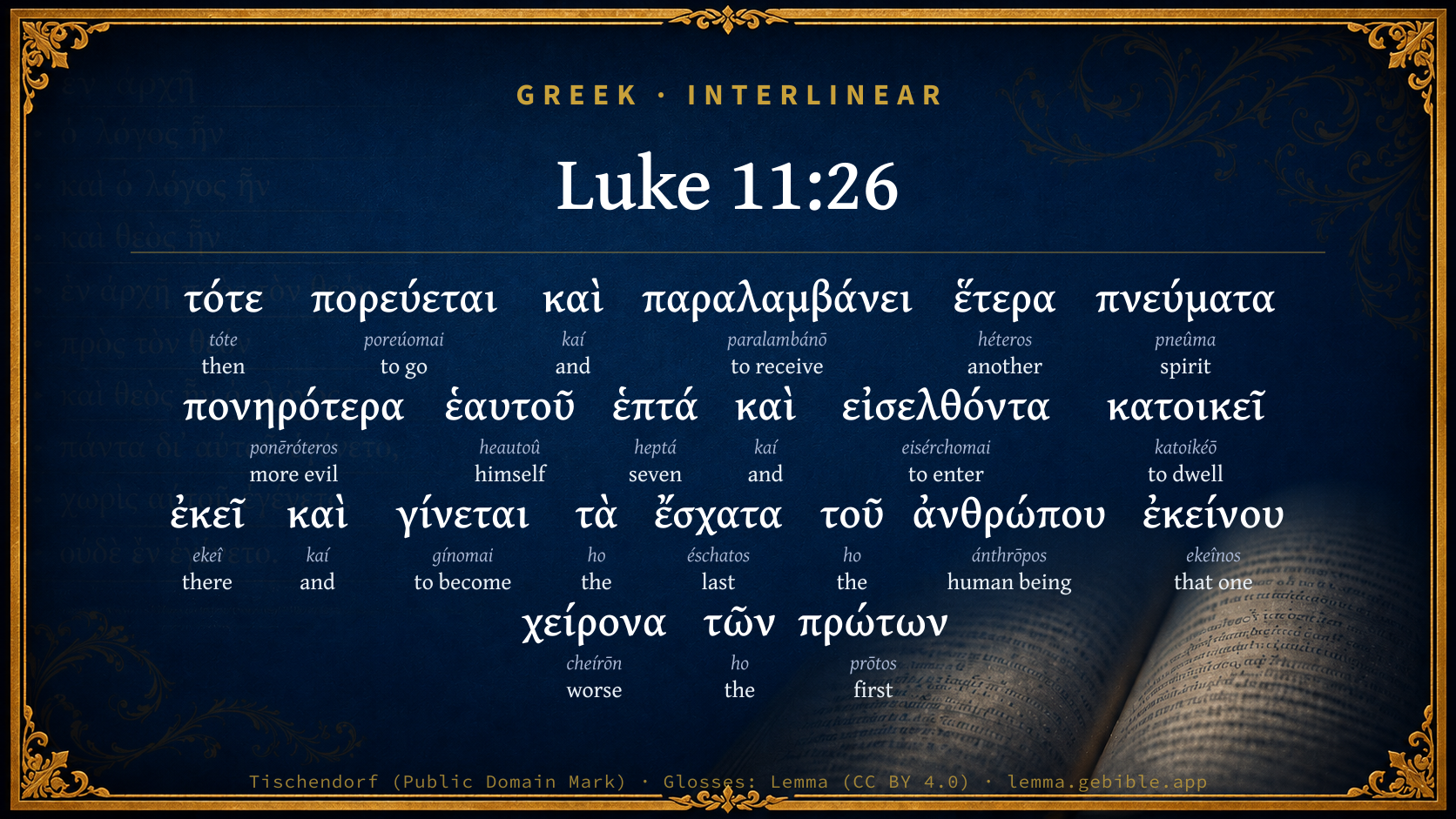
Then he goes, and takes seven other spirits more evil than himself, and they enter in and dwell there. The last state of that man becomes worse than the first."
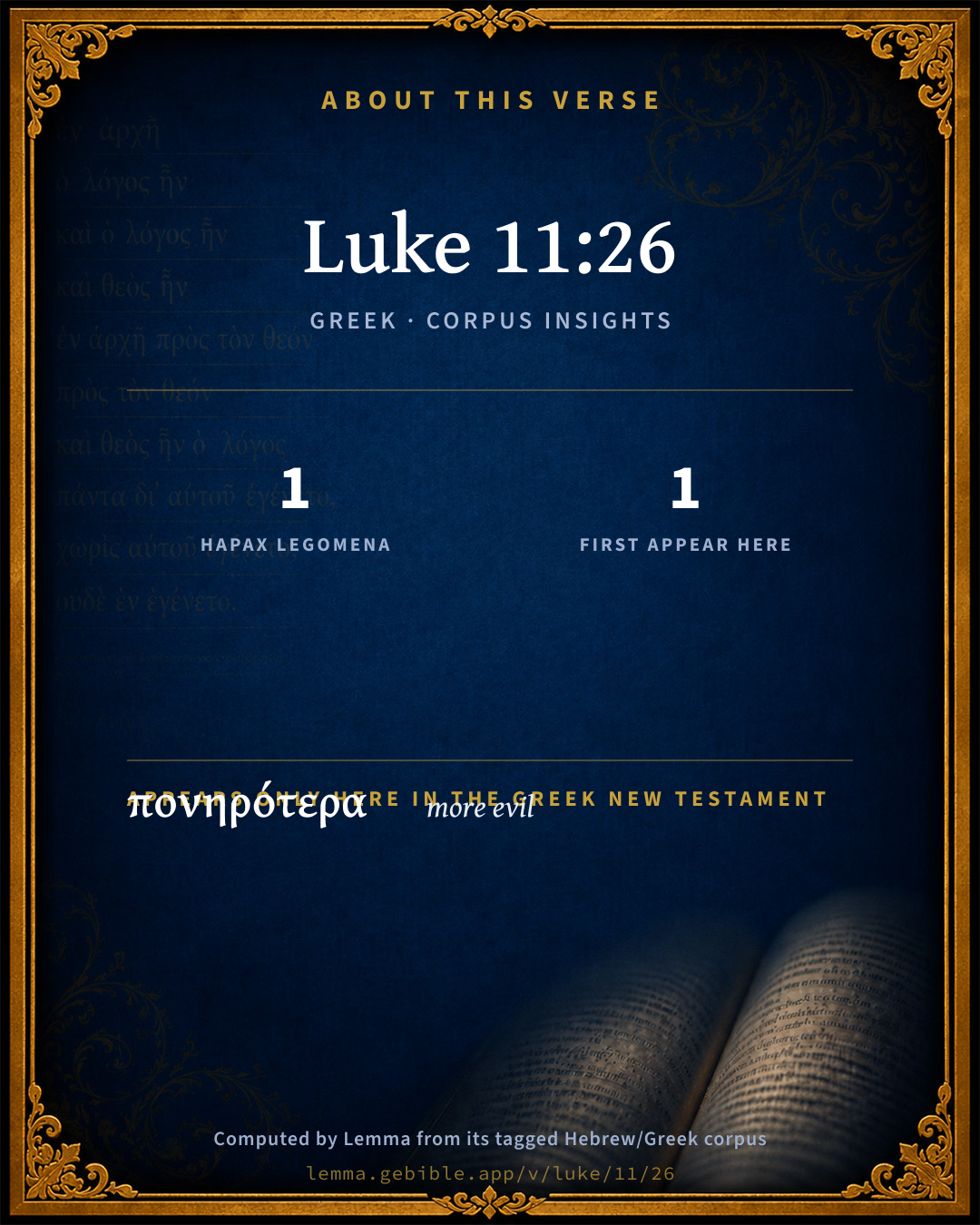
- 1 hapax legomenon — only here in the Greek New Testament
- 1 first appearance in the Greek New Testament
Download a study sheet
One document with this verse’s original text, its word-by-word gloss line, the meaning frame, cross-references with their text, attributed commentary, and full source and license credits — printable, and it pastes into notes with its structure intact.
This verse Autodidact and up
A passage Seminary Student
Up to 50 verses in one chapter. A passage sheet keeps up to 6 commentary sources and 12 cross-references per verse, in the order this page ranks them, and says so on the sheet whenever that leaves anything out. Ask for a single verse and you get the Autodidact verse sheet above.
Everything on this page stays free to read, with no account — the sheet is a download of what is already on screen, not access to it.
Compare translations 3
The same verse in 3 English versions, stacked beneath the original-language interlinear above. Click any original word for its lexicon entry.
Each is an independent rendering of the whole verse — the interlinear is not word-aligned to these translations.
Highlighted words mark where these versions differ — a whole-verse word diff, not a word-by-word alignment.
-
World English Bible Public Domain
Then he goes, and takes seven other spirits more evil than himself, and they enter in and dwell there. The last state of that man becomes worse than the first."
-
King James Version Public Domain
Then goeth he, and taketh to him seven other spirits more wicked than himself; and they enter in, and dwell there: and the last state of that man is worse than the first.
-
unfoldingWord Literal Text CC BY-SA 4.0
Then it goes and takes along seven other spirits more evil than itself and they having entered, it resides there. And the last things of that man become worse than the first things.”
unfoldingWord Literal Text — © unfoldingWord, licensed CC BY-SA 4.0. Word-aligned USFM3 via Door43 (git.door43.org/unfoldingWord/en_ult).
Show all 19 translations
Every available English version of this verse, each an independent rendering of the whole verse.
-
World English Bible Public Domain
Then he goes, and takes seven other spirits more evil than himself, and they enter in and dwell there. The last state of that man becomes worse than the first."
-
Berean Standard Bible Public Domain
Then it goes and brings seven other spirits more wicked than itself, and they go in and dwell there. And the final plight of that man is worse than the first.”
-
Majority Standard Bible Public Domain
Then it goes and brings seven other spirits more wicked than itself, and they go and dwell there. And the final plight of that man is worse than the first.”
-
King James Version Public Domain
Then goeth he, and taketh to him seven other spirits more wicked than himself; and they enter in, and dwell there: and the last state of that man is worse than the first.
-
American Standard Version (1901) Public Domain
Then goeth he, and taketh `to him' seven other spirits more evil than himself; and they enter in and dwell there: and the last state of that man becometh worse than the first.
-
Revised Version (1885) Public Domain
Then goeth he, and taketh to him seven other spirits more evil than himself; and they enter in and dwell there: and the last state of that man becometh worse than the first.
-
Geneva Bible (1599) Public Domain
Then goeth hee, and taketh to him seuen other spirites worse then himselfe: and they enter in, and dwel there: so the last state of that man is worse then the first.
-
Douay-Rheims (1899) Public Domain
Then he goeth and taketh with him seven other spirits more wicked than himself, and entering in they dwell there. And the last state of that man becomes worse than the first.
-
Young's Literal Translation Public Domain
then doth it go, and take to it seven other spirits more evil than itself, and having entered, they dwell there, and the last of that man becometh worst than the first.'
-
Literal Standard Version CC BY-SA 4.0
then it goes, and takes to it seven other spirits more evil than itself, and having entered, they dwell there, and the last of that man becomes worse than the first.”
-
Unlocked Literal Bible CC BY-SA 4.0
Then it goes and takes along with it seven other spirits more evil than itself and they all come in to live there. Then the final condition of that man becomes worse than the first.”
-
unfoldingWord Literal Text CC BY-SA 4.0
Then it goes and takes along seven other spirits more evil than itself and they having entered, it resides there. And the last things of that man become worse than the first things.”
-
Darby Bible Public Domain
Then he goes and takes seven other spirits worse than himself, and entering in, they dwell there; and the last condition of that man becomes worse than the first.
-
World Messianic Bible Public Domain
Then he goes and takes seven other spirits more evil than himself, and they enter in and dwell there. The last state of that man becomes worse than the first.”
-
Webster's Bible Public Domain
Then he goeth and taketh to him seven other spirits more wicked than himself; and they enter in, and dwell there: and the last state of that man is worse than the first.
-
Free Bible Version CC BY-SA 4.0
So it goes and finds seven other spirits more evil than itself, and they go in and live there. In the end that man is worse off than before.”
-
Bible in Basic English Public Domain
Then he goes and gets seven other spirits more evil than himself, and they go in, and take their places there: and the last condition of that man is worse than the first.
-
Text-Critical English NT CC BY 4.0
Then it goes and takes along seven other spirits more evil than itself, and they go and dwell there, and the last state of that person becomes worse than the first.”
-
Tyndale New Testament (1534) Public Domain
Then goeth he and taketh to him seve other spretes worsse then himsilfe: and they enter in and dwell there. And the ende of that man is worsse then the begynninge.
Literal Standard Version (2020), Covenant Press — licensed CC BY-SA 4.0. Text via the HelloAO Bible API (eBible.org). Unlocked Literal Bible (unfoldingWord) — licensed CC BY-SA 4.0. Text via the HelloAO Bible API (eBible.org). unfoldingWord Literal Text — © unfoldingWord, licensed CC BY-SA 4.0. Word-aligned USFM3 via Door43 (git.door43.org/unfoldingWord/en_ult). Free Bible Version, Dr. Jonathan Gallagher — licensed CC BY-SA 4.0. Text via the HelloAO Bible API (eBible.org).
Word by word
More ways to search: Search by grammar → Find every occurrence → Compare this word →
Practice this passage: Drill this verse → Learn its vocabulary →
- Appears 1× in the Greek New Testament
- First appears here
- Part of Speech
- Adjective
- Case
- Accusative
- Number
- Plural
- Gender
- Neuter
- Degree
- Comparative
Full Thayer's Definition
- τότε tóte G5119 “then” Adverb
- πορεύεται poreúomai G4198 “to go” Verb, Present, Middle or Passive deponent, Indicative, 3rd person, Singular
- καὶ kaí G2532 “and” Conjunction
- παραλαμβάνει paralambánō G3880 “to receive” Verb, Present, Active, Indicative, 3rd person, Singular
- ἕτερα héteros G2087 “another” Adjective, Accusative, Plural, Neuter
- πνεύματα pneûma G4151 “spirit” Noun, Accusative, Plural, Neuter
- πονηρότερα ponēróteros G4191 “more evil” Adjective, Accusative, Plural, Neuter, Comparative
- ἑαυτοῦ heautoû G1438 “himself” Reflexive pronoun, 3rd person, Genitive, Singular, Neuter
- ἑπτά heptá G2033 “seven” Adjective, Numeral (indeclinable)
- καὶ kaí G2532 “and” Conjunction
- εἰσελθόντα eisérchomai G1525 “to enter” Verb, Aorist, Active, Participle, Nominative, Plural, Neuter
- κατοικεῖ katoikéō G2730 “to dwell” Verb, Present, Active, Indicative, 3rd person, Singular
- ἐκεῖ ekeî G1563 “there” Adverb
- καὶ kaí G2532 “and” Conjunction
- γίνεται gínomai G1096 “to become” Verb, Present, Middle or Passive deponent, Indicative, 3rd person, Singular
- τὰ ho G3588 “the” Article, Nominative, Plural, Neuter
- ἔσχατα éschatos G2078 “last” Adjective, Nominative, Plural, Neuter, Superlative
- τοῦ ho G3588 “the” Article, Genitive, Singular, Masculine
- ἀνθρώπου ánthrōpos G444 “human being” Noun, Genitive, Singular, Masculine
- ἐκείνου ekeînos G1565 “that one” Demonstrative pronoun, Genitive, Singular, Masculine
- χείρονα cheírōn G5501 “worse” Adjective, Nominative, Plural, Neuter
- τῶν ho G3588 “the” Article, Genitive, Plural, Neuter
- πρώτων prōtos G4413 “first” Adjective, Genitive, Plural, Neuter, Superlative
About this verse
These counts appear in no published source. They are computed here, from the morphology-tagged text and Lemma’s own curated glosses. What Lemma adds →
- 23
- words
- 19
- distinct lemmas
- Gospels
- section
Notable vocabulary
1 hapax legomenon — a word that appears only here in the entire Greek New Testament:
- πονηρότερα more evil G4191
First appearance in Scripture
This word makes its first canonical appearance in the Greek New Testament here:
- πονηρότερα more evil G4191
Shared distinctive vocabulary
χείρονα worse G5501 occurs in 11 verses of the Greek New Testament. Also found in:
Cross-references
9Topical passages linked to Luke 11:26 in the Treasury of Scripture Knowledge — connected by theme and wording, ordered by reader-vote popularity; previews shown in the World English Bible.
- John 5:14 Afterward Jesus found him in the temple, and said to him, "Behold, you are made well. Sin no more, so that nothing worse happens to you."
- 2 Peter 2:20–22 For if, after they have escaped the defilement of the world through the knowledge of the Lord and Savior Jesus Christ, they are again entangled therein and overcome, the last state has become worse with them than the first.
- Zephaniah 1:6 those who have turned back from following Yahweh, and those who haven't sought Yahweh nor inquired after him.
- Matthew 12:45 Then he goes, and takes with himself seven other spirits more evil than he is, and they enter in and dwell there. The last state of that man becomes worse than the first. Even so will it be also to this evil generation."
- Matthew 23:15 Woe to you, scribes and Pharisees, hypocrites! For you travel around by sea and land to make one proselyte; and when he becomes one, you make him twice as much of a son of Gehenna as yourselves.
- Hebrews 6:4–8 For concerning those who were once enlightened and tasted of the heavenly gift, and were made partakers of the Holy Spirit,
- Hebrews 10:26–31 For if we sin willfully after we have received the knowledge of the truth, there remains no more a sacrifice for sins,
- 1 John 5:16 If anyone sees his brother sinning a sin not leading to death, he shall ask, and God will give him life for those who sin not leading to death. There is a sin leading to death. I don't say that he should make a request concerning this.
- Jude 1:12–13 These are hidden rocky reefs in your love feasts when they feast with you, shepherds who without fear feed themselves; clouds without water, carried along by winds; autumn leaves without fruit, twice dead, plucked up by the roots;
Cross-references courtesy of OpenBible.info (CC BY 4.0).
Lesson kit
Teaching starters — assembled from the data on this page, not authored interpretation. Every prompt links to the verse data it draws on. Edit before teaching.
Luke, in the Gospels, opens this verse with 23 words (19 distinct Greek lemmas). Its most distinctive word is ponēróteros (“more evil”). A historical commentator’s framing appears above. Read the whole chapter for the surrounding context.
Discussion questions
- The word ponēróteros carries the sense “more evil.” How does it shape the verse?
- 1 word here appears nowhere else in the Greek New Testament. Why might the author reach for such rare wording?
- This is the first place “more evil” appears in Scripture (first appears here). What does its debut here establish?
- How does Matthew 9:16, which shares the word «worse», read alongside this verse?
- What does the repetition of “and” (3× in this one verse) do in this verse?
- The translations on this page render this verse differently — a whole-verse word diff, not a word-by-word alignment. What might account for the different wordings?
- Compare how Tyndale Open Study Notes and The Cambridge Bible for Schools and Colleges read this verse. Where do they agree or differ?
Things to notice
- 1 word in this verse appears nowhere else in the Greek New Testament.
- 1 word makes its first canonical appearance in Scripture here.
- These translations choose different wording for 19 words in this verse.
- “and” occurs 3× in this single verse.
- 19 distinct Greek lemmas span 23 words in this verse.
Commentary
Notes on Luke 11:26 from classic Christian and Jewish commentators (each source and its license shown beneath its notes). The classic Christian expositions comment on the surrounding passage and are grouped to its opening verse, so a note may address several verses; the Jewish commentaries on the Tanakh (Rashi and others) are per-verse, so they appear only where the commentator wrote on this verse.
Lemma curates 59 commentaries, every one of them public domain or Creative Commons licensed, each selected and text-cleaned for this edition rather than reprinted as found. About our sources →
Tyndale Open Study Notes
Tyndale Open Resources
Tyndale Open Study Notes — © Tyndale Open Resources, licensed CC BY-SA 4.0. Text via the HelloAO Bible API.
The Cambridge Bible for Schools and Colleges
gen. ed. J. J. S. Perowne
The Cambridge Bible for Schools and Colleges (gen. ed. J. J. S. Perowne; Cambridge University Press, 1878–1918) — public domain. Text from a community e-Sword module.
John Gill's Exposition
John Gill's Exposition of the Whole Bible (1746–1763) — public domain (CC PDM 1.0). Text via the HelloAO Bible API.
Trapp's Complete Commentary
John Trapp
John Trapp, A Commentary or Exposition upon All the Books of the Old and New Testament (1647–1656) — public domain. Text from a community e-Sword module.
Haydock's Catholic Bible Commentary
George Leo Haydock (1774–1849), Haydock's Catholic Family Bible and Commentary, 1859 edition — public domain. Excludes Psalms (Douay-Rheims chapter numbering differs from Protestant) and Deuterocanonical books (Catholic canon only).
The Pulpit Commentary
The Pulpit Commentary (1880–1919), ed. H.D.M. Spence-Jones & Joseph S. Exell — public domain. Text from a community e-Sword module.
John Wesley's Explanatory Notes
John Wesley, Explanatory Notes Upon the Whole Bible (1754–1765) — public domain. Text via the GEBible commentary corpus.
Cambridge Greek Testament for Schools and Colleges
Cambridge Greek Testament for Schools and Colleges (Cambridge University Press, 1896; 21 vols, various authors incl. Carr, Maclear, Plummer, Farrar, Lumby, Moule, M. R. James, Simcox) — public domain. Text from a community e-Sword module.
International Critical Commentary
International Critical Commentary — older volumes (1896–1929), various authors — public domain. Text from a community e-Sword module.
Vincent's Word Studies in the New Testament
Marvin R. Vincent
Marvin R. Vincent, Word Studies in the New Testament (1887–1900) — public domain. Text from a community e-Sword/MySword module.