1 Chronicles 7:24

Hebrew (Westminster Leningrad Codex) 1 Chronicles 7:24 appears in the Hebrew Old Testament. The text above is from the Westminster Leningrad Codex. Each word links to its Strong’s number, a concise gloss, and parsing drawn from the Open Scriptures Hebrew Bible morphology. Click any word for its full Brown-Driver-Briggs (BDB) entry.
Download image
Cite this verse

1 Chronicles 7:24 (World English Bible). Public Domain. Lemma interlinear Bible study tool, https://lemma.gebible.app/v/1-chronicles/7/24.

Show BibTeX & RIS
BibTeX
RIS
English Translation
His daughter was Sheerah, who built Beth Horon the lower and the upper, and Uzzen Sheerah.
World English Bible · Public Domain
Highlights Full analysis ↓
Download a study sheet

One document with this verse’s original text, its word-by-word gloss line, the meaning frame, cross-references with their text, attributed commentary, and full source and license credits — printable, and it pastes into notes with its structure intact.

This verse Autodidact and up

Study sheet (.html) Plain text (.txt)

A passage Seminary Student

Up to 50 verses in one chapter. A passage sheet keeps up to 6 commentary sources and 12 cross-references per verse, in the order this page ranks them, and says so on the sheet whenever that leaves anything out. Ask for a single verse and you get the Autodidact verse sheet above.

Everything on this page stays free to read, with no account — the sheet is a download of what is already on screen, not access to it.

Want to remove ads? Support Godless Engineer
Compare translations 3

The same verse in 3 English versions, stacked beneath the original-language interlinear above. Click any original word for its lexicon entry.

Each is an independent rendering of the whole verse — the interlinear is not word-aligned to these translations.

Highlighted words mark where these versions differ — a whole-verse word diff, not a word-by-word alignment.

  • World English Bible Public Domain
    His daughter was Sheerah, who built Beth Horon the lower and the upper, and Uzzen Sheerah.
  • King James Version Public Domain
    (And his daughter was Sherah, who built Bethhoron the nether, and the upper, and Uzzensherah.)
  • unfoldingWord Literal Text CC BY-SA 4.0
    And his daughter Sheerah. And she built Beth Horon, Lower and Upper, and Uzzen Sheerah.

unfoldingWord Literal Text — © unfoldingWord, licensed CC BY-SA 4.0. Word-aligned USFM3 via Door43 (git.door43.org/unfoldingWord/en_ult).

Versions to compare (up to 4)

3 of 4 selected

Show all 18 translations

Every available English version of this verse, each an independent rendering of the whole verse.

  • World English Bible Public Domain
    His daughter was Sheerah, who built Beth Horon the lower and the upper, and Uzzen Sheerah.
  • Berean Standard Bible Public Domain
    His daughter was Sheerah, who built Lower and Upper Beth-horon, as well as Uzzen-sheerah.
  • Majority Standard Bible Public Domain
    His daughter was Sheerah, who built Lower and Upper Beth-horon, as well as Uzzen-sheerah.
  • King James Version Public Domain
    (And his daughter was Sherah, who built Bethhoron the nether, and the upper, and Uzzensherah.)
  • American Standard Version (1901) Public Domain
    And his daughter was Sheerah, who built Beth-horon the nether and the upper, and Uzzen-sheerah.
  • Revised Version (1885) Public Domain
    And his daughter was Sheerah, who built Beth-horon the nether and the upper, and Uzzen-sheerah.
  • Geneva Bible (1599) Public Domain
    And his daughter was Sherah, which built Beth-horon the nether, and the vpper, and Vzzen Sheerah.
  • Douay-Rheims (1899) Public Domain
    And his daughter was Sara, who built Bethoron, the nether and the upper, and Ozensara.
  • Young's Literal Translation Public Domain
    and his daughter `is' Sherah, and she buildeth Beth-Horon, the lower and the upper, and Uzzen-Sherah --
  • Literal Standard Version CC BY-SA 4.0
    and his daughter [is] Sherah, and she builds Beth-Horon, the lower and the upper, and Uzzen-Sherah—
  • Unlocked Literal Bible CC BY-SA 4.0
    His daughter was Sheerah, who built Lower and Upper Beth Horon and Uzzen Sheerah.
  • unfoldingWord Literal Text CC BY-SA 4.0
    And his daughter Sheerah. And she built Beth Horon, Lower and Upper, and Uzzen Sheerah.
  • Darby Bible Public Domain
    And his daughter was Sheerah; and she built Beth-horon the nether, and the upper, and Uzzen-sheerah.
  • World Messianic Bible Public Domain
    His daughter was Sheerah, who built Beth Horon the lower and the upper, and Uzzen Sheerah.
  • Webster's Bible Public Domain
    (And his daughter was Sherah, who built Beth-horon the nether, and the upper, and Uzzen-sherah.)
  • Free Bible Version CC BY-SA 4.0
    Sheerah, his daughter, founded Lower and Upper Beth Horon together with Uzzen Sheerah.
  • Bible in Basic English Public Domain
    And his daughter was Sheerah, the builder of Beth-horon the lower and the higher, and Uzzen-sheerah.
  • JPS Tanakh (1917) Public Domain
    And his daughter was Sheerah, who built Beth-horon the nether and the upper, and Uzzen-sheerah.

Literal Standard Version (2020), Covenant Press — licensed CC BY-SA 4.0. Text via the HelloAO Bible API (eBible.org). Unlocked Literal Bible (unfoldingWord) — licensed CC BY-SA 4.0. Text via the HelloAO Bible API (eBible.org). unfoldingWord Literal Text — © unfoldingWord, licensed CC BY-SA 4.0. Word-aligned USFM3 via Door43 (git.door43.org/unfoldingWord/en_ult). Free Bible Version, Dr. Jonathan Gallagher — licensed CC BY-SA 4.0. Text via the HelloAO Bible API (eBible.org).

Word by word

More ways to search: Search by grammar → Find every occurrence → Compare this word →

Practice this passage: Drill this verse → Learn its vocabulary →

שֶׁאֱרָ֔ה
Sheʼĕrâh
H7609
“Sherah”
Noun, Proper
Part of Speech
Noun
Type
Proper
Full BDB Definition

Origin: the same as H7608

TWOT: None

Sherah = "kinswoman" - daughter of Ephraim and foundress of the Beth-horons and of a town called after her Uzzen-sherah
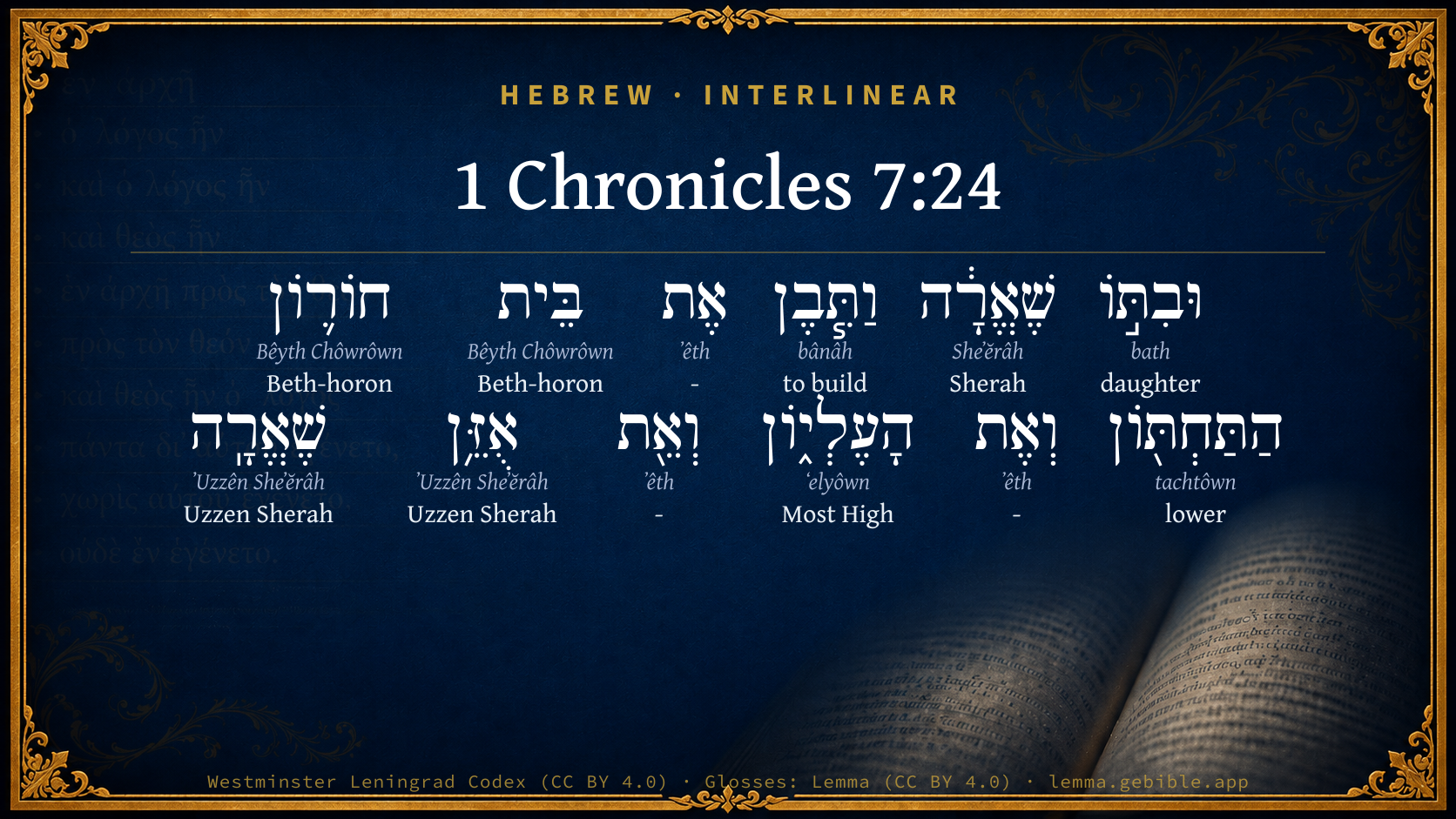
  1. וּבִתּ֣וֹ bath H1323 “and · daughter · his” Conjunction + Noun, Common, Feminine, Singular, Construct + Suffix, Personal, 3rd Person, Masculine, Singular
  2. וַתִּ֧בֶן bânâh H1129 “and · to build” Conjunction + Verb, Qal, Sequential Imperfect, 3rd Person, Feminine, Singular
  3. אֶת ʼêth H853 “-” Particle, Direct Object
  4. בֵּית Bêyth Chôwrôwn H1032 “Beth-horon” Noun, Proper
  5. חוֹר֛וֹן Bêyth Chôwrôwn H1032 “Beth-horon” Noun, Proper
  6. הַתַּחְתּ֖וֹן tachtôwn H8481 “the · lower” Particle, Definite Article + Adjective, Adjective, Masculine, Singular, Absolute
  7. וְאֶת ʼêth H853 “and · -” Conjunction + Particle, Direct Object
  8. הָעֶלְי֑וֹן ʻelyôwn H5945 “the · Most High” Particle, Definite Article + Adjective, Adjective, Masculine, Singular, Absolute
  9. וְאֵ֖ת ʼêth H853 “and · -” Conjunction + Particle, Direct Object
  10. אֻזֵּ֥ן ʼUzzên Sheʼĕrâh H242 “Uzzen Sherah” Noun, Proper
  11. שֶׁאֱרָֽה ʼUzzên Sheʼĕrâh H242 “Uzzen Sherah” Noun, Proper

About this verse

These counts appear in no published source. They are computed here, from the morphology-tagged text and Lemma’s own curated glosses. What Lemma adds →

12
words
8
distinct lemmas
Historical
section

Notable vocabulary

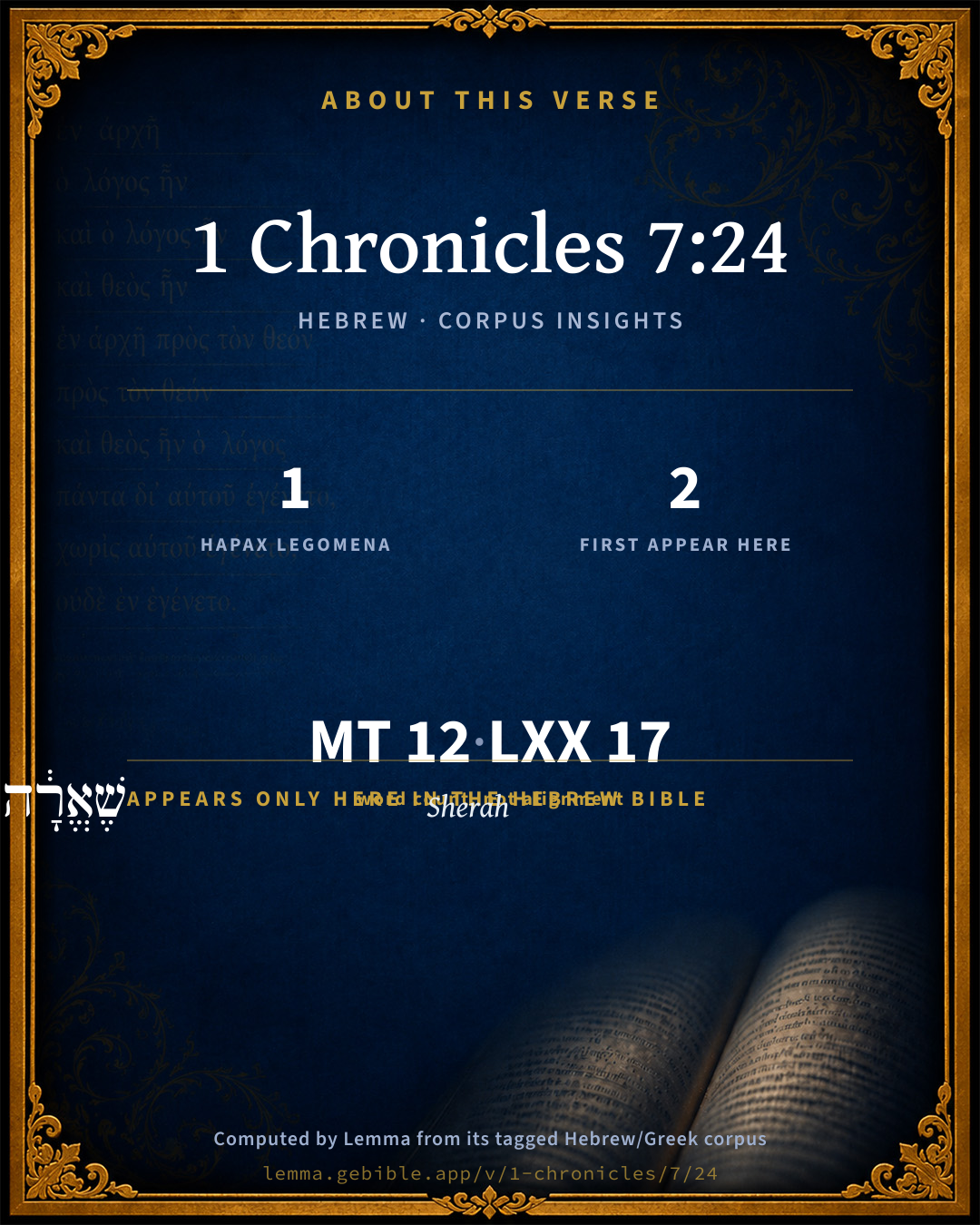
1 hapax legomenon — a word that appears only here in the entire Hebrew Bible:

  • שֶׁאֱרָ֔ה Sherah H7609

First appearance in Scripture

These words make their first canonical appearance in the Hebrew Bible here:

  • שֶׁאֱרָ֔ה Sherah H7609
  • אֻזֵּ֥ן Uzzen Sherah H242

Grammatical profile

  • 1 verb
  • 6 nouns
  • 2 adjectives
  • 3 particles

Verb forms

  • וַתִּ֧בֶן Qal · Sequential Imperfect

Repetition

Words recur within this verse — often emphatic in Hebrew:

  • בֵּית Beth-horon H1032 ×2
  • אֻזֵּ֥ן Uzzen Sherah H242 ×2

Hebrew & Septuagint length

In English translation the verse runs 16 words from the Hebrew and 29 from the Septuagint (LXX English) — the Septuagint runs noticeably longer here. See the side-by-side →

A rough comparison of the two English renderings, which tokenize alike — not a word-level alignment.

Word counts can differ between the Hebrew and the Greek without any difference in meaning — e.g. the Hebrew direct-object marker אֵת has no separate Greek word, and Greek often adds the article ὁ.

In the original languages it is 12 Hebrew tokens and 17 Greek tokens — but the two are counted differently (Hebrew bundles its prefixes and suffixes into one token; the Greek is in lemma form), so that isn’t a like-for-like length.

Cross-references

5

Topical passages linked to 1 Chronicles 7:24 in the Treasury of Scripture Knowledge — connected by theme and wording, ordered by reader-vote popularity; previews shown in the World English Bible.

  • Joshua 16:3 and it went down westward to the border of the Japhletites, to the border of Beth Horon the lower, even to Gezer; and the goings out of it were at the sea.
  • Joshua 16:5 The border of the children of Ephraim according to their families was [thus]: the border of their inheritance eastward was Ataroth Addar, to Beth Horon the upper;
  • 2 Chronicles 8:5 Also he built Beth Horon the upper, and Beth Horon the lower, fortified cities, with walls, gates, and bars;
  • Joshua 10:10 Yahweh confused them before Israel, and he killed them with a great slaughter at Gibeon, and chased them by the way of the ascent of Beth Horon, and struck them to Azekah, and to Makkedah.
  • 1 Kings 9:17 Solomon built Gezer, and Beth Horon the lower,

Cross-references courtesy of OpenBible.info (CC BY 4.0).

Hebrew and Greek witnesses Masoretic Hebrew ↔ Greek Septuagint

The same verse in the two great witnesses to the Old Testament, shown verse-for-verse.

Here the Septuagint runs noticeably longer than the Hebrew — LXX2012 (modern English Septuagint) 29 words vs World English Bible 16. A rough length comparison of the two English translations, not a word-level alignment — read both below.

These are two independent witnesses, not word-aligned to each other, and the Septuagint is shown in lemma (dictionary) form.

Hebrew 1 Chronicles 7:24 Masoretic · Westminster Leningrad Codex

וּבִתּ֣וֹ שֶׁאֱרָ֔ה וַתִּ֧בֶן אֶת בֵּית חוֹר֛וֹן הַתַּחְתּ֖וֹן וְאֶת הָעֶלְי֑וֹן וְאֵ֖ת אֻזֵּ֥ן שֶׁאֱרָֽה

His daughter was Sheerah, who built Beth Horon the lower and the upper, and Uzzen Sheerah.

World English Bible · Public Domain

Greek LXX 1 Chronicles 7:24 Septuagint · lemma form

καί ἐν ἐκεῖνος ὁ κατάλοιπος καί οἰκοδομέω βαιθωρων ὁ κάτω καί ὁ ἄνω καί υἱός οζαν σεηρα

And his daughter was Saraa, and he was among them that were left, and he built Baethoron the upper and the lower. And the descendants of Ozan were Seera,

LXX2012 (modern English Septuagint) · Public Domain

Hebrew: Westminster Leningrad Codex (CC BY 4.0). Greek: Septuagint (public domain); English from LXX2012 (modern English Septuagint) (Public Domain). How the Septuagint differs from the Hebrew →

Commentary

Notes on 1 Chronicles 7:24 from classic Christian and Jewish commentators (each source and its license shown beneath its notes). The classic Christian expositions comment on the surrounding passage and are grouped to its opening verse, so a note may address several verses; the Jewish commentaries on the Tanakh (Rashi and others) are per-verse, so they appear only where the commentator wrote on this verse.

Lemma curates 59 commentaries, every one of them public domain or Creative Commons licensed, each selected and text-cleaned for this edition rather than reprinted as found. About our sources →

Trapp's Complete Commentary

John Trapp

1Ch 7:24 (And his daughter [was] Sherah, who built Bethhoron the nether, and the upper, and Uzzensherah.)

Ver. 24. And his daughter was Sherah.] A gallant woman, famous in her generation for beautifying and fortifying of sundry cities. Thus also God made up Ephraim’s loss.

John Trapp, A Commentary or Exposition upon All the Books of the Old and New Testament (1647–1656) — public domain. Text from a community e-Sword module.

Joseph Benson's Commentary

1Ch 7:24. His daughter — His descendant, his grand-child, or great-grand- child; built Beth-horon, &c. — Rebuilt or repaired them, which possibly she did in Joshua’s time. And this work may be ascribed to her, because it was done either by her design and contrivance, or by her instigation and influence upon her husband and brethren who did it.

Joseph Benson's Commentary on the Old and New Testaments (1811–1818) — public domain. Text from a community e-Sword module.

Geneva Bible (1599)

Geneva Bible translators

Or, neice.

Geneva Bible (1599) marginal notes — public domain. Text via Bolls.life.

Adam Clarke's Commentary

Verse 24. His daughter was Sherah] That is, remnant; "called so," says the Targum, "because she was the remnant that escaped from the slaughter mentioned above."

Adam Clarke's Commentary on the Bible (1810–1826) — public domain. Text from a community e-Sword/MySword module.

Ellicott's Commentary for English Readers

(24) His daughter—i.e., Ephraim’s.

Built may mean rebuilt, or restored, or fortified (Jos_6:26; Psa_102:16; 2Ch_11:6).

Beth-horon the nether, and the upper.—The two Beth-horons (Jos_10:10) were apparently a Canaanite foundation. They are now Beit ur et-Tahta and Beit-ur el-Fariqa—i.e., Lower and Upper Beitur.

Uzzen-sherah.—Sherah’s ear, or peak, only mentioned here. The relation of Sherah to Beth-horon may be compared with that of Achsah to the Negeb of Judah (Jos_15:19. Cf. also Jos_17:4).

A Bible Commentary for English Readers, edited by Charles John Ellicott (1878–1897) — public domain. Text from a community e-Sword module.

The Cambridge Bible for Schools and Colleges

gen. ed. J. J. S. Perowne

24. Beth-horon] See 1Ch_6:68, note.

The Cambridge Bible for Schools and Colleges (gen. ed. J. J. S. Perowne; Cambridge University Press, 1878–1918) — public domain. Text from a community e-Sword module.

John Gill's Exposition

And the sons of Japhlet; Pasach, and Bimhal, and Ashvath; these are the children of Japhlet. Of whom we read not elsewhere,

And the sons of Japhlet; Pasach, and Bimhal, and Ashvath; these are the children of Japhlet. Of whom we read not elsewhere,

1 Chronicles 7:34

ch1 7:34

ch1 7:34

ch1 7:34And the sons of Shamer,.... Or Shomer, the brother of Japhlet, Ch1 7:32.

Ahi, and Rohgah, Jehubbah, and Aram; of whom nothing is known but their names.

John Gill's Exposition of the Whole Bible (1746–1763) — public domain (CC PDM 1.0). Text via the HelloAO Bible API.

Albert Barnes' Notes on the Bible

Sherah could scarcely herself have built the Palestinian cities here mentioned, which must belong to a time not earlier than Joshua. By “she built” we must understand “her descendants built.”

Albert Barnes' Notes on the Bible (1834–1885) — public domain. Text from a community e-Sword/MySword module.

Haydock's Catholic Bible Commentary

Daughter, or great grand-daughter, repaired these three cities. (Calmet) --- The last, probably, was called after her. (Haydock) --- But its situation is unknown. (Calmet)

George Leo Haydock (1774–1849), Haydock's Catholic Family Bible and Commentary, 1859 edition — public domain. Excludes Psalms (Douay-Rheims chapter numbering differs from Protestant) and Deuterocanonical books (Catholic canon only).

Matthew Poole's English Annotations

His daughter, i.e. his grandchild, or great-grandchild, for such are oft called sons or daughters in Scripture.

Who built Beth-horon, i.e. rebuilt or repaired, which possibly she did in Joshua’s time. And this work may be ascribed to her, because these works were done either by her design or contrivance, or by her instigation and influence upon her husband and brethren who did it.

Matthew Poole's English Annotations on the Holy Bible (1683–1685) — public domain. Text from a community e-Sword/MySword module.

The Pulpit Commentary

His daughter. If the literal interpretation of this whole section be accepted, according to which both Ephraim and Beriah must have passed their lifetime in Egypt, the "daughter," strictly so called, of either the one or the other could not have been the founder of the places here mentioned. The word "daughter" must, therefore, represent simply a female descendant. (For other references to Beth-heron, see Jos_10:10, 11 16:3, 5 18:13, 14 21:20-22) A famous woman.

We know nothing else of Sherah than is recorded in this verse. Whether she did herself build or enlarge and fortify these towns, or whether this was the work of her descendants, is not easy to decide. The fact, in any case, is of interest for us, that her name should be put upon record in this passage, and should be associated with great works.

I A WOMAN MAY BE SELECTED BY PROVIDENCE TO FULFIL SOME VAST DESIGN. History records great feats of feminine valour; for women have defended castles and cities by their heroism, and delivered nations, by personal bravery and by the enthusiastic support they have commanded. Some nations, as e.g. our own, number among their sovereigns queens of singular sagacity and statesmanship. In art and in literature, and even in science, women have, in our own times, won for themselves a high position and a wide renown.

II THE WORK OF NOBLE WOMEN IS ESPECIALLY TO BUILD. If not cities, societies and families have again and again been built up in strength and stateliness and serviceableness through feminine wisdom, sympathy, and devotedness. A gifted and fascinating woman has often been the architect of fortune, and, as the centre and inspiration of intellectual and social life, has not only laid the foundations, but reared the edifice of political and social power.

III A GIFTED WOMAN"S WORTHIEST WORK IS WORK FOR GOD. How many such shine from the pages of inspiration! Sarah, Miriam, Ruth, Hannah, Esther, in the Old Testament; the Maries, Priscilla, Dorcas, Lydia, in the New Testament, may serve as examples. No work is so congenial to the female character, so truly graceful and ornamental to the feminine life, as work for Christ.

IV A WOMAN WHO SERVES THE LORD AND LEAVES AN EXAMPLE OF PIETY AND USEFULNESS IS WORTHY OF BEING HELD IN LASTING REMEMBRANCE, If the inspired writer thought well to record the name of the builder of Beth-heron, surely the memory of the noblewomen of our Lord"s spiritual kingdom should never fade. T.

The Pulpit Commentary (1880–1919), ed. H.D.M. Spence-Jones & Joseph S. Exell — public domain. Text from a community e-Sword module.

Keil & Delitzsch

C. F. Keil & F. Delitzsch

And the sons of Japhlet; Pasach, and Bimhal, and Ashvath; these are the children of Japhlet. Of whom we read not elsewhere,

And the sons of Japhlet; Pasach, and Bimhal, and Ashvath; these are the children of Japhlet. Of whom we read not elsewhere,

1 Chronicles 7:34

ch1 7:34

ch1 7:34

ch1 7:34And the sons of Shamer,.... Or Shomer, the brother of Japhlet, Ch1 7:32.

Ahi, and Rohgah, Jehubbah, and Aram; of whom nothing is known but their names.

Keil & Delitzsch — Biblical Commentary on the Old Testament (1861–1891) — public domain (CC PDM 1.0). Text via the HelloAO Bible API. (Old Testament only.)

Rashi

Rabbi Shlomo Yitzchaki (Rashi)

And his daughter was Sheerah, and she built... Beth Horon Sheerah built it.

and Uzzen Sheerah She named the city after herself.

Rashi on the Tanakh — English translations: “The Judaica Press complete Tanach with Rashi, translated by A. J. Rosenberg” (CC BY 4.0); “Pentateuch with Rashi's commentary by M. Rosenbaum and A.M. Silbermann, 1929-1934” (public domain); “The Metsudah Tanach series, Lakewood, N.J” (CC BY 4.0); and “The Book of Joshua, Metsudah Publications, 1997” (CC BY 4.0). Text via Sefaria.

Lesson kit

Teaching starters — assembled from the data on this page, not authored interpretation. Every prompt links to the verse data it draws on. Edit before teaching.

1 Chronicles, in the Historical, opens this verse with 12 words (8 distinct Hebrew lemmas). Its most distinctive word is Sheʼĕrâh (“Sherah”). The Greek Septuagint runs longer here. A historical commentator’s framing appears above. Read the whole chapter for the surrounding context.

Discussion questions

  1. The word Sheʼĕrâh carries the sense “Sherah.” How does it shape the verse?
  2. This verse holds 1 word here found nowhere else in the Hebrew Bible. What might the rare word draw attention to?
  3. 2 words here appear for the first time in Scripture. What is being introduced at this debut?
  4. Joshua 16:3 shares this passage’s theme. How do the two illuminate each other?
  5. “Beth-horon” occurs 2× in this one verse. What is the effect of the repetition?
  6. Compared with the Hebrew, the Septuagint runs longer here. What questions does that raise?
  7. These translations render this verse differently; the difference is in the English rendering, not the original. What questions does that raise?
  8. The verb «וַתִּ֧בֶן» is Qal Sequential Imperfect. How does its form color the action?

Things to notice

  • 1 word in this verse appears nowhere else in the Hebrew Bible.
  • 2 words make their first canonical appearance in Scripture here.
  • This verse counts 12 Hebrew ↔ 17 Greek words.
  • These translations choose different wording for 10 words in this verse.
  • “Beth-horon” occurs 2× in this single verse.

Reading settings

Reading text

Shown beneath each verse's original-language words.

Old Testament
Old Testament edition

Read the OT as the Masoretic Hebrew (MT) or the Greek Septuagint (LXX).

English shown for the Greek Septuagint (in the Hebrew ↔ Greek comparison).

Comparing translations? Open the Compare panel on any verse page to stack up to four side by side.