Revelation 11:13

Greek (Tischendorf 8th ed.) Revelation 11:13 appears in the Greek New Testament. The text above is from the Tischendorf 8th edition. Each word links to its Strong’s number and a concise gloss. Click any word for its full Thayer’s Greek Lexicon entry.
Download image
Cite this verse

Revelation 11:13 (World English Bible). Public Domain. Lemma interlinear Bible study tool, https://lemma.gebible.app/v/revelation/11/13.

Show BibTeX & RIS
BibTeX
RIS
English Translation
In that day there was a great earthquake, and a tenth of the city fell. Seven thousand people were killed in the earthquake, and the rest were terrified, and gave glory to the God of heaven.
World English Bible · Public Domain
Download a study sheet

One document with this verse’s original text, its word-by-word gloss line, the meaning frame, cross-references with their text, attributed commentary, and full source and license credits — printable, and it pastes into notes with its structure intact.

This verse Autodidact and up

Study sheet (.html) Plain text (.txt)

A passage Seminary Student

Up to 50 verses in one chapter. A passage sheet keeps up to 6 commentary sources and 12 cross-references per verse, in the order this page ranks them, and says so on the sheet whenever that leaves anything out. Ask for a single verse and you get the Autodidact verse sheet above.

Everything on this page stays free to read, with no account — the sheet is a download of what is already on screen, not access to it.

Want to remove ads? Support Godless Engineer
Compare translations 3

The same verse in 3 English versions, stacked beneath the original-language interlinear above. Click any original word for its lexicon entry.

Each is an independent rendering of the whole verse — the interlinear is not word-aligned to these translations.

Highlighted words mark where these versions differ — a whole-verse word diff, not a word-by-word alignment.

  • World English Bible Public Domain
    In that day there was a great earthquake, and a tenth of the city fell. Seven thousand people were killed in the earthquake, and the rest were terrified, and gave glory to the God of heaven.
  • King James Version Public Domain
    And the same hour was there a great earthquake, and the tenth part of the city fell, and in the earthquake were slain of men seven thousand: and the remnant were affrighted, and gave glory to the God of heaven.
  • unfoldingWord Literal Text CC BY-SA 4.0
    And at that hour a great earthquake happened, and a tenth of the city fell. And in the earthquake, the names of 7,000 men were killed, and the rest became terrified and gave glory to the God of heaven.

unfoldingWord Literal Text — © unfoldingWord, licensed CC BY-SA 4.0. Word-aligned USFM3 via Door43 (git.door43.org/unfoldingWord/en_ult).

Versions to compare (up to 4)

3 of 4 selected

Show all 19 translations

Every available English version of this verse, each an independent rendering of the whole verse.

  • World English Bible Public Domain
    In that day there was a great earthquake, and a tenth of the city fell. Seven thousand people were killed in the earthquake, and the rest were terrified, and gave glory to the God of heaven.
  • Berean Standard Bible Public Domain
    And in that hour there was a great earthquake, and a tenth of the city collapsed. Seven thousand were killed in the quake, and the rest were terrified and gave glory to the God of heaven.
  • Majority Standard Bible Public Domain
    And in that day there was a great earthquake, and a tenth of the city collapsed. Seven thousand were killed in the quake, and the rest were terrified and gave glory to the God of heaven.
  • King James Version Public Domain
    And the same hour was there a great earthquake, and the tenth part of the city fell, and in the earthquake were slain of men seven thousand: and the remnant were affrighted, and gave glory to the God of heaven.
  • American Standard Version (1901) Public Domain
    And in that hour there was a great earthquake, and the tenth part of the city fell; and there were killed in the earthquake seven thousand persons: and the rest were affrighted, and gave glory to the God of heaven.
  • Revised Version (1885) Public Domain
    And in that hour there was a great earthquake, and the tenth part of the city fell; and there were killed in the earthquake seven thousand persons: and the rest were affrighted, and gave glory to the God of heaven.
  • Geneva Bible (1599) Public Domain
    And the same houre shall there bee a great earthquake, and the tenth part of the citie shall fall, and in the earthquake shalbe slaine in nomber seuen thousande: and the remnant were sore feared, and gaue glorie to the God of heauen.
  • Douay-Rheims (1899) Public Domain
    And at that hour there was made a great earthquake, and the tenth part of the city fell: and there were slain in the earthquake names of men seven thousand: and the rest were cast into a fear, and gave glory to the God of heaven.
  • Young's Literal Translation Public Domain
    and in that hour came a great earthquake, and the tenth of the city did fall, and killed in the earthquake were names of men -- seven thousands, and the rest became affrighted, and they gave glory to the God of the heaven.
  • Literal Standard Version CC BY-SA 4.0
    and in that hour a great earthquake came, and the tenth of the city fell, and seven thousand names of men were killed in the earthquake, and the rest became frightened, and they gave glory to the God of Heaven.
  • Unlocked Literal Bible CC BY-SA 4.0
    At that hour there will be a major earthquake, and a tenth part of the city will collapse. Seven thousand people will be killed in the earthquake, and the survivors will be terrified and give glory to the God of heaven.
  • unfoldingWord Literal Text CC BY-SA 4.0
    And at that hour a great earthquake happened, and a tenth of the city fell. And in the earthquake, the names of 7,000 men were killed, and the rest became terrified and gave glory to the God of heaven.
  • Darby Bible Public Domain
    And in that hour there was a great earthquake, and the tenth of the city fell, and seven thousand names of men were slain in the earthquake. And the remnant were filled with fear, and gave glory to the God of the heaven.
  • World Messianic Bible Public Domain
    In that day there was a great earthquake, and a tenth of the city fell. Seven thousand people were killed in the earthquake, and the rest were terrified and gave glory to the God of heaven.
  • Webster's Bible Public Domain
    And the same hour was there a great earthquake, and the tenth part of the city fell, and in the earthquake were killed of men seven thousand: and the remnant were affrighted, and gave glory to the God of heaven.
  • Free Bible Version CC BY-SA 4.0
    At the same time there was a huge earthquake, and one tenth of the city collapsed. Seven thousand people were killed in the earthquake, and the rest were terrified, and gave glory to the God of heaven.
  • Bible in Basic English Public Domain
    And in that hour there was a great earth-shock and a tenth part of the town came to destruction; and in the earth-shock seven thousand persons came to their end: and the rest were in fear, and gave glory to the God of heaven.
  • Text-Critical English NT CC BY 4.0
    On that day there was a great earthquake, and a tenth of the city fell. Seven thousand people were killed in the earthquake, and the rest were terrified and gave glory to the God of heaven.
  • Tyndale New Testament (1534) Public Domain
    And the same houre was ther a gret erth quake and the tenthe parte of the cite fell and in the erth quake were slayne names of men seven.M. and the remnaunt were feared and gave glory to god of heven.

Literal Standard Version (2020), Covenant Press — licensed CC BY-SA 4.0. Text via the HelloAO Bible API (eBible.org). Unlocked Literal Bible (unfoldingWord) — licensed CC BY-SA 4.0. Text via the HelloAO Bible API (eBible.org). unfoldingWord Literal Text — © unfoldingWord, licensed CC BY-SA 4.0. Word-aligned USFM3 via Door43 (git.door43.org/unfoldingWord/en_ult). Free Bible Version, Dr. Jonathan Gallagher — licensed CC BY-SA 4.0. Text via the HelloAO Bible API (eBible.org).

Word by word

More ways to search: Search by grammar → Find every occurrence → Compare this word →

Practice this passage: Drill this verse → Learn its vocabulary →

δέκατον
dékatos
G1182
“tenth”
Adjective, Nominative, Singular, Neuter
Part of Speech
Adjective
Case
Nominative
Number
Singular
Gender
Neuter
Full Thayer's Definition

Origin: ordinal from G1176

TDNT: None

1. the tenth
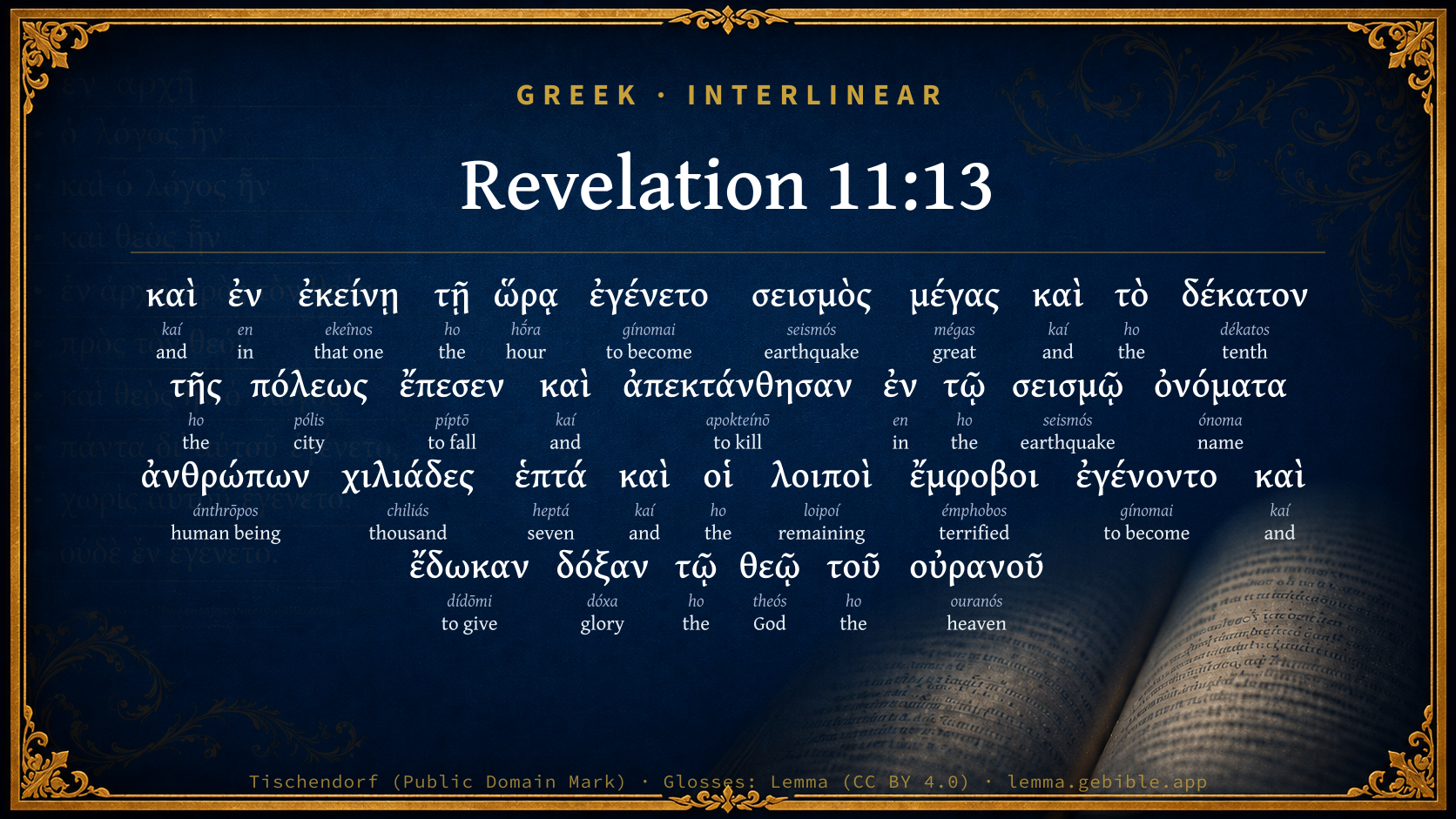
  1. καὶ kaí G2532 “and” Conjunction
  2. ἐν en G1722 “in” Preposition
  3. ἐκείνῃ ekeînos G1565 “that one” Demonstrative pronoun, Dative, Singular, Feminine
  4. τῇ ho G3588 “the” Article, Dative, Singular, Feminine
  5. ὥρᾳ hṓra G5610 “hour” Noun, Dative, Singular, Feminine
  6. ἐγένετο gínomai G1096 “to become” Verb, Aorist, Middle deponent, Indicative, 3rd person, Singular
  7. σεισμὸς seismós G4578 “earthquake” Noun, Nominative, Singular, Masculine
  8. μέγας mégas G3173 “great” Adjective, Nominative, Singular, Masculine
  9. καὶ kaí G2532 “and” Conjunction
  10. τὸ ho G3588 “the” Article, Nominative, Singular, Neuter
  11. τῆς ho G3588 “the” Article, Genitive, Singular, Feminine
  12. πόλεως pólis G4172 “city” Noun, Genitive, Singular, Feminine
  13. ἔπεσεν píptō G4098 “to fall” Verb, Aorist, Active, Indicative, 3rd person, Singular
  14. καὶ kaí G2532 “and” Conjunction
  15. ἀπεκτάνθησαν apokteínō G615 “to kill” Verb, Aorist, Passive, Indicative, 3rd person, Plural
  16. ἐν en G1722 “in” Preposition
  17. τῷ ho G3588 “the” Article, Dative, Singular, Masculine
  18. σεισμῷ seismós G4578 “earthquake” Noun, Dative, Singular, Masculine
  19. ὀνόματα ónoma G3686 “name” Noun, Accusative, Plural, Neuter
  20. ἀνθρώπων ánthrōpos G444 “human being” Noun, Genitive, Plural, Masculine
  21. χιλιάδες chiliás G5505 “thousand” Noun, Nominative, Plural, Feminine
  22. ἑπτά heptá G2033 “seven” Adjective, Numeral (indeclinable)
  23. καὶ kaí G2532 “and” Conjunction
  24. οἱ ho G3588 “the” Article, Nominative, Plural, Masculine
  25. λοιποὶ loipoí G3062 “remaining” Adjective, Nominative, Plural, Masculine
  26. ἔμφοβοι émphobos G1719 “terrified” Adjective, Nominative, Plural, Masculine
  27. ἐγένοντο gínomai G1096 “to become” Verb, Aorist, Middle deponent, Indicative, 3rd person, Plural
  28. καὶ kaí G2532 “and” Conjunction
  29. ἔδωκαν dídōmi G1325 “to give” Verb, Aorist, Active, Indicative, 3rd person, Plural
  30. δόξαν dóxa G1391 “glory” Noun, Accusative, Singular, Feminine
  31. τῷ ho G3588 “the” Article, Dative, Singular, Masculine
  32. θεῷ theós G2316 “God” Noun, Dative, Singular, Masculine
  33. τοῦ ho G3588 “the” Article, Genitive, Singular, Masculine
  34. οὐρανοῦ ouranós G3772 “heaven” Noun, Genitive, Singular, Masculine

About this verse

These counts appear in no published source. They are computed here, from the morphology-tagged text and Lemma’s own curated glosses. What Lemma adds →

35
words
22
distinct lemmas
Revelation
section

Notable vocabulary

The rarest word here is δέκατον tenth G1182 — appearing just 3 times in the whole Greek New Testament.

Shared distinctive vocabulary

δέκατον tenth G1182 occurs in 3 verses of the Greek New Testament. Also found in:

Repetition

Words recur within this verse:

  • ἐγένετο to become G1096 ×2
  • σεισμὸς earthquake G4578 ×2
  • τῇ the G3588 ×7
  • καὶ and G2532 ×5
  • ἐν in G1722 ×2

Cross-references

19

Topical passages linked to Revelation 11:13 in the Treasury of Scripture Knowledge — connected by theme and wording, ordered by reader-vote popularity; previews shown in the World English Bible.

  • Revelation 14:7 He said with a loud voice, "Fear the Lord, and give him glory; for the hour of his judgment has come. Worship him who made the heaven, the earth, the sea, and the springs of waters!"
  • Revelation 6:12 I saw when he opened the sixth seal, and there was a great earthquake. The sun became black as sackcloth made of hair, and the whole moon became as blood.
  • Joshua 7:19 Joshua said to Achan, My son, please give glory to Yahweh, the God of Israel, and make confession to him; and tell me now what you have done; don't hide it from me.
  • Jeremiah 13:16 Give glory to Yahweh your God, before he cause darkness, and before your feet stumble on the dark mountains, and, while you look for light, he turn it into the shadow of death, and make it gross darkness.
  • Revelation 8:5 The angel took the censer, and he filled it with the fire of the altar, and threw it on the earth. There followed thunders, sounds, lightnings, and an earthquake.
  • Revelation 11:11 After the three and a half days, the breath of life from God entered into them, and they stood on their feet. Great fear fell on those who saw them.
  • Revelation 11:19 God's temple that is in heaven was opened, and the ark of the Lord's covenant was seen in his temple. Lightnings, sounds, thunders, an earthquake, and great hail followed.
  • Revelation 15:4 Who wouldn't fear you, Lord, And glorify your name? For you only are holy. For all the nations will come and worship before you. For your righteous acts have been revealed."
  • Revelation 16:9–11 People were scorched with great heat, and people blasphemed the name of God who has the power over these plagues. They didn't repent and give him glory.
  • Revelation 16:18–19 There were lightnings, sounds, and thunders; and there was a great earthquake, such as was not since there were men on the earth, so great an earthquake, so mighty.
  • Isaiah 26:15–16 You have increased the nation, O Yahweh, you have increased the nation; you are glorified; you have enlarged all the borders of the land.
  • Revelation 8:9–12 and one third of the living creatures which were in the sea died. One third of the ships were destroyed.
  • Revelation 19:7 Let us rejoice and be exceedingly glad, and let us give the glory to him. For the marriage of the Lamb has come, and his wife has made herself ready."
  • Genesis 6:4 The Nephilim were in the earth in those days, and also after that, when God's sons came to men's daughters. They bore children to them: the same were the mighty men who were of old, men of renown.
  • 1 Samuel 6:5 Therefore you shall make images of your tumors, and images of your mice that mar the land; and you shall give glory to the God of Israel: peradventure he will lighten his hand from off you, and from off your gods, and from off your land.
  • Malachi 2:2 If you will not listen, and if you will not lay it to heart, to give glory to my name," says Yahweh of Hosts, "then will I send the curse on you, and I will curse your blessings. Indeed, I have cursed them already, because you do not lay it to heart.
  • Acts 1:15 In these days, Peter stood up in the midst of the disciples (and the number of names was about one hundred twenty), and said,
  • Revelation 3:4 Nevertheless you have a few names in Sardis that did not defile their garments. They will walk with me in white, for they are worthy.
  • Revelation 13:1–3 Then I stood on the sand of the sea. I saw a beast coming up out of the sea, having ten horns and seven heads. On his horns were ten crowns, and on his heads, blasphemous names.

Cross-references courtesy of OpenBible.info (CC BY 4.0).

Where the printed editions differ

1 variant

Places in this verse where the major printed Greek editions disagree on the wording in a way that affects the translation — a comparison of editions, not a manuscript-by-manuscript collation. The editions are the modern critical texts (Nestlé-Aland 28/27, SBL, Westcott-Hort, Tregelles, Tyndale House) and the traditional texts behind the KJV (the Textus Receptus and the Byzantine/Majority text). It is not a claim about which reading is original.

  1. Different wording
    ὥρᾳ

    “hour”

    In NA28NA27TynSBLWHTregTR Not in Byz

    ἡμέρᾳ (hēmera) 'day' occurs in a few manuscripts (Byz) instead of ὥρᾳ (hōra) 'hour' in older manuscripts (NA28+NA27+Tyn+SBL+WH+Treg+TR)

Textual data: Translators Amalgamated Greek New Testament (STEPBible TAGNT) · CC BY 4.0.

Commentary

Notes on Revelation 11:13 from classic Christian and Jewish commentators (each source and its license shown beneath its notes). The classic Christian expositions comment on the surrounding passage and are grouped to its opening verse, so a note may address several verses; the Jewish commentaries on the Tanakh (Rashi and others) are per-verse, so they appear only where the commentator wrote on this verse.

Lemma curates 59 commentaries, every one of them public domain or Creative Commons licensed, each selected and text-cleaned for this edition rather than reprinted as found. About our sources →

The Biblical Illustrator

Joseph S. Exell

Rev_11:13

And the remnant were affrighted, and gave glory to the God of heaven.

The judgments of God

1. The judgments of Gods mouth, and the judgments of Gods hand--the word and the work of God--the manifestation of His truth by verbal announcement, and the manifestation of His truth by providential dispensation, are alike efficacious, through the Divine blessing, to the conversion of the souls of men. The remnant were affrighted, and gave glory to the God of heaven.

2. The terrible judgments of the Almighty, overwhelming the wicked with alarm and awe, are the last means--where the other have been despised and unavailing--by which infinite mercy operates for the salvation of the souls of men (Pro_29:1).

3. These means are also, historically or prophetically, the last means by which shall be accomplished that national regeneration which shall precede and usher in the glory of the millennial era, which is thus described by revelation (Rev_11:15).

4. Wars and rumours of wars, and great earthquakes in divers places, and famines, and pestilence, and fearful sights and great signs from heaven, shall be the principal instrumentalities of judgment by which the enemies of God and His Church shall be dealt with in these predicted days of vengeance.

5. The present condition of Christendom--its Churches and its nations--viewed in the light of prophetic intimation, reveals that monitory pulse-like beating which is symptomatic of the approaching end.

6. In the meantime, let the Church of Christ, by the enterprise of faith and the devotion of worship anticipate the anthem of her triumph when, commingling her own gladness with the hymnal joys of the worlds jubilee, she shall sing (Rev_11:17). (Thos. Easton.)

The Biblical Illustrator, edited by Joseph S. Exell (c. 1880s–1900s) — public domain. Text from a community e-Sword module.

Tyndale Open Study Notes

Tyndale Open Resources

11:13 An earthquake often accompanies key moments in biblical history (see Exod 19:18; 1 Kgs 19:11-12; Matt 27:51). • Seven thousand: The number who died shows God’s involvement in judgment (contrast 1 Kgs 19:18). • everyone else . . . gave glory to the God of heaven: Those who survived the earthquake were forced to acknowledge God’s power and sovereignty over the world (see Phil 2:9-11).

Tyndale Open Study Notes — © Tyndale Open Resources, licensed CC BY-SA 4.0. Text via the HelloAO Bible API.

Bengel's Gnomon

Johann Albrecht Bengel

Rev 11:13. Ὀνόματα ἀνθρώπων χιλιάδες ἑπτά) A frequent apposition: δώδεκα χιλιάδες ἐσφραγισμένοι, ch. Rev 7:5-6; τρεῖς χιλιάδας παραβολὰς, 1Ki 4:32; ψυχὰς ἀνδρῶν ἑκατὸν χιλιάδας, 1Ch 5:21.—καὶ οἱ λοιποὶ, and the remnant) who survived from the decimation; [that is, sixty-three thousand men. A most ample conversion!—V. g.] Baal Turim (as Lightfoot teaches in his Chron. of the New Testament, on John 3) on Num 24:8, upon these words, “He shall consume the nations His enemies, and shall break their bones,” remarks, that the letter ö is gifted with a certain peculiar sign [significancy], which shows beforehand that He will root out the seven nations (namely, of the Canaanites), and in time to come (לעתיר לבוא) the remaining sixty-three nations, that is, all the nations of the world. This passage of the Apocalypse softens the sadness of the omen.[113]—ἔδωκαν δόξαν, they gave glory) A mark of their conversion: Jer 13:16.—τῷ Θεῷ τοῦ οὐρανοῦ, to the God of heaven) He is called the Lord of the earth, Rev 11:4, when He declares His authority on the earth by the two witnesses against the disobedient: He is called the God of heaven, when He not only gives rain from heaven, after a most disastrous drought, but also shows His majesty in heaven, by taking up the two witnesses into heaven.

[113] ἔμφοβοι ἐγενοντο, were affrighted) This is more desirable to be heard of than the other: in whose case no change takes place, and who do not at all reverence God: Psa 55:19. Compare also Rev 16:9.—V. g.

Bengel's Gnomon of the New Testament — English translation (T&T Clark, Edinburgh, 1860) — public domain. Text from a community e-Sword module.

Meyer's Critical & Exegetical Commentary

Heinrich August Wilhelm Meyer

Rev_11:13. At the same time a great earthquake destroys the tenth part of the city, slays seven thousand inhabitants, and thus effects the conversion of the rest.

ἐν ἐκείνῃ τῇ ὥρᾳ, viz., that in which what is reported in Rev_11:12 occurred.[2908] With the glorification of the witnesses coincides the vengeance upon their enemies, and those of the Lord.

ΣΕΙΣΜῸς ΜΈΓΑς. That the earthquake is intended just as literally as in Rev_6:12,[2909] and is not some dreadful event to be discerned only from the fulfilment of the prophecy,[2910] and that, in general, nothing allegorical is here said, follows from the further description of the effect of the earthquake; the tenth part of the city is thrown down, and seven thousand men (ὀνόματα ἀνθρ., cf. Rev_3:4) are slain (ἈΠΕΚΤΆΝΘΗΣΑΝ, in the same sense as the other plagues).[2911] If the numerical specifications be regarded as something else than concrete forms, which by a certain measure make perceptible the idea of a relatively small injury,[2912] we enter the province of conjecture. Ebrard wishes to refer the tenth part of the city to the tenth part of the fourth world-power, over which the antichrist is to extend his dominion.[2913] But, as by this arbitrary introduction of a prophecy so unlike this as that in ch. 17, the antichristian character of the number ten is inferred, an embarrassment to the text is occasioned, since it designates the antichristian men slain by the number seven, a divine number. Yet here Ebrard aids with the conjecture, that this number may indicate the servile imitation of divine relations of number on the part of the antichristian realm.

καὶ οἱ λοιποὶ, κ.τ.λ. Upon this large remainder of the inhabitants of the city, the Divine visitation is, therefore, not fruitless.[2914]

ἜΔΩΚΑΝ ΔΌΞΑΝ. A mark of conversion, Rev_16:9; Jer_13:16.[2915]

Τῷ ΘΕῷ ΤΟῦ ΟὐΡΑΝΟῦ. The expression, derived from the later books of the O. T.,[2916] occurs in the N. T. only here and Rev_16:11.[2917] It is caused here by Rev_11:13.[2918] Without further reference, De Wette explains it: the true, supreme God. But by the very fact that God carries his two witnesses to heaven, he shows himself as God of heaven.

[2908] De Wette.

[2909] Cf. also Mat_27:51; Mat_28:2, where a similar inner connection of the earthquake with the death and resurrection of the Lord occurs.

[2910] Ebrard.

[2911] Cf. Rev_6:8, Rev_8:11, Rev_9:18.

[2912] Cf. Rev_6:8, Rev_8:7 sqq., where the fourth or third are affected by a plague. So Ewald, De Wette, Lücke.

[2913] Dan_7:24. Cf. Rev_17:12 sq.

[2914] Cf., on the other hand, Rev_9:20.

[2915] Beng.

[2916] Eze_1:2; Neh_1:4 sq.; Dan_2:18.

[2917] De Wette.

[2918] Cf. Beng.

For the comprehension of the entire section, Rev_11:1-13, the text gives a completely secure standpoint by designating the holy city in which the temple of God stands, and which the Gentiles shall tread under foot, Rev_11:1-2, by the most unambiguous words as the city where Christ was crucified, Rev_11:8. Already what is said in Rev_11:1-2, suggests only Jerusalem; but the words of Rev_11:8 ὅπου

ἐσταυρώθη, are in themselves so simple, and have besides, by means of the historical aor., such immovable firmness in their reference to the definite fact of the crucifixion of the Lord, that no exposition can correspond with the text that conflicts with the norm given by Rev_11:8 and Rev_11:1-2. And if the difficulties of exposition from the standpoint given by the contextviz., concerning the two witnesses (Rev_11:3 sqq.), and the relation of Rev_11:13 and Rev_11:1-2, to the Lords prophecies concerning the destruction of Jerusalemwere still greater than they are, without doubt the solution of the difficulties can be found only in the way indicated by the text itself. Highly characteristic of the force with which the text, especially by Rev_11:8, defends itself against the allegorical interpretation, are the concessions of the allegorists themselves. C. a Lap allegorizes like the older Protestants; but in order to avoid altogether the results of Protestant allegorizing, which regards the great city as Papal Rome, he mentions that Rev_11:8 allows us to think only of Jerusalem, and, therefore, in no way of Rome. Hengstenb., who interprets the entire section (Rev_11:1-13) allegorically of the secularized church, opens his observations on Rev_11:8 with the words: The great city is Jerusalem. Tinius[2919] does not know how to defend the allegorical interpretation as Rome, otherwise than by the conjecture that the contradictory words ὅπου καὶ ὁ κύριος αὐτων ἐσταυρώθη were interpolated![2920]

[2919] Die Off. Joh.Allen verständlich gemacht, Leipz., 1839.

[2920] Cf. De Wette.

If by allegorizing, the prophecy be once withdrawn from the firm historical basis upon which, by Rev_11:8 and Rev_11:1-2,[2921] it puts itself, every limitation whereby the context itself determines the relation of prophecy is removed, and a proper refutation of the most arbitrary interpretations is no longer possible. How will an old Protestant or a modern allegorist prove that the exposition of N. de Lyra is incorrect, when by essentially the same allegorizing he infers that Rev_11:1-2, were fulfilled when Pope Felix instituted the festival of church dedications? For, why should not ΚΆΛΑΜΟς signify just as well a sprinkling-brush as the word of God? And if the ΝΑῸς ΤΟῦ ΘΕΟῦ mean the true Church, why could not the witnesses coming forth for it be as well Pope Silverius and the Patriarch Mennas,[2922] as the testes veritatis, possisibly the Waldenses, whose testimony in John Hus and Jerome of Prague was revived in Luther and Melanchthon?[2923] Or, upon what exegetical foundation can it be proved that the beast from the abyss is not the imperial general Belisarius,[2924] but the Pope?[2925] The modern allegorists are inconsistent in not expressly adopting the special relations which the allegorical interpretation formerly knew how to find in a surprising way.[2926] The modern allegorists are harmonious with the ancient in the fundamental view of all decided points of the entire prophecy: that the temple of God which was measured means the true Church which is to be preserved, while the outer court and the city given to the heathen are wicked Christians; that Christs two witnesses, their office, their miraculous powers, their suffering, their death, their resurrection and ascension, are to be understood spiritually; finally, that the earthquake (Rev_11:13) and its effect figuratively represent a visitation upon the degenerate Church. Ebrard regards the earthquake as a special fact, whose more accurate determination is impossible before the fulfilment of the prophecy. In the spiritual fundamental view, the Catholic allegorists, as C. a Lap., Stern, etc., also agree with Par., Vitr., Calov., Hengstenb., Ebrard. But differences immediately arise with the more accurate determinations, in which, however, when once the standpoint designated by the context itself is deserted, and the way of allegorizing is entered, the ancient Protestants proceed more correctly. The entire description of the two witnesses is so thoroughly personal, that it is more in harmony with the text to think of the doctors of the Church,[2927] than of the office of witness,[2928] or only of the testifying potencies, law and gospel.[2929] The slaying, the not burying, the awakening of witnesses, refers rather to the martyrdom of Savonarola and Hus, and the resuscitation of such witnesses in Luther and the other reformers,[2930] than to the fact that law and gospel are regarded dead, and then again maintained.[2931] Besides, if the dates, seeming to correspond so accurately, be taken in the sense of the old interpreters,[2932] they could please at least by the naïve confidence in their consequences; while the modern allegorists, by the timidity with which they announce only vague generalities, betray their own insecurity and weakness.

[2921] Cf. Luk_21:24.

[2922] N. de Lyra.

[2923] Vitr., etc.

[2924] N. de Lyra.

[2925] Aret., Vitr., etc.

[2926] Yet these ancient interpretations are not absolutely excluded; now and then they are expressly advanced. Thus Rinck (p. 47) says, Constance also is a part of that great city. A consistent return to the ancient Protestant allegorizing has been ventured upon again by Gräber.

[2927] Calov., Vitr., etc.

[2928] Hengstenb.

[2929] Ebrard.

[2930] Par., Vitr., Calov., etc.

[2931] Ebrard.

[2932] The one thousand two hundred and sixty days are taken by the older interpreters (almost all of our writers [Calov.]) as equal to one thousand two hundred and sixty years. Calov. reckons them from the time of Leo the Great to about the year 1700, in which a chief event bearing upon the overthrow of the degenerate, i.e., of the Romish, Church must occur. Cocceius reckons from the end of the third century until the treaty of Passau, 1552. Gravius (in Calov.) maintains three and one-half years, which he reckons from the year 1625, in which the Papists triumphed, until the appearance of Gustavus Adolphus. Brightman understands the three and one-half years which the Papists assembled at the Council of Trent, used in order to do away with the O. and N. T. (the two witnesses). The tenth part of the city, i.e., of the Papacy, which is overthrown, is, according to Cocceius, Protestant France; the seven thousand slain are the seven provinces which deserted from Spain. Most recently Gräber again has attempted such trifling expedients. The end of the one thousand two hundred and sixty days, i.e., years, he expected in 1859; then the dominion of the Turks at Jerusalem would come to an end.

From this form of allegorizing lately arising from a magical idea of foretelling the future, that form is distinguished which has been invented in the interest of a rationalistic conception of biblical prophecy, and which is, of course, very vigorous with respect to results obtained, but not at all in exegetical methods. This group of expositors[2933] has in this the great excellence, that they hold firmly to the textual reference to Jerusalem. Grot., who has found already in the preceding visions the destruction of the city by Titus, refers (ch. 11) to the times of Hadrian, who built a temple of Jupiter in the city, on the place not measured,for John, of course, must measure the already destroyed temple, because God was to preserve that space from the heathen on account of the memory of its ancient holiness.

The two witnesses are the two assemblies of Christians, a Hebrew and a Greek-speaking congregation at Jerusalem; the beast (Rev_11:7) is Barcocheba; Rev_11:13 describes the destruction of his party in the city, against which Rev_11:15 sqq. represents the suppression of the same outside of the city. According to Eichh., the ναὸς τοῦ θεοῦ, Rev_11:1, designates the worship of the one God, which is to be maintained even though the ΑὐΛῆ, i.e., the pomp of ceremonies, be surrendered at the impending destruction of the city by Titus, described in Rev_11:15 sqq. The two witnesses are the high-priests Ananus and Jesus,[2934] murdered by the Zealots (τοῖς ἔθνεσιν, Rev_11:2);[2935] the earthquake is a scene of murder introduced by the Zealots; and the words Κ. ΟἹ ΛΟΙΠΟῚ, Κ.Τ.Λ., he explains: The good citizens of Jerusalem bore this slaughter with a brave mind, having professed this besides, viz., that it had occurred, not without Gods knowledge, but by his permission.

[2933] Grot., Wetst., Herd., Eichh., Heinr., etc.

[2934] Cf. Joseph., B. J., iv. 2 sqq.

[2935] So also Herder.

The necessity of allegorical exposition, Hengstenb. has attempted to prove at length.[2936] Against the fundamental view advocated by Bleek, Ew., Lücke, and De Wette, that ch. 11 refers to the still future destruction of Jerusalem,whereby, on the one hand, those expositors maintain the harmony with the words of the Lord on the subject (cf. Rev_11:2, πατήσουσιν, with Luk_21:24), and, on the other hand, explain the difference that in this passage the proper ΝΑΌς is to remain preserved, and, in general, the judgment (cf. Rev_11:13) is far milder than in Luke 21, Matthew 24, by the patriotic feeling of John, who was unwilling to conceive of the entire holy city, together with the proper habitation of God, as surrendered to the Gentiles, Hengstenb. remarks: Within the sphere of Holy Scripture, that pseudo-patriotism, that blind partiality for ones own people, is nowhere at home. This is so far entirely inapplicable, since patriotism and pseudo-patriotism are two very distinct things. Moses, Jeremiah, all the prophets, have, as true patriots, a holy sympathy with their people. Paul especially emphasizes (Rom_9:3) the patriotic point of the wish there made. Yea, the bitterness of the book eaten by John,[2937] Hengstenb. himself has explained by a comparison with Eze_3:14, from the sad contents of the prophecy to be announced. But if it were bitter to the ancient prophets to announce to their own people the Divine judgments, this not only testifies to their holy patriotic love, but, besides, makes us see how the entire prophetic character was a profoundly moral, and not a magical, overwhelming one, consuming the moral personality of the prophet. So also in John. If the prophecy, ch. Rev_11:1-3, according to Rev_11:1-2; Rev_11:8, undoubtedly refers to the actual Jerusalem, so in the bitterness to the prophet,[2938] with which the judgment is fulfilled, Rev_11:1-2, we must not fail to see genuine patriotism. But it is of course unsatisfactory when the difference between the prediction (Rev_11:1-13) and the corresponding fundamental prophecy of the Lord[2939] is to be explained alone by Johns patriotism;[2940] while, more preposterously yet, Hengstenb. goes too far on the opposite side in attempting to defend John from pseudo-patriotism by imputing to him the view that the actual Jerusalem is the congregation of Satan. Hengstenb. is led to this misunderstanding[2941] by the zeal with which he opposes not so much the view of Lücke, etc., as rather the opinion of Baur concerning the gross Judaism of the Apoc. But it is extremely incorrect to decide the views of Lücke and of Baur[2942] as the same. Just by the false anti-Judaism which Hengstenb. ascribes to John, he breaks away the point from his apparently most important arguments for the allegorical exposition. He says, John everywhere uses the Jewish only as a symbol and form of representation of the Christian; thus, also (Rev_11:1), he designates by the temple the Christian Church, and (Rev_11:8) by Jerusalem the degenerate Christian Church as a whole. This exegetical canon is just as incorrect as that stated in Rev_8:10, etc., that a star everywhere signifies a ruler. Yet, as a matter of course, it must appear already impossible for John, if he regards actual Judaism, the temple, the holy city, etc., without any thing further, as a congregation of Satan, to use these congregations of Satan, with their institutions, as a symbol of the true Church of Christ. But Hengstenb. does John the most flagrant injustice. Those who are Jews only as they call themselves such, but are the synagogue of Satan, he thoroughly distinguishesin the sense of Rom_9:6from those who are such actually. To the latter belong the sealed out of Israel,[2943] in distinction from those out of the Gentiles. Is the name of Israel (Rev_7:4 sqq.) a symbol of the Christian Church? and are the names of the tribes there symbols of Christian churches? Hengstenb., especially on Rev_14:1 sqq., thinks that the constant Jewish symbolism cannot be mistaken, as there Mount Zion can be understood only symbolically. That is decidedly incorrect; but, on the other hand, the visionary locality where Christ is seen with his hosts is the actual Mount Zion, which, as a visionary locality, is as little understood allegorically as Rev_4:1, Heaven; Rev_4:6, the throne of God; Rev_11:15, Rev_12:1, Heaven; Rev_13:1, the seashore, etc. But when Hengstenb. appeals to Rev_20:9 in order to prove that the holy city, Rev_11:1-2, is to be understood allegorically, he does something awkward, because the entire statement of ch. 20, which extends over the historical horizon, dare in no way be made parallel with the prophecy, Rev_11:1-13, which expressly (Rev_11:8, Rev_11:1-2) indicates its historical relation.

Against the not allegorical explanation, Hengstenb. says further, that we cannot understand how an announcement of the future fate of Jewish Jerusalem … should occur just at this place, hemmed in between the sixth and seventh trumpets, the second and third woes, which have to do only with worldly power. The answer is immediately given, and that, too, not only from the methodical progress in itself of the Apoc. vision,which Hengstenb. confuses by his view, in violation of the context, that Rev_11:1-13 occurs between the second and third woe, while what is here said belongs rather to the second woe, Rev_11:14,[2944]but also, as is equally decisive, in fullest harmony with the fundamental prediction of the Lord.

When Hengstenb. judges further that the account of the two witnesses is comprehensible only by an allegorical exposition, it is, on the one hand, to be answered, that the allegorizing obliteration of the definite features referring to personalities[2945] ill harmonizes with the text, and, on the other hand, the non-allegorizing exposition must accept the difficulties, just as the text offers them, and attempt their explanation.

Finally[2946] Hengstenb. mentions the testimony of Irenaeus, which places the composition of the Apoc. in the time after the destruction of Jerusalem, and must consequently prevent the expositor from accepting, in Rev_11:1 sqq., the existence of the temple and city, and regarding the destruction as future. Lücke, who, with the fullest right, places the self-witness of the Apoc. above the testimony of Irenaeus, and vindicates for the exegete the freedom required above all things by the text, acknowledges the possibility that, in case John wrote after the fall of the city, by a kind of fiction he might have represented this fact as future. Therefore the statement (ΠΑΤΉΣΟΥΣΙΝ, Rev_11:2) would at all events be future, and refer to the destruction of the city. But Bleek correctly denies even the possibility of conceiving of this passage according to the rule of such a fiction, to say nothing of its being entirely aimless.

[2936] Cf., against him, Lücke, p. 825 sqq., and, besides, Bleek, Stud. u. Krit., 1855, p. 215 sqq.

[2937] Rev_10:9 sqq.

[2938] Rev_10:9 sq.

[2939] Matthew 24; Luke 21.

[2940] Against Lücke, etc.

[2941] Cf. Rev_2:9.

[2942] Cf. also Volkm.: The Jewish seer has completely deceived himself in his hope for Jerusalem and the Jewish people. But let Luk_21:24, as a prediction of Christ, be suggested in connection with the expression in the Apoc., notwithstanding the entire destruction of the city entering therein.

[2943] Ch. 7.

[2944] Cf. the introductory observations on ch. 10.

[2945] See on Rev_11:13 sqq.

[2946] The other observations of Hengstenb., that the beast (Rev_11:7) has, according to Rev_13:7-8, nothing to do with the Jewish, but with the holy, Jerusalem, and that the allegorical interpretation shows only that the prediction extends to us, carry with them their own answer. The beast does something antichristian in slaying the witnesses of Christ, and every thing biblical concerns us. Are we to interpret Luk_19:41 sqq. allegorically, because what is there written pertains to us?

The most immediate norm for the correct exposition resulting from the wording of the text itself, has already been asserted in opposition to the allegorists; viz., the reference to Jerusalem, Rev_11:8, Rev_11:1-2, and to the judgment impending over this city (Rev_11:2, πατήσουσιν). Another no less important norm, to which also the phraseology, Rev_11:2 (ἐδ. τοῖς ἔθνεσιν

πατήσουσιν), points by its similarity with Luk_21:24, shows the essential agreement of our prediction with the fundamental prediction of the Lord.[2947] For, just as the Lord himself places the final judgment in inner connection with the end of the world,to such an extent, that apparently even an external chronological connection is expressed,so John predicts the ultimate fulfilment (which is here represented in the seventh trumpet-vision, Rev_11:15 sqq.) in such a way that he begins with the judgment upon Jerusalem, Rev_11:1-13. After Rev_10:7 sqq., he is now to announce the completion of the mystery of God. The completion itself does not occur, as in Rev_10:7 also it is expressly said, until the time of the seventh trumpet (Rev_11:15 sqq.), in which also the third woe falls (cf. Rev_11:14); but the announcement committed to John begins, nevertheless, not first with Rev_11:15, but already at Rev_11:1. And what is here (Rev_11:1-13) predicted belongs to the second woe, and therefore stands in the connection of the series with the third, soon-coming woe.

[2947] Luke 21; Matthew 24.

No one would have thought of denying, in Rev_11:1-13, the reference afforded from the wording, and the analogy with the eschatological discourses of the Lord to the impending destruction of Jerusalem, and in order to do this, would have had to resort to allegorical explanation, if, on the other hand, the prediction of John did not deviate from that fundamental prediction, and the fact of the destruction had not in reality occurred, as the Lord, but not as John, had predicted. But just the latter difficulty brings with itself the solution; for it follows, from the peculiar deviations from Matthew 24, Luke 21, that John, in his prophecy concerning Jerusalem, had an entirely different purpose from the Lord himself, and accordingly he puts his prophetic description of the impending act of judgment in a peculiar light, and paints it in other colors.[2948] The Lord announces simply the definite fact of the destruction of the city;[2949] he mentions Judah and Jerusalem, and describes how the Gentile enemies will build a rampart against it, plunder it, and not leave one stone upon another, a destruction which affected the dishonored temple no less than the holy city. According to the description of John, there would be only a period during the 3½ years of oppression known already from Daniel, in which the city and the court are trodden under foot by the Gentiles; the temple proper is preserved from all indignity and devastation. During this time, the two witnesses of Christ come forth as preachers of repentance, who, according to their nature and office,not according to their individual personality,are the two olive-trees and candlesticks (anointed ones) of whom Zech. spake, Rev_11:4; they are Moses and Elijah,[2950]not Enoch and Elijah,[2951] who, as prophetic preachers of repentance, are thought of as having returned to the same desert, just as Elijah returned in the manifestation of John the Baptist.[2952] But these were killed, and that, too, by the beast from the abyss, whose mention in this placeas it properly belongs only to the seventh trumpetgives an indication for the conception of the ideal standpoint from which John regards the impending judgment upon Jerusalem in connection with its full and final development. No less significant is the hatred which the Gentiles present in the cityof whom we are to think so preponderatingly in the expression ΟἹ ΚΑΤΟΙΚΟῦΝΤΕς ἘΠῚ Τῆς Γῆς, that the reference to the unbelieving Jews retires altogether into the backgroundshow to the dead bodies of Christs witnesses. Finally, in comparison with the fundamental prophecy of the Lord, it is significant for the distinct mode of contemplation by John, that here an earthquake, after the manner of the preliminary plagues described in the seal- and trumpet-visions, visits the city, destroys a part of it, and brings the survivors to repentance, in contrast with the plagues remaining fruitless to those in the Gentile world;[2953] on which account, then, the seventh trumpet brings the complete destruction of the antichristian world. While, therefore, the Lord himself predicts the real fact of the destruction of Jerusalem, the same impending fact, of course, forms also for John the real goal of his prophecy; besides, he also agrees with the Lord in the fundamental prediction, in this, that he likewise maintains the inner connection between the individual acts of judgment upon Jerusalem, and the full final judgment; but in other respects the prediction of John is of an ideal character, so that we are neither to seek for the real fulfilment of individual expressions, nor, in order to conceal the incongruity between the words of prophecy and the facts of the destruction, to resort to the allegorical mode of exposition. In John, a judgment impends over the city, which is brought about no more by the heathen treading under foot (Rev_11:2) than by the earthquake (Rev_11:13), in the development of the mystery of God until its final completion, as a chief link in the chain of preliminary plagues, since it also forms a part of the second woe. But from this standpoint, the holy city cannot appear in the same light as the Gentile city, from the ground of antichristian secular power; but just as the sealed of God, as such, could not be touched by certain plagues,[2954] the temple proper, as Gods place of revelation, is preserved from the feet of the Gentiles, while the city wherein the witnesses of Christ like their Lord are slain is condemned to judgment. But this is distinguished also from the complete judgment upon Babylon, by the fact that the plague (the earthquake) is wrought as a salutary purification, since only the antichristian part are obliterated, while the rest of Israel are converted, and remain in safety.[2955] We must therefore decide, not that in Rev_11:1-13 John allegorizes by representing the future destinies of the Christian Church under Jewish symbols, but that he idealizes,[2956] by endeavoring to announce beforehand the impending destruction of Jerusalem, not according to the actual circumstances, but according to their inner connection with the ultimate fulfilment of the mystery of God,[2957] and correspondingly to state the hope which the O. T. people of God still retained, in contrast with the heathen secular power, i.e., with Babylon. In this ideal representation of prophecy, there belongs also the similar feature (Rev_11:4 sqq.). John does not think that Moses and Elijah will actually return,[2958] accordingly he does not mention them; but with colors derived from the words of Zechariah, as also from the history of Moses and Elijah, he paints the ideal picture of the two prophetic preachers of repentance, who are to work in the manner, the spirit, and the power of Moses and Elijah. Hence we are not to inquire for a particular meaning, or a particular fulfilment of what is here said.[2959]

[2948] Without foundation in the context, Weiss, a. a. O., p. 29, designates the meaning of the whole: It is to be represented how, notwithstanding the impending destruction of Jerusalem, yet the final deliverance of a last remnant of the holy people, promised by all the prophets, is to occur (in distinction from Rom_11:26 : πᾶς Ἰσρ.). This theologumenon as such is entirely remote.

[2949] Cf. also Luk_19:41 sqq.

[2950] Rev_11:5 sqq. Cf. Mat_17:1 sqq., De Wette, Lücke, Ew. ii., Hilgenf., etc.

[2951] Stern, Ew. i. Beda already rejects this view disseminated in the Church fathers. An interesting reference to this passage is found in the Gospel of Nicodemus, P. ii. (Desc. Chr. ad Inf., c. 9), where Enoch says of himself and Elijah: μέλλομεν ζῆσαι μέχρι τῆς συντελείας τοῦ αἰῶνος· τότε δὲ μέλλομεν ἀποσταλῆναι παρὰ θεοῦ ἐπὶ τῷ ἀντιστῆναι τῷ χρίστῳ καὶ ἀποκτανθῆναι παρʼ αὐτοῦ, καὶ μετὰ τρεῖς ἡμέρας ἀναστῆναι καὶ ἐν νεφέλαις ἁρπαγῆναι πρὸς τὴν τοῦ κυρίου ὑπάντησιν (We are to live until the completion of the world; then we are to be sent by God to withstand Antichrist, and to be slain by him, and after three days to be raised and snatched up in the clouds to meet the Lord) (Ev. Apocr., ed. Tisch., Lips., 1853, p. 309).

[2952] Cf. Mat_17:12; Luk_1:17.

[2953] Cf. Rev_9:20, Rev_16:9.

[2954] Cf. Rev_9:4.

[2955] Cf. Isa_37:31 sq.; Rom_9:27 sqq., Rev_11:7.

[2956] Klief., who decidedly controverts this, nevertheless, by referring the closing words from Rev_11:8 to Jerusalem, and also rejecting allegorizing, reaches the result that the Christianity of the last times appears as Jerusalem.

[2957] Cf. Rev_10:7.

[2958] Against Hilgenf., etc.

[2959] See Intr., p. 42.

Meyer — Critical and Exegetical Commentary on the New Testament — English translation by Peter Christie, edited by Frederick Crombie (T&T Clark, 1880) — public domain. Text from a community e-Sword module.

Expositor's Greek Testament

ed. W. Robertson Nicoll

Rev 11:13 . On earthquakes as a punishment for sin, cf. Jos. Ant. ix. 10, 4 = Zec 14:5 , and (for Sodom) Amo 4:11 . The beast, as in 2Th 2:9-12 , gets off scatheless in the meantime, though his tools are punished or terrified into reverence (Jon 3:5-10 ). ὀνόματα ἀ . Briggs ingeniously conjectures that this is a clumsy version of אנשׁי שׁמות = men of name or fame ( cf. 1Ch 5:24 , Num 16:2 ). From this point till Rev 16:19 and Rev 20:9 Jerusalem seems to be ignored among the wider political oracles, except incidentally at Rev 14:20 (see note), where another erratic block from the same or a similar cycle of eschatological tradition breaks the surrounding strata of prediction.

The ample and proleptic style of the next passage shows that the author has left his source in order to resume matters with (Rev 11:14-18 ) the seventh trumpet-blast or third woe, which ushers in the final stage (1Co 15:52 ) of the divine purpose (10:7 = 12 20). But what immediately follows is, by anticipation, a celestial reflex of the last judgment which is characteristically deferred till “the various underplots of God’s providence” (Alford) are worked out. The announcement of it starts an exultant song of praise in heaven.

The Expositor's Greek Testament, edited by W. Robertson Nicoll (1897–1910) — public domain. Text from a community e-Sword module.

Geneva Bible (1599)

Geneva Bible translators

Glorified God by confessing his name.

They were indeed broken with present astonishment of mind, but did not earnestly repent as they ought to have done.

Bergomensis saith, in the year of our Lord 1301, this year a blazing star foretelling great calamity to come, appeared in heaven, in which year upon the feast of S. Andrew, so great an earthquake arose, as never before: which also continuing, by times, for many days, overthrew many stately houses. This saith he of the year next following the Jubilee: which S. John so many ages before, expressed word for word.

Geneva Bible (1599) marginal notes — public domain. Text via Bolls.life.

Jamieson, Fausset & Brown

Robert Jamieson, A. R. Fausset & David Brown

"In that same hour"; literally, "the hour."

great earthquake--answering to the "great earthquake" under the sixth seal, just at the approach of the Lord (Rev 6:12). Christ was delivered unto His enemies on the fifth day of the week, and on the sixth was crucified, and on the sabbath rested; so it is under the sixth seal and sixth trumpet that the last suffering of the Church, begun under the fifth seal and trumpet, is to be consummated, before she enters on her seventh day of eternal sabbath. Six is the number of the world power's greatest triumph, but at the same time verges on seven, the divine number, when its utter destruction takes place. Compare "666" in Rev 13:18, "the number of the beast."

tenth part of the city fell--that is, of "the great city" (Rev 16:19; Zac 14:2). Ten is the number of the world kingdoms (Rev 17:10-12), and the beast's horns (Rev 13:1), and the dragon's (Rev 12:3). Thus, in the Church-historical view, it is hereby implied that one of the ten apostate world kingdoms fall. But in the narrower view a tenth of Jerusalem under Antichrist falls. The nine-tenths remain and become when purified the center of Christ's earthly kingdom.

of men--Greek, "names of men." The men are as accurately enumerated as if their names were given.

seven thousand--ELLIOTT interprets seven chiliads or provinces, that is, the seven Dutch United Provinces lost to the papacy; and "names of men," titles of dignity, duchies, lordships, &c. Rather, seven thousand combine the two mystical perfect and comprehensive numbers seven and thousand, implying the full and complete destruction of the impenitent.

the remnant--consisting of the Israelite inhabitants not slain. Their conversion forms a blessed contrast to Rev 16:9; and above, Rev 9:20-21. These repenting (Zac 12:10-14; Zac 13:1), become in the flesh the loyal subjects of Christ reigning over the earth with His transfigured saints.

gave glory to the God of heaven--which while apostates, and worshipping the beast's image, they had not done.

God of heaven--The apostates of the last days, in pretended scientific enlightenment, recognize no heavenly power, but only the natural forces in the earth which come under their observation. His receiving up into heaven the two witnesses who had power during their time on earth to shut heaven from raining (Rev 11:6), constrained His and their enemies who witnessed it, to acknowledge the God of heaven, to be God of the earth (Rev 11:4). As in Rev 11:4 He declared Himself to be God of the earth by His two witnesses, so now He proves Himself to be God of heaven also.

Jamieson, Fausset & Brown — Commentary Critical and Explanatory on the Whole Bible (1871) — public domain (CC PDM 1.0). Text via the HelloAO Bible API.

Adam Clarke's Commentary

Verse 13. A great earthquake] Violent commotions among the persecutors, and revolutions of states.

Slain of men seven thousand] Many perished in these popular commotions.

The remnant were affrighted] Seeing the hand of God's judgments so remarkably stretched out.

Gave glory] Received the pure doctrines of the Gospel, and glorified God for his judgments and their conversion.

Adam Clarke's Commentary on the Bible (1810–1826) — public domain. Text from a community e-Sword/MySword module.

Ellicott's Commentary for English Readers

(13) And the same hour . . .—Better, And in that hour there was (took place) a great earthquake, and the tenth part of the city fell, and, there were slain in the earthquake names of men seven thousand: and the rest became affrighted, and gave glory to the God of the heaven. The hour of their triumph is the hour of a retributive warning on the city where they were slain convulsion, with the overthrow of dwellings and the death of seven thousand men. Is it accidental that the number is the same as the number of those who had not bowed to Baal? (1Ki_19:18.) Rejected reformation avenges itself in revolution, and the city which might have been purified by the word is purged by the spirit of judgment (Isa_4:4); good is effected, even through fear; some are saved though as by fire; and, unlike those who repented not (Rev_9:21), they give glory to the God of heaven. The visible Church of Christ is stirred; there is a reaction from the spirit of worldliness.

A Bible Commentary for English Readers, edited by Charles John Ellicott (1878–1897) — public domain. Text from a community e-Sword module.

The Cambridge Bible for Schools and Colleges

gen. ed. J. J. S. Perowne

13. of men] Lit., names of men, as the margin: cf. Rev_3:4, and Act_1:15 there quoted.

seven thousand] Possibly this number is taken as approximately a tenth part of the population of Jerusalem. The city, which can never have extensive suburbs, being surrounded by ravines, can never hold a larger permanent population than 70,000; but in its highest prosperity it may have held as many, and perhaps it may again.

gave glory] Here and in Rev_14:7, Rev_16:9 these words seem to imply the confession of sin, as in Jos_7:19, and probably St Joh_9:24. It was the predicted work of Elijah to “turn the hearts of the fathers to the children, and the heart of the children to their fathers:” this will be fulfilled by his posthumous success, uniting the original stock of God’s People to the branches that now grow out of it (Rom_11:17, &c.).

the God of heaven] Seems to have been the way the Jews spoke of their God to heathens, see Jon_1:9 : Ezr_1:2 (which was probably written under Daniel’s or other Jewish influence), Rev_5:11, Rev_6:10. This accounts for the way that in later times heathens conceived of their religion. Nil praeter nudes et caeli numen adorant (Juv. XIV. 97).

The Cambridge Bible for Schools and Colleges (gen. ed. J. J. S. Perowne; Cambridge University Press, 1878–1918) — public domain. Text from a community e-Sword module.

John Gill's Exposition

And the same hour was there a great earthquake,.... Or the same day, as the Complutensian edition, and some copies, read; that is, at the time of the resurrection and ascension of the witnesses, as there was at the resurrection of Christ; and is to be understood of a very great commotion in the civil affairs of kingdoms and nations within the Roman jurisdiction, as there was when Rome Pagan was near its ruin, Rev 6:12.

And the tenth part of the city fell. Mr. Daubuz interprets the "earthquake" of the irruption of the Ottomans upon the Grecian empire, and the "tenth" part of the city, of the Greek church, and the falling of it, of its loss of liberty, and falling into slavery; but something yet to come is here intended. By "the city" is meant the city of Rome, the great city, mentioned in Rev 11:8; and by "the tenth part" of it may be designed either Rome itself, which as it now is, according to the observation of some, is but a tenth part of what it was once; so that the same thing is meant as when it is said, "Babylon is fallen, is fallen", Rev 14:8, or it may design the tithes and profits which arise from the several kingdoms belonging to the jurisdiction and see of Rome, which now will fall off from those who used to share them, upon this new and spiritual state of things; the Gospel daily gaining ground, and enlightening the minds of men, and freeing them from the slavery they were held in; or else the ten fold government of the Roman empire, or the ten kings that gave their kingdoms to the whore of Rome, and are the ten horns of the beast, on which she sits, who will now hate her, and burn her flesh with fire; or rather one of the ten kingdoms, into which the Roman western empire was divided. Dr. Goodwin seems inclined to think that Great Britain is intended, which having been gained over to the Popish party, will now fall off again: but I rather think the kingdom of France is meant, the last of the ten kingdoms, which rose up out of the ruins of the Roman empire, which will be conquered, and which will be the means of its reformation from Popery.

And in the earthquake were slain of men seven thousand; the meaning is, that in the commotions, massacres, tumults, and wars which will be throughout the empire, such a number of men will be slain; which is either put for a greater number; a certain for an uncertain, as in Rom 11:4; and perhaps in reference to the account there; otherwise seven thousand is but a small number to be slain in battle; or as it is in the original text, "the names of men seven thousand". Now it is observed by some, that the smallest name of number belonging to men is a centurion, or captain of an hundred men; and supposing that to be meant, then seven thousand names of men will imply, that in an hour, or about a fortnight's time, may be slain throughout all Europe, in battles and massacres, about seven hundred thousand men, which is a very large number: or names of men may signify men of name, of great renown, as in Num 16:2; and then if seven thousand men of name, officers in armies, should be slain, how great must be the number of the common soldiers? Some have thought, that ecclesiastical dignities, or men distinguished by names and titles, such as cardinals, archbishops, bishops, priests, &c. and the whole rabble of the antichristian hierarchy, which will now fall, and be utterly demolished, are intended:

and the remnant were affrighted; who were not slain in this earthquake; these will be affected with the judgments of God upon others, and be made sensible of their danger, and of their deliverance, which will so work upon them, as to reform them from Popery:

and gave glory to the God of heaven; will acknowledge the justice of God, and the righteousness of his judgments upon those that were slain, and his goodness to them who are spared; will confess their transgressions and sins they have been guilty of; and give the glory of their deliverance, not to their idols and images, but to the true God, whose religion they now embrace; for this respects the large conversions among the Popish party to the true religion, under the influence of the grace of God, through the preaching of the Gospel, which will now be spread throughout the world.

John Gill's Exposition of the Whole Bible (1746–1763) — public domain (CC PDM 1.0). Text via the HelloAO Bible API.

Trapp's Complete Commentary

John Trapp

13 And the same hour was there a great earthquake, and the tenth part of the city fell, and in the earthquake were slain of men seven thousand: and the remnant were affrighted, and gave glory to the God of heaven.

Ver. 13. A great earthquake] Since the Reformation, what stirs and broils have there been all over Christendom! God’s sword hath ridden circuit, Eze 14:17, and is not yet sheathed, nor can it, Jer 47:6-7, as being still in commission.

And the tenth part, &c.] Ruit alto a culmine Roma. Louis XII, king of France, threatened that he would destroy Rome, and coined money with an inscription to that purpose, Se perditurum Babylonem cui cum hac inscriptione monetae, minatus est. George Fransperg (a general under Charles Bourbon) that sacked the city of Rome, caused a halter to be carried near his colours, saying that with that he would hang the pope; encouraging his soldiers (who were most of them Lutherans) with the great opportunity they had to get spoils. (Hist. of the Council of Trent.) But the sins of that city are not yet full.

Gave glory to the God of heaven] Confessed their sins, as Achan, and changed their minds, as those Mal 3:18. It is said of the Burgundians, that being afflicted and oppressed by the Huns, they applied themselves to Christ the God of the Christians, whom, after a long debate, they concluded to be the Almighty God. (Alsted. Chron.)

John Trapp, A Commentary or Exposition upon All the Books of the Old and New Testament (1647–1656) — public domain. Text from a community e-Sword module.

Albert Barnes' Notes on the Bible

And the same hour - In immediate connection with their triumph.

Was there a great earthquake - “An earthquake is a symbol of commotion, agitation, change; of great political revolutions, etc. See the notes on Rev 6:12. The meaning here is, that the triumph of the witnesses, represented by their ascending to heaven, would be followed by such revolutions as would be properly symbolized by an earthquake.

And the tenth part of the city fell - That is, the tenth part of that which is represented by the “city” - the persecuting power. A city would be the seat and center of the power, and the acts of persecution would seem to proceed from it; but the destruction, we may suppose, would extend to all that was represented by the persecuting power. The word “tenth” is probably used in a general sense to denote that a considerable portion of the persecuting power would be thus involved in ruin; that is, that in respect to that power there would be such a revolution, such a convulsion or commotion, such a loss, that it would be proper to represent it by an earthquake.

And in the earthquake - In the convulsions consequent on what would occur to the witnesses.

Were slain of men seven thousand - Mart., as in the Greek, “names of men” - the name being used to denote the people themselves. The number here mentioned - seven thousand - seems to have been suggested because it would bear some proportion to the tenth part of the city which fell. It is not necessary to suppose, in seeking for the fulfillment of this, that just seven thousand would be killed; but the idea clearly is, that there would be such a diminution of numbers as would be well represented by a calamity that would overwhelm a tenth part of the city, such as the apostle had in his eye, and a proportional number of the inhabitants. The number that would be slain, therefore, in the convulsions and changes consequent on the treatment of the witnesses, might be numerically much larger than seven thousand, and might be as great as if a tenth part of all that were represented by the “city” should be swept away.

And the remnant were affrighted - Fear and alarm came on them in consequence of these calamities. The “remnant” here refers to those who still remained in the “city” - that is, to those who belonged to the community or people designed to be represented here by the city.

And gave glory to the God of heaven - Compare Luk 5:26; “And they were all amazed, and they glorified God, and were filled with fear, saying, We have seen strange things today.” All that seems to be meant by this is, that they stood in awe at what God was doing, and acknowledged his power in the changes that occurred. It does not mean, necessarily, that they would repent and become truly his friends, but that there would be a prevailing impression that these changes were produced by his power, and that his hand was in these things. This would be fulfilled if there should be a general willingness among mankind to acknowledge God, or to recognize his hand in the events referred to; if there should be a disposition extensively prevailing to regard the “witnesses” as on the side of God, and to favor their cause as one of truth and righteousness; and if these convulsions should so far change public sentiment as to produce an impression that theirs was the cause of God.

Albert Barnes' Notes on the Bible (1834–1885) — public domain. Text from a community e-Sword/MySword module.

Haydock's Catholic Bible Commentary

A great earthquake. By which may be signified the consternation that fell upon the persecutors of Christians, when by God’s visible chastisements, seven thousand (i.e. many of them) perished miserably; others were struck with fear, others converted. (Witham)

George Leo Haydock (1774–1849), Haydock's Catholic Family Bible and Commentary, 1859 edition — public domain. Excludes Psalms (Douay-Rheims chapter numbering differs from Protestant) and Deuterocanonical books (Catholic canon only).

Matthew Poole's English Annotations

And the same hour; that is, about the same time, when the Spirit of life from God entered into the witnesses, and they were again restored.

Was there a great earthquake; by earthquake doubtless is here meant a great confusion in the world, and shaking of nations by differences one with another, and wars: See Poole on "Rev 6:12".

And the tenth part of the city fell; by the city is doubtless meant the great city before named, spiritually called Sodom and Egypt; elsewhere, Babylon; by which Rome is to be understood. What is meant by the tenth part of it falling, is not so well agreed; some by it understanding many kingdoms falling off from its jurisdiction; others, a great part of its tribute or dominion.

And in the earthquake were slain of men seven thousand: these words seem to intimate that the restoration of the witnesses shall not be without opposition, and that the opposition shall not be great; seven thousand is a small number to fall in such a quarrel: but the papal party shall appear to have cheated the world so with their impostures, and so to have imposed upon them, that the world shall grow sick of them, and when the time comes for God to put a final period to them, the number shall be but few that adventure for them.

And the remnant were affrighted; others shall be affrighted, either from their own consciences, or from the stupendous dispensations of Divine Providence in the fall of the great city.

And gave glory to the God of heaven; and give glory to God, by confessing their errors, and turning to an ingenuous and sincere acknowledgment of the truth. Instead of worshipping saints, and angels, and images, worshipping the true and living God of heaven and earth only.

Matthew Poole's English Annotations on the Holy Bible (1683–1685) — public domain. Text from a community e-Sword/MySword module.

Whedon's Commentary on the Bible

Daniel D. Whedon

13. Earthquake—Anticipative image, in miniature, of the overthrow of Babylon, completed at close of chapter 19.

Tenth part… seven thousand—Says Gebhardt, “A city, the tenth part of which is destroyed by an earthquake which slays 7,000 persons, can only be a real city,” that is, not a symbolical city. But the very exactitude of the round numbers ought to have warned the commentator of numerical symbol. No earthquake ever carefully smote down a city to the precise tenth part; so also, that the number of men slain was the cube of ten multiplied by seven. And by Gebhardt’s interpretation this ought to have been the literal fact with the literal Jerusalem. The writer who has not carefully studied the symbolical numbers of the Apocalypse will never attain its true interpretation.

If ten is a symbol of universality, then one tenth indicates that but a minority of the secular dominions of the earth will be plunged into absolute destruction in the great closing contest. As to the number of the slain men, the cube of ten raises our thoughts to a great number, yet limited by the divine seven. The universality of the ten refers to their universal diffusion through the secular world. All these limitations correspond with the fact, that in the final battle, while the destruction is great, yet the survivors are in still greater numbers, consisting of “the nations” of Rev_19:15; Rev_20:3; Rev_20:8, who still remain undestroyed and roll on their generations.

Affrighted—Were filled with salutary fear resulting in their conversion and entrance into the millennial age of Rev_20:1-6.

Gave glory— From fear to praise.

The God of heaven—Whose spirit of life awakened the witnesses to a resurrection, and whose great voice bid them come by ascension into heaven. It may be rather hinted than explicitly narrated; yet all this hint is a fair miniature of what in chapters 19 and 20 is a full portraiture. And we trust we have made it clear to our readers that this passage (1-13) is an outline sketch of the victorious struggle of Christ with antichrist, of which the coming chapters are prophetic history.

The correspondences of the two appear in the following TABULATION:—

The temple, the true Church. = The mystical temple and Jerusalem, Revelation 14-16. The beast. = The beast, Rev_13:1.

The two persecuted witnesses. = The saints persecuted by the beast, Rev_13:7; Rev_13:16-17.

Slain three days and a half. = Martyred three and a half years, or 1260 days, Rev_13:5.

Resurrection of witnesses. = Reign of souls of martyrs, Rev_20:4.

Overthrow of city. = Downfall of Babylon, Rev_16:19-21.

“Remainder gave glory to God.” = Millennial triumphs, Rev_20:3-4.

Daniel D. Whedon (gen. ed.), Commentary on the Old and New Testaments (1874–1909) — public domain. Text from a community e-Sword module.

The Pulpit Commentary

And the same hour was there a great earthquake. In the visions of the seals it is set forth, under the sixth seal, how the destruction of the world is accompanied by earthquakes, etc.; the fear of the wicked is portrayed, and the preservation of the just takes place at the same time. Here, under the sixth trumpet, we have the same events shown forth, the triumph of the godly being mentioned first, though the rest happens "in that same hour." This is the conclusion of the sixth judgment, the consequence of the non repentance mentioned in Rev_9:21. The intervening narrative (Rev_10:1-11; Rev_11:1-12) serves to show that opportunities of knowing God"s will are given to men, as well as warnings of judgment in ease of disobedience. Vers. 13 of Revelation 11 might follow Rev_9:21, but for the desire of the seer to demonstrate the long suffering goodness and mercy of God. And the tenth part of the city fell, and in the earthquake were slain of men seven thousand. Both the Authorized Version and the Revised Version have in the margin, "names of men, seven thousand," and some writers make much of the expression. Thus Alford says, "As if the name of each were recounted;" and Wordsworth, "Persons known and distinguished." But, in truth, the phrase is a Hebraism, to which we can attach no special significance. (cf. Act_1:15 Rev_3:4) Whatever may he the system of interpretation adopted, this passage presents many difficulties. The whole account appears to relate to the judgment day, and it is therefore more peculiarly prophetic than many parts of the Apocalypse, and for that reason its meaning must needs be more or less obscure. The account in this verse informs us that a part (a tenth) of the city (that is, of the wicked) suffers destruction; that the number so destroyed is described as seven thousand; that the rest (nine tenths), in fear, recognize the power of God, to which they had hitherto refused attention. What is the final fate awarded to the nine tenths we are not told. We have, therefore, to inquire the meaning of the numbers given. Now, it seems inherently impossible to interpret these numbers literally, and, moreover, as we have repeatedly seen, it is not the habit of the writer of the Apocalypse to indicate exact numbers. We must, therefore, try to discover the symbolical meaning which St. John attached to these expressions, the qualities rather than the quantities which he intended to signify. In the Bible the tenth part invariably signifies the tithe the portion due from the community to God or to the ruler. (cf. Gen_28:22 Lev_27:32 Num_18:21 1Sa_8:15, 1Sa_8:17) it seems probable that this was the idea intended to be conveyed, viz. that God was now exacting his due, that men who had refused to recognize what was due from them to God were now forced to recognize his sovereignty by the exaction for punishment of a tithe, and as an evidence that all are under his sway. But, it may be objected, are not all the wicked punished at the judgment? This verse really seems to hint at a possibility of some course by which, even at the last moment, a chance of escape may be presented to men. But it does not distinctly state this; it seems, indeed, purposely to leave the fate of the rest of the ungodly untold. All it does assert is that God comes to the wicked as a Conqueror or a King, and exacts what is due to himself. But, further, why are seven thousand men slain? Again interpreting symbolically, seven involves the idea of completeness. (see on Rev_1:4 Rev_5:1, etc.) A thousand signifies a large number, though not an infinitely large number, for which we have "thousands of thousands," etc. This number, therefore, informs us that God"s vengeance overtakes a large number, and that that number is complete, none escaping who deserve to be included. Perhaps this is mentioned as a precaution against any possibility of mistake in the interpretation of the "tenth part." It is as though St. John would say, "In that hour God exacted vengeance, demanding what was due to his justice; but do not imagine that that vengeance reached only a small part of mankind. It was far extending and complete, though I do not attempt to define its exact limits, which cannot be known until the judgment day itself shall reveal everything." And the remnant were affrighted, and gave glory to the God of heaven. The rest gave glory, being, perhaps (though not necessarily), repentant. (cf. Jos_7:19 Joh_9:24 Rev_4:9 Rev_14:7 Rev_16:9) Possibly we have here a hint of God"s uncovenanted mercies (vide supra), though there is nothing sufficiently definite to encourage men to postpone the day of repentance. No mention is made of the ultimate fate of "the remnant." "The God of heaven," in contrast to things of the world, upon which their affections had been hitherto set. (cf. Rev_16:11) In these two places alone of the New Testament is this expression found; but it is not uncommon in the Old Testament. (cf. Ezr_1:2 Neh_1:4 Dan_2:18)

The Pulpit Commentary (1880–1919), ed. H.D.M. Spence-Jones & Joseph S. Exell — public domain. Text from a community e-Sword module.

John Wesley's Explanatory Notes

And there was a great earthquake and the tenth part of the city fell - We have here an unanswerable proof that this city is not Babylon or Rome, but Jerusalem. For Babylon shall be wholly burned before the fulfilling of the mystery of God. But this city is not burned at all; on the contrary, at the fulfilling of that mystery, a tenth part of it is destroyed by an earthquake, and the other nine parts converted. And there were slain in the earthquake seven thousand men - Being a tenth part of the inhabitants, who therefore were seventy thousand in all. And the rest - The remaining sixty-three thousand were converted: a grand step toward the fulfilling of the mystery of God. Such a conversion we no where else read of. So there shall be a larger as well as holier church at Jerusalem than ever was yet. Were terrified - Blessed terror! And gave glory - The character of true conversion, Jer. xiii, 16. To the God of heaven - He is styled, "The Lord of the earth," verse 4, when he declares his right over the earth by the two witnesses; but the God of heaven, when he not only gives rain from heaven after the most afflicting drought, but also declares his majesty from heaven, by taking his witnesses up into it. When the whole multitude gives glory to the God of heaven, then that "treading of the holy city" ceases. This is the point so long aimed at, the desired "fulfilling of the mystery of God," when the divine promises are so richly fulfilled on those who have gone through so great afflictions. All this is here related together, that whereas the first and second woe went forth in the east, the rest of the eastern affairs being added at once, the description of the western might afterwards remain unbroken. It may be useful here to see how the things here spoken of, and those hereafter described, follow each other in their order.

1. The angel swears; the non-chronos begins; John eats the book; the many kings arise.

2. The non-chronos and the "many kings" being on the decline, that treading" begins, and the "two witnesses" appear.

3. The beast, after he has with the ten kings destroyed Babylon, wars with them and kills them. After three days and an half they revive and ascend to heaven. There is a great earthquake in the holy city: seven thousand perish, and the rest are converted. The "treading" of the city by the gentiles ends.

4. The beast, and the kings of the earth, and their armies are assembled to fight against the Great King.

5. Multitudes of his enemies are killed, and the beast and the false prophet cast alive into the lake of fire.

6. while John measures the temple of God and the altar with the worshippers, the true worship of God is set up. The nations who had trodden the holy city are converted. Hereby the mystery of God is fulfilled.

7. Satan is imprisoned. Being released for a time, he, with Gog and Magog, makes his last assault upon Jerusalem.

John Wesley, Explanatory Notes Upon the Whole Bible (1754–1765) — public domain. Text via the GEBible commentary corpus.

Burkitt's Expository Notes on the New Testament

William Burkitt

These words are conceived by interpreters to set forth the great success of the witnesses’ ministry after their resurrection; it was accompanied with a mighty earthquake, or a great shaking of the kingdom of antichrist; insomuch that a tenth part of the city fell; that is, many nations and kingdoms under antichrist’s tyranny and dominion shook off the yoke, and disowned his jurisdiction, and fell off from him.

Observe farther, What this earthquake and fall produced, namely, a twofold effect.

1. Seven thousand were slain.

2. Others were affrighted, turned from their sins, and gave glory to God.

Behold here the great power of the word of God, and the happy success thereof, to the shaking of antichrist’s kingdom, which falls not at once, but by degrees, as it rose. The man of sin is to be consumed with the breath of Christ’s mouth at first, which is a gradual death, till at last be be quite abolished by the brightness of his coming.

Upon the whole then we may comfortably conclude, that whatever ground antichrist on the one hand may seem to have gained of late in any place, that yet he is certainly in a deep consumation; nay, far gone in it, and will languish more and more till he draws his last breath: and, on the other hand, whatever clouds may overspread the church of Christ in any place, it will not be long ere they will vanish, and that affairs are moving forward towards the church’s highest outward prosperity, and most flourishing condition that she shall ever arrive to on this side of heaven, which is to be under the blessed Millinium, or thousand years, which began probably with the resurrection of the witnesses at the beginning of the Protestant reformation, by the preaching of Luther.

Thus speaks our learned Dr. More, Myst. Inq. p 477. "I doubt not," says he, "but this vision of the resurrection of the witnesses was a prediction of our Protestant reformation, begun at Spires in Germany, Anno 1529, when several German princes and imperial cities made a solemn protestation against the innovations and usurpations of the church of Rome; from whence came the name of Protestants, which continues to this day."

"This therefore," says he, [mark his inference]" should make our reformation the more sacred, and keep all persons that wish well to our holy religion, from casting any dirt upon our first reformers, whose names ought to be had in honour, and will be so in the church of God throughout all generations."

William Burkitt's Expository Notes on the New Testament (1700–1703) — public domain. Text from a community e-Sword module.

The People's New Testament

B. W. Johnson

13. In that hour there was a great earthquake. The symbol of commotion, and of political or religious changes. The earthquake is caused by the exaltation of the two witnesses. The result is that the wicked city is shaken, and a part of it falls. A tenth part. A large part. Seven thousand persons. Various explanations have been given for these numbers. In my judgment seven is used because it is the perfect number. Seven thousands would imply totality. The meaning is, therefore, a total overthrow. And the remnant. So complete was the overthrow from the earthquake, that the rest were filled with fear and glorified God. The whole implies that when the witnesses were lifted up, a commotion shook the false religion or apostate church, and that it was destroyed by the commotion. A part of its inhabitants were slain (perhaps spiritually), and the rest repented.

THE MEANING AND FULFILLMENT.

It has been remarked by several commentators that the passage concerning the two witnesses is the most difficult to explain of any in Revelation. Certainly there is a wide disagreement concerning its meaning, but I believe that it can be clearly explained. Let all the facts stated of the witnesses be taken in one glance. 1. There are two witnesses, and only two. 2. These two are witnesses. Their business is to testify to certain facts or truths. 3. The Lord says they are “my” witnesses. They testify for the Lord. 4. The Lord gives these witnesses power. “I will give power,” etc. 5. They shall testify in sackcloth. This implies that they shall testify in sorrow, robed in mourning. 6. They shall do this in 1260 days or, since a day in prophecy is the symbol for a year, for a period of 1260 years. 7. These witnesses are likened to two olive trees and two lampstands. 8. It is stated that they shall have power to destroy their enemies. 9. Also to intercept blessings. 10. At the end of three and half years, or 1260 days, shall be slain. 11. Shall lie unburied, but after three and half days shall rise again. 12. The witnesses are “prophets” and they “prophesy;” that is, they speak by inspiration. 13. Shall have great power and glory and be exalted to heaven. 14. The city of sin shall be overthrown.

There are a number of facts recorded here which must be true of witnesses, and the business of the interpreter is simply to ascertain whether there is anything of which they are true and which would correspond with these facts. (1) The first one of the fourteen facts I have noted is that there were only two witnesses. I have lying before me an open Bible. I find that the book of Revelation is in what is called the New Testament. The whole Bible is divided into two great divisions, which are called the Old and New Testaments. There are, then two Testaments. Note further that the term testament is a word that signifies to bear witness. It is derived from a Latin word, testor, which means “I testify.” The two testaments, then, imply two witnesses. We have, therefore, in the Old Testament and New Testament, two witnesses, whether they are those described by John or not. (2) These two witnesses of the Bible each testify of the Lord. He said to the Jews concerning the Old Testament Scriptures, “They testify of me.” The Apostle John says concerning his life of the Savior, “These things were written that you might believe that Jesus is the Christ, the Son of God.” One of these witnesses testifies of the Lord in type and prophecy; the other testifies by its history of facts. (3) The two witnesses are the Lord's. He gives them their power and they testify of Him. Thus far the two witnesses of the Bible correspond exactly with the two witnesses of the prophecy. (4) The two witnesses of the Word are fed with the oil of inspiration and give forth light. (5) These two witnesses speak by inspiration, or “prophesy.” Passing over some marks of minor importance, we come to (6) the statement that the two witnesses have power to destroy. The Word of God can save and it can destroy. It can justify and it can condemn. In the Judgment the fate of men will be decided by the Word. If the reader will turn to Rev. 19:11–15, and read what is written of the conquests, triumphs, and destruction by the Word of God, he will require nothing more upon this point. In fact everything stated of the power of the two witnesses has been affirmed of the Word of God. (7) It is said that for 1260 days the witness shall prophesy in sackcloth. Every reader knows that for ages the Bible was forbidden to the people and locked up in the dead languages. It was even a crime, for which many suffered death, to have the Bible in the tongue of the people. It is proper that we should consider here this period of mourning in which, if I am correct, the witness of the Old Testament and New Testament shall be given in sorrow.

TWELVE HUNDRED AND SIXTY DAYS.

This period of mourning, during which the witnesses shall prophesy in sackcloth is 1260 days. The same period is named in several places in this prophecy. In Daniel 7:25 it is stated that the youngest horn of the sea monster shall have dominion for a time, times, and a half time. This is understood to be a period of three and a half years, forty-two months, or 1260 days. The outer court of the Holy City shall be trodden down by the Gentiles for forty-two months, or 1260 days (verse 2). The woman was fed of God in the wilderness for 1260 days (Rev. 13:6). She was nourished a time, times, and a half time, or three and one-half years, or 1260 days (chap. 13:14). In five different passages the same period of time is named, and evidently covers in each case the same period of the history of the Church. The day being used as a symbol for a year, we know that 1260 years, the horn spoken of by Daniel, which speaks great words against the Most High, shall have dominion; that for the same period the Gentiles, the enemies of the saints, shall be in power; the two witnesses prophesy in sackcloth, and the woman, the type of the true Church, flee into the wilderness. This remarkable period is that of the power and glory of Papal Rome. It becomes us, once for all, to settle when this period began and when it ends.

It is somewhat difficult to mark the exact point in this development of the Romish power, which may be regarded as the beginning of the 1260 years. But I believe that the consummation of the usurpation can be pointed out to the year.

In a.d. 527 Justinian ascended the throne of the Eastern Empire. Before his reign the schism had begun between the Greek and the Roman churches. He healed that schism by force in favor of Rome. If the reader will open Gibbon, Vol. IV., p. 528, he will find an account of a terrible persecution, inaugurated by this monarch, in order to make all conform to the Papal rule. “His reign,” says Gibbon, “was a uniform, yet various scene of persecution … Churches with their congregations were surrounded by Catholic soldiers, and the houses were burned with the congregations in them.” At this period, then, the Church is drenched in blood in order to make the Romish power universal. The witnesses certainly prophesy in mourning. What more? In a.d. 531, Justinian, the ruler of the Eastern half of the old Roman world, the ruler of the countries where the churches still protested against the arrogant claims of Rome, decreed and enforced by arms the subjugation of the whole Church to the Roman Pope, and in a.d. 533, he bestowed upon him the title of Rector Ecclesiæ,” or Lord of the Church. (D'Aubigne's Reformation, Vol. I., p. 42.) In a.d. 533 the “Man of Sin” was certainly fully revealed. The Papacy was completely established. The universal claims of the Pope were sanctioned by imperial power. Here, then, is the beginning point.

During the long period extending from a.d. 533 to 1793, a prophetic period of 1260 years, the two witnesses, the Old Testament and New Testament, remained in sackcloth. Even where the light had begun to spring up and the Protestant Reformation had taken the place of Romish faith, there was still intoleration. Puritans were persecuted in England, Baptists in Lutheran Germany, Calvin burnt Servetus in Geneva, Quakers and Baptists were punished for their religion in the American colonies.

“War was made upon them.” Near the close of the last century the most determined attack ever known was made upon the Bible. Voltaire and Rousseau led in France; Frederick the Great in Germany; Tom Paine, Hume, Gibbon and Bolingbroke in England; Thomas Jefferson and Paine in America. At last the culmination was reached in France. The nation rose in a crusade against all religion. The Convention, composed of the representatives of the mightiest nation then upon the earth, by national law abolished not only the Bible but God. They decreed that France would worship no gods but Reason and Liberty. Atheism became the law of the State.

This is the only instance known to all history of a deliberate enactment abolishing all religion. Most fitly might such an event be styled the slaying of the witnesses who testify of the Lord. For 1260 years the testimony of the witnesses had been in part suppressed; in 1793 it was enacted that they should testify no more, or henceforth should be silent as death. It was decreed that time should date no more from the Christian era, and that the week itself should be abolished because it was a Bible division of time. Let it be borne in mind: 1. That the war was waged by the power from the bottomless pit; an infidel power. 2. The witnesses were slain by the state which has done more than all others to build up and uphold the temporal power of the Pope. They lie in the street of the great city. 3. It is just 1260 years, the prophetic period, from the time when the Pope was styled Lord of the Church by imperial authority, until the state of the abolition of the Bible and of God by “the eldest son of the Church,” or from a.d. 533 to a.d. 1793.

THE TRIUMPH OF THE WITNESSES.

After three days and a half the witnesses came to life. This implies that they regain their power and influence. The French “Convention,” which inaugurated the Reign of Terror, guillotined all the royal family and many thousand citizens, decreed the dethronement of God, and made itself a terror to mankind, continued in existence for a little more than three years, and in about three and a half years the French nation began to recover from its madness. Its atheistic laws were repealed, and Christianity was acknowledged as the religion of the State. This was not all. The resurrected witnesses were in sackcloth no longer. The age of religious toleration had come. With the beginning of the present century a movement began to sweep over the civilized land in favor of religious liberty.

The exaltation of the witnesses has followed. With the nineteenth century began a mighty movement to extend the circulation of the Bible. It is now translated into every written tongue of the earth, and the Bible societies have made it the cheapest book in the world. To all who are not able to buy it is freely given. All are free to study it for themselves. Ours is also the age of missions. At the same time began a movement to preach the truths of the Bible to all nations. The result of this exaltation is that in our age we feel the heaving of a great moral earthquake. It is stated that a tenth part of the city shall be shaken down. Already Rome has lost its hold upon the governments of Italy and France. The trend of events is now towards the falling of the wicked city, the overthrow of its confirmed supporters, and the repentance of the others. These results are in the future; their fulfillment may yet require generations. We cannot name times and seasons, but the result will come.

THE SEVENTH TRUMPET.

B. W. Johnson's The People's New Testament with Notes (1889–1891) — public domain. Electronic text from the Christian Classics Ethereal Library (CCEL) ThML edition.

unfoldingWord translationNotes

Door43 World Missions Community

Seven thousand people

"7,000 people" (See: Numbers)

the survivors

"those who do not die" or "those who are still living"

give glory to the God of heaven

"say that the God of heaven is glorious"

The second woe is past

"The second terrible event is over." See how you translated "The first woe is past" in Revelation 9:12.

The third woe is coming quickly

Existing in the future is spoken of as coming. AT: "The third woe will happen soon" (See: Metaphor)

translationWords

terror

glory

heaven

woe

unfoldingWord translationNotes — © Distant Shores Media and the Door43 World Missions Community, licensed CC BY-SA 4.0. Source: git.door43.org/Door43/en_tn.

Cambridge Greek Testament for Schools and Colleges

13. τὸ δέκατον. B2 reads τὸ τρἱτον as in the other plagues.

13. τὸ δέκατον τῆς πόλεως. This is the mildest judgement recorded in this book: we are expressly told after the far severer judgements of the Trumpets and the Bowls, that they wrought no repentance but rather blasphemy (Rev 9:20-21, Rev 16:9; Rev 16:21). Here it seems as if Jerusalem by a lighter chastisement was brought, if not to repentance, to some beginning of it. Blindness in part has happened to Israel, but they are still beloved for the fathers’ sake.

ὀνόματα ἀνθρώπων. “Names of men,” as A. V[395] margin: cf. Rev 3:4, and Act 1:15 there quoted.

[395] Authorised Version.

χιλιάδες ἑπτά. Possibly this number is taken as approximately a tenth part of the population of Jerusalem. The city, which can never have extensive suburbs, being surrounded by ravines, can never hold a larger permanent population than 70,000; but in its highest prosperity it may have held as many, and perhaps it may again.

ἔδωκαν δόξαν. Here and in Rev 14:7, Rev 16:9 these words seem to imply the confession of sin, as in Jos 7:19, and probably St Joh 9:24. It was the predicted work of Elijah to “turn the heart of the fathers to the children, and the heart of the children to their fathers”: this will be fulfilled by his posthumous success, uniting the original stock of God’s People to the branches that now grow out of it (Rom 11:17, &c.).

τῷ θεῷ τοῦ οὐρανοῦ. This title (combined in Jon 1:9, Ezr 1:2 with the Name of the LORD) seems to have been the way in which Jews living among heathens (Ezr 5:12, Neh 2:4) or heathens under Jewish influence (Ezr 6:10) spoke of the God of Israel. This accounts for the way in which heathens in later times conceived of their religion. Nil praeter nubes et caeli numen adorant (Juv. XIV. 97).

Cambridge Greek Testament for Schools and Colleges (Cambridge University Press, 1896; 21 vols, various authors incl. Carr, Maclear, Plummer, Farrar, Lumby, Moule, M. R. James, Simcox) — public domain. Text from a community e-Sword module.

Vincent's Word Studies in the New Testament

Marvin R. Vincent

Earthquake. See on ch. Rev 6:12.

Of men [ονοματα ανθρωπων] . Lit., names of men See on ch. Rev 3:4. Gave glory to the God of heaven. The phrase signifies not conversion, nor repentance, nor thanksgiving, but recognition, which is its usual sense in scripture. Compare Jos 7:19 (Sept.). Joh 9:24; Act 12:23; Rom 4:20.

Marvin R. Vincent, Word Studies in the New Testament (1887–1900) — public domain. Text from a community e-Sword/MySword module.

Lesson kit

Teaching starters — assembled from the data on this page, not authored interpretation. Every prompt links to the verse data it draws on. Edit before teaching.

Revelation, in the Revelation, opens this verse with 35 words (22 distinct Greek lemmas). Its most distinctive word is dékatos (“tenth”). A historical commentator’s framing appears above. Read the whole chapter for the surrounding context.

Discussion questions

  1. How does “tenth” (dékatos) shape what this verse is saying?
  2. How does John 1:40, which shares the word «tenth», read alongside this verse?
  3. What does the repetition of “to become” (2× in this one verse) do in this verse?
  4. These translations render this verse differently. What is at stake in choosing one wording over another?
  5. Compare how The Biblical Illustrator and Tyndale Open Study Notes read this verse. Where do they agree or differ?

Things to notice

  • These translations choose different wording for 19 words in this verse.
  • “to become” occurs 2× in this single verse.
  • 22 distinct Greek lemmas span 35 words in this verse.

Reading settings

Reading text

Shown beneath each verse's original-language words.

Old Testament
Old Testament edition

Read the OT as the Masoretic Hebrew (MT) or the Greek Septuagint (LXX).

English shown for the Greek Septuagint (in the Hebrew ↔ Greek comparison).

Comparing translations? Open the Compare panel on any verse page to stack up to four side by side.