Mark 16:20

Greek (Tischendorf 8th ed.) Mark 16:20 appears in the Greek New Testament. The text above is from the Tischendorf 8th edition. Each word links to its Strong’s number and a concise gloss. Click any word for its full Thayer’s Greek Lexicon entry.
Download image
Cite this verse

Mark 16:20 (World English Bible). Public Domain. Lemma interlinear Bible study tool, https://lemma.gebible.app/v/mark/16/20.

Show BibTeX & RIS
BibTeX
RIS
English Translation
They went out, and preached everywhere, the Lord working with them, and confirming the word by the signs that followed. Amen.
World English Bible · Public Domain
Highlights
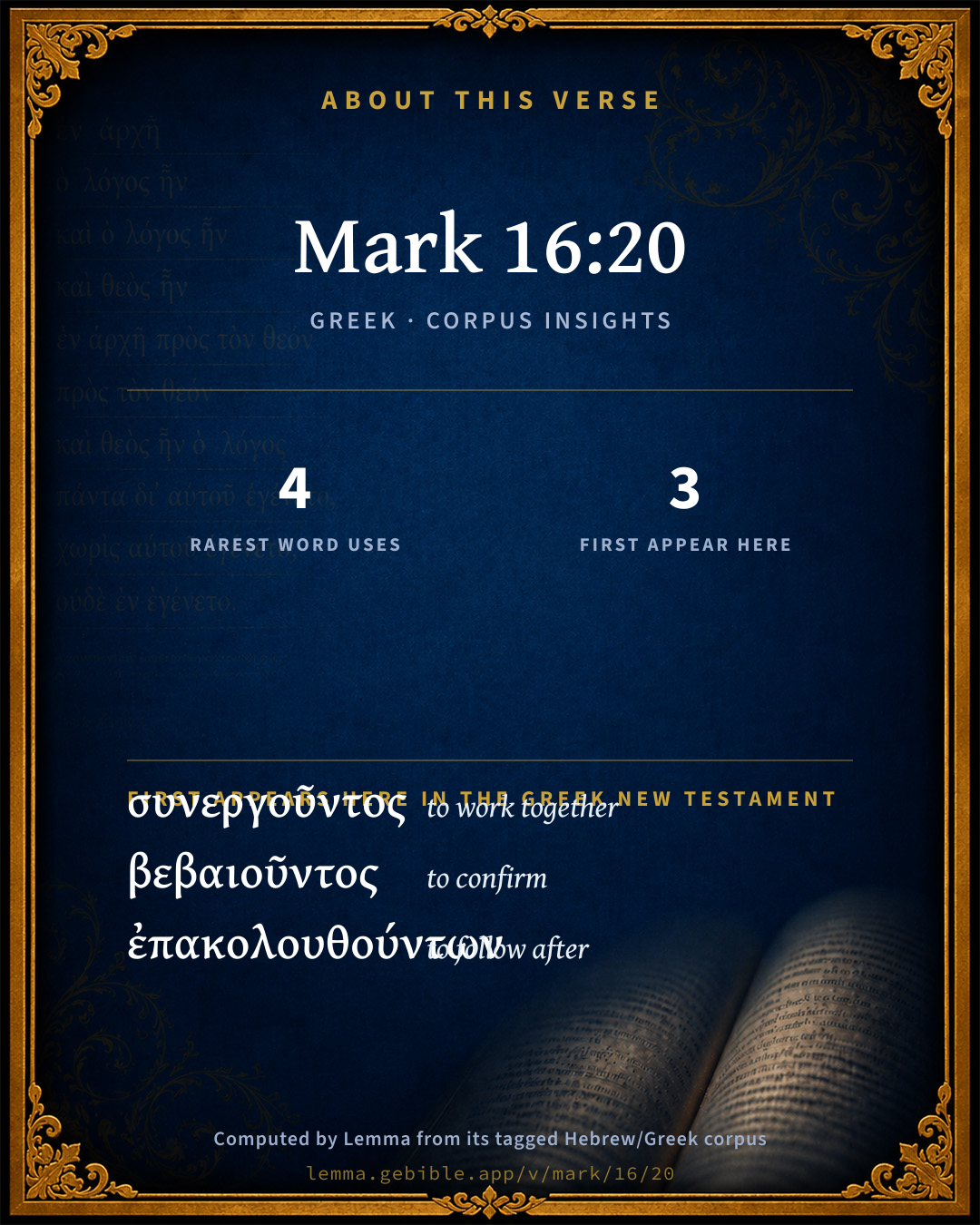
  • 3 first appearances in the Greek New Testament
Full analysis ↓
Download a study sheet

One document with this verse’s original text, its word-by-word gloss line, the meaning frame, cross-references with their text, attributed commentary, and full source and license credits — printable, and it pastes into notes with its structure intact.

This verse Autodidact and up

Study sheet (.html) Plain text (.txt)

A passage Seminary Student

Up to 50 verses in one chapter. A passage sheet keeps up to 6 commentary sources and 12 cross-references per verse, in the order this page ranks them, and says so on the sheet whenever that leaves anything out. Ask for a single verse and you get the Autodidact verse sheet above.

Everything on this page stays free to read, with no account — the sheet is a download of what is already on screen, not access to it.

Want to remove ads? Support Godless Engineer
Compare translations 3

The same verse in 3 English versions, stacked beneath the original-language interlinear above. Click any original word for its lexicon entry.

Each is an independent rendering of the whole verse — the interlinear is not word-aligned to these translations.

Highlighted words mark where these versions differ — a whole-verse word diff, not a word-by-word alignment.

  • World English Bible Public Domain
    They went out, and preached everywhere, the Lord working with them, and confirming the word by the signs that followed. Amen.
  • King James Version Public Domain
    And they went forth, and preached every where, the Lord working with them, and confirming the word with signs following. Amen.
  • unfoldingWord Literal Text CC BY-SA 4.0
    Now those, having gone out, preached everywhere, the Lord working with and confirming the word through the accompanying signs. Amen.]

unfoldingWord Literal Text — © unfoldingWord, licensed CC BY-SA 4.0. Word-aligned USFM3 via Door43 (git.door43.org/unfoldingWord/en_ult).

Versions to compare (up to 4)

3 of 4 selected

Show all 19 translations

Every available English version of this verse, each an independent rendering of the whole verse.

  • World English Bible Public Domain
    They went out, and preached everywhere, the Lord working with them, and confirming the word by the signs that followed. Amen.
  • Berean Standard Bible Public Domain
    And they went out and preached everywhere, and the Lord worked through them, confirming His word by the signs that accompanied it.
  • Majority Standard Bible Public Domain
    And they went out and preached everywhere, and the Lord worked through them, confirming His word by the signs that accompanied it. Amen.
  • King James Version Public Domain
    And they went forth, and preached every where, the Lord working with them, and confirming the word with signs following. Amen.
  • American Standard Version (1901) Public Domain
    And they went forth, and preached everywhere, the Lord working with them, and confirming the word by the signs that followed. Amen.
  • Revised Version (1885) Public Domain
    And they went forth, and preached everywhere, the Lord working with them, and confirming the word by the signs that followed. Amen.
  • Geneva Bible (1599) Public Domain
    And they went foorth, and preached euery where. And the Lord wrought with them, and confirmed the worde with signes that folowed. Amen.
  • Douay-Rheims (1899) Public Domain
    But they going forth preached every where: the Lord working withal, and confirming the word with signs that followed.
  • Young's Literal Translation Public Domain
    and they, having gone forth, did preach everywhere, the Lord working with `them', and confirming the word, through the signs following. Amen.
  • Literal Standard Version CC BY-SA 4.0
    and they, having gone forth, preached everywhere, the LORD working with [them], and confirming the word, through the signs following. Amen.]]
  • Unlocked Literal Bible CC BY-SA 4.0
    The disciples left and preached everywhere, while the Lord worked with them and confirmed the word by the signs that went with them.
  • unfoldingWord Literal Text CC BY-SA 4.0
    Now those, having gone out, preached everywhere, the Lord working with and confirming the word through the accompanying signs. Amen.]
  • Darby Bible Public Domain
    And they, going forth, preached everywhere, the Lord working with [them], and confirming the word by the signs following upon [it].
  • World Messianic Bible Public Domain
    They went out and preached everywhere, the Lord working with them and confirming the word by the signs that followed. Amen.
  • Webster's Bible Public Domain
    And they went forth, and preached every where, the Lord working with them, and confirming the word with signs following. Amen.
  • Free Bible Version CC BY-SA 4.0
    The disciples went out and spread the good news everywhere, and the Lord worked with them, confirming the message through miraculous signs that accompanied it.
  • Bible in Basic English Public Domain
    And they went out, preaching everywhere, the Lord working with them, and giving witness to the word by the signs which came after. So be it.
  • Text-Critical English NT CC BY 4.0
    Then the disciples went out and preached everywhere, while the Lord worked through them and confirmed the message by the signs that accompanied it. Amen.
  • Tyndale New Testament (1534) Public Domain
    And they went forth and preached every where. And the Lorde wrought with them and confirmed the worde with miracles that folowed.

Literal Standard Version (2020), Covenant Press — licensed CC BY-SA 4.0. Text via the HelloAO Bible API (eBible.org). Unlocked Literal Bible (unfoldingWord) — licensed CC BY-SA 4.0. Text via the HelloAO Bible API (eBible.org). unfoldingWord Literal Text — © unfoldingWord, licensed CC BY-SA 4.0. Word-aligned USFM3 via Door43 (git.door43.org/unfoldingWord/en_ult). Free Bible Version, Dr. Jonathan Gallagher — licensed CC BY-SA 4.0. Text via the HelloAO Bible API (eBible.org).

Word by word

More ways to search: Search by grammar → Find every occurrence → Compare this word →

Practice this passage: Drill this verse → Learn its vocabulary →

ἐπακολουθούντων
epakolouthéō
G1872
“to follow after”
Verb, Present, Active, Participle, Genitive, Plural, Neuter
Part of Speech
Verb
Tense
Present
Voice
Active
Mood
Participle
Case
Genitive
Number
Plural
Gender
Neuter
Full Thayer's Definition

Origin: "from G190 9">1909) and 190"

TDNT: 04:35,3

1. to follow (close) upon, follow after 2. to tread in one's footsteps i.e. to imitate his example
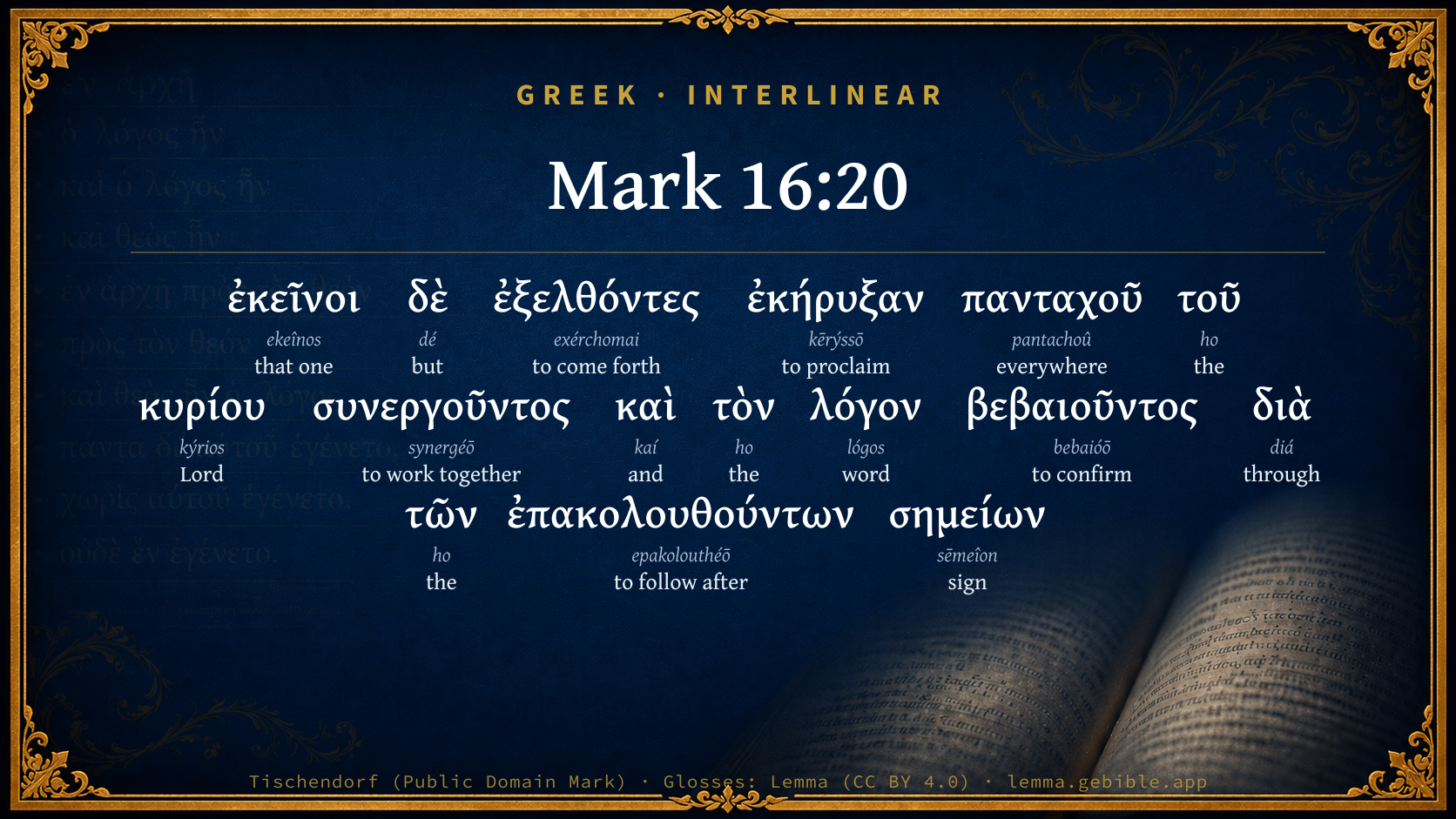
  1. ἐκεῖνοι ekeînos G1565 “that one” Demonstrative pronoun, Nominative, Plural, Masculine
  2. δὲ dé G1161 “but” Conjunction
  3. ἐξελθόντες exérchomai G1831 “to come forth” Verb, Aorist, Active, Participle, Nominative, Plural, Masculine
  4. ἐκήρυξαν kērýssō G2784 “to proclaim” Verb, Aorist, Active, Indicative, 3rd person, Plural
  5. πανταχοῦ pantachoû G3837 “everywhere” Adverb
  6. τοῦ ho G3588 “the” Article, Genitive, Singular, Masculine
  7. κυρίου kýrios G2962 “Lord” Noun, Genitive, Singular, Masculine
  8. συνεργοῦντος synergéō G4903 “to work together” Verb, Present, Active, Participle, Genitive, Singular, Masculine
  9. καὶ kaí G2532 “and” Conjunction
  10. τὸν ho G3588 “the” Article, Accusative, Singular, Masculine
  11. λόγον lógos G3056 “word” Noun, Accusative, Singular, Masculine
  12. βεβαιοῦντος bebaióō G950 “to confirm” Verb, Present, Active, Participle, Genitive, Singular, Masculine
  13. διὰ diá G1223 “through” Preposition
  14. τῶν ho G3588 “the” Article, Genitive, Plural, Neuter
  15. σημείων sēmeîon G4592 “sign” Noun, Genitive, Plural, Neuter

About this verse

These counts appear in no published source. They are computed here, from the morphology-tagged text and Lemma’s own curated glosses. What Lemma adds →

16
words
14
distinct lemmas
Gospels
section

Notable vocabulary

The rarest word here is ἐπακολουθούντων to follow after G1872 — appearing just 4 times in the whole Greek New Testament.

First appearance in Scripture

These words make their first canonical appearance in the Greek New Testament here:

  • συνεργοῦντος to work together G4903
  • βεβαιοῦντος to confirm G950
  • ἐπακολουθούντων to follow after G1872

Shared distinctive vocabulary

ἐπακολουθούντων to follow after G1872 occurs in 4 verses of the Greek New Testament. Also found in:

Repetition

A word recurs within this verse:

Cross-references

11

Topical passages linked to Mark 16:20 in the Treasury of Scripture Knowledge — connected by theme and wording, ordered by reader-vote popularity; previews shown in the World English Bible.

  • 1 Corinthians 2:4–5 My speech and my preaching were not in persuasive words of human wisdom, but in demonstration of the Spirit and of power,
  • Acts 14:3 Therefore they stayed there a long time, speaking boldly in the Lord, who testified to the word of his grace, granting signs and wonders to be done by their hands.
  • Acts 8:4–6 Therefore those who were scattered abroad went around preaching the word.
  • Romans 15:19 in the power of signs and wonders, in the power of God's Spirit; so that from Jerusalem, and around as far as to Illyricum, I have fully preached the Gospel of Christ;
  • Hebrews 2:4 God also bearing witness with them, both by signs and wonders, and by various works of power, and by gifts of the Holy Spirit, according to his own will?
  • Acts 5:12 By the hands of the apostles many signs and wonders were done among the people. They were all with one accord in Solomon's porch.
  • Acts 2:1–28 Now when the day of Pentecost had come, they were all with one accord in one place.
  • 1 Corinthians 3:6–9 I planted. Apollos watered. But God gave the increase.
  • Acts 4:30 while you stretch out your hand to heal; and that signs and wonders may be done through the name of your holy Servant Jesus."
  • 2 Corinthians 6:1 Working together, we entreat also that you not receive the grace of God in vain,
  • Acts 14:8–10 At Lystra a certain man sat, impotent in his feet, a cripple from his mother's womb, who never had walked.

Cross-references courtesy of OpenBible.info (CC BY 4.0).

Where the printed editions differ

2 variants

Places in this verse where the major printed Greek editions disagree on the wording in a way that affects the translation — a comparison of editions, not a manuscript-by-manuscript collation. The editions are the modern critical texts (Nestlé-Aland 28/27, SBL, Westcott-Hort, Tregelles, Tyndale House) and the traditional texts behind the KJV (the Textus Receptus and the Byzantine/Majority text). It is not a claim about which reading is original.

  1. Extra text
    ἐκεῖνοι δὲ ἐξελθόντες ἐκήρυξαν πανταχοῦ, τοῦ κυρίου συνεργοῦντος καὶ τὸν λόγον βεβαιοῦντος διὰ τῶν ἐπακολουθούντων σημείων.

    “They now having gone forth they preached everywhere, of the Lord [who] working with [them] and the word confirming through the accompanying signs.”

    In NA28NA27TynWHTregTRByz Not in SBL
  2. Extra text
    ἀμήν.]]

    “Amen.”

    In TynTRByz Not in NA28NA27SBLWHTreg

    ἐκεῖνοι δὲ ἐξελθόντες ἐκήρυξαν πανταχοῦ, τοῦ κυρίου συνεργοῦντος καὶ τὸν λόγον βεβαιοῦντος διὰ τῶν ἐπακολουθούντων σημείων. ἀμήν.]]¶ (ekeinoi de exelthontes ekēruxan pantachou tou kuriou sunergountos kai ton logon bebaiountos dia tōn epakolouthountōn sēmeiōn amēn) 'They now having gone forth they preached everywhere, of the Lord [who] working with [them] and the word confirming through the accompanying signs. Amen.' is only in traditional manuscripts

Textual data: Translators Amalgamated Greek New Testament (STEPBible TAGNT) · CC BY 4.0.

Commentary

Notes on Mark 16:20 from classic Christian and Jewish commentators (each source and its license shown beneath its notes). The classic Christian expositions comment on the surrounding passage and are grouped to its opening verse, so a note may address several verses; the Jewish commentaries on the Tanakh (Rashi and others) are per-verse, so they appear only where the commentator wrote on this verse.

Lemma curates 59 commentaries, every one of them public domain or Creative Commons licensed, each selected and text-cleaned for this edition rather than reprinted as found. About our sources →

The Biblical Illustrator

Joseph S. Exell

Mar_16:20

And preached everywhere.

The publication of the gospel by the apostles

I. The general publication of the Gospel by the apostles. Their industry in this work was almost incredible. What pains did they take! What hazard did they run! What difficulties and discouragements did they contend with! And yet their success was greater than their industry, and beyond all human expectation, as will appear from the following considerations.

1. The vast spreading of the gospel in so short a time (Rev_14:6; Isa_60:8). In the space of about thirty years after our Lords death, the gospel was not only diffused through the greatest part of the Roman Empire, but had reached as far as Parthia and India.

2. The wonderful power and efficacy of it upon the lives and manners of men (Rom_15:18). The change of religion led to an entire change of life. So arrange an effect had the gospel upon the lives of its professors, that Tertullian challenges the Roman Senate to instance in anyone who bore the title of Christian, who was condemned as a thief, or a murderer, or a sacrilegious person, or who was guilty of any of those gross enormities for which so many pagans were every day punished.

3. The weakness and insignificance of the instruments employed in this great work.

4. The mighty opposition that was raised against the gospel. At its first appearance it could not be otherwise, but that it must meet with a great deal of difficulty and opposition, from the lusts and vices of men, which it so plainly and severely condemned, also from the prejudices of men brought up in a contrary religion. Moreover, the powers of the world combined their forces against it.

5. The great discouragements to the embracing the profession of it. There was nothing to invite and engage men to it but the consideration of another world; for all the evils of this world threatened everyone who took the profession of Christianity upon him. Yet, in spite of every obstacle, Christianity not only lived, but grew and prospered. Can any one of the false religions of the world pretend to have been propagated and established in such a manner, merely by their own force, and the evidence and power of truth upon the minds of men; and to have borne up and sustained themselves so long under such fierce assaults, as Christianity has done?

II. The reason of the great efficacy and success of the apostles preaching. The power of the Holy Ghost accompanied it, both inwardly operating on the minds of men, and also convincing them by outward and visible signs.

1. Consider the nature of the Spirits gifts, and the use and end to which they served.

2. Show how the gospel was confirmed by them. Conclusion: How sad that this religion, which was so powerful at first, and has Divinity so clearly stamped upon it, should yet have so little effect upon most of those who call themselves Christians! (Heb_2:1-4). (Archbishop Tillotson.)

Miracles the most proper way of proving the Divine authority of any religion

An account of the means whereby the preaching of the apostles became so successful. Not from any mighty talent of persuasion, or extraordinary faculty of reasoning with which they were endued; not by any intrinsic evidences of truth, which the distinguishing doctrines they preached carried with them; nor by any other method purely human and natural; but by Divine power and assistance, accompanying them in every step they took, and miraculously blessing their endeavours. Miracles are fitly termed signs, because done to signify who are appointed by God, as the messengers of His will to men. Their suitability for this purpose will appear, if we consider-

I. The common sense and opinion of mankind. All religions, whether true or false, have at their first setting out, endeavoured to countenance themselves by real or pretended miracles.

II. The general nature of this sort of evidence. How can a man prove his Divine mission but by a miracle, i.e., by doing something which all confess that none but God can do.

III. Some peculiar characters and properties that belong to them.

1. They are extremely fit to awaken mens attention. Curiosity is the first step towards conviction. When once men are possessed with a due regard for the messenger, they will be sure to listen carefully to the message he brings.

2. They are the shortest and most expeditious way of proof. Other kinds of proof were fitted only leisurely to loosen the knots, which the disputers of this world tied, in order to disturb the apostles in the execution of their ministry; miracles, like the heros sword, divided these entanglings at a stroke, and at once made their way through them.

3. They are an argument of the most universal force and efficacy, equally reaching all capacities and understandings. Some have not leisure for philosophical research, and others have not sufficient ability to pursue it; but a miracle carries its own evidence in its face, and is patent to all. (Bishop Atterbury.)

Signs following the gospel

While the text refers immediately to facts in the infancy of our religion, it is also identified with permanent principles, and presents matter of momentous contemplation to ourselves and all generations of men.

I. An important communication delivered.

1. Its nature.

2. Its extent.

II. A conclusive attestation, by which this communication was confirmed.

1. Miraculous agencies.

2. Spiritual changes in the human character. (See Act_2:41; Act_4:4; Act_9:1-43).

III. An imperative claim, which this communication urges upon all to whom it is addressed.

1. To be believed.

2. To be promulgated (Rom_10:14-16). (James Parsons.)

Divine cooperation in Christianity

I know not precisely what advances may be made by the intellect of an unassisted savage; but that a savage in the woods could not compose the Principle of Newton, is about as plain as that he could not create the world. I know not the point at which bodily strength must stop; but that a man cannot carry Atlas or Andes on his shoulders is a safe position. The question, therefore, whether the principles of human nature, under the circumstances in which it was placed at Christs birth, will explain His religion, is one to which we are competent, and is the great question on which the whole controversy turns. Now we maintain that a great variety of facts belonging to this religion-such as the character of its Founder; its peculiar principles; the style and character of its records; its progress; the conduct, circumstances, and sufferings of its first propagators; the reception of it from the first on the ground of miraculous attestations; the prophecies which it fulfilled and which it contains; its influence on society, and other circumstances connected with it;-are utterly inexplicable by human powers and principles, but accord with, and are fully explained by, the power and perfections of God. (Dr. Channing.)

Christianity, a living power

Miracles and the fulfillments of prophecy ought no longer to be put forward in the forefront of our plea for Christianity, but should be subordinated to the exhibition of the actual power of Christianity in the intellectual, moral, and spiritual spheres of our being. In the place of prophecy we have history-the history of eighteen centuries, during which the power of Christs light and grace has been seen in actual operation, subduing to Him the human soul and human society, and thus evincing its unique and supernatural character. Instead of the miracles of the gospel we have in present reality what may fairly be called a moral and spiritual miracle, in the transcendent influence which Christ, at this moment, is exercising over the world. We stand face to face with an actual Christianity, which is unquestionably the most marvellous spiritual phenomenon in the worlds history; and it cannot be right for us to endeavour to learn Christ by proceeding as if we could obliterate eighteen centuries, and forget that there is such a thing as a living Christianity. (Bishop Alfred Barry.)

The Lord working with them:-Spread of Christianity

Arnobius, a heathen philosopher who became a Christian, speaking of the power which the Christian faith exercised over the minds of men, says: Who would not believe it, when he sees in how short a time it has conquered so great knowledge? Orators, grammarians, rhetoricians, lawyers, physicians, and philosophers, have thrown up their opinions, which but a little before they held, and have embraced the doctrines of the gospel!

The gospel everywhere

Close the eyes for two and a half centuries, and a Roman emperor has torn the eagle from his standard to set there the cross, and the mistress of the world is at the feet of Him she crucified. Wait, and look again; a thousand years have passed-just a day with God-and the power of this Name has subdued the wildness of German forests, leaped the Channel, and raised the hewn timber of the tree of Calvary against the wild Druids oak. And today, when all civilization is at its height, and the world is quivering with fresh powers and measureless hopes, there is no other name which stands for a moment beside that of the risen Lord. Nor has He won His rights unchallenged. No such battles were ever fought as those which have raged about Him. His teachings, His nature, His very existence, have been the strife of the ages. We ourselves have seen the combat: and now, thanks to the criticism which doubted and the infidelity which denied, we know with demonstration never had before, that Jesus did live on this earth, that He spoke these words in the Gospels, and that His character and His influence are merely inexplicable on the supposition of His mere manhood. (C. M. Southgate.)

Divine power in the Church

We recall the story of the Book of the Gospels-Cuthberts own book-which the monks at Lindisfarne carried with them in their wanderings. They set sail for Ireland; a storm arose; the book fell overboard, and was lost; they were driven back to the English coast. Disconsolate, they went in quest of the precious volume: for a long time they searched in vain; but at length (so says the story) a miraculous revelation was vouchsafed to them, and, following its directions, they found the book on the sands far above high-water mark, uninjured by the waves-nay, even more beautiful for the disaster. Does not this story well symbolize the power of the eternal gospel working in the Church? Through the carelessness of man, it may disappear amidst the confusion of the storms; the waves may close over it and hide it from human sight. But lost-lost forever-it cannot be. It must reassert itself, and its glory will be the greater for the temporary eclipse which it has undergone. (Bishop J. B. Lightfoot.)

Vitality of Christs religion

Christianity throughout eighteen centuries has shown itself possessed of the peculiar power of recovering life when apparently almost defunct-a peculiarity entirely absent in every mythology, which, when once dead, never can be restored, but remains forever in the realm of shadows; that Christianity has a phoenix nature, and after every historic death arises anew from the grave; and that along with the resurrection which Christianity has had in our day, has also arisen from the grave the true conception of humanity. (Bishop Martensen.)

With signs following-The Churchs evidences

Where the spiritually blind are enlightened, the spiritually dead quickened, the spiritually deaf and dumb made to hear devoutly and to speak piously, the spiritually lame made to walk in the paths of righteousness and to be active in every good work, and the spiritually leprous are cleansed from sins,-there the Lord is confirming the Word with signs following; for these are signs and wonders greater than physical changes, the greater deeds that our Lord promised that His disciples would perform. These signs still follow the preaching of the Word; and the age of miracles of grace is not past, nor shall it ever pass while time lasts. (T. M. Lindsay, D. D.)

Signs

That is, such miracles as should be the seals and testimony of the truth. These miracles were therefore-

1. Signs to the apostles themselves, so that they might not despair at the greatness of the work which they were commissioned to do.

2. Signs to others, and a confirmation of the truth which the apostles taught. Hence Christ does not call them miracles, but signs: since the very object of the miracles which followed their teaching was to have this moral effect, and to testify to those who needed this proof, that the doctrine which they delivered was from God. (W. Denton, M. A.)

Signs

Three signs which follow all effectual preaching-

(1) Compunction of file hearers;

(2) conversion of sinners;

(3) confirmation of the just.

Conclusion: The figure which stands out from this book is Jesus. It is the gospel of Jesus Christ, the Son of God. A man must be holy to comprehend the holiness of Jesus. Let us suppose the case of a sharp man, who has neither taste nor genius, standing before a great picture; he will point out flaw after flaw in Raphael. Place one who has neither musical appreciation, nor modesty to admit it, where he must hear Beethoven. It is an unmeaning noise, which gives him a headache. Even so, the lower the moral and spiritual life may be, the less is Jesus understood and loved. To an easy, soft-mannered, hard-hearted man of the world; to a subtle, bitter, selfish scholar, with the delicate intellectual egotism, and the fatal gilt of analysis a outrance, Gethsemane and the cross may be a scandal or a mockery, The gospel, which seems so poor and pale when we rise from the songs of poets and the reasonings of philosophers, is a test of our spirit. Let some ambitious students in philosophy-some who have been communing for hears with the immortal masters of history, charmed with the balanced masses and adjusted perspectives of the composition, speak out their mind today upon this Gospel of St. Mark. They will not place it very high upon their list. But turn to it tomorrow, when the end of your toil finds you disappointed men; when sorrow visits you; when, as you put your hand upon the wall of your room, memory, like a serpent, starts out and stings you. Then you will recognize the infinite strength and infinite compassion of Jesus. Out of your weakness and misery, out of your disappointment, you will feel that here you can trust in a nobility that is never marred, and rest that tired heart of yours upon a love that never fails St. Mark is the Gospel whose emblem is the lion, whose hero is full of Divine love and Divine strength. It is the Gospel which was addressed to the Romans to free them from the misery of scepticism, from the grinding dominion of iron superhuman force unguided by a loving will. Here, brief as it is, we have, in its essential germs, all the theology of the Church. Had every other part of the New Testament perished, Christendom might have been developed from this. A mans faith does not consist of the many things which he affects to believe or finds it useful to believe (as men are said to be doing in France), but of the few things which he really believes, and with which he stands, fronting his own soul and eternity. This faith in the gospel of Jesus Christ, the Son of God, is sufficient. Hold it fast, and you shall find the power of one of our Lords promises which is peculiar to this Gospel. If you are called upon to handle the serpents, or to drink the deadly things of science and philosophy, you shall lift up the serpent as a standard of victory. The cup of poison shall not reach your heart as it reached the heart of Socrates, when the sun was going down behind the hill tops. It shall not hurt you. Hold fast this gospel in that which tries many who are undisturbed by speculative doubt, in conscious sinfulness, in the allurements of lust. Hold it fast in the din of voices that fill a Church distracted by party cries, and He who has instructed His Church by the heavenly doctrine of His Evangelist St. Mark, will grant that, being not like children, carried away by every blast of vain doctrine, you shall be established in the truth of His holy gospel. (Bishop William Alexander.)

Encouragement of Gods presence

I have lately been full of perplexities about various temporal concerns. I have met with heavy afflictions; but in the mount the Lord is seen. All my hope is in God; without His power no European could possibly be converted, and that can convert any Indian. Though the superstitions of the Hindoos were a thousand times stronger than they are, and the example of Europeans a thousand times worse; though I were deserted by all, and persecuted by all, yet my hope, fixed on the Rock, will rise superior to every obstruction, and triumph over every trial. I feel happy in this, that I am engaged in the work of God, and the more I am engaged in it, the more I feel it a rich reward. Indeed, I would rejoice in having undertaken it, even though I should perish in the attempt. (William Carey.)

God with His servants

If I go to a large factory and see a hundred straps flying in all directions, I ask where is the motive power-the engine. So you are walking with the power of God, upheld by the arm of righteousness. If one of your merchantmen should ask me to go to Philadelphia to conduct a business for him, and should say to me: I expect you to carry on this business with your own capital, I would think it very strange. It would not be his business, but my own. That is the mischief with all Christians. They are in business for the Lord, but working with their own capital. (Henry Varley.)

Christians implements in the hands of God

It is one thing to attempt to row a ship; it is another to unfurl the sails, and send her leaping, with a fresh breeze, like a thing of life, across the big opposing waves. It is one thing for a man to try to drag a ear on a railroad; it is another to fill the boiler of the locomotive with water, put in fuel, kindle a strong fire, and soon fly like the wind over mountains and plains, counting the long, loaded train a mere plaything. But these analogies, drawn from our human employment of the material forces of nature, and feeble to illustrate the difference between the man who attempts to influence and convert men, and to advance spiritual and eternal things by any philosophy of the wisest of men, or by any motives of time, and the man whose whole and sincere aim it is to be but an implement in the hand of the Almighty. Then his prayers move the arm that moves the skies. Then his labours are not his own; but the eternal Father, the loving Redeemer, the Holy Ghost, the angels, the inspired Word, the prayers of the saints-all the infinite powers of good in heaven and earth-work through him. (Dr. Cuyler.)

.

The Biblical Illustrator, edited by Joseph S. Exell (c. 1880s–1900s) — public domain. Text from a community e-Sword module.

Bengel's Gnomon

Johann Albrecht Bengel

Mar 16:20. Πανταχοῦ, everywhere) Mar 16:15. At the time when Mark wrote his Gospel, even then already the apostles had gone forth into all the world; Rom 10:18: on this account it is that, excepting Peter, James the Elder, John, James the Less, and Jude, we read no mention in the books of the New Testament of any apostle, save Paul, after the second or fifteenth chapter of the Acts. Each one became most known in that place and country where he preached. The name of no apostle was celebrated throughout the whole world, but the name of Jesus Christ alone.[13]

[13] Bengel, J. A. (1860). Vol. 1: Gnomon of the New Testament (M. E. Bengel & J. C. F. Steudel, Ed.) (J. Bandinel & A. R. Fausset, Trans.) (491–577). Edinburgh: T&T Clark.

Bengel's Gnomon of the New Testament — English translation (T&T Clark, Edinburgh, 1860) — public domain. Text from a community e-Sword module.

Meyer's Critical & Exegetical Commentary

Heinrich August Wilhelm Meyer

Mar_16:20. With the ascension the evangelic history was at its end. The writer was only now concerned to add a conclusion in keeping with the commission given by Jesus in Mar_16:15. He does this by means of a brief summary of the apostolic ministry, by which the injunction of Jesus, Mar_16:15, had been fulfilled, whereas all unfolding of its special details lay beyond the limits of the evangelic, and belonged to the region of the apostolic, history; hence even the effusion of the Spirit is not narrated here.

ἐκεῖνοι] the ἕνδεκα, Mar_16:14.

δέ] prepared for by μέν, Mar_16:19.

ἐξελθόντες] namely, forth from the place, in which at the time of the ascension they sojourned. Comp. πορευθέντες, Mar_16:15; Jerusalem is meant.

πανταχοῦ] By way of popular hyperbole; hence not to be used as a proof in favour of the composition not having taken place till after the death of the apostles (in opposition to Fritzsche), comp. Rom_10:18; Col_1:6.

τοῦ κυρίου] nor God (Grotius, and also Fritzsche, comparing 1Co_3:9; Heb_2:4), but Christ, as in Mar_16:19. The σημεῖα are wrought by the exalted One. Comp. Mat_28:20. That the writer has made use of Heb_2:3-4 (Schulthess, Fritzsche), is, considering the prevalence of the thought and the dissimilarity of the words, arbitrarily assumed.

διὰ τῶν ἐπακολουθ. σημείων] by the signs that followed (the λόγος). The article denotes the signs spoken of, which are promised at Mar_16:17-18, and indeed promised as accompanying those who had become believers; hence it is erroneous to think, as the expositors do, of the miracles performed by the apostles. The confirmation of the apostolic preaching was found in the fact that in the case of those who had become believers by means of that preaching the σημεῖα promised at Mar_16:17-18 occurred.

ἐπακολουθ. is foreign to all the Gospels; it occurs elsewhere in the N. T. in 1Ti_5:10; 1Ti_5:24; 1Pe_2:21; in classical Greek it is very frequently used.

REMARK.

The fragment before us, Mar_16:9-18, compared with the parallel passages of the other Gospels and with Act_1:3, presents a remarkable proof how uncertain and varied was the tradition on the subject of the appearances of the Risen Lord (see on Mat_28:10). Similarly Mar_16:19, comp. with Luk_24:50 f., Act_1:9 ff., shows us in what an uncertain and varied manner tradition had possessed itself of the fact of the ascension, indubitable as in itself it is, and based on the unanimous teaching of the apostles.

Meyer — Critical and Exegetical Commentary on the New Testament — English translation by Peter Christie, edited by Frederick Crombie (T&T Clark, 1880) — public domain. Text from a community e-Sword module.

Cambridge Greek Testament for Schools and Colleges

20. ἐκεῖνοι δέ. The Apostles and their colleagues in the ministry of the word; cf. Mar 16:10-11; Mar 16:13.

ἐξελθόντες. This shows how condensed this summary of Apostolic labour is. Much took place before there was a Church at Jerusalem which could send out missionaries to preach everywhere.

συνεργοῦντος. The verb is found nowhere in the Gospels, and it is used nowhere in the N.T. of Christ cooperating. In Rom 8:28 it is used of the cooperation of God, if ὁ θεός is the right reading. In the Testaments we have ὁ θεὸς συνεργεῖ τῇ ἁπλότητί μου (Issach. Mar 3:7; Gad Mar 4:7).

βεβαιοῦντος. Confirming. The verb is not found elsewhere in any of the Gospels, but it is often used of confirming a bargain. Deissmann, Bib. St. p. 109.

ἐπακολουθούντων. This verb also is not found in the Gospels. The ἐπί indicates the direction of the attesting signs; see on 1Ti 5:10 and cf. 1Pe 2:21. In papyri, ἐπηκολούθηκα is found in accounts in the sense of “verified.” That may be the meaning here; “signs which authenticated the word” (G. Milligan, N.T. Documents, p. 78). Perhaps the best comment on the verse is Heb 2:4, a passage which “is of deep interest as shewing the unquestioned reality of miraculous gifts in the early Church; and the way in which they were regarded as coordinate with other exhibitions of divine power” (Westcott).

APPENDIX

ADDITIONAL NOTE ON Mar 16:14

The now well-known interpolation in this verse was known to Jerome, who says that it existed in “some copies and especially Greek MSS.” (Dial. c. Pelag. ii. 15), and he quotes a portion of the reply put into the mouths of the Apostles. His quotation runs thus: Et illi satisfaciebant dicentes; Saeculum istud iniquitatis et incredulitatis sub Satana est, qui non sinit per immundos spiritus veram Dei apprehendi virtutem. Idcirco jam nunc revela justitiam tuam. Instead of sub Satana est qui some MSS. have substantia est quae, which yields very poor sense and is now known to be certainly wrong. For in 1907 Mr C. L. Freer bought in Cairo a very interesting MS. of the Four Gospels in Greek, and the text of Mk contains the whole of the interpolation of which Jerome has given part in a Latin translation. This Greek MS. is believed to be of the fifth or sixth century; indeed some critics have thought that it may be of the fourth. The order of the Gospels is that of [3595][3596] and the old Latin MSS., viz. Mt., Jn, Lk., Mk, and the MS. (or that from which it was copied) seems to have been made from different texts. The text of Jn is superior to that of Mt. In Jn it generally agrees with [3597] in Mt. generally with the later official or Byzantine text. In Lk. down to Mar 8:12 it agrees mainly with [3598] and for the rest of the Gospel mainly with the later text. These features, however, do not greatly concern us. In Mk the text varies, but it has one or two unique readings. In Mar 1:27 it has “What is this new, this authoritative teaching, and that He commandeth even the unclean spirits and they obey Him?” In Mar 9:24 it has “the spirit of the child” instead of “the father of the child.” But for us the most interesting feature is that it contains the appendix to Mk (Mar 16:9-20) and after Mar 16:14 has the interpolation in question. The text of it runs thus:—

[3595] Codex Bezae. 6th cent. Has a Latin translation (d) side by side with the Greek text, and the two do not quite always agree. Presented by Beza to the University Library of Cambridge in 1581. Remarkable for its frequent divergences from other texts. Contains Mark, except Mar 16:15-20, which has been added by a later hand. Photographic facsimile, 1899.

[3596] Codex Monacensis. 10th cent. Contains Mar 6:47 to Mar 16:20. Many verses in 14, 15, 16 are defective.

[3597] Codex Vaticanus. 4th cent., but perhaps a little later than א. In the Vatican Library almost since its foundation by Pope Nicolas V., and one of its greatest treasures. The whole Gospel, ending at Mar 16:8. Photographic facsimile, 1889.

[3598] Codex Vaticanus. 4th cent., but perhaps a little later than א. In the Vatican Library almost since its foundation by Pope Nicolas V., and one of its greatest treasures. The whole Gospel, ending at Mar 16:8. Photographic facsimile, 1889.

κἀκεῖνοι ἀπελογοῦντ(ο) λέγοντες ὅτι ὁ

αἰὼν οὗτος τῆς ἀνομίας καὶ τῆς ἀπιστίας

ὑπὸ τὸν Σατανᾶν ἐστιν ὁ μὴ ἐῶν τὰ ὑπὸ

τῶν πνε(υμ)άτων ἀκάθαρτα τὴν ἀλήθειαν

τοῦ θ(εο)ῦ καταλαβέσθαι (καὶ) δύναμιν. διὰ

τοῦτο ἀποκάλυψον σοῦ τὴν δικαιοσύ-

νην ἤδη, ἐκεῖνοι ἔλεγον τῷ Χ(ριστ)ῷ καὶ ὁ

Χ(ριστὸ)ς ἐκείνοις προσέλεγεν ὅτι πεπλήρω-

ται ὁ ὅρος τῶν ἐτῶν τῆς ἐξουσίας τοῦ

Σατανᾶ, ἀλλὰ ἐγγίζει ἄλλα δ(ε)ινά· καὶ ὑ-

πὲρ (τ)ῶν [ἐγὼ] ἁμαρτησάντων (ἐγὼ) παρεδόθην

εἰς θάνατον ἵνα ὑποστρέψωσιν εἰς τὴν

ἀλήθειαν καὶ μηκέτι ἁμαρτήσωσιν,

ἵνα τὴν ἐν τῷ οὐρανῷ πν(ευματ)ικὴν καὶ ἄ-

φθαρτον τῆς δικαιοσύνης δόξαν

κληρονομήσωσιν. ἀλλὰ πορευθέντες …

This is evidently the work of a careless and unintelligent scribe, and the text here and there is evidently corrupt, but the disciples’ reply to Christ’s rebuke is clear enough, and what He said to them in resuming His address is also fairly clear. We may render the whole thus:—“And they excused themselves (Rom 2:15; 2Co 12:19), saying that this age of lawlessness and unbelief is under Satan, who, through the agency of unclean spirits, suffereth not the truth and power of God to be apprehended (Eph 3:18). For this cause reveal Thy righteousness now, they said to Christ. And Christ addressed them, The limit of the years of the authority of Satan has been fulfilled, but other terrors draw nigh. And for the sake of those who have sinned I was delivered over unto death, that they may return unto the truth and sin no more, that they may inherit the spiritual and incorruptible glory of righteousness which is in heaven. But go ye into all the world, etc.”

When we had only the short extract in Jerome, Zahn was inclined to believe that it was not a gloss, but a bit of conversation handed down by tradition (Introd. to N.T. II. p. 472). The words attributed to Christ have not much resemblance to those which are preserved in the Gospels; they most probably represent what some Egyptian Christians of the second or third century thought that He might have said.

INDEX

II. GREEK

[3599]ἀββᾶ Mar 14:36

[3599] A dagger denotes that the word is not found in LXX.

[3600]Ἀβιαθάρ Mar 2:26

[3600] An asterisk denotes that the word is not found elsewhere in N.T., and such words are included in the index, even if there is no note on them in the commentary.

ἀγαθοποιέω Mar 3:4

ἀγαθός Mar 10:17-18

ἀγαπάω Mar 10:21; Mar 12:30-31

ἀγαπητός Mar 1:11, Mar 9:7, Mar 12:6

[3601]ἀγγαρεύω Mar 15:21

[3601] A dagger denotes that the word is not found in LXX.

ἄγγελος Mar 1:13, Mar 8:38, Mar 12:25, Mar 13:27

ἅγιος Mar 1:24, Mar 6:20

[3602]ἄγναφος Mar 2:21

[3602] A dagger denotes that the word is not found in LXX.

ἀγνοέω Mar 9:32

ἀγορά Mar 6:56, Mar 7:4

ἀγοράζω Mar 6:37

[3603]ἀγρεύω Mar 12:13

[3603] An asterisk denotes that the word is not found elsewhere in N.T., and such words are included in the index, even if there is no note on them in the commentary.

ἀγρός Mar 5:14, Mar 6:36, Mar 11:8, Mar 13:16, Mar 15:21

ἀγρυπνέω Mar 13:33

ἄγω Mar 1:38

ἀδελφή Mar 3:35, Mar 6:3

ἀδελφός Mar 3:35, Mar 6:3, Mar 12:19, Mar 12:12

ἀδημονέω Mar 14:33

ἄζυμος Mar 14:1

ἀθετέω Mar 6:26

αἷνα Mar 5:25, Mar 14:24

αἴρω Mar 2:3; Mar 2:12; Mar 2:21, Mar 4:15, Mar 6:43, Mar 8:34, Mar 15:21

αἰτέω Mar 6:22; Mar 6:24, Mar 10:38, Mar 11:24

αἰτία Mar 15:26

αἰών Mar 3:29, Mar 4:19, Mar 10:30

αἰώνιος Mar 3:29, Mar 10:17

ἄκανθα Mar 4:7

ἀκάνθινος Mar 15:17

ἀκοή Mar 1:28, Mar 13:7

ἀκολουθέω Mar 2:14, Mar 3:7, Mar 5:24, Mar 9:38, Mar 10:21; Mar 10:28; Mar 10:52

ἀκούω Mar 2:1, Mar 3:8, Mar 4:3; Mar 4:9; Mar 4:15, Mar 6:11; Mar 6:14; Mar 6:20, Mar 7:25

ἀκρίς Mar 1:6

ἄκρον Mar 13:27

ἀκυρόω Mar 7:13

ἀλάβαστρος Mar 14:3

[3604]ἄλαλος Mar 7:37, Mar 9:17; Mar 9:25

[3604] An asterisk denotes that the word is not found elsewhere in N.T., and such words are included in the index, even if there is no note on them in the commentary.

ἅλας Mar 9:50

ἁλεεύς Mar 1:17

ἁλείφω Mar 6:13, Mar 16:1

[3605]ἀλεκτοροφωνία Mar 13:35

[3605] A dagger denotes that the word is not found in LXX.

ἀλέκτωρ Mar 14:30; Mar 14:72

ἀλήθεια Mar 5:33, Mar 12:14; Mar 12:32

ἀληθής Mar 12:14

ἀληθῶς Mar 14:70, Mar 15:39

ἀλλά Mar 2:17; Mar 2:22, Mar 3:29, Mar 4:22, Mar 6:9, Mar 7:19, Mar 9:37, Mar 10:40

[3606]ἀλλαχοῦ Mar 1:38

[3606] An asterisk denotes that the word is not found elsewhere in N.T., and such words are included in the index, even if there is no note on them in the commentary.

ἀλλήλων Mar 4:41, Mar 15:31

ἄλλος Mar 4:18; Mar 4:36, Mar 6:15

ἅλυσις Mar 5:3

ἁμαρτία Mar 1:4, Mar 2:5

ἁμαρτωλός Mar 2:15

ἀμήν Mar 3:28, Mar 10:15, Mar 12:43, Mar 13:30, Mar 14:18

ἄμπελος Mar 14:25

ἀμπελών Mar 12:1

[3607]ἀμφιβάλλω Mar 1:16

[3607] An asterisk denotes that the word is not found elsewhere in N.T., and such words are included in the index, even if there is no note on them in the commentary.

[3608]ἄμφοδον Mar 11:4

[3608] An asterisk denotes that the word is not found elsewhere in N.T., and such words are included in the index, even if there is no note on them in the commentary.

ἀναβαίνω Mar 4:7, Mar 6:51, Mar 10:32

ἀναβλέπω Mar 6:41, Mar 7:34, Mar 8:24, Mar 10:51

[3609]ἀνάγαιον Mar 14:15

[3609] A dagger denotes that the word is not found in LXX.

ἀναγινώσκω Mar 2:25, Mar 12:10; Mar 12:26, Mar 13:14

ἀναγκάζω Mar 6:45

ἀναθεματίζω Mar 14:71

ἀνάκειμαι Mar 14:18

ἀνακλίνω Mar 6:39

ἀνακράζω Mar 1:23

[3610][3611]ἀνακυλίω Mar 16:4

[3610] An asterisk denotes that the word is not found elsewhere in N.T., and such words are included in the index, even if there is no note on them in the commentary.

[3611] A dagger denotes that the word is not found in LXX.

ἀναλαμβάνω Mar 16:19

ἄναλος Mar 9:50

ἀναμιμνήσκω Mar 11:21

ἀναπαύω Mar 14:41

[3612]ἀναπηδάω Mar 10:50

[3612] An asterisk denotes that the word is not found elsewhere in N.T., and such words are included in the index, even if there is no note on them in the commentary.

ἀνασείω Mar 15:11

ἀνάστασις Mar 12:18

ἀναστενάζω Mar 8:12

ἀνατέλλω Mar 4:5, Mar 16:2

ἀναφέρω Mar 9:2

ἀναχωρέω Mar 3:7

ἄνεμος Mar 13:27

ἀνήρ Mar 6:44

ἄνθρωπος Mar 1:17, Mar 2:27, Mar 4:26, Mar 7:7, Mar 8:24, Mar 14:21

ἀντάλλαγμα Mar 8:37

ἀντί Mar 10:45

ἀπαγγέλλω Mar 5:19

ἀπαίρομαι Mar 2:20

ἀπαντάω Mar 14:13

ἀπαρνέομαι Mar 8:34, Mar 14:30

ἅπας Mar 11:32, Mar 16:15

ἀπάτη Mar 4:19

ἀπέρχομαι Mar 1:42, Mar 5:24, Mar 6:32, Mar 7:24

ἀπέχω Mar 14:41

ἀπιστέω Mar 16:16

ἀπιστία Mar 9:24, Mar 16:14

ἄπιστος Mar 9:19

ἀπὸ μακρόθεν Mar 5:6, Mar 8:3

ἀποβάλλω Mar 10:50

ἀποδημέω Mar 12:1

[3613]ἀπόδημος Mar 13:34

[3613] An asterisk denotes that the word is not found elsewhere in N.T., and such words are included in the index, even if there is no note on them in the commentary.

ἀποδίδωμι Mar 12:17

ἀποδοκιμάζω Mar 8:31, Mar 12:10

ἀποθνήσκω Mar 5:35; Mar 5:39, Mar 12:20

ἀποκαθιστάνω Mar 3:5, Mar 9:12

ἀποκεφαλίζω Mar 6:16

ἀποκρίνομαι Mar 3:33, Mar 7:28, Mar 8:29, Mar 9:5, Mar 10:3; Mar 10:51, Mar 11:14, Mar 12:28, Mar 14:48

ἀπολαμβάνω Mar 7:33

ἀπόλλυμι Mar 1:24, Mar 8:35, Mar 12:9

ἀπολύω Mar 6:36; Mar 6:45, Mar 8:3, Mar 15:6; Mar 15:15

ἀποπλανάω Mar 13:22

ἀπορέω Mar 6:20

ἀποστάσιον Mar 10:4

[3614]ἀποστεγάζω Mar 2:4

[3614] An asterisk denotes that the word is not found elsewhere in N.T., and such words are included in the index, even if there is no note on them in the commentary.

ἀποστέλλω Mar 3:14, Mar 4:29, Mar 6:7; Mar 6:27, Mar 11:1; Mar 11:3, Mar 12:3; Mar 12:13, Mar 13:27, Mar 14:13

ἀποστερέω Mar 10:19

ἀπόστολος Mar 3:14, Mar 4:30

ἀποτάσσομαι Mar 6:46

ἅπτομαι Mar 5:30

ἀπώλεια Mar 14:4

ἄρα Mar 11:13

ἄρτοι τῆς προθέσεως Mar 2:26

ἄρτον φαγεῖν Mar 7:2

ἄρτος Mar 6:8; Mar 6:38

ἀρτύω Mar 9:50

ἀρχή Mar 1:1, Mar 10:6

ἀρχιερεύς Mar 2:26, Mar 8:31, Mar 11:18; Mar 11:27, Mar 15:31

ἀρχισυνάγωγος Mar 5:22; Mar 5:35

ἄρχομαι Mar 1:45, Mar 4:1, Mar 10:47, Mar 11:15, Mar 13:5, Mar 14:19

ἄρχω Mar 10:42

ἄρχων τῶν δαιμονίων ὁ Mar 3:22

ἄρωμα Mar 16:1

ἄσβεστος Mar 9:43

ἀσέλγεια Mar 7:22

ἄσκος Mar 2:22

ἀσπασμός Mar 12:38

ἀσφαλῶς Mar 14:44

ἄτιμος Mar 6:4

αὐλή Mar 14:54; Mar 14:66, Mar 15:16

αὐτόματος Mar 4:28

αὐτός Mar 3:13, Mar 4:28; Mar 4:38, Mar 6:17; Mar 6:45, Mar 14:15

ἀφαιρέω Mar 14:47

[3615]ἀφεδρών Mar 7:19

[3615] A dagger denotes that the word is not found in LXX.

ἄφεσις Mar 1:4, Mar 3:29

ἀφίημι Mar 1:18, Mar 2:5, Mar 4:36, Mar 5:37, Mar 7:12; Mar 7:27, Mar 10:14; Mar 10:28, Mar 11:6; Mar 11:25, Mar 12:12; Mar 12:19, Mar 13:34, Mar 14:6

[3616]ἀφρίζω Mar 9:18

[3616] An asterisk denotes that the word is not found elsewhere in N.T., and such words are included in the index, even if there is no note on them in the commentary.

ἀφροσύνη Mar 7:22

[3617]ἀχειροποίητος Mar 14:58

[3617] A dagger denotes that the word is not found in LXX.

βάλλω Mar 2:22, Mar 4:26, Mar 9:42, Mar 11:23, Mar 12:41

βαπτίζω Mar 1:4-5; Mar 1:8, Mar 16:16

βάπτισμα Mar 1:4, Mar 10:38, Mar 11:30

βαπτιστής Mar 6:25, Mar 8:28

[3618]Βαρτιμαῖος Mar 10:46

[3618] An asterisk denotes that the word is not found elsewhere in N.T., and such words are included in the index, even if there is no note on them in the commentary.

βασανίζω Mar 5:7, Mar 6:48

βασιλεία τοῦ θεοῦ, ἡ Mar 1:15, Mar 9:1; Mar 9:47, Mar 10:15, Mar 14:25

βασιλεύς Mar 6:14

βασιλεὺς τῶν Ἰουδαίων, ὁ Mar 15:2; Mar 15:9; Mar 15:18

βασιλεὺς Ἰσραήλ, ὁ Mar 15:32

βάτος Mar 12:26

βδέλυγμα Mar 13:14

βεβαιοῦν Mar 16:20

Βεελζεβούλ Mar 3:22

βιβλίον ἀποστασίου Mar 10:4

βίος Mar 12:44

βλαστάνω Mar 4:27

βλασφημέω Mar 2:7, Mar 3:28-29, Mar 15:29

βλασφημία Mar 7:22, Mar 14:64

βλέπω Mar 4:12; Mar 4:24, Mar 8:15; Mar 8:23-24, Mar 12:14; Mar 12:38, Mar 13:2; Mar 13:5; Mar 13:33

Βοανηργές Mar 3:17

βουλευτής Mar 15:43

βρώματα Mar 7:19

γαζυφολάκιον Mar 12:41

γαλήνη Mar 4:39

Γαλιλαία Mar 1:14; Mar 1:28

Γαλιλαίας, ἡ θάλασσα τῆς Mar 1:16

γαμίζομαι Mar 12:25

γέεννα Mar 9:43

Γεθσημανεί Mar 14:32

γεμίζω Mar 4:37

γενεὰ αὕτη, ἡ Mar 8:12, Mar 13:30

γενέσια Mar 6:21

γένημα Mar 14:25

Γεννησαρέτ Mar 6:53

Γερασηνός Mar 5:1

γεύομαι Mar 9:1

γεωργός Mar 12:1

γίνομαι Mar 1:4; Mar 1:9; Mar 1:11; Mar 1:17, Mar 4:11, Mar 5:14, Mar 6:35

γινώσκω Mar 4:13, Mar 6:38, Mar 7:24, Mar 12:12, Mar 13:29

γέγραπται Mar 1:2, Mar 7:6, Mar 9:12, Mar 14:21

[3619]γναφεύς Mar 9:3

[3619] An asterisk denotes that the word is not found elsewhere in N.T., and such words are included in the index, even if there is no note on them in the commentary.

Γολγοθά Mar 15:22

[3620]γονυπετέω Mar 1:40

[3620] A dagger denotes that the word is not found in LXX.

γραμματεῖς Mar 1:22, Mar 2:16, Mar 3:22, Mar 9:14, Mar 11:18, Mar 12:28

γραφή Mar 12:10

γρηγορέω Mar 13:34

δαιμονίζομαι Mar 1:32, Mar 5:15; Mar 5:18

δαιμονίων, ὁ ἄρχων τῶν Mar 3:22

δεῖ Mar 8:31; Mar 13:7; Mar 13:10; Mar 13:14

δειλός Mar 4:40

δέρω Mar 12:3

δεῦτε Mar 1:17, Mar 12:7

δέχομαι Mar 9:37

[3621]δηνάριον Mar 6:37, Mar 12:15, Mar 14:5

[3621] A dagger denotes that the word is not found in LXX.

διὰ παντός Mar 5:5

διʼ ἡμερῶν Mar 2:1

[3622]διαβλέπω Mar 8:25

[3622] A dagger denotes that the word is not found in LXX.

διαγίνομαι Mar 16:1

διαθήκη Mar 14:24

[3623]διακονέω Mar 1:13; Mar 1:31, Mar 10:45

[3623] A dagger denotes that the word is not found in LXX.

διακρίνομαι Mar 11:23

διαλογίζομαι Mar 9:33, Mar 11:31

διαλογισμός Mar 7:21

διάνοια Mar 12:30

διανοίγω Mar 7:34

διαπεράω Mar 5:21, Mar 6:53

διαστέλλομαι Mar 5:43, Mar 7:36, Mar 8:15

[3624]διαφημίζω Mar 1:45

[3624] A dagger denotes that the word is not found in LXX.

διδασκαλία Mar 7:7

διδάσκαλος Mar 4:38, Mar 9:17; Mar 9:38, Mar 10:17

διδαχή Mar 4:2; Mar 12:38

διεγείρομαι Mar 4:39

διέρχομαι Mar 4:35

διηγέομαι Mar 5:16

δίκαιος Mar 6:20

δοκέω Mar 10:42

δόλος Mar 7:22

δοῦλος Mar 12:2, Mar 13:34

δύναμις Mar 6:5; Mar 6:14, Mar 9:1, Mar 13:25

δύναμαι Mar 1:40

δυνατός Mar 9:23, Mar 10:27

δύσκολος Mar 10:24

[3625]δυσκόλως Mar 10:23

[3625] A dagger denotes that the word is not found in LXX.

δώδεκα, οἱ Mar 6:7, Mar 9:35

δῶμα Mar 13:15

δωρέομαι Mar 15:45

ἐάν Mar 5:28, Mar 14:9

ἐαυτῶν Mar 13:9

ἐγείρω Mar 2:11-12, Mar 3:3, Mar 6:14, Mar 13:8

ἐγκαταλείπω Mar 15:34

ἔθνος Mar 11:17, Mar 13:10

εἰρηνεύω Mar 9:50

εἰρήνην, ὕπαγε εἰς Mar 5:34

εἷς κατὰ εἷς Mar 14:19

[3626]εἶτεν Mar 4:28

[3626] A dagger denotes that the word is not found in LXX.

ἐκβάλλω Mar 1:12; Mar 1:43, Mar 5:40

ἐκδίδομαι Mar 12:1

ἐκεῖνος Mar 12:7, Mar 14:21

[3627]ἐκθαμβέομαι Mar 9:15, Mar 14:33, Mar 16:5-6

[3627] An asterisk denotes that the word is not found elsewhere in N.T., and such words are included in the index, even if there is no note on them in the commentary.

[3628]ἐκθαυμάζω Mar 12:17

[3628] An asterisk denotes that the word is not found elsewhere in N.T., and such words are included in the index, even if there is no note on them in the commentary.

ἐκλύομαι Mar 8:3

[3629][3630]ἐκπερισσῶς Mar 14:31

[3629] An asterisk denotes that the word is not found elsewhere in N.T., and such words are included in the index, even if there is no note on them in the commentary.

[3630] A dagger denotes that the word is not found in LXX.

ἐκπλήσσομαι Mar 1:22, Mar 6:2, Mar 10:26

[3631]ἐκπνέω Mar 15:37; Mar 15:39

[3631] A dagger denotes that the word is not found in LXX.

ἔκστασις Mar 5:42, Mar 16:8

ἔκφοβος Mar 9:6

ἐκφύω Mar 13:28

ἐλαιών Mar 11:1

[3632]Ἑλληνίς Mar 7:26

[3632] A dagger denotes that the word is not found in LXX.

ἐλωεί Mar 15:34

ἐμβλέπω Mar 10:21, Mar 14:67

ἐμβριμάομαι Mar 1:43, Mar 14:5

ἐμπαίζω Mar 10:34

ἐμπτύω Mar 14:65

[3633]ἐναγκαλίζομαι Mar 9:36, Mar 10:16

[3633] An asterisk denotes that the word is not found elsewhere in N.T., and such words are included in the index, even if there is no note on them in the commentary.

[3634]ἐνειλέω Mar 15:46

[3634] An asterisk denotes that the word is not found elsewhere in N.T., and such words are included in the index, even if there is no note on them in the commentary.

ἐνεργέω Mar 6:14

ἐνέχω Mar 6:19

[3635][3636]ἔννυχα Mar 1:35

[3635] An asterisk denotes that the word is not found elsewhere in N.T., and such words are included in the index, even if there is no note on them in the commentary.

[3636] A dagger denotes that the word is not found in LXX.

ἔνοχος Mar 3:29, Mar 14:64

ἔνταλμα Mar 7:7

ἐντρέπομαι Mar 12:6

ἐξάπινα Mar 9:8

[3637]ἐξαυτῆς Mar 6:25

[3637] A dagger denotes that the word is not found in LXX.

ἔξεστιν Mar 2:26

ἐξίστημι Mar 2:12, Mar 3:21

ἐξομολογέω Mar 1:5

ἐξορύσσω Mar 2:4

[3638]ἐξου???Deu 9:12

[3638] An asterisk denotes that the word is not found elsewhere in N.T., and such words are included in the index, even if there is no note on them in the commentary.

ἐξουσία Mar 1:22, Mar 2:10, Mar 3:15, Mar 11:28

ἔξω, οἱ Mar 4:11

ἐπακολουθέω Mar 16:20

ἐπανίστημι Mar 13:12

ἐπερωτάω Mar 5:9

ἐπιβάλλω Mar 4:37, Mar 14:46

ἐπιβαλὼν ἔκλαιεν Mar 14:72

ἐπγινώσκω Mar 2:8, Mar 5:30, Mar 6:54

[3639]ἐπιγραφή Mar 12:16, Mar 15:26

[3639] A dagger denotes that the word is not found in LXX.

ἐπιλαμβάνω Mar 8:23

ἐπιλύω Mar 4:34

[3640][3641]ἐπιράπτω Mar 2:21

[3640] An asterisk denotes that the word is not found elsewhere in N.T., and such words are included in the index, even if there is no note on them in the commentary.

[3641] A dagger denotes that the word is not found in LXX.

ἐπισκιάζω Mar 9:7

ἐπίσταμαι Mar 14:68

ἐπισυνάγω Mar 1:33

ἐπιτιμάω Mar 1:25

ἐρωτάω Mar 4:10

ἐσχάτως Mar 5:23

εὐαγγέλιον Mar 1:1; Mar 1:14-15

εὐδοκέω Mar 1:11

εὐθύς Mar 1:10; Mar 1:12; Mar 1:18; Mar 1:20-21

[3642]εὐκαιρέω Mar 6:31

[3642] A dagger denotes that the word is not found in LXX.

εὐκοπώτερον Mar 2:9, Mar 10:25

εὐλογέω Mar 6:41, Mar 11:9-10, Mar 14:22

εὐλογητός Mar 14:61

εὐσχήμων Mar 15:43

εὐχαριστέω Mar 8:6, Mar 14:23

εὐώνυμος Mar 10:40

[3643][3644]ἐφφαθά Mar 7:34

[3643] An asterisk denotes that the word is not found elsewhere in N.T., and such words are included in the index, even if there is no note on them in the commentary.

[3644] A dagger denotes that the word is not found in LXX.

ζύμη Mar 8:15

ζωὴ αἰώνιος Mar 10:17

ἡμέρα ἐκείνη Mar 13:32

θάλασσα Mar 1:16, Mar 6:48

[3645]θαμβέομαι Mar 1:27, Mar 10:24; Mar 10:32

[3645] An asterisk denotes that the word is not found elsewhere in N.T., and such words are included in the index, even if there is no note on them in the commentary.

[3646]θανάσιμος Mar 16:18

[3646] An asterisk denotes that the word is not found elsewhere in N.T., and such words are included in the index, even if there is no note on them in the commentary.

θαρσέω Mar 6:50

θεωρέω Mar 5:38

[3647][3648]θυγάτριον Mar 5:23, Mar 7:25

[3647] An asterisk denotes that the word is not found elsewhere in N.T., and such words are included in the index, even if there is no note on them in the commentary.

[3648] A dagger denotes that the word is not found in LXX.

θυρωρός Mar 13:34

θύω Mar 14:12

ἱερόν Mar 11:11

Ἰεροσόλυμα Mar 10:32

ἱμάτιον Mar 5:28, Mar 10:50, Mar 11:7, Mar 13:16, Mar 15:24

ἰσχύω Mar 5:4, Mar 9:18, Mar 14:37

ἰχθύδιον Mar 8:7

κάθημαι Mar 2:6

καθώς Mar 1:2, Mar 4:33, Mar 14:16

καινός Mar 1:27, Mar 2:22

καιρός Mar 1:15

κακολογέω Mar 7:10

καλῶς Mar 7:6; Mar 7:9, Mar 12:32

κάμηλος Mar 10:25

[3649]καταβαρύνω Mar 14:40

[3649] An asterisk denotes that the word is not found elsewhere in N.T., and such words are included in the index, even if there is no note on them in the commentary.

καταγελάω Mar 5:40

[3650]καταδιώκω Mar 1:36

[3650] An asterisk denotes that the word is not found elsewhere in N.T., and such words are included in the index, even if there is no note on them in the commentary.

κατάκειμαι Mar 2:15

κατακλάω Mar 6:41

[3651]κατακόπτω Mar 5:5

[3651] An asterisk denotes that the word is not found elsewhere in N.T., and such words are included in the index, even if there is no note on them in the commentary.

κατακυριεύω Mar 10:42

καταλείπω Mar 14:52

κατάλυμα Mar 14:14

καταρτίζω Mar 1:19

καταφιλέω Mar 14:45

[3652]κατευλογέω Mar 10:16

[3652] An asterisk denotes that the word is not found elsewhere in N.T., and such words are included in the index, even if there is no note on them in the commentary.

[3653]κατοίκησις Mar 5:3

[3653] An asterisk denotes that the word is not found elsewhere in N.T., and such words are included in the index, even if there is no note on them in the commentary.

[3654]κεντυρίων Mar 15:39

[3654] An asterisk denotes that the word is not found elsewhere in N.T., and such words are included in the index, even if there is no note on them in the commentary.

[3655]κεφαλιόω Mar 12:4

[3655] An asterisk denotes that the word is not found elsewhere in N.T., and such words are included in the index, even if there is no note on them in the commentary.

κληρονομέω Mar 10:17

κλίνη Mar 4:21

κοδράντης Mar 12:42

κοινός Mar 7:2

κολαφίζω Mar 14:65

κολοβόω Mar 13:20

κόπος Mar 14:6

[3656]κορβάν Mar 7:11

[3656] An asterisk denotes that the word is not found elsewhere in N.T., and such words are included in the index, even if there is no note on them in the commentary.

[3657][3658]κούμ Mar 5:41

[3657] An asterisk denotes that the word is not found elsewhere in N.T., and such words are included in the index, even if there is no note on them in the commentary.

[3658] A dagger denotes that the word is not found in LXX.

κόφινος Mar 6:43, Mar 8:19

κράβαττος Mar 2:4

κρατέω Mar 1:31, Mar 3:21

κτίσις Mar 10:6

[3659]κυλίομαι Mar 9:20

[3659] An asterisk denotes that the word is not found elsewhere in N.T., and such words are included in the index, even if there is no note on them in the commentary.

κυλλός Mar 9:43

κυνάριον Mar 7:27

κύριος Mar 5:19

[3660]κωμόπολις Mar 1:38

[3660] An asterisk denotes that the word is not found elsewhere in N.T., and such words are included in the index, even if there is no note on them in the commentary.

λαῖλαψ Mar 4:37

λεπτόν Mar 12:42

λῃστής Mar 11:17

λίθος Mar 12:10, Mar 16:4

λόγος Mar 2:2, Mar 4:14

λοιπός Mar 4:19

λύτρον Mar 10:45

λύχνος Mar 4:21

μᾶλλον Mar 7:36

μάστιξ Mar 3:10

μάχαιρα Mar 14:47

μεγιστᾶνες Mar 6:21

μέλλω Mar 10:32

μέριμνα Mar 4:19

μεταμορφόω Mar 9:2

μετάνοια Mar 1:4

μηδέ Mar 3:20, Mar 8:26

[3661]μηκύνομαι Mar 4:27

[3661] An asterisk denotes that the word is not found elsewhere in N.T., and such words are included in the index, even if there is no note on them in the commentary.

μήτι Mar 4:21

μικρός Mar 15:40

[3662]μογιλάλος Mar 7:32

[3662] An asterisk denotes that the word is not found elsewhere in N.T., and such words are included in the index, even if there is no note on them in the commentary.

μόδιος Mar 4:21

μοιχαλίς Mar 8:38

[3663]μονόφθαλμος Mar 9:47

[3663] A dagger denotes that the word is not found in LXX.

[3664]μυρίζω Mar 14:8

[3664] An asterisk denotes that the word is not found elsewhere in N.T., and such words are included in the index, even if there is no note on them in the commentary.

μύρον Mar 14:3

μυστήριον Mar 4:11

νέος Mar 2:22

νίπτομαι Mar 7:3

[3665][3666]νουνεχῶς Mar 12:34

[3665] An asterisk denotes that the word is not found elsewhere in N.T., and such words are included in the index, even if there is no note on them in the commentary.

[3666] A dagger denotes that the word is not found in LXX.

νυμφών Mar 2:19

[3667]ξέστης Mar 7:14

[3667] An asterisk denotes that the word is not found elsewhere in N.T., and such words are included in the index, even if there is no note on them in the commentary.

ξηραίνομαι Mar 9:18

ὁλοκαύτωμα Mar 12:33

ὀνειδίζω Mar 15:32, Mar 16:14

[3668]ὀνικός Mar 9:42

[3668] A dagger denotes that the word is not found in LXX.

ὄξος Mar 15:36

ὀπίσω Mar 8:33

ὁρκίζω Mar 5:7

ὅσος Mar 3:8

ὅστις Mar 4:20, Mar 12:18

ὅταν Mar 3:11, Mar 11:19; Mar 11:25

οὐᾶ Mar 15:29

οὐαί Mar 13:17, Mar 14:21

ὄχλος Mar 2:4

[3669]παιδιόθεν Mar 9:21

[3669] An asterisk denotes that the word is not found elsewhere in N.T., and such words are included in the index, even if there is no note on them in the commentary.

πάντοτε Mar 14:7

παραβολή Mar 3:23, Mar 4:30

παράγω Mar 1:16

παραδίδωμι Mar 1:14, Mar 4:29, Mar 9:31

παράδοσις Mar 7:3

παραλαμβάνω Mar 4:36, Mar 5:40

παράπτωμα Mar 11:25

παρασκευή Mar 15:42

παρατηρέω Mar 3:2

[3670][3671]παρόμοιος Mar 7:13

[3670] An asterisk denotes that the word is not found elsewhere in N.T., and such words are included in the index, even if there is no note on them in the commentary.

[3671] A dagger denotes that the word is not found in LXX.

παρρμησία Mar 8:32

πεζῇ Mar 6:33

πειράζω Mar 1:12

πενθερά Mar 1:30

περιβλέπομαι Mar 3:5

περίλυπος Mar 6:26, Mar 14:34

[3672]περιτρέχω Mar 6:55

[3672] An asterisk denotes that the word is not found elsewhere in N.T., and such words are included in the index, even if there is no note on them in the commentary.

πετρώδης Mar 4:5

πίναξ Mar 6:25

[3673]πιστικός Mar 14:3

[3673] A dagger denotes that the word is not found in LXX.

πλανάω Mar 13:5

πλεονεξία Mar 7:22

πορνεία Mar 10:12

πορφύρα Mar 15:17

[3674]πρασιά Mar 6:40

[3674] An asterisk denotes that the word is not found elsewhere in N.T., and such words are included in the index, even if there is no note on them in the commentary.

[3675][3676]προαύλιον Mar 14:68

[3675] An asterisk denotes that the word is not found elsewhere in N.T., and such words are included in the index, even if there is no note on them in the commentary.

[3676] A dagger denotes that the word is not found in LXX.

πρόθεσις Mar 2:26

[3677][3678]προμεριμνάω Mar 13:11

[3677] An asterisk denotes that the word is not found elsewhere in N.T., and such words are included in the index, even if there is no note on them in the commentary.

[3678] A dagger denotes that the word is not found in LXX.

[3679]προσάββατον Mar 15:42

[3679] An asterisk denotes that the word is not found elsewhere in N.T., and such words are included in the index, even if there is no note on them in the commentary.

προσκαρτερέω Mar 3:9

[3680]προσκεφάλαιον Mar 4:38

[3680] An asterisk denotes that the word is not found elsewhere in N.T., and such words are included in the index, even if there is no note on them in the commentary.

[3681][3682]προσορμίζομαι Mar 6:53

[3681] An asterisk denotes that the word is not found elsewhere in N.T., and such words are included in the index, even if there is no note on them in the commentary.

[3682] A dagger denotes that the word is not found in LXX.

[3683]προσπορεύομαι Mar 10:35

[3683] An asterisk denotes that the word is not found elsewhere in N.T., and such words are included in the index, even if there is no note on them in the commentary.

πρωτοκαθεδρία Mar 12:39

πρωτοκλισία Mar 12:39

πτῶμα Mar 6:29, Mar 15:45

[3684]πυγμῇ Mar 7:3

[3684] An asterisk denotes that the word is not found elsewhere in N.T., and such words are included in the index, even if there is no note on them in the commentary.

πώρωσις Mar 3:5

ῥάπισμα Mar 14:65

[3685]ῥαφίς Mar 10:25

[3685] A dagger denotes that the word is not found in LXX.

σάββατον, σάββατα Mar 1:21

[3686]Σαλώμη Mar 15:40, Mar 16:1

[3686] An asterisk denotes that the word is not found elsewhere in N.T., and such words are included in the index, even if there is no note on them in the commentary.

σανδάλιον Mar 6:9

σάρξ Mar 13:20, Mar 14:38

σημεῖον Mar 13:22

σίναπι Mar 4:31

σινδών Mar 14:51, Mar 15:46

[3687]σκώληξ Mar 9:48

[3687] An asterisk denotes that the word is not found elsewhere in N.T., and such words are included in the index, even if there is no note on them in the commentary.

[3688]σμυρνίζομαι Mar 15:23

[3688] An asterisk denotes that the word is not found elsewhere in N.T., and such words are included in the index, even if there is no note on them in the commentary.

σπεῖρα Mar 15:16

[3689][3690]σπεκουλάτωρ Mar 6:27

[3689] An asterisk denotes that the word is not found elsewhere in N.T., and such words are included in the index, even if there is no note on them in the commentary.

[3690] A dagger denotes that the word is not found in LXX.

[3691]στασιαστής Mar 15:7

[3691] An asterisk denotes that the word is not found elsewhere in N.T., and such words are included in the index, even if there is no note on them in the commentary.

στιβάς Mar 11:8

[3692]στίλβω Mar 9:3

[3692] An asterisk denotes that the word is not found elsewhere in N.T., and such words are included in the index, even if there is no note on them in the commentary.

στολή Mar 12:38

[3693]συμπόσιον Mar 6:39

[3693] An asterisk denotes that the word is not found elsewhere in N.T., and such words are included in the index, even if there is no note on them in the commentary.

[3694]συνθλίβω Mar 5:24; Mar 5:31

[3694] An asterisk denotes that the word is not found elsewhere in N.T., and such words are included in the index, even if there is no note on them in the commentary.

[3695]συνλυπέομαι Mar 3:5

[3695] An asterisk denotes that the word is not found elsewhere in N.T., and such words are included in the index, even if there is no note on them in the commentary.

[3696]σύσσημον Mar 14:44

[3696] An asterisk denotes that the word is not found elsewhere in N.T., and such words are included in the index, even if there is no note on them in the commentary.

[3697]σφυρίς Mar 8:8

[3697] A dagger denotes that the word is not found in LXX.

σχίζω Mar 1:10, Mar 15:38

τέκνον Mar 2:5

τέκτων Mar 6:3

[3698]τελώνης Mar 2:15

[3698] A dagger denotes that the word is not found in LXX.

[3699][3700]τηλαυγῶς Mar 8:25

[3699] An asterisk denotes that the word is not found elsewhere in N.T., and such words are included in the index, even if there is no note on them in the commentary.

[3700] A dagger denotes that the word is not found in LXX.

[3701]Τίμαιος Mar 10:46

[3701] An asterisk denotes that the word is not found elsewhere in N.T., and such words are included in the index, even if there is no note on them in the commentary.

τοιοῦτος Mar 9:37, Mar 10:14

τολμάω Mar 15:43

[3702]τρίζω Mar 9:18

[3702] A dagger denotes that the word is not found in LXX.

τρύβλιον Mar 14:20

[3703]τρυμαλιά Mar 10:25

[3703] An asterisk denotes that the word is not found elsewhere in N.T., and such words are included in the index, even if there is no note on them in the commentary.

[3704]ὕπαγε Mar 1:44, Mar 5:19; Mar 5:34, Mar 10:52

[3704] A dagger denotes that the word is not found in LXX.

[3705]ὑπερηφανία Mar 7:22

[3705] An asterisk denotes that the word is not found elsewhere in N.T., and such words are included in the index, even if there is no note on them in the commentary.

[3706][3707]ὑπερπερισσῶς Mar 7:37

[3706] An asterisk denotes that the word is not found elsewhere in N.T., and such words are included in the index, even if there is no note on them in the commentary.

[3707] A dagger denotes that the word is not found in LXX.

[3708]ὑπολήνιον Mar 12:1

[3708] An asterisk denotes that the word is not found elsewhere in N.T., and such words are included in the index, even if there is no note on them in the commentary.

[3709]ὑστέρησις Mar 12:44

[3709] A dagger denotes that the word is not found in LXX.

ὕψιστος Mar 5:7, Mar 11:10

φάντασμα Mar 6:49

φιμόω Mar 1:25

[3710]Φοινίκισσα Mar 7:26

[3710] An asterisk denotes that the word is not found elsewhere in N.T., and such words are included in the index, even if there is no note on them in the commentary.

[3711]φραγελλόω Mar 15:15

[3711] A dagger denotes that the word is not found in LXX.

φραγμός Mar 12:1

φρονέω Mar 8:33

φῶς Mar 14:54

[3712]χαλκίον Mar 7:4

[3712] An asterisk denotes that the word is not found elsewhere in N.T., and such words are included in the index, even if there is no note on them in the commentary.

χειμών Mar 13:18

χιλίαρχος Mar 6:21

χιτών Mar 6:9, Mar 14:63

χορτάζω Mar 6:42

χωρίον Mar 14:32

ψυχή Mar 3:4, Mar 8:35, Mar 10:45, Mar 12:30

ὠδίν Mar 13:8

[3713]ὡσαννά Mar 11:9-10

[3713] A dagger denotes that the word is not found in LXX.

*ὠτάριον Mar 14:47

Cambridge Greek Testament for Schools and Colleges (Cambridge University Press, 1896; 21 vols, various authors incl. Carr, Maclear, Plummer, Farrar, Lumby, Moule, M. R. James, Simcox) — public domain. Text from a community e-Sword module.

Geneva Bible (1599)

Geneva Bible translators

To wit, the doctrine: therefore doctrine must go before, and signs must follow after.

Geneva Bible (1599) marginal notes — public domain. Text via Bolls.life.

Adam Clarke's Commentary

Verse 20. The Lord working with them] This co-operation was twofold, internal and external. Internal, illuminating their minds, convincing them of the truth, and establishing them in it. External, conveying their word to the souls that heard it, by the demonstration of the Holy Ghost; convincing them of sin, righteousness, and judgment; justifying them by his blood, and sanctifying them by his Spirit. Though miraculous powers are not now requisite, because the truth of the Gospel has been sufficiently confirmed, yet this co-operation of God is indispensably necessary, without which no man can be a successful preacher; and without which no soul can be saved.

With signs following.] επακολουθουντων σημειων, the accompanying signs: viz. those mentioned in the 17th and 18th verses, Mr 16:17-18; Mark 16:18, and those others just now spoken of, which still continue to be produced by the energy of God, accompanying the faithful preaching of his unadulterated word.

Amen.] This is added here by many MSS. and versions; but is supposed not to have made a part of the text originally. Griesbach, Bengel, and others, leave it out.

St. Jerome mentions certain Greek copies, which have the following remarkable addition to Mr 16:14, after these words - and reproached them for their unbelief and hardness of heart, because they did not believe those who had seen him after he was raised up: Et illi satisfaciebant dicentes: seculum istud iniquitatis et incredulitatis substantia est, quae non sinit per immundos spiritus verem Dei apprehendi virtutem. Idcirco, jam nunc revela justitiam tuam. "And they confessed the charge, saying: This age is the substance of iniquity and unbelief, which, through the influence of impure spirits, does not permit the true influence of God to be apprehended. Therefore, even now, reveal thy righteousness."

There are various subscriptions to this book in the MSS. and versions; the principal are the following: "The holy Gospel according to Mark is ended written by him - in EGYPT - in ROME - in the Latin tongue-directed by Peter the 10th-12th year after the ascension of Christ - preached in Alexandria, and all its coasts." Dr. Lardner supposes this Gospel to have been composed A. D. 64 or 65, and published before the end of the last mentioned year. See the Preface. Mr 1:1

The Gospel according to Mark, if not an abridgment of the Gospel according to Matthew, contains a neat, perspicuous abridgment of the history of our Lord; and, taken in this point of view, is very satisfactory; and is the most proper of all the four Gospels to be put into the hands of young persons, in order to bring them to an acquaintance with the great facts of evangelical history. But as a substitute for the Gospel by Matthew, it should never be used. It is very likely that it was written originally for the use of the Gentiles, and probably for those of Rome. Of this, there seem to be several evidences in the work itself. Of the other Gospels it is not only a grand corroborating evidence, but contains many valuable hints for completing the history of our Lord, which have been omitted by the others; and thus, in the mouths of FOUR witnesses, all these glorious and interesting facts are established.

One thing may be observed, that this Gospel has suffered more by the carelessness and inaccuracy of transcribers than any of the others: and hence the various readings in the MSS. are much more numerous, in proportion, than in the other evangelists. Every thing of this description, which I judged to be of real importance, I have carefully noted.

Though the matter of St. Mark's work came from the inspiration of the Holy Spirit, yet the language seems to be entirely his own: it is very plain, simple, and unadorned; and sometimes appears to approach to a degree of rusticity or inelegance. Whoever reads the original must be struck with the very frequent, and often pleonastic, occurrence of ευθεως, immediately, and παλιν, again, and such like; but these detract nothing from the accuracy and fidelity of the work. The Hebraisms which abound in it may be naturally expected from a native of Palestine, writing in Greek. The Latinisms which frequently occur are accounted for on the ground of this Gospel being written for the Gentiles, and particularly for the Roman people: this, it must be confessed, is only theory, but it is a theory which stands supported by many arguments, and highly presumptive facts. However this may be, the Gospel according to Mark is a very important portion of Divine revelation, which God has preserved by a chain of providences, from the time of its promulgation until now; and for which no truly pious reader will hesitate to render due praise to that God whose work is ever perfect. Amen.

Adam Clarke's Commentary on the Bible (1810–1826) — public domain. Text from a community e-Sword/MySword module.

The Cambridge Bible for Schools and Colleges

gen. ed. J. J. S. Perowne

20. And they] i. e. the Apostles.

went forth] Not immediately. They were commanded not to “depart from Jerusalem,” but to “tarry” there until at Pentecost they should be endued with power from on high (Luk_24:49; Act_1:4). But when the day of Pentecost had come, and the Comforter had been bestowed, they went forth on their career of conquest,

and preached every where] St Mark himself when he wrote his Gospel had witnessed the spread of the Church from Babylon in the distant East to the City of the Seven Hills in the West.

the Lord working with them] according to His promise, “Behold I am with you always, even unto the end of the world.” The word translated “working with them” only occurs here in the Gospels, but is used by St Paul, Rom_8:28, “all things work together for good to them that love God;” 1Co_16:16, “to every one that helpeth with us;” 2Co_6:1, “we then as workers together with Him, beseech you also that ye receive not the grace of God in vain;” and by St James (Mar_2:12), “seest thou how faith wrought with his works?”

confirming] The original word here employed denotes (1) to make firm to the tread, (2) to make steadfast, (3) to establish, confirm. It occurs nowhere else in the Gospels, but it is found five times in St Paul’s Epistles, and twice in the Epistle to the Hebrews. Thus St Paul writes to the Romans (Mar_15:8), “Jesus Christ was a minister of the circumcision … to confirm the promises made unto the fathers;” and to the Corinthians (Mar_1:8) that God will “confirm them unto the end, that they may be blameless in the day of our Lord Jesus Christ;” and to the same Church again (2Co_1:21), “now he which stablisheth us with you … is God;” and he exhorts the Colossians (Mar_2:6-7), “to walk, rooted and built up in [Jesus Christ], and stablished in the faith.” And for illustrations of the confirmation of the Apostolic commission compare (i) Act_4:29-30; (ii) Act_5:12; (iii) Act_14:3.

with signs] Rather, by the signs which followed.

following] The original word thus rendered denotes more than merely to follow, and = to follow close upon, to follow in the track of another. St Paul uses it in 1Ti_5:10, speaking of the condition of a “widow indeed,” “if she had diligently followed every good work;” and in 1Ti_5:24, “Some men’s sins are open beforehand … and some men they follow after.” St Peter uses the word in one place (1Pe_2:21), “Christ also suffered for you, leaving you an example, that ye should follow His steps.” The word is very expressive here, and denotes that the “signs” followed close upon, and were the immediate result of, the continued operation of Him, Who, clad in majesty ineffable, sitteth at the right hand of God, and hath promised to be with His Church “even unto the end of the world” (Mat_28:20). The Evangelist does not conceive of Christ’s Session as a state of inactive rest. (i) As the High Priest of His Church He pleads with the Father the merits of His wondrous sacrifice (Rom_8:34; Heb_4:14; Heb_7:25; 1Jn_2:1-2). (ii) As the Prophet, He teaches, inspires, and guides His Church into all truth (Deu_18:15; Luk_24:19). (iii) As King of kings and Lord of lords, He sways the destinies of the universe, and employs the agency of heaven and earth for the government and defence of His people, till He shall have subdued all things unto Himself (Php_3:21), and the last enemy, even death, shall be destroyed (1Co_15:26), and the victory, for which all Creation waits, shall be finally and completely won (Rom_8:19-23).

Amen] This is wanting in the best MSS. For some remarks respecting the apotheosis of the Cæsars at the era of the Ascension, see Abp Trench’s Hulsean Lectures, and compare the striking fact that “on public buildings at Ephesus, Augustus is found, from inscriptions on recently discovered buildings there, to have been described by the singular title Υἱὸς Θεοῦ, “Son of God.” With this revelation of the great Conqueror, the true divus Cæsar, seated at the right hand of God—of which glorious reality the divine honours paid to the emperors at the very time he was writing from Rome were the dark shadow—the second Evangelist brings his Gospel to a close. He has portrayed the Son of Man and the Son of God as He wrought on earth, in all the fulness of His living Energy, “going about doing good” (Act_10:38); He leaves us to realize, and realizing to believe in, His continued operation in the very heaven of heavens, in behalf of His Church and the Humanity He came to save.

“The golden censer in His hand,

He offers hearts from every land,

Tied to His own by gentlest band

Of silent love:

Above Him winged blessings stand

In act to move.”

Keble’s christian Year. Ascension Day.

The Cambridge Bible for Schools and Colleges (gen. ed. J. J. S. Perowne; Cambridge University Press, 1878–1918) — public domain. Text from a community e-Sword module.

Trapp's Complete Commentary

John Trapp

20 And they went forth, and preached every where, the Lord working with them, and confirming the word with signs following. Amen.

Ver. 20. And they went forth] viz. From Jerusalem, according to Isa 2:3; Psa 110:2.

John Trapp, A Commentary or Exposition upon All the Books of the Old and New Testament (1647–1656) — public domain. Text from a community e-Sword module.

Albert Barnes' Notes on the Bible

They went forth - The apostles.

Everywhere - In all parts of the world. See the account in the Acts and the Epistles.

The Lord worked with them - By miracles; by removing obstacles; by supporting them; and by giving the gospel success and making it effectual to saving men.

Confirming the word - Showing it to be the word of God or a revelation from heaven.By signs following - By attending miracles. By raising the dead, healing the sick, etc., as signs that God was with them, and had sent them forth to preach.

Amen - Truly, verily. So be it. This word here, however, is of no authority. There is no reason to think that it was added by Mark.

Mark is more concise than either of the other evangelists. In most instances he coincides with Matthew, though he has added some circumstances which Matthew had omitted. There is no evidence, however, that he copied from Matthew. The last chapter in Mark contains some things omitted in Matthew. and some things of fearful import. We learn from it that the gospel is to be preached to all mankind. Every person is to be offered eternal life, and he rejects it at his peril. The condition of the person who will not believe is fearfully awful. The Son of God has solemnly declared that he shall be damned. He will judge the world, and there is none that can deliver out of his hand. No excuse will be allowed for not believing. Unless a man has faith he must be lost for ever. This is the solemn assurance of the Bible; and in view of this awful declaration of the merciful Redeemer, how sad is the condition of him who has no confidence in Jesus, and who has never looked to him for eternal life! And how important that without delay he should make his peace with God, and possess that faith which is connected with everlasting salvation!

Albert Barnes' Notes on the Bible (1834–1885) — public domain. Text from a community e-Sword/MySword module.

Haydock's Catholic Bible Commentary

Let us here take notice, that, as the apostles confirmed their words by the signs that followed, so also in us must our words be confirmed by works. "Grant, O Jesus! that the discourse we deliver, concerning virtue, may be confirmed by works and actions; that thus, by thy co-operation, we may become perfect in word and work; for to Thee is due the glory of our discourses and actions." (Theophylactus)

George Leo Haydock (1774–1849), Haydock's Catholic Family Bible and Commentary, 1859 edition — public domain. Excludes Psalms (Douay-Rheims chapter numbering differs from Protestant) and Deuterocanonical books (Catholic canon only).

Matthew Poole's English Annotations

Here is now the history of a great deal of following time, shortly epitomized in one verse. The first motion of the eleven was to Jerusalem, Luk 24:52, and this was according to the express command of Christ, Luk 24:49. There they were continually in the temple, praising and blessing God, Luk 24:53. At Jerusalem they went into an upper room, Act 1:12,13. There they continued with one accord in prayer and supplication, Act 1:14, and chose Matthias for the twelfth apostle. The Holy Ghost came upon them, Act 2:4. Still they continued preaching to the Jews, till the Jews, by their unbelief and persecution, judging themselves unworthy of eternal life, they turned to the Gentiles, Act 13:46. Of God

confirming their word, that is, his word spoken by them,

with signs following, the whole history of the Acts of the Apostles is an abundant proof.

Matthew Poole's English Annotations on the Holy Bible (1683–1685) — public domain. Text from a community e-Sword/MySword module.

Whedon's Commentary on the Bible

Daniel D. Whedon

20. Went forth and preached — They no longer sat and mourned and wept. (Mar_16:10.) They rose like heroes and quitted themselves like men. They were afraid of no danger, and braved all deaths. Such was the Pentecostal power with which they were endued from on high. The Lord working — Through them as his instruments. With signs following — All the promises of signs were lavishly fulfilled. The apostles’ faith was made mighty by the signs that attended them, and the Gospel prevailed by these powerful testimonies from God. And how mighty was the spirit of this young Christianity!

Daniel D. Whedon (gen. ed.), Commentary on the Old and New Testaments (1874–1909) — public domain. Text from a community e-Sword module.

The Pulpit Commentary

And they went forth, and preached everywhere, the Lord working with them, and confirming the word by the signs that followed. Amen. These words are alluded to in several passages by Justin Martyr (about A.D. 160), and, for the reasons given above, could not have been written later than the time of miracles being wrought. They form a fitting introduction to the Acts of the Apostles. Cornelius a Lapide concludes his Commentary upon St. Mark with the following beautiful apostrophe of St. Augustine: kingdom of everlasting blessedness, where youth never grows old, where beauty never fades, where love never waxes cold, where health never fails, where joy never decreases, where life never ends!"

The Pulpit Commentary (1880–1919), ed. H.D.M. Spence-Jones & Joseph S. Exell — public domain. Text from a community e-Sword module.

John Wesley's Explanatory Notes

They preached everywhere - At the time St. Mark wrote, the apostles had already gone into all the known world, Rom. x, 18; and each of them was there known where he preached: the name of Christ only was known throughout the world.

John Wesley, Explanatory Notes Upon the Whole Bible (1754–1765) — public domain. Text via the GEBible commentary corpus.

Burkitt's Expository Notes on the New Testament

William Burkitt

Observe here, first, The general publication of the gospel by the apostles; they went and preached everywhere.

Secondly, the reason of the efficacy and success of it; namely, that divine and miraculous power which accompanied the preaching of it; The Lord wrought with them, and confirmed the word with signs following.

Observe, 1. The general publication of the gospel by the apostles; they went forth and preached everywhere. The industry of the holy apostles was incredibly great, yet was their success greater then their industry; even beyond all human expectation; which will evidently appear, if we consider,

1. The vast spreading of the gospel so far in so short a space of time; for in thirty years time after Christ’s death, it was spread through the greatest part of the Roman empire, and reached as far as Parthia and India.

2. The wonderful power and efficacy which the gospel had upon the lives and manners of men; the generality of those that entertained the gospel were obedient to it, both in word and deed; because Christianity being an hated and persecuted profession, no man could have any inducement to embrace it, that did not resolve to practice it, and live up unto it.

3. The weakness and meanness of the instruments that were employed in propagating the gospel, shews the success of it to be very great and strange; a company of plain and illiterate men, most of them destitute of the advantages of education, and unassisted by the countenance of any authority whatsoever; yet did they in a short space, draw the world after them.

The powerful opposition which was raised against the gospel, namely, the prejudices of education, the power of in-dwelling lusts, and also the powers of the world then in being, did strongly combine against it, yet did Christianity bear up against all this opposition, and made its way through all the resistance that the lusts and prejudices of men, armed with the power and authority of the whole world, could make against it.

4. The great discouragements that men were then under to embrace the gospel and the Christian profession; all the evils of this world threatened them, mockings and scourgings, banishments and imprisonments, reproach and ruin; death, in all its fearful shapes, was presented to them, to deter them from embracing this religion.

Observe, therefore, 2. The reason of this wonderful success, The Lord wrought with them, and confirmed the word with signs following.

The Lord wrought with them; this points at the inward operation of the Holy Spirit upon the minds of men.

O! it is sweet and prosperous working in fellowship with Christ and his Holy Spirit; he directs his ministers, he assists them, he guides their lips, influences their minds, quickens their affections, sets home their instructions, and crowns all with signs; that is, confirmed their doctrine with miracles, such as healing diseases, raising the dead, casting out the devils, inflicting corporeal diseases on scandalous persons, and sometimes death itself.

From the whole, we gather the truth and divinity of the Christian religion; that it was, and is certainly, of God; and therefore never could, never can, be overthrown.

William Burkitt's Expository Notes on the New Testament (1700–1703) — public domain. Text from a community e-Sword module.

The People's New Testament

B. W. Johnson

20. They went forth, and preached everywhere. Acts of the Apostles is the history of their preaching. It should be studied to see how the Apostles understood and preached the Commission of the Lord. The Commission of Christ is to his Church; its field is the world; its work is to preach the gospel; its congregation embraces every creature; its offer is a free and full salvation; the conditions of salvation are faith in Christ, and obedience to him; the consequence of rejecting Christ's salvation is eternal condemnation.

B. W. Johnson's The People's New Testament with Notes (1889–1891) — public domain. Electronic text from the Christian Classics Ethereal Library (CCEL) ThML edition.

Alford’s Greek Testament

Henry Alford

20.] The μὲν οὖν is not to be taken here as if there were no δέ following:—the μέν answers to the δέ as in Luk 3:18, Luk 3:19—and the οὖν is the connecting link with what went before.

μὲν οὖν, ὁ κύριος, and ὁ κύριος Ἰησοῦς, are alike foreign to the diction of Mark, in speaking of the Lord: we have ὁ κύριος in the message (common to all three Gospels) ch. 11:3—but that manifestly is no example.

μετὰ τὸ λαλ. can only in fairness mean, ‘when He had spoken these words.’ All endeavours of the Harmonists to include in them οὐ μόνον τοὺς λόγους τούτους, ἀλλὰ πάντας ὅσους ἐλάλησε () will have no weight with an honest reader, who looks to the evident sense of his author alone, and disregards other considerations. That other words were spoken, we know; but that this author intended us to infer that, surely is not deducible from the text, and is too often allowed in such cases to creep fallaciously in as an inference. We never shall read or comment on Scripture with full profit, till all such subterfuges are abandoned, and the gospel evidence treated in the clear light of intelligent and honest faith. We have an example of this last in Theophylact’s exposition, ταῦτα δὲ λαλήσας.

ἀνελ.] I should hardly say that the author of this fragment necessarily implies an ascension from the place where they were then assembled. The whole of these two verses is of a compendious character, and as ἐκάθ. ἐκ δ. τ. θ. must be understood as setting forth a fact not comprehended in the cycle of their observation, but certain in the belief of all Christians, so ἀνελήμφ. may very well speak of the fact as happening, not necessarily then and there, but (see remarks above) after these words were spoken; provided always that these words are recognized as the last in the view and information of our Evangelist. I say this not with any harmonistic view, but because the words themselves seem to require it. (See on the Ascension, notes on Luk 24:51 ff.)

20.] ἐξελθόντες—not, from the chamber where they were assembled (Meyer)—which would not answer to ἐκήρυξαν πανταχοῦ, but would require some immediate action of that very day to correspond to it (see Mat 12:14);—but used in the more solemn sense of Rom 10:18 (cited from Psa 18:4 LXX), εἰς πᾶσαν τὴν γῆν ἐξῆλθεν ὁ φθόγγος αὐτῶν: see reff.

πανταχοῦ] No inference can be drawn from this word as to the date of the fragment. In Act 9:32 Peter is said διερχόμενον διὰ πάντων κατελθεῖν …:—the expression being only a general one, indicating their performance, in their time and degree, of our Lord’s words, εἰς τὸν κόσμον ἅπαντα.

τοῦ κυρ.] the Lord, i.e. Jesus: see Mat 28:20: Heb 2:3, Heb 2:4, which last passage some have absurdly supposed to have been seen and used by our Evangelist.

ἐπακολ. and παρακολ. (ver. 17) are both foreign to the diction of Mark often as he uses the simple verb.

A few concluding remarks may be added respecting vv. 9-20. (1) For the external evidence, see var. readd. As to its genuineness as a work of the Evangelist Mark, (2) internal evidence is, I think, very weighty against Mark’s being the author. No less than twenty-one words and expressions occur in it (and some of them several times), which are never elsewhere used by Mark,—whose adherence to his own peculiar phrases is remarkable. (3) The inference therefore seems to me to be, that it is an authentic fragment, placed as a completion of the Gospel in very early times: by whom written, must of course remain wholly uncertain; but coming to us with very weighty sanction, and having strong claims on our reception and reverence.]

Henry Alford, The Greek Testament (1849–1861) — public domain. Text from a community e-Sword module.

International Critical Commentary

20. The Lord helps the disciples in their subsequent work. This statement is introduced to show how both command and promise were fulfilled in the missionary activity of the disciples. The verbal peculiarities are in the use of ἐκεῖνοι, πανταχοῦ, συνεργοῦντος, βεβαιοῦντος, and ἐπακολουθούντων. πανταχοῦ is not found elsewhere in Mk. (once in Lk.). συνεργοῦντος, βεβαιοῦντος, ἐπακολουθούντων, are not found elsewhere in the Gospels. They belong to the vocabulary of the Pauline Epistles.

Omit Ἀμήν at the end, Treg. WH. (Tisch.) Act 2:1, Act 2:33, mss. Latt. Syrr.

THE RESURRECTION

Mk. does not himself recount any appearance of the risen Lord. But he makes the angel at the tomb announce the resurrection, and promise that the Lord would meet his disciples in Galilee. The difficulty with this part of the history is that Mt. and Mk. give one version of it, Lk. another, the Acts still a third, and 1 Cor. a fourth. The account in Acts coincides with Lk. in regard to the final appearance, but, in regard to the time, differs from it more radically than either of the others, while Paul differs from them all in regard to the persons to whom Jesus appeared. But these differences of detail do not invalidate the main fact. The testimony of Paul is invaluable here. He writes his account about a.d. 58, and we know that he had had intercourse with both Peter and John, and James, who are named by him as among those to whom Jesus appeared after his resurrection. This first-hand testimony to the fact of the resurrection entirely outweighs any discrepancy in the details. It puts the latter in the class of varieties of account which do not invalidate nor weaken the historicity of any record. There is a false impression made by the unusual consistency of the Synoptical Gospels which weakens unduly their testimony in the parts where they show more independence and variety. Of course, Mt. and Mk., on the one hand, and Lk., on the other, give independent and varying accounts of the resurrection. But the variety is caused by the independence; it is no greater than the ordinary variations of independent narratives, and it does not therefore invalidate the main fact of the resurrection. But the Synoptical Gospels, in the main, in their record of the public ministry of Jesus, are interdependent, and so there is an unusual sameness about them. This should not weaken their testimony, when they become independent, and so variant.

THE ASCENSION

The result of textual criticism is to render it doubtful if there is any account of the ascension of our Lord in the Gospels. Mt., Mk., and J. contain no account of it. And the passage in Lk. which gives it is put in the column of doubtful passages, being omitted by Tisch., and double-bracketed by WH. RV. On the other hand, there is no doubt that Lk. means by the διέστη ἀπʼ αὐτῶν, he was parted from them, a final separation from the disciples on that first day following the resurrection. And this brings it directly into conflict with the account of the forty days in Acts. Moreover, the story in Acts is the only one that relates, or even implies, a visible ascent. The ἀνεφέρετο in Lk., and ἀνελήφθη in Mk., though their presence in the originals is impossible in Mk., and doubtful in Lk., can be traced back to first century sources through the old Latin and Syriac versions, so that they can be taken as witnesses to the event. But neither of them can be taken as independent witnesses to a visible ascent. That is supplied by the account in Acts.

1 τῇ μιᾷ τῶν σαββάτων is a purely Hebrew phrase, using the cardinal for the ordinal, and the plural σαββάτων for the week. Win. 37, 1.

AV. Authorised Version.

Tisch. Tischendorf.

RV. Revised Version.

Treg. Tregelles.

marg. Revided Version marg.

WH. Westcott and Hort.

אԠCodex Sinaiticus.

L Codex Regius.

Δ̠Codex Sangallensis

33 Codex Regius.

Memph. Memphitic.

B Codex Vaticanus.

1 .Codex Basiliensis

K Codex Cyprius.

69 Codex Leicestrensis.

2 On this reciprocal use of the reflexive pronoun, see Thay.-Grm. Lex.

1 Mat 28:2.

2 Luk 24:4.

3 J. 20:1-14.

4 Mat 28:5.

5 Luk 24:5.

6 On this use of ἴδε as an interjection,—in this case not governing the noun which follows,—see on 15:35.

1 Mat 28:8.

2 Mat 28:10, Mat 28:16-20.

D Codex Ephraemi.

Lat. Vet. Vetus Latina.

Vulg. Vulgate.

Pesh. Peshito.

Harcl. Harclean.

1 See Introduction.

C Codex Bezae.

1 Luk 24:11.

2 Mat 28:10, Mat 28:16.

3 Luk 24:13-34.

4 Luk 24:16, Luk 24:34.

5 Luk 24:36-49, J. 20:19.

6 Luk 24:34, Luk 24:37, J. 20:20.

A Codex Alexandrinus.

Latt. Latin Versions.

Syrr. Syriac Versions.

X Codex Wolfi A.

1 Mat 28:16-20.

2 Luk 24:50, Luk 24:51.

3 Luk 24:47-49.

4 J. 3:26, 4:1, 2.

5 See Note on the Appendix.

M Codex Campianus.

1 Luk 24:51-53.

2 Mat 28:16-20.

International Critical Commentary — older volumes (1896–1929), various authors — public domain. Text from a community e-Sword module.

Vincent's Word Studies in the New Testament

Marvin R. Vincent

Following [επακολουθουντων] . Following closely : force of ejpi. Both this and the word for follow, in verse 17, are foreign to Mark's diction, though he frequently uses the simple verb.

A manuscript of the eighth or ninth century, known as L, has, at the close of verse 8, these words : "In some instances there is added as follows." Then we read : "But all the things enjoined they announced without delay to those who were around Peter (i. e., to Peter and those who were with him). And afterward Jesus himself, from the east unto the west, sent forth through them the sacred and incorruptible message of eternal salvation." The subject of the last twelve verses of this Gospel may be found critically discussed in the second volume of Westcott and Hort's Greek Testament; by Dean John W. Burgon in his monograph, "The Last Twelve Verses of the Gospel according to St. Mark Vindicated against Recent Objectors and Established;" Frederick Henry Scrivener, LL. D., "Introduction to the Criticism of the New Testament;" James Morison, D. D., "Practical Commentary on the Gospel according to St. Mark;" Samuel Davidson, D. D., "Introduction to the Study of the New Testament;" Philip Schaff, D. D., "History of the Christian Church;" Canon F. 100 Cook in "Speaker's Commentary on Mark;" Samuel P. Tregelles, LL. D., "On the Printed Text of the Greek Testament;" also in the commentaries of Alford and Meyer. ===Luk1

CHAPTER I

Some two hundred expressions or phrases may be found which are common to Luke and Paul, and more or less foreign to other New Testament writers. Such, for instance, are :

LUKE AND PAUL'S COMMON PHRASES :

Luk 4:22. Col 4:6; Eph 4:29 Luk 4:32. 1Co 2:4. Luk 6:36. 2Co 1:3; Rom 12:1. Luk 6:39. Rom 2:19. Luk 6:48. 1Co 3:10. Luk 8:15. Col 1:10, 11. Luk 9:56. 2Co 10:8. Luk 10:8. 1Co 10:27. Luk 10:20. Phi 4:3. Luk 10:21. 1Co 1:19, 27. Luk 11:41. Tit 1:15. Luk 12:35. Eph 6:14. Luk 20:17, 18. Rom 9:33.

PROLOGUE

Marvin R. Vincent, Word Studies in the New Testament (1887–1900) — public domain. Text from a community e-Sword/MySword module.

Lesson kit

Teaching starters — assembled from the data on this page, not authored interpretation. Every prompt links to the verse data it draws on. Edit before teaching.

Mark, in the Gospels, opens this verse with 16 words (14 distinct Greek lemmas). Its most distinctive word is epakolouthéō (“to follow after”). A historical commentator’s framing appears above. Read the whole chapter for the surrounding context.

Discussion questions

  1. What does “to follow after” (epakolouthéō) contribute to the verse as a whole?
  2. 3 words here appear for the first time in Scripture. What is being introduced at this debut?
  3. 1 Timothy 5:10 shares the word «to follow after» with this verse. How do the two illuminate each other?
  4. “the” occurs 3× in this one verse. What is the effect of the repetition?
  5. The translations on this page render this verse differently — a whole-verse word diff, not a word-by-word alignment. What might account for the different wordings?
  6. Reading how The Biblical Illustrator and Bengel's Gnomon read this verse, where do the two commentators agree and where do they part?

Things to notice

  • 3 words make their first canonical appearance in Scripture here.
  • These translations choose different wording for 13 words in this verse.
  • “the” occurs 3× in this single verse.
  • 14 distinct Greek lemmas span 16 words in this verse.

Reading settings

Reading text

Shown beneath each verse's original-language words.

Old Testament
Old Testament edition

Read the OT as the Masoretic Hebrew (MT) or the Greek Septuagint (LXX).

English shown for the Greek Septuagint (in the Hebrew ↔ Greek comparison).

Comparing translations? Open the Compare panel on any verse page to stack up to four side by side.