Romans 14:15

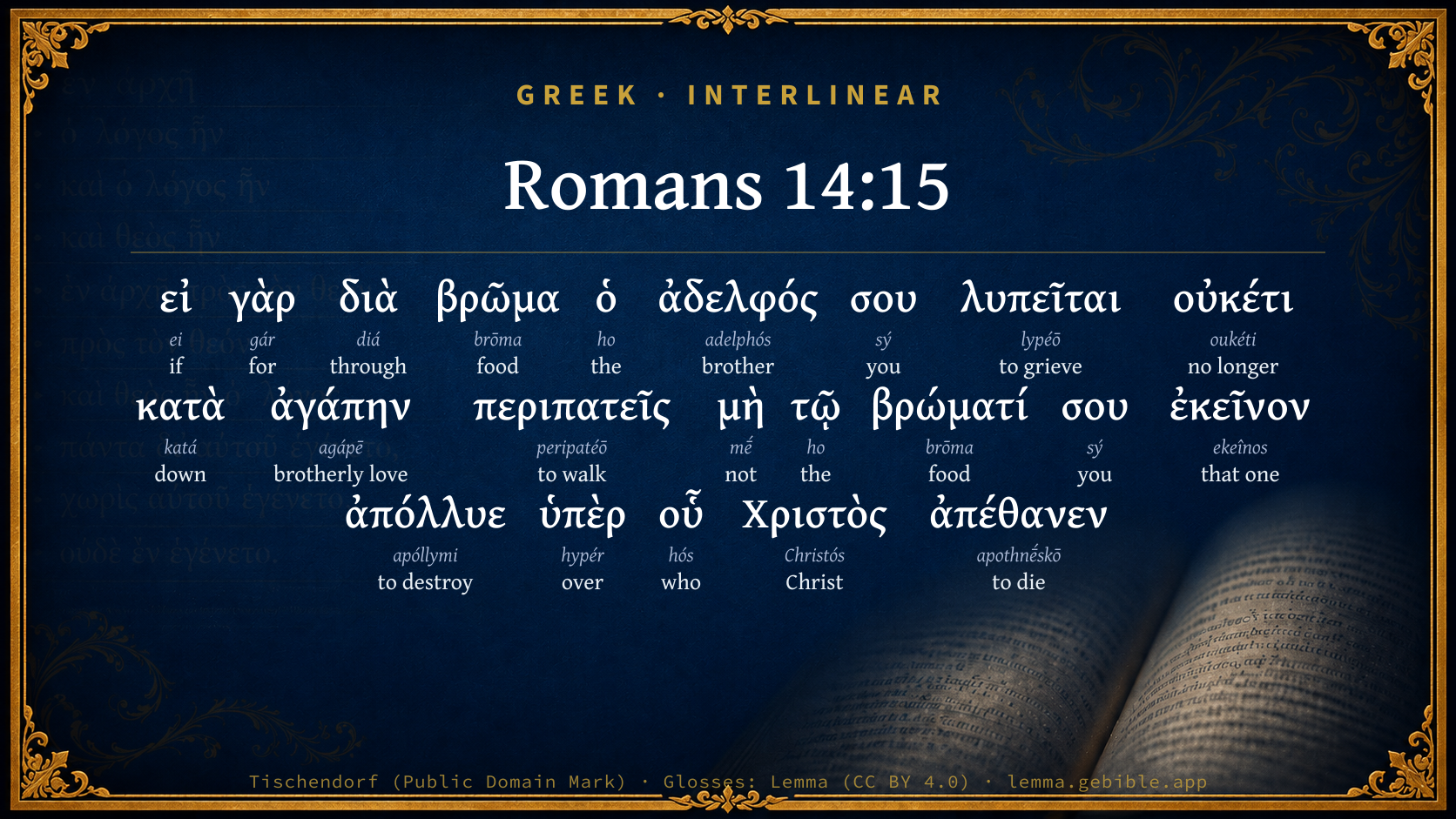
Greek (Tischendorf 8th ed.) Romans 14:15 appears in the Greek New Testament. The text above is from the Tischendorf 8th edition. Each word links to its Strong’s number and a concise gloss. Click any word for its full Thayer’s Greek Lexicon entry.
Download image
Cite this verse

Romans 14:15 (World English Bible). Public Domain. Lemma interlinear Bible study tool, https://lemma.gebible.app/v/romans/14/15.

Show BibTeX & RIS
BibTeX
RIS
English Translation
Yet if because of food your brother is grieved, you walk no longer in love. Don't destroy with your food him for whom Christ died.
World English Bible · Public Domain
Download a study sheet

One document with this verse’s original text, its word-by-word gloss line, the meaning frame, cross-references with their text, attributed commentary, and full source and license credits — printable, and it pastes into notes with its structure intact.

This verse Autodidact and up

Study sheet (.html) Plain text (.txt)

A passage Seminary Student

Up to 50 verses in one chapter. A passage sheet keeps up to 6 commentary sources and 12 cross-references per verse, in the order this page ranks them, and says so on the sheet whenever that leaves anything out. Ask for a single verse and you get the Autodidact verse sheet above.

Everything on this page stays free to read, with no account — the sheet is a download of what is already on screen, not access to it.

Want to remove ads? Support Godless Engineer
Compare translations 3

The same verse in 3 English versions, stacked beneath the original-language interlinear above. Click any original word for its lexicon entry.

Each is an independent rendering of the whole verse — the interlinear is not word-aligned to these translations.

Highlighted words mark where these versions differ — a whole-verse word diff, not a word-by-word alignment.

  • World English Bible Public Domain
    Yet if because of food your brother is grieved, you walk no longer in love. Don't destroy with your food him for whom Christ died.
  • King James Version Public Domain
    But if thy brother be grieved with thy meat, now walkest thou not charitably. Destroy not him with thy meat, for whom Christ died.
  • unfoldingWord Literal Text CC BY-SA 4.0
    For if because of food your brother is hurt, you are no longer walking according to love. Do not destroy with your food that one for whom Christ died.

unfoldingWord Literal Text — © unfoldingWord, licensed CC BY-SA 4.0. Word-aligned USFM3 via Door43 (git.door43.org/unfoldingWord/en_ult).

Versions to compare (up to 4)

3 of 4 selected

Show all 19 translations

Every available English version of this verse, each an independent rendering of the whole verse.

  • World English Bible Public Domain
    Yet if because of food your brother is grieved, you walk no longer in love. Don't destroy with your food him for whom Christ died.
  • Berean Standard Bible Public Domain
    If your brother is distressed by what you eat, you are no longer acting in love. Do not by your eating destroy your brother, for whom Christ died.
  • Majority Standard Bible Public Domain
    If your brother is distressed by what you eat, you are no longer acting in love. Do not by your eating destroy your brother, for whom Christ died.
  • King James Version Public Domain
    But if thy brother be grieved with thy meat, now walkest thou not charitably. Destroy not him with thy meat, for whom Christ died.
  • American Standard Version (1901) Public Domain
    For if because of meat thy brother is grieved, thou walkest no longer in love. Destroy not with thy meat him for whom Christ died.
  • Revised Version (1885) Public Domain
    For if because of meat thy brother is grieved, thou walkest no longer in love. Destroy not with thy meat him for whom Christ died.
  • Geneva Bible (1599) Public Domain
    But if thy brother be grieued for the meate, nowe walkest thou not charitably: destroy not him with thy meate, for whome Christ dyed.
  • Douay-Rheims (1899) Public Domain
    For if, because of thy meat, thy brother be grieved, thou walkest not now according to charity. Destroy not him with thy meat, for whom Christ died.
  • Young's Literal Translation Public Domain
    and if through victuals thy brother is grieved, no more dost thou walk according to love; do not with thy victuals destroy that one for whom Christ died.
  • Literal Standard Version CC BY-SA 4.0
    and if your brother is grieved through food, you no longer walk according to love; do not destroy with your food that one for whom Christ died.
  • Unlocked Literal Bible CC BY-SA 4.0
    If because of food your brother is hurt, you are no longer walking in love. Do not destroy with your food one for whom Christ died.
  • unfoldingWord Literal Text CC BY-SA 4.0
    For if because of food your brother is hurt, you are no longer walking according to love. Do not destroy with your food that one for whom Christ died.
  • Darby Bible Public Domain
    For if on account of meat thy brother is grieved, thou walkest no longer according to love. Destroy not him with thy meat for whom Christ has died.
  • World Messianic Bible Public Domain
    Yet if because of food your brother is grieved, you walk no longer in love. Don’t destroy with your food him for whom Messiah died.
  • Webster's Bible Public Domain
    But if thy brother is grieved with thy food, now walkest thou not charitably. Destroy not him with thy food, for whom Christ died.
  • Free Bible Version CC BY-SA 4.0
    If your fellow-believer is hurt by you over matters of food, then you're no longer behaving in a loving way. Don't destroy someone for whom Christ died by the food you choose to eat.
  • Bible in Basic English Public Domain
    And if because of food your brother is troubled, then you are no longer going on in the way of love. Do not let your food be destruction to him for whom Christ went into death.
  • Text-Critical English NT CC BY 4.0
    If yoʋr brother is distressed by what yoʋ eat, yoʋ are no longer walking in love. Do not let what yoʋ eat destroy someone for whom Christ died.
  • Tyndale New Testament (1534) Public Domain
    If thy brother be greved with thy meate now walkest thou not charitablye. Destroye not him with thy meate for whom Christ dyed.

Literal Standard Version (2020), Covenant Press — licensed CC BY-SA 4.0. Text via the HelloAO Bible API (eBible.org). Unlocked Literal Bible (unfoldingWord) — licensed CC BY-SA 4.0. Text via the HelloAO Bible API (eBible.org). unfoldingWord Literal Text — © unfoldingWord, licensed CC BY-SA 4.0. Word-aligned USFM3 via Door43 (git.door43.org/unfoldingWord/en_ult). Free Bible Version, Dr. Jonathan Gallagher — licensed CC BY-SA 4.0. Text via the HelloAO Bible API (eBible.org).

Word by word

More ways to search: Search by grammar → Find every occurrence → Compare this word →

Practice this passage: Drill this verse → Learn its vocabulary →

βρῶμα
brōma
G1033
“food”
Noun, Accusative, Singular, Neuter
Part of Speech
Noun
Case
Accusative
Number
Singular
Gender
Neuter
Full Thayer's Definition

Origin: from the base of G977

TDNT: 11:42,1

1. that which is eaten, food
  1. εἰ ei G1487 “if” Conditional
  2. γὰρ gár G1063 “for” Conjunction
  3. διὰ diá G1223 “through” Preposition
  4. ὁ ho G3588 “the” Article, Nominative, Singular, Masculine
  5. ἀδελφός adelphós G80 “brother” Noun, Nominative, Singular, Masculine
  6. σου sý G4771 “you” Personal pronoun, 2nd person, Genitive, Singular
  7. λυπεῖται lypéō G3076 “to grieve” Verb, Present, Passive, Indicative, 3rd person, Singular
  8. οὐκέτι oukéti G3765 “no longer” Adverb, Negative
  9. κατὰ katá G2596 “down” Preposition
  10. ἀγάπην agápē G26 “brotherly love” Noun, Accusative, Singular, Feminine
  11. περιπατεῖς peripatéō G4043 “to walk” Verb, Present, Active, Indicative, 2nd person, Singular
  12. μὴ mḗ G3361 “not” Particle, Negative
  13. τῷ ho G3588 “the” Article, Dative, Singular, Neuter
  14. βρώματί brōma G1033 “food” Noun, Dative, Singular, Neuter
  15. σου sý G4771 “you” Personal pronoun, 2nd person, Genitive, Singular
  16. ἐκεῖνον ekeînos G1565 “that one” Demonstrative pronoun, Accusative, Singular, Masculine
  17. ἀπόλλυε apóllymi G622 “to destroy” Verb, Present, Active, Imperative, 2nd person, Singular
  18. ὑπὲρ hypér G5228 “over” Preposition
  19. οὗ hós G3739 “who” Relative pronoun, Genitive, Singular, Masculine
  20. Χριστὸς Christós G5547 “Christ” Noun, Nominative, Singular, Masculine
  21. ἀπέθανεν apothnḗskō G599 “to die” Verb, Aorist, Active, Indicative, 3rd person, Singular

About this verse

These counts appear in no published source. They are computed here, from the morphology-tagged text and Lemma’s own curated glosses. What Lemma adds →

22
words
19
distinct lemmas
Pauline Epistles
section

Notable vocabulary

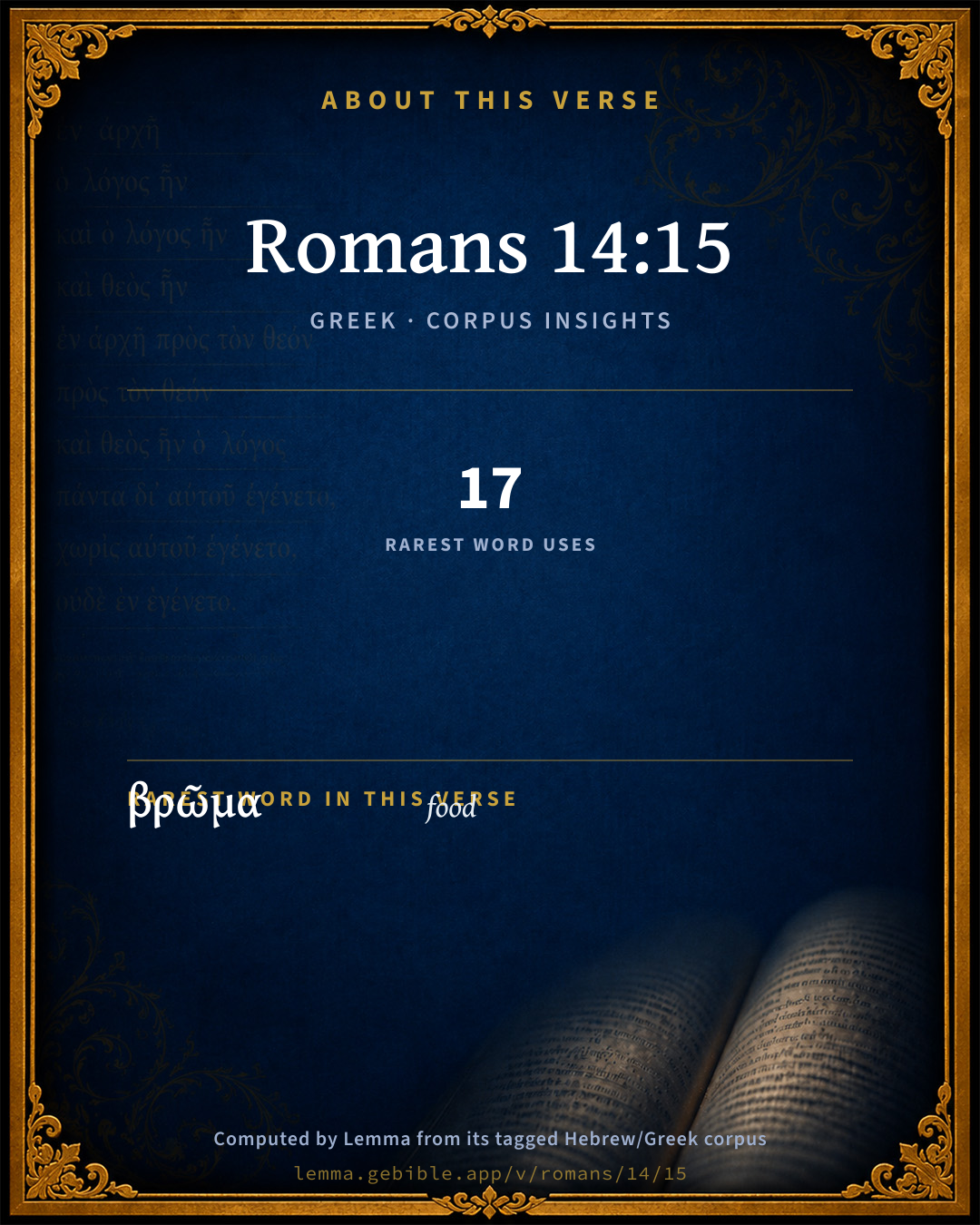
The rarest word here is βρῶμα food G1033 — appearing just 17 times in the whole Greek New Testament.

Shared distinctive vocabulary

βρῶμα food G1033 occurs in 15 verses of the Greek New Testament. Also found in:

Repetition

Words recur within this verse:

Cross-references

13

Topical passages linked to Romans 14:15 in the Treasury of Scripture Knowledge — connected by theme and wording, ordered by reader-vote popularity; previews shown in the World English Bible.

  • 1 Corinthians 8:11–12 And through your knowledge, he who is weak perishes, the brother for whose sake Christ died.
  • Galatians 5:13 For you, brothers, were called for freedom. Only don't use your freedom for gain to the flesh, but through love be servants to one another.
  • Philippians 2:2–4 make my joy full, by being like-minded, having the same love, being of one accord, of one mind;
  • Romans 14:20 Don't overthrow God's work for food's sake. All things indeed are clean, however it is evil for that man who creates a stumbling block by eating.
  • 1 Corinthians 13:4–5 Love is patient and is kind; love doesn't envy. Love doesn't brag, is not proud,
  • Romans 15:2 Let each one of us please his neighbor for that which is good, to be building him up.
  • 1 Corinthians 8:1 Now concerning things sacrificed to idols: We know that we all have knowledge. Knowledge puffs up, but love builds up.
  • Ephesians 5:2 Walk in love, even as Christ also loved you, and gave himself up for us, an offering and a sacrifice to God for a sweet-smelling fragrance.
  • Ezekiel 13:22 Because with lies you have grieved the heart of the righteous, whom I have not made sad; and strengthened the hands of the wicked, that he should not return from his wicked way, and be saved alive:
  • Romans 13:10 Love doesn't harm a neighbor. Love therefore is the fulfillment of the law.
  • 1 Corinthians 13:1 If I speak with the languages of men and of angels, but don't have love, I have become sounding brass, or a clanging cymbal.
  • 2 Peter 2:1 But there also arose false prophets among the people, as among you also there will be false teachers, who will secretly bring in destructive heresies, denying even the Master who bought them, bringing on themselves swift destruction.
  • 1 John 2:2 And he is the atoning sacrifice for our sins, and not for ours only, but also for the whole world.

Cross-references courtesy of OpenBible.info (CC BY 4.0).

Commentary

Notes on Romans 14:15 from classic Christian and Jewish commentators (each source and its license shown beneath its notes). The classic Christian expositions comment on the surrounding passage and are grouped to its opening verse, so a note may address several verses; the Jewish commentaries on the Tanakh (Rashi and others) are per-verse, so they appear only where the commentator wrote on this verse.

Lemma curates 59 commentaries, every one of them public domain or Creative Commons licensed, each selected and text-cleaned for this edition rather than reprinted as found. About our sources →

The Cambridge Bible for Schools and Colleges

gen. ed. J. J. S. Perowne

15. But] Another reading is For. The documentary evidence is doubtful; and the evidence of connexion favours But. If For is adopted, it must be explained by treating Rom_14:14 as a parenthesis; and thus connecting Rom_14:13; Rom_14:15 : q. d., “resolve to lay no stumblingblock for others; for you do lay a stumblingblock, when you neglect their scruples about food.” Reading But, the connexion shews it to be a word not of contrast but of pursuance: q. d., “But, granting what I have just urged, it is the opposite of Christian love to neglect your brother’s scruples.”

grieved] put to pain; the pain of a conflict with conscience such as either to lead to its violation, or to harden prejudice.

with thy meat] Lit., and better, on account of thy food.—“Meat,” in the E. V., is never exclusively “flesh-meat.” The word is akin to French met; a thing put on the table. In market-language “green meat” still means vegetables; and so in some country districts “meat” alone still does. Here, of course, the word is inclusive of flesh.

not charitably] Lit. no longer according: to love: “Thou forsakest the rule of Christian love which hitherto thou hast followed.”

Destroy not him] The natural effect of neglect or contempt of the mistaken scruple would be to frighten, or embolden, the “weak brother” so as to become careless of his conscience in general; to “regard iniquity in his heart,” (Psa_66:18,) and so to cease to “abide in Christ.” Cp. the language of 1Co_8:11.—Here the question what God would do for the protection or restoration of the “weak” Christian is manifestly out of sight, and out of place: not His covenant, but His servants’ duty and responsibility, is before us here. So again in Rom_14:20.—“Destroy” is the present imperative in the Gr., and indicates that a course of conduct, not an isolated and finished act, is intended.

thy meat] There is a subtle reproof in the word “thy;” a suggestion of the selfishness underlying the conduct in question.

for whom Christ died] The profoundest of all motives for a Christian’s tenderness and care.—Here, of course, the reference is to the Lord’s death for His Church, (Eph_5:25,) of which the “weak brother” is a member by faith.

The Cambridge Bible for Schools and Colleges (gen. ed. J. J. S. Perowne; Cambridge University Press, 1878–1918) — public domain. Text from a community e-Sword module.

Tyndale Open Study Notes

Tyndale Open Resources

14:15 The word translated ruin (Greek apollumi, “destroy”) is often applied to eternal damnation (see 2:12; Matt 10:28; 18:14; Luke 9:24; 13:2-5; John 3:16; 10:10, 28; 1 Cor 1:18-19; Jas 4:12; 2 Pet 3:9). By insisting on their freedom to eat whatever they want, the strong might cause sensitive Jewish Christians for whom Christ died to turn away from the faith.

Tyndale Open Study Notes — © Tyndale Open Resources, licensed CC BY-SA 4.0. Text via the HelloAO Bible API.

Bengel's Gnomon

Johann Albrecht Bengel

Rom 14:15. Δἐ, but) An antithesis. Not only faith, Rom 14:14, but also love ought to be present.—διὰ βρῶμα) μείωσις, [less is said than is intended]: comp. Heb 9:10; Heb 12:16; Heb 13:9.—λυπε͂ται, is grieved) The antithesis to this is the joy in Rom 14:17.—οὐκ ἔτι, now no longer) He places before his mind some one who stands stedfast in love, and intimates that he ought never lose sight of love. Love and joy, not love and grief, are connected together.—κατὰ ἀγάπην, according to love, charitably) Hence the connection of the first verse with the preceding chapter, Rom 14:8, is manifest.—τῷ βρώματί σου, with thy food [meat]) Do not value thy food more than Christ valued His life.—μὴ ἀπόλλυε, do not destroy) 1Co 8:11. Even the true brother may perish, for whom Christ most lovingly died.

Bengel's Gnomon of the New Testament — English translation (T&T Clark, Edinburgh, 1860) — public domain. Text from a community e-Sword module.

Meyer's Critical & Exegetical Commentary

Heinrich August Wilhelm Meyer

Rom_14:15. Γάρ] According to this reading critically beyond doubt (see the critical notes),which, however, Philippi, on account of the sense, regards as absolutely untenable,the apostle specifies the reason, why he has expressly added the exception εἰ μὴ τῷ λογιζ. κ.τ.λ. The γάρ belonging to the principal sentence is, according to a very prevalent usage (see Baeumlein, Partik. p. 85), taken into the prefixed accessory sentence, so that the argumentative thought is: not without good moral ground do I say: εἰ μὴ … κοινόν; for it indicates a want of love, if the stronger one has not regard to this relation towards the weaker.

διὰ βρῶμα] on account of food, i.e. because of a kind of food, which he holds to be unclean and sees thee eat.

λυπεῖται] not: is injured, which would consist in the ἀπόλλυσθαι (Philippi, contrary to N. T. usage), but of moral affliction, i.e. vexation of conscience, which is occasioned by the giving of a σκάνδαλον (Rom_14:13). Analogous is Eph_4:30. To understand it of the making reproaches on account of narrow-mindedness (Grotius, Rosenmüller, Ewald), is gratuitously to import the substance of the thought, and does not correspond to the connection (Rom_14:13-14; Rom_14:20-21).

οὐκέτι κατὰ ἀγάπ. περιπατεῖς] i.e. in that case thou hast ceased to bear thyself conformably to love. This is the actual state of things which subsists, when what is expressed in the protasis occurs; the λυπεῖται, namely, is conceived as the fault of the subject addressed. On εἰ … οὐκέτι, comp. Rom_7:20, Rom_11:6; Gal_3:18. To take the apodosis interrogatively (Hofmann), isconsidering the definite character, quite in keeping with the context, of the λυπεῖται which is occasioned by the offence givenquite unwarranted, and does not suit the words.

The ἀπόλλυε is the possible result of the λυπεῖται: destroy him not, bring him not into destruction, namely, through his being seduced by thy example to disregard his conscience, and to fall out of the moral element of the life of faith into the sinful element of variance with conscience. That we are to explain it of the eternal ἀπώλεια, is clear from ὑπὲρ οὗ Χ. ἀπέθνε; for in order to redemption from this Christ offered up His lifetherefore thou oughtest not to thrust back into ἀπώλεια thy (so dearly bought) brother through the loveless exercise of thy free principles. Comp. 1Co_8:11-12. Ne pluris feceris tuum cibum, quam Christus vitam suam, Bengel.

Meyer — Critical and Exegetical Commentary on the New Testament — English translation by Peter Christie, edited by Frederick Crombie (T&T Clark, 1880) — public domain. Text from a community e-Sword module.

Expositor's Greek Testament

ed. W. Robertson Nicoll

Rom 14:15 . Many expositors here supply something; e.g. , “You must have respect therefore for his scruples, although you may not share them, for if,” etc. (Sanday and Headlam); but it seems simpler to connect the γὰρ with the leading idea in the writer’s mind, Put no stumbling-block before a brother, for, etc. διὰ βρῶμα is contemptuous: “for the sake of food” thy brother is grieved. βρῶμα is the food which the strong eats in spite of his brother’s scruples. λυπεῖται need not imply that the weak is induced, against his conscience, to eat also (though that is contemplated as following); it may quite well express the uneasiness and distress with which the weak sees the strong pursue a line of conduct which his conscience cannot approve. Even to cause such pain as this is a violation of the law of Christ. He who does it has ceased to walk κατὰ ἀγάπην , according to love, which is the supreme Christian rule. In the sense of this, and at the same time aware that the weak in these circumstances may easily be cajoled or overborne into doing what his conscience disapproves, the Apostle exclaims abruptly, μὴ τῷ βρώματί σου ἐκεῖνον ἀπόλλυε ὑπὲρ οὗ Χριστὸς ἀπέθανεν . To tamper with conscience, it is here implied, is ruin : and the selfish man who so uses his Christian liberty as to lead a weak brother to tamper with his conscience is art and part in that ruin. The wanton contempt such liberty shows for the spirit and example of Christ is emphasised both here and in 1Co 8:11 f. Ne pluris feceris tuum cibum quam Christus vitam suam .

The Expositor's Greek Testament, edited by W. Robertson Nicoll (1897–1910) — public domain. Text from a community e-Sword module.

Godet's Commentaries

Frédéric Louis Godet

Vv. 15. If this verse be connected with the preceding by for, with the majority of the Mjj., it is very difficult to understand their logical relation. Meyer paraprhases thus: “It is not without reason that I remind you of that (the preceding restriction); for love is bound to take account of such a scruple.” Hofmann rightly judges this explanation of the for impossible; but is his own less so? He takes the phrase following in the interrogative sense: “For, if thy brother is grieved thereby, wouldest thou for this error on his part henceforth cease to walk toward him in love?” It is difficult to imagine anything more forced. We must therefore, though the T. R. δέ, now then or but, has only a single Mj. (L) in its favor, prefer this reading (Reiche, Rück., De W., Philip.). This δέ may be taken in the sense of now then, or in that of but. The adversative sense seems to me preferable. The but refers to the first part of Rom 14:14: “I know that nothing is unclean..., but if, nevertheless...The meaning is excellent, and the construction the more admissible because the second part of Rom 14:14 was a simple parenthesis.—Λυπεῖται, is grieved, hurt; this word expresses the painful and bitter feeling produced in the heart of the weak by the spectacle of the free and bold eating of the strong.

With the words: “Thou walkest no more (οὐκέτι) charitably,” we must evidently understand the idea: when thou actest thus. The threat, added by the apostle, of compromising thereby our neighbor’s salvation, is so grave, that it is not explicable at the first glance, and one is tempted to refer it to the sin which the weak believer would commit by imitating the strong; comp. Rom 14:20. But it is not till afterward that Paul comes to this side of the question, and it is far from probable that the weak man, at the very time when he is wounded by the conduct of the strong, could be tempted to imitate him. These words therefore refer to the profound irritation, the hurtful judgments, the breach of brotherly ties, which must result from such wounding. The asyndeton is striking: it shows Paul’s emotion when writing these last words.... “By thy meat make him perish whom Christ saved by His death!” The whole scene supposed by this verse is infinitely better understood if it is placed in the full love-feast, than if the strong and the weak are supposed taking their meal at their own houses. The following verses (Rom 14:16-19 a) complete by some secondary considerations the principal motive which has been expressed at the end of Rom 14:15.

Frédéric Louis Godet — Commentaries on Luke, John, Romans, and 1 Corinthians — English translation (T&T Clark, Edinburgh, 1870s–1890s) — public domain. Text from a community e-Sword module.

Hodge's Commentary on Romans, Ephesians & First Corinthians

Charles Hodge

Rom_14:15

But if thy brother be grieved with thy meat, now walkest thou not charitably. Destroy not him with thy meat, for whom Christ died. Instead of δέ, but, which is found in the common text, Griesbach, Lachmann, and Tischendorf, on the authority of the majority of the Uncial MSS., read γάρ, for. As this verse, however, does not assign a reason for the principle asserted in Rom_14:14, but does introduce a limitation to the practical application of that principle, the majority of commentators and editors retain the common text. The sense obviously is, Though the thing is tight in itself, yet if indulgence in it be injurious to our Christian brethren, that indulgence is a violation of the law of love. This is the first consideration which the apostle urges, to enforce the exhortation not to put a stumbling block in our brothers way. The word (λυπεῖται,) is grieved, may mean is injured. Either sense suits the context: If thy brother, emboldened by thy example, is led to do what he thinks wrong, and is thus rendered miserable, etc. Or, If thy brother, by thy example is injured (by being led into sin), thou walkest uncharitably. This use of the word, however, is foreign to the New Testament. It is a moral grievance of which the apostle speaks, a wounding of the conscience. Destroy not (μὴ ἀπόλλυε.) These words have been variously explained. The meaning may be, Avoid every thing which has a tendency to lead him to destruction. So De Brais, Bengel, Tholuck, Stuart, and many others. Or, Do not injure him, or render him miserable. So Elsner, Soppe, Flatt, Wahl, and others. There is no material difference between these two interpretations. The former is more consistent with the common meaning of the original word, from which there is no necessity to depart. Believers (the elect) are constantly spoken of as in danger of perdition. They are saved only, if they continue steadfast unto the end. If they apostatize, they perish. If the Scriptures tell the people of God what is the tendency of their sins, as to themselves, they may tell them what is the tendency of such sins as to others. Saints are preserved, not in despite of apostasy, but from apostasy. If thy brother be aggrieved, thou doest wrong; do not grieve or injure him. For whom Christ died. This consideration has peculiar force. If Christ so loved him as to die for him, how base in you not to submit to the smallest self-denial for his welfare.

Charles Hodge — Commentary on Romans (1835), First Corinthians (1857), and Ephesians (1856) — public domain. Text from a community e-Sword module.

Geneva Bible (1599)

Geneva Bible translators

It is the part of a cruel mind to make more account of meat, than of our brother’s salvation. Which thing they do, that presume to eat with offense of any brother, and so give him occasion to go back from the Gospel.

Another argument: We must follow Christ’s example: who was so far from destroying the weak with meat, that he gave his life for them.

Geneva Bible (1599) marginal notes — public domain. Text via Bolls.life.

Jamieson, Fausset & Brown

Robert Jamieson, A. R. Fausset & David Brown

But if thy brother be grieved--has his weak conscience hurt

with thy meat--rather, "because of meat." The word "meat" is purposely selected as something contemptible in contrast with the tremendous risk run for its sake. Accordingly, in the next clause, that idea is brought out with great strength.

Destroy not him with--"by"

thy meat for whom Christ died--"The worth of even the poorest and weakest brother cannot be more emphatically expressed than by the words, 'for whom Christ died'" [OLSHAUSEN]. The same sentiment is expressed with equal sharpness in Co1 8:11. Whatever tends to make anyone violate his conscience tends to the destruction of his soul; and he who helps, whether wittingly or no, to bring about the one is guilty of aiding to accomplish the other.

Jamieson, Fausset & Brown — Commentary Critical and Explanatory on the Whole Bible (1871) — public domain (CC PDM 1.0). Text via the HelloAO Bible API.

Adam Clarke's Commentary

Verse 15. If thy brother be grieved] If he think that thou doest wrong, and he is in consequence stumbled at thy conduct.

Now walkest thou not charitably.] κατα αγαπην, According to love; for love worketh no ill to its neighbour; but by thy eating some particular kind of meat, on which neither thy life nor well-being depends, thou workest ill to him by grieving and distressing his mind; and therefore thou breakest the law of God in reference to him, while pretending that thy Christian liberty raises thee above his scruples.

Destroy not him with thy meat, for whom Christ died.] This puts the uncharitable conduct of the person in question in the strongest light, because it supposes that the weak brother may be so stumbled as to fall and perish finally; even the man for whom Christ died. To injure a man in his circumstances is bad; to injure him in his person is worse; to injure him in his reputation is still worse; and to injure his soul is worst of all. No wickedness, no malice, can go farther than to injure and destroy the soul: thy uncharitable conduct may proceed thus far; therefore thou art highly criminal before God.

From this verse we learn that a man for whom Christ died may perish, or have his soul destroyed; and destroyed with such a destruction as implies perdition; the original is very emphatic, μη - εκεινον απολλυε, ὑπερ οὑ Χριστος απεθανε. Christ died in his stead; do not destroy his soul. The sacrificial death is as strongly expressed as it can be, and there is no word in the New Testament that more forcibly implies eternal ruin than the verb απολλυω, from which is derived that most significant name of the Devil, ο απολλυων, the DESTROYER, the great universal murderer of souls.

Adam Clarke's Commentary on the Bible (1810–1826) — public domain. Text from a community e-Sword/MySword module.

John Calvin's Commentaries

15. But if through meat thy brother is grieved, etc. He now explains how the offending of our brethren may vitiate the use of good things. And the first thing is, — that love is violated, when our brother is made to grieve by what is so trifling; for it is contrary to love to occasion grief to any one. The next thing is, — that when the weak conscience is wounded, the price of Christ’s blood is wasted; for the most abject brother has been redeemed by the blood of Christ: it is then a heinous crime to destroy him by gratifying the stomach; and we must be basely given up to our own lusts, if we prefer meat, a worthless thing, to Christ. The third reason is, — that since the liberty attained for us by Christ is a blessing, we ought to take care, lest it should be evil spoken of by men and justly blamed, which is the case, when we unseasonably use God’s gifts. These reasons then ought to influence us, lest by using our liberty, we thoughtlessly cause offenses.

John Calvin's Commentaries (1540-1563) — public domain. Text from the Calvin Translation Society English edition (1840s-50s) via the Christian Classics Ethereal Library (ccel.org). Calvin's coverage is partial (roughly two-thirds of the Bible); uncommented books and verses are honest gaps, never fabricated. The 19th-century editor's footnotes and remarks are omitted so the notes are faithfully Calvin's own voice.

Ellicott's Commentary for English Readers

(15) But.—The true reading is undoubtedly For, the connection of which is somewhat difficult to trace. It appears to leap over Rom_14:14, and go back to Rom_14:13. We may suppose that the substance of this verse recurs to the Apostle’s mind after the parenthetical statement just inserted, and though he does not repeat it in words, he connects on to it the sequence of his thought. “The Christian should not put a stumbling-block in his brother’s way. Not, indeed, that there is anything unclean in itself, but relatively to the person who so regards it. it is unclean. [Therefore the Christian should be careful as to what he does.] For to cause distress to another about a mere matter of food is to be uncharitable.”

Two stages are noted in the words “grieved” and “destroy.” When one man sees another do that which his own conscience condemns, it causes him pain, but when he is further led on from this to do himself what his conscience condemns, he is in danger of a worse fate; he is morally ruined and undone. The work of redemption that Christ has wrought for him is cancelled, and all that great and beneficent scheme is hindered of its operation by an act of thoughtlessness or want of consideration on the part of a fellow Christian.

With thy meat.—Rather, because of meat, on a mere question of meat.

A Bible Commentary for English Readers, edited by Charles John Ellicott (1878–1897) — public domain. Text from a community e-Sword module.

John Gill's Exposition

But if thy brother be grieved with thy meat,.... The apostle proceeds to give reasons why, though he was so fully persuaded that nothing was unclean of itself, and so he, and any other of the same persuasion, might lawfully eat anything; yet they should forbear, and not make use of this liberty; because if a brother should be grieved by it, that is, either should be concerned and troubled at it inwardly, both because the person that eats is thought by him to have transgressed a command of God, and because he himself is not only despised as a weak brother, but as if he was a "judaizing" Christian, and walked not uprightly, according to the truth of the Gospel; or else should be emboldened thereby to eat, and so wound and defile his weak conscience; or be so galled and offended at it, as to stumble and fall off from his profession of Christianity, and withdraw his communion, as judging there is nothing in it, no regard being had to the law of God:

now walkest thou not charitably; this is a breach of the rule of charity or brotherly love; such an one is a brother, and though a weak one, yet he is to be loved as a brother, and to be charitably walked with: true charity, or love, vaunts not itself over, nor is it puffed up against a weak brother; nor is it unconcerned for his peace, but bears with his weaknesses, and forbears the use of things grieving to him:

destroy not him with thy meat, for whom Christ died. This is to be understood, not of eternal destruction, that can never be thought to be either in the will or power of any man; such a degree of malice can never arise in the heart of any, to wish for, desire, or take any step towards the eternal damnation of another; and could any thing of this kind be among the men of the world, yet surely not among brethren of the same faith, and in the same church state; and were there any so wicked as to desire this, yet it is not in their power to compass it, for none can destroy eternally but God; see Mat 10:28; besides, it is not reasonable to suppose, that eternal damnation should follow upon eating things indifferent, or be caused by an offence either given or taken through them; moreover, though such as only think themselves, or profess themselves, or are only thought by others to be such, for whom Christ died, may be eternally destroyed, yet none of those can, for whom Christ really died; for they are his special people, his peculiar friends, his own sheep, his body the church, which can never perish; and he, by dying, has procured such blessings for them, such as a justifying righteousness, pardon of sin, peace with God, and eternal life, which will for ever secure them from destruction: besides, should anyone of them be destroyed, the death of Christ would be so far in vain, nor would it appear to be a sufficient security from condemnation, nor a full satisfaction to the justice of God; or God must be unjust, to punish twice for the same fault: but this is to be understood of the destruction of such a man's peace and comfort, which is signified by grieving, stumbling, offending, and making him weak; and the words are a fresh reason, why they that are strong in the faith of Christian liberty, should nevertheless forbear the use of it, to preserve the peace of a weak brother; which is a matter of importance, and the rather to be attended to, since it is the peace of one that belongs to Christ, whom he has so loved as to die for, and therefore should be the object of the regard and affections of such as believe in Christ and love him.

John Gill's Exposition of the Whole Bible (1746–1763) — public domain (CC PDM 1.0). Text via the HelloAO Bible API.

Trapp's Complete Commentary

John Trapp

15 But if thy brother be grieved with thy meat, now walkest thou not charitably. Destroy not him with thy meat, for whom Christ died.

Ver. 15. But if thy brother be grieved] It is his weakness to be grieved thereat, but gratify him howsoever. What one speaks of a plain place of Scripture, this verse, saith he, had been easy, had not commentators made it knotty; the like saith another of a Christian’s condition, it is gracious, happy, clear, sure, sweet, did not erroneous judgments vex and unsettle them.

John Trapp, A Commentary or Exposition upon All the Books of the Old and New Testament (1647–1656) — public domain. Text from a community e-Sword module.

Albert Barnes' Notes on the Bible

But if thy brother ... - This address is to the “Gentile” convert. In the previous verse, Paul admitted. that the prejudice of the Jew was not well-founded. But admitting that still the question was, “how” he should be treated while he had that prejudice. The apostle here shows the Gentile that “he” ought not so to act as unnecessarily to wound his feelings, or to grieve him.

Be grieved - Be pained; as a conscientious man always is, when he sees another, and especially a Christian brother, do anything which “he” esteems to be wrong. The “pain” would be real, though the “opinion” from which it arose might not be well founded.

With thy meat - Greek, On account of meat, or food; that is, because “you” eat what he regards as unclean.

Now walkest - To “walk,” in the Sacred Scriptures, often denotes to act, or to do a thing; Mar 7:5; Act 21:21; Rom 6:4; Rom 8:1, Rom 8:4. Here it means that if the Gentile convert persevered in the use of such food, notwithstanding the conscientious scruples of the Jew, he violated the law of love.

Charitably - Greek, According to charity, or love; that is, he would violate that law which required him to sacrifice his own comfort to promote the happiness of his brother; 1Co 13:5; 1Co 10:24, 1Co 10:28-29; Phi 2:4, Phi 2:21.

Destroy not him - The word “destroy” here refers, doubtless, to the ruin of the soul in hell. It properly denotes ruin or destruction, and is applied to the ruin or “corruption” of various things, in the New Testament. To life Mat 10:39; to a reward, in the sense of “losing” it Mar 10:41; Luk 15:4; to food Joh 6:27; to the Israelites represented as lost or wandering Mat 10:6; to “wisdom” that is rendered “vain” 1Co 1:9; to “bottles,” rendered “useless” Mat 9:17, etc. But it is also frequently applied to destruction in hell, to the everlasting ruin of the soul; Mat 10:28, “Who is able to destroy both soul and body in hell;” Mat 18:14; Joh 3:15; Rom 2:12. That “this” is its meaning here is apparent from the parallel place in 1Co 8:11, “And through thy knowledge shall thy weak brother perish.” If it be asked how the eating of meat by the Gentile convert could be connected with the perdition of the Jew, I reply, that the apostle supposes that in this way an occasion of stumbling would be afforded to him, and he would come into condemnation. He might be led by example to partake against his own conscience, or he might be excited to anger, disgust, and apostasy from the Christian faith. Though the apostle believed that all who were true Christians would be saved, Rom 8:30-39, yet he believed that it would be brought about by the use of means, and that nothing should be done that would tend to hinder or endanger their salvation; Heb 6:4-9; Heb 2:1. God does not bring his people to heaven without the use of “means adapted to the end,” and one of those means is that employed here to warn professing Christians against such conduct as might jeopard the salvation of their brethren.

For whom Christ died - The apostle speaks here of the possibility of endangering the salvation of those for whom Christ died, just as he does respecting the salvation of those who are in fact Christians. By those for whom Christ died, he undoubtedly refers here to “true Christians,” for the whole discussion relates to them, and them only; compare Rom 14:3-4, Rom 14:7-8. This passage should not be brought, therefore, to prove that Christ died for all people, or for any who shall finally perish. Such a doctrine is undoubtedly true (in this sense; that there is in the death of Christ a “sufficiency for all,” and that the “offer” is to all.) (compare 2Co 5:14-15; 1Jo 2:2; 2Pe 2:1), but it is not the truth which is taught here. The design is to show the criminality of a course that would tend to the ruin of a brother. For these weak brethren, Christ laid down his precious life. He loved them; and shall we, to gratify our appetites, pursue a course which will tend to defeat the work of Christ, and ruin the souls redeemed by his blood?

Albert Barnes' Notes on the Bible (1834–1885) — public domain. Text from a community e-Sword/MySword module.

Haydock's Catholic Bible Commentary

St. Paul repeats this, in almost the same words, in 1 Corinthians chap. viii. and plainly gives us the understand, that Christ died for the salvation of all men, by supposing a Christian brother, for whom Christ had died, in danger of perishing by the scandal given by another. This supposition could never have been made, if the death of Christ was only offered up for the elect: but we here learn from St. Paul, that they for whom Christ shed his blood and suffered the death of the cross, may perish eternally; and therefore all, even the greatest reprobates, may be saved, if they effectually desire it, by virtue of the death of our divine Redeemer.

George Leo Haydock (1774–1849), Haydock's Catholic Family Bible and Commentary, 1859 edition — public domain. Excludes Psalms (Douay-Rheims chapter numbering differs from Protestant) and Deuterocanonical books (Catholic canon only).

Matthew Poole's English Annotations

In this verse you have two reasons to induce the strong not to offend the weak: First, it is contrary to charity; to grieve a brother upon the score of meats, is to walk uncharitably; it is a violation of the royal law of love, which is against the grieving or offending others, 1Co 13:4. Two ways are weak Christians grieved, when others do unseasonably use their liberty.

1. They think such do offend God in eating that which he hath forbidden; and this is matter of grief to those that fear God, to see others transgress his laws.

2. They may be drawn by their example to do the like, against their own light and conscience; and this afterwards causeth grief and trouble; their consciences hereby are galled and wounded, 1Co 8:12.

Destroy not him with thy meat, for whom Christ died: this is the second reason why Christians should not use their liberty to the offence of others; it may occasion their ruin and destruction: q.d. Hereby, as much as in you lies, you take a course to destroy them for whom Christ died. You will alienate and estrange them from the Christian religion, or you will draw them into sin, and induce them (as before) to act against their consciences, and so hazard their salvation. See a parallel place, 1Co 8:11. Here a question may arise, whether any can perish for whom Christ died? The answer is, They cannot; and for this the Scripture is express, in Joh 10:28. See also Mat 24:24; Joh 6:39; 1Pe 1:5. How then is this text to be understood? The apostle doth not speak of those for whom Christ indeed did die, but of such as, in the judgment of charity, are held to be of that number. We must account all those who confess the faith of Christ, for such as he hath redeemed by his death.

Matthew Poole's English Annotations on the Holy Bible (1683–1685) — public domain. Text from a community e-Sword/MySword module.

Whedon's Commentary on the Bible

Daniel D. Whedon

Warning to the Strong against Injuring Weaker Brethren, Rom_14:14-23.

After declaring his firm belief that nothing was intrinsically impure, and thus classing himself with the strong, the apostle earnestly presses upon them the duty of so using their liberty as not to offend and destroy the souls of the feebler brethren.

15. Grieved—The grief which one Christian may be supposed to feel when he beholds the transgression of another.

Charitably—According to the law of love, which requires the sacrifice of our own convenience and taste for the good of the souls of others.

Destroy not—The grieved brother might be induced through disgust to leave the Christian communion, and so be lost. It was the strong brother’s duty if possible to retain him within the Christian circle, even for the very purpose of inspiring him with a purer, firmer grounding in Christian faith and morality.

This passage belongs to that large class of proof-texts which show that a Christian may totally apostatize from a true faith, and so be finally lost, by warning against that result as a confessedly and practically possible reality. Such texts require us to fear such a catastrophe as what not only may happen, but for aught we know has often happened. The customary reply to this is that these warnings are the means to prevent that catastrophe, and God’s grace will take care that this shall always be successful. But if God has predetermined that no Christian shall ever fall, the very means used to prevent the fall are falsehoods. God’s pre-determination eternally precedes the warning and falsifies it. But here the warning is not given to the Christian not to apostatize. It is given to the destroyer; it warns him not to make another person apostatize. It directs him to consider that result as sure from a certain course of his own. And so sure does the apostle feel that result to be, so practically inevitable, that he is ready in the case to eat no meat so long as he liveth. (1Co_8:13.) Surely his Roman and Corinthian readers would think it very strange if the apostle should add in a sub-tone, “But the case of a weak brother’s being destroyed is by God’s decree absolutely impossible!” All these warnings are at once neutralized when the Christian has been told, “Do not be alarmed; God has determined from all eternity that you shall never fall.”

For whom Christ died—This proves to a demonstration that Christ’s death for a man is not incompatible with the man’s final destruction. It both proves that Christ died for all, and that all men will not necessarily be saved because Christ died for all.

Daniel D. Whedon (gen. ed.), Commentary on the Old and New Testaments (1874–1909) — public domain. Text from a community e-Sword module.

The Pulpit Commentary

For (gar here certainly, rather than de as in the Textus Receptus. It introduces a reason for the general admonition beginning at ver. 13) if on account of meat (not here, thy meat, as in the Authorized Version) thy brother is grieved, thou no longer walkest charitably (literally, according to love, or charity; i.e. in continuing to set at naught his conscientious scruples). With thy meat destroy not him, for whom Christ died. (cf. 1Co_8:11, Kai apoleitai o asyenwn adelfov ... di on Cristoyanen) "Destroy" seems to denote causing his moral and religious ruin by shaking his conscientiousness, and perhaps upsetting altogether the faith he has, which, though weak, is real.

The Pulpit Commentary (1880–1919), ed. H.D.M. Spence-Jones & Joseph S. Exell — public domain. Text from a community e-Sword module.

John Wesley's Explanatory Notes

If thy brother is grieved - That is, wounded, led into sin. Destroy not him for whom Christ died - So we see, he for whom Christ died may be destroyed. With thy meat - Do not value thy meat more than Christ valued his life.

John Wesley, Explanatory Notes Upon the Whole Bible (1754–1765) — public domain. Text via the GEBible commentary corpus.

Godbey's Commentary on the New Testament

William B. Godbey

15. “For through thy meat thy brother is grieved thou art not walking according to divine love. Do not by thy meat destroy him for whom Christ died.” This would clear the churches of all tobacco, beer, jewelry, etc., as so many of the brethren are grieved by these things. How in the world can anyone use them and have a clear conscience?

William B. Godbey, Commentary on the New Testament (1896–1900) — public domain. Text from a community e-Sword module.

McGarvey & Pendleton's Commentaries

J. W. McGarvey

For if because of meat thy brother is grieved, thou walkest no longer in love . ["For" looks back to verse 13. Recklessness as to the welfare or safety of others is not loving. "Grieved" may express either a lapse into Judaism on the part of the weak because of the apparent worldliness of the strong, or it may indicate that the weak, tempted by the conduct of the strong, do things which are contrary to conscience, and hence come to grief ( Mat_27:3-5 ). It is likely that the latter danger was most prominent to the apostle's mind. (Comp. Rom_14:20 ; and 1Co_8:10 ) The context, containing the words "destroy" and "overthrow" ( Rom_14:20 ), shows that the grief is more than mere fraternal disappointment at another's laxity.] Destroy not with thy meat him for whom Christ died . [This is the strongest possible appeal. What pleasure of liberty can be so sweet as to justify us in destroying our brother's life, and frustrating the agony and sacrifice of the Master in his behalf? Shall we set a higher value on our meat than Christ did on his divine life? How shall we look our Lord in the face if we have wantonly done such a thing!]

J. W. McGarvey (with Philip Y. Pendleton), Commentaries on the New Testament (The Fourfold Gospel, 1914; Acts; and the epistles) — public domain. Text from a community e-Sword/MySword module.

The People's New Testament

B. W. Johnson

15. If thy brother is grieved with thy meat. If his feelings are hurt because you eat food that he thinks it is sinful to eat, it would be charitable for you to abstain from it for his sake. Destroy not him. His grief, and the effect upon him of seeing you do what he regards as sinful, may be to destroy him. It is kinder to give up the meat than to risk his destruction. If Christ died for him, you surely can do that much.

B. W. Johnson's The People's New Testament with Notes (1889–1891) — public domain. Electronic text from the Christian Classics Ethereal Library (CCEL) ThML edition.

Cambridge Greek Testament for Schools and Colleges

15. γὰρ. Rom 14:14 is a parenthetic admission and qualification, γὰρ refers back to Rom 14:13. The whole passage is curiously elliptic and interjectional.

διὰ βρῶμα. Owing to meat—that meat which you in your strength and freedom take, but he regards with scruples.

κατὰ ἀγάπην περ. Cf. Rom 8:4; 1Co 3:3: love no longer rules your conduct, as of course it ought to do.

μὴ … ἀπόλλυε. Cf. 1Co 8:11: the pres. act. of this verb occurs only here and Joh 12:25. Moulton, p. 114, includes this verb among those in which the prep. has the effect of ‘perfectivising’ the action of the verb. Here it must be the ‘linear perfective,’ i.e. describe the process which inevitably leads to the end. ‘Do not bring to ruin as there is danger of your doing.’ The point seems to be (as in 1 Cor. l.c[282]) that the example which encourages the weak brother to do what he feels to be wrong is destructive to him.

[282] l.c. locus citatus

ὑπὲρ οὗ Χρ. ἀπ. The strongest appeal to the Christian. You ruin him to save whom from ruin Christ died, 1 Cor. l.c[283]; cf. Mat 18:6-7.

[283] l.c. locus citatus

Cambridge Greek Testament for Schools and Colleges (Cambridge University Press, 1896; 21 vols, various authors incl. Carr, Maclear, Plummer, Farrar, Lumby, Moule, M. R. James, Simcox) — public domain. Text from a community e-Sword module.

Alford’s Greek Testament

Henry Alford

15.] The reading γάρ, besides the overwhelming authority in its favour, is the more difficult and characteristic. It can hardly (as Meyer and Tholuck) depend on the εἰ μὴ κ.τ.λ., for thus an awkwardness would be introduced into the connexion of the clauses: but I believe it to be elliptical, depending on the suppressed restatement of the precept of ver. 13: q. d. ‘But this knowledge is not to be your rule in practice, but rather, &c., as in ver. 13: ‘for if,’ &c.

βρῶμα, barely put, to make the contrast greater between the slight occasion, and the great mischief done. The mere λυπεῖν your brother, is an offence against love: how much greater an offence then, if this λυπεῖν end in ἀπολλύειν—in ruining (causing to act against his conscience, and so to commit sin and be in danger of quenching God’s Spirit within him) by a meal of thine, a brother, for whom Christ died! “Ne pluris feceris tuum cibum, quam Christus vitam suam.” Bengel. See an exact parallel in 1Co 8:10, 1Co 8:11.

Henry Alford, The Greek Testament (1849–1861) — public domain. Text from a community e-Sword module.

International Critical Commentary

15. εἰ γάρ. The γάρ (which has conclusive manuscript authority) implies a suppressed link in the argument. ‘You must have respect therefore for his scruples, although you may not share them, for if,’ &c.

λυπεῖται. His conscience is injured and wounded, for he willfully and knowingly does what he thinks is wrong, and so he is in danger of perishing (ἀπόλλυε).

ὑπὲρ οὗ Χριστὸς ἀπέθανε. Cf. 1Co 8:10, 1Co 8:11. Christ died to save this man from his sins, and will you for his sake not give up some favourite food?

International Critical Commentary — older volumes (1896–1929), various authors — public domain. Text from a community e-Sword module.

Vincent's Word Studies in the New Testament

Marvin R. Vincent

Be grieved [λυπειται] The close connection with destroy indicates that the meaning falls short of be destroyed, but is stronger than made to feel pain. It is a hurt to conscience, which, while not necessarily fatal, may lead to violation or hardening of conscience, and finally to fall. Compare 1Co 8:9 - 12.

Meat [βρωμα] . A general term for food.

Charitably [κατα αγαπην] . Lit., according to love. Rev. in love. See on 2Pe 1:6.

Him [εκεινον] . The pronoun has a strongly defining force, explained by the following phrase.

Marvin R. Vincent, Word Studies in the New Testament (1887–1900) — public domain. Text from a community e-Sword/MySword module.

Lesson kit

Teaching starters — assembled from the data on this page, not authored interpretation. Every prompt links to the verse data it draws on. Edit before teaching.

Romans, in the Pauline Epistles, opens this verse with 22 words (19 distinct Greek lemmas). Its most distinctive word is brōma (“food”). A historical commentator’s framing appears above. Read the whole chapter for the surrounding context.

Discussion questions

  1. The word brōma carries the sense “food.” How does it shape the verse?
  2. How does Matthew 14:15, which shares the word «food», read alongside this verse?
  3. What does the repetition of “food” (2× in this one verse) do in this verse?
  4. These translations render this verse differently. What is at stake in choosing one wording over another?
  5. Compare how The Cambridge Bible for Schools and Colleges and Tyndale Open Study Notes read this verse. Where do they agree or differ?

Things to notice

Reading settings

Reading text

Shown beneath each verse's original-language words.

Old Testament
Old Testament edition

Read the OT as the Masoretic Hebrew (MT) or the Greek Septuagint (LXX).

English shown for the Greek Septuagint (in the Hebrew ↔ Greek comparison).

Comparing translations? Open the Compare panel on any verse page to stack up to four side by side.