
Luke 19:4

Greek (Tischendorf 8th ed.) Luke 19:4 appears in the Greek New Testament. The text above is from the Tischendorf 8th edition. Each word links to its Strong’s number and a concise gloss. Click any word for its full Thayer’s Greek Lexicon entry.
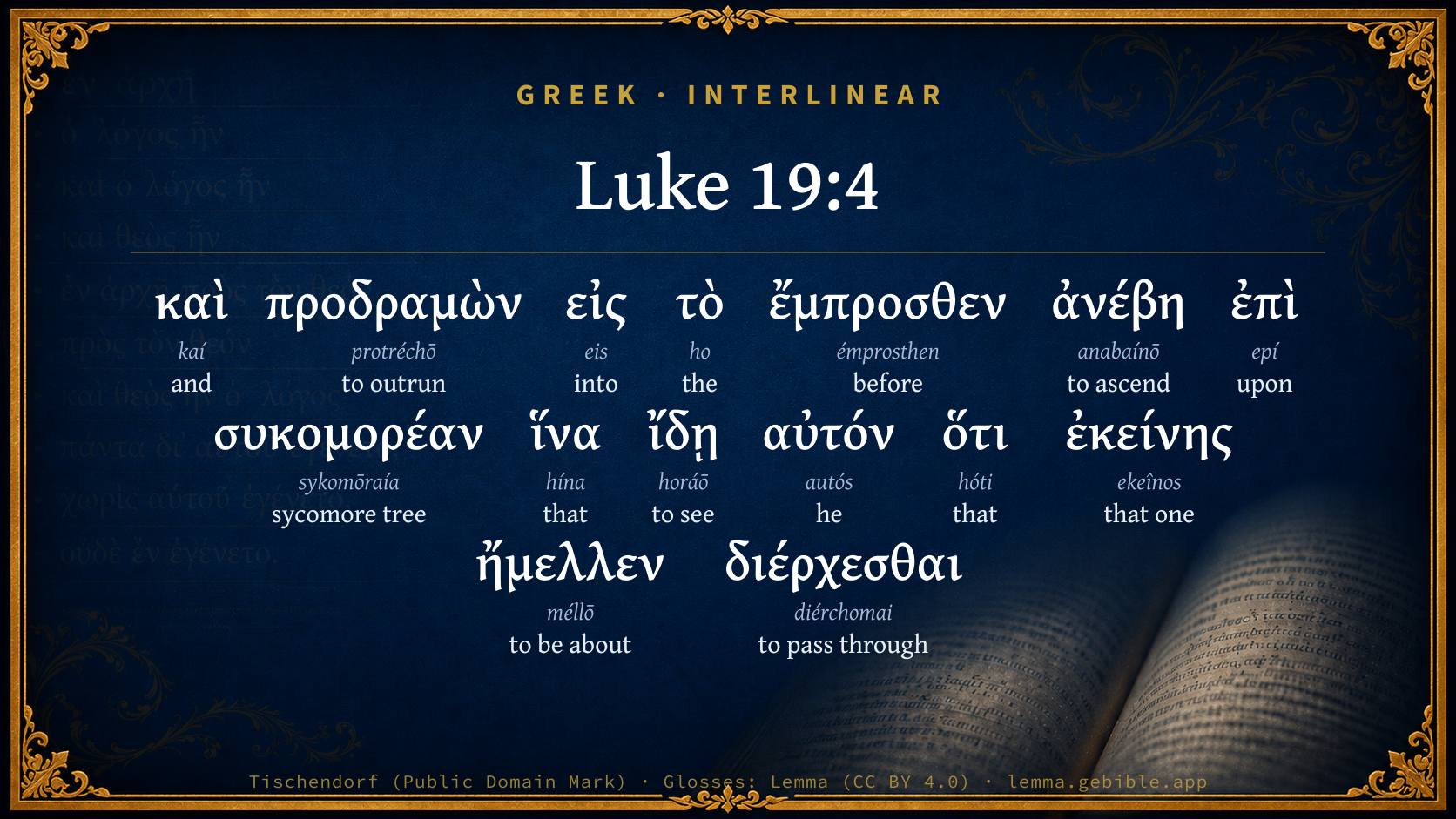
Download image
Cite this verse

Luke 19:4 (World English Bible). Public Domain. Lemma interlinear Bible study tool, https://lemma.gebible.app/v/luke/19/4.

Show BibTeX & RIS
BibTeX
RIS
English Translation
He ran on ahead, and climbed up into a sycamore tree to see him, for he was to pass that way.
World English Bible · Public Domain
Highlights
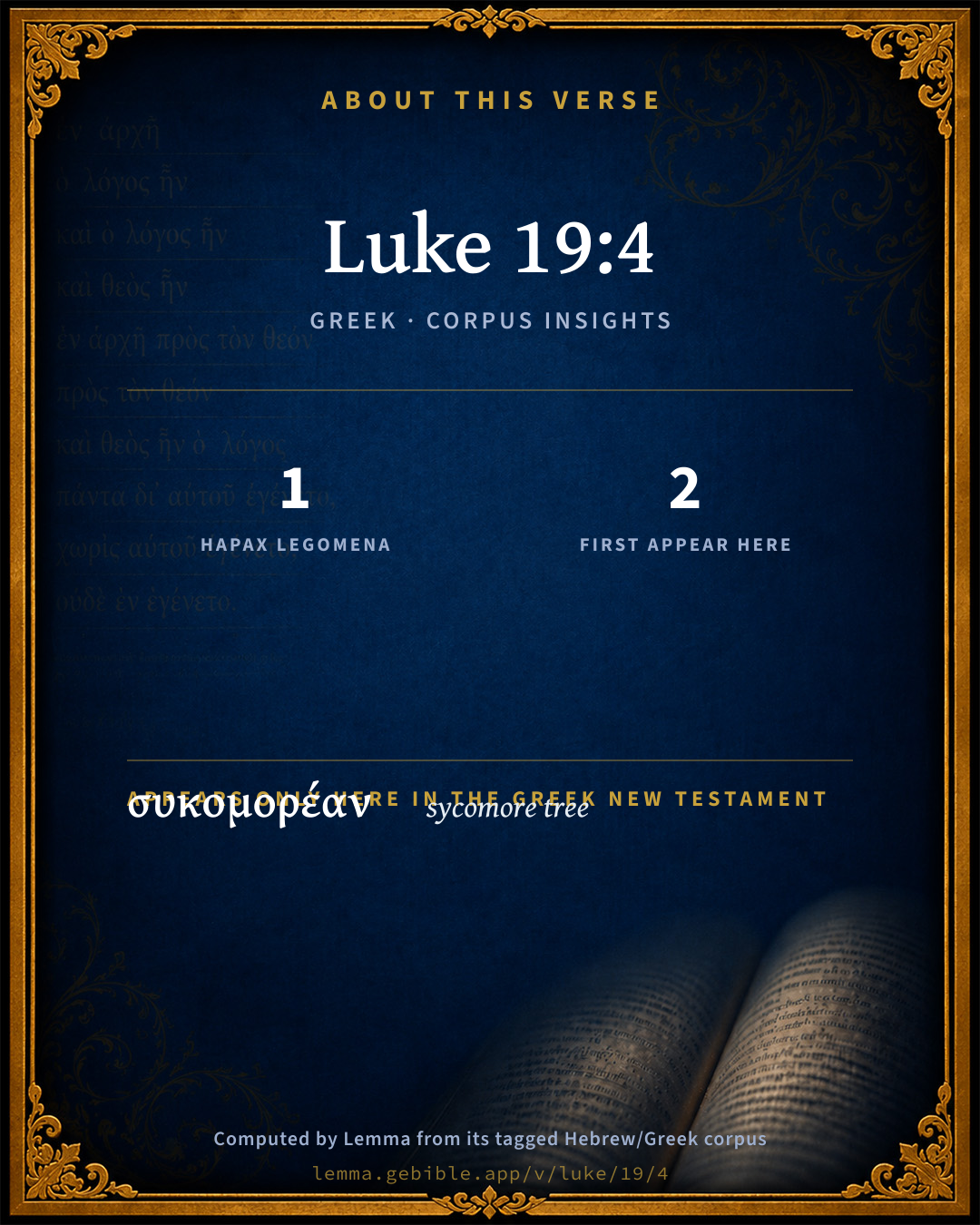
  • 1 hapax legomenon — only here in the Greek New Testament
  • 2 first appearances in the Greek New Testament
Full analysis ↓
Download a study sheet

One document with this verse’s original text, its word-by-word gloss line, the meaning frame, cross-references with their text, attributed commentary, and full source and license credits — printable, and it pastes into notes with its structure intact.

This verse Autodidact and up

Study sheet (.html) Plain text (.txt)

A passage Seminary Student

Up to 50 verses in one chapter. A passage sheet keeps up to 6 commentary sources and 12 cross-references per verse, in the order this page ranks them, and says so on the sheet whenever that leaves anything out. Ask for a single verse and you get the Autodidact verse sheet above.

Everything on this page stays free to read, with no account — the sheet is a download of what is already on screen, not access to it.

Want to remove ads? Support Godless Engineer
Compare translations 3

The same verse in 3 English versions, stacked beneath the original-language interlinear above. Click any original word for its lexicon entry.

Each is an independent rendering of the whole verse — the interlinear is not word-aligned to these translations.

Highlighted words mark where these versions differ — a whole-verse word diff, not a word-by-word alignment.

  • World English Bible Public Domain
    He ran on ahead, and climbed up into a sycamore tree to see him, for he was to pass that way.
  • King James Version Public Domain
    And he ran before, and climbed up into a sycomore tree to see him: for he was to pass that way.
  • unfoldingWord Literal Text CC BY-SA 4.0
    And running on ahead, he climbed into a sycamore tree so that he might see him, because he was about to pass through that.

unfoldingWord Literal Text — © unfoldingWord, licensed CC BY-SA 4.0. Word-aligned USFM3 via Door43 (git.door43.org/unfoldingWord/en_ult).

Versions to compare (up to 4)

3 of 4 selected

Show all 19 translations

Every available English version of this verse, each an independent rendering of the whole verse.

  • World English Bible Public Domain
    He ran on ahead, and climbed up into a sycamore tree to see him, for he was to pass that way.
  • Berean Standard Bible Public Domain
    So he ran on ahead and climbed a sycamore tree to see Him, since Jesus was about to pass that way.
  • Majority Standard Bible Public Domain
    So he ran on ahead and climbed a sycamore tree to see Him, since Jesus was about to pass that way.
  • King James Version Public Domain
    And he ran before, and climbed up into a sycomore tree to see him: for he was to pass that way.
  • American Standard Version (1901) Public Domain
    And he ran on before, and climbed up into a sycomore tree to see him: for he was to pass that way.
  • Revised Version (1885) Public Domain
    And he ran on before, and climbed up into a sycomore tree to see him: for he was to pass that way.
  • Geneva Bible (1599) Public Domain
    Wherefore he ranne before, and climed vp into a wilde figge tree, that he might see him: for he should come that way.
  • Douay-Rheims (1899) Public Domain
    And running before, he climbed up into a sycamore tree, that he might see him; for he was to pass that way.
  • Young's Literal Translation Public Domain
    and having run forward before, he went up on a sycamore, that he may see him, because through that `way' he was about to pass by.
  • Literal Standard Version CC BY-SA 4.0
    and having run forward before, he went up on a sycamore, that he may see Him, because through that [way] He was about to pass by.
  • Unlocked Literal Bible CC BY-SA 4.0
    So he ran on ahead of the people and climbed up into a sycamore tree to see him, because Jesus was about to pass that way.
  • unfoldingWord Literal Text CC BY-SA 4.0
    And running on ahead, he climbed into a sycamore tree so that he might see him, because he was about to pass through that.
  • Darby Bible Public Domain
    And running on before, he got up into a sycamore that he might see him, for he was going to pass that [way].
  • World Messianic Bible Public Domain
    He ran on ahead and climbed up into a sycamore tree to see him, for he was going to pass that way.
  • Webster's Bible Public Domain
    And he ran before, and climbed up upon a sycamore-tree to see him; for he was to pass that way.
  • Free Bible Version CC BY-SA 4.0
    So he ran ahead, and climbed up a sycamore tree to see Jesus as he passed by.
  • Bible in Basic English Public Domain
    And he went quickly in front of them and got up into a tree to see him, for he was going that way.
  • Text-Critical English NT CC BY 4.0
    So he ran on ahead and climbed a sycamore tree so that he could see him, because Jesus was about to pass by that way.
  • Tyndale New Testament (1534) Public Domain
    Wherfore he ran before and asceded vp into a wilde fygge tree to se him: for he shulde come that same waye.

Literal Standard Version (2020), Covenant Press — licensed CC BY-SA 4.0. Text via the HelloAO Bible API (eBible.org). Unlocked Literal Bible (unfoldingWord) — licensed CC BY-SA 4.0. Text via the HelloAO Bible API (eBible.org). unfoldingWord Literal Text — © unfoldingWord, licensed CC BY-SA 4.0. Word-aligned USFM3 via Door43 (git.door43.org/unfoldingWord/en_ult). Free Bible Version, Dr. Jonathan Gallagher — licensed CC BY-SA 4.0. Text via the HelloAO Bible API (eBible.org).

Word by word

More ways to search: Search by grammar → Find every occurrence → Compare this word →

Practice this passage: Drill this verse → Learn its vocabulary →

συκομορέαν
sykomōraía
G4809
“sycomore tree”
Noun, Accusative, Singular, Feminine
Part of Speech
Noun
Case
Accusative
Number
Singular
Gender
Feminine
Full Thayer's Definition

Origin: from G4810 and moron (the mulberry)

TDNT: 7:758,*

1. a sycomore tree
  1. καὶ kaí G2532 “and” Conjunction
  2. προδραμὼν protréchō G4390 “to outrun” Verb, Aorist, Active, Participle, Nominative, Singular, Masculine
  3. εἰς eis G1519 “into” Preposition
  4. τὸ ho G3588 “the” Article, Accusative, Singular, Neuter
  5. ἔμπροσθεν émprosthen G1715 “before” Adverb
  6. ἀνέβη anabaínō G305 “to ascend” Verb, Aorist, Active, Indicative, 3rd person, Singular
  7. ἐπὶ epí G1909 “upon” Preposition
  8. ἵνα hína G2443 “that” Conjunction
  9. ἴδῃ horáō G3708 “to see” Verb, Aorist, Active, Subjunctive, 3rd person, Singular
  10. αὐτόν autós G846 “he” Personal pronoun, Accusative, Singular, Masculine
  11. ὅτι hóti G3754 “that” Conjunction
  12. ἐκείνης ekeînos G1565 “that one” Demonstrative pronoun, Genitive, Singular, Feminine
  13. ἤμελλεν méllō G3195 “to be about” Verb, Imperfect, Active, Indicative, 3rd person, Singular, Attic form
  14. διέρχεσθαι diérchomai G1330 “to pass through” Verb, Present, Middle or Passive deponent, Infinitive

About this verse

These counts appear in no published source. They are computed here, from the morphology-tagged text and Lemma’s own curated glosses. What Lemma adds →

15
words
15
distinct lemmas
Gospels
section

Notable vocabulary

1 hapax legomenon — a word that appears only here in the entire Greek New Testament:

  • συκομορέαν sycomore tree G4809

First appearance in Scripture

These words make their first canonical appearance in the Greek New Testament here:

  • προδραμὼν to outrun G4390
  • συκομορέαν sycomore tree G4809

Shared distinctive vocabulary

προδραμὼν to outrun G4390 occurs in 2 verses of the Greek New Testament. Also found in:
Cross-references

6

Topical passages linked to Luke 19:4 in the Treasury of Scripture Knowledge — connected by theme and wording, ordered by reader-vote popularity; previews shown in the World English Bible.

  • Isaiah 9:10 The bricks are fallen, but we will build with hewn stone; the sycamores are cut down, but we will put cedars in their place.
  • Luke 5:19 Not finding a way to bring him in because of the multitude, they went up to the housetop, and let him down through the tiles with his cot into the midst before Jesus.
  • 1 Chronicles 27:28 and over the olive trees and the sycamore trees that were in the lowland was Baal Hanan the Gederite: and over the cellars of oil was Joash:
  • 1 Kings 10:27 The king made silver to be in Jerusalem as stones, and cedars made he to be as the sycamore trees that are in the lowland, for abundance.
  • Amos 7:14 Then Amos answered Amaziah, "I was no prophet, neither was I a prophet's son; but I was a herdsman, and a farmer of sycamore trees;
  • Psalms 78:47 He destroyed their vines with hail, Their sycamore-fig trees with frost.

Cross-references courtesy of OpenBible.info (CC BY 4.0).

Commentary

Notes on Luke 19:4 from classic Christian and Jewish commentators (each source and its license shown beneath its notes). The classic Christian expositions comment on the surrounding passage and are grouped to its opening verse, so a note may address several verses; the Jewish commentaries on the Tanakh (Rashi and others) are per-verse, so they appear only where the commentator wrote on this verse.

Lemma curates 59 commentaries, every one of them public domain or Creative Commons licensed, each selected and text-cleaned for this edition rather than reprinted as found. About our sources →

Tyndale Open Study Notes

Tyndale Open Resources

19:4 climbed a sycamore-fig tree: This act was very undignified for a man of Zacchaeus’ power and wealth; it shows his genuine spiritual interest in Jesus.

Tyndale Open Study Notes — © Tyndale Open Resources, licensed CC BY-SA 4.0. Text via the HelloAO Bible API.

Bengel's Gnomon

Johann Albrecht Bengel

Luk 19:4. Προδραμὼν, having run on before) with great eagerness.—ἀνέβη, he climbed up) External etiquette and manners would not allow a man of rank to climb up into a tree; but faith conquers every other consideration.—συκομορέαν, a sycamore) The sycamore, a tree of a nature standing midway between a fig-tree and a mulberry tree; a tree which grows to a great height. Comp. ch. Luk 17:6, note.—ἐκείνης) viz. ὁδοῦ, χώρας. There is an ellipsis of διὰ, as in ch. Luk 5:19, where see the note. Some have supplied the διά.[205]

[205] Rec. Text has δἰ ἐκείνης: a has “per illa parte.” But ABQ have ἐκείνης only; bc “illâ parte:” Vulg. and d, ‘inde.’—E. and T.

Bengel's Gnomon of the New Testament — English translation (T&T Clark, Edinburgh, 1860) — public domain. Text from a community e-Sword module.

Expositor's Greek Testament

ed. W. Robertson Nicoll

Luk 19:4 . εἰς τὸ ἔμπροσθεν , in front of the crowd, to make sure; stationed at any point opposite the crowd he might miss his chance. συκομοραίαν , a fig mulberry tree, as many think = συκάμινος in Luk 17:6 ; but why then not use the same word in both places, the only two places in N.T. where they occur, both used by the same writer? To this it has been replied: “Although it may be admitted that the sycamine is properly and in Luk 17:6 the mulberry, and the sycamore the fig mulberry, or sycamore fig, yet the latter is the tree generally referred to in the O.T. and called by the Sept [148] sycamine , as 1Ki 10:27 , 1Ch 27:28 , Psa 78:47 , Amo 7:14 . Dioscorides expressly says Συκόμορον , ἔνιοι δὲ καὶ τοῦτο συκάμινον λέγουσι , lib. i., cap. 180” (Smith’s Dictionary of the Bible , s. v. Sycamore ). This is in effect to say that through the influence of the Sept [149] and following common usage Lk. used the two words indifferently as synonyms. ἐκείνης : supply ὁδοῦ , cf. ποίας , Luk 5:19 .

[148] Septuagint.

[149] Septuagint.

The Expositor's Greek Testament, edited by W. Robertson Nicoll (1897–1910) — public domain. Text from a community e-Sword module.

Jamieson, Fausset & Brown

Robert Jamieson, A. R. Fausset & David Brown

sycamore--the Egyptian fig, with leaves like the mulberry.

Jamieson, Fausset & Brown — Commentary Critical and Explanatory on the Whole Bible (1871) — public domain (CC PDM 1.0). Text via the HelloAO Bible API.

Adam Clarke's Commentary

Verse 4. He ran before] The shortness of his stature was amply compensated by his agility and invention. Had he been as tall as the generality of the crowd, he might have been equally unnoticed with the rest. His getting into the tree made him conspicuous: had he not been so low of stature he would not have done so. Even the imperfections of our persons may become subservient to the grace of God in our eternal salvation. As the passover was at hand, the road was probably crowded with people going to Jerusalem; but the fame of the cure of the blind man was probably the cause of the concourse at this time.

Adam Clarke's Commentary on the Bible (1810–1826) — public domain. Text from a community e-Sword/MySword module.

Ellicott's Commentary for English Readers

(4) And climbed up into a sycomore tree.—The name of “sycomore” has been variously applied—(1) to a species of maple (Acer pseudo-platanus); (2) to the mulberry (Morus nigra), more properly, “sycamine,” as in Luk_17:6; and (3) to the fig mulberry (Ficus sycomorus). The last is the tree here meant. It grew to a considerable height in the Jordan valley, and was much used by builders and carpenters (1Ki_10:27). The care taken by St. Luke to distinguish between the “sycamine” of Luk_17:6 (where see Note), and the “sycomore” here, may fairly be noted as an instance of botanical accuracy, such as was likely to be found in a physician. We can picture the scene to our mind’s eye—the eager, wistful, supplicating face looking down from the fresh green foliage (it was early spring), and meeting the gaze of Jesus as He passed,

A Bible Commentary for English Readers, edited by Charles John Ellicott (1878–1897) — public domain. Text from a community e-Sword module.

The Cambridge Bible for Schools and Colleges

gen. ed. J. J. S. Perowne

4. into a sycomore tree] Not the same as the sycamine (mulberry) of Luk_17:6, or with our sycamore (or pseudo-platanus) but the Egyptian fig, of which the low spreading branches are very easy to climb.

The Cambridge Bible for Schools and Colleges (gen. ed. J. J. S. Perowne; Cambridge University Press, 1878–1918) — public domain. Text from a community e-Sword module.

John Gill's Exposition

And when Jesus came to the place,.... Where the tree stood, in which Zacchaeus was. Christ knows where his people are, and where to find them, where they commonly dwell, or where at any time they are, he being God omniscient: besides, the bounds of their habitations are fixed by the determination and appointment of God, and were foreknown by Christ, who, before the world began, was "rejoicing in the habitable part of his earth", where he knew his saints would dwell, who are "the sons of men", with whom his delights were; and he knows where they are, when the time is come to call them: he knew Zacchaeus was in the sycamore tree, as he saw Nathanael under the fig tree, before Philip called him, Joh 1:48 and Christ comes to the very place where his people are, either in person, as here; and so he came to Galilee, and to the sea there, and walked by it, and on the very spot, where he knew he should meet with Peter, and Andrew, and James, and John, whom he called to follow him, Mat 4:13. He came to his own city Capernaum, and to the place of receipt of custom near unto it, where Matthew was, and called him, Mat 9:1 and he came to Samaria, and to Jacob's well, where he knew the woman of Samaria would be at such a time, in order to call her: or, though he comes not in person to others, where they are, yet by his word, and by his Spirit; and he comes to them before they come to him; and is found of them, and finds them, who sought him not; and is made manifest to them, who asked not for him; and in this he acts the part of the good shepherd, that leaves the ninety nine in the wilderness, and goes after that which is lost till he finds it; and agreeably to his character as a Saviour, and to the end of his coming into the world, which was to call sinners to repentance, and to seek, and save that which is lost, Luk 19:10.

He looked up and saw him; he knew him, he being one of those the Father had given to him, and he had loved and undertook for, and was come into the world to seek, and to save, and now, at this time, was come hither to call by his grace. He had seen him before in the glass of his Father's purposes and decrees, he being chosen in him to grace and glory, and being a vessel of mercy, afore prepared for glory: he had seen him when he was brought into the bond of the covenant; and passed under the rod of him, that telleth all the covenant ones, as they were put into it, and given to him the Mediator of it: he had seen him among them that were lost in Adam, whom he came to recover out of the ruins of their fall in him; and now he saw him in his state of nature and unregeneracy; he saw him in his blood, and said unto him, live: this look was a look of love, grace, and mercy; he looked upon him, and loved him, and was gracious to him, and had compassion on him; and it was a distinguishing look, he looked on him, and not on others. There was a great crowd both before and behind him, and all about him; but he looked not on these, but he looked up to Zacchaeus.

And he said unto him, Zacchaeus; he knew him, and could call him by his name, as he did Saul, when he called him, and revealed himself to him. His name was written in the Lamb's book of life, and so must be known to Christ, who was present at the making of that book, and was concerned in setting down the names in it, and has it in his keeping: he was one of the sheep the Father had given him, he came to lay down his life for, and of whom he had such perfect knowledge, as to call them by name, as he does all the chosen and redeemed ones; see Isa 43:1. It must be very surprising to Zacchaeus to hear Christ call him by his name, who was an utter stranger to him, and whom he had never seen before; and it is a very considerable instance of the omniscience of Christ, as well as of the great condescension and affectionate regard he has to his own, and the familiar way in which he uses them.

Make haste, and come down; from the tree. The dangerous estate and condition of a sinner requires haste; it is like that of Lot in Sodom, when it was just going to be destroyed; and like that of the manslayer, when pursued by the avenger of blood; both whom it became to escape for their lives, and flee for refuge as fast as they could: and so it became Zacchaeus to come down with all speed to Christ, who was come hither to call and save him; and the enjoyment of Christ, and his grace, calls for haste; see Joh 11:28. Such who come to Christ must quit all their exalted thoughts of themselves, of their riches, fulness, and self-sufficiency, and come to him as poor and needy, for such only he fills with his good things; and of their health and soundness, and come to him the great physician, as sick and diseased; and of their purity and goodness, holiness and righteousness, and come to him as sinners: but it must be mighty grace to cast down imaginations, and high things, that exalt themselves against Christ, and the knowledge of him, and to humble a proud sinner, and bring him to the feet of Jesus.

For this day I must abide at thy house; for a little while; not so much for the sake of refreshment for himself, and his disciples, as for the good of Zacchaeus; to make known the great salvation to him, and to bestow his grace upon him, and converse with him in a spiritual way.

John Gill's Exposition of the Whole Bible (1746–1763) — public domain (CC PDM 1.0). Text via the HelloAO Bible API.

Trapp's Complete Commentary

John Trapp

4 And he ran before, and climbed up into a sycomore tree to see him: for he was to pass that way.

Ver. 4. And he ran before] Forgetful of his rank and quality. Rich men and rulers use not to run, much less to climb trees, as boys do for birds’ nests. But his earnest desire to see his Saviour, and especially a gracious impulse of the Holy Spirit, made him thus seemingly immodest, and unmindful of keeping a decorum.

John Trapp, A Commentary or Exposition upon All the Books of the Old and New Testament (1647–1656) — public domain. Text from a community e-Sword module.

Albert Barnes' Notes on the Bible

A sycamore tree - See this described in the notes at Luk 17:6.

Albert Barnes' Notes on the Bible (1834–1885) — public domain. Text from a community e-Sword/MySword module.

Whedon's Commentary on the Bible

Daniel D. Whedon

4. A sycamore tree—That is, a fig-mulberry tree; the tree with the leaves of a mulberry and a fruit like a fig. When of full growth it takes three men to embrace its trunk; and, being usually planted by the roadside, it serves, by its far-extending branches, either for shelter, or for such means of overlooking as Zaccheus here practiced.

To pass that way—It was publicly known that his route lay toward Jerusalem.

Daniel D. Whedon (gen. ed.), Commentary on the Old and New Testaments (1874–1909) — public domain. Text from a community e-Sword module.

The Pulpit Commentary

Into a sycomore tree. Floss sycomorus, the fig-mulberry, is here meant. It grew in the Jordan valley to a considerable height; the low, spreading branches were easy to climb. "We can picture the scene to our mind"s eye. The eager, wistful, supplicating face looking down from the fresh green foliage it was early spring and meeting the gaze of Jesus as he passed" (Dean Plumptre).

The Pulpit Commentary (1880–1919), ed. H.D.M. Spence-Jones & Joseph S. Exell — public domain. Text from a community e-Sword module.

John Wesley's Explanatory Notes

And running before - With great earnestness. He climbed up - Notwithstanding his quality: desire conquering honour and shame.

John Wesley, Explanatory Notes Upon the Whole Bible (1754–1765) — public domain. Text via the GEBible commentary corpus.

Cambridge Greek Testament for Schools and Colleges

4. συκομορέαν. See note.

ἐκείνης. See note. The δι’ ἐκείνης of Elz. is a gloss.

4. συκομορέαν. A commoner form of the name is συκόμορος. Not the same as sycamine (mulberry) of Luk 17:6, or with our sycamore (or pseudo-platanus) but the Egyptian fig, of which the low spreading branches are very easy to climb.

ἐκείνης. ‘That way.’ There is no need for the διὰ of some MSS. See Luk 5:19, ποίας. Winer, p. 738 sq.

διέρχεσθαι. To pass through the town.

Cambridge Greek Testament for Schools and Colleges (Cambridge University Press, 1896; 21 vols, various authors incl. Carr, Maclear, Plummer, Farrar, Lumby, Moule, M. R. James, Simcox) — public domain. Text from a community e-Sword module.

Alford’s Greek Testament

Henry Alford

4. προδρ. ἔμπρ.] So Jos. Antt. vii. 8. 5, προέπεμψεν ἔμπροσθεν.

συκομορ.] The Egyptian fig, a tree (Pliny xiii. 14: Dioscor. i. 182, cited by Winer) like the mulberry in appearance, size, and foliage, but belonging generically to the fig-trees. It grows to a great size and height: see Winer, Realwörterbuch, under Maulbeer-feigenbaum. See also on ch. 17:6. Notice the changes of subject here,—ἀνέβη (Ζακχ.) … ἵνα ἴδῃ αὐτόν, ὅτι ἐκείνης ἤμελλεν (ὁ Ἰησ.) διέρ.… κ. σπεύσας (Ζακχ.). See ch. 15:15:—and a curious and characteristic note in Wordsw. here.

Henry Alford, The Greek Testament (1849–1861) — public domain. Text from a community e-Sword module.

International Critical Commentary

4. εἰς τὸ ἔμπροσθεν.. Strengthens the προδραμών. He ran on to that part of the city which was in front of Christ’s route. There is nothing to show that he wished to hide, and that Christ’s call to him was like His making the woman with the issue disclose her act (Trench). On the other hand, there is no evidence that he braved the derision of the crowd. We may say, however, that no thought of personal dignity or propriety deterred him from his purpose.

TR. omits εἰς τό, which is sufficiently attested by א B L, processit in priore et (e), antecedens ab ante (d), D having προλαβών for προδραμών.

συκομορέαν. “A fig-mulberry,” quite a different tree from the fig and the mulberry and the common sycamore: Its fruit is like the fig, and its leaf like the mulberry, and hence the name. The συκάμινος of 17:6 is commonly held to be the mulberry, but may be another name for the fig-mulberry, as Groser thinks. The fig-mulberry “recalls the English oak, and its shade is most pleasing. It is consequently a favourite wayside tree. … It is very easy to climb, with its short trunk, and its wide lateral branches forking out in all directions” (Tristram, Nat. Hist. of B. P. 398).

The MSS. vary much, but all early uncials except A have -μορέα and not -μοραία; and -μορέα is much better attested than -μωρέα or -μωραία. The common form is συκόμορος.

With ἐκείης sc. ὁδοῦ comp. ποίας 5:19.

For the sudden change of subject, ἀνέβη … ἤμελλεν, comp. 14:5, 15:15, 17:2; and for the subjunctive after a past tense, ἀνέβη … ἴνα ἴδῃ, comp. 6:7, 18:15, 39; Joh 4:8, Joh 7:32.

International Critical Commentary — older volumes (1896–1929), various authors — public domain. Text from a community e-Sword module.

Vincent's Word Studies in the New Testament

Marvin R. Vincent

Sycamore [συκομορεαν] . From sukh, fig - tree, and moron, the mulberry. The fig - mulberry, resembling the fig in its fruit, and the mulberry in its leaves. Some old writers derived it from mwrov, foolish, because it produced worthless figs. Dr. Thomson says that it bears several crops yearly, which grow on short stems along the trunk and the large branches. They are very insipid, and none but the poorer classes eat them. Hence Amos expresses the fact that he belongs to the humblest class of the community, by calling himself a gatherer of sycamore fruit (Amo 7:14). It grows with its large branches low down and wide open, so that Zacchaeus could easily have climbed into it. It is a favorite and pleasant conceit with old commentators that Zacchaeus' sycamore that day bore precious fruit.

Marvin R. Vincent, Word Studies in the New Testament (1887–1900) — public domain. Text from a community e-Sword/MySword module.

Lesson kit

Teaching starters — assembled from the data on this page, not authored interpretation. Every prompt links to the verse data it draws on. Edit before teaching.

Luke, in the Gospels, opens this verse with 15 words (15 distinct Greek lemmas). Its most distinctive word is sykomōraía (“sycomore tree”). A historical commentator’s framing appears above. Read the whole chapter for the surrounding context.

Discussion questions

  1. The word sykomōraía carries the sense “sycomore tree.” How does it shape the verse?
  2. 1 word here appears nowhere else in the Greek New Testament. Why might the author reach for such rare wording?
  3. 2 words make their first appearance in Scripture here. What does this debut establish?
  4. How does John 20:4, which shares the word «to outrun», read alongside this verse?
  5. The translations on this page render this verse differently — a whole-verse word diff, not a word-by-word alignment. What might account for the different wordings?
  6. Compare how Tyndale Open Study Notes and Bengel's Gnomon read this verse. Where do they agree or differ?

Things to notice

  • 1 word in this verse appears nowhere else in the Greek New Testament.
  • 2 words make their first canonical appearance in Scripture here.
  • These translations choose different wording for 12 words in this verse.
  • 15 distinct Greek lemmas span 15 words in this verse.

Reading settings

Reading text

Shown beneath each verse's original-language words.

Old Testament
Old Testament edition

Read the OT as the Masoretic Hebrew (MT) or the Greek Septuagint (LXX).

English shown for the Greek Septuagint (in the Hebrew ↔ Greek comparison).

Comparing translations? Open the Compare panel on any verse page to stack up to four side by side.