John 5:46

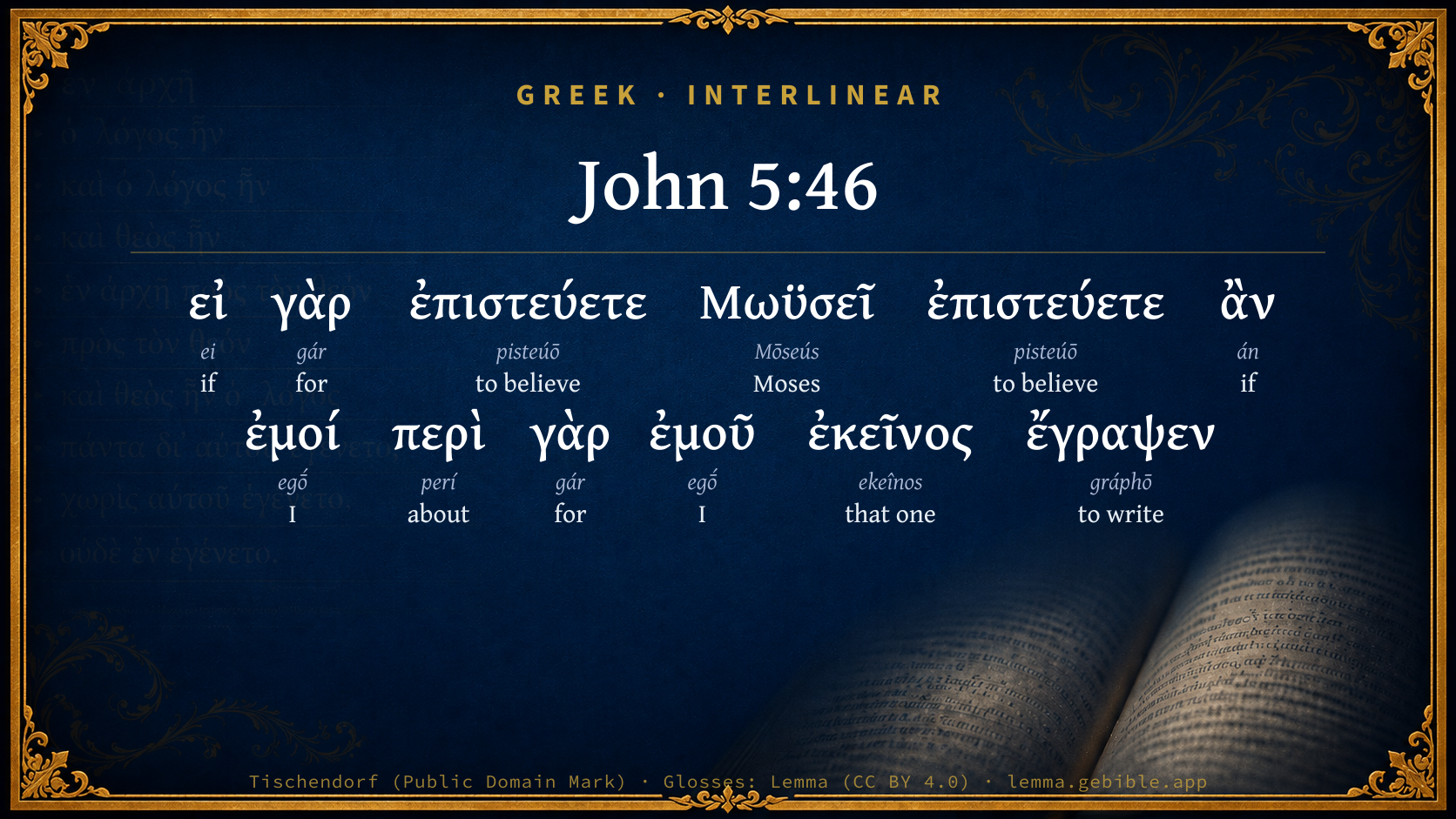
Greek (Tischendorf 8th ed.) John 5:46 appears in the Greek New Testament. The text above is from the Tischendorf 8th edition. Each word links to its Strong’s number and a concise gloss. Click any word for its full Thayer’s Greek Lexicon entry.
Download image
Cite this verse

John 5:46 (World English Bible). Public Domain. Lemma interlinear Bible study tool, https://lemma.gebible.app/v/john/5/46.

Show BibTeX & RIS
BibTeX
RIS
English Translation
For if you believed Moses, you would believe me; for he wrote about me.
World English Bible · Public Domain
Download a study sheet

One document with this verse’s original text, its word-by-word gloss line, the meaning frame, cross-references with their text, attributed commentary, and full source and license credits — printable, and it pastes into notes with its structure intact.

This verse Autodidact and up

Study sheet (.html) Plain text (.txt)

A passage Seminary Student

Up to 50 verses in one chapter. A passage sheet keeps up to 6 commentary sources and 12 cross-references per verse, in the order this page ranks them, and says so on the sheet whenever that leaves anything out. Ask for a single verse and you get the Autodidact verse sheet above.

Everything on this page stays free to read, with no account — the sheet is a download of what is already on screen, not access to it.

Want to remove ads? Support Godless Engineer
Compare translations 3

The same verse in 3 English versions, stacked beneath the original-language interlinear above. Click any original word for its lexicon entry.

Each is an independent rendering of the whole verse — the interlinear is not word-aligned to these translations.

Highlighted words mark where these versions differ — a whole-verse word diff, not a word-by-word alignment.

  • World English Bible Public Domain
    For if you believed Moses, you would believe me; for he wrote about me.
  • King James Version Public Domain
    For had ye believed Moses, ye would have believed me; for he wrote of me.
  • unfoldingWord Literal Text CC BY-SA 4.0
    For if you believed Moses, you would believe me, because that one wrote about me.

unfoldingWord Literal Text — © unfoldingWord, licensed CC BY-SA 4.0. Word-aligned USFM3 via Door43 (git.door43.org/unfoldingWord/en_ult).

Versions to compare (up to 4)

3 of 4 selected

Show all 19 translations

Every available English version of this verse, each an independent rendering of the whole verse.

  • World English Bible Public Domain
    For if you believed Moses, you would believe me; for he wrote about me.
  • Berean Standard Bible Public Domain
    If you had believed Moses, you would believe Me, because he wrote about Me.
  • Majority Standard Bible Public Domain
    If you had believed Moses, you would believe Me, because he wrote about Me.
  • King James Version Public Domain
    For had ye believed Moses, ye would have believed me; for he wrote of me.
  • American Standard Version (1901) Public Domain
    For if ye believed Moses, ye would believe me; for he wrote of me.
  • Revised Version (1885) Public Domain
    For if ye believed Moses, ye would believe me; for he wrote of me.
  • Geneva Bible (1599) Public Domain
    For had ye beleeued Moses, ye would haue beleeued me: for he wrote of me.
  • Douay-Rheims (1899) Public Domain
    For if you did believe Moses, you would perhaps believe me also; for he wrote of me.
  • Young's Literal Translation Public Domain
    for if ye were believing Moses, ye would have been believing me, for he wrote concerning me;
  • Literal Standard Version CC BY-SA 4.0
    for if you were believing Moses, you would have been believing Me, for he wrote concerning Me;
  • Unlocked Literal Bible CC BY-SA 4.0
    If you believed Moses, you would believe me, because he wrote about me.
  • unfoldingWord Literal Text CC BY-SA 4.0
    For if you believed Moses, you would believe me, because that one wrote about me.
  • Darby Bible Public Domain
    for if ye had believed Moses, ye would have believed me, for he wrote of me.
  • World Messianic Bible Public Domain
    For if you believed Moses, you would believe me; for he wrote about me.
  • Webster's Bible Public Domain
    For had ye believed Moses, ye would have believed me: for he wrote concerning me.
  • Free Bible Version CC BY-SA 4.0
    For if you really trusted Moses you would trust in me, because he wrote about me.
  • Bible in Basic English Public Domain
    If you had belief in Moses you would have belief in me; for his writings are about me.
  • Text-Critical English NT CC BY 4.0
    If you had believed Moses, you would believe me, for he wrote about me.
  • Tyndale New Testament (1534) Public Domain
    For had ye beleved Moses ye wold have beleved me: for he wrote of me.

Literal Standard Version (2020), Covenant Press — licensed CC BY-SA 4.0. Text via the HelloAO Bible API (eBible.org). Unlocked Literal Bible (unfoldingWord) — licensed CC BY-SA 4.0. Text via the HelloAO Bible API (eBible.org). unfoldingWord Literal Text — © unfoldingWord, licensed CC BY-SA 4.0. Word-aligned USFM3 via Door43 (git.door43.org/unfoldingWord/en_ult). Free Bible Version, Dr. Jonathan Gallagher — licensed CC BY-SA 4.0. Text via the HelloAO Bible API (eBible.org).

Word by word

More ways to search: Search by grammar → Find every occurrence → Compare this word →

Practice this passage: Drill this verse → Learn its vocabulary →

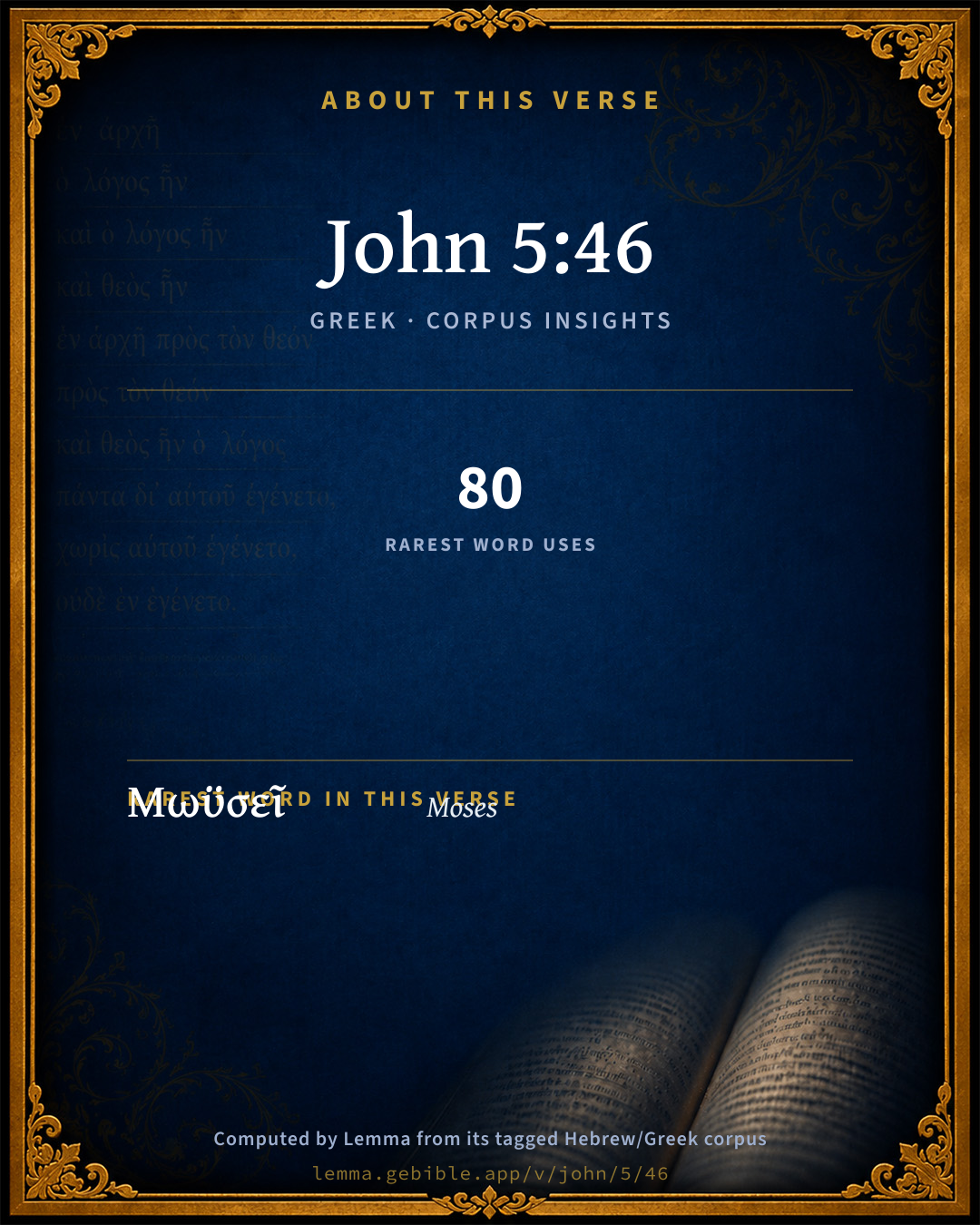
About this verse

These counts appear in no published source. They are computed here, from the morphology-tagged text and Lemma’s own curated glosses. What Lemma adds →

12
words
9
distinct lemmas
Gospels
section

Repetition

Words recur within this verse:

  • ἐπιστεύετε to believe G4100 ×2
  • γὰρ for G1063 ×2
  • ἐμοί I G1473 ×2

Cross-references

20

Topical passages linked to John 5:46 in the Treasury of Scripture Knowledge — connected by theme and wording, ordered by reader-vote popularity; previews shown in the World English Bible.

  • Deuteronomy 18:15 Yahweh your God will raise up to you a prophet from the midst of you, of your brothers, like me; to him you shall listen;
  • Deuteronomy 18:18–19 I will raise them up a prophet from among their brothers, like you; and I will put my words in his mouth, and he shall speak to them all that I shall command him.
  • John 1:45 Philip found Nathanael, and said to him, "We have found him, of whom Moses in the law, and the prophets, wrote: Jesus of Nazareth, the son of Joseph."
  • Luke 24:27 Beginning from Moses and from all the prophets, he explained to them in all the Scriptures the things concerning himself.
  • Numbers 24:17–18 I see him, but not now; I see him, but not near: There shall come forth a star out of Jacob, A scepter shall rise out of Israel, Shall strike through the corners of Moab, Break down all the sons of tumult.
  • Genesis 49:10 The scepter will not depart from Judah, Nor the ruler's staff from between his feet, Until he comes to whom it belongs. To him will the obedience of the peoples be.
  • Acts 26:22 Having therefore obtained the help that is from God, I stand to this day testifying both to small and great, saying nothing but what the prophets and Moses said would happen,
  • Genesis 22:18 In your seed will all the nations of the earth be blessed, because you have obeyed my voice."
  • Numbers 21:8–9 Yahweh said to Moses, Make you a fiery serpent, and set it on a standard: and it shall happen, that everyone who is bitten, when he sees it, shall live.
  • Genesis 12:3 I will bless those who bless you, and I will curse him who curses you. In you will all of the families of the earth be blessed."
  • Genesis 3:15 I will put enmity between you and the woman, and between your offspring and her offspring. He will bruise your head, and you will bruise his heel."
  • Hebrews 7:1–10 For this Melchizedek, king of Salem, priest of God Most High, who met Abraham returning from the slaughter of the kings and blessed him,
  • Genesis 18:18 seeing that Abraham has surely become a great and mighty nation, and all the nations of the earth will be blessed in him?
  • Galatians 4:21–31 Tell me, you that desire to be under the law, don't you listen to the law?
  • Genesis 28:14 Your seed will be as the dust of the earth, and you will spread abroad to the west, and to the east, and to the north, and to the south. In you and in your seed will all the families of the earth be blessed.
  • Galatians 3:24 So that the law has become our tutor to bring us to Christ, that we might be justified by faith.
  • Romans 10:4 For Christ is the fulfillment of the law for righteousness to everyone who believes.
  • Galatians 3:13 Christ redeemed us from the curse of the law, having become a curse for us. For it is written, "Cursed is everyone who hangs on a tree,"
  • Galatians 2:19 For I, through the law, died to the law, that I might live to God.
  • Galatians 3:10 For as many as are of the works of the law are under a curse. For it is written, "Cursed is everyone who doesn't continue in all things that are written in the book of the law, to do them."

Cross-references courtesy of OpenBible.info (CC BY 4.0).

Commentary

Notes on John 5:46 from classic Christian and Jewish commentators (each source and its license shown beneath its notes). The classic Christian expositions comment on the surrounding passage and are grouped to its opening verse, so a note may address several verses; the Jewish commentaries on the Tanakh (Rashi and others) are per-verse, so they appear only where the commentator wrote on this verse.

Lemma curates 59 commentaries, every one of them public domain or Creative Commons licensed, each selected and text-cleaned for this edition rather than reprinted as found. About our sources →

Bengel's Gnomon

Johann Albrecht Bengel

Joh 5:46. Ἐπιστεύετε ἂν, ye would have believed) It did not help the Jews to say, We believe, that all things, which Moses has written, are true. There was need of explicit faith.[112]—ἜΓΡΑΨΕΝ, He wrote) There is no part of his writings where he did not.

[112] And not merely of implicit faith, which took Moses’ writings in the mass, and not in detail.—E. and T.

Bengel's Gnomon of the New Testament — English translation (T&T Clark, Edinburgh, 1860) — public domain. Text from a community e-Sword module.

Meyer's Critical & Exegetical Commentary

Heinrich August Wilhelm Meyer

Joh_5:46. Proof that Moses was their accuser. Moses wrote of Christ, referring to Deu_18:15, and generally to all the Messianic types (comp. Joh_3:14) and promises of the Pentateuch, and to its general Messianic import (Luk_24:44; Rom_10:5); in this, that they did not believe Christ (i.e. that He spoke the truth), is implied that they rejected the truth of what Moses had written concerning Him. This unbelief is the subject-matter of Moses accusation. Well says Bengel: Non juvit Judaeos illud: Credimus vera esse omnia, quae Moses scripsit. Fide explicita opus erat.

Joh_5:47. δέ] Further conclusion from the unbelief with regard to Moses, pointed out in Joh_5:46. Thus the discourse ends with a question implying hopelessness.

The antithesis is not between γράμμασιν and ῥήμασι (as if the writings were easier of belief than the words), but between ἐκείνου and ἐμοῖς (faith in him being the necessary condition of faith in Christ); while the distinction of Moses having written (comp. Joh_5:46), and Christ spoken, simply presents the historical relation. Were the antithesis between γράμμ. and ῥήμ., these words would have taken the lead; were it between both, in γράμ. and ῥήμ., and at the same time in ἐκείνου and ἐμοῖς likewise, this twofold relationship must have been shown, thus perhaps: τοῖς γράμμασιν τοῖς ἐκείνου … τοῖς ῥήμασι τοῖς ἐμοῖς.

Note.

The discourse, Joh_5:19-47, so fully embodies in its entire progress and contents, allowing for the necessary Johannine colouring in the mode of representation, those essential doctrines which Jesus had to advocate in the face of the unbelieving Jews, and exhibits, in expression and practical application, so much that is characteristic, great, thoughtful, and striking, that even Strauss himself does not venture to deny that it came substantially from the Lord, though as to its form he attaches suspicious importance to certain resemblances with the first Epistle; but such a suspicion is all the less weighty, the more we are warranted to regard the Johannine idiosyncrasy as developed and moulded by the vivid recollection of the Lords words, and as under the guidance of His Spirit, which preserved and transfigured that recollection. The reasons which lead Weisse to see nothing in the discourse but synoptical matter, and B. Bauer to regard the whole as a reflection of the later consciousness of the Church, while Gfrörer supposes a real discourse, artificially shaped by additions and formal alterations, consist so much of arbitrary judgments and erroneous explanations and presuppositions, that sober criticism gains nothing by them, nor can the discourse which is attacked lose anything. Certainly we have in it a genuine exposition of Johannine theology (Hilgenfeld, Evang. p. 273), but in such a manner, that this is the theology of Christ Himself, the miracle of healing at Bethesda being historically the occasion of the utterance in this manner of its main elements. This miracle itself is indeed by Baur regarded as a fictitious pretext, invented for the delivery of the discourse, so much so that every feature in it seems to have been intended for this purpose (p. 159); and this in the face of the fact that no reference whatever is made (in Joh_5:19 ff.) to the point in connection with the miracle at which the Jews took offence, viz. the breaking of the Sabbath (Joh_5:16). Nothing whatever is specially said concerning miracles (for ἔργα denotes a far wider conception), but the whole discourse turns upon that Messianic faith in the person of Jesus which the Jews refused to entertain. The fundamental truths, on this occasion so triumphantly expressed, were never taught by Him so distinctly and definitely as now, when the right opportunity presented itself, at the very time when, after the Baptists removal, He came fully forth as the Messiah, and was called upon, quietly and comprehensively, to explain those highest of all relations, the explanation of which was previously demanded. Ewald, Gesch. Chr. p. 298 f.; comp. his Johann. Schr. I. 206 ff. At this crisis of His great mission and work, the references in the discourse to the Baptist, and the apologetic statements concerning His life-giving work and the divine witness of Scripture, connect themselves so necessarily with His historical position, that it cannot even remotely suffice to suppose, with Weizsäcker, p. 282, that the discourse was composed simply with an eye to the synoptical statements of Matthew 11.

Meyer — Critical and Exegetical Commentary on the New Testament — English translation by Peter Christie, edited by Frederick Crombie (T&T Clark, 1880) — public domain. Text from a community e-Sword module.

Expositor's Greek Testament

ed. W. Robertson Nicoll

Joh 5:46 . They will be accused by Moses because their unbelief in Christ convicts them of unbelief in Moses, εἰ γὰρ … ἐμοί . Had they believed the revelation made by Moses and understood it, they would necessarily have believed in Christ. “Disbelief in me is disbelief in him, in the record of the promises to the patriarchs, in the types of the deliverance from Egypt, in the symbolic institutions of the Law, in the promise of a prophet like to himself; for it was of me (the order is emphatic) he wrote,” Westcott.

The Expositor's Greek Testament, edited by W. Robertson Nicoll (1897–1910) — public domain. Text from a community e-Sword module.

Jamieson, Fausset & Brown

Robert Jamieson, A. R. Fausset & David Brown

he wrote of me--"an important testimony to the subject of the whole Pentateuch--'of Me'" [ALFORD].

Jamieson, Fausset & Brown — Commentary Critical and Explanatory on the Whole Bible (1871) — public domain (CC PDM 1.0). Text via the HelloAO Bible API.

Adam Clarke's Commentary

Verse 46. He wrote of me.] For instance, in reciting the prophecy of Jacob, Ge 49:10. The sceptre shall not depart from Judah, nor a lawgiver from between his feet, until SHILOH come; and unto him shall the gathering of the people be. And in De 18:18: I will raise them up a Prophet from among their brethren like unto thee; and I will put my words in his mouth, c. Confer this with Ac 3:22, and Ac 7:37. Besides, Moses pointed out the Messiah in a multitude of symbols and figures, which are found in the history of the patriarchs, the ceremonial laws, and especially in the whole sacrificial system. All these were well-defined, though shadowy representations of the birth, life, sufferings, death, and resurrection of the Saviour of the world. Add to this, Moses has given you certain marks to distinguish the false from the true prophet, De 13:1-3; De 18:22, which, if you apply to me, you will find that I am not a false but a true prophet of the Most High God.

Adam Clarke's Commentary on the Bible (1810–1826) — public domain. Text from a community e-Sword/MySword module.

John Calvin's Commentaries

46. For if you believed Moses, you would also believe me. He shows why Moses will be their accuser. It is because they do not reject his doctrine. We know that it is impossible to offer a greater insult to the servants of God than when their doctrine is despised or reproached. Besides, those whom the Lord has appointed to be ministers of his word, ought to be ready to defend it against despisers; and therefore, he gave to all his prophets a twofold commission, that they might teach and instruct for the salvation of believers, and that, one day, they might confound the reprobate by their testimony.

For he wrote concerning me. When Christ says, that Moses wrote concerning him, this needs no long proof with those who acknowledge that Christ is the end and soul of the Law. But if any person be not satisfied with this, and desire to have the passages pointed out to him, I would advise him, first, to read carefully the Epistle to the Hebrews, with which also agrees Stephen’s sermon, in the seventh chapter of the Acts of the Apostles; and, next, to observe the quotations which Paul applies to his purpose. I acknowledge, indeed, that there are few in which Moses expressly mentions Christ; but what was the use of the tabernacle, and sacrifices, and all the ceremonies, but to be figures drawn in conformity to that first pattern which was showed to him in the mountain? (Exodus 25:40; Hebrews 8:5.) Thus, without Christ, the whole ministry of Christ vanishes. Again, we see how he continually reminds the people of the covenant of the Fathers which had been ratified in Christ, and even how he makes Christ to be the principal subject and foundation of the covenant. Nor was this unknown to the holy Fathers, who had always their eyes fixed on the Mediator. To treat the subject more largely, would be inconsistent with the brevity at which I aim.

John Calvin's Commentaries (1540-1563) — public domain. Text from the Calvin Translation Society English edition (1840s-50s) via the Christian Classics Ethereal Library (ccel.org). Calvin's coverage is partial (roughly two-thirds of the Bible); uncommented books and verses are honest gaps, never fabricated. The 19th-century editor's footnotes and remarks are omitted so the notes are faithfully Calvin's own voice.

Ellicott's Commentary for English Readers

(46) For had ye believed Moses.—The present incredulity springs from that of the past. If they had really believed Moses, they would have seen in the whole spirit of the Pentateuch a manifestation of God, which would have led them to the fuller manifestation in Christ. Worship, and sacrifice, and offering, and priesthood, were all meant to teach. Their very name for “law” (Thorah) meant “instruction.” But they accepted what the senses could know, and never went down beneath this surface to its true significance—i.e., they never believed Moses. We have here, in another form, the thought of Joh_5:39-40.

For he wrote of me.—See the marginal references; but the thought is not to be confined to these passages.

A Bible Commentary for English Readers, edited by Charles John Ellicott (1878–1897) — public domain. Text from a community e-Sword module.

The Cambridge Bible for Schools and Colleges

gen. ed. J. J. S. Perowne

46. had ye believed Moses, ye would have believed me] Better, If ye believed Moses, ye would believe Me: the verbs are imperfects, not aorists. See on Joh_8:19 (where we have a similar mistranslation), 42, Joh_9:41, Joh_15:19, Joh_18:36. Contrast the construction in Joh_4:10, Joh_11:21; Joh_11:32, Joh_14:28. This proves that Moses is their accuser.

for he wrote of me] Christ here stamps with His authority the authority of the Pentateuch. He accepts, as referring to Himself, the Messianic types and prophecies which it contains. Comp. Luk_24:27; Luk_24:44.

The Cambridge Bible for Schools and Colleges (gen. ed. J. J. S. Perowne; Cambridge University Press, 1878–1918) — public domain. Text from a community e-Sword module.

John Gill's Exposition

But if ye believe not his writings,.... They believed them to be his writings, and that they were the word of God, and yet did not believe the things contained in them, respecting Christ; or did not see, and could not believe that they belonged unto, and were applicable to Jesus of Nazareth; and therefore it could not be supposed they would give credit to him, or his words:

how shall ye believe my words? not that Moses was greater than Christ, or rather to be credited than he; Moses indeed was faithful, but Christ was worthy of more honour and credit than he was; Moses was but a servant, but Christ was a son in his own house: but this is said with respect to the Jews, with whom Moses was in great veneration and esteem; and it was more likely they should regard what he should say, than what Jesus of Nazareth should, whom they despised.

Next: John Chapter 6

John Gill's Exposition of the Whole Bible (1746–1763) — public domain (CC PDM 1.0). Text via the HelloAO Bible API.

Trapp's Complete Commentary

John Trapp

46 For had ye believed Moses, ye would have believed me: for he wrote of me.

Ver. 46. For he wrote of me] Both clearly and mystically, in the many sacrifices and ceremonies of the law. Whence Theodoret calleth Moses, τον της θεολογιας ωκεανον, εξ ουπερ παντες ποταμοι και πασα θαλαττα, ocean of divinity, out of whom all the prophets and apostles have watered their several gardens. And Pareus closeth up his commentary upon Genesis, with these words, Quicquid Scripturarum sacrarum dehinc sequitur, huius est Commentarius. Whatever was written next to the scripures, of this it is commentary.

John Trapp, A Commentary or Exposition upon All the Books of the Old and New Testament (1647–1656) — public domain. Text from a community e-Sword module.

Matthew Poole's English Annotations

Had you given a hearty credit and understanding assent to Moses, that is, to the writings of Moses, for so the term is oft taken, Luk 16:31; 24:27, you would have received me: as all the law of Moses pointed to and prefigured me, so he in particular wrote of me, Gen 3:15; Deu 18:15.

Matthew Poole's English Annotations on the Holy Bible (1683–1685) — public domain. Text from a community e-Sword/MySword module.

Whedon's Commentary on the Bible

Daniel D. Whedon

46. Had ye believed Moses—They wilfully, but falsely, believed that they believed Moses. But the Moses they believed, like the Messiah they believed, was a false one. They substituted a false Moses because they desired a false Messiah. And so it is that false religions, and false moralities, and false philosophies are formed. They are false beliefs engendered by corrupt desires and dispositions.

He wrote of me—The Old Testament is prophet of the New. To prepare for Christ was the purpose of its whole system. He who rejects the Old Testament can never find the true Christ. A Colenso rejects Moses, and of course he diminishes and mutilates Jesus.

Daniel D. Whedon (gen. ed.), Commentary on the Old and New Testaments (1874–1909) — public domain. Text from a community e-Sword module.

The Pulpit Commentary

Vers. 46, 47. For if ye believed Moses, ye would believe me. The reason for the previous saying is introduced by gar . The form of the conditional sentence shows that the protasis is a supposition of an event contrary to the fact. They were not believing Moses, though they were putting a vain and illusive confidence in him; and hence they were not believing in Christ. Here is the secret of the antagonism to the Lord. A deeper understanding of their own Scripture would involve an acceptance of the claims of Christ. For he wrote of me. The old saying contains Christ"s utterance: Novum Testamentum in Vetere latet, Vetus Testamentum in Novo patet. Reference is made to the great place which Moses gave to the first promise, to the typical deliverances of a fallen world, to the hopes of a redeeming Seed. Christ referred to the Mosaic type involved in the spirit willing to sacrifice the Only Begotten, to the creation of the birthright blessing, the visions of the dying Israel, to the blessings on Judah; to the significance of the Law, of the tabernacle, of the Passover, of the Day of Atonement, of prophet, priest, and king, and the very special prophecy concerning a Prophet like unto himself. More than this, Moses had set forth in the Decalogue the portrait sketch of the perfect Man, of the Divine life which the Lord Jesus proceeded to fill out, to fulfil. He awakened by the Law that sense of sin and sinfulness which the Lord Christ had come to soothe and obliterate. but if ye believe not his writings, how shall ye believe my words? "They are easier for you to understand; you have them ever on your tongue. If their meaning is missed, the deeper truths of my words will be more inaccessible to you." The antithesis is rather between the "his" and "my" than between the "writings" and "words." "This charge of not believing Moses, addressed to people who were put in a fury by the pretended violation of one of the Mosaic commandments, recalls other words of Jesus, (Mat_23:29-32) Ye build the tombs of the prophets, wherefore ye be witnesses unto yourselves that ye are children of them that killed the prophets (Godet).

The Pulpit Commentary (1880–1919), ed. H.D.M. Spence-Jones & Joseph S. Exell — public domain. Text from a community e-Sword module.

John Wesley's Explanatory Notes

He wrote of me - Everywhere; in all his writings; particularly Deut. xviii, 15, 18.

John Wesley, Explanatory Notes Upon the Whole Bible (1754–1765) — public domain. Text via the GEBible commentary corpus.

Cambridge Greek Testament for Schools and Colleges

46. εἰ … ἐπιστεύετε. If ye believed (as in Joh 5:47) M., ye would believe Me: not ‘had ye believed,’ ‘would have believed,’ which would have required aorists. Comp. Joh 8:19 (where A.V. has a similar error), 42, Joh 9:41, Joh 15:19, Joh 18:36; and contrast Joh 4:10, Joh 11:21; Joh 11:32, Joh 14:28, where we have the aorist. The γάρ introduces the proof that Moses is their accuser; his statements and Christ’s agree: see on Joh 6:30.

περὶ γ. ἐμοῦ. Emphatic: For it was of Me he wrote. Christ here stamps the Pentateuch with His authority; accepting, as referring to Himself, its Messianic types and prophecies. Luk 24:27; Luk 24:44.

Cambridge Greek Testament for Schools and Colleges (Cambridge University Press, 1896; 21 vols, various authors incl. Carr, Maclear, Plummer, Farrar, Lumby, Moule, M. R. James, Simcox) — public domain. Text from a community e-Sword module.

Alford’s Greek Testament

Henry Alford

46.] The former part of this verse should not be rendered as in E. V. ‘had ye believed Moses, ye would have believed me;’ but if ye believed Moses, ye would believe me. The imperfects render this necessary: the other rendering would require aorists.

περὶ ἐμοῦ ἔγραψεν—“nusquam non.” Bengel. This is an important testimony by the Lord to the subject of the whole Pentateuch;—it is περὶ ἐμοῦ. It is also a testimony to the fact, of Moses having written those books, which were then, and are still, known by his name.

Henry Alford, The Greek Testament (1849–1861) — public domain. Text from a community e-Sword module.

International Critical Commentary

46. εἰ γὰρ ἐπιστεύετε Μωϋσεῖ κτλ., “if you believed Moses, you would believe me,” the imperfect tenses indicating a continuing belief.

περὶ γὰρ ἐμοῦ ἐκεῖνος ἔγραψεν, “for it was of me that he wrote” (cf. 12:41). Deu 18:18, Deu 18:19 is cited as Messianic in Act 3:22, and it is regarded by Cyprian (Test. i. 18) as the passage to which reference is specially made here. It was one of the first O.T. testimonia to be claimed by Christians. At 3:14, the brazen serpent is mentioned as a type of Christ; and at 8:56 reference is made to Abraham’s prevision of Christ’s work Cf. Luk 24:27, when no doubt many other types and prophecies were explained. It is probable that Jesus adduced specific passages in support of His statement that Moses had written of Him, but we cannot tell what they were. Only a summary of His argument is before us.

International Critical Commentary — older volumes (1896–1929), various authors — public domain. Text from a community e-Sword module.

Lesson kit

Teaching starters — assembled from the data on this page, not authored interpretation. Every prompt links to the verse data it draws on. Edit before teaching.

John, in the Gospels, opens this verse with 12 words (9 distinct Greek lemmas). Its most distinctive word is Mōseús (“Moses”). A historical commentator’s framing appears above. Read the whole chapter for the surrounding context.

Discussion questions

  1. What does “Moses” (Mōseús) contribute to the verse as a whole?
  2. Deuteronomy 18:15 shares this passage’s theme. How do the two illuminate each other?
  3. “to believe” occurs 2× in this one verse. What is the effect of the repetition?
  4. The translations on this page render this verse differently — a whole-verse word diff, not a word-by-word alignment. What might account for the different wordings?
  5. Reading how Bengel's Gnomon and Meyer's Critical & Exegetical Commentary read this verse, where do the two commentators agree and where do they part?

Things to notice

  • These translations choose different wording for 7 words in this verse.
  • “to believe” occurs 2× in this single verse.
  • 9 distinct Greek lemmas span 12 words in this verse.

Reading settings

Reading text

Shown beneath each verse's original-language words.

Old Testament
Old Testament edition

Read the OT as the Masoretic Hebrew (MT) or the Greek Septuagint (LXX).

English shown for the Greek Septuagint (in the Hebrew ↔ Greek comparison).

Comparing translations? Open the Compare panel on any verse page to stack up to four side by side.