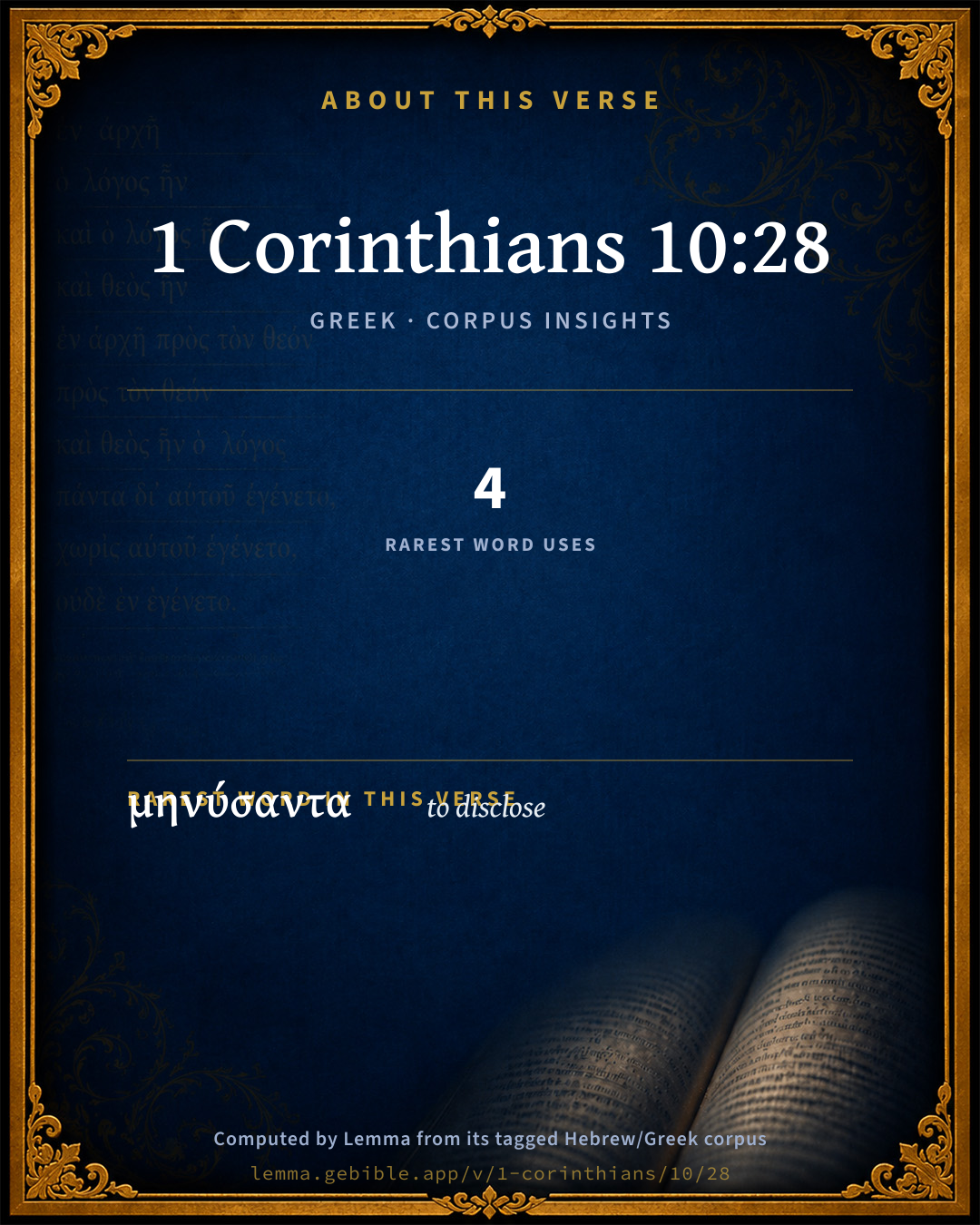
1 Corinthians 10:28

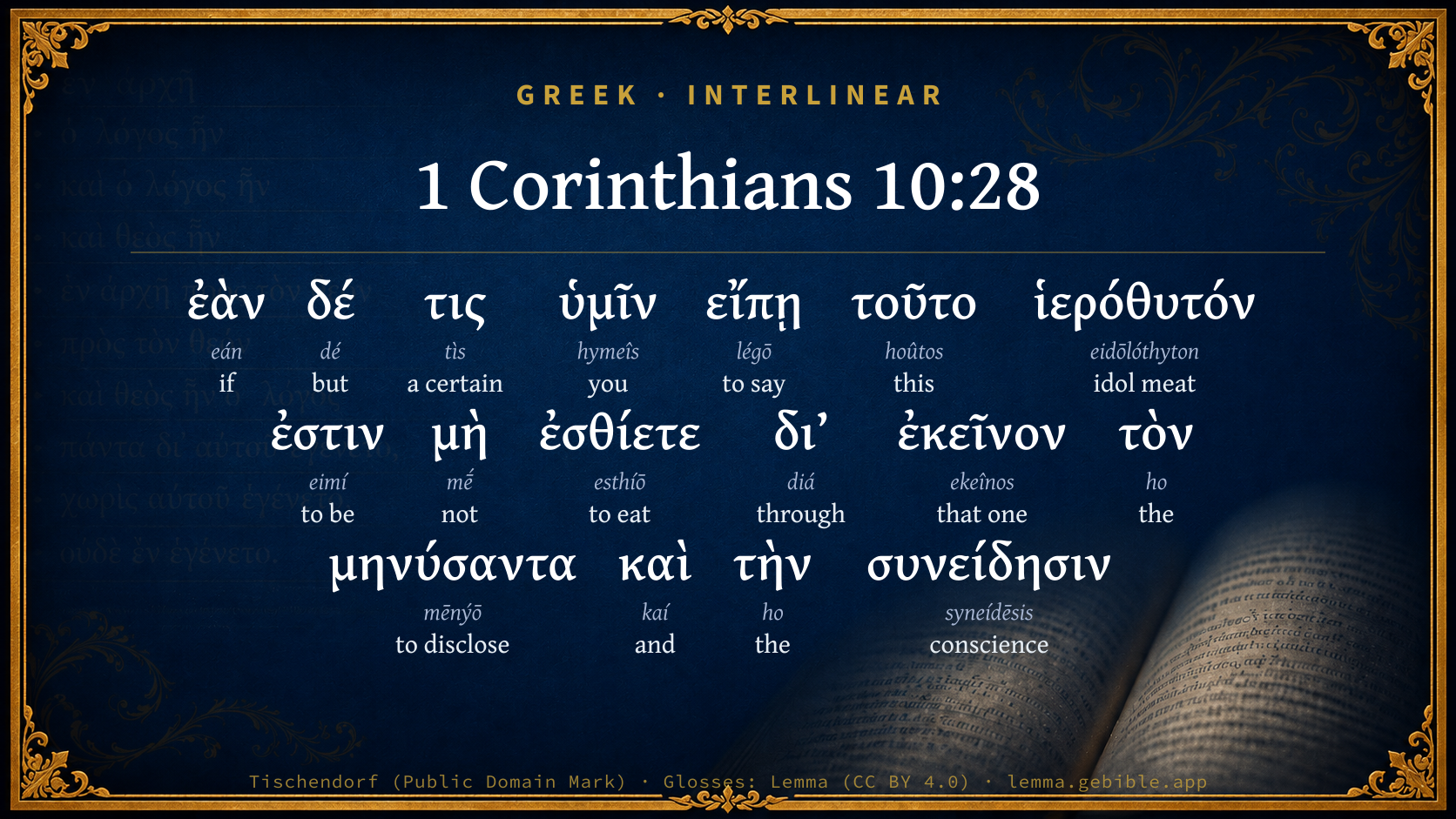
Greek (Tischendorf 8th ed.) 1 Corinthians 10:28 appears in the Greek New Testament. The text above is from the Tischendorf 8th edition. Each word links to its Strong’s number and a concise gloss. Click any word for its full Thayer’s Greek Lexicon entry.
Download image
Cite this verse

1 Corinthians 10:28 (World English Bible). Public Domain. Lemma interlinear Bible study tool, https://lemma.gebible.app/v/1-corinthians/10/28.

Show BibTeX & RIS
BibTeX
RIS
English Translation
But if anyone says to you, "This was offered to idols," don't eat it for the sake of the one who told you, and for the sake of conscience. For "the earth is the Lord's, and all its fullness."
World English Bible · Public Domain
Download a study sheet

One document with this verse’s original text, its word-by-word gloss line, the meaning frame, cross-references with their text, attributed commentary, and full source and license credits — printable, and it pastes into notes with its structure intact.

This verse Autodidact and up

Study sheet (.html) Plain text (.txt)

A passage Seminary Student

Up to 50 verses in one chapter. A passage sheet keeps up to 6 commentary sources and 12 cross-references per verse, in the order this page ranks them, and says so on the sheet whenever that leaves anything out. Ask for a single verse and you get the Autodidact verse sheet above.

Everything on this page stays free to read, with no account — the sheet is a download of what is already on screen, not access to it.

Want to remove ads? Support Godless Engineer
Compare translations 3

The same verse in 3 English versions, stacked beneath the original-language interlinear above. Click any original word for its lexicon entry.

Each is an independent rendering of the whole verse — the interlinear is not word-aligned to these translations.

Highlighted words mark where these versions differ — a whole-verse word diff, not a word-by-word alignment.

  • World English Bible Public Domain
    But if anyone says to you, "This was offered to idols," don't eat it for the sake of the one who told you, and for the sake of conscience. For "the earth is the Lord's, and all its fullness."
  • King James Version Public Domain
    But if any man say unto you, This is offered in sacrifice unto idols, eat not for his sake that shewed it, and for conscience sake: for the earth is the Lord's, and the fulness thereof:
  • unfoldingWord Literal Text CC BY-SA 4.0
    But if someone says to you, “This is offered in sacrifice,” do not eat, for the sake of that one having informed you, and conscience—

unfoldingWord Literal Text — © unfoldingWord, licensed CC BY-SA 4.0. Word-aligned USFM3 via Door43 (git.door43.org/unfoldingWord/en_ult).

Versions to compare (up to 4)

3 of 4 selected

Show all 19 translations

Every available English version of this verse, each an independent rendering of the whole verse.

  • World English Bible Public Domain
    But if anyone says to you, "This was offered to idols," don't eat it for the sake of the one who told you, and for the sake of conscience. For "the earth is the Lord's, and all its fullness."
  • Berean Standard Bible Public Domain
    But if someone tells you, “This food was offered to idols,” then do not eat it, for the sake of the one who told you and for the sake of conscience—
  • Majority Standard Bible Public Domain
    But if someone tells you, “This food was offered to idols,” then do not eat it, for the sake of the one who told you and for the sake of conscience—for the earth is the Lord’s, and the fullness thereof—
  • King James Version Public Domain
    But if any man say unto you, This is offered in sacrifice unto idols, eat not for his sake that shewed it, and for conscience sake: for the earth is the Lord's, and the fulness thereof:
  • American Standard Version (1901) Public Domain
    But if any man say unto you, This hath been offered in sacrifice, eat not, for his sake that showed it, and for conscience sake:
  • Revised Version (1885) Public Domain
    But if any man say unto you, This hath been offered in sacrifice, eat not, for his sake that shewed it, and for conscience sake:
  • Geneva Bible (1599) Public Domain
    But if any man say vnto you, This is sacrificed vnto idoles, eate it not, because of him that shewed it, and for the conscience (for the earth is the Lords, and all that therein is)
  • Douay-Rheims (1899) Public Domain
    But if any man say: This has been sacrificed to idols, do not eat of it for his sake that told it, and for conscience' sake.
  • Young's Literal Translation Public Domain
    and if any one may say to you, `This is a thing sacrificed to an idol,' -- do not eat, because of that one who shewed `it', and of the conscience, for the Lord's `is' the earth and its fulness:
  • Literal Standard Version CC BY-SA 4.0
    and if anyone may say to you, “This is a thing sacrificed to an idol,” do not eat, because of that one who showed [it], and of the conscience, for the LORD’s [is] the earth and its fullness:
  • Unlocked Literal Bible CC BY-SA 4.0
    But if someone says to you, “This has been offered in sacrifice,” then do not eat it, both for the sake of the one who informed you, and for the sake of conscience—
  • unfoldingWord Literal Text CC BY-SA 4.0
    But if someone says to you, “This is offered in sacrifice,” do not eat, for the sake of that one having informed you, and conscience—
  • Darby Bible Public Domain
    But if any one say to you, This is offered to holy purposes, do not eat, for his sake that pointed it out, and conscience sake;
  • World Messianic Bible Public Domain
    But if anyone says to you, “This was offered to idols,” don’t eat it for the sake of the one who told you, and for the sake of conscience. For “the earth is the Lord’s, with all its fullness.”
  • Webster's Bible Public Domain
    But if any man shall say to you, This is offered in sacrifice to idols, eat not for his sake that showed it, and for conscience' sake: for the earth is the Lord's, and its fullness:
  • Free Bible Version CC BY-SA 4.0
    But if someone tells you, “This food has been sacrificed to idols,” don't eat it for the sake of the one who mentioned it and for conscience' sake.
  • Bible in Basic English Public Domain
    But if anyone says to you, This food has been used as an offering, do not take it, on account of him who said it, and on account of his sense of right and wrong:
  • Text-Critical English NT CC BY 4.0
    But if someone says to you, “This meat was sacrificed to an idol,” do not eat it, for the sake of the one who informed you and for the sake of conscience; for “the earth is the Lord's and the fullness thereof.”
  • Tyndale New Testament (1534) Public Domain
    But and yf eny man saye vnto you: this is dedicate vnto ydols eate not of it for his sake that shewed it and for hurtynge of conscience. The erth is the lordes and all that there in is.

Literal Standard Version (2020), Covenant Press — licensed CC BY-SA 4.0. Text via the HelloAO Bible API (eBible.org). Unlocked Literal Bible (unfoldingWord) — licensed CC BY-SA 4.0. Text via the HelloAO Bible API (eBible.org). unfoldingWord Literal Text — © unfoldingWord, licensed CC BY-SA 4.0. Word-aligned USFM3 via Door43 (git.door43.org/unfoldingWord/en_ult). Free Bible Version, Dr. Jonathan Gallagher — licensed CC BY-SA 4.0. Text via the HelloAO Bible API (eBible.org).

Word by word

More ways to search: Search by grammar → Find every occurrence → Compare this word →

Practice this passage: Drill this verse → Learn its vocabulary →

μηνύσαντα
mēnýō
G3377
“to disclose”
Verb, Aorist, Active, Participle, Accusative, Singular, Masculine
Part of Speech
Verb
Tense
Aorist
Voice
Active
Mood
Participle
Case
Accusative
Number
Singular
Gender
Masculine
Full Thayer's Definition

Origin: probably from the same base as G3145 and G3415 (i.e. mao, to strive)

TDNT: None

1. to disclose or make known something secret a. in a forensic sense, to inform, report 2. to declare, tell, make known 3. to indicate, intimate a. of a teacher
  1. ἐὰν eán G1437 “if” Conditional
  2. δέ dé G1161 “but” Conjunction
  3. τις tìs G5100 “a certain” Indefinite pronoun, Nominative, Singular, Masculine
  4. ὑμῖν hymeîs G5210 “you” Personal pronoun, 2nd person, Dative, Plural
  5. εἴπῃ légō G3004 “to say” Verb, Aorist, Active, Subjunctive, 3rd person, Singular
  6. τοῦτο hoûtos G3778 “this” Demonstrative pronoun, Nominative, Singular, Neuter
  7. ἱερόθυτόν eidōlóthyton G1494 “idol meat” Adjective, Nominative, Singular, Neuter
  8. ἐστιν eimí G1510 “to be” Verb, Present, Active, Indicative, 3rd person, Singular
  9. μὴ mḗ G3361 “not” Particle, Negative
  10. ἐσθίετε esthíō G2068 “to eat” Verb, Present, Active, Imperative, 2nd person, Plural
  11. δι’ diá G1223 “through” Preposition
  12. ἐκεῖνον ekeînos G1565 “that one” Demonstrative pronoun, Accusative, Singular, Masculine
  13. τὸν ho G3588 “the” Article, Accusative, Singular, Masculine
  14. καὶ kaí G2532 “and” Conjunction
  15. τὴν ho G3588 “the” Article, Accusative, Singular, Feminine
  16. συνείδησιν syneídēsis G4893 “conscience” Noun, Accusative, Singular, Feminine

About this verse

These counts appear in no published source. They are computed here, from the morphology-tagged text and Lemma’s own curated glosses. What Lemma adds →

17
words
16
distinct lemmas
Pauline Epistles
section

Notable vocabulary

The rarest word here is μηνύσαντα to disclose G3377 — appearing just 4 times in the whole Greek New Testament.

Shared distinctive vocabulary

μηνύσαντα to disclose G3377 occurs in 4 verses of the Greek New Testament. Also found in:

Repetition

A word recurs within this verse:

Cross-references

10

Topical passages linked to 1 Corinthians 10:28 in the Treasury of Scripture Knowledge — connected by theme and wording, ordered by reader-vote popularity; previews shown in the World English Bible.

  • 1 Corinthians 8:10–13 For if a man sees you who have knowledge sitting in an idol's temple, won't his conscience, if he is weak, be emboldened to eat things sacrificed to idols?
  • Romans 14:15 Yet if because of food your brother is grieved, you walk no longer in love. Don't destroy with your food him for whom Christ died.
  • 1 Corinthians 8:7 However, that knowledge isn't in all men. But some, with consciousness of the idol until now, eat as of a thing sacrificed to an idol, and their conscience, being weak, is defiled.
  • 1 Corinthians 10:26 for "the earth is the Lord's, and its fullness."
  • Psalms 115:16 The heavens are the heavens of Yahweh; But the earth has he given to the children of men.
  • Jeremiah 27:5–6 I have made the earth, the men and the animals that are on the surface of the earth, by my great power and by my outstretched arm; and I give it to whom it seems right to me.
  • Matthew 6:31–32 "Therefore don't be anxious, saying, 'What will we eat?', 'What will we drink?' or, 'With what will we be clothed?'
  • Exodus 9:29 Moses said to him, "As soon as I have gone out of the city, I will spread abroad my hands to Yahweh. The thunders shall cease, neither shall there be any more hail; that you may know that the earth is Yahweh's.
  • Deuteronomy 10:14 Behold, to Yahweh your God belongs heaven and the heaven of heavens, the earth, with all that is therein.
  • Psalms 24:1 The earth is Yahweh's, with its fullness; The world, and those who dwell therein.

Cross-references courtesy of OpenBible.info (CC BY 4.0).

Where the printed editions differ

1 variant

Places in this verse where the major printed Greek editions disagree on the wording in a way that affects the translation — a comparison of editions, not a manuscript-by-manuscript collation. The editions are the modern critical texts (Nestlé-Aland 28/27, SBL, Westcott-Hort, Tregelles, Tyndale House) and the traditional texts behind the KJV (the Textus Receptus and the Byzantine/Majority text). It is not a claim about which reading is original.

  1. Extra text
    τοῦ γὰρ κυρίου ἡ γῆ καὶ τὸ πλήρωμα αὐτῆς.

    “of the for Lord [is] the earth and the fullness of her.”

    In TRByz Not in NA28NA27TynSBLWHTreg

    τοῦ γὰρ κυρίου ἡ γῆ καὶ τὸ πλήρωμα αὐτῆς. (tou gar kuriou hē gē kai to plērōma autēs) 'of the for Lord [is] the earth and the fullness of her.' is only in traditional manuscripts (TR+Byz)

Textual data: Translators Amalgamated Greek New Testament (STEPBible TAGNT) · CC BY 4.0.

Commentary

Notes on 1 Corinthians 10:28 from classic Christian and Jewish commentators (each source and its license shown beneath its notes). The classic Christian expositions comment on the surrounding passage and are grouped to its opening verse, so a note may address several verses; the Jewish commentaries on the Tanakh (Rashi and others) are per-verse, so they appear only where the commentator wrote on this verse.

Lemma curates 59 commentaries, every one of them public domain or Creative Commons licensed, each selected and text-cleaned for this edition rather than reprinted as found. About our sources →

Bengel's Gnomon

Johann Albrecht Bengel

1Co 10:28. Τὸν μηνύσαντα καὶ τὴν συνείδησιν, for the sake of him that showed it, and for conscience’ sake) a Hendiadys. μηνύω denotes serious information given of a thing.

Bengel's Gnomon of the New Testament — English translation (T&T Clark, Edinburgh, 1860) — public domain. Text from a community e-Sword module.

Meyer's Critical & Exegetical Commentary

Heinrich August Wilhelm Meyer

1Co_10:28. Ἐὰν δέ τις κ.τ.λ[1711]] But should it so happen that some one, etc. It is clear from this that the host (Grotius, Mosheim, Semler) is not meant, otherwise τίς (1Co_10:27) would not be repeated, and besides, διʼ ἐκεῖνον … συνείδησιν would not suit; but a fellow-guest, and that not a heathen (Chrysostom, Theophylact, Erasmus, al[1712], including de Wette and Maier, according to whom the thing is done maliciously, or to put the Christian to the test[1713]), nor a heathen or Christian indifferently (Flatt), nor a Jew (Wetstein), but a Christian fellow-guest (Osiander, Neander, al[1714]), who, being himself still under the influence of the ideas about sacrificial flesh, warns his fellow-believer at the table against defilement; and, moreover, a Gentile Christian (see remark on 1Co_8:7), who had somehow learnedperhaps only since coming to the housethat the flesh from the altar was to form part of the feast.[1715] According to Reiche, in his Comment. crit., we should not seek to define the τίς more specially, but leave it quite general. But this is at variance with the apodosis, which takes for granted that, in the case supposed, eating of flesh would involve a want of forbearance towards the μήνυσας, as was obviously implied of necessity in the ΔΙΆ after what had already been said in 1Co_8:7-13. The ΤΊς, therefore, must be one whose conscience required to be spared, consequently neither a heathen nor a Jew, but, in accordance with 1Co_8:7 ff., only a brother who was of weak conscience. This holds against Hofmann also, who assumes that the case supposed in 1Co_10:28 might occur just as well if the seller knew the buyer to be a Christian as if the host or any of his family knew the guest as such. To leave the τίς thus indefinite is, besides, the more clearly wrong, seeing that the rule for buying meat had been finally disposed of in 1Co_10:25-26, and cannot extend into 1Co_10:28, because 1Co_10:28 is included under the case of the invitation brought forward in 1Co_10:27, and this case again is very distinctly separated by the very order of the words (see on 1Co_10:27) from that of the purchase in the market, 1Co_10:25.

διʼ ἐκεῖνον τ. μηνύσ. κ. τ. συνείδ.] for the sake of him who made it known, and of conscience, i.e. in order to spare him and not to injure conscience. The (διὰ) τὴν συνείδησιν is the refrain which serves to give the motive for the rules laid down since 1Co_10:25. To whose conscience this refrain points here, Paul does not yet say (else he would have added αὐτοῦ), but utters again first of all this moral watchword without any more precise definition, in order immediately thereafter in 1Co_10:29 to express with the special emphasis of contrast the particular reference of its meaning designed here;[1716] for in 1Co_10:25; 1Co_10:27, the ΣΥΝΕΊΔΗΣΙς had a different meaning. This κ. τ. συνείδησιν, therefore (the ΚΑΊ here being the simple and), carries with it something to whet curiosity; it stands forth in the first place as a sort of riddle, so to speak, which is to find its solution in 1Co_10:29.

Regarding μηνύσ., see on Luk_20:37. If we imagine the ΜΗΝΎΣ. to be a heathen, the κ. τ. συνείδ. lands us in an insoluble difficulty. For either (1) we should, with Ewald, suppose that this heathens view of the matter was, that the Christian, being warned, would not eat, but, on the other hand, if he did, would be still worse than a Jew, converting liberty into licentiousness; comp Erasmus, Paraphr.[1718] But in that case how very obscurely Paul would have expressed himself, especially when in the whole context συνείδησις means the Christian consciousness raising scruples for itself, and that in respect of what was lawful or unlawful! Or (2) we should have, with de Wette, to take τὴν συνείδησιν as not the conscience of the μηνύσ. at all, but that of third persons (weak Christians), which, however, 1Co_10:29 forbids us to do, unless we are to regard Paul as writing with excessive awkwardness.

ἱερόθυτον] used of sacrificial flesh also in Plutarch, Mor. p. 729 C. The term is purposely chosen here instead of εἰδωλόθυτον, as a more honourable expression, because the words are spoken at table in the presence of heathen. We may be sure that this delicate touch is due to no corrector of the text (in opposition to de Wette and Reiche). As to the usage of the word in Greek, see Lobeck, a[1719] Phryn. p. 159.

[1711] .τ.λ. καὶ τὰ λοιπά.

[1712] l. and others; and other passages; and other editions.

[1713] Ewald, too, holds the τίς to be a heathen (the host, as most interpreters take it, or very possibly a companion at the table), who gave the hint in a frank and kindly way, as not expecting that a Christian would partake of meat of that sort.

[1714] l. and others; and other passages; and other editions.

[1715] De Wettes objection, that one of such tender conscience would hardly have gone to a heathen festival at all, carries weight only on the supposition of a sacrificial feast being meant.

[1716] Hence τ. συνείδ. should not be understood of conscience in abstracto (Hofmann: conscience as such, no matter whose, although in the first place that of the μηνύσ.).

[1718] Similarly Hofmann also thinks of the bad opinion of Christianity which the μηνύσ. first of all, but others as well, would have occasion to form, so that the Christians liberty would be subject to the tribunal of the moral consciousness of others.

[1719] d refers to the note of the commentator or editor named on the particular passage.

Meyer — Critical and Exegetical Commentary on the New Testament — English translation by Peter Christie, edited by Frederick Crombie (T&T Clark, 1880) — public domain. Text from a community e-Sword module.

Expositor's Greek Testament

ed. W. Robertson Nicoll

1Co 10:28-29 a . ἐὰν δὲ … εἴπῃ , “But if any one say to you” a probable contingency, as εἴ τις καλεῖ κ . τ . λ . (1Co 10:27 ) was an assumed fact; see Bn [1576] on the forms of the Condit. Sentence, §§ 242 ff. δὲ confronts this contingency with both the situations described in 1Co 10:25 ; 1Co 10:27 . The information, “This is sacrificial meat,” might be volunteered to the Christian purchaser in the market (by the salesman, or a by-stander), or to the Christian guest at the unbeliever’s table (by the host, or by a fellow-guest), the communication being prompted by civility and the wish to spare the supposed susceptibilities of the Christian, or by the desire to embarrass him; whatever its occasion or motive, it alters the situation. The genuine reading, ἱερόθυτον ( slain-as-sacred , i.e., in sacrifice ), takes the statement as from the mouth of unbelievers; a Jew or Christian would presumably say εἰδωλόθυτον , as above and here in T.R.: Reuss and 1. suppose the informant to be “a Christian converted from heathenism” using the inoffensive term “at the table of a heathen host”; but τ . ἀπίστων suggests heathen company, and μηνύσαντα private information. “Forbear eating ( μὴ ἐσθίετε , revoking the permission of 1Co 10:25 ff.) for the sake of him that informed (you), and for conscience’ sake.” Μηνύω (see parls.), to disclose what does not appear on the surface or is imparted secretly. The informant expects the Christian to be shocked; with his συνήθεια τ . εἰδώλου (1Co 8:7 ), he looks on the flesh of the sacrifice as having acquired a religious character (it is ἱερόθυτον ); by saying Τοῦτο ἱερόθυτον , he calls conscience into play whose conscience the next clause shows. διὰ τὸν μηνύσαντα καὶ τὴν συνείδησιν form one idea, being governed by the same prp [1577] , καὶ adding an explanation; from regard to the conscience of the μηνύσας not his possible contempt or ill-will the Christian should decline the offered flesh or stop eating it. συνείδησιν δὲ λέγω , οὐ τὴν ἑαυτοῦ κ . τ . λ ., “Conscience however I mean, not one’s own, but that of the other”. 1Co 10:29 a explains the διὰ τ . συνείδησιν of 1Co 10:28 , and reconciles its instruction with that of 1Co 10:25 ; 1Co 10:27 , while it brings the matter under the governing rule laid down in 1Co 10:23 f. By contrast with “the other,” the 2nd pl [1578] of 1Co 10:28 becomes here 2nd sing [1579] reflexive.

[1576] E. Burton’s Syntax of the Moods and Tenses in the N.T. (1894).

[1577] preposition.

[1578] plural.

[1579]ing. singular number.

1Co 10:29 b , 1Co 10:30 justify, in two rhetorical questions, the Christian’s deference to the conscience of another: ( a ) ἵνα τί γὰρ κ . τ . λ .; “For to what purpose is my liberty judged by another conscience?” i.e. “What good end will be served by my eating under these circumstances, and exposing my freedom to the censure of an unsympathetic conscience?” cf. 1Co 2:15 , Mat 7:6 . ἵνα τί ( γένηται ); ut quid ? (Vg [1580] ), signifies purpose , not ground as Mr [1581] and others take it; there is nothing to be gained by the exercise of liberty in this case. For κρίνω in adverse sense, see parls. For the previous συνείδ . τὴν τοῦ ἑτέρου ( alterius ), ἄλλης ( alienœ ) συνειδήσεως is substituted ( cf. 1Co 15:29 , 2Co 11:4 ), indicating a distinction not merely in the persons but in the consciences severally possessed. The Ap. says here of Liberty what he says of Faith in Rom 14:22 : κατὰ σεαυτὸν ἔχε ἐνώπιον τοῦ Θεοῦ . Question ( b ) intimates that, instead of any benefit resulting from the assertion of liberty in face of conscientious condemnation, positive harm ensues thanksgiving leads to blasphemy ! “If I with thanks ( or by grace) partake, why am I blasphemed over (that for) which I give thanks?” The τί is prospective , as in 1Co 15:29 f. = εἰς τί or ἵνα τί ; The bare χάριτι can scarcely mean here “by (the) grace (of God)” esp. in view of εὐχαριστῶ ; cf. Rom 14:6 ; Rom 14:16 (for βλασφημοῦμαι ). Men of heathen conscience, seeing the Christian give thanks knowingly over food devoted to the idol, will regard his act as one of sacrilegious indulgence and denounce it accordingly; it seems to them a revolting hypocrisy; “ Quelle religion est celle-là ? devaient dire les païens” (Gd [1582] ) a grievous πρόσκομμα both to Jews and Greeks (1Co 10:32 ); cf. Rom 2:24 . ὑπὲρ οὗ absorbs the dem. pron [1583] governed by the same prp [1584] ; cf. 1Co 7:39 , 2Co 2:3 . The repeated emphatic ἐγὼ points to the Christian as devout on his own part, yet incurring the scandal of gross irreverence.

[1580] Latin Vulgate Translation.

[1581] Meyer’s Critical and Exegetical Commentary (Eng. Trans.).

[1582] F. Godet’s Commentaire sur la prem. Ép. aux Corinthiens (Eng. Trans.).

[1583]ron. pronoun.

[1584] preposition.

The Expositor's Greek Testament, edited by W. Robertson Nicoll (1897–1910) — public domain. Text from a community e-Sword module.

Godet's Commentaries

Frédéric Louis Godet

Vv. 28, 29. “But if any man say unto you, This is offered in sacrifice, eat not, for his sake that showed it, and for conscience sake. 29. Conscience, I say, not thine own, but of the other: for to what purpose can my liberty be judged by another’s conscience?”

The τίς, any one, of 1Co 10:28 cannot, as Grotius thinks, denote the same person as the τίς of the foregoing verse, the heathen who invited the Christian. He would not be designated by an indefinite pronoun. It must therefore be one of the guests. Are we to suppose him, as has been thought by Chrysostom, de Wette, etc., a malicious heathen, who wishes by the remark to embarrass the Christian, or a serious heathen wishing to call his attention to the mistake he is about to commit without knowing it (Ewald)? But in these two cases the duty of the believer would have been, not to abstain, but, on the contrary, to partake of the meat while stating the motive of his conduct, and justifying his freedom from all scruple in regard to idols in which he does not believe; it was an excellent opportunity for expounding his faith. The person in question, therefore, is a sincere Christian, whose conscience is still hampered with scruples, and whom his strong brother is bound to treat with consideration. In this way, the following words: For his sake that showed it, and for conscience, are easily explained. The two motives refer to the same person, remaining, however, distinct. The first is directed against the influence which the example might exercise over the weak Christian, by leading him to eat against his conscience; the second, to the shock which his conscience will infallibly undergo on seeing the strong believer eat, even supposing he should resist the example which is set him. The repetition of the quotation from Psalms 24 at the end of 1Co 10:28, in the T. R., is evidently due to an interpolation. The only meaning which could be given to the words here would be this: “There is on the table plenty of other meats which thou mayest use.” But such a reflection is far from natural.

Vv. 29. The apostle expressly declares that such a sacrifice by no means implies that the strong believer renounces his conviction and right; his conscience remains independent of his brother’s, though he voluntarily subordinates his conduct to the other’s scruple.

The reason which the apostle gives for this conduct has been differently understood. Meyer and de Wette think that Paul means: “For on what ground should I subject your conscience to the judgment of your neighbour’s? You preserve, therefore, so far as you are yourselves concerned, your entire liberty.” But the conjunction ἱνατί does not signify: For what reason, with what right? This compound conjunction, after which we must understand γένηται, literally signifies: that what good may come about? The meaning is therefore: “For what advantage can there be in my liberty being condemned...?” We have in the parallel discussion of Romans 14 a perfectly similar saying, which leaves no doubt as to the meaning of this. Paul there says, 1Co 10:16 : “That your good be not evil spoken of (blasphemed)!” This good is the liberty of the strong, and Paul asks of them not to make such a use of it as will provoke the disapproving judgment of the weak. Here he asks, besides, what advantage such a judgment, imprudently provoked, can have; what edification it can afford either to the Christians present, or to the non-Christians, who become witnesses of the mutual contradictions between believers, and of the condemnations which they pass on one another. The question put in 1Co 10:29 is reproduced still more clearly in 1Co 10:30.

Frédéric Louis Godet — Commentaries on Luke, John, Romans, and 1 Corinthians — English translation (T&T Clark, Edinburgh, 1870s–1890s) — public domain. Text from a community e-Sword module.

Hodge's Commentary on Romans, Ephesians & First Corinthians

Charles Hodge

1Co_10:28

But if any man say unto you, This is offered in sacrifice unto idols, eat not for his sake that shewed it, and for conscience sake: for the earth (is) the Lords, and the fullness thereof:

This is an exception. They might without scruple eat any thing set before them. But if any of the guests apprised them that a particular dish contained meat which had been offered to an idol, out of regard to the conscientious scruples of him who made the intimation, they should abstain. But, on the contrary, if any one. That is, any of your fellow-guests. The only person likely to make the suggestion was a scrupulous Christian. For his sake that showed it and for conscience sake; the latter clause is explanatory. On account of him making the intimation, i.e. on account of his conscience. Though it is right to eat, and though you know it to be right, yet, to avoid wounding or disturbing the conscience of your weaker brother, it is your duty to abstain. The union of the most enlightened liberality with the humblest concession to the weakness of others, exhibited in this whole connection, may well excite the highest admiration. The most enlightened man of his whole generation, was the most yielding and conciliatory in all matters of indifference.

The clause, For the earth is the Lords and the fullness thereof, at the end of this verse, is not found in the best manuscripts, and therefore omitted in all the critical editions of the Greek Testament. They seem to be here entirely out of place. In 1Co_10:26 they assign the reason why the Corinthians might eat without scruple whatever was sold in the market. But here they have no connection with what precedes. The fact that the earth is the Lords is no reason why we should not eat of sacrificial meat out of regard to a brothers conscience. There is little doubt, therefore, that it should be omitted.

inthians, and he exhorts them to imitate him, as he did Christ, who is the ultimate standard.

Charles Hodge — Commentary on Romans (1835), First Corinthians (1857), and Ephesians (1856) — public domain. Text from a community e-Sword module.

Jamieson, Fausset & Brown

Robert Jamieson, A. R. Fausset & David Brown

if any man--a weak Christian at table, wishing to warn his brother.

offered in sacrifice unto idols--The oldest manuscripts omit "unto idols." At a heathen's table the expression, offensive to him, would naturally be avoided.

for conscience' sake--not to cause a stumbling-block to the conscience of thy weak brother (Co1 8:10-12).

for the earth is the Lord's, &c.--not in the oldest manuscripts.

Jamieson, Fausset & Brown — Commentary Critical and Explanatory on the Whole Bible (1871) — public domain (CC PDM 1.0). Text via the HelloAO Bible API.

Adam Clarke's Commentary

Verse 28. This is offered in sacrifice unto idols] While they were not apprized of this circumstance they might lawfully eat; but when told that the flesh set before them had been offered to an idol, then they were not to eat, for the sake of his weak conscience who pointed out the circumstance. For the apostle still takes it for granted that even the flesh offered in sacrifice to an idol might be eaten innocently at any private table, as in that case they were no longer in danger of being partakers with devils, as this was no idol festival.

For the earth is the Lord's, and the fulness thereof] This whole clause, which appears also in 1Co 10:26, is wanting here in ABCDEFGH, several others, the Syriac, Erpen, Coptic, Sahidic, AEthiopic, Armenian, Vulgate, Itala; and in several of the fathers. Griesbach has left it out of the text: and Professor White says, "Certissime delendum;" it should most undoubtedly be erased. It has scarcely any authority to support it.

Adam Clarke's Commentary on the Bible (1810–1826) — public domain. Text from a community e-Sword/MySword module.

Ellicott's Commentary for English Readers

(28) But if any man. . . .—If, however, some weak brother present points out that it is sacrificial meat, do not eat for his sake and for conscience sake (see 1Co_10:29). Here your personal liberty is to be modified by the principle mentioned in 1Co_10:24. If the weak brother see you eat the flesh which he has just informed you was used as a sacrifice, he may be led by your example to eat it himself, though the very fact of his having called your attention to it showed that he thinks it wrong, and so his conscience is defiled.

The word (hierothuton) here used (according to the best MSS.) for “offered to an idol” is different from the condemnatory word (eidolothuton) elsewhere used; as natural courtesy would lead a Christian at the table of a heathen to use an epithet which would not be offensive to his host. A lesson in controversy—Don’t conceal your conscientious convictions, but don’t express them in language unnecessarily painful to your opponent.

The repetition of the words “The earth is the Lord’s,” &c., in this verse is an interpolation not found in the best MSS., and tends to interrupt the thought which is carried on in 1Co_10:29.

A Bible Commentary for English Readers, edited by Charles John Ellicott (1878–1897) — public domain. Text from a community e-Sword module.

The Cambridge Bible for Schools and Colleges

gen. ed. J. J. S. Perowne

28. But if any man say unto you, This is offered in sacrifice unto idols] i.e. if (1) one of your fellow-guests should display scruples of conscience, or (2) a heathen should be likely to draw the inference that you approved of idol worship. The reading ἱερόθυτον confirms the latter, that in the text the former interpretation. “This altogether alters the case. You are no longer simply eating with thankfulness the food set before you as the gift of God. The question of idolatrous worship is now introduced. If your own conscience would permit you to eat, you have to consider whether your conduct might lead another to suppose that you regarded participation in the worship of idols as permissible to a Christian.” Most MSS. and Editors omit the words, ‘For the earth is the Lord’s, &c.’ in this verse, as a mere and meaningless repetition from 1Co_10:16.

The Cambridge Bible for Schools and Colleges (gen. ed. J. J. S. Perowne; Cambridge University Press, 1878–1918) — public domain. Text from a community e-Sword module.

John Gill's Exposition

Conscience I say, not thine own,.... Which is well informed about these things, and is fully persuaded that an idol is nothing, and that things sacrificed to idols are nothing; and as they cannot profit a man, or help forward his comfort, peace, and happiness, so they cannot hinder them:

but of the others; either the weak brother, or the unbelieving master of the feast; it is for the sake of their consciences such food must not be eaten, lest either the one should be grieved, or the other reproach:

for why is my liberty judged of another man's conscience? this is not an objection of the Corinthians, setting forth the unreasonableness of being condemned, for the use of their Christian liberty by another's conscience, be he who he will, believer or unbeliever, when they had an undoubted right to such an use, and their own consciences did not condemn them: but they are the words of the apostle, expressing his own sense, that it was not right and fitting that he should make use of his liberty, and eat under such a circumstance as here pointed out, and so his liberty should be condemned as sinful by another man's conscience; since the weak believer would be apt to censure, judge, and condemn him as a libertine, and the unbeliever as an atheist, or one that had no regard to any religion at all; and therefore he reasons, that it was best to abstain from eating, rather than expose his liberty to such a censure and condemnation.

John Gill's Exposition of the Whole Bible (1746–1763) — public domain (CC PDM 1.0). Text via the HelloAO Bible API.

Trapp's Complete Commentary

John Trapp

28 But if any man say unto you, This is offered in sacrifice unto idols, eat not for his sake that shewed it, and for conscience sake: for the earth is the Lord’s, and the fulness thereof:

Ver. 28. The earth is the Lord’s] Therefore in case of scandal abstain. Why shouldest thou use this creature, as if there were no more but this? suspend thy liberty; hast not thou all the world before thee?

John Trapp, A Commentary or Exposition upon All the Books of the Old and New Testament (1647–1656) — public domain. Text from a community e-Sword module.

Albert Barnes' Notes on the Bible

But if any man - If any fellow guest; any scrupulous fellow Christian who may be present. That the word “any” (τις tis) refers to a fellow guest seems evident; for it is not probable that the host would point out any part of the food on his own table, of the lawfulness of eating which he would suppose there was any doubt. Yet there might be present some scrupulous fellow Christian who would have strong doubts of the propriety of partaking of the food, and who would indicate it to the other guests.

For his sake that showed it - Do not offend him; do not lead him into sin;, do not pain and wound his feelings.

And for conscience’ sake - Eat not, out of respect to the conscientious scruples of him that told thee that it had been offered to idols. The word “conscience” refers to the conscience of the informer 1Co 10:29; still he should make it a matter of conscience not to wound his weak brethren, or lead them into sin.

For the earth is the Lord’s ... - See 1Co 10:26. These words are missing in many mss. (see Mill’s Greek Testament), and in the Vulgate, Syriac, Coptic, and Arabic versions; and are omitted by Griesbach. Grotius says that they should be omitted. There might easily have been a mistake in transcribing them from 1Co 10:26. The authority of the mss., however, is in favor of retaining them; and they are quoted by the Greek fathers and commentators. If they are to be retained, they are to be interpreted, probably, in this sense; “There is no “necessity” that you should partake of this food. All things belong to God; and he has made ample provision for your needs without subjecting you to the necessity of eating this. Since this is the case, it is best to regard the scruples of those who have doubts of the propriety of eating this food, and to abstain.”

Albert Barnes' Notes on the Bible (1834–1885) — public domain. Text from a community e-Sword/MySword module.

Matthew Poole's English Annotations

The meat being out of the idol’s temple, and returned to a common use, there could be no impiety in eating it, no communion with devils, and partaking of the table of devils, in and by such an action; but yet there might be a breach of charity in the action, that is, in case one were there present, who knew that it had been so offered to the idol, and declared his offence, by telling the Christian that was about to eat, that that meat had been so offered: in that case the apostle commandeth Christians not to eat, and that partly

for his sake that showed it, lest they should lay a stumbling block before him, and by their example imbolden him that showed it to do the like, though he doubted the lawfulness of it; and likewise

for conscience sake, that is, for their own conscience sake, which through weakness might afterward trouble them for it, though without just cause. He gives them as a reason for it, because

the earth is the Lord’s, and the fulness thereof, that is, because there was other meat enough to eat. This passage, taken out of the psalmist, had a something different application, 1Co 10:26; there the apostle used it to justify the lawfulness of their eating such meat, returned again to a common use, and exposed to sale in the shambles; here he useth it to dissuade them from eating, if any let them know it had been offered to the idol.

Matthew Poole's English Annotations on the Holy Bible (1683–1685) — public domain. Text from a community e-Sword/MySword module.

Whedon's Commentary on the Bible

Daniel D. Whedon

28. Any man—The word idols, in the remark of this any man, being contemptuous, shows that it is not uttered by the host or any other pagan. Nor is it uttered by a Jew, since such never ate with Gentiles. It is, therefore, from some fellow-Christian, who hesitates not to attend a pagan’s feast, but is scrupulous to pick out and reject all idolatrous meats. This brother is weak; but your example of eating may either lead him to be unscrupulous and low in his Christian life, or to condemn the religion that keeps not (as he thinks) its followers unspotted from idolatry.

His sake— As he is in danger.

Conscience sake—Which is ever a most sacred thing.

Daniel D. Whedon (gen. ed.), Commentary on the Old and New Testaments (1874–1909) — public domain. Text from a community e-Sword module.

The Pulpit Commentary

But if any man say unto you. Who is the "any man" is left undefined. Perhaps some "weak" Christian is meant, who happens to be a fellow guest. This is offered in sacrifice unto idols. The true reading is probably, hierothuton, sacred sacrifice, not eidolothuton, idol sacrifice. Perhaps there is a touch of delicate reserve in the word, implying that the remark is made at the table of heathens, who would be insulted by the word eidolothuton, sacrificed to idols. Whoever the interlocutor is supposed to be heathen host or Christian guest the mere fact of attention being drawn to the food as forming part of a heathen sacrifice is enough to make it your duty to give no overt sanction to idolatry. In that case, therefore, you ought to refuse it. It will be seen how gross was the calumny which asserted that St. Paul taught men to be indifferent about eating things offered to idols. He only taught indifference in cases where idolatry could not be directly involved in the question. He only repudiates the idle superstition that the food became inherently tainted by such a consecration when the eater was unaware of it. In later times, when the eating of such offerings was deliberately erected into a test of apostasy, he would have used language as strong against every semblance of compliance as any which was used by St. John himself or by Justin Martyr. Difference of time and circumstances necessarily involves a difference in the mode of viewing matters which in themselves are unimportant. For the earth is the Lord"s. It is doubtful whether the repetition of this clause is genuine. It is omitted by all the best uncials.

The Pulpit Commentary (1880–1919), ed. H.D.M. Spence-Jones & Joseph S. Exell — public domain. Text from a community e-Sword module.

John Wesley's Explanatory Notes

For his sake that showed thee, and for conscience' sake - That is, for the sake of his weak conscience, lest it should be wounded.

John Wesley, Explanatory Notes Upon the Whole Bible (1754–1765) — public domain. Text via the GEBible commentary corpus.

Godbey's Commentary on the New Testament

William B. Godbey

28. “But if any one may say to you, ‘This is offered to an idol,’ eat not for the sake of him who delivered you the information and his conscience.

William B. Godbey, Commentary on the New Testament (1896–1900) — public domain. Text from a community e-Sword module.

McGarvey & Pendleton's Commentaries

J. W. McGarvey

But if any man say unto you, This hath been offered in sacrifice, eat not, for his sake that showed it, and for conscience' sake:

J. W. McGarvey (with Philip Y. Pendleton), Commentaries on the New Testament (The Fourfold Gospel, 1914; Acts; and the epistles) — public domain. Text from a community e-Sword/MySword module.

The People's New Testament

B. W. Johnson

28. But if any man say unto you, etc. If some one points out that a part is from an idol's sacrifice, then it is not to be eaten; not because the food is sinful, but because the conscience of others might be offended.

B. W. Johnson's The People's New Testament with Notes (1889–1891) — public domain. Electronic text from the Christian Classics Ethereal Library (CCEL) ThML edition.

unfoldingWord translationNotes

Door43 World Missions Community

But if someone says to you ... do not eat ... who informed you ... and not yours

Some translations put these words in parentheses because 1) the forms of "you" and "yours" and "eat" here are singular, but Paul uses the plural form immediately before and after, and 2) the words "For why should my freedom be judged by another's conscience?" seem to build on "eat whatever is set before you without asking questions of conscience" (1 Corinthians 10:27) rather than "the other person's conscience." (See: Forms of You)

says to you ... do not eat ... informed you ... and not yours

Paul is speaking to the Corinthians as if they were one person, so the words "you" and "your" and the command "do not eat" here are singular. (See: Forms of You)

For why ... conscience? If I partake ... gave thanks?

Possible meanings are 1) the word "for" refers back to 1 Corinthians 10:27, "I am not to ask questions of conscience, so why ... conscience? If I partake ... gave thanks?" or 2) Paul is quoting what some Corinthians were thinking, "As some of you might be thinking, 'For why ... conscience? If I ... thanks?'"

why should my freedom be judged by another's conscience?

The speaker wants the hearer to answer the question in his mind. AT: "You should know without me telling you that no one should be able to say I am doing wrong just because that person has ideas about right and wrong that are different from mine. (See: Rhetorical Question)

If I partake of the meal with gratitude, why am I being insulted for that for which I gave thanks?

The speaker wants the hearer to answer the question in his mind. AT: "I partake of the meal with gratitude, so no one should insult me for that for which I gave thanks." (See: Rhetorical Question)

If I partake

If Paul is not quoting what some Corinthians might be thinking, the "I" represents those who eat meat with thankfulness. "If a person partakes" or "When a person eats"

with gratitude

"and thank God for it" or "and thank the person who gave it to me for it"

translationWords

sacrifice

conscience

free

judge

unfoldingWord translationNotes — © Distant Shores Media and the Door43 World Missions Community, licensed CC BY-SA 4.0. Source: git.door43.org/Door43/en_tn.

Cambridge Greek Testament for Schools and Colleges

28. ἱερόθυτον. אAB Peshito. Rec. εἰδωλόθυτον with CDEFG Vulg. The latter has the appearance of an accommodation to the feelings of a later age. See note below.

[τοῦ γὰρ κυρίου ἡ γῆ καὶ τὸ πλήρωμα αὐτῆς] at end of verse. Omit אABCDEFG Vetus Lat. Vulg. Peshito.

28. ἐὰν δέ τις, i.e. if (1) one of your fellow-guests should display scruples of conscience, or (2) a heathen should be likely to draw the inference that you approved of idol worship. ‘This altogether alters the case. You are no longer simply eating with thankfulness the food set before you as the gift of God. The question of idolatrous worship is now introduced. If your own conscience would permit you to eat, you have to consider whether your conduct might lead another to suppose that you regarded participation in the worship of idols as permissible to a Christian.’ ἐάν here implies a case not so likely to happen as the invitation imagined in 1Co 10:27, which εἰ and the pres. indic. mark as an extremely probable supposition. ‘If any one asks you … but if any one should say.’

ἱερόθυτον. The word which a heathen would use. He would be certain not to say εἰδωλόθυτον. It was the failure to see this which led to the rec. reading. See Critical Note.

καὶ τὴν συνείδησιν. In this case it is another man’s conscience, not our own, which is meant, as is explained in 1Co 10:29.

Cambridge Greek Testament for Schools and Colleges (Cambridge University Press, 1896; 21 vols, various authors incl. Carr, Maclear, Plummer, Farrar, Lumby, Moule, M. R. James, Simcox) — public domain. Text from a community e-Sword module.

Alford’s Greek Testament

Henry Alford

28.] Who is the person supposed to say this? not, as Grot., al., think, the host, of whom τις could hardly be said, but it would stand ἐὰν δὲ ὑμῖν εἴπῃ: nor, as Chrys., Theophyl., al., and De Wette,—some heathen guest, by whom De W. imagines it said maliciously, or to put the Christian to the proof,—for his συνείδησις would hardly be so much taken into, account in the matter; but, as Neander, Pfl. u. Leit. p. 399, and Meyer,—some weak Christian, wishing to warn his brother.

ἱερόθυτον is apparently placed advisedly, to represent what would be said at a heathen’s table. De W. supposes it on this very account to be a correction: but surely this is giving a corrector credit for more fineness of discrimination than they ordinarily shew. Much more probable is it, that the unusual and apparently incorrect ἱερόθυτον should give place to the ordinary and more exact term.

διʼ ἐκ. τ. μην …] On account of the man who informed you, and (καί specifying the particular point or points to which the more general preceding clause applies: as, τῶνδε εἵνεκα, καὶ γῆς ἱμέρῳ … καὶ μάλιστα τῷ χρηστηρίῳ πίσυνος ἐών, καὶ τίσασθαι θέλων … Herod. i. 73. See Hartung, Partikellehre, i. 145) conscience: i.e. to spare the informer being wounded in his conscience.

Henry Alford, The Greek Testament (1849–1861) — public domain. Text from a community e-Sword module.

International Critical Commentary

28. ἐὰν δέ τις ὑμῖν εἴπῃ. The change from εἴ to ἐάν is perhaps intentional, although the difference between the two is less in late Greek than in earlier. ‘If any one invites you,’ a thing which is very possible and may have happened. ‘If any one should say to you,’ a pure hypothesis, and not so very probable. In Gal 1:8, Gal 1:9 we have a change from ἐάν to εἰ. See J. H. Moulton, Gr. p. 187. This shows clearly that the meal is a private one, and not such as is mentioned in 8:10. The Apostle has already ruled that banquets ἐν εἰδωλίῳ must be avoided, and at such a banquet there would be no need to say Τοῦτο ἱερόθυτόν ἐστιν. It is less easy to decide who the speaker is. Certainly not the host, whose conscience would not be mentioned, but a fellow-guest. And we are almost certainly to understand a fellow-Christian, one of the ‘weak’ brethren, who, being scrupulous himself about such things, thinks that he ought to warn others of what he chances to know. That a heathen would do it out of malice, or amusement, or good-nature (“I dare say, you would rather not eat that”), is possible, but his conscience would hardly come into consideration. And his using ἱερόθυτον rather than εἰδωλόθυτον would seem to indicate that he was a Gentile Christian: when he was a heathen and regarded sacrifices to the gods as sacred, he would use ἱερόθυτον and not εἰδωλόθυτον: and he uses the old word still.* It shows how St Paul has realized the situation. The word occurs nowhere else in Bibl. Grk. See Deissmann, Light, p. 355 n.

μὴ ἐσθίετε. This cannot mean ‘Cease from eating.’ As ἐσθίετε (v. 25) means ‘make a practice of eating,’ μὴ ἐσθίετε means ‘make a practice of abstaining from eating.’

διʼ ἐκεῖνον … καὶ τὴν συνείδησιν. We expect αὐτοῦ after συνείδησιν, but the Apostle purposely omits to say whose conscience is considered, in order to leave an opening for the emphatic statement which follows: ‘out of regard to your informant and to conscience.’ He would be shocked, and the shock would be a shock to conscience.

ἱερόθυτον (א A B H, Sah.) is to be preferred to εἰδωλόθυτον C D; F G K L P, Copt. Arm.), which is a correction to a more usual and apparently more correct term. There would be little temptation to change εἰδωλόθυτον into ἱερόθυτον, which occurs nowhere else in N.T. or LXX. The AV., following H2 K L, Goth., Chrys. Thdrt., adds from v. 26 ‘The earth is the Lords,’ etc. א A B C D E F G H* P, Latt. Copt. Aeth. Arm. omit.

International Critical Commentary — older volumes (1896–1929), various authors — public domain. Text from a community e-Sword module.

Vincent's Word Studies in the New Testament

Marvin R. Vincent

Any man. Some fellow - guest, probably a gentile convert, but, at all events, with a weak conscience.

Shewed [μηνυσαντα] See on Luk 20:37 It implies the disclosure of a secret which the brother reveals because he thinks his companion in danger

Marvin R. Vincent, Word Studies in the New Testament (1887–1900) — public domain. Text from a community e-Sword/MySword module.

Lesson kit

Teaching starters — assembled from the data on this page, not authored interpretation. Every prompt links to the verse data it draws on. Edit before teaching.

1 Corinthians, in the Pauline Epistles, opens this verse with 17 words (16 distinct Greek lemmas). Its most distinctive word is mēnýō (“to disclose”). A historical commentator’s framing appears above. Read the whole chapter for the surrounding context.

Discussion questions

  1. What does “to disclose” (mēnýō) contribute to the verse as a whole?
  2. Luke 20:37 shares the word «to disclose» with this verse. How do the two illuminate each other?
  3. “the” occurs 2× in this one verse. What is the effect of the repetition?
  4. The translations on this page render this verse differently — a whole-verse word diff, not a word-by-word alignment. What might account for the different wordings?
  5. Reading how Bengel's Gnomon and Meyer's Critical & Exegetical Commentary read this verse, where do the two commentators agree and where do they part?

Things to notice

Reading settings

Reading text

Shown beneath each verse's original-language words.

Old Testament
Old Testament edition

Read the OT as the Masoretic Hebrew (MT) or the Greek Septuagint (LXX).

English shown for the Greek Septuagint (in the Hebrew ↔ Greek comparison).

Comparing translations? Open the Compare panel on any verse page to stack up to four side by side.