
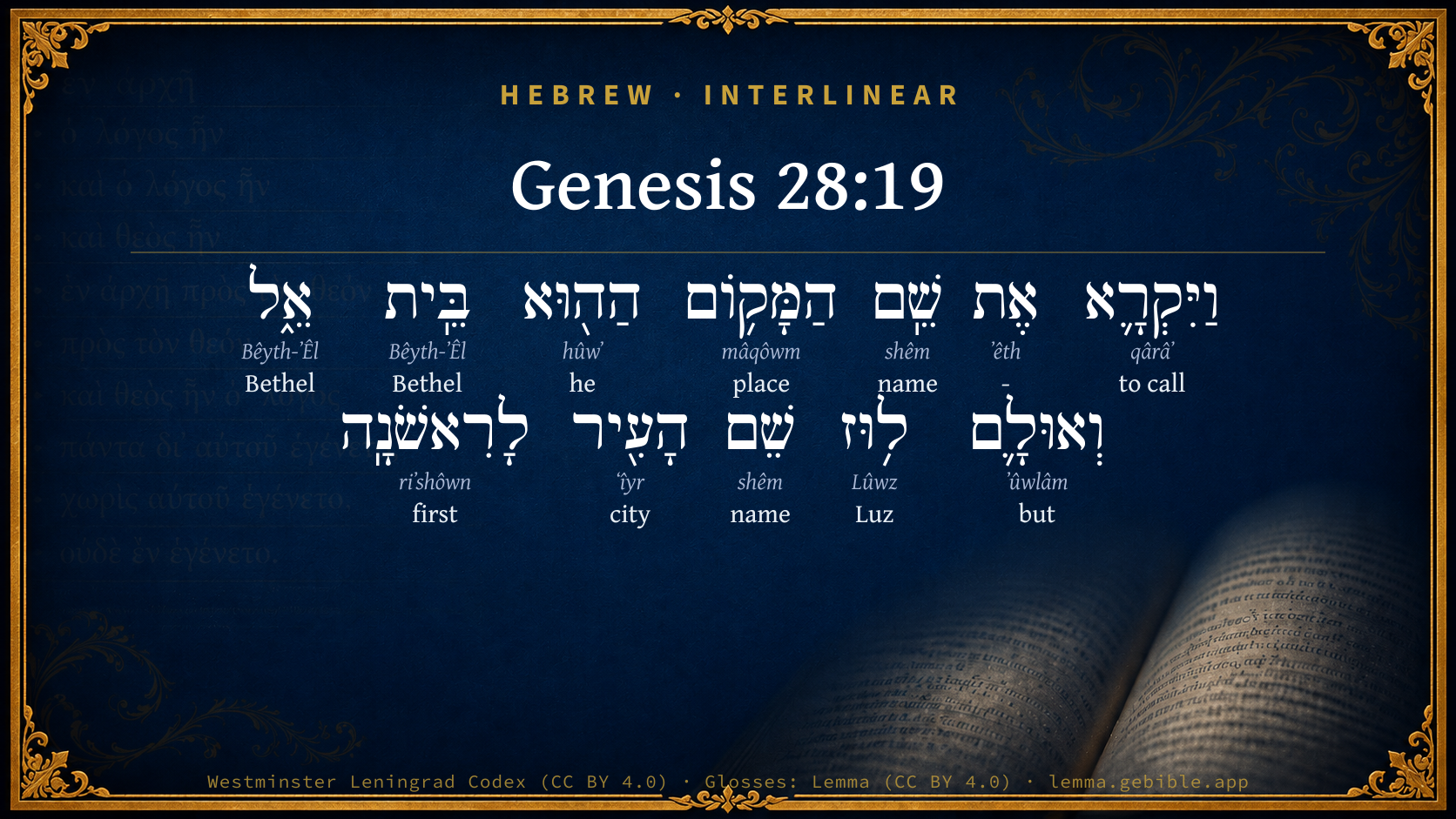
Genesis 28:19

Hebrew (Westminster Leningrad Codex) Genesis 28:19 appears in the Hebrew Old Testament. The text above is from the Westminster Leningrad Codex. Each word links to its Strong’s number, a concise gloss, and parsing drawn from the Open Scriptures Hebrew Bible morphology. Click any word for its full Brown-Driver-Briggs (BDB) entry.
Download image
Cite this verse

Genesis 28:19 (World English Bible). Public Domain. Lemma interlinear Bible study tool, https://lemma.gebible.app/v/genesis/28/19.

Show BibTeX & RIS
BibTeX
RIS
English Translation
He called the name of that place Bethel, but the name of the city was Luz at the first.
World English Bible · Public Domain
Highlights
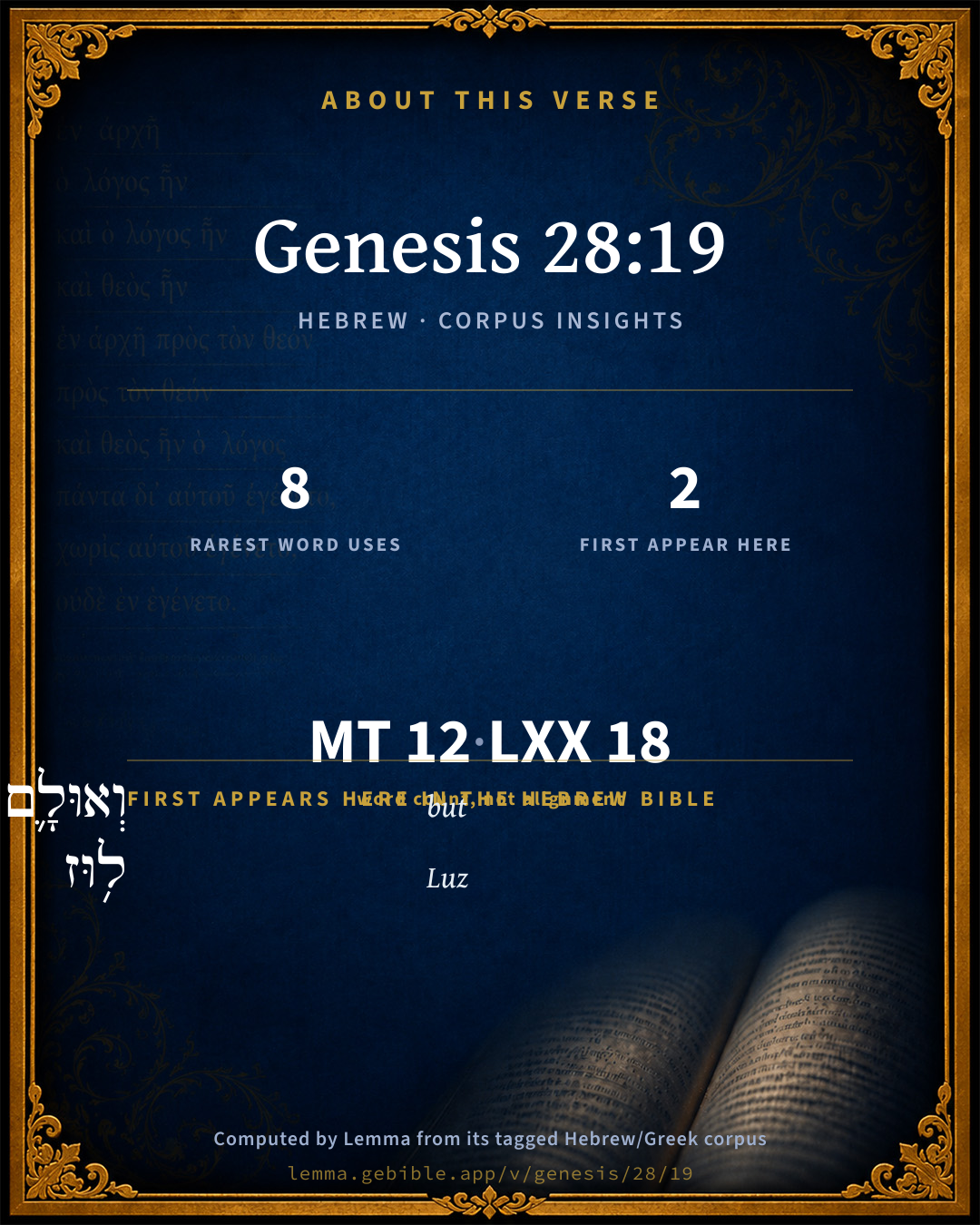
  • 2 first appearances in the Hebrew Bible
Full analysis ↓
Download a study sheet

One document with this verse’s original text, its word-by-word gloss line, the meaning frame, cross-references with their text, attributed commentary, and full source and license credits — printable, and it pastes into notes with its structure intact.

This verse Autodidact and up

Study sheet (.html) Plain text (.txt)

A passage Seminary Student

Up to 50 verses in one chapter. A passage sheet keeps up to 6 commentary sources and 12 cross-references per verse, in the order this page ranks them, and says so on the sheet whenever that leaves anything out. Ask for a single verse and you get the Autodidact verse sheet above.

Everything on this page stays free to read, with no account — the sheet is a download of what is already on screen, not access to it.

Want to remove ads? Support Godless Engineer
Compare translations 3

The same verse in 3 English versions, stacked beneath the original-language interlinear above. Click any original word for its lexicon entry.

Each is an independent rendering of the whole verse — the interlinear is not word-aligned to these translations.

Highlighted words mark where these versions differ — a whole-verse word diff, not a word-by-word alignment.

  • World English Bible Public Domain
    He called the name of that place Bethel, but the name of the city was Luz at the first.
  • King James Version Public Domain
    And he called the name of that place Bethel: but the name of that city was called Luz at the first.
  • unfoldingWord Literal Text CC BY-SA 4.0
    And he called the name of that place Bethel, even though Luz the name of the town at first.

unfoldingWord Literal Text — © unfoldingWord, licensed CC BY-SA 4.0. Word-aligned USFM3 via Door43 (git.door43.org/unfoldingWord/en_ult).

Versions to compare (up to 4)

3 of 4 selected

Show all 18 translations

Every available English version of this verse, each an independent rendering of the whole verse.

  • World English Bible Public Domain
    He called the name of that place Bethel, but the name of the city was Luz at the first.
  • Berean Standard Bible Public Domain
    and he called that place Bethel, though previously the city had been named Luz.
  • Majority Standard Bible Public Domain
    and he called that place Bethel, though previously the city had been named Luz.
  • King James Version Public Domain
    And he called the name of that place Bethel: but the name of that city was called Luz at the first.
  • American Standard Version (1901) Public Domain
    And he called the name of that place Beth-el. But the name of the city was Luz at the first.
  • Revised Version (1885) Public Domain
    And he called the name of that place Beth-el: but the name of the city was Luz at the first.
  • Geneva Bible (1599) Public Domain
    And he called ye name of that place Bethel: notwithstanding the name of the citie was at the first called Luz.
  • Douay-Rheims (1899) Public Domain
    And he called the name of the city Bethel, which before was called Luza.
  • Young's Literal Translation Public Domain
    and he calleth the name of that place Bethel, `house of God,' and yet, Luz `is' the name of the city at the first.
  • Literal Standard Version CC BY-SA 4.0
    and he calls the name of that place Bethel, [house of God,] and yet, Luz [is] the name of the city at the first.
  • Unlocked Literal Bible CC BY-SA 4.0
    He called the name of that place Bethel, but the name of the city originally was Luz.
  • unfoldingWord Literal Text CC BY-SA 4.0
    And he called the name of that place Bethel, even though Luz the name of the town at first.
  • Darby Bible Public Domain
    And he called the name of that place Beth-el; but the name of that city was Luz at the first.
  • World Messianic Bible Public Domain
    He called the name of that place Bethel, but the name of the city was Luz at the first.
  • Webster's Bible Public Domain
    And he called the name of that place Beth-el: but the name of that city was called Luz at the first.
  • Free Bible Version CC BY-SA 4.0
    He named the place “Bethel,” (previously it was called Luz).
  • Bible in Basic English Public Domain
    And he gave that place the name of Beth-el, but before that time the town was named Luz.
  • JPS Tanakh (1917) Public Domain
    And he called the name of that place Beth-el, but the name of the city was Luz at the first.

Literal Standard Version (2020), Covenant Press — licensed CC BY-SA 4.0. Text via the HelloAO Bible API (eBible.org). Unlocked Literal Bible (unfoldingWord) — licensed CC BY-SA 4.0. Text via the HelloAO Bible API (eBible.org). unfoldingWord Literal Text — © unfoldingWord, licensed CC BY-SA 4.0. Word-aligned USFM3 via Door43 (git.door43.org/unfoldingWord/en_ult). Free Bible Version, Dr. Jonathan Gallagher — licensed CC BY-SA 4.0. Text via the HelloAO Bible API (eBible.org).

Word by word

More ways to search: Search by grammar → Find every occurrence → Compare this word →

Practice this passage: Drill this verse → Learn its vocabulary →

ל֥וּז
Lûwz
H3870
“Luz”
Noun, Proper
Part of Speech
Noun
Type
Proper
Full BDB Definition

Origin: probably from H3869 (as growing there)

TWOT: None

Luz = "almond tree" - the early name of Bethel and probably the name of the town in close proximity to the actual location of the altar and pillar of Jacob - the name of a town in the land of the Hittites; site unknown
  1. וַיִּקְרָ֛א qârâʼ H7121 “and · to call” Conjunction + Verb, Qal, Sequential Imperfect, 3rd Person, Masculine, Singular
  2. אֶת ʼêth H853 “-” Particle, Direct Object
  3. שֵֽׁם shêm H8034 “name of” Noun, Common, Masculine, Singular, Construct
  4. הַמָּק֥וֹם mâqôwm H4725 “the · place” Particle, Definite Article + Noun, Common, Masculine, Singular, Absolute
  5. הַה֖וּא hûwʼ H1931 “the · he” Particle, Definite Article + Pronoun, Personal, 3rd Person, Masculine, Singular
  6. בֵּֽית Bêyth-ʼÊl H1008 “Bethel” Noun, Proper
  7. אֵ֑ל Bêyth-ʼÊl H1008 “Bethel” Noun, Proper
  8. וְאוּלָ֛ם ʼûwlâm H199 “and · but” Conjunction + Adverb
  9. שֵׁם shêm H8034 “name of” Noun, Common, Masculine, Singular, Construct
  10. הָעִ֖יר ʻîyr H5892 “the · city” Particle, Definite Article + Noun, Common, Feminine, Singular, Absolute
  11. לָרִאשֹׁנָֽה riʼshôwn H7223 “to/for the · first” Preposition, Determined + Adjective, Adjective, Feminine, Singular, Absolute

About this verse

These counts appear in no published source. They are computed here, from the morphology-tagged text and Lemma’s own curated glosses. What Lemma adds →

12
words
10
distinct lemmas
Pentateuch
section

Notable vocabulary

The rarest word here is ל֥וּז Luz H3870 — appearing just 8 times in the whole Hebrew Bible.

First appearance in Scripture

These words make their first canonical appearance in the Hebrew Bible here:

  • וְאוּלָ֛ם but H199
  • ל֥וּז Luz H3870

Shared distinctive vocabulary

ל֥וּז Luz H3870 occurs in 7 verses of the Hebrew Bible. Also found in:

Grammatical profile

  • 1 verb
  • 7 nouns
  • 1 adjective
  • 1 pronoun
  • 1 adverb
  • 1 particle

Verb forms

  • וַיִּקְרָ֛א Qal · Sequential Imperfect

Repetition

Words recur within this verse — often emphatic in Hebrew:

  • שֵֽׁם name H8034 ×2
  • בֵּֽית Bethel H1008 ×2

Hebrew & Septuagint length

In English translation the verse runs 19 words from the Hebrew and 21 from the Septuagint (LXX English) — closely comparable.

A rough comparison of the two English renderings, which tokenize alike — not a word-level alignment.

Word counts can differ between the Hebrew and the Greek without any difference in meaning — e.g. the Hebrew direct-object marker אֵת has no separate Greek word, and Greek often adds the article ὁ.

In the original languages it is 12 Hebrew tokens and 18 Greek tokens — but the two are counted differently (Hebrew bundles its prefixes and suffixes into one token; the Greek is in lemma form), so that isn’t a like-for-like length.

Cross-references

7

Topical passages linked to Genesis 28:19 in the Treasury of Scripture Knowledge — connected by theme and wording, ordered by reader-vote popularity; previews shown in the World English Bible.

  • Genesis 35:1 God said to Jacob, "Arise, go up to Bethel, and live there. Make there an altar to God, who appeared to you when you fled from the face of Esau your brother."
  • Genesis 48:3 Jacob said to Joseph, "God Almighty appeared to me at Luz in the land of Canaan, and blessed me,
  • Hosea 12:4–5 Indeed, he had power over the angel, and prevailed; He wept, and made supplication to him. He found him at Bethel, and there he spoke with us,
  • Genesis 12:8 He left from there to the mountain on the east of Bethel, and pitched his tent, having Bethel on the west, and Ai on the east. There he built an altar to Yahweh, and called on the name of Yahweh.
  • Judges 1:22–26 The house of Joseph, they also went up against Bethel; and Yahweh was with them.
  • 1 Kings 12:29 He set the one in Bethel, and the other put he in Dan.
  • Hosea 4:15 "Though you, Israel, play the prostitute, Yet don't let Judah offend; And don't come to Gilgal, Neither go up to Beth Aven, Nor swear, 'As Yahweh lives.'

Cross-references courtesy of OpenBible.info (CC BY 4.0).

Hebrew and Greek witnesses Masoretic Hebrew ↔ Greek Septuagint

The same verse in the two great witnesses to the Old Testament, shown verse-for-verse.

These are two independent witnesses, not word-aligned to each other, and the Septuagint is shown in lemma (dictionary) form.

Hebrew Genesis 28:19 Masoretic · Westminster Leningrad Codex

וַיִּקְרָ֛א אֶת שֵֽׁם הַמָּק֥וֹם הַה֖וּא בֵּֽית אֵ֑ל וְאוּלָ֛ם ל֥וּז שֵׁם הָעִ֖יר לָרִאשֹׁנָֽה

He called the name of that place Bethel, but the name of the city was Luz at the first.

World English Bible · Public Domain

Greek LXX Genesis 28:19 Septuagint · lemma form

καί καλέω ἰακώβ ὁ ὄνομα ὁ τόπος ἐκεῖνος οἶκος θεός καί ουλαμλους εἰμί ὄνομα ὁ πόλις ὁ πρότερος

And he called the name of that place, the House of God; and the name of the city before was Ulam-luz.

LXX2012 (modern English Septuagint) · Public Domain

On this verse, Adam Clarke's Commentary discusses the Septuagint’s reading. Read the note in Commentary ↓

Hebrew: Westminster Leningrad Codex (CC BY 4.0). Greek: Septuagint (public domain); English from LXX2012 (modern English Septuagint) (Public Domain). How the Septuagint differs from the Hebrew →

Targum (Aramaic paraphrase)

2

The Targum is the ancient Jewish Aramaic paraphrase of the Hebrew Scriptures — an interpretive translation, not the Hebrew text itself. Onkelos (literal) and Pseudo-Jonathan (expansive) render the Torah, and Jonathan the Prophets. Coverage is partial: where no permissively-licensed English translation exists for a verse, only the Aramaic is shown. This is verse-level text, not a word-by-word alignment to the Hebrew.

  1. Targum Onkelos Torah (Genesis–Deuteronomy)
    וּקְרָא יָת שְׁמָא דְאַתְרָא הַהוּא בֵּית אֵל וּבְרַם לוּז שְׁמָא דְקַרְתָּא בְּקַדְמֵיתָא

    (no public-domain English translation for this verse)

    Targum Onkelos — Aramaic: “Onkelos Genesis” (public domain); “Onkelos Exodus” (public domain); “Onkelos Leviticus” (public domain); “Onkelos Numbers” (public domain); “Onkelos Deuteronomy” (public domain). English: “Sefaria Community Translation” (CC0 1.0 (public-domain dedication)); “J.W. Etheridge. The Targums of Onkelos and Jonathan Ben Uzziel on the Pentateuch. London: Longmans, Green, 1862” (public domain). Text via Sefaria.

  2. Targum Pseudo-Jonathan Torah (Genesis–Deuteronomy)
    וּקְרָא שְׁמָא דְאַתְרָא הַהוּא בֵּית אֵל וּבְרַם לוּז שְׁמָא דְקַרְתָּא מִן קַדְמַת דְנָא

    And he called the name of that place Beth El; but Luz was the name of the city at the first.

    Targum Pseudo-Jonathan — Aramaic: “Targum Jonathan on Genesis” (public domain); “Targum Jonathan on Exodus” (public domain); “Targum Jonathan on Leviticus” (public domain); “Targum Jonathan on Numbers” (public domain); “Targum Jonathan on Deuteronomy” (public domain). English: “The Targum of Jonathan ben Uzziel, trans. J. W. Etheridge, London, 1862” (public domain). Text via Sefaria.

Commentary

Notes on Genesis 28:19 from classic Christian and Jewish commentators (each source and its license shown beneath its notes). The classic Christian expositions comment on the surrounding passage and are grouped to its opening verse, so a note may address several verses; the Jewish commentaries on the Tanakh (Rashi and others) are per-verse, so they appear only where the commentator wrote on this verse.

Lemma curates 59 commentaries, every one of them public domain or Creative Commons licensed, each selected and text-cleaned for this edition rather than reprinted as found. About our sources →

Trapp's Complete Commentary

John Trapp

Gen 28:19 And he called the name of that place Bethel: but the name of that city [was called] Luz at the first.

Ver. 19. Bethel,] i.e., The house of God; yet afterwards for the calf worshlp there set up by Jeroboam, it became Bethaven. {Hos 4:15} See the note there. God grant that Anglia , once called Regnum Dei , never become Thronus Satanae , the place "where Satan’s seat is". {Rev 2:13} And let all true hearted Englishmen with one mind and one mouth say, Amen and Amen.

John Trapp, A Commentary or Exposition upon All the Books of the Old and New Testament (1647–1656) — public domain. Text from a community e-Sword module.

The Biblical Illustrator

Joseph S. Exell

Gen_28:19

And he called the name of that place Bethel: but the name of that city was called Luz at the first

A Divine transformation

Luz transformed into Bethel! A grove of almonds into the house of God! The Bible is full of transformations.

There is a law of gravitation spiritual as well as physical. The downward plunge, the leap earthward is natural because in accordance with this law. But what natural law can turn the current upward, heavenward? A burning brand and natural law can accomplish a transformation of ruin; but it needs Divine intervention, a law of supernatural potency, to repair the ruin, erect the pillars of redemption, and upon them to sweep the arch of perfected restoration. In other words, between Luz and Bethel--the grove of almonds and the house of God--I recognize the necessity of a Divine heart and a Divine hand.

I. Let us view LUZ BEFORE THE TRANSFORMATION. In the midst of a wild and rugged region, broken here and there by hills, from the top of one of which Lot surveyed the well-watered valley of Jordan, and Abraham scanned his promised inheritance, a few stunted almond trees, drawing precarious nourishment from the scanty soil, afford grateful shade to the traveller. Gray, bare rocks everywhere shoot their sharp peaks through the parched earth, and not a vestige of verdure relieves the eye save the little clump of trees which gives Luz its name. Significant symbol--the almond tree! Precious, princely, yet, if embittered, deadly poison. Does the patriarch in famine-stricken Canaan design to send presents to Egypt to propitiate the man, the lord of the country, then he chooses the fruit of the almond tree to make his offering acceptable. Precious fruit! There is uniting in the wilderness among the princes of the host of Israel against the supremacy of Aaron, and a rod of the almond tree is chosen to represent the head of each tribe in the tabernacle of witness. Princely fruit! Precious, princely man! The almond tree of this bleak and rugged world. Let us reverence humanity. Not the rank or station, the varied and varying adventitious enwrapments of his lot, but the man himself! But alas! the almond may become embittered and tranformed into deadly poison. Strangely, the bitter fruit does not differ in chemical composition from the other, yet by a mysterious change of nature, it becomes a deadly thing. Sad, yet striking symbol of man! A virulent poison has entered his life-blood and venomed the whole. Men are apt to regard sin as the commission of a few evil acts, and they are disposed to balance their so-called good acts, against the evil, with a secret complacency that the account must balance in their favour. But sin is a permeating poison, engendering the habitual disposition of rebellion against and distrust toward God, circulating its venom through every artery of the soul and tainting all the issues of life and thought.

II. But notice THE TRANSFORMATION. Luz is changed to Bethel; the grove of almonds into the house of God. One evening a solitary traveller, with weary step, approaches the little clump of almond trees, and, noticing the grateful shade, casts his way-worn form upon the scant but welcome grass. His countenance betokens youth, but there are lines of deep sorrow and premature care upon his brow. The story of the prodigal son is being rehearsed in the desert of Haran. It is Jacob, the dishonest supplanter, leaving his fathers house. The curtains of darkness fall upon the scene and we see the pilgrim no longer with his awful burden of woe. Does he pray? Does he weep? Jacob sleeps as soundly and sweetly that night with the bare ground for a bed, and a rock for a pillow, as he ever did when a child, upon his mothers breast. In other words, Luz is transformed into Bethel, the grove of almonds into the house of God. But wherein does this transformation consist?

1. Jehovah unbars the casement of heaven and reveals Himself to Jacob. Now it is not Jacob who discovers God; it is God who reveals Himself to the poor wanderer. Wondrous revelation! Luz is transformed into Bethel, the place is sacred ground, for where the Supreme reveals Himself, there is the house of God. This is the age of exploration and discovery. Hidden continents, unscaled summits, untraversed deeps, secret forces have been tracked and discovered. But why is it that the explorer, the man of science, the astute discoverer has brought no tidings of God? The knowledge of the Divine Being is not a discovery by man, but a revelation from God! It is He and He alone who can unfilm the eye and unstop the ear and reveal Himself. And this He does to the babes, to those who, like Jacob, get to the end of their resources, and in their extremity and self-destitution cry out to Him. And where He reveals Himself there is Bethel, the house of God.

2. But there is more here than a dim and distant revelation; broad as is the gulf between earth and heaven, that gulf is bridged by a ladder, the foot of which rests upon earth while the top reaches heaven. The revelation of

God as He is, without such a connecting bridge, would be no boon to the sinful soul. On the 10th of May, 1869, at a place called Promontory Point, the junction was made completing the railway communication between the Atlantic and Pacific Oceans in the United States of America. A silver spike was brought by the Governor of Arizona, another was contributed by the citizens of Nevada. They were driven home into a sleeper of Californian laurel with a silver mallet. As the last blow was struck the hammer was brought into contact with a telegraph wire, and the news was flashed and simultaneously saluted on the shores of two great oceans, and through the expanse of a vast continent, by the roar of cannon and the chiming of bells. When the awful abyss between God and man had to be bridged, the junction over the deepest chasm was made by the outstretched arms of the Son of God; and as the spikes crashed through His open palms He cried: It is finished; and swifter than electric current or lightnings flash, the tidings were winged to the farthest bounds of three worlds. The stairway connecting earth with heaven is completed; the awful chasm is bridged; Luz is transformed into Bethel. Christ by dying has opened up the way to God.

3. But Jacob not only saw the ladder erected; there was actual communication between earth and heaven; he beheld the angels of God ascending and descending upon it. Much interest concentres in the first or trial trip upon a new road, or over a wide and difficult bridge. And many a fair structure has succumbed to the actual strain of traffic. There are two angels at least with whom each of us may and ought to be acquainted; their names are Faith and Love. Let faith bear up your cry to the throne of God, and love will bring the answer down. Swifter than the eagles wing, the message of grace will be borne to your needy heart, if faith but bear the plea. And your weariness will be transformed into joy, your night of sorrow into a mid-day of gladness: in other words, Luz will be transformed into Bethel, the grove of almonds into the house of God. (D. Osborne.)

The Biblical Illustrator, edited by Joseph S. Exell (c. 1880s–1900s) — public domain. Text from a community e-Sword module.

Joseph Benson's Commentary

Gen 28:19. It had been called Luz, an almond-tree, but he will have it henceforward called Beth-el, the house of God. This gracious appearance of God to him made it more remarkable than all the almond-trees that flourished there.

Joseph Benson's Commentary on the Old and New Testaments (1811–1818) — public domain. Text from a community e-Sword module.

Tyndale Open Study Notes

Tyndale Open Resources

28:19 Bethel later became a holy site for Israel (see Judg 20:18-27; 1 Sam 7:16; 10:3; 1 Kgs 12:26–13:10; 2 Kgs 2:2-3).

Tyndale Open Study Notes — © Tyndale Open Resources, licensed CC BY-SA 4.0. Text via the HelloAO Bible API.

Geneva Bible (1599)

Geneva Bible translators

Or, house of God.

Geneva Bible (1599) marginal notes — public domain. Text via Bolls.life.

Adam Clarke's Commentary

Verse 19. He called the name of that place Beth-el] That is, the house of God; for in consequence of his having anointed the stone, and thus consecrated it to God, he considered it as becoming henceforth his peculiar residence; see on the preceding verse. This word should be always pronounced as two distinct syllables, each strongly accented, Beth-El.

Was called Luz at the first.] The Hebrew has אולם לוז Ulam Luz, which the Roman edition of the Septuagint translates Ουλαμλουζ Oulamlouz; the Alexandrian MS., Ουλαμμους Oulammaus; the Aldine, Ουλαμμαους Oulammaous; Symmachus, Λαμμαους Lammaous; and some others, Ουλαμ Oulam. The Hebrew אולם ulam is sometimes a particle signifying as, just as; hence it may signify that the place was called Beth-El, as it was formerly called Luz. As Luz signifies an almond, almond or hazel tree, this place probably had its name from a number of such trees growing in that region. Many of the ancients confounded this city with Jerusalem, to which they attribute the eight following names, which are all expressed in this verse: -

Solyma, Luza, Bethel, Hierosolyma, Jebus, AElia, Urbs sacra, Hierusalem dicitur atque Salem.

Solyma, Luz, Beth-El, Hierosolyma, Jebus, AElia, The holy city is call'd, as also Jerusalem and Salem.

From Beth-El came the Baetylia, Bethyllia, Βαιτυλια, or animated stones, so celebrated in antiquity, and to which Divine honours were paid. The tradition of Jacob anointing this stone, and calling the place Beth-El, gave rise to all the superstitious accounts of the Baetylia or consecrated stones, which we find in Sanchoniathon and others. These became abused to idolatrous purposes, and hence God strongly prohibits them, Le 26:1; and it is very likely that stones of this kind were the most ancient objects of idolatrous worship; these were afterwards formed into beautiful human figures, male and female, when the art of sculpture became tolerably perfected, and hence the origin of idolatry as far as it refers to the worshipping of images, for these, being consecrated by anointing, c., were supposed immediately to become instinct with the power and energy of some divinity. Hence, then, the Bactylia or living stones of the ancient Phoenicians, &c. As oil is an emblem of the gifts and graces of the Holy Spirit, so those who receive this anointing are considered as being alive unto God, and are expressly called by St. Peter living stones, 1Pe 2:4; 1Pe 2:5. May not the apostle have reference to those living stones or Baetyllia of antiquity, and thus correct the notion by showing that these rather represented the true worshippers of God, who were consecrated to his service and made partakers of the Holy Ghost, and that these alone could be properly called the living stone, out of which the true spiritual temple is composed?

Adam Clarke's Commentary on the Bible (1810–1826) — public domain. Text from a community e-Sword/MySword module.

John Calvin's Commentaries

19. And he called the name of that place Beth-el. It may appear absurd that Moses should speak of that place as a city, respecting which he had a little while before said that Jacob had slept there in the open air; for why did not he seek an abode, or hide himself in some corner of a house? But the difficulty is easily solved, because the city was not yet built; neither did the place immediately take the name which Jacob had assigned, but lay long concealed. Even when a town was afterwards built on the spot, no mention is made of Beth-el, as if Jacob had never passed that way; for the inhabitants did not know what had been done there, and therefore they called the city Luz, according to their own imagination; which name it retained until the Israelites, having taken possession of the land, recalled into common use, as by an act of restoration, the former name which had been abolished. And it is to be observed, that when posterity, by a foolish emulation, worshipped God in Beth-el, seeing that it was done without a divine command, the prophets severely inveighed against that worship, calling the name of the place Bethaven, that is, the house of iniquity: whence we infer how unsafe it is to rely upon the examples of the fathers without the word of God. The greatest care, therefore, must be taken, in treating of the worship of God, that what has been once done by men, should not be drawn into a precedent; but that what God himself has prescribed in his word should remain an inflexible rule.

John Calvin's Commentaries (1540-1563) — public domain. Text from the Calvin Translation Society English edition (1840s-50s) via the Christian Classics Ethereal Library (ccel.org). Calvin's coverage is partial (roughly two-thirds of the Bible); uncommented books and verses are honest gaps, never fabricated. The 19th-century editor's footnotes and remarks are omitted so the notes are faithfully Calvin's own voice.

Ellicott's Commentary for English Readers

(19) Beth-el . . . Luz.—In Jos_16:1-2, we find that Luz and Beth-el were distinct places, though near one another; and with this agrees the present passage. For plainly, Jacob and his attendants did not go inside the city, but slept on the open ground; and as they would carry their provisions with them, they would need no supplies from its Canaanite inhabitants. Probably at the time of Joshua’s conquest Beth-el was rather a holy place than a town, and when Ephraim seized upon Luz and put the people to the sword (Jdg_1:23-25), the victors transferred the name of Beth-el to it. Thus the spot where Jacob slept would not be the town of Beth-el, but some place a mile or two away from it.

A Bible Commentary for English Readers, edited by Charles John Ellicott (1878–1897) — public domain. Text from a community e-Sword module.

The Cambridge Bible for Schools and Colleges

gen. ed. J. J. S. Perowne

19. Beth-el] That is, The house of God: see Gen_35:1; Gen_35:6. This place was one of the most famous sanctuaries in Canaan. It was selected by Jeroboam as one of the High Places at which he set up the calves of gold (1Ki_12:29-33). For its repute and popularity as a sanctuary and place of pilgrimage, see Amo_7:13 : close by the altar of Bethel would stand the pillar connected with its worship, and associated with this story of Jacob. The site has been identified with the modern Beitin.

Luz] The old city’s name mentioned also in Gen_35:6, Gen_48:3, Jdg_1:23, not identical with, but close to Bethel, Jos_16:2. The narrative does not suggest that Jacob’s dream was in the vicinity of a town.

The Cambridge Bible for Schools and Colleges (gen. ed. J. J. S. Perowne; Cambridge University Press, 1878–1918) — public domain. Text from a community e-Sword module.

John Gill's Exposition

And he called the name of that place Bethel,.... The house of God, which he took this place to be:

but the name of that city was called Luz at the first; which signifies an almond or hazel nut, Gen 30:37; perhaps from the number of this sort of trees that grew there, under which Jacob might lay himself down, which was probably in the field of Luz; and being at night, he might not know there was a city so near, until the morning. Though Josephus (r) says he did it purposely, out of hatred to the Canaanites, and chose rather to lie under the open air. This was about twelve miles from Jerusalem, as Jerom (s) says.

(r) Antiqu. l. 1. c. 19. sect. 1. (s) De loc. Heb. fol. 89. C.

John Gill's Exposition of the Whole Bible (1746–1763) — public domain (CC PDM 1.0). Text via the HelloAO Bible API.

Haydock's Catholic Bible Commentary

Bethel. This name signifies the house of God. (Challoner) --- Bethel was the name which Jacob gave to the place; and the town, which was built after his return, was called by the same name. Hence those famous animated stones or idols, received their title (Bethules, Eusebius, præp. i. 10.) being consecrated to Saturn, the Sun, &c. Till the days of Mahomet, the Arabs adored a rough stone, taken from the temple of Mecca, which they pretended was built by Abraham. (Chardin.) --- Luza, so called from the number of nut or almond trees. Here the golden calf was afterwards set up, on the confines of the tribes of Benjamin and of Ephraim, (Calmet) the southern limits of the kingdom of Jeroboam. (Haydock)

George Leo Haydock (1774–1849), Haydock's Catholic Family Bible and Commentary, 1859 edition — public domain. Excludes Psalms (Douay-Rheims chapter numbering differs from Protestant) and Deuterocanonical books (Catholic canon only).

Matthew Poole's English Annotations

Either of that city which was nearest to the field in which Jacob lay; or of that city which afterwards was built in or near to this place, and was known by the name of

Bethel.

Matthew Poole's English Annotations on the Holy Bible (1683–1685) — public domain. Text from a community e-Sword/MySword module.

Whedon's Commentary on the Bible

Daniel D. Whedon

19. Bethel… Luz — The spot where Abraham built his altar and Jacob had his dream was certainly not in a city, but, doubtless, on the mountain east of the city. See Gen_12:8. The names Bethel and Luz both long survived, and were distinguished from each other in the time of Joshua. Jos_16:2. The prominence of this place, in the subsequent history of Israel, led, probably, to the supplanting of the more ancient name by that of Bethel.

Daniel D. Whedon (gen. ed.), Commentary on the Old and New Testaments (1874–1909) — public domain. Text from a community e-Sword module.

The Pulpit Commentary

And he called the name of that place Bethel i.e. a house of God. Rosenm and Kalisch find a connection between Bethel and Baetylia, the former regarding Beetylia as a corruption of Bethel, and the latter viewing Bethel as the Hebraised form of Beetylion. Keil objects to both that the interchange of t in baitulion, and Q in baiqhl), would be perfectly inexplicable. On the site of Bethel (Beitin) vide Gen_12:8. But the name of that city was called Luz at the first. Originally the Canaanitish town, built according to Calvin after this event, was called Luz, or "almond tree," a name it continued to bear until the conquest (Jud_1:23) From the circumstances recorded in the narrative, Jacob called the spot where he slept (in the vicinity of Luz) Bethel the designation afterwards extending to the town. (Gen_35:6) Until the conquest both titles appear to have been used Luz by the Canaanites, Bethel by the Israelites. When the conquest was completed the Hebrew name was substituted for the Hittite, the sole survivor of the captured city building another Luz in another part of the country. (vide Jud 1:26)

The Pulpit Commentary (1880–1919), ed. H.D.M. Spence-Jones & Joseph S. Exell — public domain. Text from a community e-Sword module.

John Wesley's Explanatory Notes

It had been called Luz, an almond-tree, but he will have it henceforth called Beth-el, the house of God. This gracious appearance of God to him made it more remarkable than all the almond-trees that flourished there.

John Wesley, Explanatory Notes Upon the Whole Bible (1754–1765) — public domain. Text via the GEBible commentary corpus.

Scofield Reference Notes

C. I. Scofield

Bethel

i.e. the house of God. Cf. Gen 35:7.

The Scofield Reference Bible (1917 edition), notes by C. I. Scofield — public domain. Text from a community e-Sword module.

Lesson kit

Teaching starters — assembled from the data on this page, not authored interpretation. Every prompt links to the verse data it draws on. Edit before teaching.

Genesis, in the Pentateuch, opens this verse with 12 words (10 distinct Hebrew lemmas). Its most distinctive word is Lûwz (“Luz”). A historical commentator’s framing appears above. Read the whole chapter for the surrounding context.

Discussion questions

  1. What does “Luz” (Lûwz) contribute to the verse as a whole?
  2. 2 words here appear for the first time in Scripture. What is being introduced at this debut?
  3. Genesis 35:6 shares the word «Luz» with this verse. How do the two illuminate each other?
  4. “name” occurs 2× in this one verse. What is the effect of the repetition?
  5. The translations on this page render this verse differently — a whole-verse word diff, not a word-by-word alignment. What might account for the different wordings?
  6. The verb «וַיִּקְרָ֛א» is Qal Sequential Imperfect. How does its form color the action?
  7. Reading how Trapp's Complete Commentary and The Biblical Illustrator read this verse, where do the two commentators agree and where do they part?

Things to notice

Reading settings

Reading text

Shown beneath each verse's original-language words.

Old Testament
Old Testament edition

Read the OT as the Masoretic Hebrew (MT) or the Greek Septuagint (LXX).

English shown for the Greek Septuagint (in the Hebrew ↔ Greek comparison).

Comparing translations? Open the Compare panel on any verse page to stack up to four side by side.