
John 21:3

Greek (Tischendorf 8th ed.) John 21:3 appears in the Greek New Testament. The text above is from the Tischendorf 8th edition. Each word links to its Strong’s number and a concise gloss. Click any word for its full Thayer’s Greek Lexicon entry.

Download image
Cite this verse

John 21:3 (World English Bible). Public Domain. Lemma interlinear Bible study tool, https://lemma.gebible.app/v/john/21/3.

Show BibTeX & RIS
BibTeX
RIS
English Translation
Simon Peter said to them, "I'm going fishing." They told him, "We are also coming with you." They immediately went out, and entered into the boat. That night, they caught nothing.
World English Bible · Public Domain
Highlights
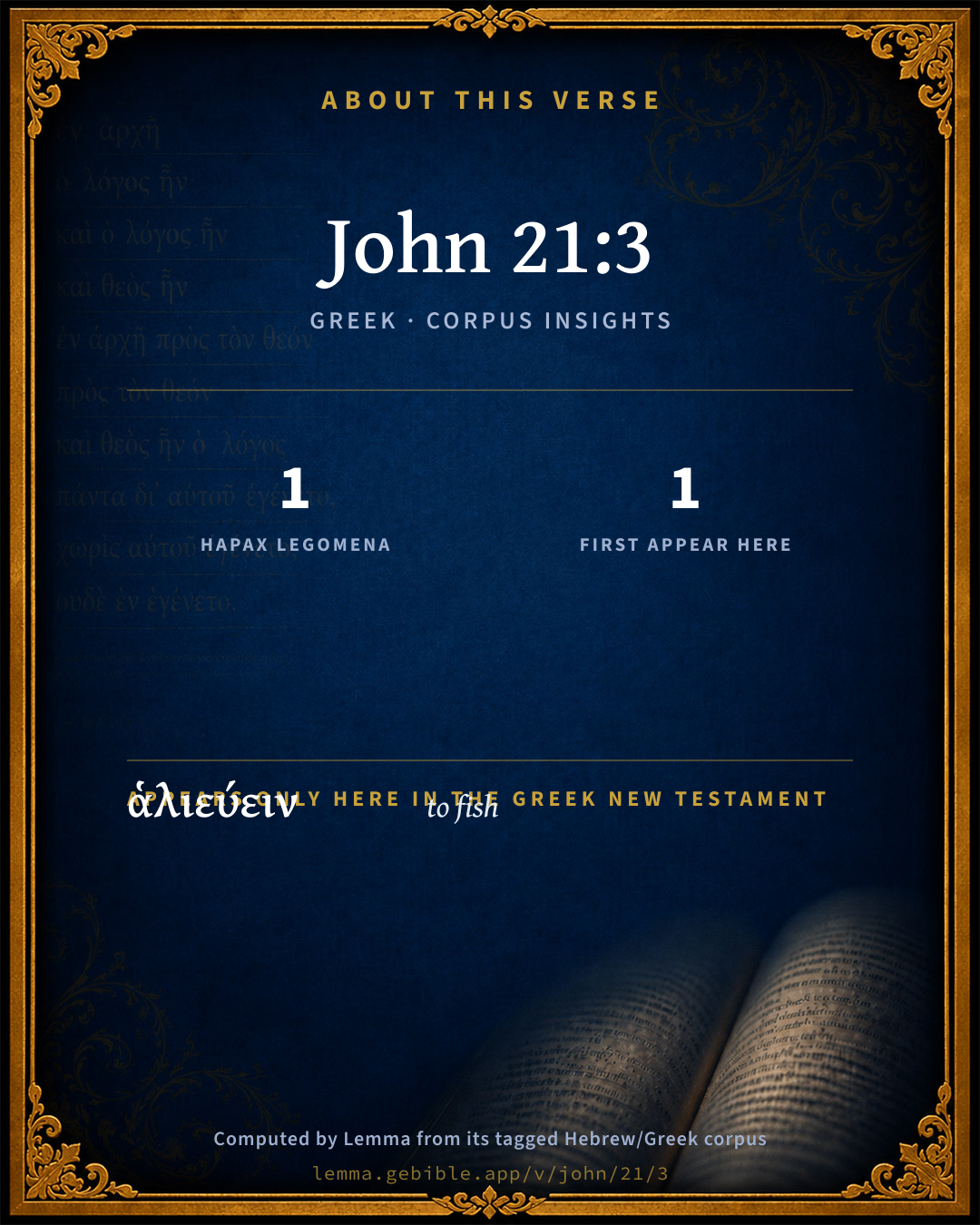
  • 1 hapax legomenon — only here in the Greek New Testament
  • 1 first appearance in the Greek New Testament
Full analysis ↓
Download a study sheet

One document with this verse’s original text, its word-by-word gloss line, the meaning frame, cross-references with their text, attributed commentary, and full source and license credits — printable, and it pastes into notes with its structure intact.

This verse Autodidact and up

Study sheet (.html) Plain text (.txt)

A passage Seminary Student

Up to 50 verses in one chapter. A passage sheet keeps up to 6 commentary sources and 12 cross-references per verse, in the order this page ranks them, and says so on the sheet whenever that leaves anything out. Ask for a single verse and you get the Autodidact verse sheet above.

Everything on this page stays free to read, with no account — the sheet is a download of what is already on screen, not access to it.

Want to remove ads? Support Godless Engineer
Compare translations 3

The same verse in 3 English versions, stacked beneath the original-language interlinear above. Click any original word for its lexicon entry.

Each is an independent rendering of the whole verse — the interlinear is not word-aligned to these translations.

Highlighted words mark where these versions differ — a whole-verse word diff, not a word-by-word alignment.

  • World English Bible Public Domain
    Simon Peter said to them, "I'm going fishing." They told him, "We are also coming with you." They immediately went out, and entered into the boat. That night, they caught nothing.
  • King James Version Public Domain
    Simon Peter saith unto them, I go a fishing. They say unto him, We also go with thee. They went forth, and entered into a ship immediately; and that night they caught nothing.
  • unfoldingWord Literal Text CC BY-SA 4.0
    Simon Peter says to them, “I am going fishing.” They say to him, “We also are coming with you.” They went out and got into a boat, but they caught nothing during that night.

unfoldingWord Literal Text — © unfoldingWord, licensed CC BY-SA 4.0. Word-aligned USFM3 via Door43 (git.door43.org/unfoldingWord/en_ult).

Versions to compare (up to 4)

3 of 4 selected

Show all 19 translations

Every available English version of this verse, each an independent rendering of the whole verse.

  • World English Bible Public Domain
    Simon Peter said to them, "I'm going fishing." They told him, "We are also coming with you." They immediately went out, and entered into the boat. That night, they caught nothing.
  • Berean Standard Bible Public Domain
    Simon Peter told them, “I am going fishing.” “We will go with you,” they said. So they went out and got into the boat, but caught nothing that night.
  • Majority Standard Bible Public Domain
    Simon Peter told them, “I am going fishing.” “We will go with you,” they said. So they went out and immediately got into the boat, but caught nothing that night.
  • King James Version Public Domain
    Simon Peter saith unto them, I go a fishing. They say unto him, We also go with thee. They went forth, and entered into a ship immediately; and that night they caught nothing.
  • American Standard Version (1901) Public Domain
    Simon Peter saith unto them, I go a fishing. They say unto him, We also come with thee. They went forth, and entered into the boat; and that night they took nothing.
  • Revised Version (1885) Public Domain
    Simon Peter saith unto them, I go a fishing. They say unto him, We also come with thee. They went forth, and entered into the boat; and that night they took nothing.
  • Geneva Bible (1599) Public Domain
    Simon Peter said vnto them, I go a fishing. They said vnto him, We also will goe with thee. They went their way and entred into a ship straightway, and that night caught they nothing.
  • Douay-Rheims (1899) Public Domain
    Simon Peter saith to them: I go a fishing. They say to him: We also come with thee. And they went forth, and entered into the ship: and that night they caught nothing.
  • Young's Literal Translation Public Domain
    Simon Peter saith to them, `I go away to fish;' they say to him, `We go -- we also -- with thee;' they went forth and entered into the boat immediately, and on that night they caught nothing.
  • Literal Standard Version CC BY-SA 4.0
    Simon Peter says to them, “I go away to fish”; they say to him, “We go—we also—with you”; they went forth and immediately entered into the boat, and on that night they caught nothing.
  • Unlocked Literal Bible CC BY-SA 4.0
    Simon Peter said to them, “I am going fishing.” They said to him, “We, too, will come with you.” They went and got into a boat, but they caught nothing during the whole night.
  • unfoldingWord Literal Text CC BY-SA 4.0
    Simon Peter says to them, “I am going fishing.” They say to him, “We also are coming with you.” They went out and got into a boat, but they caught nothing during that night.
  • Darby Bible Public Domain
    Simon Peter says to them, I go to fish. They say to him, We also come with thee. They went forth, and went on board, and that night took nothing.
  • World Messianic Bible Public Domain
    Simon Peter said to them, “I’m going fishing.” They told him, “We are also coming with you.” They immediately went out and entered into the boat. That night, they caught nothing.
  • Webster's Bible Public Domain
    Simon Peter saith to them, I go a fishing. They say to him, We also go with thee. They went forth, and entered into a boat immediately; and that night they caught nothing.
  • Free Bible Version CC BY-SA 4.0
    “I'm going fishing,” Simon Peter said to them. “We'll come with you,” they replied. So they left and went out in the boat, but all night they caught nothing.
  • Bible in Basic English Public Domain
    Simon Peter said to them, I am going fishing. They said to him, And we will come with you. They went out and got into the boat; but that night they took no fish.
  • Text-Critical English NT CC BY 4.0
    Simon Peter said to them, “I am going fishing.” They said to him, “We will go with yoʋ.” So they immediately went out and got into the boat, but that night they caught nothing.
  • Tyndale New Testament (1534) Public Domain
    Simon Peter sayde vnto them: I goo a fysshynge. They sayde vnto him: we also will goo with the. They wet their waye and entred into a shippe strayght waye and that nyght caught they nothinge.

Literal Standard Version (2020), Covenant Press — licensed CC BY-SA 4.0. Text via the HelloAO Bible API (eBible.org). Unlocked Literal Bible (unfoldingWord) — licensed CC BY-SA 4.0. Text via the HelloAO Bible API (eBible.org). unfoldingWord Literal Text — © unfoldingWord, licensed CC BY-SA 4.0. Word-aligned USFM3 via Door43 (git.door43.org/unfoldingWord/en_ult). Free Bible Version, Dr. Jonathan Gallagher — licensed CC BY-SA 4.0. Text via the HelloAO Bible API (eBible.org).

Word by word

More ways to search: Search by grammar → Find every occurrence → Compare this word →

Practice this passage: Drill this verse → Learn its vocabulary →

ἁλιεύειν
halieúō
G232
“to fish”
Verb, Present, Active, Infinitive
Part of Speech
Verb
Tense
Present
Voice
Active
Mood
Infinitive
Full Thayer's Definition

Origin: from G231

TDNT: None

1. to fish
  1. λέγει légō G3004 “to say” Verb, Present, Active, Indicative, 3rd person, Singular
  2. αὐτοῖς autós G846 “he” Personal pronoun, Dative, Plural, Masculine
  3. Σίμων Símōn G4613 “Simon” Noun, Nominative, Singular, Masculine
  4. Πέτρος Pétros G4074 “Peter” Noun, Nominative, Singular, Masculine
  5. ὑπάγω hypágō G5217 “to depart” Verb, Present, Active, Indicative, 1st person, Singular
  6. λέγουσιν légō G3004 “to say” Verb, Present, Active, Indicative, 3rd person, Plural
  7. αὐτῷ autós G846 “he” Personal pronoun, Dative, Singular, Masculine
  8. ἐρχόμεθα érchomai G2064 “to come” Verb, Present, Middle or Passive deponent, Indicative, 1st person, Plural
  9. καὶ kaí G2532 “and” Conjunction
  10. ἡμεῖς hēmeîs G2249 “we” Personal pronoun, 1st person, Nominative, Plural
  11. σὺν sýn G4862 “with” Preposition
  12. σοί sý G4771 “you” Personal pronoun, 2nd person, Dative, Singular
  13. ἐξῆλθον exérchomai G1831 “to come forth” Verb, Aorist, Active, Indicative, 3rd person, Plural
  14. καὶ kaí G2532 “and” Conjunction
  15. ἐνέβησαν embaínō G1684 “to enter” Verb, Aorist, Active, Indicative, 3rd person, Plural
  16. εἰς eis G1519 “into” Preposition
  17. τὸ ho G3588 “the” Article, Accusative, Singular, Neuter
  18. πλοῖον ploîon G4143 “ship” Noun, Accusative, Singular, Neuter
  19. καὶ kaí G2532 “and” Conjunction
  20. ἐν en G1722 “in” Preposition
  21. ἐκείνῃ ekeînos G1565 “that one” Demonstrative pronoun, Dative, Singular, Feminine
  22. τῇ ho G3588 “the” Article, Dative, Singular, Feminine
  23. νυκτὶ nýx G3571 “night” Noun, Dative, Singular, Feminine
  24. ἐπίασαν piázō G4084 “to seize” Verb, Aorist, Active, Indicative, 3rd person, Plural
  25. οὐδέν oudeís G3762 “nothing” Adjective, Accusative, Singular, Neuter, Negative

About this verse

These counts appear in no published source. They are computed here, from the morphology-tagged text and Lemma’s own curated glosses. What Lemma adds →

26
words
21
distinct lemmas
Gospels
section

Notable vocabulary

1 hapax legomenon — a word that appears only here in the entire Greek New Testament:

  • ἁλιεύειν to fish G232

First appearance in Scripture

This word makes its first canonical appearance in the Greek New Testament here:

  • ἁλιεύειν to fish G232

Shared distinctive vocabulary

ἐπίασαν to seize G4084 occurs in 12 verses of the Greek New Testament. Also found in:
Repetition

Words recur within this verse:

  • λέγει to say G3004 ×2
  • καὶ and G2532 ×3
  • αὐτοῖς he G846 ×2
  • τὸ the G3588 ×2

Cross-references

10

Topical passages linked to John 21:3 in the Treasury of Scripture Knowledge — connected by theme and wording, ordered by reader-vote popularity; previews shown in the World English Bible.

  • Luke 5:5 Simon answered him, "Master, we worked all night, and took nothing; but at your word I will let down the net."
  • Matthew 4:18–20 Walking by the sea of Galilee, he saw two brothers: Simon, who is called Peter, and Andrew, his brother, casting a net into the sea; for they were fishermen.
  • Luke 5:10–11 and so also were James and John, sons of Zebedee, who were partners with Simon. Jesus said to Simon, "Don't be afraid. From now on you will be catching people alive."
  • 2 Thessalonians 3:7–9 For you know how you ought to imitate us. For we didn't behave ourselves rebelliously among you,
  • 1 Thessalonians 2:9 For you remember, brothers, our labor and travail; for working night and day, that we might not burden any of you, we preached to you the Gospel of God.
  • 2 Kings 6:1–7 The sons of the prophets said to Elisha, See now, the place where we dwell before you is too strait for us.
  • 1 Corinthians 3:7 So then neither he who plants is anything, nor he who waters, but God who gives the increase.
  • Acts 18:3 and because he practiced the same trade, he lived with them and worked, for by trade they were tent makers.
  • Acts 20:34 You yourselves know that these hands ministered to my necessities, and to those who were with me.
  • 1 Corinthians 9:6 Or have only Barnabas and I no right to not work?

Cross-references courtesy of OpenBible.info (CC BY 4.0).

Where the printed editions differ

1 variant

Places in this verse where the major printed Greek editions disagree on the wording in a way that affects the translation — a comparison of editions, not a manuscript-by-manuscript collation. The editions are the modern critical texts (Nestlé-Aland 28/27, SBL, Westcott-Hort, Tregelles, Tyndale House) and the traditional texts behind the KJV (the Textus Receptus and the Byzantine/Majority text). It is not a claim about which reading is original.

  1. Extra text
    εὐθύς,

    “immediately”

    In TRByz Not in NA28NA27TynSBLWHTreg

    εὐθύς, (euthus) 'immediately' is only in traditional manuscripts (TR+Byz)

Textual data: Translators Amalgamated Greek New Testament (STEPBible TAGNT) · CC BY 4.0.

Commentary

Notes on John 21:3 from classic Christian and Jewish commentators (each source and its license shown beneath its notes). The classic Christian expositions comment on the surrounding passage and are grouped to its opening verse, so a note may address several verses; the Jewish commentaries on the Tanakh (Rashi and others) are per-verse, so they appear only where the commentator wrote on this verse.

Lemma curates 59 commentaries, every one of them public domain or Creative Commons licensed, each selected and text-cleaned for this edition rather than reprinted as found. About our sources →

The Biblical Illustrator

Joseph S. Exell

Joh_21:3

Simon Peter saith unto them, I go a fishing

I go a fishing

1.

A sudden inspiration.

2. A prompt resolution.

3. A hopeful expedition.

4. A laborious occupation.

5. A fruitless speculation.

6. A happy termination. (T. Whitelaw, D. D.)

Leaders and followers

I. LEADERS. In Church and State these, like Peter, should be men of

1. Prompt resolution.

2. Self-reliant action.

3. Cheery expectation.

4. Contagious inspiration.

II. FOLLOWERS. Like Peters companions, these should be

1. Unbroken in their ranks--We.

2. Hearty in their co-operation also.

3. Simultaneous in their movement--Go.

4. Unenvious in their dispositions--With thee. (T. Whitelaw, D. D.)

Night and nothing-morning and Jesus

I. A PERSONAL DETERMINATION--I go. The Church and the world need such men. Men with will and energy, who dare to strike out a course of action for themselves and face opposition. Where would the Church be today but for such men as Luther, and Knox, and Wesley? And where the world? We especially need such men now. We have got into the lazy, slovenly habit of waiting for one another. We see things that need to be done, but we wait until some one should take the lead. And so our Church life has little vitality and force.

II. THE FORCE OF EXAMPLE. We also go with thee. These men were not prepared for anything, they had no plans, but were just waiting for some one to break the ice. You have no idea how much good you would do if you would speak decidedly for Jesus; many would be prepared to listen, and to follow. Men are always influenced by truth, spoken with calmness and determination.

III. IMMEDIATE ACTION. They went forth, &c. They did not talk about going, and stand still after all. This again is a want. We meet with men who have plenty of directions to give, but they never act. Ah! says one, there ought to be more teachers in that school. Quite right; but do you teach? What a pity there are not more tract distributors. So it is; but are you one? Let us learn to act as well as speak.

IV. THE FISHERMENS FAILURE. We determine; we sometimes act upon the determination; and the result is simply--failure. Night and nothing. I have said, I will preach from such a text; I will give my soul to it, and then, what a failure it has been, and I have gone home and vowed I would never preach again. Has it not been so with you, teacher? Christian worker?

V. THE FISHERMENS SUCCESS. Throughout the darkness do we toil until the morning comes--and we see Jesus. Then success attends all we do, and our souls are filled with joy.

1. Jesus is often near to us when we little think it. We have only to stretch out our hand through the darkness, and we shall find Him.

2. We often see Him, but yet we do not know Him. Love only can recognize and realize the Lord.

VI. WHAT IS IT THAT MAKES ALL THIS DIFFERENCE BETWEEN FAILURE AND SUCCESS?

1. The presence of Jesus.

2. Listening to the voice of Jesus (Joh_21:5).

3. Obeying the command of Jesus (Joh_21:6). (A. F. Barfield.)

Catching nothing

I. A combos EXPERIENCE. Not the first time this had happened in the history of three out of the seven (Luk_5:5). Nor were these the first or the last who have spent their strength for nought (Isa_49:4).

II. A SORE DISAPPOINTMENT. Considering

1. The high expectations with which men usually start on their enterprises; and--

2. The great labour they often expend on them.

III. AN EXCELLENT DISCIPLINE

1. Teaching personal humility.

2. Suggesting the need of heavenly assistance.

3. Preparing for ultimate success. (T. Whitelaw, D. D.)

Fishing an She Sea of Galilee

Nowadays there is very little navigation on the lake of Galilee,--we might almost say, scarcely a boat; but in the days of the Gospel narrative, and for many years later, there were craft of all sorts there, and many of considerable size. The fishing-boat of to-day, as seen on the Mediterranean, is a long, broad, and deep affair, usually pointed at each end, and large enough to carry a crew of from four to a dozen men, with their nets, and the fish they may capture. Usually these larger boats fish in the night, in companies of two or three, but sometimes a larger boat goes alone with a small boat; and sometimes a small boat accompanies two or more larger ones. The smaller ones are like a skiff, while the larger ones might pass for freight boats. As here, it is nothing uncommon for the fleet (if the two or three boats can be called so) to toil all night and take nothing. In the Mediterranean, on the Syrian and Palestinian coasts, there are few places Where there is a beach upon which the net can be drawn. The net encloses the fish, and then they are drawn in as if in a bag, or picked out of the net without hauling the latter into the boat. Rarely one sees a gill-net, such as our fishermen use in deep water. Accordingly, the small boat is not so much of a necessity there as it would be where the seine was drawn to land. (S. S. Times.)

Fish in the lake

The Sea of Galilee now, as in the days of our Saviour, is well stocked with various species of fish, some of excellent flavour. One species often appears in dense masses which blacken the surface of the water, the individual fish being packed so closely together that on one occasion a single shot from a revolver killed three. These shoals were most frequently seen near the shores of Gennesareth: perhaps not far from the place where the disciples let down their net into the sea, and enclosed a great multitude of fishes: and their net brake. (Recovery of Jerusalem.)

The place soon asserted its right to the name Bethsaida by the exceeding abundance of the fish we saw tumbling into the water. The hot springs flowing in here over these rocks, and a little farther on in larger volume over a clean brown sand, warm all the ambient shallows for a hundred feet from shore, and, as much vegetable matter is brought down by the springs, and probably also insects which have fallen in, all these dainties are half cooked when they enter the lake. Evidently the fish agree to dine on these hot joints, and therefore in a large semicircle they crowd the water by myraids round the warm river mouth. Their backs are above the surface, as they bask or tumble and jostle crowded in the water. They gambol and splash, and the calm sea, fringed by a reeking crowd of vapour, has beyond this belt of living fish, a long row of cormorants feeding on the half-boiled fish as the fish have fed on insects underdone. White gulls poise in flocks behind the grebes or cormorants, and beyond these again ducks bustle on the water or whirl in the air. The whole is a most curious scene, and probably it has been thus from day to day for many thousand years. I paddled along the curved line of fishes backs and flashing tails. Some leaped into the air, others struck my boat or paddle. Dense shoals moved in brigades as if by concert or command. (MacGregors Jordan.)

The Biblical Illustrator, edited by Joseph S. Exell (c. 1880s–1900s) — public domain. Text from a community e-Sword module.

Joseph Benson's Commentary

Joh 21:3-6. Simon Peter saith, I go a fishing — They were now waiting for Christ’s promised appearance to them, and it was certainly commendable in Peter that he wished to redeem the time and not be idle; but endeavour to make some provision for his own support, and for the entertainment of his friends. They say, We also go with thee — They were as willing as he to labour for a maintenance, and not to eat the bread of idleness. They went forth, therefore, and entered into a ship immediately — A small vessel on the lake or sea of Tiberias; and that night — Though it was the properest time for fishing, and they were diligent in throwing their nets; they caught nothing — The providence of God so ordering it that the subsequent miracle might be the more illustrious. But when the morning was now come — After they had been toiling all night to no purpose; Jesus appeared and stood on the shore over against them; but the disciples — Who had no expectation of seeing him there, and also being at some distance from him, and it not being yet perfectly light; knew not that it was Jesus — They observed a person upon the shore, but knew not who he was. Then — As they approached within call; Jesus saith, Children, have ye any meat? — Have you taken fish enough to furnish out a meal? They answered him, No — We have been toiling here this whole night in vain. And he said, Cast the net on the right side of the ship, and ye shall find — Reader, whether we would cast the temporal net with success, and gain a maintenance for ourselves, and those dependant upon us, or the spiritual net, so as to be successful fishers of men, we have need of the direction of Jesus, and ought to apply to him for it; which if we do aright we shall not do in vain; the direction we need shall certainly be granted us. They — Willing to try, at least, whether this stranger conjectured right, cast the net therefore as he had directed them; and now — To their great astonishment; they were not able to draw it — Into the ship again; for the multitude of fishes — Which they had enclosed in it. This was not only a demonstration of the power of our Lord, but a kind supply for them and their families. It was, likewise, an emblem of the great success which should attend them as fishers of men.

Joseph Benson's Commentary on the Old and New Testaments (1811–1818) — public domain. Text from a community e-Sword module.

Tyndale Open Study Notes

Tyndale Open Resources

21:3 Fishing was usually successful in the early hours of the morning. However, this trip was useless and they caught nothing all night.

Tyndale Open Study Notes — © Tyndale Open Resources, licensed CC BY-SA 4.0. Text via the HelloAO Bible API.

Bengel's Gnomon

Johann Albrecht Bengel

Joh 21:3. Ὑπάγω ἁλιεύειν, I go a fishing) Constrained by necessity, not for the sake of gain: Joh 21:5, “Children, have ye any meat?” ‘No.’ A remarkable example of αὐτουργία, labouring with one’s own hands, without sacrificing the apostolical dignity.—καὶ ἡμεῖς, we also) They were now by this time not so much afraid.—εἰς τὸ πλῦιον, into a ship) which is called in Joh 21:8 a little ship.

Bengel's Gnomon of the New Testament — English translation (T&T Clark, Edinburgh, 1860) — public domain. Text from a community e-Sword module.

Meyer's Critical & Exegetical Commentary

Heinrich August Wilhelm Meyer

Joh_21:3-4. Ἐρχόμ. κ. ἡμεῖς σὺν σοί] John has not employed ἀκολουθεῖν, nor said ἄγωμεν κ. ἡμεῖς (Joh_11:16), because he has thought just what was said.

The circumstantiality is not un-Johannean (Lücke), but comp. e.g. Joh_1:39-40, Joh_9:1-12. In particular, moreover, the ὑπάγω ἁλιεύειν is only the simple language of familiar association, in which neither a brusque tone, nor an internal impulse, a presentiment (Godet), is to be recognised. The disciples desire again to pursue their earthly employments, quod privatos homines decebat, Calvin.

ἐξῆλθον] from the place indicated in Joh_21:2, probably Capernaum, out to the lake, Joh_21:1.

By night the fishing was productive. Comp. on Luk_5:5; Aristot. H. A. viii. 19. But they caught nothing. How entirely different was it afterwards, when they cast out at the bidding of the Lord!

ἔστη] Expressing the sudden appearance. Comp. Joh_20:19; Joh_20:26.

εἰς τ. αἰγ.] Comp. Joh_20:19; Joh_20:26.

οὐ μέντοι, κ.τ.λ.] To be explained from the entirely altered condition and appearance of the Risen One. Chrysostom, assigns the reason to the will of Jesus: οὐκ εὐθέως ἑαυτὸν δείκνυσιν, comp. also Luthardt and Hengstenberg, of which John, however, gives no indication. Comp. rather on Joh_20:14.

Meyer — Critical and Exegetical Commentary on the New Testament — English translation by Peter Christie, edited by Frederick Crombie (T&T Clark, 1880) — public domain. Text from a community e-Sword module.

Expositor's Greek Testament

ed. W. Robertson Nicoll

Joh 21:3 . As the disciples stand together and see boat after boat put off, Simon Peter can stand it no longer but suddenly exclaims, Ὑπάγω ἁλιεύειν , “I am off to fish”. This is a relief to all and finds a ready response, Ἐρχόμεθα καὶ ἡμεῖς σὺν σοί , At once they embark, and as we watch that boat’s crew putting off with their whole soul in their fishing, we see in how precarious a position the future of Christianity hung. They were only sure of one thing that they must live. But ἐν ἐκείνῃ τῇ νυκτὶ ἐπίασαν οὐδέν , “during that night they took nothing”. Ἁλίσκονται δὲ μάλιστα οἱ ἰχθύες πρὸ ἡλίου ἀνατολῆς καὶ μετὰ τὴν δύσιν Aristotle, Hist. Animal. , viii. 19, quoted by Lampe. [On ἐπίασαν , see Joh 7:30 and Rev 19:20 .

The Expositor's Greek Testament, edited by W. Robertson Nicoll (1897–1910) — public domain. Text from a community e-Sword module.

Godet's Commentaries

Frédéric Louis Godet

Vv. 3, 4. “Simon Peter says to them, I go a fishing. They say to him, We also go with thee. They went forth and entered immediately into the boat; and they took nothing that night. 4. But when the morning was already come, Jesus stood on the beach; the disciples, however, knew not that it was Jesus.”

Between their first call and the beginning of the active ministry of their Master (see at Joh 2:12), the disciples had returned to their ordinary profession. They seem to have acted in the same way when once they had returned to Galilee after the resurrection. As ordinarily, the initiative comes from Peter.

The word πιάζειν, to take, which is used in Joh 21:3; Joh 21:10, is found again six times in our Gospel, nowhere in the Synoptics (Hengstenberg). On the other hand, the word πρωΐα does not occur again in John. Baumlein rightly observes that the asyndeta λέγει, λέγουσιν, ἐξῆλθον, etc., are in John’s style.

This long night of toil without result had, no doubt, recalled to the apostles that which had preceded their calling to the office of preachers of the Gospel (Luke 5).

Frédéric Louis Godet — Commentaries on Luke, John, Romans, and 1 Corinthians — English translation (T&T Clark, Edinburgh, 1870s–1890s) — public domain. Text from a community e-Sword module.

Jamieson, Fausset & Brown

Robert Jamieson, A. R. Fausset & David Brown

Peter saith unto them, I go a fishing--(See on Luk 5:11).

that night . . . caught nothing--as at the first miraculous draught (see on Luk 5:5); no doubt so ordered that the miracle might strike them the more by contrast. The same principle is seen in operation throughout much of Christ's ministry, and is indeed a great law of God's spiritual procedure with His people.

Jamieson, Fausset & Brown — Commentary Critical and Explanatory on the Whole Bible (1871) — public domain (CC PDM 1.0). Text via the HelloAO Bible API.

Adam Clarke's Commentary

Verse 3. Peter saith - I go a fishing.] Previously to the crucifixion of our Lord, the temporal necessities of himself and his disciples appear to have been supplied by the charity of individuals: Lu 8:3. As it is probable that the scandal of the cross had now shut up this source of support, the disciples, not fully knowing how they were to be employed, purposed to return to their former occupation of fishing, in order to gain a livelihood; and therefore the seven, mentioned Joh 21:2, embarked on the sea of Tiberias, otherwise called the sea of Galilee.

That night they caught nothing.] God had so ordered it, that they might be the more struck with the miracle which he afterwards wrought.

Adam Clarke's Commentary on the Bible (1810–1826) — public domain. Text from a community e-Sword/MySword module.

John Calvin's Commentaries

3. I am going to fish. That Peter gave his attention to fishing, ought not to be regarded as inconsistent with his office. By breathing on him, Jesus had ordained him to be an Apostle, as we saw a little before; but he abstained from the exercise of the apostleship for a short time, till he should be clothed with new power. For he had not yet been enjoined to appear in public for the discharge of his office of teaching, but had only been reminded of his future calling, that he and the others might understand that they had not in vain been chosen from the beginning. Meanwhile, they do what they were accustomed to do, and what belonged to men in private life. It is true that Paul, in the midst of his employment as a preacher, gained the support of his life by his own hands, but it was for a different reason; for his time was so arranged, that the labors of his hands did not withdraw him from teaching. Peter and his companions, on the other hand, give themselves up entirely to fishing, because they are not hindered from doing so by any public employment.

And that night they caught nothing. God permitted them to toil to no purpose during the whole night, in order to prove the truth of the miracle; for if they had caught any thing what followed immediately afterwards would not have so clearly manifested the power of Christ, but when, after having toiled ineffectually during the whole night, they are suddenly favored with a large take of fishes, they have good reason for acknowledging the goodness of the Lord. In the same manner, also, God often tries believers, that he may lead them the more highly to value his blessing. If we were always prosperous, whenever we put our hand to labor, scarcely any man would attribute to the blessing of God the success of his exertions, all would boast of their industry, and would kiss their hands. But when they sometimes labor and torment themselves without any advantage, if they happen afterwards to succeed better, they are constrained to acknowledge something out of the ordinary course; and the consequence is, that they begin to ascribe to the goodness of God the praise of their prosperity and success.

John Calvin's Commentaries (1540-1563) — public domain. Text from the Calvin Translation Society English edition (1840s-50s) via the Christian Classics Ethereal Library (ccel.org). Calvin's coverage is partial (roughly two-thirds of the Bible); uncommented books and verses are honest gaps, never fabricated. The 19th-century editor's footnotes and remarks are omitted so the notes are faithfully Calvin's own voice.

Ellicott's Commentary for English Readers

(3) Simon Peter saith unto them, I go a fishing.—The words are the vivid representation by an ear-witness of what actually took place as they re turned to their ordinary work during the interval between the Passover and Pentecost. It does not express either an abandonment of their higher vocation, or an expectation of the presence of the Lord. The picturesque colouring of the whole scene is quite in St. John’s style, as is also the simple co-ordinate arrangement of sentences without connecting particles.

And that night they caught nothing.—Comp. for the fact Luk_5:5; but the words are different. The word here rendered “caught” occurs nowhere in the other Gospels, but is found again in this chapter (Joh_21:10), and six times in the earlier chapters of the Gospel (Joh_7:30; Joh_7:32; Joh_7:44; Joh_8:20; Joh_10:39; Joh_11:57). It occurs also in Rev_19:20.

A Bible Commentary for English Readers, edited by Charles John Ellicott (1878–1897) — public domain. Text from a community e-Sword module.

The Cambridge Bible for Schools and Colleges

gen. ed. J. J. S. Perowne

3. Simon Peter] As so often, he takes the lead. In the interval of waiting for definite instructions the disciples have returned to their usual employment. Once more we have precise and vivid details, as of an eye-witness.

We also go] Rather, we also come.

went forth] From the town or village, probably Capernaum or Bethsaida.

into a ship] Better, into the ships. ‘Immediately’ must be omitted on decisive evidence.

that night] Better, in that night. ‘That’ perhaps indicates that failure was exceptional; or it may mean ‘that memorable night’ (comp. Joh_19:31; Joh_20:19). Night was the best time for fishing (Luk_5:5).

they caught nothing] Failure at first is the common lot of Christ’s fishers. His Presence again causing success after failure might bring home to them the lesson that apart from Him they could do nothing (Joh_15:5).

The word here used for ‘catch’ does not occur in the Synoptists, but besides Joh_21:10 is found six times in this Gospel (Joh_7:30; Joh_7:32; Joh_7:44, Joh_8:20, Joh_10:39, Joh_11:57), and once in Revelation (Joh_19:20) [8]. Elsewhere only Act_3:7; Act_12:4; 2Co_11:32.

The Cambridge Bible for Schools and Colleges (gen. ed. J. J. S. Perowne; Cambridge University Press, 1878–1918) — public domain. Text from a community e-Sword module.

John Gill's Exposition

Simon Peter saith unto them, I go a fishing,.... Which was his business before his conversion; and now having nothing to do, and his Lord and master having, as yet, no service for him in the ministry of the word, until the Spirit was poured down in an extraordinary manner, which was given to be expected, in the mean while he was inclined to, and resolved upon taking up his former employment; partly that he might not live an idle life, and partly to obtain a livelihood, which was now to be sought after in another manner, since the death of Christ; and these inclinations and resolutions of his he signifies to the rest of the disciples, who agreed with him:

they say unto him, we also go with thee; that is, a fishing; for it seems to have been the business and employment of them all formerly: the place they went to was the sea of Tiberias, as appears from Joh 21:1 a place free for any to fish at. This is said to be one of the ten traditions which Joshua delivered to the children of Israel, when he divided the land among them (z):

"that any man should be free to catch fish in the waters (or sea) of Tiberias; and he might fish with an hook only; but he might not spread a net, or place a ship there, except the children of the tribe to whom that sea belonged in their division.''

But now these disciples, or the greater part of them at least, belonging to the tribe and division in which the sea was, had a right to carry a ship or boat thither, and make use of a net, as they did. Besides, there was another reason for fishing here, because there were no unclean fish; for the Jews say (a), that

"in a place of running water no clean fish goes along with unclean fish, and lo, the sea of Tiberias is , "as running waters".''

They went forth: from the house, town, or city where they were, whether Capernaum, or Bethsaida, or Tiberias itself:

and entered into a ship immediately; which was either one of their own, that belonged to some one of them before their call; which though they had left, had reserved their right and claim unto; see Luk 5:3 or which they hired for their present purpose: the word immediately is not in the Vulgate Latin, nor in the Syriac, Arabic, Persic, and Ethiopic versions, nor in Beza's ancient copy:

and that night they caught nothing. They went out in the evening of the day, and fished all night, that being a proper time for such business, and the most likely to succeed in, but caught no fish, or very little: and so it is sometimes with Gospel ministers, who are fishers of men, though they take every opportunity, and the most proper methods to gain souls to Christ, yet sometimes do not succeed; which makes things look dark and gloomy in their apprehensions.

(z) Maimon. Hilch. Nezike Maramon, c. 5. sect. 3. Vid. T. Bab. Bava Kama, fol. 81. 1. (a) T. Hieros. Avoda Zara, fol. 42. 1.

John Gill's Exposition of the Whole Bible (1746–1763) — public domain (CC PDM 1.0). Text via the HelloAO Bible API.

Trapp's Complete Commentary

John Trapp

3 Simon Peter saith unto them, I go a fishing. They say unto him, We also go with thee. They went forth, and entered into a ship immediately; and that night they caught nothing.

Ver. 3. I go a fishing, &c.] Being not yet employed in the public ministry, he would not be idle, and that he might not be chargeable to the Church. This life is in Isaiah called, "The life of our hands," because it is to be maintained by the labour of our hands. We are to earn ere we eat, 2Th 3:8. Res age tutus eris. Undertake wil will be safe to do. Ovid.

And that night they caught nothing] Labour we never so hard, unless God bless it, and stop that hole in the bottom of the bag, Hag 1:6, those secret issues and drains of expense, at which men’s estates run out, we shall be forced to say with Severus the emperor, Omnia feci et nihil profuit. Everything I have done and nothing profited. (Spartian.)

John Trapp, A Commentary or Exposition upon All the Books of the Old and New Testament (1647–1656) — public domain. Text from a community e-Sword module.

Albert Barnes' Notes on the Bible

That night they caught nothing - This was so ordered in the providence of God that the miracle which was performed might appear more remarkable.

Albert Barnes' Notes on the Bible (1834–1885) — public domain. Text from a community e-Sword/MySword module.

Haydock's Catholic Bible Commentary

How comes it that Peter, after his conversion, should return to his fishing, when Jesus Christ had said, that he that sets his hand to the plough, and looks back, is not worthy of the kingdom of heaven? The employments they applied to before their conversion, without being guilty of sin, these they might, without fault, exercise, after their conversion: therefore Peter returned to his fishing; but St. Matthew never returned to his custom-house, because when once converted, we never can be allowed to give ourselves to these employments, which of themselves lead to sin. And there are many pursuits which can scarcely, or not at all, be followed without sin. (St. Gregory, hom. xxiv. in Evan.)

George Leo Haydock (1774–1849), Haydock's Catholic Family Bible and Commentary, 1859 edition — public domain. Excludes Psalms (Douay-Rheims chapter numbering differs from Protestant) and Deuterocanonical books (Catholic canon only).

Matthew Poole's English Annotations

Peter and divers others were fishermen, as we have formerly heard, and had boats which they so employed. Though they were called to the work of the ministry, yet, churches not yet being gathered and constituted able to maintain them, they did not judge it unlawful to employ themselves in honest vocations, which might bring in something of a livelihood; no more did Paul afterward. The others resolve to go with Peter. They went, but

that night caught nothing; the providence of God so ordering it, that Christ’s Divine power might be seen in commanding fish into their nets.

Matthew Poole's English Annotations on the Holy Bible (1683–1685) — public domain. Text from a community e-Sword/MySword module.

Whedon's Commentary on the Bible

Daniel D. Whedon

3. I go a fishing—Literally, I am going to fish. The symbolical fishers of men are going to their literal and original work. The transaction that now ensues is a re-enactment and enlargement of their first call to follow Jesus, after a similar miracle. See notes on Mat_4:18-20; Luk_5:4-11. That miracle presaged their future office under Christ’s living guardianship; this miracle prophetically promises a guardianship of the ascended Christ over his faithful ministry, and their final attainment to the everlasting

shores. Caught nothing—Their catching nothing, the presence of Jesus, and their rare success at his command, are clear repetitions of the former transaction.

Daniel D. Whedon (gen. ed.), Commentary on the Old and New Testaments (1874–1909) — public domain. Text from a community e-Sword module.

The Pulpit Commentary

Simon Peter saith unto them, I go a-fishing. The abruptness of the language addressed to six (mayhtai) disciples, who seemed to be living as in one family, suggests a lengthened waiting, and some disappointment as to the effect upon their daffy life of the great revelation. They are summoned by the most commanding spirit among them to resume what was, for some of them at least, their customary calling. He would seek in humble fashion, along the lines of ordinary duty to his family and himself, the supply of daily wants. According to some writers, Peter felt a presentiment of the coming of his Lord under scenes identical with those of his first call. (Luk_5:1-11) According to others, Peter exhibited some of the heart-sickness of deferred hope. On either supposition we see a new illustration of, dud testimony to, the character of the man who was so conspicuous an initiator. They say to him, We also come (or, go) with thee. They do not "follow" him, as they had been summoned once to follow their Lord; but they are willing, even eager, to accompany the strong-hearted man, and ready to take his lead. They share at once either in his presentiment or in the expression of his delayed hope. They went forth; i.e. from the home which they had made for themselves on this well-remembered spot from Capernaum, which was most probably the early home of Peter, and a spot to which he would naturally revert. And entered into the ship; the veritable vessel that had often served them on that lake of storms. Though Peter and Andrew, James and John, had left their boats and nets and hired servants, it is not unlikely that members of their two families had retained them. And that night they took nothing. Let the unusual word be noticed. Piazein occurs three times in this brief narrative and six times in the Gospel, in the sense of "laying hold," "taking possession of," but nowhere in the synoptists. It occurs, however, in Act_12:4 2Co_11:32; Ecclus. 23. 21; and, what is more remarkable, in the sense of "taking animals" in Rev_19:20 (epiasyh to yhrion); so the LXX for zja. (Son_2:15)

The night was then, as now, the most convenient time for fishing, and the fruitless effort must have reminded them of the night described in Luke 5. Some critics have supposed this failure to be parabolic or symbolic of the comparatively barren results of the apostolic ministry to the Jews, while what followed was prophetic of the great success which should accompany their appeal to the Gentiles. But Peter"s wonderful success on the Day of Pentecost and on subsequent occasions in dealing with Jews, contradicts this interpretation. The only analogy which offers itself to our minds is the limited success of all their endeavors until the apostles were veritably endowed with power from on high.

The Pulpit Commentary (1880–1919), ed. H.D.M. Spence-Jones & Joseph S. Exell — public domain. Text from a community e-Sword module.

Scofield Reference Notes

C. I. Scofield

I go

Contra. Num 9:17-23.

The Scofield Reference Bible (1917 edition), notes by C. I. Scofield — public domain. Text from a community e-Sword module.

The People's New Testament

B. W. Johnson

3. Simon Peter saith, … I go a fishing. His old calling.

B. W. Johnson's The People's New Testament with Notes (1889–1891) — public domain. Electronic text from the Christian Classics Ethereal Library (CCEL) ThML edition.

Cambridge Greek Testament for Schools and Colleges

3. ἐνέβηαν for ἀνέβησαν. Omit εὐθύς after πλοῖον.

3. S. Peter, as so often, takes the lead: and again we have precise and vivid details, as from an eyewitness. In the interval of waiting for definite instructions the disciples support themselves by their old employment, probably at Capernaum or Bethsaida. Night was the best time for fishing (Luk 5:5); and the ἐκείνῃ may indicate that this failure was exceptional: or it may mean ‘in that memorable night’ (Joh 11:49; Joh 11:51, Joh 19:27; Joh 19:31, Joh 20:19).

ἐπίασαν οὐδέν. Failure at first is the common lot of Christ’s fishers. His Presence again causing success after failure might enforce the lesson that apart from Him they could do nothing (Joh 15:5). Πιάζειν occurs six times in this Gospel besides here, and also Rev 19:20: elsewhere only Act 3:7; Act 12:4; 2Co 11:32 [9]. The asyndeta, λέγει, λέγουσιν, ἐξῆλθον, are in S. John’s style [10]: Joh 18:34-36.

Cambridge Greek Testament for Schools and Colleges (Cambridge University Press, 1896; 21 vols, various authors incl. Carr, Maclear, Plummer, Farrar, Lumby, Moule, M. R. James, Simcox) — public domain. Text from a community e-Sword module.

Alford’s Greek Testament

Henry Alford

3.] The disciples returned to their occupation of fishing, probably as a means of livelihood, during the time which the Lord had appointed them in Galilee between the feasts of the Passover and Pentecost. This seems to be the first proposal of so employing themselves.

καὶ ἡμεῖς] See ch. 11:16.

ἐξῆλθον—from the house where they were together.

ἐπίασαν οὐδέν—as before, Luk 5:5. The correspondence of this account with that is very remarkable—as is also their entire distinctness in the midst of that correspondence. The disciples must have been powerfully reminded of that their former and probably last fishing together. And after the “fishers of men” of that other occasion, the whole could not but bear to them a spiritual meaning in reference to their apostolic commission:—their powerlessness without Christ,—their success when they let down the net at His word. Their present part was not to go fishing of themselves, but περιμένειν τ. ἐπαγγελίαν τοῦ πατρός, Act 1:4 (Luthardt).

Henry Alford, The Greek Testament (1849–1861) — public domain. Text from a community e-Sword module.

International Critical Commentary

3. λέγει αὐτοῖς Σίμων Πέτρος. He characteristically takes the lead, saying, “I am off to fish.” For ὑπάγω, see on 7:33. The verb ἁλιεύειν occurs in the Greek Bible only once elsewhere, at Jer 16:16.

To repeat the full name Σίμων Πέτρος is not in accordance with Jn.’s habit (see on 18:15); cf. vv. 7, 11, 15.

καὶ ἡμεῖς σὺν σοί. σύν is not a favourite Johannine word, occurring only twice in Jn. (see on 12:2, 18:1).

ἐξῆλθον, “they went out,” not necessarily from the same house, but from the place where they were all gathered.

ἐνέβησαν εἰς τὸ πλοῖον. For this phrase, see on 6:17. The rec. has ἀνέβησαν. Probably τὸ πλοῖον was the large boat which they were accustomed to use as they went about the lake with Jesus (see on 6:1).

The rec. adds εὐθύς, but om. אBC*DLNWΔΘ.

ἐν ἐκείνῃ τῇ νυκτὶ ἐπίασαν οὐδέν. This recalls Luk 5:5; the night is the best time for fishing, and yet they caught nothing. πιάζειν is used several times by Jn. (see on 7:30) of “arresting” or “taking” Jesus; but to use it of the catching of fish, as here and at v. 10, is curious. Cf. Son 2:15, Rev 19:20.

International Critical Commentary — older volumes (1896–1929), various authors — public domain. Text from a community e-Sword module.

Vincent's Word Studies in the New Testament

Marvin R. Vincent

A ship [το πλοιον] . Rev., the boat; restoring the article, which indicates a familiar implement. See on Luk 5:2.

Immediately. Omit.

That night. The emphatic pronoun that [εκεινη] may indicate that their ill success was unusual.

Caught [επιασαν] . So ver. 10. The verb means to lay hold of, and is nowhere else used in the New Testament of taking fish. Elsewhere in this Gospel always of the seizure of Christ by the authorities (vii. 30, 39, 44; Joh 8:20; Joh 10:39; Joh 11:57). Of apprehending Peter and Paul (Act 12:4; 2Co 11:32). Of the taking of the beast (Rev 19:20). Of taking by the hand (Act 3:7).

Marvin R. Vincent, Word Studies in the New Testament (1887–1900) — public domain. Text from a community e-Sword/MySword module.

Lesson kit

Teaching starters — assembled from the data on this page, not authored interpretation. Every prompt links to the verse data it draws on. Edit before teaching.

John, in the Gospels, opens this verse with 26 words (21 distinct Greek lemmas). Its most distinctive word is halieúō (“to fish”). A historical commentator’s framing appears above. Read the whole chapter for the surrounding context.

Discussion questions

  1. How does “to fish” (halieúō) shape what this verse is saying?
  2. 1 word here appears nowhere else in the Greek New Testament. Why might the author reach for such rare wording?
  3. This is the first place “to fish” appears in Scripture (first appears here). What does its debut here establish?
  4. How does John 7:30, which shares the word «to seize», read alongside this verse?
  5. What does the repetition of “to say” (2× in this one verse) do in this verse?
  6. These translations render this verse differently; the difference is in the English rendering, not the original. What questions does that raise?
  7. Compare how The Biblical Illustrator and Joseph Benson's Commentary read this verse. Where do they agree or differ?

Things to notice

  • 1 word in this verse appears nowhere else in the Greek New Testament.
  • 1 word makes its first canonical appearance in Scripture here.
  • These translations choose different wording for 19 words in this verse.
  • “to say” occurs 2× in this single verse.
  • 21 distinct Greek lemmas span 26 words in this verse.

Reading settings

Reading text

Shown beneath each verse's original-language words.

Old Testament
Old Testament edition

Read the OT as the Masoretic Hebrew (MT) or the Greek Septuagint (LXX).

English shown for the Greek Septuagint (in the Hebrew ↔ Greek comparison).

Comparing translations? Open the Compare panel on any verse page to stack up to four side by side.