John 21:23

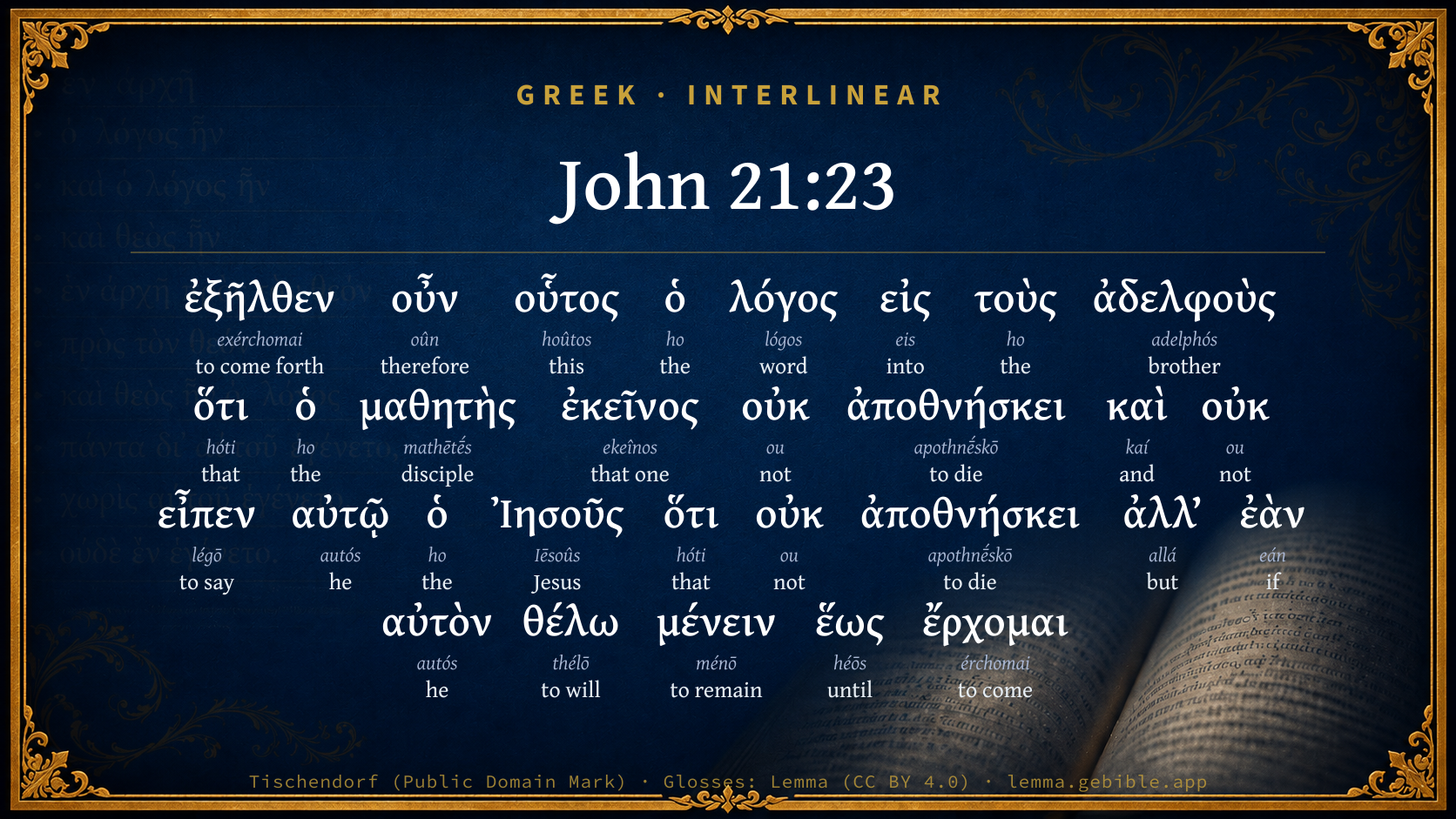
Greek (Tischendorf 8th ed.) John 21:23 appears in the Greek New Testament. The text above is from the Tischendorf 8th edition. Each word links to its Strong’s number and a concise gloss. Click any word for its full Thayer’s Greek Lexicon entry.
Download image
Cite this verse

John 21:23 (World English Bible). Public Domain. Lemma interlinear Bible study tool, https://lemma.gebible.app/v/john/21/23.

Show BibTeX & RIS
BibTeX
RIS
English Translation
This saying therefore went out among the brothers, that this disciple wouldn't die. Yet Jesus didn't say to him that he wouldn't die, but, "If I desire that he stay until I come, what is that to you?"
World English Bible · Public Domain
Download a study sheet

One document with this verse’s original text, its word-by-word gloss line, the meaning frame, cross-references with their text, attributed commentary, and full source and license credits — printable, and it pastes into notes with its structure intact.

This verse Autodidact and up

Study sheet (.html) Plain text (.txt)

A passage Seminary Student

Up to 50 verses in one chapter. A passage sheet keeps up to 6 commentary sources and 12 cross-references per verse, in the order this page ranks them, and says so on the sheet whenever that leaves anything out. Ask for a single verse and you get the Autodidact verse sheet above.

Everything on this page stays free to read, with no account — the sheet is a download of what is already on screen, not access to it.

Want to remove ads? Support Godless Engineer
Compare translations 3

The same verse in 3 English versions, stacked beneath the original-language interlinear above. Click any original word for its lexicon entry.

Each is an independent rendering of the whole verse — the interlinear is not word-aligned to these translations.

Highlighted words mark where these versions differ — a whole-verse word diff, not a word-by-word alignment.

  • World English Bible Public Domain
    This saying therefore went out among the brothers, that this disciple wouldn't die. Yet Jesus didn't say to him that he wouldn't die, but, "If I desire that he stay until I come, what is that to you?"
  • King James Version Public Domain
    Then went this saying abroad among the brethren, that that disciple should not die: yet Jesus said not unto him, He shall not die; but, If I will that he tarry till I come, what is that to thee?
  • unfoldingWord Literal Text CC BY-SA 4.0
    So this word spread among the brothers, that that disciple does not die. But Jesus did not say to him that he does not die, but, “If I want him to remain until I come, what to you?”

unfoldingWord Literal Text — © unfoldingWord, licensed CC BY-SA 4.0. Word-aligned USFM3 via Door43 (git.door43.org/unfoldingWord/en_ult).

Versions to compare (up to 4)

3 of 4 selected

Show all 19 translations

Every available English version of this verse, each an independent rendering of the whole verse.

  • World English Bible Public Domain
    This saying therefore went out among the brothers, that this disciple wouldn't die. Yet Jesus didn't say to him that he wouldn't die, but, "If I desire that he stay until I come, what is that to you?"
  • Berean Standard Bible Public Domain
    Because of this, the rumor spread among the brothers that this disciple would not die. However, Jesus did not say that he would not die, but only, “If I want him to remain until I return, what is that to you?”
  • Majority Standard Bible Public Domain
    Because of this, the rumor spread among the brothers that this disciple would not die. However, Jesus did not say that he would not die, but only, “If I want him to remain until I return, what is that to you?”
  • King James Version Public Domain
    Then went this saying abroad among the brethren, that that disciple should not die: yet Jesus said not unto him, He shall not die; but, If I will that he tarry till I come, what is that to thee?
  • American Standard Version (1901) Public Domain
    This saying therefore went forth among the brethren, that that disciple should not die: yet Jesus said not unto him, that he should not die; but, If I will that he tarry till I come, what `is that' to thee?
  • Revised Version (1885) Public Domain
    This saying therefore went forth among the brethren, that that disciple should not die: yet Jesus said not unto him, that he should not die; but, If I will that he tarry till I come, what is that to thee?
  • Geneva Bible (1599) Public Domain
    Then went this worde abroade among the brethren, that this disciple shoulde not die. Yet Iesus saide not to him, He shall not die: but if I will that he tarie till I come, what is it to thee?
  • Douay-Rheims (1899) Public Domain
    This saying therefore went abroad among the brethren, that that disciple should not die. And Jesus did not say to him: He should not die; but, So I will have him to remain till I come, what is it to thee
  • Young's Literal Translation Public Domain
    yet Jesus did not say to him, that he doth not die, but, `If him I will to remain till I come, what -- to thee?'
  • Literal Standard Version CC BY-SA 4.0
    This word, therefore, went forth to the brothers that this disciple does not die, yet Jesus did not say to him that he does not die, but, “If I will him to remain until I come, what [is that] to you?”
  • Unlocked Literal Bible CC BY-SA 4.0
    So this statement spread among the brothers, that that disciple would not die. Yet Jesus did not say to Peter that the other disciple would not die, but, “If I want him to stay until I come, what is that to you?”
  • unfoldingWord Literal Text CC BY-SA 4.0
    So this word spread among the brothers, that that disciple does not die. But Jesus did not say to him that he does not die, but, “If I want him to remain until I come, what to you?”
  • Darby Bible Public Domain
    This word therefore went out among the brethren, That disciple does not die. And Jesus did not say to him, He does not die; but, If I will that he abide until I come, what [is that] to thee?
  • World Messianic Bible Public Domain
    This saying therefore went out among the brothers that this disciple wouldn’t die. Yet Yeshua didn’t say to him that he wouldn’t die, but, “If I desire that he stay until I come, what is that to you?”
  • Webster's Bible Public Domain
    Then this saying went abroad among the brethren, that that disciple should not die: yet Jesus said not to him, He shall not die; but, if I will that he shall tarry till I come, what is that to thee?
  • Free Bible Version CC BY-SA 4.0
    This is why the saying spread among the believers that this disciple would not die. But Jesus didn't say to him that he wouldn't die, just that “If I want him to remain alive here until I return, why is that your concern?”
  • Bible in Basic English Public Domain
    So this saying went about among the brothers that this disciple would not undergo death: Jesus, however, did not say that he would not undergo death, but, If it is my desire for him to be here till I come back, what is that to you?
  • Text-Critical English NT CC BY 4.0
    So the rumor spread among the brothers that this disciple would not die. Yet Jesus did not tell him that he would not die; he only said, “If I wish for him to remain until I come, what is that to yoʋ?”
  • Tyndale New Testament (1534) Public Domain
    Then went this sayinge a broode amonge the brethren that that disciple shulde not dye. Yet Iesus sayde not to him he shall not dye: but yf I will that he tary tyll I come what is that to the?

Literal Standard Version (2020), Covenant Press — licensed CC BY-SA 4.0. Text via the HelloAO Bible API (eBible.org). Unlocked Literal Bible (unfoldingWord) — licensed CC BY-SA 4.0. Text via the HelloAO Bible API (eBible.org). unfoldingWord Literal Text — © unfoldingWord, licensed CC BY-SA 4.0. Word-aligned USFM3 via Door43 (git.door43.org/unfoldingWord/en_ult). Free Bible Version, Dr. Jonathan Gallagher — licensed CC BY-SA 4.0. Text via the HelloAO Bible API (eBible.org).

Word by word

More ways to search: Search by grammar → Find every occurrence → Compare this word →

Practice this passage: Drill this verse → Learn its vocabulary →

ἀποθνήσκει
apothnḗskō
G599
“to die”
Verb, Present, Active, Indicative, 3rd person, Singular
Part of Speech
Verb
Tense
Present
Voice
Active
Mood
Indicative
Person
3rd person
Number
Singular
Full Thayer's Definition

Origin: from G575 and G2348

TDNT: 03:07,3

1. to die a. of the natural death of man b. of the violent death of man or animals c. to perish by means of something d. of trees which dry up, of seeds which rot when planted e. of eternal death, to be subject to eternal misery in hell
  1. ἐξῆλθεν exérchomai G1831 “to come forth” Verb, Aorist, Active, Indicative, 3rd person, Singular
  2. οὖν oûn G3767 “therefore” Conjunction
  3. οὗτος hoûtos G3778 “this” Demonstrative pronoun, Nominative, Singular, Masculine
  4. ὁ ho G3588 “the” Article, Nominative, Singular, Masculine
  5. λόγος lógos G3056 “word” Noun, Nominative, Singular, Masculine
  6. εἰς eis G1519 “into” Preposition
  7. τοὺς ho G3588 “the” Article, Accusative, Plural, Masculine
  8. ἀδελφοὺς adelphós G80 “brother” Noun, Accusative, Plural, Masculine
  9. ὅτι hóti G3754 “that” Conjunction
  10. ὁ ho G3588 “the” Article, Nominative, Singular, Masculine
  11. μαθητὴς mathētḗs G3101 “disciple” Noun, Nominative, Singular, Masculine
  12. ἐκεῖνος ekeînos G1565 “that one” Demonstrative pronoun, Nominative, Singular, Masculine
  13. οὐκ ou G3756 “not” Particle, Negative
  14. καὶ kaí G2532 “and” Conjunction
  15. οὐκ ou G3756 “not” Particle, Negative
  16. εἶπεν légō G3004 “to say” Verb, Aorist, Active, Indicative, 3rd person, Singular
  17. αὐτῷ autós G846 “he” Personal pronoun, Dative, Singular, Masculine
  18. ὁ ho G3588 “the” Article, Nominative, Singular, Masculine
  19. Ἰησοῦς Iēsoûs G2424 “Jesus” Noun, Nominative, Singular, Masculine
  20. ὅτι hóti G3754 “that” Conjunction
  21. οὐκ ou G3756 “not” Particle, Negative
  22. ἀποθνήσκει apothnḗskō G599 “to die” Verb, Present, Active, Indicative, 3rd person, Singular
  23. ἀλλ’ allá G235 “but” Conjunction
  24. ἐὰν eán G1437 “if” Conditional
  25. αὐτὸν autós G846 “he” Personal pronoun, Accusative, Singular, Masculine
  26. θέλω thélō G2309 “to will” Verb, Present, Active, Subjunctive, 1st person, Singular
  27. μένειν ménō G3306 “to remain” Verb, Present, Active, Infinitive
  28. ἕως héōs G2193 “until” Adverb
  29. ἔρχομαι érchomai G2064 “to come” Verb, Present, Middle or Passive deponent, Indicative, 1st person, Singular

About this verse

These counts appear in no published source. They are computed here, from the morphology-tagged text and Lemma’s own curated glosses. What Lemma adds →

30
words
22
distinct lemmas
Gospels
section

Repetition

Words recur within this verse:

  • ἀποθνήσκει to die G599 ×2
  • ὁ the G3588 ×4
  • οὐκ not G3756 ×3
  • ὅτι that G3754 ×2
  • αὐτῷ he G846 ×2

Cross-references

5

Topical passages linked to John 21:23 in the Treasury of Scripture Knowledge — connected by theme and wording, ordered by reader-vote popularity; previews shown in the World English Bible.

  • Deuteronomy 29:29 The secret things belong to Yahweh our God; but the things that are revealed belong to us and to our children forever, that we may do all the words of this law.
  • Job 33:13 Why do you strive against him, Because he doesn't give account of any of his matters?
  • Daniel 4:35 All the inhabitants of the earth are reputed as nothing; and he does according to his will in the army of heaven, and among the inhabitants of the earth; and none can stay his hand, or tell him, What do you?
  • Acts 1:15 In these days, Peter stood up in the midst of the disciples (and the number of names was about one hundred twenty), and said,
  • Job 28:28 To man he said, 'Behold, the fear of the Lord, that is wisdom. To depart from evil is understanding.'"

Cross-references courtesy of OpenBible.info (CC BY 4.0).

Commentary

Notes on John 21:23 from classic Christian and Jewish commentators (each source and its license shown beneath its notes). The classic Christian expositions comment on the surrounding passage and are grouped to its opening verse, so a note may address several verses; the Jewish commentaries on the Tanakh (Rashi and others) are per-verse, so they appear only where the commentator wrote on this verse.

Lemma curates 59 commentaries, every one of them public domain or Creative Commons licensed, each selected and text-cleaned for this edition rather than reprinted as found. About our sources →

Tyndale Open Study Notes

Tyndale Open Resources

21:23 Jesus’ words to Peter spread, causing some to conclude that John would not die until Jesus returned in his second coming. Jesus’ rebuke to Peter (21:22) is repeated to answer that rumor. Those among the community of believers who believed this rumor were thus instructed to abandon any speculation about John. According to tradition, John died peacefully in Ephesus at an old age, surrounded by fellow believers.

Tyndale Open Study Notes — © Tyndale Open Resources, licensed CC BY-SA 4.0. Text via the HelloAO Bible API.

Bengel's Gnomon

Johann Albrecht Bengel

Joh 21:23. Ὁ λόγος, the saying) See how much more trustworthy is the written letter than a saying. The saying, even among the brethren, was without any fraudulent intention, interpolated: the hand (writing) of the apostles, applies the remedy, and the benefit of it is preserved to us even to the present day. The patrons of traditions are themselves at war both with the ancient and new books of Scripture.—ἀδελφοὺς, brethren) viz. those Seven mentioned in Joh 21:2, and the remaining brethren of that age, or rather those who were living when John wrote. Otherwise there would have been no need to refute the error at so late a period [as when the apostle wrote this Gospel]: the error seems to be confirmed by the fact of the apostle’s continuing to live so long. They learned the appellation, Brethren, from ch. Joh 20:17.—ἐκεῖνος, that disciple) This pronoun has the effect of amplifying (giving distinction or eminence to one).—οὐκ ἀποθνήσκει, doth not die) They substitute this for different words, omitting ἐὰν, ἓως, if—until, and extending (straining) too much the antithesis between the following (‘Follow’) and the remaining (‘tarry’). However they recognised the fact, that at the actual coming of the Lord, all mortality shall be abolished. This affords a specimen of the weakness of understanding which remained in the disciples before the coming of the Paraclete; nay more, a specimen of the universal want of dexterity, on the part of men, in understanding the words of Christ, especially those in the Apocalypse, of which there is given in this place a contraction.—καὶ οὐκ, and not) John carefully obviates the explanation, as foreign to the purpose and erroneous, lest an utterance should be attributed to Christ, which was not really His. For when John was dead, one thing might seem to have been foretold to him by the Lord, and a different thing to have come to pass. In the Divine words, all the points are to be precisely held fast; and we must especially guard against making any addition to them: Rev 22:18. [For by a very slight change of the words, and such a change as may seem to be of no consequence, the genuine sense may be wrested.—V. g.] Such care did John and the other Evangelists employ in reporting the words of Christ, They have not reported all things in just so many and identically the same words; but yet altogether according to the mind (sentiment) of the Lord, so that they may be and ought to be regarded exactly the same as if they had employed just so many and identically the same words.

Bengel's Gnomon of the New Testament — English translation (T&T Clark, Edinburgh, 1860) — public domain. Text from a community e-Sword module.

Meyer's Critical & Exegetical Commentary

Heinrich August Wilhelm Meyer

Joh_21:23. Hence there went forth (comp. Mat_9:26), in consequence of this answer of Jesus, the following legend[291] among the brethren (Christians): that disciple dies not (but remains in life until the Parousia, whereupon he experiences, not death, but change, 1Th_4:17; 1Co_15:51-52).

The legend, which correctly took ἔρχομαι in the solemn sense of Maranatha (1Co_16:22), would with reason have inferred its οὐκ ἀποθνήσκει from the word of Christ, had the latter run categorically: ΘΈΛΩ ΑὐΤῸΝ ΜΈΝΕΙΝ ἝΩς ἜΡΧ. From the manner, however, in which Jesus expressed Himself, a categorical judgment was derived from the conditional sentence, and consequently the case supposed by Jesus, the occurrence of which is to be left to the judgment of experience (ἐάν, not ΕἸ), was proclaimed as an actually existing relation. This John exposes as an overstepping of the words of Jesus, and hence his observation intimates, that it was straightway asserted, but without reason, on the ground of that saying: this disciple dies not,that rather the possible occurrence of the case supposed by ἘᾺΝ ΘΈΛΩ must be left over to the experience of the future, without asserting by way of anticipation either the ΟὐΚ ἈΠΟΘΝΉΣΚΕΙ or the opposite. Considering the expected nearness of the Parousia, it is conceivable enough how John himself does not in a general way declare the saying, which was in circulation about him, to be incorrect, and does not refute it (it might in truth be verified through the impending Parousia), but only refers to its conditional character (leaves it therefore to hang in doubt, Luther), and places it merely in its historical light, with verbally exact repetition of its source. According to others (see especially Heumann, B. Crusius, Hengstenberg), John would indicate that there is yet another coming of Jesus than that which is to take place at the close of history. But this other the expositors have here first invented, see on Joh_21:22.

After the death of the apostle, the legend was further expanded, to the effect that he slumbered in the grave, and by his breath moved the earth. See Introd. § 1, and generally Ittig, sel. capita hist. eccl. sec. I. p. 441 ff.

[291] Which therefore did not originate from the Apocalypse (Baur, Hilgenfeld).

Meyer — Critical and Exegetical Commentary on the New Testament — English translation by Peter Christie, edited by Frederick Crombie (T&T Clark, 1880) — public domain. Text from a community e-Sword module.

Expositor's Greek Testament

ed. W. Robertson Nicoll

Joh 21:23 . Ἐξῆλθεν … πρός σε ; “There went forth this saying among the brethren, that that disciple should not die”. John himself, however, has no such belief, because he remembers with exactness the hypothetical form of the Lord’s words, Ἐὰν αὐτὸν θέλω μένειν … Another instance of the precision with which John recalled some, at least, of the words of Jesus.

In Joh 21:24 , the writer of the gospel is identified with the disciple whom Jesus loved, and a certificate of his truth is added. The whole verse has a strong resemblance to Joh 19:35 , and it seems impossible to say with certainty whether they were or were not written by the evangelist himself. The οἴδαμεν might seem to imply that several united in this certificate. But who in John’s old age were there, who could so certify the truth of the gospel? They could have no personal, direct knowledge of the facts; and could merely affirm the habitual truthfulness of John. Cf. too the οἶμαι of Joh 21:25 where a return to the singular is made; but this may be because in the former clause the writer speaks in the name of several others, while in the latter he speaks in his own name. Who these others were, disciples, Ephesian presbyters, friends, Apostles, it is vain to conjecture. τούτων and ταῦτα refer to the whole gospel, including chap. 21. Besides the things narrated ἔστι δὲ … Ἀμήν . The verse re-affirms the statement of Joh 20:30 , adding a hyperbolical estimate of the space required to recount all that Jesus did, if each detail were separately told, ἐὰν γράφηται καθʼ ἕν .

The Expositor's Greek Testament, edited by W. Robertson Nicoll (1897–1910) — public domain. Text from a community e-Sword module.

Jamieson, Fausset & Brown

Robert Jamieson, A. R. Fausset & David Brown

Then went this saying abroad among the brethren, that that disciple should not die--into which they the more easily fell from the prevalent expectation that Christ's second coming was then near at hand.

yet Jesus said not unto him, He shall not die--The Evangelist is jealous for His Master's honor, which his death might be thought to compromise if such a misunderstanding should not be corrected.

Jamieson, Fausset & Brown — Commentary Critical and Explanatory on the Whole Bible (1871) — public domain (CC PDM 1.0). Text via the HelloAO Bible API.

John Calvin's Commentaries

23. Then this saying went forth. The Evangelist relates that, from misunderstanding Christ’s words, an error arose among the disciples, that John would never die. He means those who were present at that conversation, that is, the Apostles; not that the name brethren belongs to them alone, but that they were the first-fruits, as it were, of that holy union. It is also possible, that, besides the eleven, he refers to others who were at that time in company with them; and by the expression, went forth, he means that this error was spread in all directions; yet probably it was not of long duration, but subsisted among them, until, being enlightened by the Holy Spirit, they formed purer and more correct views of the kingdom of Christ, having laid aside carnal and foolish imaginations.

What John relates about the Apostles happens every day, and we ought not to wonder at it; for if Christ’s disciples, who belonged to his family and were intimately acquainted with him, were so egregiously mistaken, how much more are they liable to fall into mistakes, who have not been so familiarly instructed in the school of Christ? But let us also observe whence this fault arises. The teaching of Christ is useful, and for edification; that is, it is plain; but we obscure the light by our wicked inventions, which we bring to it from our own views. Christ had not intended to pronounce any thing certain or definite about John, but only to affirm that he had full power to decide about his life and death; so that the doctrine is simple and useful in itself, but the disciples imagine and contrive more than had been told them. Accordingly, in order that we may be safe from this danger, let us learn to be wise and to think soberly. But such is the wantonness of the human understanding, that it rushes with all its force into foolishness. The consequence was, that this very error, against which the Evangelist had expressly warned them to be on their guard, continued notwithstanding to gain currency in the world; for a fable has been contrived, that he ordered a ditch to be digged for him, and went down into it, and that next day it was found empty. We see, therefore, that we shall never cease to err, unless we unreservedly receive what the Lord hath taught us, and reject all inventions of men.

John Calvin's Commentaries (1540-1563) — public domain. Text from the Calvin Translation Society English edition (1840s-50s) via the Christian Classics Ethereal Library (ccel.org). Calvin's coverage is partial (roughly two-thirds of the Bible); uncommented books and verses are honest gaps, never fabricated. The 19th-century editor's footnotes and remarks are omitted so the notes are faithfully Calvin's own voice.

Ellicott's Commentary for English Readers

(23) Then (better, therefore) went this saying abroad among the brethren.—For the word “brethren” comp. Notes on Mat_23:8 and Act_9:30. As a general name for the disciples, it is not elsewhere found in the Gospels, but we have the key to it in our Lord’s own words to Mary Magdalene (Joh_20:17).

Jesus said not unto him, He shall not die; but, If. . . .—The mistake of the brethren arose from their not attending to the force of the conditional particle. They took as a statement what had been said as a supposition, and understood it in the then current belief that the Second Advent would come in their own generation. (Comp. 1Co_15:51-52; 1Th_4:17.)

The mistake and its correction are both interesting in their bearing upon the date of the Gospel, and they furnish that kind of evidence which is perfectly natural as a growth, but which cannot possibly be made.

A Bible Commentary for English Readers, edited by Charles John Ellicott (1878–1897) — public domain. Text from a community e-Sword module.

The Cambridge Bible for Schools and Colleges

gen. ed. J. J. S. Perowne

23. Then went this saying] This saying therefore went.

abroad among] Literally, forth unto: comp. Mat_9:26; Mar_1:28; Rom_10:8.

the brethren] This phrase, common in the Acts (Joh_9:30, Joh_11:1; Joh_11:29, Joh_15:1; Joh_15:3; Joh_15:22-23, &c.), is not used elsewhere in the Gospels for believers generally; but we see the way prepared for it in the Lord’s words to the disciples (Mat_23:8), to S. Peter (Luk_22:32), and to Mary Magdalene (Joh_20:17).

should not die] Literally, doth not die; so also ‘shall not die’ in the next clause. The mistake points to a time when Christians generally expected that the Second Advent would take place in their own time; and the correction of the mistake points to a time when the Apostle was still living. If this chapter was added by another hand after the Apostle’s death it would have been natural to mention his death, as the simplest and most complete answer to the misunderstanding. The cautious character of the answer given, merely pointing out the hypothetical form of Christ’s language, without pretending to explain it, shews that the question had not yet been solved in fact. Thus we are once more forced back within the limits of the first century for the date of this Gospel.

The Cambridge Bible for Schools and Colleges (gen. ed. J. J. S. Perowne; Cambridge University Press, 1878–1918) — public domain. Text from a community e-Sword module.

John Gill's Exposition

Then went this saying abroad among the brethren,.... It not being rightly understood by some one or more of the disciples present: it was divulged with a wrong sense annexed to it among other persons; who, though not of the eleven, yet were followers of Christ, children of God, that belonged to the same family, and were, in a spiritual relation, brethren to each other, and to the apostles:

that that disciple should not die; but should remain till the second coming of Christ, and be found among them that shall be then alive, and be changed. And such a notion not only was among the ancients; but Beza, in his notes on this text, tells us of a strolling wicked fellow, that gave out that he was the Apostle John; and was encouraged by some, particularly Postellus, a Sorbonic doctor, but was afterwards burnt at Tholouse.

Yet Jesus said not unto him he shall not die, but if I will that he tarry till I come, what is that to thee? These are the words of John himself, the disciple spoken of, who gives a true and just account of Christ's words, freeing them from the false sense that was put upon them; which shows his ingenuous disposition, his integrity and love of truth; being unwilling that such an error should obtain among the disciples, and pass in the world for truth.

John Gill's Exposition of the Whole Bible (1746–1763) — public domain (CC PDM 1.0). Text via the HelloAO Bible API.

Trapp's Complete Commentary

John Trapp

23 Then went this saying abroad among the brethren, that that disciple should not die: yet Jesus said not unto him, He shall not die; but, If I will that he tarry till I come, what is that to thee?

Ver. 23. Among the brethren] So are all Christians. Sanctior est copula cordis quam corporis.

That that disciple should not die] Some to this day deny that he is dead. Beza tells us of a certain impostor in his remembrance, that gave out at Paris that he was John the Evangelist, and was afterward burnt at Toulouse. Some have fabled, that after he had commanded his grave to be made, and had laid himself down in it, the next day it was found empty, and he raptured up alive into Paradise, whence he shall come together with Enoch and Elias at the last day to confound Antichrist. O quantum est in rebus inane! It is not for us to "follow cunningly devised fables," 2Pe 1:16, but to attend to that sure word of truth, as unto a light shining, &c., Joh 21:19, accounting every particle of it precious, since the change of one letter may breed so much error and cause so much contention.

John Trapp, A Commentary or Exposition upon All the Books of the Old and New Testament (1647–1656) — public domain. Text from a community e-Sword module.

Albert Barnes' Notes on the Bible

Then went this saying ... - This mistake arose very naturally:

From the words of Jesus, which might be easily misunderstood to mean that he should not die; and, It was probably confirmed when it was seen that John survived all the other apostles, had escaped all the dangers of persecution, and was leading a peaceful life at Ephesus. This mistake John deemed it proper to correct before he died, and has thus left on record what Jesus said and what he meant.

Albert Barnes' Notes on the Bible (1834–1885) — public domain. Text from a community e-Sword/MySword module.

Haydock's Catholic Bible Commentary

This saying, therefore:[4] that is, a report went about among the disciples, the John was not to die. But St. John himself, as St. Augustine and St. John Chrysostom observe, took care to tell us, that Christ said not so. Nor do we find any sufficient grounds to think that St. John is not dead. (Witham)

===============================

[BIBLIOGRAPHY]

St. Augustine, tract. 124. p. 819. D. Hanc opinionem Joannes ipse abstulit, non hoc dixisse Dominum, aperta contradictione declarans: cur emin subjungeret, non dixit Jesus, non moritur, nisi ne hominum cordibus quod falsum fuerat inhæreret? &c. So St. John Chrysostom says, he spoke this to prevent or correct this mistake. p. 528. Greek: diorthoutai.

George Leo Haydock (1774–1849), Haydock's Catholic Family Bible and Commentary, 1859 edition — public domain. Excludes Psalms (Douay-Rheims chapter numbering differs from Protestant) and Deuterocanonical books (Catholic canon only).

Matthew Poole's English Annotations

But the disciples, knowing the particular kindness our Saviour had for John, upon these words, not duly attended to, concluded John should abide upon the earth to the second coming of Christ.

Matthew Poole's English Annotations on the Holy Bible (1683–1685) — public domain. Text from a community e-Sword/MySword module.

Whedon's Commentary on the Bible

Daniel D. Whedon

23. That that disciple should not die—Many in the apostolic Church put upon Jesus’s words the first meaning, namely, his living to the Second Advent; which was the true and yet the mistaken meaning. True, because it truly was not Peter’s concern if that result really took place; and mistaken, because that result did not take place. Thus John’s contemporaries are left by him to interpret the words upon their own responsibilities. They inferred that for John to live to the Advent was to escape death completely. But John, as if to disclaim all false pretensions, and dissipate all false conceptions, publishes the words just as they were uttered, and declines all interpretation. He gives the text and refuses to give any commentary. And that there may be no responsibility on his shoulder, he takes care to repeat the very identical words, and leave the matter with the reader. Did John know? His inspiration is no proof that he did know; for inspiration is as truly, though not as narrowly, limited as natural knowledge. Inspiration only knows so far as is revealed; and who knows that the meaning of these words was revealed to John? Whatever he expected, he lived peacefully at Ephesus until about the close of the first century, nearly if not quite a century old. He was buried in that city, and some of the Fathers profess to have seen his tomb. Many in Augustine’s day fancied that John lived in his own tomb, and that the earth above him heaved with his respiration. Stier tells us that the celebrated Lavater professed to have revelation of the fact, that John still lives on earth!

Daniel D. Whedon (gen. ed.), Commentary on the Old and New Testaments (1874–1909) — public domain. Text from a community e-Sword module.

The Pulpit Commentary

We need not be surprised that the sublime meaning of these words, "Wait while I am ever coming to him," should have been misunderstood. Therefore this word went forth to the brethren. The designation, "brethren," only occurs in Joh_20:17 and Luk_22:32. The more familiar names of "disciples" and "children," "servants" and "apostles," are used in the Gospels. The Acts and Epistles introduce a new group of titles, e.g. "believers" as well as "brethren," "saints" as well as "disciples," "Christians," "slaves and soldiers of Christ," "sons of God," "priests and kings," and "little children;" but now, acting on the Divine hint of the Lord"s own words, John speaks of his fellow-disciples who are called into the sacred fellowship as "brethren." The word went forth that that disciple dieth not (ekeinov , equivalent to "the disciple whom Jesus loved"). This was not an unnatural supposition, as his age advanced, and he was regarded as the "great light of Asia," the depositary of the latest traditions, as the link between the days of our Lord"s ministry and two succeeding generations of believers, the seer of mighty visions, the enemy of all unrighteousness, and the apostle of love to the lost. In virtue of this very tradition, three hundred years later it was said that the holy apostle was still sleeping in his tomb at Ephesus, and that the dust moved lightly on his heaving breast (Augustine, "Tr. on John," 124:2). Here was the beginning of a genuine myth, which, having no real root in fact, failed to establish itself. "John the Baptist is risen from the dead," exclaimed Herod Antipas, "and therefore mighty powers energize in him." But there was no life and no truth in the story, and even among the disciples of St. John Baptist it did not take any place as a supposed fact. It is interesting to see that here a myth was started without positively bad faith, and based itself upon a recorded saying of the Lord; but it perished! The aged apostle strikes the folly dead with one stroke of his pen. The language is remarkable, as helping to prove that John wrote this chapter as well as the rest of the Gospel. Yet Jesus said not unto him, that he dieth not; but, If I will that he abide while I am ever coming, what is that to thee? Meyer, who always insists on the apostolic idea of the nearness of the parousia , thinks that John does not decide here whether the rumor was true or false, and simply says it must, when he wrote, have been left still uncertain and unsettled (so Luther). The tradition is not authoritatively condemned; but it is shown to be a mere inference, one inference out of many, from words partially understood. The Epistles of John show how deeply John pondered the idea, and how much he crowded into the words, "abide in him," until the coming, and before and during and after the various comings of the Lord to him. Mr. Browning, in "A Death in the Desert," makes St. John say in his last hours"If I live yet, it is for good, more love Through me to men: be naught but ashes here That keep awhile my semblance, who was John Still when they scatter, there is left on earth." No one alive who knew (consider this!) Saw with his eyes and handled with his hands That which was from the first, the Word of life. How will it be when none more saith, "I saw"? Such ever was love"s way: to rise, it stoops. Since I, whom Christ"s mouth taught, was bidden teach, I went, for many years, about the world, Saying, "It was so; so I heard and saw,"? Speaking as the ease asked: and men believed. "To me that story ay, that Life and Death Of which I wrote "it was to me it is; Is, here and now: I apprehend naught else. Yea, and the Resurrection and Uprise To the right hand of the throne... I saw the Power; I see the Love, once weak, Resume the Power; and in this word "I see" Lo, there is recognized the Spirit of both That moving o"er the spirit of man, unblinds His eye and bids him look.... Then stand before that fact, that Life and Death, Stay there at gaze, till it dispart, dispread, As though a star should open out, all sides, Grow the world on you, as it is my world.

In ver. 23 we find the significant close of the Fourth Gospel, and there is much to make it highly probable that the two remaining verses were added by the Ephesian elders, as their certificate of its authorship, and their identification of the beloved disciple with the author of the Gospel. It differs from the similar passage, Joh_19:35, where the writer himself gives his own autoptic testimony to the great miracle of the spear-thrust; and where that testimony is declared by himself to be alhyinh , "veritable," i.e. answering to the very idea of testimony. Here the person and verb are plural.

The untrustworthiness of tradition.

Tradition is the handing down from one person to another of what is not committed to writing. It is customary in those primitive societies where writing is unknown. It is practiced also in communities more advanced in civilization, when there is some special reason why it should be preferred to documentary preservation and transmission. That there was traditional teaching concerning our Lord"s ministry is undoubted; and it has been disputed to what extent our Gospels embody such teaching. But this passage seems to have been inserted here as if to remind us how carefully coming ages of the Church have been preserved from a fruitful source of error.

I THERE WERE PECULIAR REASONS WHY THE SAYING HERE RECORDED SHOULD HAVE BEEN PRESERVED IN ITS INTEGRITY.

1. In this case the saying concerning John was a saying of Christ, and as such might be supposed to be treasured with the greatest care and reverence.

2. It was uttered in the hearing of the select friends of our Lord, who, if any could do so, would guard it from corruption.

3. The apostles of Christ must have been the reporters of this saying to their fellow-Christians.

4. The person concerning whom the tradition went abroad was living at the time that the misrepresentation was repeated.

II YET AN ALTOGETHER ERRONEOUS VERSION OF THIS SAYING WAS CURRENT IN THE EARLY CHURCH. Although Jesus had simply said to Peter, "If I will that he tarry till I come, what is that to thee?" which might be simply a strong way of rebuking curiosity, or an intimation that John should survive until the destruction of Jerusalem; yet there went abroad a notion that Jesus had expressly assured his beloved disciple that he should never die. Could there be a more remarkable perversion of the Lord"s words? a more signal instance of the untrustworthiness of oral tradition? Yet, what happened then has often happened before and since. Passing from one man"s lips to another"s, facts may dissolve into fictions, and opinions may be reversed.

III THIS INSTANCE SUGGESTS HOW WISE AND MERCIFUL AN ARRANGEMENT IS THAT BY WHICH THE GOSPEL IS NOT LEFT TO ORAL TRADITION, BUT HAS BEEN EMBODIED IN AUTHENTICATED DOCUMENTS. By inspiring his apostles to commit the gospel facts to writing, our Lord has secured us against the mischiefs attending tradition. The truth cannot be injured either by the zeal of friends or by the malice of foes.

PRACTICAL LESSON. Readers of the New Testament are hound in reason to accept and credit what there is no room for any candid inquirer to distrust. T.

The Pulpit Commentary (1880–1919), ed. H.D.M. Spence-Jones & Joseph S. Exell — public domain. Text from a community e-Sword module.

John Wesley's Explanatory Notes

The brethren -- that is, the Christians. Our Lord himself taught them that appellation, chap. xx, 17. Yet Jesus did not say to him, that he should not die - Not expressly. And St. John himself, at the time of writing his Gospel, seems not to have known clearly, whether he should die or not.

John Wesley, Explanatory Notes Upon the Whole Bible (1754–1765) — public domain. Text via the GEBible commentary corpus.

Burkitt's Expository Notes on the New Testament

William Burkitt

Observe here, how strangely our Saviour’s words were mistaken and misunderstood by his own disciples; they apprehend presently that John should not die, and so it passed current among them.

From hence we may note, how much the wisdom of God is, and ought to be admired, in giving us a written word, and tying us to it, when we see erroneous traditions so soon on foot in the world, and our Saviour’s own speeches so much mistaken, and that by wise and holy men themselves in the purest times. Much more may the words of others be misreported, and wrested contrary to their sense and meaning. How great then is the vanity and uncertainty of oral tradition! Men are naturally prone to mistake, to mistake themselves, and to mistake one another. The more to be admired is their over-daring ignorance, who think they cannot err. Such a haughty opinion of a man’s self, concludes him to be neither good nor wise.

William Burkitt's Expository Notes on the New Testament (1700–1703) — public domain. Text from a community e-Sword module.

The People's New Testament

B. W. Johnson

23. Went this saying abroad. At the time John wrote these words he did not understand just what the saying might mean.

B. W. Johnson's The People's New Testament with Notes (1889–1891) — public domain. Electronic text from the Christian Classics Ethereal Library (CCEL) ThML edition.

Cambridge Greek Testament for Schools and Colleges

23. οὖτος before ὁ λόγος with אBCD against A.

23. ἐξῆλθεν. There went forth therefore this word unto the brethren, That disciple dieth not. Comp. Luk 7:17. Οἱ ἀδελφοί for believers generally, common in the Acts (Act 9:30; Act 11:1; Act 11:29; Act 15:1; Act 15:3; Act 15:22-23, &c.), is not found elsewhere in the Gospels: but we see the way prepared for it in the Lord’s words to Mary Magdalene (Joh 20:17), to the disciples (Mat 23:8), and to S. Peter (Luk 22:32). The mistake points to a time when Christians generally expected that the Second Advent would take place in their own time; and the correction of the mistake points to a time when the Apostle was still living. If this chapter was added by another hand after the Apostle’s death it would have been natural to mention his death, as the simplest and most complete answer to the misunderstanding. The cautious character of the answer given, merely pointing out the hypothetical form of Christ’s language, without pretending to explain it, shews that the question had not yet been solved in fact. Thus we are once more forced back within the first century for the date of this Gospel. Godet is inclined to believe that in some mysterious way the hypothesis is a fact; and that, as the primeval Church has its Enoch, and the Jewish Church its Elijah, so the Christian Church may have its S. John, preserved in special connexion with its progress to the very end.

Cambridge Greek Testament for Schools and Colleges (Cambridge University Press, 1896; 21 vols, various authors incl. Carr, Maclear, Plummer, Farrar, Lumby, Moule, M. R. James, Simcox) — public domain. Text from a community e-Sword module.

Alford’s Greek Testament

Henry Alford

23.] τοὺς ἀδελφούς is an expression of later date than any usually occurring in the Gospels. It is however frequent in the Acts. see reff.

ἐξῆλθ. εἰς (see reff.) is more in the manner of the other Gospels.

καὶ οὐκ εἶπ.…] This καί is much in John’s manner, see ch. 16:32; not meaning but,—rather, and yet.

The following words are to me a proof that this chapter was written during John’s lifetime. If written by another person after John’s death, we should certainly, in the refutation of this error, have read, ἀπέθανεν γάρ, καὶ ἐτάφη, as in Act 2:29.

This notion of John’s not having died, was prevalent in the early Church,—so that Augustine himself seems almost to credit the story of the earth of John’s tomb heaving with his breath. Tract. cxxiv. 2. “The English sect of the ‘seekers’ under Cromwell expected the reappearance of the Apostle as the forerunner of the coming of Christ,” Tholuck. See Trench on the Miracles, edn. 2, p. 467 note. The simple recapitulation of the words of the Lord shews that their sense remained dark to the writer, who ventured on no explanation of them; merely setting his own side of the apostolic duty over against that of Peter, who probably had already by following his Master through the Cross, glorified God, whereas the beloved disciple was, whatever that meant, to tarry till He came.

24,

Henry Alford, The Greek Testament (1849–1861) — public domain. Text from a community e-Sword module.

International Critical Commentary

23. ἐξῆλθεν οὖν οὗτος ὁ λόγος κτλ. “So this saying went forth,” etc. Cf. Mar 1:28 for a similar use of ἐξῆλθεν.

εἰς τοὺς ἀδελφούς. “The brethren” are the Christian community, who were to each other as brothers (see on 13:34 for the new commandment which enjoined this). The expression is not used thus in the Gospel narratives, where indeed it would be anachronistic, the sense of Christian brotherhood not being realised until after the Resurrection; but we have it often in the Acts (1:15, 9:30, 10:23, etc.), and it appears in Eph 6:23, 1Jn 3:14, 1Jn 3:16, 3Jn 1:3, 3Jn 1:5.

ὅτι ὁ μαθητὴς ἐκεῖνος οὐκ ἀποθνήσκει. ὅτι is recitantis, introducing the words of the reported saying. The use of ἐκεῖνος is Johannine (see on 1:8).

οὐκ εἶπεν δέ. This is read by אBCW 33, a strong combination; but the position of δέ is unusual, “perhaps without parallel in Johannine Greek” (Abbott, Diat. 2075). AD, followed by a b e f, have καὶ οὐκ εἶπεν, καί being used for καίτοι, a frequent Johannine usage (see on 3:11). If the original were … Αποθνηςκεικαι … καί might easily have dropped out by accident, and then δέ would be added to make the sense clear.

The comment of the writer upon the saying which he has recorded is quite in the manner of Jn. (see on 2:21), as are the repetition of the saying itself (cf. 16:16-19), and the use of the word λόγος for a “saying” of Jesus (see on 2:22).

τί πρὸς σέ; is om. in this verse by א*, but is found in אaABCWΔΘ.

Concluding Notes of Authentication (vv. 24, 25)

International Critical Commentary — older volumes (1896–1929), various authors — public domain. Text from a community e-Sword module.

Vincent's Word Studies in the New Testament

Marvin R. Vincent

Should not die [ουκ αποθνησκει] . Literally, dieth not.

24, 25. Many interpreters think that these two verses were written by some other hand than John's. Some ascribe vv. 24 and 25 to two different writers. The entire chapter, though bearing unmistakable marks of John's authorship in its style and language, was probably composed subsequently to the completion of the Gospel.

Marvin R. Vincent, Word Studies in the New Testament (1887–1900) — public domain. Text from a community e-Sword/MySword module.

Lesson kit

Teaching starters — assembled from the data on this page, not authored interpretation. Every prompt links to the verse data it draws on. Edit before teaching.

John, in the Gospels, opens this verse with 30 words (22 distinct Greek lemmas). Its most distinctive word is apothnḗskō (“to die”). A historical commentator’s framing appears above. Read the whole chapter for the surrounding context.

Discussion questions

  1. What does “to die” (apothnḗskō) contribute to the verse as a whole?
  2. How does Deuteronomy 29:29, which shares this passage’s theme, read alongside this verse?
  3. What does the repetition of “to die” (2× in this one verse) do in this verse?
  4. These translations render this verse differently; the difference is in the English rendering, not the original. What questions does that raise?
  5. Compare how Tyndale Open Study Notes and Bengel's Gnomon read this verse. Where do they agree or differ?

Things to notice

Reading settings

Reading text

Shown beneath each verse's original-language words.

Old Testament
Old Testament edition

Read the OT as the Masoretic Hebrew (MT) or the Greek Septuagint (LXX).

English shown for the Greek Septuagint (in the Hebrew ↔ Greek comparison).

Comparing translations? Open the Compare panel on any verse page to stack up to four side by side.