Genesis 32:22

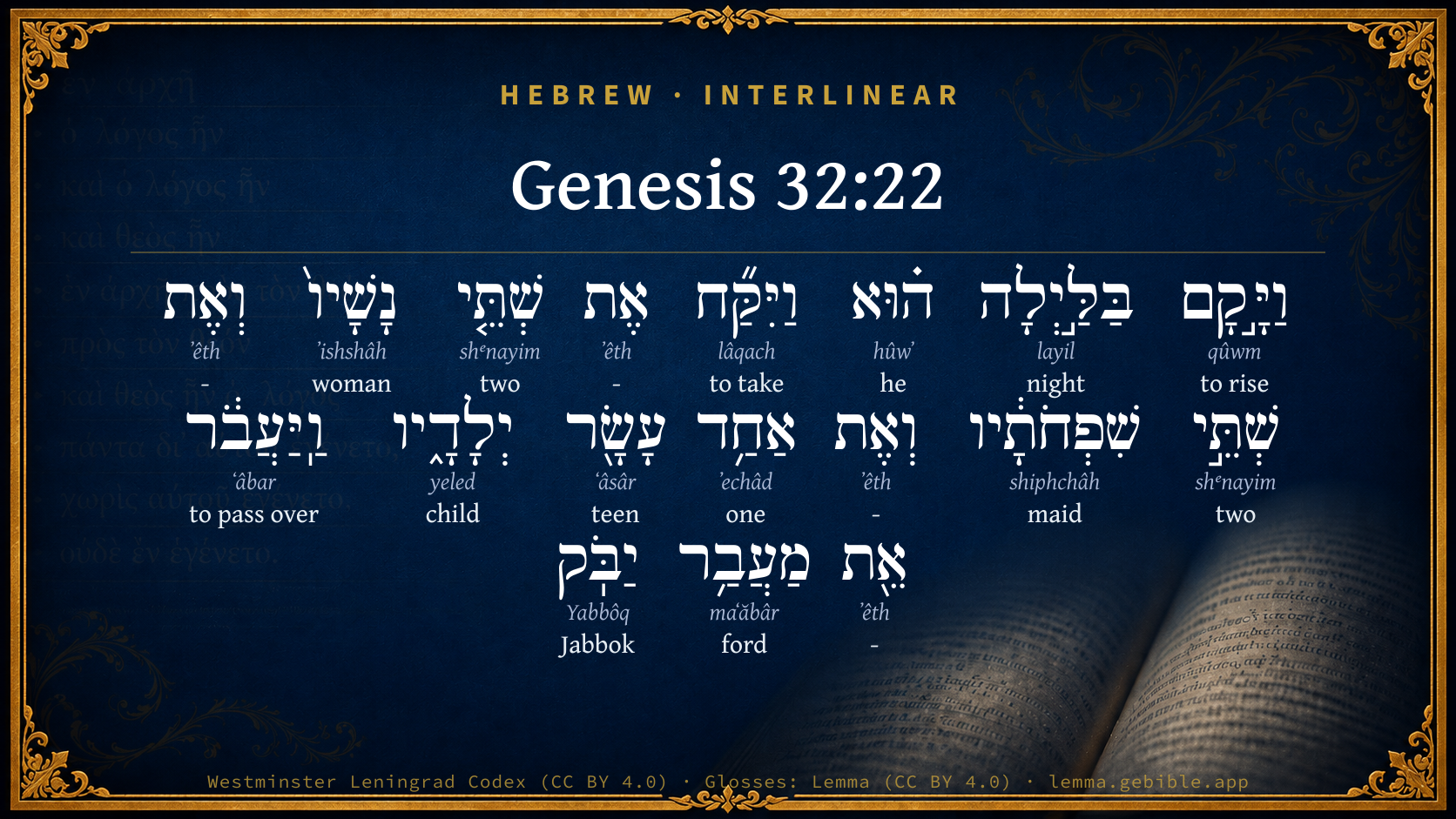
Hebrew (Westminster Leningrad Codex) Genesis 32:22 appears in the Hebrew Old Testament. The text above is from the Westminster Leningrad Codex. Each word links to its Strong’s number, a concise gloss, and parsing drawn from the Open Scriptures Hebrew Bible morphology. Click any word for its full Brown-Driver-Briggs (BDB) entry.
Download image
Cite this verse

Genesis 32:22 (World English Bible). Public Domain. Lemma interlinear Bible study tool, https://lemma.gebible.app/v/genesis/32/22.

Show BibTeX & RIS
BibTeX
RIS
English Translation
He rose up that night, and took his two wives, and his two handmaids, and his eleven sons, and passed over the ford of the Jabbok.
World English Bible · Public Domain
Highlights
  • 2 first appearances in the Hebrew Bible
Full analysis ↓
Download a study sheet

One document with this verse’s original text, its word-by-word gloss line, the meaning frame, cross-references with their text, attributed commentary, and full source and license credits — printable, and it pastes into notes with its structure intact.

This verse Autodidact and up

Study sheet (.html) Plain text (.txt)

A passage Seminary Student

Up to 50 verses in one chapter. A passage sheet keeps up to 6 commentary sources and 12 cross-references per verse, in the order this page ranks them, and says so on the sheet whenever that leaves anything out. Ask for a single verse and you get the Autodidact verse sheet above.

Everything on this page stays free to read, with no account — the sheet is a download of what is already on screen, not access to it.

Want to remove ads? Support Godless Engineer
Compare translations 3

The same verse in 3 English versions, stacked beneath the original-language interlinear above. Click any original word for its lexicon entry.

Each is an independent rendering of the whole verse — the interlinear is not word-aligned to these translations.

Highlighted words mark where these versions differ — a whole-verse word diff, not a word-by-word alignment.

  • World English Bible Public Domain
    He rose up that night, and took his two wives, and his two handmaids, and his eleven sons, and passed over the ford of the Jabbok.
  • King James Version Public Domain
    And he rose up that night, and took his two wives, and his two womenservants, and his eleven sons, and passed over the ford Jabbok.
  • unfoldingWord Literal Text CC BY-SA 4.0
    Then during that night he got up and took his two wives and his two maidservants and his eleven sons and crossed over the ford of the Jabbok.

unfoldingWord Literal Text — © unfoldingWord, licensed CC BY-SA 4.0. Word-aligned USFM3 via Door43 (git.door43.org/unfoldingWord/en_ult).

Versions to compare (up to 4)

3 of 4 selected

Show all 18 translations

Every available English version of this verse, each an independent rendering of the whole verse.

  • World English Bible Public Domain
    He rose up that night, and took his two wives, and his two handmaids, and his eleven sons, and passed over the ford of the Jabbok.
  • Berean Standard Bible Public Domain
    During the night Jacob got up and took his two wives, his two maidservants, and his eleven sons, and crossed the ford of the Jabbok.
  • Majority Standard Bible Public Domain
    During the night Jacob got up and took his two wives, his two maidservants, and his eleven sons, and crossed the ford of the Jabbok.
  • King James Version Public Domain
    And he rose up that night, and took his two wives, and his two womenservants, and his eleven sons, and passed over the ford Jabbok.
  • American Standard Version (1901) Public Domain
    And he rose up that night, and took his two wives, and his two handmaids, and his eleven children, and passed over the ford of the Jabbok.
  • Revised Version (1885) Public Domain
    And he rose up that night, and took his two wives, and his two handmaids, and his eleven children, and passed over the ford of Jabbok.
  • Geneva Bible (1599) Public Domain
    And he rose vp the same night, and tooke his two wiues, and his two maides, and his eleuen children, and went ouer the forde Iabbok.
  • Douay-Rheims (1899) Public Domain
    And rising early he took his two wives, and his two handmaids, with his eleven sons, and passed over the ford of Jaboc.
  • Young's Literal Translation Public Domain
    And he riseth in that night, and taketh his two wives, and his two maid-servants, and his eleven children, and passeth over the passage of Jabbok;
  • Literal Standard Version CC BY-SA 4.0
    And he rises in that night, and takes his two wives, and his two maidservants, and his eleven children, and passes over the passage of Jabbok;
  • Unlocked Literal Bible CC BY-SA 4.0
    Jacob got up during the night, and he took his two wives, his two women servants, and his eleven sons. He sent them across the ford of the Jabbok.
  • unfoldingWord Literal Text CC BY-SA 4.0
    Then during that night he got up and took his two wives and his two maidservants and his eleven sons and crossed over the ford of the Jabbok.
  • Darby Bible Public Domain
    And he rose up that night, and took his two wives, and his two maidservants, and his eleven sons, and passed over the ford of the Jabbok;
  • World Messianic Bible Public Domain
    He rose up that night, and took his two wives, and his two servants, and his eleven sons, and crossed over the ford of the Jabbok.
  • Webster's Bible Public Domain
    And he arose that night, and took his two wives, and his two women-servants, and his eleven sons, and passed over the ford Jabbok.
  • Free Bible Version CC BY-SA 4.0
    He got up during the night and took his two wives and the two personal maids and his eleven sons and crossed the Jabbok River at the ford.
  • Bible in Basic English Public Domain
    And in the night he got up, and taking with him his two wives and the two servant-women and his eleven children, he went over the river Jabbok.
  • JPS Tanakh (1917) Public Domain
    (32-23) And he rose up that night, and took his two wives, and his two handmaids, and his eleven children, and passed over the ford of the Jabbok.

Literal Standard Version (2020), Covenant Press — licensed CC BY-SA 4.0. Text via the HelloAO Bible API (eBible.org). Unlocked Literal Bible (unfoldingWord) — licensed CC BY-SA 4.0. Text via the HelloAO Bible API (eBible.org). unfoldingWord Literal Text — © unfoldingWord, licensed CC BY-SA 4.0. Word-aligned USFM3 via Door43 (git.door43.org/unfoldingWord/en_ult). Free Bible Version, Dr. Jonathan Gallagher — licensed CC BY-SA 4.0. Text via the HelloAO Bible API (eBible.org).

Word by word

More ways to search: Search by grammar → Find every occurrence → Compare this word →

Practice this passage: Drill this verse → Learn its vocabulary →

יַבֹּֽק
Yabbôq
H2999
“Jabbok”
Noun, Proper
Part of Speech
Noun
Type
Proper
Full BDB Definition

Origin: probably from H1238

TWOT: None

Jabbok = "emptying" - a stream which intersects the mountain range of Gilead, and falls into the Jordan on the east about midway between the Sea of Galilee and the Dead Sea
  1. וַיָּ֣קָם qûwm H6965 “and · to rise” Conjunction + Verb, Qal, Sequential Imperfect, 3rd Person, Masculine, Singular
  2. בַּלַּ֣יְלָה layil H3915 “in/at the · night” Preposition, Determined + Noun, Common, Masculine, Singular, Absolute
  3. ה֗וּא hûwʼ H1931 “he” Pronoun, Personal, 3rd Person, Masculine, Singular
  4. וַיִּקַּ֞ח lâqach H3947 “and · to take” Conjunction + Verb, Qal, Sequential Imperfect, 3rd Person, Masculine, Singular
  5. אֶת ʼêth H853 “-” Particle, Direct Object
  6. שְׁתֵּ֤י shᵉnayim H8147 “two” Adjective, Cardinal number, Feminine, Dual, Construct
  7. נָשָׁיו֙ ʼishshâh H802 “women · his” Noun, Common, Feminine, Plural, Construct + Suffix, Personal, 3rd Person, Masculine, Singular
  8. וְאֶת ʼêth H853 “and · -” Conjunction + Particle, Direct Object
  9. שְׁתֵּ֣י shᵉnayim H8147 “two” Adjective, Cardinal number, Feminine, Dual, Construct
  10. שִׁפְחֹתָ֔יו shiphchâh H8198 “maids · his” Noun, Common, Feminine, Plural, Construct + Suffix, Personal, 3rd Person, Masculine, Singular
  11. וְאֶת ʼêth H853 “and · -” Conjunction + Particle, Direct Object
  12. אַחַ֥ד ʼechâd H259 “one” Adjective, Cardinal number, Masculine, Singular, Absolute
  13. עָשָׂ֖ר ʻâsâr H6240 “teen” Adjective, Cardinal number, Masculine, Singular, Absolute
  14. יְלָדָ֑יו yeled H3206 “children · his” Noun, Common, Masculine, Plural, Construct + Suffix, Personal, 3rd Person, Masculine, Singular
  15. וַֽיַּעֲבֹ֔ר ʻâbar H5674 “and · to pass over” Conjunction + Verb, Qal, Sequential Imperfect, 3rd Person, Masculine, Singular
  16. אֵ֖ת ʼêth H853 “-” Particle, Direct Object
  17. מַעֲבַ֥ר maʻăbâr H4569 “ford of” Noun, Common, Masculine, Singular, Construct

About this verse

These counts appear in no published source. They are computed here, from the morphology-tagged text and Lemma’s own curated glosses. What Lemma adds →

18
words
14
distinct lemmas
Pentateuch
section

Notable vocabulary

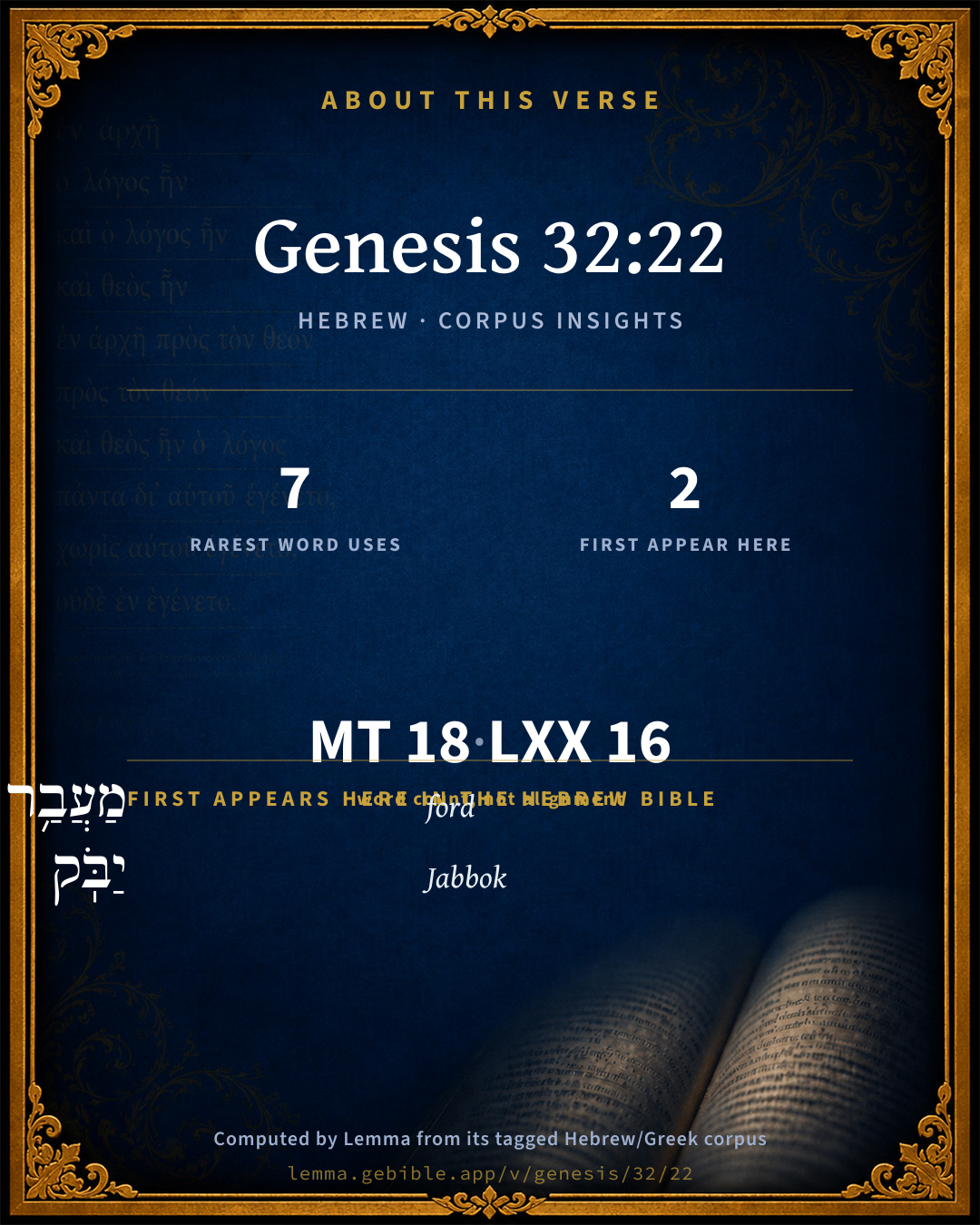
The rarest word here is יַבֹּֽק Jabbok H2999 — appearing just 7 times in the whole Hebrew Bible.

First appearance in Scripture

These words make their first canonical appearance in the Hebrew Bible here:

  • מַעֲבַ֥ר ford H4569
  • יַבֹּֽק Jabbok H2999

Shared distinctive vocabulary

יַבֹּֽק Jabbok H2999 occurs in 7 verses of the Hebrew Bible. Also found in:

Grammatical profile

  • 3 verbs
  • 6 nouns
  • 4 adjectives
  • 1 pronoun
  • 4 particles

Verb forms

  • וַיָּ֣קָם Qal · Sequential Imperfect
  • וַיִּקַּ֞ח Qal · Sequential Imperfect
  • וַֽיַּעֲבֹ֔ר Qal · Sequential Imperfect

Repetition

A word recurs within this verse — often emphatic in Hebrew:

  • שְׁתֵּ֤י two H8147 ×2

Hebrew & Septuagint length

In English translation the verse runs 26 words from the Hebrew and 27 from the Septuagint (LXX English) — closely comparable.

A rough comparison of the two English renderings, which tokenize alike — not a word-level alignment.

Word counts can differ between the Hebrew and the Greek without any difference in meaning — e.g. the Hebrew direct-object marker אֵת has no separate Greek word, and Greek often adds the article ὁ.

In the original languages it is 18 Hebrew tokens and 16 Greek tokens — but the two are counted differently (Hebrew bundles its prefixes and suffixes into one token; the Greek is in lemma form), so that isn’t a like-for-like length.

Cross-references

7

Topical passages linked to Genesis 32:22 in the Treasury of Scripture Knowledge — connected by theme and wording, ordered by reader-vote popularity; previews shown in the World English Bible.

  • Deuteronomy 3:16 To the Reubenites and to the Gadites I gave from Gilead even to the valley of the Arnon, the middle of the valley, and the border [of it], even to the river Jabbok, which is the border of the children of Ammon;
  • Deuteronomy 2:37 only to the land of the children of Ammon you didn't come near; all the side of the river Jabbok, and the cities of the hill-country, and wherever Yahweh our God forbade us.
  • Joshua 12:2 Sihon king of the Amorites, who lived in Heshbon, and ruled from Aroer, which is on the edge of the valley of the Arnon, and [the city that is in] the middle of the valley, and half Gilead, even to the river Jabbok, the border of the children of Ammon;
  • 1 Timothy 5:8 But if anyone doesn't provide for his own, and especially his own household, he has denied the faith, and is worse than an unbeliever.
  • Genesis 35:22–26 It happened, while Israel lived in that land, that Reuben went and lay with Bilhah, his father's concubine, and Israel heard of it. Now the sons of Jacob were twelve.
  • Genesis 35:18 It happened, as her soul was departing (for she died), that she named him Ben-oni, but his father named him Benjamin.
  • Genesis 29:21–30:24 Jacob said to Laban, "Give me my wife, for my days are fulfilled, that I may go in to her."

Cross-references courtesy of OpenBible.info (CC BY 4.0).

Hebrew and Greek witnesses Masoretic Hebrew ↔ Greek Septuagint

The same verse in the two great witnesses to the Old Testament, shown verse-for-verse.

These are two independent witnesses, not word-aligned to each other, and the Septuagint is shown in lemma (dictionary) form.

Hebrew Genesis 32:22 Masoretic · Westminster Leningrad Codex

וַיָּ֣קָם בַּלַּ֣יְלָה ה֗וּא וַיִּקַּ֞ח אֶת שְׁתֵּ֤י נָשָׁיו֙ וְאֶת שְׁתֵּ֣י שִׁפְחֹתָ֔יו וְאֶת אַחַ֥ד עָשָׂ֖ר יְלָדָ֑יו וַֽיַּעֲבֹ֔ר אֵ֖ת מַעֲבַ֥ר יַבֹּֽק

He rose up that night, and took his two wives, and his two handmaids, and his eleven sons, and passed over the ford of the Jabbok.

World English Bible · Public Domain

Greek LXX Genesis 32:22 Septuagint · lemma form

καί παραπορεύομαι ὁ δῶρον κατά πρόσωπον αὐτός αὐτός δέ κοιμάω ὁ νύξ ἐκεῖνος ἐν ὁ παρεμβολή

And he rose up in that night, and took his two wives and his two servant-maids, and his eleven children, and crossed over the ford of Jaboch.

LXX2012 (modern English Septuagint) · Public Domain

Hebrew: Westminster Leningrad Codex (CC BY 4.0). Greek: Septuagint (public domain); English from LXX2012 (modern English Septuagint) (Public Domain). How the Septuagint differs from the Hebrew →

Targum (Aramaic paraphrase)

2

The Targum is the ancient Jewish Aramaic paraphrase of the Hebrew Scriptures — an interpretive translation, not the Hebrew text itself. Onkelos (literal) and Pseudo-Jonathan (expansive) render the Torah, and Jonathan the Prophets. Coverage is partial: where no permissively-licensed English translation exists for a verse, only the Aramaic is shown. This is verse-level text, not a word-by-word alignment to the Hebrew.

  1. Targum Onkelos Torah (Genesis–Deuteronomy)
    וַעֲבָרַת תִּקְרֻבְתָּא עַל אַפּוֹהִי וְהוּא בָת בְּלֵילְיָא הַהוּא בְּמַשְׁרִיתָא

    (no public-domain English translation for this verse)

    Targum Onkelos — Aramaic: “Onkelos Genesis” (public domain); “Onkelos Exodus” (public domain); “Onkelos Leviticus” (public domain); “Onkelos Numbers” (public domain); “Onkelos Deuteronomy” (public domain). English: “Sefaria Community Translation” (CC0 1.0 (public-domain dedication)); “J.W. Etheridge. The Targums of Onkelos and Jonathan Ben Uzziel on the Pentateuch. London: Longmans, Green, 1862” (public domain). Text via Sefaria.

  2. Targum Pseudo-Jonathan Torah (Genesis–Deuteronomy)
    וַעֲבָרַת דוֹרוֹנָא עַל אַנְפּוֹהִי וְהוּא בָּת בְּלֵילְיָא הַהוּא בְּמַשְׁרִיתָא

    And the present passed over before him, and he abode that night in the camp.

    Targum Pseudo-Jonathan — Aramaic: “Targum Jonathan on Genesis” (public domain); “Targum Jonathan on Exodus” (public domain); “Targum Jonathan on Leviticus” (public domain); “Targum Jonathan on Numbers” (public domain); “Targum Jonathan on Deuteronomy” (public domain). English: “The Targum of Jonathan ben Uzziel, trans. J. W. Etheridge, London, 1862” (public domain). Text via Sefaria.

Commentary

Notes on Genesis 32:22 from classic Christian and Jewish commentators (each source and its license shown beneath its notes). The classic Christian expositions comment on the surrounding passage and are grouped to its opening verse, so a note may address several verses; the Jewish commentaries on the Tanakh (Rashi and others) are per-verse, so they appear only where the commentator wrote on this verse.

Lemma curates 59 commentaries, every one of them public domain or Creative Commons licensed, each selected and text-cleaned for this edition rather than reprinted as found. About our sources →

The Cambridge Bible for Schools and Colleges

gen. ed. J. J. S. Perowne

22. the ford of Jabbok] This river, the modern Zerka, is a tributary of the Jordan on its eastern bank. The narrative does not state on which bank of the Jabbok the angel appeared to Jacob. According to Gen_32:22 Jacob had crossed the stream; according to Gen_32:23 he had not. If, as seems probable, Gen_32:24-32 follow Gen_32:22 and belong to J (Gen_32:23 belonging to the E narrative), Jacob met the angel on the S. bank of the Jabbok.

22–32. Jacob’s Wrestling with the Angel

This passage forms the climax of Jacob’s history. It records the occasion on which his name is changed to Israel, and describes his personal meeting with the Divine Being, whose blessing he obtains. The religious significance of the story turns upon (1) the sudden mysterious wrestling by night; (2) Jacob’s persistence in his demand for a blessing; (3) the blessing given, and symbolized by the new name, Israel; (4) the physical disability, a memorial of acceptance and spiritual victory, and a symbol of the frailty of earthly strength, in the crisis of life, when God meets man face to face. See the hymn “Come, O thou Traveller unknown” (Chas. Wesley).

The Cambridge Bible for Schools and Colleges (gen. ed. J. J. S. Perowne; Cambridge University Press, 1878–1918) — public domain. Text from a community e-Sword module.

Trapp's Complete Commentary

John Trapp

Gen 32:22 And he rose up that night, and took his two wives, and his two womenservants, and his eleven sons, and passed over the ford Jabbok.

Ver. 22. And his eleven sons.] Together with his only daughter Dinah: but females are not so much observed in Scripture.

John Trapp, A Commentary or Exposition upon All the Books of the Old and New Testament (1647–1656) — public domain. Text from a community e-Sword module.

Tyndale Open Study Notes

Tyndale Open Resources

32:22-32 Before Jacob returned to the land God had promised him, God met him, crippled him, and blessed him, changing his name to Israel. This episode was a significant turning point for him.

32:22-24 The Jabbok River flows westward to the Jordan Valley, dividing the region of Bashan on the north from Gilead on the south. Wordplays on Jacob’s name and character preserve the memory of this encounter. Jacob (Hebrew ya‘aqob), while at Jabbok (Hebrew yabboq), wrestled (Hebrew wayye’abeq). Through his fight with an adversary to receive the blessing, Jacob’s name would be changed, and his deceptive striving would partially give way to faith as his way of life.

Tyndale Open Study Notes — © Tyndale Open Resources, licensed CC BY-SA 4.0. Text via the HelloAO Bible API.

Jamieson, Fausset & Brown

Robert Jamieson, A. R. Fausset & David Brown

ford Jabbok--now the Zerka--a stream that rises among the mountains of Gilead, and running from east to west, enters the Jordan, about forty miles south of the Sea of Tiberias. At the ford it is ten yards wide. It is sometimes forded with difficulty; but in summer it is very shallow.

he rose up and took--Unable to sleep, Jacob waded the ford in the night time by himself; and having ascertained its safety, he returned to the north bank and sent over his family and attendants, remaining behind, to seek anew, in silent prayer, the divine blessing on the means he had set in motion.

Jamieson, Fausset & Brown — Commentary Critical and Explanatory on the Whole Bible (1871) — public domain (CC PDM 1.0). Text via the HelloAO Bible API.

Adam Clarke's Commentary

Verse 22. Passed over the ford Jabbok.] This brook or rivulet rises in the mountains of Galaad, and falls into the Jordan at the south extremity of the lake of Gennesaret.

Adam Clarke's Commentary on the Bible (1810–1826) — public domain. Text from a community e-Sword/MySword module.

John Calvin's Commentaries

22. And he rose up that night. After he has prayed to the Lord, and arranged his plans, he now takes confidence and meets the danger. By which example the faithful are taught, that whenever any danger approaches, this order of proceeding is to be observed; first, to resort directly to the Lord; secondly, to apply to immediate use whatever means of help may offer themselves; and thirdly, as persons prepared for any event, to proceed with intrepidity whithersoever the Lord commands. So Jacob, that he might not fail in this particular, does not dread the passage which he perceives to be full of hazard, but, as with closed eyes, pursues his course. Therefore, after his example, we must overcome anxiety in intricate affairs, lest we should be hindered or retarded in our duty. He remains alone, — having sent forward his wives and children, — not that he might himself escape if he heard of their destruction, but because solitude was more suitable for prayer. And there is no doubt that, fearing the extremity of his peril, he was completely carried away with the ardor of supplication to God.

John Calvin's Commentaries (1540-1563) — public domain. Text from the Calvin Translation Society English edition (1840s-50s) via the Christian Classics Ethereal Library (ccel.org). Calvin's coverage is partial (roughly two-thirds of the Bible); uncommented books and verses are honest gaps, never fabricated. The 19th-century editor's footnotes and remarks are omitted so the notes are faithfully Calvin's own voice.

Ellicott's Commentary for English Readers

(22) The ford Jabbok.—Heb., the ford of the Jabbok. This river, now called the Wady Zerba or Blue Torrent, formed afterwards the boundary between the tribes of Manasseh and Gad. It flows through a deep ravine, with so rapid a current as to make the crossing of it a matter of difficulty. Dr. Tristram (Land of Israel, p. 558) says that the water reached his horse’s girths when he rode through the ford.

A Bible Commentary for English Readers, edited by Charles John Ellicott (1878–1897) — public domain. Text from a community e-Sword module.

John Gill's Exposition

And he rose up that night,.... In the middle of it, for it was long before break of day, as appears from Gen 32:24,

and took his two wives, Rachel and Leah:

and his two womenservants, Bilhah and Zilpah, or, "his two concubines", as the Targums of Onkelos and Jonathan; which distinguishes them from other womenservants or maidservants, of which, no doubt, he had many:

and his eleven sons; together with Dinah his daughter, though not mentioned, being the only female child, and a little one:

and passed over the ford Jabbok; over that river, at a place of it where it was fordable, or where there was a ford or passage: this was a river that took its rise from the mountains of Arabia, was the border of the Ammonites, washed the city Rabba, and ran between Philadelphia and Gerasa, and came into the river Jordan, at some little distance from the sea of Gennesaret or Galilee (d), about three or four miles from it.

(d) Hieron, de loc. Heb. fol. 92. f. Adrichom, Theatrum Terrae, S. p. 32.

John Gill's Exposition of the Whole Bible (1746–1763) — public domain (CC PDM 1.0). Text via the HelloAO Bible API.

Haydock's Catholic Bible Commentary

Sons, with Dina his daughter, and all his household.

George Leo Haydock (1774–1849), Haydock's Catholic Family Bible and Commentary, 1859 edition — public domain. Excludes Psalms (Douay-Rheims chapter numbering differs from Protestant) and Deuterocanonical books (Catholic canon only).

Matthew Poole's English Annotations

His eleven sons, and Dinah, though she be not here mentioned; as the women are oft omitted in Scripture, was being comprehended under the men.

Passed over the ford Jabbok, which is here generally related, but the time and manner of it is particularly described in the following verses. Of this ford Jabbok, see Num 21:24; Deu 3:16.

Matthew Poole's English Annotations on the Holy Bible (1683–1685) — public domain. Text from a community e-Sword/MySword module.

Whedon's Commentary on the Bible

Daniel D. Whedon

22. The ford Jabbok — Or, the crossing place of the Jabbok. This stream is believed to be identical with the modern Wady Zerka, which runs north of Mount Jelad, and empties into the Jordan directly east of Shechem.

Daniel D. Whedon (gen. ed.), Commentary on the Old and New Testaments (1874–1909) — public domain. Text from a community e-Sword module.

unfoldingWord translationNotes

Door43 World Missions Community

his two women servants

"his two servant wives." This means Zilpah and Bilhah.

ford

a shallow place in a river that is easy to cross

Jabbok

This is the name of a river. (See: How to Translate Names)

all his possessions

"all that he had"

translationWords

servant

possess

unfoldingWord translationNotes — © Distant Shores Media and the Door43 World Missions Community, licensed CC BY-SA 4.0. Source: git.door43.org/Door43/en_tn.

Rashi

Rabbi Shlomo Yitzchaki (Rashi)

The Midrash connects the word פניו in על פניו with פנים anger — he (Jacob) was also in an angry mood that it should be necessary for him to do all this (Genesis Rabbah 76:8).

Rashi on the Tanakh — English translations: “The Judaica Press complete Tanach with Rashi, translated by A. J. Rosenberg” (CC BY 4.0); “Pentateuch with Rashi's commentary by M. Rosenbaum and A.M. Silbermann, 1929-1934” (public domain); “The Metsudah Tanach series, Lakewood, N.J” (CC BY 4.0); and “The Book of Joshua, Metsudah Publications, 1997” (CC BY 4.0). Text via Sefaria.

Ramban (Nachmanides)

Rabbi Moshe ben Nachman (Ramban / Nachmanides)

AND HE HIMSELF LODGED THAT NIGHT IN THE CAMP. Scripture states that he did not enter his tent that night but lodged in the camp together with his servants and the shepherds of the flocks, set in array, as a man for war, lest his brother come at night and attack him.

Ramban (Nachmanides) on the Tanakh — English translation: “Commentary on the Torah by Ramban (Nachmanides). Translated and annotated by Charles B. Chavel. New York, Shilo Pub. House, 1971-1976” (CC BY 4.0). Text via Sefaria.

Radak

Rabbi David Kimhi (Radak)

ותעבור המנחה על פניו, the words על פניו are equivalent to לפניו, “ahead of him, past him.” We encounter this expression in Samuel II 15,18 עוברים על פני המלך, “marching past the king.” According to Bereshit Rabbah 76,8 the words על פניו mean “under pressure.” In other words, the entire stratagem reflected Yaakov’s dire straits at the time.

והא לן בלילה ההוא במחנה. He spent the night with the people of his encampment as he was not walking behind the herds he had sent ahead.

Radak on the Tanakh — English translations: “Sefaria Community Translation” (CC0 1.0 (public-domain dedication)); “Eliyahu Munk, HaChut Hameshulash” (CC BY 4.0); “Rabbi Mike Feuer, Jerusalem Anthology” (CC BY 4.0); and “R. David Kimhi on the first book of Psalms, Translated by R.G. Finch, London, 1919” (public domain). Text via Sefaria.

Lesson kit

Teaching starters — assembled from the data on this page, not authored interpretation. Every prompt links to the verse data it draws on. Edit before teaching.

Genesis, in the Pentateuch, opens this verse with 18 words (14 distinct Hebrew lemmas). Its most distinctive word is Yabbôq (“Jabbok”). A historical commentator’s framing appears above. Read the whole chapter for the surrounding context.

Discussion questions

  1. What does “Jabbok” (Yabbôq) contribute to the verse as a whole?
  2. 2 words make their first appearance in Scripture here. What does this debut establish?
  3. How does Numbers 21:24, which shares the word «Jabbok», read alongside this verse?
  4. What does the repetition of “two” (2× in this one verse) do in this verse?
  5. These translations render this verse differently. What is at stake in choosing one wording over another?
  6. «וַיָּ֣קָם» is a Qal Sequential Imperfect verb. How does that grammatical form shape the action described?
  7. Compare how The Cambridge Bible for Schools and Colleges and Trapp's Complete Commentary read this verse. Where do they agree or differ?

Things to notice

Reading settings

Reading text

Shown beneath each verse's original-language words.

Old Testament
Old Testament edition

Read the OT as the Masoretic Hebrew (MT) or the Greek Septuagint (LXX).

English shown for the Greek Septuagint (in the Hebrew ↔ Greek comparison).

Comparing translations? Open the Compare panel on any verse page to stack up to four side by side.