
John 20:15

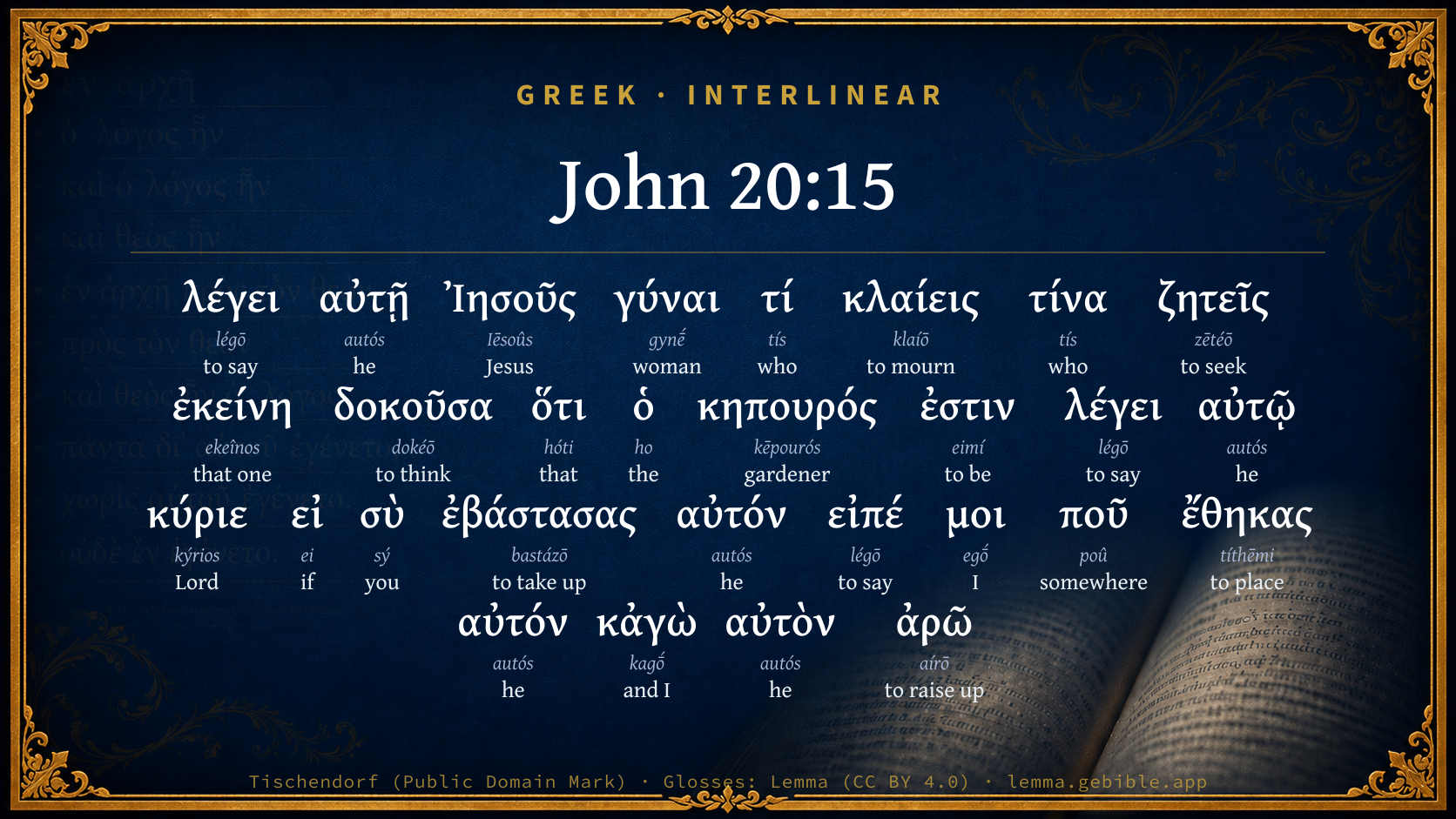
Greek (Tischendorf 8th ed.) John 20:15 appears in the Greek New Testament. The text above is from the Tischendorf 8th edition. Each word links to its Strong’s number and a concise gloss. Click any word for its full Thayer’s Greek Lexicon entry.
Download image
Cite this verse

John 20:15 (World English Bible). Public Domain. Lemma interlinear Bible study tool, https://lemma.gebible.app/v/john/20/15.

Show BibTeX & RIS
BibTeX
RIS
English Translation
Jesus said to her, "Woman, why are you weeping? Who are you looking for?" She, supposing him to be the gardener, said to him, "Sir, if you have carried him away, tell me where you have laid him, and I will take him away."
World English Bible · Public Domain
Highlights
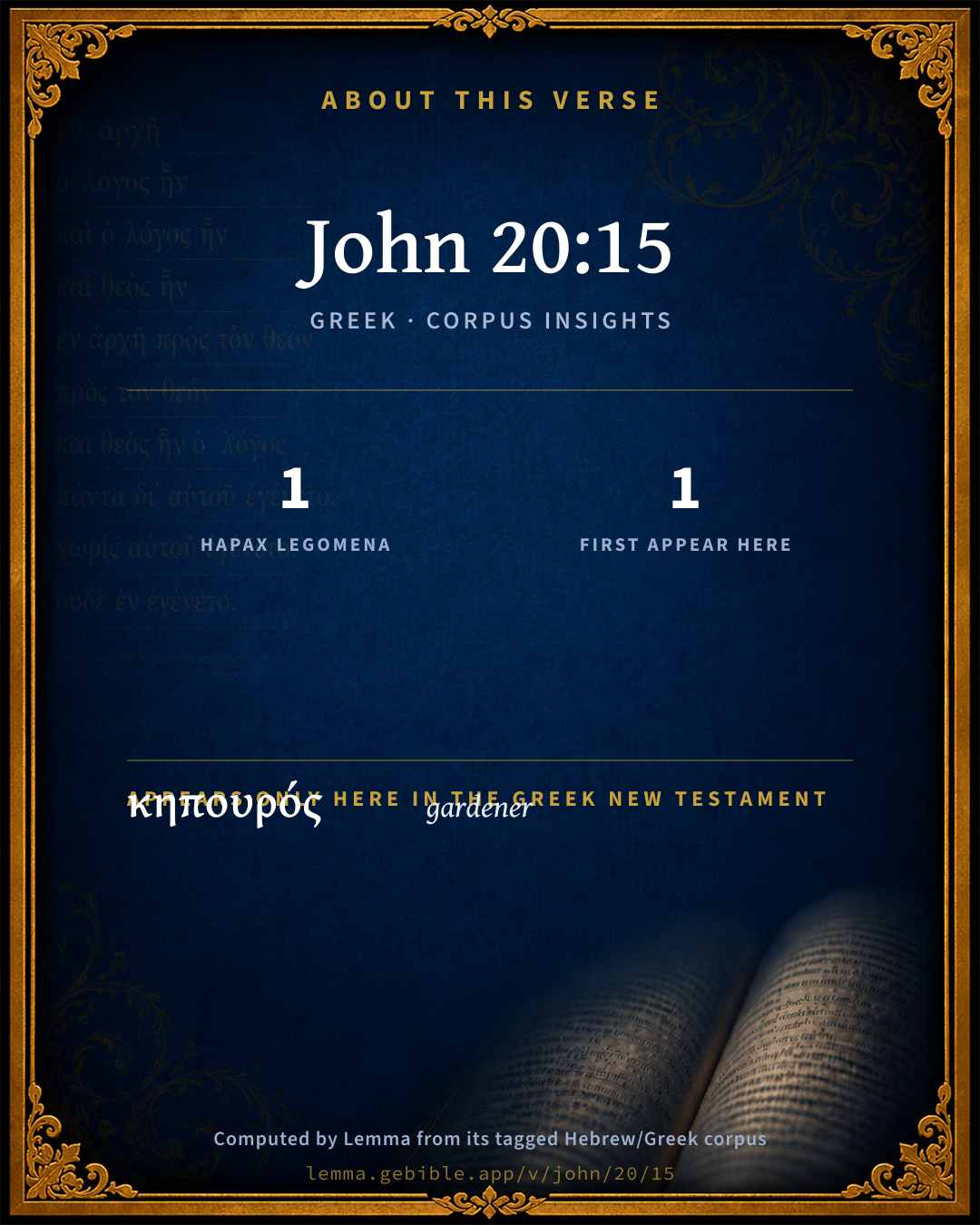
  • 1 hapax legomenon — only here in the Greek New Testament
  • 1 first appearance in the Greek New Testament
Full analysis ↓
Download a study sheet

One document with this verse’s original text, its word-by-word gloss line, the meaning frame, cross-references with their text, attributed commentary, and full source and license credits — printable, and it pastes into notes with its structure intact.

This verse Autodidact and up

Study sheet (.html) Plain text (.txt)

A passage Seminary Student

Up to 50 verses in one chapter. A passage sheet keeps up to 6 commentary sources and 12 cross-references per verse, in the order this page ranks them, and says so on the sheet whenever that leaves anything out. Ask for a single verse and you get the Autodidact verse sheet above.

Everything on this page stays free to read, with no account — the sheet is a download of what is already on screen, not access to it.

Want to remove ads? Support Godless Engineer
Compare translations 3

The same verse in 3 English versions, stacked beneath the original-language interlinear above. Click any original word for its lexicon entry.

Each is an independent rendering of the whole verse — the interlinear is not word-aligned to these translations.

Highlighted words mark where these versions differ — a whole-verse word diff, not a word-by-word alignment.

  • World English Bible Public Domain
    Jesus said to her, "Woman, why are you weeping? Who are you looking for?" She, supposing him to be the gardener, said to him, "Sir, if you have carried him away, tell me where you have laid him, and I will take him away."
  • King James Version Public Domain
    Jesus saith unto her, Woman, why weepest thou? whom seekest thou? She, supposing him to be the gardener, saith unto him, Sir, if thou have borne him hence, tell me where thou hast laid him, and I will take him away.
  • unfoldingWord Literal Text CC BY-SA 4.0
    Jesus says to her, “Woman, why are you weeping? Whom are you seeking?” She, thinking that he is the gardener, says to him, “Sir, if you carried him away, tell me where you put him, and I will take him away.”

unfoldingWord Literal Text — © unfoldingWord, licensed CC BY-SA 4.0. Word-aligned USFM3 via Door43 (git.door43.org/unfoldingWord/en_ult).

Versions to compare (up to 4)

3 of 4 selected

Show all 19 translations

Every available English version of this verse, each an independent rendering of the whole verse.

  • World English Bible Public Domain
    Jesus said to her, "Woman, why are you weeping? Who are you looking for?" She, supposing him to be the gardener, said to him, "Sir, if you have carried him away, tell me where you have laid him, and I will take him away."
  • Berean Standard Bible Public Domain
    “Woman, why are you weeping?” Jesus asked. “Whom are you seeking?” Thinking He was the gardener, she said, “Sir, if you have carried Him off, tell me where you have put Him, and I will get Him.”
  • Majority Standard Bible Public Domain
    “Woman, why are you weeping?” Jesus asked. “Whom are you seeking?” Thinking He was the gardener, she said, “Sir, if you have carried Him off, tell me where you have put Him, and I will get Him.”
  • King James Version Public Domain
    Jesus saith unto her, Woman, why weepest thou? whom seekest thou? She, supposing him to be the gardener, saith unto him, Sir, if thou have borne him hence, tell me where thou hast laid him, and I will take him away.
  • American Standard Version (1901) Public Domain
    Jesus saith unto her, Woman, why weepest thou? whom seekest thou? She, supposing him to be the gardener, saith unto him, Sir, if thou hast borne him hence, tell me where thou hast laid him, and I will take him away.
  • Revised Version (1885) Public Domain
    Jesus saith unto her, Woman, why weepest thou? whom seekest thou? She, supposing him to be the gardener, saith unto him, Sir, if thou hast borne him hence, tell me where thou hast laid him, and I will take him away.
  • Geneva Bible (1599) Public Domain
    Iesus saith vnto her, Woman, why weepest thou? whom seekest thou? She supposing that he had bene the gardener, said vnto him, Sir, if thou hast borne him hence, tell me where thou hast laid him, and I will take him away.
  • Douay-Rheims (1899) Public Domain
    Jesus saith to her: Woman, why weepest thou whom seekest thou She, thinking it was the gardener, saith to him: Sir, if thou hast taken him hence, tell me where thou hast laid him, and I will take him away.
  • Young's Literal Translation Public Domain
    Jesus saith to her, `Woman, why dost thou weep? whom dost thou seek;' she, supposing that he is the gardener, saith to him, `Sir, if thou didst carry him away, tell me where thou didst lay him, and I will take him away;'
  • Literal Standard Version CC BY-SA 4.0
    Jesus says to her, “Woman, why do you weep? Whom do you seek?” She, supposing that He is the gardener, says to Him, “Lord, if You carried Him away, tell me where You laid Him, and I will take Him away”;
  • Unlocked Literal Bible CC BY-SA 4.0
    Jesus said to her, “Woman, why are you weeping? Whom are you looking for?” She thought that he was the gardener, so she said to him, “Sir, if you have taken him away, tell me where you have put him, and I will take him away.”
  • unfoldingWord Literal Text CC BY-SA 4.0
    Jesus says to her, “Woman, why are you weeping? Whom are you seeking?” She, thinking that he is the gardener, says to him, “Sir, if you carried him away, tell me where you put him, and I will take him away.”
  • Darby Bible Public Domain
    Jesus says to her, Woman, why dost thou weep? Whom seekest thou? She, supposing that it was the gardener, says to him, Sir, if thou hast borne him hence, tell me where thou hast laid him, and I will take him away.
  • World Messianic Bible Public Domain
    Yeshua said to her, “Woman, why are you weeping? Who are you looking for?” She, supposing him to be the gardener, said to him, “Sir, if you have carried him away, tell me where you have laid him, and I will take him away.”
  • Webster's Bible Public Domain
    Jesus saith to her, Woman, why weepest thou? whom seekest thou? She, supposing him to be the gardener, saith to him, Sir, if thou hast borne him hence, tell me where thou hast laid him, and I will take him away.
  • Free Bible Version CC BY-SA 4.0
    “Why are you crying?” he asked her. “Who are you looking for?” Assuming he was the gardener, she said to him, “Sir, if you've taken him away, tell me where you've put him so I can go and get him.”
  • Bible in Basic English Public Domain
    Jesus said to her, Woman, why are you weeping? who are you looking for? She, taking him for the gardener, said to him, Sir, if you have taken him away from here, say where you have put him and I will take him away.
  • Text-Critical English NT CC BY 4.0
    Jesus said to her, “Woman, why are yoʋ weeping? Who are yoʋ looking for?” Supposing that he was the gardener, she said to him, “Sir, if yoʋ have carried him away, tell me where yoʋ have laid him, and I will take him away.”
  • Tyndale New Testament (1534) Public Domain
    Iesus sayde vnto her: woman why wepest thou? Whom sekest thou? She supposynge that he had bene the gardener sayde vnto him. Syr yf thou have borne him hence tell me where thou hast layde him that I maye fet him.

Literal Standard Version (2020), Covenant Press — licensed CC BY-SA 4.0. Text via the HelloAO Bible API (eBible.org). Unlocked Literal Bible (unfoldingWord) — licensed CC BY-SA 4.0. Text via the HelloAO Bible API (eBible.org). unfoldingWord Literal Text — © unfoldingWord, licensed CC BY-SA 4.0. Word-aligned USFM3 via Door43 (git.door43.org/unfoldingWord/en_ult). Free Bible Version, Dr. Jonathan Gallagher — licensed CC BY-SA 4.0. Text via the HelloAO Bible API (eBible.org).

Word by word

More ways to search: Search by grammar → Find every occurrence → Compare this word →

Practice this passage: Drill this verse → Learn its vocabulary →

κηπουρός
kēpourós
G2780
“gardener”
Noun, Nominative, Singular, Masculine
Part of Speech
Noun
Case
Nominative
Number
Singular
Gender
Masculine
Full Thayer's Definition

Origin: from G2779 and ouros (a warden)

TDNT: None

1. a keeper of a garden, a gardener
  1. λέγει légō G3004 “to say” Verb, Present, Active, Indicative, 3rd person, Singular
  2. αὐτῇ autós G846 “he” Personal pronoun, Dative, Singular, Feminine
  3. Ἰησοῦς Iēsoûs G2424 “Jesus” Noun, Nominative, Singular, Masculine
  4. γύναι gynḗ G1135 “woman” Noun, Vocative, Singular, Feminine
  5. τί tís G5101 “who” Interrogative pronoun, Nominative, Singular, Neuter
  6. κλαίεις klaíō G2799 “to mourn” Verb, Present, Active, Indicative, 2nd person, Singular
  7. τίνα tís G5101 “who” Interrogative pronoun, Accusative, Singular, Masculine
  8. ζητεῖς zētéō G2212 “to seek” Verb, Present, Active, Indicative, 2nd person, Singular
  9. ἐκείνη ekeînos G1565 “that one” Demonstrative pronoun, Nominative, Singular, Feminine
  10. δοκοῦσα dokéō G1380 “to think” Verb, Present, Active, Participle, Nominative, Singular, Feminine
  11. ὅτι hóti G3754 “that” Conjunction
  12. ὁ ho G3588 “the” Article, Nominative, Singular, Masculine
  13. ἐστιν eimí G1510 “to be” Verb, Present, Active, Indicative, 3rd person, Singular
  14. λέγει légō G3004 “to say” Verb, Present, Active, Indicative, 3rd person, Singular
  15. αὐτῷ autós G846 “he” Personal pronoun, Dative, Singular, Masculine
  16. κύριε kýrios G2962 “Lord” Noun, Vocative, Singular, Masculine
  17. εἰ ei G1487 “if” Conditional
  18. σὺ sý G4771 “you” Personal pronoun, 2nd person, Nominative, Singular
  19. ἐβάστασας bastázō G941 “to take up” Verb, Aorist, Active, Indicative, 2nd person, Singular
  20. αὐτόν autós G846 “he” Personal pronoun, Accusative, Singular, Masculine
  21. εἰπέ légō G3004 “to say” Verb, Aorist, Active, Imperative, 2nd person, Singular
  22. μοι egṓ G1473 “I” Personal pronoun, 1st person, Dative, Singular
  23. ποῦ poû G4226 “somewhere” Particle, Interrogative
  24. ἔθηκας títhēmi G5087 “to place” Verb, Aorist, Active, Indicative, 2nd person, Singular
  25. αὐτόν autós G846 “he” Personal pronoun, Accusative, Singular, Masculine
  26. κἀγὼ kagṓ G2504 “and I” Personal pronoun, 1st person, Nominative, Singular, Aramaic form
  27. αὐτὸν autós G846 “he” Personal pronoun, Accusative, Singular, Masculine
  28. ἀρῶ aírō G142 “to raise up” Verb, Future, Active, Indicative, 1st person, Singular

About this verse

These counts appear in no published source. They are computed here, from the morphology-tagged text and Lemma’s own curated glosses. What Lemma adds →

29
words
22
distinct lemmas
Gospels
section

Notable vocabulary

1 hapax legomenon — a word that appears only here in the entire Greek New Testament:

  • κηπουρός gardener G2780

First appearance in Scripture

This word makes its first canonical appearance in the Greek New Testament here:

  • κηπουρός gardener G2780

Shared distinctive vocabulary

ἐβάστασας to take up G941 occurs in 27 verses of the Greek New Testament. Also found in:
Repetition

Words recur within this verse:

  • λέγει to say G3004 ×3
  • αὐτῇ he G846 ×5
  • τί who G5101 ×2

Cross-references

11

Topical passages linked to John 20:15 in the Treasury of Scripture Knowledge — connected by theme and wording, ordered by reader-vote popularity; previews shown in the World English Bible.

  • John 18:7 Again therefore he asked them, "Who are you looking for?" They said, "Jesus of Nazareth."
  • John 20:13 They told her, "Woman, why are you weeping?" She said to them, "Because they have taken away my Lord, and I don't know where they have laid him."
  • Song of Solomon 3:2 I will get up now, and go about the city; In the streets and in the squares I will seek him whom my soul loves. I sought him, but I didn't find him.
  • John 1:38 Jesus turned, and saw them following, and said to them, "What are you looking for?" They said to him, "Rabbi" (which is to say, being interpreted, Teacher), "where are you staying?"
  • 1 Samuel 1:16 Don't count your handmaid for a wicked woman; for out of the abundance of my complaint and my provocation have I spoken hitherto.
  • Matthew 28:5 The angel answered the women, "Don't be afraid, for I know that you seek Jesus, who has been crucified.
  • Mark 16:6 He said to them, "Don't be amazed. You seek Jesus, the Nazarene, who has been crucified. He has risen. He is not here. Behold, the place where they laid him!
  • John 18:4 Jesus therefore, knowing all the things that were happening to him, went forth, and said to them, "Who are you looking for?"
  • Luke 24:5 Becoming terrified, they bowed their faces down to the earth. They said to them, "Why do you seek the living among the dead?
  • Song of Solomon 6:1 Where has your beloved gone, you fairest among women? Where has your beloved turned, that we may seek him with you? Beloved
  • Matthew 12:34 You offspring of vipers, how can you, being evil, speak good things? For out of the abundance of the heart, the mouth speaks.

Cross-references courtesy of OpenBible.info (CC BY 4.0).

Commentary

Notes on John 20:15 from classic Christian and Jewish commentators (each source and its license shown beneath its notes). The classic Christian expositions comment on the surrounding passage and are grouped to its opening verse, so a note may address several verses; the Jewish commentaries on the Tanakh (Rashi and others) are per-verse, so they appear only where the commentator wrote on this verse.

Lemma curates 59 commentaries, every one of them public domain or Creative Commons licensed, each selected and text-cleaned for this edition rather than reprinted as found. About our sources →

The Cambridge Bible for Schools and Colleges

gen. ed. J. J. S. Perowne

15. the gardener] Because he was there at that early hour.

if thou have borne him hence] The omission of the name is very lifelike: she is so full of her loss that she assumes that others must know all about it. ‘Thou’ is emphatic; ‘Thou and not, as I fear, some enemy.’

I will take him away] In her loving devotion she does not measure her strength. Note that throughout it is ‘the Lord’ (Joh_20:2), ‘my Lord’ (Joh_20:13), ‘Him’ thrice (Joh_20:15), never ‘His body’ or ‘the corpse.’ His lifeless form is to her still Himself.

The Cambridge Bible for Schools and Colleges (gen. ed. J. J. S. Perowne; Cambridge University Press, 1878–1918) — public domain. Text from a community e-Sword module.

The Biblical Illustrator

Joseph S. Exell

Joh_20:15

Jesus saith unto her, Woman, why weepest thou?

The risen Christ and the Magdalene

I. HOW JESUS WAS HIDDEN FROM MARY. There are times when friends are unrecognized because of mental absorption or because of our belief that they are elsewhere, or because of a supposed moral impossibility that they should be there.

1. Mary was under the influence of unfavourable associations.

(1) She had passed the interval doubtless with the disciples occupied with preparations for the completion of the embalmment. Her thoughts, therefore, were about the tomb in which the joy of her life seemed buried, and her companions would not exert any counteracting influence. The best answer to the calumny that they invented or dreamed the Resurrection is that they were all so unprepared for it. While the Lord was with them, disease and death fleeing at His presence, they could not believe that He would die. Now that He had died they forgot all His assurances that He would live again. It is not surprising, then, if Mary, drawn into the current of their unbelief and despair, should have her vision now dimmed.

(2) In our own daily life, are we not continually drawn away into modes of thinking and feeling which operate to hide Christ from us? Modern teaching and example tend to weaken the realizing power of faith. Numbers tell us that our own wisdom and strength are sufficient to find the blessed life; that sin needs no cleansing in Christs blood, and the heart no quickening by His love. Then there is the spirit of unconfessed doubt, more deadly than antagonism to trust in Christ, and indifference, which is more deadly still. All this helps to blind the spiritual vision.

2. Closely connected was Marys false notion of Jesus. He was, despite His own promise, a dead Jesus to her. And so false thoughts of Him are largely the cause of unbelief and hatred on the one hand, and of doubt and hesitation on the other. Men are thinking of another Christ than He who came that we might have life--of the Christ as churches have often made Him--the Christ of creeds and systems, of the dead letter rather than of the living Spirit, of sect or school. And mens minds are so full of these representations that they do not know Him who is love.

3. Tears blinded Marys eyes. So may sorrow, joy, excitement, dim ours. Our mistake may differ from hers. We may mistake the gardener for Christ. All do so who put priest, church, system, &c., in the place of Christ.

II. JESUS CONVINCED AND SUBDUED MARY. He had but to turn His eye upon her, and address His gracious words to her; and then when her eyes were opened and her ears caught the sound of His voice there was no doubt or hesitation longer.

1. Here we see the marvellous personal attraction of Jesus. Again and again do we find friends and foes impressed by His aspect. In the synagogue at Nazareth; in the Temple before the accusers of the woman taken in adultery; in the garden when the soldiers fell to the ground. Is the power of His personal influence lost because He is no longer here as man with men? No; His dealings with Mary are a type of His dealings with us.

2. He manifests Himself everywhere to seeking souls. Why was Mary honoured to be the first! We might have thought His mother would have been selected, or John, or Peter. Christ blesses men not because of birth, or talent, or office, but according to the humility and earnestness with which they seek Him.

3. He revealed Himself in a personal call, and only as Mary heard and answered that call was her joy complete. And there are innumerable voices that come from Him to-day--voices of mercy or affliction; voices that waken to gratitude or melt to penitence; voices that startle in the ease of carnal security or that comfort in the hour of trouble; voices to break the stubborn heart or to revive the heart of the contrite one--and not one of them is without signification. (J. Guinness Rogers, B. A.)

The Lords question to Mary

I. SOME OF THOSE TO WHOM THIS QUESTION MAY BE STILL ADDRESSED.

1. Those who have not yet found rest for their souls in God. If God be in the heart there are many ways m which men may enjoy Him; and, if God be absent, there are as many by which they may seek to fill up the vacant place--power, fame, pleasure, knowledge, and affection. For a while they aredeceived by the ardour of pursuit, or the first glow of possession. But there comes the death of their hope, their grief before its grave. And so, if their nature be of the common superficial kind, they begin the chase after new shadows. Or, if the nature be deeper, they turn in upon themselves to lament the vanity of human endeavour. And yet the Christ is near the place where they are groping among the ashes of buried hopes, which come to them to make them feel after and find Him.

2. Those who have had a deep sense of the souls value, and of Christ as a Friend who could meet its need. But they seem to have lost Him. It may come in different ways; through a shaking of our faith in the Divine and eternal as real, or through a loss of our own personal hold of them, or, as often happens, through an intermingling of both. But, however it comes, those who feel it are of all men most miserable. The cause of the gospel was never so despaired of as in the hour of its birth, and this question is for the encouragement of those who are seeking Him whom they seem to have lost.

3. Some of those who know that they have not only a dead but a risen Lord. A little view of His greatness made one of His disciples say, Depart from me; for I am a sinful man, and the sight of it, with the spiritual eye, filled the apostle with an eager longing--If by any means I might attain unto the resurrection of the dead.

II. THE ANSWER, WHICH IS CONTAINED IN THE FORM OF THE QUESTION. It is composed of two parts; the first directs us inward to our own heart, with its want and sorrow, the other, outward to what is to meet and relieve it. Let us look at them,

1. It may be that speculative unbelief is troubling your soul. Observe, then, how in creation and man, there is an agreement between the need and cry, and the provision, e.g., seed and climate, eye and light, hunger and bread, thirst and water, the breathing frame and the vital air, and the manifold necessities and supplies which are like prayers and answers in every place and through all time. If it be so in the lower wants, shall it fail to approve itself in the higher? Shall God have regard to the animal necessities and turn a deaf ear to the cries of the soul? The ear which hears the young ravens cry cannot be deaf to the sobs and prayers of human hearts. And let us thank God that He has made the soul so that when it is truly wakened by Himself, none but Himself can satisfy its need. If there are such breathings of desire in human spirits there must be an object and end for them. The word is nigh thee, even in thy heart, and then the living Word Himself is near who answers it: Why weepest thou? whom seekest thou?

2. But it may be that your trouble is that you feel unable to lay hold of Him. Then the question still comes with its own answer. Ask yourself of your pain, and see if there be not in Him the remedy you seek. Are you oppressed with the burden of guilt? Here is forgiveness from His hand in a way which should meet your hearts desire. Is life a battle to you, with daily cares, troubles, and temptations, others leaning on you, and you without strength? There is one who comes to help the fallen that they who wait upon Him may renew their strength. Is it that you feel the loneliness of life when lover and friend have been put far from you, and the world outside is bleak and bare? There Christ stands at the door and knocks--If any man open, I will come in.

3. It is by putting such questions as these that we learn the fitness of Gods answer to our hearts cry, and find it all in Jesus Christ. It is the way God Himself has taken in the Bible; for what is the Old Testament, with its utterances of want and longing desire, but a pressing of the question, Why weepest thou? and what is the New Testament but the unveiling of Him who answers the question, Whom seekest thou? And when He comes in person what is His earthly life but a touching of the deep chords of mans nature, that He may awaken him to a consciousness of his misery and sin, and then assure him of His power to save and satisfy? And what is this life but a questioning us of our heart-sores and losses, with strength and comfort interspersed like pledges which make us say, Lord, to whom but to Thee? in order that He may prepare us for the answer when the weeping of the night gives place to the joy of the morning? I will come and take you to Myself.

III. SOME THINGS WORTHY OF NOTICE IN THE RECOGNITION WHICH FOLLOWED.

1. That Christ reveals Himself to the heart before He discloses Himself to the eye. He stood at first beside Mary as a stranger, led her to review her past, and seek and find Him in her sorrow; and then He removed the cloud which had come between, and appeared as the risen Saviour. It is this method which explains to us the gloomy hours and long questionings of some who are seeking Him: Oh, that I knew where I might find Him! We wonder that God does not show Himself and speak out. But He means to deepen the sense of need, and to make the revelation of Himself more blessed, Whom having not seen we love.

2. That Christ makes Himself known in the way of duty. Some make comfort the guide of their spiritual life. But this recognition of Christ came to one who had no comfort, and who was scarcely seeking it. She came to Christs grave because she could not stay away. Grief, loyalty, love, drew her there, and she had her reward.

3. Christs way of revealing Himself. A human historian would have constructed a long speech, but Christ used a single word--so simple, so natural. It is like Him who has distilled His mercy into short Bible words--Immanuel, Jesus, Saviour, God is Love,--making it small that it may enter feeble hearts, as He makes the drops of water small to visit the blades of grass. The single word was a name. It spoke of personal knowledge and interest. We read that God counts the stars and calls them by their names; but it is something greater in Him that He calls by name the children of men: Jacob whom I have chosen; the seed of Abraham my friend. He called His own sheep by name. It was at the name that she turned and knew Him.

4. In this way of recognition, we have a hint of how Christian fellowship shall be restored in the world beyond death? This great Friend, who carries all other true friendships in His heart, named Mary from beyond His grave, to bid us hope and trust that He will meet and name His friends on the heavenly threshold Christ surely first as well befits Him, but afterward they that are Christs, and ours. (J. Ker, D. D.)

A handkerchief

1. Woman has had many reasons for weeping since the fall.

2. Jesus went to His death amid weeping women, and on His rising He met a little company of them.

3. The first words of a risen Saviour are to a weeping woman.

4. He who was born of woman has come to dry up womans tears.

5. Observe the wise method followed by the Divine Consoler.

(1) Magdalene is to state the reason of her weeping. Often sorrow vanishes when it is defined. It is wise to chase away mystery and understand the real cause of grief.

(2) He helps her also by coming nearer to her grief in the second question. She was seeking Him. He was Himself the answer to His own inquiries.

6. In all cases Jesus is the most suitable Comforter and comfort. Let us put this question in two ways.

I. IS IT NATURAL SORROW?

1. Art thou bereaved? The risen Saviour comforts thee, for He

(1) Assures thee of the resurrection of the departed.

(2) Is with thee, thy living Helper.

(3) Sympathizes with thee, for He once lost His friend Lazarus; yea, He Himself has died.

2. Are thy beloved ones sick? Sorrow not impatiently, for He

(1) Lives to hear prayer for healing.

(2) Waits to bless them if they are dying.

3. Art thou thyself sick? Be not impatient, for Jesus lives

(1) To moderate thy pains.

(2) To sustain thy heart under suffering.

(3) To give life to thy body, as He has done to thy soul.

4. Art thou poor? Do not murmur, for He

(1) Lives, and is rich.

(2) Would have thee find thine all in Himself.

(3) Will never leave thee nor forsake thee.

5. Art thou of a sorrowful spirit? Do not despond, but see

(1) Where His sorrows have brought Him.

(2) How He came to the sorrow, and how He cometh still. What He does in His consoling ministry, and imitate Him by cheering others. Thus thou shalt thyself be comforted.

II. IS IT SPIRITUAL, SORROW?

1. Distinguish. See whether it be good or ill. Is it

(1) Selfish? Be ashamed of it.

(2) Rebellious? Repent of it.

(3) Ignorant? Learn of Jesus, and so escape it.

(4) Hopeless? Believe in God and hope ever.

(5) Gracious? Then thank Him for it.

2. Declare. Tell Jesus all about it.

(1) Is it sorrow for others? He weeps with thee.

(a) Are loved ones abiding in sin?

(b) Is the Church cold and dead?

(2) Is it the sorrow of a seeking saint? He meets thee.

(a) Dost thou miss His presence?

(b) Hast thou grieved His Holy Spirit?

(c) Canst thou not attain to holiness?

(d) Canst thou not serve Him as much as thou desirest?

(e) Do thy prayers appear to fail?

(f) Does thine old nature rebel?

(3) Is it the sorrow of one in doubt? He will strengthen thee. Come to Jesus as a sinner.

(4) Is it the sorrow of a seeking sinner? He will receive thee.

(a) Dost thou weep because of past sin?

(b) Dost thou fear because of thine evil nature?

(c) Art thou unable to understand the gospel?

(d) Dost thou weep lest thou grow hardened again?

(e) Dost thou mourn because thou canst not mourn?

Conclusion:

1. He is before thee: believe in Him, and weeping will end.

2. He accepts thee: in Him thou hast all thou art seeking for. (C. H.Spurgeon.)

Women and the Bible:

A Hindoo woman said to a missionary, Surely your Bible was written by a woman. Why? Because it says so many kind things for women. Our pundits never refer to us but in reproach. (C. H.Spurgeon.)

Mission of sorrow:

It is said that gardeners sometimes, when they would bring a rose to richer flowering, deprive it for a season of light and moisture. Silent and dark it stands, dropping one fading leaf after another, and seeming to go down patiently to death. But when every leaf is dropped, and the plant stands stripped to the uttermost, a new life is even then working in the buds, from which shall spring a tender foliage and a brighter wealth of flowers. So, often, in celestial gardening, every leaf of earthly joy must drop before a new and divine bloom visits the soul. (Mrs. H. B. Stowe.)

The living God the source of comfort:

A prudent and pious lady observing her husband dejected by some misfortune which had befallen him, to such a degree that he could not sleep, pretended in the morning to be disconsolate herself, and gave way to lamentation and to tears. As she had spoken cheeringly to him the evening before, he was astonished and asked the cause of this sudden grief. Hesitating a little, she replied that she had been dreaming, and that it seemed to her that a messenger had come from heaven, and had brought the news that God was dead, and that all the angels were weeping. Foolish woman, said the husband, you know right well that God cannot die! Indeed, said the wife; and if that be so certain, how comes it that you are now indulging your sorrow as immoderately, as if He really did no longer exist, or, at least, as if He were unable to set bounds to our affliction, or mitigate its severity, or convert it into a blessing? My dear husband, learn to trust Him and to sorrow like a Christian. Think of the old proverb, What need to grieve if God doth live? (J. L. Nye.)

She, supposing Him to be the gardener

Christ the gardener

1. It is not an unnatural supposition; Mary was mistaken here; but if we are under His Spirits teaching we shall not make a mistake, for if we may truly sing, We are a garden walled around, &c., that enclosure needs a gardener.

2. Neither is the figure unscriptural; for in one of His own parables our Lord makes Himself to be the Dresser of the vineyard.

3. If we would be supported by a type, our Lord takes the name of the Second Adam, and the first Adam was a gardener. Thus also Solomon thought of Him when He described Him as going out with His beloved for the preservation of the garden, saying, Take us the foxes, &c. Supposing Him to be the gardener, we have here

I. THE KEY TO MANY WONDERS in the garden of His Church.

1. That there should be a Church at all in the world; a garden blooming in the midst of this sterile waste. Ye are of God, little children, and the whole world lieth in the wicked one. We understand its existence, supposing Him to be the gardener, but nothing else can account for it. He can cause the fir tree to flourish instead of the thorn, and the myrtle instead of the briar.

2. That the Church should flourish in such a clime. This present evil world is very uncongenial to the growth of grace, and within are elements which tend to its own disorder and destruction if left alone; even as the garden has in its soil all the germs of a thicket of weeds. The continuance and prosperity of the Church can only be accounted for by supposing Him to be the gardener Almighty strength and wisdom are put to the otherwise impossible work of sustaining a holy people among men. I will water it every moment; lest any hurt it, I will keep it night and day.

3. That ever we should have been placed among the plants of the Lord. How is it that we have been kept there, and borne with in our barrenness, when He might long ago have said, Cut it down: why cumbereth it the ground? Who could have manifested such infinite patience? I know not, except upon this ground, supposing Him to be the gardener.

II. A SPUR TO MANY DUTIES.

1. Joy. Surely it must help every little plant to drink in the sunlight when it is whispered among the flowers that Jesus is the gardener. Supposing Him to be the gardener, He will make the best of you. You cannot be in better hands.

2. Valuing the Lords presence, and praying for it. We ought whenever the Sabbath morning dawns to pray our Well-beloved to come into His garden and eat His pleasant fruits. It is our necessity that we have Christ with us, supposing Him to be the gardener; and it is our bliss that we have Christ walking between our beds and borders, watching every plant, training, maturing all.

3. Yield ourselves up entirely to Him. A plant does not know how it ought to be treated. Happiness lives next door to the spirit of complete acquiescence in the will of God, and it will be easy to exercise that when we suppose the Lord Jesus to be the gardener.

4. Bring forth fruit to Him. If Jesus is to bear the blame or the honour of what we produce, then let us use up every drop of sap and strain every fibre, that we may produce a fair reward for our Lords travail.

III. A RELIEF FROM CRUSHING RESPONSIBILITY. Supposing Him to be the gardener, the Church enjoys a better oversight than mine; all must go well in the long run. He that keepeth Israel doth neither slumber nor sleep. A certain man of God in troublous times became quite unable to do his duty because he laid to heart so much the ills of the age. Then one said to him, Mr. Whitelock, are you the manager of the world? No, he was not quite that. Did not God get on pretty well with it before you were born, and dont you think He will do very well with it when you are dead? That reflection helped to relieve the good mans mind, and he went back to do his duty. While this relieves us of anxiety it makes labour for Christ very sweet. Supposing Him to be the gardener, I am quite willing to work on a barren rock, or tie up an old withered bough, or dig a worthless sod; for, if it only pleases Jesus, the work is profitable to the last degree.

1. In dealing with the souls of men, we meet with cases which are extremely difficult. Some persons are so fearful that you do not know how to comfort them; others are so presumptuous that you hardly know how to help them; others so fickle that you cannot hold them. Some flowers puzzle the ordinary gardener: we meet with plants which are covered with prickles, and wound the hand that would help them. These strange growths would make a great muddle for you if you were the gardener; but supposing Him to be the gardener, you can go to Him and say, Lord, I do not understand this singular creature. Oh, that Thou wouldest manage it, or tell me how.

2. And then, again, plants will die down, and others must be put into their places, or the garden will grow bare; but we know not where to find them. We say, When yonder good man dies, who will succeed him? Let us wait till he is gone and needs following. Supposing Him to be the gardener, the Lord has other plants in reserve which you have not yet seen: the Lord will keep up the true apostolical succession till the day of His second advent.

IV. A DELIVERANCE FROM MANY GLOOMY FEARS. I walked down a garden where all the path was strewn with leaves and broken branches and stones, and I saw the earth upon the flower-beds tossed about: all was in disorder. Had a dog been amusing himself? or had a mischievous child been at work? No; the gardener had been doing it for the good of the garden. It may be it has happened to some of you that you have been a good deal clipped lately. Well, if the Lord has done it our gloomy fears are idle. Supposing Him to be the gardener, then

1. The serpent will have a bad time of it. Supposing Adam to be the gardener, then the serpent gets in and mischief comes of it. So, if we are afraid that the devil should get in among us, let us be always in prayer, because Jesus can keep out the adversary. Other creatures intrude; caterpillars and all sorts of destroying creatures, How can we keep them out? There is no protection except one, supposing Him to be the gardener.

2. What if roots of bitterness should spring up among us to trouble us? Who is to prevent this? Only the Lord Jesus by His Spirit.

3. Suppose the living waters of Gods Spirit should not come to water the garden, what then? We cannot make them flow. All, but the Spirit of God will be in our garden, supposing our Lord to be the gardener. The pleasure of the Lord shall prosper in His hands.

V. A WARNING FOR THE CARELESS.

1. There are many to the Church what weeds are to a garden. Take heed; for one of these days, supposing Him to be the gardener, every plant which My heavenly Father hath not planted shall be rooted up.

2. Others are like the branches of the vine which bear no fruit. Supposing Him to be the gardener, He will fulfil that sentence: Every branch in me that beareth not fruit He taketh away.

VI. A QUIETUS TO THOSE WHO COMPLAIN

1. Certain of us have been made to suffer much physical pain; others have suffered heavy losses. Take the supposition of the text. The Lord has been pruning you sharply. Be quiet until you are able to say, The Lord gave and the Lord hath taken away, &c.

2. Especially I speak to those who have suffered bereavement. The best rose in the garden is gone. The gardener came this way and gathered it. Dry your grief by supposing Him to be the gardener.

VII. AN OUTLOOK FOR THE HOPEFUL. Supposing Him to be the gardener, then

1. Expect where He works the best possible prosperity. It is our unbelief that straitens God.

2. Expect Divine intercourse of unspeakable preciousness. When Adam was the gardener the Lord God walked in the garden in the cool of the day; and supposing Him to be the gardener, then we shall have the Lord God dwelling among us.

3. Expect He will remove the whole of the garden upward with Himself to fairer skies; for He rose, and His people must rise with Him. (C. H.Spurgeon.)

Christ the Gardener:

If Creation itself was a mediatorial act; that God created all things by Jesus Christ; then Jesus is the true Gardener.

1. Every flower that blows was once a thought in the mind of my Saviour; and every wave of loveliness that charms me began in Him, passed on, at last reached my heart as its strand, and broke there. All the blooms of all the gardens owe their life to Him; and all the lights of science are hid in His treasures of wisdom and knowledge. He plants Gods gardens, He waters them, He gives the increase. Flowers, like sweet wonders, blossoming in our hedge-rows; shy flowers that look out from the green darkness of a Devonshire lane; flowers that waver like a rich mist of beauty all round the shafts of the forest; flowers in every strip of moss that softens the wayside stone; flowers under every leaf you lift in some rustic tangle; flowers that tesselate every inch of the upland moor; small flowers such as those which only a magnifying glass can show; and great flowers crowning stalks thirty feet high; flowers that blaze mile after mile in the rolling prairie; flowers about which strange birds dart like live jewels in the tropical day; land-flowers that seem delicate as coloured light, and fine as woven air; sea-flowers, in gardens that lie like worlds of enchantment under the great southern oceans, on floors where no mortal can ever stand, but of the existence of which science is sure; Crimson weeds that spreading, flow, Or lie like pictures in the sand below, in the pools left between sea-side boulders. All these are witnesses to Christ. Oh, yes, He is the Gardener--Gardener of the wild landscape, Gardener of the trees as well as of the flowers. Trees of the orchard, of the wood, of the stately forest, of the shadowed avenue, of every zone, are all of His plantation. And as I muse in the solitudes of nature on these aspects of His perfection, think of the infinite delight He must feel in creating flowers, and the tender kindness He shows in giving them; think of Him walking amidst the trees of the garden, and think of Him for ever calling into life the million marvels of the green wilderness, I have larger and more exalted thoughts of the Saviour who wore the platted thorn for me, and feel that these revelations of His glory enlighten and animate my faith.

2. But He cultivates other gardens than these. Devout Magdalene, meditates Bishop Hall, thou art not much mistaken. As it was the trade of the first Adam to dress the garden, so it is the trade of the Second Adam to dress the garden of the Church. He digs up the soil by seasonable afflictions, He sows in it the seeds of His grace, He plants it with gracious motions, He waters it by His own Spirit, He weeds it by wholesome censures. Oh! blessed Saviour, what is it that Thou neglectest to do for this selected enclosure of Thy Church? As in some respect Thou art the True Vine, and Thy Father the Husbandman, so also in some other we are the vine, and Thou art the Gardener. Oh! be Thou such to me as Thou appearedst to Magdalene! Break up the fallows of my nature, implant me ever with Thy fresh grace, prune me with meet corrections, bedew me with the former and the latter rain; do what Thou wilt to make me fruitful. (C. Stanford, D. D.)

The Biblical Illustrator, edited by Joseph S. Exell (c. 1880s–1900s) — public domain. Text from a community e-Sword module.

Bengel's Gnomon

Johann Albrecht Bengel

Joh 20:15. Ὁ κηπουρὸς) The article indicates that the garden was a large one, such a one as could not be kept without a gardener.—Κυριε, Sir, Lord) Since she addresses with this title a gardener) dresser of herbs), she herself seems to have been in an humble position of life.—αὐτὸν, Him) She supposes that it must be evident at once to the gardener, who it is that she wants.—ἀρῶ, I will take Him away) out of the garden. She was ready to seek for a new sepulchre.

Bengel's Gnomon of the New Testament — English translation (T&T Clark, Edinburgh, 1860) — public domain. Text from a community e-Sword module.

Expositor's Greek Testament

ed. W. Robertson Nicoll

Joh 20:15 . λέγει … ζητεῖς ; That she was searching for some one she had lost was obvious from her tears and demeanour. But not even the voice of Jesus sounds familiar. Ἐκείνη … ἀρῶ . She supposed Him to be the gardener (or garden-keeper) not because He had on the gardener’s clothes for probably He wore merely the short drawers in which He had been crucified (see Hug and Lücke) nor because He held the spade as represented in some pictures, but because no one else was likely to be there at that early hour and question her as to her reason for being there. Her answer shows that she thought it possible that it had been found inconvenient to have the body of Jesus in that tomb and that it had been removed to some other place of sepulture. In this case she will gladly relieve them of the encumbrance. It is none to her.

The Expositor's Greek Testament, edited by W. Robertson Nicoll (1897–1910) — public domain. Text from a community e-Sword module.

Cambridge Greek Testament for Schools and Colleges

15. κηπουρός. Because He was there at that early hour. The omission of His name is again (Joh 20:7) very natural: she is so full of her loss that she assumes that others know all about it. Σύ is emphatic; ‘Thou, and not some enemy.’ For ἐβάστασας see on Joh 12:6. In her loving devotion she does not measure her strength: κἀγὼ αὐτὸν ἀρῶ. Note that it is τ. κύριον (Joh 20:2), τ. κ. μου (Joh 20:13), αὐτόν thrice (Joh 20:15); never τ. σῶμα or τ. νεκρόν. His lifeless form to her is still Himself.

Cambridge Greek Testament for Schools and Colleges (Cambridge University Press, 1896; 21 vols, various authors incl. Carr, Maclear, Plummer, Farrar, Lumby, Moule, M. R. James, Simcox) — public domain. Text from a community e-Sword module.

Jamieson, Fausset & Brown

Robert Jamieson, A. R. Fausset & David Brown

Sir, if thou have borne him hence--borne whom? She says not. She can think only of One, and thinks others must understand her. It reminds one of the question of the Spouse, "Saw ye him whom my soul loveth?" (Sol 3:3).

tell me where thou hast laid him, and I will take him away--Wilt thou, dear fragile woman? But it is the language of sublime affection, that thinks itself fit for anything if once in possession of its Object. It is enough. Like Joseph, He can no longer restrain Himself (Gen 45:1).

Jamieson, Fausset & Brown — Commentary Critical and Explanatory on the Whole Bible (1871) — public domain (CC PDM 1.0). Text via the HelloAO Bible API.

Adam Clarke's Commentary

Verse 15. Supposing him to be the gardener] κηπουρος, the inspector or overseer of the garden, from κηπος, a garden, and ουρος, an inspector-the person who had the charge of the workmen, and the care of the produce of the garden; and who rendered account to the owner.

And I will take him away] How true is the proverb, Love feels no load! Jesus was in the prime of life when he was crucified, and had a hundred pounds weight of spices added to his body; and yet Mary thinks of nothing less than carrying him away with her, if she can but find where he is laid!

Adam Clarke's Commentary on the Bible (1810–1826) — public domain. Text from a community e-Sword/MySword module.

John Calvin's Commentaries

15. Lord, if thou hast carried him hence. She calls him Lord, according to the custom of her nation; for the same appellation, Lord, (Κύριε ) is employed by the Hebrews in addressing laborers and other persons of low condition. We see that Mary has no view of this matter but what is earthly. She desires only to obtain the dead body of Christ, that she may keep it hidden in the sepulcher; but she leaves out the most important matter, the elevation of her mind to the divine power of his resurrection. We need not wonder, therefore, if such grovelling views place a veil before her eyes.

John Calvin's Commentaries (1540-1563) — public domain. Text from the Calvin Translation Society English edition (1840s-50s) via the Christian Classics Ethereal Library (ccel.org). Calvin's coverage is partial (roughly two-thirds of the Bible); uncommented books and verses are honest gaps, never fabricated. The 19th-century editor's footnotes and remarks are omitted so the notes are faithfully Calvin's own voice.

Ellicott's Commentary for English Readers

(15) Sir, if thou have borne him hence . . .—The word rendered “Sir” is generally a mark of respect, but like the corresponding word in most languages, was also used to a stranger, and even to an inferior. The “gardener,” moreover, corresponded more to what we should call a “bailiff.” He would have been a servant of Joseph of Arimathæa, and as such may have become known to Mary at the time of embalming. She says, with emphasis, “If thou hast borne Him hence;” turning away from the angels to address him. The word rendered “borne” here means properly “to bear,” and then “bear away,” “remove,” and then “remove secretly.” (Comp. Joh_12:6.) Of this last meaning there are many undoubted examples in Josephus, and this seems clearly to be the thought here.

Tell me where thou hast laid him, and I will take him away .—Three times she refers to the Lord simply by the pronoun “Him.” She has named Him in the previous verse, and perhaps thinks that the gardener had heard those words; but the impression formed from her eager words is that her own mind is so entirely filled with the one subject, that she supposes it to be in the minds of others. The same passionate eagerness is heard in the words which follow. Devotion such as hers does not weigh difficulties. A place of safety for that sacred body is the object of her will; and that will neither dreads danger nor sees that the task would be physically impossible, but asserts in the confidence of its own strength, “and I will take Him away.”

A Bible Commentary for English Readers, edited by Charles John Ellicott (1878–1897) — public domain. Text from a community e-Sword module.

John Gill's Exposition

Jesus saith unto her, woman, why weepest thou,.... The same question he puts to her, as was put by the angels: adding,

whom seekest thou? for she was not only weeping for the loss of him, but was inquiring after him, if anyone saw him removed from thence, and where he was carried:

she supposing him to be the gardener; that had the care of the garden, in which the sepulchre was; for not the owner of the garden, who was Joseph, but the keeper of it is meant; she could not imagine that Joseph should be there so early in the morning, but might reasonably think the gardener was:

saith unto him, Sir, if thou have borne him hence, tell me where thou hast laid him, and I will take him away; she addresses him, though she took him to be but the gardener, in a very civil and courteous manner; which was rightly judged, especially since she had a favour to ask of him: she does not mention the name of her Lord, but imagined he knew who she meant, being so lately buried there; and suggests, that perhaps it might not have been so agreeable to the gardener to have his body lie there, and therefore had removed it; and would he but be so kind as to let her know where he was put, she, with the assistance of her friends close by, would take him away with them: so in a spiritual sense, a truly gracious soul is willing to do anything, and to be at any trouble, so that it may but enjoy Christ; it dearly loves him, as this good woman did; it early, and earnestly, and with its whole heart, seeks after him, as she did; and absence of him, or loss of his presence for a while, sharpens the desire after him, and makes his presence the more welcome.

John Gill's Exposition of the Whole Bible (1746–1763) — public domain (CC PDM 1.0). Text via the HelloAO Bible API.

Trapp's Complete Commentary

John Trapp

15 Jesus saith unto her, Woman, why weepest thou? whom seekest thou? She, supposing him to be the gardener, saith unto him, Sir, if thou have borne him hence, tell me where thou hast laid him, and I will take him away.

Ver. 15. Woman, why weepest thou? whom seekest thou?] Where the angels left, the Lord begins. God hath for our sakes taken the preaching of the gospel from the angels, and given it to ministers, who have thenceforth also changed names; for ministers are called angels, Rev 2:1, and angels ministers, Heb 1:14.

John Trapp, A Commentary or Exposition upon All the Books of the Old and New Testament (1647–1656) — public domain. Text from a community e-Sword module.

Haydock's Catholic Bible Commentary

If thou hast taken him away. Thinking him, as the evangelist remarks, to be the gardener, how comes it, that without saying whom she sought, she asks if he had taken him away? Because such was the ardour of her love, that she could not imagine any one could think of any other but him, of whom her own mind was so full. (St. Gregory, hom. xxv. in Evan.)

George Leo Haydock (1774–1849), Haydock's Catholic Family Bible and Commentary, 1859 edition — public domain. Excludes Psalms (Douay-Rheims chapter numbering differs from Protestant) and Deuterocanonical books (Catholic canon only).

Matthew Poole's English Annotations

Either these words passed before the angels had told her that he was risen, Mar 16:6; Luk 24:5,6; or (which is most probable) Mary was hard to believe what the angels had told her so lately; but coming out of the sepulchre, Christ appeareth to her, whom she knew not, but thought him to have been the person that had the charge of that garden where Christ was buried, and that he for his own convenience had removed the dead body; she therefore desires to know where he had disposed of it, having a mind to remove it to some honourable place of burial.

Matthew Poole's English Annotations on the Holy Bible (1683–1685) — public domain. Text from a community e-Sword/MySword module.

Whedon's Commentary on the Bible

Daniel D. Whedon

15. Supposing him to be the gardener—Still neither attentively looking nor listening, she supposed him to be the superintendent of Joseph’s grounds, in which the sepulchre belonged.

Daniel D. Whedon (gen. ed.), Commentary on the Old and New Testaments (1874–1909) — public domain. Text from a community e-Sword module.

The Pulpit Commentary

Jesus saith to her, in the words of the angels, Woman, why weepest thou? These are the first words of the risen Jesus, for Mark tells us, "He appeared first of all to Mary of Magdala." And Matthew"s summation of the entire narrative makes it clear that she was at least one of the first group who saw the risen Lord. He recalls her to herself. He seeks to assuage the grief of desolation, the bitterness of despairing love. As his first great Beatitudes had been "Blessed are the poor in spirit," "Blessed are those who mourn and weep," and "Blessed are the meek," so the first words he uttered after he rose from the dead were intended to console human weeping over the most irremediable of human sorrows. They are the beginning of a fulfillment of the Divine promise "to wipe away tears from off all faces." But the Lord adds, Whom seekest thou? She has lost some one, not some thing. Questions these which he has been asking the souls of men and women ever since, when their grief and tears, their unconscious and unsatisfied yearnings after himself, have confused their perceptions and riven their hearts. She, supposing him to be the gardener, a friend, not a stranger, a disciple, not a Roman soldier or a hostile priest, perhaps some man who had been with Joseph of Arimathaea on the Friday evening, or even the senator himself, said to him, Lord, (Sir,) if thou hast borne him hence, tell me where thou hast laid him, and I will take him away. This passionate burst reveals the blinding dominance of a fixed idea. She had no notion of the Resurrection. She was utterly overwhelmed with one bitter, cruel thought. The sacred body was to be embalmed with the precious spices which she had spent her all to buy. Others have forestalled her. Perhaps unsympathizing hands have been doing their worst. She does not know, in her terrified grief, if some wicked hands have not cast out his body into the Valley of Hinnom. She seems to imply that the khpourov has heard the words of the angels, and her previous reply to them. She is so filled with one thought, that the him, not it, explains itself. She is reckless of herself, and does not stay to count the cost. Had she not poured the precious ointment on his feet, in happier days, and washed them with her tears? Of whom can she speak but of him who said, "Thy sins, which are many, are forgiven;" "She loved much;" "Thy faith hath saved thee"? So far all is preparation for the great revelation. "The Lord has risen indeed;" but, unlike what poetry or theology might have pictured, or the mythopoeia faculty have woven out of its strong persuasion of the Lord"s indissoluble life, he has chosen first of all to present this signal manifestation of spiritual corporeity to a loving heart crushed with grief, to one groaning over irreparable wrong, without a spark of hope, that death was indeed vanquished. But she who received the objective presentation was too much preoccupied to feel her footing and her home in two worlds. It was not "an enthusiast (une hallucinee, Renan) who gave the world (un Dieu ressuscite) a resuscitated God," but a doubter, a despairing, broken-hearted sufferer, who did not know him when she saw him.

HOMILIES BY D. YOUNG Ver. 15. Weeping for the wrong thing.

I THE CAUSE OF MARY"S WEEPING. Try for a moment to think of the body of Jesus as being only that of a common mortal. Let the instance be that of one dear to yourself. The body has been safely laid away, and the earth heaped over it. Suppose, then, that in a morning or two you find the grave broken open and the body removed. Your feelings upon such an outrage would enable you to understand the feelings of Mary here. No feeling is more proper than that which regards the body of a dead friend as something sacred. Consider, too, what an extraordinary Benefactor to Mary Jesus had been. Out of her he had cast seven demons.

II THE QUESTION COMES FROM THOSE WHO HAVE A RIGHT TO ASK IT. It is the question of angels, and it is also the question of Jesus. It is the question of those who know the real state of things, to one who in anguish is following a falsehood one of the likeliest of falsehoods, indeed, but a falsehood after all. As to Jesus, he would ask the question with a sort of secret joy, well knowing how quickly those tears would be dried up, and how soon Mary would stand awed and gladdened before this stupendous revelation of immortality. The question was neither intrusive nor superfluous. How many are the tears and lamentations of ignorance! It seemed as if, in this matter of the Resurrection, the possible must become the actual, before even the possible could be credited. Jesus would not be astonished at this weeping of Mary; what he wanted was to deal with it promptly. He did not seek to weep with weeping Mary, but rather to have Mary rejoice with rejoicing angels, and with the rejoicing Jesus himself; and for once in the history of human sorrow this was possible. Mary would have been satisfied if she had found the corpse of Jesus: what shall she say when even more than the former Jesus appears? From the sense of absolute loss she passes to the sense of full possession. And yet, great as the joy was, it was not the greatest of joys, seeing it was only a revelation to the senses. This would not be Mary"s last experience of weeping. Though risen from the dead, Jesus was about to vanish, so that the life in him might be manifested in another way. Mary had yet to win her way to the sober, steady gladness of the Christian"s hope.

III THE QUESTION IS ONE TO ALL WEEPERS. Many besides Mary have groaned over troubles of their own imagining. Many besides Mary have groaned over one thing, when they should have been groaning over something quite different. The feeling will not bear to be analyzed to its depths, and traced out to all its causes. Jesus can do little for weepers till they weep for the right things and in the right way. Oftentimes the right question would be, "Why are you not weeping?" We are glad when we ought to be sorry, and satisfied when we ought to be anxious. We may have had a very great deal of trouble, and yet all the time our cares have never gone deeper than our outward circumstances. It is hard to satisfy us in some ways, but very, very easy in others. Jesus will never complain that we are troubled about common losses and disappointments. Not to be troubled about these would only argue inhuman want of sensibility. But we should also be troubled because of our weakness towards everything that would make us Christ-like and well-pleasing to God. We need not bemoan the loss of an outward Jesus, a visible Jesus, a Jesus after the flesh; such a Jesus could do us little good. We want a Jesus within, blending with the life and making himself felt everywhere. Y.

The Pulpit Commentary (1880–1919), ed. H.D.M. Spence-Jones & Joseph S. Exell — public domain. Text from a community e-Sword module.

Alford’s Greek Testament

Henry Alford

15.] The same kind of repetition by the Lord of what the angel had before said is found in Mat 28:7-10.

It is idle to enquire why she thought Him to be the gardener (see specimens of such speculations in Lücke and Stier in loc.): but I may once for all observe that we must believe the clothing of His risen Body to have been that which He pleased to assume; not earthly clothing, but perhaps some semblance of it. Certainly, in this case, He was clothed;—or she must at once have recognized Him. But see on στραφεῖσα below.

κύριε, the appellation of courtesy to an unknown person.

σύ, emphatic.

κἀγὼ αὐτ. ἀρῶ] She forgets her lack of strength for this, in the overbearing force of her love. (Meyer.)

Henry Alford, The Greek Testament (1849–1861) — public domain. Text from a community e-Sword module.

International Critical Commentary

15. λέγει αὐτῇ Ἰησοῦς. אBLW om. the rec. ὁ before Ἰησοῦς (see on 1:29, 50).

Γύναι, τί κλαίεισ; This is a repetition of the question put to Mary (v. 13) by the watchers at the tomb. In like manner, in Mat 28:7, Mat 28:10 the message given by the angel to the women is repeated by the risen Jesus, when they see Him. But, whether this be only a coincidence or no, in the Johannine story Jesus adds τίνα ξητεῖσ; He knew whom she was seeking, and what was the cause of her grief, whereas there is nothing in vv. 11-13 to show that the watchers at the tomb understood her tears, or knew that she was a disciple of Jesus.

Mary does not recognise Jesus at once, nor do His first words tell her who He was. She thinks He may be the gardener, probably because at so early an hour the gardener was the most likely person to be met in the garden (see 19:41). It is plain, however, that she does not find anything abnormal in the appearance or dress or voice of Him who speaks to her.

ὁ κηπουρός. The word does not occur again in the Greek Bible, but is common in the papyri (see Milligan s.v.).1

Κύριε (an ordinary title of respect), εἰ σὺ ἐβάστασας αὐτόν. “Sir, if you have stolen Him away.” Her mind is so full of her quest, that she does not answer the question “For whom are you looking?” She assumes that every one must know who it is For βαστάζειν in the sense of “to steal,” see on 12:6.

εἰπέ μοι ποῦ ἔθηκας αὐτόν κτλ., “tell me where you have laid Him, and I will take Him away.” She does not stay to consider if she would have strength by herself to remove the body to a fitting resting-place.

International Critical Commentary — older volumes (1896–1929), various authors — public domain. Text from a community e-Sword module.

Lesson kit

Teaching starters — assembled from the data on this page, not authored interpretation. Every prompt links to the verse data it draws on. Edit before teaching.

John, in the Gospels, opens this verse with 29 words (22 distinct Greek lemmas). Its most distinctive word is kēpourós (“gardener”). A historical commentator’s framing appears above. Read the whole chapter for the surrounding context.

Discussion questions

  1. The word kēpourós carries the sense “gardener.” How does it shape the verse?
  2. 1 word here appears nowhere else in the Greek New Testament. Why might the author reach for such rare wording?
  3. This is the first place “gardener” appears in Scripture (first appears here). What does its debut here establish?
  4. How does Matthew 3:11, which shares the word «to take up», read alongside this verse?
  5. What does the repetition of “to say” (3× in this one verse) do in this verse?
  6. These translations render this verse differently; the difference is in the English rendering, not the original. What questions does that raise?
  7. Compare how The Cambridge Bible for Schools and Colleges and The Biblical Illustrator read this verse. Where do they agree or differ?

Things to notice

  • 1 word in this verse appears nowhere else in the Greek New Testament.
  • 1 word makes its first canonical appearance in Scripture here.
  • These translations choose different wording for 18 words in this verse.
  • “to say” occurs 3× in this single verse.
  • 22 distinct Greek lemmas span 29 words in this verse.

Reading settings

Reading text

Shown beneath each verse's original-language words.

Old Testament
Old Testament edition

Read the OT as the Masoretic Hebrew (MT) or the Greek Septuagint (LXX).

English shown for the Greek Septuagint (in the Hebrew ↔ Greek comparison).

Comparing translations? Open the Compare panel on any verse page to stack up to four side by side.