John 18:25

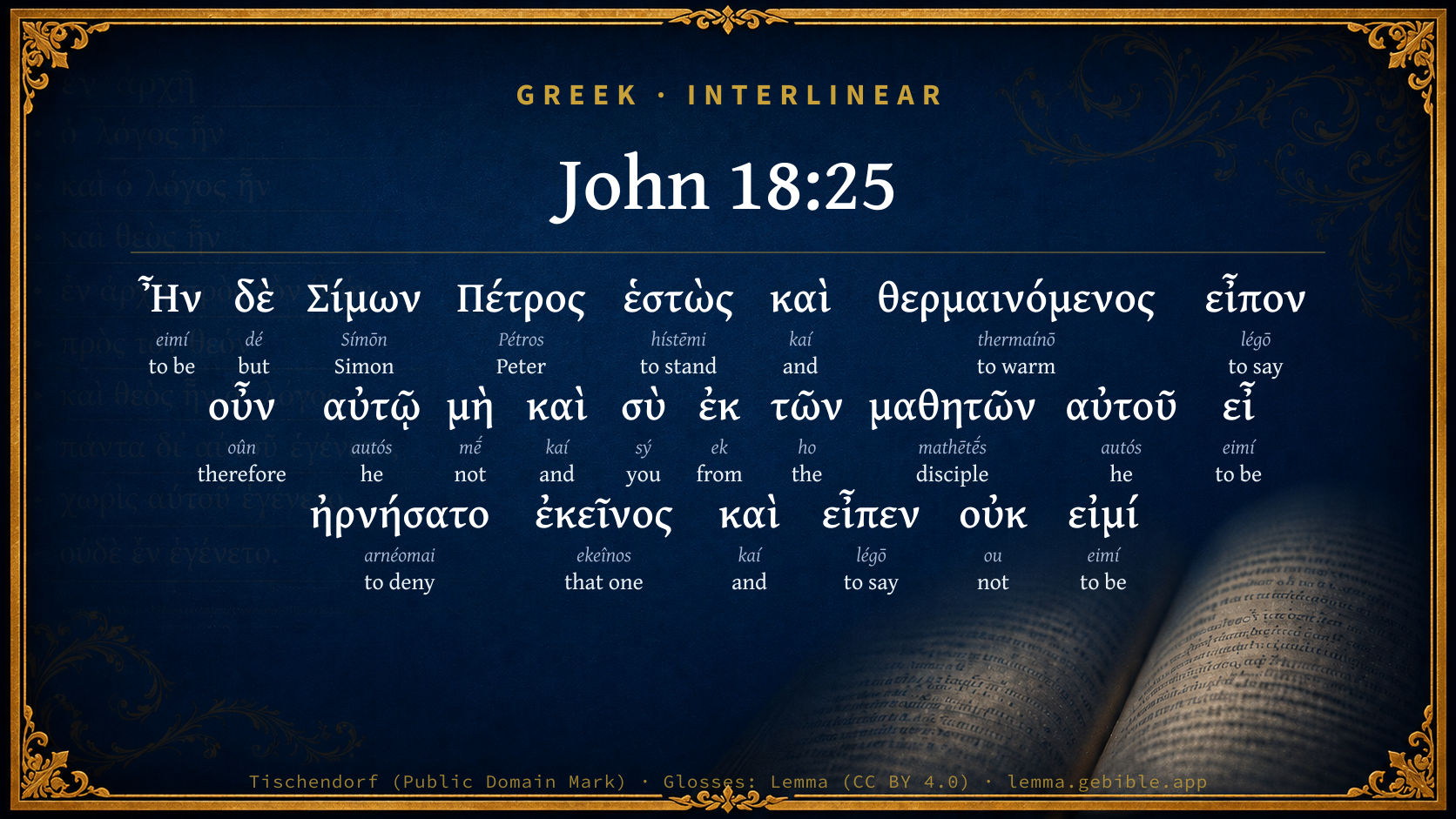
Greek (Tischendorf 8th ed.) John 18:25 appears in the Greek New Testament. The text above is from the Tischendorf 8th edition. Each word links to its Strong’s number and a concise gloss. Click any word for its full Thayer’s Greek Lexicon entry.
Download image
Cite this verse

John 18:25 (World English Bible). Public Domain. Lemma interlinear Bible study tool, https://lemma.gebible.app/v/john/18/25.

Show BibTeX & RIS
BibTeX
RIS
English Translation
Now Simon Peter was standing and warming himself. They said therefore to him, "You aren't also one of his disciples, are you?" He denied it, and said, "I am not."
World English Bible · Public Domain
Download a study sheet

One document with this verse’s original text, its word-by-word gloss line, the meaning frame, cross-references with their text, attributed commentary, and full source and license credits — printable, and it pastes into notes with its structure intact.

This verse Autodidact and up

Study sheet (.html) Plain text (.txt)

A passage Seminary Student

Up to 50 verses in one chapter. A passage sheet keeps up to 6 commentary sources and 12 cross-references per verse, in the order this page ranks them, and says so on the sheet whenever that leaves anything out. Ask for a single verse and you get the Autodidact verse sheet above.

Everything on this page stays free to read, with no account — the sheet is a download of what is already on screen, not access to it.

Want to remove ads? Support Godless Engineer
Compare translations 3

The same verse in 3 English versions, stacked beneath the original-language interlinear above. Click any original word for its lexicon entry.

Each is an independent rendering of the whole verse — the interlinear is not word-aligned to these translations.

Highlighted words mark where these versions differ — a whole-verse word diff, not a word-by-word alignment.

  • World English Bible Public Domain
    Now Simon Peter was standing and warming himself. They said therefore to him, "You aren't also one of his disciples, are you?" He denied it, and said, "I am not."
  • King James Version Public Domain
    And Simon Peter stood and warmed himself. They said therefore unto him, Art not thou also one of his disciples? He denied it, and said, I am not.
  • unfoldingWord Literal Text CC BY-SA 4.0
    Now Simon Peter was standing and warming himself. Then they said to him, “Are you not also from among his disciples?” He denied and said, “I am not.”

unfoldingWord Literal Text — © unfoldingWord, licensed CC BY-SA 4.0. Word-aligned USFM3 via Door43 (git.door43.org/unfoldingWord/en_ult).

Versions to compare (up to 4)

3 of 4 selected

Show all 19 translations

Every available English version of this verse, each an independent rendering of the whole verse.

  • World English Bible Public Domain
    Now Simon Peter was standing and warming himself. They said therefore to him, "You aren't also one of his disciples, are you?" He denied it, and said, "I am not."
  • Berean Standard Bible Public Domain
    Simon Peter was still standing and warming himself. So they asked him, “Aren’t you also one of His disciples?” He denied it and said, “I am not.”
  • Majority Standard Bible Public Domain
    Simon Peter was still standing and warming himself. So they asked him, “Aren’t you also one of His disciples?” He denied it and said, “I am not.”
  • King James Version Public Domain
    And Simon Peter stood and warmed himself. They said therefore unto him, Art not thou also one of his disciples? He denied it, and said, I am not.
  • American Standard Version (1901) Public Domain
    Now Simon Peter was standing and warming himself. They said therefore unto him, Art thou also `one' of his disciples? He denied, and said, I am not.
  • Revised Version (1885) Public Domain
    Now Simon Peter was standing and warming himself. They said therefore unto him, Art thou also one of his disciples? He denied, and said, I am not.
  • Geneva Bible (1599) Public Domain
    And Simon Peter stoode and warmed himselfe, and they said vnto him, Art not thou also of his disciples? He denied it, and said, I am not.
  • Douay-Rheims (1899) Public Domain
    And Simon Peter was standing, and warming himself. They said therefore to him: Art not thou also one of his disciples? He denied it, and said: I am not.
  • Young's Literal Translation Public Domain
    And Simon Peter was standing and warming himself, they said then to him, `Art thou also of his disciples?' he denied, and said, `I am not.'
  • Literal Standard Version CC BY-SA 4.0
    And Simon Peter was standing and warming himself, then they said to him, “Are you also of His disciples?” He denied and said, “I am not.”
  • Unlocked Literal Bible CC BY-SA 4.0
    Now Simon Peter was standing and warming himself. The people then said to him, “Are you not also one of his disciples?” He denied it and said, “I am not.”
  • unfoldingWord Literal Text CC BY-SA 4.0
    Now Simon Peter was standing and warming himself. Then they said to him, “Are you not also from among his disciples?” He denied and said, “I am not.”
  • Darby Bible Public Domain
    But Simon Peter was standing and warming himself. They said therefore to him, Art thou also of his disciples? He denied, and said, I am not.
  • World Messianic Bible Public Domain
    Now Simon Peter was standing and warming himself. They said therefore to him, “You aren’t also one of his disciples, are you?” He denied it and said, “I am not.”
  • Webster's Bible Public Domain
    And Simon Peter stood and warmed himself. They said therefore to him, Art not thou also one of his disciples? He denied it, and said, I am not.
  • Free Bible Version CC BY-SA 4.0
    As Simon Peter stood warming himself by the fire, the people there asked him, “Aren't you one of his disciples?” Peter denied it and said, “No, I'm not.”
  • Bible in Basic English Public Domain
    But Simon Peter was still there warming himself by the fire. They said to him, Are you not one of his disciples? He said, No, I am not.
  • Text-Critical English NT CC BY 4.0
    Meanwhile, Simon Peter was standing and warming himself. So they said to him, “Yoʋ are not also one of his disciples, are yoʋ?” He denied it and said, “I am not.”
  • Tyndale New Testament (1534) Public Domain
    And Annas sent him bounde vnto Caiphas the hye preste.

Literal Standard Version (2020), Covenant Press — licensed CC BY-SA 4.0. Text via the HelloAO Bible API (eBible.org). Unlocked Literal Bible (unfoldingWord) — licensed CC BY-SA 4.0. Text via the HelloAO Bible API (eBible.org). unfoldingWord Literal Text — © unfoldingWord, licensed CC BY-SA 4.0. Word-aligned USFM3 via Door43 (git.door43.org/unfoldingWord/en_ult). Free Bible Version, Dr. Jonathan Gallagher — licensed CC BY-SA 4.0. Text via the HelloAO Bible API (eBible.org).

Word by word

More ways to search: Search by grammar → Find every occurrence → Compare this word →

Practice this passage: Drill this verse → Learn its vocabulary →

θερμαινόμενος
thermaínō
G2328
“to warm”
Verb, Present, Middle, Participle, Nominative, Singular, Masculine
Part of Speech
Verb
Tense
Present
Voice
Middle
Mood
Participle
Case
Nominative
Number
Singular
Gender
Masculine
Full Thayer's Definition

Origin: from G2329

TDNT: None

1. to make warm, to heat 2. to warm one's self
  1. Ἦν eimí G1510 “to be” Verb, Imperfect, Active, Indicative, 3rd person, Singular
  2. δὲ dé G1161 “but” Conjunction
  3. Σίμων Símōn G4613 “Simon” Noun, Nominative, Singular, Masculine
  4. Πέτρος Pétros G4074 “Peter” Noun, Nominative, Singular, Masculine
  5. ἑστὼς hístēmi G2476 “to stand” Verb, Perfect, Active, Participle, Nominative, Singular, Masculine
  6. καὶ kaí G2532 “and” Conjunction
  7. εἶπον légō G3004 “to say” Verb, Aorist, Active, Indicative, 3rd person, Plural
  8. οὖν oûn G3767 “therefore” Conjunction
  9. αὐτῷ autós G846 “he” Personal pronoun, Dative, Singular, Masculine
  10. μὴ mḗ G3361 “not” Particle, Negative
  11. καὶ kaí G2532 “and” Conjunction
  12. σὺ sý G4771 “you” Personal pronoun, 2nd person, Nominative, Singular
  13. ἐκ ek G1537 “from” Preposition
  14. τῶν ho G3588 “the” Article, Genitive, Plural, Masculine
  15. μαθητῶν mathētḗs G3101 “disciple” Noun, Genitive, Plural, Masculine
  16. αὐτοῦ autós G846 “he” Personal pronoun, Genitive, Singular, Masculine
  17. εἶ eimí G1510 “to be” Verb, Present, Active, Indicative, 2nd person, Singular
  18. ἠρνήσατο arnéomai G720 “to deny” Verb, Aorist, Middle deponent, Indicative, 3rd person, Singular
  19. ἐκεῖνος ekeînos G1565 “that one” Demonstrative pronoun, Nominative, Singular, Masculine
  20. καὶ kaí G2532 “and” Conjunction
  21. εἶπεν légō G3004 “to say” Verb, Aorist, Active, Indicative, 3rd person, Singular
  22. οὐκ ou G3756 “not” Particle, Negative
  23. εἰμί eimí G1510 “to be” Verb, Present, Active, Indicative, 1st person, Singular

About this verse

These counts appear in no published source. They are computed here, from the morphology-tagged text and Lemma’s own curated glosses. What Lemma adds →

24
words
18
distinct lemmas
Gospels
section

Notable vocabulary

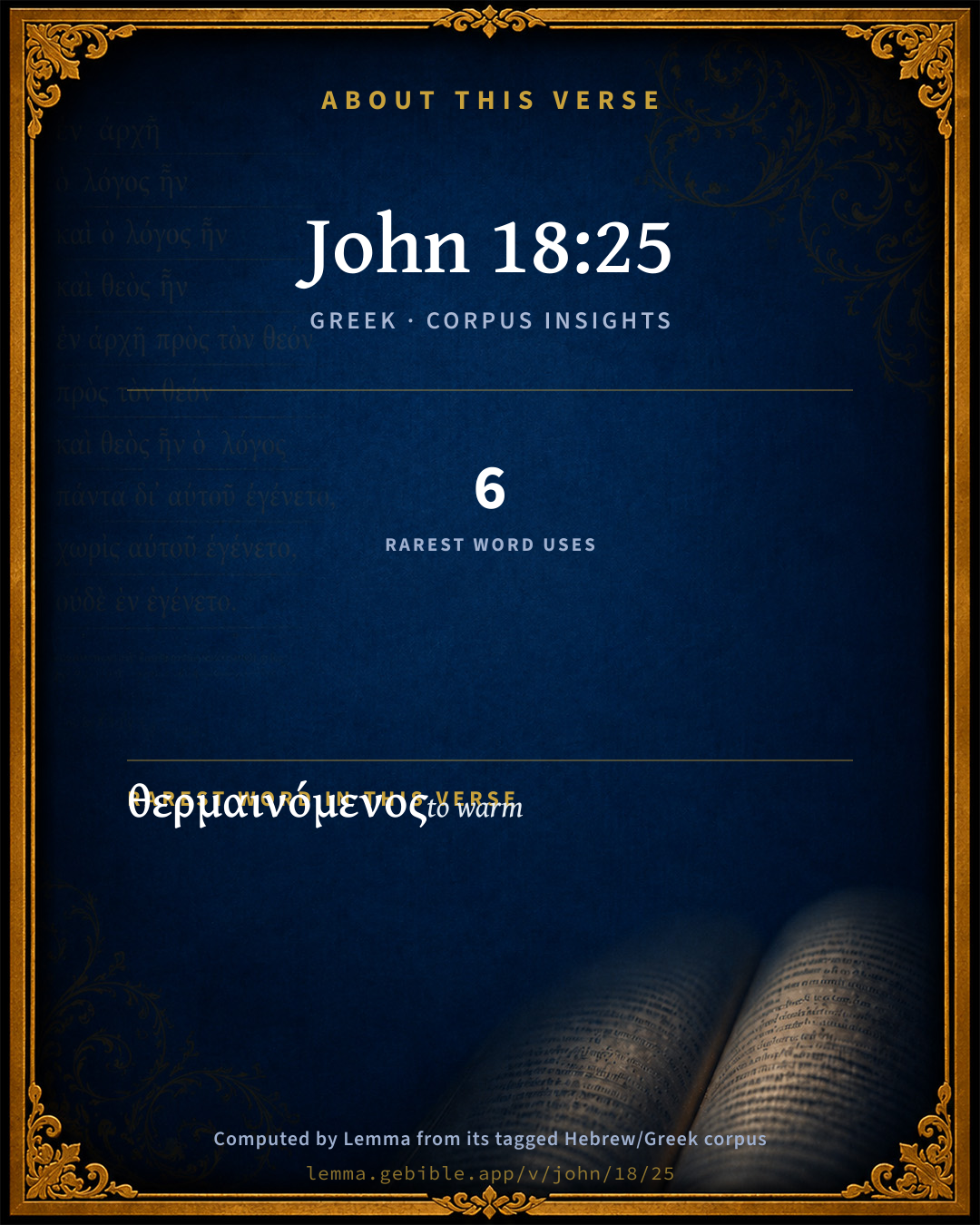
The rarest word here is θερμαινόμενος to warm G2328 — appearing just 6 times in the whole Greek New Testament.

Shared distinctive vocabulary

θερμαινόμενος to warm G2328 occurs in 5 verses of the Greek New Testament. Also found in:

Repetition

Words recur within this verse:

  • Ἦν to be G1510 ×3
  • εἶπον to say G3004 ×2
  • καὶ and G2532 ×3
  • αὐτῷ he G846 ×2

Cross-references

10

Topical passages linked to John 18:25 in the Treasury of Scripture Knowledge — connected by theme and wording, ordered by reader-vote popularity; previews shown in the World English Bible.

  • Mark 14:67–72 and seeing Peter warming himself, she looked at him, and said, "You were also with the Nazarene, Jesus!"
  • John 18:17–18 Then the maid who kept the door said to Peter, "Are you also one of this man's disciples?" He said, "I am not."
  • Genesis 18:15 Then Sarah denied, saying, "I didn't laugh," for she was afraid." He said, "No, but you did laugh."
  • Proverbs 29:25 The fear of man proves to be a snare, But whoever puts his trust in Yahweh is kept safe.
  • Matthew 26:71–75 When he had gone out onto the porch, someone else saw him, and said to those who were there, "This man also was with Jesus of Nazareth."
  • Mark 14:37–38 He came and found them sleeping, and said to Peter, "Simon, are you sleeping? Couldn't you watch one hour?
  • Luke 22:58–62 After a little while someone else saw him, and said, "You also are one of them!" But Peter answered, "Man, I am not!"
  • Matthew 26:69 Now Peter was sitting outside in the court, and a maid came to him, saying, "You were also with Jesus, the Galilean!"
  • Luke 22:56 A certain servant girl saw him as he sat in the light, and looking intently at him, said, "This man also was with him."
  • Galatians 2:11–13 But when Peter came to Antioch, I resisted him to the face, because he stood condemned.

Cross-references courtesy of OpenBible.info (CC BY 4.0).

Where the printed editions differ

1 variant

Places in this verse where the major printed Greek editions disagree on the wording in a way that affects the translation — a comparison of editions, not a manuscript-by-manuscript collation. The editions are the modern critical texts (Nestlé-Aland 28/27, SBL, Westcott-Hort, Tregelles, Tyndale House) and the traditional texts behind the KJV (the Textus Receptus and the Byzantine/Majority text). It is not a claim about which reading is original.

  1. Extra text
    οὖν

    “therefore”

    In Byz Not in NA28NA27TynSBLWHTregTR

    οὖν (oun) 'therefore' is only in a few manuscripts (Byz)

Textual data: Translators Amalgamated Greek New Testament (STEPBible TAGNT) · CC BY 4.0.

Commentary

Notes on John 18:25 from classic Christian and Jewish commentators (each source and its license shown beneath its notes). The classic Christian expositions comment on the surrounding passage and are grouped to its opening verse, so a note may address several verses; the Jewish commentaries on the Tanakh (Rashi and others) are per-verse, so they appear only where the commentator wrote on this verse.

Lemma curates 59 commentaries, every one of them public domain or Creative Commons licensed, each selected and text-cleaned for this edition rather than reprinted as found. About our sources →

Whedon's Commentary on the Bible

Daniel D. Whedon

Peter’s second and third denial, Joh_18:25-27.

The position of this part of the narrative of Peter’s denials, which seems to be separated purposely from the first denial, confirms the supposition that the whole took place during the stay of Jesus in the hall of Annas. We may add, that the clear accordance of the narratives of these denials in the different Evangelists, which discloses itself amidst apparent discrepancies, forms a striking demonstration of the truth of the history. The discrepancies show intuitively that the narratives are perfectly artless and independent, while the ultimate agreement shows that the respective authors wrote from common fact.

Daniel D. Whedon (gen. ed.), Commentary on the Old and New Testaments (1874–1909) — public domain. Text from a community e-Sword module.

Tyndale Open Study Notes

Tyndale Open Resources

18:25-27 He denied it: Peter’s three denials were later echoed when Jesus invited him three times to reaffirm his love (21:15-17).

Tyndale Open Study Notes — © Tyndale Open Resources, licensed CC BY-SA 4.0. Text via the HelloAO Bible API.

Bengel's Gnomon

Johann Albrecht Bengel

Joh 18:25. Καὶ σὺ) thou also, who art here present, a stranger to us.

Bengel's Gnomon of the New Testament — English translation (T&T Clark, Edinburgh, 1860) — public domain. Text from a community e-Sword module.

Meyer's Critical & Exegetical Commentary

Heinrich August Wilhelm Meyer

Joh_18:25-27. When Jesus was sent to Caiaphas, Peter was still on the spot mentioned in Joh_18:18, standing and warming himself. There follow his second and third denials, which, therefore, according to the brief and accurate narrative of John, who relates the denials generally with more precision, took place likewise in the court of Annas. The text gives no indication that Peter followed Jesus into the house of Caiaphas. Comp. Olshausen, Baur, Bleek. For the agreement of Luke with John in the locality of the denials, but not in the more minute determination of time, see on Luk_22:54-62.

εἶπον] Those standing there with him, Joh_18:18.

The individual, Joh_18:26, assails him with his own eye-witness.

ἐγώ] I, for my part.

ἐν τῷ κήπῳ] sc. ὄντα. The slave outside the garden (for, see on Joh_18:4) has been able, over the fence or through the door of the garden, to see Peter in the garden with Jesus. When the blow with the sword was struck, he cannot (in the confusion of the seizure of Jesus) have had his eye upon him, otherwise he would have certainly reproached him with this act.

ἀλέκτωρ] a cock. See on Mat_26:74. The contrition of Peter, John does not here relate in his concise account; but all the more thoughtfully and touchingly does this universally known psychological fact receive historical expression in the appendix, chap. 21.[217]

[217] Which, indeed (see Scholten, p. 382), is alleged to he a mistake of the appendix, the writer of which did not see through the (anti-Petrine) tendency of the Gospel.

Meyer — Critical and Exegetical Commentary on the New Testament — English translation by Peter Christie, edited by Frederick Crombie (T&T Clark, 1880) — public domain. Text from a community e-Sword module.

Expositor's Greek Testament

ed. W. Robertson Nicoll

Joh 18:25 resumes the narrative interrupted at Joh 18:18-19 , and resumes by repeating the statement that Simon Peter was standing and warming himself. While he did so the servants and officers, Joh 18:18 , who were round the fire said, Μὴ καὶ σὺ … “Are you also of His disciples?”

The Expositor's Greek Testament, edited by W. Robertson Nicoll (1897–1910) — public domain. Text from a community e-Sword module.

Godet's Commentaries

Frédéric Louis Godet

Vv. 25-27. “And Simon Peter was standing and warming himself. They said therefore to him, Art not thou also one of his disciples? He denied and said, I am not. 26. One of the servants of the high-priest, a kinsman of him whose ear Peter cut off, says to him, Did I not see thee in the garden with him? 27. Peter denied again; and immediately the cock crew.”

As far as Joh 18:18, according to John, all has happened in the house of Annas; and as Joh 18:25 expressly places us again in the situation of Joh 18:18, it is evident that the following facts also occur at his house; it is the same court, the same fire, the same persons; so that those who, like Weiss, are unwilling to admit that Caiaphas and Annas lived in two different apartments of the same priestly palace, are obliged to hold that Matthew and Mark have made a mistake in placing the denial of Peter in the house of Caiaphas. As for ourselves, we have already stated the reasons which seem to us to support the contrary opinion.

The sending of Jesus to Caiaphas, mentioned already in Joh 18:24, in reality followed the last denial (Joh 18:27). For the facts of Joh 18:25-27 took place simultaneously with Joh 18:19-23. This circumstance explains the incident, related by Luke, of the look which Jesus cast upon Peter (Luk 22:61). Jesus crossed the court to go from the apartments of Annas to those of Caiaphas (Joh 18:24). He heard at this moment the cock-crowing (Joh 18:27); and then it was that His eye met that of Peter. The epithet δεδεμένον, bound, makes us understand more fully the impression produced on the unfaithful disciple by the sight of his Master in this condition.

The subject of εἶπον, they said (Joh 18:25), is indefinite. According to Matthew, it is a maid-servant who sees Peter approaching the gate to go forth from the court to the front of the house. According to Mark, it is the same maid-servant who had already troubled him in the first instance and who denounces him to the servants who were gathered about the fire. In Luke, it is indefinitely έτερος, another person. It is probable that the portress spoke of Peter to one of her companions, who denounced him to the assembled servants. From this group came forth instantly the question addressed to Peter.

After the second denial, Peter seems to have played the bold part, and to have set himself to speak more freely with the persons present. But his Galilean accent was soon noticed, and attracted the more particular attention of a kinsman of Malchus, a fact which occasioned the third denial.

John does not mention the imprecations which Matthew puts into Peter’s mouth. If, then, any one was animated by hostile feelings towards this disciple, it was the first evangelist, and not the author of our narrative. Though he does not speak of Peter’s repentance, the narrative of the scene in Joh 21:15 ff. evidently implies it.

The story of the denial of Peter is, besides those of the multiplication of the loaves and of the entrance of Jesus into Jerusalem, the only one which is related at once by John and the Synoptics. There is no discourse here to be accounted for, as in ch. 6, and no series of events to be explained, as in ch. 12 John’s purpose, therefore, could only have been to reproduce in all their grievous reality the two simultaneous scenes of the appearance of the Master before the authorities and the disciple’s denial, which had formed the prelude of the Passion. In any case, we may discover here how the oral tradition related the facts with less of life and flexibility than is done by the pen of an eye-witness. The latter alone has reproduced the minutest articulations of the history; and it is not without reason that Renan speaks of “its varied and sharply defined points.”

Frédéric Louis Godet — Commentaries on Luke, John, Romans, and 1 Corinthians — English translation (T&T Clark, Edinburgh, 1870s–1890s) — public domain. Text from a community e-Sword module.

Geneva Bible (1599)

Geneva Bible translators

After that men have once fallen, they cannot only not lift themselves by their own strength, but also they fall more and more into worse, until they be raised up again, by a new virtue of God.

Geneva Bible (1599) marginal notes — public domain. Text via Bolls.life.

Jamieson, Fausset & Brown

Robert Jamieson, A. R. Fausset & David Brown

And Simon Peter was standing and warming himself. They said therefore . . . Art thou not also one of his disciples?--In Mat 26:71 the second charge was made by "another maid, when he was gone out into the porch," who "saw him, and said unto them that were there, This [fellow] was also with Jesus of Nazareth." So also Mar 14:69. But in Luk 22:58 it is said, "After a little while" (from the time of the first denial), "another [man] saw him, and said, Thou art also of them." Possibly it was thrown at him by more than one; but these circumstantial variations only confirm the truth of the narrative.

He denied it, and said, I am not--in Mat 26:72, "He denied with an oath, I do not know the man." This was THE SECOND DENIAL.

Jamieson, Fausset & Brown — Commentary Critical and Explanatory on the Whole Bible (1871) — public domain (CC PDM 1.0). Text via the HelloAO Bible API.

John Calvin's Commentaries

25. He denied it. How shocking the stupidity of Peter, who, after having denied his Master, not only has no feeling of repentance, but hardens himself by the very indulgence he takes in sinning! If each of them in his turn had asked him, he would not have hesitated to deny his Master a thousand times. Such is the manner in which Satan hurries along wretched men, after having degraded them. We must also attend to the circumstance which is related by the other Evangelists, (Matthew 26:74; Mark 14:71,) that he began to curse and to swear, saying, that he did not know Christ. Thus it happens to many persons every day. At first, the fault will not be very great; next, it becomes habitual, and at length, after that conscience has been laid asleep, he who has accustomed himself to despise God will think nothing unlawful for him, but will dare to commit the greatest wickedness. There is nothing better for us, therefore, than to be early on our guard, that he who is tempted by Satan, while he is yet uncorrupted, may not allow himself the smallest indulgence.

John Calvin's Commentaries (1540-1563) — public domain. Text from the Calvin Translation Society English edition (1840s-50s) via the Christian Classics Ethereal Library (ccel.org). Calvin's coverage is partial (roughly two-thirds of the Bible); uncommented books and verses are honest gaps, never fabricated. The 19th-century editor's footnotes and remarks are omitted so the notes are faithfully Calvin's own voice.

Ellicott's Commentary for English Readers

(25) And Simon Peter stood and warmed himself.—Better, And Simon Peter was standing and warming himself. (Comp. Joh_18:18.) The words are repeated to draw attention to the fact that he was standing in the court at the time when Jesus was sent from Annas unto Caiaphas, that is, from one wing of the quadrangular building across the court to the other. In Luk_22:61 it is said that “the Lord turned and looked upon Peter.”

Art not thou also one of his disciples?—Comp. Note to Joh_18:17.

A Bible Commentary for English Readers, edited by Charles John Ellicott (1878–1897) — public domain. Text from a community e-Sword module.

The Cambridge Bible for Schools and Colleges

gen. ed. J. J. S. Perowne

25. And Simon Peter stood and warmed himself] Better, Now Simon Peter was standing and warming himself (Joh_18:18).

They said therefore] The movement in taking Jesus from Annas to Caiaphas once more attracted attention to the stranger by the fire.

Art not thou also] Rather, Art thou also (see on Joh_18:17). A look of sympathy and distress on S. Peter’s face, as His Master appears bound as a criminal, and perhaps with the mark of the blow (Joh_18:22) on His face, provokes the exclamation, Surely thou also art not one of His disciples?

The Cambridge Bible for Schools and Colleges (gen. ed. J. J. S. Perowne; Cambridge University Press, 1878–1918) — public domain. Text from a community e-Sword module.

John Gill's Exposition

And Simon Peter stood and warmed himself,.... This is repeated from Joh 18:18 to connect the history, and carry on the thread of the account of Peter's denial of Christ, which is interrupted by inserting the examination of Christ before the high priest, which was made at the same time. Peter stood among, and continued with the servants and officers of the high priest, warming himself by a fire they had made, it being a cold night; and this proved of bad consequence to him. The company and conversation of wicked men should be abstained from; no good is got thereby; continuance among such is very dangerous; men are too often more concerned for their bodies than their souls; Satan baits his temptations for the fleshly and sensitive part; and that which is thought to be for good, is the occasion of hurt.

They said therefore unto him; the servants and officers, among whom he stood warming himself, having observed what the maid had said to him:

art thou not also one of his disciples? suspecting that he was, though he had denied it, and therefore press him to give a direct answer: they might observe his countenance to fall, when the maid put the question to him; there might be something in his dress, and especially in his speech, which increased the suspicion:

but he denied it, and said, I am not; a second time. This denial of his being a disciple of Christ, as before, did not arise from a sense of his unworthiness to be one; nor from diffidence and distrust of a right to such a character; but from the fear of men; and being ashamed of Christ, he denies that which was his great mercy, privilege, and glory.

John Gill's Exposition of the Whole Bible (1746–1763) — public domain (CC PDM 1.0). Text via the HelloAO Bible API.

Trapp's Complete Commentary

John Trapp

25 And Simon Peter stood and warmed himself. They said therefore unto him, Art not thou also one of his disciples? He denied it, and said, I am not.

Ver. 25. He denied it, and said, I am not] Take heed by this example, Patres nos instruunt tum docentes, tum labentes, saith Augustine. Seest thou such as Peter to make shipwreck? Look well to thy tackling. They that will not profess Christ (unless they repent with Peter, which Stephen Gardiner said at his death that he could not) shall be sorted with such in participation of plagues, as through excess of pain and defect of patience, gnaw their own tongues, Rev 16:10.

John Trapp, A Commentary or Exposition upon All the Books of the Old and New Testament (1647–1656) — public domain. Text from a community e-Sword module.

Albert Barnes' Notes on the Bible

See the notes at Mat 26:72-74.

Albert Barnes' Notes on the Bible (1834–1885) — public domain. Text from a community e-Sword/MySword module.

Matthew Poole's English Annotations

This history of Peter’s denial of his Master the second time we have before met with, Mat 26:71,72; Mr 14:69,70; Luk 22:58,59, with several circumstances not mentioned by John. See Poole on "Mat 26:69".

Matthew Poole's English Annotations on the Holy Bible (1683–1685) — public domain. Text from a community e-Sword/MySword module.

The Pulpit Commentary

Hn de . In startling contrast to this scene, and while Annas had completed his bad-hearted but foiled inquisition, possibly even while our Lord was being transferred from the one court to the other an event which provided an opportunity for the searching, loving, compassionate glance which broke Peter"s heart the second and third denials of Peter were also being enacted. Now Simon Peter, who had been challenged by the doorkeeper, was standing and warming himself (a form of verbal construction of auxiliary verb with participle to which John is addicted, and especially in those portions of his Gospel which represent his personal composition; Joh_1:6, Joh_1:9, Joh_1:24, 27 3:24, 27) not "sitting," as Luke describes his position at the first denial, having, we might suppose, impetuously changed his position. They said therefore unto him, Art thou also one of his disciples? This sentence of John really gathers up another moment of Peter"s terrible fall, variously and even discrepantly put by the synoptic narrative, and is virtually accordant with them all three. According to Matthew "another maid," according to Mark "the maid" who had first challenged him, returned to the assault. Nothing more likely than that what was said by one woman should be eagerly taken up by another, and therefore that both statements are true. Luke, however, describes the event thus: eterov , "another man" (perhaps "a different person") saw him and said, "Thou art one of them." John"s statement embraces the substance of all three statements, "They said unto him." The general resemblance of the second charge brought against the apostle, as stated by all four evangelists, is remarkable. The different personages by whose lips the charge was urged can best be explained by the occurrence of simultaneous and widely spreading conviction, instead of an unnecessary multiplication of the denials themselves. Matthew and Mark represent Peter as overhearing the conversation of the maids with those who were there (ekei), showing the obvious occasion for some eager eterov to take up their statement as an accusation. The difficulty of place is not so easily resolved, for Matthew and Mark speak of the "gate," pulwn , or proaulion , "porch," outer hall of the court, and John of the fire where Peter first sat in apparent unconcern. We do not know how near the fire was to the pulwn , whether it was not indeed between the yura and the pulwn , in the proaulion . According to Matthew he was moving towards the pulwn , probably in the stir of the procession from the house of Annas to the court of Caiaphas. The four evangelists agree in the declaration made by Peter. He denied, and said, I am not; i.e. I am not one of the disciples concerning whom Annas asks. "I do not know the Man."

The Pulpit Commentary (1880–1919), ed. H.D.M. Spence-Jones & Joseph S. Exell — public domain. Text from a community e-Sword module.

Kretzmann's Popular Commentary

Paul E. Kretzmann

Peter’s second and third denial:

v. 25. And Simon Peter stood and warmed himself. They said therefore unto him, Art not thou also one of His disciples? He denied it and said, I am not.

v. 26. One of the servants of the high priest, being his kinsman whose ear Peter cut off, saith, Did not I see thee in the garden with Him?

v. 27. Peter then denied again; and immediately the cock crew.

While the hearing was going on in the chambers of Hannas, Peter had remained in the circle of the servants and guards near the fire. That was foolhardiness, for he that willfully courts temptation and danger usually finds himself overwhelmed by the danger. The first time Peter had denied on account of the mocking question of the doorkeeper. Her suspicions had meanwhile been transmitted to the other servants, especially through the agency of a second janitress. A. number of them now turned to Peter with searching questions as to his connection with the prisoner in the hall. The specific accusation was that Peter was a disciple of Christ. Peter denied for the second time. But the suspicion continued. One remark led to another, the dialect of Peter came in for its measure of attention. Finally a kinsman of Malchus, the man whose ear Peter had cut off in the garden, told him pointblank that he had seen him with Jesus in the garden. Peter was driven into a corner and had no weapon left with which to defend himself He blasphemously reiterated his denial, -and then the time of cock-crowing came. He had entirely overheard the first signal of warning, but now was brought back to his senses. Note: The familiarity of the evangelist with affairs in the house of the high priest is indicated also in this section by his knowledge of relationships. Mark also: A repeated denial, such as that of Peter in this case, results in loss of faith. It may happen, under regrettable circumstances, that a person, being thrown into the company of scoffers, may deny his Lord by word or deed, and still retain his faith. But if such a denial is done repeatedly without heeding the warnings of conscience, then there is no chance for Christianity to remain in the heart. That was Peter’s condition at that moment; if he had died during the time of the third denial, he would have been lost. But the Lord had His disciple in mind and called him back to faith through a sincere repentance.

Paul E. Kretzmann, Popular Commentary of the Bible (1921–1924) — public domain. Text from a community e-Sword module.

unfoldingWord translationNotes

Door43 World Missions Community

General Information:

Here the story line shifts back to Peter.

Now

This word is used to mark a break in the story line so John can provide information about Peter. (See: Background Information)

Are you not also one of his disciples?

This remark appears in the form of a question to add emphasis. AT: "You are also one of his disciples!" (See: Rhetorical Question)

Did I not see you in the garden with him?

This remark appears in the form of a question to add emphasis. Here the word "him" refers to Jesus. AT: "I saw you in the olive tree grove with the man they arrested! Did I not?" (See: Rhetorical Question and Assumed Knowledge and Implicit Information)

Peter then denied again

Here it is implied that Peter denied knowing and being with Jesus. AT: "Peter then denied again that he knew Jesus or that he had been with him" (See: Assumed Knowledge and Implicit Information)

immediately the rooster crowed

Here it is assumed the reader will remember that Jesus had said Peter would deny him before the rooster crowed. AT: "immediately the rooster crowed, just as Jesus had said would happen" (See: Assumed Knowledge and Implicit Information)

translationWords

Peter

disciple

servant

high priest

unfoldingWord translationNotes — © Distant Shores Media and the Door43 World Missions Community, licensed CC BY-SA 4.0. Source: git.door43.org/Door43/en_tn.

Cambridge Greek Testament for Schools and Colleges

25. The narrative is resumed from Joh 18:18: But Simon Peter was standing and warming himself. Dramatic contrast: the Lord stands bound; His disciple stands and warms himself. A look of distress on his face, when his Master appears bound as a criminal, and perhaps with the mark of the blow (Joh 18:22) on His face, provokes (οὖν) the exclamation, Surely thou also art not one of His disciples: see on Joh 18:17.

Cambridge Greek Testament for Schools and Colleges (Cambridge University Press, 1896; 21 vols, various authors incl. Carr, Maclear, Plummer, Farrar, Lumby, Moule, M. R. James, Simcox) — public domain. Text from a community e-Sword module.

Alford’s Greek Testament

Henry Alford

25-27.] Mat 26:71-74.Mar 14:69-72Mar 14:69-72.Luk 22:58-61Luk 22:58-61:—see note on Mat 26:69.

Peter was in the court-yard of the house—the αὐλή.

Henry Alford, The Greek Testament (1849–1861) — public domain. Text from a community e-Sword module.

International Critical Commentary

25. The courtyard scene is now taken up again from v. 18, where see note. We had there ὁ Πέτρος ἑστὼς καὶ θερμαινόμενος, and the phrase is repeated to bring us back to what has been said before, but with the characteristic substitution of Σίμων Πέτρος for ὁ Πέτρος of v. 18, as the apostle has been out of the narrative for some paragraphs (see on v. 15 above).

That there was some interval between the first denial of Peter and the third is apparent from the Synoptists, although they do not agree in small details. Mk. and Mt. suggest that the second interrogation of Peter followed hard upon the first, but this is told explicitly only by Lk. (μετὰ βραχύ, Luk 22:58). Then Mar 14:70 and Mat 26:73 say that the third interrogation was μετὰ μικρόν after the second, but Lk. allows an hour to elapse (διαστάσης ὡσεὶ ὥρας μιᾶς, Luk 22:59). Jn. brings the second denial nearer to the third than Lk. does; but that there was more than an hour’s interval between the first denial and the third, as Lk. records, is quite in agreement with the Johannine account.

εἶπον οὖν αὐτῷ. The speakers are not defined: on lui dit.

Μὴ καὶ σύ ἐκ τῶν μαθ. αὐτ. κτλ. The question and answer are almost the same as those of v. 17; and the question is again expressed as if a negative answer were expected (see on v. 17). This is a point peculiar to Jn.’s narrative; he describes the first two interrogatories as put in a form which almost suggested that Peter should say “No!” In this (see also on v. 27), Jn. gives a less severe account of Peter’s lapse from courage and faithfulness than the Synoptists do.

International Critical Commentary — older volumes (1896–1929), various authors — public domain. Text from a community e-Sword module.

Lesson kit

Teaching starters — assembled from the data on this page, not authored interpretation. Every prompt links to the verse data it draws on. Edit before teaching.

John, in the Gospels, opens this verse with 24 words (18 distinct Greek lemmas). Its most distinctive word is thermaínō (“to warm”). A historical commentator’s framing appears above. Read the whole chapter for the surrounding context.

Discussion questions

  1. The word thermaínō carries the sense “to warm.” How does it shape the verse?
  2. How does Mark 14:54, which shares the word «to warm», read alongside this verse?
  3. What does the repetition of “to be” (3× in this one verse) do in this verse?
  4. The translations on this page render this verse differently — a whole-verse word diff, not a word-by-word alignment. What might account for the different wordings?
  5. Compare how Whedon's Commentary on the Bible and Tyndale Open Study Notes read this verse. Where do they agree or differ?

Things to notice

Reading settings

Reading text

Shown beneath each verse's original-language words.

Old Testament
Old Testament edition

Read the OT as the Masoretic Hebrew (MT) or the Greek Septuagint (LXX).

English shown for the Greek Septuagint (in the Hebrew ↔ Greek comparison).

Comparing translations? Open the Compare panel on any verse page to stack up to four side by side.