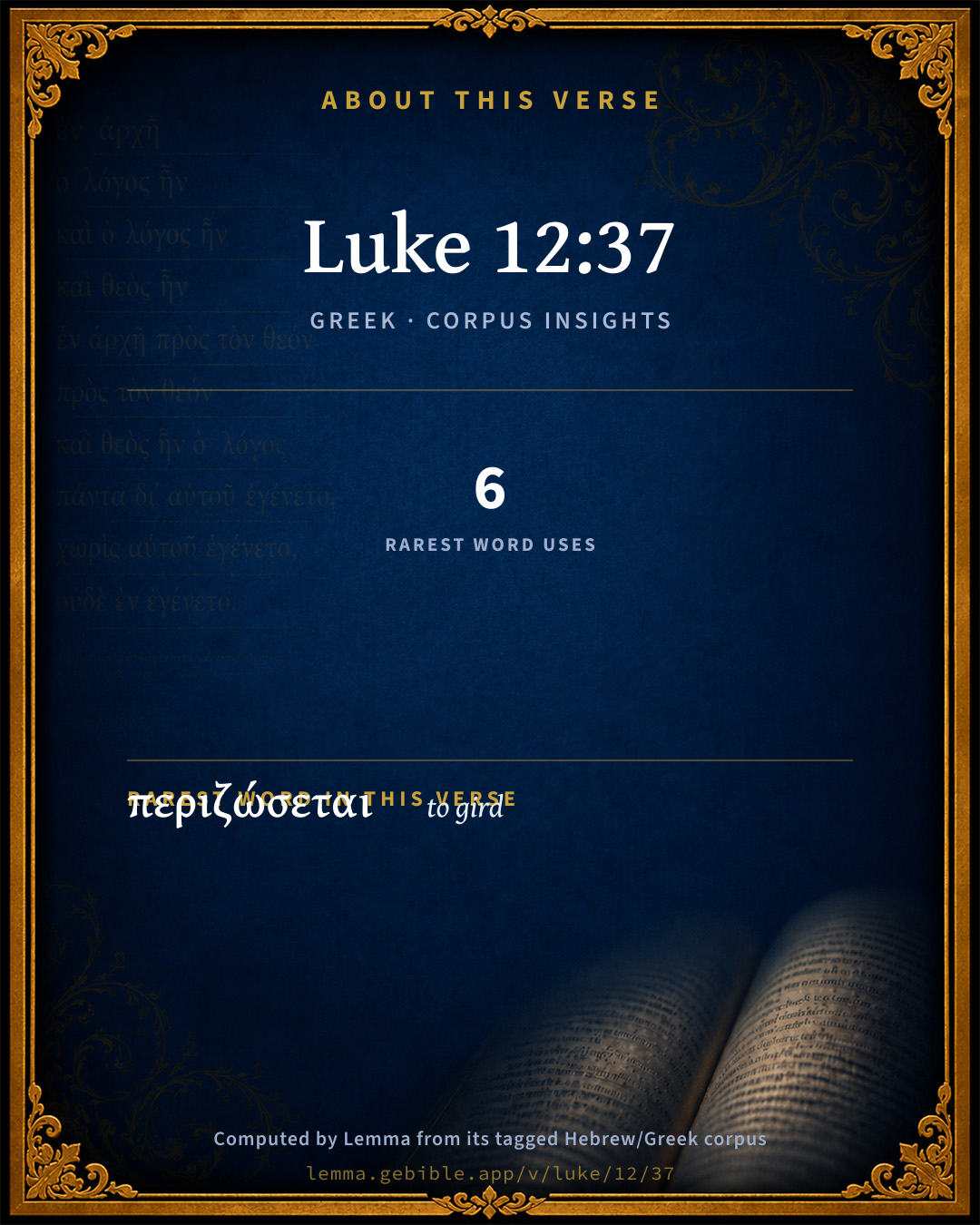
Luke 12:37

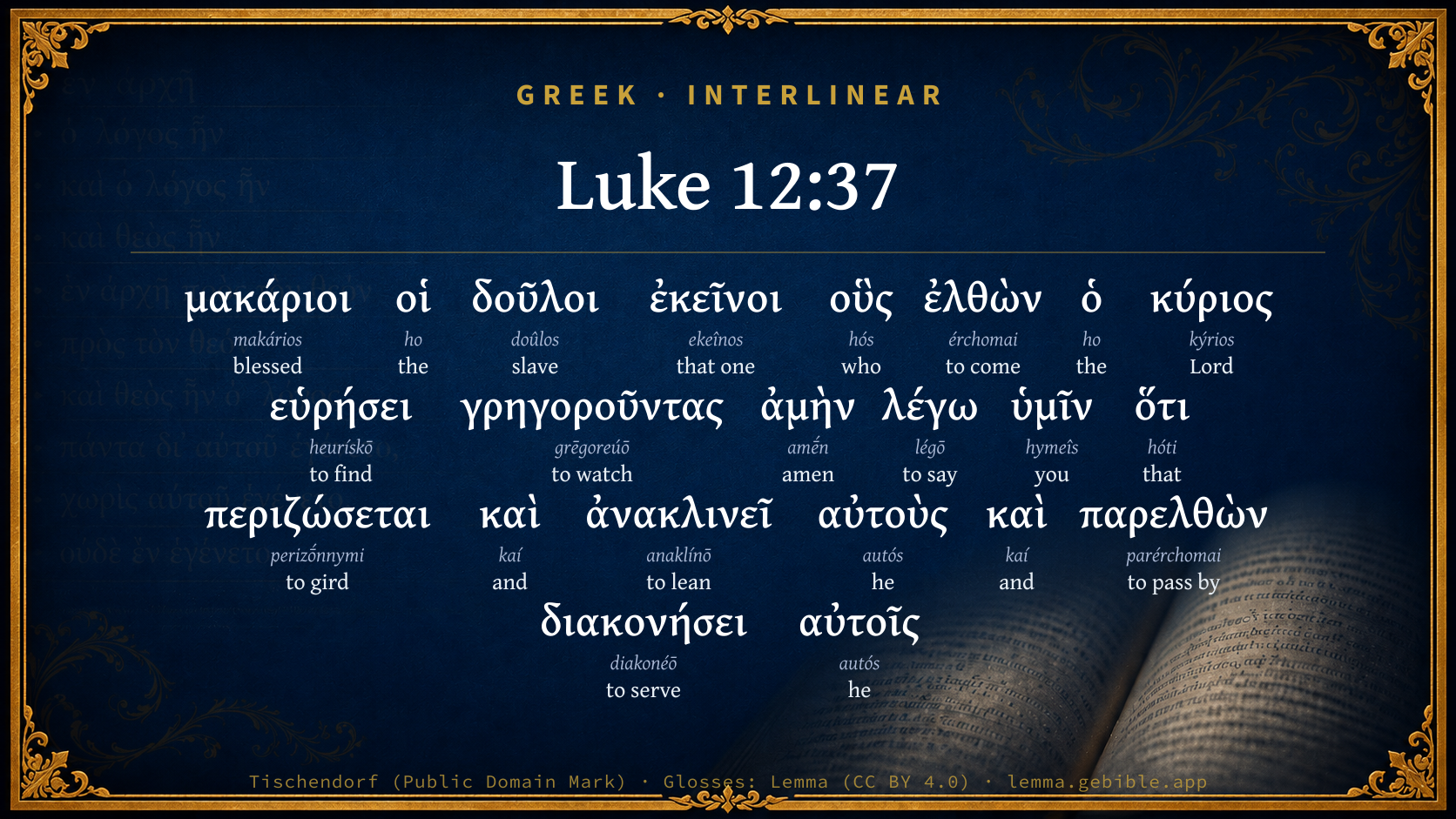
Greek (Tischendorf 8th ed.) Luke 12:37 appears in the Greek New Testament. The text above is from the Tischendorf 8th edition. Each word links to its Strong’s number and a concise gloss. Click any word for its full Thayer’s Greek Lexicon entry.
Download image
Cite this verse

Luke 12:37 (World English Bible). Public Domain. Lemma interlinear Bible study tool, https://lemma.gebible.app/v/luke/12/37.

Show BibTeX & RIS
BibTeX
RIS
English Translation
Blessed are those servants, whom the lord will find watching when he comes. Most assuredly I tell you, that he will dress himself, and make them recline, and will come and serve them.
World English Bible · Public Domain
Download a study sheet

One document with this verse’s original text, its word-by-word gloss line, the meaning frame, cross-references with their text, attributed commentary, and full source and license credits — printable, and it pastes into notes with its structure intact.

This verse Autodidact and up

Study sheet (.html) Plain text (.txt)

A passage Seminary Student

Up to 50 verses in one chapter. A passage sheet keeps up to 6 commentary sources and 12 cross-references per verse, in the order this page ranks them, and says so on the sheet whenever that leaves anything out. Ask for a single verse and you get the Autodidact verse sheet above.

Everything on this page stays free to read, with no account — the sheet is a download of what is already on screen, not access to it.

Want to remove ads? Support Godless Engineer
Compare translations 3

The same verse in 3 English versions, stacked beneath the original-language interlinear above. Click any original word for its lexicon entry.

Each is an independent rendering of the whole verse — the interlinear is not word-aligned to these translations.

Highlighted words mark where these versions differ — a whole-verse word diff, not a word-by-word alignment.

  • World English Bible Public Domain
    Blessed are those servants, whom the lord will find watching when he comes. Most assuredly I tell you, that he will dress himself, and make them recline, and will come and serve them.
  • King James Version Public Domain
    Blessed are those servants, whom the lord when he cometh shall find watching: verily I say unto you, that he shall gird himself, and make them to sit down to meat, and will come forth and serve them.
  • unfoldingWord Literal Text CC BY-SA 4.0
    Blessed those servants whom the master will find watching he comes. Truly I say to you that he will gird himself and have them recline to eat, and he will come serve them.

unfoldingWord Literal Text — © unfoldingWord, licensed CC BY-SA 4.0. Word-aligned USFM3 via Door43 (git.door43.org/unfoldingWord/en_ult).

Versions to compare (up to 4)

3 of 4 selected

Show all 19 translations

Every available English version of this verse, each an independent rendering of the whole verse.

  • World English Bible Public Domain
    Blessed are those servants, whom the lord will find watching when he comes. Most assuredly I tell you, that he will dress himself, and make them recline, and will come and serve them.
  • Berean Standard Bible Public Domain
    Blessed are those servants whom the master finds on watch when he returns. Truly I tell you, he will dress himself to serve and will have them recline at the table, and he himself will come and wait on them.
  • Majority Standard Bible Public Domain
    Blessed are those servants whom the master finds on watch when he returns. Truly I tell you, he will dress himself to serve and will have them recline at the table, and he himself will come and wait on them.
  • King James Version Public Domain
    Blessed are those servants, whom the lord when he cometh shall find watching: verily I say unto you, that he shall gird himself, and make them to sit down to meat, and will come forth and serve them.
  • American Standard Version (1901) Public Domain
    Blessed are those servants, whom the lord when he cometh shall find watching: verily I say unto you, that he shall gird himself, and make them sit down to meat, and shall come and serve them.
  • Revised Version (1885) Public Domain
    Blessed are those servants, whom the lord when he cometh shall find watching: verily I say unto you, that he shall gird himself, and make them sit down to meat, and shall come and serve them.
  • Geneva Bible (1599) Public Domain
    Blessed are those seruants, whom the Lord when he commeth shall finde waking: verely I say vnto you, he will girde himselfe about, and make them to sit downe at table, and will come forth, and serue them.
  • Douay-Rheims (1899) Public Domain
    Blessed are those servants, whom the Lord when he cometh, shall find watching. Amen I say to you, that he will gird himself, and make them sit down to meat, and passing will minister unto them.
  • Young's Literal Translation Public Domain
    `Happy those servants, whom the lord, having come, shall find watching; verily I say to you, that he will gird himself, and will cause them to recline (at meat), and having come near, will minister to them;
  • Literal Standard Version CC BY-SA 4.0
    Blessed those servants, whom the lord, having come, will find watching; truly I say to you that he will gird himself, and will cause them to recline, and having come near, will minister to them;
  • Unlocked Literal Bible CC BY-SA 4.0
    Blessed are those servants whom the master will find watching when he comes. Truly I say to you, he will tuck in his long clothing at his belt, and have them sit down at the table, and he will come and serve them.
  • unfoldingWord Literal Text CC BY-SA 4.0
    Blessed those servants whom the master will find watching he comes. Truly I say to you that he will gird himself and have them recline to eat, and he will come serve them.
  • Darby Bible Public Domain
    Blessed are those bondmen whom the lord [on] coming shall find watching; verily I say unto you, that he will gird himself and make them recline at table, and coming up will serve them.
  • World Messianic Bible Public Domain
    Blessed are those servants whom the lord will find watching when he comes. Most certainly I tell you that he will dress himself, make them recline, and will come and serve them.
  • Webster's Bible Public Domain
    Blessed are those servants, whom the lord when he cometh shall find watching: verily I say to you, that he will gird himself, and make them to sit down to eat, and will come forth and serve them.
  • Free Bible Version CC BY-SA 4.0
    How good it will be for those servants that the master finds watching when he returns. I tell you the truth, he will get dressed, have them sit down for a meal, and will come and serve them himself!
  • Bible in Basic English Public Domain
    Happy are those servants who are watching when the lord comes; truly I say to you, he will make himself their servant and, placing them at the table, he will come out and give them food.
  • Text-Critical English NT CC BY 4.0
    Blessed are those servants whom their master finds keeping watch when he comes. Truly I say to you, he will dress himself for service and have them recline at the table, and he will come and serve them.
  • Tyndale New Testament (1534) Public Domain
    Happy are those servauntes which the Lorde when he cometh shall fynde wakynge. Verely I saye vnto you he will gerdde him selfe about and make them sit doune to meate and walke by and minister vnto them.

Literal Standard Version (2020), Covenant Press — licensed CC BY-SA 4.0. Text via the HelloAO Bible API (eBible.org). Unlocked Literal Bible (unfoldingWord) — licensed CC BY-SA 4.0. Text via the HelloAO Bible API (eBible.org). unfoldingWord Literal Text — © unfoldingWord, licensed CC BY-SA 4.0. Word-aligned USFM3 via Door43 (git.door43.org/unfoldingWord/en_ult). Free Bible Version, Dr. Jonathan Gallagher — licensed CC BY-SA 4.0. Text via the HelloAO Bible API (eBible.org).

Word by word

More ways to search: Search by grammar → Find every occurrence → Compare this word →

Practice this passage: Drill this verse → Learn its vocabulary →

περιζώσεται
perizṓnnymi
G4024
“to gird”
Verb, Future, Middle, Indicative, 3rd person, Singular
Part of Speech
Verb
Tense
Future
Voice
Middle
Mood
Indicative
Person
3rd person
Number
Singular
Full Thayer's Definition

Origin: from G4012 and G2224

TDNT: 10:02,7

1. to fasten garments with a girdle or belt 2. to gird one's self 3. metaph. with truth as a girdle a. to equip one's self with knowledge of the truth
  1. μακάριοι makários G3107 “blessed” Adjective, Nominative, Plural, Masculine
  2. οἱ ho G3588 “the” Article, Nominative, Plural, Masculine
  3. δοῦλοι doûlos G1401 “slave” Noun, Nominative, Plural, Masculine
  4. ἐκεῖνοι ekeînos G1565 “that one” Demonstrative pronoun, Nominative, Plural, Masculine
  5. οὓς hós G3739 “who” Relative pronoun, Accusative, Plural, Masculine
  6. ἐλθὼν érchomai G2064 “to come” Verb, Aorist, Active, Participle, Nominative, Singular, Masculine
  7. ὁ ho G3588 “the” Article, Nominative, Singular, Masculine
  8. κύριος kýrios G2962 “Lord” Noun, Nominative, Singular, Masculine
  9. εὑρήσει heurískō G2147 “to find” Verb, Future, Active, Indicative, 3rd person, Singular
  10. γρηγοροῦντας grēgoreúō G1127 “to watch” Verb, Present, Active, Participle, Accusative, Plural, Masculine
  11. ἀμὴν amḗn G281 “amen” Hebrew transliteration
  12. λέγω légō G3004 “to say” Verb, Present, Active, Indicative, 1st person, Singular
  13. ὑμῖν hymeîs G5210 “you” Personal pronoun, 2nd person, Dative, Plural
  14. ὅτι hóti G3754 “that” Conjunction
  15. καὶ kaí G2532 “and” Conjunction
  16. ἀνακλινεῖ anaklínō G347 “to lean” Verb, Future, Active, Indicative, 3rd person, Singular
  17. αὐτοὺς autós G846 “he” Personal pronoun, Accusative, Plural, Masculine
  18. καὶ kaí G2532 “and” Conjunction
  19. παρελθὼν parérchomai G3928 “to pass by” Verb, Aorist, Active, Participle, Nominative, Singular, Masculine
  20. διακονήσει diakonéō G1247 “to serve” Verb, Future, Active, Indicative, 3rd person, Singular
  21. αὐτοῖς autós G846 “he” Personal pronoun, Dative, Plural, Masculine

About this verse

These counts appear in no published source. They are computed here, from the morphology-tagged text and Lemma’s own curated glosses. What Lemma adds →

22
words
19
distinct lemmas
Gospels
section

Notable vocabulary

The rarest word here is περιζώσεται to gird G4024 — appearing just 6 times in the whole Greek New Testament.

Shared distinctive vocabulary

περιζώσεται to gird G4024 occurs in 6 verses of the Greek New Testament. Also found in:

Repetition

Words recur within this verse:

  • οἱ the G3588 ×2
  • καὶ and G2532 ×2
  • αὐτοὺς he G846 ×2

Cross-references

22

Topical passages linked to Luke 12:37 in the Treasury of Scripture Knowledge — connected by theme and wording, ordered by reader-vote popularity; previews shown in the World English Bible.

  • 2 Peter 3:14 Therefore, beloved, seeing that you look for these things, be diligent to be found in peace, without blemish and blameless in his sight.
  • Matthew 24:42 Watch therefore, for you don't know in what hour your Lord comes.
  • John 13:4–5 arose from supper, and laid aside his outer garments. He took a towel, and wrapped a towel around his waist.
  • Matthew 24:45–47 "Who then is the faithful and wise servant, whom his lord has set over his household, to give them their food in due season?
  • John 12:26 If anyone serves me, let him follow me. Where I am, there will my servant also be. If anyone serves me, the Father will honor him.
  • 1 Corinthians 2:9 But as it is written, "Things which an eye didn't see, and an ear didn't hear, Which didn't enter into the heart of man, These God has prepared for those who love him."
  • Luke 12:43 Blessed is that servant whom his lord will find doing so when he comes.
  • Philippians 1:23 But I am in a dilemma between the two, having the desire to depart and be with Christ, which is far better.
  • 2 Peter 1:11 For thus will be richly supplied to you the entrance into the eternal Kingdom of our Lord and Savior, Jesus Christ.
  • Isaiah 62:5 For as a young man marries a virgin, so shall your sons marry you; and as the bridegroom rejoices over the bride, so shall your God rejoice over you.
  • Luke 21:36 Therefore be watchful all the time, asking that you may be counted worthy to escape all these things that will happen, and to stand before the Son of Man."
  • 2 Timothy 4:7–8 I have fought the good fight. I have finished the course. I have kept the faith.
  • 1 Peter 5:1–4 I exhort the elders among you, as a fellow elder, and a witness of the sufferings of Christ, and who will also share in the glory that will be revealed.
  • Revelation 14:13 I heard the voice from heaven saying, "Write, 'Blessed are the dead who die in the Lord from now on.'" "Yes," says the Spirit, "that they may rest from their labors; for their works follow with them."
  • Luke 17:8 and will not rather tell him, 'Prepare my supper, clothe yourself properly, and serve me, while I eat and drink. Afterward you shall eat and drink'?
  • Philippians 1:21 For to me to live is Christ, and to die is gain.
  • Revelation 3:21 He who overcomes, I will give to him to sit down with me on my throne, as I also overcame, and sat down with my Father on his throne.
  • Revelation 7:17 for the Lamb who is in the midst of the throne shepherds them, and leads them to springs of waters of life. And God will wipe away every tear from their eyes."
  • Revelation 14:3–4 They sing a new song before the throne, and before the four living creatures and the elders. No one could learn the song except the one hundred forty-four thousand, those who had been redeemed out of the earth.
  • Jeremiah 32:41 Yes, I will rejoice over them to do them good, and I will plant them in this land assuredly with my whole heart and with my whole soul.
  • Zephaniah 3:17 Yahweh, your God, is in the midst of you, a mighty one who will save. He will rejoice over you with joy. He will rest in his love. He will rejoice over you with singing.
  • Matthew 25:20–23 He who received the five talents came and brought another five talents, saying, 'Lord, you delivered to me five talents. Behold, I have gained another five talents besides them.'

Cross-references courtesy of OpenBible.info (CC BY 4.0).

Commentary

Notes on Luke 12:37 from classic Christian and Jewish commentators (each source and its license shown beneath its notes). The classic Christian expositions comment on the surrounding passage and are grouped to its opening verse, so a note may address several verses; the Jewish commentaries on the Tanakh (Rashi and others) are per-verse, so they appear only where the commentator wrote on this verse.

Lemma curates 59 commentaries, every one of them public domain or Creative Commons licensed, each selected and text-cleaned for this edition rather than reprinted as found. About our sources →

Joseph Benson's Commentary

Luk 12:37. Blessed are those servants, &c. — And blessed also will you be, if this shall be your case: verily, he shall gird himself, and make them sit down to meat — The master of such servants, pleased with their care, would perhaps order them a refreshment, after having watched and fasted so long; and if he were of a very humane disposition, might even bring it them himself, and give it them out of his own hand. It may not be improper to observe here, that it was usual for servants to sit at table, and for their masters to wait upon them, among the Romans in their Saturnalia, among the Cretans in their Hermæ, and among the Babylonians at their feast called Saccas: but whether our Lord here alludes to these, or any of these, it is difficult to judge. The words certainly are very intelligible without supposing any such reference. What our Lord chiefly meant by the similitude evidently was, to intimate to his disciples how acceptable their zeal in discharging the duties of their function would be to him, and how highly he would reward them for it.

Joseph Benson's Commentary on the Old and New Testaments (1811–1818) — public domain. Text from a community e-Sword module.

MacLaren's Expositions of Holy Scripture

Alexander MacLaren

Luke

SERVANTS AND STEWARDS HERE AND HEREAFTER

THE SERVANT-LORD

Luk 12:37.

No one would have dared to say that except Jesus Christ. For surely, manifold and wonderful as are the glimpses that we get in the New Testament of the relation of perfect souls in heaven to Him, none of them pierces deeper, rises higher, and speaks more boundless blessing, than such words as these. Well might Christ think it necessary to preface them with the solemn affirmation which always, upon His lips, points, as it were, an emphatic finger to, or underlines that which He is about to proclaim. ‘Verily I say unto you,’ if we had not His own word for it, we might hesitate to believe. And while we have His own word for it, and do not hesitate to believe, it is not for us to fathom or exhaust, but lovingly and reverently and humbly, because we know it but partially, to try to plumb the unfathomable depth of such words. ‘He shall gird Himself, and cause them to sit down to meat; and come forth and serve them.’

I. Then we have, first of all, the wonderful revelation of the Servant-Lord.

For the name of dignity is employed over and over again in the immediate context, and so makes more wonderful the assumption here of the promise of service.

And the words are not only remarkable because they couple so closely together the two antagonistic ideas, as we fancy them, of rule and service, authority and subordination, but because they dwell with such singular particularity of detail upon all the stages of the menial office which the Monarch takes upon Himself. First, the girding, assuming the servant’s attire; then the leading of the guests, wondering and silent, to the couches where they can recline; then the coming to them as they thus repose at the table, and the waiting upon their wants and supplying all their need. It reminds us of the wonderful scene, in John’s Gospel, where we have coupled together in the same intimate and interdependent fashion the two thoughts of dignity and of service-’Jesus, knowing that the Father had given all things into His hand, and that He came from God and went to God,’ made this use of His consciousness and of His unlimited and universal dominion, that ‘He laid aside His garments, and took a towel, and girded Himself, and washed the disciples’ feet’; thus teaching what our text teaches in still another form, that the highest authority means the lowliest service, that the purpose of power is blessing, that the very sign and mark of dignity is to stoop, and that the crown of the Universe is worn by Him who is the Servant of all.

But beyond that general idea which applies to the whole of the divine dealings and especially to the earthly life of Him who came, not to be ministered unto, but to minister, the text sets forth special manifestations of Christ’s ministering love and power, which are reserved for heaven, and are a contrast with earth. The Lord who is the Servant girds Himself. That corresponds with the commandment that went before, ‘Let your loins be girded,’ and to some extent covers the same ground and suggests the same idea. With all reverence, and following humbly in the thoughts that Christ has given us by the words, one may venture to say that He gathers all His powers together in strenuous work for the blessing of His glorified servants, and that not only does the metaphor express for us His taking upon Himself the lowly office, but also the employment of all that He is and has there in the heavens for the blessing of the blessed ones that sit at His table.

Here upon earth, when He assumed the form of a Servant in His entrance into humanity, it was accompanied with the emptying Himself of His glory. In the symbolical incident in John’s Gospel, to which I have already referred, He laid aside His garments before He wrapped around Him the badge of service. But in that wondrous service by the glorified Lord there is no need for divesting ere He serves, but the divine glories that irradiate His humanity, and by which He, our Brother, is the King of kings and the Lord of the Universe, are all used by Him for this great, blessed purpose of gladdening and filling up the needs of the perfected spirits that wait, expectant of their food, upon Him. His girding Himself for service expresses not only the lowliness of His majesty and the beneficence of His power, but His use of all which He has and is for the blessing of those whom He keeps and blesses.

I need not remind you, I suppose, how in this same wonderful picture of the Servant-Lord there is taught the perpetual-if we may so say, the increased-lowliness of the crowned Christ. When He was here on earth, He was meek and holy; exalted in the heavens, He is, were it possible, meeker and more lowly still, because He stoops from a loftier elevation. The same loving, gentle, gracious heart, holding all its treasures for its brethren, is the heart that now is girded with the golden girdle of sovereignty, and which once was girt with the coarse towel of the slave. Christ is for ever the Servant, because He is for ever the Lord of them that trust in Him. Let us learn that service is dominion; that ‘he that is chiefest among us’ is thereby bound to be ‘the servant’ and the helper ‘of all.’

II. Notice, the servants who are served and serve.

There are two or three very plain ideas, suggested by the great words of my text, in regard to the condition of those whom the Lord thus ministers to, and waits upon. I need not expand them, because they are familiar to us all, but let me just touch them. ‘He shall make them to sit down to meat.’ The word, as many of you know, really implies a more restful attitude-’He shall make them recline at meat.’ What a contrast to the picture of toil and effort, which has just been drawn, in the command,’ Let your loins be girded about, and your lamps burning, and ye yourselves as men that wait for their Lord!’ Here, there must be the bracing up of every power, and the careful tending of the light amid the darkness and the gusts that threaten to blow it out, and every ear is to be listening and every eye strained, for the coming of the Lord, that there may be no unpreparedness or delay in flinging open the gates. But then the tension is taken off and the loins ungirded, for there is no need for painful effort, and the lamps that burn dimly and require tending in the mephitic air are laid aside, and ‘they need no candle, for the Lord is the light thereof’; and there is no more intense listening for the first foot-fall of One who is coming, for He has come, and expectation is turned into fellowship and fruition. The strained muscles can relax, and instead of effort and weariness, there is repose upon the restful couches prepared by Him. Threadbare and old as the hills as the thought is, it comes to us toilers with ever new refreshment, like a whiff of fresh air or the gleam of the far-off daylight at the top of the shaft to the miner, cramped at his work in the dark. What a witness the preciousness of that representation of future blessedness as rest to us all bears to the pressure of toil and the aching, weary hearts which we all carry! The robes may flow loose then, for there is neither pollution to be feared from the golden pavement, nor detention from briars or thorns, nor work that is so hard as to be toil or so unwelcome as to be pain. There is rest from labour, care, change, and fear of loss, from travel and travail, from tired limbs and hearts more tired still, from struggle and sin, from all which makes the unrest of life.

Further, this great promise assures us of the supply of all wants that are only permitted to last long enough to make a capacity for receiving the eternal and all-satisfying food which Christ gives the restful servants. Though ‘they hunger no more,’ they shall always have appetite. Though they ‘thirst no more,’ they shall ever desire deeper draughts of the fountain of life. Desire is one thing, longing is another. Longing is pain, desire is blessedness; and that we shall want and know ourselves to want, with a want which lives but for a moment ere the supply pours in upon it and drowns it, is one of the blessednesses to which we dare to look forward. Here we live, tortured by wishes, longings, needs, a whole menagerie of hungry mouths yelping within us for their food. There we wait upon the Lord, and He gives a portion in due season.

The picture in the text brings with it all festal ideas of light, society, gladness, and the like, on which I need not dwell. But let me just remind you of one contrast. The ministry of Christ, when He was a servant here upon earth, was symbolised by His washing His disciples’ feet, an act which was part of the preparation of the guests for a feast. The ministry of Christ in heaven consists, not in washing, for ‘he that is washed is clean every whit’ there, and for ever more-but in ministering to His guests that abundant feast for which the service and the lustration of earth were but the preparation. The servant Christ serves us here by washing us from our sins in His own blood, both in the one initial act of forgiveness and by the continual application of that blood to the stains contracted in the miry ways of life. The Lord and Servant serves His servants in the heavens by leading them, cleansed to His table, and filling up every soul with love and with Himself.

But all that, remember, is only half the story. Our Lord here is not giving us a complete view of the retributions of the heavens, He is only telling us one aspect of them. Repose, society, gladness, satisfaction, these things are all true. But heaven is not lying upon couches and eating of a feast. There is another use of this metaphor in this same Gospel, which, at first sight, strikes one as being contradictory to this. Our Lord said: ‘Which of you, having a servant ploughing or feeding cattle, will say unto him by and by, when he is come from the field, go and sit down to meat, and will not rather say unto him, make ready wherewith I may sup, and gird thyself, and serve me, till I have eaten and drunken; and afterward thou shalt eat and drink.’ These two representations are not contradictory. Put the two halves together like the two pictures in a stereoscope and, as you look, they will go together into one solid image, of which the one part is the resting at the table of the feast, and the other part is that entrance into heaven is not cessation, but variation, of service. It was dirty, cold, muddy work out there in the field ploughing, and when the man comes back with his soiled, wet raiment and his weary limbs a change of occupation is rest. It is better for him to be set to ‘make ready wherewith I may eat and drink,’ than to be told to sit down and do nothing.

So the servants are served, and the servants serve. And these two representations are not contradictory, but they fill up the conception of perfect blessedness. For remember, if we may venture to say so, that the very same reason which makes Christ the Lord serve His servants makes the servants serve Christ the Lord. For love, which underlies their relationship, has for its very life-breath doing kindnesses and good to its objects, and we know not whether it is more blessed to the loving heart to minister to, or to be ministered to by, the heart which it loves. So the Servant-Lord and the servants, serving and served, are swayed in both by the same motive and rejoice in the interchange of offices and tokens of love.

III. Mark the earthly service which leads to the heavenly rest.

I have already spoken about Christ’s earthly service, and reminded you that there is needed, first of all, that we should partake in His purifying work through His blood and His Spirit that dwells in us, ere we can share in His highest ministrations to His servants in the heavens. But there is also service of ours here on earth, which must precede our receiving our share in the wonderful things promised here. And the nature of that service is clearly stated in the preceding words, ‘Blessed are those servants whom the Lord when He cometh shall find’-doing what? Trying to make themselves better? Seeking after conformity to His commandments? No! ‘Whom the Lord when He cometh shall find watching.’ It is character rather than conduct, and conduct only as an index of character-disposition rather than deeds-that makes it possible for Christ to be hereafter our Servant-Lord. And the character is more definitely described in the former words. Loins girded, lights burning, and a waiting which is born of love. The concentration and detachment from earth, which are expressed by the girded loins, the purity and holiness of character and life, which are symbolised by the burning lights, and the expectation which desires, and does not shrink from, His coming in His Kingdom to be the Judge of all the earth-these things, being built upon the acceptance of Christ’s ministry of washing, fit us for participation in Christ’s ministry of the feast, and make it possible that even we shall be of those to whom the Lord, in that day, will come with gladness and with gifts. ‘Blessed are the servants whom the Lord shall find so watching.’

Alexander MacLaren, Expositions of Holy Scripture (1904–1910) — public domain. Text from a community e-Sword module.

Tyndale Open Study Notes

Tyndale Open Resources

12:37 he himself will seat them: In Middle Eastern culture, the master would never serve his servants! Jesus redefined the role of the master by serving his disciples, giving himself for them, and meeting all their needs (see 22:24-27). • An apron was typical garb for a servant.

Tyndale Open Study Notes — © Tyndale Open Resources, licensed CC BY-SA 4.0. Text via the HelloAO Bible API.

Bengel's Gnomon

Johann Albrecht Bengel

Luk 12:37. Παρελθὼν διακονήσει) The participle is pleonastic (παρέλκον), and often occurs in similar cases where a banquet is spoken of. See ch. Luk 17:7, παρελθὼν ἀνάπεσε.[123] Sir 29:23 (26), ΠΆΡΕΛΘΕ ΚΌΣΜΗΣΟΝ ΤΡΆΠΕΖΑΝ. This promise of Himself ministering to (serving) His servants is the most distinguishing and greatest of all marks of honour. It is thus that the Bridegroom receives and entertains His friends on the solemn day of the marriage feast.

[123] Go forward and sit to meat. Wahl, Clavis, under ἀνίστημι, ἀναστὰς, attributes this pleonastic junction of a participle with the finite verb to the simplicity of antiquity, which is wont “totum rei ambitum emetiri, nihilque cogitationum, quod eodem spectet, missum facere.”—ED. and TRANSL.

Bengel's Gnomon of the New Testament — English translation (T&T Clark, Edinburgh, 1860) — public domain. Text from a community e-Sword module.

Meyer's Critical & Exegetical Commentary

Heinrich August Wilhelm Meyer

Luk_12:37. A symbolic representation of the most blessed recompense, which the servants of Christ, who are faithful to their calling, shall receive from Him at His Parousia. It is not the idea of the great and general Messianic banquets (Mat_8:11) that underlies this, but it is the thought of a special marriage-feast for those servants (the disciples). That the washing of the disciples feet by Jesus, John 13, gave occasion (de Wette) to the mode of representation, according to which the Lord Himself serves (promissio de ministrando honorificentissima et maxima omnium, Bengel), is the less probable the greater the difference is seen to be between the idea expressed by the foot-washing and that which is here set forth. The thought of the Saturnalia (Grotius, comp. Paulus and Olshausen) brings in something wholly foreign, as also the calling of the slaves to partake in certain sacred feasts according to the law, Deu_12:17 f., Luk_16:11 f., is something very different from the idea of this feast (in opposition to Kuinoel, de Wette, and others), in respect of which, moreover, it has been assumed (see Heumann, Kuinoel, de Wette) that the Lord brought with Him meats from the wedding feast,an assumption which is as needless as it is incapable of proof.

περιζώσεται κ.τ.λ.] a vivid representation of the individual details among which even the drawing near to those waiting (παρελθών) is not wanting.

The parable, Luk_17:7-10, has an entirely different lesson in view; hence there is no contradiction between the two.

Meyer — Critical and Exegetical Commentary on the New Testament — English translation by Peter Christie, edited by Frederick Crombie (T&T Clark, 1880) — public domain. Text from a community e-Sword module.

Expositor's Greek Testament

ed. W. Robertson Nicoll

Luk 12:37 . μακάριοι : here as always implying rare felicity the reward of heroic virtue. ἀμὴν : the Hebrew word retained here contrary to custom, introducing a startling thought, the inversion of the relation of master and servants, lord and slaves, through joy over their fidelity. For the other side of the picture vide Luk 17:7-10 . διακονήσει αὐτοῖς : the master, in genial mood, turns servant to his own slaves; makes them sit down, throws off his caftan, girds his under-garments, and helps them to portions of the marriage feast he has brought home with him , as a father might do for his children (De Wette, Koetsveld, p. 244). There is not necessarily an allusion either to the last supper (Luk 22:27 ) or to the Roman Saturnalia (Grotius, Holtzmann, H. C.).

The Expositor's Greek Testament, edited by W. Robertson Nicoll (1897–1910) — public domain. Text from a community e-Sword module.

Jamieson, Fausset & Brown

Robert Jamieson, A. R. Fausset & David Brown

gird himself, &c.--"a promise the most august of all: Thus will the Bridegroom entertain his friends (nay, servants) on the solemn Nuptial Day" [BENGEL].

Jamieson, Fausset & Brown — Commentary Critical and Explanatory on the Whole Bible (1871) — public domain (CC PDM 1.0). Text via the HelloAO Bible API.

Adam Clarke's Commentary

Verse 37. He shall gird himself] Alluding to the long garments which were worn in the eastern countries; and which, in travelling and serving, were tucked up in their belts. That those among the Romans who waited on the company at table were girded, and had their clothes tucked up, appears from what Horace says, Sat. b. vi. l. 107: Veluti SUCCINCTUS cursitat HOSPES, He runs about like a girded waiter. The host himself often performed this office. And ibid. viii. 10: Puer alle cinctus: and that the game custom prevailed among the Jews appears from Joh 13:4-5, and Lu 17:8. From this verse we may gather likewise, that it was the custom of those days, as it was, not long since, among us, for the bridegroom, at the wedding supper, to wait as a servant upon the company. See Bishop PEARCE.

Adam Clarke's Commentary on the Bible (1810–1826) — public domain. Text from a community e-Sword/MySword module.

Ellicott's Commentary for English Readers

(37) He shall gird himself.—The words give a new significance to the act of our Lord in Joh_13:4. Their real fulfilment is to be found, it need hardly be said, in the far-off completion of the Kingdom, or in the ever-recurring experiences which are the foretastes of that Kingdom; but the office which He then assumed must have reminded the disciples of the words which are recorded here, and may well have been intended to be at once a symbol and an earnest of what should be hereafter. In the promise of Rev_3:20 (“I will sup with him and he with Me”) we have a recurrence to the same imagery. The passage should be borne in mind as balancing the seeming harshness of the Master in Luk_17:8.

To sit down.—Literally, to lie down, or recline.

Will come forth . . .—Better, and as He passes on will minister unto them. The Greek verb expresses, not the “coming out” as from another chamber, but the passing from one to another, as when He washed the disciples’ feet, in Joh_13:5.

A Bible Commentary for English Readers, edited by Charles John Ellicott (1878–1897) — public domain. Text from a community e-Sword module.

The Cambridge Bible for Schools and Colleges

gen. ed. J. J. S. Perowne

37. he shall gird himself and make them to sit down to meat] Doubtless some of the Apostles must have recalled these words when Jesus washed their feet. To Roman readers the words would recall the customs of their Saturnalia when slaves were waited on by their masters.

The Cambridge Bible for Schools and Colleges (gen. ed. J. J. S. Perowne; Cambridge University Press, 1878–1918) — public domain. Text from a community e-Sword module.

John Gill's Exposition

And if he shall come in the second watch,.... Of the night, that is, after nine o'clock, or any time between nine or twelve; for the second watch was from nine o'clock till twelve; and this was coming early from an entertainment, or a wedding, which were commonly kept in the night, and late;

or come in the third watch, or after twelve o'clock, or any time between twelve and three; for the third watch was from twelve o'clock to three, which was late; See Gill on Mat 14:25 The Persic version reads, "in the second, or third part of the night"; and the Ethiopic version, "in the second or third hour of the night";

and find them so. The Arabic version adds, "doing"; as above described, with their loins girt, lights burning, and they watching for their Lord's coming:

blessed are those servants; since they shall be used and treated as before related.

John Gill's Exposition of the Whole Bible (1746–1763) — public domain (CC PDM 1.0). Text via the HelloAO Bible API.

Trapp's Complete Commentary

John Trapp

37 Blessed are those servants, whom the lord when he cometh shall find watching: verily I say unto you, that he shall gird himself, and make them to sit down to meat, and will come forth and serve them.

Ver. 37. Blessed are those servants] So Luk 12:38; Luk 12:43. They are three times said to be blessed that watch. Terque quaterque beati: Faelices ter et amplius. Horat.

John Trapp, A Commentary or Exposition upon All the Books of the Old and New Testament (1647–1656) — public domain. Text from a community e-Sword module.

Albert Barnes' Notes on the Bible

Shall gird himself - Shall take the place of the servant himself. Servants who waited on the table were girded in the manner described above.

Shall make them sit ... - Shall place them at his table and feast them. This evidently means that if we are faithful to Christ, and are ready to meet him when he returns, he will receive us into heaven - will admit us to all its blessings, and make us happy there - as if “he” should serve us and minister to our wants. It will be as if a master, instead of sitting down at the table “himself,” should place his faithful “servants” there, and be himself the servant. This shows the exceeding kindness and condescension of our Lord. For “us,” poor and guilty sinners, he denied himself, took the form of a servant Phi 2:7, and ministered to our wants. In our nature he has worked out salvation, and he has done it in one of the humblest conditions of the children of men. How should our bosoms burn with gratitude to him, and how should “we” be willing to serve one another! See the notes at John 13:1-17.

Albert Barnes' Notes on the Bible (1834–1885) — public domain. Text from a community e-Sword/MySword module.

Matthew Poole's English Annotations

The duty which Christ is here pressing upon his hearers is watchfulness, which signifieth:

1. A negation of sleep;

2. An industrious keeping ourselves awake with reference to some particular end. The end here expressed is the happy receiving of Christ, coming to judgment; from whence is evident, that the watching here intended is a spiritual watching, which is a denial of ourselves as to our lusts, and the sleep of sin, which is compared to sleep, Rom 13:11; Eph 5:14, and an industrious keeping ourselves from such sleep in order to the coming of our Lord, who will come at an hour when we think not, Luk 12:40; his coming is to us uncertain, and will be to many surprising.

This watchfulness he presseth upon his hearers;

1. From the reward the Lord will give to such persons:

He shall gird himself, and make them to sit down to meat, and will come forth and serve them: very high metaphorical expressions, signifying no more, than that he will put upon them a very high honour and dignity, and satisfy them with a fulness of happiness and glory, and they shall be at rest for ever. The state of glory is elsewhere set out under the notion of drinking new wine in the kingdom of God, and eating and drinking in his kingdom.

2. From the benefit which they will have by watching in this; that let the Lord come when he will, whether in the second or third watch, they will be ready, and they shall be blessed.

3. He presseth it also from the ordinary prudence of men, who if they have an intimation that a thief is coming, will watch, and prevent the mischief that might ensue by the breaking open of their houses. But concerning those words;

See Poole on "Mat 24:43-44", where we met with them before used upon the same occasion.

Matthew Poole's English Annotations on the Holy Bible (1683–1685) — public domain. Text from a community e-Sword/MySword module.

Whedon's Commentary on the Bible

Daniel D. Whedon

37. Blessed are those servants—At the Roman Saturnalia the masters put on the servile dress and waited on and served their servants. As our Lord bases this parable upon the ancient relation of master and servant, so he uses this custom for an image to express the great honour he will confer upon his servants at the judgment day. He will indeed then have put off the “form of a servant;” and all the blessings accruing to his followers from his ever having worn it, he will then confer.

Daniel D. Whedon (gen. ed.), Commentary on the Old and New Testaments (1874–1909) — public domain. Text from a community e-Sword module.

The Pulpit Commentary

Blessed are those servants, whom the lord when he cometh shall find watching: verily I say unto you, that he shall gird himself, and make them to sit down to meat, and will come forth and serve them. The title "blessed," when used by our Lord, is ever a very lofty one, and implies some rare and precious virtue in the one to whom this title to honor is given. It seems as though the house-master of the parable scarcely expected such true devotion from his servants; so he hastens to reward a rare virtue with equally rare blessedness and honor. He raises the slaves to a position of equality with their master. These true faithful ones are no longer his servants; they are his friends. He even deigns himself to minister to their wants. A similar lofty promise is made in less homely language. The final glorious gift to the faithful conqueror in the world"s hard battle appears in the last of the epistles to the seven Churches: "To him that overcometh will I grant to sit with me in my throne". (Rev_3:21)

The Pulpit Commentary (1880–1919), ed. H.D.M. Spence-Jones & Joseph S. Exell — public domain. Text from a community e-Sword module.

John Wesley's Explanatory Notes

He will come and serve them - The meaning is, he will show them his love, in the most condescending and tender manner.

John Wesley, Explanatory Notes Upon the Whole Bible (1754–1765) — public domain. Text via the GEBible commentary corpus.

Burkitt's Expository Notes on the New Testament

William Burkitt

Here our Saviour makes use of several arguments to enforce the duty of watchfulness upon his disciples; the first is drawn from the transcendent reward which Christ will bestow upon his watchful servants: He will gird himself, make them sit down to meat, and will come forth and serve them; a very high metaphorical expression: as if a master should be so transported with the diligence and faithfulness of his servant, as to vouchsafe not only to let him sit down to meat in his presence, but to take the napkin upon his arm, and wait upon him himself at his table.

Lord, how poor and how inconsider-able is that service, which the best of us do for thee! And yet thou speaks of it as if thou were beholden to us for it. Thou does not only administer to us a supper, but thou ministers and waits upon us at supper: He will gird himself, and serve them.

The second argument to excite to watchfulness is drawn from the benefit which we have received by watching in this life; then let the Lord come when he will, whether in the second or third watch, they shall be found ready, and in a blessed condition, who are found diligent in his service, and waiting for his appearance.

Note here,

1. The Son of man will certainly come at one hour or other.

2. At what hour the Son of man will come cannot be certainly known.

3. That there is no hour wherein we can promise ourselves that the Son of man will not come.

4. Very joyful will the coming of the Son of man be, if we be found upon our watch, and ready for his coming: Be ye therefore ready also; for the Son of man cometh at an hour when ye think not.

William Burkitt's Expository Notes on the New Testament (1700–1703) — public domain. Text from a community e-Sword module.

unfoldingWord translationNotes

Door43 World Missions Community

Blessed are

"How good it is for"

whom the master will find watching when he comes

"whose master finds them waiting for him when he returns" or "who are ready when the master returns"

he will tuck in his long clothing at his belt, and have them sit down

Because the servants have been faithful and ready to serve their master, the master will now reward them by serving them.

in the second watch of the night

The second watch was between Luk 9:00 p.m. and midnight. AT: "late at night" or "just before midnight"

or if even in the third watch

The third watch was from midnight to Luk 3:00 a.m. AT: "or if he comes very late at night"

translationWords

bless

servant

lord

servant

amen

watch (biblical time)

unfoldingWord translationNotes — © Distant Shores Media and the Door43 World Missions Community, licensed CC BY-SA 4.0. Source: git.door43.org/Door43/en_tn.

Cambridge Greek Testament for Schools and Colleges

37. περιζώσεται καὶ ἀνακλινεῖ αὐτούς. Doubtless some of the Apostles must have recalled these words when Jesus washed their feet. To Roman readers the words would recall the customs of their Saturnalia when slaves were waited on by their masters.

παρελθὼν διακονήσει αὐτοῖς. ‘He will draw near and serve them.’ The παρελθὼν adds a graphic touch to the Master’s condescension. We often find participles used in this vivid way, as in Luk 15:18, ἀναστὰς πορεύσομαι, 1Pe 3:19, πορευθεὶς ἐκήρυξεν, &c. Winer, p. 760.

Cambridge Greek Testament for Schools and Colleges (Cambridge University Press, 1896; 21 vols, various authors incl. Carr, Maclear, Plummer, Farrar, Lumby, Moule, M. R. James, Simcox) — public domain. Text from a community e-Sword module.

Alford’s Greek Testament

Henry Alford

37.] See Rev 3:20, Rev 3:21, where the same similitude is presented, and the promise carried on yet further,—to the sharing of his Throne. The Lord himself, in that great day of his glory,—the marriage-supper of the Lamb,—will invert the order of human requirements (see ch. 17:8), and in the fulness of his grace and love will serve his brethren:—the Redeemer, his redeemed,—the Shepherd, his flock.

παρελθ., coming in turn to each. Compare the washing of the disciples’ feet in Joh 13:1 ff., which was a foreshewing of this last great act of self-abasing love.

Henry Alford, The Greek Testament (1849–1861) — public domain. Text from a community e-Sword module.

International Critical Commentary

37. περιζώσεται καὶ ἀνακλινεῖ αὐτούς. Comp. Rev 3:20, Rev 3:21. Christ acted in this way when He washed the disciples’ feet: not, however, in gratitude for their faithful vigilance, but to teach them humility. Nevertheless, that was a type of what is promised here: comp. Rev 19:9. References to the Saturnalia, when Roman masters and slaves changed places in sport, are here quite out of place. The parable 17:7-10 sets forth the usual course between master and man.

International Critical Commentary — older volumes (1896–1929), various authors — public domain. Text from a community e-Sword module.

Vincent's Word Studies in the New Testament

Marvin R. Vincent

Watching. See on Mr 13:35.

Gird himself. As a servant girding up his loose garments to wait on the table.

Serve. See on minister, Mt 20:26.

Marvin R. Vincent, Word Studies in the New Testament (1887–1900) — public domain. Text from a community e-Sword/MySword module.

Lesson kit

Teaching starters — assembled from the data on this page, not authored interpretation. Every prompt links to the verse data it draws on. Edit before teaching.

Luke, in the Gospels, opens this verse with 22 words (19 distinct Greek lemmas). Its most distinctive word is perizṓnnymi (“to gird”). A historical commentator’s framing appears above. Read the whole chapter for the surrounding context.

Discussion questions

  1. The word perizṓnnymi carries the sense “to gird.” How does it shape the verse?
  2. Luke 12:35 shares the word «to gird» with this verse. How do the two illuminate each other?
  3. “the” occurs 2× in this one verse. What is the effect of the repetition?
  4. These translations render this verse differently; the difference is in the English rendering, not the original. What questions does that raise?
  5. Reading how Joseph Benson's Commentary and MacLaren's Expositions of Holy Scripture read this verse, where do the two commentators agree and where do they part?

Things to notice

Reading settings

Reading text

Shown beneath each verse's original-language words.

Old Testament
Old Testament edition

Read the OT as the Masoretic Hebrew (MT) or the Greek Septuagint (LXX).

English shown for the Greek Septuagint (in the Hebrew ↔ Greek comparison).

Comparing translations? Open the Compare panel on any verse page to stack up to four side by side.