John 16:26

Greek (Tischendorf 8th ed.) John 16:26 appears in the Greek New Testament. The text above is from the Tischendorf 8th edition. Each word links to its Strong’s number and a concise gloss. Click any word for its full Thayer’s Greek Lexicon entry.
Download image
Cite this verse

John 16:26 (World English Bible). Public Domain. Lemma interlinear Bible study tool, https://lemma.gebible.app/v/john/16/26.

Show BibTeX & RIS
BibTeX
RIS
English Translation
In that day you will ask in my name; and I don't say to you, that I will pray to the Father for you,
World English Bible · Public Domain
Download a study sheet

One document with this verse’s original text, its word-by-word gloss line, the meaning frame, cross-references with their text, attributed commentary, and full source and license credits — printable, and it pastes into notes with its structure intact.

This verse Autodidact and up

Study sheet (.html) Plain text (.txt)

A passage Seminary Student

Up to 50 verses in one chapter. A passage sheet keeps up to 6 commentary sources and 12 cross-references per verse, in the order this page ranks them, and says so on the sheet whenever that leaves anything out. Ask for a single verse and you get the Autodidact verse sheet above.

Everything on this page stays free to read, with no account — the sheet is a download of what is already on screen, not access to it.

Want to remove ads? Support Godless Engineer
Compare translations 3

The same verse in 3 English versions, stacked beneath the original-language interlinear above. Click any original word for its lexicon entry.

Each is an independent rendering of the whole verse — the interlinear is not word-aligned to these translations.

Highlighted words mark where these versions differ — a whole-verse word diff, not a word-by-word alignment.

  • World English Bible Public Domain
    In that day you will ask in my name; and I don't say to you, that I will pray to the Father for you,
  • King James Version Public Domain
    At that day ye shall ask in my name: and I say not unto you, that I will pray the Father for you:
  • unfoldingWord Literal Text CC BY-SA 4.0
    In that day you will ask in my name, and I do not say to you that I will ask the Father on behalf of you,

unfoldingWord Literal Text — © unfoldingWord, licensed CC BY-SA 4.0. Word-aligned USFM3 via Door43 (git.door43.org/unfoldingWord/en_ult).

Versions to compare (up to 4)

3 of 4 selected

Show all 19 translations

Every available English version of this verse, each an independent rendering of the whole verse.

  • World English Bible Public Domain
    In that day you will ask in my name; and I don't say to you, that I will pray to the Father for you,
  • Berean Standard Bible Public Domain
    In that day you will ask in My name. I am not saying that I will ask the Father on your behalf.
  • Majority Standard Bible Public Domain
    In that day you will ask in My name. I am not saying that I will ask the Father on your behalf.
  • King James Version Public Domain
    At that day ye shall ask in my name: and I say not unto you, that I will pray the Father for you:
  • American Standard Version (1901) Public Domain
    In that day ye shall ask in my name: and I say not unto you, that I will pray the Father for you;
  • Revised Version (1885) Public Domain
    In that day ye shall ask in my name: and I say not unto you, that I will pray the Father for you;
  • Geneva Bible (1599) Public Domain
    At that day shall ye aske in my Name, and I say not vnto you, that I will pray vnto the Father for you:
  • Douay-Rheims (1899) Public Domain
    In that day you shall ask in my name; and I say not to you, that I will ask the Father for you:
  • Young's Literal Translation Public Domain
    `In that day, in my name ye will make request, and I do not say to you that I will ask the Father for you,
  • Literal Standard Version CC BY-SA 4.0
    In that day you will make request in My Name, and I do not say to you that I will ask the Father for you,
  • Unlocked Literal Bible CC BY-SA 4.0
    On that day you will ask in my name and I do not say to you that I will pray to the Father for you,
  • unfoldingWord Literal Text CC BY-SA 4.0
    In that day you will ask in my name, and I do not say to you that I will ask the Father on behalf of you,
  • Darby Bible Public Domain
    In that day ye shall ask in my name; and I say not to you that I will demand of the Father for you,
  • World Messianic Bible Public Domain
    In that day you will ask in my name; and I don’t say to you that I will pray to the Father for you,
  • Webster's Bible Public Domain
    At that day ye will ask in my name: and I say not to you, that I will pray the Father for you:
  • Free Bible Version CC BY-SA 4.0
    At that time you will ask in my name. I'm not saying to you that I will plead with the Father on your behalf,
  • Bible in Basic English Public Domain
    In that day you will make requests in my name: and I do not say that I will make prayer to the Father for you,
  • Text-Critical English NT CC BY 4.0
    In that day you will ask in my name, and I do not say to you that I will ask the Father on your behalf,
  • Tyndale New Testament (1534) Public Domain
    At that daye shall ye axe in myne name. And I saye not vnto you that I will speake vnto my father for you.

Literal Standard Version (2020), Covenant Press — licensed CC BY-SA 4.0. Text via the HelloAO Bible API (eBible.org). Unlocked Literal Bible (unfoldingWord) — licensed CC BY-SA 4.0. Text via the HelloAO Bible API (eBible.org). unfoldingWord Literal Text — © unfoldingWord, licensed CC BY-SA 4.0. Word-aligned USFM3 via Door43 (git.door43.org/unfoldingWord/en_ult). Free Bible Version, Dr. Jonathan Gallagher — licensed CC BY-SA 4.0. Text via the HelloAO Bible API (eBible.org).

Word by word

More ways to search: Search by grammar → Find every occurrence → Compare this word →

Practice this passage: Drill this verse → Learn its vocabulary →

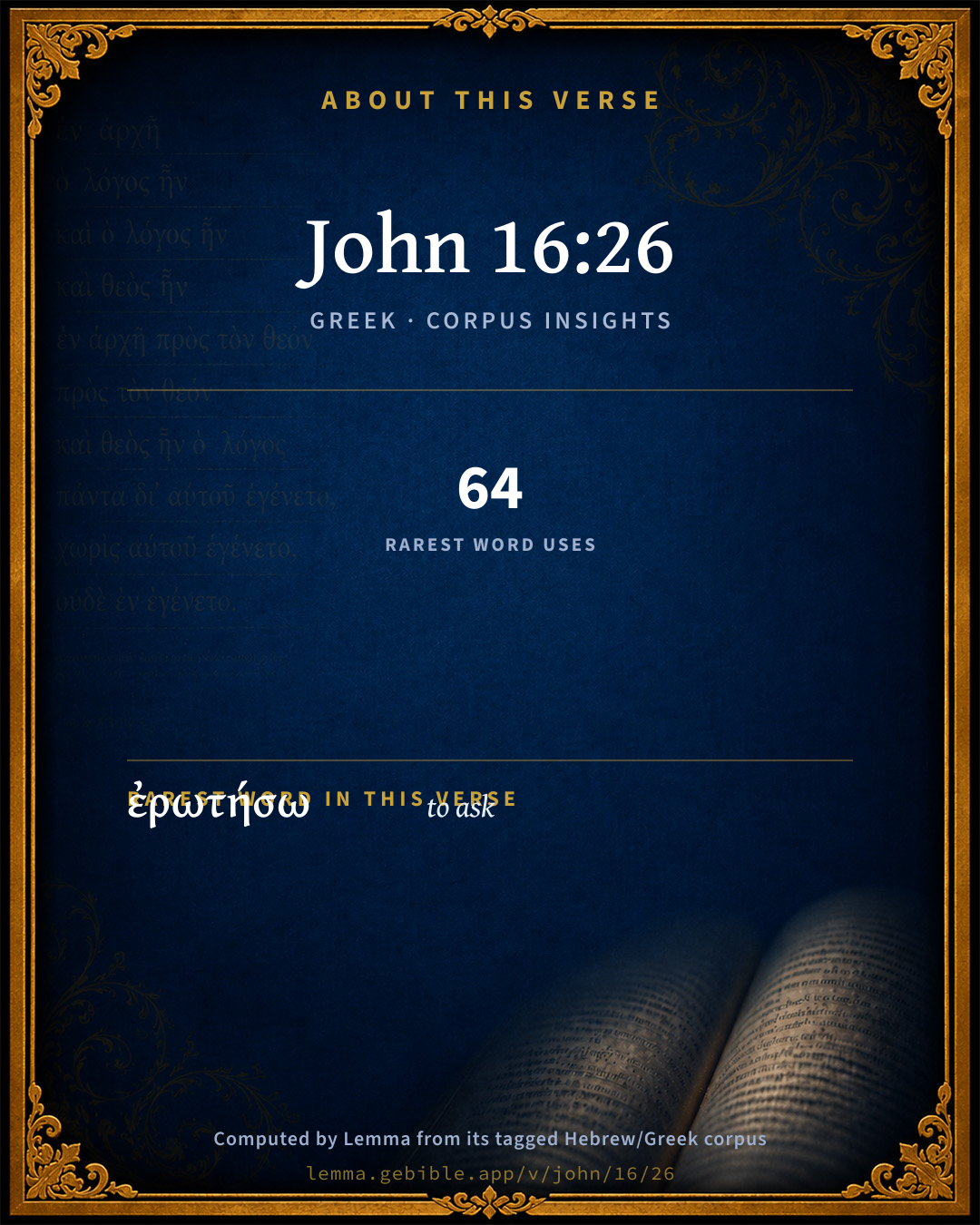
ἐρωτήσω
erōtáō
G2065
“to ask”
Verb, Future, Active, Indicative, 1st person, Singular
Part of Speech
Verb
Tense
Future
Voice
Active
Mood
Indicative
Person
1st person
Number
Singular
Full Thayer's Definition

Origin: apparently from G2046 cf G2045

TDNT: 13:25,3

1. to question 2. to ask a. to request, entreat, beg, beseech
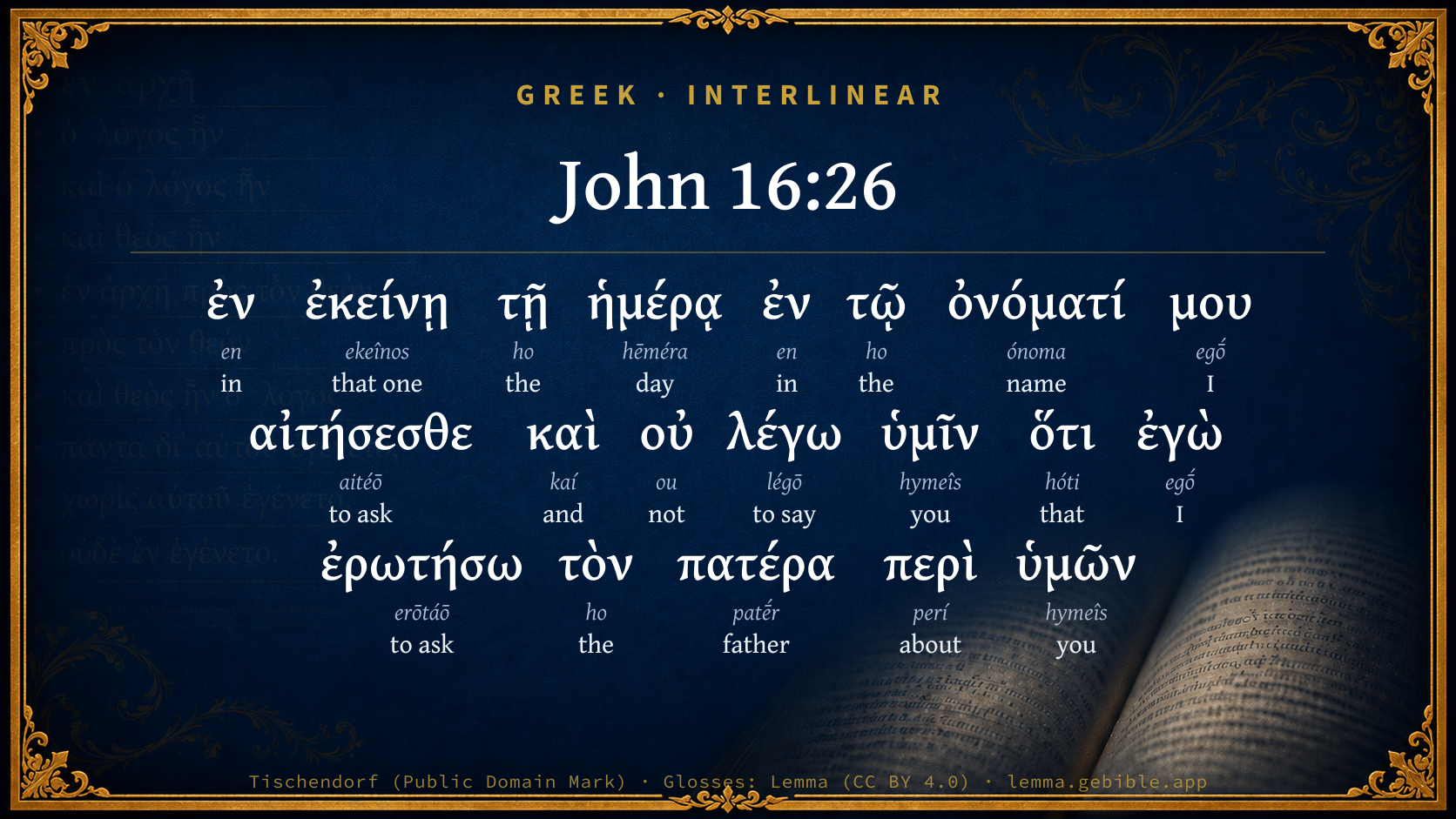
  1. ἐν en G1722 “in” Preposition
  2. ἐκείνῃ ekeînos G1565 “that one” Demonstrative pronoun, Dative, Singular, Feminine
  3. τῇ ho G3588 “the” Article, Dative, Singular, Feminine
  4. ἡμέρᾳ hēméra G2250 “day” Noun, Dative, Singular, Feminine
  5. ἐν en G1722 “in” Preposition
  6. τῷ ho G3588 “the” Article, Dative, Singular, Neuter
  7. ὀνόματί ónoma G3686 “name” Noun, Dative, Singular, Neuter
  8. μου egṓ G1473 “I” Personal pronoun, 1st person, Genitive, Singular
  9. αἰτήσεσθε aitéō G154 “to ask” Verb, Future, Middle, Indicative, 2nd person, Plural
  10. καὶ kaí G2532 “and” Conjunction
  11. οὐ ou G3756 “not” Particle, Negative
  12. λέγω légō G3004 “to say” Verb, Present, Active, Indicative, 1st person, Singular
  13. ὑμῖν hymeîs G5210 “you” Personal pronoun, 2nd person, Dative, Plural
  14. ὅτι hóti G3754 “that” Conjunction
  15. ἐγὼ egṓ G1473 “I” Personal pronoun, 1st person, Nominative, Singular
  16. τὸν ho G3588 “the” Article, Accusative, Singular, Masculine
  17. πατέρα patḗr G3962 “father” Noun, Accusative, Singular, Masculine
  18. περὶ perí G4012 “about” Preposition
  19. ὑμῶν hymeîs G5210 “you” Personal pronoun, 2nd person, Genitive, Plural

About this verse

These counts appear in no published source. They are computed here, from the morphology-tagged text and Lemma’s own curated glosses. What Lemma adds →

20
words
15
distinct lemmas
Gospels
section

Repetition

Words recur within this verse:

Cross-references

6

Topical passages linked to John 16:26 in the Treasury of Scripture Knowledge — connected by theme and wording, ordered by reader-vote popularity; previews shown in the World English Bible.

  • Romans 8:34 Who is he who condemns? It is Christ who died, yes rather, who was raised from the dead, who is at the right hand of God, who also makes intercession for us.
  • John 17:9 I pray for them. I don't pray for the world, but for those whom you have given me, for they are yours.
  • John 17:19 For their sakes I sanctify myself, that they themselves also may be sanctified in truth.
  • John 17:24 Father, I desire that they also whom you have given me be with me where I am, that they may see my glory, which you have given me, for you loved me before the foundation of the world.
  • John 14:16 I will pray to the Father, and he will give you another Counselor, that he may be with you forever,--
  • John 16:23 "In that day you will ask me no questions. Most assuredly I tell you, whatever you may ask of the Father in my name, he will give it to you.

Cross-references courtesy of OpenBible.info (CC BY 4.0).

Commentary

Notes on John 16:26 from classic Christian and Jewish commentators (each source and its license shown beneath its notes). The classic Christian expositions comment on the surrounding passage and are grouped to its opening verse, so a note may address several verses; the Jewish commentaries on the Tanakh (Rashi and others) are per-verse, so they appear only where the commentator wrote on this verse.

Lemma curates 59 commentaries, every one of them public domain or Creative Commons licensed, each selected and text-cleaned for this edition rather than reprinted as found. About our sources →

The Biblical Illustrator

Joseph S. Exell

Joh_16:26-27

I say not unto you that I will pray the Father for you

No need of an intercessor

Our Lord would teach that the Father is ready to receive our petitions directly, because He loveth us.

We have here

I. A NEW CONCEPTION OF GOD.

1. New to the Jew with his elaborate sacrificial and mediatorial scheme.

2. New to us who, conscious of sin and of Gods anger against it, could never have hoped that He would view us in any other light but that of aliens.

II. THE ANXIETY OF OUR HEAVENLY FATHER TO ESTABLISH AND MAINTAIN CLOSE RELATIONS WITH HIS CHILDREN. The mediation of Christ is a means to the end of bringing us to God (1Pe_3:18).

III. THE ERROR OF MULTIPLYING THE MEDIATIONS BETWEEN THE SOUL AND GOD. Remove God afar off, confine Him to the heavens, then priests mediating for men, and saints mediating for priests, is rational; but how does it comport with this saying and the whole teaching of Scripture, which reveals a God dwelling in the heart, and jealous of everything that comes between Him and the soul He has redeemed.

IV. THE COMFORTABLE BELIEF THAT CHRIST MAKES INTERCESSION FOR US. Christ does not decline to pray for us. He only makes known Gods willingness to hear us directly. But all the while we know He ever liveth to make intercession for US. (H. M. Jackson.)

The intercession of Christ

1. In three passages from the Epistles, we find a notable consensus of statement on the present work of Christ as our Intercessor. St. John lays stress on the basis of this advocacy; it is His own personal righteousness and His propitiatory atonement. St. Paul makes intercession the climax of that splendid series of facts on which reposes the safety of a believer: Christ not only died and rose, He even ascended to the Fathers side, and there, says he, He also maketh intercession. In the Epistle to the Hebrews, emphasis lies on the ceaselessness of that intercession, which is offered not by a mortal priest, but by One who ever liveth, and whose priesthood is unchangeable.

2. How admirably all this fits into the wants of our nature! Even had there been no sin to be dealt with, humanity might have found its way to the Father best through a mediator. As it is, not without some reconciling Go-between to act for him and to speak for him, does the criminal venture to approach his Judge. Even after we know that satisfaction has been made, there still remain the hesitation and the awe of conscious unworthiness. Now, the appropriate and very tender response which God has given to this reserve on our part is the Divine Man. The awful fact of incarnation creates at once a Spokesman, into whose ear we need have less fear to whisper our confessions or our needs, and whose lips are clean enough to speak for us to the Father.

3. But while Christs advocacy for us is a valuable part of His mediation and a comfort to timid petitioners, it is exposed to misconception. Jesus is our priestly Suppliant, who entreats mercy on the ground of His sacrifice; our Advocate, who represents our case to the Judge; our powerful Patron, who moves the Father to do at His instance what He would not do for our deserving. The first of these modes of representing the intercession is biblical and harmless. The others suggests false associations. In Asiatic states, and even under Roman law, patronage was nearly everything. To get some one in high position or close friendship with the judge to speak for you, was, as it still is in the East, the only line of safety. It is plain that where mens minds were steeped in associations of this description, it would be natural to transfer similar ideas to the Divine Advocate in heaven. What a miserably false conception this suggests of the Divine character! How it reduces the righteous and impartial God to the weakness of a corruptible earthly sovereign! How it makes the Saviours plea a plea not of equity addressed to righteous love, but of affection addressed to the indulgence of partiality! It splits the Divine character in two, and apportions its features between the First and Second of the blessed Persons, and gathers into the remoter Father, at whose judgment-seat Jesus pleads, all the sterner attributes of anger, rigorous justice, and hardness to be won: while Jesus Christ become the placable and gentle Friend, on whose good offices, with His Father, we have to build our hope.

4. Any one who is familiar with the popular working of Catholicism in modern times will know how, in the Church of Rome, this process has gone even a step further. Having thrust back the Son into the Fathers supposed place, the Church has consistently thrust Mary in the Sons. For all practical purposes of religious worship, or pious hope, Christs mother is now the benignant patroness, to whose maternal persuasions the soul may trust for final mercy. Nay, this generation of Catholics has begun to carry the process one step further still. Since Mary was declared to be immaculate, the Catholic heart seeks now an intercessor with the Virgin. Joseph must plead now with the awful mother, that she may plead with her more awful Son. Horrible as all this sounds in a Protestant ear, yet it is possible to say, Jesus, pray for us! and mean what is quite as dishonouring to the infinite charity of the Godhead, as though we said, Mary, pray for us! or Joseph, pray for us! If the intercession which we solicit means in either case the extorting of boons from an unwilling hand, then the one conception is just as heathenish and unscriptural as the other.

5. None of the apostolic writers has been led to say one word to guard against an abuse so monstrous, but their far-sighted Master had before protested against it by anticipation, in the text which was spoken only a few minutes before He lifted up His voice in that wonderful intercession, and that lest the apostles should suppose the Fathers love to be in the least inferior to His own, or to need any prompting from Him. It was the special work of Jesus to discover to us, not Himself, but His Father; or Himself only as the Incarnate image of His Father. As this was His business, so, being a true Son, it was also His delight. What vexed Him was that the disciples would not, or could not, look through and past Himself to the Greater One, whose Image and Messenger He was. Hence there grew up in Him a consuming anxiety that men would honour the Father, and an alarm lest they should be led to think less of the Fathers love than of His own. This alarm it is which finds vent in the text.

6. How, then, are we to represent to ourselves the intercession of Christ while guarding the spontaneous love of the Father? Take the case of a guilty penitent who approaches the Divine seat for pardon. He is certain that the heart of God is as the heart of a father. He knows, therefore, that the Father Himself loves him, and of His own accord will bend a favourable ear to his request. But he is no less certain that pardon is a judicial act on the part of God, an act which He can only do in consideration of previous satisfaction for sin. The guilty petitioner, therefore, approaches with his mind full of the Atonement, recognizing in it the supreme generosity of God clearing away every obstacle to his forgiveness, and he begs for the Fathers mercy in the name of Jesus. Let him now be told that Jesus Himself is to be thought of as a priestly Advocate by the Fathers side, to sustain each earthly cry for mercy with the plea of His own finished atonement. What does the petitioner learn from that? That the Father cares less about forgiving him than the Son? That forgiveness is not only to be wrung through personal interest? No, but this--that the judicial basis on which the righteous Father can grant the pardon which He longs to grant is now for ever present to the Fathers mind, and for ever avails to sustain the sinners plea for mercy. (J. O. Dykes, D. D.)

The Father Himself loveth you because ye have loved Me

The Fathers love

I. ITS NATURE. It is

1. A redeeming love. God so loved the world, &c.

2. A calling love. No man cometh unto Me except the Father draw him.

3. An adopting love. Behold what manner of love, &c.

4. A protecting love. Babes, children, want guardian care, Can a mother forget, &c.

5. A sanctifying love. As we all desire to see our children grow, so our Father desires to see us grow in grace. Whom the Lord loveth, He chasteneth.

6. An everlasting love (Joh_16:31.).

II. ITS CLAIMS. My Son, give Me Thy heart. God claims our

1. Supreme love--a love of Him above every creature whatsoever.

2. Practical love (Joh_14:21; 1Jn_3:18).

3. Expansive love. It must embrace all Gods family for His sake. Apply this in the way of

(1) Remonstrance.

(2) Encouragement. (Bp. Montagu Villiers.)

Mutual love

We have here

I. AN AMIABLE CHARACTER. The saints love is the love of

1. Of a debtor to his surety.

2. One friend to another.

3. A brother.

4. A wife to her husband.

5. A scholar to his teacher.

6. A servant to his master.

7. A loyal subject to his king.

II. A DISTINGUISHING PRIVILEGE.

1. Gods love to us is prior to our love to Christ.

2. Our love to Christ is not the cause but the effect of Gods love to us.

3. Gods love to us is infinitely superior to our love to Christ.

4. Though Gods love is the same to all the saints, yet the manifestations of it are not so.

Conclusion:

1. Serious self-examination, Lovest thou Me.

2. Subjects for astonishment, gratitude and praise. (B. Beddome, M. A.)

Going to God through Christ

Did you ever observe the difference there sometimes is between father and mother, in regard to gaining the confidence and affection of their children? Here are two equally good parents, but they are very diverse in their dispositions, and the children make an election of one of them in preference to the other. The father is great-hearted and noble, but rugged, firm, stern, and inflexible; and the children do not like to climb up the steep sides of his disposition. If they are in trouble, they say, Do not let us go to father first: let us go to mother first, and she will tell it to father. It is a level, grassy, flowery slope to her heart, and the children go to her first because she receives them so kindly. If they want to go to the father, they go to him through her. Now I think it is exactly so in respect to going to God the Father, through Christ, regarded as a Being characterised by love and tenderness and pity and sympathy; but all the gentle elements of disposition which we see displayed in men--only in Him they exist in a state of glorious perfection, while in us they are but imperfectly developed. He invites us to come to Him with our troubles and sorrows, and we feel drawn to Him because He is so placable and, we may say, so persuadable--though no man ever did persuade Christ. No tears or implorations ever persuaded Him. He never was persuaded by anything. There never was a time when His mercy was not ahead of our requests. When a heart comes to Him asking for a blessing, quicker than a flash of lightning the thought of God leaps to the conclusion of mercy. When we plead for the smallest favour, which in His wisdom He sees that we need, before we have half done our prayer, He has granted it. He is always ahead of us in this way. Do you not see such things among men? (H. W. Beecher.)

The love of God

Mary, said a missionary to a pious woman, a negro--Mary, is notthe love of God wonderful? Massa, me no tink it so wonderful, she replied; its just like Him.

The love of God

A mother, whose daughter had behaved very badly, and at length had run away from home, thought of a singular plan in order to find the wanderer and draw her back to her home. After having exhausted the ordinary means, she had her own portrait fixed on a large handbill, and pasted on the walls of the town where she supposed her daughter to be concealed. The portrait, without name, had these words--I love thee always. Crowds stopped before the strange handbill, trying to guess its meaning, Days elapsed, when a young girl at last passed by, and in her turn, lifted her eyes to the singular placard. Can it be? Yes, truly it is the picture of my mother. Those eyes full of tenderness, I know them from childhood. Why is it here? She approaches nearer and reads, I love thee always. She understood; this was a message for her. Her mother loved her--pardoned her. Those words transformed her. Never had she felt her sin or ingratitude me deeply. She was unworthy of such love. She loves me always, she cried. If she had ever doubted that love, if in moments of distress she had feared to return home, those doubts were all gone now. She set out for the house of her mother; at last she crosses the threshold, is in her mothers arms. My child! cried the mother, as she presses her repentant daughter to her heart; I have never ceased to love thee. (La bonne Nouvelle.)

The Biblical Illustrator, edited by Joseph S. Exell (c. 1880s–1900s) — public domain. Text from a community e-Sword module.

Tyndale Open Study Notes

Tyndale Open Resources

16:26-27 After Jesus’ resurrection, the Spirit brought intimacy, allowing individual disciples to ask the Father to meet their needs. (14:23).

Tyndale Open Study Notes — © Tyndale Open Resources, licensed CC BY-SA 4.0. Text via the HelloAO Bible API.

Bengel's Gnomon

Johann Albrecht Bengel

Joh 16:26. Ὀνόματι, in My name) knowledge of God [which they were to have in that coming day] produces prayer.—οὐ λέγω, I do not say [I say not]) comp. οὐ λέγω, 1Jn 5:16, where, I do not say, is similarly used for, I say that He is not to, etc.; a courteous (i.e. expressive of affection) and Attic mode of expression. Jesus declares that the love of the Father needs not then, as if for the first time, be conciliated for them by His request, so as that they should be heard. It is rather owing to the very fact that they belonged to the Father, that now He makes request for them: ch. Joh 17:9, “I pray for them, whom Thou hast given Me, for they are Thine.”[367]

[367] In this verse we have αἰτήσεσθε used of the disciples’ prayer, ἐρωτήσω, of Jesus’ request. Ἐρωτάω, rogo, interrogo (see note, ver. 23) implies a certain equality in the asker, as of king with king (Luk 14:32), or at least familiarity. Jesus never in the New Testament uses αἰτεῖν of Himself, which would mean the petition of a creature, but ἐρωτῶ, which implies the request of an equal—of the Son to the Father. Ἐρωτῶ is therefore never used in the New Testament of the prayer of man to God. See Trench Syn. N. T.—E. and T.

Bengel's Gnomon of the New Testament — English translation (T&T Clark, Edinburgh, 1860) — public domain. Text from a community e-Sword module.

Meyer's Critical & Exegetical Commentary

Heinrich August Wilhelm Meyer

Joh_16:26-27. Ἐν ἐκ τ. ἡμ. ἐν τῷ ὀν. μ. αἰτήσ.] Because enlightened by the Paraclete. Comp. Joh_16:24. Bengels remark is apt: Cognitio parit orationem, and that the prayer to be heard in the name of Jesus.[183]

ΚΑῚ Οὐ ΛΈΓΩ, Κ.Τ.Λ.] and I say not, etc.; I would therewith promise something for that coming time that may be dispensed with. For on my part (ἐγώ) an intercession on your behalf in order to the hearing of these your prayers will not at all be needed, because, that is, they are just prayers in my name (see on Joh_14:14). The opposite meaning is deduced by Aretius, Grotius, Wolf, Rosenmüller, Kuinoel: that οὐ λέγω ὑΜ. means: I will not mention at all, so that the intercession is thus designated as a matter of course. Against this the following αὐτὸς γὰρ, κ.τ.λ., is decisive. There is no contradiction, however, with Joh_14:16, Joh_17:9, since in these places the intercession of Christ belongs to the time prior to the communication of the Paraclete.

αὐτός] ipse, from the proper divine impulse of love, without my intercessory mediation being required to that end.

φιλεῖ] amat vos, adeoque vos exaudit, Bengel. The present denotes that the future is represented as present. They have then the πνεῦμα υἱοθεσίας, Rom_8:15; Gal_4:6; along with which, however, the intercession intended in 1Jn_2:1, Heb_7:25, Rom_8:34, on the part of the exalted Jesus, is not excluded. This intercession is not required in order to the hearing of prayer, if it is made in virtue of the Spirit in the name of Jesus, but rather generally in order to the continued efficacy of the atonement on behalf of believers.

The reason of that ΑὐΤῸς … ΦΙΛΕῖ ὙΜᾶς is: ὍΤΙ ὙΜΕῖς, Κ.Τ.Λ.: for He will not thus remove Himself out of the midst, that they should pray without and exclusive of Him, Luther. Note ὙΜΕῖς ἘΜΈ: because ye are they who have loved me. πεφιλ. is placed first as the correlate of φιλεῖ; and with logical correctness, since faith, in this definiteness of development (ὍΤΙ … ἘΞῆΛΘΟΝ), could in its progress gradually unfold itself only in their loving bond to Christ, by means of the exercise and experience of this love. On the perfects, as the presents of the completed act, Bengel says, and rightly: amore et fide prehensum habetis. Hofmann, Schriftbew. II. 1, p. 543, incorrectly explains them from the standpoint of the Parousia, from which a glance is taken backwards to the love that has been borne to the close. The entire promise has nothing to do with the Parousia; see on Joh_16:16; Joh_16:22; Joh_14:18.

ἐξῆλθον] See on Joh_8:42.

[183] For thou comest not in thine own name, work, or merit, but on this, that it is announced to thee by the Holy Spirit what Gods will and command is, which He has performed through Christ, Luther.

Meyer — Critical and Exegetical Commentary on the New Testament — English translation by Peter Christie, edited by Frederick Crombie (T&T Clark, 1880) — public domain. Text from a community e-Sword module.

Expositor's Greek Testament

ed. W. Robertson Nicoll

Joh 16:26 . ἐν ἐκείνῃ τῇ ἡμέρᾳ . “In that day,” in which I shall tell you plainly of the Father (Joh 16:25 , ἔρχεται ὥρα ), “ye shall ask in my name”; this is the natural consequence of their increased knowledge of the Father. καὶ οὐ λέγω … ἐξῆλθον “And I do no say to you that I will ask the Father concerning you” περί , almost equivalent to ὑπέρ , here and in Mat 26:28 ; 1Jn 4:10 , “in relation to,” almost “in behalf of” (Joh 16:27 ) “for the Father Himself loves you, because ye have loved me, and have believed that I came forth from God”. The intention of the statement is to convey fuller assurance that their prayers will be answered. The Father’s love needs no prompting. Yet the intercession of Christ, so emphatically presented in the Epistle to the Hebrews and in Rom 8:34 , is not ignored. Jesus says: “I do not base the expectation of answer solely on my intercession, but on the Father’s love, a love which itself is quickened and evoked by your love for me”. “I do not say that I will ask” means “I do not press this,” “I do not bring this forward as the sole reason why you may expect to be heard”. The mediation of Christ has here its incidence at an earlier stage than in the Apostolic statements. The love of God is represented as intensified towards those who have accepted Christ as the revealer of the Father.

The Expositor's Greek Testament, edited by W. Robertson Nicoll (1897–1910) — public domain. Text from a community e-Sword module.

Geneva Bible (1599)

Geneva Bible translators

The sum of the worship of God, is the invocation of the Father in the Name of the Son the Mediator, who is already heard for us, for whom he hath abased himself, and is now also glorified.

Geneva Bible (1599) marginal notes — public domain. Text via Bolls.life.

Jamieson, Fausset & Brown

Robert Jamieson, A. R. Fausset & David Brown

I say not . . . I will pray the Father for you--as if He were not of Himself disposed to aid you: Christ does pray the Father for His people, but not for the purpose of inclining an unwilling ear.

Jamieson, Fausset & Brown — Commentary Critical and Explanatory on the Whole Bible (1871) — public domain (CC PDM 1.0). Text via the HelloAO Bible API.

Adam Clarke's Commentary

Verse 26. I say not unto you that I will pray the Father for you] I need not tell you that I will continue your intercessor: I have given you already so many proofs of my love that ye cannot possibly doubt this: besides, the Father himself needs no entreaty to do you good, for he loves you, and is graciously disposed to save you to the uttermost, because ye have loved me and believed in me as coming from God, for the salvation of the world.

Adam Clarke's Commentary on the Bible (1810–1826) — public domain. Text from a community e-Sword/MySword module.

John Calvin's Commentaries

26. In that day you shall ask in my name. He again repeats the reason why the heavenly treasures were then to be so bountifully opened up. It is, because they ask in the name of Christ whatever they need, and God will refuse nothing that shall be asked in the name of his Son. But there appears to be a contradiction in the words; for Christ immediately adds, that it will be unnecessary for him to pray to the Father Now, what purpose does it serve to pray in his name, if he does not undertake the office of Intercessor? In another passage John calls him our Advocate, ( 1 John 2:1.) Paul also testifies that Christ now intercedes for us, (Romans 8:34;) and the same thing is confirmed by the author of the Epistle to the Hebrews, who declares that Christ always liveth to make intercession for us, (Hebrews 7:25.) I reply, Christ does not absolutely say, in this passage, that he will not be Intercessor, but he only means, that the Father will be so favorably disposed towards the disciples, that, without any difficulty, he will give freely whatever they shall ask. “My Father,” he says, “will meet you, and, on account of the great love which he bears towards you, will anticipate the Intercessor, who, otherwise, would speak on your behalf.”

Besides, when Christ is said to intercede with the Father for us, let us not indulge in carnal imaginations about him, as if he were on his knees before the Father, offering humble supplication in our name. But the value of his sacrifice, by which he once pacified God toward us, is always powerful and efficacious; the blood by which he atoned for our sins, the obedience which he rendered, is a continual intercession for us. This is a remarkable passage, by which we are taught that we have the heart of the Heavenly Father, as soon as we have placed before Him the name of his Son.

John Calvin's Commentaries (1540-1563) — public domain. Text from the Calvin Translation Society English edition (1840s-50s) via the Christian Classics Ethereal Library (ccel.org). Calvin's coverage is partial (roughly two-thirds of the Bible); uncommented books and verses are honest gaps, never fabricated. The 19th-century editor's footnotes and remarks are omitted so the notes are faithfully Calvin's own voice.

Ellicott's Commentary for English Readers

(26) At that day ye shall ask in my name.—Comp. Notes on Joh_16:23-24. When guided by the Paraclete, the life will be subject to the will of Christ, and the prayer will be in His name.

And I say not unto you, that I will pray the Father for you.—These words have often been taken to mean, “That I will pray the Father for you, is a matter of course, of which I need not tell you; but this sense is excluded by the following verse. The thought is rather, “I do not speak of praying for you, because in the presence of the Advocate you will yourselves be able to pray in My name to the Father.” His prayer is thought of as not necessary for them, and yet the form of the words implies that He will pray for them if it should be needed. While their hearts are the temples of the Holy Ghost, and they maintain communion with the Father, they will need no other Advocate, but “If any man sin, we have an Advocate with the Father, Jesus Christ the righteous” (1Jn_2:1). Comp. Joh_14:16; Joh_17:9, which refer to the time which precedes the gift of the Holy Ghost.

A Bible Commentary for English Readers, edited by Charles John Ellicott (1878–1897) — public domain. Text from a community e-Sword module.

The Cambridge Bible for Schools and Colleges

gen. ed. J. J. S. Perowne

26. At that day] As in Joh_16:23 and Joh_14:20 from Pentecost onwards.

ye shall ask in my name] With the perfect knowledge just promised they will discern what may be asked in His name (see on Joh_14:13): ‘cognitio parit orationem.’

I say not unto you] This does not mean ‘I need not say unto you; for of course I shall do so;’ which does not harmonize with Joh_16:27. The meaning rather is, that so long as through the power of the Advocate they have direct communion with the Father in Christ’s name, there is no need to speak of Christ’s intercession. But this communion may be interrupted by sin, and then Christ becomes their Advocate (1Jn_2:1; Rom_8:34).

that I will pray] The pronoun is emphatic. On the word here rendered ‘pray’ (erôtân) see on Joh_14:16.

for you] More literally, concerning you.

The Cambridge Bible for Schools and Colleges (gen. ed. J. J. S. Perowne; Cambridge University Press, 1878–1918) — public domain. Text from a community e-Sword module.

John Gill's Exposition

I came forth from the Father,.... This is the sum of what the apostle believed, and Christ, in these discourses of his, had been speaking of. This his coming forth from the Father is to be understood, not of his eternal filiation; nor of his coming forth in a way of grace towards his own people in the council and covenant of grace and peace; nor of his constitution, as Mediator, from everlasting; but of his coming in the flesh in the fulness of time: which supposes that he was, that he existed as a divine person before; that he was with the Father before; that he came forth from him with his knowledge, mind, and will; he came not of himself, but he sent him; and yet he came willingly, was not forced, or did not come against his will: and this does not suppose any local motion, or change of place, but only intends an assumption of the human nature into unity with his divine person, who fills heaven and earth with his presence; nor any separation from his Father, with whom he was, and in whose bosom he lay when he was made flesh, and dwelt among men; nor any absence from heaven, for he was there when on earth.

And am come into the world; where he was before, as the Creator and upholder of it, by his immensity and powerful presence; this designs his coming and manifestation in the flesh, which in general was to do the whole will of God, which he in council and covenant agreed to do, and for which he came down from heaven; and in particular to preach the Gospel, call sinners to repentance, give life and light to many, and to fulfil the law, by obeying its precepts, and bearing its penalty, and both to do and suffer in the room and stead of his people, and to save lost sinners, even the chief of them.

Again, I leave the world; not that he relinquished the sustaining and government of it, as God, nor the care of his people in it, as Mediator, for whom he retains the same love as ever, and will not leave them fatherless and comfortless; nor was he leaving it as never to return more; for he will descend, in like manner he ascended, and will come a second time and judge the world in righteousness: but he was about to depart from it by death, having done the work and business for which he came about.

And go to the Father; to give an account of his work unto him, as his righteous servant, being faithful to him that had appointed him; and to transact the affairs of his people; to appear in the presence of God for them; to present their petitions, be their advocate, make intercession for them, take possession of heaven in their name, and prepare it for them; to take his place at the right hand of God in human nature, and to be glorified with the glory promised him before the world was.

John Gill's Exposition of the Whole Bible (1746–1763) — public domain (CC PDM 1.0). Text via the HelloAO Bible API.

Trapp's Complete Commentary

John Trapp

26 At that day ye shall ask in my name: and I say not unto you, that I will pray the Father for you:

Ver. 26. At that day ye shall ask, &c.] Christ had promised them further light, but yet expects they should pray for it. Prayer is a putting the promises in suit; we must pray them over ere we get the performance, Eze 36:37. Christ himself was to ask of his Father the world for his inheritance, &c., Psa 2:8;

John Trapp, A Commentary or Exposition upon All the Books of the Old and New Testament (1647–1656) — public domain. Text from a community e-Sword module.

Albert Barnes' Notes on the Bible

I say not unto you that I will pray ... - In Joh 14:16, Jesus says that he would pray the Father, and that he would send the Comforter. In John 17 he offered a memorable prayer for them. In Heb 7:25, it is said that Jesus ever liveth to make intercession for us; and it is constantly represented in the New Testament that it is by his intercession in heaven now that we obtain the blessings of pardon, peace, strength, and salvation. Compare Heb 9:24. This declaration of Jesus, then, does not mean that he would not intercede for them, but that there was no need then of his mentioning it to them again. They knew that; and, in addition to that, he told them that God was ready and willing to confer on them all needful blessings.

Albert Barnes' Notes on the Bible (1834–1885) — public domain. Text from a community e-Sword/MySword module.

Haydock's Catholic Bible Commentary

In that day ... I say not to you that I will ask the Father for you, or shall need to ask the Father for you, though I am your Redeemer, you chief Advocate and Mediator, by dying for all the world. --- For the Father himself loveth you, because you have loved me, and have believed that I came forth from God, sent to be your Redeemer. --- I came forth from the Father, both as begotten of him from all eternity; and I also came into the world, as sent from him to become man, to become the Redeemer of the world, both as God and man. Now I am going, as man, to leave the world, and go to the Father, with whom I am, and have always been, as God. (Witham)

George Leo Haydock (1774–1849), Haydock's Catholic Family Bible and Commentary, 1859 edition — public domain. Excludes Psalms (Douay-Rheims chapter numbering differs from Protestant) and Deuterocanonical books (Catholic canon only).

Matthew Poole's English Annotations

When the Spirit shall come, then you shall fully and clearly understand how to put up your prayers to the Father in my name: hitherto have you done it imperfectly, not fully understanding what you did; but when I shall have poured out my Spirit, then you shall fully understand what it is to pray in my name, and you shall accordingly do it. He doth not deny that he would ask the Father; for the Scripture elsewhere plainly expresses it, Rom 8:34; Heb 7:25; but he only tells them, that he said not so to them; the reason of which he tells us in the next words.

Matthew Poole's English Annotations on the Holy Bible (1683–1685) — public domain. Text from a community e-Sword/MySword module.

Whedon's Commentary on the Bible

Daniel D. Whedon

26. I say not… will pray—That he said at another time; but that he sets aside for the present. He will omit now to mention his own prayer to the Father for them, in view of the rich access they shall have to the Father himself.

Daniel D. Whedon (gen. ed.), Commentary on the Old and New Testaments (1874–1909) — public domain. Text from a community e-Sword module.

The Pulpit Commentary

In that day pointing to "the hour" of these open declarationsye shall ask (make petitions, not ask or demand of me, in the tone of equality) in my Name. The opportunity will come when all my Name will be appreciated by you, and your spiritual reception of me will teach you to approach the Father, who is thus revealed to you. Calvin in these verses calls attention to the familiarity of Israel with the idea of a Mediator, one by whom they drew near to God, and that Christ places himself here in the stead of the whole propitiatory service and ritual of the temple. "His Name" was the Divine equivalent of all the work of the high priest from one Day of Atonement to another and for evermore. And I do not say to you, that I will make my request to the Father concerning you (see note on erwtaw and aitew , Ver. 23, etc.). It will not do to argue, with Grotius, that this is just as if he had said, "To say nothing of my own intercessions for you," or, "You may take these for granted;" because the very next verse gives his reason for the assertion. Nor is it satisfactory to say, with Meyer, that the "prayers" of which he speaks (Joh_14:16 Joh_17:9, Joh_17:20) are before the gift of the Paraclete, and not inconsistent with the higher condition of the disciples after the Paraclete should have been given; because John had received the Paraclete when he wrote, "We have an Advocate with the Father". (1Jn_2:1) Nor can we suppose that the great utterances of Rom_8:34 and Heb_9:25 are vain imaginations, and that there is no sense in which the Lord does augment and complete our prayers, taking them upon his heart and going in his high-priestly prerogative into the holy place with his own blood; but the words must nevertheless be pressed, and their meaning held to be compatible with what Paul and John say of the" intercession of Christ." They reveal the perfect access to the Father"s heart which he has secured for his disciples, the full reconciliation effected as well as devised and consummated by the Father"s own love (cf. Eph_2:18, "By Christ we both Jew and Gentile) have access (prosagwghn) in one spirit to the Father"). The end of the whole ministry of Christ is, in the power of the Holy Ghost"s revelation of him, to bring men to the Father and let them know it. There is no need that Christ should (erwtan) make special prayer to the Father, as though he were merciful and the Father needed to be appeased towards those for whom he had prepared so great a salvation. (Rom_8:34, where Philippi, Calvin, and others show that Christ"s entugcanein is the effect of his own glorious and eternal work) His appearance in the presence of God for us is the perpetual pledge of the completeness of his sacrifice. These very passages in Hebrews and Romans have to be interpreted in harmony with this great statement of his own, viz. that there is no reason to ask the Father concerning them; all has been asked and answered, the intercession is complete; his whole work will have reconciled the Father with his children, and that by reason of the Father"s own love.

Vers. 26, 27. The Father"s love.

The time here referred to must be the dispensation of the Holy Spirit. A great purpose of the gift of the Comforter and the establishment of the Church on earth was that a new, intimate, and happy relation might be constituted uniting the eternal God by personal and spiritual bonds to those who, made in his image, should become by grace partakers of his character.

I THE OBJECTS OF THE FATHER"S LOVE. The description given of such as the Father regards with affection is very definite and very instructive.

1. They are those who love Christ. Undoubtedly, the apostles, to whom these words were originally spoken, did love their Master; events proved the sincerity of their attachment. Yet this qualification is one which may exist in those who have not seen Jesus in the body, but only with the eye of faith. Christians, who are such in reality and not merely in name, cherish a warm and grateful affection towards the Son of God, who himself loved them and bought them with his precious blood. Their love does not evaporate in sentiment; it displays itself in their reception of his doctrine, their obedience to his commands, their imitation of his holy example.

2. They are those who believe in Christ"s Divine mission. If any man thinks of Christ as of One who is "of the earth," who is a merely human development, who has no special and Divine authority to save and to rule, such a one is not described in this language, and shuts himself out from the blessing which is accessible. But he who thinks of Jesus as of the Being who came forth from the Father, commissioned and equipped by the Father to be the Savior of men, and who not only thinks of him aright, but acts towards him in such a way as this belief authorizes, he may be encouraged to regard himself as the object of the Divine Father"s love. Thus love and belief are both necessary. In this passage love takes precedence; but some belief concerning Christ must come before love, though unquestionably the loving soul learns to believe more richly and fully concerning the Divine, incomparable Friend.

II THE CHARACTER OF THE FATHER"S LOVE.

1. It originates in his benevolent nature. His love is not caused by ours. "We love him, because he first loved us." But the love of Divine pity revealed in Christ enkindles the flame of love upon our hearts.

2. It manifests itself in the mediation of the Son. The love of God is not caused by the intercession of our Divine Advocate and Representative.

3. It is, towards these who believe in Christ, the love of satisfaction and complacency. Beginning (if we may use language so human) with pity, the Divine love goes on to approval. The Father recognizes in the friends and followers of Christ the same moral features and expressions which he looks upon with delight in his Son. This is a view of God which is eminently and distinctively Christian. The God whom we worship is a God who can love man, whose love flows forth in streams of compassion towards all men, but whose favor is revealed to those who display moral sympathy with his own beloved Son.

III THE PROOF OF THE FATHER"S LOVE.

1. The objects of this Divine affection are encouraged to ask for what they need from him who is able to supply their many and varied wants. What greater evidence can there be of fatherly and filial feeling than when a son is at liberty to prefer requests to a parent who has confidence in his child and has the means of satisfying and of pleasing him? Such are the relations between the heavenly Father and those whom he adopts into his family.

2. The spontaneous disposition of the Father is to grant the requests of his children. This language casts light upon the Scripture doctrine of intercession. Christ is the Advocate with God, but his advocacy does not consist in persuading an unwilling Deity to relent from his severity and to act with generosity. On the contrary, the advocacy is the appointment of Divine love and the channel of Divine favor. Christ does not mean that he will not pray the Father for us; but that this fact of intercession is not the point upon which he is now dwelling. He is anxious that his friends should understand that the Father"s love is free, that his liberality is such as to secure to his Son"s friends the enjoyment of all good. And, as a consequence, every Christian is encouraged to bring his petitions to God, in the Name of Christ indeed, yet with the assurance that there is now nothing on the part of the Father to hinder the bestowal of all needed and desirable blessings. T.

The Pulpit Commentary (1880–1919), ed. H.D.M. Spence-Jones & Joseph S. Exell — public domain. Text from a community e-Sword module.

John Wesley's Explanatory Notes

At that day ye shall ask - For true knowledge begets prayer. And I say not that I will pray - This in nowise implies that he will not: it means only, The Father himself now loves you, not only because of my intercession, but also because of the faith and love which he hath wrought in you.

John Wesley, Explanatory Notes Upon the Whole Bible (1754–1765) — public domain. Text via the GEBible commentary corpus.

Burkitt's Expository Notes on the New Testament

William Burkitt

At that day ye shall ask in my name; that is, after I have ascended into heaven, and have sent down the Holy Ghost upon you, you shall put up all your prayers and requests to God in my name; And I say not that I will pray the Father for you, for the Father himself loveth you; that is, I need not tell you (though I shall certainly do it) that I will intercede with the Father for you, for he of himself is kindly disposed and affected towards you for my sake.

When Christ says, I do not say that I will pray the Father for you, the meaning is not that he will lay aside his office as intercessor for believers, but that they had not only his intercession, but the Father’s love, upon which to ground their hope of audience.

Learn hence, 1. That the Christian’s prayers, put up in Christ’s name, cannot fail of audience and acceptance for the sake of the Mediator’s intercession and the Father’s love.

2. That in our prayers we ought so to eye and look up to Christ’s intercession, as not to overlook and forget the Father’s love, but ground our hopes of audience upon both; I say not that I will pray the Father for you, though I shall assuredly do it, for the Father himself loveth you, because ye have loved me.

William Burkitt's Expository Notes on the New Testament (1700–1703) — public domain. Text from a community e-Sword module.

unfoldingWord translationNotes

Door43 World Missions Community

you will ask in my name

Here "name" is a metonym for the person and authority of Jesus. AT: "you will ask because you belong to me" (See: Metonymy)

the Father himself loves you because you have loved me

When a person loves Jesus, the Son, they also love the Father, because the Father and Son are one.

Father

This is an important title for God. (See: Translating Son and Father)

I came from the Father ... I am leaving the world and I am going to the Father

After his death and resurrection, Jesus will return to God the Father.

I came from the Father ... going to the Father

Here "Father" is an important title for God. (See: Translating Son and Father)

world

The "world" is a metonym that refers to the people who live in the world. (See: Metonymy)

translationWords

pray

God the Father

love

believe

world

unfoldingWord translationNotes — © Distant Shores Media and the Door43 World Missions Community, licensed CC BY-SA 4.0. Source: git.door43.org/Door43/en_tn.

Cambridge Greek Testament for Schools and Colleges

26. With the perfect knowledge just promised they will discern what may be asked in His name (see on Joh 14:13): cognitio parit orationem. The οὐ λέγω does not mean ‘I need not say, for of course I shall do so;’ which does not harmonize with Joh 16:27. The meaning rather is, that so long as through the power of the Advocate they have direct communion with the Father in Christ’s name, there is no need to speak of Christ’s intercession. But this communion may be interrupted by sin, and then Christ becomes their Advocate (1Jn 2:1; Rom 8:34). Note the emphatic ἐγώ. On ἐρωτᾶν see on Joh 14:6.

Cambridge Greek Testament for Schools and Colleges (Cambridge University Press, 1896; 21 vols, various authors incl. Carr, Maclear, Plummer, Farrar, Lumby, Moule, M. R. James, Simcox) — public domain. Text from a community e-Sword module.

Alford’s Greek Testament

Henry Alford

26.] “The more knowledge, the more prayer in the name of Jesus,” Lücke. “Cognitio parit orationem,” Bengel. The approaching the Father through Him shall be a characteristic of their higher state under the dispensation of the Spirit.

οὐ λέγω ὑμ.] This has been variously understood. Grotius’s rendering, “prætereo hoc quasi minus eo quod jam inferam,” comes I believe the nearest to the truth, though it does not express the whole meaning. The Lord is now describing the fulness of their state of communion with Himself and the Father by the Spirit. He is setting in the strongest light their reconciliation and access to the Father. He therefore says, Ye shall ask the Father in My name: and I do not now say to you,—I do not now state it in this form,—that I will ask the Father for you—as if there were no relation of love and mercy between the Father and yourselves:—(27) for the Father Himself (αὐτός, i.e. αὐτοκέλευτος (Nonnus)—‘proprio motu’) loveth you;—why? Because ye love and believe on Me.

The whole mind of the Father towards mankind is Love: both in Redemption itself (ch. 3:16),—and then in an especial manner by drawing those who come to Christ (6:44),—and again by this fuller manifestation of His love to those who believe on and love Christ. The aim of this saying is to shew them that His intercession (which is still going on under the dispensation of the Spirit, 1Jn 2:1) does not imply their exclusion from access to the Father, but rather ensures that access, by the especial love which the Father bears to them who believe in and love His Son: Christ being still the efficient cause of the Father’s love to them, and the channel of that Love.

No stress must be laid (Lücke) on πεφιλήκατε here coming before πεπιστεύκατε, as to Faith coming after Love: probably πεφιλ. is placed first as corresponding to φιλεῖ just before:—and it might be said with just as much reason that καὶ πεπιστεύκατε … contains the ground of the πεφιλ, as the converse.

Henry Alford, The Greek Testament (1849–1861) — public domain. Text from a community e-Sword module.

International Critical Commentary

26. ἐν ἐκείνῃ τῇ ἡμέρᾳ (see on v. 23) ἐν τῷ ὀνόματί μου αἰτήσεσθε (see on 15:16 for this phrase). With the coming of the Paraclete, the doctrine of the Fatherhood of God as revealed in Christ would be better understood. They would know more of God as Father, and so would be bolder and more ambitious in prayer (cf. 1Jn 5:14 αὕτη ἐστὶν ἡ παρρησία ἣν ἔχομεν πρὸς αὐτόν, ὅτι ἐάν τι αἰτώμεθα κατὰ τὸ θέλημα αὐτοῦ, ἀκούει ἡμῶν). Cognitio parit orationem (Bengel).

καὶ οὐ λέγω ὑμῖν ὅτι ἐγὼ ἐρωτήσω τὸν πατέρα περὶ ὑμῶν, “I do not say to you that I will entreat the Father for you” (see for ἐρωτᾷν on 11:22, 16:23), because in the dispensation of the Spirit prayer in the Name of Jesus does not fail to reach the Father and to receive its answer. The prayers of those who are “in Christ,” and offered “in His Name,” are virtually His prayers. Before the Coming of the Spirit He did pray for His disciples (14:16, 17:9, 15, 20), but here the thought is of the ideal disciple after the Spirit has descended. This does not exclude the perpetual intercession of Jesus for sinful disciples; ἐάν τις ἁμάρτῃ, παράκλητον ἔχομεν πρὸς τὸν πατέρα, Ἰησοῦν Χριστὸν δίκαιον (1Jn 2:1; cf. Rom 8:34, Heb 7:25). But the true disciple is encouraged to be bold in prayer for himself, and the reason why he may be bold is now stated.

International Critical Commentary — older volumes (1896–1929), various authors — public domain. Text from a community e-Sword module.

Vincent's Word Studies in the New Testament

Marvin R. Vincent

Ye shall ask - I will pray. Note again the use of the two verbs for asking. Ye shall ask [αιτησεσθε] ; I will pray [ερωτησω] . See on ver. 23.

Marvin R. Vincent, Word Studies in the New Testament (1887–1900) — public domain. Text from a community e-Sword/MySword module.

Lesson kit

Teaching starters — assembled from the data on this page, not authored interpretation. Every prompt links to the verse data it draws on. Edit before teaching.

John, in the Gospels, opens this verse with 20 words (15 distinct Greek lemmas). Its most distinctive word is erōtáō (“to ask”). A historical commentator’s framing appears above. Read the whole chapter for the surrounding context.

Discussion questions

  1. What does “to ask” (erōtáō) contribute to the verse as a whole?
  2. Romans 8:34 shares this passage’s theme. How do the two illuminate each other?
  3. “the” occurs 3× in this one verse. What is the effect of the repetition?
  4. These translations render this verse differently. What is at stake in choosing one wording over another?
  5. Reading how The Biblical Illustrator and Tyndale Open Study Notes read this verse, where do the two commentators agree and where do they part?

Things to notice

Reading settings

Reading text

Shown beneath each verse's original-language words.

Old Testament
Old Testament edition

Read the OT as the Masoretic Hebrew (MT) or the Greek Septuagint (LXX).

English shown for the Greek Septuagint (in the Hebrew ↔ Greek comparison).

Comparing translations? Open the Compare panel on any verse page to stack up to four side by side.