Matthew 27:63

Greek (Tischendorf 8th ed.) Matthew 27:63 appears in the Greek New Testament. The text above is from the Tischendorf 8th edition. Each word links to its Strong’s number and a concise gloss. Click any word for its full Thayer’s Greek Lexicon entry.
Download image
Cite this verse

Matthew 27:63 (World English Bible). Public Domain. Lemma interlinear Bible study tool, https://lemma.gebible.app/v/matthew/27/63.

Show BibTeX & RIS
BibTeX
RIS
English Translation
saying, "Sir, we remember what that deceiver said while he was still alive: 'After three days I will rise again.'
World English Bible · Public Domain
Highlights
  • 1 first appearance in the Greek New Testament
Full analysis ↓
Download a study sheet

One document with this verse’s original text, its word-by-word gloss line, the meaning frame, cross-references with their text, attributed commentary, and full source and license credits — printable, and it pastes into notes with its structure intact.

This verse Autodidact and up

Study sheet (.html) Plain text (.txt)

A passage Seminary Student

Up to 50 verses in one chapter. A passage sheet keeps up to 6 commentary sources and 12 cross-references per verse, in the order this page ranks them, and says so on the sheet whenever that leaves anything out. Ask for a single verse and you get the Autodidact verse sheet above.

Everything on this page stays free to read, with no account — the sheet is a download of what is already on screen, not access to it.

Want to remove ads? Support Godless Engineer
Compare translations 3

The same verse in 3 English versions, stacked beneath the original-language interlinear above. Click any original word for its lexicon entry.

Each is an independent rendering of the whole verse — the interlinear is not word-aligned to these translations.

Highlighted words mark where these versions differ — a whole-verse word diff, not a word-by-word alignment.

  • World English Bible Public Domain
    saying, "Sir, we remember what that deceiver said while he was still alive: 'After three days I will rise again.'
  • King James Version Public Domain
    Saying, Sir, we remember that that deceiver said, while he was yet alive, After three days I will rise again.
  • unfoldingWord Literal Text CC BY-SA 4.0
    saying, “Lord, we remember that that deceiver said, still living, ‘After three days I am being raised up.’

unfoldingWord Literal Text — © unfoldingWord, licensed CC BY-SA 4.0. Word-aligned USFM3 via Door43 (git.door43.org/unfoldingWord/en_ult).

Versions to compare (up to 4)

3 of 4 selected

Show all 19 translations

Every available English version of this verse, each an independent rendering of the whole verse.

  • World English Bible Public Domain
    saying, "Sir, we remember what that deceiver said while he was still alive: 'After three days I will rise again.'
  • Berean Standard Bible Public Domain
    “Sir,” they said, “we remember that while He was alive that deceiver said, ‘After three days I will rise again.’
  • Majority Standard Bible Public Domain
    “Sir,” they said, “we remember that while He was alive that deceiver said, ‘After three days I will rise again.’
  • King James Version Public Domain
    Saying, Sir, we remember that that deceiver said, while he was yet alive, After three days I will rise again.
  • American Standard Version (1901) Public Domain
    saying, Sir, we remember that that deceiver said while he was yet alive, After three days I rise again.
  • Revised Version (1885) Public Domain
    saying, Sir, we remember that that deceiver said, while he was yet alive, After three days I rise again.
  • Geneva Bible (1599) Public Domain
    And said, Syr, we remember that that deceiuer saide, while he was yet aliue, Within three dayes I will rise.
  • Douay-Rheims (1899) Public Domain
    Saying: Sir, we have remembered, that that seducer said, while he was yet alive: After three days I will rise again.
  • Young's Literal Translation Public Domain
    saying, `Sir, we have remembered that that deceiver said while yet living, After three days I do rise;
  • Literal Standard Version CC BY-SA 4.0
    saying, “Lord, we have remembered that this deceiver said while yet living, After three days I rise;
  • Unlocked Literal Bible CC BY-SA 4.0
    They said, “Sir, we remember that when that deceiver was alive, he said, 'After three days will I rise again.'
  • unfoldingWord Literal Text CC BY-SA 4.0
    saying, “Lord, we remember that that deceiver said, still living, ‘After three days I am being raised up.’
  • Darby Bible Public Domain
    saying, Sir, we have called to mind that that deceiver said when he was still alive, After three days I arise.
  • World Messianic Bible Public Domain
    saying, “Sir, we remember what that deceiver said while he was still alive: ‘After three days I will rise again.’
  • Webster's Bible Public Domain
    Saying, Sir, we remember that that deceiver said, while he was yet alive, After three days I will rise again.
  • Free Bible Version CC BY-SA 4.0
    They said to him, “Sir, we recall that the imposter said while he was still alive, ‘After three days, I'll rise again.’
  • Bible in Basic English Public Domain
    Saying, Sir, we have in mind how that false man said, while he was still living, After three days I will come again from the dead.
  • Text-Critical English NT CC BY 4.0
    and said, “Sir, we remember that while he was still alive that deceiver said, ‘After three days I will rise again.’
  • Tyndale New Testament (1534) Public Domain
    and sayde: Syr we remember that this deceaver sayde whyll he was yet alyve After thre dayes I will aryse agayne.

Literal Standard Version (2020), Covenant Press — licensed CC BY-SA 4.0. Text via the HelloAO Bible API (eBible.org). Unlocked Literal Bible (unfoldingWord) — licensed CC BY-SA 4.0. Text via the HelloAO Bible API (eBible.org). unfoldingWord Literal Text — © unfoldingWord, licensed CC BY-SA 4.0. Word-aligned USFM3 via Door43 (git.door43.org/unfoldingWord/en_ult). Free Bible Version, Dr. Jonathan Gallagher — licensed CC BY-SA 4.0. Text via the HelloAO Bible API (eBible.org).

Word by word

More ways to search: Search by grammar → Find every occurrence → Compare this word →

Practice this passage: Drill this verse → Learn its vocabulary →

πλάνος
plános
G4108
“wandering”
Adjective, Nominative, Singular, Masculine
Part of Speech
Adjective
Case
Nominative
Number
Singular
Gender
Masculine
Full Thayer's Definition

Origin: of uncertain affinity

TDNT: 09:48,9

1. wandering, roving 2. misleading, leading into error a. a vagabond, "tramp", imposter b. corrupter, deceiver
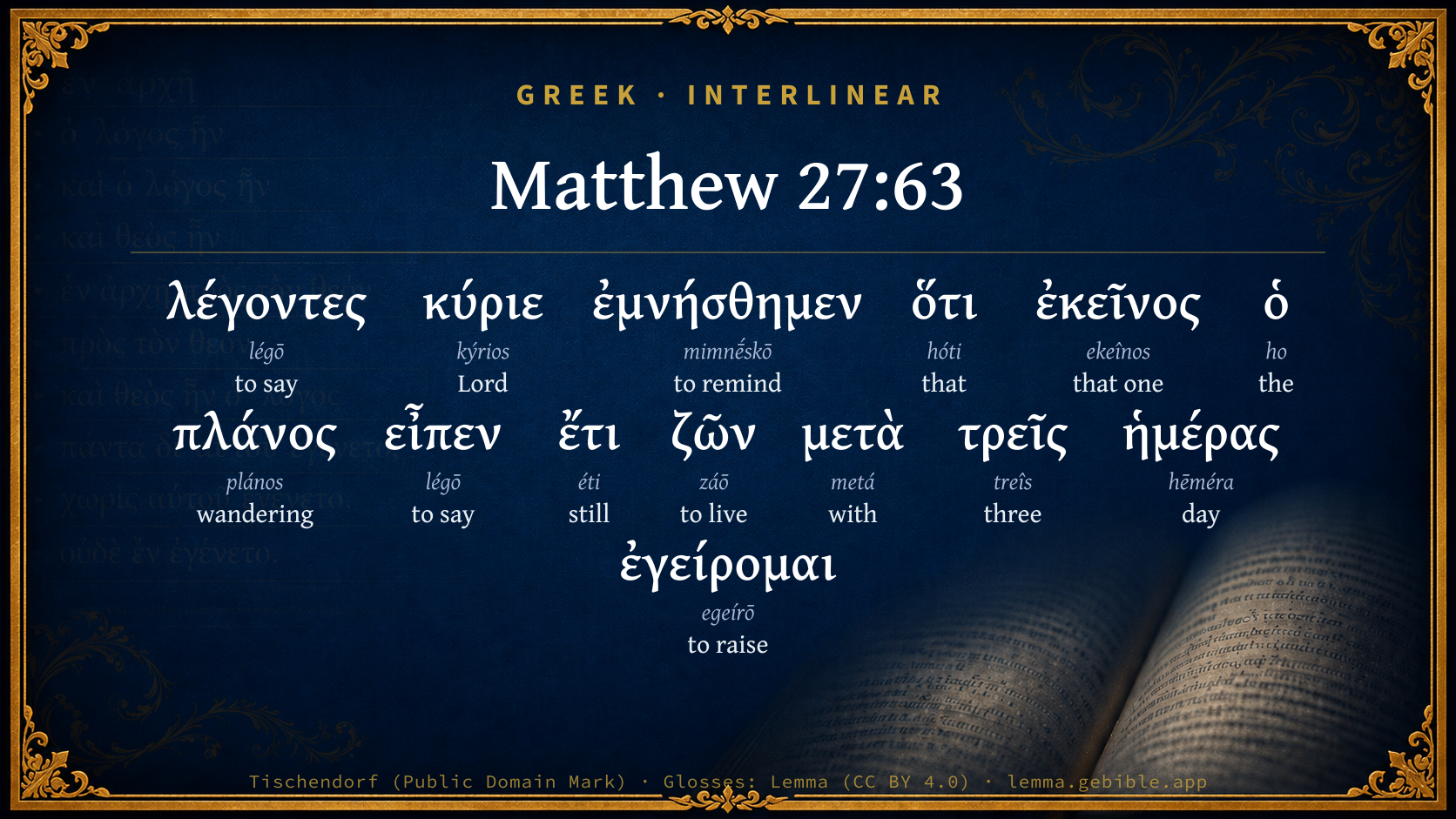
  1. λέγοντες légō G3004 “to say” Verb, Present, Active, Participle, Nominative, Plural, Masculine
  2. κύριε kýrios G2962 “Lord” Noun, Vocative, Singular, Masculine
  3. ἐμνήσθημεν mimnḗskō G3403 “to remind” Verb, Aorist, Passive, Indicative, 1st person, Plural
  4. ὅτι hóti G3754 “that” Conjunction
  5. ἐκεῖνος ekeînos G1565 “that one” Demonstrative pronoun, Nominative, Singular, Masculine
  6. ὁ ho G3588 “the” Article, Nominative, Singular, Masculine
  7. εἶπεν légō G3004 “to say” Verb, Aorist, Active, Indicative, 3rd person, Singular
  8. ἔτι éti G2089 “still” Adverb
  9. ζῶν záō G2198 “to live” Verb, Present, Active, Participle, Nominative, Singular, Masculine
  10. μετὰ metá G3326 “with” Preposition
  11. τρεῖς treîs G5140 “three” Adjective, Accusative, Plural, Feminine
  12. ἡμέρας hēméra G2250 “day” Noun, Accusative, Plural, Feminine
  13. ἐγείρομαι egeírō G1453 “to raise” Verb, Present, Passive, Indicative, 1st person, Singular

About this verse

These counts appear in no published source. They are computed here, from the morphology-tagged text and Lemma’s own curated glosses. What Lemma adds →

14
words
13
distinct lemmas
Gospels
section

Notable vocabulary

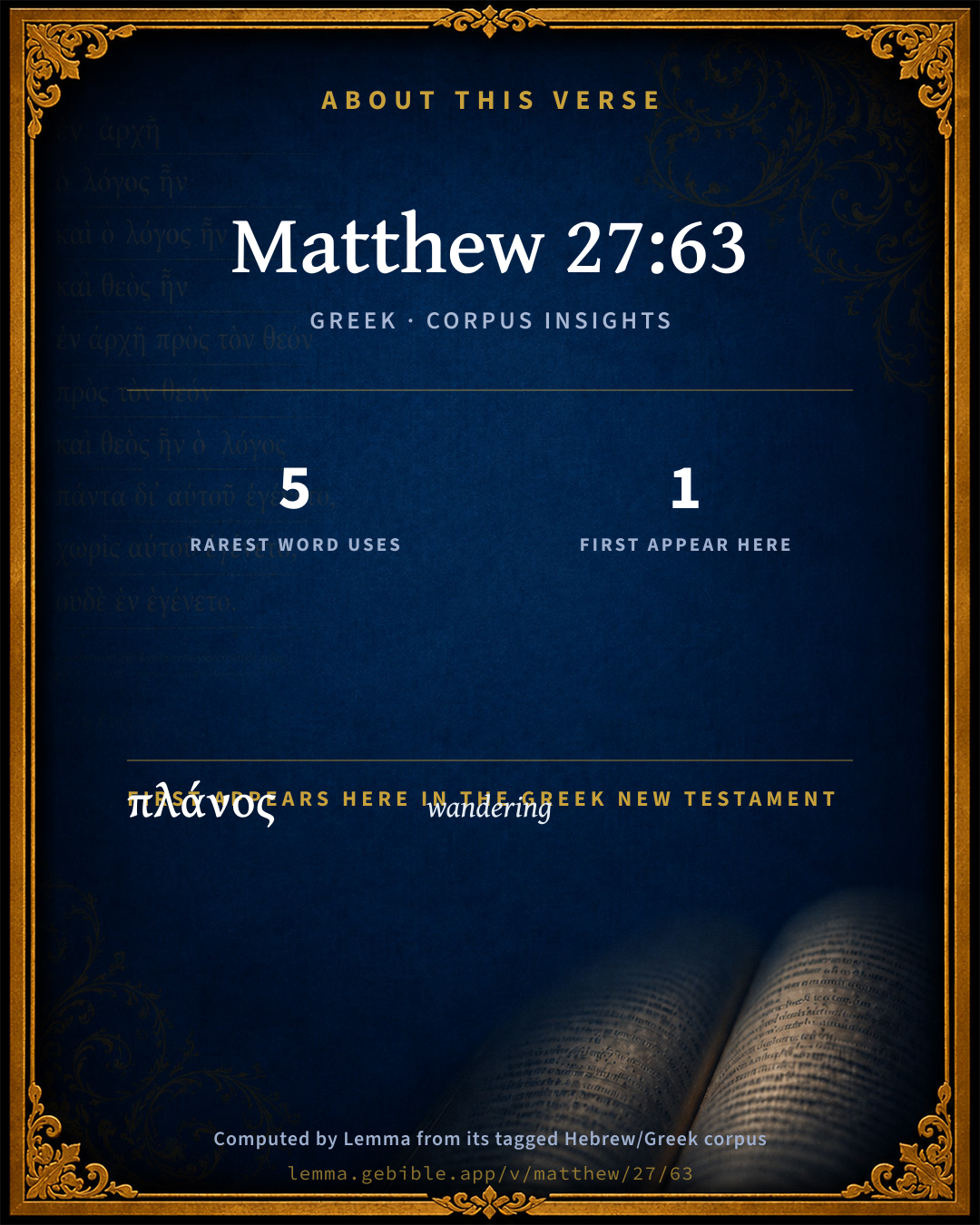
The rarest word here is πλάνος wandering G4108 — appearing just 5 times in the whole Greek New Testament.

First appearance in Scripture

This word makes its first canonical appearance in the Greek New Testament here:

  • πλάνος wandering G4108

Shared distinctive vocabulary

πλάνος wandering G4108 occurs in 4 verses of the Greek New Testament. Also found in:

Repetition

A word recurs within this verse:

  • λέγοντες to say G3004 ×2

Cross-references

14

Topical passages linked to Matthew 27:63 in the Treasury of Scripture Knowledge — connected by theme and wording, ordered by reader-vote popularity; previews shown in the World English Bible.

  • Luke 9:22 saying, "The Son of Man must suffer many things, and be rejected by the elders, chief priests, and scribes, and be killed, and the third day be raised up."
  • Matthew 16:21 From that time, Jesus began to show his disciples that he must go to Jerusalem and suffer many things from the elders, chief priests, and scribes, and be killed, and the third day be raised up.
  • Matthew 17:23 and they will kill him, and the third day he will be raised up." They were exceedingly sorry.
  • Mark 8:31 He began to teach them that the Son of Man must suffer many things, and be rejected by the elders, the chief priests, and the scribes, and be killed, and after three days rise again.
  • Mark 10:34 They will mock him, spit on him, scourge him, and kill him. On the third day he will rise again."
  • Luke 18:33 They will scourge and kill him. On the third day, he will rise again."
  • John 2:19 Jesus answered them, "Destroy this temple, and in three days I will raise it up."
  • Matthew 26:61 and said, "This man said, 'I am able to destroy the temple of God, and to build it in three days.'"
  • Matthew 20:19 and will hand him over to the Gentiles to mock, to scourge, and to crucify; and the third day he will be raised up."
  • Luke 23:2 They began to accuse him, saying, "We found this man perverting the nation, forbidding paying taxes to Caesar, and saying that he himself is Christ, a king."
  • Luke 24:6–7 He isn't here, but is risen. Remember what he told you when he was still in Galilee,
  • John 7:12 There was much murmuring among the multitudes concerning him. Some said, "He is a good man." Others said, "Not so, but he leads the multitude astray."
  • 2 Corinthians 6:8 by glory and dishonor, by evil report and good report; as deceivers, and yet true;
  • John 7:47 The Pharisees therefore answered them, "You aren't also led astray, are you?

Cross-references courtesy of OpenBible.info (CC BY 4.0).

Commentary

Notes on Matthew 27:63 from classic Christian and Jewish commentators (each source and its license shown beneath its notes). The classic Christian expositions comment on the surrounding passage and are grouped to its opening verse, so a note may address several verses; the Jewish commentaries on the Tanakh (Rashi and others) are per-verse, so they appear only where the commentator wrote on this verse.

Lemma curates 59 commentaries, every one of them public domain or Creative Commons licensed, each selected and text-cleaned for this edition rather than reprinted as found. About our sources →

Bengel's Gnomon

Johann Albrecht Bengel

Mat 27:63. Δέγοντες, κύριε, saying, my Lord) They cringe to Pilate: they had not addressed him so before.—ἐκεινος, that) They already desired Jesus to be obliterated from the memory of all.—ἐγείρομαι, I am raised) The present tense.

Bengel's Gnomon of the New Testament — English translation (T&T Clark, Edinburgh, 1860) — public domain. Text from a community e-Sword module.

Meyer's Critical & Exegetical Commentary

Heinrich August Wilhelm Meyer

Mat_27:63 Ἐμνήσθημεν] we have remembered, it has just occurred to us, the sense being purely that of the aorist and not of the perfect (in opposition to de Wette).

ἐκεῖνος ὁ πλάνος] that deceiver (2Co_6:8), impostor; Justin, c. Tr. 69: λαοπλάνος. Without once mentioning His name, they contemptuously allude to Him as one now removed to a distance, as got rid of by death. This is a sense in which ἐκεῖνος; is frequently used by Greek authors (Schoem. ad Is. p. 177; Ellendt, Lex. Soph. I. p. 559).

ἐγείρομαι] present; marking the confidence with which he affirmed it.

Meyer — Critical and Exegetical Commentary on the New Testament — English translation by Peter Christie, edited by Frederick Crombie (T&T Clark, 1880) — public domain. Text from a community e-Sword module.

Expositor's Greek Testament

ed. W. Robertson Nicoll

Mat 27:63 . ἐκεῖνος : contemptuous reference, as to one not worthy to be named, and far off, a thing of the past removed for ever by death. ὁ πλάνος : a wanderer in the first place, then derivatively, from the character of many wanderers, in N. T. a deceiver. ἐγείρομαι , present for future, expressing strong confidence.

The Expositor's Greek Testament, edited by W. Robertson Nicoll (1897–1910) — public domain. Text from a community e-Sword module.

Jamieson, Fausset & Brown

Robert Jamieson, A. R. Fausset & David Brown

Saying, Sir, we remember that that deceiver--Never, remarks BENGEL, will you find the heads of the people calling Jesus by His own name. And yet here there is betrayed a certain uneasiness, which one almost fancies they only tried to stifle in their own minds, as well as crush in Pilate's, in case he should have any lurking suspicion that he had done wrong in yielding to them.

said, while he was yet alive--Important testimony this, from the lips of His bitterest enemies, to the reality of Christ's death; the corner-stone of the whole Christian religion.

After three days--which, according to the customary Jewish way of reckoning, need signify no more than "after the commencement of the third day."

I will rise again--"I rise," in the present tense, thus reporting not only the fact that this prediction of His had reached their ears, but that they understood Him to look forward confidently to its occurring on the very day named.

Jamieson, Fausset & Brown — Commentary Critical and Explanatory on the Whole Bible (1871) — public domain (CC PDM 1.0). Text via the HelloAO Bible API.

Adam Clarke's Commentary

Verse 63. Sir, we remember, c.] While these wicked men are fulfilling their own vicious counsels, they are subserving the great cause of Christianity. Every thing depended on the resurrection of Christ if it did not appear that he rose from the dead, then the whole system was false, and no atonement was made. It was necessary therefore that the chief priests, c., should make use of every precaution to prevent an imposture, that the resurrection of Christ might have the fullest evidence to support it. See Clarke on Mt 27:60.

The word Κυριε is here very properly translated sir, which, in many other places, is as improperly translated Lord. When a Roman is the speaker, or the person addressed, Κυριε should always be translated sir when strangers address our Lord, the word is a title of civil respect, and should, in general, be translated in the same way.

After three days I will rise again.] This they probably took from his saying, Destroy this temple, and in three days I will build it up. If so, they destroyed, by their own words, the false accusation they brought against him to put him to death; then they perverted the meaning, now they declare it. Thus the wise are taken in their own craftiness. Neither the devil nor his servants ever speak truth, but when they expect to accomplish some bad purpose by it.

Adam Clarke's Commentary on the Bible (1810–1826) — public domain. Text from a community e-Sword/MySword module.

Ellicott's Commentary for English Readers

(63) We remember that that deceiver said . . .—It appears, then, that though they had deliberately stirred up the passions of the people by representing the mysterious words of Joh_2:14 as threatening a literal destruction of the Temple (Mat_26:61; Mat_27:40), they themselves had understood, wholly or in part, their true meaning. We are, perhaps, surprised that they should in this respect have been more clear-sighted than the disciples, but in such a matter sorrow and disappointment confuse, and suspicion sharpens the intellect.

That deceiver.—They had used the cognate verb of Him before (Joh_7:12), and this was, perhaps, their usual way of speaking of Him.

A Bible Commentary for English Readers, edited by Charles John Ellicott (1878–1897) — public domain. Text from a community e-Sword module.

The Cambridge Bible for Schools and Colleges

gen. ed. J. J. S. Perowne

63. said … After three days I will rise] Literally in the Greek, I rise. For this present cp. ch. Mat_24:41, Mat_26:2.

It appears from this that the priests and Pharisees understood the true import of Christ’s words, “Destroy this temple, and after three days I will raise it up,” which they wilfully misinterpreted to the people.

The Cambridge Bible for Schools and Colleges (gen. ed. J. J. S. Perowne; Cambridge University Press, 1878–1918) — public domain. Text from a community e-Sword module.

John Gill's Exposition

Command therefore that the sepulchre be made sure,.... By this also they own, that he was buried; and they knew in what, and whose sepulchre he was laid, and where it was; and request of Pilate, that as he had given leave to Joseph to take the body and inter it, that he would also give orders that the sepulchre might be watched, that no body might come near it, and remove the body, and that

until the third day: not from the time they made this request, but from the time of Christ's death; for no longer did they desire the sepulchre to be guarded; for if he did not rise, and no pretensions could be made to it in that time, they then very likely intended to expose his dead body, and triumph over him as an impostor; and after that time, they cared not what became of it, and were in no concern about watching the sepulchre; but till then they judged it necessary and desired it,

lest his disciples come by night, and steal him away: but of this there was no danger; they were too fearful and timorous to do such an action, had they been ever so much inclined to it; they all forsook him and fled immediately upon his apprehension; nor durst any of them appear at the time of his crucifixion, but John; and were now shut up for fear of the Jews; and besides, they had forgot what Christ said to them about his resurrection, though these men remembered it, and even disbelieved it when it was told them: the phrase "by night", is not in two copies of Beza's, nor in the Vulgate Latin and Arabic versions, nor in Munster's Hebrew Gospel; but is in other copies, and in the Syriac, Persic, and Ethiopic versions:

and say unto the people, he is risen from the dead; to the common people, that were illiterate, credulous, and easily imposed on: as for themselves, who were the learned, the wise and knowing, they were in no danger of being carried away with such a deception; but the populace, for whom they pretend a great concern, were:

so the last error shall be worse than the first; either their own error and mistake, should the sepulchre be neglected, and an opportunity given for such a report; this would be of more fatal consequence than their first mistake, in suffering him and his followers to go on so long: or rather, the error of the people, in believing that Jesus was the Messiah; which would be greatly strengthened and received by greater numbers, should it be given out, and there was any proof of it, that he was risen from the dead: nor were they mistaken in this, for the number of the disciples and followers of Christ greatly increased after his resurrection; to an hundred and twenty, which was their number upon Christ's resurrection, three thousand were added at one time; being converted under one sermon, and that the first preached after Christ was risen.

John Gill's Exposition of the Whole Bible (1746–1763) — public domain (CC PDM 1.0). Text via the HelloAO Bible API.

Trapp's Complete Commentary

John Trapp

63 Saying, Sir, we remember that that deceiver said, while he was yet alive, After three days I will rise again.

Ver. 63. Sir, we remember, &c.] They that had forgotten so many sweet and savoury sayings of our blessed Saviour, and written them all in the sand, could remember (but for no good purpose) that which his disciples could not so readily call to mind for their good and comfort; no, nor understand it when plainly told them, Mar 9:32. The soul should be as a holy ark, the memory as the pot of manna, preserving holy truths for holy uses. But most men have memories like nets, that let go the clear water, catch nothing but sticks and refuse stuff; or like sieves, that retain the chaff, let go the good corn; like the creature Cervarius, that if he but look back, forgets the food he was eating, though never so hungry, and seeks for new; or Sabinus in Seneca, who never in all his life could get by heart those three names of Homer, Ulysses, and Achilles. Old songs, old wrongs, &c., they can retain sufficiently; but in matters of God, their memories serve them not.

This deceiver said] "Men muse as they use." Quis tulerit Gracchos? Who could have tolerated the Gracchi brothers. Who can endure to hear the devil taxing God of envy, as he did to our first parents? or these deceitful workers calling "the faithful and true witness," πλανος, a deceiver, a cheater, one who doth profess an art of cozening men to their faces? for so the Greek word signifieth. We must look to hear all that nought is, either while alive, or when dead. Melancthon mortuus, tantum non ut blasphemus in Deum, cruci affigitur, saith Zanchy; and all because he pleased not, in all points, the peevish Lutherans. In like manner many lewd opinions were fathered upon John Wycliffe, after he was dead; yea, some that were monstrous and diabolical, as that men ought, yea, that God himself ought to obey the devil. (Speed.) And this famous doctor dying of a palsy, hath this charitable eulogy or epitaph bestowed upon him by a monk, The devil’s instrument, church’s enemy, people’s confusion, heretic’s idol, hypocrite’s mirror, schism’s broacher, hatred’s sower, lie’s forger, flattery’s sink; who at his death despaired like Cain, and stricken by the horrible judgment of God, breathed forth his wicked soul to the dark mansions of the black devil (Tho. Walsingham). The servant is not greater than his master. Him they called Beelzebub, Samaritan (that is, conjuror), traitor, and here deceiver. But what a mouth of blasphemy opened that pseudo-Christian, Emperor Frederick the Second, who was heard often to say that there had been three notorious impostors who had cheated the world, viz., Moses, Christ, and Mahomet! Oh base!

John Trapp, A Commentary or Exposition upon All the Books of the Old and New Testament (1647–1656) — public domain. Text from a community e-Sword module.

Albert Barnes' Notes on the Bible

We remember - They had either heard him say this, or, more probably, had understood that this was one of his doctrines.

That deceiver - One of the charges against him was that he deceived the people, Joh 7:12. By this title they still chose to designate him, thinking that his death had fully confirmed the truth of the charges against him.

Albert Barnes' Notes on the Bible (1834–1885) — public domain. Text from a community e-Sword/MySword module.

Haydock's Catholic Bible Commentary

Sir, we have remembered, that that seducer, this impostor, this cheat; so the called our blessed Redeemer; from whence, says St. Augustine, Christians may learn to be patient under the greatest injuries. --- Said: ... after three days I will rise again. This, therefore, must have been well known among the Jews. (Witham) --- The chief motive, which influenced the high priest on this occasion, was probably the apprehension lest this prediction of Christ’s resurrection should be verified. The wonderful prodigies which took place at his death, and especially the opening of the graves, (though none arose it is believed till after Christ’s resurrection, since Christ is called the first-born from the dead, 1 Colossians i. 18. and the first-fruits of them that sleep, 1 Corinthians xv. 20.) might naturally appear as preludes to what he had so often foretold. It is true they had no idea but of a temporal passing resurrection , like that of Lazarus, which they had seen: yet they judged that such an event might be attended with the most serious consequences. Hence, it is probable, that they gave them most express injunctions to put Jesus to death by all means, and to secure the body in the monument: for, it is certain, they formed a similar design against the life of Lazarus, whose resurrection occasioned many to believe in Jesus. (Haydock) --- They were not satisfied with taking his life; they must, moreover, deprived him of his good name. (Menochius) ---The chief priests could not yet be satisfied, after the horrid murder they had committed, unless they stirred up the minds of the people to a still greater height, by calumniating this innocent Lamb of God, and calling him an impostor, who was the most innocent of men, and spread abroad their poisonous doctrines in every sentence they uttered. (St. Jerome)

George Leo Haydock (1774–1849), Haydock's Catholic Family Bible and Commentary, 1859 edition — public domain. Excludes Psalms (Douay-Rheims chapter numbering differs from Protestant) and Deuterocanonical books (Catholic canon only).

Whedon's Commentary on the Bible

Daniel D. Whedon

63. We remember — It seems strange that these men should remember a prophecy of our Lord which his own disciples seemed to forget. But the disciples did not forget that our Lord made this prophecy. They were only doubtful as to its true meaning, and so practically allowed it no meaning at all. It required high faith in them to believe that he would rise on the third day; but it required little faith for these men to believe that Jesus had made this prophecy, and that his disciples might try by deception to render it apparently fulfilled. Deceiver — Literally, strolling juggler.

Daniel D. Whedon (gen. ed.), Commentary on the Old and New Testaments (1874–1909) — public domain. Text from a community e-Sword module.

John Wesley's Explanatory Notes

That impostor said, while he was yet alive, After three days I will rise again - We do not find that he had ever said this to them, unless when he spoke of the temple of his body, John ii, 19, 21. And if they here refer to what he then said, how perverse and iniquitous was their construction on these words, when he was on his trial before the council? Chap. xxvi, 61. Then they seemed not to understand them!

John Wesley, Explanatory Notes Upon the Whole Bible (1754–1765) — public domain. Text via the GEBible commentary corpus.

Scofield Reference Notes

C. I. Scofield

After three days

See, Mat 16:21; Mat 17:23; Mat 20:19; Mat 26:61; Mar 8:31; Mar 10:34; Luk 9:22; Luk 18:33; Luk 24:6; Luk 24:7; Joh 2:19

The Scofield Reference Bible (1917 edition), notes by C. I. Scofield — public domain. Text from a community e-Sword module.

The People's New Testament

B. W. Johnson

63. Sir, we remember. These dignitaries had not forgotten the predictions of Christ that he would rise on the third day, even if his own disciples had.

B. W. Johnson's The People's New Testament with Notes (1889–1891) — public domain. Electronic text from the Christian Classics Ethereal Library (CCEL) ThML edition.

Cambridge Greek Testament for Schools and Colleges

63. ἐμνήσθημεν. ‘We remembered,’ it occurred to us, aorist of an action just past.

πλάνος … πλάνη, ‘deceiver’ … ‘deceit.’ The relation between the two words is lost in A.V.

Μετὰ τρεῖς κ.τ.λ. For this present cp. ch. Mat 24:41, Mat 26:2.

It appears from this that the priests and Pharisees understood the true import of Christ’s words, ‘Destroy this temple, and after three days I will raise it up,’ which they wilfully misinterpreted to the people.

Cambridge Greek Testament for Schools and Colleges (Cambridge University Press, 1896; 21 vols, various authors incl. Carr, Maclear, Plummer, Farrar, Lumby, Moule, M. R. James, Simcox) — public domain. Text from a community e-Sword module.

Vincent's Word Studies in the New Testament

Marvin R. Vincent

We remember [εμνησθημεν] . Lit., we remembered : i e., it occurred to us : we have just remembered, and have come to tell you before it shall be too late.

That deceiver [εκεινος ο πλανος] . The pronoun that is very picturesque; being used of distant objects, and therefore here as pointing to one who is out of the way and far removed. Planov, deceiver, is akin to planaw, to wander; and hence a vagabond imposter.

Marvin R. Vincent, Word Studies in the New Testament (1887–1900) — public domain. Text from a community e-Sword/MySword module.

Lesson kit

Teaching starters — assembled from the data on this page, not authored interpretation. Every prompt links to the verse data it draws on. Edit before teaching.

Matthew, in the Gospels, opens this verse with 14 words (13 distinct Greek lemmas). Its most distinctive word is plános (“wandering”). A historical commentator’s framing appears above. Read the whole chapter for the surrounding context.

Discussion questions

  1. How does “wandering” (plános) shape what this verse is saying?
  2. The word “wandering” first appears here in Scripture. What is being introduced at this debut?
  3. 2 Corinthians 6:8 shares the word «wandering» with this verse. How do the two illuminate each other?
  4. “to say” occurs 2× in this one verse. What is the effect of the repetition?
  5. These translations render this verse differently; the difference is in the English rendering, not the original. What questions does that raise?
  6. Reading how Bengel's Gnomon and Meyer's Critical & Exegetical Commentary read this verse, where do the two commentators agree and where do they part?

Things to notice

  • 1 word makes its first canonical appearance in Scripture here.
  • These translations choose different wording for 14 words in this verse.
  • “to say” occurs 2× in this single verse.
  • 13 distinct Greek lemmas span 14 words in this verse.

Reading settings

Reading text

Shown beneath each verse's original-language words.

Old Testament
Old Testament edition

Read the OT as the Masoretic Hebrew (MT) or the Greek Septuagint (LXX).

English shown for the Greek Septuagint (in the Hebrew ↔ Greek comparison).

Comparing translations? Open the Compare panel on any verse page to stack up to four side by side.