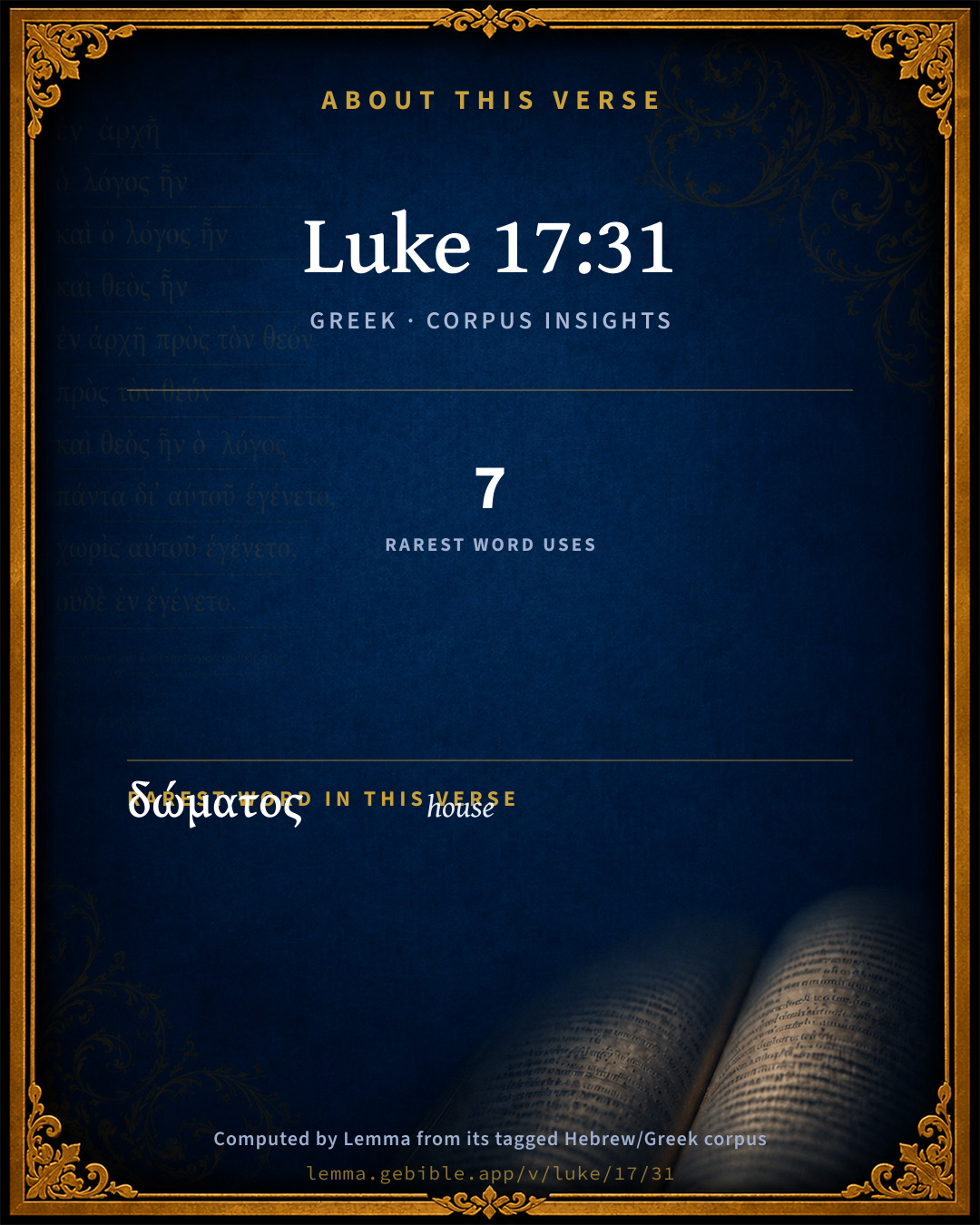
Luke 17:31

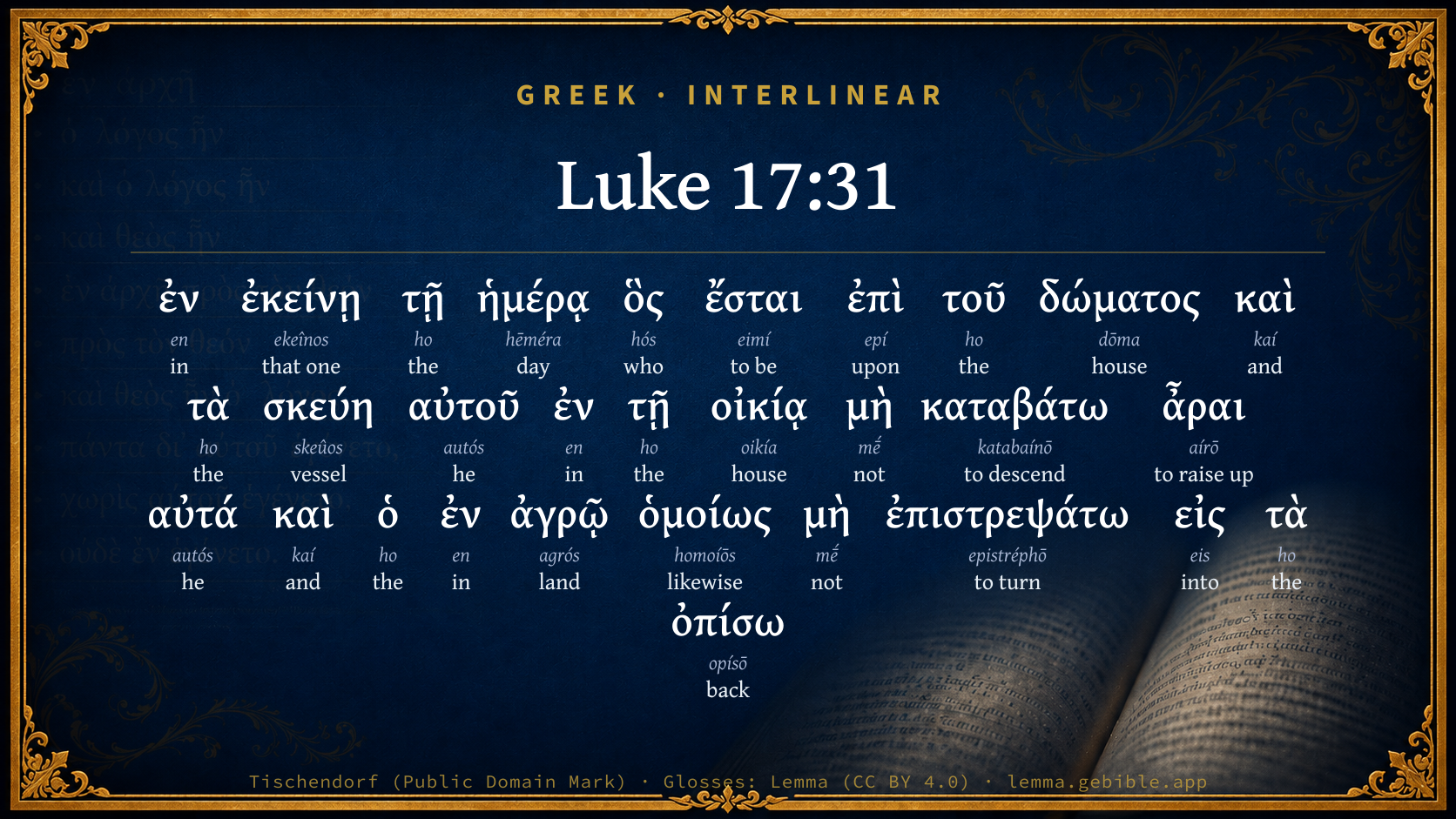
Greek (Tischendorf 8th ed.) Luke 17:31 appears in the Greek New Testament. The text above is from the Tischendorf 8th edition. Each word links to its Strong’s number and a concise gloss. Click any word for its full Thayer’s Greek Lexicon entry.
Download image
Cite this verse

Luke 17:31 (World English Bible). Public Domain. Lemma interlinear Bible study tool, https://lemma.gebible.app/v/luke/17/31.

Show BibTeX & RIS
BibTeX
RIS
English Translation
In that day, he who will be on the housetop, and his goods in the house, let him not go down to take them away. Let him who is in the field likewise not turn back.
World English Bible · Public Domain
Download a study sheet

One document with this verse’s original text, its word-by-word gloss line, the meaning frame, cross-references with their text, attributed commentary, and full source and license credits — printable, and it pastes into notes with its structure intact.

This verse Autodidact and up

Study sheet (.html) Plain text (.txt)

A passage Seminary Student

Up to 50 verses in one chapter. A passage sheet keeps up to 6 commentary sources and 12 cross-references per verse, in the order this page ranks them, and says so on the sheet whenever that leaves anything out. Ask for a single verse and you get the Autodidact verse sheet above.

Everything on this page stays free to read, with no account — the sheet is a download of what is already on screen, not access to it.

Want to remove ads? Support Godless Engineer
Compare translations 3

The same verse in 3 English versions, stacked beneath the original-language interlinear above. Click any original word for its lexicon entry.

Each is an independent rendering of the whole verse — the interlinear is not word-aligned to these translations.

Highlighted words mark where these versions differ — a whole-verse word diff, not a word-by-word alignment.

  • World English Bible Public Domain
    In that day, he who will be on the housetop, and his goods in the house, let him not go down to take them away. Let him who is in the field likewise not turn back.
  • King James Version Public Domain
    In that day, he which shall be upon the housetop, and his stuff in the house, let him not come down to take it away: and he that is in the field, let him likewise not return back.
  • unfoldingWord Literal Text CC BY-SA 4.0
    In that day, whoever is on the housetop and his goods are in the house, let him not go down to take them; and the one in the field, likewise let him not turn back to the things behind.

unfoldingWord Literal Text — © unfoldingWord, licensed CC BY-SA 4.0. Word-aligned USFM3 via Door43 (git.door43.org/unfoldingWord/en_ult).

Versions to compare (up to 4)

3 of 4 selected

Show all 19 translations

Every available English version of this verse, each an independent rendering of the whole verse.

  • World English Bible Public Domain
    In that day, he who will be on the housetop, and his goods in the house, let him not go down to take them away. Let him who is in the field likewise not turn back.
  • Berean Standard Bible Public Domain
    On that day, let no one on the housetop come down to retrieve his possessions. Likewise, let no one in the field return for anything he has left behind.
  • Majority Standard Bible Public Domain
    On that day, let no one on the housetop come down to retrieve his possessions. Likewise, let no one in the field return for anything he has left behind.
  • King James Version Public Domain
    In that day, he which shall be upon the housetop, and his stuff in the house, let him not come down to take it away: and he that is in the field, let him likewise not return back.
  • American Standard Version (1901) Public Domain
    In that day, he that shall be on the housetop, and his goods in the house, let him not go down to take them away: and let him that is in the field likewise not return back.
  • Revised Version (1885) Public Domain
    In that day, he which shall be on the housetop, and his goods in the house, let him not go down to take them away: and let him that is in the field likewise not return back.
  • Geneva Bible (1599) Public Domain
    At that day hee that is vpon the house, and his stuffe in ye house, let him not come downe to take it out: and he that is in the fielde likewise, let him not turne backe to that he left behinde.
  • Douay-Rheims (1899) Public Domain
    In that hour, he that shall be on the housetop, and his goods in the house, let him not go down to take them away: and he that shall be in the field, in like manner, let him not return back.
  • Young's Literal Translation Public Domain
    in that day, he who shall be on the house top, and his vessels in the house, let him not come down to take them away; and he in the field, in like manner, let him not turn backward;
  • Literal Standard Version CC BY-SA 4.0
    in that day, he who will be on the housetop, and his vessels in the house, do not let him come down to take them away; and he in the field, in like manner, do not let him turn backward;
  • Unlocked Literal Bible CC BY-SA 4.0
    In that day, do not let him who is on the housetop go down to get his goods out of the house; and do not let him who is in the field return.
  • unfoldingWord Literal Text CC BY-SA 4.0
    In that day, whoever is on the housetop and his goods are in the house, let him not go down to take them; and the one in the field, likewise let him not turn back to the things behind.
  • Darby Bible Public Domain
    In that day, he who shall be on the housetop, and his stuff in the house, let him not go down to take it away; and he that is in the field, let him likewise not return back.
  • World Messianic Bible Public Domain
    In that day, he who will be on the housetop and his goods in the house, let him not go down to take them away. Let him who is in the field likewise not turn back.
  • Webster's Bible Public Domain
    In that day, he who shall be upon the house-top, and his furniture in the house, let him not come down to take it away: and he that is in the field, let him likewise not return back.
  • Free Bible Version CC BY-SA 4.0
    If you're up on the roof that day don't go down and get your things; and if you're out in the fields don't go back home either.
  • Bible in Basic English Public Domain
    On that day, if anyone is on the roof of the house, and his goods are in the house, let him not go down to take them away; and let him who is in the field not go back to his house.
  • Text-Critical English NT CC BY 4.0
    On that day, he who is on the housetop and whose goods are in the house must not come down to get them. Likewise, he who is in the field must not turn back.
  • Tyndale New Testament (1534) Public Domain
    At that daye he that is on the housse toppe and his stuffe in the housse: let him not come doune to take it out. And lykewyse let not him that is in the feldes turne backe agayne to that he lefte behynde.

Literal Standard Version (2020), Covenant Press — licensed CC BY-SA 4.0. Text via the HelloAO Bible API (eBible.org). Unlocked Literal Bible (unfoldingWord) — licensed CC BY-SA 4.0. Text via the HelloAO Bible API (eBible.org). unfoldingWord Literal Text — © unfoldingWord, licensed CC BY-SA 4.0. Word-aligned USFM3 via Door43 (git.door43.org/unfoldingWord/en_ult). Free Bible Version, Dr. Jonathan Gallagher — licensed CC BY-SA 4.0. Text via the HelloAO Bible API (eBible.org).

Word by word

More ways to search: Search by grammar → Find every occurrence → Compare this word →

Practice this passage: Drill this verse → Learn its vocabulary →

δώματος
dōma
G1430
“house”
Noun, Genitive, Singular, Neuter
Part of Speech
Noun
Case
Genitive
Number
Singular
Gender
Neuter
Full Thayer's Definition

Origin: from demo (to build)

TDNT: None

1. a building, house 2. a part of a building, dining room, hall 3. house top, roof a. the house tops of the Orientals were (and still are) level and frequented not only for walking, but also for meditation and prayer
  1. ἐν en G1722 “in” Preposition
  2. ἐκείνῃ ekeînos G1565 “that one” Demonstrative pronoun, Dative, Singular, Feminine
  3. τῇ ho G3588 “the” Article, Dative, Singular, Feminine
  4. ἡμέρᾳ hēméra G2250 “day” Noun, Dative, Singular, Feminine
  5. ὃς hós G3739 “who” Relative pronoun, Nominative, Singular, Masculine
  6. ἔσται eimí G1510 “to be” Verb, Future, Middle deponent, Indicative, 3rd person, Singular
  7. ἐπὶ epí G1909 “upon” Preposition
  8. τοῦ ho G3588 “the” Article, Genitive, Singular, Neuter
  9. καὶ kaí G2532 “and” Conjunction
  10. τὰ ho G3588 “the” Article, Nominative, Plural, Neuter
  11. σκεύη skeûos G4632 “vessel” Noun, Nominative, Plural, Neuter
  12. αὐτοῦ autós G846 “he” Personal pronoun, Genitive, Singular, Masculine
  13. ἐν en G1722 “in” Preposition
  14. τῇ ho G3588 “the” Article, Dative, Singular, Feminine
  15. οἰκίᾳ oikía G3614 “house” Noun, Dative, Singular, Feminine
  16. μὴ mḗ G3361 “not” Particle, Negative
  17. καταβάτω katabaínō G2597 “to descend” Verb, Aorist, Active, Imperative, 3rd person, Singular
  18. ἆραι aírō G142 “to raise up” Verb, Aorist, Active, Infinitive
  19. αὐτά autós G846 “he” Personal pronoun, Accusative, Plural, Neuter
  20. καὶ kaí G2532 “and” Conjunction
  21. ὁ ho G3588 “the” Article, Nominative, Singular, Masculine
  22. ἐν en G1722 “in” Preposition
  23. ἀγρῷ agrós G68 “land” Noun, Dative, Singular, Masculine
  24. ὁμοίως homoíōs G3668 “likewise” Adverb
  25. μὴ mḗ G3361 “not” Particle, Negative
  26. ἐπιστρεψάτω epistréphō G1994 “to turn” Verb, Aorist, Active, Imperative, 3rd person, Singular
  27. εἰς eis G1519 “into” Preposition
  28. τὰ ho G3588 “the” Article, Accusative, Plural, Neuter
  29. ὀπίσω opísō G3694 “back” Adverb

About this verse

These counts appear in no published source. They are computed here, from the morphology-tagged text and Lemma’s own curated glosses. What Lemma adds →

30
words
20
distinct lemmas
Gospels
section

Notable vocabulary

The rarest word here is δώματος house G1430 — appearing just 7 times in the whole Greek New Testament.

Shared distinctive vocabulary

δώματος house G1430 occurs in 7 verses of the Greek New Testament. Also found in:

Repetition

Words recur within this verse:

Cross-references

8

Topical passages linked to Luke 17:31 in the Treasury of Scripture Knowledge — connected by theme and wording, ordered by reader-vote popularity; previews shown in the World English Bible.

  • Jeremiah 45:5 Seek you great things for yourself? Don't seek them; for, behold, I will bring evil on all flesh, says Yahweh; but your life will I give to you for a prey in all places where you go.
  • Mark 13:14–16 But when you see the abomination of desolation, spoken of by Daniel the prophet, standing where it ought not (let the reader understand), then let those who are in Judea flee to the mountains,
  • Luke 21:21 Then let those who are in Judea flee to the mountains. Let those who are in the midst of her depart. Let those who are in the country not enter therein.
  • Matthew 16:26 For what will it profit a man, if he gains the whole world, and forfeits his life? Or what will a man give in exchange for his life?
  • Matthew 24:17–21 Let him who is on the housetop not go down to take out things that are in his house.
  • Philippians 3:7–8 However, what things were gain to me, these have I counted loss for Christ.
  • Job 2:4 Satan answered Yahweh, and said, "Skin for skin. Yes, all that a man has will he give for his life.
  • Matthew 6:25 Therefore, I tell you, don't be anxious for your life: what you will eat, or what you will drink; nor yet for your body, what you will wear. Isn't life more than food, and the body more than clothing?

Cross-references courtesy of OpenBible.info (CC BY 4.0).

Commentary

Notes on Luke 17:31 from classic Christian and Jewish commentators (each source and its license shown beneath its notes). The classic Christian expositions comment on the surrounding passage and are grouped to its opening verse, so a note may address several verses; the Jewish commentaries on the Tanakh (Rashi and others) are per-verse, so they appear only where the commentator wrote on this verse.

Lemma curates 59 commentaries, every one of them public domain or Creative Commons licensed, each selected and text-cleaned for this edition rather than reprinted as found. About our sources →

Joseph Benson's Commentary

Luk 17:31-32. In that day — (Which will be the grand type of the last day,) when ye shall see Jerusalem encompassed with armies; he which shall be upon the house-top, let him not come down — See on Mat 24:17-18; Mar 13:15. Remember Lot’s wife — And escape with all speed, without ever looking behind you. See note on Gen 19:26.

Joseph Benson's Commentary on the Old and New Testaments (1811–1818) — public domain. Text from a community e-Sword module.

Godbey's Commentary on the New Testament

William B. Godbey

EXPEDITION

Luk 17:31-32. “In that day, let him who shall be upon the housetop, and his goods in the house, not come down to take them; and he who is in the field, likewise not return back. Remember Lot’s wife.” From these and many other clear affirmations of our Savior, we learn that He will come very suddenly, giving no time for any preparations after the great light shall flash athwart the sky, belting the globe with the splendors of His glory, and attracting the attention of all the people in the world. “Every eye shall behold Him.” (Rev 1:7) Lot’s wife, in the precipitate flight from burning Sodom, only looked back, and, as E. V. says, was turned to a pillar of salt. The R. V. is evidently the more correct, rendering it “a monument of warning,” as the presumption is she dropped dead in her tracks. That whole country gives every manifestation of volcanic influence. Where E. V. says, “God rained on them fire and brimstone from heaven,” the verb is impersonal, and properly rendered, “It mined on them fire and brimstone,” corroborating the hypothesis that these cities in the Vale of Siddim were destroyed by volcanic eruptions. In that case the brimstone gases are awfully suffocating. I tried them when I visited the crater of Mount Vesuvius. Hence there is quite a plausibility in the conclusion that the woman, halting and facing the scene, fell dead by suffocation of the sulfurous exhalations. As God rules the material world, with its oceans, seas, mineral resources, and volcanic fires, the hypothesis which imputes the destruction of Sodom and Gomorrah to volcanic eruptions and earthquakes is in perfect harmony with the Biblical history, imputing it directly to Divine intervention. The Dead Sea, which is about a thousand feet deep. doubtless occupied a much smaller area before the destruction of those cities, as now all authorities certify that the site of Sodom and Gomorrah is covered by the sea. Antecedently to that notable epoch, the Vale of Siddim, encompassing the Salt Sea, was exceedingly prosperous. Now, while the soil is immensely rich, it is all desert for the want of water, rains never falling there, and without an inhabitant except the roaming Bedouin. I have visited it twice, both times being under the necessity of hiring an armed escort. All this is a most striking and incontestable manifestation of the Divine retribution, which rained fire and brimstone on Sodom and Gomorrah, not only burning the cities, but bursting up and consuming the great strata of bitumen and asphaltum by the heaving of earthquakes and the eruptions of volcanoes, changing the face of the entire country, consuming the foundation and reducing the surface, and thus letting in the thundering sea, whose rolling billows for these thirty-eight hundred years have passed over the streets where once thronged the precipitate multitudes of these mighty cities. Such was the impregnation of the waters by the excessive quantities of sulfur, bitumen, asphaltum, and other poisons, as to render them so buoyant that the human body will not sink, and so caustic that no animal can live in them. Since the destruction of those cities, that country, once the garden of the East, has been deserted by the rain-clouds till utter desolation has monopolized it these long, rolling centuries. Eze 47:1-12, tells us about the glorious redemption which awaits this wrath-smitten country in the coming millennium, when that great river, coming out of Jerusalem, shall course down the mountains into the Vale of Siddim, redeeming all of that desolate land, and transforming it into the garden of the Lord, and pouting into the Salt Sea, which has been denominated the Dead Sea ever since the calamitous visitation, healing its waters, so that they will be again occupied by vast quantities of valuable fishes, and the shore again dotted with thriving villages and populous cities, while the whole surrounding country shall again groan beneath the abundant harvests, the luscious semi-tropical fruits everywhere saluting the eye and gladdening the heart. The prophet says that the, grand restoration shall extend from Engedi — which means the “goat-spring” — a short distance below the, southern terminus of the Dead Sea, to Enrogel, which is a celebrated well in the Valley of Jehoshaphat, thus including the Vale of Siddim, encompassing the Dead Se and the wilderness of Judea, an arid desert, extending from the plain toward Jerusalem, within about a dozen miles of the city.

William B. Godbey, Commentary on the New Testament (1896–1900) — public domain. Text from a community e-Sword module.

Bengel's Gnomon

Johann Albrecht Bengel

Luk 17:31. Ἐν ἐκείνῃ, in that day) that day, on which the kingdom of God shall come. The day of Jerusalem being besieged is meant: comp. Luk 17:34, note: a day which has many points (aspects under which it may be viewed) in common with the last day. Comp. Luk 17:22. After Jerusalem had been destroyed, Christianity was most freely propagated. See ch. Luk 21:28.

Bengel's Gnomon of the New Testament — English translation (T&T Clark, Edinburgh, 1860) — public domain. Text from a community e-Sword module.

Meyer's Critical & Exegetical Commentary

Heinrich August Wilhelm Meyer

Luk_17:31-33. At that day it is well to abandon all earthly possession, wherefore I call to your remembrance the example of Lots wife. Even the temporal life must be abandoned by him who wishes not to lose the life eternal.

ὃς ἔσται ἐπὶ τοῦ δώμ. κ.τ.λ.] indicates certainly the undelayed flight with abandonment of earthly possession, but not, as at Mat_24:17, Mar_13:15, the flight in the destruction of Jerusalem, of which here there is no mention, but the flight for deliverance to the coming Messiah at the catastrophe which immediately precedes His Parousia, Mat_24:29-31. Then nothing of temporal possession should any more fetter the interest. Hence de Wette is wrong in regarding (comp. Weiss) the expression as unsuitably occurring in this place.

καὶ τ. σκ. αὐτοῦ] see Bernhardy, p. 304.

Luk_17:32. τῆς γυναικὸς Λώτ.] whose fate was the consequence of her looking back contrary to the injunction (Gen_19:26), which she would not have done if she had given up all attachment to the perishing possessions, and had only hastened to the divine deliverance. Comp. Wis_10:7 f.

Luk_17:33. Comp. Luk_9:24, and on Mat_10:39; Mar_8:35.

ζητήσῃ … ἀπολέσῃ] in the time of that final catastrophe ἀπολέσει … ζωογον.: in the decision at the Parousia

ζωογονεῖν, to preserve alive, as Act_7:19, and in the LXX. See Biel and Schleusner.

Meyer — Critical and Exegetical Commentary on the New Testament — English translation by Peter Christie, edited by Frederick Crombie (T&T Clark, 1880) — public domain. Text from a community e-Sword module.

Expositor's Greek Testament

ed. W. Robertson Nicoll

Luk 17:31-34 . Sauve qui peut (Mat 24:17-18 ; Mar 13:15-16 ). The saying in Luk 17:31 is connected in Mt. and Mk. with the crisis of Jerusalem, to which in this discourse in Lk. there is no allusion. The connection in Mt. and Mk. seems the more appropriate, as a literal flight was then necessary.

The Expositor's Greek Testament, edited by W. Robertson Nicoll (1897–1910) — public domain. Text from a community e-Sword module.

Geneva Bible (1599)

Geneva Bible translators

We must take good heed, that neither distrust, nor the enticements of this world, nor any respect of friendship hinder us the least that may be.

Geneva Bible (1599) marginal notes — public domain. Text via Bolls.life.

Jamieson, Fausset & Brown

Robert Jamieson, A. R. Fausset & David Brown

to take it away . . . Remember, &c.--a warning against that lingering reluctance to part with present treasures which induces some to remain in a burning house, in hopes of saving this and that precious article till consumed and buried in its ruins. The cases here supposed, though different, are similar.

Jamieson, Fausset & Brown — Commentary Critical and Explanatory on the Whole Bible (1871) — public domain (CC PDM 1.0). Text via the HelloAO Bible API.

Adam Clarke's Commentary

Verse 31. He which shall be upon the housetop] See this explained on Mt 24:17.

Adam Clarke's Commentary on the Bible (1810–1826) — public domain. Text from a community e-Sword/MySword module.

Ellicott's Commentary for English Readers

(31) He which shall be upon the housetop, and his stuff.—Better, his goods, as in Mat_12:29; Mar_3:27. (See Notes on Mat_24:17-18.)

A Bible Commentary for English Readers, edited by Charles John Ellicott (1878–1897) — public domain. Text from a community e-Sword module.

The Cambridge Bible for Schools and Colleges

gen. ed. J. J. S. Perowne

31. upon the housetop] the common Oriental place for cool and quiet resort. See on Luk_12:3, Luk_5:19.

his stuff] i.e. his furniture or goods:

“Therefore away to get our stuff aboard.”

Shaksp. Com. of Errors.

let him not come down to take it away] let him escape at once by the outer steps, Mat_24:16-18. It is clear that in these warnings, as in Matthew 24, our Lord has distinctly in view the Destruction of Jerusalem, and the awful troubles and judgments which it brought, as being the first fulfilment of the Prophecy of His Advent.

The Cambridge Bible for Schools and Colleges (gen. ed. J. J. S. Perowne; Cambridge University Press, 1878–1918) — public domain. Text from a community e-Sword module.

John Gill's Exposition

Remember Lot's wife. Whose name by the Jews, is said to be Adith, as some (s); or Irith, as others (t): and who, they also say, was a native of Sodom; and that the reason of her looking, was either to see what would be the end of her father's house and family (u); or as others (w), because her heart yearned after her daughters, and she looked back to see if they followed her; upon which she became a pillar of salt, Gen 19:26 They say (x), that her bones were burnt with the brimstone, and along with which was salt, into which she was turned, according to Deu 29:23. They often speak of , "salt of Sodom" (y); where the gloss says, it is thick and hard, as a stone; and to which they sometimes (z) ascribe this virtue, that it blinds the eyes: and there is a sort of salt, which they call (a) Galilaean salt, of like hardness; and Pliny (b) speaks of salt in the Indies, which they cut out, as stones out of quarries; and that, at Carthis, a town in Arabia, is salt with which they build houses and walls: of a very durable nature it is certain, was this pillar of "salt", Lot's wife became; for Josephus reports (c), that he saw this pillar of salt in his time; and Irenaeus asserts (d), that it was in being when he lived; and modern writers, as Burchardus and Adrichomius, speak of it as still existing; and the Jerusalem "paraphrast" on Gen 19:26 says it shall endure till the time the resurrection comes, in which the dead shall live: the reason of her becoming a pillar of salt, the Jews say, is, that she sinned by salt, and so was punished by salt; and which is differently related, and in a very fanciful way: one writer (f) reports, that when the angels came, Lot said to her, give me a little salt for these travellers; she replied to him, truly this is a bad custom, which thou bringest to be used in this place; and elsewhere (g) it is said, that upon their coming, she went to all her neighbours, and said to them, give me some salt, for we have travellers; but her intention was, that the men of the city might know them: but leaving those things, our Lord's design in these words, is to instruct his followers by this instance, not to look back in their flight, or to turn back to their houses, to save their goods, when the desolation of Jerusalem was coming on, lest they should suffer in it; and to warn all professors of religion, in all ages, against looking back to things that are behind, or turning their backs on him, in a time of distress and persecution; since such are not fit for the kingdom of God; and in these God has no delight and pleasure.

(s) Pirke Eliezer, c. 25. (t) Baal Hatturim in Gen. xix. 26. (u) Targum Jon. & Hieros. in ib. (w) Pirke Eliezer ib. (x) Aben Ezra in Gen. xix. 26. (y) T. Bab. Bava Bathra, fol. 20. 2. & Menachot, fol. 21. 1. (z) Bartenora in Misna Erubin, c. 1. sect. 10. (a) T. Bab Kiddushin, fol. 62. 1. (b) Nat. Hist. l. 31. c. 7. (c) Antiqu. l. 1. c. 12. (d) Adv. Haeres. l. 4. c. 51. (f) Jarchi in Gen. xix. 26. (g) Bereshit Rabba, sect. 51. fol. 46. 1.

John Gill's Exposition of the Whole Bible (1746–1763) — public domain (CC PDM 1.0). Text via the HelloAO Bible API.

Trapp's Complete Commentary

John Trapp

31 In that day, he which shall be upon the housetop, and his stuff in the house, let him not come down to take it away: and he that is in the field, let him likewise not return back.

Ver. 31. He which shall be on the housetop] A hyperbolic expression, usual among the Jews, to denote matter of haste.

John Trapp, A Commentary or Exposition upon All the Books of the Old and New Testament (1647–1656) — public domain. Text from a community e-Sword module.

Albert Barnes' Notes on the Bible

See the notes at Mat 24:17-18.

Albert Barnes' Notes on the Bible (1834–1885) — public domain. Text from a community e-Sword/MySword module.

Haydock's Catholic Bible Commentary

When you see war lighted up in Judea, lose no time, but betake yourselves to flight for safety. Indeed the Christians, forewarned by these predictions, and other prophecies of the apostles, according to Lactantius, (lib. iv. chap. 21.) fled from the danger beyond the Jordan, into the states of Herod, to Pella and the neighbouring villages. See Eusebius, Eccles. Hist. lib. iii. chap. 5.

George Leo Haydock (1774–1849), Haydock's Catholic Family Bible and Commentary, 1859 edition — public domain. Excludes Psalms (Douay-Rheims chapter numbering differs from Protestant) and Deuterocanonical books (Catholic canon only).

Matthew Poole's English Annotations

These words seem to relate singly to the destruction of Jerusalem. See Poole on "Mat 24:17-18", where we had the same. They only signify the certain ruin and destruction of the place, and are our Saviour’s counsel to his disciples, not to linger, or promise themselves any longer security there, notwithstanding what any false Christs or false prophets should plainly tell them, but to make as much haste away out of it as they possibly could.

Matthew Poole's English Annotations on the Holy Bible (1683–1685) — public domain. Text from a community e-Sword/MySword module.

Whedon's Commentary on the Bible

Daniel D. Whedon

31. Upon the housetop—Of course this can be no description of any incident at the coming of Christ to judge the world. For from what is this owner of the stuff in the house supposed to flee? Certainly not from the judgment throne of Christ! It can, therefore, be no continuance of the same topic with that in Luk_17:26-30. And therefore, again, it must be referred to its proper place in the great discourse of which it seems to be a fugitive fragment.

Daniel D. Whedon (gen. ed.), Commentary on the Old and New Testaments (1874–1909) — public domain. Text from a community e-Sword module.

The Pulpit Commentary

Vers. 31, 32. In that day, he which shall be upon the house-top, and his stuff in the house, let him not come down to take it away: and he that is in the field, let him likewise not return back. Remember Lot"s wife. The Lord, with this striking imagery, describes, not the attitude which men who would be saved must assume when he appears with power and great glory there will be no time then to shape any new way of life but it pictures the attitude they must always maintain, if they would behis servants, towards the things of this world. His servants must be ready to abandon all earthly blessings at a moment"s notice; none but those who have been sitting loosely to these will be able, when the sudden cry comes, at once to toss away all, and so to meet the long-tarrying Bridegroom. The reminder of Lot"s wife a very familiar story to Jews warned all would-be disciples of the danger of the double service, God and the world, and how likely the one who attempted it would be to perish miserably.

The Pulpit Commentary (1880–1919), ed. H.D.M. Spence-Jones & Joseph S. Exell — public domain. Text from a community e-Sword module.

John Wesley's Explanatory Notes

In that day - (Which will be the grand type of the last day) when ye shall see Jerusalem encompassed with armies.

John Wesley, Explanatory Notes Upon the Whole Bible (1754–1765) — public domain. Text via the GEBible commentary corpus.

Kretzmann's Popular Commentary

Paul E. Kretzmann

Final warnings:

v. 31. In that day, he which shall be upon the housetop, and his stuff in the house, let him not come down to take it away; and he that is in the field, let him likewise not return back.

v. 32. Remember Lot’s wife.

v. 33. Whosoever shall seek to save his life shall lose it; and whosoever shall lose his life shall preserve it.

v. 34. I tell you, in that night there shall be two men in one bed; the one shall be taken, and the other shall be left.

v. 35. Two women shall be grinding together; the one shall be taken, and the other left.

v. 36. Two men shall be in the field; the one shall be taken, and the other left.

v. 37. And they answered and said unto Him, Where, Lord? And He said unto them, Wheresoever the body is, thither will the eagles be gathered together.

The thought which stands out from the Lord’s warning is this, that it will be too late to prepare for the Lord’s coming when His hour has come, when the Judgment bursts upon the world. The suddenness of the breaking of Judgment Day will take every person where he just happens to be at that time. A man will be up on the flat roof of the house. He will neither have, nor should he attempt to take, time to go down and get any instruments or possessions. A man will be out in the field. He also should not turn back behind him for anything of this world’s goods that he may have valued. As when an army of the enemy makes a sudden successful assault and only precipitate flight will save the inhabitants, he that turns back for money, clothes, or other goods is lost, so the person whose mind is still attached to the things of this world on the last day is beyond hope of salvation. The example of Lot’s wife should be before the minds of the believers at all times. Had she not turned behind her to satisfy her curiosity, she might have saved her soul with the rest. Her hesitation proved her destruction. See Mat 16:25; Mar 8:35; Luk 9:24. He that in the last emergency will have nothing in mind but the saving of this earthly life and the goods that are necessary for its preservation, will lose forever the true life in and with God; but he whose desires are free from all love for this world and what it has to offer, that has denied himself and all that this life might have given him, he will save his life, the life in God, his soul and its eternal salvation. Christ repeats this warning once more, with great emphasis. In that same night two men will be occupying the same bed, of whom one will be accepted and the other rejected. Two women will be grinding flour at the same mill; one will be accepted, the other will be rejected. Two men will be in the field; the one will be accepted, the other will be rejected. And the emphasis of the Lord was not without its effect upon the disciples. In awe and fear, they barely breathe the question: Where, Lord? Where will all this happen? And He told them: Where the dead body is, there will the eagles gather themselves together. The world, especially in the last days, will be, and today is, like a decaying carcass, whose stench rises up into the heavens. And judgment and destruction will come upon the entire spiritually dead and morally rotten human race. It is a strong, but fitting figure, revealing the world as it is, in its true condition, without a redeeming feature to recommend it in the sight of God.

Summary.Christ gives a lesson concerning offenses and forgiveness, heals the ten lepers, receiving the thanks of one, and gives a discourse concerning the kingdom of God and the coming to Judgment.

Paul E. Kretzmann, Popular Commentary of the Bible (1921–1924) — public domain. Text from a community e-Sword module.

Burkitt's Expository Notes on the New Testament

William Burkitt

Here our Saviour advises them, that when they shall see the judgments of God breaking out upon Jerusalem, that they make all possible speed to get out of it, as Lot and his family did out of Sodom; and to take heed of imitating Lot’s wife, who looking back became a pillar of salt, Gen 19:26

Where observe,

1. Her offence, She looked back.

2. The punishment of her offence, She became a pillar of salt.

Her offence in looking behind her was manifest disobedience to the divine command, which said, Look not behind thee; and proceeded either from carelessness or from covetousness, or from curiosity, or from compassion to those that she left behind her, and was undoubtedly the effect of great infidelity, she not believing the truth of what the angel had declared, as touching the certainty and suddenness of Sodom’s destruction. The punishment of her offence was exemplary, She became a pillar of salt: that is, a perpetual monument of divine severity for her infidelity and disobedience.

Where note,

1. The suddenness of her punishment: the justice of God surprises her in the very act of sin, with a present revenge.

2. The seeming disproportion between the punishment and the offence: her offence was a forbidden look. From whence carnal reason may plead, "Was it not sufficient for her to lose her eyes, but must she lose her life?" But the easiness and reasonableness of the command aggravated her disobedience; and though her punishment may seem severe, it was not unjust.

Now, says our Saviour, Remember Lot’s wife: that is, let her example caution all of you against unbelief, disobedience, worldy- mindedness, contempt of God’s threatenings, and lingerings after the forbidden society of lewd and wicked persons.

William Burkitt's Expository Notes on the New Testament (1700–1703) — public domain. Text from a community e-Sword module.

The People's New Testament

B. W. Johnson

31, 32. See notes on Matt. 24:16–18.

Remember Lot's wife. By tarrying and looking back, the warning came to flee, she lost her life. So hesitation and delay at this great crisis will be perilous.

B. W. Johnson's The People's New Testament with Notes (1889–1891) — public domain. Electronic text from the Christian Classics Ethereal Library (CCEL) ThML edition.

Cambridge Greek Testament for Schools and Colleges

31. ἐπὶ τοῦ δώματος. The common Oriental place for cool and quiet resort. See on Luk 12:3, Luk 5:19.

τὰ σκεύη αὐτοῦ. Vulg[310] vasa. I.e. his furniture or goods:

[310] Vulg. Vulgate.

“Therefore away to get our stuff aboard.”

SHAKSP. Com. of Errors.

The A.V[311] took “stuff” from Tyndale.

[311] A.V. Authorised Version.

μὴ καταβάτω. Let him escape at once by the outer steps, Mat 24:16-18. It is clear that in these warnings, as in Matthew 24, our Lord has distinctly in view the Destruction of Jerusalem, and the awful troubles and judgments which it brought, as being the first fulfilment of the Prophecy of His Advent.

Cambridge Greek Testament for Schools and Colleges (Cambridge University Press, 1896; 21 vols, various authors incl. Carr, Maclear, Plummer, Farrar, Lumby, Moule, M. R. James, Simcox) — public domain. Text from a community e-Sword module.

International Critical Commentary

31. In Mat 24:17, Mat 24:18 and 13:15, 16 these words are spoken of flight before the destruction of Jerusalem. Here flight is neither expressed nor understood. The point is absolute indifference to all worldly interests as the attitude of readiness for the Son of Man. We need not discuss whether the words were spoken in a literal sense, as in MK. and Mt., and Lk has applied them spiritually; or in a spiritual sense, and Mt. and MK. have taken them literally. Christ may have used them in both senses. The warning about flight from Judæa is recorded by Lk. elsewhere (21:21). On the oratio variata of the constr. see Win. lxiii. 2. 1, p. 722, 723.

International Critical Commentary — older volumes (1896–1929), various authors — public domain. Text from a community e-Sword module.

Vincent's Word Studies in the New Testament

Marvin R. Vincent

Goods. See on Mt 12:29.

On the house - top. See on Mt 24:17.

Marvin R. Vincent, Word Studies in the New Testament (1887–1900) — public domain. Text from a community e-Sword/MySword module.

Godet's Commentaries

Frédéric Louis Godet

Vers. 31-37. “In that day, he which shall be upon the housetop, and his stuff in the house, let him not come down to take it away: and he that is in the field, let him likewise not return back. 32. Remember Lot’s wife. 33. Whosoever shall seek to save his life, shall lose it; and whosoever shall lose his life, shall preserve it. 34. I tell you, in that night there shall be two men in one bed; the one shall be taken, and the other shall be left. 35. Two women shall be grinding together; the one shall be taken, and the other left. 36, 37. And they answered and said unto Him, Where, Lord? And He said unto them, Wheresoever the body is, thither will the eagles be gathered together.”

Here is the practical conclusion of the discourse. Jesus describes that disposition of mind which, in this last crisis, shall be the condition of salvation. The Lord passes with His heavenly retinue. He attracts all the inhabitants of the earth who are willing and ready to join Him; but it transpires in the twinkling of an eye. Whoever is not already loosened from earthly things, so as to haste away without hesitation, taking flight toward Him freely and joyously, remains behind. Thus precisely had Lot’s wife perished with the goods, from which she could not part. Agreeably to His habitual method, Jesus characterizes this disposition of mind by a series of external acts, in which it is concretely realized. The Revue de Théologie (passage quoted, p. 337) condemns Luke for here applying to the Parousia the counsel to flee, which has no meaning, except as applied to the destruction of Jerusalem (Matthew 24). This accusation is false, for there is no mention of fleeing from one part of the earth to another, but of rising from the earth to the Lord, as He passes and disappears: “Let him not come down (from the roof); but, forgetting all that is in the house, let him be ready to follow the Lord!” So he who is in the fields is not to attempt to return home to carry upwards with him some object of value. The Lord is there; if any one belongs to Him, let him leave everything at once to accompany Him (Mat 24:18: the labourer should not even return to seek his dress, which he laid aside to work). This saying, especially in the form of Matthew, evidently referred to the Parousia, which shall come suddenly, and not to the destruction of Jerusalem, which will be preceded by an armed invasion and a long war. Luke’s context is therefore preferable to Matthew’s.

Ver. 33. To save one’s life, by riveting it to some object with which it is identified, is the means of losing it, of being left behind with this perishing world; to give one’s life, by quitting everything at once, is the only means of saving it, by laying hold of the Lord who is passing. See on Luk 9:24. Jesus here substitutes for the phrase to save his life, the word ζωογονεῖν, literally, to give it birth alive. The word is that by which the LXX. express the Piel and Hiphil of חָיָה, H2649, to live. Here it is having the natural life born again, that it may be reproduced in the form of spiritual, glorified, eternal life. The absolute sacrifice of the natural life is the means of this transformation. Here is a word of unfathomable depth and of daily application.

At this time a selection will take place (Luk 17:34),—a selection which will instantaneously break all earthly relations, even the most intimate, and from which there will arise a new grouping of humanity in two new families or societies, the taken and the left. Λέγω ὑμῖν, I tell you, announces something weighty. Bleek thinks, that as the subject under discussion is the return of the Lord as judge, to be taken is to perish, to be left is to escape. But the middle παραλαμβάνεσθαι, to take to one’s self, to welcome as one’s own, can only have a favourable meaning (Joh 14:3). And St. Paul certainly understood the word in this sense; for it is probably not without relation to this saying that he teaches, 1Th 4:17, the taking up into the air of the believers who are alive at the return of Christ; it is the ascension of the disciples, as the complement of their Master’s. ᾿Αφιέναι, to forsake, to leave behind, as Luk 13:35. The image of Luk 17:34 supposes that the Parousia takes place at night. Luk 17:35, on the contrary, supposes it happening during the day. It matters little. For one hemisphere it will be in the day; for the other, at night. The idea remains the same: whether he is sleeping, or whether he is working, man ought to be sufficiently disengaged to give himself over without delay to the Lord who draws him.

Handmills were used among the ancients. When the millstone was large, two persons turned it together.

Ver. 36, which is wanting in almost all the Mjj., is taken from the parallel passage in Matthew.

Thus the beings who shall have been most closely connected here below, shall, in the twinkling of an eye, be parted for ever.

The apostle’s question (Luk 17:37) is one of curiosity. Although Jesus had already answered it in Luk 17:24, He takes advantage of it to close the conversation by a declaration which applies it to the whole world. The natural phenomenon, described by Job 39:30, is used by Jesus to symbolize the universality of the judgment proclaimed. The carcase is humanity entirely secular, and destitute of the life of God (Luk 17:26-30; comp. Luk 9:60, Let the dead...). The eagles represent punishment alighting on such a society. There is no allusion in this figure to the Roman standards, for there is no reference in the preceding discourse to the destruction of Jerusalem. Comp. also Mat 24:28, where this saying applies exclusively to the Parousia. The eagle, properly so called, does not live in flocks, it is true, and does not feed on carrion. But ἀετός, as well as ‡ֶנשֶׁר, H5979, Pro 30:17, may (as Furrer shows, Bedeut. der Bibl. Geogr. p. 13) denote the great vulture (gyps fulvus), equal to the eagle in size and strength, which is seen in hundreds on the plain of Gennesareth. Some Fathers have applied the image of the body to Jesus glorified, and that of the eagles to the saints who shall accompany Him at His advent!

Frédéric Louis Godet — Commentaries on Luke, John, Romans, and 1 Corinthians — English translation (T&T Clark, Edinburgh, 1870s–1890s) — public domain. Text from a community e-Sword module.

Lesson kit

Teaching starters — assembled from the data on this page, not authored interpretation. Every prompt links to the verse data it draws on. Edit before teaching.

Luke, in the Gospels, opens this verse with 30 words (20 distinct Greek lemmas). Its most distinctive word is dōma (“house”). A historical commentator’s framing appears above. Read the whole chapter for the surrounding context.

Discussion questions

  1. What does “house” (dōma) contribute to the verse as a whole?
  2. How does Matthew 10:27, which shares the word «house», read alongside this verse?
  3. What does the repetition of “the” (6× in this one verse) do in this verse?
  4. The translations on this page render this verse differently — a whole-verse word diff, not a word-by-word alignment. What might account for the different wordings?
  5. Compare how Joseph Benson's Commentary and Godbey's Commentary on the New Testament read this verse. Where do they agree or differ?

Things to notice

Reading settings

Reading text

Shown beneath each verse's original-language words.

Old Testament
Old Testament edition

Read the OT as the Masoretic Hebrew (MT) or the Greek Septuagint (LXX).

English shown for the Greek Septuagint (in the Hebrew ↔ Greek comparison).

Comparing translations? Open the Compare panel on any verse page to stack up to four side by side.