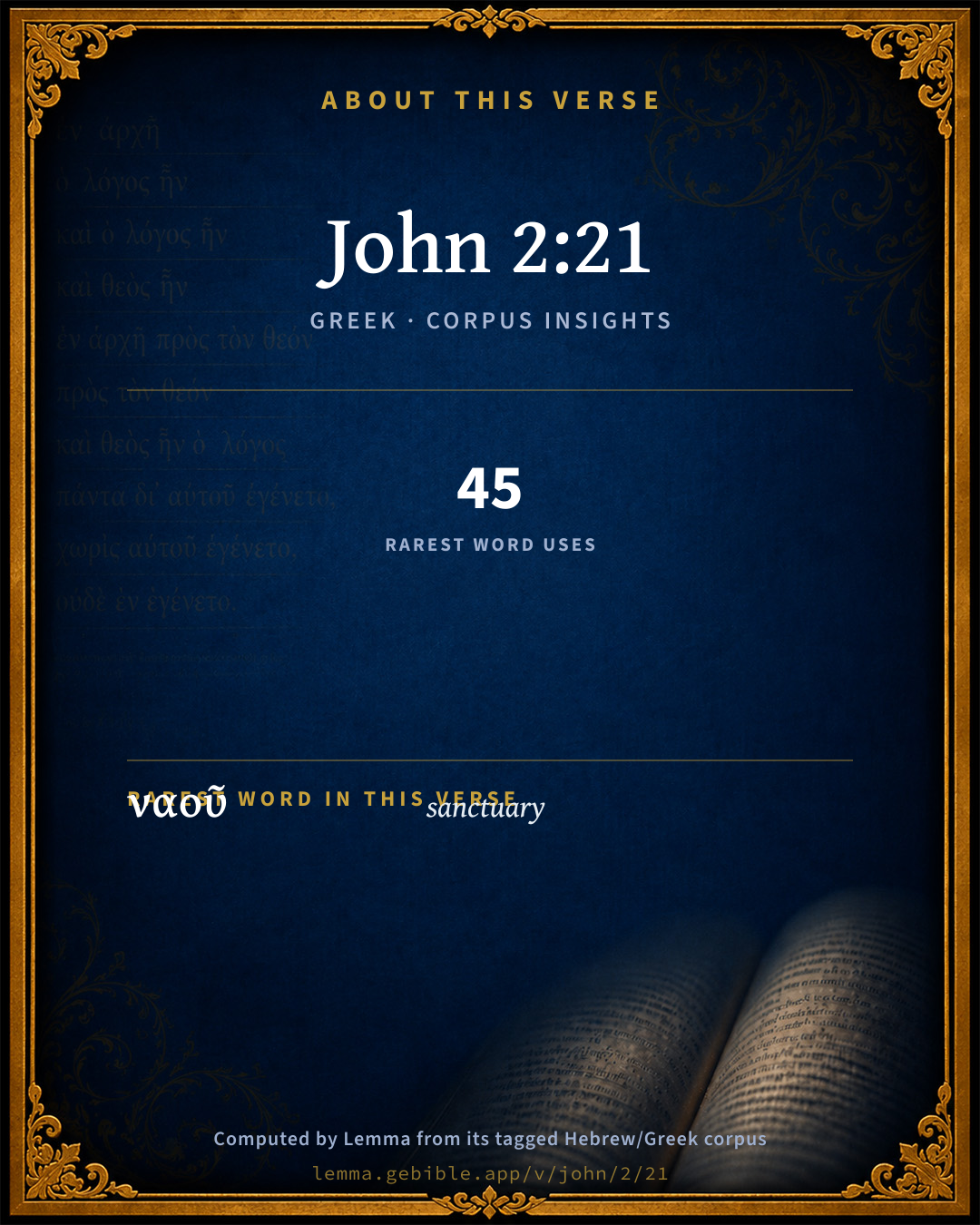
John 2:21

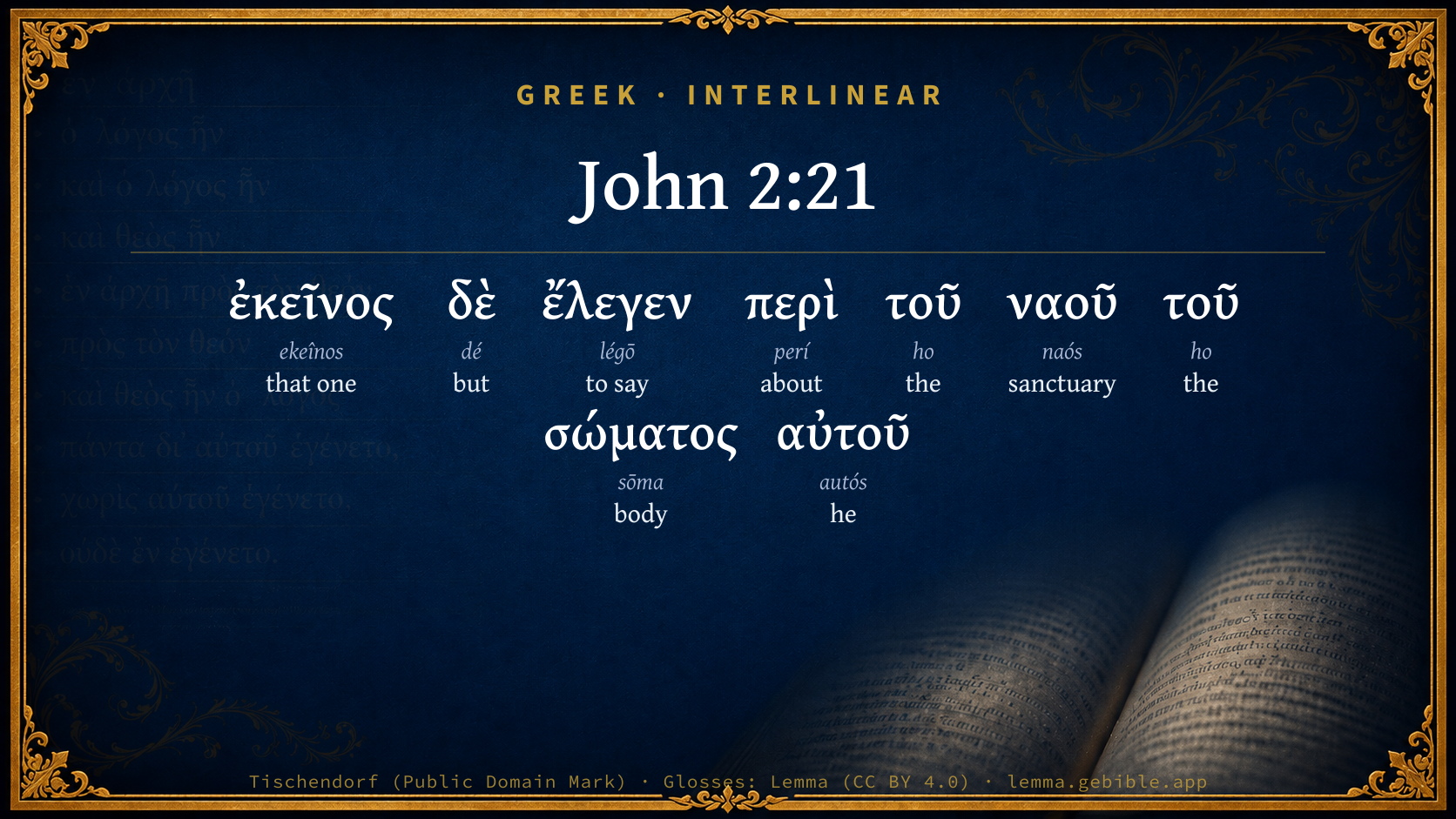
Greek (Tischendorf 8th ed.) John 2:21 appears in the Greek New Testament. The text above is from the Tischendorf 8th edition. Each word links to its Strong’s number and a concise gloss. Click any word for its full Thayer’s Greek Lexicon entry.
Download image
Cite this verse

John 2:21 (World English Bible). Public Domain. Lemma interlinear Bible study tool, https://lemma.gebible.app/v/john/2/21.

Show BibTeX & RIS
BibTeX
RIS
English Translation
But he spoke of the temple of his body.
World English Bible · Public Domain
Download a study sheet

One document with this verse’s original text, its word-by-word gloss line, the meaning frame, cross-references with their text, attributed commentary, and full source and license credits — printable, and it pastes into notes with its structure intact.

This verse Autodidact and up

Study sheet (.html) Plain text (.txt)

A passage Seminary Student

Up to 50 verses in one chapter. A passage sheet keeps up to 6 commentary sources and 12 cross-references per verse, in the order this page ranks them, and says so on the sheet whenever that leaves anything out. Ask for a single verse and you get the Autodidact verse sheet above.

Everything on this page stays free to read, with no account — the sheet is a download of what is already on screen, not access to it.

Want to remove ads? Support Godless Engineer
Compare translations 3

The same verse in 3 English versions, stacked beneath the original-language interlinear above. Click any original word for its lexicon entry.

Each is an independent rendering of the whole verse — the interlinear is not word-aligned to these translations.

Highlighted words mark where these versions differ — a whole-verse word diff, not a word-by-word alignment.

  • World English Bible Public Domain
    But he spoke of the temple of his body.
  • King James Version Public Domain
    But he spake of the temple of his body.
  • unfoldingWord Literal Text CC BY-SA 4.0
    But that one was speaking about the temple of his body.

unfoldingWord Literal Text — © unfoldingWord, licensed CC BY-SA 4.0. Word-aligned USFM3 via Door43 (git.door43.org/unfoldingWord/en_ult).

Versions to compare (up to 4)

3 of 4 selected

Show all 19 translations

Every available English version of this verse, each an independent rendering of the whole verse.

  • World English Bible Public Domain
    But he spoke of the temple of his body.
  • Berean Standard Bible Public Domain
    But Jesus was speaking about the temple of His body.
  • Majority Standard Bible Public Domain
    But Jesus was speaking about the temple of His body.
  • King James Version Public Domain
    But he spake of the temple of his body.
  • American Standard Version (1901) Public Domain
    But he spake of the temple of his body.
  • Revised Version (1885) Public Domain
    But he spake of the temple of his body.
  • Geneva Bible (1599) Public Domain
    But he spake of the temple of his bodie.
  • Douay-Rheims (1899) Public Domain
    But he spoke of the temple of his body.
  • Young's Literal Translation Public Domain
    but he spake concerning the sanctuary of his body;
  • Literal Standard Version CC BY-SA 4.0
    But He spoke concerning the temple of His body;
  • Unlocked Literal Bible CC BY-SA 4.0
    However, he was speaking about the temple of his body.
  • unfoldingWord Literal Text CC BY-SA 4.0
    But that one was speaking about the temple of his body.
  • Darby Bible Public Domain
    But *he* spoke of the temple of his body.
  • World Messianic Bible Public Domain
    But he spoke of the temple of his body.
  • Webster's Bible Public Domain
    But he spoke of the temple of his body.
  • Free Bible Version CC BY-SA 4.0
    But the Temple Jesus was speaking of was his body.
  • Bible in Basic English Public Domain
    But his words were about that holy building which was his body.
  • Text-Critical English NT CC BY 4.0
    But he was speaking about the temple of his body.
  • Tyndale New Testament (1534) Public Domain
    But he spake of the temple of his body.

Literal Standard Version (2020), Covenant Press — licensed CC BY-SA 4.0. Text via the HelloAO Bible API (eBible.org). Unlocked Literal Bible (unfoldingWord) — licensed CC BY-SA 4.0. Text via the HelloAO Bible API (eBible.org). unfoldingWord Literal Text — © unfoldingWord, licensed CC BY-SA 4.0. Word-aligned USFM3 via Door43 (git.door43.org/unfoldingWord/en_ult). Free Bible Version, Dr. Jonathan Gallagher — licensed CC BY-SA 4.0. Text via the HelloAO Bible API (eBible.org).

Word by word

More ways to search: Search by grammar → Find every occurrence → Compare this word →

Practice this passage: Drill this verse → Learn its vocabulary →

ναοῦ
naós
G3485
“sanctuary”
Noun, Genitive, Singular, Masculine
Part of Speech
Noun
Case
Genitive
Number
Singular
Gender
Masculine
Full Thayer's Definition

Origin: from a primary naio (to dwell)

TDNT: 18:40,6

1. used of the temple at Jerusalem, but only of the sacred edifice (or sanctuary) itself, consisting of the Holy place and the Holy of Holies (in classical Greek it is used of the sanctuary or cell of the temple, where the image of gold was placed which is distinguished from the whole enclosure) 2. any heathen temple or shrine 3. metaph. the spiritual temple consisting of the saints of all ages joined together by and in Christ
  1. ἐκεῖνος ekeînos G1565 “that one” Demonstrative pronoun, Nominative, Singular, Masculine
  2. δὲ dé G1161 “but” Conjunction
  3. ἔλεγεν légō G3004 “to say” Verb, Imperfect, Active, Indicative, 3rd person, Singular
  4. περὶ perí G4012 “about” Preposition
  5. τοῦ ho G3588 “the” Article, Genitive, Singular, Masculine
  6. τοῦ ho G3588 “the” Article, Genitive, Singular, Neuter
  7. σώματος sōma G4983 “body” Noun, Genitive, Singular, Neuter
  8. αὐτοῦ autós G846 “he” Personal pronoun, Genitive, Singular, Masculine

About this verse

These counts appear in no published source. They are computed here, from the morphology-tagged text and Lemma’s own curated glosses. What Lemma adds →

9
words
8
distinct lemmas
Gospels
section

Shared distinctive vocabulary

ναοῦ sanctuary G3485 occurs in 39 verses of the Greek New Testament. Also found in:

Repetition

A word recurs within this verse:

Cross-references

9

Topical passages linked to John 2:21 in the Treasury of Scripture Knowledge — connected by theme and wording, ordered by reader-vote popularity; previews shown in the World English Bible.

  • 1 Corinthians 6:19 Or don't you know that your body is a temple of the Holy Spirit which is in you, which you have from God? You are not your own,
  • 1 Corinthians 3:16 Don't you know that you are a temple of God, and that God's Spirit lives in you?
  • Ephesians 2:20–22 being built on the foundation of the apostles and prophets, Christ Jesus himself being the chief cornerstone;
  • Colossians 1:19 For all the fullness was pleased to dwell in him;
  • Colossians 2:9 For in him all the fullness of the Godhead dwells bodily,
  • Hebrews 8:2 a minister of the sanctuary, and of the true tabernacle, which the Lord pitched, not man.
  • John 1:14 The Word became flesh, and lived among us. We saw his glory, such glory as of the one and only Son of the Father, full of grace and truth.
  • 2 Corinthians 6:16 What agreement has a temple of God with idols? For you are a temple of the living God. Even as God said, "I will dwell in them, and walk in them; and I will be their God, and they will be my people."
  • 1 Peter 2:4–5 coming to him, a living stone, rejected indeed by men, but chosen by God, precious.

Cross-references courtesy of OpenBible.info (CC BY 4.0).

Commentary

Notes on John 2:21 from classic Christian and Jewish commentators (each source and its license shown beneath its notes). The classic Christian expositions comment on the surrounding passage and are grouped to its opening verse, so a note may address several verses; the Jewish commentaries on the Tanakh (Rashi and others) are per-verse, so they appear only where the commentator wrote on this verse.

Lemma curates 59 commentaries, every one of them public domain or Creative Commons licensed, each selected and text-cleaned for this edition rather than reprinted as found. About our sources →

Bengel's Gnomon

Johann Albrecht Bengel

Joh 2:21. Περὶ τοῦ ναοῦ τοῦ σώματος, concerning the temple of His body) that is, concerning the temple, which was the body of Jesus. Let the expression be compared, which is found ch. Joh 11:13, “Howbeit Jesus spake of His death; but they thought that He had spoken of taking rest in sleep.”

Bengel's Gnomon of the New Testament — English translation (T&T Clark, Edinburgh, 1860) — public domain. Text from a community e-Sword module.

Meyer's Critical & Exegetical Commentary

Heinrich August Wilhelm Meyer

Joh_2:21-22. Τοῦ σώματος]

[147] Genitive of apposition; see Winer, p. 494 [E. T. p. 666].

Joh_2:22. οὖν] represents the recollection as answering to the true meaning of that declaration.

ἐμνήσθησαν] they became mindful of, Joh_2:17; Joh_12:16. The saying came afresh to their remembrance when it was explained as a fact by the resurrection; previously, because not understood, it had been forgotten. With ἠγέρθη comp. ἐγερῶ, Joh_2:19.

καὶ ἐπίστευσαν, κ.τ.λ.] As the result of this recollection, they believed the Scripture (felt convinced of the truth of its statements),observing, that is, the harmony of its prophecies concerning the resurrection of Jesus (Psa_16:10; Isaiah 53; cf. Luk_24:26; Act_13:33 ff.; 1Co_15:4; Mat_12:40) with that saying of Christs,and the word which Jesus had (then, Joh_2:19) spoken, which now, as fulfilled in the resurrection, presented itself to them in its full prophetic truth. Upon πιστεύειν τινι in St. John, comp. Weiss, Lehrbegr. p. 20.

Schweizer (whom Scholten follows) regards Joh_2:21-22 as spurious, quite groundlessly. The statement is the exact outcome of St. Johns inmost personal experience.

[147] John explains the saying so simply and definitely, that there is no room for the double meaning which Luthardt, Hengstenberg, and others import into it. With equal simplicity and definiteness does he represent the meaning given as that of Jesus Himself (against Weizsäcker, p. 266). In like manner Joh_7:38, Joh_12:32, Joh_21:19. In none of these passages is any distinction drawn between the sense given and the meaning intended by Jesus Himself.

Meyer — Critical and Exegetical Commentary on the New Testament — English translation by Peter Christie, edited by Frederick Crombie (T&T Clark, 1880) — public domain. Text from a community e-Sword module.

Geneva Bible (1599)

Geneva Bible translators

That is, of his body.

Geneva Bible (1599) marginal notes — public domain. Text via Bolls.life.

Jamieson, Fausset & Brown

Robert Jamieson, A. R. Fausset & David Brown

temple of his body--in which was enshrined the glory of the eternal Word. (See on Joh 1:14). By its resurrection the true Temple of God upon earth was reared up, of which the stone one was but a shadow; so that the allusion is not quite exclusively to Himself, but takes in that Temple of which He is the foundation, and all believers are the "lively stones." (Pe1 2:4-5).

Jamieson, Fausset & Brown — Commentary Critical and Explanatory on the Whole Bible (1871) — public domain (CC PDM 1.0). Text via the HelloAO Bible API.

Adam Clarke's Commentary

Verse 21. Of the temple of his body.] Rather, the temple, his body: his body had no particular temple: but it was the temple of his Divinity-the place in which, as in the ancient temple, his Godhead dwelt; See how the Jews perverted these words, Mt 26:60, and the notes there.

Adam Clarke's Commentary on the Bible (1810–1826) — public domain. Text from a community e-Sword/MySword module.

Ellicott's Commentary for English Readers

(21) But he spake.—Literally, was speaking. This is the solution of the enigma as the disciples read it in the after history. It is remarkable that we have the interpretation of the spiritual temple in Mar_14:58 (see Note there, and comp. Joh_4:21; Joh_4:23).

A Bible Commentary for English Readers, edited by Charles John Ellicott (1878–1897) — public domain. Text from a community e-Sword module.

The Cambridge Bible for Schools and Colleges

gen. ed. J. J. S. Perowne

21. spake] Or, was speaking. Setting aside inspiration, S. John’s explanation must be admitted as the true one. What better interpreter of the mind of Jesus can be found than ‘the disciple whom Jesus loved?’ And he gives the explanation not as his only, but as that of the disciples generally. Moreover it explains the ‘three days,’ which interpretations about destroying the old Temple religion and raising up a new spiritual theocracy do not.

The Cambridge Bible for Schools and Colleges (gen. ed. J. J. S. Perowne; Cambridge University Press, 1878–1918) — public domain. Text from a community e-Sword module.

John Gill's Exposition

But he spoke of the temple of his body. Which was the antitype of the material temple; and might well be called so, since the bodies of the saints are called temples, Co1 3:16 Co2 6:16; and the human nature of Christ is called a tabernacle, Heb 8:2; and he himself, in prophecy, is said to be "for a sanctuary", or temple, Isa 8:14, and that because the fulness of the Godhead dwelt in him bodily, the train of the divine perfections filled the temple of his human nature, Col 2:9. And because here, as in the temple, God grants his presence, and communes with his saints, accepts of their prayers and praises, and all their spiritual sacrifices through him; and who is the oracle, the true "Urim" and "Thummim", by whom he delivers his whole mind and will to his people.

. And because here, as in the temple, God grants his presence, and communes with his saints, accepts of their prayers and praises, and all their spiritual sacrifices through him; and who is the oracle, the true "Urim" and "Thummim", by whom he delivers his whole mind and will to his people.

John 2:22

joh 2:22

joh 2:22

joh 2:22When therefore he was risen from the dead,.... Which was three years after this:

his disciples remembered that he had said this unto them; either to the Jews, or to them the disciples; though the phrase "to them", is not in the Vulgate Latin, nor in any of the Oriental versions. The disciples themselves were very dull of understanding the doctrine of Christ's resurrection; and so they continued, notwithstanding he gave them afterwards very full hints of it, until that he was actually risen; and then they called to mind these words of his, with others that dropped from him upon the same subject:

and they believed the Scripture; that spoke of his resurrection, Psa 16:10, and on the third day, Hos 6:2.

And the word which Jesus had said; concerning his rising again the third day at this time, and at others, as in Mat 16:21; and they believed his word equally with the Scripture, it agreeing to it, and being founded on it.

John Gill's Exposition of the Whole Bible (1746–1763) — public domain (CC PDM 1.0). Text via the HelloAO Bible API.

Trapp's Complete Commentary

John Trapp

21 But he spake of the temple of his body.

Ver. 21. The temple of his body] Wherein the "Godhead dwelt bodily," Col 2:9, that is, personally, as he dwelt in the material temple sacramentally, and doth dwell in the hearts of his people spiritually. This tabernacle of Christ’s body was not made with hands, nor built by the power of nature, Heb 9:2.

John Trapp, A Commentary or Exposition upon All the Books of the Old and New Testament (1647–1656) — public domain. Text from a community e-Sword module.

Matthew Poole's English Annotations

But, alas, our Saviour spoke not of their material temple, but of the temple of his body; which yet was proper speaking: for if the apostle calleth our bodies the temple of God, as he doth, 1Co 3:16; 6:19; 2Co 6:16; it much more may be said so of the body of Christ: for as God dwelt in the temple, and there revealed his will, and would be there worshipped; how properly must the notion of the temple agree to Christ, in whom the fulness of the Godhead dwelt bodily, Col 2:9, who revealeth his Father’s nature and will to men, Mat 11:27, and in whom all must worship him? So as the temple at Jerusalem was every way a most illustrious type of Christ, and Christ might well, speaking concerning his body, say, Destroy this temple; and thus Christ (would these blind Jews have seen it) drew off the Jews from glorying in their temple, Jer 7:4; and from the temple, which was but a type, (as the tabernacle was before, Act 7:44; Heb 9:23,24), to himself, prefigured by those houses, Heb 9:11. Nor doth he think fit at this time to speak more plainly; for as he knew that the perverse Jews, in seeing would not see, nor bear any such doctrine; so he also knew, that his better disciples were as yet weak in faith; and none putteth new wine into old bottles.

Matthew Poole's English Annotations on the Holy Bible (1683–1685) — public domain. Text from a community e-Sword/MySword module.

Whedon's Commentary on the Bible

Daniel D. Whedon

21. Temple of his body—That the body is a building has been recognized by both the science and the literature of all the world. And religious thought specially recognizes that it should be a temple; the temple of the Holy Spirit. And Christ’s body was the temple; of which the Jewish material temple was the type. When, therefore, the disciples subsequently found that after three days of destruction Christ revived his bodily temple, a new inner meaning flashed upon their minds. The meaning now is, Destroy, ye Jews, this sacred frame, (as you surely will,) and in three days it shall by my divine power rise again. Before fulfilment it would indeed have taken a prophet to extract this inner meaning; yet, none the less we see, after the fulfilment, that none but a prophet could have uttered the prediction. And to us may they not bear a third still deeper meaning? Destroy this old dispensation of which this temple is the symbol, and my three days of death will build it anew. Abolish old Judaism, and in brief time I will rear young Christianity. So that there are in these words three strata of meaning: an outside, an inner, and an inmost sense; each true for its own class of searchers.

Daniel D. Whedon (gen. ed.), Commentary on the Old and New Testaments (1874–1909) — public domain. Text from a community e-Sword module.

Cambridge Greek Testament for Schools and Colleges

21. ἔλεγεν. Was speaking. Even if inspiration be set aside, S. John’s explanation must be admitted as the true one. What better interpreter of the mind of Jesus can be found than ‘the disciple whom Jesus loved’? And he gives the interpretation not as his only, but as that of the disciples generally. Moreover, it explains the ‘three days,’ which interpretations about destroying the old Temple-religion and raising up a new spiritual theocracy do not. Ναός is also used of Christians, the spiritual Body of Christ, 1Co 3:16-17; 1Co 6:19; 2Co 6:16. For the genitive of apposition see Winer, p. 666.

Cambridge Greek Testament for Schools and Colleges (Cambridge University Press, 1896; 21 vols, various authors incl. Carr, Maclear, Plummer, Farrar, Lumby, Moule, M. R. James, Simcox) — public domain. Text from a community e-Sword module.

International Critical Commentary

21. ἐκεῖνος δὲ ἔλεγεν κτλ., “but He was speaking about the temple of His body.” ἐκεῖνος is emphatic, “but He, on the contrary …” See on 1:8, 19:35.

For Jn.’s habit of commenting on sayings of Jesus, cf. Introd., p. xxxiv. This comment seems to convey that by the words “Destroy this temple,” Jesus meant “Destroy this body of mine.” But this is hardly possible (see on v. 19). Had He meant that, He would have spoken with less ambiguity. He plainly meant Herod’s Temple, and was so understood. Christian believers are, indeed, spoken of as the “Temple of God” (2Co 6:16), but not Christ Himself. He was “greater than the Temple” (Mat 12:6). But the comment is much condensed, and may mean only that the “temple of His body” of which Jesus spoke was the “spiritual house” of Christian believers (1Pe 2:5), who are collectively the Body of Christ (1Co 12:27); the “three days” carrying an allusion to the interval between the Death and Resurrection of Jesus, which marked, as it seems to the evangelist looking back, the watershed between Judaism and Christianity.

τοῦ σώματος αὐτοῦ. Jn. is not fond of the word σῶμα (see p. clxxi); he always uses it of a dead body, not of a living one (cf. 19:31, 38, 40, 20:12).

International Critical Commentary — older volumes (1896–1929), various authors — public domain. Text from a community e-Sword module.

Vincent's Word Studies in the New Testament

Marvin R. Vincent

He [εκεινος] . See on 1 18. Emphatic, and marking the contrast between the deeper meaning of Jesus and the literalism of the Jews and of His disciples (see next verse). For other illustrations of John's pointing out the meaning of words of Jesus which were not at first understood, see Joh 7:39; Joh 12:33; Joh 21:19.

Marvin R. Vincent, Word Studies in the New Testament (1887–1900) — public domain. Text from a community e-Sword/MySword module.

Godet's Commentaries

Frédéric Louis Godet

Ver. 21. “But he spoke of the temple of his body.”

By ἐκεῖνος, ille vero, he opposed to every other, John strongly contrasts the thought of Jesus with the interpretation of the Jews and the want of understanding of the apostles. Only He comprehends perfectly the true sense of His own saying.

Frédéric Louis Godet — Commentaries on Luke, John, Romans, and 1 Corinthians — English translation (T&T Clark, Edinburgh, 1870s–1890s) — public domain. Text from a community e-Sword module.

Lesson kit

Teaching starters — assembled from the data on this page, not authored interpretation. Every prompt links to the verse data it draws on. Edit before teaching.

John, in the Gospels, opens this verse with 9 words (8 distinct Greek lemmas). Its most distinctive word is naós (“sanctuary”). A historical commentator’s framing appears above. Read the whole chapter for the surrounding context.

Discussion questions

  1. How does “sanctuary” (naós) shape what this verse is saying?
  2. Matthew 23:16 shares the word «sanctuary» with this verse. How do the two illuminate each other?
  3. “the” occurs 2× in this one verse. What is the effect of the repetition?
  4. These translations render this verse differently. What is at stake in choosing one wording over another?
  5. Reading how Bengel's Gnomon and Meyer's Critical & Exegetical Commentary read this verse, where do the two commentators agree and where do they part?

Things to notice

  • These translations choose different wording for 5 words in this verse.
  • “the” occurs 2× in this single verse.
  • 8 distinct Greek lemmas span 9 words in this verse.

Reading settings

Reading text

Shown beneath each verse's original-language words.

Old Testament
Old Testament edition

Read the OT as the Masoretic Hebrew (MT) or the Greek Septuagint (LXX).

English shown for the Greek Septuagint (in the Hebrew ↔ Greek comparison).

Comparing translations? Open the Compare panel on any verse page to stack up to four side by side.