
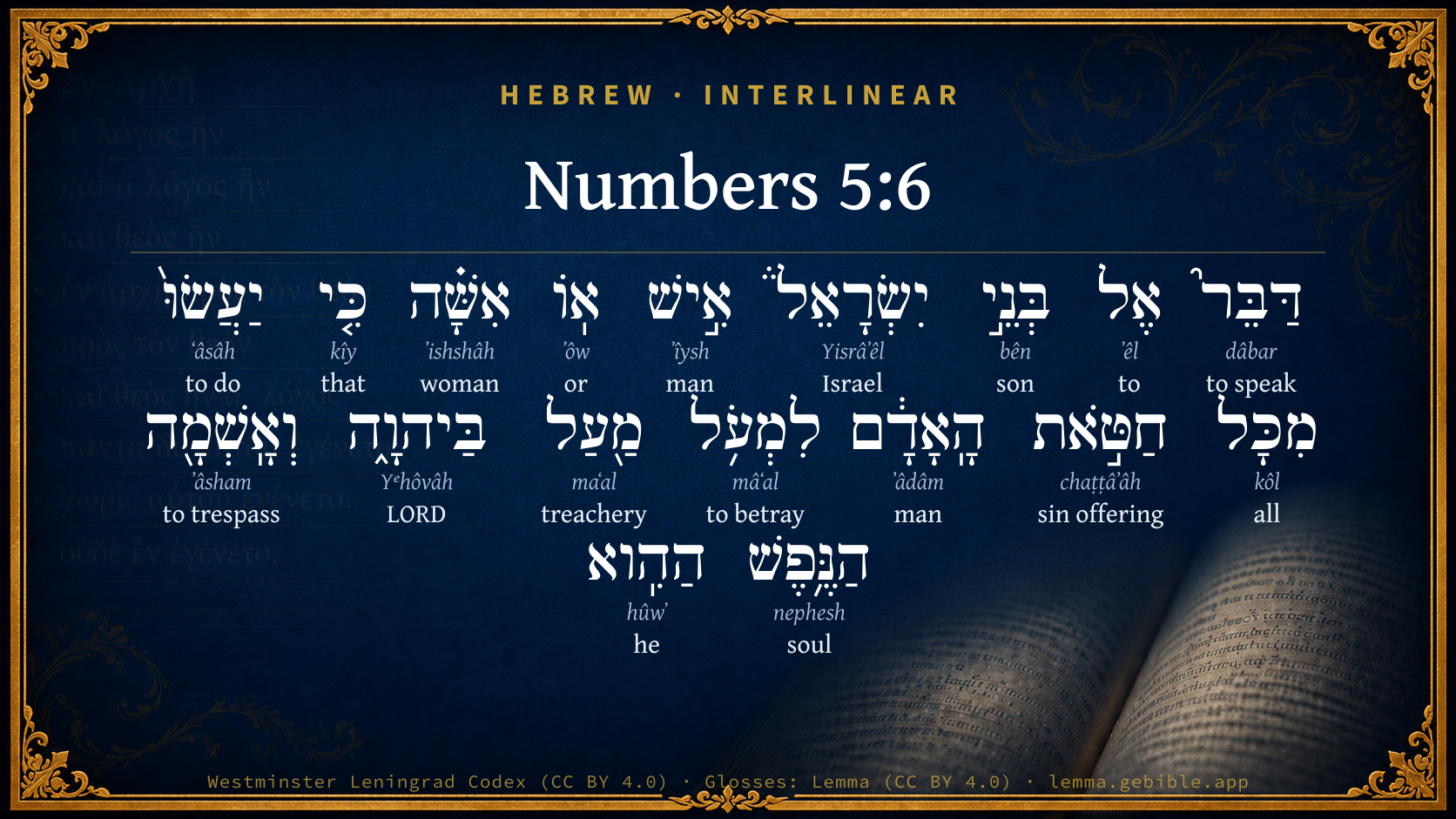
Numbers 5:6

Hebrew (Westminster Leningrad Codex) Numbers 5:6 appears in the Hebrew Old Testament. The text above is from the Westminster Leningrad Codex. Each word links to its Strong’s number, a concise gloss, and parsing drawn from the Open Scriptures Hebrew Bible morphology. Click any word for its full Brown-Driver-Briggs (BDB) entry.
Download image
Cite this verse

Numbers 5:6 (World English Bible). Public Domain. Lemma interlinear Bible study tool, https://lemma.gebible.app/v/numbers/5/6.

Show BibTeX & RIS
BibTeX
RIS
English Translation
"Speak to the children of Israel: When a man or woman commits any sin that men commit, so as to trespass against Yahweh, and that soul is guilty;
World English Bible · Public Domain
Download a study sheet

One document with this verse’s original text, its word-by-word gloss line, the meaning frame, cross-references with their text, attributed commentary, and full source and license credits — printable, and it pastes into notes with its structure intact.

This verse Autodidact and up

Study sheet (.html) Plain text (.txt)

A passage Seminary Student

Up to 50 verses in one chapter. A passage sheet keeps up to 6 commentary sources and 12 cross-references per verse, in the order this page ranks them, and says so on the sheet whenever that leaves anything out. Ask for a single verse and you get the Autodidact verse sheet above.

Everything on this page stays free to read, with no account — the sheet is a download of what is already on screen, not access to it.

Want to remove ads? Support Godless Engineer
Compare translations 3

The same verse in 3 English versions, stacked beneath the original-language interlinear above. Click any original word for its lexicon entry.

Each is an independent rendering of the whole verse — the interlinear is not word-aligned to these translations.

Highlighted words mark where these versions differ — a whole-verse word diff, not a word-by-word alignment.

  • World English Bible Public Domain
    "Speak to the children of Israel: When a man or woman commits any sin that men commit, so as to trespass against Yahweh, and that soul is guilty;
  • King James Version Public Domain
    Speak unto the children of Israel, When a man or woman shall commit any sin that men commit, to do a trespass against the LORD, and that person be guilty;
  • unfoldingWord Literal Text CC BY-SA 4.0
    “Speak to the sons of Israel: ‘A man or a woman, when they do from all the sins of the man to be unfaithful unfaithfulness against Yahweh, then that person is guilty.

unfoldingWord Literal Text — © unfoldingWord, licensed CC BY-SA 4.0. Word-aligned USFM3 via Door43 (git.door43.org/unfoldingWord/en_ult).

Versions to compare (up to 4)

3 of 4 selected

Show all 18 translations

Every available English version of this verse, each an independent rendering of the whole verse.

  • World English Bible Public Domain
    "Speak to the children of Israel: When a man or woman commits any sin that men commit, so as to trespass against Yahweh, and that soul is guilty;
  • Berean Standard Bible Public Domain
    “Tell the Israelites that when a man or woman acts unfaithfully against the LORD by committing any sin against another, that person is guilty
  • Majority Standard Bible Public Domain
    “Tell the Israelites that when a man or woman acts unfaithfully against the LORD by committing any sin against another, that person is guilty
  • King James Version Public Domain
    Speak unto the children of Israel, When a man or woman shall commit any sin that men commit, to do a trespass against the LORD, and that person be guilty;
  • American Standard Version (1901) Public Domain
    Speak unto the children of Israel, When a man or woman shall commit any sin that men commit, so as to trespass against Jehovah, and that soul shall be guilty;
  • Revised Version (1885) Public Domain
    Speak unto the children of Israel, When a man or woman shall commit any sin that men commit, to do a trespass against the LORD, and that soul be guilty;
  • Geneva Bible (1599) Public Domain
    Speake vnto the children of Israel, When a man or woman shall commit any sinne that men commit, and transgresse against the Lord, when that person shall trespasse,
  • Douay-Rheims (1899) Public Domain
    Say to the children of Israel: When a man or woman shall have committed any of all the sins that men are wont to commit, and by negligence shall have transgressed the commandment of the Lord, and offended,
  • Young's Literal Translation Public Domain
    `Speak unto the sons of Israel, Man or woman, when they do any of the sins of man, by committing a trespass against Jehovah, and that person `is' guilty,
  • Literal Standard Version CC BY-SA 4.0
    “Speak to the sons of Israel: Man or woman, when they do any of the sins of man, by committing a trespass against YHWH, and that person [is] guilty,
  • Unlocked Literal Bible CC BY-SA 4.0
    “Speak to the people of Israel. When a man or woman commits any sin such as people do to one another, and is unfaithful to me, that person is guilty.
  • unfoldingWord Literal Text CC BY-SA 4.0
    “Speak to the sons of Israel: ‘A man or a woman, when they do from all the sins of the man to be unfaithful unfaithfulness against Yahweh, then that person is guilty.
  • Darby Bible Public Domain
    Speak unto the children of Israel, When a man or woman shall commit any of all the sins of man to work unfaithfulness against Jehovah, and that soul is guilty,
  • World Messianic Bible Public Domain
    “Speak to the children of Israel: ‘When a man or woman commits any sin that men commit, so as to trespass against the LORD, and that soul is guilty,
  • Webster's Bible Public Domain
    Speak to the children of Israel, When a man or woman shall commit any sin that men commit, to do a trespass against the LORD, and that person shall be guilty;
  • Free Bible Version CC BY-SA 4.0
    “Tell the Israelites that when a man or woman is unfaithful to the Lord by sinning against someone else, they are guilty
  • Bible in Basic English Public Domain
    Say to the children of Israel, If a man or a woman does any of the sins of men, going against the word of the Lord, and is in the wrong;
  • JPS Tanakh (1917) Public Domain
    Speak unto the children of Israel: When a man or woman shall commit any sin that men commit, to commit a trespass against the LORD, and that soul be guilty;

Literal Standard Version (2020), Covenant Press — licensed CC BY-SA 4.0. Text via the HelloAO Bible API (eBible.org). Unlocked Literal Bible (unfoldingWord) — licensed CC BY-SA 4.0. Text via the HelloAO Bible API (eBible.org). unfoldingWord Literal Text — © unfoldingWord, licensed CC BY-SA 4.0. Word-aligned USFM3 via Door43 (git.door43.org/unfoldingWord/en_ult). Free Bible Version, Dr. Jonathan Gallagher — licensed CC BY-SA 4.0. Text via the HelloAO Bible API (eBible.org).

Word by word

More ways to search: Search by grammar → Find every occurrence → Compare this word →

Practice this passage: Drill this verse → Learn its vocabulary →

מַ֖עַל
maʻal
H4604
“treachery”
Noun, Common, Masculine, Singular, Absolute
Part of Speech
Noun
Type
Common
Gender
Masculine
Number
Singular
State
Absolute
Full BDB Definition

Origin: from H4603

TWOT: 1230a

unfaithful or treacherous act, trespass - against man - against God
  1. דַּבֵּר֮ dâbar H1696 “speak” Verb, Piel, Imperative, 2nd Person, Masculine, Singular
  2. אֶל ʼêl H413 “to” Preposition
  3. בְּנֵ֣י bên H1121 “sons of” Noun, Common, Masculine, Plural, Construct
  4. יִשְׂרָאֵל֒ Yisrâʼêl H3478 “Israel” Noun, Proper
  5. אִ֣ישׁ ʼîysh H376 “man” Noun, Common, Masculine, Singular, Absolute
  6. אֽוֹ ʼôw H176 “or” Conjunction
  7. אִשָּׁ֗ה ʼishshâh H802 “woman” Noun, Common, Feminine, Singular, Absolute
  8. כִּ֤י kîy H3588 “that” Conjunction
  9. יַעֲשׂוּ֙ ʻâsâh H6213 “to do” Verb, Qal, Imperfect, 3rd Person, Masculine, Plural
  10. מִכָּל kôl H3605 “from · all of” Preposition + Noun, Common, Masculine, Singular, Construct
  11. חַטֹּ֣את chaṭṭâʼâh H2403 “sin offerings of” Noun, Common, Feminine, Plural, Construct
  12. הָֽאָדָ֔ם ʼâdâm H120 “the · man” Particle, Definite Article + Noun, Common, Masculine, Singular, Absolute
  13. לִמְעֹ֥ל mâʻal H4603 “to betray” Preposition + Verb, Qal, Infinitive Construct
  14. בַּיהוָ֑ה Yᵉhôvâh H3068 “in/at · LORD” Preposition + Noun, Proper
  15. וְאָֽשְׁמָ֖ה ʼâsham H816 “and · to trespass” Conjunction + Verb, Qal, Perfect, 3rd Person, Feminine, Singular
  16. הַנֶּ֥פֶשׁ nephesh H5315 “the · soul” Particle, Definite Article + Noun, Common, Both, Singular, Absolute
  17. הַהִֽוא hûwʼ H1931 “the · he” Particle, Definite Article + Pronoun, Personal, 3rd Person, Feminine, Singular

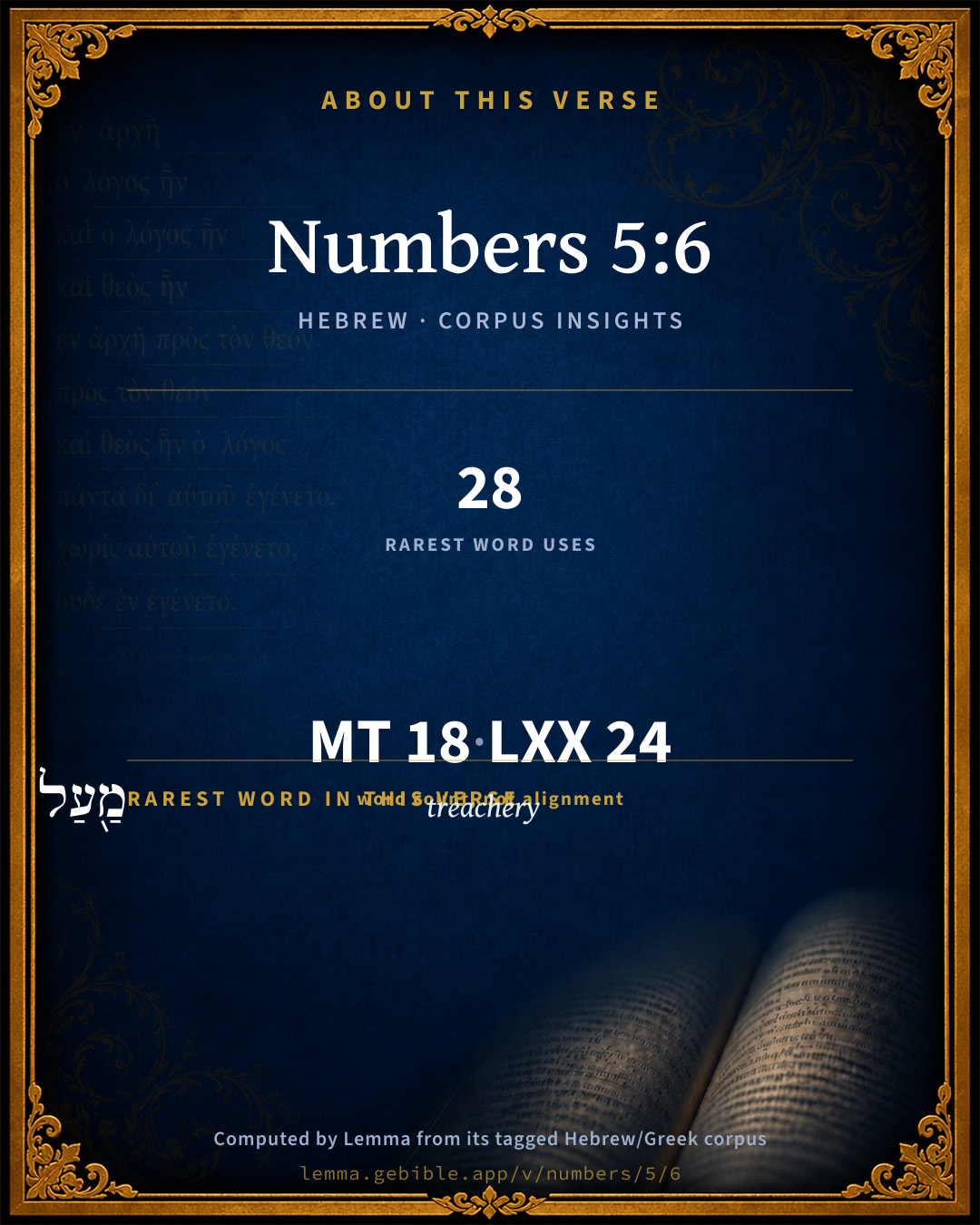
About this verse

These counts appear in no published source. They are computed here, from the morphology-tagged text and Lemma’s own curated glosses. What Lemma adds →

18
words
18
distinct lemmas
Pentateuch
section

Shared distinctive vocabulary

מַ֖עַל treachery H4604 occurs in 28 verses of the Hebrew Bible. Also found in:

Grammatical profile

  • 4 verbs
  • 10 nouns
  • 1 pronoun
  • 1 preposition
  • 2 conjunctions

Verb forms

  • דַּבֵּר֮ Piel · Imperative
  • יַעֲשׂוּ֙ Qal · Imperfect
  • לִמְעֹ֥ל Qal · Infinitive Construct
  • וְאָֽשְׁמָ֖ה Qal · Perfect

Hebrew & Septuagint length

In English translation the verse runs 28 words from the Hebrew and 34 from the Septuagint (LXX English) — closely comparable.

A rough comparison of the two English renderings, which tokenize alike — not a word-level alignment.

Word counts can differ between the Hebrew and the Greek without any difference in meaning — e.g. the Hebrew direct-object marker אֵת has no separate Greek word, and Greek often adds the article ὁ.

In the original languages it is 18 Hebrew tokens and 24 Greek tokens — but the two are counted differently (Hebrew bundles its prefixes and suffixes into one token; the Greek is in lemma form), so that isn’t a like-for-like length.

Cross-references

2

Topical passages linked to Numbers 5:6 in the Treasury of Scripture Knowledge — connected by theme and wording, ordered by reader-vote popularity; previews shown in the World English Bible.

  • Leviticus 5:1–4 "'If anyone sins, in that he hears the voice of adjuration, he being a witness, whether he has seen or known, if he doesn't report it, then he shall bear his iniquity.
  • Leviticus 5:14–6:7 Yahweh spoke to Moses, saying,

Cross-references courtesy of OpenBible.info (CC BY 4.0).

Hebrew and Greek witnesses Masoretic Hebrew ↔ Greek Septuagint

The same verse in the two great witnesses to the Old Testament, shown verse-for-verse.

These are two independent witnesses, not word-aligned to each other, and the Septuagint is shown in lemma (dictionary) form.

Hebrew Numbers 5:6 Masoretic · Westminster Leningrad Codex

דַּבֵּר֮ אֶל בְּנֵ֣י יִשְׂרָאֵל֒ אִ֣ישׁ אֽוֹ אִשָּׁ֗ה כִּ֤י יַעֲשׂוּ֙ מִכָּל חַטֹּ֣את הָֽאָדָ֔ם לִמְעֹ֥ל מַ֖עַל בַּיהוָ֑ה וְאָֽשְׁמָ֖ה הַנֶּ֥פֶשׁ הַהִֽוא

"Speak to the children of Israel: When a man or woman commits any sin that men commit, so as to trespass against Yahweh, and that soul is guilty;

World English Bible · Public Domain

Greek LXX Numbers 5:6 Septuagint · lemma form

λαλέω ὁ υἱός ἰσραήλ λέγω ἀνήρ ἤ γυνή ὅστις ἐάν ποιέω ἀπό ὁ ἁμαρτία ὁ ἀνθρώπινος καί παραὁράω παραὁράω καί πλημμελέω ὁ ψυχή ἐκεῖνος

Speak to the children of Israel, saying, Every man or woman who shall commit any sin that is common to man, or if that soul shall in anyway have neglected the commandment and transgressed;

LXX2012 (modern English Septuagint) · Public Domain

Hebrew: Westminster Leningrad Codex (CC BY 4.0). Greek: Septuagint (public domain); English from LXX2012 (modern English Septuagint) (Public Domain). How the Septuagint differs from the Hebrew →

Targum (Aramaic paraphrase)

2

The Targum is the ancient Jewish Aramaic paraphrase of the Hebrew Scriptures — an interpretive translation, not the Hebrew text itself. Onkelos (literal) and Pseudo-Jonathan (expansive) render the Torah, and Jonathan the Prophets. Coverage is partial: where no permissively-licensed English translation exists for a verse, only the Aramaic is shown. This is verse-level text, not a word-by-word alignment to the Hebrew.

  1. Targum Onkelos Torah (Genesis–Deuteronomy)
    מַלֵל עִם בְּנֵי יִשְׂרָאֵל גְבַר אוֹ אִתְּתָא אֲרֵי יַעְבְּדוּן מִכָּל חוֹבֵי אֱנָשָׁא לְשַׁקָרָא שְׁקָר קֳדָם יְיָ וְיֵחוֹב אֱנָשָׁא הַהוּא

    (no public-domain English translation for this verse)

    Targum Onkelos — Aramaic: “Onkelos Genesis” (public domain); “Onkelos Exodus” (public domain); “Onkelos Leviticus” (public domain); “Onkelos Numbers” (public domain); “Onkelos Deuteronomy” (public domain). English: “Sefaria Community Translation” (CC0 1.0 (public-domain dedication)); “J.W. Etheridge. The Targums of Onkelos and Jonathan Ben Uzziel on the Pentateuch. London: Longmans, Green, 1862” (public domain). Text via Sefaria.

  2. Targum Pseudo-Jonathan Torah (Genesis–Deuteronomy)
    מַלֵיל עִם בְּנֵי יִשְרָאֵל גְבַר אוֹ אִיתְּתָא דִי יַעֲבְדוּן מִכָּל חוֹבֵי אֱנָשָׁא לִמְשַׁקְרָא שְׁקַר קֳדָם יְיָ וְיִתְחַיֵיב בַּר נַשׁ הַהוּא

    Say to the children of Israel: A man or a woman who committeth any human sin, in acting perversely before the Lord, and hath become guilty;

    Targum Pseudo-Jonathan — Aramaic: “Targum Jonathan on Genesis” (public domain); “Targum Jonathan on Exodus” (public domain); “Targum Jonathan on Leviticus” (public domain); “Targum Jonathan on Numbers” (public domain); “Targum Jonathan on Deuteronomy” (public domain). English: “The Targum of Jonathan ben Uzziel, trans. J. W. Etheridge, London, 1862” (public domain). Text via Sefaria.

Commentary

Notes on Numbers 5:6 from classic Christian and Jewish commentators (each source and its license shown beneath its notes). The classic Christian expositions comment on the surrounding passage and are grouped to its opening verse, so a note may address several verses; the Jewish commentaries on the Tanakh (Rashi and others) are per-verse, so they appear only where the commentator wrote on this verse.

Lemma curates 59 commentaries, every one of them public domain or Creative Commons licensed, each selected and text-cleaned for this edition rather than reprinted as found. About our sources →

Trapp's Complete Commentary

John Trapp

Num 5:6 Speak unto the children of Israel, When a man or woman shall commit any sin that men commit, to do a trespass against the LORD, and that person be guilty;

Ver. 6. Any sin that men commit.] For what man is he that liveth and sinneth not? I am a man a sinner, {a} saith Peter, {Luk 5:8} not more a man than a sinner. Our lives are fuller of sin, than the firmament of stars, or the furnace of sparks: we can as little cease to sin, as the hart to pant, pulse to beat, &c. The devil, when he speaks lies, speaks of his own, {Joh 8:44} so when we do evil, we work of our own, we "walk as men." {1Co 3:3} Sins are here called human sins, as the Greek hath it.

{a} ανηρ αμαρταλος

John Trapp, A Commentary or Exposition upon All the Books of the Old and New Testament (1647–1656) — public domain. Text from a community e-Sword module.

The Biblical Illustrator

Joseph S. Exell

Num_5:6-10

Recompense his trespass.

The law as to fraud

1. He must confess his sin, and crave pardon from the bottom of his heart; he must submit himself unto God, knowing that he can by no means hide his sin, nor by any colour keep it from the sight of God.

2. We must make satisfaction to Him whom we have wronged. It is not enough to make open confession unto God, unless also we make actual restitution unto men. This is done to discourage injurious persons. For if they should only restore the principal, they know, if their offences were found out, they should be no losers.

3. He must seek reconciliation and atonement with God, by offering up of a ram in sacrifice, which figured out the suffering of Christ, and offering up of Himself once upon the Cross, for the discharge of our sin, and appeasing of the wrath of His Father. It shall profit us nothing to be at peace with men, except we be at peace with our God. This the enacting of the Law: an exception is annexed by way of prevention. For the offender that hath trespassed against his neighbour might object and say, How can I restore that I have taken? It may be the party is dead; it may be he hath neither son nor daughter nor kinsman: may I not then lawfully conceal it, and justly retain it unto myself? I answer, nay; the Lord answereth, Thou shalt by no means detain the goods that are not thine own, if thou look for any good at My hand. If the owner be dead or unknown, and he have none of his kindred and alliance living to be his heir, it shall not be thine, it is the Lords, and He giveth it unto the priest for a recompense of his labours in the tabernacle. God is the Lord of the soil; He challengeth it at His own, and He disposeth it at His own pleasure. (W. Attersoll.)

Fraud and forgiveness:

I. The sin of fraud.

1. As assuming many forms.

(1) Fraud in the matter of goods entrusted to the keeping of another.

(2) In business transactions.

(3) In seizing by force that which belongs to another.

(4) In wronging another by means of deceit.

(5) In the finder of lost property injuring the loser by falsehood.

And in our own age fraud assumes many forms, and is widely prevalent. The employer who does not pay just wages to those in his service is guilty of it (Pro_22:16; Isa_3:14-15; Col_4:1; Isa_5:4). So also is the servant or workman who squanders the time for which his employer pays him; in so doing he defrauds his employer. The trader who takes an unfair advantage of his customer, which he calls by some special name, e.g., practice of the trade, &c.; the broker or speculator or manager who induces persons to invest their money in unreliable enterprises; the person who contracts a debt without the sincere intention and reasonable prospect of paying it--all these, and others, are guilty of fraud.

2. As a wrong done to God.

II. The conditions of its forgiveness.

1. Consciousness of guilt. The expression, that person be guilty, does not merely refer to his actual criminality; but to his consciousness of guilt respecting it: for this case must be distinguished from that of a person detected in dishonesty which he attempted to conceal. Without the consciousness of guilt the other conditions of forgiveness could not be truly complied with.

2. Confession. Then they shall confess their sin which they have done. This is an essential condition of forgiveness (Psa_32:5; Pro_28:13; 1Jn_1:9). In itself it relieves the burdened soul, and leads to the joy and peace of forgiveness.

3. Restitution is essential to remission of sin; for where restitution is not made it is evident that sincere repentance is absent (Eze_18:7; Eze_18:9; Eze_18:12-13; Eze_33:15).

4. Sacrifice. In addition to making restitution the offender was commanded to offer the ram of the atonement, whereby an atonement shall be made for him.

Conclusion:

1. Let those who have injured others make speedy and full confession and restitution.

2. Let us all cultivate the most thorough integrity and uprightness in our whole life and conduct. (W. Jones.)

Restitution:

When Mr. Moody was once speaking upon prayer, an incident occurred illustrating his subject, which made a profound impression, and came home to every one. He said true prayer consisted of ten elements--Adoration, Confession, Restitution, Thanksgiving, Unity, or Brotherly Love, the Spirit of Forgiveness, Faith, Ask (with a beggars importunity, a servants docility, and a friends confidence), Perseverance, and last, Submission. When he came to the third element, Restitution, a man rose in the audience and cried out: Mr. Moody, let me cut in here. I went to Texas five years ago, having cheated my creditors of 15,000 dollars. My wife and I thought we were real smart. We settled in one of the cities, bought a nice house and furnished it tip top; grand piano, Brussels carpets, and my wife thought no end of the lace curtains. But we had hardly got settled down when Mr. Moody came along, and, like others, we followed the crowd of professors and church members. He preached the same sermon we have so far heard to-night. The Spirit of God convicted me and my wife both of sin, on this head of Restitution, and we went home perfectly miserable. I said, Loo, what are we to do? Do! says she; you know what to do without asking me; repay everybody to the last cent. No sooner said than done; the house was sold and an auction called right away; and, oh, the joy I had in handing up the silverware and the china. The piano and all went, but my wife was so happy at parting with the lace curtains it was really curious. Then we took two little rooms, a bedroom and a kitchen, and the only table we had was the one we had used in the kitchen for chopping meat on; but the Lord filled us with Himself, and we had peace and joy, because we had pardon and a clean conscience. The dear Lord has blessed me far above my desert and beyond what the devil led me to steal, and we have come to Northfield to praise the Lord, and carry back with us to Texas a fresh baptism of the blessed power which set us free five years ago.

The Biblical Illustrator, edited by Joseph S. Exell (c. 1880s–1900s) — public domain. Text from a community e-Sword module.

Joseph Benson's Commentary

Num 5:6. Any sin that men commit — Hebrew, any sins of men; that is, sins against men, as deceits or wrongs, whereby other men are injured, of which he manifestly speaks. Against the Lord — Which words may be added, to show that such injuries done to men are also sins against God, who hath commanded justice to men, as well as religion to himself. Guilty — That is, shall be sensible of his guilt, convicted in his conscience.

Joseph Benson's Commentary on the Old and New Testaments (1811–1818) — public domain. Text from a community e-Sword module.

Tyndale Open Study Notes

Tyndale Open Resources

5:6 Doing something wrong to another human being is the same as betraying—literally breaking faith with—the Lord (cp. 5:8). A right relationship with God produces right relationships with people; a wrong relationship with others shows a wrong relationship with the Lord.

Tyndale Open Study Notes — © Tyndale Open Resources, licensed CC BY-SA 4.0. Text via the HelloAO Bible API.

Geneva Bible (1599)

Geneva Bible translators

Commit any fault willingly.

Geneva Bible (1599) marginal notes — public domain. Text via Bolls.life.

Jamieson, Fausset & Brown

Robert Jamieson, A. R. Fausset & David Brown

RESTITUTION ENJOINED. (Num 5:5-10)

When a man or a woman shall commit any sin that men commit, to do a trespass against the Lord--This is a wrong or injury done by one man to the property of another, and as it is called "a trespass against the Lord," it is implied, in the case supposed, that the offense has been aggravated by prevaricating--by a false oath, or a fraudulent lie in denying it, which is a "trespass" committed against God, who is the sole judge of what is falsely sworn or spoken (Act 5:3-4).

and that person be guilty--that is, from the obvious tenor of the passage, conscience-smitten, or brought to a sense and conviction of his evil conduct. (See on Lev 6:2). In that case, there must be: first, confession, a penitential acknowledgment of sin; secondly, restitution of the property, or the giving of an equivalent, with the additional fine of a fifth part, both as a compensation to the person defrauded, and as a penalty inflicted on the injurer, to deter others from the commission of similar trespasses. (See on Exo 22:1). The difference between the law recorded in that passage and this is that the one was enacted against flagrant and determined thieves, the other against those whose necessities might have urged them into fraud, and whose consciences were distressed by their sin. This law also supposes the injured party to be dead, in which case, the compensation due to his representatives was to be paid to the priest, who, as God's deputy, received the required satisfaction.

Jamieson, Fausset & Brown — Commentary Critical and Explanatory on the Whole Bible (1871) — public domain (CC PDM 1.0). Text via the HelloAO Bible API.

The Cambridge Bible for Schools and Colleges

gen. ed. J. J. S. Perowne

6. to da a trespass against the Lord] in acting unfaithfully towards Jehovah. To sin against one’s fellow men involves breaking faith with God; cf. Lev_6:2.

The Cambridge Bible for Schools and Colleges (gen. ed. J. J. S. Perowne; Cambridge University Press, 1878–1918) — public domain. Text from a community e-Sword module.

John Gill's Exposition

Speak unto the children of Israel,.... Put them in mind of the following law, that they observe it; and which is here repeated, because of two new things in it, as Jarchi observes, the one relates to confession, teaching that there is no fifth part nor trespass offering by witnesses, till a man confesses the thing; and the other is, concerning taking anything away by violence from a proselyte, which is to be given to the priests; see the original law in Lev 6:1,

when a man or woman shall commit any sin that men commit; or, "any of the sins of men" (e), which are commonly done by men, and men are subject to through the infirmity of the flesh, and the temptations of Satan; or "any sin against man" (f), so some, as this referred to is expressly said to be, Num 5:7,

to do a trespass against the Lord; for every sin against man is also against the Lord, being a breach of his command; as David's sin against Uriah was a sin against the Lord, Psa 51:4; though the Jews understand it particularly of lying and swearing falsely, appealing to God, and calling him to be a witness to a falsehood; and so the Targum of Onkelos seems to interpret it:

and the person be guilty; and knows he is so, and even knew it when he took an oath to the contrary; see Lev 6:3.

(e) "ex omnibus peccatis hominis", Montanus. (f) "Ex omnibus peccatis contra hominem", Tigurine version; so Patrick.

John Gill's Exposition of the Whole Bible (1746–1763) — public domain (CC PDM 1.0). Text via the HelloAO Bible API.

Haydock's Catholic Bible Commentary

To commit, against one another, ver. 7. (St. Augustine, q. 9.) When the thing is secret, so that the judges cannot take cognizance of it, the offender must nevertheless abide by the decision of the priest. Moses condemns him who had stolen an ox to restore it with another, or even to give five oxen, if he have not the one stolen in his possession, Exodus xxii. 1, 4. (Haydock) --- Here to reward the sincerity of the man, who confesses his private fault, he only requires the thing itself to be restored, with a fifth part besides. (Calmet) --- Negligence, not with contempt; (Menochius) though he knows that he is transgressing the divine and natural law. (Tirinus)

George Leo Haydock (1774–1849), Haydock's Catholic Family Bible and Commentary, 1859 edition — public domain. Excludes Psalms (Douay-Rheims chapter numbering differs from Protestant) and Deuterocanonical books (Catholic canon only).

Matthew Poole's English Annotations

Any sin that men commit, Heb. any sins of men, i.e. either,

1. Of common infirmity, or such sins as men commit through human frailty; for if this were done knowingly and willingly, a greater punishment was appointed. See Lev 6:5,6. Or rather,

2. Sins against men, or belonging to men, to wit, deceits or wrongs, whereby other men are injured, of which he manifestly speaks, as appears from Num 5:7,8; so this is a genitive case of the object, as Mat 12:31, blasphemy of the Spirit (for so it is in the Greek) is blasphemy against the Holy Ghost, as it is called Mar 3:29; Luk 12:10; and power of all flesh, Joh 17:2, is power over all flesh; and power of spirits, Mat 10:1, is power over or against spirits, Luk 9:1; and prayer of God, Luk 6:12, is prayer directed unto God; and the spoil of the poor, Isa 3:14, is the spoil taken from the poor; and violence of the children of Judah, Joe 3:19, is violence against them, as we translate it.

To do a trespass against the Lord; which words may be added, either,

1. To express a new sin, of prevaricating or dealing falsely with God, either by a false oath, which is a special injury to God, or by a lie or simple denial that he hath taken any thing of his neighbour’s, which also God takes as a sin especially concerning himself, who in such cases is the only judge of what is falsely said or sworn. See Act 5:3,4. Or,

2. To aggravate the former sin, and to show that such injuries done to men are also sins against God. who hath commended justice to men as well as religion to himself. But the former is more probable, both because here is a ram of atonement to be offered to God for the special injury clone to him, as well as satisfaction is to be made to the man whom he injured; and especially by comparing this with the parallel place, Lev 6:2, &c. And that person be guilty, i.e. shall be sensible of his guilt, or be convicted in his conscience of his sin; for otherwise this might seem a mere tautology, if it were only meant of being really guilty of sin, which was expressed before in those words, when one shall commit any sin, i.e. be guilty of any sin.

Matthew Poole's English Annotations on the Holy Bible (1683–1685) — public domain. Text from a community e-Sword/MySword module.

Whedon's Commentary on the Bible

Daniel D. Whedon

6. To do a trespass — This embraces offences against the right of property, such as denying and withholding a deposit, finding and concealing lost goods, getting possessions by violence or by fraud, and concealing the wrong by lies and perjury.

Against the Lord — The cardinal ethical principle involved in this is, that the creature is so intimately related to the Creator that any infringement of his rights dishonours and displeases his “Great Original.” Hence it follows, that all that morality is radically defective which treats our neighbour as a mere man, and ignores the obligations springing from his relation to God. In other words, no man can keep the second table of the law while disregarding the first; no man can love his neighbour as himself unless he loves God with all his heart.

Guilty — Hebrew, asham, to be in debt or at fault. For this the trespass offering, or asham, was prescribed. See on Lev_6:1-7, of which this law is an epitome.

Daniel D. Whedon (gen. ed.), Commentary on the Old and New Testaments (1874–1909) — public domain. Text from a community e-Sword module.

The Pulpit Commentary

Shall commit any sin that men commit. Literally, one of all the transgressions of men," i.e. , the wrongs current amongst men. To do a trespass against the Lord. This qualifies the former expression, and restricts its reference to the sins mentioned in Lev_6:2, Lev_6:8, Lev_6:5, viz., wrongs done to the property of another. Such wrongs, perhaps because they were considered legitimate as long as they were not found out, were taken up by the Lord himself as involving a trespass against his own righteousness.

The Pulpit Commentary (1880–1919), ed. H.D.M. Spence-Jones & Joseph S. Exell — public domain. Text from a community e-Sword module.

John Wesley's Explanatory Notes

Any sin that men commit - Hebrew. any sins of men, that is, sins against men, as deceits or wrongs, whereby other men are injured, of which he manifestly speaks. Against the Lord - Which words may be added, to shew that such injuries done to men are also sins against God, who hath commanded justice to men, as well as religion to himself. Guilty - That is, shall be sensible of his guilt, convicted in his conscience.

John Wesley, Explanatory Notes Upon the Whole Bible (1754–1765) — public domain. Text via the GEBible commentary corpus.

Rashi

Rabbi Shlomo Yitzchaki (Rashi)

למעל מעל בה׳ [WHEN A MAN OR WOMAN SHALL DO ANY OF THE SINS AGAINST MAN,] TO ACT DECEITFULLY AGAINST THE LORD — Here, you see, Scripture writes down again the section dealing with a person who robs by violence from another, and swears falsely regarding it, — it is the same section that has already been stated in the Sedrah ויקרא (Lev 5:21), “[If a soul sin], and commits a trespass against the Lord, and deny unto his neighbour etc.” The reason why it is repeated here is because of two new points which are contained in it. The one is that it (Scripture) writes here, “and if they confess” which teaches that one is not liable to payment of the fifth (in addition to the capital; cf. Leviticus 5:24), nor to bring a guilt offering (cf. Leviticus 5:25) if he is convicted by the evidence of witnesses, but only when he himself confesses the matter (his guilt). The second new point is about something stolen from a proselyte (cf. Rashi on v. 8) — that it has to be handed over to the priests (cf. Sifrei Bamidbar 2).

Rashi on the Tanakh — English translations: “The Judaica Press complete Tanach with Rashi, translated by A. J. Rosenberg” (CC BY 4.0); “Pentateuch with Rashi's commentary by M. Rosenbaum and A.M. Silbermann, 1929-1934” (public domain); “The Metsudah Tanach series, Lakewood, N.J” (CC BY 4.0); and “The Book of Joshua, Metsudah Publications, 1997” (CC BY 4.0). Text via Sefaria.

Ramban (Nachmanides)

Rabbi Moshe ben Nachman (Ramban / Nachmanides)

WHEN A MAN OR WOMAN SHALL DO ANY OF THE SINS OF MAN. [The sense of the verse] is as follows: “If a man does any of the sins by which one can transgress, of any sin which man commits against another man, and he deals falsely with his neighbor [—that soul shall be guilty].” He states [here] to commit a trespass against the Eternal, which means that he swears by His Name falsely and is thus guilty before Him [as well]. Now because this sin has already been mentioned, and here it only comes to introduce the new point concerning robbing a proselyte, He deals with it briefly. He stated here a man or woman because since it is not usual for a woman to rob, [we might think that] perhaps Scripture does not make her liable to pay the additional fifth or to bring a guilt-offering [when she confesses the sin], Verse 25. like a man, [therefore He stated here a man or woman, teaching that her liability is in all respects the same as that of a man]. He mentioned [here], And every heave-offering of all the holy things of the children of Israel, which they present unto the priest, shall be his, meaning to say that once they have given the heave-offering to the priest it becomes his [personal property], and he who robs it from him is to be dealt with in accordance with the law of the guilt-offering for robberies. That is the reason why He mentioned it here. Or it may be that [this verse] comes to complete the laws of the priests regarding the heave-offering, since till now He only mentioned them by way of allusion, [stating] Thou shalt not delay to offer of the fulness of thy harvest, and of the outflow of thy presses, (Vol. II, pp. 398-400). and so also, they may eat of his bread, but He did not explain the law of the heave-offering at all, that it is to be given to the priest; and as for the tithe, He [only] mentioned at the end of Torath Kohanim [i.e., the Book of Leviticus] that it is holy unto the Eternal., 27:30. Now, therefore, He came to command that the heave-offering and the holy gifts should belong to the priests by the grant of the owners, who may give them to them as they please, meaning to say that the benefit of satisfaction [of choosing to whom to give it] belongs to the owner [and the priest may not come and take it by force, since the owner may have the pleasure of giving it to any priest he chooses].The meal-offering of the sotah is a woman suspected of adultery, and is subject to the laws explained further on in Verses 11-31. The law concerning her meal-offering is found in Verse 15, where it is called a meal-offering of jealousy. is not mentioned together with the other meal-offerings in Torath Kohanim [i.e., Leviticus Chapter 2] because it is a meal-offering of jealousy is a woman suspected of adultery, and is subject to the laws explained further on in Verses 11-31. The law concerning her meal-offering is found in Verse 15, where it is called a meal-offering of jealousy. and does not come for atonement, therefore He completed the law thereof here [in the Book of Numbers]. Besides, since He traced the genealogy of the people by their fathers’ houses, He now gave them a law and judgment to ascertain who are the mamzerim, according to the final decision of the law, refers to a child born of a union which is prohibited, with the penalty of excision. It thus covers a child of any incestuous or adulterous relationship. who are not the children of their mothers’ husbands, when there arises a suspicion in a man’s heart concerning his wife.Similarly He completed here [the laws of] the offerings with the law of the Nazirite, for [only] after the Tabernacle was put up and the impure people separated from the camp, He took of their young men for Nazirites, who crowded at the entrance of the Tent of Meeting, to stand before the Eternal to minister unto Him, and to bless in His name. Furthermore, a woman who makes the Nazirite vow is the opposite of the sotah, is a woman suspected of adultery, and is subject to the laws explained further on in Verses 11-31. The law concerning her meal-offering is found in Verse 15, where it is called a meal-offering of jealousy. [and for this reason the law of the Nazirite follows that of the sotah]. Therefore He stated in the section [of the Nazirite], when either man ‘or woman’ utter a vow, the vow of a Nazirite.? It is to hint that this woman who takes upon herself the Nazirite vow, is the opposite of the sotah whose law has just been stated in the preceding section. Our Rabbis have furthermore said: “Why is the section dealing with the Nazirite placed next to the section dealing with the sotah? is a woman suspected of adultery, and is subject to the laws explained further on in Verses 11-31. The law concerning her meal-offering is found in Verse 15, where it is called a meal-offering of jealousy. [It is to tell us] that whoever sees a sotah in her disgrace should abstain [by means of a vow] from wine,” the reason being that harlotry, wine, and new wine, take away the heart. And [the commandment that] the Nazirite should let his hair grow loose is because this is the opposite of [the habit of] young men who curl their hair in order to beautify themselves, for allowing the hair to grow loose causes anxiety in man’s heart, and therefore the Nazirite is holy and must guard himself from impurity, Verse 7. for he is like the priest who ministers before his G-d [who likewise must be pure for service at the Sanctuary].

Ramban (Nachmanides) on the Tanakh — English translation: “Commentary on the Torah by Ramban (Nachmanides). Translated and annotated by Charles B. Chavel. New York, Shilo Pub. House, 1971-1976” (CC BY 4.0). Text via Sefaria.

Sforno

Rabbi Ovadia Sforno

Acting treacherously against Hashem. The Sages explained that this refers to property stolen from a proselyte at the time the Beis HaMikdash is standing. One who steals from a proselyte profanes the name of Hashem from the point of view of the proselyte, who had come to take refuge under the wings of the Divine Presence. Therefore, it is termed “acting treacherously” in holy matters, and he must bring a guilt offering as the law applying to anyone who acts treacherously.

Sforno on the Tanakh — English translation: “Yalkut, Sifsei Chachomim Chumash, Metsudah Publications, 2009” (CC BY 4.0). Text via Sefaria.

Lesson kit

Teaching starters — assembled from the data on this page, not authored interpretation. Every prompt links to the verse data it draws on. Edit before teaching.

Numbers, in the Pentateuch, opens this verse with 18 words (18 distinct Hebrew lemmas). Its most distinctive word is maʻal (“treachery”). A historical commentator’s framing appears above. Read the whole chapter for the surrounding context.

Discussion questions

  1. The word maʻal carries the sense “treachery.” How does it shape the verse?
  2. How does Leviticus 5:15, which shares the word «treachery», read alongside this verse?
  3. These translations render this verse differently. What is at stake in choosing one wording over another?
  4. «דַּבֵּר֮» is a Piel Imperative verb. How does that grammatical form shape the action described?
  5. Compare how Trapp's Complete Commentary and The Biblical Illustrator read this verse. Where do they agree or differ?

Things to notice

Reading settings

Reading text

Shown beneath each verse's original-language words.

Old Testament
Old Testament edition

Read the OT as the Masoretic Hebrew (MT) or the Greek Septuagint (LXX).

English shown for the Greek Septuagint (in the Hebrew ↔ Greek comparison).

Comparing translations? Open the Compare panel on any verse page to stack up to four side by side.