Joshua 2:24

Hebrew (Westminster Leningrad Codex) Joshua 2:24 appears in the Hebrew Old Testament. The text above is from the Westminster Leningrad Codex. Each word links to its Strong’s number, a concise gloss, and parsing drawn from the Open Scriptures Hebrew Bible morphology. Click any word for its full Brown-Driver-Briggs (BDB) entry.
Download image
Cite this verse

Joshua 2:24 (World English Bible). Public Domain. Lemma interlinear Bible study tool, https://lemma.gebible.app/v/joshua/2/24.

Show BibTeX & RIS
BibTeX
RIS
English Translation
They said to Joshua, Truly Yahweh has delivered into our hands all the land; and moreover all the inhabitants of the land do melt away before us.
World English Bible · Public Domain
Download a study sheet

One document with this verse’s original text, its word-by-word gloss line, the meaning frame, cross-references with their text, attributed commentary, and full source and license credits — printable, and it pastes into notes with its structure intact.

This verse Autodidact and up

Study sheet (.html) Plain text (.txt)

A passage Seminary Student

Up to 50 verses in one chapter. A passage sheet keeps up to 6 commentary sources and 12 cross-references per verse, in the order this page ranks them, and says so on the sheet whenever that leaves anything out. Ask for a single verse and you get the Autodidact verse sheet above.

Everything on this page stays free to read, with no account — the sheet is a download of what is already on screen, not access to it.

Want to remove ads? Support Godless Engineer
Compare translations 3

The same verse in 3 English versions, stacked beneath the original-language interlinear above. Click any original word for its lexicon entry.

Each is an independent rendering of the whole verse — the interlinear is not word-aligned to these translations.

Highlighted words mark where these versions differ — a whole-verse word diff, not a word-by-word alignment.

  • World English Bible Public Domain
    They said to Joshua, Truly Yahweh has delivered into our hands all the land; and moreover all the inhabitants of the land do melt away before us.
  • King James Version Public Domain
    And they said unto Joshua, Truly the LORD hath delivered into our hands all the land; for even all the inhabitants of the country do faint because of us.
  • unfoldingWord Literal Text CC BY-SA 4.0
    And they said to Joshua, “Truly Yahweh has given all of the land into our hand, for indeed, all of the dwellers of the land are melting from our faces.”

unfoldingWord Literal Text — © unfoldingWord, licensed CC BY-SA 4.0. Word-aligned USFM3 via Door43 (git.door43.org/unfoldingWord/en_ult).

Versions to compare (up to 4)

3 of 4 selected

Show all 18 translations

Every available English version of this verse, each an independent rendering of the whole verse.

  • World English Bible Public Domain
    They said to Joshua, Truly Yahweh has delivered into our hands all the land; and moreover all the inhabitants of the land do melt away before us.
  • Berean Standard Bible Public Domain
    “The LORD has surely delivered the entire land into our hands,” they said to Joshua. “Indeed, all who dwell in the land are melting in fear of us.”
  • Majority Standard Bible Public Domain
    “The LORD has surely delivered the entire land into our hands,” they said to Joshua. “Indeed, all who dwell in the land are melting in fear of us.”
  • King James Version Public Domain
    And they said unto Joshua, Truly the LORD hath delivered into our hands all the land; for even all the inhabitants of the country do faint because of us.
  • American Standard Version (1901) Public Domain
    And they said unto Joshua, Truly Jehovah hath delivered into our hands all the land; and moreover all the inhabitants of the land do melt away before us.
  • Revised Version (1885) Public Domain
    And they said unto Joshua, Truly the LORD hath delivered into our hands all the land; and moreover all the inhabitants of the land do melt away before us.
  • Geneva Bible (1599) Public Domain
    Also they saide vnto Ioshua, Surely the Lord hath deliuered into our handes all the lande: for euen all the inhabitants of the countrey faint because of vs.
  • Douay-Rheims (1899) Public Domain
    But they went and came to the mountains, and stayed there three days till they that pursued them were returned. For having sought them through all the way, they found them not.
  • Young's Literal Translation Public Domain
    and they say unto Joshua, `Surely Jehovah hath given into our hand all the land; and also, all the inhabitants of the land have melted at our presence.'
  • Literal Standard Version CC BY-SA 4.0
    and they say to Joshua, “Surely YHWH has given all the land into our hand; and also, all the inhabitants of the land have melted at our presence.”
  • Unlocked Literal Bible CC BY-SA 4.0
    They said to Joshua, “Truly Yahweh has given this land to us. All the inhabitants of the land are melting away because of us.”
  • unfoldingWord Literal Text CC BY-SA 4.0
    And they said to Joshua, “Truly Yahweh has given all of the land into our hand, for indeed, all of the dwellers of the land are melting from our faces.”
  • Darby Bible Public Domain
    And they said to Joshua, Of a surety Jehovah has given the whole land into our hands, and even all the inhabitants of the land faint because of us.
  • World Messianic Bible Public Domain
    They said to Joshua, “Truly the LORD has delivered all the land into our hands. Moreover, all the inhabitants of the land melt away before us.”
  • Webster's Bible Public Domain
    And they said to Joshua, Truly the LORD hath delivered into our hands all the land; for even all the inhabitants of the country do faint because of us.
  • Free Bible Version CC BY-SA 4.0
    “The Lord has placed this land in our hands,” they assured him. “All the people who live there are scared to death of us!”
  • Bible in Basic English Public Domain
    And they said to Joshua, Truly, the Lord has given all the land into our hands; and all the people of the land have become like water because of us.
  • JPS Tanakh (1917) Public Domain
    And they said unto Joshua: 'Truly the LORD hath delivered into our hands all the land; and moreover all the inhabitants of the land do melt away before us.'

Literal Standard Version (2020), Covenant Press — licensed CC BY-SA 4.0. Text via the HelloAO Bible API (eBible.org). Unlocked Literal Bible (unfoldingWord) — licensed CC BY-SA 4.0. Text via the HelloAO Bible API (eBible.org). unfoldingWord Literal Text — © unfoldingWord, licensed CC BY-SA 4.0. Word-aligned USFM3 via Door43 (git.door43.org/unfoldingWord/en_ult). Free Bible Version, Dr. Jonathan Gallagher — licensed CC BY-SA 4.0. Text via the HelloAO Bible API (eBible.org).

Word by word

More ways to search: Search by grammar → Find every occurrence → Compare this word →

Practice this passage: Drill this verse → Learn its vocabulary →

נָמֹ֛גוּ
mûwg
H4127
“to melt”
Verb, Niphal, Perfect, 3rd Person, Common, Plural
Part of Speech
Verb
Stem
Niphal
Form
Perfect
Person
3rd Person
Gender
Common
Number
Plural
Full BDB Definition

Origin: a primitive root

TWOT: 1156

to melt, cause to melt - (Qal) - to melt, faint - to cause to melt - (Niphal) to melt away - (Polel) to soften, dissolve, dissipate - (Hithpolel) to melt, flow
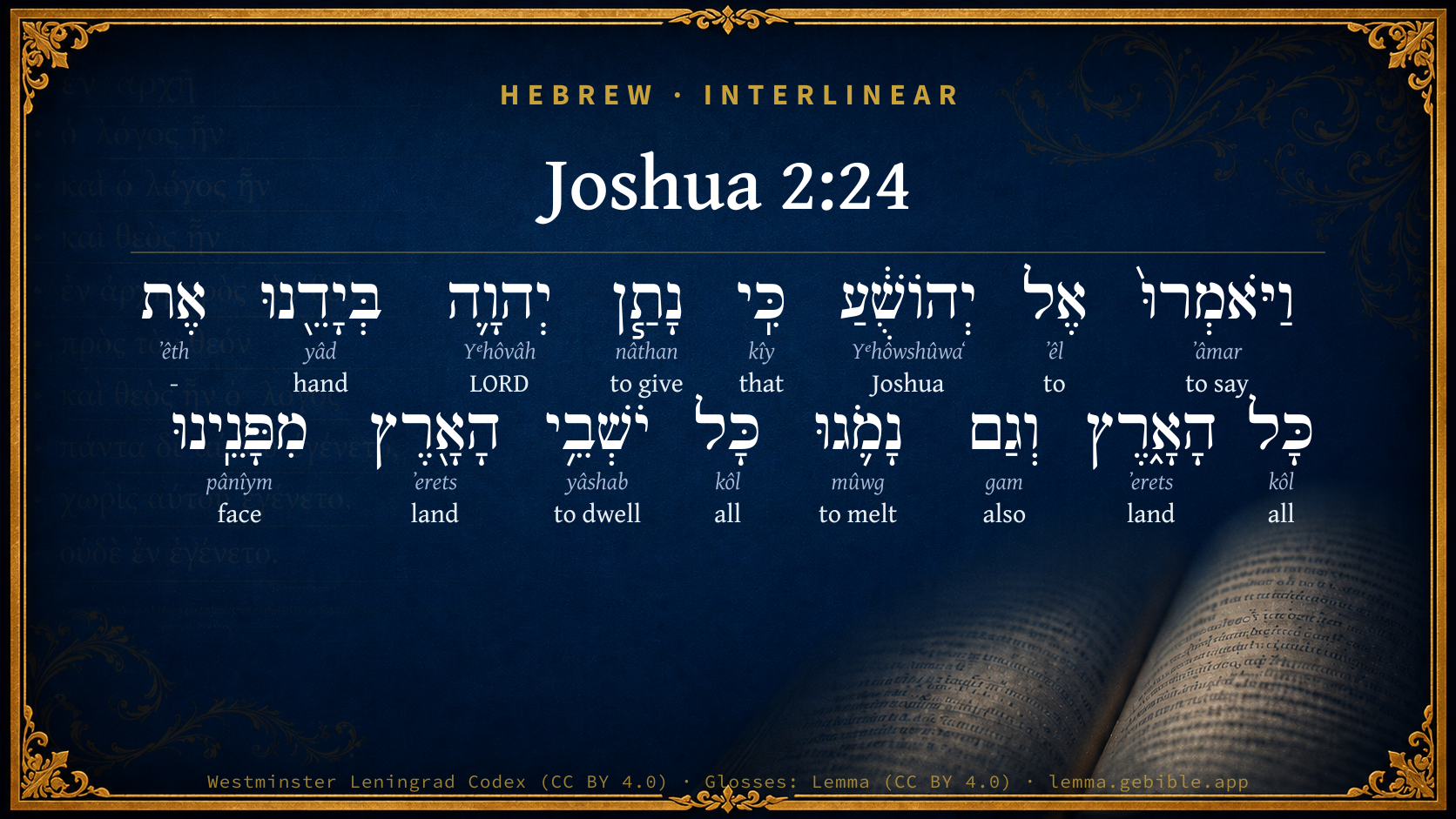
  1. וַיֹּאמְרוּ֙ ʼâmar H559 “and · to say” Conjunction + Verb, Qal, Sequential Imperfect, 3rd Person, Masculine, Plural
  2. אֶל ʼêl H413 “to” Preposition
  3. יְהוֹשֻׁ֔עַ Yᵉhôwshûwaʻ H3091 “Joshua” Noun, Proper
  4. כִּֽי kîy H3588 “that” Conjunction
  5. נָתַ֧ן nâthan H5414 “to give” Verb, Qal, Perfect, 3rd Person, Masculine, Singular
  6. יְהוָ֛ה Yᵉhôvâh H3068 “LORD” Noun, Proper
  7. בְּיָדֵ֖נוּ yâd H3027 “in/at · hand · our” Preposition + Noun, Common, Both, Singular, Construct + Suffix, Personal, 1st Person, Common, Plural
  8. אֶת ʼêth H853 “-” Particle, Direct Object
  9. כָּל kôl H3605 “all of” Noun, Common, Masculine, Singular, Construct
  10. הָאָ֑רֶץ ʼerets H776 “the · land” Particle, Definite Article + Noun, Common, Both, Singular, Absolute
  11. וְגַם gam H1571 “and · also” Conjunction + Particle, Accusative
  12. כָּל kôl H3605 “all of” Noun, Common, Masculine, Singular, Construct
  13. יֹשְׁבֵ֥י yâshab H3427 “dwelling” Verb, Qal, Participle Active, Masculine, Plural, Construct
  14. הָאָ֖רֶץ ʼerets H776 “the · land” Particle, Definite Article + Noun, Common, Both, Singular, Absolute
  15. מִפָּנֵֽינוּ pânîym H6440 “from · face(s) · our” Preposition + Noun, Common, Both, Plural, Construct + Suffix, Personal, 1st Person, Common, Plural

About this verse

These counts appear in no published source. They are computed here, from the morphology-tagged text and Lemma’s own curated glosses. What Lemma adds →

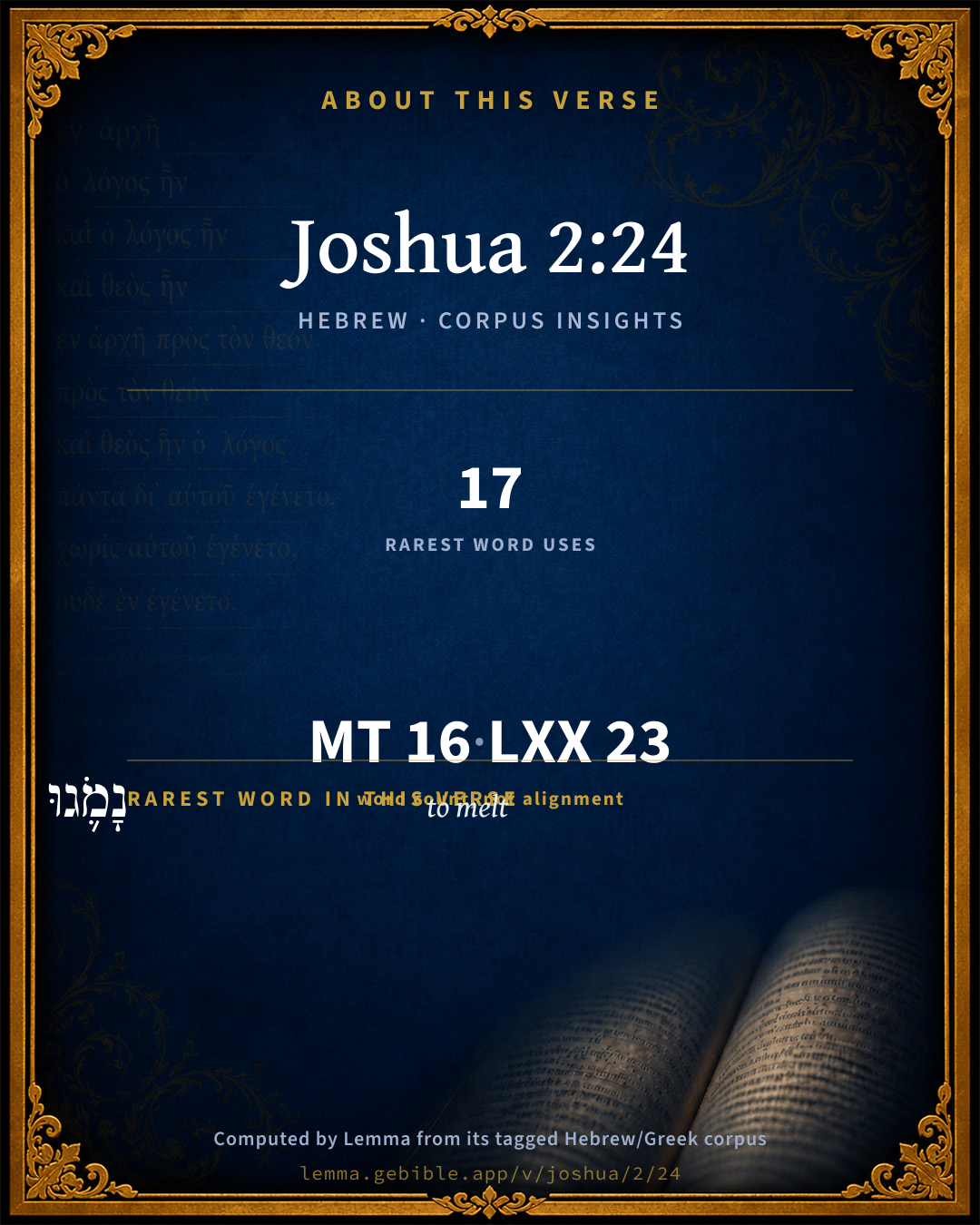
16
words
14
distinct lemmas
Historical
section

Notable vocabulary

The rarest word here is נָמֹ֛גוּ to melt H4127 — appearing just 17 times in the whole Hebrew Bible.

Shared distinctive vocabulary

נָמֹ֛גוּ to melt H4127 occurs in 17 verses of the Hebrew Bible. Also found in:

Grammatical profile

  • 4 verbs
  • 8 nouns
  • 1 preposition
  • 1 conjunction
  • 2 particles

Verb forms

  • וַיֹּאמְרוּ֙ Qal · Sequential Imperfect
  • נָתַ֧ן Qal · Perfect
  • נָמֹ֛גוּ Niphal · Perfect
  • יֹשְׁבֵ֥י Qal · Participle Active

Repetition

Words recur within this verse — often emphatic in Hebrew:

  • כָּל all H3605 ×2
  • הָאָ֑רֶץ land H776 ×2

Hebrew & Septuagint length

In English translation the verse runs 27 words from the Hebrew and 26 from the Septuagint (LXX English) — closely comparable.

A rough comparison of the two English renderings, which tokenize alike — not a word-level alignment.

Word counts can differ between the Hebrew and the Greek without any difference in meaning — e.g. the Hebrew direct-object marker אֵת has no separate Greek word, and Greek often adds the article ὁ.

In the original languages it is 16 Hebrew tokens and 23 Greek tokens — but the two are counted differently (Hebrew bundles its prefixes and suffixes into one token; the Greek is in lemma form), so that isn’t a like-for-like length.

Cross-references

10

Topical passages linked to Joshua 2:24 in the Treasury of Scripture Knowledge — connected by theme and wording, ordered by reader-vote popularity; previews shown in the World English Bible.

  • Exodus 23:31 I will set your border from the Red Sea even to the sea of the Philistines, and from the wilderness to the River; for I will deliver the inhabitants of the land into your hand, and you shall drive them out before you.
  • Exodus 15:15 Then the chiefs of Edom were dismayed. Trembling takes hold of the mighty men of Moab. All the inhabitants of Canaan are melted away.
  • Numbers 13:32–33 They brought up an evil report of the land which they had spied out to the children of Israel, saying, The land, through which we have gone to spy it out, is a land that eats up the inhabitants of it; and all the people who we saw in it are men of great stature.
  • Joshua 1:8 This book of the law shall not depart out of your mouth, but you shall meditate thereon day and night, that you may observe to do according to all that is written therein: for then you shall make your way prosperous, and then you shall have good success.
  • Joshua 2:9–11 and she said to the men, I know that Yahweh has given you the land, and that the fear of you is fallen on us, and that all the inhabitants of the land melt away before you.
  • Joshua 5:1 It happened, when all the kings of the Amorites, who were beyond the Jordan westward, and all the kings of the Canaanites, who were by the sea, heard how that Yahweh had dried up the waters of the Jordan from before the children of Israel, until we were passed over, that their heart melted, neither was there spirit in them any more, because of the children of Israel.
  • Joshua 21:44–45 Yahweh gave them rest round about, according to all that he swore to their fathers: and there stood not a man of all their enemies before them; Yahweh delivered all their enemies into their hand.
  • Psalms 48:5–6 They saw it, then they were amazed. They were dismayed, They hurried away.
  • Proverbs 25:13 As the cold of snow in the time of harvest, So is a faithful messenger to those who send him; For he refreshes the soul of his masters.
  • Revelation 6:16–17 They told the mountains and the rocks, "Fall on us, and hide us from the face of him who sits on the throne, and from the wrath of the Lamb,

Cross-references courtesy of OpenBible.info (CC BY 4.0).

Hebrew and Greek witnesses Masoretic Hebrew ↔ Greek Septuagint

The same verse in the two great witnesses to the Old Testament, shown verse-for-verse.

These are two independent witnesses, not word-aligned to each other, and the Septuagint is shown in lemma (dictionary) form.

Hebrew Joshua 2:24 Masoretic · Westminster Leningrad Codex

וַיֹּאמְרוּ֙ אֶל יְהוֹשֻׁ֔עַ כִּֽי נָתַ֧ן יְהוָ֛ה בְּיָדֵ֖נוּ אֶת כָּל הָאָ֑רֶץ וְגַם נָמֹ֛גוּ כָּל יֹשְׁבֵ֥י הָאָ֖רֶץ מִפָּנֵֽינוּ

They said to Joshua, Truly Yahweh has delivered into our hands all the land; and moreover all the inhabitants of the land do melt away before us.

World English Bible · Public Domain

Greek LXX Joshua 2:24 Septuagint · lemma form

καί εἶπον πρός ἰησοῦς ὅτι παραδίδωμι κύριος πᾶς ὁ γῆ ἐν χείρ ἐγώ καί καταπτήσσω πᾶς ὁ καταοἰκέω ὁ γῆ ἐκεῖνος ἀπό ἐγώ

And they said to Joshua, The Lord has delivered all the land into our power, and all the inhabitants of that land tremble because of us.

LXX2012 (modern English Septuagint) · Public Domain

Hebrew: Westminster Leningrad Codex (CC BY 4.0). Greek: Septuagint (public domain); English from LXX2012 (modern English Septuagint) (Public Domain). How the Septuagint differs from the Hebrew →

Targum (Aramaic paraphrase)

1

The Targum is the ancient Jewish Aramaic paraphrase of the Hebrew Scriptures — an interpretive translation, not the Hebrew text itself. Onkelos (literal) and Pseudo-Jonathan (expansive) render the Torah, and Jonathan the Prophets. Coverage is partial: where no permissively-licensed English translation exists for a verse, only the Aramaic is shown. This is verse-level text, not a word-by-word alignment to the Hebrew.

  1. Targum Jonathan Prophets (Joshua–Malachi)
    וַאֲמַרוּ לִיהוֹשֻׁעַ אֲרֵי מְסַר יְיָ בִּידָנָא יַת כָּל אַרְעָא וְאַף אִתְּבַּרוּ כָּל יָתְבֵי אַרְעָא מִן קֳדָמָנָא:

    (no public-domain English translation for this verse)

    Targum Jonathan — Aramaic: “Mikraot Gedolot” (public domain). English: “Sefaria Community Translation” (CC0 1.0 (public-domain dedication)); “London "Chaldee Paraphrase," 1871” (public domain). Text via Sefaria.

Commentary

Notes on Joshua 2:24 from classic Christian and Jewish commentators (each source and its license shown beneath its notes). The classic Christian expositions comment on the surrounding passage and are grouped to its opening verse, so a note may address several verses; the Jewish commentaries on the Tanakh (Rashi and others) are per-verse, so they appear only where the commentator wrote on this verse.

Lemma curates 59 commentaries, every one of them public domain or Creative Commons licensed, each selected and text-cleaned for this edition rather than reprinted as found. About our sources →

Adam Clarke's Commentary

Verse 24. Truly the Lord hath delivered into our hands all the land] How different was this report from that brought by the spies on a former occasion! They found that all the inhabitants of the land were panic-struck. The people had heard of the great exploits of the Israelites on the other side of Jordan; and as they had destroyed the potent kings of the Amorites, they took it for granted that nothing could stand before them. This information was necessary to Joshua to guide him in forming the plan of his campaign.

1. IT may be asked, Did not Rahab lie in the account she gave to the officers of the king of Jericho, (Jos 2:4; Jos 2:5), There came men unto me, c.? I answer, She certainly did and the inspired writer sets down the fact merely as it stood, without making the Spirit of God responsible for the dissimulation of the woman. But was she not rewarded, c.? Yes for her hospitality and faith, not for her lie. But could she have saved the spies without telling a lie? Yes, she certainly might; but what notion could a woman of her occupation, though nothing worse than an inn-keeper, have of the nicer distinctions between truth and falsehood, living among a most profligate and depraved people, where truth could scarcely be known?

2. There is a lax morality in the world that recommends a lie rather than the truth, when the purposes of religion and humanity can be served by it. But when can this be? The religion of Christ is one eternal system of truth, and can neither be served by a lie nor admit one. On this vile subject fine words have been spoken. Tasso, in his elegant episode of Sophronia and Olindo, in the Gerusalemme Liberata, b. ii., v. 22, represents the former as telling a lie to Saladdin, relative to the stealing of an image, for which, as he could not discover the culprit, he doomed all the Christians in his power to death. Sophronia, a pious Christian virgin, getting into the presence of the tyrant, in order to save her people, accuses herself, though perfectly innocent, of the theft. Her conduct on this occasion the poet embellishes in the following manner, for which the religion of that time, which dealt in holy frauds, would no doubt applaud him. 'Ed ella: il reo si trova al tuo cospetto;

Opra e il furto, Signor, di questa mano

Io l' immagine tolsi; Io son colei

Che tu ricerchi, e me punir tu dei.

Cosi al pubblico fato il capo altero

Offerse, e 'l volle in se sol racorre.

MAGNANIMA MENZOGNA! or quando e il VERO

SI BELLO, che si possa a te preporre?"

Then she: "Before thy sight the guilty stands;

The theft, O King, committed by these hands.

In me the thief who stole the image view!

To me the punishment decreed is due."

Thus, filled with public zeal, the generous dame

A victim for her people's ransom came.

O great deceit! O lie divinely fair!

What truth with such a falsehood can compare!

HOOLE.

Thus a lie is ornamented with splendid decorations both by the Italian and English poet, and the whole formed into an anti-apostolic maxim, Let us do EVIL, that GOOD may come of it.

A purer morality was taught by one of the most ancient heathen writers than is here preached by these demi-christians: -

Εχθρος γαρ μοι κεινος, ὁμως αΐδαο πυλησιν,

Ὁς χ' ἑτερον μεν κευθει ενι φρεσιν, αλλο δε βαζει.

Iliad. l. ix., v. 312.

My soul detests him as the gates of hell,

Who knows the truth and dares a falsehood tell, The following is the advice of a genuine Christian poet, and one of the holiest men of his time: -

LIE not; but let thy heart be true to God;

Thy tongue to it, thy actions to them both.

Cowards tell lies, and those who fear the rod;

The stormy working soul spits lies and froth.

DARE TO BE TRUE! nothing can NEED a lie.

The fault that needs it most grows TWO thereby.

HERBERT.

For other observations on this subject See Clarke on Ge 12:20, at the end, and "Ge 20:12".

3. Though the hand of God was evidently in every thing that concerned the Israelites, and they were taught to consider that by his might alone they were to be put in possession of the promised land; yet they were as fully convinced that if they did not use the counsel, prudence, and strength which they had received from him, they should not succeed. Hence, while they depended on the Divine direction and power, they exercised their own prudence, and put forth their own strength; and thus they were workers together with him, and did not receive the grace of God in vain. The application of this maxim is easy; and we cannot expect any success, either in things spiritual or temporal, unless we walk by the same rule and mind the same thing.

Adam Clarke's Commentary on the Bible (1810–1826) — public domain. Text from a community e-Sword/MySword module.

John Calvin's Commentaries

24. And they said unto Joshua, etc. This passage shows that Joshua was not mistaken in selecting his spies; for their language proves them to have been right-hearted men possessed of rare integrity. Others, perhaps, not recovered from the terror into which they had once been thrown, would have disturbed the whole camp, but these, while they reflect on the wonderful kindness of God, displayed in their escape from danger, and the happy issue of their expedition, exhort Joshua and the people to go boldly forward. And although the mere promise of possessing the land ought to have been sufficient, yet the Lord is so very indulgent to their weakness, that, for the sake of removing all doubt, he confirms what he had promised by experience. That the Lord had not spoken in vain, was proved by the consternation of the nations, when it began already to put them to flight., and to drive them out, as if hornets had been sent in upon them. For they argue in the same way as Rahab had done, that the land was given to them, as the inhabitants had almost fainted away from fear. I have therefore used the illative particle for, though the literal meaning is, and also. But it is sufficiently plain, that in the other way there is a confirmation of what they had said. And, indeed, the courage of all melted away, as if they felt themselves routed by the hand of God.

John Calvin's Commentaries (1540-1563) — public domain. Text from the Calvin Translation Society English edition (1840s-50s) via the Christian Classics Ethereal Library (ccel.org). Calvin's coverage is partial (roughly two-thirds of the Bible); uncommented books and verses are honest gaps, never fabricated. The 19th-century editor's footnotes and remarks are omitted so the notes are faithfully Calvin's own voice.

Ellicott's Commentary for English Readers

(24) The Lord hath delivered.—Observe the entirely satisfactory effect of this mission, and compare what was said on Jos_2:1.

A Bible Commentary for English Readers, edited by Charles John Ellicott (1878–1897) — public domain. Text from a community e-Sword module.

The Cambridge Bible for Schools and Colleges

gen. ed. J. J. S. Perowne

24. all the inhabitants] This was the most important part of their communication, that the inhabitants of the land were utterly dispirited and cast down.

The Cambridge Bible for Schools and Colleges (gen. ed. J. J. S. Perowne; Cambridge University Press, 1878–1918) — public domain. Text from a community e-Sword module.

John Gill's Exposition

And they said unto Joshua,.... Made a report of what they had got knowledge of, which answered the end of their mission:

truly the Lord hath delivered into our hands all the land: which they concluded by the terror the inhabitants of it were in, and so in no condition to make resistance and defend themselves; and they not only judged of the whole land by the case of the inhabitants of Jericho, but were assured by Rahab that all the inhabitants of the land were in the same plight and condition, Jos 2:9,

for even the inhabitants of the country do faint because of us; this was the temper and disposition they appeared in, and seems to be what Joshua was chiefly desirous of knowing; since nothing else is told by the spies nor inquired of by him, but immediately upon this report began his march towards Canaan, as in the next chapter is related.

Next: Joshua Chapter 3

John Gill's Exposition of the Whole Bible (1746–1763) — public domain (CC PDM 1.0). Text via the HelloAO Bible API.

Haydock's Catholic Bible Commentary

Fear, as Rahab had testified. They might also have been witnesses of the people’s consternation, which gave them the most assured hopes of victory, as the Lord had given this sign, among others, that he would be with them, Deuteronomy xxviii. 10. (Haydock)

George Leo Haydock (1774–1849), Haydock's Catholic Family Bible and Commentary, 1859 edition — public domain. Excludes Psalms (Douay-Rheims chapter numbering differs from Protestant) and Deuterocanonical books (Catholic canon only).

Whedon's Commentary on the Bible

Daniel D. Whedon

24. Truly the Lord hath delivered into our hands all the land — A nation palsied with despair is already conquered. The result of the mission of the spies was very encouraging to Joshua. The principal thing they reported, and probably that which it had been their chief object to ascertain, was the fear and trembling which prevailed among the idolatrous inhabitants of the land.

Daniel D. Whedon (gen. ed.), Commentary on the Old and New Testaments (1874–1909) — public domain. Text from a community e-Sword module.

The Pulpit Commentary

For even all the inhabitants of the country do faint because of us. For even" is literally "and also." As Keil remarks, this information concerning the feelings of the Canaanites was the one great thing they had been sent out to discover.

The Pulpit Commentary (1880–1919), ed. H.D.M. Spence-Jones & Joseph S. Exell — public domain. Text from a community e-Sword module.

Lesson kit

Teaching starters — assembled from the data on this page, not authored interpretation. Every prompt links to the verse data it draws on. Edit before teaching.

Joshua, in the Historical, opens this verse with 16 words (14 distinct Hebrew lemmas). Its most distinctive word is mûwg (“to melt”). A historical commentator’s framing appears above. Read the whole chapter for the surrounding context.

Discussion questions

  1. What does “to melt” (mûwg) contribute to the verse as a whole?
  2. Exodus 15:15 shares the word «to melt» with this verse. How do the two illuminate each other?
  3. “all” occurs 2× in this one verse. What is the effect of the repetition?
  4. These translations render this verse differently. What is at stake in choosing one wording over another?
  5. The verb «וַיֹּאמְרוּ֙» is Qal Sequential Imperfect. How does its form color the action?
  6. Reading how Adam Clarke's Commentary and John Calvin's Commentaries read this verse, where do the two commentators agree and where do they part?

Things to notice

Reading settings

Reading text

Shown beneath each verse's original-language words.

Old Testament
Old Testament edition

Read the OT as the Masoretic Hebrew (MT) or the Greek Septuagint (LXX).

English shown for the Greek Septuagint (in the Hebrew ↔ Greek comparison).

Comparing translations? Open the Compare panel on any verse page to stack up to four side by side.